Introduction
The phyline plant bug genus Chlamydatus Curtis consists of 32 widely distributed Holarctic species (Schuh and Menard Reference Schuh and Menard2013), including 17 from North America (Schuh and Schwartz Reference Schuh and Schwartz2005). Chlamydatus spp. are small (typically < 3 mm), usually dark brown or black, oblong or ovate, with enlarged hind femora (Kelton Reference Kelton1980). With the exception of the transcontinental C. associatus (Uhler), North American species have limited distributions, with several known only from Mexico, the western United States of America, and Canada (Kelton Reference Kelton1980; Henry and Wheeler Reference Henry, Wheeler, Henry and Froeschner1988; Schuh and Schwartz Reference Schuh and Schwartz2005). Most species are presumed to be phytophagous, but hosts for several are unknown (Kelton Reference Kelton1965; Schuh and Schwartz Reference Schuh and Schwartz2005). Chlamydatus associatus has been reported as an aphid (Hemiptera: Aphididae) predator by Costamagna and Landis (Reference Costamagna and Landis2007) and Cranshaw et al. (Reference Cranshaw, Halbert, Favret, Britt and Miller2018). The North American species were keyed by Knight (Reference Knight1959), Kelton (Reference Kelton1965), and Schuh and Schwartz (Reference Schuh and Schwartz2005).
One of the least known members of the genus is Chlamydatus ruficornis Knight. It is rarely encountered and poorly represented in collections. Its basic biology, habits, and ecology are unknown. Schuh and Schwartz (Reference Schuh and Schwartz2005) described its distribution as the “plains region of North America.” Records exist from southern Alberta and Saskatchewan, Canada (Kelton Reference Kelton1965; Maw et al. Reference Maw, Foottit, Hamilton and Scudder2000; Schuh and Schwartz Reference Schuh and Schwartz2005) and Iowa (Knight Reference Knight1959), Colorado (Knight Reference Knight1959; Polhemus Reference Polhemus1994), New Mexico (Schuh and Schwartz Reference Schuh and Schwartz2005; Symbiotic Collection of Arthropods Network 2021), and Arizona (Symbiotic Collection of Arthropods Network 2021), United States of America. Although the species was described from Iowa, at an elevation of approximately 300 m (Knight Reference Knight1959), the Symbiotic Collection of Arthropods Network contains a number of records from the Texas A&M University Insect Collection (College Station, Texas, United States of America) from pine woodlands in Arizona (1), Colorado (25), and New Mexico (2) at relatively high elevations (> 2300 m). One specimen was collected above timberline (3256 m) in the Sierra Blanca Mountains, New Mexico.
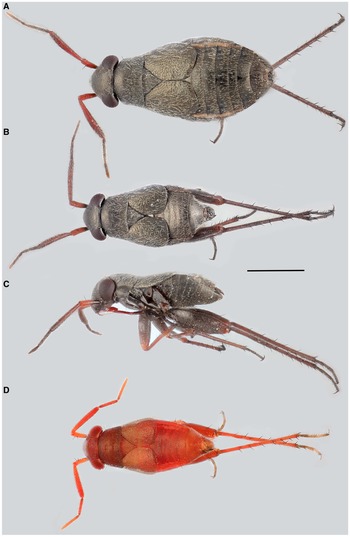
Chlamydatus ruficornis is distinguished from its North American congeners by its small size, overall dull greyish-black colouration, distinctly reddish antennae, labium, and tibiae, fusiform antennal segment 2, and typically short truncate hemelytra (Fig. 1). Schuh and Schwartz (Reference Schuh and Schwartz2005) reported the mean length of males and females as 1.79 and 2.28 mm, respectively. The dorsal vestiture is recumbent and silvery to golden. The hind femora are enlarged (Fig. 1C), and adults and instars III–V jump when disturbed, often over considerable distances. Although a few macropters are known (Schuh and Schwartz Reference Schuh and Schwartz2005), C. ruficornis is typically incapable of flight with short (ending on abdominal tergum 4), truncate wings without membranes (Fig. 1).
Adult Chlamydatus ruficornis habitus: A, dorsal female; B, dorsal male; C, lateral male; and D, teneral male. Scale bar = 1 mm.

Chlamydatus ruficornis is similar to C. wilkinsoni (Douglas and Scott), a Holarctic species indigenous to the highest latitudes and altitudes of North America (Schuh and Schwartz Reference Schuh and Schwartz2005). Both species are brachypterous, with unknown hosts, and have been captured above timberline in the Rocky Mountains. They are separated by size (C. wilkinsoni is smaller), differences in the shape of antennal segment 2 (weakly fusiform in C. ruficornis; linear in C. wilkinsoni), antennal colour (nearly black in C. wilkinsoni; distinctly reddish in C. ruficornis), and colour patterns on the legs (see Schuh and Schwartz Reference Schuh and Schwartz2005, fig. 3B–D). The vesicae are similar in both species.
The nymphs of most mirids, including C. ruficornis, have not been described (Wheeler Reference Wheeler2001), and nymphal descriptions of brachypterous Miridae are few. The European literature contains a few references for Chlamydatus nymphs, including Brown’s (Reference Brown1925) description of the fifth instar of C. evanescens (Boheman) and Cobben’s (Reference Cobben1978) illustrations of the first instars of C. evanescens and C. saltitans (Fallén). McGavin (Reference McGavin1979) described the locations of meso- and metafemoral trichobothria for the fifth instar of C. pullus (Reuter) and illustrated the fifth instars and dorsal abdominal scent gland openings of C. pullus and C. saltitans. In the sole North American reference to date, Akingbohungbe et al. (Reference Akingbohungbe, Libby and Shenefelt1973) briefly described the fifth instar and illustrated the dorsal abdominal scent gland opening of C. associatus.
Here, I report bionomic information for the poorly known mirid, C. ruficornis, documenting prostrate knotweed, Polygonum aviculare Linnaeus (Polygonaceae), as a host and noting that the temporal distribution of third instars indicates multiple generations in 2021. In Wyoming, United States of America, C. ruficornis overwinters as eggs. Of the nearly 800 adults and nymphs collected from the knotweed, only a single macropterous specimen was found, a fifth-instar nymph.
Materials and methods
The study site was a shallow drainage swale (20 × 100 m) on Rabbit Creek Ranch in the eastern foothills of the Laramie Mountain Range in northwest Platte County, Wyoming (42.21627˚, –105.22458˚; elevation 1665 m). The swale drains an open meadow, with adjacent granite outcrops covered by ponderosa pine, Pinus ponderosa P. and C. Lawson (Pinaceae), woodlands. A channel that forms downstream of the swale passes through snowberry shrubs, Symphoricarpos sp. (Caprifoliaceae), interspersed with pine trees. Cattle graze the area, and the swale and adjacent uplands are periodically mowed. Knotweed began invading the swale in 2016. By 2020, knotweed had displaced other native species and formed a monoculture.
In addition to being collected from the swale, a few adults and nymphs were collected at a gravelled ruderal site, under the drip line of a barn roof, 25 m west of the swale. Adults were also found in neighbouring Albany County (42.2012˚, –105.2969˚; elevation 1744 m) on the edge of a dirt road, about 6 km west of the Platte County study site.
I collected adults and nymphs of C. ruficornis from the swale approximately weekly from 1 July to the end of November 2021. Specimens were collected with an aspirator as I crawled across transects through the swale. Two transects were completed on each sampling date. Open areas between stems of knotweed were examined for specimens on the bare ground, with particular attention to small cracks and crevices. Each knotweed stem was then lifted, and the ground beneath examined for specimens hiding under the foliage. It took about one hour to complete a single transect through the swale. Behavioural and feeding observations were completed during the transects and from the end of August through mid-September, when late instars and adults were numerous.
The typical adult wing state in C. ruficornis is brachypterous (staphylinoid). In the present paper, nymphs that would have developed into the typical short-winged adults are referred to as brachypterous nymphs. Reference to macropterous nymphs is limited to a single fully winged fifth instar collected from the swale.
I reared nymphs to adults in small plastic containers to verify identity. Adults and nymphs were observed in captivity to determine feeding habits. Voucher specimens are deposited in the National Museum of Natural History, Smithsonian Museum (Washington, D.C., United States of America), the American Museum of Natural History (New York, New York, United States of America), the University of Wyoming Insect Museum (Laramie, Wyoming), and the Canadian National Collection of Insects and Arachnids (Ottawa, Ontario, Canada).
The number of generations, based on the temporal distribution of third-instar nymphs, was tested using the ACR approach (Ameijeiras-Alonso et al. Reference Ameijeiras-Alonso, Crujeiras and Rodriguez-Casal2019) provided in the multimode package in R and executed within RStudio (Ameijeiras-Alonso et al. Reference Ameijeiras-Alonso, Crujeiras and Rodriguez-Casal2021; R Core Team 2021; RStudio Team 2022). A logical test for the presence of multiple modes applied to a kernel density estimate of the temporal distribution of third-instar nymphs was applied using the “is.unimodal”, “is.bimodal”, and “is.trimodal” functions from the LaplacesDemon R package (Statisticat, LLC 2021).
Photographs were taken with a Dun Inc. BK Plus Lab System (Dun Inc., http://www.duninc.com/index.html) using a Canon 5DS camera (Tokyo, Japan) with 5×, 10×, and 20× LD Mitutoyo (Kanagawa, Japan) objective lenses. Measurements were taken from digital images, using scales calibrated for each lens. All measurements are in millimetres. In many nymphs, especially those about to moult, alcohol storage caused the cuticle to lift away from the body, but the raised cuticle was excluded from measurements.
Eye width and maximum number of ommatidial lenses were measured and counted, respectively, across a horizontal line drawn through the centre of the eye in a digital image. The line was placed across the horizontal row of ommatidia with the largest number of lenses. The lengths of the pronotum, mesonotum, and metanotum were measured along the midline of each segment. The combined mesonotum and wing pad length represents the midline perpendicular distance between a line drawn across the tips of the mesothoracic wing pads and the anterior margin of the mesonotum.
Results
Chlamydatus ruficornis (a third instar) was first found in the swale on 26 June 2021. A third and a fourth instar and an adult female were collected during the first weekly sample on 1 July. Adults (n = 360) were present in the swale from 1 July through November. All adults collected were brachypterous, with approximately the same number of females (n = 171) and males (n = 189). I collected nymphs (n = 412) from the swale in weekly samples from 1 July through September.
Description of adults
Although Schuh and Schwartz (Reference Schuh and Schwartz2005) presented a complete description of C. ruficornis, a few observations based on adult Wyoming specimens are worth noting. In females collected postcopulation, likely as a result of the formation of ripe eggs, the abdomen is visibly swollen and rounded, which lifts the connexivum dorsad, exposing a yellowish-brown band between the terga and adjacent laterotergites. This band is most distinct in late-season females (Fig. 1A) and sexually active males (Fig. 1B).
Teneral adults are bright red, with nearly translucent wings (Fig. 1D), and are easily spotted in the field. Even several days after the last moult, orangish-red patches are still visible on the abdomen, which is typically dull greyish black in older adults.
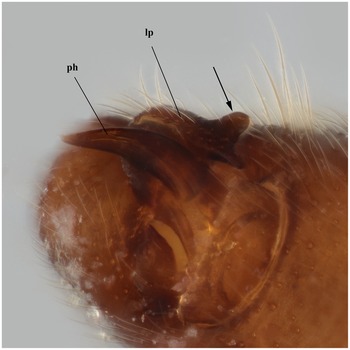
The male pygophore is shown in Figure 2. Schuh and Schwartz (Reference Schuh and Schwartz2005) described the left paramere of Chlamydatus as conventionally phyline, without distinctive structural variation. However, in the Wyoming specimens, the proximal end of the anterior process of the left paramere (Fig. 2, lp, arrow) is distinctly bifurcate. Re-examination of a paratype of C. ruficornis evaluated by Schuh and Schwartz (Reference Schuh and Schwartz2005) during their review of the genus confirmed that the left paramere of C. ruficornis is bifurcate (M.D. Schwartz, personal communication). The shape of the anterior process of the left paramere should allow C. ruficornis to be separated from its congener, C. wilkinsoni, which lacks the bifurcate proximal end (M.D. Schwartz, personal communication).
Chlamydatus ruficornis male pygophore. Arrow indicates unique bifurcation of anterior process of left paramere. Abbreviations: lp, left paramere; ph, phallotheca.

Description of nymphs
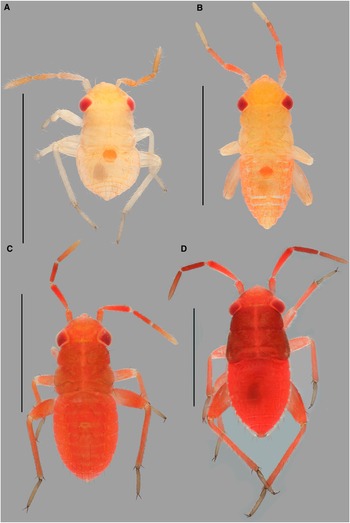
Nymphs of C. ruficornis are readily distinguished from the other hemipteran nymphs by the presence of a single dorsal abdominal scent gland opening (Figs. 3, 4) and from other mirids by the shape of the scent gland opening (Fig. 4D), the placement of meso- and metafemoral trichobothria, and the lack of metathoracic wing pads in instars IV and V. In the field, C. ruficornis nymphs were recognised by behavioural differences, including the preference of older nymphs (III–V) for small, open habitats between knotweed stems and jumping, rather than running or hiding, as their primary escape behaviour.
Dorsal habitus of instars: A, instar I; B, instar II; C, instar III; and D, instar IV. Scale bars = 1 mm.

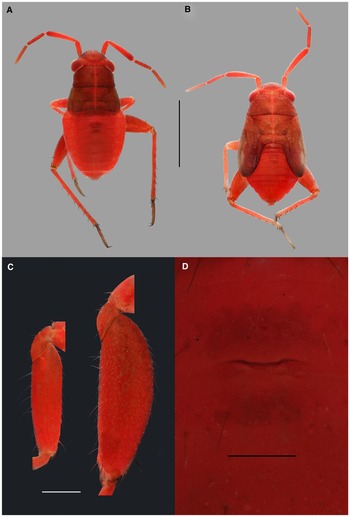
A, Instar V dorsal habitus image of brachypterous nymph; B, instar V macropterous nymph, common scale bar = 1 mm; C, instar V meso- (left) and metafemoral (right) trichobothria, scale bar = 0.2 mm; and D, instar V dorsal abdominal scent gland opening, scale bar = 0.1 mm.

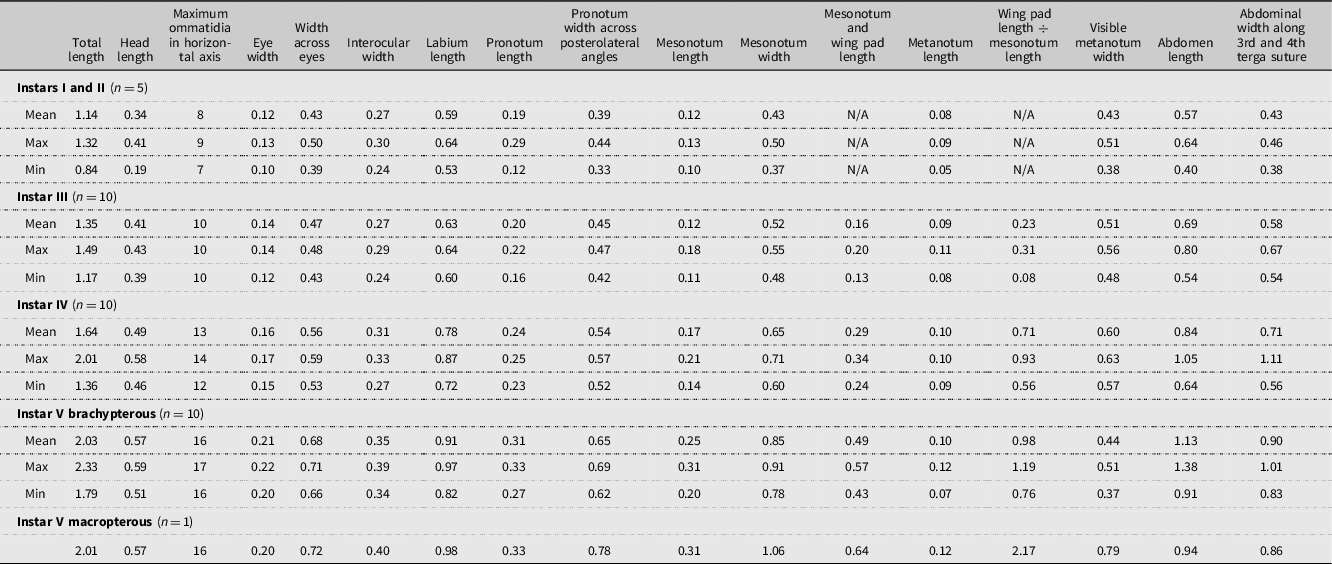
Nymphs of C. ruficornis are oblong to ovate (Figs. 3, 4) and range in length from 0.84 to 2.33 mm (Table 1). Length varies considerably within each instar, primarily due to a large variation in the lengths of the abdomen (Table 1). First and second instars are whitish yellow, with distinct red eyes and a solid orange medial spot on abdominal terga 2 and 3 (Fig. 3A, B) cephalad of the dorsal abdominal scent gland opening. The orange spot is frequently present on recently moulted third-instar nymphs but, in captivity, becomes faint or absent after a day.
Chlamydatus ruficornis nymph measurements.

Shortly after each moult, instars III–V may appear mottled yellowish orange, the mesothoracic wing pads are somewhat translucent, and the margins are difficult to observe. In captivity, older instars darkened and lost the mottled appearance in about one day. Beginning with instar III, the nymphs darken from a mottled orangish red to dark reddish brown with each successive moult. The thorax, which is concolorous with the head and abdomen in instars I and II, becomes dusky grey in instars IV and V and occasionally in instar III.
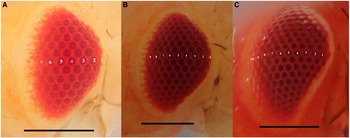
When viewed dorsally, the front of the head can appear broadly rounded or triangular (Figs. 3, 4), depending on the tilt of the head. The bright red eyes, with whitish-yellow margins, are common to all instars. The number of lenses in the longest horizontal ommatidial row increases with each moult (Table 1; Fig. 5) and can be used to determine the developmental stage of instars III–V. The ommatidial lens count (7 to 9) will likely also prove useful in separating instars I and II, but additional specimens are necessary to confirm a consistent difference in younger nymphs. The vertical lens count varies within each instar and has little value in distinguishing development stages.
Eyes of instars: A, instar I; B, instar II; and C, instar III. Number of ommatidial lenses in longest horizontal row. Scale bar = 0.1 mm.

Antennal colour varies from yellowish orange to dark red, with all or the distal half of segment 4 usually a lighter whitish yellow to yellowish brown. Antennal length varies considerably within and between instars and offers little value in distinguishing developmental stages. The legs range from translucent in younger and newly moulted instars to nearly solid red in fifth-instar nymphs. The tibiae and labial segment 4 are dusky grey (instars I–IV) to solid black (instar V). Distinct black erect tibial spines are present in instars IV and V but are translucent white to light brown in instars I–III.
In the Miridae, trichobothria are present on the meso- and metafemora and at the same locations in adults and nymphs (Schuh Reference Schuh1975). Studies by Schuh (Reference Schuh1975) and McGavin (Reference McGavin1979) suggest that trichobothria may be useful in distinguishing subfamilies among mirid nymphs. Comparing adult and nymphal trichobothrial numbers and locations may also be useful in confirming the identity of nymphs where multiple species are present in samples.
Trichobothrial numbers in the Phylini are five to six mesofemoral and seven to eight metafemoral, with trichoma present on both femora (Schuh Reference Schuh1975). Trichobothria on the ventral surface of the meso- and metafemora of a fifth instar of C. ruficornis are shown in Figure 4C. McGavin (Reference McGavin1979) reported six meso- and seven metafemoral trichobothria in C. pullus and illustrated their location. Chlamydatus ruficornis has the same number of trichobothria. The mesofemoral trichobothria in C. ruficornis (Fig. 4C) are essentially in the same locations as in C. pullus and are, with the exception of #6, of the same relative lengths. Mesofemoral trichobothria #6 in C. ruficornis appears shorter than McGavin’s (Reference McGavin1979) illustration of C. pullus. Also similar to C. pullus, all but one of the trichobothria (#7) are on the distal half of the metafemur in C. ruficornis, and #2 is located medially on the lateral surface of the femur directly dorsal of the #3 trichoma.
Mirid nymphs have a single dorsal abdominal scent gland opening that is lost in adults. The adult metathoracic scent glands are absent in nymphs. The scent gland opening and colour were the quickest and most reliable characteristics for sorting C. ruficornis nymphs from other hemipteran nymphs. Figure 4D shows the dorsal abdominal scent gland opening of a fifth-instar nymph collected from the swale. The opening consists of a long, sinuate, transverse fold that is widest in the middle and tapers to a point on both ends. Medially, the anterior margin is slightly convex, and the posterior margin is broadly concave. The gland opening is similar to the illustration of the gland opening of C. associatus (Akingbohungbe et al. Reference Akingbohungbe, Libby and Shenefelt1973), but it differs from McGavin’s (Reference McGavin1979, fig. 25, 1 and 3) illustrations of the nymphal gland openings of C. pullus and C. saltitans. In both of these species, the distal ends of the gland openings are rounded, not tapering, and the medial anterior and posterior margins overlap (C. pullus) or are coincident (C. saltitans). Given these differences, further study may demonstrate that the dorsal abdominal scent gland openings can be used to separate the nymphs of Chlamydatus congeners.
The best character for distinguishing between instars of brachypterous C. ruficornis nymphs are the mesothoracic wing pads, which develop in the same general progression as in macropterous nymphs, except that the relative length of the wing pads, when compared to the length of the abdomen, is much shorter (Fig. 4A, B). In addition, metathoracic wing pads do not develop in the brachypterous nymphs (Figs. 3C, D, 4A). The posterior margin of the metanotum in fourth and fifth instars is slightly concave, without detectable lobes on the posterolateral angles (Fig. 3D). In macropterous fourth- and fifth-instar Miridae, including C. saltitans and C. pullus (McGavin Reference McGavin1979), the metanotum is distinctly lobate with the metathoracic wing pads extending well onto the abdomen, the posterior margin of the metanotum deeply concave, and the inner margins of the metathoracic wing pads visible between the mesothoracic wing pads. The lack of metathoracic wing pads appears to occur in most brachypterous mirid nymphs, such as the sexually dimorphic Orectoderus obliquus Uhler, in which the metathoracic wing pads are undeveloped in the brachypterous female but are fully developed in the macropterous male (McIver and Stonedahl Reference McIver and Stonedahl1987).
The following key, based primarily on wing pad development, will separate the brachypterous instars.
Key to brachypterous instars of Chlamydatus ruficornis
-
1. Mesothoracic wing pads absent; abdominal spiracles not visible Instars I and II
-
–. Mesothoracic wing pads present; spiracles visible (may be faint) laterally on abdominal terga 2–8 2
-
2. Mesothoracic wing pads not extending beyond posterior margin of metanotum; combined length of mesonotum and mesothoracic wing pads less than 0.4 mm 3
-
–. Mesothoracic wing pads extending beyond posterior margin of metanotum onto abdominal tergum 2; combined length of mesonotum and mesothoracic wing pad greater than 0.4 mm Instar V
-
3. Mesothoracic wing pads consisting of short lobes, length of lobes less than half the mesonotum length, usually not extending to middle of metanotum; mesonotum and metanotum width subequal; combined length of mesonotum and mesothoracic wing pad less than 0.22 mm; 10 lenses in longest horizontal row of ommatidia Instar III
-
–. Mesothoracic wing pads longer, length about 75% of the mesonotum length, lobes extending to near posterior margin of metanotum; mesonotum wider than metanotum, covering most of metanotum lateral margins; combined length of mesonotum and mesothoracic wing pad greater than 0.22 mm; number of lenses in longest horizontal ommatidial row more than 10 Instar IV
Instars I and II
(Figs. 3A, B, 5A, B; Table 1) – brachypterous wing state.
Of the 412 nymphs collected in 2021, only five were instars I and II. Because of the small number of nymphs, I was not able to verify the consistency of characters that separate instars I and II. Therefore, for purposes of the nymphal descriptions, I have combined first and second instars into a single group.
It is difficult to distinguish instar I from instar II. Instar I appears to be smaller, but a larger number of specimens is required to confirm the difference. Instar I also appears to have fewer ommatidia (Fig. 5A, B). The longest horizontal row of ommatidia in instar I has seven lenses. In second instars, eight or nine lenses are present. However, as with the length, many more specimens are required to determine if consistent differences in ommatidial count occur between instars I and II.
Description
Mean total length (instars I and II combined) 1.14 mm (0.84–1.32 mm). Oblong, lateral margins nearly parallel. Head width across eyes less than or subequal to width of meso- and metanotum, slightly wider than width across posterolateral angles of pronotum (Table 1). Dorsum mottled, whitish yellow and orange, with distinct solid orange medial spot, about size of eye, cephalad of dorsal scent gland opening on abdominal terga 2 and 3 (Fig. 3A, B). Venter mostly pale, whitish yellow with light orange patches along lateral margins of abdomen, thorax, and buccula, and between anterior margin of eye and labium. Eyes large, bright red with dark-brown circular cones. Seven to nine lenses in the longest horizontal row of ommatidia (Fig. 5A, B). Labium extending to between meso- and metacoxae, segments 1 and 2 transparent with pinkish lateral margins, segment 3 whitish to light yellow, segment 4 darker, dusky grey. Buccula mostly pink and orange, widening distally, extending to anterior margin of prothorax. Antennae with long brown and white setae, segment 1 nearly transparent, pinkish, with two stout brown setae on inner margins, segments 2 and 3 orange, segment 4 longest, white to yellowish brown on distal half. Pronotum whitish yellow to orange, mottled, with long white to light brown erect setae on posterior and anterior margins and distinct single long erect brown setae on anterolateral angle adjacent to posterior margin of eye. Posterolateral angles rounded. Mesonotum concolorous with pronotum, with six erect long brown setae along anterior margin. Posterolateral margins rounded (Fig. 3A, B), lacking discernable wing pads. Metanotum concolorous with remainder of thorax, with row of six erect long brown setae along posterior margin. Abdominal spiracles not visible laterally on abdominal terga 2–8. Legs transparent to pinkish orange, except tarsi and claws dusky grey, concolorous with labial segment 4. Tibial spines white to light brown.
Instar III
(Figs. 3C, 5C; Table 1) – brachypterous wing state.
The third instar is distinguished from instars I and II by the presence of short but well-defined mesothoracic wing pads (Fig. 3C) and by the mesonotum and abdomen typically wider than the width across the eyes (Table 1). It can be distinguished from instar IV by its shorter mesothoracic wing pads and the exposed lateral margins of most of the metanotum. In brachypterous instar IV, the mesothoracic wing pads extend nearly to the posterior margin of the metanotum and cover most of the lateral margins of the metanotum (Fig. 3D). The mean combined length of the mesothoracic wing pads and mesonotum can be used to distinguish between instars III and IV. In instar III, the combined length ranges from 0.13 to 0.2 mm compared to from 0.24 to 0.34 mm in instar IV (Table 1). There are 10 lenses in the longest horizontal ommatidial row (Fig. 5C), compared to 12 or more in instar IV.
Description
Mean total length 1.35 mm (1.17–1.49 mm). Overall shape and colour variable, oblong to ovate, mostly orangish red to mottled yellow and orange. Width across abdomen and mesonotum typically greater than width across eyes. Medial orange spot on abdominal terga 2 and 3 faint or absent, except in recently moulted specimens. Thorax orange or brownish red, occasionally with dusky grey similar to instar IV. Venter concolorous with dorsum. Antennal segments orangish to orangish red, with distal half or nearly all of segment 4 lighter, yellowish to light brown. Segment 4 with numerous white, erect to semi-erect setae, some as long as diameter of segment. Setae of segments 2 and 3 darker, brown, less dense; many setae on segment 3 longer than diameter of segment. Pronotum width typically less than width of mesonotum (Table 1), posterior and anterior margins nearly straight. Single erect brown setae extending laterally from postero- and anterolateral angles. Mesothoracic wing pads evident but short, broadly rounded, extending over anterior margin of metanotum but usually not extending to middle of metanotum. Posterior margin of wing pads typically narrowly dusky grey with six long dark-brown erect setae. Lateral margins of metanotum mostly visible, length less than mesonotum. Posterior margin concave, typically with six long dark-brown erect setae. Abdomen length variable, light orange to darker reddish orange. Long, dark-brown erect setae in transverse rows on abdominal tergum. Legs and labium mostly orange, except dusky-grey tarsi, claws, and labial segment 4. Tibial spines whitish grey to light brown, lighter than instars IV and V.
Instar IV
(Fig. 3D; Table 1) – brachypterous wing state.
This instar is recognised by the intermediate level of mesothoracic wing pad development. In instar IV, the mesothoracic wing pads are about three times longer than in instar III and extend beyond the middle of the metanotum to near, but not usually crossing, the posterior margin of the metanotum. The wing pads extend beyond the posterior margin of the metanotum onto the abdominal terga in brachypterous instar V. The mesothoracic wing pads cover most of the lateral margin of the metanotum (Fig. 3D), and the posterior margins of the eyes are usually coincident with the anterolateral margins of the pronotum.
Description
Mean total length 1.64 mm (1.36–2.01 mm). Typically, more ovate than younger instars and darker red, with yellowish to brownish-red, dusky-grey thorax (Fig. 3D). Dorsum and venter orangish red to red. Maximum horizontal ommatidial lenses 12–14 (Table 1). Labium extending to between metacoxae, segments 1 and 2 reddish orange, segments 3 and 4 dusky grey to dark brown. Antennae orangish red to bright red, except yellowish grey along distal half of segment 4. Segments 2 and 3 with long, brown semi-erect to erect setae, segment 4 with mostly white setae. Dorsum of thorax often yellowish to brownish red (Fig. 3D), usually darker than abdomen and head. Width across eyes subequal to width across posterolateral angles of pronotum but typically less than width of mesonotum. Mesothoracic wing pads distinct, more developed and usually darker than instar III, extending to near posterior margin of metanotum. Combined length of mesonotum and wing pad almost twice length of instar III (Table 1). Posterior margin of mesonotum at midline nearly straight. Posterior margin of metanotum broadly concave with posterolateral angles only partially visible (Fig. 3D). Abdomen typically with light to distinct brownish-red bars or spots on terga 2, 3, and 4. Coxae light ferruginous with dusky-grey bands and spots on trochanters and coxae. Legs pinkish to red, except tibiae and claws brown to dusky grey. Tibial spines brown to black, darker than instar III.
Instar V
(Fig. 4A; Table 1) – brachypterous wing state.
This instar is readily recognised by the mesothoracic wing pad extending beyond the posterior margin of the metanotum onto abdominal tergum 2 or the anterior margin of tergum 3 (Fig. 4A). The lateral margins of the metanotum are completely covered by the mesothoracic wing pads, which frequently are translucent, allowing some detail of the metanotum to be viewed. The posterior margin of the metanotum is slightly concave. The last-instar nymphs are typically dark red with a contrasting darker reddish-brown thorax and yellowish to dark-red patches medially on abdominal terga 1–4. In specimens ready to moult, light ecdysial cleavage lines are distinct in this instar (Fig. 4A), including a deep crescent-shaped transverse sulcus that extends across the head, beginning at the front of each eye and curving near the middle of the anterior pronotal margin. Sex of nymphs can usually be determined at instar V. In the typically larger females, the ovipositor is usually visible through the cuticle.
Description
Mean total length 2.03 mm (1.79–2.33 mm). Ovate with abdomen usually projecting laterally well beyond thorax and eyes (Fig. 4A). Thorax dark brownish red, abdomen red. Usually brown patches between eyes and antennae. Venter more orange than the dorsum, with brown patches on laterotergites 2–4. Ommatidial lenses 16 or 17, and eye width exceeding 0.2 mm (Table 1). Labium extending to the middle of metacoxae. Antennae orangish red to red, except yellowish brown on distal half of segment 4. Pronotum width across posterolateral angles about three-quarters of the width of mesonotum and abdomen (Table 1), dark reddish brown. Posterior and anterior margins of pronotum straight. Mesothoracic wing pads long, extending beyond posterior margin of metanotum and onto abdomen, yellowish brown and somewhat translucent. Metanotum visible only between mesothoracic wing pads, posterior margin broadly concave and usually with a narrow black margin. Legs orange to red, with distinct dark spines on meso- and metatibia. Tarsi dusky grey to black, claws black, usually with white tips.
Instar V
(Fig. 4B; Table 1) – macropterous wing state.
Of the 412 nymphs collected, only one macropterous specimen could be identified (Fig. 4B). The instar V macropterous nymph is easily distinguished from the brachypterous nymphs by the presence of equally long meso- and metathoracic wing pads that extend onto abdominal tergum 6. Metathoracic wing pads are absent in the brachypterous nymphs. Total length (2.01 mm) is about the same as the mean length of brachypterous instar V nymphs, but the pronotal posterolateral angles, mesonotum, and metanotum are considerably wider in the macropterous nymph (Table 1). The number of horizontal ommatidial lenses (16) is the same as in brachypterous nymphs.
Host plant
At the three Wyoming sites in 2021, C. ruficornis was found in association with prostrate knotweed, Polygonum aviculare Linnaeus (Polygonaceae), which is also known as smartweed. Similar to the Ames, Iowa type location (Knight Reference Knight1959), C. ruficornis was absent from adjacent shrubs, grasses, and weeds.
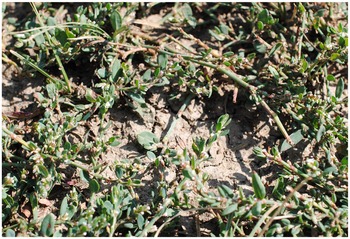
In the swale, knotweed grows as a monoculture in mats formed by overlapping and intertwined stems (Fig. 6). At the Albany County site, C. ruficornis was found in narrow bands of knotweed mats growing along the edge of a dirt road. When active, C. ruficornis adults and older nymphs (III–V) were found most often in small open areas of bare dirt between the knotweed stems. During the hottest part of the day, they retreated to shade under the knotweed stems or in small cracks in the soil.
Typical knotweed (Polygonum aviculare Linnaeus) habitat occupied by Chlamydatus ruficornis nymphs and adults.

In captivity, both adults and nymphs were observed feeding on knotweed stems. Even though inflorescences and seeds were available in rearing chambers, nymphs fed primarily on knotweed stems and only occasionally on leaves. Nymphs were successfully reared from instar III to adults solely on cuttings from the tips of knotweed stems and water.
Chlamydatus ruficornis may also be associated with black medic, Medicago lupulina Linnaeus (Fabaceae). A few adults and nymphs (n = 24) were collected at a gravelled ruderal site adjacent to the swale, under and adjacent to short mounds of black medic.
Seasonality
Adults were collected from 4 July to 29 November 2021, and nymphs were collected from 26 June to 30 September 2021. Adults were abundant during the last two weeks of September and the first week of October. Chlamydatus ruficornis declined precipitously in the swale following the first killing frost.
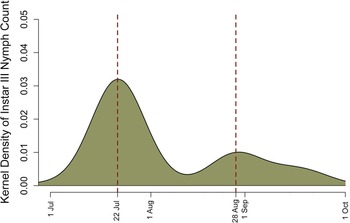
A few nymphs (n = 3) and a single adult female were collected in the first sample taken on 1 July, indicating that some eggs had hatched before the start of sampling. The first observed generation developed between mid-July and early August (Fig. 7). Of the 82 nymphs collected on 22 July, more than half (n = 46) were instar III. Between 31 July and 18 August, only two third instars were collected from the swale. The presence of a second generation was indicated in sampling that began on 24 August (Fig. 7). Third instars represented about 14% of the 300 nymphs collected between 24 August and 21 September; they were not collected after 21 September, and only fifth instars were present on 30 September.
Kernel density of instar III nymph count.

The distribution of third instars in swale samples between 1 July and 21 September (Fig. 7) indicates that C. ruficornis was bivoltine in 2021. The absence of third-instar nymphs in the mid-August samples suggests at least two distinct generations rather than continuous breeding throughout the summer and fall. The P-value for the null hypothesis that the number of generations equals “1” is less than 0.05, indicating support for multiple generations. Statistical support for the presence of two modes and no support for one or three modes indicate bivoltine generations in 2021.
Snow covered the swale at the end of October for three days, and nighttime temperatures dropped below freezing, killing most of the knotweed. In early November, when only about 10% of the knotweed still had green stems, leaves, and inflorescences, the number of C. ruficornis quickly declined. A second multiple-day freeze in mid-November killed all but a few of the remaining plants. Only a few specimens of C. ruficornis were found in the swale after the mid-November freeze. The last adult was collected on 29 November.
Repeated attempts to locate C. ruficornis in the swale during December were unsuccessful. In early December, snow drifted over the swale and partially covered the site until January. As the edges of the drift melted, sieves were used in an attempt to locate diapausing adults. Vegetation and litter were sampled sporadically over a two-week period, as weather permitted. No overwintering adults were found and, given the poor dispersal capability of the dominant brachypterous wing state, it appears that C. ruficornis overwinters only as eggs in the Laramie Range.
Potential predators
The only predators consistently observed in the swale were bigeyed bugs (Heteroptera: Geocoridae), which at times were as prevalent as C. ruficornis. Geocoris pallens Stål and G. bullatus (Say) were the most common of the predators. In the field, only a few feeding attempts on C. ruficornis nymphs by bigeyed bugs were observed, and it appeared older nymphs could easily avoid the predators by jumping. Bigeyed bugs might be more successful in attacks on younger instars. In captivity, where the opportunity for C. ruficornis to jump was constrained by the small size of the rearing chamber, bigeyed bugs frequently fed on mirid nymphs.
Discussion
Although several species of Chlamydatus are known from Wyoming (Stephens Reference Stephens1982; Henry and Wheeler Reference Henry, Wheeler, Henry and Froeschner1988; Schuh and Schwartz Reference Schuh and Schwartz2005), this is the first report of C. ruficornis. This species is likely more common than current collections suggest. Like many ground-dwelling hemipterans, its scarcity in collections probably results from a lack of collecting on the ground surface.
Current records indicate a 3000-m elevational range for C. ruficornis (from 300 m in Iowa to above 3200 m in the Sierra Blanca Mountains, New Mexico). Schuh and Schwartz (Reference Schuh and Schwartz2005) reported specimens of C. wilkinsoni from Mount Goliath (3650 m) and Rocky Mountain National Park (3200 m), Colorado, that overlap or are near the upper elevational range reported for the New Mexico alpine specimen of C. ruficornis (3250 m). In addition, a number of specimens (n = 25) in the Texas A&M University Insect Collection collected near Rand, Colorado, have been identified as C. ruficornis. These specimens were collected at an elevation less than 300 m lower and only 40 km from where the Rocky Mountain Park C. wilkinsoni specimens were found. It would be interesting to re-examine the high-altitude populations of C. ruficornis and C. wilkinsoni in Colorado and New Mexico to determine the extent, if any, of elevational overlap. Unfortunately, the five Colorado specimens of C. wilkinsoni listed by Schuh and Schwartz (Reference Schuh and Schwartz2005) are females; therefore, the proximal end of the anterior process of the left paramere (Fig. 2) cannot be used to distinguish the species.
In North America, Chlamydatus spp. are not recorded from Polygonaceae. Chlamydatus ruficornis appears to have been collected exclusively from Fabaceae (particularly Trifolium spp.) (Knight Reference Knight1959; Kelton Reference Kelton1965, Reference Kelton1980; Polhemus Reference Polhemus1994; Schuh and Schwartz Reference Schuh and Schwartz2005). Böcher (Reference Böcher1971) found C. pullus at sites with P. viviparum Linnaeus in Greenland. Göllner-Scheiding (Reference Göllner-Scheiding1972) reported collecting C. saltitans from Polygonum sp. in Germany. Woodroffe (Reference Woodroffe1955) found C. pullus associated with P. aviculare in England.
Prostrate knotweed is probably one of the most widespread weeds in the world and can quickly establish on all types of soils (Costea and Tardif Reference Costea and Tardif2005). In the Laramie Range, it is commonly found along roads and trails, at stock tanks, and at other ruderal sites. Knotweed tolerates compacted and poorly aerated soils and heavy animal and human traffic (Costea and Tardif Reference Costea and Tardif2005). Polygonum aviculare is an annual (Costea and Tardif Reference Costea and Tardif2005), with seeds that usually germinate in a single flush between March and May, although cold springs can delay germination until June (Costea and Tardif Reference Costea and Tardif2005). In the Laramie Range, seed germination varies considerably, based on spring snow levels, moisture, and temperature. Knotweed produces a persistent seed bed, is somewhat drought-tolerant (Costea and Tardif Reference Costea and Tardif2005), and in the swale, typically remains green after other native vegetation cures. In 2021, a few knotweed plants flowered in the swale into late November.
Polygonum aviculare is known to attract a variety of insects, particularly species that feed on nectar or pollen. Bugg et al. (Reference Bugg, Ehler and Wilson1987) observed 36 insect taxa, including the hemipterans Geocoris sp. (Geocoridae), Lygus sp. (Miridae), Nabis sp. (Nabidae), and Orius tristicolor (White, 1879) (Anthocoridae), feeding on knotweed inflorescence in California, United States of America. These groups (and several more) were found, often in large numbers, in the swale during the 2021 surveys. In the swale, the knotweed mats appeared to provide important habitat for several additional hemipteran nymphs, including Sphragisticus nebulosus (Fallén) and Emblethis vicarius Horvath (Heteroptera: Rhyparochromidae).
Bigeyed bugs were particularly abundant in the knotweed mats. Bugg et al. (Reference Bugg, Ehler and Wilson1987) noted that bigeyed bugs feed on nectar from P. aviculare. The presence of this supplementary food source might have reduced predation pressure on C. ruficornis. It also likely explains the presence of large numbers of bigeyed bugs in the swale.
During 2021, a few specimens of C. ruficornis (n = 24) were found outside the swale under and adjacent to short mounds of black medic. This prostrate broadleaf weed is common across southern Canada and the United States of America. Given the number of reports of C. ruficornis on Fabaceae, an association with black medic seems possible, but additional surveys will be necessary to confirm an association.
Relatively few mirids overwinter as adults (Kelton Reference Kelton1980), and Wheeler (Reference Wheeler2001) considered adult overwintering in Phylinae unusual. Chlamydatus evanescens, C. pullus, and C. pulicarius (Fallén) overwinter as adults in Germany (Siegfried and Strauss Reference Siegfried and Strauss2010), but in Greenland, C. pullus overwinters as eggs (Böcher Reference Böcher1971). Repeated attempts to locate overwintering adults in the swale were unsuccessful, indicating that C. ruficornis overwinters as eggs in southeast Wyoming.
Most Miridae have only a single summer generation (Kelton Reference Kelton1980). However, Wheeler (Reference Wheeler2001) listed numerous exceptions. Siegfried and Strauss (Reference Siegfried and Strauss2010) reported that C. pullus, C. evanescens, and C. pulicarius are bivoltine in Germany. Böcher (Reference Böcher1971) reported a single annual generation for C. pullus at several sites in Greenland, where the entire population consisted of adults by early July or early August. In the swale in 2021, two distinct generations were observed (Fig. 7), and these peaked (based on the number of third instars) on 22 July and 28 August. The P-value for a single generation in the swale in 2021 is less than 0.05. The presence of a few nymphs and a single adult female in the first sample collected during 1 July indicate some eggs hatched before sampling and that an earlier generation(s) may have been present in the swale.
Only a few first and second instars were collected from the swale in 2021. This was likely the result of focusing too much collecting and observational effort on the small open areas typically occupied by the older instars and adults. Instars I and II appear to avoid areas favoured by older instars and adults. Early instars might not be capable of jumping, which would make them more susceptible to predation and perhaps restrict them to the knotweed plants or the litter layer. Wheeler (Reference Wheeler2001) pointed out that early Miridae instars are more delicate and vulnerable and “tend to live under bud scales or within blossoms, flower clusters, and curled leaves rather than on exposed plant parts, which is typical of later instars.” McIver and Stonedahl (Reference McIver and Stonedahl1987) reported that early instars of the myrmecomorphic phyline Orectoderus obliquus remain in dense, matted foliage of the host plant, making them difficult to collect. Similarly to the present study, because they faced a lack of first and second instars, McIver and Stonedahl (Reference McIver and Stonedahl1987) were unable to describe the early instars of O. obliquus.
Although a few macropterous adults are known, both sexes of C. ruficornis are typically flightless (Schuh and Schwartz Reference Schuh and Schwartz2005), which is unusual among the Miridae. Where brachyptery occurs in mirids, usually the female is flightless and the male is winged (Wheeler Reference Wheeler2001). No macropterous adults, male or female, were collected from the swale in 2021. Brachypterous adults totalled 360. It might be argued that winged adults were able to flee in advance of my collection efforts, which were admittedly focused on the ground surface and beneath knotweed stems. However, if a higher percentage of macropterous adults was present in the adult population but eluded capture, then macropterous fifth instars should have been more common. I observed only one macropterous fifth instar, compared to a total of 171 brachypterous fifth instars. The low percentage of macropterous fifth instars found during the present study (> 0.6%) suggests that their actual numbers were quite small.
A high proportion of brachyptery is often associated with persistent habitat (Wheeler Reference Wheeler2001). However, knotweed invasion of the swale did not begin until 2016, and the monoculture developed only a year or two before 2021. During this five-year period, the swale has experienced rapid succession from native grasses to a knotweed monoculture. Over the next few years, the swale will be monitored to determine whether C. ruficornis persists in the knotweed monoculture and if the proportion of winged morphs changes over time.
Acknowledgements
The author is grateful for Michael Schwartz’s (American Museum of Natural History) assistance in comparing the left paramere of Wyoming specimens with specimens used by Schuh and Schwartz (Reference Schuh and Schwartz2005) in their review of the genus and in providing helpful comments on the first draft of the manuscript. Al Wheeler (Clemson University) answered several questions, provided an obscure paper that was critical to completing this manuscript, and provided comments on an early draft. Paige Copenhaver-Parry (Wyoming Natural Diversity Database) conducted the statistical tests for the presence of multiple generations in the temporal distribution of third-instar nymphs. Three anonymous reviewers provided comments that improved the quality of the manuscript.