INTRODUCTION
Chronic disabling or life-threatening illnesses are becoming more prevalent as the world population grows older and as unhealthy lifestyle habits increase globally (Wagner & Brath, Reference Wagner and Brath2012). Noncommunicable diseases (NCDs, including cardiovascular and pulmonary diseases, diabetes, cancer, among others) account for about 60% of all deaths worldwide, while 80% of chronic-disease deaths occur in low- and middle-income countries (Daar et al., Reference Daar, Singer and Persad2007). More than 40 million people with NCDs and other communicable chronic life-limiting diseases (e.g., HIV/AIDS) require complementary palliative care every year in order to alleviate uncontrolled symptoms and problems of a physical, psychosocial, and spiritual nature (World Health Association, 2014). These conditions lead to great suffering, which not only relates to the disease itself but also to a variety of factors, particularly among vulnerable populations, increasing the burden of being ill. Consequently, suffering detection and relief are at the heart of palliative care in this population.
A prior systematic review conducted by Krikorian et al. (Reference Krikorian, Limonero and Corey2013a ) sought to identify, describe, and discuss the psychometric properties of instruments developed to assess suffering in palliative care. However, the focus of the present paper is to further describe the content of the strategies that aid in detecting and assessing the suffering experience in patients with chronic illnesses and/or in palliative care settings, as well as the dilemmas commonly encountered regarding the available assessment measures.
CONCEPTUALIZATION OF SUFFERING
The word “suffering” is commonly used in the health science literature. A quick search in a health literature engine might yield over 100.000 results. However, the scientific study of suffering within the health field is surprisingly recent. While in the 1960s Dame Cicely Saunders introduced the term “total pain,” it was not until the 1980s that Cassell decided to dedicate efforts to the conceptualization and assessment of suffering (Krikorian & Limonero, Reference Krikorian and Limonero2012). Saunders and Baines (Reference Saunders and Baines1983) described an integrated, multidimensional experience including physical, psychological, social, and spiritual aspects that contrasted with the limited consideration of pain as a physiological response that was held for many at the time. Her work—along with that of Bonica, Melzack, Wall, Fordyce, and others—prepared the ground for a more comprehensive understanding of symptoms and diseases experienced by patients (Krikorian & Limonero, Reference Krikorian and Limonero2012).
Cassell defined suffering as “a specific state of severe distress associated with events that threaten the intactness of a person” (Reference Cassell1991, p. 33). It is personal, individual, and subjective in nature, affecting all dimensions of the person. Therefore, it cannot be experienced by the body alone. More recently, in an effort to contribute to our understanding of the experience, suffering was conceptualized as a multidimensional and dynamic experience of severe stress. This experience occurs when there is a significant threat to the whole person and where regulatory processes (biological, psychological, spiritual) that would normally enable adaptation are insufficient, leading to exhaustion (Krikorian & Limonero, Reference Krikorian and Limonero2012).
Others offer broader definitions in which suffering is considered a subjective experience nested in social and cultural contexts of an event interpreted as painful or damaging (Le Breton, Reference Le Breton1999), and where suffering is conceived as a social experience resulting from such power imbalances as inequality, poverty, and insecurity related to political, economic, and institutional reciprocal forces and influences (Darby, Reference Darby2006). In this sense, members of a group or community agree to perceive certain phenomena as painful or damaging to their integrity (Vargas et al., Reference Vargas, Vélez and Krikorian2008). Anderson, in order to account for experiences of suffering beyond healthcare settings, provides a more simple definition: “distress resulting from threat, major loss, or damage to one's body and/or self-identity” (Anderson, Reference Anderson2014).
Although relief from suffering is essential in healthcare and palliative care, particularly regarding patients with chronic, deteriorating conditions such as NTDs, little research has been directly aimed at defining, operationalizing, and developing standards for suffering detection, assessment, and relief. In order to enhance the efforts to explore and identify factors that contribute to suffering (Kahn & Steeves, Reference Kahn and Steeves1995; Dildy, Reference Dildy1996; Sherman, Reference Sherman1998; Black & Rubinstein, Reference Black and Rubinstein2004; Wilson et al., Reference Wilson, Chochinov and McPherson2007; Blume et al., Reference Blume, Balkin and Aiyagari2014), more attention needs to be paid on studying the means to assess and measure it in palliative care and other health settings (Krikorian et al., Reference Krikorian, Limonero and Román2013a ).
ASSESSMENT OF SUFFERING
Making a diagnosis of suffering means first of all maintaining a high index of suspicion in the presence of serious disease and obviously distressing symptoms. As a start, it means asking whether the patient is suffering and why. Even though patients often do not know that they are suffering, they must be questioned directly: “Are you suffering?” (Cassell, Reference Cassell1991, p. 532)
Assessing suffering is a challenging task—not only because it is a complex experience in itself, but also because it is not always obvious to the health professional that the patient is suffering. Regarding patients, those who are gravely ill may have conditions that affect verbal communication; denial might hamper their expression of emotions or concerns; uncontrolled symptoms in a determined dimension may block the identification or expression of problems in other dimensions; the mere recognition of suffering may be energy consuming for patients in a frail condition. Barriers associated with health system procedures also exist: time limitations, referrals from one professional to another, and fragmentation of care, among others. These factors may impose difficulties when establishing a therapeutic relationship, when conducting follow-ups, or when communicating with patients and families about sensitive matters.
Suffering is a dynamic experience in which contributing factors may lightly or radically change over time. Continued follow-up and assessment of the experience is thus essential. As well, many factors may interact to shape a single, integrated experience. Thus, rather than going over a list of possible contributing factors with each patient (a time- and effort-consuming task), suffering assessments should be directed at understanding the specific contributors of suffering in each patient and what weight they bring to bear in this comprehensive experience. Furthermore, given that the objective of palliative care and other types of interventions is directed at relief from suffering, it should follow that their effectiveness should be measured in terms of actual alleviation of suffering.
SUFFERING ASSESSMENT MEASURES
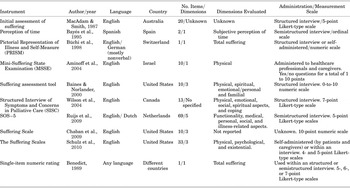
Over the past decades, a number of suffering assessment measures have been developed in healthcare or palliative care settings in order to aid in the difficult task of detecting when a patient is suffering and identifying why this is occurring. Krikorian et al. (Reference Krikorian, Limonero and Corey2013a ) conducted a systematic review of suffering-assessment instruments employed in the context of palliative care and found 10 different strategies (see Table 1); their psychometric quality was also examined and described. A further discussion regarding their content is provided herein.
Available instruments to assess suffering

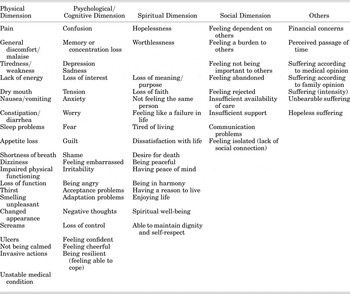
Most of the instruments identified consist of a series of questions examining factors associated with suffering in different dimensions. Their presence and frequency are evaluated using Likert-type scales or 0-to-10 numeric scales, either in a self-administrated format or a structured interview. Common physical symptoms are examined (e.g., pain, weakness, loss of appetite) as well as psychological or emotional (e.g., feeling depressed or anxious) and spiritual aspects (e.g., hopelessness, loneliness, worthlessness). For some, family, social, and environmental matters are also included (e.g., feeling a burden to others, financial strains). Table 2 lists the common factors included in the instruments for more detailed examination.
Aspects generally included in the instruments used to assess suffering

Surprisingly, only a few instruments include items that directly ask about the suffering experience—State of Suffering (SOS–5) and the Structured Interview of Symptoms and Concerns (SISC):
SOS–5:
How severe is your suffering overall?
How unbearable is your suffering overall?
How hopeless is your suffering overall?
SISC:
In an overall, general sense, do you feel that you are suffering?
How bad does it get?
Is it a problem for you?
The single-item numeric rating is also an example of direct exploration of level of suffering, consisting, however, of a one-dimensional assessment strategy. Other single-item instruments that employ nondirective strategies are: the Perception of Time (POT) (Bayés et al., Reference Bayés, Limonero and Barreto1997) and the Pictorial Representation of Illness and Self-Measure (PRISM) (Büchi et al. (Reference Büchi, Sensky and Sharpe1998). While the POT employs a verbal cue to indirectly assess suffering (how long has the patient perceived the passage of time), the PRISM uses a graphic, nonverbal strategy where the patient points out how much the illness (or aspects of it) have had an impact on the self.
Some of the instruments also include the caregiver's perceptions of a patient's suffering. For example, the Suffering Scales (Schulz et al., Reference Schulz, Monin and Czaja2010) include a separate scale for caregivers where they are asked questions about whether the patient they are caring for is suffering, how easy it is for them realize this, and if they feel they can help lessen this suffering, among others. Two items of the Mini-Suffering State Examination (MSSE) (Aminoff et al., Reference Aminoff, Purits and Noy2004) rely on the caregiver's and health professional's perceptions of a patient's suffering.
Although social aspects are relevant to suffering assessment, few instruments take them into account. The SISC, SOS–5, and the Suffering Scales include such interpersonal matters as social connection, communication, and sense of burden (e.g., SISC: “Are you feeling left out or abandoned?” “Are you able to talk openly to your family and friends?” “Do you feel that you have become a physical or emotional burden for your family?”; SOS–5: “Unsatisfactory contact with family, friends, and those who are nearby”; Suffering Scales: “Feeling abandoned,” “Feeling rejected”).
The interpersonal and social consequences of suffering are usually considered in a linear mode: the suffering of the patient and the caregiver are assessed and considered separately. However, the bidirectional influences of suffering and how both the patient's and caregiver's suffering can be mutually amplified should be considered. Sherman (Reference Sherman1998) proposed a dyadic perspective on suffering and introduced the concept of reciprocal suffering, referring to the inextricable interrelatedness of the suffering experience in patients and caregivers, a type of social suffering that is not currently considered in assessment instruments.
QUALITY OF THE MEASURES
Assessment measures are designed to accurately measure behaviors that reflect attitudes, emotions, beliefs, and experiences in a standardized manner. They should also be able to measure subjective elements or concepts in a consistent and valid manner during a specified period of time (Gregory, Reference Gregory2012). Regarding validity, an instrument should reflect the theoretical construct of what it intends to measure. The items of the instrument are supposed to be comprehensive and include all aspects of the domain (content validity). The results of an assessment must also relate to measures of similar constructs and differ from opposing ones (construct validity) (Bot et al, Reference Bot, Terwee, van der Windt, Ader and Mellenbergh2003).
When it comes to assessing suffering, an initial dilemma is encountered. Even though several definitions of suffering have been offered (Fordyce, Reference Fordyce1988; Cassell, Reference Cassell1991; Reference Cassell1999; Bayés et al., Reference Bayés, Arranz and Barbero1996; Loeser & Melzack, Reference Loeser and Melzack1999; Chapman & Gavrin, Reference Chapman and Gavrin1999; van Hooft, Reference van Hooft2000; Krikorian & Limonero, Reference Krikorian and Limonero2012), few attempts at developing theoretical models exist (Kahn & Steeves, Reference Kahn and Steeves1995; Dildy; Reference Dildy1996; Bayés et al., Reference Bayés, Arranz and Barbero1996; Reeve et al., Reference Reeve, Lloyd-Williams and Payne2009; Krikorian & Limonero, Reference Krikorian and Limonero2012). To date, only one proposed model has undergone empirical validation (Krikorian et al., Reference Krikorian, Limonero and Román2013b ). Thus, suffering is still a construct under development, and ongoing efforts toward clarifying this concept are required. Moreover, when developing a suffering assessment measure or using one already developed, a coherent theoretical background should be presented.
Concerning administration issues, measures should be not only easy to administer and understandable for the patient in his/her cultural context, but also simple and fast. These aspects are crucial when assessing suffering due to the particular conditions patients are experiencing. Patients with life-limiting conditions are usually polysymptomatic, feel weak, and have little time on their hands. Consequently, assessment of suffering should not constitute an additional burden but a means to lessen it. It should as well be a practical tool for the clinician. In this sense, assessment strategies that have a therapeutic impact or guide clinical decisions are preferred. Early detection and assessment of suffering is supposed to be followed by implementation of particular standards of care intended at relieving suffering. Strategies designed to prevent suffering in a particular patient and in others need to be developed. Furthermore, follow-up assessments should be implemented in order to provide feedback on the effectiveness of interventions.
The use of multisource information is recommended: for example, objective data from clinical charts and the perception of formal and informal caregivers beyond the patient's perception. It not only offers a more global view of the patient's context, but increases the validity of the measure and provides a more accurate means for assessing suffering.
The conceptualization, assessment, and management of pain may serve as an example of the former. The International Association for the Study of Pain (Merskey & Bogduk, Reference Merskey and Bogduk1994) provided a clear definition of pain coherent with current models to explain the pain experience (see Melzack, Reference Melzack2000). Visual analog and numeric rating scales have been developed for pain assessment, and their psychometric quality in different patient populations has been examined (Flaherty, Reference Flaherty1996). The World Health Organization (1986) developed a model for pain relief known as the “analgesic ladder,” which has been implemented as part of patient care (e.g., the “Toward a Pain-Free Hospital” initiative, Besner & Rapin, Reference Besner and Rapin1993). This efficacy of this model has been investigated (see Azevedo São Leão Ferreira et al., Reference Azevedo São Leão Ferreira, Kimura and Jacobsen Teixeira2006).
A second dilemma in relation to suffering assessment deals with the coherence between the conceptual framework and the measure used to assess suffering. In some cases, the measure is coherent with the available theoretical framework. For instance, the PRISM (Büchi & Sensky, Reference Büchi and Sensky1999) is a nondirective, nonverbal, and integrated assessment of the suffering experience. It utilizes a graphic representation of the patient's illness in relation to the self in order to quantitatively measure a person's perception of the intrusiveness of an illness. This is consistent with the conceptualization of suffering as a personal experience of threat to integrity and has been shown to correlate with factors likely to influence personal constructs (Sensky, Reference Sensky2010).
Other measures, on the other hand, lack a sound theoretical background or show inconsistencies between the theoretical construct and how they are assessed. As an example of the first case, Bayés et al. (Reference Bayés, Limonero and Barreto1997) developed an instrument they called the “Perception of Time,” according to which time is perceived as passing more slowly when the patient suffers. In order to screen for suffering, they developed an instrument where patients were asked such questions as “How long did yesterday seemed to you? What would you say? Short, long, neither?” Most of their patients who reported feeling very bad, bad, or fair indicated perceiving time as passing more slowly. However, judgments on perceived passage of time have also been found to be influenced by such external factors as segmentation of events into discrete units and consumption of alcohol (Ogden et al., Reference Ogden, Wearden and Gallagher2011; Liverence & Scholl, Reference Liverence and Scholl2012), not specifically related to suffering.
In the second case, some measures show inconsistencies in terms of theoretical background. Suffering is generally conceived as a subjective experience of severe stress and threat to a person's integrity. As such, it must be assessed using the subjective perception of the individual and not only attending to the objective aspects of the experience. Aminoff and colleagues (Reference Aminoff, Purits and Noy2004) developed the Mini-Suffering State Examination (MSSE) in order to assess suffering in patients with advanced dementia incapable of verbal communication. It consists of a 10-item scale including the patient's characteristics and the perception of their condition by the medical staff and family. According to this instrument, the presence of agitation, screaming, facial expressions of pain, ulcers, malnutrition, and other objective signs, as well as the perception of the family and the healthcare professionals of the patient's suffering, are considered indicative of a patient's actual suffering. Although it is a useful tool for assessing the condition of a patient and his/her deteriorating health status and to identify potential sources of suffering, it is not actually aimed at examining a subjective construct that requires the personal expression of a private experience.
As stated above, suffering-assessment instruments are intended to help relieve suffering and thus should not constitute a burden for the patient. The third dilemma deals with practical issues such as the length of the measure, its potential intrusiveness, and the need to rely on verbal expression (oral or written). Time-consuming instruments may be difficult to complete when patients have debilitating conditions. In such a case, the assessment procedure in itself may become an additional source of suffering. Consequently, the length of the instrument should conform to the needs of gravely ill populations. In the context of requests to hasten death, the SOS–5 instrument was developed specifically to detect unbearable suffering (Ruijs et al., Reference Ruijs, Onwuteaka-Philipsen and van der Wal2009). The authors dedicated their efforts to first define the concept of unbearable suffering and then describe a framework in which items were to be identified and selected. The framework consisted of five domains: medical signs and symptoms; loss of function; personal aspects; aspects of environment and nature; and disease prognosis. Sources of suffering in each domain were selected using a prior literature search, and the instrument was designed to measure not only the presence of the problem but also how unbearable it was for the patient. Moreover, open questions were included at the end of the interview that addressed the capacity to bear suffering, the role of spirituality, the influence of previous experiences, and any unexpected positive consequences of the disease. The instrument examined 69 aspects, and the time required to complete the interview was between 60 and 75 minutes. The instrument showed adequate content and construct validity and was psychometrically sound in many respects. However, the length of the interview constituted its major limitation, bearing in mind that its focus is on detection of unbearable suffering. Most people who consider hastening their death have uncontrolled symptoms, depression, and hopelessness (Breitbart et al., Reference Breitbart, Rosenfeld and Pessin2000), so that an instrument capable of detecting suffering and its sources in a practical, sensitive, and timely fashion would be ideal for both the patient and the health team.
Single-item measures have become increasingly popular in healthcare settings, particularly for screening purposes or when multiple-item instruments are not suitable due to time and resources limitations. Chochinov et al. (Reference Chochinov, Wilson and Enns1997) compared the performance of different measures to screen for depression in the terminally ill and found that a single measure asking “Are you depressed?” was more valid than multiitem instruments and visual analog scales. The Distress Thermometer is another example of a valid and reliable single-item tool to measure distress in cancer settings (Snowden et al., Reference Snowden, White and Christie2011). Regarding quality-of-life measures, Cunny and Perri (Reference Cunny and Perri III1991) found that a single item extracted from the short-form General Health Survey of the Medical Outcomes Study positively and significantly correlated with overall score. Finally, single-item measures may be useful for research in palliative care, where small sample sizes are more common.
Finally, a fourth dilemma deals with the psychometric adequacy of instruments. Not only should an instrument measure what it is intended to be measured, but it should do so in a valid and reliable manner in order to be useful for both clinical and research purposes. The Scientific Advisory Committee of the Medical Outcomes Trust (1994) developed a list of attributes necessary for an instrument to be considered of high quality:
-
1. conceptual and measurement model
-
2. reliability
-
3. validity
-
4. responsiveness
-
5. interpretability
-
6. respondent and administrative burden
-
7. alternative forms
-
8. cultural and language adaptations
Following these recommendations and the report by Lohr et al. (Reference Lohr, Aaronson and Alonso1996), a checklist to test for psychometric quality was developed in order to examine the quality of assessment instruments (see Bot et al., Reference Bot, Terwee, van der Windt, Ader and Mellenbergh2003). The quality and usefulness of some suffering-assessment instruments have been examined (for a complete review of the psychometric quality of suffering-assessment instruments, see Krikorian et al., Reference Krikorian, Limonero and Corey2013a ).When suffering-assessment instruments were tested against these criteria, two instruments were found to have the strongest psychometric quality: the PRISM and the SISC. Both tested positive for 9 of 12 items included in the checklist: ease of scoring, readability and comprehensibility, content and construct validity, floor and ceiling effects, test–retest reliability, agreement, responsiveness, and interpretability. For many, however, there was insufficient or no information available on such aspects as content validity, internal consistency, test–retest reliability, floor and ceiling effects, and agreement and responsiveness; and for none was a statistically significant difference calculated.
Although a number of assessment measures are now available for use in the palliative care setting that employ different and innovative approaches to assessment, many are yet to be examined and validated in different contexts, so that they cannot be considered high-quality tools for suffering detection and assessment of intervention results.
CONCLUSIONS
Though we have made much progress, there is still a great deal of work to be done toward optimal suffering detection, assessment, and relief in patients with both communicable and noncommunicable chronic life-limiting diseases. A more robust theoretical background is needed, as well as supporting empirical evidence. Further examination of the psychometric characteristics of most suffering-assessment instruments is still to be done. Testing these instruments in different patient populations and cultural contexts is recommended as a means to identify sensitive and practical ways for early detection and assessment of the suffering experience and a way to determine the effectiveness of the means provided to alleviate it.