The humanitarian sector has grown dramatically since the end of the Cold War; there are now more non-governmental organisations (NGOs) operating with more resources and visibility than ever before. At the same time, the humanitarian enterprise has faced a commensurate amount of attention to and criticism of its weaknesses – a lack of demonstrable impacts, low levels of professionalism, and poor coordination, among others. Following a series of high-profile humanitarian crises including the international intervention in response to the 1984 Ethiopian famine, humanitarian organisations came to the realisation that the piecemeal, uncoordinated way of delivering humanitarian aid was not making any strides in extinguishing human suffering. Interventions in the 1990s, particularly in response to the genocide in Rwanda, further compounded this perception that the humanitarian community needed to start working together in a coordinated fashion to ensure that it could effectively deliver services in a way that reinforced collective commitments to accountability.Footnote 1
Humanitarian organisations increasingly recognise that improving humanitarian responses requires shared responsibility with collective commitments to accountability. Since the 1990s, NGOs have established shared principles and standards to improve the quality of their performance and their collective accountability. The One World Trust database profiles over 350 civil society self-regulatory initiatives, 56 of which are transnational codes of conduct and standard-setting programs for NGOs.Footnote 2 The database lists 14 different transnational self-regulatory initiatives for the humanitarian sector alone.
Accountability includes the processes and practices through which an actor reports on and answers for its conduct to those parties whom it affects.Footnote 3 Accountability is typically considered a feature of democratic governments, however the rise of global actors who exercise private authority but provide public goods has led to increased scholarship on the meaning and form of global accountability.Footnote 4 The literature on NGO accountability tends to focus on organisational-level relationships between NGOs and their funders, their members, or their staff rather than on inter-organisational, collective accountability systems. Mary Kay Gugerty and Aseem Prakash’s groundbreaking volume on accountability clubs is an exception that draws on the principal-agent approach to conceptualise collective accountability as ‘clubs’, rule-based institutions that create benefits shared by members.Footnote 5 Accountability clubs are premised on predetermined accountability standards designed to enhance the donor-NGO accountability relationship. Yet, accountability relationships in the global realm are multidirectional and complex and in self-regulatory systems, NGOs must agree on and recognise standards for behaviour. The standard definition process is highly political, but critical to successfully coordinating collective behaviour and eliciting compliance. How do humanitarian NGOs define and institutionalise principles and standards for global accountability?
This article process-traces the case of the Humanitarian Accountability Partnership-International (HAP-I) and its HAP Standard to develop an understanding of how NGOs define collective rules, practices, and norms to self-regulate global accountability. HAP-I is a self-regulatory, membership-based organisation where members agree to abide by the HAP standard – seven principles that elaborate the political and civil rights that aid beneficiaries can claim against NGOs. HAP-I is currently the most institutionalised self-regulatory accountability mechanism in the humanitarian sector and also the successor to the failed Humanitarian Assistance Ombudsman (HAO), which was designed to police NGO accountability. Process tracing enables within-case analysis to determine the processes through which NGOs successfully developed self-regulatory standards. To trace the processes that created HAP-I, I employ grounded theory methodology to inform a qualitative analysis of its extensive on-line archives and secondary source material. The article also draws on 51 semi-structured interviews with NGO staff, and official aid agency and foundation programme officers; interviewees were either instrumental in shaping the early debates on accountability and/or the administrators of the collective accountability standards.
To preview this article’s main conclusions, I show the limitations of traditional representative and principal-agent models of NGO accountability when applied to the global inter-organisational realm and argue that mutual accountability better conceptualises these relationships. Mutual accountability is generated by shared values and visions that create shared identities and foster relationships of mutual trust.Footnote 6 I then propose the concept of Global Accountability Communities (GACs) to show how mutual accountability is institutionalised in the global realm. GACs are groups of organisations that view accountability as a practice that is defined by community members through social learning processes that create shared social identities, build trust, and foster mutual accountability. GACs both regulate the behaviour of members and constitute their social identities, interests, and practices. The process-tracing data shows that HAP-I both advances standards to regulate the behaviour of humanitarian organisations and also constitutes the preferences and practices of these organisations to be more accountable to the beneficiaries of humanitarian aid – the group that has the least control over the organisations. Changes in the accountability practices of donor groups provide evidence for the constitutive effects of GACs and challenge traditional notions of NGO accountability as principal-agent relationships where salient donors impose financial and legal accountability standards upon NGOs.
Literature overview
This section begins by defining what NGO accountability means in the global system. While multiple models of accountability exist, this section focuses on the three most expansive categories, contrasting classic definitions of representative and principal-agent accountability with mutual accountability. The former identify unidirectional, often hierarchical relationships where standards and expectations for performance are predetermined and imposed onto NGOs, while the latter articulates a dynamic approach that conceptualises multiparty accountability relationships. The section then briefly considers why NGOs might address accountability, reviewing factors that led to NGO self-regulation. Finally, the section discusses scholarship that sheds light on collective accountability institutions and introduces the concept of global accountability communities (GACs).
What is accountability?
At its core, accountability refers to a process by which individuals or institutions answer for their actions and the consequences that follow from them. Accountability is a relational concept; it refers to the expectation that an actor reports on its performance to its stakeholders. Traditional approaches to NGO accountability focus on a small group of stakeholders whose legal or financial powers grant a formal authority over the organisation. Michael Edwards and David Hulme suggest that ‘accountability is generally defined as the means by which individuals and organizations report to a recognized authority, or authorities, and are held responsible for their actions’.Footnote 7 Similarly, Ruth W. Grant and Robert O. Keohane state: ‘Accountability … implies that some actors have the right to hold other actors to a set of standards, to judge whether they have fulfilled their responsibilities in light of these standards and to impose sanctions if they determine that these responsibilities have not been met.’Footnote 8 In this view, accountability is a reactive and punitive process where an authority evaluates the performance, outcomes, outputs, or actions taken by an organisation and imposes sanctions if dissatisfied with the results.Footnote 9
Traditional models of accountability fall into two broad categories: representative and principal-agent. Representative accountability, or what has also been called political/democratic accountability, is rooted in the democratic ideal that elected representatives are answerable to their constituents for carrying out their mandates and adhering to legal standards.Footnote 10 Constituents sanction poor performance or wrongdoing by voting elected officials out of office, which again reflects a reactive and punitive approach to accountability. In the global realm, the absence of a world government to establish legal rules and procedures means that the representative accountability of NGOs is diffuse. Global governance institutions suffer from a democratic deficit in that they do supply or increase representative accountability to global citizens.Footnote 11
Given the deficits of representative models in the global realm, scholars then turn to the Principal-Agent (PA) approach to conceptualise accountability relationships. Under New Public Management (NPM) – a market-driven model, which directs states to outsource the provision of public services to private and voluntary organisations that compete for consumers – NGOs are considered the contractors of states.Footnote 12 PA views NGOs as agents who perform tasks to remedy government and market failures, for principals (funders, government agencies, international organisations, etc.).Footnote 13 Principal-agent accountability focuses on motivating agents to achieve the goals of their principals by designing mechanisms to constrain agents’ self-interested behaviour and limit information asymmetries.Footnote 14 NPM advances mechanisms such as evaluations, ratings, and audits to provide consumers with the necessary information to evaluate the efficiency and effectiveness of services rendered and to hold service providers accountable.Footnote 15
In both representative and principal-agent models, recognised authorities evaluate the performance of representatives or agents and have the ability to sanction them if necessary. When applied to the global arena, two problems arise with these traditional conceptualisations: first, they limit the types of accountability relationships under consideration because they adopt the vantage point of one organisation and its interactions with its stakeholders.Footnote 16 In the global realm, NGOs often collaborate with other actors to acquire resources and leverage; these multiparty configurations involve manifold poorly defined relationships that create multiple accountabilities.Footnote 17 Second, these traditional conceptualisations obfuscate the question of power; the principal has the power and capability to sanction a non-compliant, misbehaving, or underperforming actor and the agents accept this authority.Footnote 18 Particularly in the global arena, those affected by humanitarian crises – whether populations or governments – in the global South may not have the power to hold NGOs or donors from the global North to account. To talk of accountability in the global realm, thus requires first identifying ways to depict complex and multifaceted accountability mechanisms and processes.
Given these critiques, scholars of international NGOs have begun work on more dynamic models of accountability firmly located on the inter-organisational not organisational level.Footnote 19 L. David Brown proposes the concept of mutual accountability: ‘accountability among autonomous actors that is grounded in shared values and visions and in relationships of mutual trust and influence’.Footnote 20 Mutual accountability views accountability relationships as fundamentally contested where ‘actors with different analyses and interests struggle over the definitions of the problems involved, the desirability of different standards, and the nature of acceptable processes for establishing and enforcing them’.Footnote 21 This process of negotiating shared values and visions fosters a bond among members, creates shared social identities, and builds trust.Footnote 22 Actors comply with the requirements of mutual accountability out of a felt responsibility to themselves and others rather than in response to legal obligation.Footnote 23 Sanctions for violating the compact are reputational and relationship-based, including a loss of valued relationships and a decline in social status.Footnote 24
Why accountability?
The purpose of this article is to create an understanding of how NGOs define and institutionalise principles and standards for global accountability, not why they might initiate such efforts, which has been amply investigated elsewhere.Footnote 25 This section briefly examines the question of ‘why accountability?’ to the extent that the reasons for addressing accountability might inform and impact how NGOs define and institutionalise accountability at the global level. At the organisational level, attention to or demands for improved NGO accountability might originate from key stakeholder groups. Calls for accountability often follow scandals and evidence of NGO mismanagement and misappropriation, which diminish public trust in NGOs, undermine their credibility and reduce their ability to raise funds.Footnote 26 After Rwanda, donors demanded accountability from NGOs in light of evidence of ineffectiveness, inefficiency, shirking, or mission drift.
At the inter-organisational level, various developments and industry pressures created a demand for NGO accountability as well. Following the end of the Cold War, increased demand for humanitarian activities and the subsequent influx of financial resources for humanitarian relief led to the unprecedented expansion of the sector and the proliferation of inexperienced and unprofessional groups.Footnote 27 This proliferation of new humanitarian groups coupled with a series of problematic emergency relief operations, particularly in Ethiopia, Somalia, and Rwanda, drew attention to NGO accountability and the lack of professional standards. Some NGOs developed industry-wide standards to differentiate themselves from low-quality organisations.Footnote 28 Hostile political environments also engendered collective action as NGOs developed accountability standards to undermine and stymie state efforts to heavily regulate the sector.Footnote 29
Finally, the rise of the rights-based approach (RBA) to development and governance also created a normative demand for and attention to NGO accountability. An important departure from the NPM approach to accountability, the RBA ‘sets the achievement of human rights as an objective of development’.Footnote 30 Based on the Universal Declaration of Human Rights and its associated conventions, it emphasises the universality, indivisibility, and interdependence of all rights, and advances principles of good governance including participation, empowerment, inclusion, rule of law and accountability.Footnote 31
The purported value of RBA, is the belief that it will enhance accountability and reduce power differentials throughout the global development sector.Footnote 32 For citizens in weak or undemocratic states, the RBA supplies the language and tools to demand accountability from their leaders. Furthermore, the RBA also expands the notion of accountability beyond states to non-state actors whose actions have an impact on the rights of people.Footnote 33 Sceptics of the RBA argue that it is little more than a fad or discursive shift whose potential is limited by the very real power inequities that exist in the international system.Footnote 34 Crisis-affected and poor populations lack both the capacity to recognise and claim their rights and the ability to hold states and non-state actors accountable. As such, without mechanisms for addressing unequal power relations, Alnoor Ebrahim argues, the purported benefits of participation for downward and internal accountability are more imagined than real.Footnote 35
This brief discussion highlights the manifold reasons – moral arguments, practical considerations for how to improve accountability to produce better outcomes, and donor demands – that prompted sustained attention and commitment to accountability post-Rwanda. The rise of accountability is a complex issue and one that cannot be definitively attributed to one cause, not in the least in this article, thus the focus here is on how NGOs interpreted, reacted to, and responded to the accountability problem.
Accountability ‘how’?
How, through what processes, do NGOs institutionalise accountability at the global level? In their work on collective accountability clubs, Gugerty and Prakash adopt a principal-agent view of accountability and theorise how the institutional design of private self-regulation provides monitoring mechanisms to ensure adherence to standards and sanctions in case of violations. Accountability clubs are ‘rule-based institutions that create benefits that can be shared by members, but which nonmembers are excluded from enjoying – provide both the public good of regulation and excludable, collective benefits for members, most notably the reputational signal of NGO quality’.Footnote 36 Accountability clubs mitigate agency dilemmas and solve collective action problems among NGOs by providing private benefits, most notably branding, to compel compliance and elicit rule-following behaviour. Accountability clubs with stringent standards (that impose requirements beyond legal and donor guidelines), strong verification mechanisms (third-party certification) and sanctioning capacity are most likely to correct for agency dilemmas.Footnote 37
A collective accountability system based on mutual accountability views accountability as a practice – defined as ‘knowledge-constituted, meaningful patterns of socially recognized activity embedded in communities, routines and organizations that structure experience’Footnote 38 – that generates relationships among members, creates a shared social identity and builds trust. This organisational form, what I call Global Accountability Communities (GACs), resembles a community of practice – cognitive-based communities formed around expertise acquired through experience and practice – rather than a club.Footnote 39
Coined by Etienne Wenger, communities of practice are cognitive-based ‘like-minded groups of practitioners who are informally as well as contextually bound by a shared interest in learning and applying a common practice’.Footnote 40 Considering accountability as a practice rather than a mechanism of control, permits exploration of the processes of social learning that create mutual engagement, joint enterprise, and a shared repertoire, which constitute and coordinate a community of practice.Footnote 41 As practitioners mutually engage, they debate and deliberate norms of membership and negotiate, through collective processes, the meaning of their joint enterprise.Footnote 42 Joint enterprise does not imply that there is no contestation or contention within the community; rather it suggests that the meaning of the joint enterprise is communally negotiated.Footnote 43 Therefore, mutual engagement and the sense of joint enterprise serve to coordinate activities, enable sense-making and produce a consensus-based definition of good practices. Community coherence is sustained through a shared repertoire of communal resources – language, routines, narratives, and procedures.Footnote 44
As organisations define mutual accountability, social learning occurs and coordinates NGO activity.Footnote 45 Social learning refers to a process of interaction through which social actors actively redefine and reinterpret social reality by exchanging knowledge and practices, which generate new collective understandings and identities.Footnote 46 In the literature on organisational learning, Chris Argyris and Donald A. Schön call this ‘double-loop’ learning, a process through which organisational values and norms themselves are modified, in contrast to ‘single-loop’ learning which is primarily concerned with generating knowledge to improve organisational effectiveness.Footnote 47 As actors engage in social learning they intensify social ties, build channels of communication, build trust and create a sense of mutual accountability. Social learning therefore creates communities that are ‘naturally self-incentivizing; members tend to stay involved and invested in communities of practice because of the inherent rewards of social learning and collaboration’.Footnote 48 Evidence of social learning includes instances when participant organisations question fundamental assumptions or principles, such that their identities, interests, or practices are transformed during social interaction. Furthermore, social learning occurs when actors maintain dialogue beyond the production of communal resources to create feedback loops of research, innovation, and practice.Footnote 49
The key insight is that GACs embody an accountability model that is both regulative and constitutive of member interaction. They are regulative in that they produce norms and standards to constrain member behaviour and compel compliance with these standards. GACs are also constitutive of member interaction because they shape the identities, interests, and experiences of members and the social systems in which they are embedded.Footnote 50
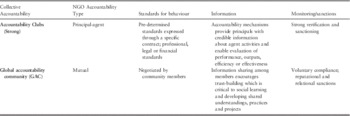
Table 1 uses the three main components of accountability relationships: (1) standards for behaviour; (2) information regarding behaviour; and (3) ability to monitor and sanction behaviour if standards are not metFootnote 51 to identify the general differences between accountability clubs and GACS.
Comparing accountability clubs and GACs.

Defining and institutionalising collective accountability
A confluence of factors, including the perception of ethical failure, the proliferation of unprofessional and inexperienced NGOs, and evidence of inefficiency and ineffectiveness during and after the international response to the Rwandan genocide in 1994 fuelled the institutionalisation process. The aid infrastructure was unprepared for the rapid influx of refugees into the countries bordering Rwanda, which resulted in unchecked cholera and dysentery epidemics that killed tens of thousands of refugees.Footnote 52 Some NGOs sent untrained staff members to work in the camps; others shipped inappropriate supplies, such as expired medicines.Footnote 53 Interviewees suggest that there was widespread concern that the proliferation of NGOs in Rwanda created a disorganised free-for-all. The CEO of an Australian NGO explains that NGOs were ‘critical of the myriad of NGOs and the poor quality of many of them; larger NGOs express[ed] frustration with the myriad of players [and] seized on this situation to solidify their status and professionalism in the sector.’Footnote 54 Likewise, the director of the Child Protection and Emergency Response Unit of a US-based NGO explains the importance of self-regulation in forming a community of practice to improve the quality of humanitarian action, ‘The whole industry self-regulates because [NGOs think] “it is not a problem for us but these other groups” [self-regulation] is the only way to get people involved, to get people to sign on.’Footnote 55
Humanitarians’ experience in Rwanda accelerated and intensified ongoing transnational discussions regarding the meaning and practice of humanitarianism. These conversations were characterised both by a deep questioning of the values and norms of humanitarianism, which is indicative of social learning, and the burgeoning recognition of a humanitarian community. First, humanitarians noted their role in enabling and exacerbating conflict while working in the refugee camps bordering Rwanda. These camps initially served as a refuge for Tutsis and moderate Hutus who fled the Rwandan genocide in April 1994. In the summer of that year, as the Tutsi Rwandan Patriotic Front (RPF) regained political control of the country, génocidaires fearing retaliation for the genocide escaped Rwanda and overran the refugee camps.Footnote 56 Former génocidaires co-opted aid distribution systems in camps and diverted aid to support military efforts, specifically those of resurgent groups who used the aid to mobilise and launch a counter-attack on Rwanda.Footnote 57 A disaster management team leader for a US-based NGO describes ‘aid is being used for political and military purposes and despite repeated attempts to correct diversions, we can’t meet the four basic humanitarian principles – neutrality, impartiality, do no harm and non-discrimination.’Footnote 58
NGO experiences in the camps revealed not only that humanitarian aid could do harm, but that it could reinforce inequitable and oppressive power structures. This realisation ‘[struck] at the core of the humanitarian ethic. … The result for NGOs was perhaps the most acute crisis of conscience, accompanied by profound and at times strident criticism of humanitarian action to date.’Footnote 59 Médecins Sans Frontières (MSF) and other NGOs withdrew from the camps in order to disrupt the distribution of power. Fiona Terry, then director of MSF-France recalls, ‘The moral quandary we faced was intense, emotional, and sometimes the acrimonious debates that surrounded our decision left an indelible mark on my conscience. It pushed all of us in MSF to reflect deeply upon what humanitarian action represents, and at what point it loses its sense and becomes a technical function in the service of evil.’Footnote 60
Second, in recognising the potential of humanitarian action to do harm, humanitarians felt a responsibility for the long-term impacts of their activity. The head of strategic policy at a French NGO explains, ‘there was a true search for quality in the NGO sector, a sincere idea of responsibility; we looked for the tools to improve our actions’.Footnote 61 From the donor side, Johan Scharr, former Head of Division for Humanitarian Assistance of the Swedish International Development Agency (SIDA) recalls that he and his peers were troubled by the inherent disorganisation in the humanitarian sector, the allocation of aid based on political preferences and not needs or principles; and a lack of appreciation for the root causes of human suffering.Footnote 62
Finally, interviewees refer to the rising sentiment of interconnectedness and collective responsibility for achieving the common objectives of humanitarianism. A senior director of Humanitarian and Emergency Affairs at a US NGO articulates, ‘[humanitarian activity] became less about individual organizations and more about us as a community and a collective group – how did we do? Could we have done better?’Footnote 63 Concerns regarding how the actions of individual organisations impact the credibility of the entire industry and collective project also engendered the search for global, collective mechanisms for coordination.Footnote 64
This discussion highlights the multiple factors and events that precipitated re-evaluation of the collective rules and obligations that govern humanitarian activity and fuelled discussions of collective NGO accountability. In particular, the recognition of the ethical failure in Rwanda and subsequent questioning of the purpose and values of humanitarianism, suggest the initiation of deeper processes of social learning.Footnote 65 The broad-scale, multi-actor Joint Evaluation of Emergency Assistance to Rwanda (JEEAR) further advanced social learning in the sector.Footnote 66
The JEEAR, a multi-agency, multi-donor evaluation of an international response, undertook the first system-wide analysis of the humanitarian sector and articulated the need for humanitarian organisations to develop self-regulatory institutions to monitor their accountability.Footnote 67 Interviewees suggest that the JEEAR generated a feeling of mutual engagement – referring to their ‘little gang’ – and joint enterprise among various humanitarian actors with a commitment to improving the accountability practices of the sector.Footnote 68 Interviews with programme officers at donor agencies suggest that donors were an integral part of the standard definition process, but they did not dominate it.Footnote 69 Thus, the JEEAR meetings and working groups served as a venue for social interaction and provided a forum for elaborating new norms of evaluation and accountability.
JEEAR meetings served as incubators for ideas regarding collective accountability for the sector and the relationships forged among the attendees facilitated the realisation of these standards. To illustrate, an attendee recalls, ‘In many respects, it [the JEEAR] was the first time that someone took a real critical look at the overall system, [we were] not just looking at any individual organization’s performance we were trying to look at the system’s performance.’Footnote 70 Likewise, a senior director for Humanitarian and Emergency Affairs at a US NGO observes, ‘After the JEEAR we started looking at these problems and our actions collectively. This is why the joint evaluation was important, it was a system-wide look at our work; we didn’t look at each other as individual organizations anymore.’Footnote 71
The JEEAR generated the strong preference and recommendation for an Ombudsman for humanitarian assistance – a special office under the aegis of the United Nations where beneficiaries of humanitarian assistance could voice their grievances about humanitarian organisations’ activities in the field.Footnote 72 When asked about the impetus for including recommendations for accountability in the JEEAR, a key author replied that the group seized the political opportunity afforded by the evaluation to build momentum for performance standards that had debuted in 1995.Footnote 73
The highly contested Humanitarian Assistance Ombudsman (HAO)
The Ombudsman Project gained momentum at the 1997 World Disasters Forum (WDF) hosted by the British Red Cross Society where UK-based NGOs agreed to support a pilot project, spearheaded by the British Red Cross, to research the feasibility of various models of ombudsmen-type systems.Footnote 74 While the forum delegates agreed to involve both international and local NGOs in the initiative, the original working group was comprised of British NGOs, donors, and academics involved in the humanitarian system as well as ALNAP, which was also based in the UK and housed at the Overseas Development Institute (ODI) in London.Footnote 75
The premise of the working group was to establish a complaints procedure and an external monitoring and regulatory mechanism based on a framework derived from the Red Cross/Red Crescent Code of Conduct and the Sphere Humanitarian Charter and Minimum Standards.Footnote 76 The results of the eight-month feasibility study, known as the Ombudsman Project and coordinated by the British Red Cross, were presented to the attendees of the following WDF held in London in June 1998.Footnote 77 The report detailed the significant challenges impeding progress on the Ombudsmen Project, including beneficiary access, increasing the scope of the stakeholders beyond UK-based agencies, and financing.Footnote 78 Attendees of the WDF suggested a pilot project to test the rationale, feasibility, and effectiveness of the proposed Ombudsman through research and consultation with beneficiaries and field offices.
Much of the animated debate regarding the HAO centered on competing views of accountability; the HAO promulgated a model of accountability based on the logic of control where the Ombudsman would apply collective rules and standards to constrain NGO activity and punish non-compliance.Footnote 79 Critics viewed the suggested policing role of the Ombudsman and its potential power to sanction NGOs as an unacceptable violation of NGO independence.Footnote 80 Moreover, those agencies that viewed accountability as a process for enabling learning and improving quality, believed that the role of the HAO should be to facilitate and guide NGO efforts to improve their practices. Groupe Urgence-Réhabilitation-Développement (Groupe URD) and MSF objected to the premise that the HAO would ensure compliance with universalist accountability standards and instead advocated for a more flexible, context-based application of accountability standards designed to improve the quality of humanitarian assistance.Footnote 81 The executive director of a French NGO expressed, ‘we do not have a precise definition of quality; it is mostly a sentiment of shared satisfaction among the beneficiaries of humanitarian action, donors, and the global public … for us, that’s quality.’Footnote 82 This quote suggests that competing notions of what constituted the joint enterprise impeded coordination.
Many of the Groupe URD’s criticisms were directed towards the Sphere Project’s emphasis on technical standards and thus a technocratic view of accountability.Footnote 83 The Sphere Project established minimum technical standards for humanitarian assistance and the perceived association between the Sphere and HAO-fuelled resistance to the HAO project.Footnote 84 An executive director of a French NGO explains the hostility to Sphere’s technical standards: ‘We think that humanitarian action cannot be summarized in a few technical criteria, which might be applied well or poorly. Humanitarian action is much more complicated … just because we have given 10 liters of water to a refugee doesn’t mean that we have responded to his or her needs … We are hostile to [these criteria]’.Footnote 85 Another contentious point involved HAO’s emphasis on legal accountability, which Groupe URD feared would absolve national governments and the international community of their legal accountability to citizens and crisis victims by shifting responsibility onto NGOs.Footnote 86
On 16 March 2000 at the headquarters of the International Federation of the Red Cross and Red Crescent Societies (IFRC) in Geneva, fifty senior representatives from key humanitarian organisations agreed to a two-year pilot study called the Humanitarian Accountability Project (HAP).Footnote 87 At the meeting, attendees deliberated many of the concerns raised by the Groupe URD and others regarding the policing function; the meaning of and standards for quality; expectations of legal accountability; and the risk of losing independence through standardisation.Footnote 88 A programme officer at Danida recalls that while ‘there was general support for the idea to start up an international project, the idea of an Ombudsman would probably not move forward because there was too much policing’.Footnote 89 During this meeting the majority of conference participants reached consensus on accountability to beneficiaries as the focus of their joint enterprise and supported the establishment of field trials to investigate how to develop accountability practices. Given the aversion to policing or other external mechanisms of control, attendees elected to rename the HAO the Humanitarian Accountability Project (HAP) and relocated the project to Geneva, Switzerland.
The Humanitarian Accountability Partnership-International
HAP-I achieved consensus around accountability practices through transnational and participatory decision-making processes and by linking accountability to beneficiaries to human rights norms. Launched in 2001, HAPFootnote 90 was tasked with examining different methods for promoting accountability, developing recommendations for strengthening accountability within the humanitarian sector, as well as designing a governance structure to oversee and administer a permanent accountability institution.Footnote 91 HAP was led by the International Steering Committee, which was comprised of a wide range of senior executives and individuals spanning the humanitarian sector; co-chaired by Niels Dabelstein, the then chairman of the OECD/DAC Working Party on Aid Evaluation, and Dr Alvaro Umana, the former chair of the World Bank Inspection panel, and included 13 founding organisations – including international organisations, official aid agencies, and NGOs.Footnote 92 To facilitate learning, HAP conducted three trials to field test and gather feedback on different types of accountability mechanisms designed to address needs at the field, agency, and sectoral levels. They also organised a series of workshops to establish consensus on a number of issues including: prioritisation of stakeholders; defining accountability and related practices; and the implementation of a self-regulatory mechanism. The overall findings of the trials were discouraging; the complexity of accountability relationships and accountability demands at the organisational, inter-agency and field levels provided little clarity on how to establish best practices for accountability.Footnote 93
The feedback from the trials led HAP staff to revisit the meaning of accountability; they finally reached consensus by adopting a rights-based approach (RBA) to ensuring accountability to beneficiaries. According to Lisa Jordan, HAP used the RBA to produce the following understanding: ‘agencies delivering emergency relief are primarily responsible to crisis-affected populations; their goal is to help those populations establish life with dignity; that a variety of mechanisms including a self-regulatory body would be necessary to ensure accountability in the field; and the outcome envisioned is a strengthened sector’.Footnote 94
The RBA enabled consensus building by providing NGOs with a way to organise and prioritise principles to meet perceptions of their felt responsibility to beneficiaries of humanitarian assistance. A CEO of an Australian NGO elaborates, ‘I think the RBA provides a framework to hang off a lot of things we used to do anyway but also some things we didn’t used to do. In humanitarian response, the early focus was always on the basics: food, water, shelter, but increasingly we realise it is – not just what you provide but the process of interaction with community that’s important and empowerment of the community so the human rights framework is a common way of framing all of that.’Footnote 95 By explicitly recognising that the most basic right of disaster-affected populations was to life with dignity and the right to voice their opinions on the activities of humanitarian organisations, NGOs also created responsibilities for themselves. These obligations included the responsibility to provide aid beneficiaries with relevant information regarding NGO programmes, and to provide beneficiaries with an opportunity to voice their opinions on NGO actions.
In 2003, the Humanitarian Accountability Partnership-International (HAP-I) replaced HAP to build upon this newfound vision for accountability in humanitarianism. HAP-I is a self-regulatory, membership-based organisation where members agree to abide by seven principles that elaborate the political and civil rights that aid beneficiaries can claim against NGOs.Footnote 96 The purpose of HAP-I is: ‘To make humanitarian action accountable to its intended beneficiaries through self-regulation and compliance verification … [to] achieve and promote the highest principles of accountability through self-regulation by members linked by common respect for the rights and dignity of beneficiaries.’Footnote 97 Members of HAP-I commit to standards of accountability and quality management published under the rubric of the HAP standard.Footnote 98 Each of the seven principles defines how NGOs should interact with beneficiaries and other stakeholders in key sectors of organisational activity.
In contrast to the HAO’s dominance by British organisations, multiple humanitarian organisations and stakeholders developed the HAP principles through extensive deliberation and a participatory model of decision-making. HAP-I undertook a similar process to operationalise the principles into actionable and verifiable standards and indicators.Footnote 99 The process for developing the HAP Standard involved several layers of foundational work submitted by multiple working groups and standing committees. In August 2005, HAP-I formed a Humanitarian Accountability and Quality Management Reference Group to begin developing the HAP Standard. The Reference Groups were designed to enhance the ownership of the HAP Standard and participants were drawn from beneficiaries, HAP-I members, non-member agencies, donors, and others.Footnote 100 The first meeting gathered 166 participants from 67 agencies and 190 participants from 90 organisations and agencies participated in the 2006 meeting.Footnote 101 HAP-I hosted Reference Group Workshops in multiple venues worldwide and participants were tasked with sharing their expertise, skills, and knowledge to develop appropriate standards, benchmarks, indicators, and verification tools. Workshop participants also provided feedback and input on the standard development process and committed to hosting discussion groups on and field trials of the standards and indicators.Footnote 102
The participatory model of defining the collective standards included several working groups that convened NGOs from around the globe. The 21-member Manual Editorial Steering Group charged with day-to-day management of the project as well as commenting and approving the final version of the standards, was drawn from HAP-I members and specialists to provide leadership for the project.Footnote 103 Four Working Groups – Scoping, Good Practices, Business Case, and Implementation – constituted the final layer of collaboration. HAP-I commissioned the Working Groups to research various facets of self-regulation and accreditation for use in standard development.Footnote 104 Each of the Working Groups hosted meetings around the globe to assist in the process of collecting, synthesising, and analysing information.Footnote 105
With the standardisation process underway, some participants raised concerns that HAP-I was not adequately consulting beneficiaries. In response, HAP-I hosted regional workshops that brought together field practitioners and beneficiaries; asked southern NGOs to conduct self-assessments that tested the usability of the HAP Standard; and conducted field visits to the Office Africain pour le Développement et la Coopération (OFADEC) in Senegal, DRC in Somaliland and World Vision Tsunami Response Team in Sri Lanka in August–October 2006 to collect additional feedback on the HAP Standard.Footnote 106
This multilayered, participatory process produced the HAP Standard, first published by HAP-I in 2007, which set forth six benchmarks for verifying compliance with the seven HAP principles of accountability and quality management.Footnote 107 NGOs conduct self-assessments of their organisational activities using the HAP Standard to verify compliance with the HAP principles. Additionally, HAP-I members choose whether to participate in the HAP Certification Audit, which consists of an independent evaluation conducted by a registered HAP auditor. Successful completion of the audit confers the Certificate in Humanitarian Accountability and Quality Management, which is valid for three years and requires a mandatory mid-term monitoring audit. Currently, HAP-I has 96 members, 19 of which have been certified using the HAP Certification Audit.Footnote 108
Donor role in HAP-I standard formation
Given the prevalence of the accountability clubs approach to collective accountability, it is useful to specifically examine the role of donors in the standard formation process. The accountability clubs approach suggests that salient donors directly influence how NGOs define and institutionalise accountability by imposing standards in contracts and threatening to withdraw resources if standards are not met. Absent a coercive threat, NGOs might conform to the standards of dominant donors to enhance organisational efficiency by defining and institutionalising accountability in ways that streamline reporting requirements.
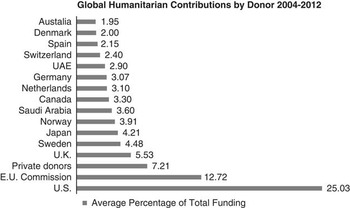
Who are the salient donors for humanitarian NGOs at the inter-organisational level? For one, salient donors might be those governments who contribute significant sums to humanitarian relief efforts. I use the United Nations Office for the Coordination of Humanitarian Affairs (UNOCHA) Financial Tracking Service’s Global Humanitarian Funding Total Contribution by Donor reports for the years 2004–12 to track global humanitarian aid flows. Figure 1 shows the average percentage of total global humanitarian contributionsFootnote 109 by donor over the period 2004–12.
Global humanitarian donations by donor. Source: United Nations Office for the Coordination of Humanitarian Affairs (UNOCHA) Financial Tracking Service reports for the years 2004–12.

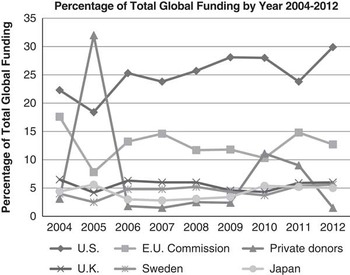
The United States has the highest average contribution of 25.03 per cent, followed by the European Union Commission (EC) with 12.72 per cent, private donations (individuals and organisations) average 7.21 per cent, and the United Kingdom with 5.53 per cent. Figure 2 shows the percentage of total global funding per year (2004–12) for the top six donors from Figure 1.
Percentage of total global funding by year (2004–12). Source: United Nations Office for the Coordination of Humanitarian Affairs (UNOCHA) Financial Tracking Service reports for the years 2004–12.

Figure 2 shows that the US and the EC were consistently the top two donors and the UK, Sweden, and Japan consistently contributed on average 4–5 per cent of the total global funding. While private donors gave generously in some years – most notably 32 per cent of total global funding in 2005 in response to the Asian Tsunami – they did not maintain this trend over time.
Salient donors might also be those who contribute significantly or consistently to HAP-I itself. HAP-I annual reports are available for 2004–12 and detail three main resource flows for the organisation: core funding, earmarked contributions, and membership fees. Core funding is the primary source of revenue for HAP-I and over the 2004–12 period, 15 donors contributed to HAP-I’s core funding. Some donors started making earmarked contributions in 2007, these donations generally fund very specific projects such as field tests or site visits.
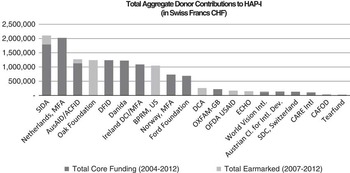
Figure 3 shows the total aggregate donor contributions in Swiss Franc (CHF) millions for the years 2004–12. SIDA and the Netherlands Ministry of Foreign Affairs (MFA) are the top two donors for the period 2004–12 contributing CHF 2.1 and 2.0 million respectively to HAP-I over the eight-year period. Moreover, both countries donated consistently to global humanitarian funding (see Figure 1); Sweden contributed on average 4.48 per cent of total global humanitarian funding, while the Netherlands contributed 3.10 per cent. The Oak Foundation (Switzerland) and the Bureau of Population, Refugees and Migration (US BPRM)’s contributions are notable because they began donating to HAP-I in 2007 with only earmarked contributions, compared to other top donors who contributed consistently to core funding during the entire 2004–12 period. This data suggests which donors – the US, EC, the UK, SIDA, and the Netherlands MFA – we would expect to strongly impact the standard definition process.
Total aggregate donor contributions to HAP-I in Swiss Francs (CHF) millions 2004–12. Source: HAP-I annual reports for 2004–12. Abbreviations: Australian Aid/ Australian Council for International Development (AusAID/ACFID); Austrian Council for International Development; Bureau of Population, Refugees & Migration, US Department of State (BPRM); Catholic Agency for Overseas Development (CAFOD); Department for International Development-United Kingdom (DFID); Ministry of Foreign Affairs of Denmark (Danida); Ministry of Foreign Affairs, Ireland (Ireland, MFA); Ministry of Foreign Affairs, Norway (Norway, MFA); Swiss Agency for Development and Cooperation (SDC).

Data from the process-tracing shows a collaborative not hierarchical or coercive relationship between NGOs and states or other governmental actors. Official aid agency representatives were at the table with NGOs negotiating the meaning of joint enterprise and best practices, but did not dictate the process, and in fact their understandings changed as a result of the standardisation process. Moreover, while larger more well-known NGOs, such as Oxfam UK, World Vision International, Care International, CAFOD (UK), and Tearfund (UK) – contributed core funding to HAP-I as indicated in Figure 3 – they did not overtake the standard-definition process. By contrast, the case shows that the perception that the UK and British agencies dominated the HAO process was one reason for its demise. Instead, NGOs led by the Groupe URD impacted the standard definition and institutionalisation process even though they did not make financial contributions to HAP-I and are primarily mid-sized NGOs.Footnote 110
In particular three initiatives – DECAF, Good Humanitarian Donorship (GHD), and ECHO’s revised standards – point to evidence of social learning where large NGOs and donors questioned the objectives and purpose of humanitarian aid and changed their understandings and practices of accountability. Changes to the Disasters Emergency Committee’s (DEC) accountability and evaluation practices occurred concurrently to the unveiling of the HAP standard in 2007.Footnote 111 While DEC previously used external joint evaluations to demonstrate accountability, starting in 2007 they adopted the DEC Accountability Framework (DECAF) which emphasises learning and accountability and harmonises with HAP benchmarks for improving accountability to beneficiaries.Footnote 112 A 2010 review of DECAF found that the assessments led to improvements around systems for learning and accountability to beneficiaries, but required updates to ‘reflect new frontiers of best practice’.Footnote 113
Humanitarian donors also questioned their practices and sought ways to improve accountability to humanitarian outcomes. SIDA’s Scharr recalls that the idea for the GHD initiative emerged during an informal meeting of the EU’s humanitarian assistance committee in October 2002 where attendees engaged in introspection and self-questioning: ‘If we expected UN agencies, the Red Cross Red Crescent Movement, and NGOs to work according to good or even best practice, why not demand the same of ourselves?’Footnote 114 Sixteen governments as well as the EC, NGOs, and representatives of international organisations met in Stockholm on 16–17 June 2003 to discuss good humanitarian donorship and established the Principles and Good Practice of Humanitarian Donorship, which set forth general principles for humanitarian action, and good practices in donor financing, management, and accountability.Footnote 115 The GHD initiative is an informal donor forum and network, which facilitates meetings, workshops, and information exchanges to coordinate donor behaviour and improve humanitarian action. It is an aspirational self-regulatory system based on the 23 principles and operational standards with no mechanism for monitoring compliance with the code and no formalised decision-making body.
The GHD group of donors has consistently expanded since its inception, growing from 17 original members to 37 in 2010 and 41 in 2012.Footnote 116 Despite weak monitoring and enforcement mechanisms, the GHD initiative has achieved some successes in coordinating humanitarian donor behaviour including codifying norms and principles that allow for peer review of humanitarian assistance by the OECD/DAC and increasing the volume of the UN’s Central Emergency Response Fund, which promotes a needs-based approach to humanitarian emergencies.
Further evidence of social learning includes changes to the evaluation and monitoring practices of the EC’s Department for Humanitarian Aid and Civil Protection (ECHO), which as previously indicated is a top humanitarian donor. In 2007 ECHO implemented new accountability and evaluation practices including peer monitoring by recipient agencies to enhance inter-agency learning, an emphasis on institutional learning, and self-regulatory initiatives for donors such as DAC peer review process and the GHD principles.Footnote 117 The peer monitoring approach goes beyond the ‘information sharing’ in single loop learning to encourage community discussion and participation in planning so that monitoring visits become a source of joint learning and collective quality improvement. While early evaluations of these initiatives found scant evidence of changes in donor behaviour, more analysis needs to be conducted to evaluate their long-term effects.Footnote 118
The examples of DECAF, GHD, and ECHO suggest that the process of developing the HAP-I transformed understandings and practices of humanitarian aid through social learning and engendered mutual accountability throughout the humanitarian community. Changes in donor practices indicate the constitutive nature of a GAC; the development of the HAP standard fostered social interaction and learning that shaped the identities, interests and experiences of participants; and compelled change in how they define and practice accountability.
Discussion
Process-tracing the case of HAP-I shows how humanitarian organisations developed collective accountability standards and practices and institutionalised these standards in a self-regulatory system. Notably, the case highlights an evolution in understandings and practices of collective accountability. The HAO embodied a logic of control where accountability was defined in technocratic, functional, and punitive terms, whereas HAP-I reflects a logic of participation that emphasises mutual accountability and learning.Footnote 119 The case challenges several expectations of how inter-organisational accountability works at the transnational level.
The case shows that a confluence of principal demands and structural pressures – including the proliferation of poor quality and inexperienced NGOs whose lack of professionalism impacted the entire sector, continued shortfalls in capacity, and ethical failure – highlighted the accountability deficit in the humanitarian sector during and following the Rwandan crisis. The JEEAR, a multi-party system-wide evaluation of the humanitarian response to the Rwanda crisis, noted the functional need for improved accountability and specifically recommended a Humanitarian Ombudsman and third-party certification system to regulate the accountability of humanitarian actors. An accountability clubs approach expects NGOs to conform to the recommendations of the donor-led JEEAR by developing a third-party policing or accreditation system to mitigate agency dilemmas and send strong signals of quality to principals. Indeed, the first iterations of collective accountability conformed to the JEEAR’s recommendations, but attempts to institutionalise the HAO failed mainly because of its logic of control, policing functions and technocratic definitions of accountability. However the conversations initiated by the JEEAR were important catalysts for continued collaboration; interviewees suggest that its importance was to create a feeling of mutual engagement and commitment to defining collective accountability practices. The mutual engagement of states, independent evaluators, official aid agency representatives, and NGOs laid the foundation for a global accountability community committed to developing best practices for accountability in humanitarianism.
The process of negotiating shared values and visions for collective accountability created a bond among humanitarian organisations and increased trust and collaboration. Through the processes of social learning, community members changed their preferences, interests, and accountability practices. The case highlights several examples of social learning beginning with initial disagreement over the meaning of accountability. While HAP initially promulgated a technical definition of accountability that aligned with the Sphere minimum standards, objections from the Groupe URD and others impelled NGOs to consider the meaning of quality and how best to achieve accountability in varied contexts. Humanitarian organisations eventually achieved consensus by adopting a RBA and defined accountability as primarily to beneficiaries. Adopting a RBA required compromise from the Groupe URD and others who initially opposed legal-based definitions of accountability. Humanitarian organisations used the RBA as an ordering framework to prioritise the right to life with dignity and the right to voice, which enabled consensus-building and the generation of the seven HAP principles. This communally negotiated practice of accountability to beneficiaries, produced coherence and stability in the community, and coordinated NGO activities around a joint enterprise. Moreover, the repeated field trials, workshops, self-assessments and pilot testing in all stages of development – from the HAO to HAP-I – are examples of how social learning occurred through repeated feedback loops and refinement of standards.
Finally, changes in the practices of donors such as ECHO and the GHD provide evidence for the constitutive effects of the GAC. Through the extended process of defining collective accountability principles, HAP-I succeeded in transforming the culture of accountability in the humanitarian sector. The GHD requires donors to consider their own accountability to affected populations and to partner organisations including NGOs. ECHO adopted evaluation techniques to foster institutional learning and enhance inter-organisational cooperation. The processes of diffusion flowed multidirectionally among these multiple actors as the GAC approach would expect.
Conclusion
This article has shown that the transnational coordination of NGO accountability practices results from social learning that generates a global accountability community (GAC) constituted by mutual engagement, joint enterprise, and a shared repertoire of practices. The global accountability of NGOs cannot be understood as a singular principal-agent relationship where salient donors impose financial and legal accountability standards upon NGOs. Instead, collective accountability practices are mutually negotiated by members of a community, which include NGOs, donors, affected populations, and others. GACs both regulate and constitute the practice of accountable humanitarianism.
This article makes several contributions to the scholarship on NGO accountability and self-regulation. First and foremost, the GAC concept fundamentally changes how we view and understand collective accountability. The GAC concept challenges literature on NGO accountability that assumes that the resource dependence of NGOs makes them primarily accountable to donors. The process-tracing data provides a longitudinal view of the relationship between NGOs and donors and shows their fluidity; NGOs and donors interact to create new identities, shared norms, and practices. The meaning and practice of accountability shifted from the early Ombudsman Project, which embodied a logic of control and promoted a technical definition of accountability to HAP-I, which establishes norms for mutual accountability based on the RBA. Therefore, while it might appear that NGO accountability aligns with donor preferences, these preferences were mutually constituted.
Second, while a conventional understanding of global governance suggests that organisational forms that emphasise social (‘soft’) over legal (‘hard’) obligations might not have any regulatory teeth because they are neither state-centered nor grounded in international law. HAP-I is one example of how ‘soft’ rules coordinate and socialise transnational actors through social-learning that builds communities with shared identities, practices, and obligations.Footnote 120 Evidence of diffusion from HAP-I to DEC, GHD, and ECHO indicate that NGO accountability initiatives influenced how official state agencies think about and practice humanitarian aid.
The GACs concept subsequently provides new perspectives and approaches to the study of self-regulation, particularly on the question of compliance with community standards. The rich literature on compliance is too vast to fully engage here, but future empirical studies could investigate whether and how the HAP standard has impacted the behaviour of participating organisations and ensured compliance. Further research is also needed on the political and power dynamics of GACs to develop a more robust understanding of their impact. Scholarship on private self-regulation is largely sceptical of its ability to enhance participatory global governance or reflect the public interest.Footnote 121 GACs conceptualise one form of global governance that is accountable to affected populations, especially those in the global south, but further research is needed to investigate whether and how HAP-I gives a voice to these groups. Another key area for research could investigate if and how these standards diffuse to NGO communities located in the Global South to then transform their accountability relationships with government.
Acknowledgments
For their close readings and constructive comments on previous versions of this article, I would like to thank Samer Abboud, Jennifer Brinkerhoff, Sarah Bush, Jess Clayton, Amy Cox, Mary Kay Gugerty, Virginia Haufler, Amanda Murdie, Christopher Pallas, Jennifer Riggan, Hans Peter Schmitz, and Michael Schroeder. Earlier versions of this article were presented at the 2014 meeting of the International Studies Association and the 2013 meetings of the Mid-West Political Science Association and the American Political Science Association. Research was supported by an American Political Science Association Small Research Grant (2014). For research assistance, I thank Cameron Allen, Leah Knappage, Adriana Miladinovic and Samantha Wolk.
The interviews conducted for this research were approved by the Institutional Review Board at The George Washington University; the study was approved as IRB 030812.
Declaration of conflicting interests
None.