Introduction
The Otariidae (fur seals and sea lions) are the second-most diverse pinniped clade and are found throughout the North Pacific and Southern Hemisphere. Nine of 14 extant species are found in the Southern Hemisphere, where they are conspicuous and important components of coastal ecosystems. Despite their abundance, otariids are only recent immigrants to the region, evolving in the North Pacific and dispersing south of the equator between 6 and 7 Ma (Churchill et al., Reference Churchill, Clementz and Boessenecker2014a). In the Southern Hemisphere, otariid fossils are rare but are known from Plio-Pleistocene deposits of South America (Muizon, Reference Muizon1978; Oliveira and Drehmer, Reference Oliveira and Drehmer1997; Drehmer and Ribeiro, Reference Drehmer and Ribeiro1998; Rodrigues et al., Reference Rodrigues, Prevosti, Ferigolo and Ribeiro2004; Valenzuela-Toro et al., Reference Valenzuela-Toro, Gutstein, Varas-Malca, Suarez and Pyenson2013), South Africa (Avery and Klein, Reference Avery and Klein2011), Australia (McCoy, Reference McCoy1877; Gill, Reference Gill1968), and New Zealand (King, Reference King1983a).
Otariid fossils from the Southern Hemisphere are generally represented by fragmentary material. One important exception is Neophoca palatine King, Reference King1983a, which is represented by a nearly complete skull (King, Reference King1983a). The holotype was recovered from below a seaside cliff at Ohope Beach, Whakatane, in the Bay of Plenty on the North Island of New Zealand (Fig. 1) and has been dated to the New Zealand Castlecliffian Stage (1.63–0.34 Ma; Raine et al., Reference Raine, Beu, Boyes, Campbell, Cooper, Crampton, Crundwell, Hollis and Morgans2012). Although recovered in 1937, this specimen was only described in 1983 and was placed within the genus Neophoca on the basis of its wide interorbital region. It was distinguished from the extant Australian sea lion N. cinerea on the basis of smaller alveoli, a differently shaped bulla, and a wider palate and basioccipital. Although relatively complete, this taxon has largely been ignored in phylogenetic analyses of Otariidae, such as those by Berta and Deméré (Reference Berta and Deméré1986) or Barnes et al. (Reference Barnes, Ray and Koretsky2006). Churchill et al. (Reference Churchill, Clementz and Boessenecker2014a) did include this taxon within their phylogenetic analysis. They recovered N. palatina as the sister taxon to crown Otariidae, but with little support.
Locality information for Neophoca palatina. (1) The locality within New Zealand. (2) The Ohope Beach area and the location of Tauranga Group sediments.

Neophoca palatina is one of only two southern otariids known from well-preserved cranial material (the other being Hydrarctos lomasiensis Muizon, Reference Muizon1978) and is the oldest known otariid from the Australasian region. It represents a significant range extension for the genus Neophoca, which today is confined to temperate waters in coastal southern and western Australia (Gales et al., Reference Gales, Shaughnessy and Dennis1994); occurrence of Neophoca within New Zealand waters in the past may suggest different climatic conditions than are present today or a greater range of temperature tolerance in the past for this genus. Placement of N. palatina within Neophoca, as well as the diagnosability of the species, remains uncertain. King (Reference King1983a) only employed a limited number of measurements in her study and did not carry out comparisons between taxa in a rigorous statistical framework. In addition, sample sizes of extant taxa used in her analysis were limited. While phylogenetic analysis has not been successful in inferring the evolutionary relationships of Neophoca palatina to other otariids (Churchill et al., Reference Churchill, Clementz and Boessenecker2014a), morphometric analysis may provide an answer. Morphometrics has previously been applied to otariid taxonomy and has been successful in separating out taxa at the generic level (Brunner, Reference Brunner2004). This study will redescribe Neophoca palatina and use morphometrics to test whether it is most similar to Neophoca cinerea among extant Australasian otariids. This will clarify the biogeographic distribution of Neophoca and may provide further information on the origins of Southern Hemisphere otariid biodiversity.
Materials and methods
Preparation, photography, and anatomical terminology
Sometime after the death of J.A. Berry, Dr. Judith King received the Ohope skull on loan in Australia for study, where it was carefully prepared by Dr. Michael Archer. Restoration of the skull included acid preparation, which removed much of the calcareous siltstone from endocranial cavities of the braincase, rostrum, and intertemporal region. Unfortunately, when the fossil was sent back to New Zealand, the loss of concretionary matrix from these areas permitted an extensive series of fractures to form, which resulted in the palate separating from the braincase and dorsal rostrum, with the middle of the rostrum and orbital region reduced to hundreds of fragments. To address this damage, we repaired as much of the skull as possible and reassembled most of the damaged part of the rostrum from these fragments using cyanoacrylate glues and poly vinyl butyral. Unfortunately, many of the fragile elements of the interorbital region were too highly shattered to repair, although many of these fragments have been saved and scope for further reassembly exists. After reassembly, the specimen was coated with sublimated ammonium chloride and photographed with a Canon EOS Rebel XS. Anatomical terminology follows Fordyce and Mead (Reference Fordyce and Mead2009).
Sampling
To quantitatively determine the taxonomic affinities of Neophoca palatina, we collected measurement data from 109 specimens belonging to six otariid taxa from throughout the Australasian region. Taxonomy used follows Berta and Churchill (Reference Berta and Churchill2012). This taxonomy splits Arctocephalus into two genera, Arctocephalus s.s. which includes Arctocephalus pusillus Schreber, Reference Schreber1775, and Arctophoca, which includes the remaining southern fur seals. While controversial (Nyakatura and Bininda-Emonds, Reference Nyakatura and Bininda-Emonds2012; Committee on Taxonomy, 2014), we found distinct morphometric differences between these southern fur seal ‘genera,’ and thus they provide useful labels for morphologically distinctive groups. We focused on taxa from this region as they are the species most likely to be closely related to Pleistocene taxa from New Zealand. Other genera, such as Callorhinus and Eumetopias, are only known from the North Pacific, and Zalophus does not range any further south than the Galapagos Islands. Otaria is known from the Atlantic and Pacific coasts of South America, but this taxon possesses unambiguous autapomorphies not found in N. palatina, such as a deeply concave and elongated palate, eliminating the genus from consideration as a close relative of N. palatina. Taxa examined included the extant Australian sea lion (N. cinerea; n=29), New Zealand sea lion (Phocarctos hookeri Gray, Reference Gray1844; n=7), Australian fur seal (Arctocephalus pusillus doriferus Wood Jones, Reference Wood Jones1925; n=32), New Zealand fur seal (Arctophoca australis forsteri Lesson, Reference Lesson1828, n=17), Antarctic fur seal (Arctophoca gazelle Peters, Reference Peters1875; n=20), and the Subantarctic fur seal (Arctophoca tropicalis Gray, Reference Gray1872; n=4; Appendix). Sampling focused on male individuals, the same sex as the N. palatina holotype.
In addition to the extant otariids and N. palatina, we also sampled two Holocene Neophoca specimens from Victoria, Australia, outside the present range of extant N. cinerea. These specimens were included to assess whether early Holocene and Late Pleistocene Neophoca may be more closely related to N. palatina than to modern N. cinerea. Specimen NMV P12110 was collected from the lower beds of the Bridgewater Group coastal aeolianites near Queenscliff and dates from the last interglacial (Eemian interglacial equivalent; ca. 90–110 ka; Gill and Collins, Reference Gill and Collins1986). NMV P21397 was collected from Holocene coastal sands near the town of Queenscliff and is dated to ca. 7 ka. The former specimen (NMV P12110) was originally described as a new species, Arctocephalus williamsi (McCoy, Reference McCoy1877), but was later synonymized with N. cinerea (Gill, Reference Gill1968; King, Reference King1983b).
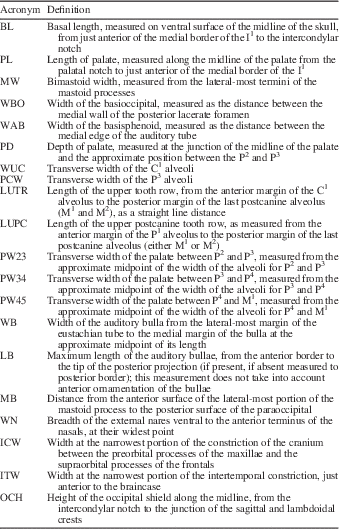
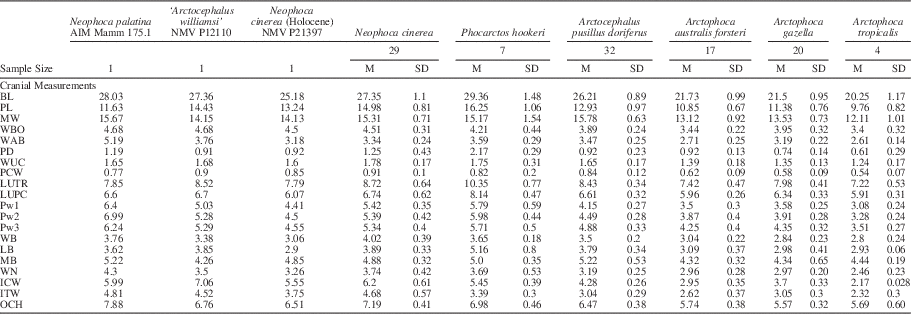
The twenty cranial measurements chosen for data collection (Fig. 2, Table 1) were based on previous morphometric analyses of otariids (Brunner et al., Reference Brunner, Bryden and Shaughnessy.2004) and selected for ease of measurement and comparability with N. palatina. Measurements were collected with digital calipers to the nearest 0.1 mm (Table 2). A correction factor (based on comparison with extant otariid crania) was applied to the basal length of the cranium measurement in order to accommodate the ~10.6% of the length missing due to damage to the rostrum.
The cranium of Phocarctos hookeri (USNM [National Museum of Natural History] 489526), illustrating cranial measurements used in this study. (1) Dorsal view; (2) lateral view; (3) ventral view. BL=basal length; ICW=width in dorsal view of the cranium between the preorbital and supraorbital processes; ITW=width across the intertemporal constriction anterior to the braincase; LB=maximum length of the auditory bullae; LUPC=length of upper postcanine tooth row; LUTR=length of upper tooth row; MB=distance between the mastoid and paraoccipital processes; MW=bimastoid width; OCH=height of the occipital shield; PCW=transverse width of P3 alveoli; PD=depth of palate; PL=palate length; PW23=transverse width of palate between the P2 and P3; PW34=transverse width of the palate between the P3 and P4; PW45=transverse width of palate between the P4 and M1; WAB=basisphenoid width between the auditory bullae; WB=width across the bullae); WBO=basioccipital width; WN=width of the external nares; WUC=transverse width of canine alveoli. For more detailed descriptions of measurements, see Table 1.
Descriptions of measurements used in analysis of morphometric data.
Measurements used in morphometric analysis. All recent specimens averaged and values reported in centimeters. Basal Length (BL) for N. palatina corrected for damage to rostrum. ICW=width in dorsal view of the cranium between the preorbital and supraorbital processes; ITW=width across the intertemporal constriction anterior to the braincase; LB=maximum length of the auditory bullae; LUPC=length of upper postcanine tooth row; LUTR=length of upper tooth row; MB=distance between the mastoid and paraoccipital processes; MW=bimastoid width; OCH=height of the occipital shield; PCW=transverse width of P3 alveoli; PD=depth of palate; PL=palate length; PW23=transverse width of palate between the P2 and P3; PW34=transverse width of the palate between the P3 and P4; PW45=transverse width of palate between the P4 and M1; WAB=basisphenoid width between the auditory bullae; WB=width across the bullae; WBO=basioccipital width; WN=width of the external nares; WUC=transverse width of canine alveoli; M=mean; SD=standard deviation. For more detailed descriptions of measurements, see Table 1.
Analysis of morphometric data
To describe the morphological variation in otariid skulls and determine which extant otariids were most similar to N. palatina, we performed principal component analysis (PCA) using a covariance matrix on our cranial measurement data set. We also used discriminant function analysis (DFA) to test the generic placement of N. palatina. This allowed us to identify significant differences in cranial shape and size between taxa, with size isolated to PC 1. For this analysis, we tested whether N. palatina and the Holocene Australian Neophoca specimens were most similar to Neophoca cinerea, Phocarctos hookeri, Arctocephalus pusillus, or Arctophoca ssp. PCA and DFA were both performed in R 2.12.1.
Institutional abbreviations
AIM=Auckland War Memorial Museum; AM=Australian Museum; SAMA=South Australian Museum; NMV=Museum Victoria; OM=Otago Museum; OU=University of Otago Department of Geology; USNM=United States National Museum of Natural History.
Systematic paleontology
Order Carnivora Bowdich, Reference Bowdich1821
Family Otariidae Gill, Reference Gill1866
Genus Neophoca Gray, Reference Gray1866
Neophoca palatina King, Reference King1983a
Reconstruction of the skull of Neophoca palatina, based on the holotype (AIM M 76) and comparisons with other otariid taxa. (1) Lateral view; (2) ventral view; (3) dorsal view.
Holotype of Neophoca palatina (AIM M 76), with bones and anatomical landmarks labeled. (1) Anterior view; (2) posterior view.
Holotype of Neophoca palatina (AIM M 76), with bones and anatomical landmarks labeled. (1) Dorsal view; (2) ventral view.
Holotype of Neophoca palatina (AIM M 76), with bones and anatomical landmarks labeled. (1) Right lateral view; (2) left lateral view.
Holotype
M 76, nearly complete cranium from Ohope Beach (undifferentiated Tauranga Group, Middle Pleistocene), North Island, New Zealand (grid reference NZMS1 N69/466258).
Diagnosis
Neophoca palatina can be distinguished from all other Australasian otariids on the basis of possession of unusually broad basisphenoid. It is placed within the genus Neophoca on the basis of proportionally broad interorbital and intertemporal regions, as well as proportionally reduced width across the mastoid processes of the squamosal. It shares the following traits with both Neophoca cinerea and Phocarctos: a cranium that is broad across the preorbital processes, transversely broad external nares, and a broad palate. It can be distinguished from Neophoca cinerea and Phocarctos on the basis of its smaller skull length, comparable to male A. pusillus. It shares no unique morphometric characters with Phocarctos and can be distinguished from this taxon on the basis of a less transversely concave palatal surface and absence of posterior projections of the auditory bullae. It shares with Arctophoca an anteroposteriorly short palate and greater separation of the mastoid and paraoccipital processes.
Occurrence
The holotype skull of Neophoca palatina was found in 1937 by Mr. H.C. McReady and presented to then Auckland Institute and Museum (now Auckland War Memorial Museum) in 1939 (King, Reference King1983a); it was under study by Dr. J.A. Berry for many years prior to his death in 1962 (Fleming, Reference Fleming1968). King (Reference King1983a) further indicated that “skull was found just below the surface of an area of talus at the base of cliffs representing a stranded shoreline” (p. 105) at the west end of Ohope Beach, approximately 6 km east of Whakatane (Fig. 1; grid reference NZMS1 N69/466258). Fleming (in King, Reference King1983a) considered the parent unit to be assignable to the Castlecliffian Stage (1.63–0.34 Ma; Raine et al., Reference Raine, Beu, Boyes, Campbell, Cooper, Crampton, Crundwell, Hollis and Morgans2012) and to be between 0.45 and 0.25 Ma in age. An earlier study of invertebrates from this locality (Fleming, Reference Fleming1955) reported a correlation with the Putikian substage of the Castlecliffian based upon mollusks and foraminifera. According to Carter and Naish (Reference Carter and Naish1998), the Putikian substage is from 0.78 to 0.34 Ma, corresponding to the Middle Pleistocene (Ionian Stage of international usage). More recent field studies have mapped Pleistocene marine deposits of the locally undivided Tauranga Group in the vicinity of Ohope Beach (Leonard et al., Reference Leonard, Begg and Wilson2010). According to Leonard et al. (Reference Leonard, Begg and Wilson2010), these sediments are 1.81–0.524 Ma in age. Taking into account a Putikian age reported by Fleming (Reference Fleming1955) and age ranges reported by Leonard et al. (Reference Leonard, Begg and Wilson2010), the absolute age of the Neophoca palatina type locality may be summarized as 0.780–0.524 Ma, Middle Pleistocene.
Description
The holotype of Neophoca palatina consists of a partial cranium, missing the zygomatic arches, supraorbital processes of the frontal, and the anterior portion of the premaxilla (Fig. 3). In addition to the left pterygoid and palatine, much of the medial orbital and temporal wall is damaged. The basicranium is nearly complete. Preservation is, unless noted in the following, comparable for left and right sides of the cranium. We agree with King (Reference King1983a), who considered the holotype to represent an adult male, according to the combination of suture patterns (6 of 9 sutures used by Doutt, Reference Doutt1942, to assess maturity in seals are closed), large sized and circular cross-section of canine alveoli (greatest alveolar diameter measures 7% of condylobasal length), and robust proportions of the skull. Using the multivariate total-length regression equation for otariids presented in Churchill et al. (Reference Churchill, Clementz and Kohno2014b), a total body length of ~230 cm is estimated for this taxon, similar to the body size seen in extant male Phocarctos.
Premaxilla and maxilla
The premaxillae are badly damaged, and only the narial (ascending) process dorsal to the canine alveolus and maxilla is preserved. The external nares are badly damaged, and the narial processes of the premaxillae are broken and absent. The external nares are broad and proportionally similar in size to those of Phocarctos and N. cinerea (Fig. 4.1; King, Reference King1983a). Dorsally (Fig. 5.1), the maxilla extends from the anterodorsal border of the broken canine alveolus toward the anterior margin of the nasal in a nearly straight line. A shallow nasolabialis fossa is present on the ascending process of the maxilla immediately anterior to the antorbital process. The maxilla forms a nearly transversely straight suture with the frontal. In dorsal aspect, the antorbital process projects further laterally than the transversely broadest part of the rostrum (similar to Phocarctos hookeri and Neophoca cinerea).
The lateral wall of the maxilla is thin and heavily damaged on the left side (Fig. 6.2); the right side (Fig. 6.1) was well preserved at the time of description by King (Reference King1983a). In lateral view, the maxilla is incomplete, and a large empty cavity is posteriorly contiguous with the missing section of orbital wall. The anterior portion of the right infraorbital foramen is present and large (~15 mm dorsoventral depth) in the cast but now damaged in the specimen. A vertically arranged pair of posteriorly opening foramina (2–3 mm diameter) is present anteriorly within the foramen. The antorbital process of the maxilla is damaged, but appears to have been developed as a low vertical ridge outlining the anterior wall of the orbit and formed entirely by the maxilla. The anterior orbital margin is formed as an arcuate ridge and ventrally consists of the broken zygomatic process of the maxilla, anteriorly by the incomplete antorbital process and dorsally by the broken supraorbital process of the frontal. The frontal-maxilla suture is positioned immediately dorsal to the antorbital process. The zygomatic processes of the maxilla are damaged. Ventrally, the right palatine process of the maxilla is nearly complete, but the left side is missing.
Nasal
The nasal is transversely broad and absolutely broader than that of most male Neophoca cinerea of larger absolute size (Fig. 5.1). This is the opposite of the condition reported by King (Reference King1983a), who found that the nasals of N. palatina overlapped with the lower range of values recorded in her study for N. cinerea. Differences in nasal width comparisons between studies are largely a result of differences in sample size between the two studies (six individuals in the study by King, Reference King1983a; 29 in this study). The lateral margin of the nasal is straight and forms a 90° angle with the maxilla-frontal suture. The premaxilla contacts the anterolateral margin of the nasals. The posterior margin of the nasals is roughly W-shaped with a triangular wedge of frontal medially separating the nasals and a bilateral pair of minute prongs of frontal extending anteriorly between the nasal and maxilla (King, Reference King1983a); the posterior margin of each nasal is rounded. The anterior morphology of the nasals is unknown owing to damage, although the canine alveolus and nasal are separated by a relatively short expanse of maxilla, which suggests a short rostrum similar to Arctophoca tropicalis.
Palate and pterygoid
The palate (Fig. 5.2) is slightly transversely concave and similar in depth to the palate of Neophoca cinerea and Arctocephalus (King, Reference King1983a); the palate is not as strongly arched as in Phocarctos and Otaria. The palate is proportionally short relative to basal skull length, similar to Arctocephalus pusillus, Arctophoca australis, and Arctophoca tropicalis (King, Reference King1983a). However, the palate is proportionally broad and more similar to Phocarctos and N. cinerea (King, Reference King1983a). The palate is slightly broader posteriorly than anteriorly, with the rostrum widest at the position of the canines. The anterior palatine foramina are present at the level of the third premolar, preceded anteriorly by a shallow sulcus. Posterior to these foramina and in line with them are a series of minute foramina. Anterior to the canine alveolus, the palate is incomplete; the incisive foramina are exposed in a broken surface but appear to have been small and paired.
The tooth row is proportionally short relative to the basal length of the cranium, similar to N. cinerea and A. pusillus. The canine alveolus is large and circular in cross section and is positioned anterolateral to the P1 alveolus. The postcanine alveoli are smaller than those possessed by N. cinerea and Arctocephalus and proportionally similar to those seen in Phocarctos and Arctophoca. This contrasts with King (Reference King1983a), who found that the alveoli were proportionally and absolutely smaller than those possessed by Phocarctos, which again may be a result of differences in sampling between our study and hers. Roots for the P1–P3 are single-rooted. The P4 is bilobate. Alveolus for the M1 is shallow and possibly indicates a double root, but damaged. The posterolateral portion of the palate is damaged on the left side, but the right side is more complete and preserves a shallow alveolus for a single-rooted M2. A slight diastema is present between the P4 and M1. This diastema is similar in size to those exhibited in N. cinerea and much smaller than the diastema possessed by Arctocephalus. No diastema between the M1 and M2 is evident.
The posterior portion of the palate is broken, and missing on the right side. The maxillopalatine suture is unfused, as is the posterior half of the intermaxillary suture. The shape and lack of closure on the maxillopalatine suture is somewhat obscured due to breakage of the skull in the palatal region since the original description of the specimen by King (Reference King1983a) but obvious on the cast and published figures in King (Reference King1983a, fig. 1). The anterior margin of the palatine forms a broad U shape, with the anterior-most portion of the suture forming a transverse straight line. The posterior margin of the palate forms a U shape. A pentagonal accessory midline ossification (9.93 mm wide, 8.73 mm long) is present between the maxillae and palatines and separated by an obvious suture, but appears to have a closed suture with the left palatine. The right pterygoid strut is present and transversely narrow as in other otariids. The damaged hamular process is present as a small laterally projecting knob; the pterygoid strut is slightly transversely thicker at the level of the broken hamulus.
Orbital wall
A thin portion of the orbital wall is preserved on the left side (Fig. 6.1). A large orbital vacuity is evident in the cast (but damaged in the original holotype). It is positioned anteriorly on the orbital wall and is formed between the frontal and maxilla as in most other Otariidae. The optic canals are closely medially appressed and lack a median osseous septum; anteriorly, a small fenestra completely perforates the orbital wall as in all Otariidae.
Frontal
The supraorbital processes of the frontal are missing, but the remaining large bases of processes indicate that the supraorbital processes were large (approximately 3 cm in anteroposterior length on the left frontal) and unambiguously confirm placement of Neophoca palatina within the Otariidae (King, Reference King1983b). Dorsally (Fig. 5.1), the frontal-maxilla suture is transversely straight, with a wedge of frontal separating the posterior portions of the nasals. Ventrally, this suture turns posteroventrally into the orbit immediately dorsal to the antorbital process. The frontal-parietal suture is completely obliterated in dorsal view. The posterior part of the frontal forms the anterior portion of the braincase; the anterolateral margin of the braincase is formed as a minute corner in dorsal view, and the braincase widens posteriorly. This condition is morphologically intermediate between the subrectangular braincase of many members of Arctocephalus and the gradually posteriorly widening braincase characteristic of ‘Otariinae.’ The braincase is proportionally narrow at the frontoparietal suture relative to mastoid width, similar in proportions to Phocarctos, Arctocephalus, and N. cinerea. The intertemporal and interorbital regions are relatively transversely wide (King, Reference King1983a). In dorsal view, the intertemporal region is transversely wide and of near-constant transverse width along the anteroposterior axis, although slightly narrower posteriorly so that the narrowest intertemporal constriction is positioned immediately anteriorly adjacent to the braincase. These features are shared with Neophoca cinerea (King, Reference King1983a). The dorsal surface of the frontal is slightly convex in lateral view, although less so than that exhibited by many N. cinerea specimens. Most of the sagittal crest is damaged, and its full dorsoventral development cannot be discerned in the specimen, although it appears to have been a low, broad ridge that extended anteriorly to the intertemporal constriction. It is bifid anteriorly and forms temporal crests that diverge anterolaterally toward the supraorbital processes.
Supraoccipital, exoccipital, and parietal
The supraoccipital (Fig. 4.1) is proportionally high relative to the basal length of the skull, as in A. tropicalis. The supraoccipital forms a large triangular shield outlined by rugose nuchal crests. In lateral view, the nuchal crests extend anteroventrally in a straight line onto the dorsal margin of the mastoid process of the squamosal, posterior to the external auditory meatus, unlike N. cinerea, Arctocephalus, Arctophoca gazella, or Arctophoca australis. The dorsal half of the occipital shield is visible and triangular in dorsal view (Fig. 5.1); this is similar to the condition that is variably present within Arctophoca. However, it is unclear how visible the supraoccipital shield would have been when the nuchal crests were complete. A low external occipital crest is positioned on the dorsal half of the supraoccipital; the dorsolateral edge of the supraoccipital shield is smooth but irregular and bears several fossae for the obliquus capitis superior (laterally on occipital) and the rectus capitis posterior insertion (medially), which become deeper medially. At the junction of the supraoccipital and exoccipital, an oblique subhorizontal crest runs ventromedially from the nuchal crest toward the dorsal margin of the foramen magnum; this crest forms the dorsal margin of the deep dorsal condyloid fossa. The occipital condyles are complete, dorsoventrally shallow, and widely separated. In posterior view, they do not protrude prominently posteriorly from the supraoccipital. The foramen magnum is large and subcircular. A shallower, trough-like ventral condyloid fossa wraps around and defines the anterior and ventral margins of the occipital condyle.
The surface of the parietal is smooth and lacks the rugosities and textures present in older male otariids. The frontal-parietal suture is completely closed, preventing assessment of the shape of the contact between these cranial elements. There is significant vertical development of the parietal portion of the sagittal crest, which begins just anterior to the approximate position of the frontal-parietal suture.
Squamosal and basicranium
The mastoid process is cuboid (Fig. 5.2). The width across the mastoid processes indicates a proportionally narrow skull, similar to that of N. cinerea, but not as narrow as Phocarctos (King, Reference King1983a). The mastoid process is connected to the paraoccipital process by a well-developed, continuous crest. The distance between the mastoid and paraoccipital processes is proportionally short and similar to Phocarctos and N. cinerea. The zygomatic processes of the squamosal are completely missing, along with the glenoid fossa and postglenoid processes.
The tympanic bulla is large and ventrally convex, although ventrally flatter than typically seen in Arctophoca. The right bulla is broken posterior to the level of the stylomastoid foramen. The medial margin of the bulla is rounded, and the bulla does not obscure the bony carotid canal in ventral view. The anterior margin of the bulla forms a thin ventrally projecting plate that would probably have overlapped the posterior surface of the postglenoid process. The bulla bears a short tubercle-like posterior projection similar to other otariids but not as greatly elongated as in Otaria and Phocarctos (King, Reference King1983a). The ventral surface of the bulla consists of smooth cortical bone and lacks a sculptured or crenulated medial margin as seen in Callorhinus ursinus Linnaeus, Reference Linnaeus1758, Thalassoleon macnallyae Repenning and Tedford, Reference Repenning and Tedford1977, and Thalassoleon inouei Kohno, Reference Kohno1992; the posterior surface is somewhat cancellous. A low crest runs from the lateral margin of the posterior lacerate foramen posterolaterally toward the paroccipital process. A small, laterally directed tubercle is present immediately anterior to the stylomastoid foramen. A shallowly concave fossa is present ventrally on the squamosal between the tympanic bulla and the mastoid process.
The basisphenoid is smooth and the basisphenoid-basioccipital suture is completely fused. The basisphenoid and basioccipital are broad and most similar to N. cinerea and Phocarctos, with a wider basisphenoid than any other Australasian otariid (King, Reference King1983a). A small and circular hypoglossal foramen perforates the basioccipital immediately posteromedial to the posterior lacerate foramen. The basioccipital is roughly trapezoidal in shape and features a deep fossa for the rectus capitis anterior insertion medial to the large and circular posterior lacerate foramen (King, Reference King1983a). These fossae are separated by a median longitudinal crest.
Remarks
The diagnosis as presented is emended according to reexamination of the holotype as well as comparison of the holotype with additional taxa and specimens. King (Reference King1983a) originally diagnosed this taxon as a distinct species of Neophoca on the basis of a short palate, wide basioccipital, small postcanine teeth, and lack of posterior processes on the tympanic bullae. Of the features described, only the wide basioccipital is unique to this taxon. Neophoca palatina does possess smaller teeth and a shorter palate than N. cinerea, although these traits overlap with values reported for other Australasian otariids. This study did not find consistent significant differences in the bullae between N. cinerea and N. palatina.
Results
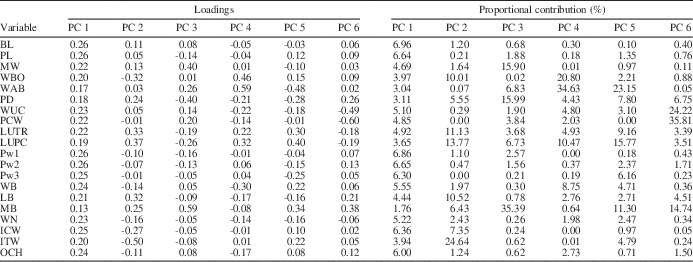
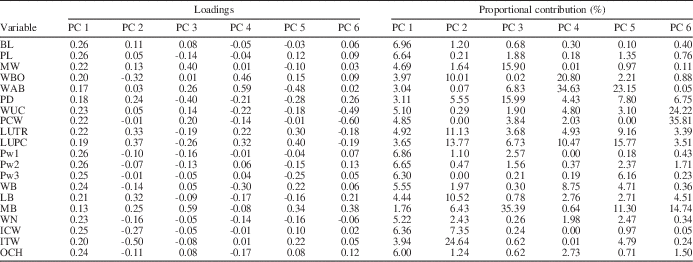
Our PCA segregated taxa by genera (Fig. 7, Table 3). Approximately 89% of the variation was explained by the first six components. Component 1 explained ~65% of the variation and reflected size differences between taxa. Large taxa, including Phocarctos and Neophoca, plotted positively, while small taxa such as Arctophoca had negative scores. Arctocephalus is intermediate between the two groups. Fossil Neophoca plotted with extant Neophoca. Principal component 2 explained ~7% of the variation and reflected variation in the width of the intertemporal constriction (ITW). This component segregated Phocarctos and Neophoca from one another, with the relatively broad ITW of Neophoca resulting in more negative scoring than the narrow ITW of Phocarctos. Principal component 3 explained ~6% of the variation and reflected the breadth of the mastoid process. This feature weakly segregated Arctocephalus and Phocarctos from all other taxa. Neophoca and Arctophoca were not segregated from one another, and fossil Neophoca also plotted within this intermediate range. Principal component 4 explained ~4% of the variation and reflected width of the basicranium. Most taxa were only poorly segregated on this axis; however, N. palatina was clearly distinguished from all other taxa on the basis of its unusually broad basisphenoid. Holocene Neophoca plotted with extant otariids. Principle component 5 explained ~3% of the variation and reflected width of the basisphenoid, breadth of the skull across the mastoids, and length of the tooth row. Again, N. palatina was segregated from other taxa, but all other taxa showed no significant segregation. Principal component 6 explained ~3% of the variation and reflected size of the postcanine teeth. Taxa were not easily segregated by this component.
Bivariate plots for Australasian otariid seals. (1) Principal components 1 and 2; (2) principal components 3 and 4; (3) principal components 5 and 6.
Variable loadings for principal component analysis of cranial measurement data from Australasian Otariidae.
Discriminant function analysis results supported the PCA analysis. Holocene fossil Neophoca were classified within Neophoca with a posterior probability of 1.0. Neophoca palatina was also classified as belonging to Neophoca, with a posterior probability of 0.99. Identification of these taxa to other genera all carried posterior probabilities far less than 0.001.
Discussion
Phylogenetic and biogeographic implications
Our morphometric analysis placed N. palatina within the morphospace occupied by Neophoca, supporting King’s (Reference King1983a) referral of this species to the genus. We are also able to confirm that the Pleistocene and Holocene material from Victoria, Australia, is referable to extant N. cinerea, supporting the synonymy of Arctocephalus williamsi McCoy, Reference McCoy1877 with N. cinerea (Gill, Reference Gill1968; King, Reference King1983b). Our analysis also found distinctive characters that separate N. palatina from N. cinerea, specifically an unusually broad basisphenoid and smaller body size. The results for N. palatina in this study contrast with the earlier study of Churchill et al. (Reference Churchill, Clementz and Boessenecker2014a), which was unable to resolve the position of this taxon with any support. Otariid skulls are morphologically conservative (Jones and Goswami, Reference Jones and Goswami2010), and this has been a confounding problem in analyzing the relationships of extant taxa (Churchill et al., Reference Churchill, Clementz and Boessenecker2014a). Churchill et al. (Reference Churchill, Clementz and Boessenecker2014a) used many qualitative characters, and these characters may not have properly captured differences in cranial shape between taxa. By contrast, this study has revealed several potential new characters derived from morphometric comparisons that may be useful in phylogenetic analysis. Further research on otariid systematics should focus on creating large data sets of cranial measurement data and exploring these data sets to create novel quantitative characters that can improve the resolution of phylogenies produced using morphologic data.
The role of Neophoca palatina in the evolution of Australasian sea lions is unclear. Molecular and total evidence phylogenetic analyses have generally had problems resolving the position of Neophoca within Otariidae (Wynen et al., Reference Wynen2001; Árnason et al., Reference Árnason, Gullberg, Janke, Kullberg, Lehman, Petrov and Väinölä2006; Higdon et al., Reference Higdon, Bininda-Emonds, Beck and Ferguson2007; Churchill et al., Reference Churchill, Clementz and Boessenecker2014a), although Yonezawa et al. (Reference Yonezawa, Kohno and Hasegawa2009) recovered Neophoca as the sister taxon to Phocarctos. If Neophoca is indeed the sister taxon to Phocarctos, than the presence of N. palatina in New Zealand suggests that the Neophoca and Phocarctos clade may have originated in New Zealand. Divergence of these taxa may have been driven by successive cycles of regional extinction and recolonization, driven by either cooling climate during glacial intervals or changes in haul-out habitat as a result of changes in sea level (Valenzuela-Toro et al., Reference Valenzuela-Toro, Gutstein, Varas-Malca, Suarez and Pyenson2013).
Churchill et al. (Reference Churchill, Clementz and Boessenecker2014a), however, recovered Phocarctos as the sister taxon to Otaria of South America. If this topology is correct, we can hypothesize that Neophoca was once distributed widely in the Australasian region. Extinction of N. palatina would have left the ‘sea lion’ niche open in New Zealand. New Zealand would have then been colonized by stem members of the Phocarctos-Otaria lineage, and divergence of these two genera would have been facilitated by the distance between New Zealand and South America. A similar dispersal pattern is indicated by Arctophoca australis, which originated along the Pacific coast of South America and expanded its range to New Zealand and later Australia, giving rise to A. australis forsteri (Churchill et al., Reference Churchill, Clementz and Boessenecker2014a). More comprehensive phylogenetic analyses and further fossil discoveries from the Pliocene and Pleistocene of Australia and New Zealand are needed to test these hypotheses.
Paleoenvironmental implications
Fossil and archaeological material of pinniped taxa has provided important evidence of Holocene and Pleistocene climate change (Gill, Reference Gill1968; Sun et al., Reference Sun, Liu, Yin, Zhu, Xie and Wang2004; Hall et al., Reference Hall, Hoelzel, Baroni, Denton, Le Boeuf, Overturf and Töpf2006; Bruyn et al., Reference Bruyn, Hall, Chauke, Baroni, Koch and Hoelzel2009). Otariid distribution is strongly controlled by sea surface temperature and productivity, with the distribution of extant taxa closely aligning with regions of low sea surface temperature (SST) and upwelling-enhanced productivity (Churchill et al., Reference Churchill, Clementz and Boessenecker2014a). The temperature tolerances of individual species may also provide clues on past sea surface temperature. Gill (Reference Gill1968) argued that the coastline of Victoria was warmer during the last interglacial, according to the current distribution of Neophoca cinerea and the presence of fossil material referable to this taxon in the area.
Neophoca cinerea inhabit regions with a mean SST of ~16–23°C. By contrast, the sea around New Zealand has a mean SST of ~12–17°C. Phocarctos is the only extant sea lion known from New Zealand; although today this species is mostly restricted to the Auckland and Campbell Islands, archaeological evidence indicates that this species bred on both North and South Island (Childerhouse and Gales, Reference Childerhouse and Gales1998; Collins et al., Reference Collins, Rawlence, Worthy, Scofield, Tennyson, Smith, Knapp and Waters2014b), and only recently became extinct due to human exploitation (Collins et al., Reference Collins, Rawlence and Prost2014a). Our morphometric analysis clearly placed N. palatina within the morphospace of Neophoca, and we were unable to find any characters that link this taxon to Phocarctos. If N. palatina possessed a temperature tolerance similar to that possessed by N. cinerea, this would indicate that SSTs in New Zealand were warmer in the Middle Pleistocene than they are today.
However, paleoenvironmental reconstructions of SST during the Middle Pleistocene in the vicinity of New Zealand disagree and conclude that SSTs during interglacial periods were not significantly different from SSTs during the Holocene (King and Howard, Reference King and Howard2000; Schaefer et al., Reference Schaefer, Rodger, Hayward, Kennett, Sabaa and Scott2005; Wilson et al., Reference Wilson, Hayward, Sabaa, Scott and Kennett2005). This suggests that N. palatina may have been more cold tolerant than N. cinerea and that adaptation of N. cinerea toward warmer environments is recent in origin. Furthermore, this provides evidence for a widespread distribution of Neophoca, with the extant N. cinerea currently relegated to southern and western Australia. Whether Phocarctos later immigrated to New Zealand after the local extinction of Neophoca, or was in part responsible for its extinction, is presently unknown. The limited pre-Holocene pinniped fossil record in New Zealand and Australia makes these hypotheses speculative, but further discovery and description of Australasian fossil pinnipeds will allow testing.
Acknowledgments
We thank B. Gill and J. Froggatt (Auckland Museum) for access to and loaning of the Neophoca palatina holotype and for permission to reconstruct the skull. We also thank R.E. Fordyce for hosting this study and receiving the loan for us. We greatly appreciate assistance from R.E. Fordyce and S.E.M. White with preparation and provision of working laboratory space. For assistance with locality data for Holocene and Pleistocene Neophoca, we thank E. Fitzgerald. For access to specimens, we thank S. Ingleby (Australian Museum); E. Fitzgerald and K. Roberts (Museum Victoria); E. Burns, C. Fraser, and F.G. Marx (Otago Museum); and C. Kemper and D. Stemmer (South Australian Museum). The late I.W. Keyes graciously provided a cast of the holotype skull to the University of Otago Geology Museum. This study benefited from discussions with R.E. Fordyce and Y. Tanaka.
Appendix. List of specimens examined for this study
Abbreviations for museum collections used in this study: AIM=Auckland War Memorial Museum; AM=Australian Museum; SAMA=South Australian Museum; NMV=Museum Victoria; OM=Otago Museum; OU=University of Otago Department of Geology; USNM=United States National Museum of Natural History.
Neophoca palatina: AIM Mamm 175.1
Neophoca cinerea (recent): AM M8945; M3124; SAMA M2480; M3219; M6163; M1263; M2003; M1256; M2477; M4942; M5077; M6263; M8674; M7472; M9040; M9041; M9545; M11,223; M11,636; M11,702; M11,704; M11,710; M12788; M13379; M15458; M15748; M15964; M15963; M16229;
Neophoca cinerea (fossil): NMV P12110; P21397
Phocarctos hookeri: AIM LM146; OM VT620; OM VT090; OM VT087; OM VT088; two unregistered specimens from the marine sciences department at University of Otago
Arctocephalus pusillus doriferus: AM S1656; M4750; M3714; S211; S1793; NMV C1987; C1991; C1988; SAMA M10,109; M25591; M23799; M22085; M22966; M22086; M14040; M15297; M15407; M15404; M15411; M15502; M15511; M15500; M15410; M15414; M15515; M15512; M15513; M15517; M15967; M22014; M25592
Arctophoca australis forsteri: AIM LM506; LM747; LM919; LM1504; LM1512; OM NC2011.73; VT534; VT3013; VT079; OU 22012; 22013; SAMA M22071; M22094; M22092; one unregistered specimen from the marine sciences department and one from the geology department from the University of Otago
Arctophoca gazella: AM M29116; M29113; M28914; M29111; M29121; M29120; M29110; M29114; M29117; M32062; M28910; M29119; M28912; M29122; M29109; M28913; M28913; M28915; M29115
Arctophoca tropicalis: NMV unregistered specimen; SAMA M18395; M17672; M24981