Introduction
Much work indicates that subclinical hallucinatory experiences share risk factors with clinical psychosis and are associated with significant burden (Baumeister, Sedgwick, Howes, & Peters, Reference Baumeister, Sedgwick, Howes and Peters2017; Laloyaux et al., Reference Laloyaux, Bless, Hugdahl, Krakvik, Vedul-Kjelsas, Kalhovde and Laroi2019; Linscott & van Os, Reference Linscott and van Os2013). However, little is known about the presentation and clinical implications of different modalities of hallucinations in community samples. The phenomenology of hallucinatory experiences in the general population is poorly understood. The vast majority of previous work exclusively investigated auditory and sometimes visual hallucinations, frequently neglecting other sensory modalities, like haptic and olfactory hallucinations, and most commonly used self-report only. As a large proportion of psychotic patients hallucinate in more than one sensory modality (Lim, Hoek, Deen, Blom, & Investigators, Reference Lim, Hoek, Deen, Blom and Investigators2016; Llorca et al., Reference Llorca, Pereira, Jardri, Chereau-Boudet, Brousse, Misdrahi and de Chazeron2016; McCarthy-Jones et al., Reference McCarthy-Jones, Smailes, Corvin, Gill, Morris, Dinan and Dudley2017), it has been proposed that the possible mechanisms behind hallucinations present in psychiatric disorders are multimodal by nature (Ffytche & Wible, Reference Ffytche and Wible2014; Laloyaux et al., Reference Laloyaux, Bless, Hugdahl, Krakvik, Vedul-Kjelsas, Kalhovde and Laroi2019; Rollins et al., Reference Rollins, Garrison, Simons, Rowe, O'Callaghan, Murray and Suckling2019). Hallucinations that arise from the activation of primary sensory areas tend to be simple and unimodal. For example, a convulsive activity on the primary auditory cortex can generate an experience of tinnitus, while the activation of the primary visual cortex during neurosurgery produces a bright sphere (Ffytche & Wible, Reference Ffytche and Wible2014). Hallucinations present in psychosis and mental disorders, however, involve complex representations, for example, human voices with specific prosody and pitch that formulate sentences or entire conversations (McCarthy-Jones et al., Reference McCarthy-Jones, Trauer, Mackinnon, Sims, Thomas and Copolov2014). Therefore, it is thought that these are linked to the activation of higher order cortical process (Ffytche & Wible, Reference Ffytche and Wible2014) and can involve the activation of different sensory representations (Ffytche & Wible, Reference Ffytche and Wible2014; Rollins et al., Reference Rollins, Garrison, Simons, Rowe, O'Callaghan, Murray and Suckling2019). To the best of our knowledge, only one study investigated multimodal (i.e. hallucinations in more than one sensory modality) v. unimodal hallucinations in a community-based sample (Laloyaux et al., Reference Laloyaux, Bless, Hugdahl, Krakvik, Vedul-Kjelsas, Kalhovde and Laroi2019; Laroi et al., Reference Laroi, Bless, Laloyaux, Krakvik, Vedul-Kjelsas, Kalhovde and Hugdahl2019). The authors found that, similarly to what happens in psychotic disorder (Llorca et al., Reference Llorca, Pereira, Jardri, Chereau-Boudet, Brousse, Misdrahi and de Chazeron2016; McCarthy-Jones et al., Reference McCarthy-Jones, Smailes, Corvin, Gill, Morris, Dinan and Dudley2017), the great majority of those in the general population who have auditory hallucinations present with hallucinations in other sensory modalities. In addition, the presence of multimodal hallucinations, compared to unimodal visual hallucinations, was associated with poorer mental health and more negative life events (Laloyaux et al., Reference Laloyaux, Bless, Hugdahl, Krakvik, Vedul-Kjelsas, Kalhovde and Laroi2019). Although the aforementioned work is an important contribution to the understanding of subclinical manifestations of psychosis in the general population, it focused on auditory hallucinations and associations with other sensory modalities. Thus, the clinical significance of each sensory modality was not assessed. It also was not established whether only auditory hallucinations predict other modalities or if all types of hallucinations predict each other. These questions are of relevance, as previous studies that did not include such modalities may have underestimated the strength of the association of hallucinations with mental problems. Furthermore, if all modalities cluster together and are associated with the indicators of poor mental health, they are likely to pertain to the same underlying construct and should all be routinely evaluated for the identification of individuals at risk.
It is also relevant that the great majority of previous studies investigating hallucinatory experiences in the general population used self-report and did not characterize the psychopathological context in which they emerged (Maijer, Begemann, Palmen, Leucht, & Sommer, Reference Maijer, Begemann, Palmen, Leucht and Sommer2018). The use of self-report is associated with rates more than three times higher than rates obtained from interview-based assessments of psychotic experiences (Linscott & van Os, Reference Linscott and van Os2013). Although there is evidence that clinically confirmed and self-reported psychotic experiences show similar patterns of associations with morbidity and risk factors for mental health problems and psychotic disorder, clinically validated psychotic experiences are strongly associated with help-seeking behaviours, and may index greater risk (van Nierop et al., Reference van Nierop, van Os, Gunther, Myin-Germeys, de Graaf, ten Have and van Winkel2012). In addition, studying hallucinations without psychopathological context may also represent a suboptimal strategy, as the incidence of hallucinations is intertwined with the onset of delusional ideation and affective dysregulation (Bartels-Velthuis, Blijd-Hoogewys, & van Os, Reference Bartels-Velthuis, Blijd-Hoogewys and van Os2011; Escher, Romme, Buiks, Delespaul, & van Os, Reference Escher, Romme, Buiks, Delespaul and van Os2002a; Krabbendam et al., Reference Krabbendam, Myin-Germeys, Hanssen, Bijl, de Graaf, Vollebergh and van Os2004; Krabbendam et al., Reference Krabbendam, Myin-Germeys, Hanssen, de Graaf, Vollebergh, Bak and van Os2005; Smeets et al., Reference Smeets, Lataster, van Winkel, de Graaf, Ten Have and van Os2013), which, in combination with known risk factors for psychotic disorder, appear to impact the course and outcome of hallucinations (Bartels-Velthuis, Wigman, Jenner, Bruggeman, & van Os, Reference Bartels-Velthuis, Wigman, Jenner, Bruggeman and van Os2016; Escher, Romme, Buiks, Delespaul, & Van Os, Reference Escher, Romme, Buiks, Delespaul and Van Os2002b; Krabbendam et al., Reference Krabbendam, Myin-Germeys, Hanssen, de Graaf, Vollebergh, Bak and van Os2005).
Finally, most studies investigated lifetime prevalence rather than incidence of hallucinations (Linscott & van Os, Reference Linscott and van Os2013; Maijer et al., Reference Maijer, Begemann, Palmen, Leucht and Sommer2018; Rubio, Sanjuan, Florez-Salamanca, & Cuesta, Reference Rubio, Sanjuan, Florez-Salamanca and Cuesta2012), reporting relatively high rates. A meta-analysis found a mean lifetime prevalence of 9.6% for the general population (Maijer et al., Reference Maijer, Begemann, Palmen, Leucht and Sommer2018). Reviews of the few incidence studies suggest that the rate of new hallucinatory experiences is much lower than reported prevalence rates (Linscott & van Os, Reference Linscott and van Os2013; Rubio et al., Reference Rubio, Sanjuan, Florez-Salamanca and Cuesta2012) and that persistence may be more important than occurrence in determining negative outcomes associated with psychotic experiences (Linscott & van Os, Reference Linscott and van Os2013). Consequently, it is important to understand to what degree newly incident experiences are associated with burden and to what extend they are likely to persist. Furthermore, although different authors found hallucinations to be associated with risk factors for psychosis (Kelleher et al., Reference Kelleher, Connor, Clarke, Devlin, Harley and Cannon2012; Linscott & van Os, Reference Linscott and van Os2013), the use of prevalence in previous studies limits causal inferences.
In conclusion, although growing importance has been given to hallucinations as a risk factor for mental health problems, little is known about how the experience of hallucinations presents itself for the first time across the different sensory modalities.
We studied the incidence and prevalence of hallucinations across different sensory modalities in two large prospective representative population-based samples. Incidence and prevalence rates were obtained for both self-reported and clinically confirmed hallucinations. Our aims were (i) to estimate the prevalence and incidence of self-reported and clinically confirmed hallucinatory experiences from different sensory modalities; (ii) to assess the persistence rates of hallucinatory experiences; (iii) to test if hallucinations in one sensory modality increase the likelihood of another modality; (iv) to test the association of different sensory modalities with psychiatric morbidity and clinical characteristics associated with psychosis. We hypothesized that the incidence of hallucinations would be well below the reported 1% incidence of psychotic experiences but with a similar 20% persistence rate (Linscott & van Os, Reference Linscott and van Os2013); that all hallucinatory modalities would be strongly associated with each other and with the presence of mental disorder, delusional ideation, impaired functioning, environmental risks and help-seeking. We also hypothesized that, based on previous work, results using self-reported hallucinatory experiences would be similar to results based on clinician-validated hallucinatory experiences (Bak et al., Reference Bak, Delespaul, Hanssen, de Graaf, Vollebergh and van Os2003; Kelleher, Harley, Murtagh, & Cannon, Reference Kelleher, Harley, Murtagh and Cannon2011; van der Steen et al., Reference van der Steen, Myin-Germeys, van Nierop, Ten Have, de Graaf, van Dorsselaer and van Winkel2018; van Nierop et al., Reference van Nierop, van Os, Gunther, Myin-Germeys, de Graaf, ten Have and van Winkel2012).
Methods
NEMESIS (Netherlands Mental Health Survey and Incidence Study), and its successor NEMESIS-2, are longitudinal cohort studies of the prevalence, incidence, course and consequences of mental disorders in the Dutch general population. Both studies applied multistage, random sampling procedures of municipalities and households. Detailed information about the study characteristics was published elsewhere (Bijl, Ravelli, & van Zessen, Reference Bijl, Ravelli and van Zessen1998; de Graaf, Ten Have, & van Dorsselaer, Reference de Graaf, Ten Have and van Dorsselaer2010). NEMESIS included 7076 participants aged 18–64 years (average age at baseline 41.2 years, s.d. = 12.2) and consisted of two follow-up waves, respectively 1 (T1) and 3 (T2) years after the baseline measurement (T0). At T2, a total of 4796 persons participated (68% of T0 cases). NEMESIS-2 included 6646 participants aged 18–65 years (average age at baseline 44.2 years, s.d. = 12.5). Three years after baseline (T0), 5303 persons participated in the follow-up assessment (T1, 80% of T0 cases), 6 years after baseline, 4618 persons participated in the second follow-up assessment (T2, 69% of T0 cases).
In both studies, participants were interviewed using various versions of the Composite International Diagnostic Interview (CIDI) (World Health Organisation, 1990). This is a comprehensive and standardized diagnostic interview assessing symptoms, syndromes and diagnoses of mental disorders according to the diagnostic criteria of a version of the Diagnostic and Statistical Manual of Mental disorders (DSM). The instrument is designed to be used by trained lay interviewers, who read questions in a standardized way and record participants' answers. Therefore, the CIDI is essentially a self-report instrument (Eaton, Neufeld, Chen, & Cai, Reference Eaton, Neufeld, Chen and Cai2000). Both the validity (Haro et al., Reference Haro, Arbabzadeh-Bouchez, Brugha, de Girolamo, Guyer, Jin and Kessler2006; Reed et al., Reference Reed, Gander, Pfister, Steiger, Sonntag, Trenkwalder and Wittchen1998) and the test-retest reliability have been established, showing that the CIDI provides valid diagnoses for almost all non-psychotic disorders with good to excellent κ coefficients for most diagnostic sections (Wittchen, Reference Wittchen1994).
In NEMESIS, interviews were performed using the CIDI version 1.1 (Smeets & Dingemans, Reference Smeets and Dingemans1993). This version of the CIDI generated DSM-III-R diagnoses. Participants of the NEMESIS-2 were interviewed using the CIDI version 3.0 (Alonso et al., Reference Alonso, Angermeyer, Bernert, Bruffaerts, Brugha, Bryson and Eseme2004; de Graaf, ten Have, Burger, & Buist-Bouwman, Reference de Graaf, ten Have, Burger, Buist-Bouwman, Kessler and Ustun2008). This version of the CIDI generated DSM-IV diagnoses and contained a screening section with key questions for most mental disorders (de Graaf et al., Reference de Graaf, Ten Have and van Dorsselaer2010). Only participants answering positively on a key question were administered the complete disorder section.
Assessment of psychotic experiences
In NEMESIS, the G section of the CIDI version 1.1 was used to assess both delusions and hallucinations, here referenced to as psychotic experiences (PE). This section consists of 13 items on delusions and four items on hallucinations. In NEMESIS-2, a psychosis add-on instrument based on the G section of the previous CIDI versions was included. This add-on instrument consists of 20 psychotic symptoms corresponding to the symptoms assessed in NEMESIS. Detailed descriptions of the specific PE items can be found in previous work using NEMESIS (Smeets et al., Reference Smeets, Lataster, van Winkel, de Graaf, Ten Have and van Os2013) and NEMESIS-2 (van Nierop et al., Reference van Nierop, van Os, Gunther, Myin-Germeys, de Graaf, ten Have and van Winkel2012). At baseline, the lifetime prevalence of PE was assessed in both NEMESIS and NEMESIS-2. The assessment of CIDI self-reported hallucinations was virtually identical for NEMESIS and NEMESIS-2, so that the results of one can be used as replication for the other.
For NEMESIS-2 data, analyses are presented separately for any CIDI self-reported PE and for clinically validated PE, in order to examine to what degree results based on CIDI self-reported hallucinatory experiences are comparable with clinically validated PE. Thus, in NEMESIS-2, a clinician did a follow-up telephone interview when participants reported a psychotic symptom to assess whether this symptom was a true PE using questions from the Structured Clinical Interview for DSM-IV. At baseline, a total of 1081 participants (16.3%) endorsed at least one self-reported PE. Of these, 794 participated in clinical re-interview (74%), of whom 340 (42.8%) reported at least one clinically validated PE. At T1, 440 out of a total of 5303 (8.3%) participants reported that at least one self-reported PE had occurred since the previous interview. Of these, 367 (83.4%) participants were available for clinical re-interview, of whom 172 (46.9%) reported at least one clinically validated PE. At T2, 284 out of the total 4618 (6.2%) participants reported that at least one self-reported PE had occurred since the previous interview. Of these, 230 (81%) participants were available for clinical re-interview, of which 135 (58.7%) reported at least one clinically validate PE. In addition, in NEMESIS-2, those participants who were re-interviewed were also asked whether they had wanted to seek help for any of the psychotic experiences reported (hereafter: psychosis help-seeking).
PE were dichotomized consistent with previous work in NEMESIS and NEMESIS-2 (Pries et al., Reference Pries, Guloksuz, Ten Have, de Graaf, van Dorsselaer, Gunther and van Os2018; Rosa, Fananas, Marcelis, & Van Os, Reference Rosa, Fananas, Marcelis and Van Os2000). Thus, the presence of delusions was defined as having at least one delusion endorsed.
Childhood adversity
In both NEMESIS and NEMESIS-2, childhood adversity was assessed using a questionnaire based on the NEMESIS trauma questionnaire (de Graaf et al., Reference de Graaf, Ten Have and van Dorsselaer2010). Whenever a subject reported having experienced one of five types of childhood adversity [two times or more emotional neglect (not listened to, ignored or unsupported), physical abuse (kicked, hit, bitten or hurt with an object or hot water), psychological abuse (yelled at, insulted, unjustly punished/treated, threatened, belittled or blackmailed), peer victimization (bullying) and one time or more sexual abuse (any unwanted sexual experience) before the age of 16], they were asked to state how often it had occurred on a scale of 1 (once) to 5 (very often). In NEMESIS, conform previous analyses, ‘no abuse’ was defined as any item ⩽3 and ‘abuse’ if the score on any item >3 (Janssen et al., Reference Janssen, Krabbendam, Bak, Hanssen, Vollebergh, de Graaf and van Os2004). In NEMESIS-2, conforming with previous work in this area, the childhood adversity score was dichotomized at the 80th percentile (van Dam et al., Reference van Dam, van Nierop, Viechtbauer, Velthorst, van Winkel, Genetic and Wiersma2015).
Cannabis use
In NEMESIS-2, cannabis use was assessed in the section Illegal Substance Use of the CIDI 3.0. Consistent with previous work (van Winkel, Genetic, & Outcome of Psychosis, Reference van Winkel and Genetic2011), the cut-off of use of once per week or more in the period of most frequent use was used to define a binary variable for regular lifetime cannabis use. In NEMESIS, a similar cannabis exposure was defined based on lifetime use (van Os et al., Reference van Os, Bak, Hanssen, Bijl, de Graaf and Verdoux2002).
Urbanicity
In NEMESIS-2, the extent of the exposure to the urban environment until age 16 years was constructed at five levels based on the Dutch classification of population density: (1) countryside (distances to amenities is larger), (2) village (<25 000 inhabitants), (3) small city (25 000–50 000 inhabitants), (4) medium city (50 000–100 000 inhabitants), (5) large city (>100 000 inhabitants). Consistent with previous work, the cut-off of >50 000 inhabitants was used to define the binary variable of the urban area (Guloksuz et al., Reference Guloksuz, van Nierop, Lieb, van Winkel, Wittchen and van Os2015). In NEMESIS, urban exposure was based on current residence, using the same dichotomized definition.
Other variables
For both NEMESIS and NEMESIS-2, the continuous ratings of general, mental and physical health and social functioning over the past month were assessed by the Medical Outcomes Study Short-form Health Survey (Stewart, Hays, & Ware, Reference Stewart, Hays and Ware1988; Ware & Sherbourne, Reference Ware and Sherbourne1992), of which the continuous rating of impaired social functioning was used as a variable in the analysis, dichotomized around the 75th percentile. In NEMESIS, mental health service use was defined as having had contact with a community mental health centre, a psychiatric outpatient clinic, a private psychiatrist, a psychologist, a psycho-therapist, psychiatric admission or day treatment lifetime (at baseline) or in the past 12 months (T1 or T2). In NEMESIS-2, contact with any psychiatrist or psychologist or other mental health professionals in the last 12 months for any psychiatric problem including drug or alcohol problems was also assessed at each wave (hereafter: any mental health service use). For both NEMESIS and NEMESIS-2, the variable ‘any diagnosis’ refers to the presence of any axis-I diagnosis of mental disorder (mood, anxiety and substance use disorders) as assessed in NEMESIS and NEMESIS-2 in any of the waves.
Risk set
For both NEMESIS and NEMESIS-2, individuals with an established diagnosis of a psychotic disorder (NEMESIS: n = 107; NEMESIS-2: n = 43) were excluded from analyses.
Analysis
First, self-reported and clinically confirmed hallucinatory experiences were used to assess prevalence, incidence and persistence. Persistence was measured using lagged data, indicating the status of the outcome in question at the previous visit. For incident hallucinatory experiences, persistence was defined as: the probability of having a hallucinatory experience at T2 in those who had not displayed a hallucinatory experience at T0 and for the first time did display a hallucinatory experience at T1. For prevalent hallucinatory experiences, persistence was defined as: the probability of having a hallucinatory experience at T2 in those who had displayed a hallucinatory experience at T0 and again at T1. Persistence rate was calculated only for NEMESIS-2.
For the other research questions, data were set for survival analysis using the stset routine in Stata, release 15 (StataCorp, 2017). In four different analyses, failure was defined as, separately, any auditory, visual, haptic or olfactory hallucinatory experience. In NEMESIS-2, separate analyses were conducted for any CIDI-reported hallucinatory experience and clinically validated hallucinatory experience. Incidence was calculated using failures in single-failure per subject data (i.e. one single event was defined as failure, with a single record per subject).
To test if hallucinations in one sensory modality would increase the likelihood of another modality, the association between concomitant incident hallucinations from different sensory modalities was estimated using Cox proportional hazard regression analysis and hazard ratios (HR) and 95% confidence intervals (CI) were estimated.
To analyse the fourth research question, Cox proportional hazard regression analysis was performed including psychiatric morbidity and clinical characteristics as the independent variables and the four sensory modalities as the dependent variable. The STSET command was used to tell Stata the format of the survival data, guiding treatment of time-varying and fixed independent variables in the analyses.
Results
Incidence and persistence
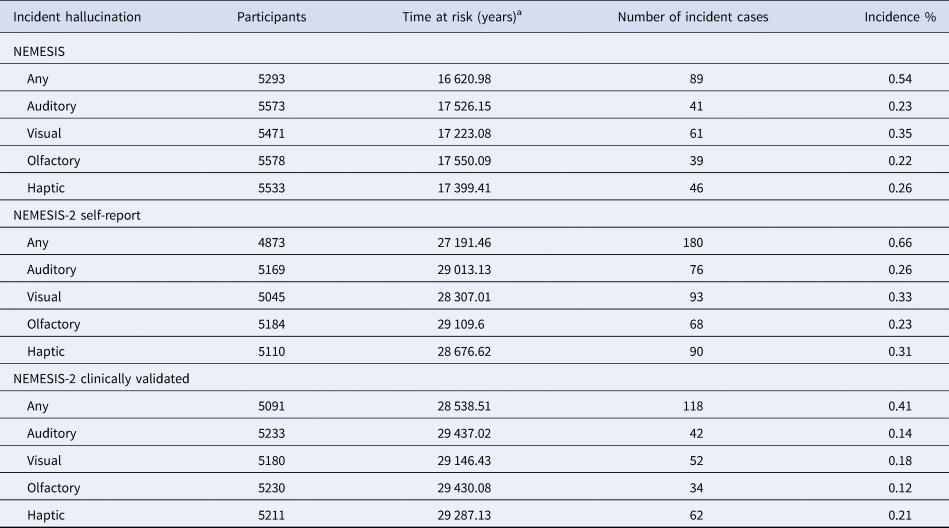
The yearly incidence of any hallucinatory experience in NEMESIS was 0.54%, varying from 0.22 to 0.35 for the different subtypes (Table 1), with highest rates in descending order for visual, haptic, auditory and finally olfactory hallucinatory experiences. A similar rate for any hallucinatory experience was observed in NEMESIS-2 (0.66%), with similarly lower subtype rates (Table 1). The rate of clinically validated hallucinatory experiences was around 60% the rate of self-reported experiences.
Incident hallucinations

a The total number of person-years, derived from the number of persons and the length of their individual follow-ups, in years.
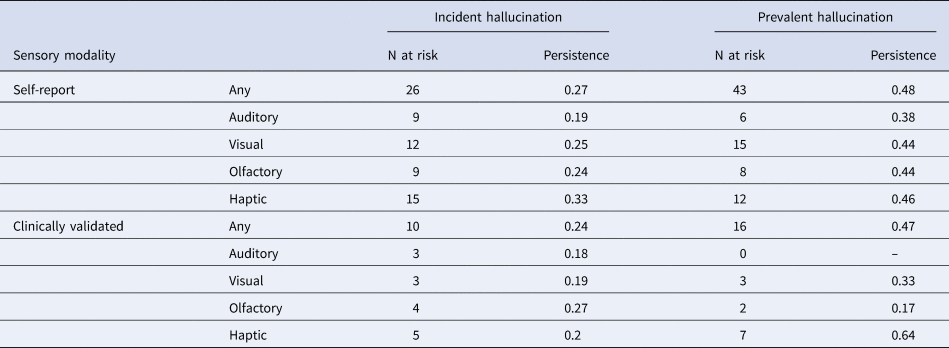
Around 20–30% of incident hallucinatory experiences persisted, whereas for prevalent hallucinatory experiences, the rate was around 40–50%. Persistence rates were not consistently different for self-reported and clinically validated experiences (Table 2).
Persistence rate for the incident and prevalent hallucinations (NEMESIS-2)

Co-occurrence of hallucinatory experiences
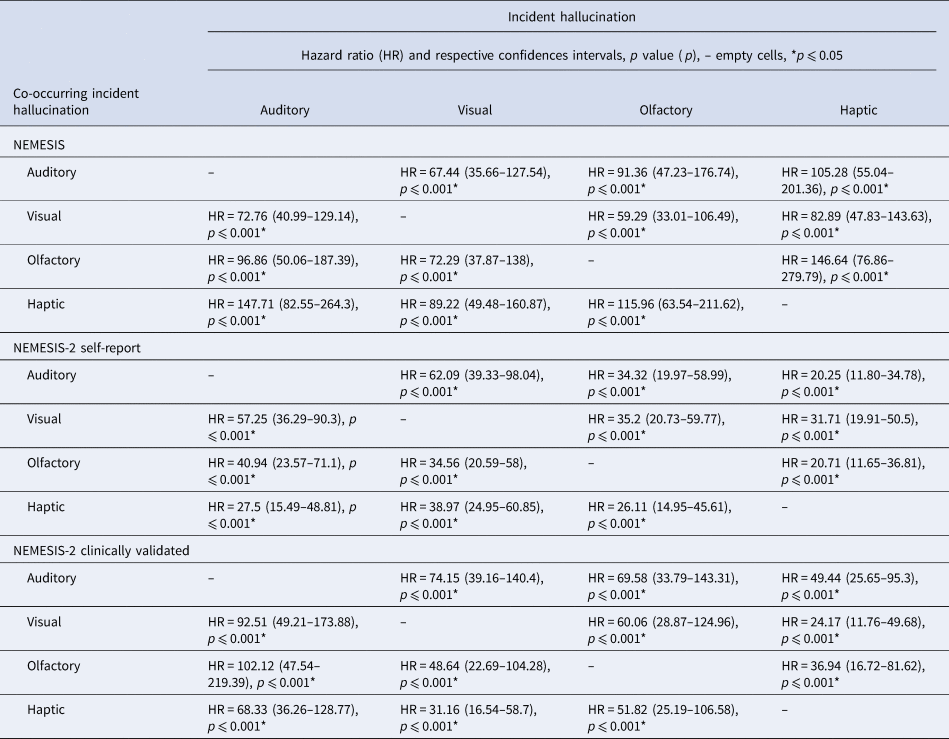
Incident hallucinatory experiences across different modalities were very strongly associated with each other, regardless of NEMESIS sample and clinical validation (Table 3). The median co-occurrence odds ratio across all analyses in NEMESIS and NEMESIS-2 was 59.
Co-occurrence of hallucinations

Risk factors and clinical associations
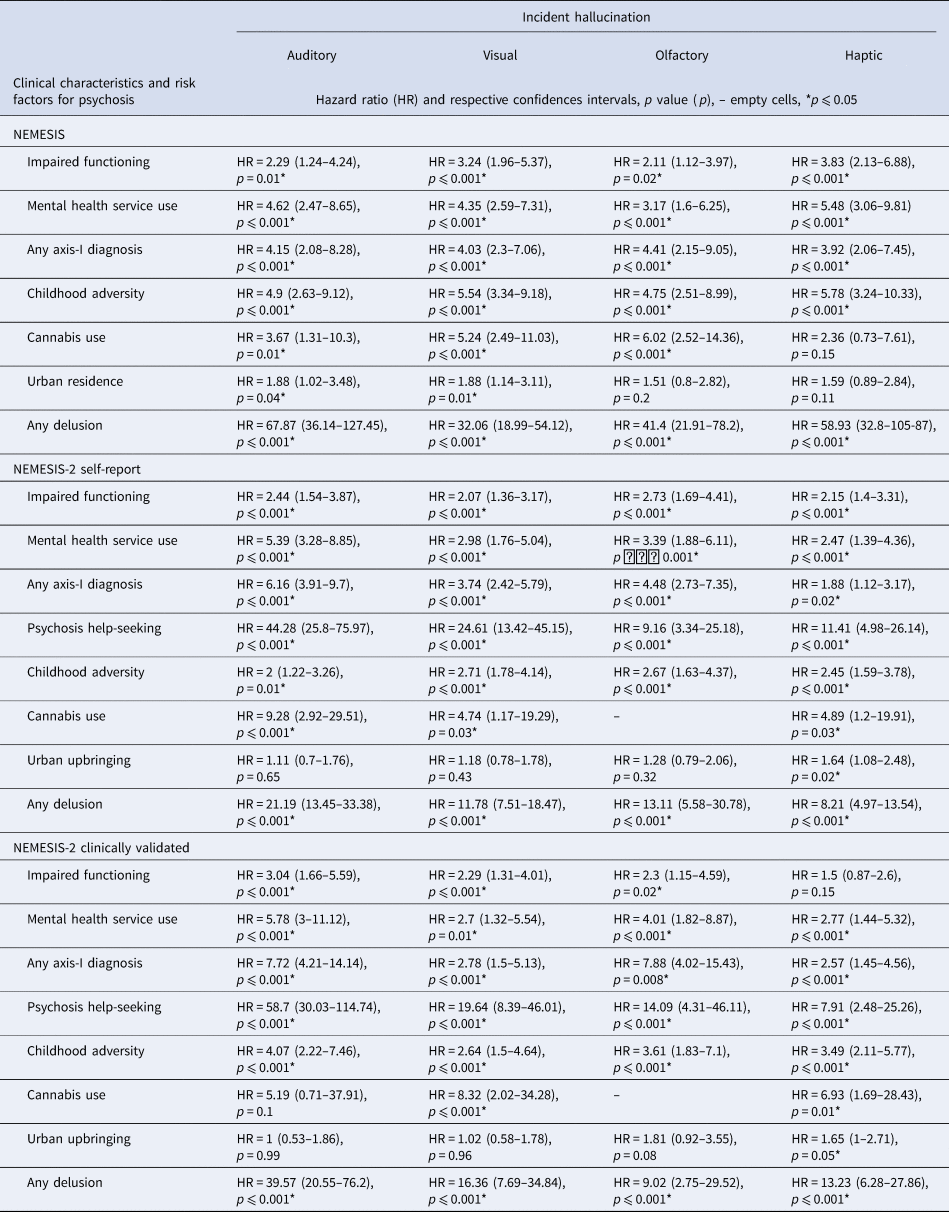
Impaired functioning, mental health service use, any axis-1 non-psychotic diagnosis and help-seeking were strongly associated with incident hallucinatory experiences, regardless of sample and clinical validation (median OR = 4; Table 4). The median OR for co-occurrence with delusional ideation was 21. Childhood adversity and cannabis use were consistently associated with incident hallucinatory experiences, whereas urbanicity was more weakly and less consistently associated with incident hallucinatory experiences (Table 4).
Incident hallucinations clinical and risk factor associations

Discussion
We examined the incidence, course and risk factors of hallucinatory experiences in different sensory modalities in two large prospective cohorts of non-psychotic community-based individuals. We found very consistent results across the two samples, the yearly incidence of self-reported visual hallucinations was the highest (0.33% in NEMESIS and 0.35% in NEMESIS-2), followed by haptic hallucinations (0.31% and 0.26%, respectively), auditory hallucinations (0.26% and 0.23%) and olfactory hallucinations (0.23% and 0.22%). The incidence of clinician-confirmed hallucinations was approximately 60% of the self-reported rate. Around 20–30% of newly incident hallucinations persisted across 3 years and 40–50% of prevalent hallucinations that were evident in the first two waves of evaluation persisted into the third wave. Incident hallucinations in one modality were very strongly (median OR = 59) associated with incidence in another modality and all modalities were strongly associated with delusional ideation (median OR = 21). Presence of mental disorder (median OR = 4), functioning, indicators of help-seeking and environmental risk factors for psychotic disorder were approximately equally strongly associated with all modalities. Our findings advance current knowledge by showing that the types of hallucinations frequently neglected in the literature and clinical evaluation of non-psychotic patients, like haptic and olfactory hallucinatory experiences, are relatively common in non-psychotic individuals and their occurrence is as strongly associated with psychiatric morbidity and need of care as auditory and visual hallucinations. We also showed that all different types of hallucinations tend to co-occur and present similar patterns of associations, suggesting a possible shared mechanism. These results are coherent with previous data, showing that hallucinations, although frequent in the general population, are associated with increased morbidity (Laloyaux et al., Reference Laloyaux, Bless, Hugdahl, Krakvik, Vedul-Kjelsas, Kalhovde and Laroi2019); however, we expand previous knowledge by showing that all modalities of hallucinations are likely associated with mental problems. In order to progress the characterization of phenotypes of risk, future studies should put more emphasis on the evaluation of hallucinations across different sensory modalities and in differentiating those with unimodal v. multimodal hallucinations.
Occurrence, co-occurrence and clinical significance of hallucinatory experiences across different sensory modalities
In two large population cohorts, we replicated the finding that hallucinatory experiences arise in the non-psychotic population at a rate of around 0.5%, roughly 25 times the reported incidence of a psychotic disorder (0.02%). While the rate of clinically validated hallucinatory experiences was somewhat lower, the pattern of associations with other variables and between different modalities was similar for self-reported and clinically validated measures, suggesting self-reported measures of hallucinatory experiences are valid, as reported in previous studies examining this issue (Bak et al., Reference Bak, Delespaul, Hanssen, de Graaf, Vollebergh and van Os2003; Kelleher et al., Reference Kelleher, Harley, Murtagh and Cannon2011; van der Steen et al., Reference van der Steen, Myin-Germeys, van Nierop, Ten Have, de Graaf, van Dorsselaer and van Winkel2018; van Nierop et al., Reference van Nierop, van Os, Gunther, Myin-Germeys, de Graaf, ten Have and van Winkel2012).
To our knowledge, this was the first study that described the incidence and clinical correlates of the four sensory modalities of hallucinations in the general population. Surprisingly, in our samples, auditory hallucinations were only the third most common in terms of incidence, being overpassed by visual and haptic modalities. This finding was consistent across different assessment methods (clinical v. self-report) and within the two samples.
One important aspect of our results is the fact that haptic hallucinations were not only the second most common type in the general population, but was also strongly associated with all variables signalling poorer mental health and risk factors for psychosis. Previous studies found somatic hallucinations to index severity among psychotic patients (Lewandowski, DePaola, Camsari, Cohen, & Ongur, Reference Lewandowski, DePaola, Camsari, Cohen and Ongur2009; Thomas et al., Reference Thomas, Mathur, Gottesman, Nagpal, Nimgaonkar and Deshpande2007). It is thus possible that such experiences, although infrequently studied, are of particular clinical relevance.
Associations of hallucinatory experiences with psychotic and non-psychotic psychopathology
The co-occurrence odds ratio of axis-1 non-psychotic disorder and hallucinations, although substantial (median OR = 4), was much lower than that found for the association between different modalities of hallucinations (median OR = 59) or between delusional ideation and hallucinations (median OR = 21). This suggests a degree of dissociation in the mechanisms driving the (very strong) association between delusions and hallucinations on the one hand, and the (weaker) association between hallucinatory experiences and non-psychotic psychopathology on the other. The association between hallucinatory experiences and non-psychotic axis-1 disorder is compatible with a growing body of data showing that hallucinatory and delusional experiences co-vary with dimensional expressions of affective, motivational and cognitive variation (Dominguez, Saka, Lieb, Wittchen, & van Os, Reference Dominguez, Saka, Lieb, Wittchen and van Os2010; Pries et al., Reference Pries, Guloksuz, Ten Have, de Graaf, van Dorsselaer, Gunther and van Os2018; van Rossum, Dominguez, Lieb, Wittchen, & van Os, Reference van Rossum, Dominguez, Lieb, Wittchen and van Os2011; Werbeloff et al., Reference Werbeloff, Dohrenwend, Yoffe, van Os, Davidson and Weiser2015). Symptoms within dimensions will be more strongly associated with each other than symptoms across dimensions, thus explaining the median OR of 21 between hallucinatory experiences and delusional ideation, and the median OR of 4 for the association between hallucinatory experiences and (mainly) diagnoses of affective dysregulation.
Persistence of hallucinatory experiences across 3 years follow-up
The persistence rate of incident hallucinatory experiences was around 20–30%, rising to 40–50% with more evidence of presence at the previous two waves, comparable to a phenomenon of ‘slowing down’ or non-return to baseline, indicative of a growing probability of transition to a state of disorder (Dominguez, Wichers, Lieb, Wittchen, & van Os, Reference Dominguez, Wichers, Lieb, Wittchen and van Os2011). This finding converges with the one of a previous meta-analysis that showed that 20% of psychotic experiences go on to persist (Linscott & van Os, Reference Linscott and van Os2013).
Multimodal hallucinations
We found that all hallucinatory experiences cluster together, suggesting they reflect an underlying central mechanism that can impact different sensory domains. The co-occurrence odds ratio for delusional ideation was also very high, indicating these too may form part of the same underlying mechanism. It has been suggested that the common factor linking modalities of hallucinatory experiences and delusional ideation may be an alteration in the assignment of meaning to (internal and external) experience (Kapur, Reference Kapur2003) which may be induced by environmental exposures (van Os, Kenis, & Rutten, Reference van Os, Kenis and Rutten2010) in interaction with genetic variation predisposing to psychotic disorder (Guloksuz et al., Reference Guloksuz, Pries, Delespaul, Kenis, Luykx, Lin and van Os2019) as well as with predisposing cognitive traits (Howes & Murray, Reference Howes and Murray2014).
Although hallucinations from different sensory modalities frequently co-occur in clinical samples (Laroi et al., Reference Laroi, Bless, Laloyaux, Krakvik, Vedul-Kjelsas, Kalhovde and Hugdahl2019; Lim et al., Reference Lim, Hoek, Deen, Blom and Investigators2016; Llorca et al., Reference Llorca, Pereira, Jardri, Chereau-Boudet, Brousse, Misdrahi and de Chazeron2016; McCarthy-Jones et al., Reference McCarthy-Jones, Smailes, Corvin, Gill, Morris, Dinan and Dudley2017) and in the general population (Laloyaux et al., Reference Laloyaux, Bless, Hugdahl, Krakvik, Vedul-Kjelsas, Kalhovde and Laroi2019), some clinical conditions are more likely to express hallucinations in specific sensory modalities, but as the disorders progress, hallucinations tend to expand to the others. In psychotic disorders, for example, auditory hallucinations are largely acknowledged as the most common sensory modality (Baethge et al., Reference Baethge, Baldessarini, Freudenthal, Streeruwitz, Bauer and Bschor2005; McCarthy-Jones et al., Reference McCarthy-Jones, Smailes, Corvin, Gill, Morris, Dinan and Dudley2017; Mueser, Bellack, & Brady, Reference Mueser, Bellack and Brady1990; Thomas et al., Reference Thomas, Mathur, Gottesman, Nagpal, Nimgaonkar and Deshpande2007), while visual, haptic and olfactory hallucinations are less common (Baethge et al., Reference Baethge, Baldessarini, Freudenthal, Streeruwitz, Bauer and Bschor2005; McCarthy-Jones et al., Reference McCarthy-Jones, Smailes, Corvin, Gill, Morris, Dinan and Dudley2017; Mueser et al., Reference Mueser, Bellack and Brady1990; Thomas et al., Reference Thomas, Mathur, Gottesman, Nagpal, Nimgaonkar and Deshpande2007) and associated with more severe cases (Chouinard et al., Reference Chouinard, Shinn, Valeri, Chouinard, Gardner, Asan and Ongur2019; Clark, Waters, Vatskalis, & Jablensky, Reference Clark, Waters, Vatskalis and Jablensky2017; Lewandowski et al., Reference Lewandowski, DePaola, Camsari, Cohen and Ongur2009; Thomas et al., Reference Thomas, Mathur, Gottesman, Nagpal, Nimgaonkar and Deshpande2007). In patients with Parkinson's disease, psychotic experiences in the initial phases are generally visual hallucinations, but as the illness progresses, associations with delusions and non-visual hallucinations emerge (Ffytche et al., Reference Ffytche, Creese, Politis, Chaudhuri, Weintraub, Ballard and Aarsland2017). In sleep deprivation, the visual modality is the most common form in initial phases, followed by somatosensory and auditory hallucinations. After 48–90 h of sleep deprivation, more complex hallucinations appear, after 72 h delusions, by the third day without sleep, hallucinations across all three sensory modalities were reported (Waters, Chiu, Atkinson, & Blom, Reference Waters, Chiu, Atkinson and Blom2018). It seems thus that across many different primary conditions, hallucinatory phenomena start by one modality, but progress to other sensory modes as the pathological process that generates them becomes more severe and widespread. The high rates of co-occurrence between different modalities of hallucinations found in this report are consistent with the aforementioned data, suggesting that one same process underlying hallucinations can have different phenomenological presentations.
The finding that the incidence of visual hallucinations was higher than the incidence of auditory hallucinations may seem at odds with the observation that the prevalence of auditory hallucinations is higher than visual hallucinations in clinical samples of patients with psychotic disorders. However, the lifetime rate of visual hallucinations in clinical samples may be very high (Bracha, Wolkowitz, Lohr, Karson, & Bigelow, Reference Bracha, Wolkowitz, Lohr, Karson and Bigelow1989). One explanation for these diverse findings may be that auditory hallucinations run a more chronic course, or that those with auditory hallucinations in the long run are more likely to make the transition to clinical status.
Strengths and limitations
Our study has many strengths: the large sample size, the inclusion of two different samples of the general population, the prospective design, the use of both self-report and clinical assessment of hallucinations and delusions, the wide characterization of the psychopathological profile of individuals and the possibility of studying newly incident hallucinations. Nevertheless, some limitations should be addressed. First, we did not characterize hallucinations in terms of frequency, levels of conviction and other phenomenological characteristics known to have an impact on the clinical significance of such experiences (Thomas et al., Reference Thomas, Mathur, Gottesman, Nagpal, Nimgaonkar and Deshpande2007). Second, the presentation of hallucinations in term of sensory modality may be influenced by culture and immediate environment (Suhail & Cochrane, Reference Suhail and Cochrane2002; Thomas et al., Reference Thomas, Mathur, Gottesman, Nagpal, Nimgaonkar and Deshpande2007; Zarroug, Reference Zarroug1975). Consequently, our findings may not be generalizable to other contexts. Lastly, we mention the time period between the follow-ups which was relatively long. As hallucinatory experiences are known to be unstable over time, the persistence and incidence rate could have been different in case follow-up assessments had been more frequent.
Conclusion
Hallucinations across different modalities are a clinically relevant feature of non-psychotic disorders and need to be studied in relation to each other and in relation to delusional ideation, as all appear to have a common underlying mechanism.
Financial support
This work was supported by the Ministry of Health, Welfare and Sport (Grant Number 310253), with supplement support from the Netherlands Organization for Health Research and Development (ZonMw) and the Genetic Risk and Outcome of Psychosis (GROUP) investigators. Supported by the European Community's Seventh Framework Program under Grant agreement No. HEALTH-F2-2009-241909 (Project EU-GEI).
Conflict of interest
Tais Moriyama, Marjan Drukker, Sinan Guloksuz, Saskia van Dorsselaer, Margreet ten Have, Ron de Graaf, Nicole Gunter have received no funding or compensation from companies. Maarten Bak has received financial compensation as a speaker from AstraZeneca and Eli Lilly and as a course organizer from Janssen Nederland. In the past 5 years, university research funding managed by Professor Jim van Os has received unrestricted investigator-led research grants or recompense for presenting research from Janssen-Cilag and Lundbeck, companies that have an interest in the treatment of psychosis.
Ethical standards
The authors assert that all procedures contributing to this work comply with the ethical standards of the relevant national and institutional committees on human experimentation and with the Helsinki Declaration of 1975, as revised in 2008.