

1. Introduction
The primary motivation of this paper is to answer the following two questions for a selected sample of ten European Union (EU) countries. (a) Is unemployment rate correlated with financial development for the average country in our sample? (b) Are the unemployment rate and financial development causally related in each country? Since our sample includes mostly the largest economies of the EU, some of which have been experiencing persistently high rates of unemployment, we believe that the results of our paper might raise new questions about the extent to which the financial policies of the EU are capable of dealing with unemployment problems across the EU.
Our study (to the best of our knowledge) is likely to be one of very few (if not the first) in the literature that has attempted to investigate the direct relationship between financial development and unemployment. Financial development is simply defined as ‘the improvement in quantity, quality and efficiency of financial intermediary services’ (Ref. Reference Calderón and Liu1, p. 326). Based on this definition (and its more elaborate versions), some theoretical arguments have been developed linking financial development to economic growth and vice versa. Usually, the main channels of linkage are assumed to be savings, investment and resource efficiency. However (to our knowledge), no specific theoretical framework has been developed that can be used to predict the nature of the employment effects of financial development. As we will argue in the next section in some detail, the effects of financial development on employment (and therefore unemployment) are likely to operate through alternative channels, and the direction of the net effect is likely to be ambiguous. We believe that investigating the nature of the empirical relationship (particularly in terms of causality) between financial development and unemployment rate is particularly important for policy makers in the EU given their continuing focus on expansionary monetary policy as the main policy choice to deal with the prevailing high rates of unemployment in several member countries, such as Spain, Portugal, Italy and Greece.
Given this, the main focus of our paper has been to find answers to the two empirical questions that we stated at the beginning of this section. In this regard, the main findings of our paper can be summarized as follows: even though the unemployment rate is negatively correlated (or associated) with financial development for the average country in our sample, the causality tests that we performed for each individual country have produced evidence of statistically significant causal effects of financial development on unemployment rate only for four countries in our sample. And furthermore, in two of these four countries, the causal effects have been found to exist only for one of the proxy measures used for the level of financial development.
The organization of the rest of the paper is as follows: The next section is devoted to both a review of some of the literature that investigated the real effects of financial development (particularly in terms of savings, investment and growth) and a theoretical discussion of how some of the possible channels through financial development can affect unemployment. The third section describes the data and the empirical methodology of the paper. The empirical results are presented in the fourth section. The final section concludes with a brief summary of the main findings of the paper.
2. Theory and Literature Review
As pointed out in the previous section, we could not find a theoretical model that specifically focuses on the analysis of the employment effects of financial development. However, there are some theoretical arguments in favour of the hypothesis that financial development affects economic growth positively, particularly through its positive effects on the volume of savings, investments and efficiency of resource allocation (particularly allocation of capital). More specifically, financial development is expected to exert these effects largely through mobilization of savings, (an increase in the fraction of savings held in the form of financial assets in the financial sector instead of unproductive assets such a land, gold and durables), an improvement in risk management, facilitation of transactions and an increase in the quantity and quality of information about the feasible investment projects.Reference Jbili, Enders and Treichel 2 This view forms the basis of the ‘supply-leading hypothesis’ that posits a causal relationship from financial development to economic growth (Ref. Reference Calderón and Liu1, p. 328). The opposite view, ‘demand-following hypothesis’, is based on the idea that an expansion in economic activity (economic growth) might generate an increased demand for the services of the financial sector, leading to development in the financial sector.Reference Patrick 3 The results of a large number of empirical studies have produced evidence in support of both hypotheses depending on the choice of sample of countries, sample period and the methodology.Reference Ang and McKibbin 4 However, the results of some studies have suggested that the effects of financial development on economic growth for certain countries could be negative.Reference Hassan, Sanchez and Yu 5 Furthermore, some authors have argued that countries with better developed financial systems are more likely to be adversely affected by crisis, relative to economies with less developed financial systems.Reference Lartey and Farka 6 Naturally, an increase in the frequency and severity of crisis can increase macroeconomic volatility and risks in investment, negatively affecting both the rate of investment and the efficiency of resource allocation.
Similar to the case of investment, the response of savings to financial development may also be theoretically ambiguous, particularly for two factors: first, the increase in real interest rates that is expected to result from a relatively more competitive financial system may not always lead to a higher volume of savings. If the income effect dominates the substitution effect, the net effect of higher real interest rates on savings (consumption) could be negative (positive). Second, financial development is theoretically expected to lower the borrowing (liquidity) constraints for those households who are unable to borrow against future income in financially less developed systems. As a financial sector develops, one can intuitively expect to see an increase in the volume of borrowing by such households so as to finance additional consumption, which inevitably exerts negative effects on the overall volume of private savings. These two factors alone are enough to show that the net effect of financial development on savings is theoretically ambiguous and that, ultimately, the issue is an empirical matter that has been extensively investigated in the literature. The results reported in various studies are usually conflicting in nature: the authors that reported adverse effects of financial development on savings include Jappelli and Pagano.Reference Jappelli and Pagano 7 On the other hand, Güngör, Çiftçioğlu and Balcılar produced evidence of a positive effect of financial development on savings for Turkey.Reference Güngör, Çiftçioğlu and Balcılar 8
Since the net effect of financial development on private savings might be ambiguous, its net effect on investment is likely to be (theoretically) ambiguous as well. One of the possible sources of this ambiguity is the extent to which financial development will be able to lower the borrowing constraints for firms. Second, the size of the increase in real interest rate (that is expected to result from a relatively more competitive financial system) and the interest elasticity of investment are likely to be critical in determining the net investment effect of financial development. The argument that financial development is likely to reduce credit constraints for risky investors has been empirically supported by several authors, including Becker and Sivadasan.Reference Becker and Sivadasan 9 However, Sancak has shown that liberalization of the financial sector in Turkey was not successful in relaxing the borrowing constraints of a typical Turkish firm, and the volume of investment did not increase for an average firm in the post-liberalization era.Reference Sancak 10 Another possible source for the ambiguity of the response of investment to financial development could result from its likely positive effect on the efficiency of capital allocation. Wurgler reported that this efficiency effect operates particularly through the reduction in investment in ‘overinvested diminishing industries’ and an increase in investment in ‘underinvested growing industries’, which, in turn, make the net investment effect of financial development ambiguous.Reference Wurgler 11 The ambiguity of the net effect of financial development on investment is (at least partly) supported by the findings of DeGregorio and Gnidotti who reported that financial development affects economic growth positively, not by increasing the rate of investment but through improving the efficiency of capital allocation.Reference DeGregorio and Gnidotti 12 And some authors, such as Bond and Malik, based on the experience of 61 developing countries, have shown that the positive effects of financial development on investment are likely to occur only in countries experiencing relatively high macroeconomic volatility.Reference Bond and Malik 13
The mixed and contradictory nature of the findings of the literature that has investigated the savings, investment and growth effects of financial development suggests that, theoretically, its effects (in terms of both actual and natural rate of unemployment) are likely to be ambiguous. In what follows, we attempt to explain the source of this ambiguity by identifying the alternative channels through which financial development can affect the equilibrium level of employment through its possible effects on both supply of and demand for labour.
As pointed out earlier in this section, financial development that entails a relatively more competitive financial sector is expected to lead to higher real interest rates. The net effect of this change on current consumption and savings is ambiguous due to the opposing nature of its income and substitution effects: if the substitution effect dominates, households increase their savings at the expense of lower consumption in the current period. Williamson argues that the same holds for the labour supply and leisure choices of households; assuming that the substitution effect dominates, an increase in real interest rates leads to an increase in labour supply in the current period at the expense of a decrease in leisure time.Reference Williamson 14 If the income effect dominates, labour supply falls, and the quantity of time allocated for leisure increases. Another source of ambiguity for the net effect of financial development on labour supply could be related to the response of liquidity-constrained households to financial development in terms of whether or not some of them may choose to use additional borrowing capacity, not to increase their consumption but to invest in the accumulation of additional human capital. Particularly young and low-income households (who were unable to borrow before the relaxation of borrowing constraints) can choose to quit work and enrol in schools or training programmes to empower themselves with new skills and finance this by borrowing. Naturally, this implies a reduction in the supply of labour from such households.
The net effect of financial development on demand for labour by firms will particularly depend on its effects on aggregate demand in the current period. The net change in aggregate demand may be positive or negative depending on the qualitative and quantitative nature of the effects of financial development on consumption and investment. And since these are likely to be ambiguous, the net effect of financial development on labour demand is also likely to be ambiguous.
It is worth noting that if financial development increases, the chances of new investment financing increases for those firms whose production technology is relatively more capital-intensive and also research-based, and then total factor productivity might be positively affected by financial development. Ilyina and Samaniego showed how an increase in total factor productivity can increase the current demand for labour by positively affecting the marginal productivity of labour and therefore lead to a lower rate of unemployment.Reference Ilyina and Samaniego 15 However, this kind of possible positive effects on labour demand might (at least partly) be offset by the likely favourable effects of financial development on the degree of competition in the goods market: if relaxation of borrowing constraints for a large enough number of firms leads to a decrease in the ‘markups’ over unit cost of production (in price setting), then financial development may lead to lower prices on the supply-side of the goods market and therefore cause an increase in real wage. And this, in turn, can decrease the natural rate of unemployment.Reference Blanchard 16 Our discussion in this section showed at least some of the complexities in analysing the effects of financial development on unemployment. It seems that the net effect of financial development is likely to be theoretically ambiguous, rendering the issue to ultimately be an empirical matter.
3. Data and Methodology
3.1. Data
Our sample period is 1991–2012, and all the data that we used are from the World Bank’s World Development Indicator (WDF) 2014 database. Our panel dataset consists of the annual data of 10 EU countries and includes not only most of the largest economies of the EU but also some of the economies that have had persistently high rates of unemployment, particularly since 2008. The countries investigated are Germany, France, the UK, Italy, Spain, Greece, Portugal, Poland, Sweden and Finland.
Our empirical approach is to investigate the relationship between unemployment rate and the level of financial development using both panel regression analysis and causality tests.
3.2. Proxies for Financial Development
In this study, we use three alternative proxies to measure financial development. These proxies are, respectively, ‘domestic credit to the private sector as a percentage of GDP’ (DCP), ‘domestic credit provided by the financial sector as a percentage of GDP’ (DCF) and ‘domestic credit to the private sector by banks as a percentage of GDP’ (DCB). Even though there are some other alternative proxies (for financial development) that have been used in the literature, we preferred to use these three mainly because we wanted to focus on investigating, in particular, the relationship between unemployment and financial development in the form of ‘credit expansion’ in the EU.
3.3. Panel Estimation
The general form of the ‘fixed-effects’ version of the panel regression model that we used to examine the general relationship between unemployment rate (UNE) and financial development (FD) is specified by equation (1):
 $$Y_{{it }} \,{\equals}\,b {\rotate 15 ' } \,X_{{it }} {\plus}a_{i} {\plus}{\rm }u_{{it}} $$
where i=1, …, n (n=the number of countries); t=1,…, T (T=the number of periods); Y it =the value of dependent variable (UNE) for country i in period t; X it =the vector of k regressors; b`=the vector of k coefficients; a i =country-specific fixed effect for the dependent variable of country i; and u it =error term for each observation distributed normally with ‘0’ mean and constant variance.
The specific form of example (1) that we have used for performing several regressions is given by equation (2):
 $$UNE_{{}} {\,\equals\,}\alpha _{i} {\plus}\beta _{1} INF_{{it}} _{{}} {\plus}\beta _{2} \,GR_{{it}} {\plus}\beta _{3} FD_{{it}} _{{}} {\plus}{\itε}$$
where UNE is the unemployment rate, FD is the proxy for financial development and INF and GR are the two controlling variables, inflation rate and growth rate of GDP, respectively. We do not include all three proxies for financial development in equation (2) simultaneously simply because they are highly correlated.
Our theoretical expectation is that, due to a Phillips curve kind of relationship, the sign of the coefficient of INF (β 1) is likely to be negative; assuming some kind of nominal wage rigidity (in the short-run or even medium-run), higher inflation might reduce real wage, leading to an increase in employment. Another possible justification for this theoretical expectation could be given by Tobin’s insight that (under certain conditions) higher inflation, by inducing agents to substitute capital in place of money in their portfolios, may increase the rate of accumulation of physical capital.Reference Tobin 17 And this, in turn, may lead to a lower rate of unemployment. Similarly, we theoretically expect the association between GR (growth rate of GDP) and UNE to be negative, particularly through a multiplier-accelerator type of mechanism. Suppose that a favourable supply shock (such as a decrease in energy prices) increases output growth through its positive effects on total factor productivity. This increase in income growth is likely to exert additional expansionary (demand-side) effects through its positive effects on consumption and investment. And both of these effects are likely to lower the rate of unemployment.
We perform two separate regressions (both by 3-year averaging of the data and without averaging) using equation (2) for each one of the three alternative specifications of the regression equation resulting from the use of the three different proxies for financial development we estimated. The purpose of averaging is to control for business cycles and reduce the possible distortions caused by yearly credit bubbles. In applying this method of averaging, we calculated seven non-overlapping three-year averages for each variable in our sample.
3.4. Granger Causality Test
The Granger causality (GC) test attempts to identify causal relationships between sets of two or more time series.Reference Granger 18 We present GC for the two variables that we employ in this study. According to GC in equation (4), variable Z is said to Granger cause another variable W if the past and present values of Z help to predict W, and in equation (3), vice versa. Note that two-way causation is frequently the case: Z Granger causes W and W Granger causes Z. Unit root tests must be performed to check out the stationarity of the series, otherwise GC results can be invalid. In our study, since we did not find cointegration between variables, it necessitates the use of the VAR framework for the Granger causality test, which is given as:
 $$Z_{t} {\,\equals\,}c{\plus}\mathop{\sum}\limits_{i{\equals}1}^{plag} {\alpha _{i} } Z_{{t{\minus}i}} {\plus}\mathop{\sum}\limits_{j{\equals}1}^{plag} {\beta _{j} W_{{t{\minus}j}} {\plus}{\itε}_{i} } $$
 $$W_{t} {\,\equals\,}d{\plus}\mathop{\sum}\limits_{t{\equals}1}^{plag} {\gamma _{i} W_{{t{\minus}i}} {\plus}\mathop{\sum}\limits_{j{\equals}1}^{plag} {\delta _{j} Z_{{t{\minus}j}} {\plus}\eta _{t} } } $$
where ε t and ηt are serially uncorrelated white-noise residuals.
The letters c and d represent the intercept in each model.
The null hypotheses to be tested are:
 $$H_{1} \,\colon\,\delta _{j} {\,\equals\,}0,\,{\rm }j{\,\equals\,}{\rm }1{\rm }.{\rm }.{\rm }.p$$
which means the Z variable does not Granger cause the W variable, and
 $\,\,\,\,\,\,\,\,\,\,\,\,\,\,\,\,\,\,\,\,\,\,\,\,\,\,\,\,\,\,\,\,\,\,\,\,\,\,\,\,\,\,\,\,\,\,\,\,\,\,\,\,\,\,\,\,\,\,\,\,\,\,\,\,\,\,\,\,\,\,\,\,\,\,\, H_{{1{\rm }}} \,\colon\,\beta _{j} {\,\equals\,}0,\,j{\,\equals\,}1{\rm }.{\rm }.{\rm }.{\rm }p{\rm }$
which means the W variable does not Granger cause the Z variable.
If neither of the hypotheses is rejected, it means that Z does not Granger cause W, and W does not Granger cause Z. It indicates that the two variables are independent of each other. If the first hypothesis is rejected, it shows that Z Granger causes W. Rejection of the second hypothesis means that the causality runs from W to Z. If all hypotheses are rejected, there is bi-directional causality between Z and W. The Granger causality test uses simple F-test statistics in deciding the existence of causality.
4. Empirical Results
4.1. Panel Regression Results
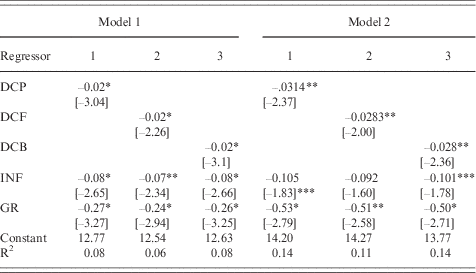
Table 1 shows the results of the panel regressions based on utilizing 3-year averaging and without the averaging of annual data for the sample period of 1991–2012. Each model shows three different regression results (1, 2 and 3, respectively), each of which is estimated with a different proxy for the level of financial development: DCP, DCF and DCB. We have included only one of the three proxies in each regression simply because they are all highly correlated with each other. Therefore, each regression equation for UNE (unemployment rate) contains only three regressors: INF (inflation rate), GR (growth rate of GDP) and FD (a proxy for financial development).
Dependent variable: unemployment rate.

Note: Model 1 regressions are estimated using balanced panel annual data without averaging, whereas Model 2 regressions are estimated using balanced panel averaged annual data for three of the ten countries. Heteroscedasticity-robust t-statistics are given in parentheses under the coefficients.
– *, **, *** The individual coefficient is statistically significant at the 1%, 5% and 10% levels, respectively.
The basic findings of the regression results presented in Table 1 can be summarized as follows. (a) All three alternative proxy measures (DCP, DCF and DCB, respectively) that have been used for the level of financial development are negatively associated with unemployment rate. In addition, their coefficient estimates are all statistically significant. (b) Both INF and GR are also negatively correlated with unemployment rate, and their coefficient estimates are also statistically significant in all three regressions performed ‘without averaging’ and ‘with averaging’ the annual data.
The finding that financial development that entails an expansion in the credit creation capacity of the financial sector (or the banking sector by itself) relative to the magnitude of GDP is highly likely to be negatively correlated with lower unemployment rate for the average country in our sample might have important implications for EU policy making, as long as this result also implies causality for each and every country in our sample. Therefore, the subsection that follows is devoted to a presentation of the results of the Granger causality tests that we have performed to investigate the nature and direction of causality between (each proxy of measure) of financial development and unemployment rate for each of the ten countries in our sample.
4.2. Granger Causality Results
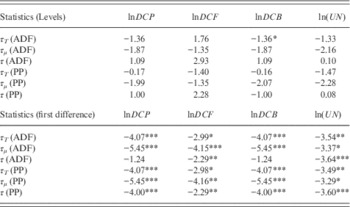
Table 2 displays augmented Dickey–Fuller (ADF) and Phillips–Perron (PP) tests for a unit root on financial development (on three proxies of FD) and the unemployment rate for France.Reference Dickey and Fuller 19 , Reference Phillips and Perron 20 The tests on the level fail to reject the null hypothesis, meaning that the series are nonstationary at level. However, the tests on the first difference of the series are stationary, and this can be confirmed by the ADF and PP test results in Table 2. Similar tests have been carried out for the rest of the nine countries before checking for causality relationships; in order to save space, the authors have not presented the ADF and PP test results for those nine countries, but they are available upon request.
ADF and PP Tests for Unit Root (France)

Note: τT represents the most general model with a drift and trend; τμ is the model with a drift and without trend; τ is the most restricted model without a drift and trend; ***, ** and * denote rejection of the null hypothesis at the 1%, 5% and 10% levels, respectively.
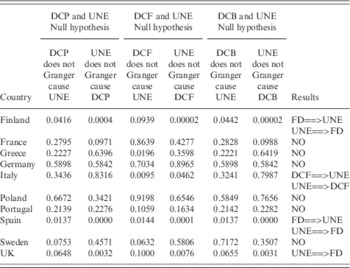
Table 3 shows the GC test results for ten countries after conducting the ADF and PP tests for unit root. The GC test reveals different results for different countries. For example, for Spain there is highly significant bi-directional causality between all three proxies of FD and UNE. In the case of Finland, there is highly significant bi-directional causality between the two proxies of FD (DCP and DCF) and unemployment rate. Moreover, there is also highly significant unidirectional causality running from unemployment to the third proxy of FD (DCB) and some causality, not highly significant (at 10%), from DCB to UNE. Concerning the test for Italy, there is highly significant bi-directional causality between one of the proxies of FD (DCF) and unemployment rate. Furthermore, the GC test for the UK reveals that there is highly significant unidirectional causality running from unemployment to all three proxies of FD and some causality, not highly significant (at 10%), from the three proxies to UNE. In addition, the test for Greece suggests the existence of highly significant causality running from one of the proxies of FD (DCF) to UNE. Finally, the GC test suggests there is some causality (at 10%) running from UNE to DCB for France and from DCP to UNE for Sweden. The tests on the rest of the countries reveal there is no relationship between financial development (using the three proxies’ measure) and unemployment rate.
Granger causality tests for the selected countries

Note: The numbers given in Table 3 are P-values at lag 1. P-value smaller than 0.05 indicates rejection of the null hypothesis. The lag selection criteria are in line with Akaike Information Criterion (AIC), Schwarz information criterion (SC), Hannan-Quinn information criterion (HQ), Final prediction error (FPE) and sequential modified LR test statistic (LR).
5. Conclusion
In this paper, we have attempted to investigate the relationship between financial development and unemployment rate in a selected group of EU countries, which included not only the largest economies of the EU but also those with high rates of unemployment in recent years. The ‘fixed-effects’ version of panel regressions that we performed ‘with averaged’ and ‘without averaged’ annual data produced evidence of a statistically significant negative correlation (or association) of financial development and unemployment rate for the average country in our sample. However, the Granger causality tests that we carried out for each country produced evidence of statistically highly significant causality running from financial development to unemployment rate for several countries, notably Spain, Finland, Greece and Italy.
In the case of Sweden and the UK, there is some evidence of causality running from financial development to unemployment, but the level of statistical significance is not as strong as that which we obtained for the countries we just listed. The fact that we have been able to produce evidence of a statistically significant causal effect (for at least one proxy measure) of financial development on unemployment rate, particularly in the case of countries such as Spain, Greece and Italy (in addition to Finland), might suggest that the expansionary policies that have been adapted by the European Central Bank (ECB) in response to the ongoing crisis since 2008 are not only justified in terms of their likely positive effects on employment but should also be encouraged. If the main objective of the ECB in the short and medium terms is to lower the rate of unemployment, particularly in countries experiencing relatively high rates of unemployment, it should probably accelerate the process of injection of additional liquidity into the financial sectors of these countries. The finding that in some of the ‘crisis countries’ of the Eurozone (Italy and Greece) the causal effect of financial development on unemployment rate has been found to be statistically significant only for one specific proxy measure of financial development (namely ‘domestic credit allocated by the financial sector’) could yield critical policy insights for policy makers: credit allocation through commercial banks might not be as effective a mechanism as allocation carried out by non-bank financial intermediaries in bringing down the unemployment rate. On the other hand, in Spain (another ‘high-unemployment’ country), all three proxy measures of financial development have been found to have statistically significant effects on the rate of unemployment. In other words, it appears that expansion of the relative size of the credits allocated by the banking sector (in relation to GDP) is effective in affecting unemployment.
The fact that our findings have not produced any evidence of statistically significant causal effects of financial development on unemployment in the two largest economies of the EU (namely Germany and France as well as some others in our sample) deserves attention and may indicate one possible direction for future research: there is a need to understand in more detail the nature of the employment effects of development of the financial sector not only empirically but also theoretically. And particularly given the prevailing relatively high rates of unemployment across the EU, future research should focus on understanding in more detail the conditions under which further development of the financial sector in each member country can help to lower the rate of unemployment.
Serhan Çiftçioğlu received his PhD in Economics from Boston College, USA. His areas of specialization are macroeconomics and international economics, and he has published approximately 30 theoretical and empirical articles in international journals and books. Some of the journals in which his articles have been published include Actual Problems of Economics, Acta Oeconomica, Politicka Ekonomie, Ekonomicky Casopis, El Trimestre Económico, International Review of Economics and Business, Latin American Journal of Economic Development. Some of his theoretical work has been translated into Spanish and Czech. He has been a full-time faculty member at the Faculty of Business and Economics of Eastern Mediterranean University since 1991, where he served as head of the Department of Business between 1994 and 1999. He is currently a full professor of economics at the Department of Business Administration of Eastern Mediterranean University.
Murad A. Bein holds a PhD in Economics and is an Assistant Professor in the Department of Accounting and Finance, Faculty of Economics and Administrative Sciences, Cyprus International University. His research interests include International Economics/Trade, International Business/Multinational Corporations, Financial Economics–Empirical Finance, Cost and Benefit Analysis, Industrial Organization.