Introduction
Teaching singing
Voice lessons are traditionally a rather ‘private’ affair and regardless of whether held within a Conservatoire, a music school or in a private singing studio, they are to a large degree shaped by each teacher's individual approach and style. Just like instrumental teaching and unlike classroom teaching one-on-one voice teaching is neither strictly regulated nor under scrutiny by any authority. The very nature of its subject makes voice teaching arguably more challenging than instrumental teaching: the vocal instrument cannot be bought or borrowed and the very ‘building of the instrument’ constitutes a large part of learning – and teaching – of how to sing. The voice relies on a delicate mechanism that is substantially internal, not readily seen, and poorly innervated for sensory feedback. Moreover, virtually all organs used for singing have multiple and often vital other functions that compete with their singing function which cannot be consciously controlled.
In order to influence this elusive instrument, which is also closely connected to psyche and emotions, the singer has to learn how good singing sounds and, more importantly, feels. The teacher on the other hand has to be able to explain the desired physiological functions, sound concepts and sensations guided by ears and eyes as well as knowledge and experience in a way that is meaningful to the student. There is a palpable controversy between different approaches to teaching singing namely between advocates of factual teaching (Miller, Reference MILLER1996, Reference MILLER2004) and users of imagery (Hemlsey, Reference HEMSLEY1998; Patenaude-Yarnell, Reference PATENAUDE-YARNELL2003).
However, Bunch (Reference BUNCH1995, p. 82) points out that ‘adequate verbal description for a sensory experience . . . is nearly impossible through strictly scientific and mathematical terms as certain vocal qualities simply defy quantification’, so that imagery and metaphor have long played a vital part in the teaching of singing. And a lack of acoustical adjectives in the English language means that sound is often described in terms borrowed from the worlds of spatiality (e.g. ‘broad’, ‘narrow’, ‘spread’), shapes (e.g. ‘round’, ‘sharp’, ‘flat’), texture (e.g. ‘hard’, ‘silky’, ‘velvety’), colour (e.g. ‘bright’, ‘dark’, ‘white’) or temperature (e.g. ‘warm’) (Thurman & Welch, Reference THURMAN and WELCH2000).
Whilst there are recommendations and guidelines as to the content and structure of voice lessons (e.g. Miller, Reference MILLER1996; Caldwell & Wall, Reference CALDWELL and WALL2001; Dayme, Reference DAYME2006; Nair, Reference NAIR2007) there is surprisingly little material about the ways in which all this may be communicated to a student – it is simply assumed that the teacher will teach using a combination of verbal explanation and demonstration.
The majority of publications on voice pedagogy acknowledge that ‘body alignment affects all aspects of singing’ (Callaghan, Reference CALLAGHAN2000, p. 52) and most publications (e.g. Bunch, Reference BUNCH1995; Miller, Reference MILLER1996; Davis, Reference DAVIS1998; Hemsley, Reference HEMSLEY1998; Callaghan, Reference CALLAGHAN2000; Thurman & Welch, Reference THURMAN and WELCH2000; Caldwell & Wall, Reference CALDWELL and WALL2001; Kayes, Reference KAYES2004; Chapman, Reference CHAGNON2006; Nair, Reference NAIR2007; Smith, Reference SMITH2007) dedicate a chapter or two to ‘posture’, ‘body alignment’ or ‘postural alignment’. Although descriptions of the ideal posture vary considerably, methods such as the Alexander TechniqueFootnote 1, YogaFootnote 2, Tai ChiFootnote 3 and FeldenkraisFootnote 4 are regularly recommended as helpful ways to increase body awareness.
Gesture in voice teaching
Considering the body of evidence on benefits of gesture and movement use, it comes as a surprise that only a very limited number of publications on vocal pedagogy document the incorporation of gesture and/or body-movement into the training of solo singers. Lloyd (Reference LLOYD1986) reports of the effect of continued Alexander-technique work on singing students, Rao (Reference RAO2005) and Chapman (Reference CHAGNON2006) incorporate Tai-Chi and Accent-method. Estill Voice Training™ puts an explicit emphasis on kinesthetic awareness and uses very specific hand signals to facilitate motor learning. Building on Estill's (Estill & Colton, Reference ESTILL and COLTON1979) work, Kayes (Reference KAYES2004) uses gesture directly as a tool to visualise a physiological function in what will below be defined as ‘Physiological Gesture’.
Due to the private nature of one-on-one voice teaching, little is known about actual teaching practice, and so the notion of gesture as a deliberately employed powerful tool for the communication of vocal and musical concepts in the voice lesson is still based mainly on evidence borrowed from related fields of study (i.e. choral rehearsal, music education, motor learning) as well as empirical and anecdotal evidence. In order to investigate if and how voice teachers used gestures to enhance and/or illustrate their explanations and/or demonstrations and if these gestures could be categorised with some coherence, the author conducted a pilot study at the Sydney Conservatorium of Music (Nafisi, Reference NAFISI2008, Reference NAFISI2010).
A pilot study
Taking into account that people are often not aware of the way their body communicates (Goldin-Meadow, Reference GOLDIN-MEADOW2000; Beattie, Reference BEATTIE2003; Kendon, Reference KENDON2004) and with no existing appropriate nomenclature, both interview and self-reporting questionnaire had been found unsuitable as methods of investigation. Instead, the study was carried out as a non-participant observation with video camera (Fraenkel & Wallen, Reference FRAENKEL and WALLEN2006). Over the course of five days, 18 university-level singing lessons given by five different singing teachers were observed and filmed. Simple digital video editing software made it possible to slow down and replay relevant scenes and to distil still pictures of various gestures. The relatively small scale of the study was offset by the authenticity and great depth of the data.
Analysis of the video footage showed that four out of five observed teachers had deliberately and consciously used gesture in their teaching and although the observed gestures as well as the way and context in which they were used was somewhat characteristic to each teacher, there was sufficient common ground to identify three gesture types. Taking the pedagogical intent behind the observed gestures as determinant resulted in a surprisingly clear and coherent system of categorisation: The first distinction between the observed gestures was rather obvious – they either stood in relation to a technical or a musical phenomenon. Therefore, gestures which were employed to assist the explanation of a primarily physiological mechanism or an acoustic phenomenon and which occurred during the warm-up and technical phase of the lessons were named Technical Gestures.
Gestures which were deliberately deployed by the teachers to communicate musical elements like phrasing, emphases and articulation, using hands to give visible forms to musical phenomena, have been called Musical Gestures.
An analysis of the Technical Gestures however revealed an initially puzzling fundamental difference between some gestures whose pedagogic intent seemed rather similar.
On one side there were gestures which were representations of real physiological mechanisms, that is gestures which mirrored the teachers’ knowledge and perception of what was happening invisibly inside his/her body when singing or preparing to sing. Although the mechanisms in question were necessarily presented in a rather simplified way, the pedagogic intention behind these gestures was clearly to make those very physiological actions known and understandable to the student. These types of gestures have been named Physiological Gestures.
On the other hand there were gestures related to acoustic phenomena like vocal timbre and tonal quality which did clearly not represent real physiological mechanisms. Those gestures invariably represented a particular sensation or a thought deemed helpful by the teacher for the production of a particular tone or phrase. The types of gestures in which the hands were used to give a visible form to a thought or sensation have been called Sensation-Related Gestures.
The study which yielded this neat categorisation of gestures used in the singing studio had however only concerned itself with gestures used by the teachers as communication aids, while any employment of gesture or other movements by the students had been completely ignored. Yet there is plenty of anecdotal evidence that many a voice teacher instructs and/or encourages their students to move in a variety of ways whilst singing in order to enhance their learning experience. Informal observation of the ‘movements’ carried out by singing students revealed that the previously found categorisation into Musical, Physiological and Sensation Related Gestures could in many cases still be applied; and where the movements fit neither of these groups, a new category was found: movements that do not have an intentional expressive component and which cannot be employed by the teacher as a means to enhance explanation or demonstration have been called Body-Movements.
This pioneering system of naming and categorising the movements encountered in the one-on-one teaching of singing (Nafisi, Reference NAFISI2008, Reference NAFISI2010), although able to withstand theoretical scrutiny, was still limited in its credibility by being based on a relatively small scale study. The best way to demonstrate that the categorisation into Musical Gestures, Physiological Gestures, Sensation Related Gestures and Body-Movements was valid and coherent was to have them contemplated, recognised and accepted by a wider audience of voice teachers.
A survey
Prior to the existence of a coherent system of distinguishing and naming the specific gestures used as deliberate teaching and learning tools a survey would have been pointless as the absence of such a system had made clear and unambiguous wording impossible. Yet, once such a categorisation system had been found a survey became not only possible but it also appeared to be precisely the tool to test this system's validity.
The survey concentrated explicitly only on gestures and movements that were used intentionally. The other equally interesting aspect of the respondents’ body-language and gesticulation (‘idiosyncratic spontaneous movements of hands and arms accompanying speech’, McNeill, Reference MCNEILL1992, p. 37) which was in all likelihood also present, was completely disregarded. This distinction was made clear to respondents as the new categorisation system of gestures and movements was introduced in the questionnaire.
Apart from testing the validity of the categorisation system the survey sought to confirm the following hypotheses: (1) Gestures of various description were used by a significant number of voice teachers to enhance explanation and/or demonstration, (2) a significant number of voice teachers encouraged their students to carry out similar Gestures whilst singing to enhance their learning experience and (3) another type of essentially non-expressive Body-Movements was also encouraged by a significant number of voice teachers to enhance students’ learning. Should these rather clear-cut hypotheses be confirmed, the survey hoped to further explore (4) for what reasons voice teachers were utilising Gestures and Body-Movements, and if (5) some favourite and universally applicable Gestures and Body-Movements could be identified.
Having gained ethical approval and taking advantage of the author's bilingualism, a questionnaire was designed in German and English and distributed in Germany to voice teachers sourced through the Bundesverband Deutscher Gesangspädagogen (Federal Association of German Singing Pedagogues). A total of 301 singing teachers across Germany received an email with the subject line (Umfrage: Gesten und Bewegung im Gesangsunterricht. Survey: gesture and movement in the voice lesson). The body of the email explained who the researcher was and outlined the purpose of the study. Recipients were invited to take part in the anonymous survey by clicking on a link which opened the survey page on a web-based survey site. Recipients were invited to leave their email contact at the end of the on-line questionnaire if they wanted to be informed of the result of the survey and the study as a whole. In designing the questionnaire, care had been taken to allow greatest possible freedom in responding whilst achieving greatest possible clarity. The majority of questions asked for a rating on a 4-point scale and many had an option for an own response/comment.
General data
Within 4 weeks of mailing out the invitations, there were 72 responses, bringing the response rate to just over 24%. The first three questions established that there were significantly more female respondents (79.2%) than male (20.8%). The respondents ranged in age from 25–88 with a median age of 48 years and had been teaching singing since between 4 and 63 years with a median of 25 years. (It should be noted however that one 88-year-old respondent who has been teaching for 63 years will have had an impact on those median numbers.)
The great majority of respondents (83.3%) have trained equally well as a performing artist (singer) and a singing teacher/voice pedagogue.
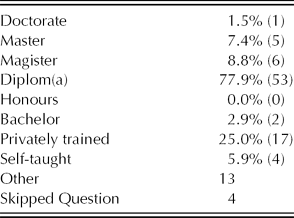
The next question asked for respondents’ professional training with multiple answers possible; the answers are shown in Table 1.
Respondents’ level of qualification

It should be pointed out that ‘Diploma’ (German: Diplom) which was, with 77.9%, the by far most common degree amongst respondents is a degree awarded after a 4-year full-time university course in a dedicated music university/academy or conservatorium. 1999 saw the gradual introduction of Bachelor and Master degrees in Germany which have since 2010 replaced the old ‘Diplom’ and ‘Magister’. The low numbers of Bachelors and Masters thus reflect that the majority of respondents finished their professional education before 1999. Bearing in mind that this question allowed multiple answers, the relatively high number of privately trained respondents testifies to an important role of private teaching in singer/teacher education, often in addition to institutionalised training. Using the ‘Other – please specify’ option, respondents added a number of qualifications which have no direct equivalent in the English-speaking world, for instance ‘State certified examination for music teachers (Staatsexamen Schulmusik)’, ‘artistic maturity graduation examination (künstlerische Reifeprüfung)’, ‘State certified examination for music teachers – singing, (Staatliche Prüfung für Musiklehrer – Gesang)’, ‘Academy of Music, performance examination, pedagogical examination (Hochschule für Musik, Konzertexamen, Pädagogisches Examem)’.
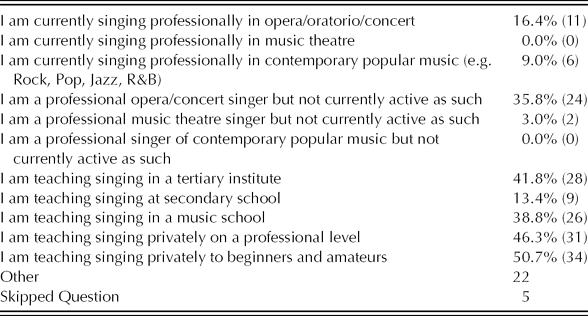
The next question asked for respondents’ current professional status; the answers are shown in Table 2.
Respondents’ current professional status
The large number of respondents teaching privately suggests that many respondents run their own singing studios alongside teaching in a variety of institutionalised settings. The relatively low incidence of voice teaching at secondary level is somewhat compensated for by its higher prevalence in music schools. Taking the opportunity to expand on their current professional status, respondents added a wide field of other professional expertise including ‘director of live-music broadcasts’, ‘lecturer for Atem – Tonus – Ton (breath – muscle-tone – vocal-tone) after Maria Höller-Zangenfeind’,Footnote 5 ‘lecturer for voice physiology and pedagogy at a music academy’, ‘privately owned voice institute, speech-pathological patients, professional speaker’.
The core part of the survey started out with a brief definition of the key terms used in the questionnaire according to the above-described Nafisi system of singing movements.
Gestures as tools of communication (teaching tools)
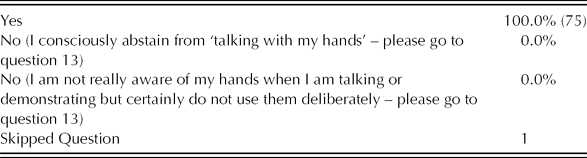
The first question enquired if respondents used Gestures (Musical, Physiological and/or Sensation Related) to enhance and/or illustrate explanations and/or demonstration; the answers are shown in Table 3.
Percentage of respondents that use Gestures actively as a tool for communication
This response confirms the first hypothesis of this study in showing that a significant number of voice teachers use Gestures actively as a tool for communication. The astonishingly unanimous response also supports the already mentioned supposition that invitees who were adverse to gesture-use tended to simply not respond.
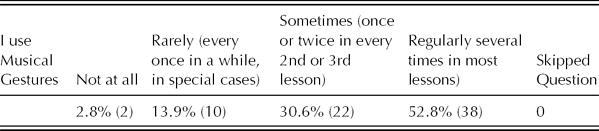
The next three questions sought to differentiate between the three Gesture types; the extent to which Musical Gestures were used is shown in Table 4.
Respondents’ use of Musical Gestures
The extent to which Physiological Gestures were used is shown in Table 5.
Respondents’ use of Physiological Gestures

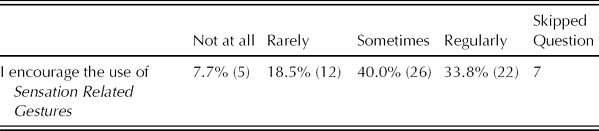
The extent to which Sensation Related Gestures were used is shown in Table 6.
Respondents’ use of Sensation Related Gestures

The differentiated responses regarding the Gesture-types suggest that respondents did indeed recognise and accept the distinction of Gestures based on Nafisi (Reference NAFISI2008, Reference NAFISI2010). Whilst all three Gesture-types appear to feature prominently in the respondents’ explanations and/or demonstrations, it is notable that Physiological Gestures have by far the highest number of regular users.
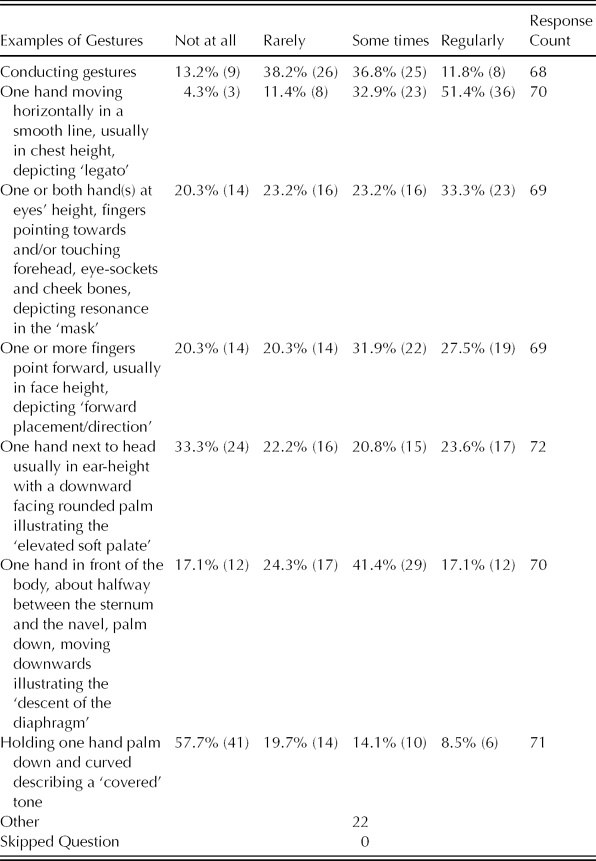
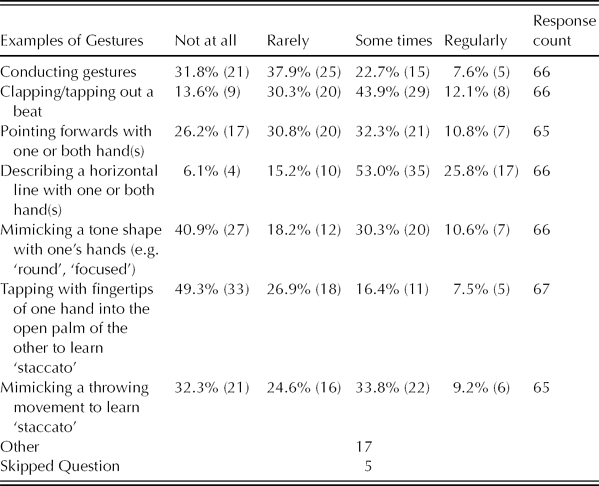
Next, respondents were asked to indicate to what extent they used specific Gestures and/or to describe others they used; the answers are shown in Table 7.
Extent to which respondents used specific Gestures
A relatively large number of respondents took the opportunity to describe their own Gestures such as ‘one hand held at mouth-height moves from front to back in order to demonstrate the opening of the backward pharynx/resonance chamber’, ‘Hand signs spell out the functions of the larynx’, ‘A rounded hand, palm down moves upward-forward in an upward scale; going down the hand opens and stretches upwards, palm up in the Passagio’.
The great variance in responses suggests that it would be difficult to agree on a specific form of Gesture; apart from some emblematic Gestures like a horizontal line for ‘legato’ and well-established conducting Gestures (Cofer, Reference COFER1998) it would prove difficult to name and describe specific Gestures which would be regularly used by a majority of teachers.
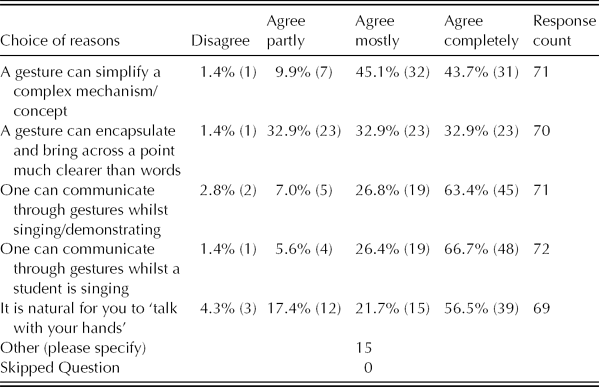
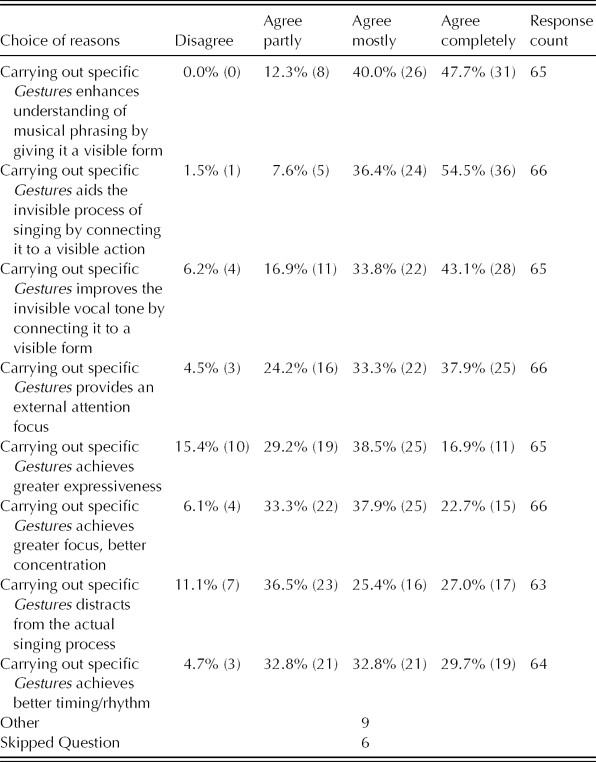
The next question sought to find predominant reasons why respondents used Musical, Physiological or Sensation Related Gestures. Respondents were asked to indicate their level of agreement with a number of given reasons and/or state their own reasons; the answers are given in Table 8.
The predominant reasons why respondents used Musical, Physiological or Sensation Related Gestures
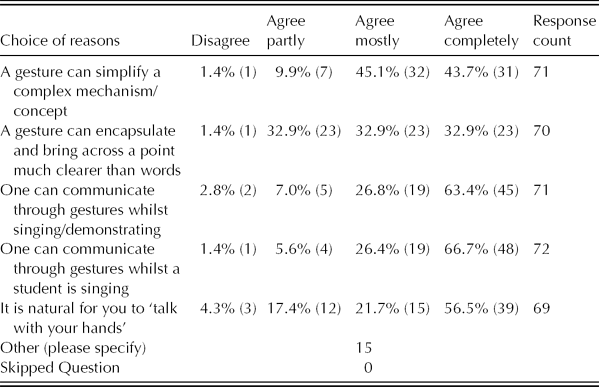
Additional reasons given by respondents included ‘A gesture supports and illustrates the spoken word and thus can help avoid misunderstandings’; ‘Gestures are a natural part of language that also precede the advent of (spoken) language’; ‘Nonverbal communication is communication on an additional channel’. It is notable that there is a much greater level of agreement regarding the rationale of Gesture use than regarding the preference of specific Gestures (Table 7).
Gestures as Learning Tools
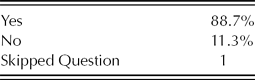
The next question enquired if respondents instructed/encouraged their students to carry out Gestures (Musical, Physiological or Sensation Related) whilst singing; the answers are given in Table 9.
Percentage of respondents who instructed/encouraged their students to carry out Gestures (Musical, Physiological or Sensation Related) whilst singing
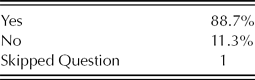
This response confirms the second hypothesis of this study in showing that a significant number of voice teachers encourage/instruct their students to carry out Gestures whilst singing. The result is however not as emphatic as it was in regards to Gesture as a teaching/communication tool with a significant 11.3% of teachers not encouraging them at all.
The next three questions sought to differentiate between the three Gesture types; the extent to which Musical Gestures were encouraged whilst singing is shown in Table 10.
The extent to which Musical Gestures were encouraged whilst singing

The extent to which Physiological Gestures were encouraged whilst singing is shown in Table 11.
The extent to which Physiological Gestures were encouraged whilst singing
The extent to which Sensation Related Gestures were encouraged whilst singing is shown in Table 12.
The extent to which Sensation Related Gestures were encouraged whilst singing
It is notable that Physiological Gestures were encouraged most frequently which correlates with the above finding that Physiological Gestures were most frequently used in communication. The prominence of this type of Gesture both in communication and as a learning tool seems to also reflect Estill and Colton's (Reference ESTILL and COLTON1979) and Kayes’ (Reference KAYES2004) usage of it.
Next respondents were asked to indicate to what extent they encouraged specific Gestures to be carried out by students whilst singing and/or to describe others they used; the answers are shown in Table 13.
The extent to which respondents encouraged specific Gestures to be carried out by students whilst singing
The discord visible in the range of answers, which points to the difficulty of finding and describing universally applicable Gestures, is further highlighted by the relatively large number of respondents (25.8%) who added their own gestures/comments, including ‘a lying “eight” and other kinesiological gestures’; ‘Moving one or both hands in opposite direction as the pitch, like a “lift and its weight”’. It appears that the choice of Gesture depends to a large part on the student's (and the teacher's) individuality as well as the situation at hand; many teachers might have a certain ‘repertoire’ of possible Gestures whose efficacy has been proven in similar situations, yet any attempt to schematise these runs the danger of forfeiting what seems to lie at the very core of any Gestures’ power: to render visible the hidden connections between mind, body, voice and emotion so that these may be influenced by modifying the Gesture (Seitz, Reference SEITZ1993; Goldin-Meadow, Reference GOLDIN-MEADOW2000).
The next question sought to find predominant reasons why respondents instructed/encouraged their students to carry out Gestures; respondents were asked to indicate their level of agreement with a number of given reasons and/or state their own reasons; the answers are given in Table 14.
Reasons why respondents instructed/encouraged their students to carry out Gestures
Additional reasons added by respondents included ‘Carrying out specific gesture makes singing more precise, creating greater awareness for the singing process’; ‘Gestures are stored in the brain alongside other parameters of motor-learning, leading to a greater learning effect than without gesture use (psychology of learning, psycho-motoric learning)’; ‘a gesture can help to commit a voice-technical mechanism to the physiological/kinesthetic part of the brain so that it can later be called upon. Also – very importantly – a gesture can (particularly when used to replace useless, tense, habitual gestures) help to get rid of faulty old habits’.
These answers testify to the great importance ascribed to Gestures as learning tools by the responding vocal teachers; they tie in with findings in the field of neurology and motor-learning (Seitz, Reference SEITZ1993; Wulf, Reference WULF2007) and also reflect the advantages of Gesture-use in the choral rehearsal as reported by Wis (Reference WIS1993), Chagnon (Reference CHAGNON2001) and Bailey (Reference BAILEY2007). This suggests that respondents were either aware of the relevant science or, more likely, their experience and intuition told them what is only being reconfirmed by research. It is notable that there is again a much greater level of agreement regarding the rationale of Gesture-use whilst singing than regarding the preference of specific Gestures (Table 13).
Body-Movement as learning tool
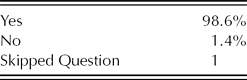
The next question enquired if respondents instructed/encouraged their students to carry out Body-Movements whilst singing. The answers are given in Table 15.
Percentage of respondents that instructed/encouraged their students to carry out Body-Movements whilst singing
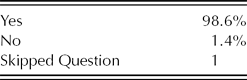
This response confirms the third hypothesis of this study in showing that a significant number of voice teachers encourage/instruct their students to carry out Body-Movements whilst singing. There is a notable difference between the number of respondents encouraging Body-Movement (98.6%) and those encouraging Gesture (88.7%), suggesting firstly that the distinction between the two types of movement has been understood and accepted by respondents and secondly that Body-Movements are more popular than Gestures as learning tools in the voice lesson.
Next respondents were asked to indicate to what extent they encouraged Body-Movements (The ‘No’ option in the previous question made a ‘Not at all’ option in this question unnecessary); the answers are given in Table 16.
The extent to which respondents encouraged Body-Movements

A comparison with Tables 10, 11 and 12 suggests that teachers who ask their students to use Gesture and Body-Movement in their learning tend to do this rather frequently.
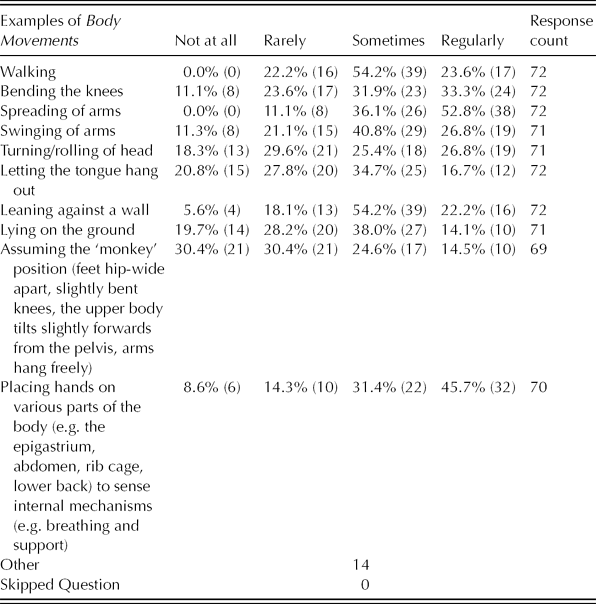
Next respondents were asked to indicate to what extent they encouraged specific Body Movements to be carried out by students whilst singing and/or to describe others they used; the answers are shown in Table 17.
The extent to which respondents encouraged specific Body Movements to be carried out by students whilst singing
Other Body-Movements recommended by respondents included ‘dance movements’, ‘putting one foot behind the other and distributing one's weight equally between both legs helps to feel a diagonal (forwards-upwards–backwards-downwards) in the body and the tone is better connected with the body’ and ‘energetic/dynamic standing, shifting one's weight from one leg to the other similar to awaiting a serve in tennis – high energy, elasticity, flexibility’. These descriptions correlate to the notion that ‘posture is not a static or fixed position, rather it is an active stillness or a physically quiet attitude’ (Sell, Reference SELL2005, p. 71) also mirrored in the ‘dynamic posture’ mentioned by Bunch (Reference BUNCH1995) and Chapman (Reference CHAGNON2006). Similarly to Table (7) and (13) there is a wide spread of responses indicating how potentially contentious this subject is. The difficulty in pinpointing ‘generally applicable’ Body-Movements, apart from the more generic walking, swinging/spreading of arms etc. appears to lie here, as with the Gestures above, in the sheer number of possibilities and the dependence of their efficacy on the individual case.
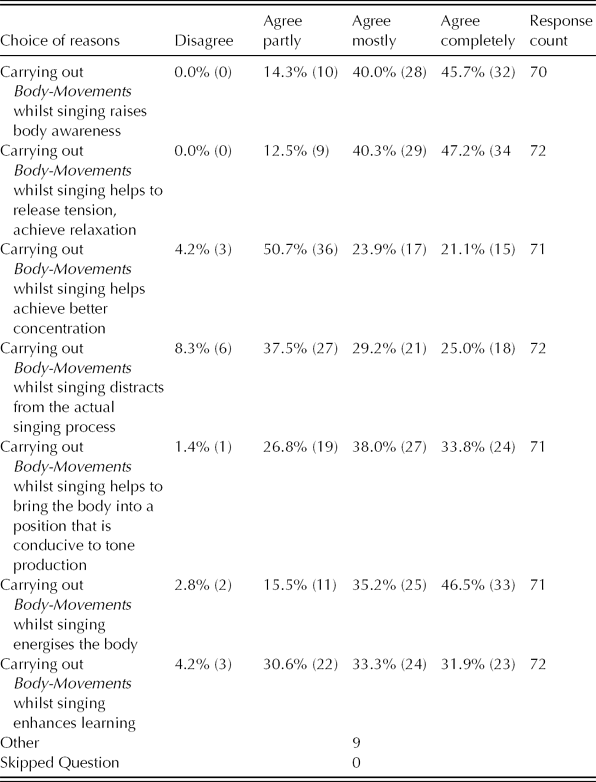
The next question sought to find predominant reasons why respondents instructed/encouraged their students to carry out Body-Movements; respondents were asked to indicate their level of agreement with a number of given reasons and/or state their own reasons; the answers are given in Table 18.
Predominant reasons why respondents instructed/encouraged their students to carry out Body-Movements
Additional reasons given included: ‘body-movement releases external tensions and blockages as well as bad habits’, ‘affects, depending on the respective movement, posture, breathing, Appoggio, neck muscles and secondary breathing muscles etc. – generally a liberating effect on tone and timbre’. Generally it can be said that respondents’ reasons for encouraging Body-Movements in their singing students reflect the advantages found in choral rehearsal (Wis, Reference WIS1993; Chagnon, Reference CHAGNON2001; Bailey, Reference BAILEY2007). Just as seen above regarding Gesture in communication (Table 8) and Gesture as a learning tool (Table 14), there is again a notable level of agreement regarding the rationale of using Body-Movement.
At the end of the survey the invitation to add a general comment or suggestion was taken up by 31.5% (22) of respondents; 36.4% (8 out of 22) of these commented very positively on the survey, its topic and design e.g. ‘Good survey, many thanks for your work!’. Others reiterated some of the subject-inherent problems, emphasising the complexity of the subject matter and the dangers potentially arising from any over-simplification. Some respondents ventured to give their own perception of, and approach to, the matter: ‘Just like the gesture itself, one must also practise to reduce a gesture to the point of mere thought’.
I like to take up spontaneous movements and gestures of the student as they originate in him/her and elucidate something that the student might otherwise not be aware of. We then question and at times modify these movements until they become a natural part of the whole. Prescribed gestures should always just be a first impulse (much in the sense of Feldenkrais).
There is an understanding that the benefit of the use of Gesture and/or Body-Movement is highly dependent on the personality of the individual student (e.g. learning-types) and the situation in which a song or musical phrase is sung (i.e. learning situation versus performance). Generally the comments reflected the importance that respondents assigned to the survey's subject matter and to the depth of thought they had given it.
The avid interest and positive response to the survey is also reflected in that 79.1% (57) of respondents followed the invitation to leave their email contacts on a provided list in order to be informed of the results of this study.
Discussion
It came somewhat as a surprise that all bar one respondent used Gestures actively in their teaching communication and that the overwhelming majority of respondents were actively encouraging Gestures and Body-Movements as learning tools for students.
The fact that only very few respondents explicitly rejected the use of Gestures and Body Movement – although many called for greatest caution and differentiation could be seen as suggesting that the great majority of voice teachers uses Gestures and Body Movement in one way or the other – as one respondent commented: ‘I find this survey rather unnecessary as I have never encountered a single voice pedagogue who did not employ gestures and movements . . .’. This notion is however contradicted by a substantial amount of anecdotal and empirical evidence attesting that many voice teachers neither move nor encourage movement and also the author's above-mentioned observational study (Nafisi, Reference NAFISI2008, Reference NAFISI2010) included one out of five observed teachers who did not use Gesture at all. As we cannot conclude that the percentage of Gesture and Body Movement users amongst respondents reflects the percentage of Gesture and Body Movement users amongst voice teachers in general, it appears that the surprisingly unanimous positive response is simply due to a self-selection of invitees: predominantly those teachers who were actively using and encouraging Gestures and Body Movement in their teaching responded. On the other hand there are obviously many potential reasons for not responding to a lengthy survey which have nothing to do with the subject matter. We can therefore neither conclude that all advocates of Gesture and Body Movement amongst the invitees actually responded nor that non-response to the survey implies a rejection of the incorporation of Gestures and Body Movement in vocal teaching.
Although it is thus unfeasible to put even a vague percentage on advocates or rejecters of Gesture and Body Movement in vocal teaching, the still significant number of responses of professional voice teachers means that the three hypotheses of the study have clearly been confirmed: (1) Gestures of various description are used by a significant number of voice teachers to enhance explanation and/or demonstration, (2) a significant number of voice teachers encourage their students to carry out similar Gestures whilst singing to enhance their learning experience and (3) another type of essentially non-expressive Body-Movements is also being encouraged by a significant number of voice teachers to enhance students’ learning.
Responses to the survey have also demonstrated that the categorisation into Musical Gestures, Physiological Gestures, Sensation Related Gestures and Body-Movements as conceived in the initial study by Nafisi (Reference NAFISI2008, Reference NAFISI2010) has been unquestioningly accepted as valid and coherent by a large audience of highly trained voice teachers in a country with a long tradition of music education of the highest standard. Henceforth, it will be legitimate therefore to refer to movements encountered within the context of the teaching of singing according to this nomenclature.
This study had also set out to explore if voice teachers were utilising Gestures and Body-Movements for similar reasons and if prevailing Gestures and Body-Movements could be identified. The first of these questions can be answered with a cautious affirmative: despite a palpable hesitancy towards some offered reasons, the majority of respondents appeared to see similar advantages in the use of Gestures (namely the capacity of a Gesture to visualise hidden mechanisms, illustrate musical concepts or to provide an external attention focus) and Body-Movements (namely achieving relaxation, release of tensions, postural improvement, raising body awareness and physical energy). These reasons are backed up by findings in the context of choral rehearsal as well as motor-learning (Wis, Reference WIS1993; Seitz, Reference SEITZ1993; Cofer, Reference COFER1998; Chagnon, Reference CHAGNON2001; Goldin-Meadow, Reference GOLDIN-MEADOW2000; Bailey, Reference BAILEY2007; Wulf, Reference WULF2007; Durrant, Reference DURRANT2009; Mathers, Reference MATHERS2009).
The quest for favoured Gestures and Body-Movements however shows a rather patchy picture: there appears to be a limited number of, one might say, ‘obvious’ Gestures and Body-Movements like ‘conducting gestures’ which were used by a majority of voice teachers. This confirms Cofer's (Reference COFER1998) finding that conducting gestures consist to a large part of emblems (universally understood non-verbal acts that have a universally understood verbal translation, Ekman & Friesen, Reference EKMAN and FRIESEN1969); being largely able to be spontaneously understood makes conducting gestures a likely tool to communicate musical concepts. Simple forms of Body-Movements particularly generic ones like ‘walking’ or the ‘spreading of arms’ were widely accepted as useful and there also seems to be consensus regarding the validity of ‘posture enhancing’ movements/stances, reflecting the importance assigned to posture in the voice teaching community (Callaghan, Reference CALLAGHAN2000, p. 52) and most publications (e.g. Bunch Reference BUNCH1995; Miller, Reference MILLER1996; Davis, Reference DAVIS1998; Hemsley, Reference HEMSLEY1998; Thurman & Welch, Reference THURMAN and WELCH2000; Callaghan, Reference CALLAGHAN2000; Caldwell & Wall, Reference CALDWELL and WALL2001; Kayes, Reference KAYES2004; Chapman, Reference CHAPMAN2006; Nair, Reference NAIR2007; Smith, Reference SMITH2007). Regarding more specific Gestures and Body-Movements however it was found that the majority of examples met with similar numbers of frequent users and rejecters. It becomes clear that, even within the group of voice teachers who generally subscribe to the advantages of Gesture and Body-Movement use, there exists a high level of individuality regarding which specific Gestures and Body-Movements are used. This tendency towards personal preference is also reflected in the finding that no body-awareness method was a clear favourite giving rise to the conclusion that a number of different ‘body/breathing/alignment – schools’ might actually have equal validity.
It is notable that the use of Gesture as a means of enhancing expressiveness in singing students was, whilst still significant, considerably less prevalent as the use of Gesture as tool to improve tonal quality and musical phrasing, suggesting that Gesture and Body-Movement are valued more as tools for singing technique than artistic expression. This may however also be due to the fact that work in the voice lesson is often predominantly focused on voice production and musical issues whereas the combination of expression and movement becomes more important once a singer is on stage. It is thus usually dealt with at a later stage in a singer's career and not necessarily by a voice teacher, but rather a director or acting coach.
In conclusion one can say that the survey has yielded a large amount of hitherto unavailable quantitative and qualitative data which could not have been acquired in any other way; the unthreatening nature of an anonymous self-reporting questionnaire persuaded respondents to offer some insight into their teaching practice thus granting access into the intimate space of the singing studio without risking disturbing that very intimacy. The survey has confirmed the significant role of Gesture and Body-Movement in the teaching of singing, consolidated the author's way of denoting and distinguishing these specific Gestures and Movements and given an insight into actual teaching practice.
On the other hand it is evident that a survey is, by its very nature, but an accumulation of subjective perceptions and herein lies the main limitation of this paper. There still remains an absence of data on the actual effect of Gestures and Body-Movements on a student's learning, vocal quality and performance. Only direct observation, recording and analysis of Gesture and Body-Movement in action would give the researcher the opportunity to gauge their actual effect in each situation. Specific parameters linked for instance to the notion of ‘improvement’ of vocal tone could be defined and the obtained data analysed regarding these parameters. Yet, as the survey has emphasised, the greatest strength of Gesture and Body-Movement lies in their capacity to mirror and capture each individual singer's need in each changing situation. It is this endless adaptability of Gesture and Body-Movement and their endless number of variables which makes them both valuable teaching and learning tools but also renders reliable and repeatable measurement extremely difficult. Even so the author is currently in the process of conducting an experiment which will hopefully shed more light on some of the questions left open in the present study.
Julia Nafisi studied voice in Munich and Vienna finishing with the Bühnenreifeprüfung Oper (Final Stage Examination in Opera) as well as Vocal Pedagogy (Master) in Sydney. She has appeared in opera, concert and recital across Europe and Australia and teaches voice at the Melbourne Conservatorium of Music/University of Melbourne. Julia is currently completing her PhD investigating the role of Gesture and Body-Movement in the classical voice lesson and, more specifically, their effect on the quality of the vocal tone.