Introduction
The genus Tephromela was erected for Lecanora atra (Huds.) Ach. by Choisy (Reference Choisy1929), who separated it from Lecanora s. str. by its constantly straight conidia and the dark purple hymenium. Unfortunately, Choisy (Reference Choisy1929) failed to explicitly associate Lecanora atra with his new genus and so the combination Tephromela atra was not validly published. The combination was validated by Hafellner (Kalb Reference Kalb1983) who, the following year (Hafellner Reference Hafellner1984), placed this monotypic genus in a new, monotypic family, Tephromelataceae, which he characterized by the large apothecia with a thalline margin, purple hymenium and hypothecium, and Bacidia-type ascus. A year later, the genus was expanded by the addition of two, similar species by Hafellner & Roux (Clauzade & Roux Reference Clauzade and Roux1985). In the same year, Hertel & Rambold (Reference Hertel and Rambold1985) carried out a detailed comparison of T. atra and the Lecidea armeniaca group – comparing ascus structure (which they showed to be variable), ascospores, paraphyses, and conidiophores and conidia. They concluded that the two groups were similar in all significant characters and so transferred the armeniaca group to Tephromela, thus expanding the circumscription of the genus to include species with apothecia lacking a thalline margin. Hertel & Rambold (Reference Hertel and Rambold1985) were also the first to mention the characteristic gelatinous coat of the paraphyses, although these were clearly illustrated by Hafellner (Reference Hafellner1984). The armeniaca group has subsequently been removed to a separate genus, Calvitimela Hafellner (Hafellner & Türk Reference Hafellner and Türk2001), because of its lecideine apothecia and Lecanora-type asci. However, preliminary molecular data (Arup et al. Reference Arup, Ekman, Grube, Mattsson and Wedin2007) does not support the monophyly of either Calvitimela or Tephromela as currently circumscribed, suggesting that, whereas C. aglaea (Sommerf.) Hafellner is closely related to T. atra, C. armeniaca (DC.) Hafellner, the type species of the genus, is more closely related to Mycoblastus sanguinarius (L.) Norman. However, lacking conclusive data to the contrary, the separation of Calvitimela for species with lecideine apothecia and Lecanora-type asci is maintained here.
The familial placement of the genera is also currently unclear. Preliminary molecular data (Miądłikowska et al. Reference Miądłikowska, Kauff, Hofstetter, Franker, Grube, Hafellner, Reeb, Hodkinson, Kukwa and Lücking2006; Arup et al. Reference Arup, Ekman, Grube, Mattsson and Wedin2007) indicates that they do not belong in either the Lecanoraceae or the Ramalinaceae but are related to Mycoblastus Norman (Mycoblastaceae). However, Mycoblastus and Tephromela/Calvitimela differ markedly in many characters (e.g., ascospores and secondary chemistry) and additional data is required to clarify this relationship.
Tephromela is a cosmopolitan genus of c. 40 species (Elix Reference Elix and McCarthy2009) known from polar to tropical regions where the species grow on bark, wood, rock or on other lichens, whereas Calvitimela has only 6 species and is largely restricted to saxicolous substrata in the arctic/boreal region. Tephromela atra is widespread in the Southern Hemisphere, being reported from Argentina (Calvelo & Liberatore Reference Calvelo and Liberatore2002), Chile (Galloway & Quilhot Reference Galloway and Quilhot1998), Australia (Elix Reference Elix and McCarthy2009) New Zealand (Galloway Reference Galloway2007) and Antarctica (Øvstedal & Lewis Smith Reference Øvstedal and Lewis Smith2000), but the other Northern Hemisphere species are apparently unknown in the region. However, numerous other species have been reported, especially from Australia (Elix Reference Elix and McCarthy2009) and Antartica (Øvstedal & Lewis Smith Reference Øvstedal and Lewis Smith2001). In southern South America the only other species reported apart from T. atra is T. austrolitoralis (Zahlbr.) Kalb & Elix (Elix & Kalb Reference Elix and Kalb2008) which is similar to T. atra but has an inspersed hymenium (but see below under T. skottsbergii). Here a new species of Calvitimela is described from southern Chile, a new species of Tephromela is described from southern South America, Campbell Island (New Zealand) and Antarctica, and four species are transferred to Tephromela; three originally described in Lecanora and one in Aspicilia.
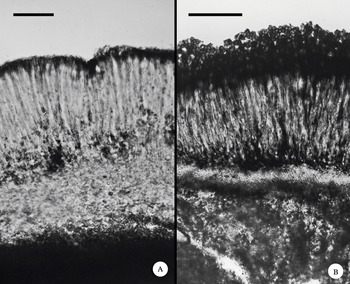
The new species of Tephromela included here are all closely related to the type species of the genus, T. atra having: apothecia with a thalline margin; a purple brown, K+ purple hymenium (atra-brown); a golden brown hypothecium (not purple as stated by Hafellner Reference Hafellner1984); and a thalline chemistry of atranorin, α-collatolic acid, and ± alectoronic acid. In addition, Elix & Kalb (Reference Elix and Kalb2008) reported 4-O-methylphysodic acid (minor) and physodic acid (trace) from T. austrolitoralis, and TLC of several specimens described in this study (typically 1–2 of each species) also revealed minor/trace amounts of these substances. The degree of purple coloration of the hymenium varies between densely colouring the whole hymenium and being restricted to vertical streaks (Fig. 3), but this does not appear to be systematically significant because there is great variation within specimens of the same species. The base of the hymenium (subhymenium) and the epihymenium are always more densely coloured than the middle sections of the hymenium (Fig. 3). The hypothecium is usually bi-layered with a narrow upper hyaline layer, which is sometimes absent, and a wider, lower golden brown layer (Fig. 3). The relative and absolute measurements of these layers are systematically significant in at least one species.
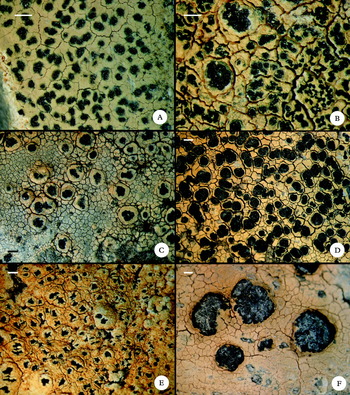
Calvitimela and Tephromela species, thalli and apothecia. A, C. austrochilensis (Imshaug 44725 – holotype); B, C. austrochilensis (Imshaug 45343); C, T. atrocaesia (A. E. Eaton s.n., Swain's Bay); D, T. atroviolacea (Imshaug 41811 A); E, T. lirellina (Imshaug 44022); F, T. superba (Imshaug 53272). Scales A–F = 1 mm.

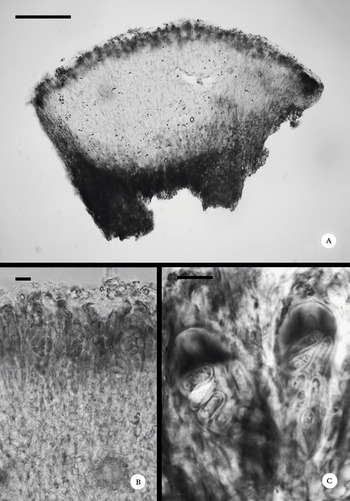
Calvitimela austrochilensis (Imshaug 44725, holotype). A, section of an apothecium; B, hymenium with ascus and ascospores; C, ascus in KI. Scales: A = 100 µm; B & C = 10 µm.

Apothecial sections of Tephromela species in 10% KOH. A, T. superba (Imshaug 39968 A); B, T. atroviolacea (Imshaug 41811 A). Scale = 100 µm.

Materials and Methods
The study is based chiefly upon collections held in MSC that were made by Dr H. A. Imshaug and co-workers during several expeditions to various austral regions in the 1960s and 1970s (Fryday & Prather Reference Fryday and Prather2001). Type material and other collections were obtained on loan from AAS, B, BM, E, M, H-Nyl and S.
Apothecial characteristics were examined by light microscopy on hand-cut sections mounted in water, 10% KOH (K), 15% HCl (H), 50% HNO3 (N) or 0·15% aqueous IKI. Thallus sections were investigated in water and 10% KOH (K). Ascus structure was studied in 0·15% aqueous IKI, both without prior treatment and after pretreatment with 10% KOH. Anatomical measurements were made in 10% KOH.
Thin-layer chromatography followed the methodologies of either Culberson & Kristinsson (Reference Culberson and Kristinsson1970) or Orange et al. (Reference Orange, James and White2001). Nomenclature for apothecial pigments follows Meyer & Printzen (Reference Meyer and Printzen2000).
Selected comparative material examined (all MSC). Tephromela atra: Argentina: Tierra del Fuego Province: Isla de los Estados; Bahia Capitan Canepa, on ridge at head of N arm of bay, rock outcrops, 120 m., 1971, Imshaug (53135) & Ohlsson.—Chile: Valparaíso Region: Juan Fernandez Islands, [Alejandro Selkirk Island], Mas Afuera; Quebrada de las Vacas, entrance to canyon, 1965, H. Imshaug 36961. Magallanes and Antártica Chilena Region: Brunswick Peninsula, Puerto del Hambre, Fuerte Bulnes, Punta Santa Ana, Nothofagus forest, sea level, 1967, Imshaug (38780) & Harris (corticolous, sorediate).—Denmark: Bornholm: Nexö, sandstone, 1884, P. Hellbom.—New Zealand: South Island: Central Otago, Cromwell, along route 6, 13·8 miles west of junction of Routes 6 & 8, 1973, H. A. Imshaug 58156.—Spain: Canary Islands: Tenerife, ridge north of Pico Baracan (west of Cuevas del Palmar), Sierra de Herjos, rock outcrops and remnants of fayal-brezal, Imshaug (36034) & F. Imshaug.
Taxonomy and Nomenclature
New Species
Calvitimela austrochilenis Fryday sp. nov
MycoBank: MB519202
Apothecia innata, azureo-atra, parva, 0·2–0·4 mm diam.; hypothecium hyalinum; asci Lecanora-typi; thallus luteolus, atranorinum continens. Ab omnibus speciebus generis Calvitimelae apotheciis innatis, hypothecio usque ad 300 µm profundis valde differt.
Typus: Chile, Isla Desolación, S side of Caleta San José, Bahía Tuesday, moorland on hill, 4 October 1969, H. A. Imshaug (44725) & K. E. Ohlsson (MSC—holotypus; M, CONC—isotypi).
Thallus creamy-white to yellow, 0·5–1·5 mm thick, widespreading with distinct margin and thin, bluish grey prothallus; cracked-areolate, areoles flat, smooth, 0·3–0·5 mm across, not corticate but with pale brown pigment in surface cells; large crystals (15–35 µm) not dissolving in K present in medulla. Photobiont chlorococcoid, 12–15 µm diam.
Apothecia innate, blue-black, orbicular to slightly irregular, 0·2–0·4 mm diam.; disc concave, separated from the thallus by a narrow crack, sometimes with part of thallus attached to the apothecium and forming a pseudothalline margin; proper margin usually not apparent but rarely thin and slightly raised above the level of the disc; blue-black pigment spreading patchily into the surrounding thallus. Hymenium 80–90 µm tall, inspersed; paraphyses septate, sparingly branched and anastomosing, with a gelatinous sheath, c. 3 µm thick, swollen at the apex to 5–8 µm; epihymenium blue-black (H+ blue, N+ red; cinereorufa-green). Hypothecium massively developed, c. 300 µm tall, hyaline but appearing pale brown due to minute crystals that dissolve in K. Asci Lecanora-type, 60–70 × 15–17 µm, cylindrical; ascospores simple, hyaline, occasionally with a thin septum, 10–13 × 5–7 µm. Proper exciple sometimes visible as a band of golden brown cells on the edge of the thecium. Thalline exciple not developed.
Conidiomata not observed.
Chemistry. Atranorin and unknown substances by TLC.
Notes. The new species is placed in Calvitimela, rather than Tephromela because of its Lecanora-type asci (Fig. 2). The apothecia are immersed in the thallus and appear aspicilioid, sometimes with a cryptothalline margin that is probably best described as parts of the thallus adhering to the apothecia as cracks form between the apothecium and adjacent thallus. Calvitimela austrochilensis is further characterized by its massively developed, hyaline hypothecium.
The single Marion Island collection is similar in morphology and chemistry to the SW Chile population, but has a brownish hypothecium that is not as massively developed as in the Chilean collections. It may represent a distinct species, especially considering its disjunct location.
Associated species include Lithographa olivacea Fryday and Pertusaria stellata Fryday, both species with a SW Chile/southern New Zealand shelf islands distribution pattern (Fryday Reference Fryday2008). A superficially similar species from Campbell Island (New Zealand), but with protocetraric acid (Pd+ yellow), appears to be an undescribed species of Lecanora.
Additional specimens examined (all MSC, except where noted). Chile (all collected by H. A. Imshaug & K. E. Ohlsson): Magallanes and Antártica Chilena Region: Patagonian Channels, I. Madre de Dios, gap at head of fiord E of Mte Roberto, moorland, 1969, Imshaug 44140; Isla Desolación, Bahía Tuesday, head of inner harbour, outcrops & moorland on hills, 1969, Imshaug 44669; ibid., Bahía Tuesday, S side of Caleta San José, moorland on hill, 1969, Imshaug 44715; ibid., Perto Churruca, head of Brazo Lobo, moorland on hill, 1969, Imshaug 44830; Strait of Magellan, Bahía Fortescue, climax forest, 1969, Imshaug 44942 B; ibid., W side of Bahía Borja, moorland on ridge, 1969, Imshaug 45201, 45207; ibid., S shore of Bahía Pond, fringe of mossy forest, 1969, Imshaug 45343.— Marion Island: Tafelberg, 46°52′50″–46°53′10″S, 37°48′00″– 37°48′45″E, 350 m., older successions of grey basaltic lava, Steinübersätes Gipfelplateau, lose Steinplatte, 1982, H. Hertel 24,582 (M).
Tephromela superba Fryday sp. nov
MycoBank: MB519203
Tephromelae atrae similis sed apotheciis usque ad 5 mm diam., excipulo thallino ± excluso, thallo laevi tenui minus quam 0·5 mm crasso, hypothecio supero hyalino 50–80 µm elato.
Typus: Argentina, Tierra del Fuego Province, Isla de los Estados, Puerto Roca, summit of peak S of bay, 21 October 1971, H. A. Imshaug (51113) & K. E. Ohlsson (MSC—holotypus).
Thallus creamy white, sometimes with a slightly yellowish or pinkish tinge, thin to 0·5 mm thick, widespreading with a thin, blackish prothallus; cracked-areolate, areoles flat, smooth, 0·5–1·2 mm across; cortex lacking, medulla with minute inclusions not all dissolving in K. Photobiont chlorococcoid, (9–)12–15 µm diam.
Apothecia adnate when young becoming slightly sessile when mature, blue-black, orbicular 1·2–5·0 mm diam., disc slightly convex to almost hemispherical, often irregularly cracked; separated from the thallus by a narrow crack with part of thallus attached to the apothecium and forming a thalline margin; thalline margin thin, partially developed when young becoming excluded in mature apothecia. Hymenium 120–150(–250) µm tall; paraphyses septate, not branched and anastomosing, with a gelatinous sheath, c. 3 µm thick, not or only slightly swollen at the apex to 3–5 µm; epihymenium purple (atra-red). Hypothecium golden brown below, lower cells vertically orientated and forming a ‘root’ into the thallus, 200 µm tall, upper layer hyaline sometimes with blue-black pigment (H+ blue, N+ red cinereorufa-green), 50–80 µm tall. Asci Bacidia-type, 65–75 × 18–20 µm, ± clavate; ascospores simple, hyaline, thin-walled, 12–13 × 8–10 µm. Proper exciple not well-developed.
Conidiomata not observed.
Chemistry. Atranorin, α-collatolic acid, ± alectoronic acid, ?physodic acid by TLC.
Notes. Tephromela superba is characterized by its massive apothecia (up to 5 mm diam.), thin thallus (up to 0·5 mm), relatively low hymenium (< 250 µm, usually less than 150 µm), unbranched paraphyses that are not swollen at the apex, and a wide, hyaline upper hypothecium c. 70 µm wide (Fig. 3A) and a massively developed lower, golden brown hypothecium (to 200 µm). The hyaline band in the upper hypothecium is also present in most other species of the group (e.g., T. atroviolacea (Flot.) Fryday: Fig. 3B) but is rarely more than 20 µm wide. The greater width of this band is not a consequence of the massive apothecia of T. superba because it is also present in relatively small apothecia of this species.
The Campbell island collection has a thicker, more distinctly areolate thallus than the South American collections, but is similar in all other respects.
Additional specimens examined (all MSC). Argentina (all collected by H. A. Imshaug & K. E. Ohlsson): Tierra del Fuego Province: Isla Grande de Tierra del Fuego, Bahia Buen Suceso, alpine region at summit of mountain behind bay, 600 m, 1971, Imshaug 50019, 50020; ibid., alpine region on E side of Paso garibaldi, Sierra Lucas Bridges, 640 m., 1971, Imshaug 55486; Isla de los Estados, Bahia Flinders, at E end of bay, rock debris from vertical face of mountain, 1971, Imshaug 53272.—Chile (all collected by H. A. Imshaug & K. E. Ohlsson): Magallanes and Antártica Chilena Region: Isla Desolación, Bahía Tuesday, head of inner harbour, outcrops & moorland on hills, 1969, Imshaug 44659; ibid., Bahía Tuesday, S side of Caleta San José, moorland on hill, 1969, Imshaug 44697; ibid., Perto Churruca, head of Brazo Lobo, moorland on hill, 1969, Imshaug 44829, 44841.—Falkland Islands (all collected by H. A. Imshaug & R. C. Harris): East Falkland: Mt. Usborne, on windward side of Mt. Usborne 1 summit, 2300 ft., feldmark, 1968, Imshaug 39968 A. West Falklands: Port Howard, on summit ridge of Mt. Maria, 2158 ft., feldmark, 1968, Imshaug 41329 A; ibid., 2150 ft., feldmark and outcrops, 1968, Imshaug 41365.—New Zealand: Campbell Island: summit of Mt. Azimuth, rock outcrops, 1970, Imshaug 46536.—South Shetland Islands: Livingston Island, Byers Peninsula, between Chester Cone and Sealers Hill, 62°38′S 61°04′W, 25–50 m., on small stones scattered over sparsely vegetated black ash plain, 1981, R. I. L. Smith 3834 (AAS).
New Combinations
Tephromela atrocaesia (Nyl ex Cromb.) Fryday comb. nov
MycoBank No.: MB519204
Basionym: Lecanora atrocaesia Nyl. ex Cromb., J. Bot. 13: 334 (1875); type: Kerguelen, Swain's Bay, [January 1875,] A. E. Eaton (H-Nyl. 25774—lectotypus!, hic designatus; BM—probable isolectotypus!).
(Fig. 1C)
Thallus white to pale grey, effuse, from less than 1 cm to several cm across, thin to moderately thick (0·7–1·0 mm); areolate, areoles flat to slightly convex, 0·3–0·4 across; not corticate although upper 10 µm cells with blue-black pigment (H+ blue, N+ red; cinereorufa-green); inspersed with numerous, minute (< 1µm across) crystals that do not dissolve in K. Photobiont chlorococcoid, 12–15(–17) µm diam.
Apothecia lecanorine, adnate to slightly raised, 0·8–1·4 mm diam.; disc black, thalline margin thick, grey-white, non corticate, 0·1 mm wide, not raised above the level of the disc and becoming almost excluded in larger apothecia. Hymenium c. 170–250 µm tall, hyaline with purple-brown streaks or completely purple-brown (atra-red); epihymenium purple (atra-red); paraphyses 3 µm thick, sparingly branched and anastomosing, septate, with a gelatinous sheath, widening at the apex (5–8 µm) with a distinct, purple (atra-red), rarely blue-black (H+ blue, N+ red; cinereorufa-green) cap. Hypothecium 75–100 µm tall, golden brown with a narrow upper hyaline band (15–20 µm). Asci Bacidia-type, 35 × 15 µm (but immature; no mature asci seen), cylindrical to slightly clavate; ascospores simple, hyaline 10–11 × 6–8 µm. Thalline exciple with numerous, minute, crystals (< 1µm across, intermixed with larger, angular crystals, 3–5(–10) µm across that do not dissolve in K; differentiated cortical cells lacking but surface cells with blue-black pigment (H+ blue, N+ red; cinereorufa-green), algal layer composing all but the upper 40–50 µm.
Conidia not seen.
Chemistry. Atranorin, α-collatolic acid, ± alectoronic acid, 4-O-methylphysodic acid (minor) and physodic acid (trace), ± unknown by TLC.
Notes. Tephromela atrocaesia is similar to T. atra but differs in having a greyish thallus and less prominent apothecia with a thick, non corticate thalline margin. This gives the surface of the thalline margin a rough appearance that contrasts with that of T. atra that is always corticate and smooth. Tephromela atrocaesia was described from Îles Kerguelen in the southern Indian Ocean, where it appears to be frequent, but also occurs in southern South America, including the Falkland Islands, and South Georgia.
Typification. The author citation of Lecanora atrocaesia should be Nyl. ex Cromb., rather than Nyl. (or Nyl. in Cromb.) because, as pointed out by T. Ahti (pers. comm.), Crombie's description is an extraction and modification in English of the Latin diagnosis sent to him by Nylander, who never wrote in English. Although Crombie (Reference Crombie1876) subsequently published Nylander's Latin diagnosis in full, this is of no nomenclatural consequence because it appeared at a later date. However, as the diagnosis was prepared by Nylander, the lectotype should be selected from the specimens in H-Nyl.
There are four collections of Lecanora atrocaesia referable to the original collection in H-Nyl. One of these (H-Nyl.25776) was annotated as the ‘lectotype’ by H. T. Lumbsch in 1991, but this typification was never published and so is not binding. H. T. Lumbsch (pers. comm. 2010) saw only two of the four collections of L. atrocaesia in H-Nyl. and, among the specimens that Lumbsch did not see, there is one (H-Nyl. 26774) that is very much better developed than H-Nyl. 25776 and this specimen is here designated as the lectotype. This specimen was annotated by Nylander as “sp. nov.” but is undated, although the specimen in BM cited above as a probable isolectotype appears to be from the same collection and is dated January 1875.
Selected specimens examined (all MSC, except where noted). Argentina: Tierra del Fuego Province: Isla Grande de Tierra del Fuego, Bahia Valentin, summit of mountain behind bay, 500 m., krummholtz area, 1971, Imshaug (50274) & Ohlsson.—Chile: Magallanes and Antártica Chilena Region: Brunswick Peninsula, Seno Otway, E of Canelos & just W of Ch. La Quema, along shore, 1967, Imshaug (39182, 39196) & Harris.— Falkland Islands (all collected by H. A. Imshaug & R. C. Harris): East Falkland: Mt. Usborne, outcrops on summit of Table Rock, 1800 ft., feldmark, 1968, Imshaug 40097 B. West Falklands: Mt. Adam, summit ridge, 2200–2297 ft., feldmark, 1968, Imshaug 41070; Port Howard, on summit ridge of Mt. Maria, 2000–2150 ft., feldmark & outcrops, 1968, Imshaug 41374.—Îles Kerguelen: Kerguelen's Land, Eaton (H-Nyl 25776); ibid., xii 1874, Eaton (H-Nyl. 25777); Royal Sound, ii 1875, A. E. Eaton (BM); ibid., no date, A. E. Eaton (BM); ibid., no date, A. E. Eaton (H-Nyl); Ile Haute, highest point of E end of island, 1971, Harris 7044; ibid., stream in valley behind Anse des Rennes, 1971, Harris 7099; Presqu'ile Ronarch, 2 km W of Port-Douzième cabin, ravine and outcrop, 1971, Harris 7243; Presqu'ile du Prince de Galles, summit of cliffs & top of hill at Pointe Guite, 97 m, 1971, Imshaug 48693.—South Georgia: Royal Bay, above Köppen Point. GR 162 098, 30 m, on dry, south-facing bird perching stone, 1972, Lindsay 4092 (M, duplicate in AAS not seen).
Tephromela atroviolacea (Flot. in Nyl.) Fryday comb. nov
MycoBank No.: MB519205
Basionym: Lecanora atroviolacea Flot., in Nyl. Lich. Fueg. et Patag. 21–22 (1888)—Aspicilia atroviolacea (Flot.) Hue, Nouv. Archiv. du Muséum, ser. 5. 2: 530 (1912); type: Falkland Islands, [orient. sinum Port William] super saxa quartoza in Ins. Maclovianis, [Sept.] 1850, Lechler, (Plantae Insularum Maclovianae #60: lectotypus—B (4421)!, hic designatus; isolectotypi—B (4420)!, M!, H-Nyl!, S).
Aspicilia orbiculata Darb., Wiss. Ergebn. Schwed. Südpolar-Exped. 4(11): 11 (1912); type: Falkland Islands, Port Louis, 1902, C. Skottsberg (holotypus—S!).
Thallus creamy yellow to orange, thick, (1–1·5 mm), 2–5 cm across, delimited and ± slightly effigurate at margin, sometimes with a thin blue-black prothallus; areolate, areoles 0·5–2·0 mm across, flat to slightly convex; cortex lacking but surface cells with pale brown pigment. Photobiont chlorococcoid, 9–15(–17) µm diam.
Apothecia black, cryptolecanorine, innate, orbicular, 0·6–0·8 mm diam., 1–2(–3)/areole; disc black, concave to flat; thalline margin 0·05 mm wide, concolorous with, and often indistinguishable from, the thallus but sometimes separated from it by a narrow crack. Hymenium 170–200 µm tall, purple (at least in streaks); subhymenium more densely pigmented; epihymenium purple; paraphyses septate, sparingly branched and anastomosing, with a gelatinous sheath, 3 µm thick widening to 5–8 µm at the apex with a pigmented cap. Hypothecium golden brown, 25–35 µm tall, with a narrow hyaline zone (c. 20 µm) above. Ascus Bacidia-type, 70–80 × 15–18 µm, cylindrical; ascospores simple, hyaline, thick-walled, 13–15 × 8–10 µm. Proper exciple thin, 15–20 µm, of radiating hyaline hyphae. Thalline exciple containing angular crystals not dissolving in K; cortex lacking.
Conidiomata pycnidia, often present, sometime abundant, black, round to slightly elongate (c. 0·05 mm diam.), immersed in the thallus; conidia straight, c. 10 × 0·8 µm.
Chemistry. Atranorin, α-collatolic acid, ± alectoronic acid, 4-O-methylphysodic acid (minor) by TLC.
Notes. Tephromela atroviolacea is an easily recognized species with its yellow-orange thallus and large, innate apothecia. Tephromela lirellina (see below) is similar but generally has a paler thallus and elongate apothecia. The two species are readily separated microscopically by the blue-black (H+ bright blue, N+ red; cinereorufa-green) epihymenium of T. lirellina.
Tephromela atroviolacea appears to be frequent on the Falkland Islands and Isla de los Estados, but is apparently almost absent from the rest of southern South America being known only from a single collection from the extreme eastern tip of Isla Grande de Tierra del Fuego. It is also known from Îles Kerguelen.
Additional specimens examined (all MSC except where noted). Argentina (all collected by H. A. Imshaug & K. E. Ohlsson): Tierra del Fuego Province: Isla Grande de Tierra del Fuego, Bahia Buen Suceso, near head of bay, on N side, along shore, 1971, sea level, Imshaug 50185; Isla de los Estados, Puerto San Juan, at head of bay, littoral zone, 1971, Imshaug 51875 B; ibid., Puerto San Juan, on slope of Punta Lasserre facing entrance to bay, 1971, Imshaug 51954 A; ibid., Puerto Cook, at head of inner bay, littoral zone with Chiliotrichum & Berberis, 1971, Imshaug 52139; ibid., Cabo San Bartolome, on N side of peninsula, littoral zone, 1971, Imshaug 53184.—Falkland Islands (all collected by H. A. Imshaug & R. C. Harris): East Falklands: Port William, N shore of Cape Pembroke peninsula S of Kelly Rocks, 1968, Imshaug 339840 A; Darwin Settlement, on S side of Carcass Bay, Darwin Harbour, coastal cliffs, 1968, Imshaug 40253; Port William, on N side of Hell's Kitchen, coastal rocks, 1968, Imshaug 41642 A. West Falklands: Westpoint Island, in steep sided coves at S end of The Woolly Gut, Hebe scrub, 1968, Imshaug 40739; New Island, on point at W base of North Bluff peninsula, top of cliffs, 1968, Imshaug 41799, 41807 A, 41808; ibid., top of cliffs, 1968, Imshaug 41811 A; Weddell Island, along E side of Ottos Bay, coastal rocks, 1968, Imshaug 42034 A, 42037 A; Fox Bay, at Kelp Pt., coastal rocks, 1968, Imshaug 42212 A, 42215 A.— Îles Kerguelen: Kerguelen's Land, [A. E. Eaton] (ex hb. Kew; H-Nyl 25775); Swain's Bay, i 1875, A. E. Eaton (BM); Péninsule Courbet: NE shore of Anse de St. Malo (0·5 km SE of head of bay), 1971, G. Bratt 71/492.
Tephromela lirellina (Darb.) Fryday comb. nov
MycoBank No.: MB519206
Basionym: Aspicilia lirellina Darb., Wiss. Ergebn. Schwed. Südpolar-Exped. 4(11): 10 (1912)—Lecanora atra var. lirellina (Darb.) Zahlbr., Kongl. Svenska Vetenskaps-Akademiens Handlingar, Stockholm 57: 32–33 (1917); type: Falkland Islands, Port Louis, 1902, C. Skottsberg (S—holotypus!).
(Fig. 1E)
Thallus creamy white, thick, (1–1·5 mm), thinner at margin, 2–5 cm across, delimited and ± slightly effigurate at margin, sometimes with a thin blue-black prothallus; areolate, areoles 1·5–2·0 mm across, flat to slightly convex, each areole divided into 2–3 ‘subareoles’ 0·6–1·0 mm across, surface minutely verrucose; cortex lacking but surface cells with pale brown pigment. Photobiont chlorococcoid, 9–15(–17) µm diam.
Apothecia black, cryptolecanorine, innate, often elongate, 0·5 × 0·1 mm, but sometimes orbicular, c. 0·5 mm diam., 1(–3) per areole; disc black, concave to flat; thalline margin 0·05 mm wide, concolorous with, and often indistinguishable from, the thallus but sometimes separated from it by a narrow crack. Hymenium 170–250 µm tall, hyaline with purple streaks; subhymenium more densely pigmented; epihymenium blue-black (H+ blue, N+ red; cinereorufa-green); paraphyses septate, sparingly branched and anastomosing, with a gelatinous sheath, 3 µm thick widening to 5–7 µm at the apex with a pigmented cap. Hypothecium golden brown, c. 50 µm tall. Ascus Bacidia-type, c. 70 ×15 µm, cylindrical; ascospores simple, hyaline, thick-walled, 12–14 × 7–9 µm. Proper exciple not apparent in mature apothecia but with a blue-black pigment in apothecia initials. Thalline exciple containing angular crystals, not dissolving in K; cortex lacking but surface cells with blue-black (H+ blue, N+ red) pigment.
Conidiomata not observed.
Chemistry. Atranorin, α-collatolic acid, ± alectoronic acid, 4-O-methylphysodic acid (minor) and physodic acid (trace) by TLC.
Notes. In its typical form, the innate, elongate apothecia make Tephromela lirellina an easily recognized species. Any cases of doubt can be checked by the distinctive blue-black pigmentation of the paraphyses tips. Although other species occasionally have patches of blue-black pigment, the predominant colour is always purple-brown. See Tephromela atroviolacea for differences from that species.
Tephromela lirellina appears to be most frequent in SW Chile with its range extending through Fuegia to the Falkland Islands.
Additional specimen examined (all MSC). Argentina: Tierra del Fuego Province: Isla de los Estados, Bahia Primera, on W side of inner bay, littoral zone, 1971, Imshaug (54200 A) & Ohlsson.—Chile: Magallanes and Antártica Chilena Region (all collected by H. A. Imshaug & K. E. Ohlsson, except where noted): Brunswick Peninsula, at copper mine, coastal rocks, 1967, Imshaug (39542) & Harris; Patagonian Channels, W side of Isla Grant (Pto del Morro), along shore in treeless area, 1969, Imshaug 43667; ibid., at E side of entrance to Pto Alert, along shore of cove, 1969, Imshaug 43986, 44008, 44014, 44021, 44022; Isla Desolación, along S shore of Caleta San José, Bahía Tuesday, Hebe scrub, 1969, Imshaug 44743; ibid., at head of Brazo Lobo, Puerto Churruca, shore, 1969, Imshaug 44789, 44795 A; Strait of Magellan, E side of B. Borja, moorland on ridge, 1969, Imshaug 45163, 45176; ibid., S shore of B. Pond, fringe of mossy forest, 1969, Imshaug 45310.—Falkland Islands: East Falkland: Darwin Settlement on S side of Carcass Bay, Darwin Harbour, coastal cliffs, 1968, Imshaug (40229) & Harris; Boca House on Brenton Lock, 1968, H. A. Imshaug (40321 A) & R. C. Harris; Kidney Island, S shore near base of SE Pt peninsula, 1968, Imshaug (40537) & Harris.
Tephromelia skottsbergii (Darb.) Fryday comb. nov
MycoBank No.: MB519207
Lecanora skottsbergii Darb., Wiss. Ergebn. Schwed. Südpolar-Exped. 4(11): 9 (1912); type: South Georgia, Cumberland Bay, Moraine Fjord, C. Skottsberg (S—lectotypus!).
Tephromela austrolitoralis (Zahlbr.) Kalb & Elix syn. nov., Australasian Lichenology 63: 33 (2008)—Lecanora austrolitoralis Zahlbr., Meddel. Göteborgs Bot. Trädg. 2: 14 (1926); type: Chile, Coquimbo, Loma Frei Jorge, auf Gestein, C. Scottsberg (W—holotypus).
Schismatomma fuegiensis C.W. Dodge syn. nov., Nova Hedwigia 12: 328 (1967) [1966]; type: Chile, Tierra del Fuego, Mt. Dorothea near Southwest corner of Argentina, on rock, P.A. Simple & R.G. Frazier 392 (FH—holotypus!).
See Elix & Kalb (Reference Elix and Kalb2008) for a full description of this species (as T. austrolitoralis).
Notes. Tephromela skottsbergii is widespread and frequent in the southern subpolar region with many collections previously referred to T. atra belonging here. It is also frequent in the Antarctic; of a random selection of 16 collections of T. atra from South Georgia, South Orkney Islands, South Shetland Islands, and the Antarctic Peninsula in the herbarium of the British Antarctic Survey (AAS), 13 were referable to T. skottsbergii and none to T. atra (one was referable to T. superba, whereas the other two were not referable to Tephromela).
Tephromelia skottsbergii differs from the cosmopolitan T. atra only by the inspersed hymenium and slightly shorter conidia (Elix & Kalb Reference Elix and Kalb2008). However, the difference in conidia is small (10–20 against 15–20 µm) and possibly not significant, whereas thedegree of inspersion of the hymenium appears variable. Consequently, it is not certain that a distinct species is involved, but T. skottsbergii is accepted here pending full molecular/morphological investigation of the T. atra complex. Darbishire (Reference Darbishire1912) separated his new species from T. atra by its large apothecia, but these are within the range of that species.
Dodge's ability to describe a new species in a genus totally unrelated to the correct one is well documented (Hertel Reference Hertel1988; Castello & Nimis Reference Castello and Nimis1995) and his description of a species of Tephromela in the completely unrelated genus Schismatomma would be beyond comprehension if it were anyone else. He described the ascospores of his new species as “ellipsoid to subfusiform, 4-locular, 18 ×3 µm” and the photobiont as “Trentepohlia” (Dodge Reference Dodge1966) suggesting he may have been looking at a different specimen. However, the rest of his description is fairly accurate (e.g., “Apothecia sessile, 1·2–1·5 mm in diameter, margins white, entire: disc subconvex, black, nitid…”) and clearly indicates that this was the specimen he was describing under this name. Presumably, he mistook the septate paraphyses for ascospores.
Additional specimens examined (all MSC, except where noted). Antarctica: Antarctic Peninsula: Southern [end?] of Engle Peaks main east ridges, ridge starting at 2000 ft. rising to 4500 ft, 69°30′S 53°06′W, 3100 ft. on wall of vertical 4″ wide crack, facing north-east, 1983, I. W. Lovegrove 216 (ASS).—Argentina: Tierra del Fuego Province: Isla Grande de Tierra del Fuego, on W side of Paso Garibaldi, Sierra Alvear, krumholtz region, 490 m., 1971, Imshaug (54889) & Ohlsson.—Falkland Islands: East Falkland: Stanley, outcrop on Sapper Hill, 1968, Imshaug (39720, 39726) & Harris. West Falkland: Hill Cove, between Sharp Peak ridge & Byron Sound, 1968, Imshaug (41235 B) & Harris.—Îles Kerguelen: Ile Longe, W side of lake in valley E of le Kioske, 120 m, 1971, Imshaug 49157.—Marion Island: Northeastern Coast, Transvaal Cove, vicinity of Meterological Station, Nellie Humps, 46°52′20″–53′20″S, 37°50′30″–52′10″E, c. 25 m, an der Kuppe eines niedrigen Lavablockes im moorigen Glände, 1982, H. Hertel 24,043 b (M).—New Zealand: Campbell Island: outcrops on N side of W end of Lyall ridge, 1970, Harris 5559.—South Georgia: Royal Bay, Mt. Krokisius, on rock, 29 iv 1902, C. Skottsberg (S); cliffs above western side of Bjornstadt Bay, 54°35′S 35°54′W, 150 m, on grewacke outcrop facing south, 1971, D. C. Lindsay 3555 (ASS).—South Orkney Islands: Signy Island: Marble Knolls, 60°42′S 45°37″W, 25 m, on marble, 1977, R. I. L. Smith 2505 (ASS).
Other Species Studied
Tephromela eatonii (Cromb.) Hertel
Lecidea eatonii Cromb. [as ‘eatoni'], J. Bot. 13: 334 (1875);—Tephromela eatonii (Cromb.) Hertel [as ‘eatoni'], Beih. Nova Hedwigia 79: 456 (1984); type: Kerguelen, Observatory Bay, December 1874, A. E. Eaton (BM—lectotypus, fide Hertel Reference Hertel1984).
(Fig. 4)
Thallus white to pale yellow, thin, 0·1–0·2 mm thick, widespreading with thin, bluish grey prothallus; areolate, areoles flat, smooth, 0·25–0·4 mm across, not corticate. conglutinate or dispersed on a black prothallus. Photobiont chlorococcoid, 9–12 µm diam.
Apothecia adnate to slightly sessile, between thallus areoles, lecideine, blue-black, orbicular to somewhat irregular, 0·3-0·4 mm diam., disc flat, usually immarginate but rarely with a thin (0·02 mm wide) barely raised proper margin, separated from the thallus by a narrow crack, rarely with part of thallus attached to the apothecium and forming a pseudothalline margin. Hymenium 80–100 µm tall; paraphyses septate, branched and anastomosing, with a gelatinous sheath, ± lax in K, c. 3 µm thick swollen at the apex to 5–8 µm with a blue-black cap; epihymenium blue-black (H+ blue, N+ red; cinereorufa-green). Hypothecium c. 100 µm tall, hyaline to dilute brown, K± purple, with numerous minute inclusions, not all dissolving in K. Asci Bacidia-type, 40–50 × 12–15 µm, cylindrical (immature); ascospores simple, hyaline, thick-walled, 10–12 ×5–6 µm. Proper exciple poorly developed, blue-black, darker than the epihymenium. Thalline exciple not developed.
Conidiomata not observed.
Chemistry. Atranorin and unknown substance by TLC.
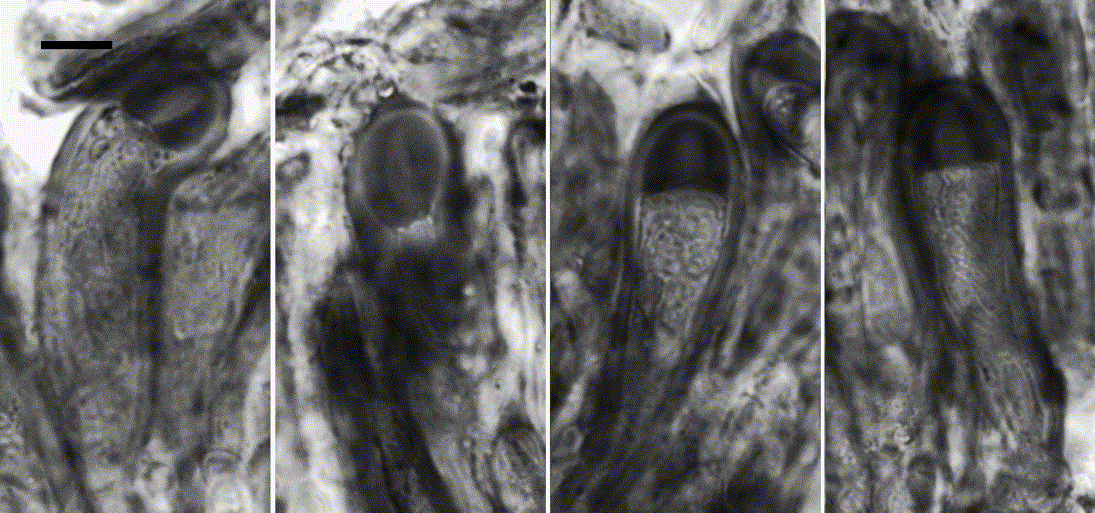
Notes. Calvitimela is separated from Tephromela by having apothecia lacking a thalline margin and by having Lecanora-type asci. However, preliminary molecular data (Miądlikowska et al. Reference Miądłikowska, Kauff, Hofstetter, Franker, Grube, Hafellner, Reeb, Hodkinson, Kukwa and Lücking2006; Arup et al. Reference Arup, Ekman, Grube, Mattsson and Wedin2007) indicate that the situation is more complex than this (see Introduction). The position of T. eatoni is intermediate between these two genera: it has adnate to sessile, lecideine apothecia but the ascus structure, although varying considerably in the same apothecium section (Fig. 4), is fundamentally Bacidia-type. Consequently, because ascus structure is considered to be a more important character at the generic level than the presence/absence of a thalline margin, the species is here retained in Tephromela. The presence of a K+ purple pigment in the lower hymenium, hypothecium and exciple of T. eatonii also indicates a relationship with the T. atra-group.
Tephromela eatonii. (Hertel 24562), variation in ascus type from the same section of an apothecium. Scale = 10 µn.

Typification. Crombie (Reference Crombie1875) gives the habitat and locality as “on rocks, Swain's Bay and Royal Sound” and later (Crombie Reference Crombie1879) as “On rocks and boulders, Observatory, Volage, and Swain's Bays”. Hertel (Reference Hertel1984) selected a lectotype from the specimens in BM but, unfortunately, this collection could not be found and the only specimen in BM under this name from Eaton's original material was referable to Lecanora disjungenda (Cromb.) Hertel & Rambold. An Eaton collection in E from the same locality is also L. disjungenda. However, a specimen of L. atrocaesia in BM has T. eatonii as an associated species (see Specimens examined below). This appears to be the only available original material and it could be chosen as a replacement if the lectotype selected by Hertel cannot be traced. However, as it is quite possible that the original lectotype will be found, no action is taken here.
Specimens examined. Îles Kergulen: Swain's Bay, i 1975, A. E. Eaton (BM, sub L. atrocaesia).—Marion Island: Long Ridge, between Long Ridge South (Lake) and Sea Elephant Bay, 46°52′S, 37°48′E, c. 50 m, older successions of grey basaltic lava, loser Stein in flacher, teilweise sickerwassererfüllten Mulde, 1982, H. Hertel 24,187 (M); Northeastern Coast, Transvaal Cove, vicinity of Meterological Station, 46°53′15″S, 37°51′E, c. 50 m, flacher, steinübersäter Rücken (grey Lava) westlich der Trypot Beach, lose Platte, 1982, H. Hertel 24,562 (M); Central Highland, Katrdraalkrans, 46°53′45′–54′00″S, 37°46′30″–45″E, 810 m, Strilfläche, anstehender Basaltfels, 1982, H. Hertel 24,628 (M).
Discussion
In this study, five species have been added to the genus Tephromela from the southern subpolar region. Along with T. eatonii and the four additional species described by Øvstedal from the Antarctic (Øvstedal & Lewis Smith Reference Øvstedal and Lewis Smith2001), this makes the southern polar region a major centre of speciation for the genus. Indeed, because all the species described here, except T. eatonii, are known from southern South America, and all of Øvstedal's new species were described from collections from the Antarctic Peninsula and associated island groups, there is a high concentration of Tephromela species in this particular area [i.e., the land bordering on Drake's Passage (Mar de Hoces) and the Scotia Sea]. In addition to the species described here, a single corticolous specimen with both apothecia and soredia is known from the Brunswick Peninsula in southern Chile (see Comparative material examined under Materials and Methods). This could be considered to be referable to T. pertusarioides (Degel.) Hafellner & Cl. Roux, but as the apothecia are identical to those of T. atra, this specimen, at least, appears to be nothing more than a sorediate morph of that species.
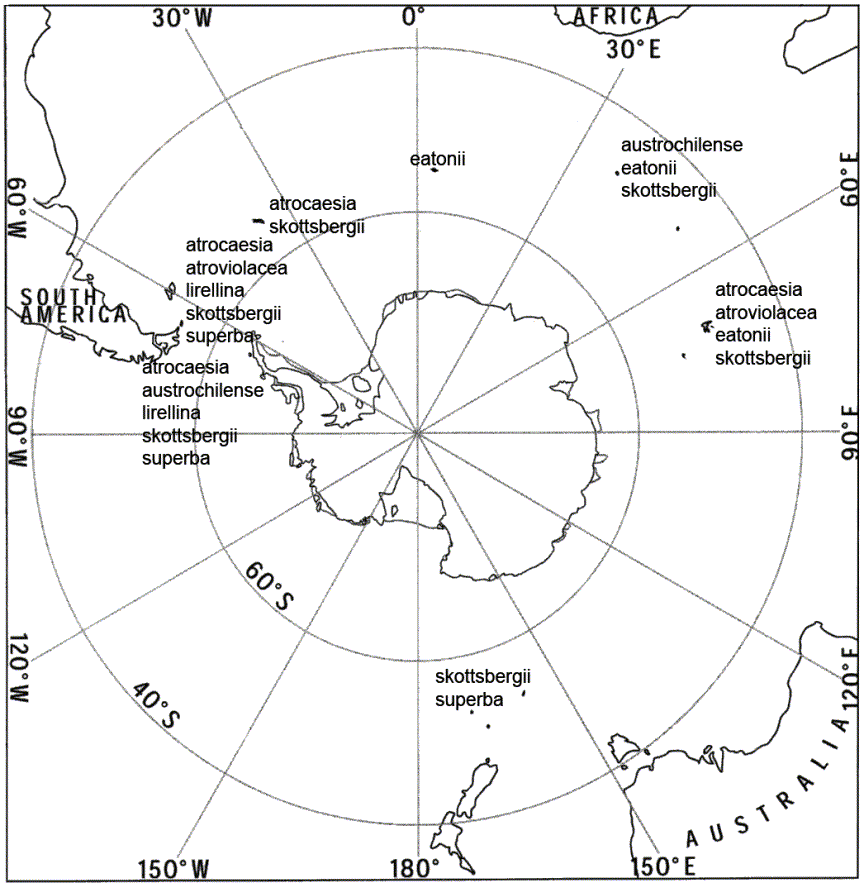
The distribution patterns of the Tephromela species described here are of some interest (Fig. 5). Although Tephromela atra is frequent further north in the south temperate zone (e.g., South Island, New Zealand, Juan Fernandez Islands, Chile), it appears to be rare in the southern subpolar region, most specimens previously referred to this species belonging to the morphologically similar T. skottsbergii. In contrast, none of the other species described here have been reported from further north: T. skottsbergii appears to be ubiquitous in the region; T. atrocaesia is frequent on Îles Kerguelen with additional, outlaying records from South Georgia, the Falkland Islands, and southern Chile; T. atroviolacea appears endemic to the Falkland Islands and adjacent southern South America (with a disjunct population on Îles Kerguelen); T. lirellina is endemic to southern South America (including the Falkland Islands); and T. superba is most frequent in southern South America (including the Falkland Islands) with a single outlying collection from Campbell Island. It is possible that these distributions are artificial and that the apparent absence of a species from an area is due to lack of collections. However, the large number of collections from southern South America (including the Falkland Islands), Îles Kerguelen, and Campbell Island and the Auckland Islands in MSC (c. 18,000; Fryday & Prather Reference Fryday and Prather2001) makes this unlikely, and it is most probable that these perceived distributions are, to a large extent, correct.
Distribution of Tephromela and Calvitimela species in the southern subpolar region.

In addition to the species described above, there are numerous other collections in MSC, especially from Îles Kerguelen and Campbell Island, that have not been studied in detail. These mostly belong to the T. atra group and it is unclear whether these are variations of already described species (e.g., T. atra, T. atrocaesia, T skottsbergii) or represent undescribed taxa. However, their study is outside the scope of this preliminary investigation.
Key to the species of Calvitimela and Tephromela occurring in the southern subpolar region
1 Thecium hyaline ... 2
Thecium purple-brown (at least in streaks) ... 3
2(1) Apothecia innate; hypothecium c. 250–300 µm, hyaline, but with numerous inclusions (dissolving in K) that make it appear dilute brown ... ... Calvitimela austrochilensis
Apothecia adnate to sessile; hypothecium c. 100 µm, brown (K+ purple) ... ... Tephromela eatonii
3(1) Apothecia ± lirellate sometimes ± orbicular; paraphyses tips blue-black ... ... Tephromela lirellina
Apothecia consistently orbicular; paraphyses tips purple-brown ... 4
4(3) Hymenium inspersed ... Tephromela skottsbergii
Hymenium not inspersed ... 5
5(4) Thallus orange-yellow; apothecia innate ... Tephromela atroviolacea
Thallus creamy-grey to yellow; apothecia sessile ... 6
6(5) Thalline margin poorly developed, usually ± excluded; apothecia large (to 5 mm diam.); hypothecium with wide hyaline band adjacent to the hymenium ... ... Tephromela superba
Thalline margin well developed ... 7
7(6) Thalline margin not corticate, not raised above the level of the disc ... ... Tephromela atrocaesia
Thalline margin corticate, raised above the level of the disc ... Tephromela atra
I gratefully acknowledge support from the US National Science Foundation, Award No. DBI–9808 735 (Alan Prather, PI), to Michigan State University for facilitating access to Dr Imshaug's collections, and a Harvey Pofcher Award from the Friends of the Farlow that allowed me to study Carroll Dodge's subantarctic lichen collections in FH. Dr Brian Coppins (E) kindly corrected my Latin diagnoses. The curators of AAS, B, BM, M, H-Nyl and S are thanked for the loan of collections in their care.