Introduction
An estimated 40–80% of individuals with mental illnesses (MI) smoke cigarettes, with up to 90% prevalence among those with severe and persistent (i.e., schizophrenia, major depressive disorder, bipolar disorder) MI (de Leon & Diaz, Reference de Leon and Diaz2005; Kalman, Morissette, & George, Reference Kalman, Morissette and George2005; Morisano, Bacher, Audrain-McGovern, & George, Reference Morisano, Bacher, Audrain-McGovern and George2009). These high rates result in the excessive smoking-related morbidity and mortality observed in these populations (Brown, Barraclough, & Inskip, Reference Brown, Barraclough and Inskip2000; Miller, Paschall, & Svendsen, Reference Miller, Paschall and Svendsen2006; Newcomer & Hennekens, Reference Newcomer and Hennekens2007; Osborn et al., Reference Osborn, Levy, Nazareth, Petersen, Islam and King2007). Although individuals with MI are motivated to stop smoking (Siru, Hulse, & Tait, Reference Siru, Hulse and Tait2009), important barriers exist in their smoking cessation efforts. Most notably, tobacco treatment programmes (TTPs) have not fully integrated into mental health services (MHS) (Prochaska, Reference Prochaska2011; Ziedonis et al., Reference Ziedonis, Hitsman, Beckham, Zvolensky, Adler and Audrain-McGovern2008) and many existing TTPs may not meet the specific needs of MI populations (Addington, Reference Addington1998; McChargue, Gulliver, & Hitsman, Reference McChargue, Gulliver and Hitsman2002). Since individuals with severe and persistent MI often smoke to cope with symptoms of their illness and side-effects of medications (Barnes et al., Reference Barnes, Lawford, Burton, Heslop, Noble and Hausdorf2006; Lawn, Pols, & Barber, Reference Lawn, Pols and Barber2002; Sandyk, Reference Sandyk1993), they may require more specialised approaches to deal with nicotine addiction (McChargue et al., Reference McChargue, Gulliver and Hitsman2002; Selby, Voci, Zawertailo, George, & Brands, Reference Selby, Voci, Zawertailo, George and Brands2010).
Fortunately, individuals with MI are successful in smoking cessation if provided evidence-based TTPs. Extant reviews (Banham & Gilbody, Reference Banham and Gilbody2010; el-Guebaly, Cathcart, Currie, Brown, & Gloster, Reference el-Guebaly, Cathcart, Currie, Brown and Gloster2002; Tsoi, Porwal, & C, Reference Tsoi, Porwal and Webster2010) demonstrate that TTPs provided to the general population can be efficacious for individuals with MI (but at lower success rates). However, it has been contended that MI populations may benefit more from longer treatment durations and intensities (Addington, Reference Addington1998; McChargue et al., Reference McChargue, Gulliver and Hitsman2002; Ziedonis et al., Reference Ziedonis, Hitsman, Beckham, Zvolensky, Adler and Audrain-McGovern2008).
Few studies in Canada have examined TTPs in MHS settings. Among such studies, smoking cessation at end-of-treatment ranges from 20.6% to 33% (Khara & Okoli, Reference Khara and Okoli2011; Selby, et al., Reference Selby, Voci, Zawertailo, George and Brands2010). Hence, there remains a need to examine TTP outcomes in MHS settings within the Canadian context. The specific aims of our study were to examine: a) factors associated with programme completion and b) smoking cessation/reduction outcomes among individuals with severe and persistent MI attending a TTP (the Butt-Out group) within community MHSs in Vancouver, Canada.
Methods
Participants
This study employs a retrospective chart review (between June 2010 and February 2012) of individuals with MI participating in the Butt-Out Programme offered at six community mental health teams through the Vancouver Community Mental Health and Addictions Services (VCMHAS). A majority of non-institutionalised persons (about 6,000 people) with a severe and persistent MI in Vancouver receives ongoing treatment and care by one of these mental health teams. Each team provides psychiatric assessment and comprehensive treatment (including individual and group therapy, medication management, rehabilitation and psycho-education) through drop-in and outreach services for people in their catchment area (Johnson et al., Reference Johnson, Ratner, Malchy, Okoli, Procyshyn and Bottorff2010). Participants of these teams have severe and chronic MI in terms of need for case management, often having a history of hospitalisation, and generally a need for medications and interdisciplinary treatment. Eligibility for the Butt-Out group includes being an existing client of the VCMHAS, tobacco dependent and 19 years or older. Participants come into contact with the Butt-Out programmes primarily through referrals from their primary mental health and addictions teams, health care providers and self-referrals.
Intervention
A detailed summary of the Butt-Out Programme has been described elsewhere (Goldie, Masuhara, Heah, Okoli, & Johnson, Reference Goldie, Masuhara, Heah, Okoli and Johnson2012). In brief, it is comprised of up to 26 weeks of behavioural counselling (facilitated by two trained health care providers) combined with pharmacotherapy in keeping with best practice guidelines for tobacco treatment (Fiore et al., Reference Fiore, Jaén, Baker, Bailey, Benowitz and Curry2008). Behavioural counselling consists of 12-weekly structured-group sessions (1.5 hours duration) followed by additional (optional) 12-weekly support-group sessions (1.5 hours duration). Pharmacotherapy (using single doses or combinations of nicotine gum, patch, lozenge, inhaler, bupropion, and/or varenicline) is provided at no cost to clients, dispensed weekly, and tailored to the participant's individual needs.
Measures
Demographic data included gender (female/male) and age (years). Smoking history questions included: age at smoking initiation (years), cigarettes smoked per day (CPD), nicotine dependence using Fagerström Test for Nicotine Dependence scores (Heatherton, Kozlowski, Frecker, & Fagerstrom, Reference Heatherton, Kozlowski, Frecker and Fagerstrom1991), past smoking cessation attempts (five or less times vs. greater than five times), motivation to quit smoking (i.e., importance, confidence, and readiness each on a scale of ‘0’ low to ‘10’ high) (Kahler et al., Reference Kahler, LaChance, Strong, Ramsey, Monti and Brown2007), smoking cessation stage of change (pre-contemplative/contemplative vs. preparation/action) (Prochaska & DiClemente, Reference Prochaska and DiClemente1983), and social supports for quitting (yes vs. no). Additional information included: Substance abuse history (yes vs. no), primary MI diagnosis (categorised as: none, mood disorder/anxiety disorder, or psychotic disorder), expired carbon monoxide (expCO) level (Middleton & Morice, Reference Middleton and Morice2000), type of medication used during treatment (single vs. combination therapy), Patient Health Questionnaire (PHQ-9) scores (Cameron, Crawford, Lawton, & Reid, Reference Cameron, Crawford, Lawton and Reid2008), and number of visits to the programme.
End-of-treatment is at any time after completing the 12-week mandatory group based on mutual agreement between participant and provider to cease the programme whether or not abstinent. Our main outcome was smoking cessation at the end-of-treatment, defined by 7-day point-prevalence of smoking abstinence (based on self-report and validation of expCO≤8 parts/million, when available). A secondary outcome was reducing to at least 50% of CPD at initial visit (among those unable to achieve abstinence).
Data analysis
Of the 156 individuals who enrolled in the Butt-Out Programme in the review period, nine reported only having a substance use or eating disorder and were not included in further analysis. Of the 147 with severe and persistent mental illness, 13 did not ‘engage’ by having two or fewer contacts with the programme before leaving, hence analyses is based on 134 engagers with a severe and persistent mental illness (i.e., psychotic disorder, depressive disorders, anxiety disorders).
Less than 15% of the sample had scores imputed with the grand mean or median responses on any single missing variables. Chi-square analyses and independent sample t-tests (as appropriate) were used to determine baseline group differences among programme completers and non-completers. A two-step model building procedure (Hosmer & Lemeshow, Reference Hosmer and Lemeshow2000) was used to determine variables to include in logistic models predicting programme completion and cessation at end-of-treatment. The Hosmer-Lemeshow goodness-of-fit test was used to assess the fit of the final models with greater p-values representing better fit. All analyses were performed using the PASW Statistics 20.0 (SPSS, Inc., 2009, Chicago, IL, USA www.spss.com). This study was approved by the University of British Columbia Behavioural Ethics Board.
Results
Sample Characteristics
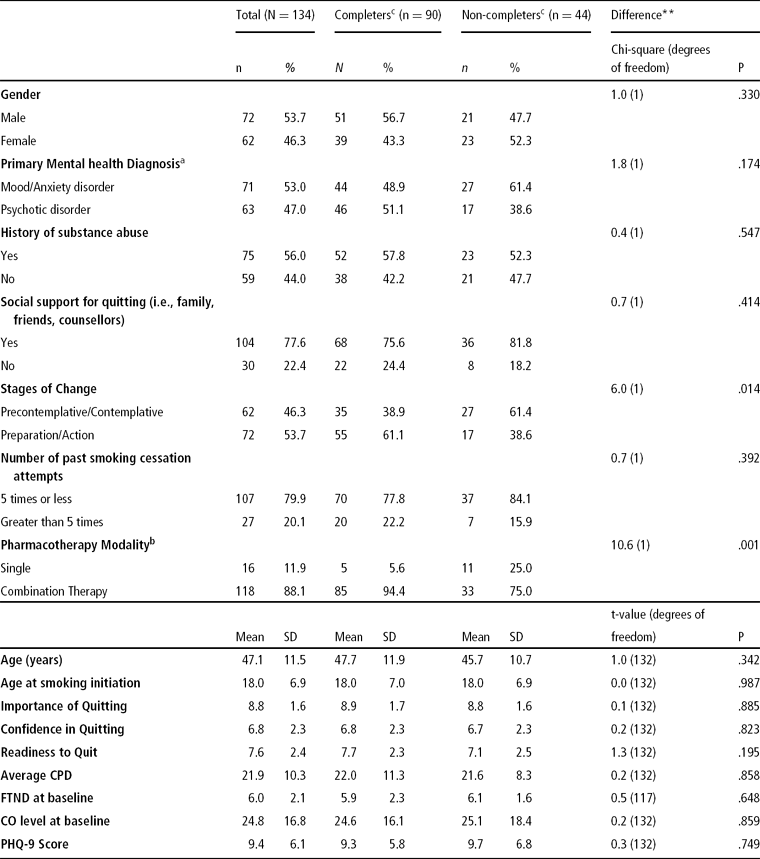
Participants were male (53.7%) with a mean age of 47.1 (SD = 11.5) years. Approximately half had a mood/anxiety disorder and a co-occurring substance abuse history. Three-quarters had social support for cessation and more than half were preparing/actively engaged in cessation. The majority (i.e., 80%) had attempted cessation five or fewer times. A significantly greater proportion of programme completers were in the preparation/action stage of change and had used combination therapy than had non-completers (Table 1). The majority (55%) of participants were referred to the programme through their mental health and addictions health care team, whereas 26.1% were referred by primary health care providers, 17.1% were self-referrals or referred by friends and families, and 0.01% were referred through other community sources.
Sample Characteristics

a. The ‘Mood/Anxiety disorder’ category includes individuals with depression and bipolar disorder and four individual with an ‘anxiety disorder’. The ‘psychotic disorder’ category includes individuals with a primary past history of schizophrenia, schizoaffective disorder, psychotic disorder.
b. The single group includes individuals who only received a single product (patch, or gum, or lozenge, or varenicline, or bupropion) during their treatment. It also includes four individuals who opted not to receive any medications. The Combination therapy group is made up of individuals who received any combination of nicotine replacement or oral medications during their treatment.
c. Programme completers are individuals who attended at least 12 weeks of behavioural therapy sessions of the Butt Out programme. Programme non-completers are individuals who had engaged in the programme for more than two weeks, but attended less than 12 weeks of behavioural therapy sessions.
** Differences are calculated using chi-square analyses for categorical and ordered categorical values, and using independent sample T-Tests for continuous variables.
Program Completion Outcomes
Sixty-seven per cent (90/134) of participants completed the programme. In multivariate analyses, being in the preparation/action stage of change (OR = 2.4, 95%CI = 1.1–5.3) and using combination pharmacotherapy (OR = 5.5, 95%CI = 1.7–17.6) were significant predictors of program completion.
Smoking Cessation and Reduction Outcomes
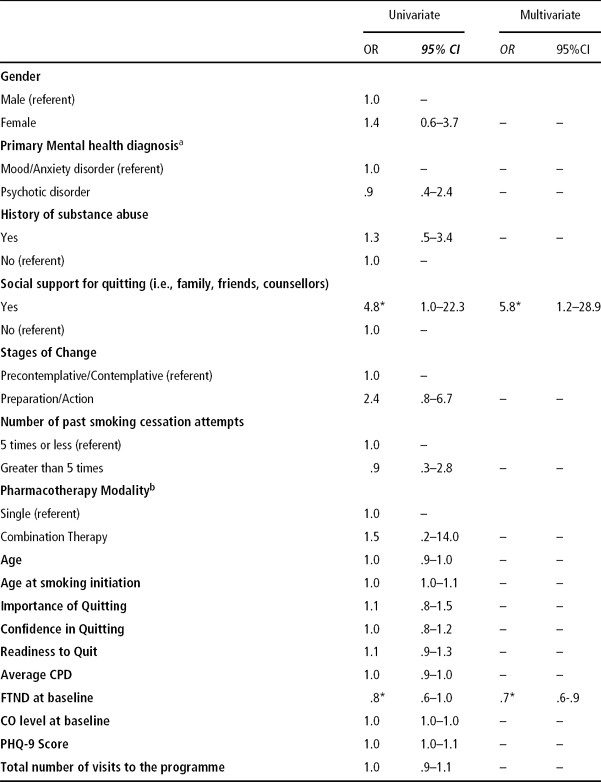
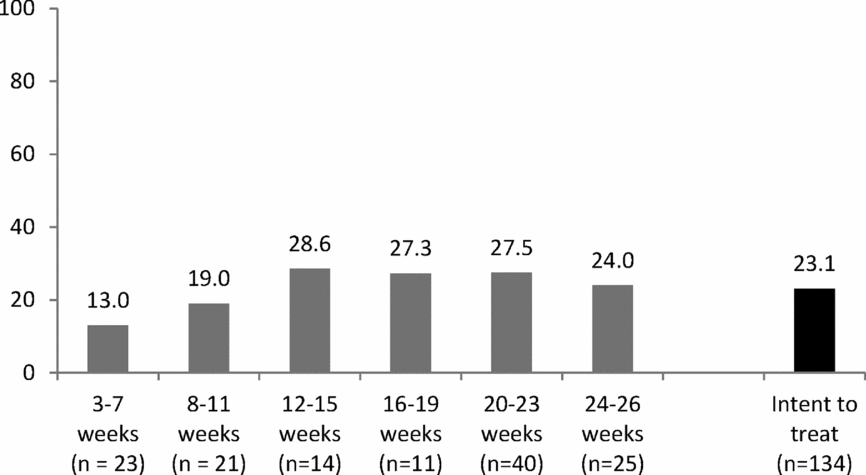
Among those who engaged in the programme (i.e., stayed longer than two sessions n = 134), 23.1% were successfully abstinent at the end-of-treatment (Figure 1). However, among programme completers, 26.7% (24/90) achieved cessation at the end-of-treatment; and 50.0% (33/66) of those who did not achieve cessation reduced their consumption. A longer duration of stay in the programme was associated with successful cessation, but this trend failed to reach statistical significance [F = 1.5 (df = 1), p = .225]. In multivariate analyses significant predictors of cessation at end-of-treatment were having a social support for cessation and having lower nicotine dependence scores at baseline (Table 2).
Predictors of smoking cessationc among programme completers (n = 90)
OR = Odds Ratio, 95%CI = 95% Confidence Intervals
a. The ‘Mood/Anxiety disorder’ category includes individuals with depression and bipolar disorder and four individual with an ‘anxiety disorder’. The ‘psychotic disorder’ category includes individuals with a primary past history of schizophrenia, schizoaffective disorder, psychotic disorder.
b. The monotheray group includes individuals who only received a single product (patch, or gum, or lozenge, or varenicline, or bupropion) during their treatment. It also includes 4 individuals who opted not to receive any medications. The Combination therapy group is made up of individuals who received any combination of nicotine replacement or oral medications during their treatment.
c. Smoking cessation was determined by 7-day smoking abstinence based on self-report and verified by expired carbon monoxide level of 8 parts per milliliter or less. End-of-treatment was based on agreement between the participant and the program team whether the participant had achieved smoking abstinence or not. Final model: Hosmer and Lemeshow goodness-of-fit test χ2 = 4.1 [df = 7], p = .767
* p ≤ .05, **p ≤ .01, ***p ≤ .001
Smoking cessation outcomes by duration of treatment in the Butt-Out programme
Discussion
Our current study examined smoking cessation outcomes and factors associated with completing a TTP for individuals with a severe and persistent MI accessing community MHS. First, the 67% programme completion rate in our study is similar to rates found in other studies in this population (Baker et al., Reference Baker, Richmond, Haile, Lewin, Carr and Taylor2006; Khara & Okoli, Reference Khara and Okoli2011). The 12-weeks of structured programme in the Butt-Out programme followed by another (optional) 12-weeks of support group was in recognition of the particular needs of individuals who have severe and persistent MI (i.e., cognitive-impairments) that necessitate more time to cover psychoeducational components (Addington, Reference Addington1998; McChargue et al., Reference McChargue, Gulliver and Hitsman2002). Future studies may examine optimal treatment durations which minimally burden clients, yet, maximise the potential for cessation success. For example, since we found an increasing smoking cessation rate with longer duration of treatment which appeared to peak between 15 to 23 weeks (see Figure 1), at a minimum smoking cessation programmes among individuals with severe and persistent mental illness should be considered for 15 weeks (i.e., using our current treatment approach of combining behavioural counselling with pharmacotherapy). However, considerations of treatment duration within mental health and addictions services are often pragmatic and limited by the available resource.
Second, 23.1% of participants successfully achieved cessation at the end-of-treatment. These cessation rates are comparable to those found in other recent studies (Gershon Grand, Hwang, Han, George, & Brody, Reference Gershon Grand, Hwang, Han, George and Brody2007; Khara & Okoli, Reference Khara and Okoli2011; Selby, et al., Reference Selby, Voci, Zawertailo, George and Brands2010). Moreover, 50% (among those who did not achieve cessation) reduced their smoking. Studies have found that smoking reduction may be an important aspect of tobacco treatment among individuals with MI, especially as a ‘reducing-to-quit’ strategy (McChargue et al., Reference McChargue, Gulliver and Hitsman2002). This notion is strengthened by evidence to suggest that smoking reduction interventions can facilitate future cessation (Hughes & Carpenter, Reference Hughes and Carpenter2006).
Third, we found that social support and lower nicotine dependence scores were important predictors of smoking cessation. These findings support other studies which demonstrate that greater social support is associated with greater cessation success in the general population (Hanson, Isacsson, Janzon, & Lindell, Reference Hanson, Isacsson, Janzon and Lindell1990; May & West, Reference May and West2000; Murray, Johnston, Dolce, Lee, & O'Hara, Reference Murray, Johnston, Dolce, Lee and O'Hara1995) and that lower nicotine dependence scores at the beginning of treatment are associated with better cessation outcomes (Bailey, Bryson, & Killen, Reference Bailey, Bryson and Killen2011; Dorner, Tröstl, Womastek, & Groman, Reference Dorner, Tröstl, Womastek and Groman2011). Although individuals in our study were five times more likely to achieve cessation if they had social support, this finding should be interpreted with caution given the wide confidence interval range surrounding the Odds Ratio (i.e., 95%CI = 1.2–28.9). Future studies may examine ways to bolster social support for cessation and aspects of social support (e.g., support type such as emotional support, and/or support source such as partner/family members) that facilitate cessation. For example, studies have shown that receiving cessation social support from close counterparts (i.e., friends or relatives or partners) is associated with smoking abstinence as compared to receiving support from more distant counterparts (Ross et al., Reference Ross, Thomsen, Boesen, Frederiksen, Lund and Munk2013). Hence, it may be important to design interventions that have a component of actively involving partners or those whom participants identify as being close to them in order to bolster smoking cessation among individuals with severe and persistent mental illness.
A few important limitations should be considered in interpreting our findings. First, important demographic variables (e.g., education and income) were not available in participants’ charts which could have affected main outcomes. Second, we were unable to obtain follow-up data beyond end-of-treatment to determine the sustained effects of the programme. However, their progress could be followed beyond their completion of the 12-week structured programme (up to 26 weeks). Third, specific MI diagnoses were not available in charts (only broad categories of illness); neither were participants’ insight into their particular illness measured. Finally, the sample size was insufficient to determine which modes of pharmacotherapy were associated with successful cessation among participants based on MI groupings. Future studies with adequate sample sizes could be designed to obtain such valuable information.
In conclusion, evidence-based TTPs provided within MHS is acceptable and effective for individuals who have severe and persistent MI. Providing no-cost pharmacotherapy tailored to the specific addiction needs of participants further eliminates programme access barriers. Given the important predictors of cessation obtained from our study, future TTPs in this population may consider including components that bolster social support for cessation. Additionally, TTPs of longer duration and employing reduction-to-quit based approaches may be considered. Such future programmes may provide policy directions for the integration of TTPs within MHS and assist in reducing the disproportionate disease burden of tobacco use among individuals with MI.
Acknowledgements
We would also like to acknowledge the contributions of Fanna Yee, BFA, BA and Marvin Wesenberg, RRT, CRE who contributed to the data collection in this study.
Financial support
This study was made possible in part through a financial contribution from Health Canada. The views expressed herein do not necessarily represent the views of Health Canada. Health Canada had no role in the study design, collection, analysis or interpretation of the data, writing the manuscript, or the decision to submit the paper for publication.
Conflict of interests
Chizimuzo Okoli has received consultation fees from Vancouver Coastal Health Mental Health and Addictions Services for the study. In addition, he has received consultation fees from Pfizer, a maker of smoking cessation medications, in the past three years.
Joy Masuhara and Tom Heah have no financial disclosures to declare.
Ethical standards
The authors assert that all procedures contributing to this work comply with the ethical standards of the relevant national and institutional committees on human experimentation and with the Helsinki Declaration of 1975, as revised in 2008.