Firms in Great Britain and Ireland were allowed to establish freely on an unlimited liability joint-stock basis from the mid-1820s.1
The reluctance to permit to form freely on a joint-stock basis in Great Britain and Ireland may have been partially due to the conservative nature of the common law, see Cottrell, Industrial Finance, p.45; Harris, Industrializing English Law, p. 78.
Incorporation liberalization was initiated with Irish banks, which could constitute freely on a joint-stock basis as early as 1825, and was then extended to English banks the following year.
2 Irish Banking Copartnerships Regulation Act (1825), 6 Geo. IV, c. 42. Banking Copartnerships Act (1826), 7 Geo. IV, c. 46.
Eventually all firms could freely constitute on a joint-stock basis from 1844.
3 The Joint Stock Companies Registration and Regulation Act (1844), 7/8 Vict., c.110. Harris, Industrializing English Law, p. 284 states that “for the first time in at least 500 years corporations could be formed without explicit, deliberated and specific State permission”. However, firms could only freely incorporate as limited liability companies under An Act for Limiting the Liability of Members of Certain Joint Stock Companies (1855), 18/19 Vict., c. 113. This act was repealed, but re-enacted in 1856 (Hunt, Development, p. 134). The re-enactment was entitled An Act for the Incorporation and Regulation of Joint Stock Companies and other Associations (1856), 19/20 Vict., c. 47. The privilege of limited liability was extended to banks under the Joint Stock Banking Companies Act (1857), 21/22 Vict., c. 49.
The unlimited liability joint-stock institutional form introduced into banking under the 1825 and 1826 acts had a relatively long life, lasting until the general adoption of limited liability just after 1879.4
Prior to the establishment of joint-stock banks, note-issuing banks in Ireland and England were restricted to partnerships with fewer than six partners (Hall, Bank of Ireland, p. 37, Richards, Early History, p. 147). The move to joint-stock banking was preceded by numerous banking failures. In Ireland in 1820, nearly half the commercial banks failed (Hall, ibid., p.37). In 1825 sixty English banks failed which accounted for 7.5 percent of all banks (Pressnell, Country Banking, p. 538). A possible explanation for the failure of these banks is that the six-partner restriction meant that banks were small and undercapitalized making them less robust to economic downturns (Ó Gráda, Ireland, p. 139).
As joint-stock banks operated without any other type of legal constraint apart from note-issue restrictions, a crucial issue is how secure were their deposit liabilities. As contemporaries fully realized, the security of deposits, in large part, depended on bank-owners' personal wealth.
5 Professor Leone Levi, writing in the Bankers' Magazine, expresses the view that the personal wealth of the unlimited liability bank shareholders acted to “inspire unlimited confidence” in depositors (Levi, “Reconstruction,” p. 476). Indeed, many established bankers, sharing Levi's views, believed that unlimited liability gave their banks prestige (The Bankers' Magazine, “Banking Capital and Limited Liability,” September 1882, p. 717).
The amount of personal wealth securing deposits was subject to severe and relentless criticism by Walter Bagehot, the well-known author of
Lombard Street.
6 For example, see Bagehot's Unfettered Banking, Safest Bank, Sound Banking, Limited Liability in Banking - I, and Limited Liability in Banking II.
Bagehot argued in
The Economist, albeit without offering much in the way of evidence, that the shareholders of unlimited banks “do not object to subject all their property to liability, because they have no property.”
7 Bagehot, Limited Liability in Banking I, p. 397.
Similarly, he stated elsewhere that “we enact that every person joining a bank shall be liable for every sixpence contained in it, to his last acre and shilling. The consequence is, that persons who join banks have very commonly but few acres and few shillings.”
8 Bagehot, Unfettered Banking, p. 312.
Bagehot, writing in the mid-1850s, admitted that many banks had wealthy owners, but he believed that this would not remain the case.
9 Eschewing any belief in the brand-name-capital guarantee, Bagehot implied that all bank shares would ultimately end up being owned by widows, orphans and the impecunious.
10 In 1879 The Economist, arguing in the spirit of Bagehot, stated “that the limited liability of the wealthy may be expected to prove as good if not a better security to the depositor as the unlimited liability of the poor.” “Banks and Limitation of Liability,” The Economist, 25 October 1879.
Thus, these banks would become
de facto limited, leaving deposits unsecured.
As Bagehot seemed to realize, the bid price for unlimited liability bank shares depended on a buyer's wealth, with the impecunious willing to bid the highest. Nevertheless, an alternative conjecture is that the governing bodies of such banks, constrained by the legislation governing the formation of joint-stock banks, operated to prevent shares being transferred to impecunious individuals. If any such legal and institutional constraints were effective, new owners would be selected on the basis of meeting some minimum wealth requirements rather than on the basis of bid prices alone.
Using probate records and the business archives of an Irish joint-stock bank, we examine the wealth characteristics of individuals who bought or were given bank shares over a 12-year period. In particular, we analyze the occupational and social profiles, and probated wealth of individual shareholders. We also explore the possibility that the price of bank shares differed across individuals depending on their wealth. In addition, we examine potential information-gathering activities of individual sellers and the bank's governing bodies. We also present evidence on the wealth and shareholding characteristics of the individuals comprising the governing bodies to determine the strength of their incentive to vet share transfers in order to maintain a sufficient level of shareholder wealth backing the bank's public liabilities.
Our findings suggest that the shares of the Irish joint-stock bank were not transferred to impecunious individuals, even in periods when there was an increased probability of bank distress, indicating little support for Bagehot's view. There is little evidence to indicate that investors paid a different price for bank shares on the basis of their wealth. We also find that the governing body contained the largest and wealthiest shareholders, indicating that this body had sufficient incentives to vet share transfers.
Although we focus on one nineteenth-century Irish bank, our study may have a much broader significance. For example, legal scholars are debating the impact upon the capital markets of introducing unlimited liability for corporate torts.11
Some of the main contributions in the law literature include Halpern et al, “Economic Analysis”; Hansmann and Kraakman, “Toward Unlimited Liability” and “Capital Markets”; and Grundfest, “Limited Future.”
Furthermore, modern economists recognize the issue raised by Bagehot, and several have offered theoretical solutions to rectify the problems arising from unlimited liability shares being freely transferable.
12 See Alchian and Woodward, “Firm,” p. 71; Carr and Mathewson, “Unlimited Liability,” p. 769; Jensen and Meckling, “Theory,” p. 331; Winton, “Limitation,” pp. 480, 500; and Woodward, “Limited Liability,” p. 601. Notably, Manne (“Our Two Corporation Systems,” p. 262) argued that investments in unlimited liability firms would tend to come from investors who were nearly insolvent and wealthy individuals would almost never invest in such a firm.
Yet, despite such studies, there is very little evidence as to how unlimited liability joint-stock firms operated in the past.
13 Hansmann and Kraakman, “Toward Unlimited Liability,” pp. 1924–25; and Grossman, “Market.”
THE BAGEHOT HYPOTHESIS AND INSTITUTIONAL COMMITMENT
In this section, we analyze under what conditions Bagehot's hypothesis may or may not hold. As is commonly recognized, shares in unlimited liability firms are more valuable to those having low wealth, in the sense that they do not have much wealth other than that which they have invested in bank shares.14
Grossman, “Market,” p. 68; Halpern et al, “Economic Analysis”; Kraakman, “Unlimited Liability,” p. 651; and Winton, “Limitation,” p. 490.
By extension, shares of an unlimited liability bank would be most valued by any individual whose share ownership approximates their total wealth, making it possible for any shareholder to extract rents by transferring ownership to any individual having less wealth. This raises the crucial question as to whether all wealthy shareowners will ultimately transfer their shares to impecunious individuals.
If, as Bagehot believed, depositors remain ignorant of the dilution of the level of wealth backing the bank's public liabilities, then the full cost of such share transfers would be borne by them, and, as Bagehot clearly hypothesized, there would be an exodus of wealthy shareholders accompanied by an inflow of low-wealth individuals, resulting in each surviving bank becoming de facto limited.15
See also Winton, “Limitation,” p. 490; and Woodward, “Limited Liability,” p. 602. Bagehot, Limited Liability in Banking - I and Limited Liability in Banking - II.
In contrast, when it is assumed that depositors are fully informed and there is a competitive market for bank shares, depositors would demand a fully compensatory risk premium from bank owners, resulting in remaining shareholders bearing the full cost of any share transfer to lower-wealth individuals.
16 Evans and Quigley, “Shareholder Liability,” pp. 502–03. Winton, “Limitation,” p. 500.
Given fully informed depositors, if wealthy shareowners are unable to prevent the free transfer of shares, the unlimited joint-stock bank would not be established in the first place. One possible scheme to prevent such transfers is for co-owners to simply vet buyers before validating any ownership transfer. Indeed, it would be most in the interests of the wealthiest owners to ensure that their fellow owners had sufficient wealth to meet any claims against the bank.17
Carr and Mathewson, “Unlimited Liability,” p. 769.
For this reason alone, we should expect that the wealthiest owners would be most active in the governance of the bank.
18 Hansmann and Kraakman, “Toward Unlimited Liability,” p. 1893.
Interestingly, section 22 of the Irish Banking Copartnership Regulation Act specified that “no share transfer shall take place without the consent of the directors; nor is any transfer valid unless signed by one or more of such directors.”
19 However, as suggested, it would be in the self-interest of the bank promoters to set up such a structure. Therefore, it appears that this section was somewhat redundant. Notably, the English Banking Copartnership Act (1826) did not have this provision, but it appears that English bank promoters voluntarily inserted such clauses into their bank's deeds.
20 Hickson and Turner, “Shareholder Liability Regimes”; and Plumptre, Grant's Treatise, p. 444.
Vetting of transfers might prevent the entrance of low-wealth shareholders into the bank during normal times, but during deep recession years, when the prospect of bank insolvency might dramatically increase, incumbent owners might collectively and individually want to exit the bank by offloading their ownership shares. Consequently, fully informed depositors would require some credible guarantee against the exit of wealthy shareholders during such periods. One can argue that the post-sale-extended liability requirement imposed under the Banking Copartnerships Regulation Act of 1825 (6 Geo. IV, c. 42) provided this function.21
Winton, “Limitation,” p. 480 suggests two possible solutions to the pecuniary externality we have described: either forbid the sale of shares without approval by all shareholders or impose a post sale extended liability requirement.
Specifically, section 18 of this act specified that in the case where an existing shareholder was unable to fully meet all debt obligations, former owners having sold their ownership within the three-year extended liability period then became liable for remaining debts of the bank.
22 Section 13 of the Banking Copartnership Act (7 Geo. IV, c. 42) imposed the same requirement upon shareholders of English banks. See Hickson and Turner “Shareholder Liability Regimes.”
After the 1862 Companies Act, banks were permitted to abandon their old co-partnership constitutions and register as unlimited liability companies.
23 One of the main benefits to shareowners of doing this was a reduction from three years to one year for which members were liable after they had sold their shares.
24 Crick and Wadsworth, Hundred Years, p. 33.
The enactment of the post-sale-extended liability requirement raises the issue as to whether it would have been feasible for shareowners to adopt a similar provision voluntarily in their deeds of co-partnership. Mitigating against such a possibility is that such a provision could have been eliminated at the most expedient time, which would correspond with an increase in bank distress.
We have argued that once a bank having wealthy shareowners has been established, the Bagehot-type bank would not evolve. However, Bagehot's de facto limited liability bank might arise for some banks where all the initial shareowners establishing the bank are low-wealth individuals.25
Indeed, there is some evidence to suggest that this may have been the case with the Agricultural and Commercial Bank of Ireland. See Hickson and Turner “Genesis.”
Nevertheless, if depositors are fully informed, such a bank would either have to pay a very high-risk premium to depositors or accumulate idle resources.
26 Evans and Quigley, “Shareholder Liability.”
The rest of this article analyzes the trading of shares in an unlimited liability joint-stock bank and tests the implications arising from this section.
THE ULSTER BANKING COMPANY
The publicly accessible archives of the Ulster Banking Company (UBC) contain share transfer journals which recorded the details of every share transfer made, making this bank ideally suited to test Bagehot's hypothesis.27
Ulster Banking Company's Share Transfer Journal (1874–1880) - PRONI D/3499/CC/3.
Unfortunately, for most banks such detailed records are not easily accessible as they are deemed to have little archival value.
28 We thank Dr. John Booker (Archivist at Lloyds-TSB) for pointing this out to us.
Fortunately, as we demonstrate in what follows, this bank proves to be a good example to study as its low share denomination makes it,
a priori, a prime candidate for Bagehot's view.
Historical Context
Prior to the mid-1820s the Bank of Ireland, which had been established in 1783, was the only joint-stock bank in Ireland. In return for raising £600,000 for the Treasury, the charter of this bank granted it the unique privileges of incorporation and limited liability.29
Hall, Bank of Ireland, pp. 35–36.
The privilege of incorporation was then extended to all banks following the enactment of the Banking Copartnership Regulation Act in 1825, leading to two waves of joint-stock bank promotion. During the first wave in the mid-1820s, the Belfast, Hibernian, Northern, and Provincial Banking Companies were formed. Later, during the joint-stock mania of the mid-1830s, the Agricultural and Commercial Bank, National Bank of Ireland Bank, Royal Bank of Ireland, and Ulster Banking Company (UBC) were established. The only other joint-stock banks of note were the Tipperary Joint-Stock Bank, which was a small bank founded in 1838, and the Munster Bank Limited, a limited liability bank founded in 1864. The former failed due to fraud in 1856, the latter due to poor governance in 1885.
30 Barrow, Emergence, pp. 160–63. See also Ó Gráda, Munster Bank. Similar to their English counterparts, Irish banks could form on a limited liability basis from 1858 onwards. However, it wasn't until the early 1880s that the established Irish joint-stock banks converted to limited liability. For the various explanations for this delay, see Hickson and Turner, “Shareholder Liability Regimes.”
As already noted, Irish banking experienced several bank failures during the nineteenth century, but the failure of the Agricultural and Commercial Bank in 1836 was so serious that a British parliamentary committee spent a considerable amount of time investigating the reasons for the failure of this bank. Although there is debate regarding whether or not this bank was a scam, the fundamental point is that the available evidence strongly suggests that the vast majority of its shareholders were from the poorer classes of society.31
Several historians believe that the failure of this bank can be attributed to fraud on the part of two of the bank promoters (Dillon, History and Development, pp. 71–78; and Hall, Bank of Ireland, p.158). However, for the contrary view see Barrow, “Justice for Thomas Mooney”; and Barrow, Emergence, p. 111. On the social class of shareholders, see Hickson and Turner, “Genesis.”
Indeed, this bank and several similar English ones may have coloured Bagehot's views about the shareholders of all joint-stock banks. Nevertheless, except for this failure and the two failures noted above, Irish banking was otherwise stable in the nineteenth century, possibly as a consequence of unlimited liability. Another factor may have been the emerging role of the Bank of Ireland as a liquidity provider.
32 During the nineteenth century, banking in Belfast and in the province of Ulster was dominated by the Belfast, Northern, and Ulster Banking Companies. These banks had virtually identical deeds of copartnership, the same governance structure, similar amounts of total assets and approximately similar numbers of branches. Furthermore, there is evidence that they formed a successful cartel, and are generally regarded as being the most efficiently managed of all the Irish banks.33
Ollerenshaw, Banking, pp. 122–40.
The UBC opened in July 1836 to service the banking needs of the growing city of Belfast and its surrounding districts.34
Ollerenshaw, Banking, p. 46.
Initially, the UBC registered under the Banking Copartnerships Regulation Act (1825), but at its Annual General Meeting of 1867, it was unanimously resolved “that the Ulster Banking Company shall be registered as an Unlimited Liability Company, under the Companies Act, 1862.”
35 AGM of 1867 - Ulster Banking Company's Committee and General Meeting Minute Book (1864–1879) - PRONI D/3499/AA/2.
In registering as an unlimited company, it emulated the Belfast and Northern Banking Companies.
36 Ollerenshaw, Banking, p. 143.
One of the main reasons for undertaking this registration was that the UBC's deed did not allow for perpetual succession, whereas registering under the 1862 Companies Act allowed the bank to have perpetual succession as a corporate entity.
37 Deed of Copartnership of the Ulster Banking Company, p.5, section 1.
The UBC's constitution required that the bank have four directors answerable to a shareholders' committee, which had seven elected members. Directors, at their discretion, continued in office unless they were voted off by two-thirds of the shareholders.38
Ibid., pp. 14–15, section 11.
In contrast, the members of the shareholders' committee were elected annually, with at least two members to be replaced annually.
39 Ibid., p. 16, section 14.
In many respects, the UBC was representative of most Irish banks. In 1875 it had a similar number of branches to other unlimited joint-stock banks, apart from the National Bank and Royal Bank.40
Branch numbers in 1875 were as follows: Belfast (36), Hibernian (32), National (106), Northern (44), Provincial (44), Royal (5), and Ulster (44). The source of these figures is Dun, “Banking.”
Also, in terms of total assets, the UBC was similar to that of other banks, with only the National Bank having significantly more total assets than the rest.
41 In 1875 the National's total assets were £11,571,000, whereas the UBC had £4,251,000 (Dun, “Banking”).
In terms of shareholders, the UBC had 1,020 in 1875, which was several hundred shareholders more than its two close rivals, but it had slightly fewer shareholders than the southern-based Irish banks, and significantly less than the National Bank, which had 4,000 shareholders in 1875.
42 Close rivals the Belfast Banking Company had 648 shareholders and the Northern had 718 (Dun, “Banking”). Shareholder numbers for southern-based banks in 1875 were as follows: Hibernian (1,380), Provincial (2,000), and Royal (1,350). The figures are from Dun, “Banking.”
The UBC differed from other major Irish joint-stock banks in having a significantly lower share price. For example, in October 1874 the share price of the UBC was £10.2s.10d., whereas the share prices of the other six major Irish unlimited liability joint-stock banks ranged from £30.10s.0d. to £125.10s.0d., with an average share price of £78.2s.5d.
43 Share prices obtained from Investors' Monthly Manual, October 1874.
Indeed, of all the Irish, English, and Scottish banks reported in Dun's comprehensive statistical study of British banking, only one has a lower share price than the UBC. According to an influential contemporary view, banks such as the UBC, having low share prices, were more likely to be owned by the poorer classes.
44 This makes the UBC the most relevant Irish bank to study in regard to the Bagehot hypothesis.
Sample Period
The period chosen for our study (January 1868 to December 1879) is interesting for several reasons. Firstly, trading in unlimited liability bank shares would have been highly developed by this stage given that the unlimited liability joint-stock bank had been in existence for nearly half a century. Secondly, these were the final years of unlimited liability banking, as across the British Isles there was a general move by banks to limited liability after 1879. Finally, during the period of our study, the City of Glasgow Bank, a prominent unlimited liability Scottish bank, failed.45
The City of Glasgow Bank failed on 1 October 1878 with assets of £7,200,000 against liabilities of £12,400,000 (Checkland, Scottish Banking, p. 741). The depositors and note holders of this bank did not incur any losses, but after the bank's liquidation, the majority of shareholders were insolvent (Checkland, ibid., p. 471).
Following the collapse of this bank and the bankruptcy of the majority of its shareholders, there was a widespread concern across the British Isles that the wealthy shareholders of unlimited joint-stock banks would sell their shares to less wealthy investors or even transfer them to impecunious individuals.
46 Levi, “Reconstruction,” p. 476; Gregory, Westminster Bank, p. 212; Clapham, Bank, p. 311; and Alborn, Conceiving Companies, p. 135.
Indeed, if the post-sale-extended liability requirement was an ineffective restriction for preventing shareholders selling to individuals with substantially less surplus wealth, then one would expect this to be especially apparent after the City of Glasgow failure.
The start date for our study (January 1868) was chosen because this was the beginning of the bank's first full year as a registered Unlimited Liability Company. Prior to this date, the bank did not publish an annual shareholders' list, which is required for our analysis. Our study ends in December 1879, as by this stage, there was the genesis of a general move to limited liability by banks, and the expectation that banks were going to convert to limited liability had already been incorporated into bank share prices.47
Hickson and Turner, “Shareholder Liability Regimes.”
Stock Transfer Process
Although the legislation governing the establishment of joint-stock banks permitted shares to be freely traded, such shares were not traded through an established stock exchange, as the Belfast Stock Exchange did not appear until 1897.48
Thomas, Stock Exchanges, p. 221. The Dublin Stock Exchange did exist at this time, but it is unlikely that many UBC shares were traded on that market because just over 7 percent of the UBC's share owners actually lived outside of the province of Ulster.
Nevertheless, numerous local stockbrokers could “execute clients' orders by matching them in their own offices, negotiating with each other, contacting correspondents in other markets, or by buying and selling on their own account.”
49 Frequent market-reports on the shares of the three Belfast-based banks appeared in the local press.
50 For example, a report in the Belfast Newsletter (12 April 1875) stated that: “Neither Belfast nor Northern Banks have changed hands during the week; the former are wanted at 102, the latter offered at 90. Ulsters have been repeatedly done at £10 6s, and £10 6s 6d is now asked for them.”
It was also possible to trade shares privately. Alternatively, empowered by the UBC deeds, directors or members of the shareholders' committee could act as agents for shareholders and sell their shares.
51 Deed of Copartnership of the Ulster Banking Company, p. 34, section 32.
Unfortunately, the UBC archives provide no indication of the degree to which these various means were used by shareholders to find buyers for their shares.
The UBC's deed stipulated that share transfers were under the control of the directors and shareholders' committee.52
Ibid., p. 28, section 26.
Before the shares could be transferred, the seller had to notify the directors in writing specifying the person intending to buy the shares, the number of shares being sold, and the price at which shares would be sold.
53 Ibid., pp. 29–30, section 27.
The directors had the right to refuse any sale, and at the time of notifying directors of a sale, sellers had to simultaneously offer their shares at the same price to the directors. Directors were authorized to purchase shares of the bank when necessary and hold them in their possession, and sell those shares either by public auction or private sale at an expedient time.
54 Ibid., pp. 30–31, section 29.
The directors notified sellers whether or not their proposed share sale was acceptable; in which case, the exchange was then entered into a transfer book. Once a transfer was authorized, it could not be cancelled ex post, except when a sale was made at a lower price than was notified to the directors.55
Ibid., p. 29, section 27.
In this instance, the shares were forfeited.
Proprietors or their legal representatives could also make gratuitous assignments of shares. However, such assignments were not valid without the consent of the directors and shareholders' committee, and if consent was refused, the proprietor had the option of requiring the directors to dispose of their shares. If executors or next of kin of a deceased proprietor wanted to become proprietors themselves, in respect of shares held in trust, they had to seek the permission of the directors and shareholders' committee.56
Ibid., pp. 32–33, section 30.
Although the directors were the company officers notified about all share transfers, from the minutes of the shareholders' committee, it appears that the task of vetting share transfers was shared with the shareholders' committee, and they ultimately had the final say on share-transfer authorization. The shareholders' committee usually met bi-monthly, and of their 281 ordinary meetings between January 1868 and December 1879, the only item minuted for 55.5 percent of these meetings was the authorization of share transfers.57
Ulster Banking Company's Committee and General Meeting Minute Book (1864–1879) - PRONI D/3499/AA/2.
Notably, many additional minutes include non-time-consuming items such as declarations of secrecy, changes in meeting times, and offering condolences to relatives of deceased staff or major shareholders.
According to the minutes of the shareholders' committee, during the first few years of the UBC, there were approximately 17 occasions when share transfers were rejected, and the bank subsequently bought the shares.58
Ulster Banking Company's Committee and General Meeting Minute Book (1864–1879) - PRONI D/3499/AA/1, 1 May, 6 November, 4 December, 1837; 1 January, 5 February 1838; 5 October 1840; 7 October, 5 December 1842, 6 February, 3 April, and 1 May 1843.
However, no indication is given as to why these transfers were rejected. After this initial period, there are no minutes relating to share transfers being rejected, perhaps because directors and committee members may have provided alternative buyers. Alternatively, directors may have purchased the shares on behalf of the bank, either holding them or subsequently selling them to more suitable investors. In our sample period, two directors in particular (Henry McCance and Francis Lepper) were very active in selling shares, although they were almost inactive when it came to purchasing shares. Henry McCance made 88 share sales, selling 1,561 shares, and along with Francis Lepper, he made 20 sales, selling 380 shares. However, the available evidence does not shed light whether these were sales made either on their own behalf or on that of the bank.
Ulster Banking Company's Capital and Share Price
The deed of the UBC states that the capital of the bank was £1 million, consisting of 100,000 shares of £10 each, with one-quarter paid-up.59
Deed of Copartnership of the Ulster Banking Company, p. 5, section 1.
Initially, only 75,000 shares were issued, but on 4 September 1871, it was resolved to issue the 25,000 unissued £10 shares on the basis of one share for every three held, with one-quarter paid-up. These unissued shares were offered for sale to incumbent shareholders. Then, on 1 September 1876, it was resolved that the capital of the company should be increased by 100,000 shares of £10 each. Twenty thousand of these were to be offered for sale to shareholders in proportion of one share for every five held, and these shares were one-quarter paid-up.
60 This meant that from 1877 onwards, there were 120,000 issued shares. The capital increases may have had a significant impact on shareholder numbers, as the number of shareholders increased from 544 in 1868 to 1,454 by 1879.
61 Ulster Banking Company's Yearly Reports 1868–1881 - PRONI D/3499/AE/1.
The average monthly share prices displayed in Figure 1 were calculated using prices reported in the Ulster Banking Company's Committee and General Meeting Minute Book (1864–1879).62
The average share price in January 1868 was £9.8s., peaking in September 1876 at £12.13s., and falling by December 1879 to £10.17s.2d. From
Figure 1, it can be seen that the from the end of 1868 until the end of 1875, the share price of the UBC did not change much. However, from the end of 1875 until September 1876, there was a sharp rise in the share price. Unsurprisingly, the share price fell over the few months just after the announcement of new capital being raised, but it recovered again by early 1878, after which time it was relatively stable until the City of Glasgow crisis occurring at the end of October 1878. Similar to the pattern displayed by other banks, the share price fell 13.6 percent, between October 1878 and January 1879.
63 Baker and Collins, “Financial Crises,” p. 430.
The dramatic decline in the price of bank shares was also mirrored in the market for industrial shares.
64 By July 1879,the monthly index of industrial shares had fallen 13.8 percent from its level in October 1878 (Smith and Horne, “Index”).
DATA ON ULSTER BANKING COMPANY SHAREHOLDER PROFILES
In this article, we examine the wealth and occupational status of individuals who bought or were given shares in the UBC from 1868 through to 1879. The UBC's share-transfer journal contains the following information: the buyer's and seller's names, the buyer's address and occupation or social status, whether the seller was deceased, and the number of shares transferred. Unfortunately, the share-transfer journal does not report the share price associated with each transfer. Nevertheless these prices were recorded in the minute books of the UBC's shareholders' committee.65
Ulster Banking Company's Committee and General Meeting Minute Book (1864–1879) - PRONI D/3499/AA/2.
In many cases, shares were gratuitously transferred for a fee (to cover stamp duty). We also use the list of shareholders reported in the bank's 1868 annual accounts to help us fill in gaps with respect to shareholder addresses, especially when it comes to the addresses of sellers, which were not reported in the share transfer journals.
66 Ulster Banking Company's Yearly Reports 1868–1881 - PRONI D/3499/AE/1.
In our sample period, there were 1907 individuals and 88 married couples who obtained UBC shares.67
A relatively small number of individuals jointly purchased shares in the bank and they are included in these figures.
From
Table 1, we can see that the majority of individuals who obtained shares in our sample period accumulated between 11 and 100 shares, with the median number of shares accumulated being 25.
From Table 2, we see that during the sample period there were 3,232 transfers of UBC shares, translating into an average of approximately 1.2 transfers per working day. Unsurprisingly, after the issuance of share capital in 1877, the frequency and volume of transfers increased, but the increase in trading activity, particularly in 1879, could also be due to shareholder concerns following the failure of the City of Glasgow Bank in 1878.
From Table 2, it can also be seen that just over half of all the shares transferred in the period were transferred gratuitously. Just over 42.2 percent of all shares transferred gratuitously were transferred by the executors of deceased shareholders. A further 40.5 percent were transferred inter vivos to relatives bearing the same surname as that of the transferor. As this figure actually increased after the City of Glasgow failure, we can infer that shares were not necessarily dumped on unrelated impecunious individuals in this period.68
Between the start of November 1878 and the end of December 1879, 60.3 percent of shares were transferred inter vivos to relatives having the same surname as that of the transferor. A further 31.8 percent were transferred by the executors of deceased shareholders.
The available evidence does not provide an explanation for the remaining 17.3 percent of shares transferred gratuitously. However,
inter vivos transfers between business partners, maternal aunts and uncles and their nephews and nieces, widows and their brothers and sisters, men and their widowed sisters may account for the majority of these.
Stamp duty had to be paid on each share bought or obtained gratuitously. Before 1872 this duty was 5s. per share, but it increased to 10s. after this date. Given that the stamp duty was a high proportion of the UBC's share price, it might be expected that this may have reduced the volume of trading in these shares. However, the increase of the stamp duty in 1872 does not appear to have been sufficient to unduly dampen the market for UBC shares, as there was a significant increase in trading activity in 1873 and subsequent years.
In order to estimate the wealth of the 1,995 UBC shareholders included in our sample period, we use the terminal value of their wealth as recorded in probate records. This approach has the obvious drawback of not capturing the actual wealth of the shareholder at the time of obtaining shares in the bank. For example, of the 52 shareholders in our sample whose terminal wealth was £200 or less, 19 actually owned shares having a greater value than their bequeathed estate.69
Notably, six of these had obtained more than 100 shares in our sample period.
Indeed, due to life-cycle effects, the terminal wealth of a shareholder will generally underestimate their wealth at the time they bought UBC shares. The existence of
inter vivos gifts may also lead to an underestimation of the terminal wealth of the testator. In addition, the testator's wealth may be underestimated in order to evade death duties, as would be especially easy if the testator's business was a partnership.
70 Rubenstein, “Victorian,” pp. 603–04.
Another drawback of our approach is that the majority of property owners did not leave wills in this period because property was transferred in testate or inter vivos. This becomes particularly problematic when certain types of investors are less likely to leave wills than others. For example, merchants may have been more likely to pass their business unto an heir before dying. In addition, spinsters would have a lower propensity to leave wills as the property bequeathed to them in their father's will would frequently have contained an entail enforceable through legal restrictions.
Fortunately, the UBC's share-transfer journals record whether a particular seller was deceased. Searching through the share-transfer journals from 1868 to 1898 (this was the last year that was available for public inspection), we found that close to 280 of our 1,995 shareholders died during this time period. Using this information, we examined the relevant Will Calendar book to ascertain if the deceased had left a will.71
The Will Calendar books for Ireland can be found at the PRONI.
By this method, we identified the probated wills of 152 of our 1,995 shareholders.
In order to find the wills of the remaining shareholders, we searched the Ulster Historical Foundation's database, which contains an index of the probated wills and letters of administration in Ireland for the years 1878 to 1900. We also searched the following indexes located in the Public Record Office of Northern Ireland: Index to the Belfast Wills and Administrations 1900–1908, Index to the Belfast Wills and Administrations 1900–1908, and Index to the Armagh Wills and Administrations 1901–1908. All these will indexes typically only report the deceased's name, county of residence, and year of probate. Of the names in these indexes matching those of our investors, we only accepted those having the same address and occupation or social status as recorded in the UBC share-transfer journals. Using the database and indexes, we identified the probated wills of a further 459 shareholders. Therefore, in total, we identified the probated wealth of 611 of our 1,995 shareholders. This proportion is remarkable given that in 1879, the Irish Will Calendar contains about 4,600 wills, while there were approximately 105,100 deaths.72
Mitchell, British, p. 54. The Will Calendar book for 1879 has 773, and on average each page has six entries. With the passage of time, there appears to be a greater propensity for individuals to leave wills. For example, in 1889, there were approximately 6,700 probated wills in Ireland.
The average year of probate for our sample was 1887, with the median also being 1887. The probate dates for three of our shareholders were in the late 1860s; the probate dates of a further 114 were in the 1870s; the probate dates of a further 243 were in the 1880s, with 175 in the 1890s, and 76 in the first decade of the twentieth century. As there was a low rate of inflation from 1870 to 1910, we do not convert our terminal wealth figures into real terms.
UBC SHAREHOLDER PROFILES AND THE BAGEHOT HYPOTHESIS
Shareholder Occupations
The information in Table 3 lists the occupations or social status of our 1,995 UBC shareholders. Table 3 indicates that just over 30 percent of these shareholders were widows or spinsters, although between them they only obtained 27 percent of the shares in the period. Nevertheless, five spinsters alone obtained 34.7 percent of shares accumulated by all spinsters in the sample period. We also observe that by far the largest group of investors in terms of the number of shares obtained were professionals who had nearly 2,500 more shares than spinsters and nearly double the number of shares bought by widows. After the professionals and spinsters, the merchant classes and gentlemen were the next largest groups in terms of number of shares obtained, between them obtaining nearly 20,000 more shares than the spinster group. We also observe that the average and median number of shares accumulated over our sample period was greater for the merchants, professionals, and gentlemen than for the spinsters or widows group. Unsurprisingly, given the UBC's presence in the rural economy, many farmers bought or obtained shares in our sample period.
From a first glance, we see that very few shares were sold to individuals from the lower middle classes or below. The 39 bank clerks may have been from wealthy banking or mercantile families, perhaps being groomed for higher office in the bank. Notably, there are only 28 individuals in the tradesmen category, accumulating only 0.9 percent of the shares traded in the period. However, many of these individuals, although categorized by the UBC as builders and butchers etc., may have been small businessmen.
Shareholder Wealth
From the information in Table 4, it can be seen that UBC shareholders, on average, bequeathed £5,334 and that the median wealth of our investors was £1,961. Looking at each decade separately, there are no substantial differences in the distribution of wealth that was bequeathed.73
Average wealth bequeathed in the 1870s was £6,525 (standard deviation = £15,473); average wealth bequeathed in the 1880s was £4,185 (standard deviation = £8,871); average wealth bequeathed in the 1890s was £5,834 (standard deviation = £10,570); average wealth bequeathed in the 1900s was £6,020 (standard deviation = £11,691).
indicates that the majority of our shareholders had less than £5,000 of wealth, but 10.6 percent of our 611 shareholders bequeathed wealth greater than £10,000. Furthermore, as can also be seen in
Table 4, the failure of the City of Glasgow Bank did not lead to a reduction in the quality of individual entering the membership of the UBC. Indeed, it appears that, if anything, the average wealth of individuals entering the UBC rose during this period, reflecting perhaps that depositors had become more risk averse following the City of Glasgow crisis.
In order to get a measure of the relative wealth of our investors with respect to the population leaving wills during the late nineteenth century, we took a sample of wills from the Will Calendar book for 1889.74
The Will Calendar for 1889 had 747 pages with an average of nine entries per page. We took the top three entries from each page, which gave us the estates left by 2,189 deceased individuals.
The average probated wealth of our sample individuals was £2,277 compared to £5,334 for the UBC investors.
75 The standard deviation for the sample was £37,897.78 and the median was £239.
Notably, repeating this procedure using the Will Calendar for 1879 yielded similar results.
76 The average for 1879 was £2,289.42, with a standard deviation of £11,820.98 and a median of £450.
Using the Welch procedure, the difference in means is statistically significant at the 99-percent confidence interval.
77 Notably, the total wealth of our 611 shareholders constitutes 86 percent of the UBC's total liabilities to the public in 1879, when the bank had 1,454 shareholders.
78 The total public liabilities were £3,785,399. Ulster Banking Company's Yearly Reports 1868– 1881 - PRONI D/3499/AE/1.
The wealth characteristics of the main occupational or social status categories are reported in Table 5. Although, spinsters were less likely to leave wills than other shareholder categories, they were on average, relatively wealthy. Unsurprisingly, widows have the lowest average wealth with just over half of the widows having less than £1,000 when they died. Notably, half of the shareholders having estates smaller than £200 were either widows or spinsters, placing them at the bottom end of the wealth distribution of our sample.
Although Table 3 shows that gentlemen, merchants, and professionals accumulated 52.9 percent of the shares in our sample period, Table 5 reveals that these three occupational categories were, on average, the three wealthiest groups after manufacturers. Furthermore, apart from the manufacturers, these three categories have the lowest percentage of shareholders bequeathing less than £1,000. Notably, as can also be seen from Table 5, the tradesmen leaving wills were relatively wealthy individuals, which gives some support to our earlier claim that they may in fact have been better described as small businessmen.
Shareholder Wealth and Share Prices
As recognized by some economists and legal scholars, shares carrying unlimited liability may have different values depending on the wealth levels of shareholders, thus a common market price for unlimited liability shares may not exist.79
Grossman, “Market for Shares,” p. 68; Kraakman, “Unlimited Liability,” p. 651; and Winton, “Limitation,” p. 490.
We now explore the possibility that the amount that shareholders paid for their shares was correlated to their wealth. Indeed, in order for a Bagehot-like scenario to develop, one would expect to see the less wealthy paying more for their shares than wealthier individuals.
At first glance we note that there was little variation each month in the prices paid by shareholders. The monthly standard deviations of share prices ranged from zero to £0.6557, with the average for the 144 months being £0.0842. Yet, when we take into account the events associated with the issuance of new share capital and the City of Glasgow failure, this average falls to £0.0736. Notably, only in ten of the months of our sample period did the standard deviation of share prices exceed £0.20, with six of these being the previously mentioned exceptional periods.
To account for general share price trends, we calculated a premium by first subtracting the average monthly share price from the share price paid by each shareholder, and then dividing this figure by the share price paid by each shareholder. Given the existence of price discrimination, one should find that the wealthier investors pay a negative premium and the less wealthy pay a positive premium. The mean value of this premium is 0.06 percent with a standard deviation of 1.123 and a kurtosis equal to 9.324. Nevertheless, as the premium ranges from 6.411 percent to –8.945 percent, we explore in what follows the possibility that these premiums are associated with differential prices based on wealth.
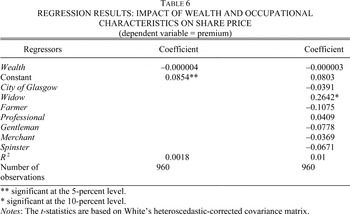
As indicated in Table 1, the total number of transfers for monetary consideration during the period under review was 2,667, and of these, 960 transfers were made to shareholders on whom we have probated wealth. Against the 960 shares transfers, we applied an OLS regression having the premium as our regressand. Given that price discrimination could have been directly applied not only against wealth, but also on the basis of socio-economic status, we include as our regressors both probated wealth and dummy variables indicating occupational or social status. In addition, we include a dummy variable to account for a City of Glasgow failure effect. This dummy variable takes on a zero value for the period before October 1878, and the value of one thereafter.
The regression results in Table 6 show that the coefficient on the wealth variable is negligible and is statistically insignificant. The results in Table 6 provide little support for the contention that the share price paid by individuals was dependent on their wealth or occupational status. Interestingly, only the widow dummy variable is significant and has a positive sign, suggesting that widows pay a higher premium than other investors. Although, the size of this coefficient indicates that this premium is relatively small, one interpretation may be that widows were less sophisticated than the other categories of investors. Consistent with our previous findings, the City of Glasgow variable is also statistically insignificant.
THE IMPORTANCE OF INFORMATION AND THE TRANSFER OF SHARES
As we have noted, a major provision of the 1825 Banking Copartnership Regulation Act was the post-sale-extended liability requirement. The provision meant that a seller would became liable for the bank's debts if the buyer had insufficient wealth to meet his or her pro rata share of claims during bankruptcy proceedings. Consequently, it would be anticipated that sellers would want information on the individual purchasing their shares, especially during recessionary periods. However, there is no direct archival evidence suggesting that shareholders did gather information on potential buyers. Furthermore, if shareholders used stockbrokers to sell their shares, there would have been no guarantee that the stockbroker would ascertain that a particular buyer had sufficient levels of wealth.
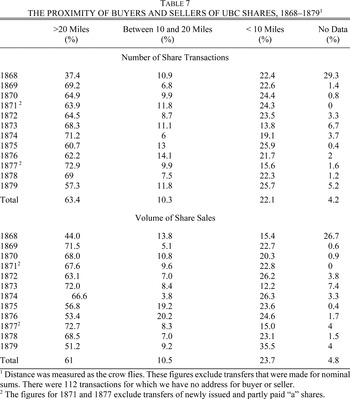
As noted, it was the responsibility of the shareholder to inform the bank's directors of an intention to sell shares to a named individual. We now explore the possibility that the seller obtained information as to the suitability of a prospective buyer. Although we find no direct archival evidence on information gathering by sellers, nevertheless, we use an indirect proximity measure. In the nineteenth century, one would expect shareowners to incur lower information costs regarding the suitability of prospective buyers who live in closer proximity. Table 6 reports the distance between (as the crow flies) the location of buyers and sellers. The addresses of the sellers were obtained from the shareholder lists contained in the UBC's annual reports.80
Ulster Banking Company's Yearly Reports 1868–1881 - PRONI D/3499/AE/1.
One validation of the usefulness of this measure is to examine whether the size of trades is greater the further apart the buyer lives from the seller. One would expect that the costs of information gathering per trade are fixed. Notably, there were 649 trades where more than ten shares were transferred; 63.1 percent of these took place between individuals living more than 20 miles apart, whereas only 26.4 percent took place between individuals living less than ten miles apart.
Table 7 indicates that the majority of trades were between individuals not living in close proximity. The absence of data for a large number of trades in 1868 is due to this being the first year in which a shareholders' list was published, with it only being published towards the end of the year. It is also worth noting that only 26.35 percent of trades and 28.31 percent of shares sold in our sample period took place between individuals living in the same county. Our evidence, at best, suggests that sellers gathered little information on prospective buyers. Notably, as can be seen in Table 5, between 1878 and 1879, there was a sharp decrease in the percentage of share trades and volume of share sales taking place between individuals living more than 20 miles apart. One possible explanation for this is that sellers, being aware of the post-sale-extended liability, were more circumspect following the failure of the City of Glasgow.
Overall, shareholders may not have had an incentive to acquire information on prospective buyers because if the directors refused to validate the sale, the board could buy the shares. Indeed, an important role played by the directors and shareholders' committee was to vet share transfers. We next explore the governing body's incentives to prevent shares being transferred to low-wealth individuals.
The UBC had four directors and a shareholders' committee comprised of seven members, and during our sample period, 18 different men served on this committee. From Table 8, we see that collectively these men owned 27,122 shares, constituting 22.6 percent of the UBC. Unsurprisingly, these men were the largest shareholders with the top five largest shareholders participating in the governance of the UBC. Furthermore, in our sample period, seven of the top ten largest shareholders and 12 of the top 15 all served either as members of the shareholders' committee or as directors. Conversely, only four of the 22 men listed in Table 8 were ranked outside the 30 largest shareholders.81
In 1878 only 36 UBC shareholders owned more than 500 shares. Ulster Banking Company's Return of Shareholders 1876–1879 - PRONI D/3499/CB/2.
Finally, although 12 of the 30 largest shareholders failed to serve on the shareholders' committee in our sample period, we note that of these, nine were classified either as widows or spinsters, the remaining shareholders being two merchants and a gentleman.
Fortunately, we were able to obtain the probated wills of all the directors and nine of the committee members. Table 8 clearly shows that these individuals were very wealthy relative to other investors in the UBC. Indeed, the total wealth of the ten who left wills was 21.2 percent of the total wealth of our sample of 611 investors. As predicted by our argument, the evidence clearly shows that the members of the UBC governing bodies tended to be both the wealthiest and largest shareholders.
We now turn to the possible access of the UBC's governing body to information regarding prospective owners. Based on what is known about the owners of other British banks in this period, it is probable that many prospective owners were also customers of the bank.82
Holmes and Green, Midland, p. 71
Consequently, directors may have used their privileged access to customer information to determine a prospective owner's suitability. Given that the shareholders' committee at the AGM annually exhorted shareholders with missionary-like zeal to do all that they could to increase the circulation and deposits of the bank, one may infer that many shareholders were also customers of the bank.
83 Ulster Banking Company's Committee and General Meeting Minute Book (1836–1864, 1864– 1879) - PRONI D/3499/AA/1 and PRONI D/3499/AA/2.
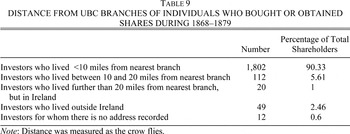
Using the proximity measure between shareholders and UBC branches, we next offer evidence to further test the possibility that many shareholders were also customers. From Table 9, we note that the vast majority of the 1,995 individuals who obtained shares in the UBC in our sample period lived within ten miles of the nearest UBC branch and only 49 lived outside of Ireland.84
The 23 shareholders who lived outside Ireland had mostly local connections or had emigrated from Ireland. These individuals lived in England (27), Scotland (15), the United States (3), Austria (1), Canada (1), and France (1).
Notably, although over 80 percent of our investors lived in the six northern counties of Ireland, significant parts of this area were not covered by UBC branches.
85 The shareholder numbers in the north of Ireland are as follows: Belfast (393), Down (434), Antrim (307), Tyrone (241), Armagh (138), Derry (78), and Fermanagh (31).
For example, although there were 27 branches in the six northern counties, there were no branches in large parts of North and East Antrim, South Down, Tyrone, and much of Derry. Indeed, these areas tended to be served by the two other major banks in the north of Ireland (Belfast Banking Company and Northern Banking Company).
86 The Northern Banking Company (NBC) had branches in North and East Antrim market towns (Ballyclare, Ballycastle, Ballycarry, Carrickfergus, and Cushendall). Much of Derry was covered by the two banks, with both banks having branches in Coleraine, Newtownlimavady, and Magherfelt, and the NBC also having branches in Kilrea, Dungiven, and Claudy. South Down was covered by the two banks, with the NBC having branches in Ardglass, Castlewellan, Dromore, Gilford, Hillsborough, and Newry, and the Belfast Banking Company (BBC) having branches in Kilkeel, Newry, Portaferry, Rathfriland, and Saintfield. The NBC had three Tyrone branches (Fintona, Fivemiletown, and Newtownstewart), whilst the BBC had a branch in Dunngannon.
CONCLUSIONS
Banking was the first business sector in Ireland and Britain to be granted the privilege of incorporation on a joint-stock basis without requiring prior state approval. Such joint-stock banks were criticized by Walter Bagehot on the basis that their shareholders would be impecunious, bringing into question the stability of joint-stock banking. Using a combination of archival data on bank shareholders and probate records, we examine the characteristics of individuals purchasing (or receiving gratuitously) Ulster Banking Company shares over a 12-year period. Because the UBC had the lowest share price of any Irish unlimited liability joint-stock bank, it is a prime candidate to manifest Bagehot-like characteristics. Our evidence on shareholder occupations and wealth suggests that bank shareholders were in fact not impecunious, and in fact were drawn from merchants, professionals, and otherwise wealthy individuals. Indeed, our probate evidence indicates that several of the bank's shareholders were extremely wealthy individuals. Also, we find little evidence to suggest that shareholders with varying levels of wealth paid different prices for bank shares, indicating no mechanism by which any shareholder could be compensated for selling shares to less wealthy individuals.
The main explanation we advance as to why Bagehot was mistaken is that the directors and the shareholders' committee successfully ensured that ownership was not transferred to those who have “but few acres and few shillings.” Also, the evidence, drawn from the period after the City of Glasgow failure, indicates that transfers to impecunious individuals were particularly prevented in times of increased bank distress. We suggest that this may have been partially due to the post-sale-extended liability requirement, imposed under the joint-stock bank legislation.87
Significantly, the Joint Stock Companies Registration and Regulation Act (1844), which for the first time freely permitted all firms to constitute on a joint-stock basis, also imposed a post-sale-extended liability requirement on the transfer of shares having unlimited liability attached to them (7/8 Vict., c. 110).
Unsurprisingly, the directors and members of the shareholders' committee were amongst the wealthiest and largest shareholders of the bank, thereby ensuring that they had adequate incentives to prevent the entrance of low-wealth individuals into the bank. The vetting function of these governing bodies would have required information on the potential new owners of bank shares. One method the directors could have used was to access bank information on customers, but this presupposes that potential shareholders are already customers. Alternatively, given that the vast majority of individuals buying (or being given) UBC shares in our sample period lived within ten miles of the nearest UBC branch, if a prospective buyer was not a customer, the directors could have tapped the local knowledge of their branch managers in order to ascertain the suitability of a potential shareholder.
Thanks go to the Public Record Office of Northern Ireland (PRONI) for giving us access to their archives. This article would not have been possible without the advice and guidance of William Roulston, whose knowledge of genealogical sources is legendary. This article has benefited from comments made by Knick Harley and JEH referees. Useful suggestions have also been made by Nicholas Alexander, John Armour, David Canning, Simon Deakin, Wally Johnson, Kevin O'Rourke, Michael Moore, Tom Stark, participants at the Canadian Law and Economics Association conference (Toronto, 2001), seminar participants at the Centre for Business Research (Cambridge University), and seminar participants at Trinity College Dublin, University of Ulster and Queen's University. The usual caveat applies. An earlier version of this article appeared as a CBR (Cambridge University) Working Paper.