Scholars working in the eastern Great Basin and northern Colorado Plateau have long recognized the potential of the Fremont archaeological record to contribute to broad understandings of the foraging-farming transition. We follow an inclusive definition of Fremont as those northern Colorado Plateau Formative societies that cultivated domesticates from 200 BC (Geib Reference Geib1996; Roberts Reference Roberts2018; Wilde et al. Reference Wilde, Newman and Godfrey1986) into the AD 1500s in certain locations peripheral to the region (Creasman and Scott Reference Creasman and Scott1987; Spangler and Jones Reference Spangler, Jones, Matheny, Janetski and Nielsen2012). Most Fremont groups adopted domesticates relatively late in prehistory, a period spanning 1,000 years from AD 300 to 1300, creating large pithouse hamlets and rock art galleries that have been studied for more than a century (Montgomery Reference Montgomery1894; Morss Reference Morss1931). Opinions vary in how to best interpret the record as either an enigmatic northern periphery of the American Southwest (Judd Reference Judd1926; Kidder Reference Kidder1924), an historically independent phenomenon (Gunnerson Reference Gunnerson1969; Marwitt Reference Marwitt1970), an exemplar of behavioral variability as it pertains to the foraging-farming transition (Madsen and Simms Reference Madsen and Simms1998), or a player in a vast regional system (Talbot Reference Talbot, Harry and Roth2018, Reference Talbot, Talbot and Richens2019). At some fundamental level, all of these perspectives are correct. The regional adoption of maize agriculture overlaps chronologically with the final centuries of the Basketmaker II period on the southern Colorado Plateau (Matson Reference Matson1991), and many Fremont communities likely represented a mix of indigenous foragers and immigrant farmers (Simms Reference Simms2008:199–205).
Madsen and Simms (Reference Madsen and Simms1998) isolate the problem of Fremont behavioral variability by focusing on the concepts of adaptive diversity and residential cycling. In the Fremont example, one facet of adaptive diversity refers to the timely incorporation of cultigens in a primarily foraged diet, while residential cycling describes the movement of individuals into and out of semisedentary horticultural communities and lifeways throughout their life histories. Both processes characterize the vast frontier between true foraging and farming societies of western North America (Upham Reference Upham1994). Within this context, we must consider the Fremont archaeological record, particularly the formation of pithouse communities, as a generational process that unfolded over the course of a few decades to a century at most (Simms Reference Simms2008:189). The potential provided by a generational (~25 years; Whittle and Bayliss Reference Whittle and Bayliss2007) framework for the foraging-farming transition is something that cannot be attained in other global case studies of this critical but repeated moment in human history. However, coarse-grained chronologies based primarily on long-lived radiocarbon samples currently applied to the Fremont record (Massimo and Metcalfe Reference Massimo and Metcalf1999; Spangler Reference Spangler, Madsen and Metcalf2000, Reference Spangler2002; Talbot and Wilde Reference Talbot and Wilde1989) limit our potential to realize a generational perspective on community formation during the foraging-farming transition.
This study provides the first steps toward developing generational-scale approaches to the Fremont record by examining the formation of a pithouse community in the Cub Creek reach of Dinosaur National Monument in eastern Utah's Uinta Basin. We propose that the development of high-precision archaeological chronology and a high-resolution precipitation reconstruction are essential to achieving a generational perspective of the Fremont foraging-farming transition. High-precision chronology in our analysis means three things. First, sampling strategies focus as much as possible on short-lived annuals that target specific events. Second, new dating methods yield small standard errors in individual radiocarbon ages that reduce the probabilities of calibrated age ranges. Third, formal Bayesian models that incorporate archaeological information such as sample location and site type and that enable potential inbuilt-age samples (e.g., “old wood”) to be statistically accounted for reduce the potential to overestimate the spans of target events to be dated (Bayliss et al. Reference Bayliss, Ramsey, van der Plicht and Whittle2007; Bronk Ramsey Reference Bronk Ramsey2009). Formal Bayesian models provide posterior densities, which estimate ages for the beginning and end of Fremont occupations that approach multidecadal, multigenerational scales of analysis. Bayesian model output is different from more commonly used summed probability distribution (SPD) models in that posterior probability densities are age ranges reducing uncertainty in the timing of events of archaeological interest rather than a continuous time series represented by SPDs. As such, Bayesian age models are not subject to issues of taphonomic loss (Surovell et al. Reference Surovell, Finley, Smith, Kelly and Brantingham2009) that are often considered in regard to SPDs. In addition, and most important to this study, SPDs provide coarse-grained regional analyses that lack the small-scale and site-specific resolving power of Bayesian age models. We wish to make clear that the Bayesian age model output does not provide a continuous time series that can be correlated with a continuous environmental reconstruction like the one we present. Rather, our interpretation is based on a comparison of event timing in both the archaeological and paleoenvironmental records.
Developing high-resolution climate reconstructions based on long tree-ring chronologies has not been a central focus of Fremont environmental archaeological studies. We produce a new regional precipitation reconstruction based on tree-ring widths that spans the last 2,115 years and captures precipitation variability in the centuries leading into and out of the Fremont period. Strong, multidecadal trends in interannual precipitation variability emerge from the analysis that we compare directly with our chronological model of Cub Creek. Generational-scale shifts in predictable precipitation regimes likely controlled the shifts between foraging and horticulture. We suggest that the low-level adoption of cultigens was a successful response to multidecadal climate variability that offset shortfalls of foraged foods. Furthermore, the intensification of maize horticulture and pithouse community formation occurred during a 300-year period that corresponds to a breakdown of the dominant multidecadal variability regime when precipitation, on average, would have been more predictable, increasing maize yields. We propose that similar processes structured the formation of other Fremont communities across the northern Uinta Basin and that the phase of resource intensification may have been at the center of emergent social hierarchies and intercommunity conflict noted in the regional archaeological record.
In the following study, we review the Cub Creek archaeological record as it pertains to our analysis. We present the methods and results of our high-precision chronology and high-resolution precipitation reconstruction. This chronology allows us to capture behavioral variability that Madsen and Simms (Reference Madsen and Simms1998) proposed in order to characterize the Fremont foraging-farming transition. Our reconstruction of Uinta Fremont culture history is incongruent with Spangler's (Reference Spangler, Madsen and Metcalf2000) Uinta adaptation, including a hypothesis of regional abandonment after AD 1050, which we suggest is based on an aggregated, coarse-grained, and therefore imprecise chronology. We conclude with suggestions about how high-precision chronologies of Fremont community formation can be exported to other sites across the Uinta Basin and the Fremont world as a whole.
The Cub Creek Archaeological District
The Fremont archaeological record has a long history of scientific investigation in the eastern Great Basin and northern Colorado Plateau, ranging from excavations along the Wasatch Front near Salt Lake City as part of the 1893 Chicago World's Fairs to the Harvard Peabody Museum's 1928–1931 Claflin-Emerson Expedition (Gunnerson Reference Gunnerson1969; Morss Reference Morss1931). This body of research is reviewed by Madsen and Simms (Reference Madsen and Simms1998), Simms (Reference Simms2008), and Spangler (Reference Spangler2013). Archaeologists divide the Fremont area into five regionally distinct variants (Ambler Reference Ambler1966; Marwitt Reference Marwitt1970). Here, we focus on the Uinta Fremont. Spangler (Reference Spangler, Madsen and Metcalf2000, Reference Spangler2002) provides comprehensive reviews of the Uinta Basin record. Our review covers the Cub Creek Archaeological District in the Utah portion of Dinosaur National Monument.
History of Investigations
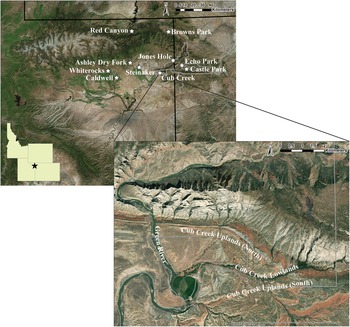
The Cub Creek Archaeological District is located along a first-order tributary of the Green River that receives most of its water from the slick-rock surface of Split Mountain immediately north of Cub Creek, which recharges numerous local springs at the base of the mountains and provides surface run-off to the perennial stream (Figure 1). Split Mountain, so named in 1869 by John Wesley Powell for the canyon that the Green River cuts through the massive uplift, is an extensive exposure of Late Paleozoic Weber Formation Sandstone flanked by flatirons of Triassic Chinle Formation Sandstone, and various Jurassic deposits, including the cross-bedded eolian Nugget Sandstone and the fossil-bearing Morrison Formation (Gregson et al. Reference Gregson, Chure, Sprinkel, Sprinkel, Chidsey and Anderson2010). The local combination of hard-rock stratigraphy, geomorphology, and hydrology made ideal environmental conditions for Fremont horticulture and the eventual formation of an extensive pithouse community—most importantly, a source of sandy alluvium for field locations and a stable, shallow water table.
Location of the Cub Creek Archaeological District in the northern Uinta Basin. Major Fremont communities are shown on the regional map. The inset map illustrates the general location of sites formalized in the age model.

Work at Cub Creek took place from 1963 to 1965, which is when University of Colorado crews conducted preliminary archaeological surveys across Dinosaur National Monument as well as excavations at Cub Creek (Breternitz Reference Marwitt1970; Leach Reference Leach1966), Deluge Shelter (Leach Reference Leach1970a), Swelter Shelter (Leach Reference Leach and Breternitz1970b), and several other rockshelters in the Jones Hole reach of the Monument (Burton Reference Burton and Breternitz1970; Sheets Reference Sheets1969). The Fremont archaeology of the Yampa River canyon country was well known at the time, particularly through work at Mantles Caves (Burgh and Scoggin Reference Burgh and Scoggin1948), Marigold Cave (Burgh Reference Burgh1950), and Hells Midden (Lister Reference Lister1951)—all preliminary studies in a failed Bureau of Reclamation effort to dam both rivers at Echo Park (Stegner Reference Stegner1955). The recognized potential of the Monument's archaeological record was one of several tools leveraged in the movement to stop dam construction.
Breternitz's 1964–1965 Cub Creek excavations focused on 11 Fremont sites in the valley, including Boundary Village (Leach Reference Leach1966), Whole Place Village (Birkedal and Hayden Reference Birkedal, Hayden and Breternitz1970), Wagon Run (Maronde Reference Maronde and Breternitz1970), and Burnt House Village (Biggs Reference Biggs and Breternitz1970). Leach's (Reference Leach1966) work at Boundary Village provided the framework for subsequent analysis and interpretation where Type I and Type II houses were recognized as representing a key developmental construction sequence observed in superposed stratigraphic position. Both Type I and Type II houses are roughly circular in outline and shallowly excavated into sandy substrate. The key difference between house types is the formalization in Type II structures of a four-post center framework, clay-lined floors, and adobe-collared fire hearths. Other house forms in Cub Creek include rectangular, rock-outlined structures appearing either as single features or contiguous “rooms.” Bell-shaped storage cists are common inside houses, as well as extramural work areas. Abundant grayware pottery, formalized ground stone along with two-handed manos and trough metates, varied stone and bone tool assemblages, faunal remains, and maize macrofossils are evidence for a characteristically diverse but intensified mixed foraging-farming economy. The absence of formalized middens at any site indicates a probably semisedentary community. Breternitz's crew excavated 36 pithouses and 131 features (i.e., hearths, cists, pits, and bins) in the Cub Creek pithouse hamlets. With no absolute chronological information, Breternitz (Reference Marwitt1970:160–161) suggested the Cub Creek Phase occupied a narrow window from AD 1000 to 1150, a period that became deeply entrenched in local cultural historical frameworks (Spangler Reference Spangler, Madsen and Metcalf2000:122). This short chronology was at odds with a long view of Fremont culture history argued by Jennings (Reference Jennings1978). As in other Uinta Fremont communities, status differentiation is difficult to discern through house size, human interments, and material remains, although elaborate anthropomorphs in numerous Classic Vernal rock art panels attest to emergent heterarchical leadership.
Reinvestigating Cub Creek
In the decades following Breternitz's (Reference Breternitz1970) excavations, the Cub Creek sites remained unanalyzed along with other Uinta Basin sites that the University of Colorado and University of Utah crews excavated in the 1960s. During a short tenure at Dinosaur National Monument, Truesdale (Reference Truesdale1993) added the first AMS radiocarbon ages of Cub Creek pithouses, leading to the conclusion that construction occurred from approximately AD 450 to 750. Otherwise, in many Fremont overviews (Madsen and Simms Reference Madsen and Simms1998; Spangler Reference Spangler, Madsen and Metcalf2000), the sites became lumped into the Dinosaur National Monument sites or, generally, as Cub Creek Village. This added a level of confusion about the valley as a whole and what each site might individually contribute to understanding the importance of the Fremont horticultural transition.
We revisited the area in 2016–2017 with the aim first to document the impacts of tourism on extensive rock art galleries, which quickly expanded to include revisiting the pithouse hamlets, as well as a few known open-air sites and rockshelters. In the Monument files, we discovered an additional set of approximately 30 unreported sites that had been documented in 2002–2003 with the repeated theme of “roasting feature.” By the end of the 2017 field season, we understood Cub Creek to consist of approximately 70 sites, including the originally reported pithouse hamlets, rock art galleries, and rockshelters, as well as six storage sites—one of which is a proper cliff-side granary—and >120 roasting features. Roasting features are roughly circular charcoal and ash stains averaging 4 m in diameter, with extensive surface scatters of fire-cracked rock and informal ground stone assemblages with manos of Uinta Group Formation Quartzite coming from Quaternary alluvium of the Green River and slab metates of Jurassic sandstone available on-site. Pottery is notably absent from these sites. In contrast with pithouse hamlets, which occur on Quaternary terraces and pediments immediately adjacent to the main stem of Cub Creek, roasting features are found almost exclusively in the uplands, sheltered by massive sandstone flatirons and fins. Our knowledge of these roasting features comes from surface observations only, and it is possible they may represent early pithouse forms similar to those observed in the Steinaker Lake area (Talbot and Richens Reference Talbot and Richens2004). Our working hypothesis is that these features represent stone boiling of maize in a pre-pottery context similar to Basketmaker sites in southeastern Utah's Cedar Mesa (Ellwood et al. Reference Ellwood, Paul Scott, Lipe, Matson and Jones2013).
This site sample is the basis for our chronological model of Fremont community formation. In subsequent discussions, we use the terms Upland and Lowland occupations to reference roasting sites and pithouse hamlets, respectively. Elevation differences between the two categories are minimal, and instead, the terms describe fundamental differences in the geomorphic position of roasting features in weathered Paleozoic and Mesozoic sandstone landforms and pithouse hamlets adjacent to Quaternary alluvial landforms.
Methods
Age Model Background
Knowledge of the development of Fremont societies has been based on radiocarbon dates from a range of both long-lived (e.g., feature charcoal, internal rings of structural timbers) and short-lived samples (e.g., maize, twigs, sagebrush, external rings of structural timbers). Fremont communities are often dated with a single sample from one pithouse, such as charcoal from a hearth (Spangler Reference Spangler, Madsen and Metcalf2000; Truesdale Reference Truesdale1993). These ages are then calibrated to calendar years for each site and compared with other sites to form our understanding of variability in Fremont community formation.
Interpretations of calibrated radiocarbon age distributions to understand archaeological site histories can lead to misinterpretations caused by the statistical scatter and imprecision resulting from old-wood problems (Dean Reference Dean and Schiffer1978; Schiffer Reference Schiffer1986) and calibration effects (Bayliss et al. Reference Bayliss, Ramsey, van der Plicht and Whittle2007; Bronk Ramsey Reference Bronk Ramsey2009; Whittle and Bayliss Reference Whittle and Bayliss2007). For this reason, developing high-precision chronologies requires formalized models that constrain the inherent scatter in the calibration process. Solely calibrating a set of radiocarbon ages does not enable researchers to formally incorporate other archaeological information such as site type, diagnostic cultural material, or stratigraphy into the production of calibrated age distributions. Considering these problems, the past two decades have seen a rise in the development of more formalized chronologies using Bayesian statistics that enable the incorporation of this other archaeological information. This “informative prior information” (Bronk Ramsey Reference Bronk Ramsey2009) enables the development of parameters (e.g., the start or end of occupations, or the transition between two occupation phases) in the formal model that, once modeled alongside the actual radiocarbon samples of interest, can be assigned 68% and 95% posterior probability density ages. The formalization of archaeological chronologies using Bayesian approaches provides estimates that are more precise for probable ages of target archaeological events and can provide chronologies on the scale of human generations (Bayliss et al. Reference Bayliss, Ramsey, van der Plicht and Whittle2007, Reference Bayliss, van der Plicht, Ramsey, McCormac, Healy, Whittle, Whittle, Healy and Bayliss2011). By human generations we mean ~25 years (Whittle and Bayliss Reference Whittle and Bayliss2007). Considering previous interpretations of Fremont pithouse communities being occupied on generational scales (Simms Reference Simms2008:189), merely calibrating sets of single dates from pithouses without the development of formal models that incorporate other “prior” archaeological information will not suffice. Understanding the generational scales of Fremont community formation requires these recent advances using Bayesian statistical analyses.
One challenge to Bayesian chronological analysis is the quality control of legacy radiocarbon ages—samples of limited or unknown context and with large standard errors (Hamilton and Krus Reference Hamilton and Krus2018). Legacy dates from Cub Creek are limited to seven AMS ages that Truesdale (Reference Truesdale1993) reported from specific pithouse contexts and on wood from construction timbers and hearth charcoal. Reported standard errors of these ages range from 50 to 90 years (Table 1). We added 34 ages from our 2016–2017 work, which included new samples collected from upland roasting features, maize macrofossils from rockshelter surfaces, and twigs from the construction mud of a jacal masonry granary. Upland roasting feature samples were bulk or fragmentary charcoal collected from surface features. We also added curated samples from Breternitz's 1964–1965 excavations. Curated samples were from provenienced pithouses and features collected at the time of excavation with the intent of future radiocarbon dating. We prioritized maize macrofossils, hearth charcoal, and the outer rings of construction timbers in that order to reduce interpretive error between target and dated events.
Radiocarbon Samples and Context for the Cub Creek Archaeological District.

aConventional radiocarbon age (± 1σ error) reported in radiocarbon years before AD 1950.
bSamples originally reported in Truesdale (Reference Truesdale1993).
Building the Cub Creek Age Model
We developed our Bayesian age model for the Cub Creek Fremont using OxCal v4.3 (Bronk Ramsey Reference Bronk Ramsey2009). Calibrated dates within the model were produced using the IntCal13 calibration curve (Reimer et al. Reference Reimer, Bard, Bayliss, Warren Beck, Blackwell, Ramsey, Buck, Cheng, Lawrence Edwards, Friedrich, Grootes, Guilderson, Haflidason, Hajdas, Hatté, Heaton, Hoffmann, Hogg, Hughen, Felix Kaiser, Kromer, Manning, Niu, Reimer, Richards, Marian Scott, Southon, Staff, Turney and van der Plicht2013). The model structure is defined in Figure 2. The brackets in Figure 2 denote the structure of the model, and the first terms (e.g., Phase, Sequence, Boundary, After) denote the OxCal Command Query Language 2 that are the specific algorithms employed to produce the model (OxCal CQL2 terms listed in bold). The model produces 68% and 95% posterior density estimates for the parameters defined by the model structure. These posterior density estimates are quoted in italics and rounded to five years, following the protocol established by Bayliss (Reference Bayliss2015).
Age model multiplot comparing the Cub Creek Upland and Cub Creek Lowland sequences. (Color online)

A central challenge in the development of the model was incorporating legacy dates from Truesdale (Reference Truesdale1993) on charcoal samples from unspecified species and unspecified wood samples (e.g., “structural timber”) that have larger standard errors, with our dates on unspecified charcoal and short-lived samples, that have much smaller standard errors. Due to this likely inbuilt age problem with many of our samples, we included all charcoal and wood samples in the model as termini post quos, which means that we model each of these samples as taking place during a time before the final deposition of the sample. We do this using the After command in OxCal (Figure 2).
Our central aim is to produce a model that will provide highest posterior density (hpd) estimates for the start and end Boundaries of both the Upland and Lowland Fremont occupations in Cub Creek that can be compared to our tree-ring-based precipitation reconstruction. We therefore developed an overlapping Phase model for the Fremont uplands and lowlands at Cub Creek. Within each upland and lowland Phase, we developed a Phase for each site (Figure 2). The code for this model can be found in Supplemental Information.
Tree-Ring-Based Precipitation Reconstruction
Multi-millennial-length tree-ring chronologies can provide relatively localized records of environmental variability at annual resolution. Here, we reconstruct precipitation for the last 2,115 years using the previously published reconstruction from Harmon Canyon (Knight et al. Reference Knight, Meko and Baisan2010), a tributary of Nine Mile Canyon in the West Tavaputs Plateau, and a newly developed Bristlecone pine chronology from the Fish Lake Plateau area of central Utah. We chose annual precipitation over a water year (previous August to current July) to reflect environmental conditions that could control agricultural development. A water-year index integrates previous winter snowpack effects on spring soil moisture with both spring rain and monsoon rain that might occur during the growing season. Tree-ring-based climate reconstructions require instrumental climate data against which to calibrate. Because there are no long-term climatic data collected within Dinosaur National Monument, we used monthly precipitation at 4 km resolution from the Parameter-elevation Regressions on an Independent Slopes Model (PRISM Climate Group 2018) dataset. Monthly data were cumulated into water-year total data by summing over the previous August through current July water year, a period that best captures the peak in cool-season precipitation delivery and that includes spring rainfall before entering into the mid-summer drought period (starting approximately in July) before late-summer American monsoon-derived rainfall materializes in August. To extend the record of growing-season rainfall for a period of >2,000 years, we limited the suite of potential predictor variables to those that had sufficient expressed population signal (EPS, >0.85; Wigley Reference Wigley, Briffa and Jones1984). Therefore, we considered both regional tree-ring chronologies that were previously published and those that were currently under development.
Tree-Ring Sampling and Preparation
Increment cores and cross-sections were collected from low-elevation, dry sites with skeletal soils, where the presumption was that precipitation drives growth increment. Increment cores were mounted to accentuate the transverse section and sanded with progressively finer grades of sandpaper. Cores were cross-dated using the marker year method and verified using the program COFECHA (Holmes Reference Holmes1983). Chronologies were built by detrending individual series using a very flexible Friedman filter. Autoregressive modeling was applied to remove any autocorrelation before series were averaged with a robust method in the program Arstan (Cook Reference Cook1985). We ultimately chose two chronologies for the precipitation reconstruction in the study, including one unpublished and one previously published study (Knight et al. Reference Knight, Meko and Baisan2010; Table 2).
Chronology Statistics for the Two Predictors of Dinosaur National Monument Precipitation.

aKnight and others (Reference Knight, Meko and Baisan2010), International Tree-Ring Data Bank contribution ut530. All tree-ring data are available for download from the International Tree-Ring Data Bank (https://www.ncdc.noaa.gov/data-access/paleoclimatology-data/datasets/tree-ring).
Tree-Ring Response to Climate
Ring-width response to historical climate variability was examined for the tree-ring chronologies using a general response function analysis in the treeclim package (Zang and Biondi Reference Zang and Biondi2015) in the R statistical environment (Bunn Reference Bunn2008), following a seasonal correlation approach (Meko et al. Reference Meko, Touchan and Anchukaitis2011). Monthly precipitation and maximum temperatures from the PRISM dataset for the period AD 1895–2010 were used to conduct bootstrapped correlation function analysis showing that both sites exhibit pronounced response to growing season precipitation (maximum response to a 12-month cumulative growing season ending in June and/or August), which suggested that the chronologies were appropriate to reconstruct growing season precipitation. Moving response function windows were calculated for 30-year periods over the historical data, and they indicated that the response to precipitation had temporal fidelity.
Precipitation Reconstruction
To reconstruct water-year precipitation for Dinosaur National Monument, we carefully examined the PRISM-derived data and truncated the earliest years due to insufficient station data available to accurately model the earliest precipitation records (see Knight et al. Reference Knight, Meko and Baisan2010). We ultimately settled on the period 1920–2005 since 2005 is the latest calendar year in the Harmon Canyon chronology (Table 2), yielding 86 years for statistical analysis. The water-year precipitation exhibited no significant autocorrelation. A reconstruction model for August–July water-year precipitation was built using multiple linear regressions with water-year precipitation as the dependent variable and the two tree-ring chronologies as independent variables. We also explored the use of t + 1 and t − 1 lags on precipitation data, but neither contributed to any additional explanation of variance. Linear regression model assumptions were evaluated by inspection of residual plots to ensure that there was no pattern in error variance. Normality of model residuals was evaluated graphically by examining a histogram and tested statistically using the Kolmogorov–Smirnov test. An autocorrelation function of the residuals was examined visually, and the Durbin–Watson D statistic was used to evaluate the assumption of independence in the predictor variable (Savin and White Reference Savin and White1977). Pearson's correlation coefficient (r), the coefficient of determination (R 2), and adjusted coefficient of determination (adj. R 2) were used to evaluate model skill. We also calculated root-mean squared-error (RMSE) from the model as an indicator of variability in the reconstruction.
Model Calibration and Verification
Split calibration/verification was performed in two ways: (1) by splitting the period of historical record in half and building independent linear models for the early (1920–1962) and late (1963–2005) periods, and then reversing the time periods; and (2) by splitting the historical record into even and odd years and repeating independent model building, then reversing and repeating. The reduction of error (RE), an indicator of skill compared to the calibration-period mean, and the coefficient of efficiency (CE), an indicator of skill compared to the verification-period mean, were used to assess the model and calculated using equations from Cook and colleagues (Reference Cook, Meko, Stahle and Cleaveland1999). The ability of the model to reproduce the mean and variance of the instrumental data was assumed if values of RE and CE were greater than 0 (Fritts Reference Fritts1976). We also conducted a sign test to evaluate the fidelity of year-to-year changes in the reconstructed precipitation to the tree-ring predictors (Fritts Reference Fritts1976).
Precipitation Variability Analyses
While year-to-year rainfall can be quite variable in the region, lower-frequency changes in the amount of precipitation likely cued social response to precipitation due to the effects on maize yields. Therefore, we tested the precipitation reconstruction for the presence of multidecadal regimes by assessing the spectral properties of the annual precipitation time-series using a continuous wavelet transform in the dplR package in R (Bunn Reference Bunn2008). The wavelet transforms a time-series from the time domain to a time-frequency space that can indicate intermittent periodicities over time (Grinsted et al. Reference Grinsted, Moore and Jevrejeva2004). The ability to visualize significant power of precipitation variability in the frequency domain at various points in time is crucial for our assessment of Fremont adaptive strategies. The wavelet transform was calculated under an assumption of red noise, and significance levels were interpreted at p = 0.05. Because the analysis was padded with zeros to prevent wraparound effects, care must be taken not to interpret outside the cone of influence.
To reflect generational-scale perceptions of precipitation variability, we also computed a 21-year running standard deviation on the annual reconstruction. This time period reflects generational memory of precipitation conditions consistent with chronological reconstructions as suggested by Whittle and Bayliss (Reference Whittle and Bayliss2007). Significant shifts in mean of the 21-year running variation were tested using a changepoint analysis using the changepoint library in R (Killick and Eckley Reference Killick and Eckley2014). A linear computational cost approach was applied to indicate significant changes in mean (Killick et al. Reference Killick, Fearnhead and Eckley2012). This approach uses log-likelihood (Akaike's Information Criterion) to indicate likely shifts, and we used a minimum segment length of 200 years to minimize false positive changepoints in the 21-year time series.
Results
Cub Creek Age Model
The Bayesian model successfully provides 68% and 95% hpd ranges for the start and end of the Upland and Lowland Fremont sites in Cub Creek, as well as the overall span of each (Figure 3; Table 3). The start of the Cub Creek Uplands is estimated to have occurred from cal 900 BC to AD 395 (95.4% probability), most probably from cal AD 100 to 380 (68.2% probability). The end of the Cub Creek Uplands is estimated to have occurred from cal AD 1285 to 2295 (95.4% probability), most probably from cal AD 1300 to 1585 (68.2% probability). The total span of the Uplands lasted from about 930 to 2330 years (95.4% probability), most probably 980 to 1515 years (68.2% probability). The start of occupation in the Cub Creek Lowlands, and therefore the start of Fremont pithouse villages, occurred from cal AD 840 to 960 (95.4% probability). The end of the Lowlands occupation, and therefore the end of Fremont pithouse villages, occurred from cal AD 995 to 1080 (95.4% probability). The overall span of the pithouse occupation lasted from 55 to 220 years (95.4% probability).
Modeled 95% posterior probability density functions for the start, end, and span of the Cub Creek Upland and Cub Creek Lowland sequences.

Posterior Probability Densities of the Primary Model.

Precipitation Reconstruction Results
A multiple linear regression model that used an unpublished Bristlecone pine residual chronology and a previously published Douglas fir residual chronology (Table 2) as predictors resulted in an overall reconstruction model that accounted for 55.4% of the variation in historical Dinosaur National Monument, August–July water-year precipitation for the period 1920–2005. Inspection of residual plots using the Kolmogorov–Smirnov test indicated that the residuals were normally distributed (p < 0.0001). An autocorrelation function plot of the residuals showed no significant first-order autocorrelation, and the Durbin-Watson test statistic fell well above the threshold to fail to reject the null hypothesis of no autocorrelation at the alpha = 0.01 level, which indicated that residuals were normal and validated that the predictor variables were independent. Calibration and verification statistics indicated strong fidelity between predictors and predictand for both the early and late model data split and for the even-odd year data split (Table 4). Calibrating on the early period resulted in slightly less predictive skill than calibrating on the later period with the early/late calibration and was slightly better between even and odd (Table 4). However, RE and CE statistics were all well above 0, which indicates predictive skill for all the calibration, verification, and full model periods (Table 4). The sign test was significant at the 0.01 level, which indicated that 78% of the time, year-to-year changes in the direction of predicted flow followed that of the instrumental data, while 22% of the time, they did not (Table 4).
Model Skill and Calibration Verification Statistics for the Dinosaur National Monument Precipitation Reconstruction.

Note: (R2) = coefficient of determination, (adj. R2) coefficient of determination adjusted for degrees of freedom, RE = reduction of error statistic, CE = coefficient of efficiency statistic, RMSE = root mean-squared error. Full model: 7.2188 + 4.375 × HAR + 6.8263 × RCB.
aSign Test significant at the alpha <0.01 level (Fritts Reference Fritts1976).
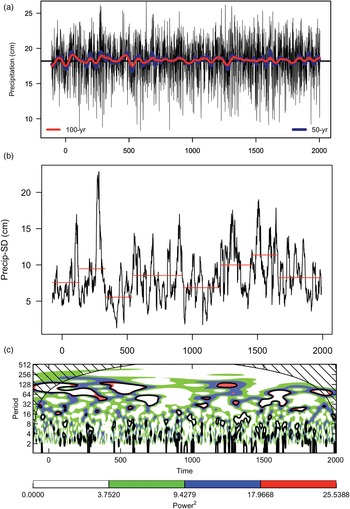
Fifty-year and 100-year splines fit through the annual reconstruction highlighted the extreme variability found in dry lowland environments of the western United States over approximately the past 2,000 years (Figure 4a). There were marked periods of longer-term increases and decreases in water-year precipitation. Huge droughts centered on AD 0, 100, 200, 500, 1250, and 1600 indicate periods of well-below-average precipitation. The 21-year running variation of the reconstruction revealed wide fluctuations in the inherent multidecadal precipitation variability, with the highest peak at AD 300, followed by AD 1500, early AD 1600s and 1300, then AD 900 and 100 (Figure 4b). The changepoint analyses (Figure 4b; Table 5) indicated the first three shifts in mean precipitation occurred early in AD 100, 324, and 539. Somewhere around AD 1000, mean precipitation dropped (Table 5). The wavelet power spectra revealed a strong pattern of annual variability (2–8 years) that appeared AD 100–300, 500–1000, 1200–1700, and then in the 1800s (Figure 4c). Multidecadal variability less than approximately 30 years was largely lacking from the reconstruction but appeared AD 200, 600, 1000, and 1300–1500. Longer-term decadal variability on the order of 30-plus years was also apparent circa AD 0–750 before it disappeared abruptly, and it returned circa AD 1050. These specific moments where precipitation mean and multidecadal variability shift were significantly critical to year-to-year and decade-to-decade patterns in subsistence decisions that Fremont forager-farmers would have faced.
Precipitation reconstruction charts: (a) full reconstruction periods (114 BC–AD 2005) for Dinosaur National Monument water-year precipitation, with 50-year and 100-year cubic smoothing splines to accentuate multidecadal and centennial variability; (b) 21-year precipitation variability over the entire reconstruction with changepoint analysis in red; horizontal lines are significant changes in mean (at 95% confidence); (c) wavelet analysis over the entire precipitation reconstruction; dark lines indicate significant variability at the 95% confidence level.

Changepoint Dates from 21-Year Precipitation Variability.

Fremont Community Formation in Cub Creek
Integrating Archaeological and Paleoecological Records
Radiocarbon dating, Bayesian chronological modeling, and reconstructed precipitation provide a coherent framework within which we reconstruct the development of the Cub Creek Fremont community. We find remarkable correspondence between key archaeological and environmental events. Maize agriculture began at Cub Creek circa AD 300 with two direct ages on separate maize macrofossils from an upland rockshelter (Table 1). These ages correspond with the earliest reported maize from Steinaker Gap (Talbot and Richens Reference Talbot and Richens1996), although the Steinaker Gap age is from charcoal rather than directly from the macrofossil and may reflect an inbuilt age. The appearance of maize agriculture in Cub Creek corresponds with the highest measured generational-scale precipitation variability over the last 2,000 years (Figure 4b). In other words, transitional forager-farmers began cultivating maize at a time when year-to-year precipitation was least predictable. Although our specific knowledge of the resource base in the centuries leading up to this moment remains unknown, as Barlow (Reference Barlow2002) suggests, declining environmental productivity may have been a key factor in the initial adoption of maize agriculture as diet breadths increased. Small garden plots located in the well-protected, spring-fed box canyons along the base of Split Mountain were a low-investment agricultural strategy that supplemented a foraged diet. These first farmers, however, could not simply plant and walk away—some minimal investment in weeding, pest control, and garden tending was required to ensure continuity in a seed corn supply (Freeman Reference Freeman2012). These are the same decisions that transitional forager-farmers made time and again in many global settings, although our data show that this decision happened within a context of extreme year-to-year precipitation variability.
Once maize agriculture was adopted in Cub Creek, the Fremont residents created a low-level horticultural system that focused settlement on the uplands at the base of Split Mountain and above Cub Creek. Runoff from Split Mountain recharged springs and created numerous opportunities for garden plots along its base. The sandstone flatirons and fins surrounding the uplift provided protected campsites in well-drained sand sheets and dunes populated by mixed pinyon-juniper woodland that would have been a reliable source of foraged foods while providing access to upland resources. The redundant record of >120 features replete with fire-cracked rock scatters, expedient ground stone technology, and a notable absence of pottery inform our preliminary interpretation that these sites served as stone boiling features to process maize and other foraged foods. We suggest that this horticultural system was designed to offset the effects of multidecadal droughts that the wavelet analysis indicates happened with a periodicity of 30-plus years (Figure 4c). Specifically, the AD 500–542 event had little impact on the Cub Creek community. Interestingly, coming out of the AD 500–542 drought, mean precipitation increased for roughly the next 400 years (Figure 4b). Regardless, as our age model shows, the upland occupation continued uninterrupted for the duration of the 1,000-year community history (AD 300–1300).
A surprising feature of the Cub Creek age model is the narrow occupation range of the lowland pithouses, which is constrained to the centuries between AD 840 and AD 1080 (Figure 3). Most importantly, the Cub Creek village phase corresponds to the window when the dominant pattern in 30-plus-year multidecadal precipitation variability became quiescent (Figure 4c). Inside that period, mean generational-scale precipitation was more predictable from year to year and decade to decade with an immediate consequence of increased maize yields. What had been a system designed to offset subsistence shortfalls structured by regular, multidecadal droughts suddenly became one of economic intensification. This would have been accompanied by an investment in infrastructure—pithouses, storage features, ground stone, pottery, and locally adapted landraces of maize—all elements of a classic Uinta Fremont strategy. Although an emergent social hierarchy is difficult to demonstrate in the Fremont world writ large (Janetski Reference Janetski2002), the Cub Creek village phase may have also corresponded with the creation of elaborate rock art galleries depicting the portraits of local village leaders. Bone pendants illustrated in the portraits were common in Cub Creek pithouses and as a cache in one Wholeplace Village storage pit (Birkedal and Hayden Reference Birkedal, Hayden and Breternitz1970), indicating that emergent leadership possibly accompanied subsistence intensification.
Just as surprising as the rapid appearance of the Cub Creek village phase was its swift abandonment around AD 1050. Posterior probabilities of the radiocarbon age model indicate that the phase ending spans 85 years (Table 3) from AD 995 to AD 1080. This event corresponds with the return of the dominant 30-plus-year precipitation variability pattern that characterized the reconstruction. An important feature of the age model is that the upland strategy continued as a viable option through the pithouse occupation. The return of predictable variability at AD 1050, combined with a reduction in mean precipitation, led the Cub Creek residents to quickly abandon the lowland pithouse hamlets in favor of the upland settlement pattern. This apparently stable strategy encompassed the three key events of the Medieval Climate Anomaly (MCA), and like the AD 500–542 event, the MCA had no apparent impact on the Cub Creek community. We suggest that even though environmental conditions tipped local communities into a phase of economic intensification that may have included incipient social stratification, the Cub Creek community may have never moved far enough from a stable, low-level foraging-farming economy to quickly move back to that strategy as required. This socioeconomic flexibility, more than anything else, is the defining feature of the Fremont lifeway (Madsen and Simms Reference Madsen and Simms1998).
Operationalizing Fremont Behavioral Perspectives
A major objective of our study has been to fulfill the aims of Madsen and Simms's (Reference Madsen and Simms1998) Fremont behavioral perspective by focusing on the dynamics of life as conceptualized in their models of behavioral options, matrix modification, symbiosis, and switching strategies. Four key historical factors underlie these models: (1) the forager-farmer transition cannot be explained by the interaction of foragers and farmers alone—the underlying resource base must be considered, (2) the introduction of maize horticulture changed Fremont lifeways no matter their choice to adopt domesticates or continue a foraging pattern, (3) the impact of horticulture on foraging societies was not unidirectional—the presence of foraging populations likewise conditioned the success of farmers, and (4) contexts of selection ultimately defined cultural variability. As Simms (Reference Simms2008:189) later suggested, these dynamics played out over the lifetime of individuals or across generations. We demonstrate that these dynamics can be realized through development of robust and congruent archaeological and environmental chronologies that combine Bayesian posterior density estimates with a multidecadal precipitation reconstruction. In other words, multidecadal environmental variability is the context of selection for cultural variability during the foraging-farming transition. For example, the adoption of maize horticulture in Cub Creek at approximately AD 300, corresponding with peak precipitation variability, likely occurred within a context of selection where returns on foraged foods declined below a critical threshold. In this situation, maize horticulture was a behavioral option that leveled economic variability across years and decades—the time scale of human generations. Following the adoption of maize horticulture, the Cub Creek community developed a pattern of stable upland occupation that remained in place for the next 1,000 years. Our reconstruction suggests that the upland strategy was a solution to resource shortfalls introduced by the predictable 30-plus-year precipitation variability pattern. The upland strategy is consistent with the idea of matrix modification, which refers to changes in the context of selection for foragers brought about by the introduction of farming. As Madsen and Simms suggested (Reference Madsen and Simms1998:283) matrix modification is less about the spread and style of traits and more about the circumstances that shaped behavior. These circumstances were both environmental and economic in scope. Matrix modification also explains the 300-year florescence of the Cub Creek village because the absence of predictable droughts and the development of more regular precipitation were the circumstances that changed the context of selection, which resulted in an apparent phase of economic intensification. Again, we demonstrate that these contexts of selection can be operationalized on the order of multidecadal, or generational, timescales.
We find the concepts of symbiosis and switching strategies more difficult to operationalize within the context of our analysis. Madsen and Simms (Reference Madsen and Simms1998:285) suggest that symbiosis is closely related to matrix modification where foraging and farming populations become mutually dependent as individuals move between lifeways, which is consistent with the idea of residential cycling observed among Great Salt Lake Fremont communities (Coltrain and Leavitt Reference Coltrain and Leavitt2002). Switching strategies, similarly, refers to residential cycling between foraging and farming lifeways, but the key difference is the ease with which individuals or groups can move into or out of one or the other strategy. For example, it may have been easier to switch strategies during the upland phase at Cub Creek compared to the lowland village phase due to the relative investment in maize horticulture. Low-level investment in maize horticulture allowed maintenance of more permeable boundaries, keeping mobility as a viable alternative strategy, whereas economic intensification required a more stable residential strategy focused on maize processing and storage. We suggest that the lowland strategy was at odds with the greater mobility afforded by the upland strategy, which was one reason for its quick abandonment and the switch back to the upland strategy at AD 1080 as the predictable 30-plus-year precipitation regime—including the events of the MCA—returned to the northern Uinta Basin.
Finally, Madsen and Simms (Reference Madsen and Simms1998:286) caution that symbiosis and switching strategies should not be an invitation to falsely dichotomize foragers and farmers in the archaeological record since neither strategy is mutually exclusive. We suggest that this is the key problem underlying Spangler's (Reference Spangler, Madsen and Metcalf2000) Uinta adaptation, which—coupled with a coarse-grained chronology based on unmodeled radiocarbon ages, including the problematic dates from Truesdale's (Reference Truesdale1993) Cub Creek work—produces a framework of occupation and abandonment that our results do not replicate. Based on these findings, we urge caution with Spangler's (Reference Spangler, Madsen and Metcalf2000) framework for Uinta Basin culture history. Specifically, whereas Spangler (Reference Spangler, Madsen and Metcalf2000) suggested Uinta Fremont village florescence prior to AD 750 and abandonment of the northern Uinta Basin after AD 1000, we find that Cub Creek village florescence occurred from AD 840 to AD 1080, and there is no evidence for regional abandonment. Furthermore, in a summed probability distribution of more than 500 radiocarbon ages, including those Spangler (Reference Spangler, Madsen and Metcalf2000, Reference Spangler2002) used in his reconstruction, Hora-Cook (Reference Hora-Cook2018) identified peak occupational intensity of the Uinta Basin at AD 750–1050, coincident with the Cub Creek village florescence. This reconstruction is more in keeping with Spangler's (Reference Spangler2002) refined hypothesis of Uinta Basin population shift rather than regional abandonment. We suggest that our model of Uinta Fremont community formation can be tested at other Fremont communities across the northern Uinta Basin, and that Madsen and Simms's (Reference Madsen and Simms1998) behavioral perspectives will continue to highlight the dynamics of the Fremont foraging-farming transition at the edge of maize horticulture in western North America.
Conclusion
Variability has been repeatedly mentioned as one of the hallmarks of Fremont societies (Madsen and Simms Reference Madsen and Simms1998; Simms Reference Simms2008). This variability provides unique perspectives not only on the diverse processes through which foragers incorporated domesticates into their lifeways but also the processes through which foragers abandoned the use of domesticates. Embedded within these processes are the development of pithouse hamlets and villages and the development of incipient heterarchies controlled by aggrandizing leaders—both men and women (Simms Reference Simms2008). These processes played out on generational scales (Simms Reference Simms2008). In this paper, we argue that traditional approaches to Fremont chronologies that rely on inbuilt age samples and informal chronologies without considering other archaeological information have produced ages that are too old for the events that they seek to understand. Traditional chronologies also overestimate the span of Fremont community formation. This has generated dichotomous models for Fremont societies that are unable to capture the generational scales at the heart of Fremont variability. Capturing generational scales requires emphasis on higher-precision chronologies based on short-lived samples, small standard errors, the use of outlier models minimizing the impact of inbuilt age samples, and formal models enabling other prior archaeological information needs to be taken into account. Formal Bayesian models provide posterior probability densities that can then be integrated into high-resolution environmental constructions like the one we presented here. Rather than understanding the Uinta Basin Fremont in terms of a dichotomous abandonment model (Spangler Reference Spangler, Madsen and Metcalf2000) that fails to provide a basis for building knowledge about Fremont variability, our higher-precision approach enables the components of Fremont lifeways to be broken down in order to understand how they worked together to establish the distinct variability of Fremont forager-farmer societies within dynamic Late Holocene environments in the semiarid Desert West. This window into the foraging-farming transition is one of the main contributions we can make through close analysis of the Fremont archaeological record.
Acknowledgments
Funding for the Cub Creek research was provided by Dinosaur National Monument and the Utah State University College of Humanities and Social Sciences. Lisa Baldwin, Chief of Resource Stewardship and Science at Dinosaur National Monument, gave us the latitude to explore Cub Creek as we saw fit. Trista Schiele helped prepare the maps included here. Chantel Saban and Maria Spicer-Escalante translated our abstract into Spanish. Andrew McAllister and Mike Bianchini are essential members of the team. We thank everyone involved in developing this project. This article was prepared in part by an employee of the U.S. Forest Service as part of official duties and is therefore in the public domain. Our research is part of the Past Global Changes (PAGES) PalEOclimate and the Peopling of the Earth (PEOPLE3K) network. This article is dedicated to the memory of Peter J. Meheringer Jr. (1933–2019), Professor Emeritus of Anthropology at Washington State University.
Data Availability Statement
The DOI for a Zenodo open access file that includes all data and code used in the precipitation reconstructions is 10.5281/zenodo.2656700. The data and code can be found at https://github.com/ericknrobinson/precipitation-reconstruction-dinosaur.
Supplemental Information
For supplemental information accompanying this article, including code for the Bayesian model, visit https://doi.org/10.1017/aaq.2019.79.