

Introduction
Scavengers, such as chickens, naturally obtain the nutrients they require in their diet from the insects, leaves and grains they consume, directly influencing the nutrient profile of the egg. Hen's eggs are of high nutritional value, rich in fats, proteins, vitamins, minerals and antioxidants. It is well known that omega-3 fatty acids play a beneficial role in the diet, particularly docosahexaenoic acid (DHA), with positive effects in fertility (Hoffman et al., Reference Hoffman, Teuer, Castaneda, Wheaton, Bosworth, O'Connor, Morale, Wiedemann and Birch2004) and immune functions (Calder, Reference Calder, Hamazaki and Okuyama2001) while demonstrating anti-inflammatory, anti-tumour and anti-viral properties (Maehle et al., Reference Maehle, Eilertsen, Mollerup, Schonberg, Krokan and Haugen1995; Wall et al., Reference Wall, Ross, Fitzgerald and Stanton2010). Levels of essential polyunsaturated fatty acids (PUFAs) in eggs are typically quite low, but it is possible to improve the fatty acid content of eggs through direct dietary supplementation. This has traditionally been achieved with vegetable or fish oils but more recently, with DHA-rich algae (Howe et al., Reference Howe, Downing, Grenyer, Grigonis-Deane and Bryden2002; Fredriksson et al., Reference Fredriksson, Elwinger and Pickova2006).
The levels of omega-3 fatty acids expressed in eggs are directly related to the type and levels fed to the hens (van Elswyk, Reference van Elswyk1997). Howe et al. (Reference Howe, Downing, Grenyer, Grigonis-Deane and Bryden2002) showed up to seven-fold increases in PUFA in eggs by feeding elevated levels of high omega oil fish meal. Trials using flaxseed (linseed) and canola (rapeseed) as a source of omega-3 oil in hen diets showed significant increases in the omega-3 content of resulting eggs (Cherian and Sim, Reference Cherian and Sim1991). Eggs with high omega-3 contents resulting from the inclusion of ground flaxseed meal in layer diets showed a good transfer of PUFA to humans consuming those eggs (Ferrier et al., Reference Ferrier, Caston, Leeson, Squires, Weaver and Holub1995).
Commercially available omega-3 eggs tend to be either enriched with alpha-linolenic acid (ALA), from oleaginous cereals such as flaxseed and canola, or with DHA, from fish oil or algal sources. ALA is only partially converted to DHA in the body; however, DHA specifically has garnered increasing attention over recent years as a key omega-3 fatty acid in both human and animal nutrition. DHA acts as an important structural component and is closely associated with good neural, cardiovascular and reproductive health (Simopoulos et al., Reference Simopoulos1991). The incorporation of DHA into the cellular matrix, particularly through dietary means, has demonstrated a direct influence on membrane fluidity, hormone synthesis and inflammation resolving functions (Wall et al., 2009). The potential efficacy of DHA is also recognised by the European Commission, whereby products recognised as a source of omega-3 fatty acids must contain at least 300 mg ALA/100 g but only 40 mg combined EPA and DHA/100 g (Regulation (EC) No 1924/2006).
Traditional omega-3 sources for animal feed inclusion include oleaginous cereals and fish oils, both of which have issues with sustainability, suitability and price volatility. Microalgae offers an alternative microbial source of omega-3 long chain PUFAs, particularly for DHA which cannot be naturally obtained in oleaginous cereal crops. The addition of proprietary algal biomass to poultry feeds has been shown to improve the overall health of hens, the nutritional value of their eggs, working towards meeting the DHA requirements of human diets. Various researchers have reported that feeding an algal source of DHA can increase omega-3 expression in eggs, for example feeding 4.3% algae in the ration increased expression of DHA in eggs 5-fold (Abril et al., Reference Abril, Barclay, Abril, Sim, Nakai and Guenter1999).
In much the same way that the fatty acid profile of eggs can be altered through dietary means, the antioxidant status of eggs is also subject to manipulation through the diet (Surai and Sparks, Reference Surai and Sparks2001). The ability of specific antioxidants to prevent against lipid peroxidation makes the association between egg yolks, approximately 25% of which of is lipid (Fredriksson et al., Reference Fredriksson, Elwinger and Pickova2006) and antioxidant content an important aspect of nutritional quality. The deposition of fat soluble carotenoids in the egg yolk can be specifically tailored through feed composition (Hernadez et al., Reference Hernandez, Beardswort and Weber2005). Phenolic antioxidants are commonly found in cereal grains such as corn and wheat; however, their natural deposition in egg yolks is relatively low despite typically high cereal concentrations in poultry feed (Nimalaratne et al., 2011). The antioxidant capacity of egg yolks has been previously improved through a variety of natural dietary supplements, ranging from the inclusion of tomato peel (Benakmoum et al., Reference Benakmoum, Larid and Zidani2013) to microalgae (Fredriksson et al., Reference Fredriksson, Elwinger and Pickova2006).
The aim of the present study was to take a range of egg varieties (with various claims regarding feeding and management) directly from the supermarket shelf and assess their nutritional quality by determining fatty acid profiles, DHA content and antioxidant status.
Materials and methods
Five different commercially available egg varieties were taken directly from the supermarket shelf. No information on the poultry diet was provided other than what was published on the egg box in terms of feeding and management claims. Egg varieties were marketed as enriched with a dietary source of omega-3 fatty acids (as long chain PUFAs - herein referred to as DHA-enriched); fed with natural grains high in omega-3 (Grain n-3); free range eggs (free range); from corn/maize fed hens (corn fed – i.e. higher carotenoid intake) and compared against standard caged systems (standard caged). The eggs were broken and their yolks were separated from albumen and shells, pooled, homogenised, lyophilised, and ground into a powder (n = 6).
Fatty acids in the egg yolk were derivatised to fatty acid methyl esters (FAMEs) in a boron trifluoride-methanol solution and quantified by GC-FID using methyl behenate as an internal standard (Gaffney et al., Reference Gaffney, O'Rourke and Murphy2014). Antioxidant components were extracted from lyophilised egg yolk using a three-stage sequential extraction procedure with hexane, methanol and water (Gaffney et al., Reference Gaffney, O'Rourke and Murphy2014). Antioxidant capacity was assessed using a modified 2, 2'-azino-bis 3-ethylbenzothiazoline-6-sulphonic acid (ABTS.+) method (Re et al., Reference Re, Pellegrini, Proteggente, Pannala, Yang and Rice-Evans1999). Briefly, a 1:1 mixture of 7 mM ABTS and 2.45 mM potassium persulphate was left to stabilise in the dark for 16 hrs and diluted with ethanol to an absorbance of 0.7 ± 0.05. The solution was mixed with test samples for 5 minutes at 30°C and absorbance was determined at 734 nm. Results were expressed as μmol Trolox equivalents (TE)/g dry weight egg yolk.
Total phenolic content was determined using a modified Folin-Ciocalteu method (Singleton and Rossi, Reference Singleton and Rossi1965). Briefly, 25 μl of extracted sample was mixed with 125 μl Folin reagent (10% (v/v) in deionised water). After 4 minutes, 150 μl saturated sodium carbonate (75 g/l) was added. After 2 hours in the dark, absorbance was measured at 750 nm. Results were expressed as mg gallic acid equivalents (GAE)/g dry weight egg yolk.
Results were analysed by ANOVA, with means separated by Tukey's test and based on a confidence interval of 95% unless otherwise stated. Data were analysed using the Minitab statistical software package, version 17.0 (Minitab, Coventry, U.K.).
Results
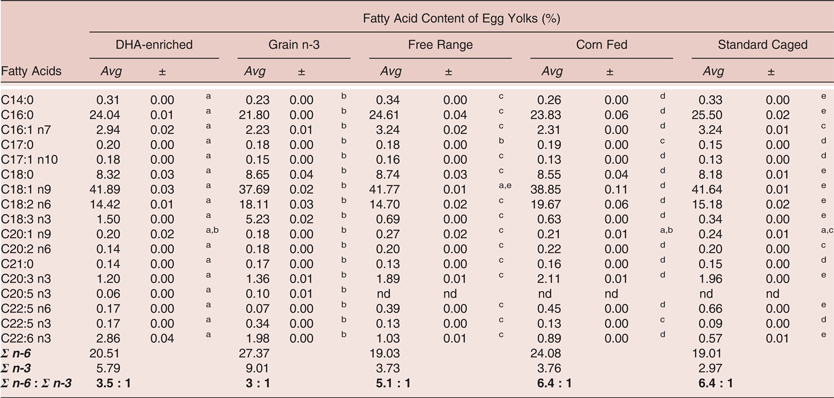
Relative fatty acid compositions for each egg variety, as determined by the analysis of fatty acid methyl esters by gas chromatography, are summarised in Table 1. Oleic acid, an omega-9 monounsaturated fatty acid commonly found in oleaginous feed crops such as corn and wheat, was the predominant fatty acid in each egg variety, accounting for approximately 38–42% of total fatty acids. The major fatty acids detected were palmitic, stearic, oleic, linoleic and DHA; however, these were found at different relative quantities and in general, significant differences were detected between egg varieties (P ≤ 0.05). DHA in particular was found at significantly higher levels in eggs from hens stated to have been fed DHA-enriched diets, accounting for 2.9% of total fatty acids. Dietary supplementation with an omega-3 source has previously been shown to effectively improve the DHA status of eggs, compared to those marketed as conventional or organic (Samman et al. Reference Samman, Kung, Carter, Foster, Ahmad, Phuyal and Petocz2009).
Fatty acid profiles of supermarket egg yolk samples
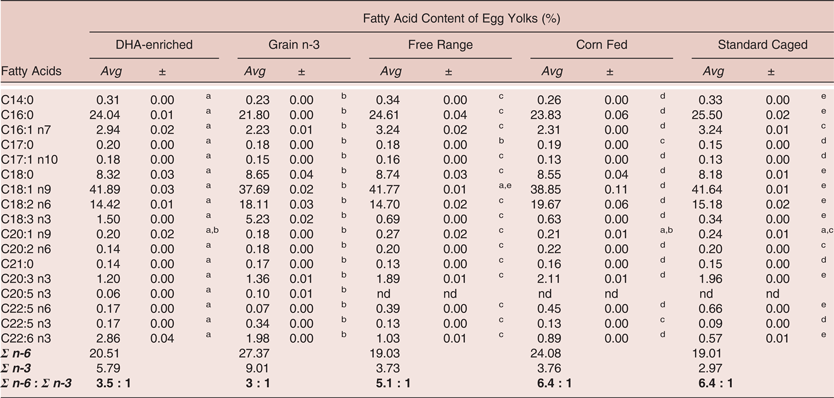
Data expressed as percentages of total fatty acids and presented as mean ± SD of triplicate assessments for each egg variety (nd: not detected). Means that do not share a common superscript letter in the same line differ significantly (P ≤ 0.05) by way of the Tukey test.
Inclusion of a dietary omega-3 source in the layer diet had a pronounced effect on the ratio of omega-6 to omega-3 (n6:n3) PUFAs. The ratio of omega-6 to omega-3 was reduced to 3:1 and 3.5:1 for Grain n-3 and DHA-enriched eggs, respectively. The predominant omega-3 source in the Grain n-3 supplemented diets was identified as alpha-linolenic acid (C18:3 n3), a fatty acid commonly found in cereals and vegetable oils (Kartikasari et al., Reference Kartikasari, Hughes, Geier, Makrides and Gibson2012). By comparison, the predominant omega-3 source in DHA-enriched eggs was confirmed as DHA, an important cell structural component associated with a host of health mediating functions (Gillingham et al., Reference Gillingham, Caston, Leeson, Hourtovenko and Holub2005; Wall et al., Reference Wall, Ross, Fitzgerald and Stanton2010). Other egg varieties had considerably higher n6:n3 values, with free range eggs at 5.1:1 and a ratio of 6.4:1 for both corn fed and standard caged eggs. Elevated n6:n3 ratios were largely reflective of varieties with lower relative omega-3 values. Milinsk et al. (Reference Milinsk, Murakami, Gomes, Matsushita and de Souza2003) reported similar findings, whereby hen dietary strategy had a pronounced effect on both the fatty acid profile and n6:n3 ratio of eggs. The nutritional importance of the n6:n3 ratio in foods is well established, with a recognised need to reduce Western diet PUFA ratios from approximately 20:1 to much lower values (Simopoulos, Reference Simopoulos1991).
While layers fed with DHA-enriched diets had a significantly higher relative content of DHA in their eggs, absolute DHA quantities were significantly higher than in other egg varieties (P ≤ 0.05), equating to 14.6 ± 0.8 mg DHA/g yolk (Figure 1) or 2.9% of total fatty acids. Comparatively, the standard caged eggs contained the least DHA with 3.3 ± 0.3 mg DHA/g yolk, just 0.6% of the total fatty acid content. In order of absolute DHA quantities, Grain n-3 enriched eggs were significantly lower with 10 ± 0.3 mg DHA/g yolk than DHA-enriched eggs, as were free range and corn fed eggs with values of 5.3 ± 0.2 and 4.8 ± 0.3 mg DHA/g yolk, respectively (P ≤ 0.05). While diet composition has been shown to have a direct influence of the omega-3 content of egg yolks, Oliveira et al. (Reference Oliveira, Baião, Cançado, Grimaldi, Souza, Lara and Lana2010) observed decreased PUFA deposition in older laying hens, another important consideration when evaluating nutritional quality.
DHA content (mg/g) of eggs produced from various feeding strategies. Data presented as mean ± SD of triplicate assessments for each egg variety. Means that do not share a common letter differ significantly (P ≤ 0.05) by way of the Tukey test.

Antioxidant components were sequentially extracted from lyophilised yolks on the basis of increasing polarity. Resulting antioxidant yields and activities were largely dependent on the characteristics of the extraction solvent and the corresponding solubility of specific components. Sequential extraction, in addition to a cell disruption step, facilitated the determination of both lipophilic and hydrophilic components (Guedes et al., Reference Guedes, Amaro, Gião and Malcata2013).
Differences in antioxidant activity were observed across egg variety and extraction solvent (Figure 2). Hexane fractions demonstrated the greatest differences between egg varieties, with DHA-enriched eggs yielding significantly higher antioxidant values equating to 1.9 ± 0.1 μmol TE/g (P ≤ 0.05), indicating an increased level of non-polar antioxidants. Standard caged eggs consistently had the lowest antioxidant values for each extraction solvent, while remaining egg varieties had similar values when extracted in methanol (ranging from 2.2–2.7 μmol TE/g) and in water (ranging from 2.1–2.6 μmol TE/g).
Antioxidant status of eggs produced from various feeding strategies. Data presented as mean ± SD of triplicate assessments for each egg variety. Means that do not share a common superscript letter in the same series differ significantly (P ≤ 0.05) by way of the Tukey test.
When the sum of individual fractions were taken into consideration, DHA-enriched eggs had the highest antioxidant activity (6.6 μmol TE/g), followed by Grain n-3 enriched eggs (6.4 μmol TE/g), corn fed eggs (5.9 μmol TE/g), free range eggs (5.2 μmol TE/g) and standard caged eggs (4.3 μmol TE/g). The ability of diet composition to influence the antioxidant status of eggs has been previously documented, with relevant literature reporting significant differences between corn and wheat fed hens (Nimalaratne et al. 2011); housed, free range and feral geese (Speake et al., Reference Speake, Surai, Noble, Beer and Wood1999) and with the dietary inclusion of tomato peel (Benakmoum et al., Reference Benakmoum, Larid and Zidani2013) or microalgae (Fredriksson, Reference Fredriksson, Elwinger and Pickova2006) to layer diets.
The overall phenolic content of the egg yolks was relatively low across each egg variety (Figure 3). In general, total phenolic contents were relatively similar, ranging from 1.1–1.7 mg GAE/g yolk. Although the cereal grains commonly used in poultry feeds are rich in phenolic compounds, their deposition in the yolk is low under natural conditions. Nimalaratne et al. (2011) found only trace amounts of phenolic compounds, suggesting that the hydrophilic nature of certain phenolics may have restricted their deposition in lipid-rich egg yolks. Similar findings have been reported indicating that natural phenolic sources supplemented to the diet did not result in the uptake of sufficient amounts to impart a clearly pronounced antioxidative benefit in the yolk (Johnson et al., Reference Johnson, Dahiya, Olkowoski and Classen2008; Loetscher et al., Reference Loetscher, Kreuzer and Messikommer2013).
Phenolic content of eggs produced from various feeding strategies. Data presented as a total of means ± SD of triplicate assessments for each egg variety.
Conclusions
The analysis of supermarket eggs produced from stated specialist feeding systems showed major differences in fatty acid profiles, DHA levels and antioxidant status. Eggs from hens stated to have been fed DHA-enriched diets contained significantly higher levels of DHA in eggs compared to non-supplemented eggs or those supplemented with other omega-3 sources (P ≤ 0.05). Eggs from caged poultry production systems contained very low levels of DHA, nearly 4.5-fold lower than DHA-enriched eggs. Similarly, Grain n-3, free range and corn fed eggs had 1.5, 2.8 and 3.1 fold reductions respectively in DHA levels compared to DHA-enriched eggs. Both the DHA-enriched and Grain n-3 supplemented eggs had considerably lower omega-6 to omega-3 ratios than the other egg varieties, an important consideration when evaluating the nutritional value of the egg. Dietary supplementation with omega-3 fatty acid sources influenced the antioxidant status of the egg, with significant increases in the non-polar antioxidant fraction documented for DHA-enriched eggs, as well as slightly improved overall antioxidant activity. However, methods of analysis for antioxidant content is important, as results can vary.
The present research demonstrates the pronounced influence of layer feeding strategy on fatty acid, DHA and antioxidant composition, with direct implications for the nutritional value of commercially available egg verities.
Acknowledgements
The support, both financially and professionally, provided by Alltech is greatly appreciated.
Declaration of interest
The authors are employees of Alltech Ltd, Ireland, which manufactures All-G-Rich™, a DHA rich algal feed supplement.