I FOUNDATION OF THE SOCIETY
The Society for the Promotion of Roman Studies was founded at a public meeting on Friday, 3 June 1910 at the headquarters of the Civil Service Commission in London. The meeting was sponsored by a group of men who we may assume had been involved in planning the foundation: Percy Gardner, George Macmillan and John Penoyre (Hellenic Society), Francis Haverfield (Oxford), J. S. Reid (Cambridge), A. H. Smith and G. F. Hill (British Museum), and G. H. Hallam (Classical Association). Hallam, who taught at Harrow, was a pupil of Benjamin Kennedy of Shrewsbury, a school well represented in the published list of attending grandees.Footnote 1 They included another Kennedy pupil, Henry Moss, Senior ClassicFootnote 2 at Cambridge in 1864, who had succeeded his teacher as headmaster of Shrewsbury, retiring in 1907. T. E. Page, taught by both Kennedy and Moss, had just retired as a Charterhouse housemaster; he was the most celebrated schoolmaster of the age, and about to become co-editor of the Loeb Classical Library. The law was represented by Lord Justice William Kennedy, who had in 1868 been Senior Classic (as had three of his uncles, one of them Benjamin Kennedy). The meeting was chaired by Frederic Kenyon, Director of the British Museum, whose official position provided both gravitas and neutrality.Footnote 3 The proceedings were carefully orchestrated, resolutions, proposers and seconders having been arranged in advance. Similarly, a committee had been pre-selected and was duly voted into office at the meeting. The major interested parties were all represented: Oxford (F. Haverfield, D. G. Hogarth and H. Stuart-Jones), Cambridge (J. S. Reid), the British Museum (G. F. Hill, A. H. Smith and H. B. Walters), and learned schoolmasters (T. Rice Holmes of St Paul's). S. H. Butcher, though a Hellenist, was also President of the British Academy (founded in 1902) and MP for Cambridge University.
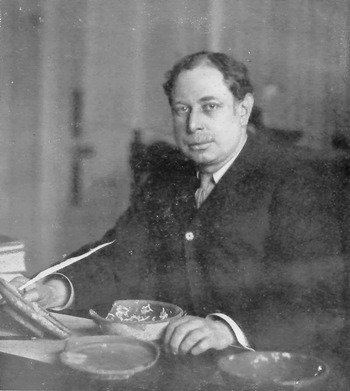
Haverfield (fig. 1) led the way with a speech which provoked cheers when he ended, perhaps because his peroration invoked the claim of the new society on ‘the patriot and the professor alike’. He also listed the existing classical bodies, stressing the need for co-operation between them, and explaining that the new society hoped to be able to support the British School at Rome; and also the existing journals. Underlying all this was a situation which offered the infant society both problems and opportunities. On the one hand, it was entering a crowded field in which boundary disputes, notably between the Hellenic Society (founded in 1879) and the British School at Athens (1886) and their journals, had already flared up. On the other hand, any mental map of the field clearly showed up an unoccupied area, parallel to Hellenic Studies and linked to the British School at Rome (founded in 1900): ‘Roman Studies’. In the empire of Classics, this was the final province waiting to be established.Footnote 4
Francis Haverfield (1860–1919), founder and first president of the Roman Society. An undated portrait by Elliot & Fry of London, originally published in the Journal of the Chester Archaeological & Historical Society 23 (1920).

What, then, were the boundaries of this academic province? Haverfield declared that ‘Roman art might be a poor thing, but Roman architecture, archaeology, and history were three living studies of signal value to the world today’. The omission that strikes us now, looking back, is that of language and literature. The Times report of the meeting explained that the avoidance ran parallel to the practice of the Hellenic Society. That practice had its origin in a defiant assertion in 1879 of the value of non-literary study, when the Society's first president, Charles Newton, had insisted that there was more to Greece than grammar.Footnote 5 Thirty years on, however, the classical field was also occupied by the archaeological Schools in Athens and Rome and by the Classical Association (founded in 1903). In his speech, Haverfield was thus plotting a course for the infant Society through an archipelago of established institutional interests. If the new committee represented a range of interests relevant to the pursuit of Roman studies, the list of sponsors represented the parties who needed to be recruited, avoided or appeased.
The reefs and currents to be navigated round can be seen from what little is known of the negotiations which took place behind the scenes before the carefully-rehearsed public event of June 1910. The chain of events that led to the foundation of the Roman Society had begun with a request from Thomas Ashby, director of the British School at Rome, to the Hellenic Society in the spring of 1908, for a grant comparable to that made by it to the Athens School. The extension of its activity to Rome had been suggested before, but the Hellenic Society felt this was a step too far, not least since it would require a rise in subscription rates.Footnote 6 It therefore set up a committee which in April 1909 produced three proposals. D. G. Hogarth, director of the British School at Athens, urged the founding of an Institute of Classical Studies which would co-ordinate the existing bodies and a new, Roman, institution. Percy Gardner, Lincoln Professor of Classical Archaeology at Oxford, while preferring the creation of a society ‘for Latin or Italian Studies’,Footnote 7 also thought the Hellenic Society might broaden its remit to include the Roman world; G. F. Hill of the British Museum suggested the setting up of a new branch of the Hellenic Society, with a separate subscription and journal. These proposals encompassed the three logical alternatives: (1) an umbrella body, (2) an extension of an existing body, and (3) a new body. The same alternatives had been mooted a decade earlier when the lack of a single body to represent the humanitiesFootnote 8 in Britain had been a subject of discussion. In that case, they had been (1) an Imperial Institute covering both science and the humanities, (2) a committee of the Royal Society, and (3) a new dedicated body. In both cases the third alternative was chosen, and the British Academy was founded in 1902, as was the Roman Society eight years later.Footnote 9 The point to be stressed here is that while the extending of an existing body seemed a simple or attractive course of action, the financial argument was decisive. An umbrella body was too expensive; extension was a financial risk for the existing body; but an independent body would not be a drain on the funds of the older organizations, especially its elder sibling the Hellenic Society.
The question was, then, could an independent body survive? In order to establish whether sufficient support could be found, the Hellenic Society circulated a memorandum in November 1909, asking for declarations of interest and indications of whether an extension of its own work or the founding of a new society was preferred. The majority response was in favour of a new body; numbers were fewer than the 500 the Hellenic Society Council had reckoned would be needed to found and fund an independent society, but still respectable: 416 unconditional and 17 conditional acceptances were eventually received. The way was (fairly) clear to move toward foundation.Footnote 10
The surviving evidence suggests that the Classical Association was the most concerned of the existing bodies at the prospect of a Roman Society. It was in expansive, even expansionist, mood in 1909, having just bought the Classical Quarterly and Classical Review from their publisher David Nutt. Having considered and abandoned a proposal to buy the Journal of Philology from Macmillan, the Association's Journals Board was busy drawing up a plan to publish a journal of Roman studies.Footnote 11 The cost, they thought, would not exceed £400 a year; the journal would be offered to Classical Association members at a reduced price. All subscribers would have the right to use the Hellenic Society's library, and in return the Classical Association would subsidise the purchase of Latin books for the library.Footnote 12 The announcement of the campaign to found the Roman Society must therefore have come as something of a shock, and led to a meeting with members of the Hellenic Society Council on 3 December 1909 at which the Classical Association representatives complained at not being consulted before the Society had sent their letters to the press. They went on to argue that ‘societies were multiplying unduly’, and that they were ready to publish a journal of Roman studies. The Hellenic Society deputies replied that their Society felt unable to raise its subscription to support expansion from Greece to Rome, and that they had simply tried to assess ‘the extent of what might be called “the Roman demand”’ — represented at that point by 350 promises of support.Footnote 13
II THE CLASSICAL FIELD
It is worth stepping back from this micropolitics to look at the wider context. On its foundation in June 1910, the Society joined a group of classical organizations which, like it, survive and flourish to this day: the Hellenic Society (1879), the British School at Athens (1886), the British School at Rome (1900), the Classical Association of Scotland (1902), and the Classical Association (1903).Footnote 14 The chronological sequence raises some questions. The Hellenic Society, as we have seen, had played a part in the campaign to found the British School at Athens; the latter's existence inevitably suggested the foundation of the British School at Rome; the Roman School in turn provoked proposals for a Society in Britain. This was a curious causal loop, curving as it did, boomerang-like, from Britain out to the Mediterranean and then back home again. It suggests that the status of the Roman Society was in some sense anomalous: that of a latecomer or an afterthought. There is no sign, for example, that any need for such a body had been felt in the immediate wake of the foundation of the Hellenic Society. Only when that was followed by the establishment of the two Schools did any pressure build up for the creation of a Roman Society: and then not immediately. A subsidiary theme is also detectable throughout: the tendency to seek support from the dominant (Hellenic) institutions to incorporate, or if not, to support, those devoted to the study of ancient Rome. Thus the earliest proposal for a School in Rome saw it as a branch of the British School at Athens; similarly, suggestions for the organizing of Roman studies looked to the pre-existing body, the Hellenic Society.
If one compares this (pre)history with that of other countries, some interesting differences emerge; though comparison with bodies belonging to different national contexts is not easy. In Germany, the Versammlungen der deutscher Philologen und Schulmänner were held from 1837, and their proceedings published from 1838; the meetings lapsed in 1914–20, but by 1930, fifty-seven volumes of proceedings had been published. These meetings reflected, when they began, the institutionalization of the idealist vision of Altertumswissenschaft, the integrated study of Classical Antiquity, in an era of romantic nationalism when the Greeks were fighting for independence from the Ottomans, and the Germans (not yet politically unified themselves) had broken free from Napoleonic France.Footnote 15 In France, the Association pour l'Encouragement des Études Grecques en France was founded in 1869, and from then till 1887 published an Annuaire, which in 1888 became the Revue des Études Grecques. In Italy, the Società italiana per la diffusione e l'incoraggiamento degli studi classici was founded in 1897; its journal Atene e Roma started publication in the following year. Society and journal both collapsed during World War II, but in 1950 the Associazione italiana di cultura classica was founded, and the journal resumed publication. In the USA, the American Philological Association was founded in 1868 and held its first meeting in 1869. The Archaeological Institute of America, founded in 1879, focused heavily on classical archaeology in its early years, and has close ties with the American schools in Athens (1881) and Rome (1895 – now the American Academy). Since 1905 it has almost invariably shared its annual meeting with the American Philological Association.
In several cases these foreign examples parallel the British sequence: first Greece, then Rome. The conventional phrase ‘Greece and Rome’ took that form because throughout the nineteenth century, and not only in Britain, Greek civilization had been accorded primacy. It is thus not surprising that J. C. Stobart's The Glory that was Greece (1911) preceded his companion volume The Grandeur that was Rome (1912). Similar couplets could be seen in the following decade: for example, Richard Livingstone's The Legacy of Greece (1921) was followed in 1923 by Cyril Bailey's The Legacy of Rome.Footnote 16 The pattern has been repeated in recent studies of classical reception — Richard Jenkyns' The Victorians and Ancient Greece (1980) and Frank Turner's The Greek Heritage in Victorian Britain (1981) were followed only after a considerable interval by Norman Vance's The Victorians and Ancient Rome (1997), and Catharine Edwards' edited collection: Receptions of Rome in European Culture, 1789–1945 (1999).
This consistent downgrading of Rome in favour of Greece helps to explain the lateness of the Society's appearance, but other factors worked in its favour. The fundamental point, perhaps, is that the high noon of late-Victorian Hellenism coincided with that of British imperialism. In 1876 Queen Victoria became Empress of India, and the apogee of imperial rhetoric began. During her son Edward's reign (1901–10), however, a literature emerged comparing the Roman and British empires, culminating in the Earl of Cromer's Ancient and Modern Imperialism (1910), Charles Lucas's Greater Rome and Greater Britain (1912), and James Bryce's The Ancient Roman Empire and the British Empire in India (1914). Cromer's book was an expanded version of his presidential address to the Classical Association in January 1910, which had led to a formal session on the topic in Oxford on 6 May that year.Footnote 17 Bryce and Lucas had both gained double firsts in Classics at Oxford; the university had played a major part in supplying administrators for the Empire, and was to be similarly central to the founding and later history of the Roman Society.Footnote 18 After Victoria's death in January 1901, however, it was a Greek scholar, Richard Jebb, who was consulted by the Chancellor of the Exchequer about the rewording of the new King's Latinate title on British coins to reflect the imperial title (OMN was added to IMP).Footnote 19 Jebb was an MP and a leading spokesman for what is now termed the humanities; but it was significant in itself that it was a Hellenist who occupied such positions.Footnote 20
The foreign societies listed above can also be distinguished according to their focus on linguistic or literary, or on archaeological and historical study. In fact most of them aimed to cover both fields; the Società italiana, for example, had as one of its aims the dissemination of information on papyrological finds. The clear-cut distinction between literary and historical/archaeological seems to be confined to Anglo-American bodies, and presumably stems from the embeddedness of linguistic and literary scholarship as the basis of élite education in nineteenth-century Britain and America. Certainly the beginnings of the Hellenic Society, as we have seen, included a marked strain of resistance to the dominance of language and literature as foci of classical work.
Another factor, however, needs to be taken into account which is especially germane to the early years of the Roman Society: the development of the Literae Humaniores (Greats) course at Oxford. In 1872 ancient history was established as a distinct course of study within Greats, and this fostered the study of ancient history in a way unknown in Cambridge. The work of Henry Pelham, William Warde Fowler and Francis Haverfield had its home within the teaching of Greats; in the next generation, notably in the working lives of Fowler's pupil Hugh Last and Haverfield's protégée Margerie Taylor, the Roman Society was in its early decades in many ways an extension of Oxford Classics.Footnote 21 Between the Wars Oxford provided a firm base for both Society and Journal. Miss Taylor worked from there, so that the Society did not have an administrative base in London till her retirement as Secretary in 1954. Together with Hugh Last, she kept a close eye on Greats candidates, hoping to recruit the Firsts for the cause of Roman history and archaeology. Links with the world beyond Oxford were maintained by friendship between Hugh Last, Frank Adcock of Cambridge and Norman Baynes of London. Adcock deployed his considerable diplomatic skills in editing the Cambridge Ancient History; Baynes was a gregarious man who ploughed his own furrow, both in refusing Oxonian offers in order to stay in London and in focusing increasingly on Byzantium. The annual informal meetings of ancient historians at Tring and Wellingborough begun by him provided a useful venue for discussion between ancient historians at a time when academic conferences were few and far between.Footnote 22
The Society's Memorandum and Articles of Association listed its major aims: to promote Roman studies by creating a library, publishing a journal, and supporting the British School at Rome. Of these, the Journal stands out as the medium through which the Society is known to most people, members and non-members alike.
III THE JOURNAL OF ROMAN STUDIES
Like its Hellenic counterpart, the Journal of Roman Studies first appeared the year after its parent body was founded. The Journal of Hellenic Studies had started out in 1880 as an octavo format volume with accompanying larger-format volumes of plates, but soon adopted an intermediate format which suited both text and illustrations.Footnote 23 JRS followed the same format until 2005, when a smaller size was adopted to economize on printing charges. For most of its history, the Journal has contained 250–350 pages per volume, though war and depression have at times reduced its size.Footnote 24 The earliest issues were single volumes, but in 1913 two parts appeared, perhaps in an attempt to publish reviews more promptly. Subsequently the two-part format was adhered to whenever possible, though after World War II the labelling of (single) annual volumes as ‘parts 1 and 2’ was purely nominal.Footnote 25 In 1955, news of Ivan Margary's gift of £1,000 prompted a suggestion that the Journal might return to bi-annual issues, but the financial commitment was felt to be too great.Footnote 26
The appearance of the Journal of Roman Studies led to strained relations with the Classical Association. Not only was there a concern that the new journal might compete with the Classical Quarterly and the Classical Review; the Classical Association itself, as we have seen, had been preparing to launch a journal of Roman studies. At an informal meeting between the Classical Association and the Hellenic and Roman Societies held in November 1910 on the ‘adjustment of … provinces' of JHS, JRS and CQ, it was agreed that ‘normally and in general, the province of the … Roman journal’ should be ‘the history and archaeology of Italy and of the lands of the Roman Empire’; the ‘Hellenic journal’ was allotted the parallel Greek province it already occupied, while the ‘literature, philology and grammar, palaeography and the like, of both classical languages’ was given to CQ.Footnote 27 The restricted range claimed by the Journal of Roman Studies, then, was the product both of the example provided by the Journal of Hellenic Studies, and of the need to avoid offending the Classical Association.
The first volume of the Journal opens with Haverfield's presidential address. Grand themes are eschewed and professionalism emphasized (in Vol. 2 he was to dismiss Lucas's Greater Rome and Greater Britain as the work of an amateur). This is followed by a long article by Eugénie Strong on an exhibition of Roman provincial art in the Baths of Diocletian. The prominence given to a woman is striking — and she is not the only female contributor to the volume. Mrs Strong was a member of Council, and also assistant director of the British School at Rome, but there may also be a subtext here: a protest, in effect, at Haverfield's downgrading of her own field, Roman art, as ‘a poor thing’.Footnote 28 Other contributors who appear more than once in early volumes of JRS are Albert Van Buren of the American School of Classical Studies at Rome and his wife Elizabeth. A survey of the first few volumes reveals, not surprisingly, the repetition of a few names (including Haverfield and his protégé G. L. Cheesman, who was killed in action in 1915),Footnote 29 suggesting that the founders were obliged to prime the pump themselves. On the other hand, it looks as if foreign contributors were encouraged from the start: as well as the Van Burens, we find von Domaszewski and Reinach in Vol. 1, Dessau and Cumont in Vol. 2, Boni in Vol. 3. This may account for the encouraging growth of subscriptions from foreign libraries.
Originally, the editing of the Journal was among the duties of the Secretary; but since the first incumbent, George Hardinge-Tyler, was essentially an administrator (he had previously been Secretary of the Royal Archaeological Institute), an editorial committee was set up at the first Council meeting on 20 October 1910.Footnote 30 When Margerie Taylor became Secretary in 1923 the Journal acquired a scholarly editor. The bi-annual issues of the Journal had fallen behind schedule during World War I, and the sharp rise in printing and paper costs in the immediate post-War years had not helped. The 1920s issues carried behind the title pages the dates on which printing had been completed — often two years later than that on the title page itself.Footnote 31 But as Miss Taylor remarked in 1960 with justifiable pride, three years after her appointment in 1923 the Journal ‘was now only one half-year in arrears and by 1931 it was up to date’.Footnote 32 After the Second World War, she decided to relinquish the editorial role while remaining Secretary; but in fact the reverse happened. At the Council meeting of 5 January 1954 she resigned as Secretary, becoming Honorary Secretary and Editor of JRS, and an Assistant Secretary (Naomi Myers) was appointed.
The pages of JRS in the 1930s and 1940s reflected the Oxford-centred world of the Society, though Last, who in many ways took over the role of protector and advisor to Miss Taylor previously inherited from Haverfield by R. G. Collingwood, contributed few articles, preferring to write lengthy reviews.Footnote 33 Last was a devotee of Mommsen, and throughout his career produced solidly learned constitutional history.Footnote 34 In marked contrast, and often to be found in the pages of JRS from 1928 onwards, was the work of Ronald Syme (fig. 6), whose inspiration came from Münzer and Gelzer rather than from Mommsen; he wrote first on Roman military history, then turned to questions of politics and historiography in his great books on the Roman Revolution (1939) and Tacitus (1958).Footnote 35 A major contrast to Syme's prosopography of senatorial élites was provided by Last's pupil Peter Brunt (fig. 6), who contributed important articles on finance and the army. In the 1960s Oxford itself changed; new questions began to be asked, and new areas of the Roman Empire to be explored — the East, for example, by Fergus Millar (fig. 6). The new questions can be seen in Millar's review of A. N. Sherwin-White's edition of, and selections from, the letters of Pliny (JRS 58 (1968), 218–24). The edition is identified by Millar as inspired by a suggestion from Last, and as belonging to an Oxford tradition of massive commentaries. He concludes (p. 224) that:
… the book still reflects the outlook on this period current a generation ago, the assumptions, one might put it, of the CAH rather than Syme's Tacitus. That is to say, it is the product of that firmly ‘constitutionalist’, Rome-based, tradition in the study of Roman history as studied in England, which goes back to Mommsen — the Mommsen of the Staatsrecht that is, many of whose truest descendants are found here — and by-passes both Syme and Rostovtzeff. This partially explains the primary limitation of the book, which is that the basic process involved is (to over-simplify grossly) that of interpreting the contents of the letters in terms of ‘rules’, thought to be already known, rather than that of using the letters as the tool of an open-minded inquiry into the nature of ancient government and society.
A decade earlier, Moses Finley had made a similar assault on A. E. R. Boak's Manpower Shortage and the Fall of the Roman Empire (JRS 48 (1958), 156–64); a decade later, Millar's The Emperor in the Roman World was to be reviewed in much the same style by Keith Hopkins (JRS 68 (1978), 178–84). The pages of JRS, in fact, enable us to map the rise and fall of several generations of historiography, and to follow the expansion of the Journal to a scholarly world no longer dominated by Oxford.Footnote 36
In the 1921 volume, Miss Taylor and R. G. Collingwood gave a report on ‘Roman Britain in 1921 and 1922’, supported by the Haverfield Bequest — thus beginning a long series of annual reports which came to an end only with the appearance of Britannia in 1970.Footnote 37 There is some evidence that Last and Miss Taylor wanted JRS to be primarily a historical journal. If this is so, then she presumably saw the annual Roman Britain reports as a means of containment, rather than as a Trojan Horse through which archaeology could enter the Journal. Linked with this tension was that between the study of Roman Britain and of the Empire at large.Footnote 38 The study of late Imperial and Byzantine history was encouraged by Baynes, who took care to stake the claim of Byzantium to be considered Roman: as he wrote in 1930,
New Rome did not belie her name: the empire set in Greek lands with its heart in the city of Constantine may still with reason claim the interest of the members of a Society formed for the study of the work of Rome.Footnote 39
Although it was unquestionably ‘Roman’, literature was at first sternly excluded so as to avoid boundary conflicts with CQ and CR. J. W. Mackail was, however, allowed to speak and publish on Virgil (1913) and on the historian Ammianus (1921), and later both literature and language were admitted as subjects. It was in JRS that Fraenkel published his lengthy demolition of the Harvard edition of Servius; so lengthy that it had to be split between two volumes (JRS 38 (1948), 131–43; 39 (1949), 145–54).Footnote 40
The Editorial Committee of the Journal took its duties seriously; its members scrutinized submissions, and recommendations for revision were very detailed — on occasion even specifying type size. A powerful and (to some) terrifying member of the committee, till 1983, was Arnaldo Momigliano. He rejected an article by the young Oswyn Murray on the Quinquennium Neronis on the ground that, as he told Murray, ‘one does not write learned articles on subjects suitable for undergraduate essays’.Footnote 41 In the early 1980s the committee rejected an article by Ronald Syme, the greatest of Roman historians, who had published dozens of articles and reviews in JRS since 1928: he did not offer again. Submissions by committee members were not spared, and on at least two occasions, rejections led to their resignations. The Journal's reputation for efficiency and high standards was also fostered by a rule, apparently introduced by Miss Taylor, that all articles were to be published in the year they were submitted. At the year's end, therefore, an unpublished article had to be resubmitted. The Taylor tradition of heavy-handed but benevolent autocracy was continued by Frank Lepper (1964–8) and Martin Frederiksen (1969–75); and continuity was further maintained by both men's going on to chair the Editorial Committee. The next editor, Fergus Millar (fig. 6), quickly came to the conclusion that the burdens of the office took up at least a quarter of his working time; he pointed out that unlike Miss Taylor her successors had no private income and had full-time academic jobs. At his suggestion, Elaine Matthews was appointed Editorial Assistant in 1976; she was succeeded in 1981 by Helen Cockle, who went on to be the Society's Secretary.
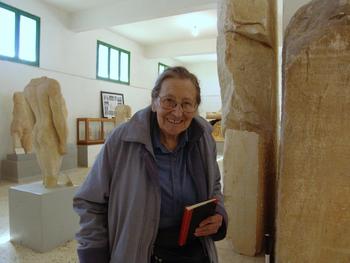
It would be difficult, perhaps invidious, to select highlights in the long history of JRS; but some reports of new discoveries retain an uncontroversially special status as milestones in our understanding of Roman culture and society. The text of the papyrus of Cornelius Gallus found in Egypt was published, introduced, translated and interpreted in 1979.Footnote 42 In 1986 the Lex Irnitana, a version of the Lex Flavia municipalis found on bronze tablets in Spain in 1981, was similarly presented, in an article of nearly a hundred pages. This was the longest Latin inscription ever published.Footnote 43 A different but equally striking kind of discovery was made by J. K. St Joseph, whose long series of aerial surveys, published in JRS from 1951, revealed unknown sites in many parts of the country.Footnote 44 Inscriptions have had their own surveys, assembled for half a century now by Joyce Reynolds (fig. 2) at roughly five-yearly intervals, working since 1976 with other scholars.Footnote 45
Joyce Reynolds, President 1986–1989, in the museum at Cyrene. (Photo: Hafed Walda, King's College Lon-don)

Reviews
Reviews have always been an important part of JRS, and when the Journal appeared twice a year, as it originally did, they were able to respond to books with some promptness, except in the 1920s, when several issues were published up to two years late.Footnote 46 The reviews in the early volumes give a sense of the mapping, sometimes tentative, of the Journal's field. A few anthropological works were dealt with — for example, in Vol. 2, Hose and McDougall's Pagan Tribes of Borneo.Footnote 47 The wilder shores of speculation, instead of being discarded, were faithfully reported, though briefly. Of T. Lloyd's The Making of the Roman People (1914), the anonymous reviewer wrote:
In this astonishing work Mr Lloyd shows that the language of the Romans is derived from modern Irish. The book is of no value or interest, except as indicating what preposterous absurdities can be achieved by quite harmless people who take to writing on subjects of which they know nothing.Footnote 48
The great majority of reviews were sober and conscientious, and one rarely catches a sight of animus, or indeed of violent emotion. It was surely a continuing patriotic impulse which provoked R. S. Conway's onslaught on Mommsen in a review of W. W. Fowler's Roman Essays and Interpretations (JRS 9 (1919), 216–18):
The truth cannot be too often repeated that [Mommsen's] ‘History’ was a brilliant political tract, designed, inter alia, to support the Prussian monarchy, and perhaps the most eloquent piece of journalism that ever imposed upon the ignorance of the public and the indolence of scholars. Its widespread use in English schools has been nothing less than an injury to education; and if any written words could produce such a result I should rejoice to see Volume iv of Mommsen's History burnt in the play-ground of every school that possesses it.
Some reviews were of considerable length, but in addition, in 1928 a separate subgenre of ‘reviews and discussions’ was introduced to provide for the extended discussion of deserving works. Several volumes of CAH received this treatment, as did Syme's Roman Revolution, of which Momigliano sent in at speed a remarkable review, at once generous and penetratingly critical (JRS 30 (1940), 75–80). The subgenre has continued under a variety of titles, including ‘review articles’ and ‘survey articles’.
Reviews begin a dialogue: where should it stop? The issue first raised its head in 1920, when Thomas May, whose The Pottery Found at Silchester (1916) had been reviewed by Donald Atkinson (JRS 8 (1918: published in July 1920), 199–200), demanded a right of reply. The Editorial Committee were supported by Council in refusing to do so, but Atkinson was asked to correct some mistakes,Footnote 49 and a grovelling apology appeared (Vol. 9, p. 102). In 1960 D. R. Shackleton Bailey's Towards a Text of Cicero ‘ad Atticum’ arrived for review. The review editor, Frank Walbank, sent it to W. S. Watt of Aberdeen for review, knowing that he too had been working on the letters. What he did not know was that Bailey and Watt, originally contracted as co-editors of a two-volume Oxford Classical Text of the letters, had fallen out; Oxford University Press had then split the task, giving them a volume each.Footnote 50 When Watt's abrupt and dismissive review appeared (JRS 50 (1960), 278– 9), Bailey circulated the Society's officers with a demand for a right of reply, which was refused. The incident led to the resignation of John Crook from Council.
IV THE JOINT LIBRARY
Since its foundation, JRS review copies, like those of its sister journal, have provided a crucial support to the Joint Library of the two Societies. To begin with, reviewers were paid (18s 4d a page; maximum one guinea) ‘if they wished it’.Footnote 51 Presumably it was hoped that at least some reviewers would waive payment.Footnote 52 In the mid-1950s, after the establishment of the Institute of Classical Studies, its director Eric Turner suggested that reviewers might keep the books, and the Societies make larger grants to the Library. Not surprisingly, this was rejected, the Editor of JRS declaring that he had no trouble getting reviews under the existing system.Footnote 53 In 1970 the system was itself reviewed, and its weaknesses assessed (for example, some books were kept for long periods by reviewers, and might not become available to readers for over a year). It was concluded, however, that the financial benefit to the Library outweighed all the disadvantages of the system. The raising of reviewers' fees was considered in 1971, but in 1975 they were abolished altogether and replaced by free offprints of reviews. In the early twenty-first century, the Editors of both Journals face competition from other periodicals which both publish more often and allow reviewers to keep books. It is a tribute to both the altruism of reviewers and the status of the Joint Library that the flow of reviews and books continues.Footnote 54
V CONJOINED SIBLINGS
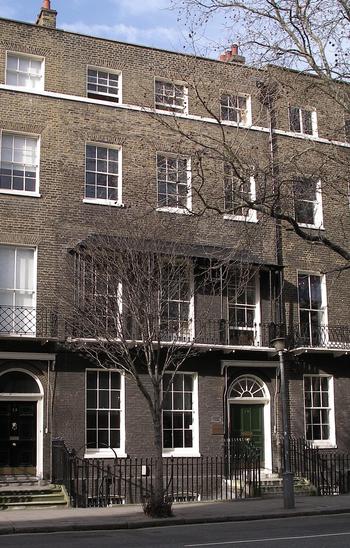
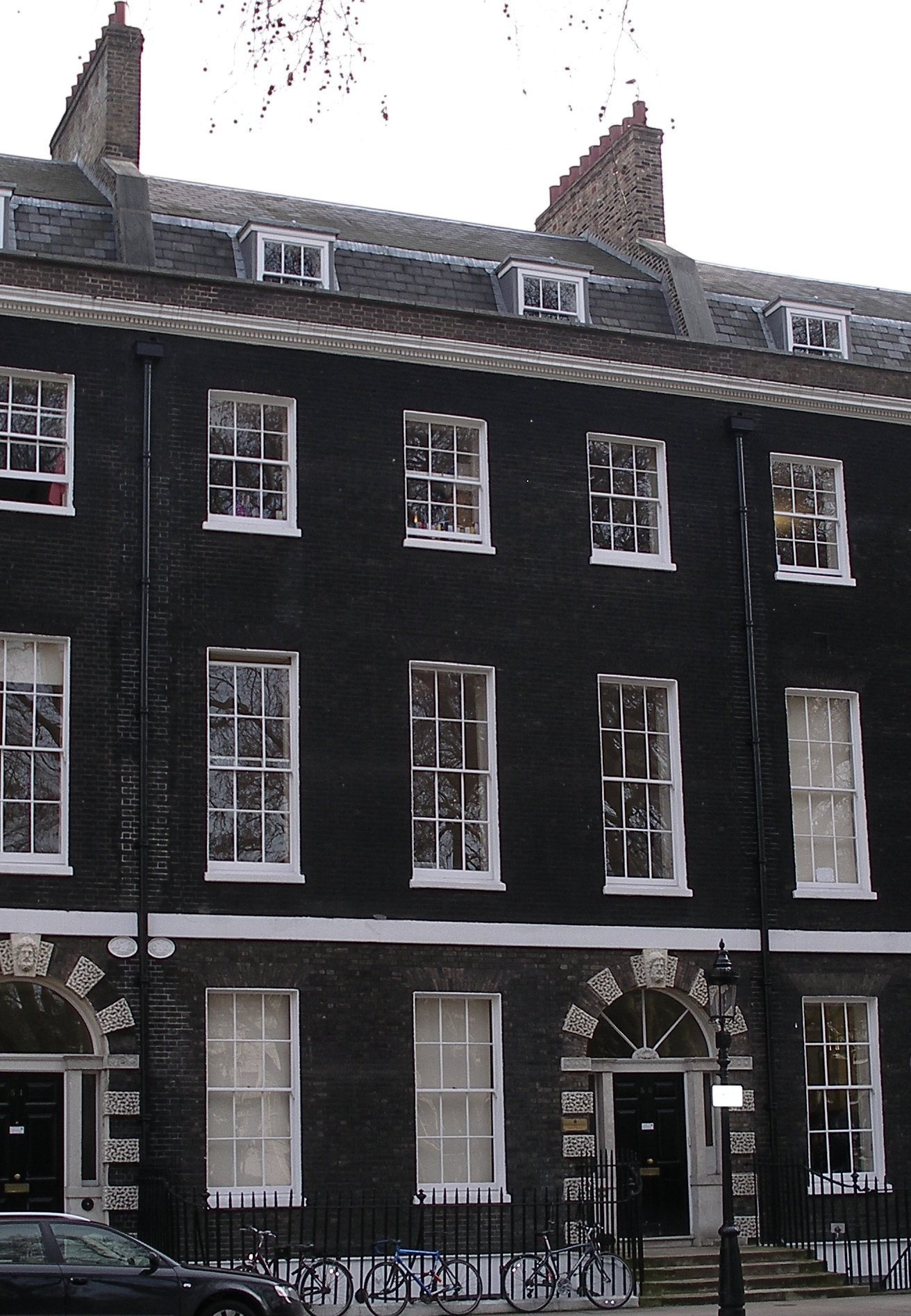
It is not just with regard to the foundation that the relationship between the two Societies has to be taken into account. Alongside the careful statements about division of intellectual labour at the foundation meeting were expressions of hope that both premises and books and slides could be shared, a joint library being established to the mutual benefit of the Societies and their members. The hope was realized, the Roman Society office being located at 19 Bloomsbury Square, WC1, to the south-east of the British Museum (fig. 3). The house was rented by the Hellenic Society, and the Roman Society library, as it was built up, was shelved with the Hellenic books. As the library grew, the need for larger premises became clear, and in 1924 the Societies moved to 50 Bedford Square, on the other side of the Museum (fig. 4); a twenty-five-year lease was taken out, but in fact this was to be the Societies' home for more than thirty years.
19 Bloomsbury Square, London WC1, the Society's home from 1910 to 1924. Here its books first joined those of its landlord the Hellenic Society to form the Joint Library. (Photo: Helen Cockle)

50 Bedford Square, London WC1, the Society's home, and that of the Joint Library, from 1924 to 1958. (Photo: Helen Cockle)

For several decades this cohabitation was crucial to the survival and prosperity of the Roman Society, which was to begin with too poor to stand on its own feet, and which was generously treated by its elder sibling. The arrangement was, however, also a recipe for conflict. Miss Taylor was blunt about this: ‘the co-operation of the secretaries of the two societies was not easily achieved’.Footnote 55 She referred to the correspondence between the two men, and indeed it is full of mutual recrimination. The sharing of telephone, typist and porter inevitably led to disputes, since all involved pro rata payments. A tragi-comic chart survives showing the amount of usage by the two Societies as viewed by one side.Footnote 56 In the 1930s, when the Society was putting its finances on a firmer footing and overcoming the problems inherited from World War I and the economic depression of the previous decade, the Hellenic Society began to protest that the scale of Roman contributions should be increased. An exchange of frank and confidential letters between the two Presidents, John Myres (Hellenic) and Hugh Last (Roman), in November 1935, indicates the degree of confusion and mutual ignorance which obtained.Footnote 57 The building and staffing costs were controlled by the Hellenic Society, the Roman Society making contributions to them which became disproportionately smaller as its membership grew. The Roman response to Hellenic demands for increased payments was, in effect, ‘no taxation without representation’. At first the Society was allowed to send non-voting representatives to meetings of the Hellenic Society's ‘standing committee’; later on their rights were formalized, and this led in 1949 to the setting up of the Joint Standing Committee on which the two Societies were equally represented.Footnote 58 By the outbreak of war in 1939, the two bodies had become equal partners, though the formula used to calculate funding meant that the younger Society continued to pay less than half of the total costs. Alongside this history of disharmony runs a history of harmony and goodwill which, curiously, has also created problems for both Societies. The concern for both bodies to act in concert has often led to mutual consultation to ensure that one Society did not make a commitment to which the other could not agree. This became an important element in the negotiations with the University of London over its library convergence policy in 2005–8.
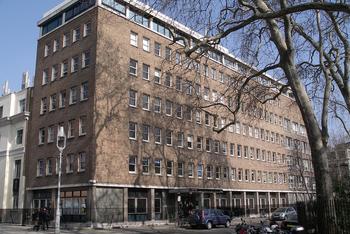
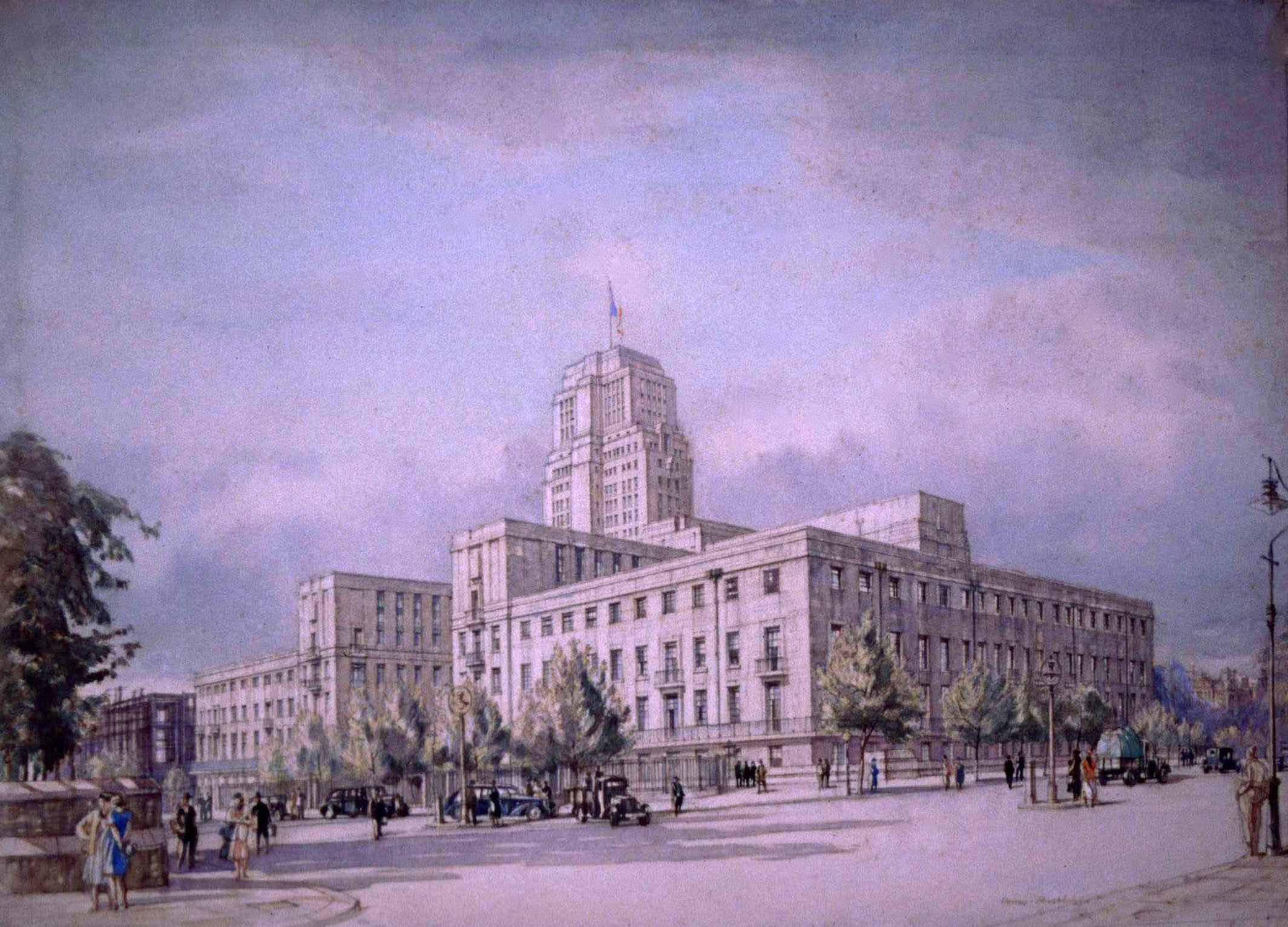
The need for continuity in handling those negotiations led to the prolongation of Alan Bowman's term as President (2001–5). The same action had been taken in 1951, when Ronald Syme's term of office was extended into a fourth year, and for a similar reason: to facilitate negotiations by both Societies with the University of London over the move from 50 Bedford Square, whose rent was about to increase dramatically on the expiry of the lease taken out in 1924, to a new university building at 31–34 Gordon Square (fig. 5).Footnote 59 Like the Society's earlier homes, this was near the British Museum, but it was even nearer to Senate House, the central University of London building in Malet Street, WC1 (fig. 9). After a series of short-term arrangements, the diplomacy of T. B. L. Webster secured a long-term solution: the Joint Library and the Societies were to be housed in the premises of a new Institute of Classical Studies established by the University.Footnote 60 The new Institute was to share the Gordon Square building with the University's Institute of Archaeology.Footnote 61 The Library's reference books were to be given to the Institute; the rest of the stock was to remain the Societies' property and continue to be available to their members for borrowing as before. The deal was concluded in 1953; the new building was not ready until 1958, but the University took over the rent of 50 Bedford Square and also paid for dilapidations. The new accommodation for Library and Societies was more spacious and more convenient than their old home had been: it included a seminar room, common room and terrace.Footnote 62 The Joint Library became part of a ‘combined’ library, while the new Institute provided a new, metropolitan focus for the national — and international — community of classical scholars. The expansion of the Joint Library Committee's remit from the managing of stock and loans to matters of strategy led in 1950 to the appointment of an Honorary Librarian. The post has been held by members of both Societies. Its first holder was the papyrologist Eric Turner, who was also the first Director of the Institute of Classical Studies. He was followed by the Latinist Otto Skutsch; three Hellenists then served (Robert Browning, Christopher Lowe, Pat Easterling), before the appointment of the current Honorary Librarian, Michael Crawford.
The Institute of Classical Studies, 31–34 Gordon Square, London WC1. The Society, the Hellenic Society and their Joint Library moved here in 1958. They and the Institute of Classical Studies occupied the top two floors, the rest of the building housing the Institute of Archaeology. (Photo: Helen Cockle)

VI HALFWAY
1960 was a good year in which to celebrate a half-century. Good relations had been firmly established with the Hellenic Society, and the Societies' Joint Library was running smoothly in its new home at Gordon Square. The effects of the abolition of Compulsory Latin at Oxbridge were yet to be felt, as were those of the price inflation following the oil crisis of the early 1970s. The Society was now recognized as an authoritative source of influence and advice on all things Roman.Footnote 63 The central event of the year was an exhibition of Roman art at Goldsmiths' Hall — so much for Roman art being, as Haverfield had called it in 1910, ‘a poor thing’.Footnote 64 The exhibition marked a turning point in the appreciation of Roman art; it included 140 original works of art, including sculptured reliefs from the recently-excavated Temple of Mithras in the City of London, and was accompanied by a catalogue prepared by Jocelyn Toynbee, Art in Roman Britain, with superb photographs by Otto Fein, photographer to the Warburg Institute. One visitor who went on to work on Romano-British art later remembered that: ‘It was a revelation to me when I visited the exhibition’.Footnote 65 There had, however, been some anxious moments: the applications to foundations for supporting grants were all refused, and only a presidential appeal to Oxford and Cambridge colleges brought in the necessary funds. The task of collecting exhibits from all over the country and bringing them to London was a considerable one. In the case of the Facilis tombstone in Colchester, the ever-resourceful Sheppard Frere secured the help of the city's engineers and superintended the removers with a firm hand; in London eight men hauled Facilis into position late on the very eve of the exhibition. In the end it was remarkably successful, attracting nearly 11,000 visitors during the four weeks it was open, while more than 3,000 schoolchildren came to hear the associated lectures (JRS 51 (1961), 289). The half-century volume of JRS included a special section with Miss Taylor's history of the Society (pp. 129–34) and six fifty-year surveys of work in different areas. In the survey on the historiography of the Roman Republic, A. H. McDonald rather charmingly referred to the eminent scholars whose work he was assessing as ‘our member X’ or ‘our honorary member Y’.
VII MISS TAYLOR
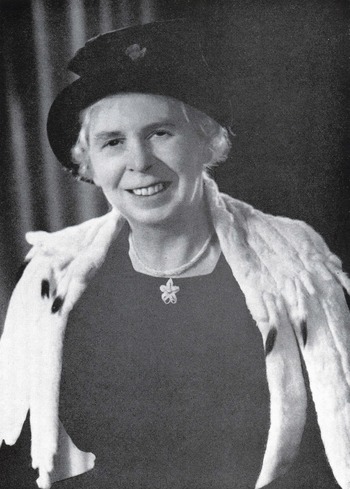
Miss Taylor's short history of the Society was followed by a tribute to her by the Editorial Committee, with a bibliography of her published work. This exchange of gifts between Secretary and Society reflects a relationship which deserves separate attention. Margerie Venables Taylor (fig. 7) was born in 1881, the daughter of a Flintshire antiquary, and educated at Somerville 1900–3.Footnote 66 She worked with Haverfield on the Victoria County History, acted as his secretary, and after his death in 1919 became the de facto librarian of the Haverfield Library in the Ashmolean Museum (the address given for her in JRS 50). She also acted as secretary to the administrators of the Haverfield Bequest.Footnote 67 The initiative for the joint Oxford meeting in September 1942, which became in effect the first Triennial meeting, was hers.Footnote 68 She was Secretary to the Society (and also Editor of JRS) from 1923 till her resignation in 1954, after which she concentrated on the Journal till her death in 1963.Footnote 69 By then she had uniquely served both as Honorary Secretary (1954–5, 1958–60) and as President (1955–8). Miss Taylor worked from Oxford, at home or in the Haverfield Library in the Ashmolean. Oswyn Murray recalls that, ‘She sat every day at the same desk in the second room of the Ashmolean next to another immovable object, Sir John Beazley: we graduate students knew to tiptoe through to Room 3 or stay like juniors in Room 1 — difficult for the Greek archaeologists because the Corpus Vasorum Antiquorum was housed in Room 2. They used to talk in loud voices, which could be heard in all three rooms'.Footnote 70 Only after her retirement in 1954 did the Society need to use office space in London (at first sharing the Hellenic Society's office). As a result, very little of her correspondence survives.Footnote 71 Luckily we have a vivid impression of Miss Taylor from Mary Bennett, who was appointed Honorary Secretary in 1960:
I … remember … nothing at all about the move to Gordon Square, except that I found the arrangements unintelligible, and that there seemed no good reason for trying to understand them since Miss Taylor so clearly had everything in her grip. (I think it was then that I first noticed the tone of pity for the comparative lack of business-like qualities in the Hellenic Society that she occasionally allowed to come into her voice.)Footnote 72
Her view of Council was that it should be large, so as to give a wide acquaintance with the Society's activities, but that there was no reason for it to be strong: it did not matter if attendance at its meetings was sporadic, indeed she expected that it would be. Certainly before I became Hon. Sec. I attended very irregularly & had only the dimmest understanding of how the wheels went round … There could never be any doubt about who made them go round.
Not that Miss Taylor was a battleaxe. Everyone was fond of her. She had certain affinities with Miss Marple — the soft white hair, pink cheeks & chiffon scarves — and Miss Marple's skill in handling the clever gentlemen. Like many of the women who created the girls' schools & women's colleges in the century before, she understood the value of high-powered masculine supporters, and made sure that her Hon. Treasurer was always a man who would carry weight in the world at large. This was all the more important in early days, because the Society worked on a shoestring. If an adequate Journal were to appear every year, every penny had to be watched. It was only after the Last & Atkinson bequests that there was any margin of manoeuvre. (The terms of the Last bequest reflect the central importance & real difficulty of safeguarding the scope and standards of the JRS at that time.)Footnote 73
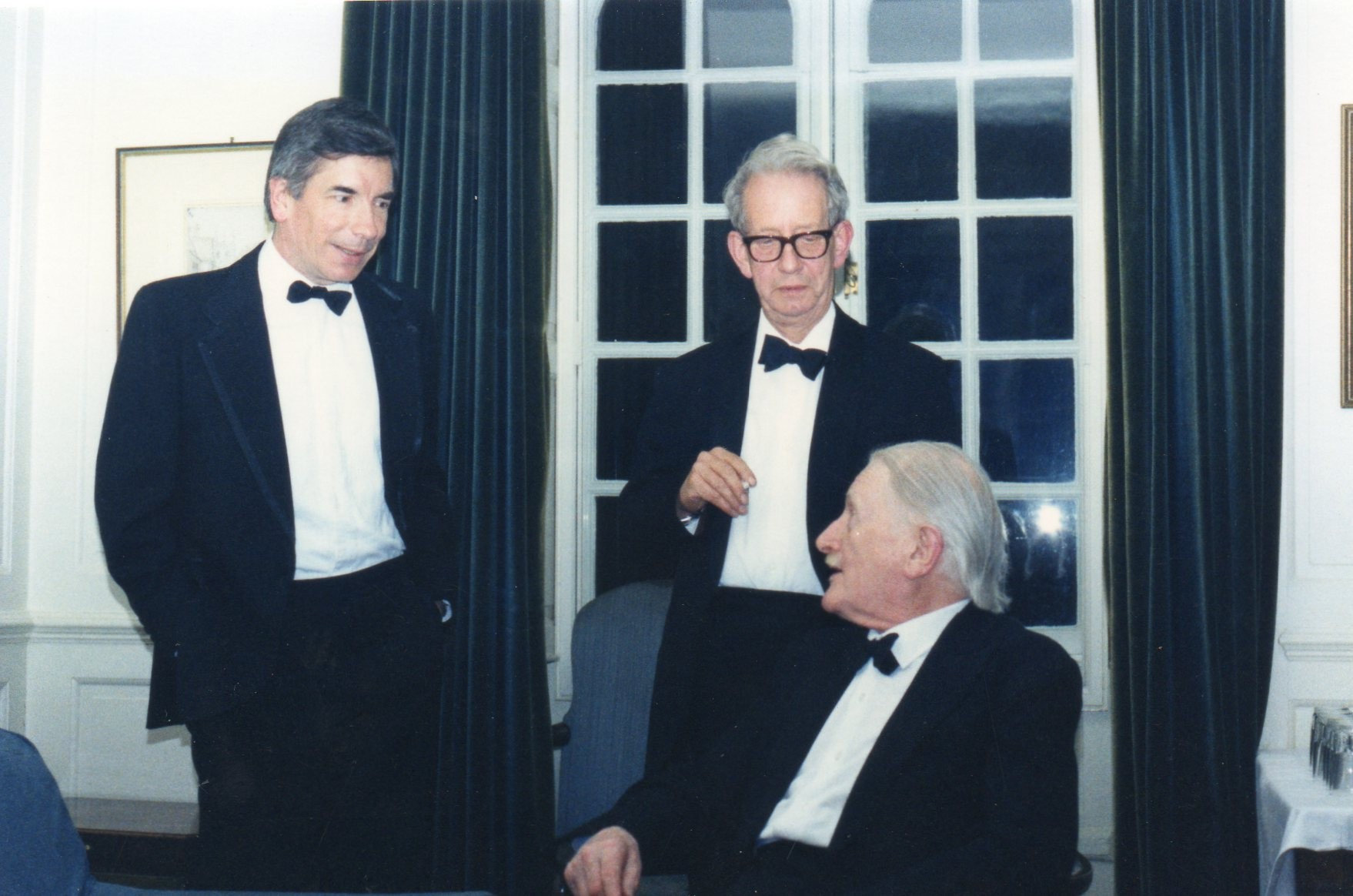
A trio of presidents in 1986: Sir Ronald Syme (1948–52), Peter Brunt (1980–3) and Fergus Millar (1989–92). (Photo: John Matthews)

Margerie Venables Taylor (1881–1963), Secretary 1923–54, Editor of JRS 1923–63, Honorary Secretary 1954–5 and 1958–60, President 1955–8. (JRS 50 (1960), opposite p. xi)

Miss Taylor's Marple-like image must have been reinforced by the small car in which she drove herself and others to a variety of excavations all over England. This was an Austin Seven, registration AJO 71, which she bought in 1935. Several years after her death, it was rescued from a Yorkshire scrap yard and used in the opening credits of a popular TV programme.Footnote 74
A comment by Mortimer Wheeler, in a review of JRS 50, provides an interesting pendant to Mary Bennett's vignette:
She has cloaked a tireless generosity under a veil of intolerance which has deceived only those who do not know her. In this dual quality she is, no doubt, in the direct line of succession to Haverfield himself. Of her single-minded devotion to the Society there is no manner of doubt; the distinguished list of Presidents whom she has controlled, and above all the remarkable line of fifty Journals for which she has been in great measure responsible, are her witness.Footnote 75
Wheeler's buccaneer eloquence needs to be taken with a pinch of salt (he had never met Haverfield himself). But the references to intolerance and control, however carefully deployed, hint at a relationship which was not without difficulties. The way in which Miss Taylor handled her ‘clever gentlemen’ can be glimpsed in the final paragraph of the Editorial Committee's tribute (JRS 50 (1960), xi):
The upsurge of feminine achievement that has been an outstanding feature of the last hundred years is now much taken for granted. Our Editor's generation was in the forefront of the movement, and her own zeal for a scholar's life was of a steady purpose not to be denied. … Not a few women who ardently advocated emancipation lost in the process the pleasanter characteristics of their sex, exchanging daintiness for vehemence and femininity for self-assertion. Miss Taylor (see Frontispiece) has left none of the charm of her generation behind: adding wisdom to charm, she has carried both with her to grace and dignify her ideals while ever revealing her keen and indomitable personality.Footnote 76
After surveying these almost superhuman achievements, it is comforting to gain a glimpse of human fallibility in the Council minutes of 8 May 1934, when ‘The Secretary confessed that the Minute Book … had been left by her that morning in a telephone box from whence [it] had been removed by some unknown person’.Footnote 77
VIII BRITANNIA
There had clearly been tensions between the supporters of excavation in Britain and those of the analysis of the Roman world more generally. Mary Bennett remembered that:
… during Miss Taylor's lifetime the lid was firmly kept on Roman Britain. The orthodoxy was that those who enjoyed a good dig should be led, via the archaeological survey in the JRS, to read further and come to see their subject in a wider context, while Miss Taylor herself did not admit the possibility of diverting energies or funds from her own cherished Journal. This position became increasingly hard to hold as archaeological interest spread and Sheppard Frere, ignoring red tape & proper channels, revealed possible sources of finance.Footnote 78
After Miss Taylor's death in 1963, the ‘Britons’ seem to have increased pressure for the recognition of their field by the Society. In November 1966, the then President, Arnaldo Momigliano, reported to the Hon. Secretary Mary Bennett that a sub-committee had been set up to consider starting a ‘second journal of Roman Britain’, and commented:
The fact that the committee has been set up so easily does not of course mean that there will not be trouble in the future. I gather that what Dr Webster would like is to have another Society within the Society and a Journal which would not only include Roman Britain but also all the provinces. I suppose he would leave us Rome and part of Italy excluding Gallia Cisalpina and Sicily. This obviously will not do.Footnote 79
Though (or perhaps because) the tensions between the ‘Britons’ and the ‘Romans’ were clearly potentially damaging to the Society, there has been almost no later published reference to them. They were, however, hinted at in the announcement of Momigliano's death in the 1987 Annual Report, which remembered that, ‘He did much to ensure that the Society's archaeological and historical interests remained together at a time when it seemed that they might diverge’.Footnote 80 The anti-Britannia faction assembled a variety of arguments, even pointing out that the Hugh Last bequest specifically excluded Roman Britain from its remit, but in the event the pro-Britannia party, led by Sheppard Frere (fig. 8), was successful in gaining approval for the new journal. It was to have been called Britannia Romana, but the title was criticized as pleonastic by Oswyn Murray, who pointed out that ‘Britannia’ was good enough for William Camden (Britannia, 1586). Frere countered with John Horsley's Britannia Romana (1732), but the simpler title won the day.Footnote 81 The first issue of the journal appeared in 1970, joining the continental ‘provincial’ journals Germania (1918) and Gallia (1943).
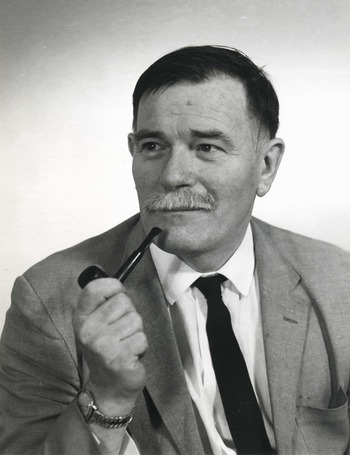
Sheppard Frere, President 1983–6, Editor of Britannia 1970–80. (Photo: Bartle Frere)

The central figure in the creation of Britannia, as this suggests, was Sheppard Frere, who had succeeded Ian Richmond as Professor of the Archaeology of the Roman Empire at Oxford after Richmond's death in 1965. As Mary Bennett's memoir, quoted above, indicates, Frere was adept at obtaining financial support outside conventional channels. He went on to edit not only the new journal, but also the first ten Britannia monographs. The first of these, David Neal's Roman Mosaics in Britain, appeared in 1981; in all twenty-four monographs have appeared to date. The parent journal followed suit, a series of JRS monographs beginning in 1982 (eleven volumes have now appeared). This series was primed by a loan from the Atkinson Fund; individual volumes of Britannia monographs have been supported by outside bodies, including English Heritage, Cadw and Historic Scotland. In 1989, on the initiative of Fergus Millar, a Publications Secretary was appointed. Lynn Pitts, who had previously worked on Britannia, now dealt with JRS as well as managing the monograph series; she is still in post.
In 1988 Britannia and JRS were joined by the Journal of Roman Archaeology, founded by John Humphrey, and published by him in the USA. This was an entirely independent journal, but was welcomed by the Society's Editorial Committee (one of whose members, John Wilkes, served on the JRA editorial board). From its inception, JRA encouraged the discussion of newer approaches to Roman archaeology which were relatively under-represented in other journals in the field. It has since taken on the publication of the papers from some of the biennial conferences on Roman archaeology sponsored by the Society, the eighth of which (co-sponsored and held in the USA) was held in 2009.Footnote 82 Its editor John Humphrey has also, via JRA, sponsored a number of sessions at the Roman Archaeology Conferences, of which he was an early supporter.
Britannia itself evolved a mixed format: articles and notes, and the informative ‘Roman Britain in [year]’ section, which carries information on sites explored and inscriptions. Since 2004, when a colour photograph of the Staffordshire Moorlands Pan appeared, the journal has also listed finds reported under the Portable Antiquities Scheme. Important finds in London (the amphitheatre in 1997, the water-lifting device in 2006) and documents from Vindolanda (1990 and 1996) have been given initial reports in advance of full publication. Britannia is now firmly established as the national journal for its period, positioned between Proceedings of the Prehistoric Society and Medieval Archaeology.
The status of both journals has been recognized in ways which have benefited the Society financially. From 1963 a contract with Kraus Reprint Corporation provided a considerable income, though it declined as libraries completed their sets of JRS.Footnote 83 In 2003 the US-based online archive system JSTOR acknowledged the journals’ status by inviting the Society to add them both to its initial collection, access generating a fee income. The ‘moving wall’ imposed initially allowed access only to issues five or more years old, but this was soon reduced to three years. A contract with Ingenta allows subscription access to recent issues. At present, members receive hard copy of the journals, online access being available for additional payment; student members have online access only.Footnote 84 From 2010 both journals will be produced by Cambridge University Press, who will manage both hard copy and online distribution.Footnote 85 The new arrangement is likely to promote and protect sales through bundling (institutional subscriptions to groups of journals) and consortia (subscriptions shared by groups of institutions).
IX FINANCE AND MEMBERSHIP
For its first twenty-five years the Society's finances depended entirely on membership subscriptions (the entrance fees planned to be introduced in 1912 were never imposed). Membership had stood at a discouraging 223 in October 1910, and a year later had risen only to 297; but in March 1911 it stood at 390, and a year later at 573. In 1913 Council considered placing advertisements because the rate of increase was so poor. World War I brought severe problems: some members were killed and others cancelled subscriptions, as did several foreign libraries. After the War came steep rises in printing costs, and then economic depression. By 1926, however, membership had almost returned to ‘the high water mark of 1913’; and in the following year the figure was 536 (at which point the Hellenic Society had 1,346 members). It did not help that JRS had been printed in numbers which assumed a continuing growth in membership: in May 1921, Council was told that the printers had in stock 556 bound volumes and 4,625 volumes in sheets.Footnote 86 A vicious circle operated: more could not be offered to members unless more members joined. Nor could the subscription rate be raised above that charged by the Hellenic Society, since those who wanted access to the Joint Library would simply switch allegiance. It must have been galling that the older body was able to demand an entrance fee in addition to an annual subscription, yet had over twice as many members as the Roman Society. But as Miss Taylor commented in her half-century historical sketch in 1960, ‘the sister society … appealed to a wider and better-to-do and even somewhat fashionable public’ (p. 131). In 1950 the subscription was raised from a guinea (the rate set in 1910!) to two pounds. This applied only to new members (an indication of the nervousness felt about any increase), and in 1956 more than half the members were still paying at the old rate; though Miss Taylor calculated that a copy of JRS cost more than a guinea to produce.
In 1936 the incalculable happened: an anonymous donation of £200 was made, intended to enlarge the Journal, a further £50 a year being promised if the donor lived that long. After the War donations became more common. In 1955 Ivan Margary gave £1,000 and the Nuffield Foundation a subvention of £400, both for JRS. This was followed in 1958 by a legacy of £500 from Hugh Last in memory of his teacher William Warde Fowler. The Nuffield funding ended in the same year, but in 1961 Margary gave another £10,000, and the British Academy (in part using Nuffield funds) supported the Journal from the 1960s to the early 1990s. In 1974 a large legacy was received from Stefan Weinstock, who asked for the fund set up to be named after Hugh Last (thus continuing the tradition of pietas begun by Last himself). Later legacies included the Atkinson bequest of 1974 (£55,000) and the Scott and Toynbee bequests of the late 1980s, which totalled over £60,000. These windfalls were used to publish enlarged volumes of JRS and to postpone subscription rises. The oil crisis of the early 1970s brought savage rises in printing costs, which brought the presses of both the ancient universities within sight of failure; without the bequests the Society would have been in serious trouble. In 1981 the Funds Committee was set up, and since then has awarded grants from the combined interest on the Hugh Last (1976) and Donald Atkinson (1981) Funds. These grants, which in some years have totalled c. £15,000, have provided an important source of support, in a period when state funding has become increasingly hard to obtain. In 2007, seventeen grants were awarded to support summer schools, conferences, excavations and journals. These subventions were made possible by the growth in the Society's financial resources: during Colin Leach's term of office as Treasurer, thanks to well-timed investment in a depressed market, its resources were almost doubled in a decade (1981–90).Footnote 87 Its total financial assets now stand at £1.25 million.
In the 1920s, the Society had followed the lead of the Hellenic Society in creating a reduced level of subscription for Student Associates.Footnote 88 The scheme arose in part in response to the report of the Prime Minister's Committee on Classics (1921), which had recommended attempts at outreach, and was linked to the work of a ‘Propaganda’ or ‘Popularisation’ Committee set up under the chairmanship of Norman Baynes to publicize the work of the Society beyond scholarly circles. But it was also adopted as a way of increasing the membership; and of course the hope was that student associates would eventually become full members. Numbers were at first very small: at the end of 1930, the membership consisted of 524 ordinary, 70 life, and 31 student members (204 libraries subscribed to JRS, making an overall total of 962). Student numbers rose into the 40s only after World War II, but stood at over 100 until the 1990s; they were buoyed by the expansion of eligibility beyond the Commonwealth in 1991, an initiative owed to Helen Cockle. The current individual membership stands at nearly 2,500, while institutional membership is over 1,100. With a membership which is now larger than that of its Hellenic elder sibling, the Society is well equipped to face its second century.
Since the mid-1980s the Society has been involved in the encouragement of school Classics, and together with the Hellenic Society and the Classical Association has developed links with the Joint Association of Classical Teachers (JACT, founded 1962). The Schools Committee, set up in 1986, began by funding the purchase of books, mainly for use in state-maintained schools where financial pressures were increasing, especially after the Thatcher government in 1988 introduced a ‘national curriculum’ in which Classics had no explicit place. In 2007, thirty schools were awarded grants for the purchase of textbooks. Among the activities encouraged by the Committee has been the participation of schoolchildren in excavations. This has been supported by the award of bursaries for sixth-formers, some in association with the Roman Research Trust. Another indication of the Society's concern for those working at the chalk face was the decision made in 1988 that Council should include at least six teachers among its members. The shrinking numbers of candidates made this impossible to enforce, but the agenda now contains a standard item covering educational matters.
X THE INSTITUTE OF CLASSICAL STUDIES
The Institute of Classical Studies set up in 1953 was a complicated hybrid based on trust and on perceived mutual benefits. Such an arrangement can easily seem secure while those elements remain in place. In a lecture given in 1999, John Barron welcomed the recent move of the Institute from Gordon Square to Senate House (fig. 9), which ‘promised … a secure and independent future’.Footnote 89 From 2005, however, the vagaries of governmental policy and funding, and the resulting institutional changes within the University of London, posed a serious threat to what half a century of mutual interest and goodwill had assembled. The University of London School of Advanced Study had been established in 1994 to include the Institute of Classical Studies and several other Institutes; this had prompted a reassessment of library provision, and a ‘convergence’ policy was adopted by the University which made little, if any, allowance for the unique status of the Combined Library as an institution whose holdings were largely owned by two registered charities with obligations to their members. At the end of 2005, extensive building work in Senate House obliged the Library and the Society's office to move into temporary accommodation elsewhere in the building. In the summer of 2009, both Library and office returned to their previous location, albeit within a reconfigured space layout; and it seems that the future of the Joint Library is now once again secure. Any alliance with another body brings risks with it, as has already been seen in the case of the Hellenic Society, though the tensions arising from that alliance, as described above, were resolved in the 1940s.Footnote 90 The sometimes turbulent history of relations with the University of London since 2005 has created difficulties for the Society, and especially for office and library staff obliged to work in temporary accommodation. The move back to the South Block of Senate House and the signing in 2009 of a new agreement with the University, however, give ground for hope that the Societies and their library will be able to return to normal running in the Roman Society's centenary year.
‘Senate House in 1943’ by Sir Henry Rushbury RA. The Society's office and the Joint Library have been housed in Senate House, the headquarters of the University of London, since 1997. (Photo © Richard Simpson; published by kind permission of the owner of the original: all rights reserved)

XI MEETINGS AND CONFERENCES
The Society interacts with its members largely through the journals, the library, and meetings and conferences. Of these the last offer the greatest opportunities for two-way communication. Annual meetings and lectures have been held since the inaugural meeting in 1911. In 1995, for the first time, the AGM was held outside London, in Edinburgh. Meetings followed in Cardiff (1996: with a visit to Caerleon and the uninvited but welcome appearance of the legio Secunda Augusta in full kit) and Belfast (1997); but the additional cost and difficulty in mounting regional meetings, and in some cases a disappointing turnout, led to the ending of the experiment.Footnote 91
The Triennial conferences, organized in collaboration with other classical bodies, have run since 1942. The original meeting (not of course called a Triennial) was expected to attract up to 100 people and ended up with over 500 applying and more than 400 attending. It was important as a pioneering effort, organized under difficult circumstances, which brought together members of several classical bodies.Footnote 92 It was not only the first conference organized by the Roman Society, but also the first classical conference to be held in Britain. More recently, the establishment of an Archaeology Committee, on the initiative of Michael Fulford, has led to the successful biennial Roman Archaeology Conference series, mentioned above. The first meeting was held in Reading in 1995 and was very successful; together with the AGM of that year, held in Edinburgh, it represented a determined attempt to reach out to sections of the Society's membership which some thought had previously been marginalized. The eighth in the series (2009), held at the University of Michigan, can be seen as a continuation of this process of expansive inclusion, in this case at an international level.Footnote 93
As well as holding its own meetings, the Society has since the 1940s, together with the Hellenic Society, supported lectures given by members of a panel to local branches of the Classical Association; the cost of lecturers' travel being shared equally with the branches.Footnote 94 Organized visits to Silchester and Bignor, among other sites, have helped to cater for the large proportion of the Society's membership who are not academics, but keen amateurs of Roman Britain. Of the current individual membership of over 2,000, probably no more than 400 are academics. The grants given by the Schools Committee, already mentioned, have also enabled the Society to support a wider range of students, while the Committee's involvement in curriculum discussion, often in collaboration with JACT, has given it a voice in the planning of what is taught in schools.
XII LOOKING FORWARD
In 1992 a Review Committee was established with a very wide remit: ‘to review the activities of the Society and report’. The Committee sent a questionnaire to members, of whom 629, nearly a third, returned them (a very high response rate for postal questionnaires). The journals and the Library were singled out for appreciation by respondents, the importance of the Library being emphasized by both academics and amateur archaeologists. Among the Committee's recommendations was that the Archaeology Committee and conferences mentioned above should be established. The setting up of an Advisory Committee was also proposed — in effect, making the review process permanent. Both proposals were acted on, the Advisory Committee, like its predecessor, being chaired by Elaine Matthews.
A notable feature of the late 1980s and 1990s was the introduction of computer technology. The Society's office took delivery of its first computer after a recommendation from Helen Cockle was accepted by Council in 1989; Lynn Pitts was given a computer in 1994 to streamline the production of journals and monographs.Footnote 95 In the late 1980s, the Joint Library had PCs installed for catalogue searching, and later on, for the use of online bibliographic and other databases such as Perseus. A vigorous campaign in the early 1990s by the then Librarian, Naomi Alvarez, resulted in the securing of a substantial HEFCE grant of £120,000 for the retroconversion of the catalogue. This took place in 1995–6, and was managed by Naomi Alvarez's assistant Colin Annis, who was then succeeding her as Librarian.Footnote 96 More mundane technology also appeared: for example, turnstiles and library cards early in 1993. Early on in this process, it was proposed to set aside an area of the Library for computer use; but by 1999, it had become ubiquitous, so that a computer-free area was established instead. In 2001 the Library took out its first subscription to an e-journal, Ancient Narrative. Throughout its involvement with computer technology, the Society has been helped by John Dardis, originally in his capacity as a staff member in the University of London Computing Centre, and after his retirement, as a consultant.
XIII CONCLUSIONS
Looking back over a century, we can identify some general themes in the history of the Roman Society. The dialectic of separate identity and relationship between Greece and Rome has been reflected in the history of the Societies and Schools founded to study them. In the ancient world, these two worlds were separate yet at many points intertwined; the same has been true of the institutions founded to study them. The mixture of cordiality and suspicion in the relationship with the Hellenic Society until at least mid-century was firmly rooted in shared premises, staff and library, and also in the fond but conflicted links between a richer elder and a poorer younger sibling. The financial imbalance was soon to be rectified, not least by a number of generous donations and bequests from Last, Atkinson, Weinstock, Margary, and Toynbee. These made possible an expanded publishing programme, while delaying rises in subscription rates, and helped the Society survive the accelerating inflation of the 1970s. As it faces its second century, the struggling infant of the 1920s has a larger membership and greater financial resources than its elder sibling.
The dialectic of Roman identity and relationship with the Hellenic Society was in the 1950s resolved at the institutional level. We have seen that the vision of an Institute of Classical Studies was held at least as early as 1909 by D. G. Hogarth, who from his vantage point in Athens saw how Classical studies were organized there and in Rome by the French and German ‘imperial institutes’. The British ‘late state’ might lag behind these comprehensive schemes; its servants might be temperamentally unsuited to copying their bureaucratic and hierarchical ways; but it could learn from them.
Other themes have to do with the variable and contested definitions of ‘Roman Studies’. In its early years the Society tried to cater for students of both Roman Britain and the Empire more generally; its financial difficulties prevented it from being exclusive, though as we have seen Miss Taylor was determined to ‘keep the lid on Roman Britain’. Another source of potential tension was the relationship between archaeology and history. The centre of gravity of the Society lay in the former in the days of Haverfield, Macdonald and Collingwood, but with Last, Syme and Momigliano it moved to the latter. The late 1960s witnessed the beginnings of an archaeological breakaway movement, headed off in effect by the foundation of Britannia.Footnote 97 In its first half-century, the need to co-exist happily with other classical bodies led to the virtual exclusion of literary topics. The situation is now much more relaxed, and the boundary maintenance both between societies and between fields of study has been eased by collaboration and interdisciplinary work.
A similar relaxation and expansion can be seen in the Society's relations with different groups, both within and without its membership. Since at least the later 1980s, attempts have been made to appeal to, and assist, those outside the golden triangle of Oxford, Cambridge and London; amateur enthusiasts for Roman Britain; and schoolchildren and their teachers. In addition the Society is represented on a wide range of other bodies, including the Roman Research Trust, the Colchester Archaeological Trust, and the Joint Association of Classical Teachers. It was also a founder member of the Council for British Archaeology, whose establishment in 1943 in fact stemmed from a proposal made by the Society.
The history of learned societies often revolves around the long-term commitment of individuals.Footnote 98 That of the Roman Society is no exception, but the commitment of Margerie Taylor remains unparalleled. Not only did she reign as Secretary and as Editor of JRS for several decades; she also crossed the conventional boundary between the male academic and his female secretary to become a one-woman administrative and editorial powerhouse, finally becoming the Society's first female president. It should be added, however, that the Society has had a fair sprinkling of female officers, presidents and JRS editors among them.Footnote 99 The nearest Hellenic Society equivalent to Miss Taylor was John Baker-Penoyre, Secretary and Librarian 1904–36;Footnote 100 she herself was soon followed by Patricia Gilbert, whose personal warmth made the life of several Presidents easier for nearly thirty years (1960–89).Footnote 101 It has not been possible to mention in this essay all those whose dedicated work has enabled the Society to survive in hard times and to flourish in good; but it needs to be remembered they have offered commitment as well as efficiency. George Macmillan, Hon. Secretary of the Hellenic Society 1879–1919, was in 1922 given honorary life membership of that society; in his report for that year, he declared that ‘The Society is not a paying proposition; it is a mission, and should be served as such’.Footnote 102 If qualification is called for, it might be that the Roman Society has become a ‘paying proposition’ whose profits are used to support its mission.
The Society's Memorandum and Articles of Association listed aims which have already been referred to: to promote the study of Rome by publishing a journal, establishing a library, and supporting the British School at Rome. The Library has appeared at several points in this account, but its nature and its centrality to the Society's work need to be emphasized here. Both books and slides have always been borrowable by members, and this has been crucial in supporting members who live beyond easy reach of libraries, or who do not belong to academic institutions. In this respect the nearest relation of the Joint Library is perhaps the London Library, founded in 1840 by a group of scholars who were incensed by the British Museum Library's refusal to loan books. The Combined Library of the Institute of Classical Studies now consists of three roughly equal sections: one-third of the holdings belong to the University of London and the remainder to the two Societies. The Library contains about 125,000 volumes, and is generally regarded as one of the world's leading classical libraries. Its value to scholars is enhanced by its staff of specialized librarians, and also by the presence of ongoing research projects and of the offices of classical bodies, including those of both Societies. It is in fact the heart of a scholarly community which has its location in London, but with members and links all over the world.
In a survey of the state of Roman archaeology published in 2004, Greg Woolf compared the relatively integrated and self-critical community at work on the study of Greek civilization with the sprawling, more specialized and rather less reflexive discipline of Roman imperial archaeology.Footnote 103 The Roman Society, its library and its journals might be described as a thriving provincial capital in this academic empire; but they are also a centre for the activities and enthusiasm of non-academics fascinated by Roman civilization. Professionals and amateurs (‘professors and patriots’, in Haverfield's words), they all share a concern for the promotion of Roman studies.
ACKNOWLEDGEMENTS
My thanks for help of different kinds go to Elizabeth Boardman, Richard Brewer, Richella Doyle, Philip Freeman, Fiona Haarer, John Humphrey, Elaine Matthews, Lorraine McEwan, Lynn Pitts, Simon Price, Lyn Rodley, Alison Sharrock, Graham Whitaker and John Wilkes. It was a pleasure to be able to interview Mary Bennett, John Crook and Sheppard Frere. My greatest debt is to Helen Cockle, who as well as being the only begetter of this essay, has been constantly helpful and constructively critical throughout its researching and writing. Her infectious gaiety, which will be familiar to many members of the Society, has added a sense of fun to the work of research and writing.
fig. 1 is reproduced by permission of the Secretary to the Delegates of Oxford University Press; FigS 3–5 by permission of Helen Cockle; fig. 6 by permission of John Matthews; fig. 8 by permission of Sheppard Frere.
APPENDIX: OFFICERS OF THE ROMAN SOCIETY, 1910–2010
Presidents
1911 Francis J. Haverfield
1916 James S. Reid
1921 George Macdonald
1926 Henry Stuart-Jones
1929 Frank E. Adcock
1931 Norman H. Baynes
1934 Hugh M. Last
1937 H. Idris Bell
1943 Martin P. Charlesworth
1948 Ronald Syme
1952 A. Hugh M. Jones
1955 Margerie V. Taylor
1958 Ian A. Richmond
1961 Frank A. Walbank
1965 Arnaldo D. Momigliano
1968 J. P. V. Dacre Balsdon
1971 Alexander H. McDonald
1974 A. Nicholas Sherwin-White
1977 A. Leo F. Rivet
1980 Peter A. Brunt
1983 Sheppard S. Frere
1986 Joyce M. Reynolds
1989 Fergus G. B. Millar
1992 T. Peter Wiseman
1995 Averil M. Cameron
1998 John S. Richardson
2001 Alan K. Bowman
2005 Michael G. Fulford
2008 Andrew M. Burnett
Secretaries
1910 George D. Hardinge-Tyler
1919 A. Margaret Ramsay
1920 Robert Gardner
1923 Margerie V. Taylor
1954 Naomi Myers (Assistant Secretary)
1955 Helen Waugh
1960 Patricia Gilbert
1989 Helen M. Cockle
2007 Fiona K. Haarer
Honorary Secretaries
1954–5, 1958–60 Margerie V. Taylor
1960 Mary L. S. Bennett
1985 Elizabeth D. Rawson
1989 Elaine Matthews
Editors of the Journal of Roman Studies
1911 George D. Hardinge-Tyler
1919 George F. Hill
1920 Robert Gardner
1923 Margerie V. Taylor
1964 Frank A. Lepper
1970 Martin W. Frederiksen
1975 Fergus G. B. Millar
1980 Michael H. Crawford
1985 Averil M. Cameron
1991 Andrew F. Wallace-Hadrill
1995 Simon R. F. Price
1999 Martin D. Goodman
2003 Alison R. Sharrock
2008 Greg D. Woolf
Editors of Britannia
1970 Sheppard S. Frere
1980 John J. Wilkes
1985 Malcolm Todd
1989 John Peter Wild
1994 Michael G. Fulford
1999 Lawrence J. F. Keppie
2004 A. Simon Esmonde Cleary
2009 Richard J. Brewer
Treasurers
1910 Douglas W. Freshfield
1920 Sir John N. Barran
1929 Robert M. Holland-Martin
1944 Sir Arthur C. McWatters
1948–9 Sir Lancelot Graham (deputy)
1954 Sir Maurice J. Dean
1956 Sir Nicolas de Villiers
1958 Sir Douglas Veale
1964 Sir A. Hilton Poynton
1976 Paul R. Odgers
1981 J. H. Colin Leach
1990 Peter R. S. Earl
1991 Graham E. A. Kentfield