Introduction
According to the World Health Organization, major depressive disorder is the second largest healthcare problem worldwide in terms of illness-induced disability (Levav & Rutz, Reference Levav and Rutz2002). Major depressive disorder afflicts an estimated 17% of individuals during their lifetime, at tremendous cost to the individual and society (Greenberg et al. Reference Greenberg, Stiglin, Finkelstein and Berndt1993; Kessler et al. Reference Kessler, McGnagle, Zhao, Nelson, Hughes, Eshleman, Wittchen and Kendler1994). Roughly a third of all depressive disorders take a chronic course (Spijker et al. Reference Spijker, de Graaf, Bijl, Beekman, Ormel and Nolen2002; Arnow & Constantino, Reference Arnow and Constantino2003). Compared with other medical disorders, depressive illness causes the most significant deterioration in individual quality of life (Bech, Reference Bech1999). Approximately 15% of depressive patients will commit suicide over a 10- to 20-year period (Fawcett, Reference Fawcett1993).
Antidepressant medication remains the mainstay in the treatment of depression (Cipriani et al. Reference Cipriani, Santilli, Furukawa, Signoretti, Nakagawa, McGuire, Churchill and Barbui2009). However, meta-analyses have shown that the new antidepressants only obtain beneficial effect in severely depressed patients, and that this effect seems to be clinically small (Kirsch et al. Reference Kirsch, Deacon, Huedo-Medina, Scoboria, Moore and Johnson2008; Turner et al. Reference Turner, Matthews, Linardatos, Tell and Rosenthal2008). Continuous use of antidepressants is, however, known to decrease the risk of relapse (Geddes et al. Reference Geddes, Carney, Davies, Furukawa, Kupfer, Frank and Goodwin2003). The therapeutic benefits of antidepressants seem to be limited and this raises the question of whether there are other effective treatments for this serious illness.
Cognitive therapy (or cognitive-behavioural therapy) and interpersonal psychotherapy are alternative interventions for major depressive disorder, but we did not identify any systematic reviews or meta-analyses using The Cochrane Collaboration methodology examining the effect of cognitive therapy versus interpersonal psychotherapy.
Method
We embarked on a systematic review using The Cochrane Collaboration methodology (Higgins & Green, Reference Higgins and Green2008) involving meta-analyses (Higgins & Green, Reference Higgins and Green2008) and trial sequential analyses (Brok et al. Reference Brok, Thorlund, Gluud and Wetterslev2008; Wetterslev et al. Reference Wetterslev, Thorlund, Brok and Gluud2008; Thorlund et al. Reference Thorlund, Devereaux, Wetterslev, Guyatt, Ioannidis, Thabane, Gluud, Als-Nielsen and Gluud2009) to assess the effects of cognitive therapy versus interpersonal psychotherapy in the treatment of major depressive disorder (Higgins & Green, Reference Higgins and Green2008). We used assessment of bias risk to reduce the risk of systematic errors (bias) (Higgins & Green, Reference Higgins and Green2008), and trial sequential analysis to reduce the risk of random errors (play of chance) (Brok et al. Reference Brok, Thorlund, Gluud and Wetterslev2008; Wetterslev et al. Reference Wetterslev, Thorlund, Brok and Gluud2008).
For details regarding the methodology, please consult our protocol published on our website (http://www.ctu.dk) in February 2010 before we began the systematic literature searches in all relevant databases, data extraction and analyses (Jakobsen et al. Reference Jakobsen, Lindschou Hansen, Simonsen and Simonsen2010).
In short, we included all randomized clinical trials comparing the effect of cognitive therapy versus interpersonal psychotherapy – irrespective of language, publication status, publication year and publication type. We searched in The Cochrane Library's CENTRAL, MEDLINE via PubMed, EMBASE, Psychlit, PsycInfo, and Science Citation Index Expanded. The time-frame for the search was all trials published before August 2010.
To be included, participants had to be aged older than 17 years with a primary diagnosis of major depressive disorder. Trials were only included if the diagnosis of depression was based on one of the standardized criteria, such as International Statistical Classification of Diseases, tenth revision (ICD-10; WHO, 1992), Diagnostic and Statistical Manual of Mental Disorders, 3rd edition (DSM-III; APA, 1980), 3rd edition revised (DSM-III-R; APA, 1987), or 4th edition (DSM-IV; APA, 1994). Co-morbidity with other psychiatric diagnoses was not an exclusion criterion.
The following types of trials were excluded: (a) trials focusing on depressed participants with co-morbid serious somatic illness, e.g. myocardial infarction, multiple sclerosis, cerebral stroke, cancer, etc.; (b) trials focusing on ‘late life’ depression or depression in the elderly, most often participants over 65 years; (c) trials focusing on pregnancy-related depression, e.g. postpartum depression, postnatal depression, etc.; and (d) trials focusing on depression related to drug or alcohol abuse.
These exclusions were conducted because we expect participants in such trials to respond differently to standardized psychotherapy than other depressed patients, and these types of depressed patients are traditionally examined in separate trials (Howard et al. Reference Howard, Battle, Pearlstein and Rosene-Montella2006; Wilkins et al. Reference Wilkins, Mathews and Sheline2009; Davidson et al. Reference Davidson, Rieckmann, Clemow, Schwartz, Shimbo, Medina, Albanese, Kronish, Hegel and Burg2010; Sofuoglu et al. Reference Sofuoglu, Sugarman and Carroll2010).
Interventions
Cognitive therapy
Cognitive therapy (or cognitive behavioural therapy) is a collective term for a range of different interventions, and it is difficult to find a simple definition that adequately describes this psychotherapeutic method. However, we considered the following criteria from Beck et al. (Reference Beck, Rush, Shaw and Emery1979) as being necessary for the intervention to be classified as ‘cognitive therapy’ (Beck et al. Reference Beck, Rush, Shaw and Emery1979): (1) that the intervention sought to link thoughts, feelings, and behaviour – and related these to the depressive symptoms; (2) that the intervention sought to record and correct irrational thoughts or behavioural patterns, and related these to the depressive symptoms; (3) that the intervention sought to teach the patient alternative methods of thinking or behaving, and related these to the depressive symptoms; (4) that the intervention was undertaken face-to-face either individually or in a group.
Interpersonal psychotherapy
Interpersonal psychotherapy is a structured form of psychotherapy that addresses interpersonal issues in depression (Cornes & Frank, Reference Cornes and Frank1994; Weissman et al. Reference Weissman, Markowitz and Klerman2000; Levenson et al. Reference Levenson, Butler, Powers and Beitman2002; Cutler et al. Reference Cutler, Goldyne, Markowitz, Devlin and Glick2004). We selected the following criteria in order for the intervention to be classified as ‘interpersonal psychotherapy’: (1) that the intervention sought to intervene on interpersonal disputes, role transitions, grief, and interpersonal deficits (Cornes & Frank, Reference Cornes and Frank1994; Weissman et al. Reference Weissman, Markowitz and Klerman2000; Levenson et al. Reference Levenson, Butler, Powers and Beitman2002; Cutler et al. Reference Cutler, Goldyne, Markowitz, Devlin and Glick2004); and (2) that the intervention was undertaken face-to-face either individually or in a group.
Psychodynamic-interpersonal therapy is a modified form of interpersonal psychotherapy (Wiser & Goldfried, Reference Wiser and Goldfried1998), but due to its similar characteristics to interpersonal psychotherapy (Cornes & Frank, Reference Cornes and Frank1994; Wiser & Goldfried, Reference Wiser and Goldfried1998; Weissman et al. Reference Weissman, Markowitz and Klerman2000; Levenson et al. Reference Levenson, Butler, Powers and Beitman2002; Cutler et al. Reference Cutler, Goldyne, Markowitz, Devlin and Glick2004), we chose also to include trials assessing the effects of psychodynamic-interpersonal therapy.
Regarding the interventions in general
We chose to include trials irrespective of the duration of therapy and trials assessing the effects of individual and group therapy. This was done as there is no evidence showing that short-term therapy versus long-term therapy or individual therapy versus group therapy leads to different effects. Furthermore, these inclusion criteria made it possible for us to conduct subgroup analyses examining if these factors influence the effects of the included interventions.
The trials had to present a treatment manual and had to document adherence to the treatment manual in order for the interventions to be classified as ‘adequately defined’. All other trials that classified their interventions as ‘cognitive’ or ‘cognitive-behavioural’ versus ‘interpersonal’ or ‘psychodynamic-interpersonal’ were included, but these interventions were classified as ‘not adequately defined’.
Trials comparing cognitive therapy versus interpersonal psychotherapy as add-on therapy to any co-intervention were included only if these co-interventions were described and administered similarly in the compared intervention groups.
Three of the review authors (J.C.J., S.S. and J.L.H.) independently selected relevant trials. If a trial was not identified by all three, it was discussed whether the trial should be included. Excluded trials were entered on a list, stating the reason for exclusion.
Trial selection and data extraction
Trials were selected and data were extracted independently by two authors (J.C.J. and J.L.H.). Disagreements were resolved by discussion (J.C.J. and J.L.H.) or through arbitration (C.G.). Data were extracted for trial design, bias risk and outcomes. We used the instructions in The Cochrane Handbook for Systematic Reviews of Interventions (Higgins & Green, Reference Higgins and Green2008) in our evaluation of the methodology and hence bias risk of the trials. We assessed the bias risk in respect to generation of the allocation sequence; allocation concealment; blinding; intention-to-treat analysis; drop-outs; reporting of outcome measures; economic bias; and academic bias. These components enable classification of the included trials into trials with ‘low risk of bias’ or with ‘high risk of bias’. The trials were overall classified as ‘high risk of bias’ if one or more of the above components was categorized as ‘unclear’ or ‘inadequate’ (Kjaergaard et al. Reference Kjaergaard, Villumsen and Gluud2001; Gluud, Reference Gluud2006a, Reference Gluudb; Higgins & Green, Reference Higgins and Green2008; Wood et al. Reference Wood, Egger, Gluud, Schulz, Juni, Altman, Gluud, Martin, Wood and Sterne2008). This classification is important because trials with ‘high risk of bias’ may overestimate benefits and underestimate harm (Kjaergaard et al. Reference Kjaergaard, Villumsen and Gluud2001; Gluud, Reference Gluud2006b; Higgins & Green, Reference Higgins and Green2008; Wood et al. Reference Wood, Egger, Gluud, Schulz, Juni, Altman, Gluud, Martin, Wood and Sterne2008).
Primary outcome measures
Depressive symptoms
Our primary outcome was the mean value of the Hamilton Rating Scale for Depression (HAMD; Hamilton, Reference Hamilton1960) and the Beck Depression Inventory (BDI; Beck et al. Reference Beck, Ward, Mendelson, Mick and Erbaigh1961). We included data based on the total number of randomized patients (intention-to-treat analysis) (Anonymous, 1999; Higgins & Green, Reference Higgins and Green2008) if these data were reported. We planned to estimate the therapeutic follow-up responses at two time points: (1) at cessation of treatment (the trial's original primary choice of completion date was used – this was the most important outcome measure time point in this review); and (2) at maximum follow-up.
Adverse events
We classified adverse events as serious or non-serious. Serious adverse events were defined as medical events that are life threatening; result in death, disability, or significant loss of function; that cause hospital admission or prolonged hospitalization; a hereditary anomaly; or fetal injury (International Conference on Harmonisation E9 Expert Working Group, 1997). All other adverse events (that is, events that have not necessarily had a causal relationship with the treatment, but that resulted in a change in or cessation of the treatment) were considered as non-serious events.
Quality of life
We included any measure of quality of life, noting each assessment measure.
Secondary outcome measures
Participants without remission
We calculated the proportion of participants not having achieved remission based on the total number of randomized participants (intention-to-treat analysis) (Anonymous, 1999; Higgins & Green, Reference Higgins and Green2008) – if at all possible. If the results were not based on the total number of participants, we preformed an intention-to-treat analysis assuming that the participants not included in the results did not achieve remission (Anonymous, 1999; Higgins & Green, Reference Higgins and Green2008). We pragmatically defined remission as a score on the HAMD of less than 8 or a BDI score less than 10, in that prioritized order (Hamilton, Reference Hamilton1960; Beck et al. Reference Beck, Ward, Mendelson, Mick and Erbaigh1961).
Participants with suicidal inclination
Reports of suicide inclination, suicide attempts, or suicides were noted.
Statistical methods
This meta-analysis was undertaken according to the recommendations of The Cochrane Handbook for Systematic Reviews of Interventions (Higgins & Green, Reference Higgins and Green2008). In analysing continuous outcomes with both fixed-effect and with random-effects models, we used the mean difference (MD) with a 95% confidence interval (CI). We did not use ‘standardized MD’, so each outcome measure was analysed separately. We did not adjust the outcome variables at follow-up according to the baseline values (Higgins & Green, Reference Higgins and Green2008). We used the odds ratio (OR) with a 95% CI to estimate intervention effects on dichotomous outcomes with both fixed-effect and with random-effects models. We performed a ‘test of interaction’ (Altman & Bland, Reference Altman and Bland2003) for all subgroup analyses. For statistical calculations we used RevMan version 5.0 (The Cochrane Collaboration, Denmark).
For the primary outcome measures, we also conducted trial sequential analyses (Brok et al. Reference Brok, Thorlund, Gluud and Wetterslev2008; Wetterslev et al. Reference Wetterslev, Thorlund, Brok and Gluud2008; Thorlund et al. Reference Thorlund, Devereaux, Wetterslev, Guyatt, Ioannidis, Thabane, Gluud, Als-Nielsen and Gluud2009). In order to calculate the required information size and the cumulative Z curve's eventual breach of relevant trial sequential monitoring boundaries (Brok et al. Reference Brok, Thorlund, Gluud and Wetterslev2008; Wetterslev et al. Reference Wetterslev, Thorlund, Brok and Gluud2008; Thorlund et al. Reference Thorlund, Devereaux, Wetterslev, Guyatt, Ioannidis, Thabane, Gluud, Als-Nielsen and Gluud2009), the trial sequential analysis was based on a type I error of 5%, a β of 20% (power of 80%), the variance of all the trials (as none of the trials had ‘low risk of bias’), and a minimal relevant difference of 2 points on the HAMD or 4 points on the BDI.
Results
Search results
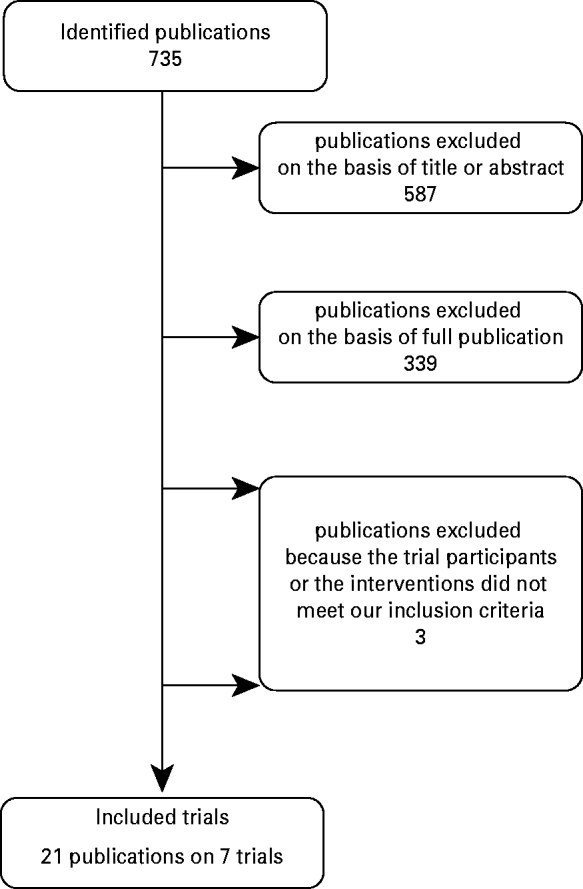
Our primary literature search identified 954 publications. Of these, 587 publications were excluded on the basis of the title or abstract, and a further 343 citable units were excluded on the basis of the full publication. These exclusions were done either because the publications did not relate to cognitive therapy, interpersonal psychotherapy, and major depressive disorder – or because they were not randomized trials comparing cognitive therapy versus interpersonal psychotherapy.
We excluded three publications (Hogg & Deffenbacher, Reference Hogg and Deffenbacher1988; Gallagher & Steffen, Reference Gallagher and Steffen1994; Kellet et al. Reference Kellet, Clarke and Matthews2007) because the trial participants or the interventions did not meet our inclusion criteria.
Included trials
We included 21 publications (Elkin et al. Reference Elkin, Parloff, Hadley and Autry1985, Reference Elkin, Shea, Watkins and Imber1989; Covi & Lipman, Reference Covi and Lipman1987; Imber et al. Reference Imber, Pilkonis, Sotsky, Elkin, Watkins, Collins, Shea, Leber and Glass1990; Neimeyer & Feixas, Reference Neimeyer and Feixas1990; Neimeyer & Weiss, Reference Neimeyer and Weiss1990; Shapiro et al. Reference Shapiro, Barkham, Hardy and Morrison1990, Reference Shapiro, Barkham, Rees, Hardy, Reynolds and Startup1994, Reference Shapiro, Rees, Barkham and Hardy1995; Shea et al. Reference Shea, Pilkonis, Beckham and Collins1990, Reference Shea, Elkin, Imber and Sotsky1992; Sotsky et al. Reference Sotsky, Glass, Shea and Pilkonis1991; Hardy et al. Reference Hardy, Barkham, Shapiro, Stiles, Rees and Reynolds1995; Barber & Muenz, Reference Barber and Muenz1996; Stewart et al. Reference Stewart, Garfinkel, Nunes, Donovan and Klein1998; McBride et al. Reference McBride, Atkinson, Quilty and Bagby2006; Bellino et al. Reference Bellino, Zizza, Rinaldi and Bogetto2007; Joyce et al. Reference Joyce, McKenzie, Carter, Rae, Luty, Frampton and Mulder2007; Luty et al. Reference Luty, Carter, McKenzie, Rae, Frampton, Mulder and Joyce2007; Marshall et al. Reference Marshall, Zuroff, McBride and Bagby2008; Quilty et al. Reference Quilty, McBride and Bagby2008) on seven randomized trials (Covi & Lipman, Reference Covi and Lipman1987; Elkin et al. Reference Elkin, Shea, Watkins and Imber1989; Neimeyer & Weiss, Reference Neimeyer and Weiss1990; Hardy et al. Reference Hardy, Barkham, Shapiro, Stiles, Rees and Reynolds1995; Bellino et al. Reference Bellino, Zizza, Rinaldi and Bogetto2007; Luty et al. Reference Luty, Carter, McKenzie, Rae, Frampton, Mulder and Joyce2007; Quilty et al. Reference Quilty, McBride and Bagby2008) randomizing a total of 741 participants [see Fig. 1 for a preferred reporting items for systematic reviews and meta-analyses (PRISMA) flowchart].
Preferred reporting items for systematic reviews and meta-analyses (PRISMA) flowchart.

Of the trials, five compared the effect of cognitive therapy versus interpersonal therapy (Elkin et al. Reference Elkin, Shea, Watkins and Imber1989; Neimeyer & Weiss, Reference Neimeyer and Weiss1990; Bellino et al. Reference Bellino, Zizza, Rinaldi and Bogetto2007; Luty et al. Reference Luty, Carter, McKenzie, Rae, Frampton, Mulder and Joyce2007; Quilty et al. Reference Quilty, McBride and Bagby2008). Two trials compared cognitive therapy versus psychodynamic-interpersonal psychotherapy (Covi & Lipman, Reference Covi and Lipman1987; Hardy et al. Reference Hardy, Barkham, Shapiro, Stiles, Rees and Reynolds1995).
There were two trials that used group therapy in both intervention groups (Neimeyer & Weiss, Reference Neimeyer and Weiss1990; Bellino et al. Reference Bellino, Zizza, Rinaldi and Bogetto2007). One trial used a combination of both individual and group therapy (Covi & Lipman, Reference Covi and Lipman1987). The remaining four trials used only individual therapy (Elkin et al. Reference Elkin, Shea, Watkins and Imber1989; Hardy et al. Reference Hardy, Barkham, Shapiro, Stiles, Rees and Reynolds1995; Luty et al. Reference Luty, Carter, McKenzie, Rae, Frampton, Mulder and Joyce2007; Quilty et al. Reference Quilty, McBride and Bagby2008).
The length of the intervention period varied from eight weekly sessions (Hardy et al. Reference Hardy, Barkham, Shapiro, Stiles, Rees and Reynolds1995) up to 24 weekly sessions (Bellino et al. Reference Bellino, Zizza, Rinaldi and Bogetto2007).
Both the cognitive and the interpersonal interventions were assessed as ‘adequately defined’ in three trials (Elkin et al. Reference Elkin, Shea, Watkins and Imber1989; Hardy et al. Reference Hardy, Barkham, Shapiro, Stiles, Rees and Reynolds1995; Luty et al. Reference Luty, Carter, McKenzie, Rae, Frampton, Mulder and Joyce2007), and as ‘not adequately defined’ in the remaining four (Covi & Lipman, Reference Covi and Lipman1987; Neimeyer & Weiss, Reference Neimeyer and Weiss1990; Bellino et al. Reference Bellino, Zizza, Rinaldi and Bogetto2007; Quilty et al. Reference Quilty, McBride and Bagby2008). We classified the therapists' level of experience and/or education in one trial as ‘low’ (Luty et al. Reference Luty, Carter, McKenzie, Rae, Frampton, Mulder and Joyce2007), in three trials as ‘intermediate’ (Covi & Lipman, Reference Covi and Lipman1987; Hardy et al. Reference Hardy, Barkham, Shapiro, Stiles, Rees and Reynolds1995; Bellino et al. Reference Bellino, Zizza, Rinaldi and Bogetto2007), in one trial as ‘high’ (Elkin et al. Reference Elkin, Shea, Watkins and Imber1989), and in two trials as ‘unclear’ (Neimeyer & Weiss, Reference Neimeyer and Weiss1990; Quilty et al. Reference Quilty, McBride and Bagby2008).
Bellino et al. (Reference Bellino, Zizza, Rinaldi and Bogetto2007) used psychotherapy as add-on therapy to antidepressants (fluoxetine). The antidepressant medicine was delivered similarly in both intervention groups. All the participants in this trial had co-morbidity with borderline personality disorder. None of the other included trials used antidepressants as a part of the intervention.
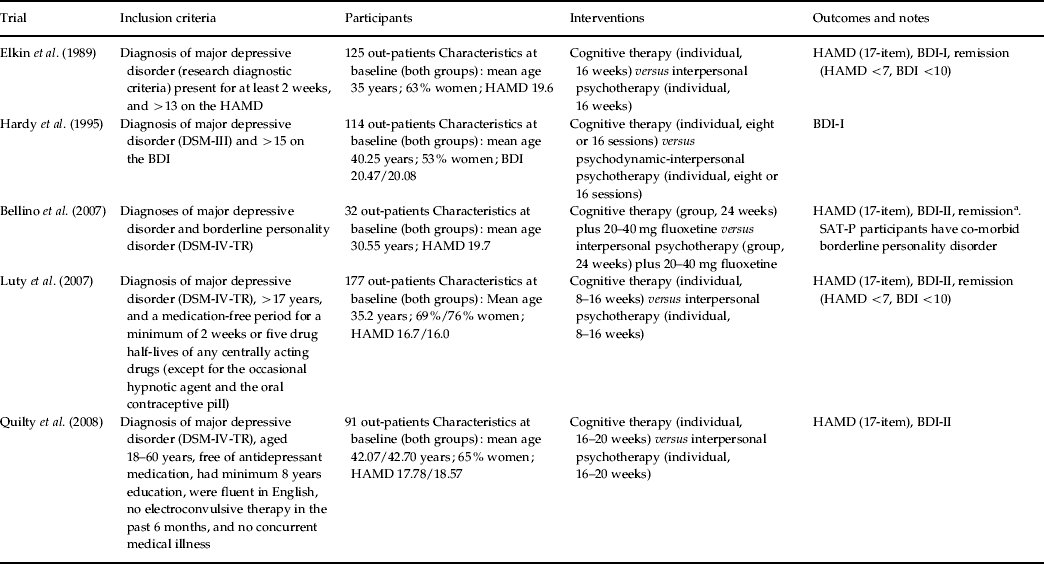
Table 1 summarizes the characteristics of the seven included trials.
Characteristics of the included trials

HAMD, Hamilton Depression Rating Scale; BDI, Beck Depression Inventory; DSM-III, Diagnostic and Statistical Manual of Mental Disorders, 3rd edn; DSM-IV-TR, Diagnostic and Statistical Manual of Mental Disorders, 4th edn, text revision; SAT-P, Satisfaction Profile.
a Bellino et al. (Reference Bellino, Zizza, Rinaldi and Bogetto2007) used a combined measure of a decreased HAMD score of 40% or more, final HAMD score less than 9, and a score of 1 or 2 on the improvement item of the Clinical Global Impression Scale (Berk et al. Reference Berk, Ng, Dodd, Callaly, Campbell, Bernardo and Trauer2008).
Bias risk
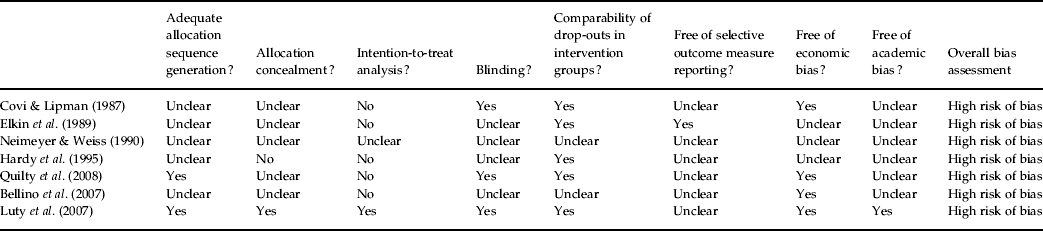
We assessed all seven trials (Covi & Lipman, Reference Covi and Lipman1987; Elkin et al. Reference Elkin, Shea, Watkins and Imber1989; Neimeyer & Weiss, Reference Neimeyer and Weiss1990; Hardy et al. Reference Hardy, Barkham, Shapiro, Stiles, Rees and Reynolds1995; Bellino et al. Reference Bellino, Zizza, Rinaldi and Bogetto2007; Luty et al. Reference Luty, Carter, McKenzie, Rae, Frampton, Mulder and Joyce2007; Quilty et al. Reference Quilty, McBride and Bagby2008) as having ‘high risk of bias’ due to unclear or inadequate components as described in Table 2.
Risk of bias

Effects of cognitive therapy versus interpersonal psychotherapy: primary outcome measures
Depressive symptoms
Of the trials, four reported means and standard deviations on the HAMD at cessation of treatment (Elkin et al. Reference Elkin, Shea, Watkins and Imber1989; Bellino et al. Reference Bellino, Zizza, Rinaldi and Bogetto2007; Luty et al. Reference Luty, Carter, McKenzie, Rae, Frampton, Mulder and Joyce2007; Quilty et al. Reference Quilty, McBride and Bagby2008). Five trials reported means and standard deviations on the BDI at cessation of treatment (Elkin et al. Reference Elkin, Shea, Watkins and Imber1989; Hardy et al. Reference Hardy, Barkham, Shapiro, Stiles, Rees and Reynolds1995; Bellino et al. Reference Bellino, Zizza, Rinaldi and Bogetto2007; Luty et al. Reference Luty, Carter, McKenzie, Rae, Frampton, Mulder and Joyce2007; Quilty et al. Reference Quilty, McBride and Bagby2008).
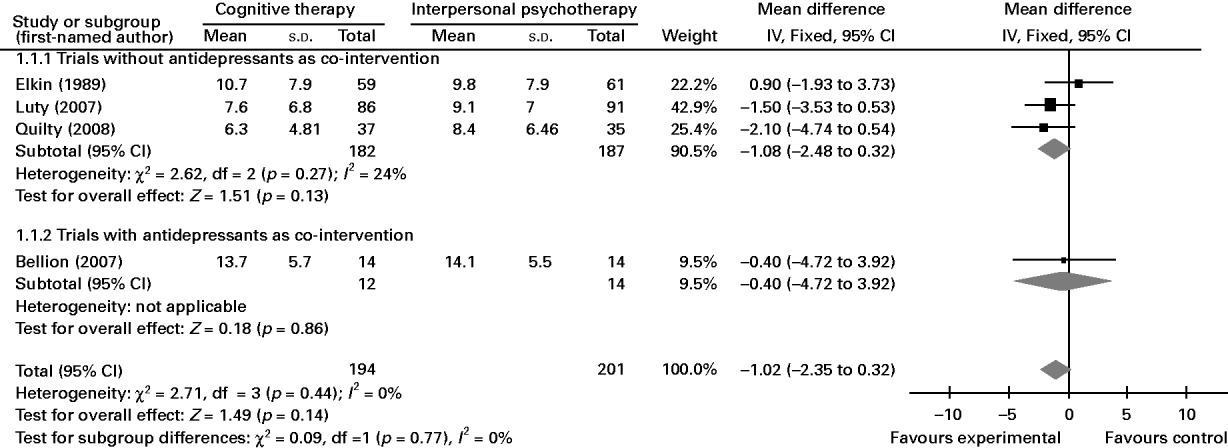
Meta-analysis with the fixed-effect model on the HAMD data from the four trials (Elkin et al. Reference Elkin, Shea, Watkins and Imber1989; Bellino et al. Reference Bellino, Zizza, Rinaldi and Bogetto2007; Luty et al. Reference Luty, Carter, McKenzie, Rae, Frampton, Mulder and Joyce2007; Quilty et al. Reference Quilty, McBride and Bagby2008) showed that the effect of cognitive therapy did not differ significantly compared with the effect of interpersonal psychotherapy (MD in favour of cognitive therapy −1.02 HAMD, 95% CI −2.35 to 0.32, p=0.14, I 2=0) (Fig. 2). Meta-analysis with the random-effects model gave an identical result.
Effect of cognitive therapy versus interpersonal psychotherapy at cessation of treatment on the Hamilton Rating Scale for Depression. s.d., Standard deviation; IV, inverse variance; CI, confidence interval; df, degrees of freedom.

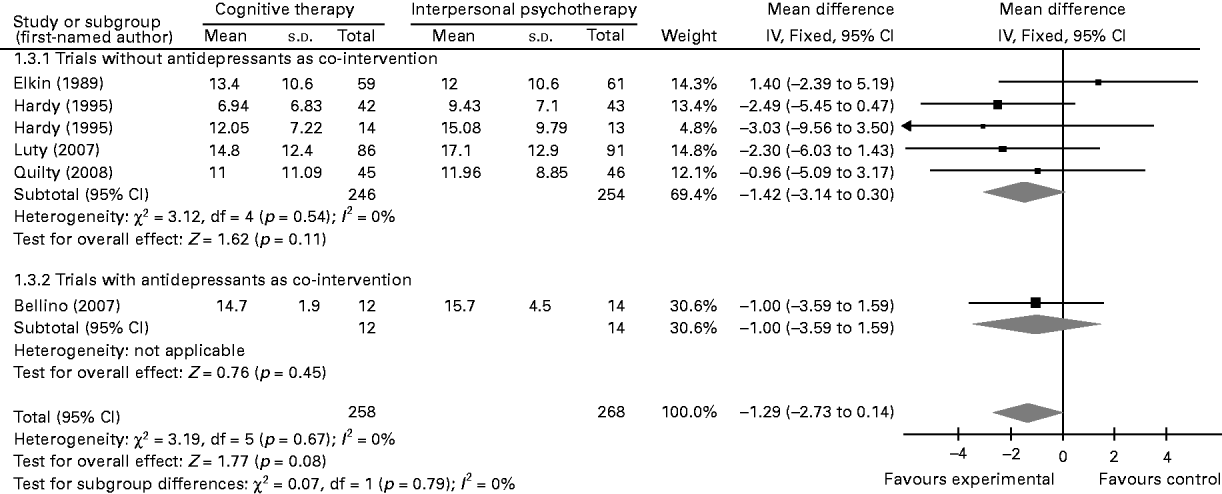
Meta-analysis with the fixed-effect model on the BDI data from the five trials (Elkin et al. Reference Elkin, Shea, Watkins and Imber1989; Hardy et al. Reference Hardy, Barkham, Shapiro, Stiles, Rees and Reynolds1995; Bellino et al. Reference Bellino, Zizza, Rinaldi and Bogetto2007; Luty et al. Reference Luty, Carter, McKenzie, Rae, Frampton, Mulder and Joyce2007; Quilty et al. Reference Quilty, McBride and Bagby2008) also showed that the effect of cognitive therapy did not differ significantly compared with the effect of interpersonal psychotherapy (MD in favour of cognitive therapy −1.29 BDI, 95% CI −2.73 to 0.14, p=0.08, I 2=0) (Fig. 3). Meta-analysis with the random-effects model gave an identical result.
The effect of cognitive therapy versus interpersonal psychotherapy at cessation of treatment on the Beck Depression Inventory. s.d., Standard deviation; IV, inverse variance; CI, confidence interval; df, degrees of freedom. The results from Hardy et al. (Reference Hardy, Barkham, Shapiro, Stiles, Rees and Reynolds1995) are reported as two subgroups because the means and s.d. were reported for participants with and without co-morbid personality disorder.

Trial sequential analysis
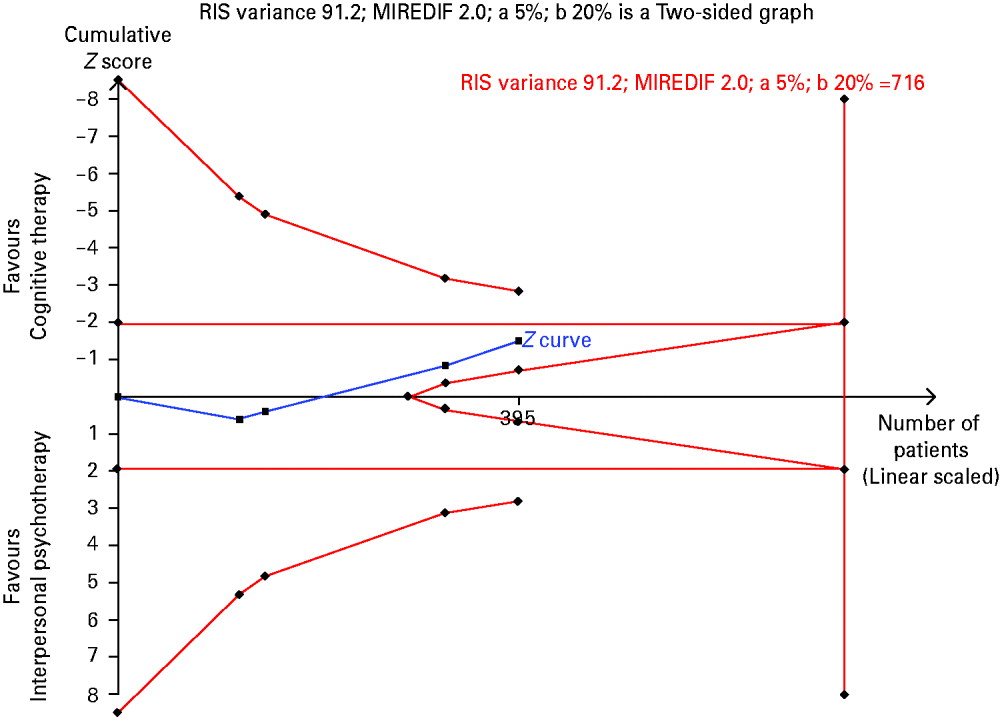
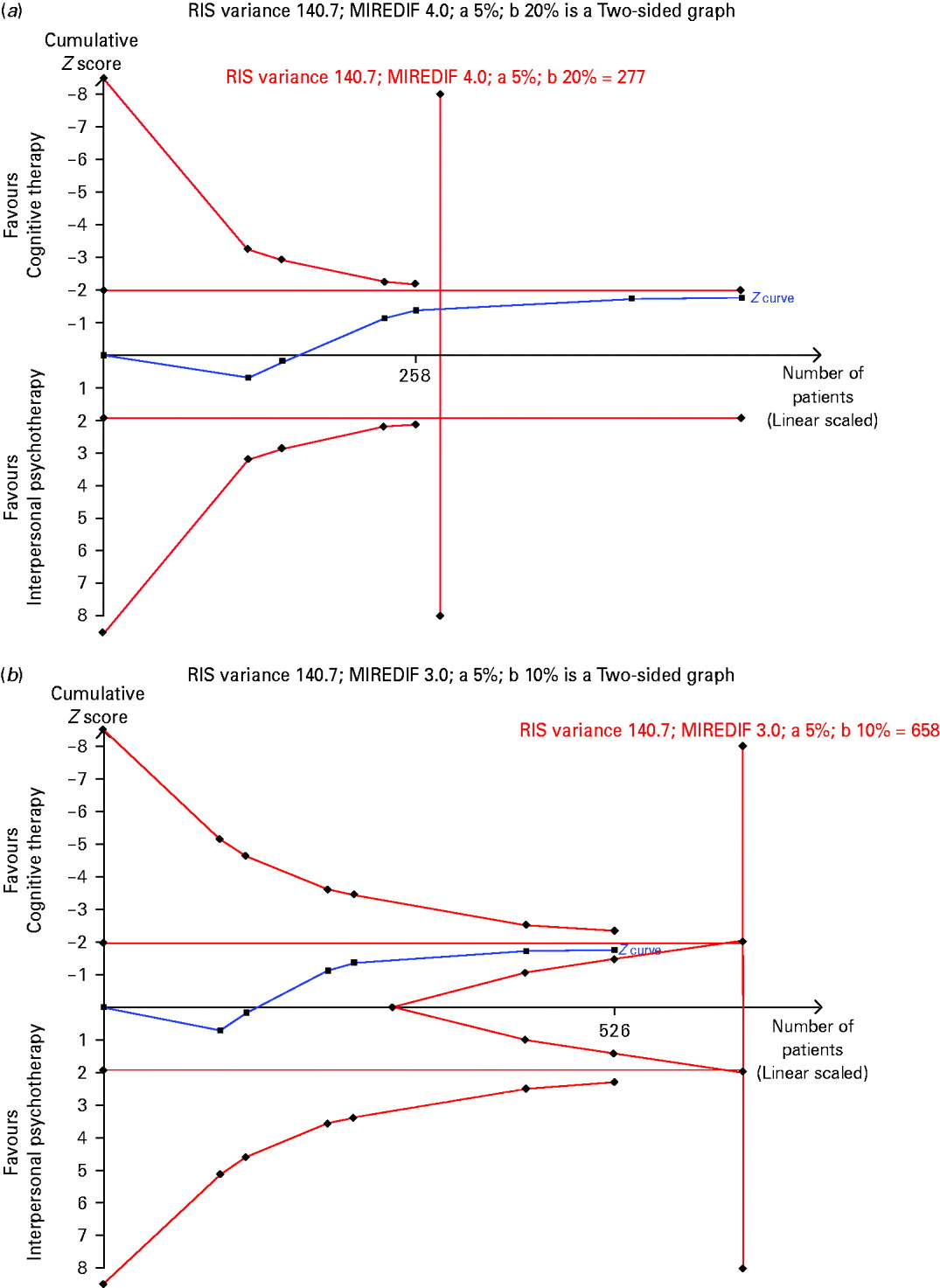
Trial sequential analysis on the HAMD data showed that insufficient data have been obtained to decide if cognitive therapy and interpersonal psychotherapy have different effects on this outcome (Fig. 4). Trial sequential analysis on the BDI data showed that the futility boundary was crossed. This indicates that there is no significant difference in effect between the two interventions and that no more trials may be needed regarding this outcome (Fig. 5 a). However, we also performed trial sequential analysis on the BDI data with more strict presumptions (a power of 90% instead of 80%). This analysis showed that insufficient data have been obtained to decide if cognitive therapy and interpersonal psychotherapy have different effects on the BDI (Fig. 5 b).
Trial sequential analysis of the cumulative meta-analysis of the effect of cognitive therapy versus interpersonal psychotherapy for major depressive disorder. The required information size of 716 participants is calculated based on an intervention effect compared with interpersonal psychotherapy of 2 points on the Hamilton Rating Scale for Depression, a variance of 91.2, a risk of type I error of 5% and a power of 80%. With these presumptions, the cumulated Z curve (blue curve) does not cross the trial sequential monitoring boundaries (red inner sloping lines), implying that there is no firm evidence for a beneficial effect of cognitive therapy compared with interpersonal psychotherapy.

Trial sequential analysis of the cumulative meta-analysis of the effect of cognitive therapy versus interpersonal psychotherapy for major depressive disorder. (a) The required information size of 277 participants is calculated based on an intervention effect compared with interpersonal psychotherapy of 4 points on the Beck Depression Inventory (BDI), a standard deviation of 10, a risk of type I error of 5% and a power of 80%. With these presumptions, the cumulated Z curve (blue curve) does cross the futility boundary, implying that there are no significant differences in effect between the two interventions and no more trials are needed. (b) The required information size of 658 participants is calculated based on an intervention effect compared with interpersonal psychotherapy of 3 points on the BDI, a variance of 140.7, a risk of type I error of 5% and a power of 90%. With these presumptions, the cumulated Z curve (blue curve) does not cross the trial sequential monitoring boundaries (red inner sloping lines), implying that there is no firm evidence for a beneficial effect of cognitive therapy compared with interpersonal psychotherapy.

Follow-up
Only one of the trials included assessment data after the cessation of treatment (Hardy et al. Reference Hardy, Barkham, Shapiro, Stiles, Rees and Reynolds1995). Hardy et al. (Reference Hardy, Barkham, Shapiro, Stiles, Rees and Reynolds1995) assessed the participants with the BDI 1 year after the beginning of treatment (36 weeks after cessation of treatment). There was no significant difference on the BDI between the two intervention groups (MD −0.13, 95% CI −2.94 to 3.21, p=0.93). None of the remaining trials included data after the cessation of treatment.
Adverse events
None of the included trials reported on adverse events.
Quality of life
One trial (Bellino et al. Reference Bellino, Zizza, Rinaldi and Bogetto2006) assessed Satisfaction Profile (SAT-P) for quality of life (Majani et al. Reference Majani, Pierobon, Giardini and Callegari2000). The results showed a significant change on two (psychological functioning and social functioning) of the five factors in favour of interpersonal psychotherapy. None of the remaining six trials assessed quality of life.
Effects of cognitive therapy versus interpersonal psychotherapy: secondary outcome measures
Participants without remission
Of the trials, four (Covi & Lipman, Reference Covi and Lipman1987; Elkin et al. Reference Elkin, Shea, Watkins and Imber1989; Bellino et al. Reference Bellino, Zizza, Rinaldi and Bogetto2007; Luty et al. Reference Luty, Carter, McKenzie, Rae, Frampton, Mulder and Joyce2007) reported the proportion of participants without remission at cessation of treatment. We had planned to define remission as a HAMD score of less than 8 or a BDI score less than 10. However, these definitions were not used by all the trials, so we adopted the slightly different definitions of remission used by the four trials.
Elkin et al. (Reference Elkin, Shea, Watkins and Imber1989) defined remission in two different ways: HAMD less than 7 and BDI less than 10. Bellino et al. (Reference Bellino, Zizza, Rinaldi and Bogetto2007) used a combined measure of a decreased HAMD score of 40% or more, a final HAMD score less than 9, and a score of 1 or 2 on the improvement item of the Clinical Global Impression Scale (Bellino et al. Reference Bellino, Zizza, Rinaldi and Bogetto2007; Berk et al. Reference Berk, Ng, Dodd, Callaly, Campbell, Bernardo and Trauer2008). Covi & Lipman (Reference Covi and Lipman1987) defined remission as a BDI score less than 10, and Luty et al. (Reference Luty, Carter, McKenzie, Rae, Frampton, Mulder and Joyce2007) defined remission in two different ways: HAMD less than 7 and BDI less than 10.
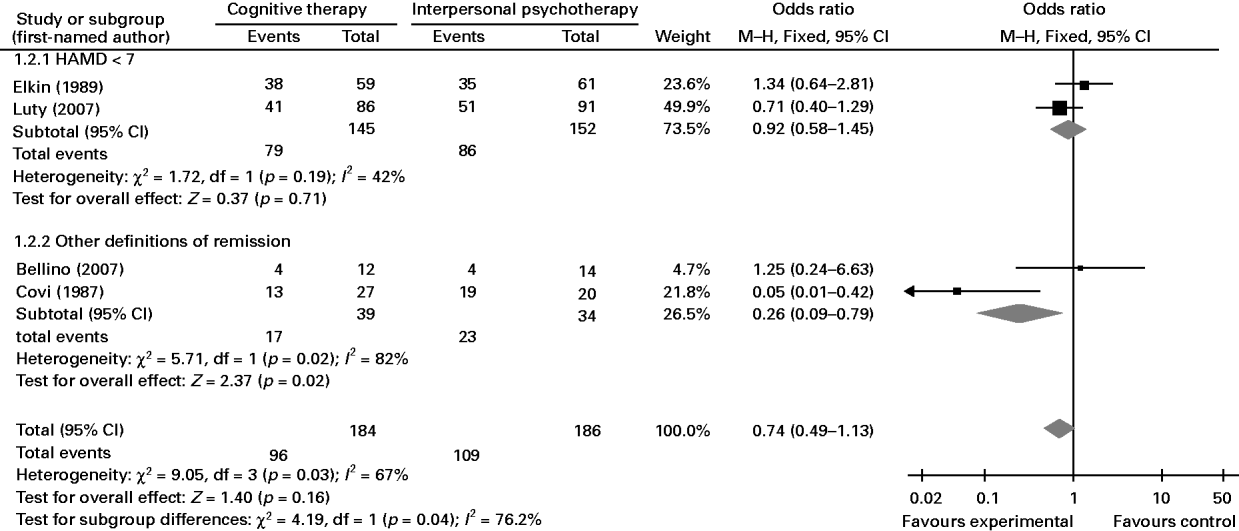
Meta-analysis on the data from all four trials (Covi and Lipman, Reference Covi and Lipman1987; Elkin et al. Reference Elkin, Shea, Watkins and Imber1989; Bellino et al. Reference Bellino, Zizza, Rinaldi and Bogetto2007; Luty et al. Reference Luty, Carter, McKenzie, Rae, Frampton, Mulder and Joyce2007), prioritizing the results from the HAMD (see ‘Discussion’), showed no significant difference between the effect of cognitive therapy and interpersonal psychotherapy on risk of ‘no remission’ (OR in favour of cognitive therapy of no remission 0.74, 95% CI 0.49–1.13, p=0.16, I 2=67%) (Fig. 6).
Effect of cognitive therapy versus interpersonal psychotherapy on ‘no remission’ at cessation of treatment. MH, Mantel–Haenszel; CI, confidence interval; HADS, Hamilton Rating Scale for Depression.

Meta-analysis on the BDI data from the three trials reporting on the BDI (Elkin et al. Reference Elkin, Shea, Watkins and Imber1989; Bellino et al. Reference Bellino, Zizza, Rinaldi and Bogetto2007; Luty et al. Reference Luty, Carter, McKenzie, Rae, Frampton, Mulder and Joyce2007) showed no significant difference between the effect of cognitive therapy and interpersonal psychotherapy on risk of ‘no remission’ (OR in favour of cognitive therapy of ‘no remission’ 0.70, 95% CI 0.46–1.08, p=0.11, I 2=77%) (Fig. 7).
Effect of cognitive therapy versus interpersonal psychotherapy on ‘no remission’ at cessation of treatment (Beck Depression Inventory). MH, Mantel–Haenszel; CI, confidence interval.

Suicide inclination, suicide attempts, or suicides
Quilty et al. (Reference Quilty, McBride and Bagby2008) reported that two participants dropped out from the trial due to risk of suicide. Both participants were in the interpersonal psychotherapy group. None of the other trials reported on suicide inclination, suicide attempts, or suicides.
Sensitivity analysis and ‘test of interaction’
One trial (Bellino et al. Reference Bellino, Zizza, Rinaldi and Bogetto2006) differed from the rest of the trials because it was the only trial including antidepressants as co-intervention, it had a relatively long trial period (24 weeks), and all of the included depressed participants had co-morbidity with borderline personality disorder. A ‘test of interaction’ (Altman & Bland, Reference Altman and Bland2003) showed no significant difference between this trial and the rest of the included trials (p=0.77) (Fig. 2). We also conducted a sensitivity analysis excluding this trial from the meta-analysis on the HAMD data, and found results similar to the meta-analysis including the results from the trial by Bellino et al. (Reference Bellino, Zizza, Rinaldi and Bogetto2006) (MD in favour of cognitive therapy −1.08, 95% CI −2.48 to 0.32, p=0.13, I 2=24%).
Results from trials not included in the meta-analyses
Covi & Lipman (Reference Covi and Lipman1987) reported that cognitive therapy significantly reduced depressive symptoms measured on the HAMD compared with interpersonal psychotherapy, but the authors did not report means and standard deviations.
Neimeyer & Weiss (Reference Neimeyer and Weiss1990) reported no significant difference on the mean value on the HAMD and BDI between the participants receiving cognitive therapy and interpersonal psychotherapy. However, the authors did not report means and standard deviations.
We have written to the authors from both trials requesting the necessary data but we have received no answer. Therefore we have not been able to include the results from these two trials in our analysis.
Subgroup analyses
In subgroup analyses stratified according to the type of therapy (group compared with individual therapy and interpersonal psychotherapy compared with psychodynamic-interpersonal) and according to the therapists' level of education and experience (‘high’ and ‘intermediate’ compared with ‘low’ and ‘unclear’), a ‘test of interaction’ (Altman & Bland, Reference Altman and Bland2003) on the HAMD data showed no significant differences in treatment effect between these subgroups. Furthermore, we found no heterogeneity in our meta-analysis result on the HAMD data. This indicates that these factors do not seem to influence the effect of cognitive therapy measured on the HAMD.
We had also planned a subgroup analysis according to risk of bias (Jakobsen et al. Reference Jakobsen, Lindschou Hansen, Simonsen and Simonsen2010). However, as all trials were classified as ‘high risk of bias’, it was not possible to conduct this analysis.
Discussion
The results of our systematic review with meta-analyses show that cognitive therapy and interpersonal psychotherapy do not seem to differ significantly regarding depressive symptoms in patients with major depressive disorder, but randomized trials with low risk of bias and low risk of random errors are needed. Future trials should include assessment of quality of life and report on adverse events.
One of our trial sequential analyses on the BDI data showed that the futility boundary was crossed. The results from the two other trial sequential analyses further underline the lack of firm evidence on the intervention effects of cognitive therapy versus interpersonal psychotherapy for major depressive disorder. The trial sequential analyses results also indicate that in order to detect or reject an intervention effect with a minimal relevant difference of 2 points on the HAMD, an information size of 716 participants may be needed. Trial sequential analysis is a statistical analysis that is adjusted for multiple testing on accumulating data and, therefore, is a more robust analysis than a traditional cumulative meta-analysis (Brok et al. Reference Brok, Thorlund, Gluud and Wetterslev2008; Wetterslev et al. Reference Wetterslev, Thorlund, Brok and Gluud2008; Thorlund et al. Reference Thorlund, Devereaux, Wetterslev, Guyatt, Ioannidis, Thabane, Gluud, Als-Nielsen and Gluud2009).
The BDI is a self-report questionnaire. The HAMD is an observer-dependent interview that enables a more objective and blinded assessment of the degree of depressive symptoms. We therefore emphasize the HAMD results more than the BDI results (Wood et al. Reference Wood, Egger, Gluud, Schulz, Juni, Altman, Gluud, Martin, Wood and Sterne2008).
Strengths
This review has a number of strengths. Our protocol (Jakobsen et al. Reference Jakobsen, Lindschou Hansen, Simonsen and Simonsen2010) was published before we began the systematic literature search in all relevant databases, data extraction and data analyses. Data were extracted by two independent authors minimizing the risk of inaccurate data extraction, and we assessed the risk of bias in all trials according to The Cochrane Handbook for Systematic Reviews of Interventions (Higgins & Green, Reference Higgins and Green2008). We meta-analysed data both with the fixed-effect model and the random-effects models. Furthermore, we performed trial sequential analysis to control for random errors (Brok et al. Reference Brok, Thorlund, Gluud and Wetterslev2008; Wetterslev et al. Reference Wetterslev, Thorlund, Brok and Gluud2008; Thorlund et al. Reference Thorlund, Devereaux, Wetterslev, Guyatt, Ioannidis, Thabane, Gluud, Als-Nielsen and Gluud2009).
We chose both to include interventions classified as ‘interpersonal psychotherapy’ and ‘psychodynamic-interpersonal psychotherapy’. The extent and form of the compared interventions varied, and one of the trials used antidepressants as co-intervention in both intervention groups (Table 1). We did not, however, find any heterogeneity in our analyses on the primary outcomes. This indicates that there might be a comparable treatment effect between the different types of interventions regardless of the use of antidepressants as co-intervention and regardless of the form of interpersonal psychotherapy. This may make our results more generally applicable.
Limitations
Our systematic review has a number of limitations. Our results are based on only seven trials with a limited number of participants. Cognitive therapy, or interpersonal psychotherapy, might have a superior effect on major depressive disorder, but we need more randomized trials to show this difference in effect. Apart from one trial (Elkin et al. Reference Elkin, Shea, Watkins and Imber1989), none of the included trials was assessed as being free of ‘selective outcome measure reporting bias’ (Higgins & Green, Reference Higgins and Green2008). There is, therefore, a risk of within-study selective outcome reporting in the seven included trials. All of the included trials had an overall assessment as ‘high risk of bias’ – so we cannot exclude that our results may be biased. Moreover, trial sequential analysis showed that we could not exclude the risk of random errors (Brok et al. Reference Brok, Thorlund, Gluud and Wetterslev2008; Wetterslev et al. Reference Wetterslev, Thorlund, Brok and Gluud2008; Thorlund et al. Reference Thorlund, Devereaux, Wetterslev, Guyatt, Ioannidis, Thabane, Gluud, Als-Nielsen and Gluud2009).
As mentioned under ‘strengths’, we found no heterogeneity in the majority of our results, and this indicates that the different interventions assessed in the included trials have comparable effects. On the other hand, few trials with few participants were included and this decreases our power to detect any differences. Furthermore, in order to thoroughly examine a difference in effect between interventions, head-to-head comparisons are needed.
Only one of the included trials included assessments after the cessation of treatment. The evidence for long-term effects of cognitive therapy versus interpersonal psychotherapy seems to be lacking.
Only one of the trials reported measures of quality of life. Outcome measures of quality of life are generally not standardized and thoroughly validated (Higginson & Carr, Reference Higginson and Carr2001). The use of standardized outcome measures for quality of life in research has been limited by difficulties in administering and scoring quality of life (Higginson & Carr, Reference Higginson and Carr2001), but quality of life can be used as a valid outcome measure (Higginson & Carr, Reference Higginson and Carr2001; Gluud, Reference Gluud2006a). The effect of cognitive therapy versus interpersonal psychotherapy on quality of life is, therefore, unclear.
Only one of the trials reported on risk of suicide (Quilty et al. Reference Quilty, McBride and Bagby2008). None of the remaining trials reported on adverse events or on suicide inclination, suicide attempts, or suicides. Typically, adverse events are not reported as thoroughly as beneficial outcome measures (Hopewell et al. Reference Hopewell, Wolfenden and Clarke2008), and psychological interventions might have harmful effects. Psychological debriefing for preventing post-traumatic stress disorder is one example (Rose et al. Reference Rose, Bisson, Churchill and Wessely2002). Debriefing has in some clinical trials showed to have a harmful effect (Rose et al. Reference Rose, Bisson, Churchill and Wessely2002). Possible harmful effects of these two interventions have therefore not been adequately examined.
A number of subgroups of depressed patients (e.g. in-patients) were not included in the trials of this review. These subgroups may react differently to psychotherapy and our results cannot be generalized to other than the included patient groups. These aspects might make our results less generally applicable.
Only three of the included trials (Elkin et al. Reference Elkin, Shea, Watkins and Imber1989; Hardy et al. Reference Hardy, Barkham, Shapiro, Stiles, Rees and Reynolds1995; Luty et al. Reference Luty, Carter, McKenzie, Rae, Frampton, Mulder and Joyce2007) used an intervention that we classified as ‘adequately defined’, i.e. using and documenting the use of therapeutic manuals. And although we did not find any heterogeneity on our primary outcomes indicating that this classification may not influence the effect of the psychotherapeutic interventions, it is imperative in clinical trials that the interventions are adequately defined and described (Boutron et al. Reference Boutron, Moher, Altman, Schulz and Ravaud2008). Factors such as personal style, communication skills and personality of the therapist evidently will influence the way psychotherapy is delivered (Walwyn & Roberts, Reference Walwyn and Roberts2010). It is difficult to describe and control for these subjective factors, and this makes it even more important to relate the therapy to a treatment manual. Otherwise, it is unclear what kind of intervention the participants were receiving and it is difficult to apply any result in clinical practice.
Implications
Our results indicate that there is no major difference in effect between the two interventions, and if there is a difference it presumably only amounts to a few points on the HAMD or the BDI. From a clinical point of view it could be argued that this possible difference in effect is not clinically relevant, and that the two interventions in practice are equally effective. On the other hand, our results also show that we may need more data on the comparative effects.
The included trials used the HAMD and BDI as outcome measures. However, the HAMD and the BDI might not be useful instruments to quantify the effect of interventions for depression. Other assessment methods could demonstrate a more or less substantial effect of any given intervention for depression. Furthermore, severity of depression as measured by the total HAMD score has failed to predict suicide attempts (Chakraborty & Chatterjee, Reference Chakraborty and Chatterjee2007), and some publications have questioned the usefulness of the HAMD and concluded that the scale is psychometrically and conceptually flawed (Bagby et al. Reference Bagby, Ryder, Schuller and Marshall2004). The BDI probably corresponds with the HAMD (Fitzgibbon et al. Reference Fitzgibbon, Cella and Sweeney1988; Heo et al. Reference Heo, Murphy and Meyers2007). From the patient's point of view, a score on the HAMD or BDI is not necessarily a relevant measure of the degree of suffering. The HAMD has during 40 years been the ‘gold standard’ to quantify depressive symptoms in clinical trials (Bagby et al. Reference Bagby, Ryder, Schuller and Marshall2004). There is a need for trials assessing and reporting more clinically relevant outcome measures. We believe such assessment methods should include more thorough reporting of adverse events and outcome measures based on the patient's point of view. To our knowledge, the evidence on such clinically relevant assessment methods is lacking.
Future research should focus on comparing the effect of cognitive therapy versus interpersonal psychotherapy for major depressive disorder. First and foremost, such trials should be conducted with longer follow-up, low risk of bias (systematic errors) and low risk of random errors (play of chance) (Keus et al. Reference Keus, Wetterslev, Gluud and van Laarhoven2010). Such trials should report on adverse events, suicide inclination, suicide attempts and numbers of suicides. There may be a need for a new ‘gold standard’ assessment method other than the HAMD to assess depressive symptoms.
Conclusions
Randomized trials with low risk of bias and low risk of random errors are needed, although the effects of cognitive therapy and interpersonal psychotherapy do not seem to differ significantly regarding depressive symptoms. Future trials should include assessment of quality of life and report on patient-relevant outcomes including adverse events.
Acknowledgements
Ethical approval was not required for this review.
Declaration of Interest
None.