Introduction
The cabbage stem weevil, Ceutorhynchus pallidactylus (Mrsh.) (Col., Curculionidae), is one of the most damaging stem boring pests of winter oilseed rape (Brassica napus L. var. oleifera Metzg.) throughout Europe (Alford et al., Reference Alford, Nilsson, Ulber and Alford2003). The damage potential of cabbage stem weevil has been reported to vary between locations and years (Winfield, Reference Winfield1992; Mrówczyński et al., Reference Mrówczyński, Wachowiak, Muśnicki, Jodłowski and Heimann2006). However, yield losses of 20–30% have been reported from Germany (Broschewitz et al., Reference Broschewitz, Steinbach and Goltermann1993), Poland (Toboła et al., Reference Toboła, Muśnicki and Muśnicka1996) and the UK (Newman, Reference Newman1984). The biology of C. pallidactylus has been studied by Winfield (Reference Winfield1992) and Alford et al. (Reference Alford, Nilsson, Ulber and Alford2003). Adult females deposit egg batches into petioles of oilseed rape plants in April/May. Larvae feed within petioles and later in the main stem. In May/June, the full-grown larvae leave the plants to pupate in the soil. Young adults emerge toward the end of June and migrate to overwintering habitats in woodlands or hedges. Females pass through an obligate, pre-reproductive diapause before oviposition in the following spring.
Resistant cultivars of oilseed rape are needed to help minimize the number of insecticide applications in integrated pest management systems (Williams, Reference Williams and Horwitz2004). Although the susceptibility of oilseed rape genotypes to C. pallidactylus and potential sources of resistance have not been studied in detail, preliminary field observations have indicated considerable variation in infestation levels of C. pallidactylus on different cultivars and lines of oilseed rape (Mrówczyński, Reference Mrówczyński1998; Lühs et al., Reference Lühs, Ulber, Seyis, Frauen, Busch, Friedt, Gustafsson and Poulsen2003; Dechert & Ulber, Reference Dechert and Ulber2004). The level of genetic diversity in oilseed rape breeding material with double-low seed quality (no erucic acid, low glucosinolate content) is limited (Seyis et al., Reference Seyis, Friedt, Lühs, Hammer and Gladis2000). Resynthesized oilseed rape (‘resyntheses’), originating from crosses of Brassica oleracea×Brassica rapa (syn. B. campestris), may provide a major tool to broaden this limited genetic base (Becker et al., Reference Becker, Enqvist and Karlsson1995). The potential of resyntheses as sources for disease resistance has been reported in several studies (Diederichsen & Sacristan, Reference Diederichsen and Sacristan1996; Rygulla et al., Reference Rygulla, Snowdon, Eynck, Koopmann, von Tiedemann, Lühs and Friedt2007). Thus, it is reasonable to expect that resyntheses might provide a source for resistance to pest insects as well (Seyis et al., Reference Seyis, Friedt, Lühs, Hammer and Gladis2000).
Secondary plant compounds of Brassica species, particularly phytochemicals such as glucosinolates (GSLs), significantly affect host finding, feeding and oviposition by various pests on oilseed rape (Giamoustaris & Mithen, Reference Giamoustaris and Mithen1995; Schoonhoven et al., Reference Schoonhoven, van Loon and Dicke2005; Ulmer & Dosdall, Reference Ulmer and Dosdall2006). Based on the GSL content of their progenitors, the GSLs in resyntheses might substantially differ from those in cultivars of oilseed rape (Cleemput & Becker, Reference Cleemput, Becker, Prohens and Badenes2008).
The objective of the present study was to evaluate the susceptibility of 15 genotypes of B. napus to C. pallidactylus and to identify new resources of resistance, focussing on resynthesized lines of oilseed rape. Oviposition and larval performance of C. pallidactylus were studied in laboratory tests to identify preference-performance responses to these genotypes. To validate the results of the laboratory test and to evaluate the relationship between plant infestation levels by C. pallidactylus and plant characteristics such as stem length, stem width and leaf GSL content, we also studied the susceptibility of 12 genotypes in a semi-field experiment.
Materials and methods
Laboratory tests
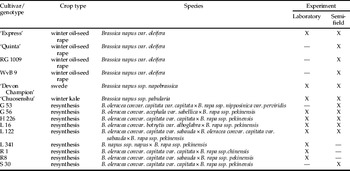
An oviposition choice-test was conducted to evaluate the susceptibility of seven resynthesized rapeseed lines (B. oleracea L.×B. rapa L.) and one cultivar of swede rape (B. napus ssp. napobrassica (L.)), winter kale (B. napus ssp. pabularia (L.)) and oilseed rape (B. napus var. oleifera) to C. pallidactylus (table 1). Adult weevils used for screening were collected from unsprayed crops of oilseed rape near Goettingen, Lower-Saxony, during the immigration period in March/April. They were kept on B. napus leaves taken from a glasshouse within plastic boxes in a climatic chamber at 6°C (L10:D14). Under these conditions, adults were maintained up to three months with negligible mortality for use in the tests.
Genotypes of Brassica napus evaluated for susceptibility to C. pallidactylus in the laboratory oviposition test and a semi-field experiment (progenitors of resyntheses according to Girke (2002)).

Acceptance of selected B. napus genotypes for oviposition by female C. pallidactylus was studied in dual-choice tests under controlled environmental conditions (19°C; L16:D8; 4000 lux). Plants were grown in a standard soil substrate (Fruhstorfer Substrat T25) to the 8-true-leaf stage in a glasshouse and transferred to a climatic chamber one week before testing. One plant of the test genotype and one plant of the moderately susceptible standard cv ‘Express’ were offered next to each other to six females and three males within a cage measuring 60×60×60 cm (BugDorm-2, Mega View Science and Education Services Co., Taichung, TW). The sex of the weevils was determined under a stereo microscope using characteristics of the last abdominal sternite (Cook et al., Reference Cook, Watts, Castle and Williams2006). Weevils were used only once in the experiments. Each accession was tested in eight replicates, and treatments were randomized over a period of eight weeks.
Following a duration of 24 h, plants were transferred to a growth chamber. Because a high proportion of eggs would be destroyed by dissection of petioles, instead we quantified oviposition by counting the number of neonate larvae which hatched from the egg batches. This was determined after ten days by dissection of petioles and midribs under of a stereo microscope.
Semi-field experiment
The susceptibility of 12 of the 15 B. napus genotypes (table 1) was examined in a semi-field experiment in 2005/06. Because of the limited availability of seed, some of the genotypes selected for use in the laboratory tests had to be replaced in the field trial. On 19 August 2005, the 12 genotypes were sown in single, 2-m-long rows (20 seeds m−1) with 25 cm row spacing; the rows were distributed at random in six replicated plots. To avoid edge effects, we sowed the two outer rows at each side of the plot with the standard cv ‘Express’.
On 27 March 2006, gauze cages (Seran PVDC, mesh width 425 μm) measuring 4.0×2.0×1.8 m were installed on each plot before the natural invasion of pests occurred. On 24 April 2006, at the beginning of the oviposition period during stem elongation, 60 males and 60 females of C. pallidactylus were released into each cage. These weevils had been collected from crops of oilseed rape on 20 April 2006.
To assess the effect of caging on microclimate, we measured temperature and relative humidity continuously over 6 h on 10 May 2006 with a data logging system (Modell Escort Junior, NZ) in non-caged field and semi-field conditions. On that date, the light intensity (testo 545, TESTO Inc., USA) at 2 m above ground level was 33300 lux in cages and 68500 lux in the adjacent oilseed rape crop. Mean temperature was 19.3°C in cages and 23.0°C in the non-caged crop.
Assessment of plant infestation by C. pallidactylus in the semi-field experiment
The number of stem weevil larvae per plant was determined on 29 May 2006, at full-flowering, by random sampling of 20 plants per plot of each genotype and by dissection of stems and petioles. The length of larval feeding galleries within stems, as well as the length and diameter of the main stems, were recorded. The stem injury coefficient was calculated by dividing the length of larval feeding galleries by the length of the main stem. The weight of 50 larvae, randomly collected from the stems of each sample, was determined with a microbalance (Sartorius, MC 5, Germany). Subsequently, the larvae were transferred for pupation to transparent plastic boxes filled with a soil mixture (moist sandy loam). The boxes were stored in the laboratory (L16:D8; 22°C). The emergence rate, the weight and the sex ratio (M:F) of young adults were determined for >130 individuals per genotype.
Analysis of glucosinolate content from plants
The glucosinolate (GSL) content was analysed from leaf samples of all 12 genotypes harvested on 24 April 2006, before any herbivory at early stem elongation. Random samples of the seventh leaf were collected from ten plants per genotype. They were pooled and oven-dried (three days at 60°C) before being subjected to glucosinolate analysis by high-performance liquid chromatography (HPLC) according to Beckmann et al. (Reference Beckmann, Möllers, Becker and Kopisch-Obuch2007). Dried leaves were ground with a mortar and pestle, and subsamples of 200 mg were heated in polypropylene tubes on a heating block for 1 min at 75°C. Boiling methanol (3 ml) was added to the test tubes followed immediately by 200 μl benzyl GSL as an internal standard. The tubes were heated for ten minutes and centrifuged at 4000 rpm for four minutes. The supernatant was transferred to 10 ml tubes. Following two additional extraction steps, 500 μl of the supernatant was transferred to a DEAE-A25 Sephadex column and allowed to drain. Desulfoglucosinolates were obtained after treatment of the column with sulphohydrolase (75 μl). The column was capped for 12 hours. Desulfated GSLs were eluted from the column with three portions of 500 μl water and then subjected to final separation. The extracts of the leaves were directly injected into an analytical liChrospher 100 RP 18 EC-5μ column (CS Chromatographie Service GmbH, Langerwehe, Germany) at 35°C with a flow rate of 600 μl min−1. Individual GSLs were identified by matching the retention times with those of an internal standard and observing the rise in peak height.
Statistical analysis
In the dual-choice oviposition tests the paired t-test was used to compare the number of larvae hatching from eggs on each test genotype and the number hatching on the standard cv ‘Express’. Mean numbers of larvae collected from genotypes in the semi-field experiment were subjected to ANOVA; the differences between the means were evaluated by the Tukey-test (P≤0.05). Regression analyses were conducted using Sigma Plot Version 10 (Systat Software GmbH, Erkrath, DE). SPSS® Version 14.0 for Windows (Chicago, IL, USA) was used for correlation analyses, t-tests, ANOVAs and multiple comparisons.
Results
Laboratory tests
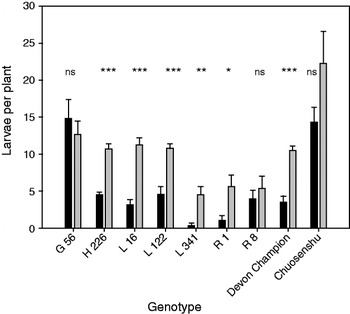
In the dual-choice oviposition tests, there were significantly fewer neonate larvae of C. pallidactylus on resyntheses H 226, L 16, L 122, L 341 and R 1, as well as on cv ‘Devon Champion’, than on the standard cv ‘Express’ (fig. 1). The mean reduction ranged from 59–94%.
Number of Ceutorhynchus pallidactylus larvae/plant found in seven resynthesized rapeseed lines and two cultivars of B. napus in dual-choice oviosition tests. Values are means (+SE) of eight replicates. The number of larvae per plant in each test genotype was compared with the number of larvae in simultaneously offered plants of the standard cv Express by using independent-sample t-tests, where *, P≤0.05; **, P≤0.01; ***, P≤0.001; ns, non-significant (▪, test genotype.  , Express).

Semi-field experiment
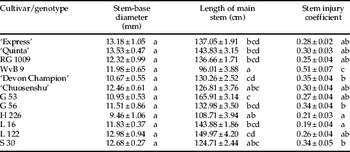
Stem-base diameters varied widely and did not significantly differ among the tested genotypes (ANOVA, Tukey-HSD, F=1.33, df=71, P=0.232) (table 2). The mean length of the main stem ranged from 96 cm (WvB 9) to 165 cm (G 53) and did significantly differ among the genotypes (table 2) (ANOVA, Tukey-HSD, F=6.46, df=71, P≤0.0001). The stem injury coefficient was significantly different between genotypes; it ranged from 0.19 (L 16) to 0.51 (WvB 9) (table 2). The coefficient was smaller in resyntheses L 16 and H 226 than in WvB 9, ‘Devon Champion’, G 56 and S 30 (ANOVA, Tukey-HSD, F=3.94, df=71, P≤0.0003).
Stem-base diameter, length of main stem, and stem injury coefficient of B. napus genotypes infestated by C. pallidactylus in a semi-field experiment.

Values are means (±SE) of six replicated plots.
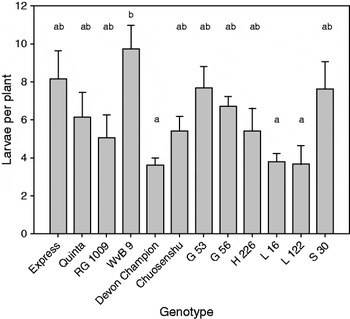
The number of larvae per plant was significantly smaller in resyntheses L 16 and L 122 and in the swede cultivar ‘Devon Champion’ than in WvB 9 (ANOVA, Tukey-test, F=3.12, df=71, P=0.0022) (fig. 2). The larval infestation of ‘Quinta’, ‘Chuosenshu’, RG 1009, and H 226 was also reduced by 24–37% relative to the standard cultivar ‘Express’; however, differences between other cultivars were not significant (fig. 2).
Number (mean+SE) of C. pallidactylus larvae/plant collected from 12 B. napus genotypes in a semi-field experiment.

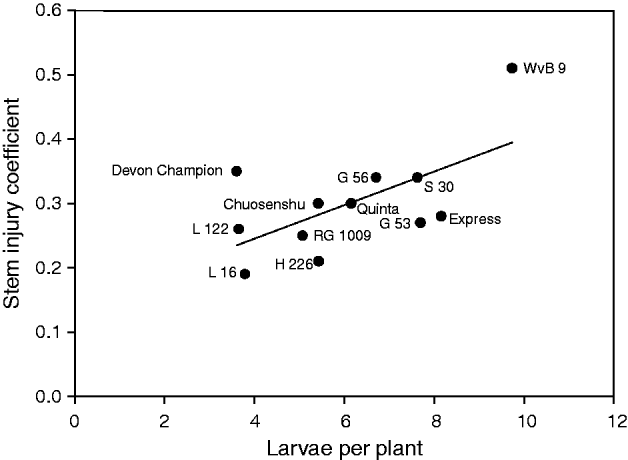
The number of larvae per plant was positively correlated with the stem injury coefficient (y=0.142+0.026x, r2=0.379, F=6.10, df=11, P=0.0331) (fig. 3). In spite of a low number of larvae per plant, the level of stem injury in the swede cv ‘Devon Champion’ was relatively high. No significant relationship was found between the number of larvae and the stem length (y=7.042–0.007x, r2=0.003, F=0.22, df=71, P=0.64) or the stem diameter (y=2.858+0.271x, r2=0.046, F=3.35, df=71, P=0.071).
Relationship between the number of larvae/plant and the stem injury coefficient by C. pallidactylus in a semi-field experiment.

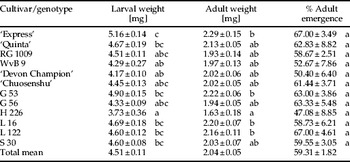
The weight of the larvae reared on the 12 genotypes in the semi-field experiment was significantly different (ANOVA, Tukey-HSD, F=4.24, df=71, P≤0.0001) (table 3). Larval weight was significantly less on resynthesis H 266, WvB 9 and ‘Devon Champion’ than on the standard cv ‘Express’. The weight of adults developing from these larvae showed similar differences between cultivars (table 3) (ANOVA, Tukey-HSD, F=2.67, df=71, P=0.0074).
Larval weight, percentage emergence and weight of adult C. pallidactylus reared from larvae collected from 12 B. napus genotypes in a semi-field experiment.

Values are means (±SE) of six replicated plots.
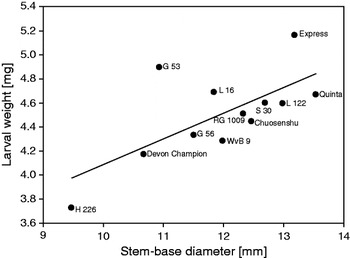
Adult weight and percentage of adult emergence were both positively correlated to larval weight (adult weight: y=0.085+0.435x, r2=0.609, F=108.98, df=71, P≤0.0001; percent emergence: y=2.990+10.542x, r2=0.406, F=47.38, df=71, P≤0.0001). The percentage of adult emergence did not significantly differ among the genotypes (ANOVA, Tukey-HSD, F=1.21, df=71, P=0.5868) (table 3). The average F:M sex ratio was female biased (1.25), with the exception of RG 1009 (0.9). The stem-base diameter was significantly correlated with larval weight (y=1.961+0.213x, r2=0.468, F=8.74, df=11, P=0.0141) (fig. 4).
Relationship between the stem-base diameter and the larval weight of C. pallidactylus in a semi-field experiment.

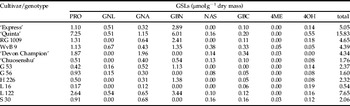
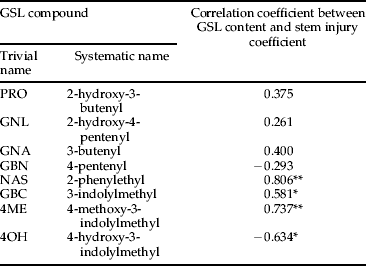
There was no consistent difference in the leaf GSL content of resyntheses vs. B. napus cultivars (table 4). An exceptionally high content of alkenyl GSL (15.8 μmol g−1 dry mass) was found in the leaves of the 0/+ cultivar ‘Quinta’. Neither the total GSL content nor the content of specific GSL compounds was correlated with the number of C. pallidactylus larvae per plant. The content of individual GSL compounds was also not correlated with larval weight or with the percentage of adult emergence. However, the stem injury coefficient was positively correlated with the contents of 2-phenylethyl GSL, 3-indolylmethyl GSL and 4-methoxy-3-indolylmethyl GSL, and was negatively correlated with the content of 4-hydroxy-3-indolylmethyl GSL (table 5).
Mean content of individual and total glucosinolates (GSLs) in leaves of 12 B. napus genotypes grown in a semi-field experiment.

Alkenyl GSLs: PRO, 2-hydroxy-3-butenyl; GNL, 2-hydroxy-4-pentenyl; GNA, 3-butenyl; GBN, 4-pentenyl. Aromatic GSL: NAS, 2-phenylethyl. Indolyl GSLs: GBC, 3-indolylmethyl; 4ME, 4-methoxy-3-indolylmethyl; 4OH, 4-hydroxy-3-indolylmethyl.
Correlations between the leaf content of individual GSL compounds before infestation and the stem injury coefficient following infestation by C. pallidactylus of 12 B. napus genotypes in a semi-field experiment.

*, P≤0.05; **, P≤0.01.
Discussion
Because their genetic variability is greater than that of modern oilseed rape cultivars, resyntheses have been suspected of possessing valuable sources of resistance to pest insects on oilseed rape (Seyis et al., Reference Seyis, Friedt, Lühs, Hammer and Gladis2000). Our results provide the first evidence that host-plant quality of resyntheses for pests could be significantly lower than host quality of B. napus lines and cultivars. In the laboratory oviposition tests, fewer neonate C. pallidactylus larvae were found in five of seven tested resyntheses than in B. napus cv Express. The selection of progenitors used for hybridisation between accessions of B. oleracea and B. rapa apparently has an important impact on the resistance characteristics of their progeny. The susceptibility of progenitors of the tested resyntheses to C. pallidactylus, however, could not be assessed separately. One of the parents of resyntheses L 16, L 122, H 226 and L 341, all of which had a significantly lower level of larval infestation than cv ‘Express’ in the field or reduced oviposition in the laboratory, was Chinese cabbage, B. rapa ssp. pekinensis. Chinese cabbage, however, was also a progenitor of resyntheses G 56, S 30 and R 8, which did not show a reduced susceptibility to C. pallidactylus.
The significantly lower number of neonate larvae on resynthesized rapeseed lines L 16 and L 122 and on swede cv ‘Devon Champion’ in our laboratory oviposition tests was confirmed by results of the semi-field experiment. In the field, the semi-dwarf oilseed rape line WvB 9 supported twice as many larvae as resyntheses L 16 and L 122. This might be attributed to the delayed phenology of WvB 9, leading to a prolonged period of attractiveness of the plants for oviposition by C. pallidactylus. Stem length and stem diameter were not correlated with larval abundance. These parameters, however, were assessed at the time of plant sampling on 29 May, while C. pallidactylus females already were released for oviposition on 24 April. Consequently, correlations between stem length or diameter at oviposition and abundance of larvae could have been altered by subsequent differential plant growth of genotypes. The stem injury coefficient, which reflects the amount of larval feeding within the stem pith, was correlated with the number of C. pallidactylus larvae in stems. In B. napus plants infested by C. pallidactylus, the stem injury coefficient was negatively correlated with oil yield (Ferguson et al., Reference Ferguson, Klukowski, Walczak, Clark, Mugglestone, Perry and Williams2003).
In the semi-field experiment, the weight of larvae and adults was significantly affected by plant genotype; it was lowest on resynthesis H 226 and highest on the standard cv ‘Express’, indicating an inferior host quality of the resynthesis. Corresponding to the weight of larvae, the percentage of adults emerging was highest on cv ‘Express’ and lowest on H 226; however, it did not significantly differ among genotypes. A significant effect of host plant quality on larval and adult weight was also observed for other pests of oilseed rape, e.g. the pod midge, Dasineura brassicae Winn. (Åhman, 1984), the diamondback moth, P. xylostella (Sarfraz et al., Reference Sarfraz, Dosdall and Keddie2007) and the cabbage seed weevil, C. obstrictus (Ulmer & Dosdall, Reference Ulmer and Dosdall2006).
The concentration and profile of GSLs greatly influence the quality of Brassicaceae host plants for herbivores (Giamoustaris & Mithen, Reference Giamoustaris and Mithen1995; Pickett et al., Reference Pickett, Smiley, Woodcock and Callow1999; Gols & Harvey Reference Gols and Harvey2009; Hopkins et al., Reference Hopkins, van Dam and van Loon2009). GSLs show significant differences between various Brassica species (Cole, Reference Cole1997) and can differ considerably among resyntheses (Beckmann et al., Reference Beckmann, Möllers, Becker and Kopisch-Obuch2007; Cleemput & Becker, Reference Cleemput, Becker, Prohens and Badenes2008). In our semi-field experiment, total and individual GSLs varied substantially among the accessions tested. High total amounts of GSLs were found in leaves of B. napus accessions and particularly in cv ‘Quinta’, whereas the total amount of GSLs in five of the six tested resyntheses was on a low level. Contradictory effects of total content of GSL in the plant tissue on pest infestation and the level of plant resistance have been reported in literature. Reduced herbivory by specialist insects was observed at low GSL concentrations but also at intermediate and high GSL concentrations (Siemens & Mitchell-Olds, Reference Siemens and Mitchell-Olds1996; Rask et al., Reference Rask, Andréasson, Ekbom, Eriksson, Pontoppidan and Meijer2000; Pontoppidan et al., Reference Pontoppidan, Hopkins, Rask and Meijer2003; Hopkins et al., Reference Hopkins, van Dam and van Loon2009). In our study, total GSL was not correlated with the number of C. pallidactylus larvae or the stem injury coefficient. The GSL content, however, was measured in the leaves prior to oviposition, and the larval infestation might have been influenced not only by the effects of leaf GSLs on oviposition or survival of eggs and early-instar larvae in the leaves but also by GSL cues in stems. However, in this study we were not able to analyse GSLs in stems at the time of larval assessment, which would have killed the larvae. Females of C. pallidactylus oviposit into leaf petioles; thus, GSL composition in the leaves is regarded an important cue for host acceptance and oviposition. Qualitatively, GSLs compositions in leaves and stems commonly are highly correlated (Cleemput & Becker, Reference Cleemput, Becker, Prohens and Badenes2008), but concentrations might be higher in the stems (Rothe et al., Reference Rothe, Hartung, Marks, Bergmann, Götz and Schöne2004).
Our results suggest that specific GSL compounds and the GSL profile are more important cues for oilseed rape pests than the total GSL content. In the semi-field experiment, the number of larvae was not significantly correlated with any specific GSL. The stem injury coefficient, however, was negatively correlated with the concentration of the indolyl GSL 4-hydroxy-3-indolylmethyl, whereas it was positively correlated with the concentrations of the indolyl GSLs 3-indolylmethyl and 4-methoxy-3-indolylmethyl and the aromatic GSL 2-phenylethyl. The concentrations of these compounds were low or even at zero in resyntheses L 16, L 122 and H 226, which were significantly less infested by stem weevils than the other genotypes. On the other hand, corresponding to a very high amount of 3-indolylmethyl in the leaves, line WvB 9 and swede cv. ‘Devon Champion’ showed the highest stem injury coefficients. This GSL compound is commonly found in leaves and stems of oilseed rape (Rothe et al., Reference Rothe, Hartung, Marks, Bergmann, Götz and Schöne2004) and occurs especially in higher concentrations in varieties of B. oleracea (Kirkegaard & Sarwar Reference Kirkegaard and Sawar1998). Similarly, a high concentration of 2-phenylethyl in the leaves was positively correlated with the stem injury coefficient, particularly in WvB 9. This indicates that 2-phenylethyl affects feeding as a phagostimulant. The hydrolysis product 2-phenylethyl-isothiocyanate is known as a volatile attractant for C. pallidactylus and has potential to be used as a bait in pest monitoring (Walczak et al., Reference Walczak, Kelm, Klukowski, Smart, Ferguson and Williams1998).
The impact of indolyl GSLs on insect species specialized on brassicaceous host plants has been previously reported, e.g. for the cabbage root fly, Delia radicum L. on B. oleracea (Roessingh et al., Reference Roessingh, Stadler, Baur, Hurter and Ramp1997) and for P. xylostella on B. rapa (Sarfraz et al., Reference Sarfraz, Dosdall and Keddie2007). In addition to the stimulating effect of indolyl GSLs on host selection and oviposition, these compounds were also found to affect the feeding activity and performance of larvae. For example, 3-indolylmethyl GSL is known as a phagostimulant of cabbage stem flea beetle, P. chrysocephala (Bartlet et al., Reference Bartlet, Parsons, Williams and Clark1994; Wallsgrove et al., Reference Wallsgrove, Bennett, Kiddle, Bartlet and Ludwig-Mueller1999). Furthermore, Ulmer & Dosdall (Reference Ulmer and Dosdall2006) found a significant relationship between alkenyl GSLs (3-butenyl and 4-pentenyl) in pods and host preference of C. obstrictus. In our study, the content of alkenyl GSLs was not correlated with host preference or larval feeding of C. pallidactylus.
These results support the hypothesis that pest species on brassicaceous host plants are not very sensitive to the total GSL content, but can respond specifically to individual GSLs. The close relationship between 2-phenylethyl GSL and 3-indolylmethyl GSL and the larval infestation indicates that a complex of attractants and phagostimulants may be necessary for host finding and larval development of C. pallidactylus. Ulmer & Dosdall (Reference Ulmer and Dosdall2006) hypothesized that a sequence of several single GSLs cues can affect host finding (3-butenyl), host acceptance and larval development (3-indolylmethyl) of C. obstrictus. A similar effect of specific GSL cues on host preference and feeding can be expected for C. pallidactylus.
For future development of resistance in oilseed rape to C. pallidactylus, a better understanding of the mechanisms determining this plant-pest interaction is necessary.
Acknowledgements
We are grateful to H. Becker, C. Moellers, F. Kopisch-Obuch and K. Beckmann (Department of Crop Sciences, Plant Breeding Division, University of Goettingen) for providing resynthesized rapeseed lines and for glucosinolate analyses. We also thank W. Luehs (IFZ Giessen), M. Frauen (NPZ), D. Stelling (DSV), J. Detering (Raps GbR) and H. Meyer zu Beerentrupp (W. von Borries-Eckendorf) for supplying the seed of the tested genotypes, and R. Wedemeyer and C.F. Trittermann for technical assistance. We thank M. Beyer for critical comments on the draft. We are particularly grateful for valuable comments made by two anonymous reviewers on an earlier version of the manuscript. The study was funded by the German Federal Ministry of Food, Agriculture and Consumer Protection (BMELV) and the Board for Support of Private Plant Breeding in Germany (GFP).