Introduction
End-of-life caregiving encompasses great adaptive efforts and intense grief responses, influencing adjustment to the loss (Boerner and Schulz, Reference Boerner and Schulz2009). Two competing theoretical perspectives were previously formulated to explain the caregiver's transition to the bereavement (Bass and Bowman, Reference Bass and Bowman1990; Bernard and Guarnaccia, Reference Bernard and Guarnaccia2003). The perspective of stress reduction argues that the patient's death represents relief from suffering and, simultaneously, ceases the physically and emotionally demanding tasks of end-of-life caregiving, thus predicting better outcomes. Alternatively, the perspective of cumulative stress postulates that the accumulation of distress depletes resources, therefore undermining the adjustment to loss. Support for the first perspective derives from prospective data stressing that family caregiver (FC) grief is exacerbated by intense end-of-life caregiving distress and then gradually declines after the acute grief period (Chentsova-Dutton et al., Reference Chentsova-Dutton, Shucter and Hutchin2002; Ferrario et al., Reference Ferrario, Cardillo and Vicario2004). However, there is also evidence that, for some, distress levels remain high for a long time, suggesting the cumulative effect of the caregiving strain and suffering from loss. For instance, Breen et al. (Reference Breen, Aoun and O'Connor2019) found that only 9–10 months after the patient's death, the FC's levels of grief, general health and quality of life were equal to those of the noncaregiver comparison group.
In line with the latter perspective, studies using prolonged grief disorder (PGD) criteria have consistently shown that high pre-death grief symptoms tend to persist, predicting poor long-term adjustment (Thomas et al., Reference Thomas, Hudson and Trauer2014; Nielsen et al., Reference Nielsen, Neergaard and Jensen2017; Zordan et al., Reference Zordan, Bell and Price2019). Newly recognized as a mental health disorder, PGD includes intense longing and preoccupation with the deceased, along with pervasive emotional pain that persists for more than 6 months.Footnote 1 The criteria for evaluating pre-death PGD are equivalent, although adapted to the illness situation (instead of loss due to death) and excluding the temporal criterion. The pre-death PGD prevalence values are 12.5% in a Danish nationwide sample of cancer FC (n = 2,865; Nielsen et al., Reference Nielsen, Neergaard and Jensen2017), 15% in palliative care FC (n = 381; Hudson et al., Reference Hudson, Thomas and Trauer2011), and 38.5% in caregivers of patients in vegetative states (n = 52; Bastianelli et al., Reference Bastianelli, Gius and Cipolletta2016). In bereaved FC, PGD ranges between 6% and 40% (Ghesquiere et al., Reference Ghesquiere, Martí and Shear2011; Guldin et al., Reference Guldin, Vedsted and Zachariae2012; Tsai et al., Reference Tsai, Prigerson and Li2015). Specifically, in palliative care, 6.7% and 11.3% meet the criteria for PGD at 6 and 13 months, respectively (Thomas et al., Reference Thomas, Hudson and Trauer2014).
Difficulties in loss adjustment clearly reflect the presence of heightened psychological distress prior to death. In cancer FC, the incidence of clinical depression lies between 18.1% and 48.3% (Tang et al., Reference Tang, Chang and Chen2013; Williams et al., Reference Williams, Tisch and Dixon2013; Oechsle et al., Reference Oechsle, Ullrich and Marx2019). Moderate to severe levels of anxiety range between 33% and 48.1% (Washington et al., Reference Washington, Parker and Smith2018; Oechsle et al., Reference Oechsle, Ullrich and Marx2019; Perpiña-Galvañ et al., Reference Perpiña-Galvañ, Orts-Beneito and Fernandez-Alcantara2019) and 41.6% and 47.4% in burden (Perpiña-Galvañ et al., Reference Perpiña-Galvañ, Orts-Beneito and Fernandez-Alcantara2019; Zubaidi et al., Reference Zubaidi, Ariffin and Oun2020). A study carried out with FC followed in palliative care showed that 40% of participants reported a probable anxiety disorder, and 20% had a probable depressive disorder (Hudson et al., Reference Hudson, Thomas and Trauer2011). Specifically, pre-death severe depression constitutes a major risk factor for worst bereavement outcomes, including PGD and depression (Tsai et al., Reference Tsai, Prigerson and Li2016; Nielsen et al., Reference Nielsen, Neergaard and Jensen2017). Concerning caregiver burden, studies provide divergent results: some authors found that high burden is predictive of grief complications (Ferrario et al., Reference Ferrario, Cardillo and Vicario2004; Nielsen et al., Reference Nielsen, Neergaard and Jensen2017), whereas others reported no association (e.g., Kapari et al., Reference Kapari, Addington-Hall and Hotopf2010). Rather than the objective aspects of the role strain (e.g., hours of care provided or tasks performed), the subjective burden (i.e., the person's evaluation of strain resulting from the caregiver role) has shown to play a critical role in caregiver adjustment to loss (Große et al., Reference Große, Treml and Kersting2018).
Another aspect that influences the caregiving experience and subsequent adjustment to loss is the quality of the relationship with the patient (Kelly et al., Reference Kelly, Edwards and Synott1999; Williams and McCorkle, Reference Williams and McCorkle2011). A higher-quality relationship was associated with a lower burden (Francis et al., Reference Francis, Worthington and Kypriotakis2010; Tough et al., Reference Tough, Brinkhof and Siegrist2017). In contrast, great emotional closeness and dependence from the partner were associated with more burden (Spaid and Barusch, Reference Spaid and Barusch1994) and more difficulties in adjustment to loss (Rickerson et al., Reference Rickerson, Somers and Allen2005; Pruchno et al., Reference Pruchno, Cartwright and Wilson-Genderson2009; Thomas et al., Reference Thomas, Hudson and Trauer2014). When the relationship is marked by conflicts and discord, adding ambivalence to the relationship, it results in increased burden and distress during caregiving (Reblin et al., Reference Reblin, Donaldson and Ellington2016). Conflictual relationships have also been traditionally associated with grief complications (Parkes and Weiss, Reference Parkes and Weiss1983), but this assumption was rejected with the argument that it may reflect a bias of bereaved retrospective memory (Bonanno et al., Reference Bonanno, Wortman and Lehman2002).
Although the caregiver distress is well documented, further research is needed to understand its long-term effects, as well as the interference of other related aspects, such as the quality of relationship with the patient. This may shed light on the path through which the different grieving trajectories of caregivers occur. In this prospective cohort study carried out with advanced cancer FC, we aimed to examine the evolution of PGD symptoms and the predictive role of the caregiving-related factors in the FC's grieving trajectory from pre- to post-death.
Method
Sampling and procedures
Participants were recruited through an outpatient palliative care consultation of a general hospital. Eligible participants were FCs (i.e., relatives or friends involved in caregiving) of advanced cancer patients (Grade IV), older than 18 years old. Caregivers were excluded if they were illiterate or had cognitive impairment that would influence their ability to understand the consent process. After explaining the aims of the study, those who gave their oral consent were invited to respond to the questionnaires, either in person (at the hospital) or at home. The modalities of response were on paper or by mail. When the questionnaires were completed at home on paper, they were requested at the next appointment.
FCs who completed the survey in the pre-death phase (T1) were contacted again more than 6 months after the patient's death to complete the follow-up (T2). When people did not answer the first call, more attempts were made at different times, extending the contact period up to 12 months. In the case of the patients who were discharged from palliative care after the first assessment, this contact was not made for ethical reasons. Participants who agreed to participate were invited to respond in person (at the hospital), by phone or mail. All the participants were advised to give feedback about the emotional impact of responding to the questionnaires, and if emotional distress was experienced, they were offered a referral for psychology consultation. This study was approved by the hospital ethics committee (reference No. 344/14).
Instruments
The survey included the following self-report instruments:
Socio-demographic questionnaire, developed by the research team to evaluate demographic data (age, gender, education, kinship);
Circumstances of caregiving, composed of two items: “Cohabitation with the patient,” with a Yes (1) or No (0) response; “Number of daily hours (h) spent, on average, caring for the patient (i.e., providing any kind of help), in the last week” rated in a 5-point scale: <2 h = 1; 2–4 h = 2; 4–8 h = 3; 8–16 h = 4; and >16 h = 5.
Prolonged Grief Disorder Questionnaire (Prigerson et al., Reference Prigerson, Horowitz and Jacobs2009). This questionnaire is used as a diagnostic instrument for prolonged grief disorder (PGD), considering the following clinical criteria: separation distress; cognitive, emotional, and behavioral symptoms; and social and functional impairments. The pre-death version (PG-12) was designed to assess grief experience related to illness. It is composed of 12 questions rated on a 5-point Likert scale ranging from 1 (almost never) to 5 (always), except for the last item, which is dichotomous. In the Portuguese validation (Coelho et al., Reference Coelho, Silva and Barbosa2017), this instrument demonstrated a unifactorial structure with high internal consistency (α = 0.846). Examples of items include “In the past month, how often have you had intense feelings of emotional pain, sorrow, or pangs of grief related to (patient's) illness?” and “Do you feel that life is unfulfilling, empty, or meaningless since (patient's) illness?” PG-13, used at the follow-up, is focused on the post-loss grief and includes one more item, also dichotomous, in which respondents are questioned if the grief symptoms persist for longer than 6 months (temporal criteria). This instrument was validated for the Portuguese population by Delalibera et al. (Reference Delalibera, Coelho and Barbosa2011). The internal consistency was considered excellent (α = 0.932).
Depression, Anxiety, and Somatization subscales of the Psychopathological Symptom Inventory (BSI; Deorogatis and Melisaratos, Reference Derogatis and Melisaratos1983). These subscales consist of 18 statements evaluating symptoms of psychological distress, including depression (feeling blue, lack of interest in things, loneliness, hopelessness about the future, worthlessness, and suicidal thoughts), anxiety (feeling tense, nervousness, fearful, spells of panic, suddenly scared, and restless), and somatization (feeling weakness, nausea, numbness, faintness, trouble getting breath. and pains in the chest). Responses are evaluated on a Likert scale, ranging from 0 (never) to 4 (always). This measure was validated for the Portuguese population (Canavarro, Reference Canavarro, Simões, Gonçalves and Almeida1999), showing acceptable to excellent internal consistency (subscales between α = 0.67 and α = 0.92). We used the recommended cut-off points of 1.051 for depression, 0.940 for anxiety, and 1.004 for somatization. A score of psychological distress, also referred to as the Global Severity Index, was computed by calculating the mean total score of the three subscales (Meijer et al., Reference Meijer, de Vries and van Bruggen2011).
Zarit Burden Interview. This instrument, developed by Zarit and Zarit (Reference Zarit and Zarit1987), evaluates feelings of stress related to the caregiving role. It contains 22 items with scores ranging from 0 (never) to 4 (always). Items include “Patient asks for more help than he/she needs,” “Afraid of patient's future,” and “Negative effect on other relationships.” The Portuguese validation (Ferreira et al., Reference Ferreira, Pinto and Laranjeira2010) obtained high internal consistency (α = 0.88). A total score below 21 indicates no burden, 21–40, moderate burden, 41–60, moderate to severe burden, and more than 60, severe burden.
Relationship Quality. This instrument is composed of eight items developed for this study to evaluate the current quality of the relationship with the patient. Items are evaluated by a Likert scale from 1 (nothing) to 5 (very much). Examples of questions are “We used to talk about what we are feeling intimately” and “I feel hurt by some things my family member tells me.” It has a multifactorial structure with two dimensions: (1) emotional closeness and (2) conflict. Internal consistency values range between 0.854 and 0.868.
Statistical analysis
Descriptive and frequency analyses were conducted to characterize the sample and to establish the prevalence of distress symptoms, burden, and PGD symptoms. Differences in PGD rates were then analyzed by the chi-square test. Demographic mean differences in caregiving distress indicators and PGD symptoms were evaluated using ANOVA and t-tests. In this analysis, demographic variables were recoded (age: <40, 41–60, >61 years old; married status: yes/no; kinship: spouse/others; education: ≤9 years/>9 years; cohabitation with the patient: yes/no). To establish the relationship between caregiver distress, relationship quality, and PGD symptoms, Pearson's correlations were computed. The prediction of pre-death PGD was estimated by hierarchical regression. Values for independence (Durbin–Watson: 2.082–2.229) and multicollinearity (1.063 < VIF values < 1.402; 0.503 < tolerance values < 0.941) were considered acceptable. Analyses were performed using complete cases. Statistical analyses were performed using SPSS.
Results
Participants and demographics
Of the 200 eligible FCs, 156 (78%) agreed to participate and completed the survey in the pre-death phase (T1). The reasons for non-participation at T1 were not responding (n = 20; 10%), unavailability, or not wanting to talk about the topic (n = 22; 11%). During the post-loss period (T2), 87 responded to the questionnaires, corresponding to a response rate of 55.77%. Reasons for non-participation at T2 were: patient was discharged from palliative care after the first assessment (n = 40; 25.6%); did not respond, were unavailable, or did not want to talk about the topic (n = 24; 15.4%); the patient was still alive (n = 4; 2.6%); less than 6 months after death (n = 1; 0.6%) for unavailability or not wanting to talk about the topic with a stranger.
Demographic information is displayed in Table 1. Participants in T1 were mostly female, married, and adult children of the care recipient and had a high education level, with a mean age of 51.78 (SD = 13.29). At the follow-up, the average length of time since death was 9.05 months (SD = 2.123, ranging from 6–12 months). The sample at T2 was equivalent in demographics.
Demographics

Prevalence of caregiver distress and PGD symptoms
Using the cut-off values or criteria of each measure, high levels were found in symptoms of depression (41.7%), anxiety (34.4%), and somatization (25.8%). Most FCs presented moderate (40.1%) and moderate to severe burdens (28.9%). Pre-death PGD symptoms (38.6%) were higher than those in the post-loss period (33.7%). This difference was statistically significant (X 2 = 28.51, p = 0.000). Of those who met the PGD criteria before death, most also met these criteria after death (n = 26, 61.9%). Sixteen participants (38.1%) no longer met the diagnostic criteria at T2, and only 3 (7%) new cases of PGD emerged that had not been diagnosed in the pre-death phase.
Relationship between demographics, caregiver distress, and PGD symptoms
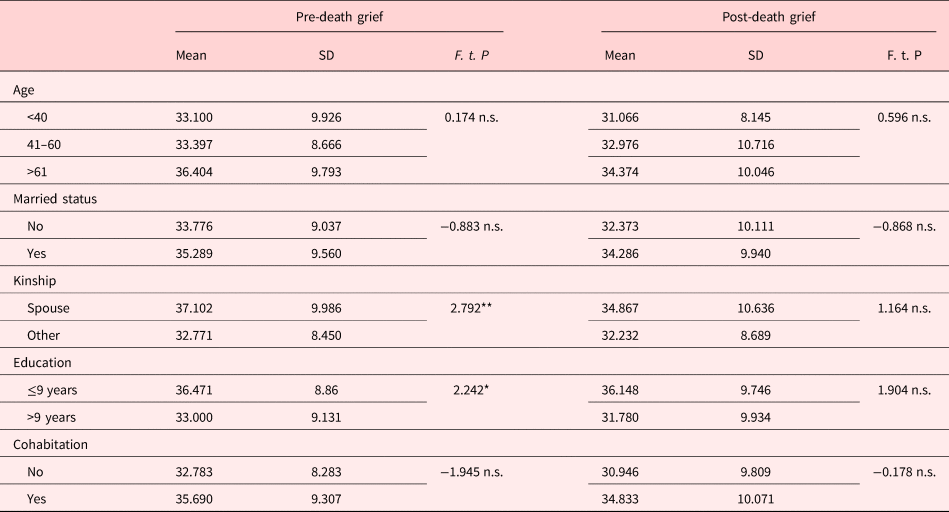
An analysis of mean differences in grief levels across demographics (Table 2) showed that being a spouse of the care recipient (F = 2.792, p < 0.01) and having lower education (F = 2.242, p < 0.01) were associated with increased pre-death PGD. There were no differences in demographics regarding bereavement outcome. Pre-death grief was highly correlated with psychological distress and caregiver burden (r = 0.643, p < 0.01 and r = 0.447, p < 0.01, respectively). For post-death grief, strong correlation values were found with psychological distress (r = 0.511, p < 0.01), but not with burden (r = 0.009, n.s.). Emotional closeness was moderately associated with pre- and post-death grief (r = 0.377, p < 0.01 and r = 0.417, p < 0.01). Conversely, conflict presented a moderate correlation with psychological distress (r = 0.237, p < 0.01), caregiver burden (r = 0.231, p < 0.05), and post-death grief (r = 0.304, p < 0.01), but not with pre-death PGD (r = 0.143, n.s.). Correlations between caregiving context variables and grief symptoms are displayed in Table 3.
Demographic mean differences in pre- and post-death PGD manifestations

* p < 0.01.
** p < 0.05.
Correlations between grief manifestations, caregiver distress, and relationship quality

* p < 0.05.
** p < 0.01.
Predictors of pre- and post-death PGD symptoms
Two separate hierarchical regressions were conducted to explore the predictors of PGD before and after death. Only the factors that were related to each dependent variable were included. To predict pre-death PGD (n = 156), the variables were entered in the equation in the following order: Model 1: demographics (kinship and education level); Model 2: Time spent caregiving; Model 3: Caregiver distress (psychological distress total score and burden); and Model 4: Relationship quality (emotional closeness and conflict). To predict post-death PGD (n = 87), the variables entered in the equation were as follows: Model 1: Psychological distress; Model 2: Pre-death PGD symptoms; and Model 3: Relationship quality (emotional closeness and conflict; Table 4).
Predictors of pre-death PGD symptoms

*** p < 0.001.
** p < 0.01.
* p < 0.05.
a Kinship: Spouse = 1; Other = 0.
b Education: ≤9 = 0; >9 = 1.
c Time spent daily on caregiving in the last week <8 h = 0; >8 h = 1.
d Sum of mean values of BSI subscales of depression, anxiety, and somatization.
e Total score of Zarit Burden scale.
f Subscale of emotional closeness, relationship quality questionnaire.
g Subscale of conflict, relationship quality questionnaire.
The hierarchical regression of pre-death PGD symptoms revealed that the strongest predictor was caregiving distress, including psychological distress and burden. They both explained 41.4% of the PG-12 variance (R 2 = 0.495; F(2–129) = 25.314, p < 0.001). The emotional closeness of the relationship contributed 12.23% of the variance. Overall, this model explained 57.7% of the PG-12 score [R 2 = 0.577; F(2–127) = 24.726, p < 0.001]. The demographics and the time spent caregiving were not significant predictors in the final model.
In predicting post-death PGD symptoms (Table 5), the direct effect of caregiver psychological distress (Model 1) was 28.2% [R 2 = 0.282; F(1–78) = 30.675, p < 0.001], but when controlling for pre-death PGD symptoms, it was no longer statistically significant. In the final model, only pre-death PGD symptoms and relationship emotional closeness were considered predictive. Together, these factors explained 42.5% of the PG-13 score variance [R 2 = .425; F(2–75) = 13.848, p < 0.001].
Predictors of post-death PGD symptoms

*** p < 0.001.
** p < 0.01.
* p < 0.05.
a Sum of mean values of BSI subscales of depression, anxiety, and somatization.
b Pre-death PGD symptoms, PG-13.
c Subscale of current emotional closeness, relationship quality questionnaire.
d Subscale of current conflict, relationship quality questionnaire
Discussion
This longitudinal study examined the evolution of caregiver PGD symptoms and their association with caregiving-related factors in a sample of advancer cancer FCs accompanied by a palliative care outpatient consultation. In line with previous research (Nielsen et al., Reference Nielsen, Neergaard and Jensen2017), we found that the levels of pre-death PGD were higher than those presented during bereavement (38.6% and 33.7%, respectively). It suggests that the experience of pre-death grief tends to be more intense than after death, largely justified by the psychological distress of caregiving. However, the vast majority of FCs who presented PGD post-loss already met these criteria prior to the patient's death, confirming the continuity of PGD symptoms from the pre- to post-death period (Thomas et al., Reference Thomas, Hudson and Trauer2014; Nielsen et al., Reference Nielsen, Neergaard and Jensen2016, Reference Nielsen, Neergaard and Jensen2017; Holm et al., Reference Holm, Årestedt and Öhlen2019; Zordan et al., Reference Zordan, Bell and Price2019).
Compared with other studies carried out with FC in palliative care (e.g., Hudson et al., Reference Hudson, Thomas and Trauer2011), this sample reports heightened levels of psychological distress, burden, and PGD, both pre- and post-death. However, these findings are consistent with previous studies carried out with the Portuguese FC population. For example, Areia et al. (Reference Areia, Fonseca and Major2018) reported that a large proportion of cancer caregivers presented high-risk levels for depression (68.8%), anxiety (72.3%), somatization (50.9%), and complicated anticipatory grief (25.9%). Levels of burden were moderate in 52% and moderate to severe in 26.7% (Delalibera et al., Reference Delalibera, Coelho and Frade2020). Another study stated that more than 6 months after the loss, 28.8% met the criteria for PGD (Coelho et al., Reference Coelho, Delalibera and Barbosa2015). The heightened values in the Portuguese population may reflect the influence of cultural aspects in caregiving, namely the importance of family ties and religion, typical of Southern European countries (Meñaca et al., Reference Meñaca, Evans and Andrew2012).
Being a spouse of the care recipient and having poor education were associated with the worst outcomes in pre-death grief, as supported by the literature (Kiely et al., Reference Kiely, Prigerson and Mitchell2008; Hudson et al., Reference Hudson, Thomas and Trauer2011; Liew, Reference Liew2016). However, neither the demographics nor the objective aspects of burden (i.e., time spent in caregiving) were predictive of pre-death PGD. In contrast, the psychological distress and caregiver burden jointly contributed to explain 41.4% of the PG-12 score variance, evidencing that, above all, the subjective impact of caregiving is the aspect that influences the most of the grief outcome. The overlap between caregiver distress, burden, and pre-death symptoms has also been noted by other authors (Thomas et al., Reference Thomas, Hudson and Trauer2014; Nielsen et al., Reference Nielsen, Neergaard and Jensen2017).
Likewise, the psychological distress was predictive of post-death PGD, but when controlling for pre-death PGD in multivariate analysis, its effect decreased, suggesting the mediating role of the latter variable in the link between psychological distress and bereavement outcome. In other words, the influence of caregiving distress on post-loss PGD symptomatology was overshadowed by the impact of pre-death PGD symptoms. Additionally, the caregiver burden was predictive of pre-death PGD, but it was not correlated to post-loss grief symptomatology, thus suggesting that its effect does not influence the adjustment to bereavement more than 6 months after the patient's death.
On the other hand, the great emotional closeness was considered a risk factor for adverse grief outcomes, both pre- and post-death. This finding is congruent with research carried out with bereaved individuals arising from numerous causes of death stating that the perceived closeness to the deceased is associated with higher distress throughout the course of bereavement (Dyregrov et al., Reference Dyregrov, Frykholm and Lilled2003; Servaty-Seib and Pistole, Reference Servaty-Seib and Pistole2007). Other studies (Spaid and Barusch, Reference Spaid and Barusch1994; Thomas et al., Reference Thomas, Hudson and Trauer2014) also emphasized the difficulties that dependent caregivers experience in dealing with separation and death.
Conflict was positively correlated but not predictive of post-death grief, excluding causality between these two variables. Despite the widespread belief that grief is more severe if the relationship is conflicted, very little research has been conducted on this matter, and the existing studies present contradictory results. For example, in a sample of bereaved college students, it was found that in association with a preoccupied attachment style (high anxiety, low avoidance), both close and conflictual relationships were predictive of more adverse post-loss grief reactions (Smigelsky et al., Reference Smigelsky, Bottomley and Relyea2020). In contrast, Carr et al. (Reference Carr, House and Kessler2000) noted that the levels of yearning were lower for widowed persons whose relationships were conflicted and higher for those reporting high levels of marital closeness and dependence on their spouses. More prospective research is needed to understand the long-term influence of conflictual feelings in bereaved FC, especially in the context of ambivalent relationships caused by intensive caregiving (Reblin et al., Reference Reblin, Donaldson and Ellington2016).
Together, these findings provide support for both theoretical perspectives on the caregivers’ bereavement — the stress reduction and cumulative stress. The first one is demonstrated by the decrease in the PGD rate from the pre- to post-death phase. The second is substantiated by the fact that the FC pre-death PGD symptoms have a cumulative effect with psychological distress. As previously noted by other authors (Schulz et al., Reference Schulz, Boerner, Hebert, Stroebe, Hansson and Schut2008; Große et al., Reference Große, Treml and Kersting2018), those two apparently opposed perspectives are not mutually exclusive. Instead, they reflect the diversity of FC individual responses and the complex pattern of interactions of caregiving-related factors across time. Hence, in the phase preceding death, the target of intervention should be the caregiver burden and the FC's psychological distress. On the contrary, in bereavement, particular attention should be paid to the group of FCs who had a very emotionally close relationship with the patient and meet the criteria for pre-death PGD. These are possibly the people who will experience the most complicated grieving trajectory in the long run.
This research has limitations that should be considered before any definitive conclusions can be drawn. One potential bias may be related to the convenience sampling method. Participants were selected based on their accessibility and willingness to participate in the study, so it is possible that those subjects with more difficulties in adjusting to the end-of-life caregiving experience are overrepresented in this sample. This fact eventually contributes to explaining the high rates of caregiver distress that were found in the sample. Another limitation refers to the reduced sample size due to missing values and the low rates of response in the second assessment moment. This led us to reduce the number of variables in the study, mainly due to multivariate analysis, which requires a larger number of participants. Thus, the predictive effects of other caregiving-related variables potentially relevant for this analysis were not verified (e.g., past relationship, coping mechanisms). Further research is needed to explore the influence of these factors. Finally, it is important to take into account the multidimensionality of the burden concept, which makes its assessment very complex and difficult to capture, potentially biasing the results of the present study.
Despite these limitations, the results offer a more nuanced understanding of the evolution and predictors of family caregiver grief, with clinical implications. First, we found evidence for high levels of caregiving distress and prolonged grief symptoms, especially in the pre-death phase, as opposed to long-term deleterious effects of caregiving, which can inform the timing of support provision for FCs. Second, we reinforce that it is possible to identify, from the pre-death phase, those who are at greater risk of developing PGD. As recommended by the international guidelines of palliative care, emphasis should be given to the early screening and intervention to FCs who are most vulnerable to grief complications (Hudson et al., Reference Hudson, Remedios and Zordan2012). Third, we call attention to the psychosocial vulnerability of the bereaved caregiver, considering aspects such as education. According to Bindley et al. (Reference Bindley, Lewis and Travaglia2019), the social and structural inequities potentially contribute to disadvantage and disenfranchisement following expected death.
Conclusion
The results from this prospective cohort study support the idea that in some ways, stress in caregivers reduces from pre- to post-loss, while in others, it accumulates leading to challenges in bereavement. Specifically, the pre-death PGD symptoms and the emotional closeness with the care recipient have been shown to play a central role in mediating the link between psychological distress and bereavement outcome. These aspects, together with the caregiver's psychological distress, seem to override the effects of burden and the conflict in the relationship with the deceased. Further research is needed to confirm these findings and to explore the roles of other influencing factors in this complex and dynamic process of transition from caregiving to bereavement.