Introduction
The lichen-forming ascomycete genus Aspicilia s. lat. includes a diverse assemblage of 200–250 species (Owe-Larsson et al. Reference Owe-Larsson, Nordin, Tibell, Nash, Gries and Bungartz2007; Sohrabi et al. Reference Sohrabi, Owe-Larsson, Nordin and Obermayer2010b ) within Megasporaceae (Schmitt et al. Reference Schmitt, Yamamoto and Lumbsch2006; Lumbsch et al. Reference Lumbsch, Schmitt, Lücking, Wiklund and Wedin2007; Nordin et al. Reference Nordin, Tibell and Savić2010; Sohrabi et al. Reference Sohrabi, Stenroos, Myllys, Søchting, Ahti and Hyvönen2013). Recent taxonomic studies incorporating molecular sequence data have supported the monophyly of Megasporaceae, while calling for major generic and species-level revisions (Nordin et al. Reference Nordin, Tibell and Savić2010; Sohrabi et al. Reference Sohrabi, Stenroos, Myllys, Søchting, Ahti and Hyvönen2013). To accommodate major phylogenetic clades identified within the family, Nordin et al. (Reference Nordin, Tibell and Savić2010) reintroduced the old generic names Circinaria Link and Sagedia Ach., and redefined Aspicilia A. Massal. and Lobothallia (Clauzade & Cl. Roux) Hafellner. Although these studies provide a robust working hypothesis of relationships, taxonomic delimitations within this family cannot be regarded as conclusively settled due to limited taxonomic and molecular sampling. Furthermore, unresolved species complexes burdened by complicated nomenclature and taxonomic problems are common within many Aspicilia s. lat. lineages (e.g. Clauzade & Roux Reference Clauzade and Roux1984; Owe-Larsson et al. Reference Owe-Larsson, Nordin, Tibell, Nash, Gries and Bungartz2007, Reference Owe-Larsson, Nordin, Tibell and Sohrabi2011; Sohrabi & Ahti Reference Sohrabi and Ahti2010; Sohrabi et al. Reference Sohrabi, Ahti and Litterski2011a , Reference Sohrabi, Stenroos, Högnabba, Owe-Larsson and Nordin b , Reference Sohrabi, Stenroos, Myllys, Søchting, Ahti and Hyvönen2013), requiring substantial taxonomic revisions within many groups.
Species within Aspicilia s. lat. (traditional sense) show a wide range of substratum preference and ecological adaptation. While the majority of species are saxicolous, several taxa are terricolous (including vagrant species – see Rosentreter Reference Rosentreter1993; Sohrabi et al. Reference Sohrabi, Stenroos, Högnabba, Owe-Larsson and Nordin2011b , Reference Sohrabi, Stenroos, Myllys, Søchting, Ahti and Hyvönen2013) or epiphytic (corticolous and lignicolous). In some cases, species that are normally saxicolous, occurring mainly on acidic rocks, are also occasionally found growing on hard lignum, conifers and worked timber, often with morphological characters deviating somewhat from saxicolous forms (Rico et al. Reference Rico, Aragón and Esnault2007; Owe-Larsson et al. Reference Owe-Larsson, Nordin, Tibell, Nash, Gries and Bungartz2007).
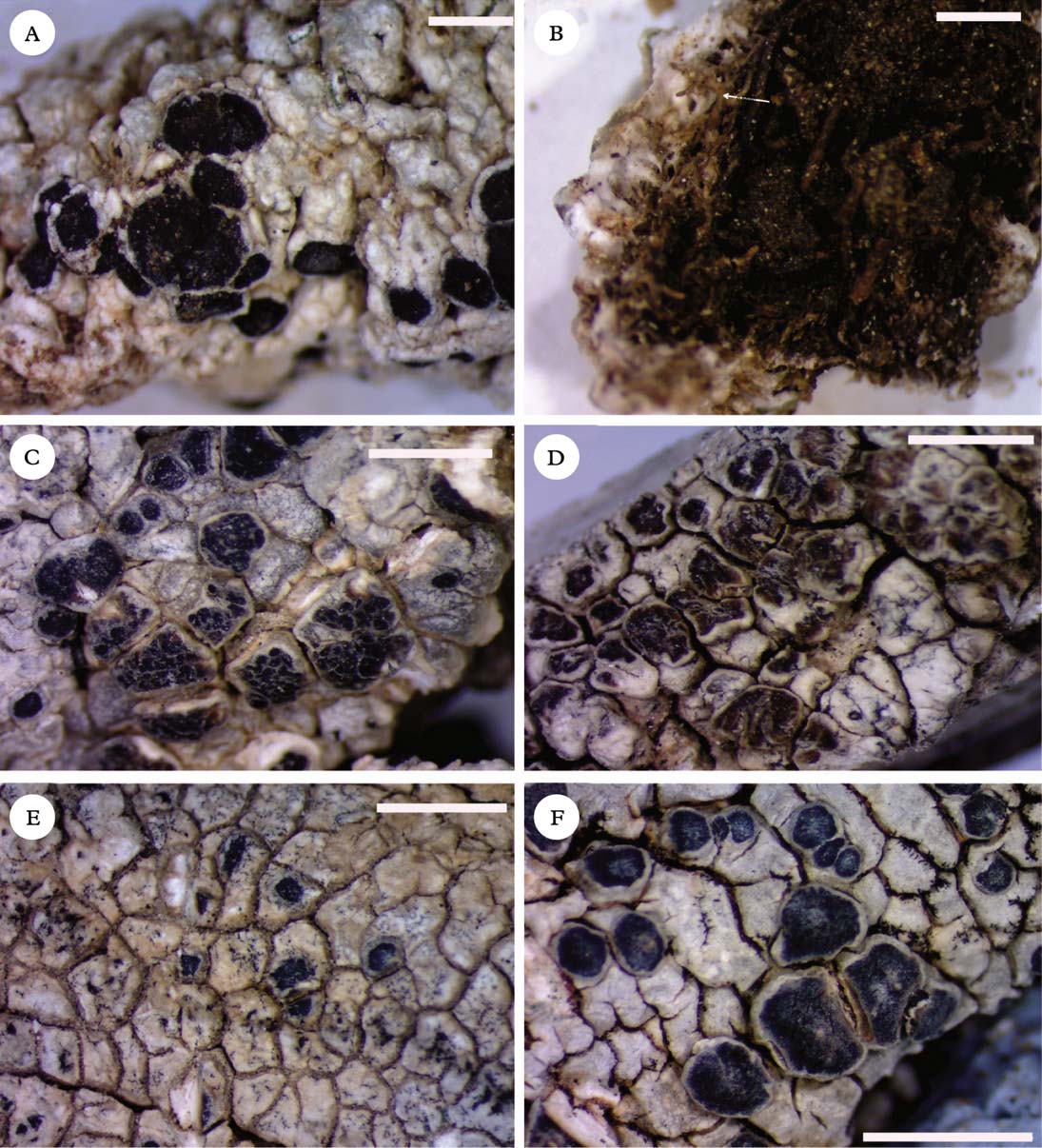
Currently, the relationships of epiphytic Aspicilia s. lat. species to major groups within Megasporaceae remain unclear. The corticolous taxon Aspicilia uxoris was originally studied from material collected in Algeria, Morocco and Spain (Rico et al. Reference Rico, Aragón and Esnault2007). However, recent collections of corticolous/lignicolous specimens of Aspicilia, particularly on Juniperus spp. in Iran and western North America (Shrestha & St. Clair Reference Shrestha and St. Clair2009), indicated that A. uxoris s. lat. probably has a much broader geographical distribution than originally assumed. Furthermore, a particularly puzzling specimen was recently collected on plant debris on soil in an open Juniperus forest in southern Anatolia in Turkey (M. G. Halici s. n. – hb. M.G. Halici). This specimen showed morphological similarities to both the epiphytic taxon A. uxoris and some terricolous species, such as A. tibetica Sohrabi & Owe-Larss., Aspicilia mansourii Sohrabi (see Lumbsch et al. Reference Lumbsch, Ahti, Altermann, Amo de Paz, Aptroot, Arup, Bárcenas Peña, Bawingan, Benatti and Betancourt2011) and A. crespiana V. J. Rico (Rico Reference Rico1999), suggesting the potential for increased morphological variability and substratum preference within A. uxoris s. lat. A literature search revealed the existence of several other epiphytic Aspicilia species described from Central Asia: Lecanora ferganensis Tomin (Fig. 2D) described from Uzbekistan (Tomin Reference Tomin1950) growing on Juniperus trees and also recorded from some localities in Kyrgyzstan (Baǐbulatova Reference Baǐbulatova1988), Tajikistan (Kudratov Reference Kudratov1984, Reference Kudratov1985; Kudratov & Mayrhofer Reference Kudratov and Mayrhofer2002) and Uzbekistan (Tomin Reference Tomin1950; Shafeev Reference Shafeev1953); Lecanora atrodiscata Gintovt (Fig. 2E) from Tajikistan growing on Populus bark (Gintovt Reference Gintovt1959); and Lecanora takyroides Dzhur. from Turkmenistan growing on Turkmen juniper (Dzhuraeva Reference Dzhuraeva1974). As part of an ongoing study of the systematics of Megasporaceae, we investigated the relationships of the epiphytic species Aspicilia uxoris to other previously recognized groups by using DNA sequence data from the nuclear ribosomal ITS and LSU markers. Our objectives were to 1) identify the phylogenetic position of A. uxoris and related species within Megasporaceae, 2) assess biogeographical and morphological patterns within A. uxoris s. lat, and 3) re-evaluate relationships within Megasporaceae. In this study, phylogenetic analyses recovered species within the A. uxoris group as a well-supported monophyletic clade, sister to Lobothallia, within Megasporaceae. Since this species group cannot be included in any of the existing genera within this family, the new genus Teuvoa is formally described here. Additionally, morphological, biogeographical, and molecular sequence data support the distinction of a previously unrecognized species within the A. uxoris group, described here as Teuvoa junipericola.
Materials and Methods
Taxon sampling
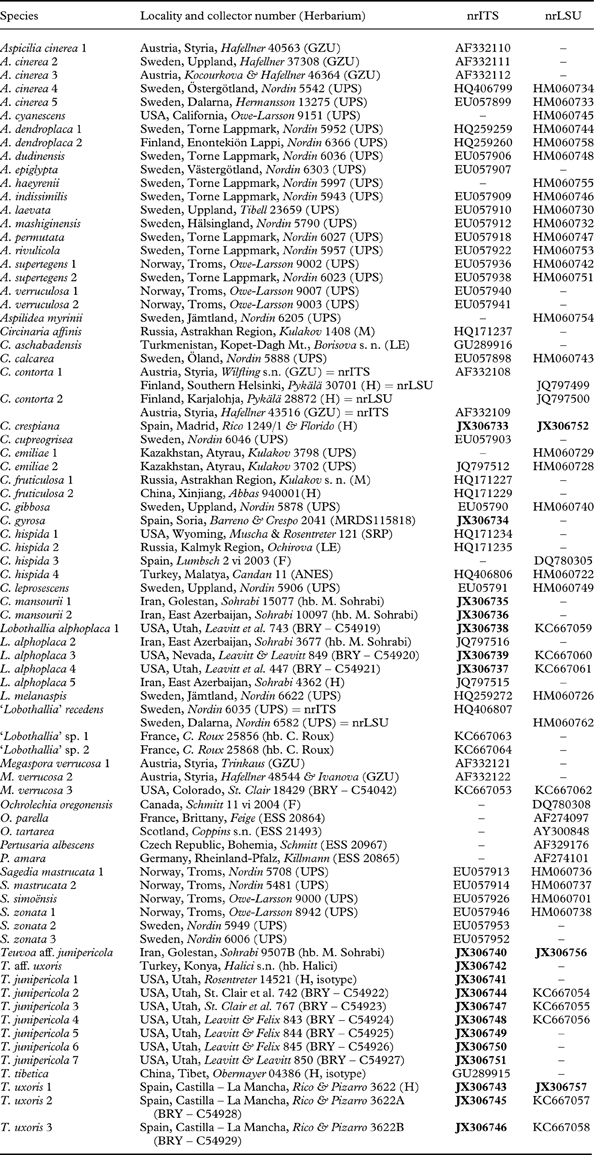
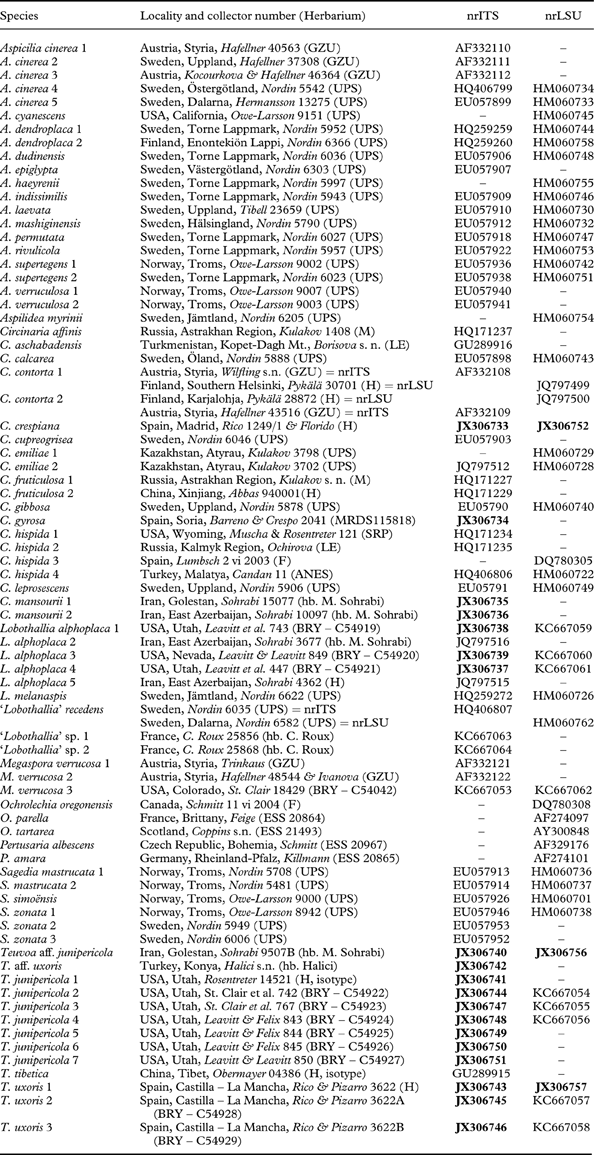
In the present study a total of 77 specimens were included in order to assess the phylogenetic position of the Aspicilia uxoris group within Megasporaceae (Table 1). Specimens were selected to represent genera currently circumscribed within Megasporaceae, including Aspicilia, Sagedia, Lobothallia, Megaspora, and Circinaria (sensu Nordin et al. Reference Nordin, Tibell and Savić2010). For the nomenclature of Circinaria affinis, C. aschabadensis, C fruticulosa, and C. hispida, see Sohrabi et al. (2012). The focal group was represented by 13 specimens of A. uxoris s. lat. and a single representative of A. tibetica. We were unable to obtain fresh material corresponding to Lecanora ferganensis, L. atrodiscata and Lecanora takyroides from Central Asia for molecular analyses, although a single collection of A. uxoris s. lat. was made from Iran. Representatives of Aspilidea, Ochrolechia, and Pertusaria were used as outgroup taxa (Nordin et al. Reference Nordin, Tibell and Savić2010). Voucher specimen information and GenBank accession numbers for sequences produced for this study are listed in Table 1, together with sequences obtained from GenBank. For Circinaria contorta and Megaspora verrucosa, we combined nuclear ITS and LSU data from different individuals in order to represent important lineages with both loci sampled in this study. Additional specimens from the Aspicilia uxoris group investigated for this study are deposited in B, BRY, GZU, H, IRAN, LE, MAF, MSK, the herbarium of M. G. Halici (hb. M. G. Halici) in Erciyes University and the herbarium of the first author. Specimens, including Lecanora atrodiscata, L. ferganensis and L. takyroides, were examined under a light microscope and a stereomicroscope, and tested with the usual reagents (K, C, KC, P, N and KOH/I). Thin-layer chromatography (TLC) followed Orange et al. (Reference Orange, James and White2001), using solvent systems A, B and C. For spore shape terminology, see Bas (Reference Bas1969: 321–332).
Material used in this study. Vouchers, their geographical origin, and herbaria where vouchers are deposited are also listed. GenBank accession numbers of the newly obtained sequences are in bold.
DNA extraction, PCR amplification and sequencing
Total genomic DNA was extracted from herbarium specimens (e.g., A. crespiana, A. tibetica), recent collections of A. uxoris, and the newly described species A. mansourii Sohrabi (see Lumbsch et al. Reference Lumbsch, Ahti, Altermann, Amo de Paz, Aptroot, Arup, Bárcenas Peña, Bawingan, Benatti and Betancourt2011) following Sohrabi et al. (Reference Sohrabi, Myllys and Stenroos2010a ) or Leavitt et al. (Reference Leavitt, Johnson and St. Clair2011). DNA sequence data were generated from the nuclear ribosomal ITS (ITS1, 5.8S, ITS2) and LSU regions via the polymerase chain reaction (PCR). The complete ITS region was amplified using the primers ITS1F (Gardes & Bruns Reference Gardes and Bruns1993) and ITS4 (White et al. Reference White, Bruns, Lee, Taylor, Innis, Gelfand, Sninsky and White1990). A fragment of the LSU was amplified using AL2R (Mangold et al. Reference Mangold, Martín, Kalb, Lücking and Lumbsch2008) and LR3 (Vilgalys & Hester Reference Vilgalys and Hester1990). Standard PCR reactions were used to amplify targeted loci. PCR cycling parameters for amplifying the ITS loci included an initial denaturation for 1 min 25 s at 94°C, followed by 35 cycles of 35 s at 95°C, 55 s at 55°C, 45 s at 72°C, with a 4 s increase per cycle, terminating with a final elongation at 72°C for 10 min. Cycling parameters for the LSU fragment followed Blanco et al. (Reference Blanco, Crespo, Elix, Hawksworth and Lumbsch2004). Purification and sequencing of PCR products were performed by Macrogen Inc. (www.macrogen.com) or followed Leavitt et al. (Reference Leavitt, Johnson and St. Clair2011).
Sequence alignment and phylogenetic analyses
Sequences were assembled and edited using Sequencher version 4.6.1 (Gene Codes Corporation, Ann Arbor, MI) and sequence identity was confirmed with a ‘megaBLAST’ search in GenBank (Wheeler et al. Reference Wheeler, Barrett, Benson, Bryant, Canese, Chetvernin, Church, DiCuccio, Edgar and Federhen2005). The program SATé has been shown to improve alignment accuracy compared to other currently available programs (Liu et al. Reference Liu, Raghavan, Nelesen, Linder and Warnow2009, Reference Liu, Warnow, Holder, Nelesen, Yu, Stamatakis and Linder2012), including lichen-forming fungi (Leavitt et al. Reference Leavitt, Esslinger and Lumbsch2012). Therefore, ITS and LSU sequences were aligned seperately in SATé version 2.2.5 using the following options: ‘Aligner’ = MAFFT, ‘Merger’ = MUSCLE, ‘Tree Estimator’=RAxML, and ‘RAxML Model’=GTRGAMMA. Each alignment was run for 500 iterations following the final improvement under the remaining default SATé settings. Ambiguously aligned positions were removed from the aligned ITS dataset using the program Gblocks v. 0.91b, implementing settings which allow for smaller final blocks, gap positions within the final blocks, and less strict flanking positions (Castresana Reference Castresana2000). Gblocks provides an objective and repeatable method to exclude difficult to align regions within a multiple sequence alignment, a procedure that has been shown to improve phylogenetic accuracy in some cases (Talavera & Castresana Reference Talavera and Castresana2007). The Gblocks-modified ITS matrix and LSU alignment were combined for subsequent phylogenetic anlyses.
Phylogenetic hypotheses were constructed under both maximum likelihood (ML) and Bayesian inference (BI) criteria. ML searches were conducted using the program RAxML v. 7.2.8, allowing separate GTRGAMMA models with unique parameter values for each locus (Stamatakis Reference Stamatakis2006; Stamatakis et al. Reference Stamatakis, Hoover and Rougemont2008). A search combining 200 separate maximum likelihood searches to find the optimal tree and 1000 ‘fastbootstrap’ replicates to evaluate nodal support was conducted using the combined ITS/LSU dataset.
Bayesian phylogenetic inference was estimated from the combined dataset using the program MrBayes v. 3.1.2 (Huelsenbeck et al. Reference Huelsenbeck, Ronquist, Nielsen and Bollback2001; Ronquist & Huelsenbeck Reference Ronquist and Huelsenbeck2003), using default priors. MrModeltest was used to identify the best-fitting model of evolution for each marker using the Akaike Information Criterion (AIC; Posada & Crandall Reference Posada and Crandall2001; Posada & Buckley Reference Posada and Buckley2004) and each marker was treated as a separate partition using unique parameter values for shared parameters and proportional partition rates. Four independent runs were executed with four chains; each run started from randomly generated trees and sampling every 1000 generations for 10 000 000 generations. To evaluate stationarity and convergence between runs, log-likelihood scores were plotted using the program Tracer v. 1.5 (Rambaut & Drummond Reference Rambaut and Drummond2005). Effective sample size (ESS) statistics were all ≫200 and the average standard deviation in split frequencies was below 0·01 (=0·0063) (Hall Reference Hall2007). The first 250 000 generations were discarded as burn-in, and the results were summarized in the form of a maximum clade credibility tree using Tree Annotator (http://beast.bio.ed.ac.uk/TreeAnnotator).
Results and Discussion
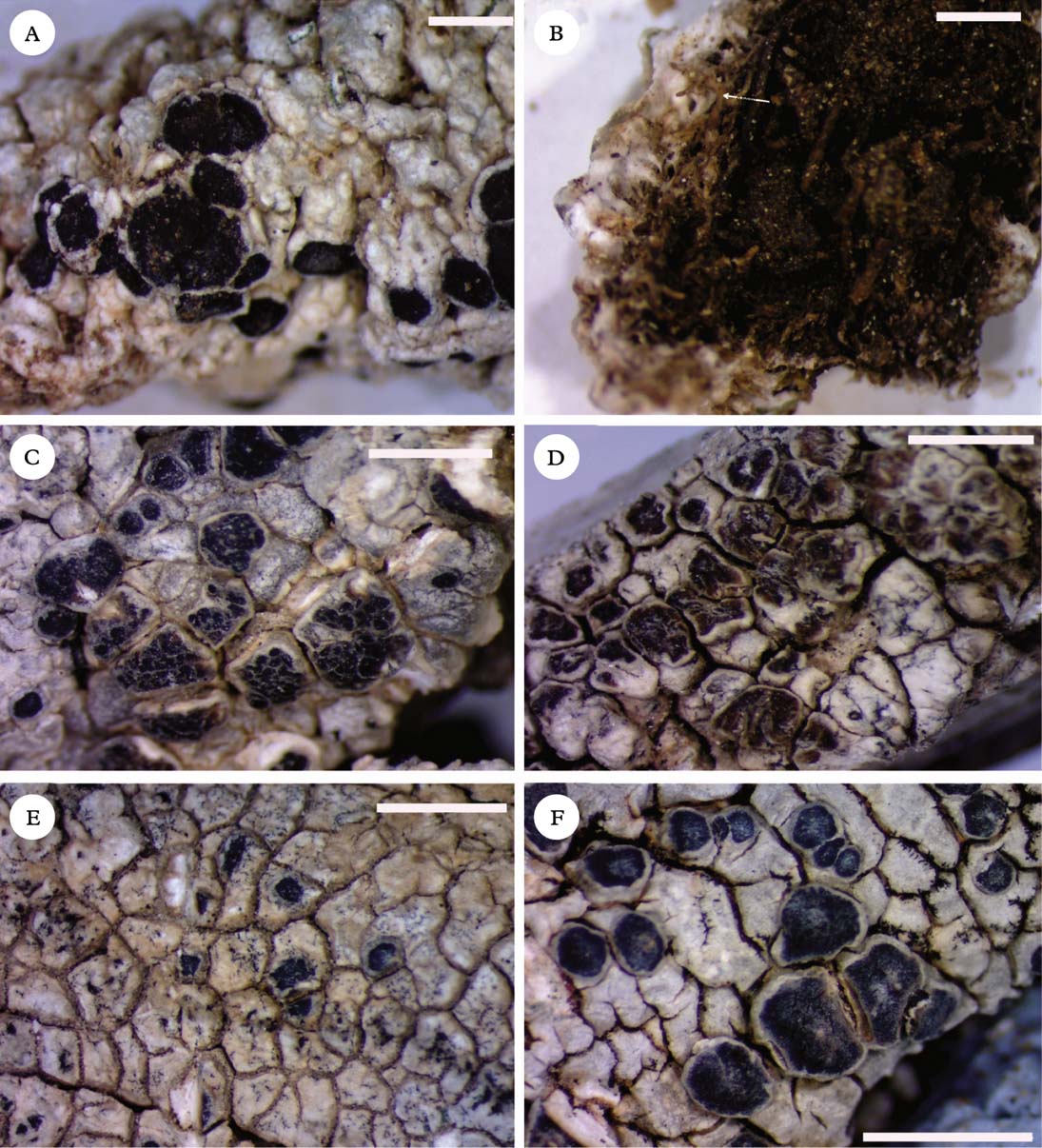
The morphological analyses and comparison with the type material from Spain indicated that all the available epiphytic specimens were morphologically similar to Aspicilia uxoris s. lat. (Rico et al. Reference Rico, Aragón and Esnault2007), including type material of three epiphytic species described from Asia: Lecanora atrodiscata, L. ferganensis and L. takyroides. Consequently, the three epiphytic species described from Asia become heterotypic synonyms for Aspicilia uxoris: Lecanora ferganensis (Fig. 2D), known from Kyrgyzstan, Tajikistan and Uzbekistan (Tomin Reference Tomin1950; Shafeev Reference Shafeev1953; Kudratov Reference Kudratov1984, Reference Kudratov1985; Baibulatova Reference Baǐbulatova1988; Kudratov & Mayrhofer Reference Kudratov and Mayrhofer2002); Lecanora atrodiscata (Fig. 2E), from Tajikistan growing on Populus sp. bark (Gintovt Reference Gintovt1959); and Lecanora takyroides from Turkmenistan, growing on Turkmen juniper (Dzhuraeva Reference Dzhuraeva1974).
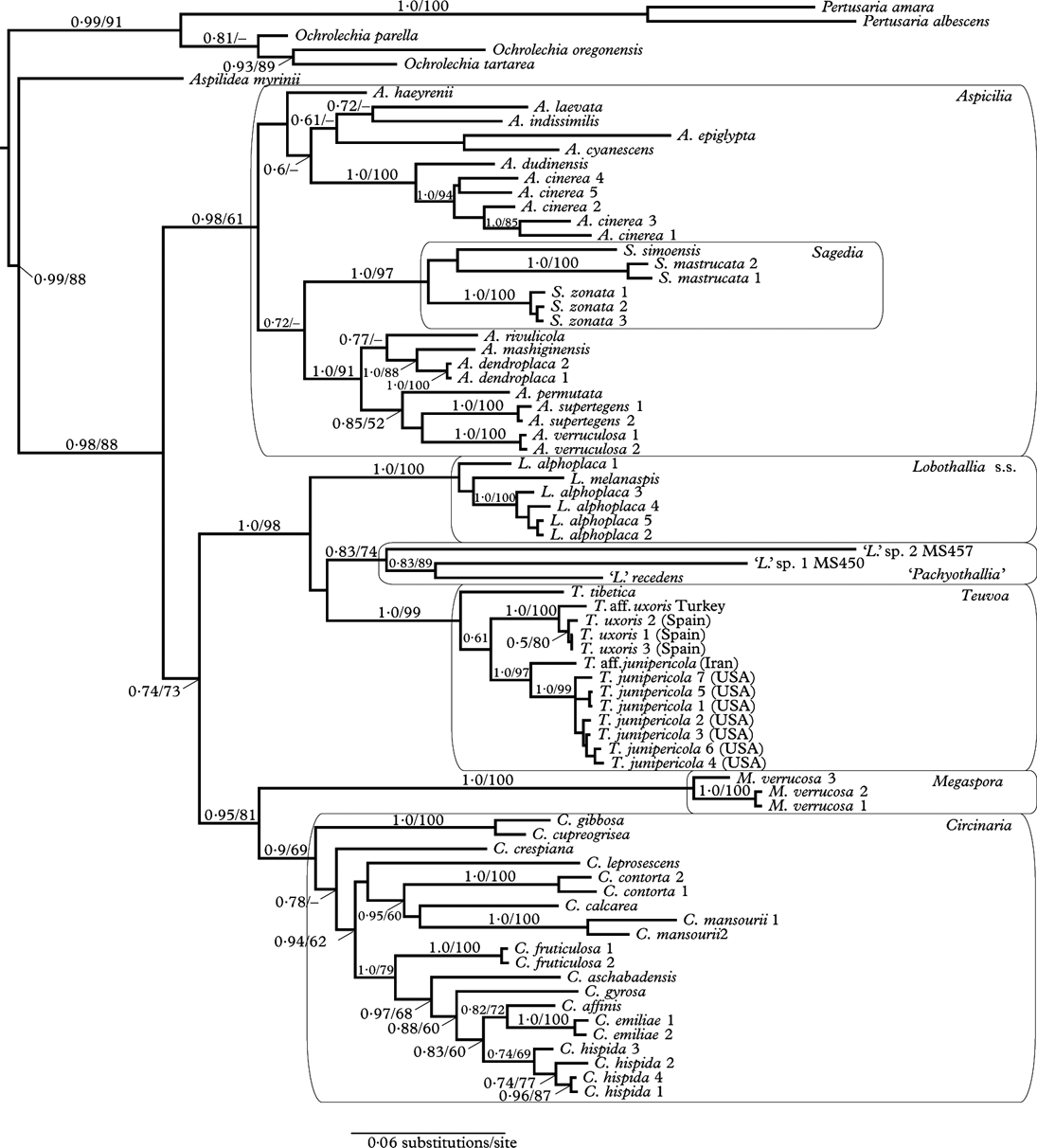
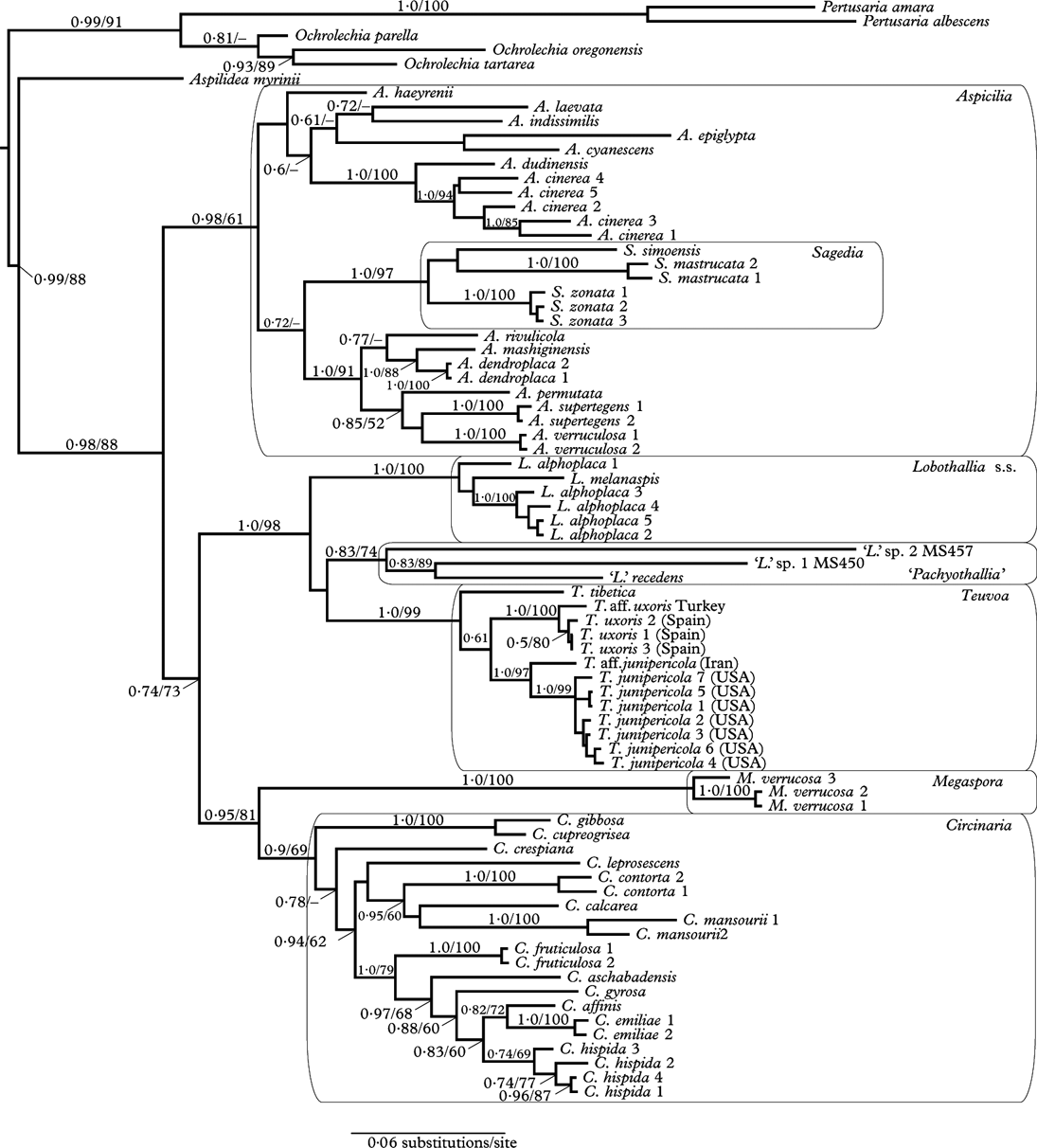
A total of 127 ambiguously aligned nucleotide positions were removed from the initial multiple sequence ITS alignment made in SATé, resulting in a combined ITS/LSU matrix consisting of 1191 aligned bp (ITS=457 bp; and LSU=706 bp). The ML and BI topologies from the combined dataset were identical at all well-supported nodes, and we chose to present the BI topology (Fig. 1). The ‘Lobothallia’ group received moderate ML bootstrap support (BS=64) and strong support in the BI topologies (posterior probability=1·0) (Fig. 1). The ‘Lobothallia group’ included Lobothallia s. str., ‘Pachyothallia’ sensu Clauzade & C. Roux, and ‘Aspicilia’ uxoris; however, relationships among these lineages were unresolved. Specimens representing ‘Aspicilia’ uxoris s. lat. formed a well-supported monophyletic clade within the ‘Lobothallia’ group (Fig. 1) and are hereafter referred to as the ‘Teuvoa’ group, corresponding to the new genus Teuvoa. Specimens identified as ‘Aspicilia’ uxoris s. lat. were recovered in two well-supported lineages within the Teuvoa group. One clade included isotype material from ‘Aspicilia’ uxoris collected from Spain, labelled here as ‘Teuvoa uxoris’ (Fig. 1). The specimen found on plant debris on soil in southern Anatolia (‘T. aff. uxoris’) was also recovered within the epiphytic ‘T. uxoris’ clade, and was not related to the terrestrial species A. mansourii and A. crespiana (Fig. 1). The second well-supported lineage within the Teuvoa group contained T. uxoris s. lat. specimens collected in western North America and Iran. All specimens from western North America were recovered within a single well-supported lineage (‘T. junipericola’), sister to a single specimen collected in Iran (‘T. aff. junipericola’). Teuvoa tibetica was recovered as sister to the ‘T. junipericola’ clade, with weak statistical support.
Phylogenetic relationships within Megasporaceae, including the new genus Teuvoa, derived from Bayesian inference of nuclear ribosomal ITS and LSU sequence data. Values at each node indicate non-parametric bootstrap support (BS)/posterior probability (PP). Only support indices≥PP 0·50/ BS 50 are indicated. With the exception of the newly described genus in this study, Teuvoa, generic concepts within Megasporaceae follow Nordin et al. (Reference Nordin, Tibell and Savić2010) and Sohrabi et al. (2012).
A & B Teuvoa uxoris, habit, arrow indicates rhizomorph-like extensions (Turkey; Halici s. n.); C, Lecanora atrodiscata (LE L314—holotype); D, Lecanora ferganensis (H—isolectotype); E, Lecanora takyroides (LE L358—holotype); F, Teuvoa junipericola, Utah, USA (Rosentreter 14521, H—isotype). Scales: A–F=1 mm. In colour online.
Relationships of major lineages within Megasporaceae are similar to results reported in Nordin et al. (Reference Nordin, Tibell and Savić2010) (Fig. 1). However, relationships among genera within Megasporaceae were generally only weakly supported in the present study.
In this study, a substantial number of ambiguous nucleotide characters were excluded from the nuclear ribosomal ITS marker. Although our results are largely congruent with previous phylogenetic hypotheses of Megasporaceae (Nordin et al. Reference Nordin, Tibell and Savić2010), the impact of removing difficult to align regions, which are often the most rapidly evolving regions and contain valuable phylogenetic signals (Lee Reference Lee2001), is uncertain. These results highlight the importance of including additional loci for establishing a well-supported hypothesis of relationships within the family (Schoch et al. Reference Schoch, Seifert, Huhndorf, Robert, Spouge, Levesque and Chen2012). Current molecular sampling supports the distinction of Lobothallia s. str., ‘Pachyothallia’ and Teuvoa as three monophyletic clades. Relationships within the Lobothallia s. str., ‘Pachyothallia’ clades are currently under investigation using a multi-loci phylogenetic framework and will be presented in a subsequent paper (M. Sohrabi, S. D. Leavitt, A. Nordin & B. Owe-Larsson, unpublished).
According to Sohrabi et al. (Reference Sohrabi, Owe-Larsson, Nordin and Obermayer2010b ), Teuvoa tibetica (syn: Aspicilia tibetica) is a terricolous species, growing on plant debris at a high altitude in the Tibetan region of China. Teuvoa uxoris s. lat. is a predominantly lignicolous species, mainly reported on conifers from North America to Pakistan in the Holarctic (see Ecology and distribution). Both T. tibetica and T. uxoris s. lat. show morphological and chemical similarities: 8-spored asci, bacilliform conidia, absence of extrolites (secondary substances) and a subhypothecial algal layer (Rico et al. Reference Rico, Aragón and Esnault2007; Sohrabi et al. Reference Sohrabi, Owe-Larsson, Nordin and Obermayer2010b ). However, specimens within T. uxoris s. lat. have larger non-globose spores, moniliform paraphyses, pruinose lecanoroid apothecia and it rarely develops rhizomorph-like extensions. Phylogenetic analyses revealed that T. tibetica and T. uxoris s. lat. are not conspecific, but are both nested in the new genus Teuvoa.
Taxonomy
Teuvoa Sohrabi & S. Leavitt gen. nov.
MycoBank No.: MB 800659
Type: Teuvoa uxoris (Werner) Sohrabi, V. J. Rico & S. Leavitt (BC hb. Werner! s. n.)
Thallus crustose, verrucose, distinctly areolate, rimose, contiguous, margin indistinct to distinct; prothallus absent. Surface white to grey, dull. Cephalodia absent. Pseudocyphellae absent. Cortex one layer, paraplectenchymatous. Medulla white, I−. Photobiont Trebouxia or other chlorococcoid genera; cells ± globose. Ascomata apothecial, aspicilioid. Disc black to brown-black, flat, rarely concave or convex. Thalline margin ± elevated, prominent; concolorous with thallus. True exciple thin, distinct, ± I+. Epihymenium green to olive-brown, N± light green, K± brown; paraphysoids (sub) moniliform to non moniliform, with (1–8) uppermost cells ± globose to subglobose. Subhymenium and hypothecium hyaline, I+ blue. Asci clavate, Aspicilia-type, wall and apical dome I−, outer coat I+ blue, with 8 spores. Ascospores hyaline, simple, globose to ellipsoid, I−. Conidiomata pycnidial, immersed, single or aggregated; ostiole dark, punctiform to elongated; conidiogenous cells sessile or on short conidiophores.
Conidia hyaline, simple, more or less filiform, straight.
Chemistry
Spot tests: cortex and medulla K−, C−, P−. Secondary metabolites: none detected.
Etymology
The generic epithet honours Professor Teuvo Ahti, one of the prominent lichen taxonomists of the 20th century.
Distribution
Mostly found in the temperate regions of the Holarctic, growing mainly on wood or plant debris.
Comments
Teuvoa is distinguished from Aspicilia by its small ascospores and conidia size (5–8 µm), and the absence of extrolites (secondary metabolites). It is also distinguished from Lobothallia s. str. by the lack of lobate, radiating thalli, a subhypothecial algal layer (in some), absence of extrolites [norstictic, constictic (9′-O-methylsalazinic acid) and salazinic acids], and having organic substrata corticolous/terricolous, on bark, wood and dead plant debris (non-saxicolous thalli). Teuvoa is separated from ‘Aspicilia subgenus Pachyothallia Clauzade & C. Roux’ by the lack of a subhypothecial algal layer, lecanoroid apothecia, absence of extrolites (norstictic and constictic acids) and growing on organic substrata and a different ecological amplitude.
The Species
Teuvoa junipericola Sohrabi & S. Leavitt sp. nov.
MycoBank No.: MB 800661
Morphologically similar to Eurasian T. uxoris but differs somewhat by having larger ascospores (10–16×13–22 µm) and a different geographical distribution which is so far restricted to the arid continental regions of the western USA.
Type: USA, Utah, Kane County, East of Kanab, Five Mile Road area, off Hwy #89, 37°2′N / 112°14′W, pinyon-juniper woodland with Artemisia tridentata subsp. wyomingensis, Hilaria jamesii, mixed with Artemisia nova and Oryzopsis hymenoides, 1650 m, on Juniperus sp., 24 January 2001, R. Rosentreter 14521 (BRY—holotype; H, MAF—isotypes).
(Fig. 1F)
Thallus corticolous to lignicolous, on conifers. Areoles irregular, flat to convex, rather thick, opaque, angular to rounded. Surface grey to whitish grey, with a greenish shade, slightly roughened, ± pruinose, up to 2 mm wide.
Apothecia numerous, cryptolecanorine or ± urceolate when young, becoming lecanoroid or lecideoid when mature, orbicular to slightly angular, simple to frequently composite, up to 1·0–2·5 mm wide. Disc concave to plane or slightly convex when mature, brown to brownish black, but whitish to bluish grey by pruine. Thalline exciple ± well-developed, concolorous with thallus, thin, smooth, not flexuous. True exciple up to 160 µm wide laterally, variable in development and thickness, of ± paraplectenchymatous tissue. Epihymenium dark to olive brown, rarely light brownish, pigment N+ green to fairly blue-green, K+ brown to green, up to 30(–40) µm tall, with granular surface, partially soluble in N and K. Hymenium hyaline, I+ persistently blue, (80–)90–145(–160) µm tall, conglutinated. Subhymenium and hypothecium pale, I+ persistently blue. Paraphyses moniliform, usually simple, rarely branched in lower parts and anastomosed, with 1–7 globose to subglobose cells apically. Asci clavate, (65–)70–120(–135)×18–30(–35) µm, 8-spored, apical apparatus thick, K/I−. Ascospores hyaline, simple, (10–)11[12·9] 14(–16)×(13–)16[17·9]19(–22) µm, (n=81), ellipsoid to elongate (-cylindrical).
Pycnidia usually very common, 1–3(–5) per areole, immersed, often indistinct, occasionally with a white rim, and aggregated, 100–300 µm diam.; with a brownish or black ostiole, 40–100(–190) µm diam. Conidia 5–8×0·75–1·00(–1·70) µm, bacilliform, straight.
Chemistry
Spot test: cortex and medulla K−, C−, KC−, I−, and PD−. Secondary metabolites: no lichen substances detected.
Etymology
The specific epithet refers to the substratum (Juniperus tree) on which this new species was found.
Distribution and ecology
Widespread in the arid continental regions of the western USA, largely restricted to the Colorado Plateau and Great Basin.
Comments
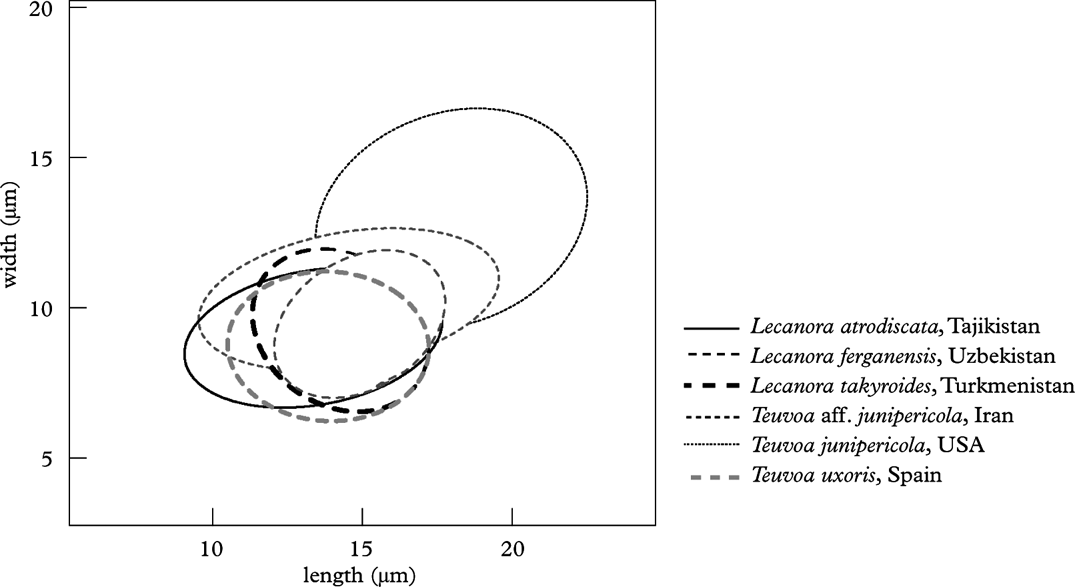
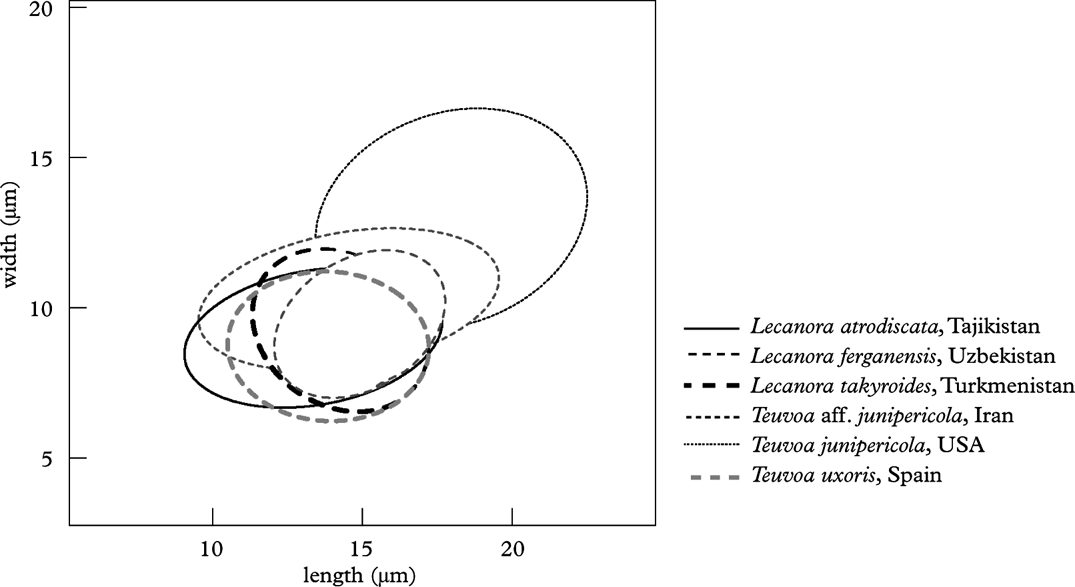
Teuvoa junipericola has the habit of T. uxoris, growing on juniper trees, and prefers arid climates. Previously, it was reported by Shrestha & St. Clair (Reference Shrestha and St. Clair2009) as Aspicilia uxoris, new to the USA, but detailed morphological investigations of the American and Eurasian specimens of A. uxoris showed that American species generally have a larger ascospore than the Eurasian specimens (see also Fig. 3). To assess this difference, molecular sequence data were obtained from several American and Eurasian specimens. The results show that all American specimens were included within a single well-supported lineage T. junipericola, sister to a single Eurasian specimen collected in Iran (‘T. aff. junipericola’). Detailed morphological studies showed that the Iranian specimen has an intermediate ascospore size compared to other American and Eurasian specimens. Therefore, we refrain from including the Iranian specimen within the new species T. junipericola until additional specimens from Central Asia are investigated.
Relationship between ascospore length and width within the Eurasian and North American species of the genus Teuvoa with 95% confidence ellipses obtained from ascospore measurements of 30 ascospores per specimen. The graph was implemented in the R program using boxplot and ellipse packages (see R Development Core Team 2008).
Additional specimens examined. USA: Colorado: Moffat County, Dinosaur National Monument, Deerlodge Park, Plug Hat Picnic Area, 40°17·584′N / 108°57·991′W, 2073 m, in pinyon-juniper woodland, on lignum of Juniperus osteosperma, 5 v 1992, L. St. Clair, C. Newberry & K. St. Clair (BRY – 35721). Utah: Duchesne County, Pinyon Ridge Rest Area, along US Highway 40°12·231′N / 110°42·777′W, 2055 m, in Pinion-Juniper woodland, 2009, L. St. Clair, S. Leavitt 742 & G. Shrestha (BRY); San Juan County, vicinity of Moonhouse Ruin, 37°25·855′N / 109°47·823′W, 1761 m, in pinyon-juniper woodland, 2009, S. Leavitt 850 & J. Leavitt (BRY); Uintah County, Brush Creek Drainage of Coyote Gulch near US Route 191, 40°35′15·7′N / 109°28′32·2′W, 1786 m, in pinyon-juniper woodland, 15 vii 2009, L. St. Clair, S. Leavitt. G. Shrestha & C. Newberry [Leavitt 767 (BRY)]; Wayne County, vicinity of Upper Muley Twist Trailhead, 37°51·647′N / 111°02·414′W, 1773 m, on Juniperus lignum in pinyon-juniper woodland, 2008, Leavitt 843, 844 & 845 & M. Felix (BRY).—Iran: Golestān: Gorgān district, Shahkuh-e-Bala, c. 33 km S of Gorgān along minor road to Shahrud, 36°33·69′N / 54°33·68′E, 2600 m, Astragalus steppe with scattered Juniperus excelsa on steep mountain slope in valley, on decorticated wood of J. excelsa, 2007, M. Sohrabi 9507B, H. Sipman, U. Søchting & R. Zare (hb. M. Sohrabi, IRAN, B, H, MAF-Lich. 16248, here as Teuvoa aff. junipericola).
Teuvoa uxoris (Werner) Sohrabi, V. J. Rico & S. Leavitt comb. nov.
MycoBank No.: MB 800660
Lecanora uxoris Werner, Bull. Soc. Sci. Nat. Maroc 18(2): 130–131 (1938) [basionym, as “Lecanora (Zeora) uxoris”]; type: [Morocco: Ifrane: road from Azrou to Midelt,] Ad corticem Juniperi thuriferae cum Parmelia jacquesii prope lacum Si[di] Ali-ou-Mohand dictum in Atlante Medio ad alt. 2100 m, [33°05′N, 05°00′W,] 30 viii [19]34 (BC hb Werner! s. n.—lectotype and isolectotype).—Aspicilia uxoris (Werner) V. J. Rico, Aragón & Esnault, Lichenologist 39: 110 (2007).
New heterotypic synonyms:
Lecanora ferganensis Tomin, Sborn. Naučn. Trudov Inst. Biol. Akad. Nauk Belorussk. SSR [Minsk] 1: 82 (1950); type: “In promontoriis jugi Alaiensis, Ad lignum nudum Juniperi, Dzhajlau Schaid”, Uzbekistan, Ferganskaya Oblast’, close to the Alai Range, Shand summer pastures, on lignum of old Juniperus sp., 26 November 1946 [?8], N. Shafeev s. n. (MSK s. n.!—lectotype, designated here; H s. n.!—isolectotype; LE L328!—isolectotype).—Aspicilia ferganensis (Tomin) Baǐbul. ad int.
Lecanora atrodiscata Gintovt, Uzbeksk. Biol. Žurn. 4: 72 (1959); type: Tajikistan, Leninobod, between Panjakent and Urmetan, south-western slope of the Dashtikazy canyon, on the bark of Populus sp., 7 June 1956, E. A. Gintovt (LE L314—holotype).
Lecanora takyroides Dzhur., Novosti Sist. Nizšh. Rast. 11: 294 (1974); type: Turkmenistan, Akhal'skaya Oblast’, central Khrebet Kopet Dag Mountains, Dushak summit, 2290 m, on dry twigs of Turkmen juniper [Juniperus polycarpos K. Koch.], 2 June 1967, Z. Dzhuraeva s. n. (LE L358—holotype).
A full description is provided in Rico et al. (Reference Rico, Aragón and Esnault2007); an actualized short description, with ecological data, is included here. Thallus corticolous to lignicolous, on conifers or rarely on deciduous trees (Populus sp.), areolate to rimose-areolate or slightly verrucose. Sometimes the thalli become partially detached from the phorophyte, forming holes between the lichen and the bark or wood, finally become detached portions and fall to the ground, carrying bark portions on the lower surface and developing whitish to yellow-brown rhizomorph-like hypothalline extensions, 1–3 mm long.
Distribution and ecology
Based on the results of this study, it appears that T. uxoris represents an element with typical Madrean-Thethyan disjunction (Raven Reference Raven, Davis, Harper and Hedge1971; Wen & Ickert-Bond Reference Wen and Ickert-Bond2009). Teuvoa uxoris belongs to a Mesogean contingent (cf. Quézel Reference Quézel1978), widely distributed in large isoclimatic continental Mediterranean areas of the Mediterranean, Irano-Turanian and Saharo-Sindian phytogeographical regions, as was suggested for some terricolous lichens by Barreno (Reference Barreno1991). Pending additional data, it appears that some other lichen species, including terricolous (such as vagrant Circinaria), epiphytic and saxicolous species, with similar distributional and ecological ranges could be included in this Mesogean lichen contingent (e.g. Follmann & Crespo Reference Follmann and Crespo1974; Crespo & Barreno Reference Crespo and Barreno1978; Barreno Reference Barreno1991; Egea & Alonso Reference Egea and Alonso1996; Martínez et al. Reference Martínez, Aragón, Carrión, Escudero, Burgaz and Coppins2003; Rico et al. Reference Rico, Aragón and Esnault2007). Furthermore, several bryophytes exhibit a similar type of distribution (cf. Moya et al. Reference Moya, Ros, Guerra and Cano1995).
Teuvoa uxoris has been collected on various coniferous trees and shrubs: Cedrus atlantica (Endl.) Manetti, Juniperus oxycedrus L., J. phoenicea L., J. thurifera L. and Pinus halepensis Miller (Rico et al. Reference Rico, Aragón and Esnault2007). Taking into account that all these phorophytes are conifers, which have a very acid bark, and that bark acidity is one of the most important and selective chemical factors for epiphytic lichens (Barkman Reference Barkman1958), it can be expected that T. uxoris may also occur on other coniferous species, such as Juniperus excelsa M.-Bieb., J. osteosperma (Torr.) Little, J. polycarpos K. Koch. and J. sabina L. All these Cupressaceae have a largely relictual distribution in the Holarctic, from western Mediterranean mountains (J. sabina) or the eastern Mediterranean (J. excelsa and J. polycarpos) to Minor Asia, Central Asia (e.g. Iran, Uzbekistan), Pakistan (Baluchistan) and India (Himachal Pradesh), where they form open forest ± confined to semi-arid regions (Vidakovic Reference Vidakovic and Soljan1991; Farjon Reference Farjon1992, Reference Farjon2005). The preference of Teuvoa uxoris for conifers forming ± open forest and growing on calcareous substrata, with continental influences (never near the coast) in a contrasted seasonal climate (cold-hot, ± semi-arid), suggests that the range of T. uxoris may extend still further in view of the availability of suitable host trees and climate conditions. Furthermore, within T. uxoris, two records appear to have a deviating substratum preference: a collection from Turkey was found on debris on soil under Juniperus trees; and the type collection of ‘Lecanora’ atrodiscata was on Populus bark in Tajikistan. These specimens indicate that T. uxoris is not restricted to conifers.
Comments
The taxonomy of epiphytic Teuvoa uxoris populations in Central Asia, including ‘Lecanora’ atrodiscata, ‘L.’ ferganensis and ‘L.’ takyroides, remains uncertain. All three species are morphologically and chemically similar to T. uxoris. Type collections corresponding to ‘L.’ atrodiscata and ‘L.’ takyroides were found in LE herbarium. One of three specimens of ‘L.’ ferganensis found in MSK herbarium (with collecting date “26.XI.1946[?8]”) is clearly identifiable with the original description in Tomin (Reference Tomin1950) and consequently is designated here as a lectotype. However, the relationship of these collections with other epiphytic species within Teuvoa remains unclear. The only specimen from Central Asia, included in the phylogenetic portion of this study, T. aff. uxoris, is morphologically and chemically indistinguishable from T. uxoris s. str., but appears to be more closely related to T. junipericola from western North America. Ultimately it appears likely that molecular phylogenetic studies will be required to accurately resolve the taxonomy of these epiphytic populations from Central Asia.
Additional specimens examined. Spain: Castilla-La Mancha: Guadalajara, Zaorejas, carretera de Villanueva de Alcorón a Zaorejas, cruce a Huertapelayo, sabinar en calizas, sobre Juniperus thurifera, 40°43′58·57″N / 2°12′35·92″W, 2006, V. J. Rico 3622 & J. Pizarro (BRY 765, 766, H, MAF-Lich. 14275).—Turkey: Konya, G. Halici s. n. (hb. Halici, here as Teuvoa aff. uxoris).
Teuvoa tibetica (Sohrabi & Owe-Larss.) Sohrabi comb. nov.
MycoBank No.: MB 800667
Aspicilia tibetica Sohrabi & Owe-Larss., Mycological Progress 9: 492 (2010); type: China, Tibet (Xizang), Himalaya Range, 135 km SSW of Lhasa, SSE of Pomo Tso (=Puma Yumco), near the pass into the Kuru valley, way from the pass-road to the glacier, 28°28′N, 090°37′E, alt. 5100–5300 m, Kobresia meadows and slopes covered with rock debris, on soil, 18 July 1994, Obermayer 04386 (GZU s. n.!—holotype; H s. n.!—isotype).
New combinations on Circinaria
As a consequence of our analysis, the following new combinations are proposed:
Circinaria mansourii (Sohrabi) Sohrabi comb. nov.
MycoBank No.: MB 800662
Aspicilia mansourii Sohrabi, Phytotaxa 18: 17 (2011); type: Iran, Golestan National Park, Mirzabaylou towards Almeh valley, 37°21′N, 56°12′E, 1300 m, May 2008, Sohrabi 15077 & Ghobad-Nejhad (IRAN MS015088!—holotype; H MS016188!, GZU MS016189!, hb. M. Sohrabi MS016192!—isotypes).
Circinaria crespiana (V. J. Rico) Sohrabi & V. J. Rico comb. nov.
MycoBank No.: MB 800663
Aspicilia crespiana V. J. Rico, Aragón & Esnault, Lichenologist 31: 130 (1999); type: Spain, Madrid, San Martín de Valdeiglesias, road from Cadalso de los Vidrios to Pelayos de la Presa, km 3, Corcobada, 740 m, overgrowing Grimmia sp. on horizontal sun-exposed granitic rocks, 30TUK843668, 12 February 1988, V. J. Rico 1249/1 & M. A. Florido (MAF-Lich. 4221!—holotype; MA-Lich. 3274!—isotype).
We are grateful to E. Yurchenko (Minsk, MSK) and M. Andreev (St. Petersburg, LE) who made available collections under their care. We also acknowledge T. Timonen (Helsinki) for the confirmation of Populus sp. as substratum of Lecanora atrodiscata. H. T. Lumbsch (Chicago), L. L. St. Clair (Provo) and R. Rosentreter (Boise) are thanked for sending North American material and for permission to use it for this study. The first author (MS) expresses his gratitude to T. Ahti (Helsinki), H. Sipman (Berlin) and to A. Nordin and B. Owe Larsson (both in Uppsala) for their advice on the taxonomy of Aspicilia. The Iranian Ministry of Science provided a scholarship to MS for study at the Botanical Museum, University of Helsinki. MGH acknowledges M. Kocakaya for his help in the field excursion.