I do not think there has ever been a country whose musical development has been fostered so almost exclusively by women as America.
Musical education began among the well-to-do classes who could afford to engage the European musicians who immigrated to America to teach their daughters—but not, alas, their sons. A strong feeling existed that music was essentially an effeminate art, and that its cultivation by a man took away that much from his manliness and, above all, made him unfit to worship at the most sacred shrine of business. I am speaking now of fifty years ago [i.e., the 1870s]. Conditions have improved since that time, but not sufficiently as yet to produce normal and healthy conditions regarding the civilization of our people.Footnote 1
Writing in 1923, Walter Damrosch captured the growing contemporary concern that women, much more than men, were the guiding force behind art music in the United States. In recognizing and criticizing this status quo as unhealthy, Damrosch was not alone: Three years earlier, Paul Rosenfeld blamed the failure of a new-music venture in New York City on “the domination of American musical organizations by women”; he had concluded that “the control by women of art is not the health of art.”Footnote 2 Similarly, Deems Taylor bemoaned the feminized cultural milieu of music in the United States in 1922; he observed that women had been ceded the “serious cultivation” of music (and the arts in general) and made up “ninety per cent” of its supporters. “It is no disparagement of their activities to say that such a state of affairs is unhealthy,” Taylor concluded. “This well-nigh complete feminization of music is bad for it.”Footnote 3
For the most part, histories of music have given short shrift to the involvement of women in music in the United States, and by doing so they have promoted a misleading model of the past in which men “dominate the ‘creative’ realm of human activity.”Footnote 4 Modern readers subscribing to this common model would most likely be confused by Damrosch's statements: Given that women's contributions to music have for so long been undervalued and underreported, it seems odd for Damrosch to mention women at all, let alone as the leading supporters of music. Even for those modern readers who have kept up with recent attempts to correct the gender imbalance in the historical record, the women to whom Damrosch, Taylor, and Rosenfeld refer would be unfamiliar, because such corrections have been focused mainly on women composers and to a lesser extent on performers and pedagogues.Footnote 5 Although significant data about women's involvement in these pursuits have been recovered, serious scholarship on women patrons or behind-the-scene musical activists is less developed. In the groundbreaking 1997 collection Cultivating Music in America: Women Patrons and Activists since 1860, editors Ralph P. Locke and Cyrilla Barr defined the field of musical “matronage” in the United States for the first time and opened the door to a more complete understanding of its scope. Individual essays in this volume, such as Carol Oja's “Women Patrons and Crusaders for Modernist Music: New York in the 1920s,” provided specific case studies of women's multifaceted involvement in the support of music. Linda Whitesitt's essay in the same volume, “Women as ‘Keepers of Culture’: Music Clubs, Community Concert Series, and Symphony Orchestras,” illuminates women's participation in musical institutions. In 1998 Barr published a thorough examination of America's most significant female patron in Elizabeth Sprague Coolidge: American Patron of Music.Footnote 6 Despite these excellent works, however, the breadth of women's contributions in support of music remains only sketchily explored.
Why have readers and scholars avoided a serious consideration of patronage in general, much less of women patrons? Locke and Barr point out that the neglect of the topic stems from several sources. One, for example, concerns musicology's historical preference for the examination of canonical works or the lives of their composers rather than the larger societal factors contributing to their creation. Another involves a common aversion to discussions of the transfer of money, which might be seen to sully the idealistic plane on which art music is perceived to exist. For whatever reason, as scholars and readers veer away from a serious consideration of patronage, they unduly penalize women patrons, who suffer not only from the marginalization of patronage itself but also from the lack of appreciation for women's pursuits.Footnote 7 As a result, the contributions of male patrons are more widely reported, and women patrons are largely invisible in the historical record (with a few notable exceptions). Even more invisible are the many women who, instead of footing the bill, worked behind the scenes in support of music, volunteering their time, energy, and know-how to educate audiences and facilitate performances. Because unpaid labor, even in support of the arts, is often equated with conventionally undervalued women's tasks such as housework and childrearing, such work has also gone largely unreported.Footnote 8 Scholars may also have avoided the study of women patrons and supporters of music because their activities do not “match certain current feminist ideals, based as they are on the (laudable) goal of achieving public recognition and financial and professional parity with men.”Footnote 9 Women working on behalf of music often did so anonymously, which added to their invisibility.
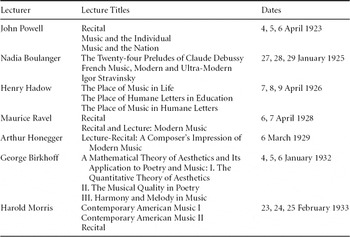
In the context of these realities, and in reaction to the critics quoted earlier, this article reveals and contextualizes a particularly striking plan of women's patronage from the 1920s in the “provincial” city of Houston, Texas. Especially because it is contemporaneous with Taylor's, Rosenfeld's, and Damrosch's articles, this plan and the milieu in which it was put into operation provide a rich field in which to further the exploration of women's involvement in the support of music. The patron in question is Miss Ima Hogg (1882–1975)—wealthy, socially prominent, and a skilled musician in her own right—who had been instrumental in founding the Houston Symphony in 1913.Footnote 10 The particular plan of patronage addressed here, however, is something with which she became involved when the symphony was on hiatus: Beginning in 1922 she collaborated with the male president of a local university to improve the musical taste of the citizens of her city by importing prominent musicians for individual or small numbers of concerts and lectures. The resulting “Rice Lectureship in Music” brought seven lecturers—most of them prominent musicians of international fame—to Houston over a period of ten years, significantly augmenting the musical life of the city (see Table 1). Her interest in the lectureship eventually waned only because she decided that there were more effective ways to achieve her unwavering goal of raising the level of musical appreciation in Houston. By looking closely at the lectureship, Hogg's involvement with it, and the musical environment of Houston, one comes to appreciate one more facet in the richly important role of women in the support of music during the 1920s.
The Rice Lectureship in Music

Houston, Hogg, and the Lectureship
About 250,000 people lived in Houston in the early 1920s, but this figure was more than triple the size of the city in 1900.Footnote 11 As the number of its inhabitants grew and prospered, so did Houston's sense of itself, and well before 1920 its leading citizens had aspired to make Houston a great city by acquiring the markers of culture associated with older and more sophisticated eastern urban centers. In doing so, Houston followed a pattern often repeated throughout the United States, where economic prosperity gave new credence to arts that had been neglected during a city's pioneer beginnings.Footnote 12 Women were at the forefront of this push for artistic elevation in Houston as in other cities; indeed, women, through social convention—and in a kind of familial microcosm of the urban growth pattern described above—had become the “torchbearers” of culture in the United States.Footnote 13 In the decade before Ima Hogg's birth, republican-minded men in the United States were still deeply suspicious of the cultural affectations of their European forebears, and so, as Walter Damrosch noted, they saw no value in the arts. As the century progressed and these men became more prosperous, however, their suspicions relaxed, yet not enough to devote any time to the arts themselves. Instead, they encouraged their wives and daughters to engage in the arts in order to ornament their own economic success. In what has been called a “peculiarly American design for high culture,” women in the United States were expected to be fluent in music—but not so fluent as to compete with their chief role as keeper of the home.Footnote 14 In the wake of continued prosperity and the development of modern conveniences in the later nineteenth century, middle- and upper-class women had even more free time, so they began to meet together to share and enlarge their knowledge of the arts. The “club,” the forum that resulted from these meetings, was socially acceptable because it was open only to members—women of the same class and experience—and thus similar to the “home” environment, and because it maintained the antiprofessional limitations associated with women's earlier involvement in the arts. Eventually the women's club movement, and more specifically women's music clubs, created an environment where women could play music with or for one another, inform their peers about specific musical topics, and—inspired by another occupation open to women, charitable “good works”—contribute toward the increased musical understanding of their communities by sponsoring, among other events, public performances by professionals. Guided by a sense of “maternal responsibility,” women became the country's strongest advocates for the arts, and their influence extended far beyond their music clubs to many public institutions and programs.Footnote 15 As a striking illustration of their importance in the growth of U.S. musical organizations, for example, women were involved in founding nearly all of the symphony orchestras in major cities between 1842 and 1919.Footnote 16
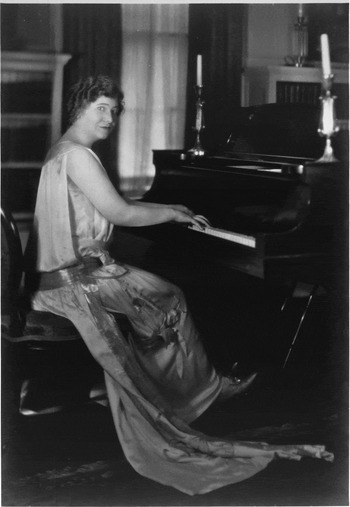
It was in the context of these women's activities in 1913 that Ima Hogg (Figure 1), then in her early thirties, employed her musical, organizational, and fund-raising skills to lead the efforts of a group of socially prominent Houstonians—mostly women—to organize local musicians into the Houston Symphony Orchestra. Performing initially for five seasons, the symphony disbanded in the spring of 1918 when many of its players enlisted after the United States entered into the Great War. The symphony next offered concerts in 1931, and Hogg guided its reorganization from as early as 1928, but during the early years of its hiatus the Rice Lectureship in Music provided her with an alternate mode of expressing her support for music.
Ima Hogg at the piano (Hixon Studio, Houston). (Hogg [Ima] Papers, 1824–1977, the Dolph Briscoe Center for American History, University of Texas at Austin [Identifier: di_03457]. Reprinted by permission.)

As she worked for both endeavors (the Symphony and the lectureship), Hogg drew heavily on her own motivational, musical, and financial resources. From the beginning of her life she had known great privilege as the daughter of Texas governor James Stephen Hogg (1851–1906), whose investments provided amply for her and her three brothers after his death. In 1919 the Hogg children became independently wealthy when oil was discovered on their inherited land, and by 1920 they shared an average monthly gross income of $225,000 (equivalent to about $2.5 million in 2010).Footnote 17 Although Ima Hogg, by choice, had no part in guiding the family fortune, she always had funds at her disposal. She also had recourse to her own significant musical ability and knowledge, acquired over nearly forty years. Her training began with piano lessons as a child; eventually, after attending the University of Texas for two years, she traveled to New York City at age eighteen to continue her musical studies.Footnote 18 After two additional years of piano study in Berlin with Franz Xaver Scharwenka and Martin Krause in 1907–9, she returned to Houston, where she taught piano until 1918. During those years she was also active in other facets of the city's musical circles, including various music clubs that held weekly or monthly meetings during the concert season. Hogg kept abreast of musical trends by reading various music periodicals and by traveling regularly to eastern U.S. and European cities. Although her studies in Berlin had led her to conclude that she was more suited to teaching than to performing on a professional basis, she continued to play the piano throughout her life.Footnote 19
Ima Hogg and her brothers, instilled by their father with a sense of the importance of public service, and, like him, skilled at persuading others to see things from their perspective, used their social and financial position to support and promote their state, its university (the University of Texas), and especially their adopted city of Houston. Much of the Hogg fortune was returned to the people of Texas through scholarships for university study, the donation of land for public parks, and funding for cultural, social, and educational institutions. Many of their gifts were anonymous, and they often persuaded their fellow citizens to donate to the projects that they themselves felt were most important for the community.Footnote 20
After helping to found the Houston Symphony in 1913, Hogg remained active in the association that supported it; even when the symphony itself ceased to exist between 1918 and 1931, the supporting organization remained intact, sponsoring performances by a number of visiting musical artists and ensembles, including orchestras. Initially vice president of this Symphony Association, Hogg had become its president in 1917 and remained in that post until 1921, during the first years of the symphony's dormancy.Footnote 21 Late in 1918, however, she became ill and spent most of the next two years in a sanatorium in Philadelphia under the care of a specialist in mental and nervous disorders. The cause or exact nature of her illness is unclear: In the days before standardized psychiatric and psychological diagnoses, a rest cure could be prescribed for a variety of maladies.Footnote 22 Virginia Bernhard, her biographer, has concluded that Hogg most likely suffered from what today would be labeled depression, perhaps brought on by the wartime death of an unidentified romantic interest.Footnote 23 She was sufficiently recovered to visit Houston briefly in April 1921 for the first meeting of the new family corporation that her brothers had founded to control their augmented wealth, but she did not return to Houston to live until February 1922. While recuperating in Philadelphia Hogg had become interested in collecting rare antique furniture, which eventually emerged as one of her lifelong passions. Her brothers, always solicitous of her health, encouraged her to pursue an active life at this time—to learn about antiques and collect what appealed to her and to support causes near to her heart, such as music.Footnote 24 Childless, unmarried, and independently wealthy, Hogg presumably turned to patronage as a socially acceptable route to personal fulfillment, as did numerous other wealthy women: In New York City in the 1920s, for example, Gertrude Whitney, Alma Morgenthau Wertheim, and Blanche Walton patronized modernist composers “as part of a search for personal satisfaction,” according to Carol Oja. Just as Elizabeth Sprague Coolidge's massive program of patronage gave structure and meaning to a life overwhelmed by personal loss, so too did Ima Hogg's musical patronage contribute to her return to health.Footnote 25
For middle- and upper-class white women in the 1920s, increased educational opportunities and the popularity of volunteerism for social or cultural causes provided incentives to step away from the traditional role of keeper of hearth and home. Paid work outside the home became much more common for women than it had been in the past, and many college-educated women worked in salaried jobs for at least a few years of their adult lives, mainly in the nurturing or service professions of teaching, nursing, and social work.Footnote 26 Patronage, by its very nature a nurturing activity, constituted an acceptable occupation for women because it fell into this “feminized” realm. As work outside the home, it was as progressive as any salaried job in that it involved independent actions by women beyond their traditional sphere of activity, but as an unpaid activity performed for the public good, it not only followed the model of “volunteering” for good causes but also satisfied the social consciences of women who believed that it would be irresponsible to accept a salary that they did not need.Footnote 27 Hogg, not limited by conventional views of a woman's “place,” nevertheless presented an outlook that, as Oja writes of Claire Reis's work on behalf of new music in New York, “combined activism with a Victorian sense of womanly duty.”Footnote 28 When she returned to Houston in 1922 Hogg was motivated by this outlook to become the city's foremost patron of the arts, merging her earlier, typically middle-class attitude concerning behind-the-scenes support for music with the new possibilities of patronage that her augmented wealth provided.
The Houston to which Hogg returned in 1922 may have been provincial by East Coast urban standards, but it was no cultural desert: Indeed, it was rife with musical activities. Amateur music making and music clubs flourished. Visiting solo artists and groups provided a varied season of “classical” music for listeners to enjoy, including opera, ballet, and instrumental music. Local dance bands played popular music in informal surroundings such as clubs and restaurants. The city's musical life was booming. Ellen MacCorquodale, the music editor for the Houston Chronicle, captured the dynamic effects of Houston's musical growth at the midpoint of the 1922–23 season: “Rather a staggering outlook for the New Year is faced by The Chronicle's music editor,” she wrote. “Houston's calendar for the first four months of the year 1923 already contains 25 professional performances to be reviewed. Nothing to compare with a New York season, of course, but a rather amazing number of musical attractions for Houston, compared with previous seasons.”Footnote 29
Hogg was readily accepted into this musical community, and not just on the basis of her social status and newly augmented wealth: Because of her earlier musical activities as a piano teacher and musical club participant, she was well respected as a musician. As a newspaper clipping from Hogg's personal collection explained:
If the Hogg millions should ever vanish, Miss Hogg would not have to worry about making a living. All she would have to do would be to run an “ad” in the fine arts section of the Post-Dispatch, permit the publication of one of her beautiful pictures, with a little announcement of the opening of a studio, and she need never worry about wolves of want prowling about her door. Furthermore, she would find a welcome from her colleagues, who have long respected her worth as a musician.Footnote 30
Although she did not return to teaching piano when she came back to Houston, Hogg did resume her involvement with the city's music clubs: In Houston as in many other cities throughout the United States these clubs dominated musical life.Footnote 31 Some of Houston's music clubs were focused on group singing or playing, such as various “Glee Clubs,” the Treble Clef Club, and the Saxophone Club; others were oriented not only to performance but also to the study of music. A typical meeting of this latter type of club would involve the delivery of a talk on a specific musical topic by one of the club's members, followed by various performances of solo or small ensemble musical works related to the topic, also by members of the group. On occasion, an outside speaker would address the membership, and performers from clubs in neighboring communities would sometimes be invited to perform. In the 1922–23 season, topics for meetings of this type in Houston ranged from Chopin, Brahms, and Bach to jazz, women composers, and different kinds of folk music.Footnote 32 Women of society made up the membership of many of these clubs; Ima Hogg, a past president of the Girls’ Musical Club, hosted its meetings at her home during the 1922–23 season.
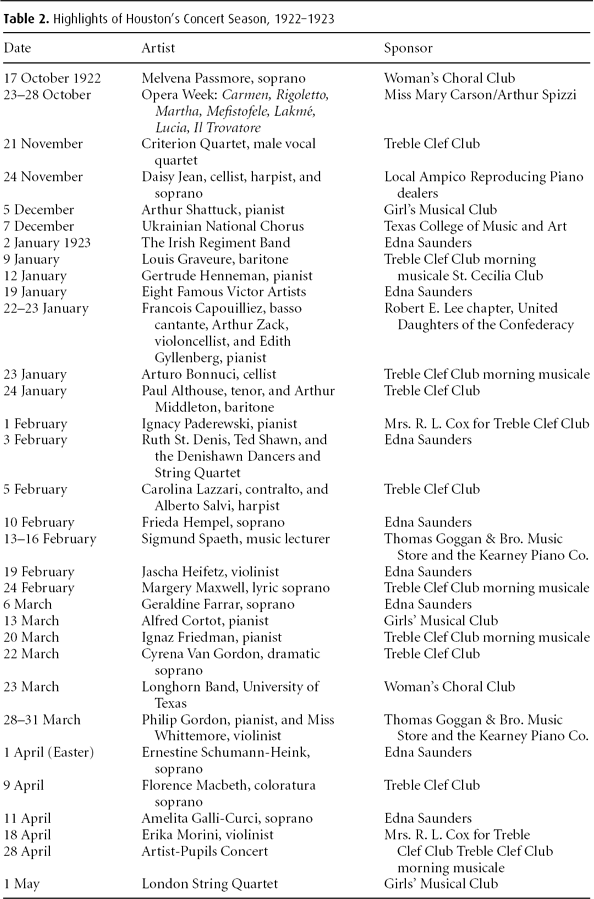
In addition to sponsoring their own study and amateur performance events, some of Houston's music clubs (and similar clubs around the country) served as presenters of professional soloists and ensembles. In 1922–23 Houston's Treble Clef Club marketed a series of five concerts at “popular” prices, a series of five “morning musicales,” and two additional concerts of big-name artists personally sponsored by the club's leader, Mrs. R. L. Cox.Footnote 33 The Girls’ Musical Club sponsored a more modest series of three concerts, and club members tended to study the repertory to be played prior to the performances.Footnote 34 Edna Saunders, a local woman who emerged from the music club milieu to run her own professional concert agency for many years, also presented a significant program of artists each year. These clubs and individuals imported an impressive array of performers to Houston that included some of the biggest names of the day and a variety of lesser-known musicians (see Table 2).
Highlights of Houston's Concert Season, 1922–1923
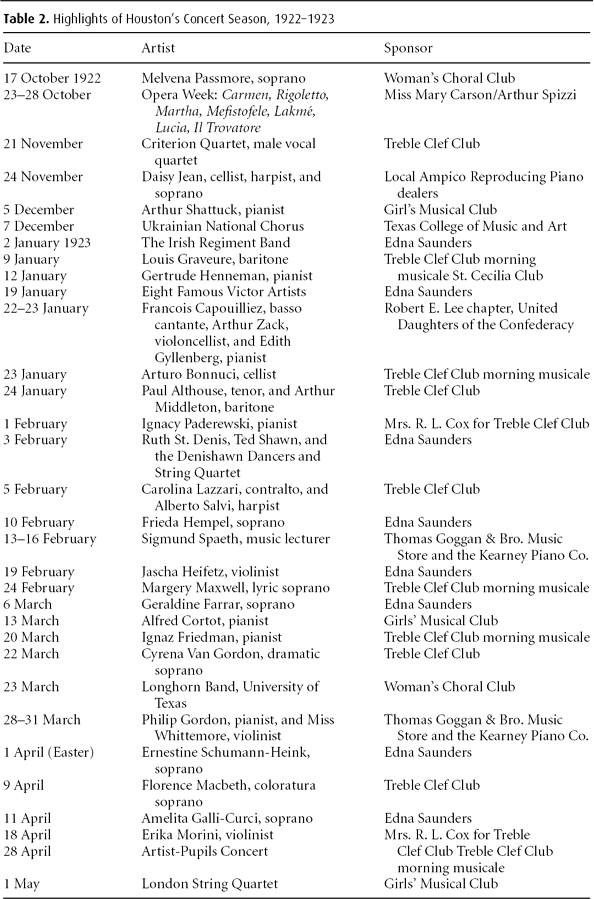
Houston's music clubs and their members, in their efforts to bring concert artists to the city and foster audience education, paved the way for the eventual creation of the Rice Lectureship in Music. The basic model of the didactic music club meeting and the music club sponsorship of concerts provided a prototype for Hogg's ideas about enlightening the public through the Rice Lectureship; even Hogg's stated goal of “elevating the public taste” was an idea that had been articulated by women's organizations elsewhere in the United States dating back to the turn of the century.Footnote 35 Nevertheless, the Rice Lectureship took the prototype to a new level, engaging renowned international musical figures, rather than fellow club members, to speak and play, and unlike the daytime educational events sponsored by most music clubs, lectures and concerts of the Rice Lectureship would be held in the evening to draw an audience that included men.Footnote 36
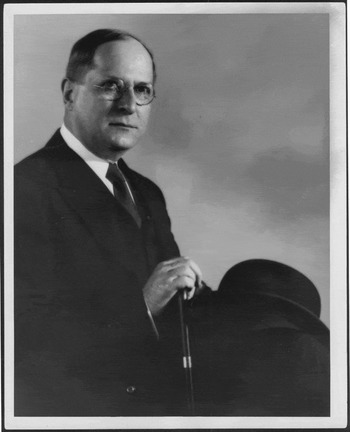
If Hogg's inspiration and rationale for the lectureship most likely came from her membership in music clubs, her collaborator's model was quite different. In the 1920s public lectures were an accepted method for universities to reach out to the larger community. Edgar Odell Lovett (1871–1957; see Figure 2) was chair of the Department of Mathematics and Astronomy at Princeton University when, in 1907, he was asked to head the new Rice Institute, Houston's first institution of higher learning, on the recommendation of Woodrow Wilson, who was then president of Princeton.Footnote 37 After several years of research and planning, Lovett was formally inaugurated at Rice's opening in 1912. Even in his initial plan for the Rice Institute, Lovett specifically called for public lectures geared toward a general audience. As a result, professors at Rice, as at many other universities around the country, offered a number of so-called extension lectures each year, and Lovett also brought in speakers for this purpose.Footnote 38 For example, he had earlier inaugurated endowed lectureships in “Civics and Philanthropy” and “Public Affairs,” each funded by a public-spirited citizen of Houston, to bring outside speakers to Rice for public presentations.Footnote 39 Such lecture series were not unique, but the idea of a lectureship in music appears to have been unprecedented in the early 1920s: Elsewhere in the country lectureships that included musicians were launched only at the end of that decade.Footnote 40 Musicians certainly gave lectures in other cities, and universities undoubtedly sponsored some of these, but the idea of a series of university-sponsored public lectures on musical topics by noted musicians seems not to have occurred elsewhere.
Edgar Odell Lovett (1935), first president of the Rice Institute. (Courtesy of Woodson Research Center, Fondren Library, Rice University.)

Was it Ima Hogg who first proposed such a venture, based on her experience with music clubs, or was it Lovett—a music lover in his own right—who sought to match Hogg's special interest in music with the preexisting model of a series of extension lectures? The genesis of the lectureship seems to have been joint, stemming from a casual conversation at a social encounter in April 1922 in which Hogg and Lovett discussed ways of fostering deeper musical understanding in Houston.Footnote 41 Lovett was especially receptive to such discussion: Although his research fields were mathematics and astronomy, he was very fond of music, having played the violin as a young man.Footnote 42 When he entered into Houston's intellectual and social circles at the time of his appointment to Rice, he also become active in its artistic world, serving on the board of directors of the Houston Symphony from its founding. Hogg and Lovett's dialog on music continued in their correspondence: “With all of the energy being spent on music in Houston,” Hogg wrote to Lovett in June 1922, “I often wonder to what purpose—and how much we are understanding. Nothing is as responsive as music—real music—a little attention, a little higher thought and what rewards! And while the art of music may seem to recede as we approach—its laws are fundamental and are part of life itself.” Hogg's musings were probably not the first thoughts that she had shared with Lovett on the topic of music in Houston, but Lovett praised the eloquence of this particular written statement.Footnote 43 He himself had recently penned a statement articulating the goals of the “Lectureship in Music” that the Rice Institute would present through Hogg's beneficence:
It will serve primarily to stimulate an intellectual interest in music among the students of the university. It would also serve to supplement the work of such musical organizations of the city as the [Woman's] Choral Club, the Treble Clef Club, the Symphony Orchestra Association, and similar organizations in which this city is singularly rich. It is confidently believed that such a lectureship will elevate the taste of all of us, not only in the direction of classical music and its interpretation, but as well in the more modern creative developments.Footnote 44
Following the model of earlier Rice lectureships, Lovett suggested that the new series be labeled the Hogg Lectureship in Music, but Hogg wanted her involvement in the project to remain anonymous. Although he respected her desire for public anonymity, Lovett nevertheless consulted with Hogg frequently about the implementation of the lectureship. Together they researched and formulated a list of potential speakers that was a veritable “Who's Who” of the U.S. musical world of the 1920s, but not all of their choices were ultimately willing to come to Houston. In 1922, however, Hogg and Lovett were optimistic about securing the most prestigious musicians for the lectureship. Hogg expressed her enthusiasm to Lovett repeatedly and encouraged him to seek lecturers who “have vision and personality to direct the vast talent, to call attention to the value of the creative in music—and [who] can point out those simple principles in intelligent listening.” She was well aware that Houston's geographical isolation might be a significant factor in deciding the course that the lectureship should take, and she suggested that because Houston was so far removed from other cultural centers, the speakers had to be of the highest quality. “You see we must make our own center, as far away as we are.”Footnote 45
The Inauguration and Implementation of the Lectureship, 1922–1933
For the inaugural speaker, Lovett and Hogg concurred from their earliest discussions that Ignacy Jan Paderewski (1860–1941) would be the best possible choice. Lauded before World War I as “one of the greatest pianists that the world has ever seen,” Paderewski entered into diplomacy after the war, serving first as the Polish representative to Washington and then as prime minister of Poland.Footnote 46 When he resumed his concert career in 1922 his recitals met with wild acclaim.Footnote 47 Lovett wrote to him in August, detailing the scope of what he and the “anonymous” donor had in mind for the inauguration of the lectureship:
A course of three free public lectures . . . at the City Auditorium of Houston at your convenience during the academic year 1922–23, and on subjects of your own choosing. The auditorium seats five thousand auditors, and there will be no charge for admission to these lectures. We would like to have the privilege of giving your lectures to a wider public through publication in the Rice Institute Pamphlet, a quarterly journal mailed without subscription to a selected mailing list in this country and abroad. The honorarium provided for the lectureship is twelve hundred dollars for the course of three lectures, and we should expect to reimburse you for all traveling expenses from New York or other place of residence in this country to Houston and return, including those of Madame Paderewski.Footnote 48
The letter went unanswered, and despite Lovett's efforts, further attempts to contact Paderewski were fruitless, possibly because the fee offered, equivalent to approximately $15,000 in 2010, was less than that which Paderewski typically received for a single performance, much less a series of three lectures.Footnote 49
When it became clear that Paderewski was unattainable, Hogg, demonstrating her expertise on the topic, provided Lovett with information about other possible speakers. She divided her list of possible lecturers into two categories, “academic men” and “creative artists,” and offered her own observations about each candidate. From academia Hogg recommended George Sherman Dickinson (1888–1964) of Vassar College, Daniel Gregory Mason (1873–1955) of Columbia University, and Alexander Russell (1880–1953) of Princeton. Hogg cited Dickinson as “one of the finest writers on music in the country” and “an extremely popular lecturer.” She had heard that Mason was “zealous, pedantic” and “a dull lecturer,” but respected nonetheless; and she characterized Russell as a “splendid organizer” with “good vision, not a gifted lecturer, but most admirable.”Footnote 50 She had actually spoken with Russell and found him sympathetic. From the realm of the “creative artist,” Hogg recommended composer John Alden Carpenter (1876–1951), composer-pianist-conductor Ernest Schelling (1876–1939), and philanthropist-editor Edward Bok (1863–1930). Hogg characterized Bok as an experienced lecturer and someone who had worked in his own city of Philadelphia “to form public taste.” She identified Schelling as a “composer, great pianist, [and] gentleman of culture from all accounts,” and she called Carpenter a “composer, man of business, and a splendid figure from all accounts in the life of his city.” Hogg concluded, “I am sorry the sum offered is not large enough to be alluring. I'm afraid these specialists have to have golden plums hung before them. The college men are more modest.”Footnote 51
Lovett apparently researched the candidates recommended by Hogg and then consulted further with Alexander Russell, whose Princeton connection gave them something in common. Russell in turn recommended two additional possible lecturers: pianists Harold Bauer and John Powell.Footnote 52 Powell (1882–1963) was a noted composer as well as a pianist, a native of Virginia, and a graduate (1901) of the University of Virginia, from which Lovett had received his first doctorate in 1895. Press reports in the early 1920s suggested that he would be the “next Paderewski.”Footnote 53 Russell noted that Powell would be in Ft. Worth, Texas, during March or April, and this proximity to Houston, along with Powell's connection to the University of Virginia, was apparently enough to spark Lovett's attention. Powell agreed to come to Houston, arriving there in early April 1923.Footnote 54
Powell inaugurated the Lectureship in Music not with a lecture, but with a recital featuring works by European masters and contemporary U.S. composers (including Powell himself). Designed to appeal to a general audience, it was held in the 5,000-seat City Auditorium at 8:15 on a Wednesday evening; a newspaper reviewer observed that it was “as good as concerts for which the public pays admission” but confirmed that only five to six hundred people attended.Footnote 55 Powell's second and third appearances, however, consisted of lectures aimed at a more specialized musical audience—meaning amateur and professional performers, music teachers, and listeners who were willing to ponder the theoretical or philosophical side of music—and were thus delivered in a smaller hall, the Palace Theater, with a capacity of about 1,200. According to a reviewer, the audience of “music lovers” filled about half of the lower floor of the theater, thus constituting about three to four hundred auditors.Footnote 56 Because of the time at which the lectures were scheduled—4:30 on a Thursday and Friday afternoon—it is most likely that women dominated the audience, but almost all of the later lectures were scheduled in the evening, allowing working men to attend. From his correspondence with Powell, it is clear that Lovett had suggested the general topics for the lectures, “Music and the Individual” and “Music and the Nation,” but the content was Powell's alone.Footnote 57 The first of these lectures stressed the ways in which music, for the individual, enriched emotional experience, soothed, healed, offered hope, and inspired nobility and generosity. Powell also noted that studying music improved mental function. Regarding music and the community as a whole, Powell observed how music introduced a refining element and improved societal spirit through its use in churches, by school groups, and by community singers.
In the second lecture, Powell presented his opinions on contemporary music in the United States, tracing the current fragmentation of style to the advice that Dvořák had offered in the 1890s on developing a national style through the inspiration of indigenous musical influences, particularly those of African Americans and American Indians.Footnote 58 He discussed trends such as the Red Indian School, Negro School, Stephen Foster School, Popular Music School, Ultra-Modern School, and Anglo-Saxon Folk Music School, concluding that only the Anglo-Saxon Folk-Music School offered a viable direction for American music.Footnote 59 Invoking an anti-immigrant, racist rhetoric, he explained that the redemption of the United States as a nation lay in building on the Anglo-Saxon “root” of its founding fathers.Footnote 60 Although viewed with some suspicion when delivered elsewhere, Powell's xenophobia and negative reaction to the multifaceted musical style of the day were not unprecedented and did not arouse comment in Houston.Footnote 61
Hogg indicated her approval of the first installment in the lectureship by funding it for a second year, and she continued to be involved in the project by calling Lovett's attention to the League of Composers in New York as a possible source for future speakers.Footnote 62 “They are among two or three other similar organizations in New York that are doing some very interesting educational work,” she noted.Footnote 63 Founded earlier that year to promote performances of contemporary music, the League of Composers was of special interest to Hogg because it sponsored two lecture-recitals in addition to three concerts during its first season.Footnote 64 Significantly, its executive director was a woman, Claire Reis. Hogg sent a program from the first League of Composers concert to Lovett, underlining a notice of an upcoming lecture-recital on “Modern European Music.” She also underlined the name of Eugene Goossens, one of the composers to be featured on the lecture-recital, and wrote beside his name, “English composer and conductor now in America.”Footnote 65
Despite Hogg's attempt to interest Lovett in Goossens and the League of Composers, he followed his own leads and invited Walter Damrosch (1862–1950) to speak in Houston. Topping the amount that he had paid to Powell by one-third, Lovett offered Damrosch $1,500 to deliver three lectures on topics of his own choosing, and he advised Damrosch that the object of the lectureship was “the stimulation of musical intelligence and the elevation of the musical taste of our people.” When informed of Lovett's choice, Hogg praised Damrosch and spelled out what his visit could mean to Houston and Texas, clarifying the scope of her vision as a patron. “At first I was a bit disappointed that you hadn't chosen a composer,” she wrote,
but on consideration I thought as usual, you had shown excellent judgment. [There is] nobody in America, [that] I can think of, who has had a wider or better influence on musical taste in directing attention to good music, to good musicians, to orchestral music, and to Europe's as well as America's progress in composition. So he [Damrosch] should have something of real importance to say concerning the state of music in America today, the trend of present day composition, and helpful suggestions to struggling parts of the country like ours—especially as to orchestras, etc.
Unfortunately Damrosch refused Lovett's invitation, citing travel plans and other previous commitments, and nothing more came of the lectureship for the 1923–24 academic year.Footnote 66
In the fall of 1924 Lovett renewed his efforts on behalf of the lectureship, apparently consulting in person with Alexander Russell and presumably also with Ima Hogg. He amassed a list of names—including those of Russell, Schelling, Carpenter, Deems Taylor, Nadia Boulanger, Stravinsky, Sergei Rachmaninoff, Leo Sowerby, Alfred Newman, Howard Hanson, Goossens, Percy Grainger, and Austen Fox Riggs—and from it he proposed two possible lecturers to Hogg: “Russell suggests Mademoiselle Boulanger, sister of the composer [Lili Boulanger], good lecturer and performer, in this country January-February. What would you think of having Schelling this fall or next spring at his convenience and also Miss Boulanger who will come for less [presumably because she was an ‘unknown’ and actually trying to organize a tour] and whose honorarium can be taken from last year's income?” Hogg approved, expressing her enthusiasm about the well-known Schelling.Footnote 67 Boulanger (1887–1979), however, was not yet as well known as her younger sister, Lili, who had been a promising talent before her premature death in 1918.Footnote 68 Although Lili's was the bigger name at the time, Nadia Boulanger's fame was growing in the United States. By 1924 she had “taught well over a hundred American students,” including Virgil Thomson, Walter Piston, and Aaron Copland, and with the support of Walter Damrosch and others she had decided to undertake a tour of the United States.Footnote 69 Beginning in January 1925, Boulanger spoke or played organ recitals at institutions and in cities throughout the Midwest and Northeast.Footnote 70 When Lovett invited her to deliver three lectures or combinations of lectures and recitals in Houston for $1,000, she accepted immediately.Footnote 71 Schelling, on the other hand, to whom Lovett offered $1,500 for three lectures, declined Lovett's invitation.Footnote 72
Boulanger's three lecture-recitals, titled “The Twenty-four Preludes of Claude Debussy,” “French Music, Modern and Ultra-Modern,” and “Igor Stravinsky,” took place on 27, 28, and 29 January at 8:15 p.m. at the Scottish Rite Cathedral hall in downtown Houston. She also delivered an informal, morning lecture to area music teachers at the Houston Art Museum.Footnote 73 As with the Powell lectures, the evening presentations were aimed at the music-loving public, but Boulanger was more specifically analytical than Powell had been in addressing individual musical works as well as larger trends. Newspaper reviews provided rather detailed summaries of her lectures; reviewers repeatedly marveled at her ability to make complex music understandable. Although they did not provide attendance figures, the reviews indicated that her presentations were well received because, in addition to imparting important information about music and musical style, she was a skilled and charming lecturer.Footnote 74 As a vital advocate for music, Boulanger was an ideal choice for the lectureship, and her visit to Houston can only be viewed as a boon to Hogg and Lovett's enterprise.
Perhaps because of the complexities involved in trying to sign two speakers for the 1924–25 season, only one was invited for the next. Although it is not clear how he came to Lovett's attention, the British scholar Sir Henry Hadow (1859–1937) agreed to present three lectures in Houston on the topic “The Place of Music in a Liberal Education” during early April 1926.Footnote 75 Sir Henry was at that time vice-chancellor of the University of Sheffield, but he was renowned as a lecturer and author on musical topics and as editor of the influential Oxford History of Music. He was also strongly devoted to music education for the general population and to education in general, as reflected in the theme of his lectures.
Hadow came to Houston for $1,000 and travel expenses, fitting the trip in between terms at his home institution. He arrived in Houston on 6 April 1926, delivered his lectures in the Physics Amphitheater on the Rice Institute campus over the next three days (the first two in the evening, the third in the afternoon to accommodate his travel plans), and left by train on the same day as his final lecture. Titled “The Place of Music in Life,” “The Place of Humane Letters in Education,” and “The Place of Music in Humane Letters,” his lectures dealt with the essential nature of music, educational models that improved the self or the social order, and the importance of musical education to the general populace. According to a reviewer, Hadow lectured to “enthusiastic audiences.”Footnote 76 Lovett was especially pleased with Hadow's lectures, later referring to them, as they were published in the Rice Institute Pamphlet, as being of “extraordinary interest.”Footnote 77 Hadow's visit amounted to another success for Lovett's vision for the lectureship, although the next speaker better suited Hogg's.
There were no lectures during the 1926–27 academic year, but in the fall of 1927 Hogg proposed Maurice Ravel when she learned that he would be touring the United States. In naming Ravel, Hogg stressed her preference for composers, perhaps in reaction to the previous lecturer:
Of course, as you know, no other Frenchman living today has the same place in the musical world. I trust he is still available. Again I must say, the importance of stressing the creative side of music to the Houston public. I have always wanted to do a small part in keeping a high standard of musical appreciation and would like in some way to stimulate the potential young composers of Texas. Any little bit helps, doesn't it! Seeing and hearing a successful composer seems to me one way of helping.Footnote 78
Lovett signed Ravel to present a recital and a lecture-recital at the Scottish Rite Cathedral on the evenings of 6 and 7 April 1928 for $2,000, reserving “the right to publish a translation of the French manuscript, by Mr. Ravel, in the Rice Institute Pamphlet.”Footnote 79 As an internationally known artist, Ravel excited considerable attention, and newspaper reports embody more of the local fascination with his fame and larger-than-life personality than a dispassionate reporting of the facts of his visit. Although it is clear that Ravel played two recitals of his own works in Houston, assisted by soprano Esther Dale and violinist Barbara Lull, it is not certain that he actually presented the lecture, which was to have prefaced his second recital.Footnote 80 Newspaper interviews and reviews made it clear that Ravel did not speak a word of English, and they alluded to the variety of mishaps that greeted him in Houston: The programs for the two recitals had been reversed (“When one's Saturday night recital is set for Friday, and Friday night's for Saturday . . . his look spake volumes”), attempts to guard his privacy had kept him from meeting with his singer and violinist to rehearse, the piano was late in arriving, no page turner was supplied, and “inadequate arrangements had been made, so that the lecture was omitted.”Footnote 81 Nevertheless, a week after Ravel's visit, his management sent the lecture, in French, and asked for the remainder of Ravel's fee. Unfortunately that French original has disappeared, and the printed English translation is the only surviving version of the lecture.Footnote 82 Titled “Contemporary Music,” it is a brief and eloquent statement about musical influence, and even if Ravel did not deliver it verbally, his visit and the sensation it caused in the local press raised the profile of the lectureship.Footnote 83
During the following fall, Lovett and Hogg rejected French composer and theorist Charles Koechlin in favor of Arthur Honegger, perhaps because Koechlin had visited Houston in 1918. Honegger, who was paid $800, delivered a single lecture-recital on the evening of 6 March 1929 at the Scottish Rite Cathedral with the assistance of mezzo-soprano Berty Jenny and pianist Andrée Vaurabourg, who was Honegger's wife.Footnote 84 To illustrate “A Composer's Impression of Modern Music,” in which, as a reviewer explained, the composer defined a new trend that combined the “best qualities of German and French music,” Honegger drew on his own works for piano, two pianos, and voice, but it was Jenny, rather than Honegger, who presented the lecture “due to the composer's unfamiliarity with the English language.”Footnote 85 Although not as big a name as Ravel, Honegger was an internationally famous composer, and this fame was a mark of status for the Rice Lectureship. Newspaper reviewers, although they did not report the size of the audience, noted that it represented “the thinking portion of Houston's population.”Footnote 86
After Honegger's visit, there were no lectures for nearly two years, and the reasons for this cessation of activity were complex. Back in 1924, Hogg had funded the lectureship for a fixed period of time ending in 1928 by sending $26,000 in municipal funding warrants to Lovett with instructions that the interest only, amounting to $1,560 per year, be used “to stimulate an interest in, and love for music on the part of the students of your educational institution and the people of Houston generally.” Officials at the Rice Institute, however, had overlooked the deadline, and the bonds had not been returned to her. Lovett apologized for the oversight, and a meeting between Lovett and Hogg most likely took place at this time, but its results were not recorded immediately in their correspondence. From a reference in a much later letter, it seems that Hogg was disinclined to continue her support of the lecture series, but that Lovett intended to host at least one more lecture, paid for by the accumulated interest from Hogg's earlier payments, even if she discontinued her financial support. Eventually it became clear that Hogg planned to transfer her patronage to other components of Houston's musical life:
I have been trying to see where I could do something to stimulate music here, and believe that a sum of money could be used to good advantage in stimulating our struggling Symphony Orchestra.
When I look at the Rice Institute pamphlets, I am especially proud to feel that the music lectureship has furnished such interesting essays. . . . They have been a source of much gratification to me.Footnote 87
Although its title implies something rather insignificant, the Rice Institute Pamphlet was actually a substantial scholarly journal begun by Lovett in 1915 and distributed to hundreds of academic libraries around the world. In addition to the texts of special public lecture series such as the Rice Lectureship in Music, it carried scholarly articles and monographs by Rice faculty. Lovett shared Hogg's pride in the printed lectures: In this format they could reach far more people than had heard them in person.
From this point forward Lovett became the driving force behind the lectureship. He planned to continue offering events under the aegis of the Lectureship in Music for as long as the interest remaining from Hogg's earlier payments would allow, and Hogg was amenable to helping him decide on appropriate lecturers. To that end Hogg sent Lovett numerous newspaper and magazine clippings referring to the U.S. visits of the Russian composers Sergei Prokofiev and Alexander Glazunov. Lovett attempted to contact and sign each of these composers, but apparently neither was able to come to Houston, and thus there was no lecture for the 1929–30 season. Footnote 88
While Lovett was attempting to interest Glazunov and Prokofiev in the lectureship, he and Hogg rejected, without explanation, three potential lecturers suggested by Bogue Laberge Concert Management: Albert Roussel; E. Robert Schmitz, who had founded the contemporary music society Pro-Musica; and Louise Arnoux, who, as Laberge put it, performed a “delightful lecture recital on folk songs of different nations.”Footnote 89 When asked for additional suggestions, Hogg noted that Manuel de Falla, “the foremost Spanish composer,” would be in the United States in the fall, and she enclosed a clipping relating to his upcoming tour with a specific piece of advice:
There has been a great deal of interest in this man all over the world. He is characteristically Spanish, and yet to me his is not the big name some others are in other countries. Nevertheless, I believe if you would want him that he would be a valuable addition to the . . . lectures already given. I would advise having him talk on the character and sources of Spanish music. I have myself, it so happens, been much interested in hunting up the sources of this music—in my small way. It has had some bearing on early music in Europe. I do not mean to suggest that an outstanding man as he is devote his lecture to other music than his own entirely.Footnote 90
Although Lovett attempted to engage him, Falla's visit had been postponed until the 1931–32 season.Footnote 91 At this point the flurry of activity regarding the lectureship that had dominated the spring of 1930 came to a halt as Lovett apparently gave up on finding a lecturer any time soon. Consequently there were no lectures for the 1930–31 season, and it was not until more than a year had passed that he renewed his efforts.
When Lovett wrote to Hogg in September 1931 asking if she approved of William J. Henderson (1855–1937), the music critic of the New York Sun, as a possible lecturer, she replied, “I think, as you intimated, that Wm. J. Henderson is perhaps a little too far along in life to give the interest or to take the interest in a lecture here.” Drawing on her first-hand experience with music in New York City, and on her perusal of U.S. music periodicals, she made a new suggestion:
[Henderson] has always been more of a critic of performance than of music and I really think someone like Deems Taylor would be better. He was formerly a music critic and is now an eminent American composer. If you could get Deems Taylor I think he is the kind of person you, yourself, would appreciate and approve. I shall look in my music magazines and periodicals for further suggestions.Footnote 92
Taking Hogg's advice, Lovett invited Deems Taylor to present three lectures in Houston, offering to cover travel expenses and provide a $600 honorarium, but Taylor refused the invitation, because of his newspaper work and other commitments.Footnote 93 In the meantime Hogg had recommended two additional possibilities: Harold Morris and John Erskine:
[Morris] has just had a most unusual recognition and success as you will notice from a clipping I am sending under separate cover [a review from Musical America, 10 November 1931, of Morris playing his own piano concerto with the Boston Symphony Orchestra]. He would be an ideal choice for the lectureship, I think. He is a Texan, graduate of the University of Texas, a fine earnest young man of character, first class pianist, a thinker, and a seemingly promising composer. Then, if for some reason he can't be arranged, there is John Erskine, head of the Juilliard Foundation—a lecture writer, critic, musician, etc. I shall be interested in hearing that you have made a choice.Footnote 94
Morris had the additional distinction of having been cited by John Powell in his earlier lecture on contemporary U.S. music as a master of the so-called Popular Music School.Footnote 95
Despite Hogg's suggestions, Lovett acted on a coincidence that brought an acquaintance and potential speaker near to Houston: George D. Birkhoff, chairman of the Department of Mathematics at Harvard University, was to attend the meetings of the American Association for the Advancement of Science in New Orleans:
He had for some time been engaged in developing a mathematic [sic] theory of aesthetics, so I wrote him from New York inviting him to come on over to Houston from New Orleans and deliver three lectures under the auspices of our Lectureship in Music. . . . A Mathematic [sic] Theory of Aesthetics and its Applications: I. The Quantitative Theory of Aesthetics; II. The Musical Quality in Poetry; III. Harmony and Melody in Music. On reading the programme you may find the first of Dr. Birkhoff's lectures a bit heavy, but I think they will all be interesting, and I anticipate some real contribution to musical theory as their ultimate outcome.Footnote 96
Birkhoff lectured in the Physics Amphitheater on the Rice campus on the evenings of 4, 5, and 6 January 1932. In a review aptly titled “Doctor Birkhoff Astounds Houston Musical Public in Lectures at Rice Institute,” the reviewer noted that “the audiences for the lectures were small but they were highly interested in the theories of Dir. Birkhoff.”Footnote 97 Because his lectures were focused on the aesthetic evaluation of music in the abstract rather than on specific trends in contemporary music or on music appreciation for general audiences—indeed, Birkhoff proposed a theorem derived from his study of Greek vases to weigh the aesthetic success of poetry and music—he was certainly not what Ima Hogg had envisioned, nor did his presentations fulfill the goals that Lovett had outlined in his announcement of the founding of the lectureship.Footnote 98 In almost all respects he represented a departure from earlier ideas about the lectureship.
After Birkhoff's visit, Lovett again contacted Hogg and asked if she thought that he should renew his invitation to Deems Taylor. Hogg confirmed that Taylor was her first choice but again suggested Harold Morris if Taylor declined. She referred once more to Morris's performance of his piano concerto with the Boston Symphony Orchestra during the previous winter and to its critical acclaim. “At the end of this last season,” she recalled, “that hardened old music critic W. J. Henderson pronounced his concerto as one of the most important contributions to the musical world.” Lovett renewed his earlier invitation to Taylor, but Taylor refused it on the basis of other commitments, so Lovett invited Morris to give three lectures in Houston and offered him $500 as honorarium and to cover travel expenses.Footnote 99
Morris accepted Lovett's invitation with dispatch and agreed to deliver two evening lectures on U.S. composers in the Physics Amphitheater on the Rice campus and an evening recital of his own works, assisted by the New York String Quartet and a local pianist (Rhodes Dunlap) recommended by Hogg, at the Scottish Rite Cathedral. As Morris envisioned it, the pair of lectures, titled “Contemporary American Music,” would represent “a summing up of [U.S. musical] creative activities, something that has not been attempted, to my knowledge, within recent years.”Footnote 100 Morris's value for the lectureship was multifaceted. As a native Texan educated at the University of Texas who had become successful on the East Coast, Morris was an ideal realization of the westerner finding validation in the East. As a skilled performer and composer, Morris was also a role model for younger musicians in Houston. Finally, in his choice of lecture topics, Morris reinforced a focus on the topic of U.S. music that had been introduced with the first lectures ten years previously. His appearances were a fitting conclusion to the lectureship.
The Lectureship, Patronage, and Ima Hogg
As a thinly veiled tribute to Ima Hogg, Harold Morris concluded the very last lecture (25 February 1933) delivered under the auspices of the Rice Lectureship in Music by acknowledging the value of patronage for the advancement of U.S. composers. Significantly, he noted the work of women patrons of music and cited some of their more famous projects, including Marian MacDowell and the MacDowell Colony, Katrina Trask and her estate, Yaddo, and Elizabeth Sprague Coolidge and her festivals in the United States and Europe. “I could go on and on, for almost every city that has made musical strides owes it to one or more women, who are trying to keep the torch of beauty ever aflame, and to insure [sic] greater opportunities for composers,” he observed. “I assure you that I am as appreciative as I know you are of the magnificent work done for music in Houston and in other cities of Texas by enterprising women possessed of an artist's vision of our needs.”Footnote 101
If Hogg had not wished to remain anonymous, perhaps Morris would have cited “Miss Hogg and the Rice Lectureship in Music” among his examples, yet such a citation in 1933 would hardly have captured the scope of Hogg's support of music in Houston. Of course, years before receiving Morris's well-deserved praise she had become a driving force in the reorganization of the Houston Symphony. The support of this institution would remain her primary, life-long musical project (and in the year of her death, the Houston Symphony created a lasting, public memorial to Ima Hogg by naming its annual young artists’ competition for her), but it was not her only patronage. In the realm of music, she also subsidized the education of several protégés over the years; outside of music, she contributed to causes as varied as museums, libraries, mental health agencies, and foreign charities. In the larger world, Hogg is best known for the important collection of U.S. and European decorative arts and furniture that she amassed during her lifetime, said to be second only to the Henry Francis du Pont collection at Winterthur; eventually she bequeathed her collection to the Houston Museum of Fine Arts along with the home, Bayou Bend, that she had built in 1927, and she provided an endowment for its maintenance. In 1929 she founded the Houston Child Guidance Center to provide counseling and therapy for children and families, and she eventually channeled funds from her brother Will's estate to form the Hogg Foundation for Mental Health at the University of Texas; the bulk of her own estate formed a separate endowment controlled by that foundation to continue the work of the Child Guidance Center.Footnote 102
Although Hogg's financial investment in the Rice Lectureship in Music might seem paltry, given the income generated by her family's land in the 1920s, it apparently matched her interest in what proved to be only a single facet of a larger musical project. She was instrumental in its founding, maintenance, and direction, but she was never consumed by it, nor did it define the scope of her patronage—indeed, by the time of the visits of the final two lecturers she was focused on another musical project. Her main involvement in the Rice Lectureship was in recommending potential lecturers for the series, but there was a significant discrepancy between the lists of potential lecturers that Hogg assembled and the slate of lecturers who actually came to Houston. Hogg studied music periodicals and drew on her personal experiences in New York when brainstorming about which musicians she wanted to be invited, and she repeatedly recommended “big-name” musical figures to Lovett. His success in contacting and signing lecturers, however, was dependent on his ability to reach the right management firm and identify who might be traveling near Houston at an appropriate time. Happenstance thus played a significant role in determining who actually appeared in Houston. Lovett also added a different dynamic to the search for lecturers when he worked independently of Hogg, and even when he consulted with her he clearly applied different criteria to the selection process. Whereas Hogg, in her comments and in her choices, always favored creative musicians—performers or composers—Lovett seemed to prefer scholars. This slight dissonance between “music as art” and “music as science” was never addressed directly by the two powers behind the lectureship, although, reading between the lines of their correspondence, it seems clear that they were both aware of it. The absence of a completely unified aesthetic may have hastened the demise of the lectureship, but it also added to its variety, which may in turn have augmented the size of the audience.
Even if they did not always reflect her musical taste, and even if she was less involved in the project toward the end of the series, the lectures contributed to Hogg's goal of educating Houston audiences. Spanning ten years and seven speakers, they introduced a variety of themes and subjects that served “to call attention to the value of the creative in music [and] point out those simple principles in intelligent listening.” In the broadest of categories, the topics of the lectures ranged from discussions of the nature of music itself to assessments of specific trends in contemporary composition. In several instances themes introduced by one speaker were reinforced or readdressed by at least one of the other speakers, and these topics emerge as unifying elements in the series.
Reiterating the notion that lay behind Hogg's original idea for the lectureship, Henry Hadow (1926) addressed the idea of music on the largest scale, observing that by its very nature, music was powerful and essential to life. On a related plane, John Powell (Reference Powell1923) argued that music augmented emotional experience, soothed, healed, offered hope, and inspired nobility and generosity. “All the suffering and joy of humanity, its hope and despair, its courage and its fear, its longings, its aspirations, its passions, its love, its triumph, are embodied in the works of the great composers,” Powell concluded.Footnote 103
Regarding “intelligent listening,” a topic implicit in Hogg's concept of the lectureship, Boulanger (1925) observed that there could be no substitute for actually listening to a given work. To guide the listener, however, she addressed the constant evolution of music and how the concept of musical dissonance had changed in the twentieth century. Hadow (1926), in his strategy for teaching audiences how to listen, wanted listeners to know enough about the elements of music so that they could appreciate music as a language.Footnote 104 In other words, as a reviewer of his lecture put it, “to read Beethoven as one reads Shakespeare.”Footnote 105
Several lecturers addressed the issue of “influence” in the creation of a composer's musical style—a sophisticated topic that met Hogg's desire for deeper musical understanding. Harold Morris (1933) observed that musical style typically evolved through the expansion and extension by younger composers of the fundamentals that had been established by the older generation, a message that bore repeating for those who found it difficult to connect with newer music. Boulanger (1925) added depth to the concept by citing not only musical but also nonmusical influences on composers such as Debussy. Ravel (Reference Ravel1928) noted the importance of the “national consciousness” of a composer's homeland.Footnote 106
Contemporary trends in European music, a subject Hogg considered important to Houston audiences, engaged several of the lecturers. Boulanger (1925) and Honegger (1927), for example, cited the composers and trends they believed to be most important, but, as a reflection of how times had changed, Morris (1933) was interested in contemporary European trends mainly because they had stopped many U.S. composers from believing that “the future of music lay in following Brahms or any of the Romantic composers.”Footnote 107
As the first and last speakers in the lectureship, John Powell and Harold Morris presented their views on contemporary trends in U.S. music ten years apart, and it was large-scale overviews such as these that Hogg hoped would inspire the creative talents of young Texas musicians. Although Morris still described several of the trends that Powell had attributed to Dvořák's influence, he came out in favor of a more unified national expression that could evolve from the study of jazz, which he took to be an assimilation of the musics associated with the different ethnic and national groups present in the United States.Footnote 108
Ultimately the lectureship provided a forum in which Hogg's goal of educating Houston audiences could take place, and it generated interest among music lovers. A newspaper article that appeared just after Nadia Boulanger's visit to Houston captures the tone of that interest in the reactions of Mildred Foster, identified as one of Houston's widely known teachers of music. “On the occasion of her . . . lecture I sat near the music editor of the Post-Dispatch,” Foster reported, “and . . . vainly tried to express in concise terms the tremendous importance of such a lectureship from the standpoint of a music teacher. It was entirely useless.” Unable to describe the massive scope of its importance, Foster instead praised Boulanger's ability to communicate with her audience about very difficult music.Footnote 109 With articles such as this one, and with the previews, reports, and reviews of the individual lectures and recitals, Houston's newspapers augmented the lectureship's impact. It is most likely that this increased profile for serious music helped to pave the way for the positive reception of the Houston Symphony as it was reconstituted.Footnote 110
Late in 1922 the music editor of the Houston Chronicle had noted that musical events were much more numerous than in past seasons; during the next ten years the number of concert offerings, balanced between local and imported performers, remained more or less constant as the city's population rose to over 300,000. By 1928 Ima Hogg was encouraging her fellow citizens to join her in reviving the long-dormant Houston Symphony, and by 1931 the reorganized orchestra was again presenting concerts and building a base of patrons and subscribers.Footnote 111 Back in 1922 Hogg had observed to Lovett: “With all of the energy being spent on music in Houston I often wonder to what purpose—and how much we are understanding.” At that point in time, encouraged by Lovett, she clearly thought that lectures on music would best serve to elevate the city's musical sophistication; by the end of the decade she had decided that the lofty goal of “stimulat[ing] an interest in and a love for music” in Houston was best served by letting the music speak for itself. Thus, the demise of the lectureship was the Houston Symphony's gain, but the goal, if not the means, of Ima Hogg's patronage remained constant.