Introduction
Binge-eating disorder (BED) is a relatively common eating disorder (most recent prevalence estimate of roughly 1% among adults in the United StatesReference Udo and Grilo 1) that is associated with psychosocial impairment.Reference Udo, Bitley and Grilo 2 BED is characterized by a recurrent pattern of binge eating (i.e., consuming large quantities of food in a short period of time while experiencing a subjective sense of loss of control) associated with marked distress and without weight-compensatory behaviors. 3 , Reference Citrome 4 One factor thought to contribute to the development and maintenance of binge-eating psychopathology is impulsivity, a multidimensional construct that reflects a propensity to engage in increased reward-seeking behavior and poor reward-related decision-making.Reference Dawe and Loxton 5 Impulsivity differs from compulsivity,Reference Robbins, Gillan, Smith, de Wit and Ersche 6 although obsessions/compulsions about food are associated with frequency of binge eating and BED severity.Reference Deal, Wirth, Gasior, Herman and McElroy 7 Notably, impulsivity has been associated with increased risk of developing eating disordersReference Wonderlich, Connolly and Stice 8 , Reference Pearson, Zapolski and Smith 9 and with poorer outcomes in a small pilot intervention for BED.Reference Manasse, Espel and Schumacher 10
Research has found that individuals with BED have poor impulse control, specifically in the context of food stimuli. Compared to groups with overweight, individuals with BED show greater food-reward sensitivity and greater rash-spontaneous behavior in the context of food.Reference Giel, Teufel, Junne, Zipfel and Schag 11 - 13 Experimental, neurocognitive, and neuroimaging studies have found that impulsivity-related deficits in individuals with BED may be food-specific.Reference Hege, Stingl and Kullmann 14 - 17 Accordingly, researchers have begun to develop and test interventions for BED that target food-related impulsivity; to date, however, these initial efforts have yielded mixed results.Reference Boutelle, Knatz, Carlson, Bergmann and Peterson 18 , Reference Schag, Rennhak and Leehr 19
In contrast, a substantial body of research suggests that individuals with BED show impulsivity across multiple contexts. Individuals with eating psychopathology engage in a range of impulsive behaviors, including substance misuse,Reference Calero-Elvira, Krug, Davis, Lopez, Fernandez-Aranda and Treasure 20 nonsuicidal self-injury,Reference Stein, Lilenfeld, Wildman and Marcus 21 shoplifting,Reference Goldner, Geller, Birmingham and Remick 22 and risky sexual behavior.Reference Culbert and Klump 23 Both experimental and neuroimaging studies have found evidence of general reward sensitivity and rash impulsiveness outside of food-related context in BED.Reference Kober and Boswell 16 , Reference Balodis, Kober and Worhunsky 24 - 27 Consistent with this, individuals with BED report elevated scores on trait measures of impulsivity.Reference Davis, Levitan and Carter 28 Further, BED frequently co-occurs with impulsivity-related psychopathology, including mood, substance, and personality disorders.Reference Udo and Grilo 29 - 35 More specifically, analysis of the National Comorbidity Survey Replication data revealed that 43.3% of persons with BED reported comorbid impulse control disorders.Reference Hudson, Hiripi, Pope and Kessler 31 Because there is a shared neurobiological basis of many impulsive behaviors,Reference Balodis, Grilo and Potenza 13 , Reference Schulte, Grilo and Gearhardt 36 - 38 a general impairment in impulse control could underlie both BED and related comorbidities. If so, general impulse control could represent an important broader target to include in or to refine treatments for BED.
Subtyping individuals with BED based on patterns of impulsivity might inform treatment formulations and intervention efforts. Previous work subtyping BED has focused on the severity of clinical presentation for groups differentiated by dietary restraint and negative affectReference Grilo, Masheb and Wilson 39 or differentiated by rates of psychiatric comorbidity.Reference Peterson, Miller, Crow, Thuras and Mitchell 40 An older body of research identified a subgroup of individuals with bulimia nervosa (BN) characterized with “multi-impulsivity”Reference Lacey and Moureli 41 who exhibited a more severe clinical presentation characterized by greater distress, more severe cognitive eating-related psychopathology, greater rates of comorbidity, and a poorer response to treatment.Reference Wiederman and Pryor 42 - 45 These “multi-impulsive” individuals seemed susceptible to “behavioral substitution” during eating-disorder treatment, such that reductions in binge eating and purging were associated with increases in other impulsive behaviors (eg, substance use).Reference Brisman and Siegel 46
Given that individuals with BED have shown impulse control difficulties in various contexts,Reference Kober and Boswell 16 , Reference Balodis, Kober and Worhunsky 24 - 27 it is possible that a “multi-impulsive” subtype may represent a more severe variant of BED. We are unaware of prior research on the frequency and clinical presentation of an impulsivity-related subtype of BED. Thus, we compared treatment-seeking patients with BED categorized with and without impulsivity in more than two domains (general impulsivity) in eating-related psychopathology and in rates of psychiatric comorbidity.
Methods
Subjects
Participants in this report were a consecutive series of 343 treatment-seeking patients at one site (Yale University School of Medicine) evaluated between 1996 and 2001 who met Diagnostic and Statistical Manual of Mental Disorders, fourth edition (DSM-IV) 3 research criteria for BED. Previous publications with this dataset have characterized psychiatric and personality disorder comorbidityReference Becker and Grilo 30 , Reference Becker, Masheb, White and Grilo 47; the data presented here, which focuses on subtyping by impulsivity, is entirely distinct from the previous reports. The majority of participants were female (74.6%), white (80.7%), married (66.9%), and had completed at least some college-level education (84.4%). Participants ranged in age from 18 to 60 (M = 44.70, standard deviation [SD] = 9.26; previously reportedReference Becker and Grilo 30 , Reference Becker, Masheb, White and Grilo 47). The study received full Institutional Review Board (IRB) review and approval; all participants provided written informed consent prior to performing study procedures.
Procedures
Participants who responded to media advertisements for persons interested in treatment studies for eating/weight concerns were evaluated by trained and monitored doctoral research clinicians to determine eligibility (ages 18-60 and meeting full DSM-IV criteria for BED, which exceeds DSM-5 criteria in behavioral frequency and duration stipulations). Individuals were excluded if they were receiving current treatments for eating/weight disorders, had medical conditions that could influence weight or eating (e.g., diabetes), had severe psychiatric illness that could interfere with assessment or required alternative treatments (e.g., psychosis, bipolar disorder), or if they were pregnant.
Two semi-structured interviews were administered by doctoral-level clinicians to establish DSM-IV-defined BED diagnosis, to assess eating-disorder psychopathology, and to diagnose psychiatric and personality disorders. Clinical interviews included assessment of historical variables, including ages of onset of obesity, dieting, binge eating, and lifetime psychopathology. Height and weight were measured during the evaluation process and participants completed a battery of self-report inventories.
Assessments
Structured Clinical Interview for DSM-IV (SCID-IV Reference First, Gibbon, Spitzer, Williams and Benjamin 48 ). The SCID-IV, a structured diagnostic interview, was used to assess current and lifetime DSM-IV-defined psychiatric disorders, including BED. Kappa coefficients for interrater reliability for psychiatric disorders ranged from 0.68 to 1.0; kappa for BED was 1.0.
Eating Disorder Examination Interview (EDE Reference Fairburn, Cooper and Wilson 49 ). The EDE, a semi-structured investigator-based clinical interviewReference Grilo, Masheb and Wilson 50 with demonstrated reliability for BED,Reference Grilo, Masheb, Lozano-Blanco and Barry 51 was used to confirm the SCID-IV-informed diagnosis of BED and to assess the features of eating-disorder psychopathology. The EDE assesses the frequency of objective binge episodes (OBE), defined as consuming objectively large quantities of food in a short period of time while experiencing a subjective loss of control over eating. In addition, the EDE assesses cognitive and behavioral features of eating psychopathology and generates four subscales (restraint, shape concern, weight concern, and eating concern) and a total “global” scale using a 7-point scale (0-6), where higher total scores reflect greater severity. In the present study, interrater reliability for eating psychopathology and binge-eating frequency was excellent (Spearman rho = 0.87-0.97 for the subscales and 0.99 for OBEs).
Diagnostic Interview for DSM-IV Personality Disorders (DIPD-IV Reference Zanarini, Frankenburg, Sickel and Yong 52 ). The DIPD-IV, a semi-structured diagnostic interview, was administered to assesses for DSM-IV-defined personality disorders. The DIPD-IV guidelines require that a criterion be judged present and pervasive for at least two years and that it be viewed as characteristic of the individual throughout their adulthood. For this study, participants were categorized as having features of a personality disorder if they were one criterion short of meeting full diagnostic threshold given the conservative nature of the DIPD-IV. Kappa coefficients for interrater reliability for diagnoses ranged from 0.58 to 1.0.
The DIPD-IV includes a criterion assessing “impulsivity” in at least two domains. Participants were asked about patterns of engagement in 12 impulsive behaviors, including impulsive binge eating, sexual behavior, substance abuse, self-harm, and antisocial behaviors. This criterion was used to indicated clinically-elevated impulsivity, as in previous work.Reference Weiss, Tull, Viana, Anestis and Gratz 53
Impulsivity Control Scale (ICS Reference Plutchik and van Praag 54 , Reference Grosz, Lipschitz and Sofia 55 ). ICS is a 15-item self-report measure of impulsivity that is independent of aggressive behavior. ICS is related to UPPS-P dimensions of negative urgency, sensation seeking, and positive urgency.Reference Verdejo-Garcia, Lozano, Moya, Alcazar and Perez-Garcia 56 The ICS was completed by a subsample of participants (N = 128) and was used in this study as a “concurrent validity” check for the impulsivity criterion determined by the DIPD-IV interview.
Beck Depression Inventory (BDI) is a well-established 21-item measure of depressive symptomsReference Beck and Steer 57 , Reference Beck, Steer and Garbin 58
Rosenberg Self-Esteem Scale (RSES) is a 10-item measure of global self-esteem.Reference Rosenberg 59
Analyses
Based on assessment of impulsivity via DIPD-IV, participants were categorized into two groups: (1) Individuals with BED and general impulsivity (GI+) and (2) Individuals with BED and without general impulsivity (GI−). The general impulsivity group had significantly higher scores on the ICS (t (126) = 3.29, P = .002), supporting the concurrent validity of subgrouping based on the DIPD-IV interview assessment.
We investigated group differences in demographic features, developmental history, and psychological features, and group differences in rates of comorbidity. Demographic features included age, sex, body mass index (BMI), and race/ethnicity. Developmental history included age of onset of obesity, binge eating, dieting, and history of lifetime psychiatric and personality disorder comorbidity. Psychological features included self-report measures of depressive symptoms and self-esteem (BDI and RSES) and measures of eating-disorder psychopathology (EDE interview). Groups were also compared on the frequency of current and lifetime psychiatric and personality disorders.
Results
Participants were grouped based on the presence or absence of general impulsivity as assessed by the DIPD-IV. Of the 343 included participants with BED, 21% were categorized with general impulsivity (GI+: N = 73) and 79% without general impulsivity (GI−: N = 270).
Demographic, developmental, psychological, and eating-disorder characteristics
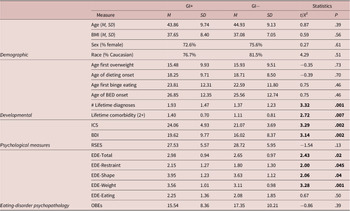
Table 1 summarizes the characteristics and comparisons of the two BED groups. The BED groups with and without general impulsivity did not differ significantly in demographic characteristics, including age, sex, or race, or in BMI. The two groups did not differ significantly in age of onset of obesity, binge eating, or dieting. Individuals with general impulsivity and BED reported a significantly greater number of lifetime psychiatric diagnoses than those without general impulsivity. Individuals with general impulsivity reported significantly greater levels of depressive symptoms but did not differ on self-esteem levels.
Demographic, Developmental, Psychological, and Eating-Disorder Characteristics of BED Patients With (N = 73) and Without (N = 270) General Impulsivity

Individuals with general impulsivity (GI+) reported greater eating psychopathology (EDE-Global, EDE-Restraint, EDE-Shape, EDE-Weight) than those without general impulsivity (GI−). There were no differences in number of objective binge episodes (OBEs) or eating concern (EDE-Eating). Individuals with general impulsivity reported greater depressive symptoms and lifetime psychopathology. Bold indicates significant results.
Abbreviations: BDI, Beck Depression Inventory; BMI, body mass index; ICS, Impulsivity Control Scale; M, mean; RSES, Rosenberg Self Esteem Scale; SD, standard deviation.
Individuals with general impulsivity reported significantly greater overall eating-disorder psychopathology (EDE-Global) with higher scores on three of the four EDE subscales (dietary restraint, shape concern, and weight concern, but not eating concern) compared to individuals without general impulsivity. The two groups did not differ significantly in frequency of binge eating.
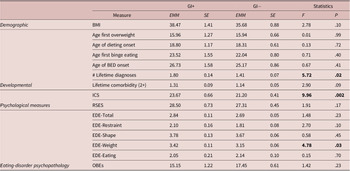
Because the BED groups categorized with and without general impulsivity differed significantly in BDI scores and because higher levels of depressive/negative affect are associated with severity of BED,Reference Grilo, Masheb and Wilson 39 subsequent analysis of co-variance (ANCOVA) examined group differences after statistically adjusting for BDI scores. Table 2 shows estimated marginal means after statistically adjusting for BDI and results from ANCOVA analyses. Even after adjusting for BDI scores, individuals categorized with general impulsivity still had significantly greater impulsivity levels (ICS), supporting the concurrent validity of DIPD-IV-based grouping. ANCOVAs (adjusting for BDI) revealed, consistent with ANOVA findings, that individuals with general impulsivity reported a significantly greater number of lifetime psychiatric diagnoses. ANCOVAs (adjusting for BDI) revealed that individuals with general impulsivity reported greater weight concern but differences on the other EDE scales no longer attained statistical significance.
Demographic, Developmental, Psychological, and Eating-Disorder Characteristics of BED Patients With (N = 73) and Without (N = 270) General Impulsivity, After Statistically Adjusting for BDI

Estimated marginal means (EMM), standard error (SE), and ANCOVA results are presented in this table. When statistically adjusting for depressive symptoms, individuals with BED and general impulsivity (GI+) had significantly greater impulsivity, different numbers of lifetime psychological diagnoses, and greater weight concern than individuals without general impulsivity (GI−). Bold indicates significant results.
Abbreviations: BDI, Beck Depression Inventory; BMI, body mass index; EDE, Eating Disorder Examination; ICS, Impulsivity Control Scale; OBE, objective binge episode; RSES, Rosenberg Self Esteem Scale.
Rates of comorbidity
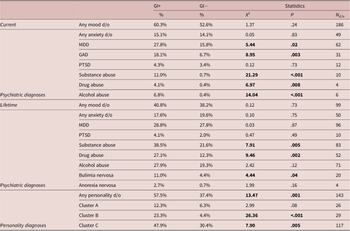
Table 3 summarizes rates of diagnostic comorbidity. Patients categorized with general impulsivity had significantly higher rates of psychiatric and personality disorder comorbidity than those without general impulsivity. Specifically, they had significant higher rates of current diagnoses (i.e., major depressive disorder [MDD], generalized anxiety disorder [GAD], substance abuse, drug abuse, and alcohol abuse) and lifetime diagnoses (i.e., substance abuse, drug abuse, and bulimia nervosa). Additionally, they had higher rates of personality disorders, including cluster B (e.g., antisocial personality disorder and borderline personality disorder) and cluster C diagnoses (e.g., avoidant personality disorder and obsessive–compulsive personality disorder).
Psychiatric and Personality Diagnoses in BED Patients With (N = 73) and Without (N = 270) General Impulsivity

Individuals with BED and general impulsivity (GI+) had greater rates of psychiatric and personality diagnoses than individuals without general impulsivity (GI−). Features and diagnosis of personality psychopathology included. N = 0 reported lifetime GAD without current d/o. Bold indicates significant results.
Abbreviations: d/o, disorder; GAD, generalized anxiety disorder; MDD, major depressive disorder; N d/o, N who meet criteria for disorder; PTSD, post-traumatic stress disorder.
Discussion
This study investigated whether individuals with BED and general impulsivity differ in clinical presentation from those without general impulsivity. Similar to findings for individuals with “multi-impulsive” bulimia nervosa, individuals with BED and general impulsivity reported greater eating-related psychopathology, greater depressive symptoms, and greater rates of comorbidity than those without general impulsivity. Thus, a general-impulsive subtype could signal a more severe variant of BED characterized by heightened and broader psychopathology.
Given the unknown nature of impulse control difficulties in BED, the frequency of general impulsivity in this sample is notable. In line with research suggesting that impulsivity in BED can be food-specific, 11-13 , Reference Voon 17 79% of this sample reported impulse control problems only in the context of food. However, 21% met clinical criteria for impulsivity in multiple domains. For comparison, data from the National Comorbidity Replication survey found that 43.3% of persons with BED reported comorbid impulse control disorders and 23.3% reported comorbid substance use disorders.Reference Hudson, Hiripi, Pope and Kessler 31 Because of divergent findings about different forms of impulsivity in BED, future work should examine whether individuals with BED and general impulsivity perform differently than those without general impulsivity on behavioral, neurocognitive, and brain-based measures of both food-specific and general impulse control.
Compared to individuals without general impulsivity, individuals with BED plus general impulsivity had a more severe clinical presentations in both eating-disorder feature domains as well as with respect to heightened rates of several psychiatric and personality disorders. For example, they reported greater lifetime rates of alcohol use and drug use disorders, in line with a broader literatureReference Udo and Grilo 1 , Reference Hudson, Hiripi, Pope and Kessler 31 and research on potential shared neurobiological features between BED and these conditions.Reference Balodis, Grilo and Potenza 13 , Reference Schulte, Grilo and Gearhardt 36 - 38 Consistent with prior work investigating depressive/negative affect and comorbidity-based subtyping of BED,Reference Grilo, Masheb and Wilson 39 , Reference Peterson, Miller, Crow, Thuras and Mitchell 40 individuals with BED and general impulsivity reported both greater depressive/negative affect and higher rates of comorbidity. Importantly, even after statistically adjusting for current depressive symptoms, group differences in impulsivity, lifetime comorbidity, and weight-related psychopathology remained significant. Collectively, these findings suggest continued efforts are needed by risk-factor, developmental, and experimental studies to examine how depressive/negative affect, comorbidity, and impulsivity-related factors interface to shape the course and outcome of BED.
The present work converges with older work investigating “multi-impulsivity” in bulimia nervosa. In this study, individuals with BED and general impulsivity had a greater lifetime history of bulimia nervosa, suggesting shared impulsivity-related risk for these conditions.Reference Waxman 43 Prior work found that individuals with “multi-impulsive” bulimia nervosa had more severe eating psychopathology, greater depressive symptoms, greater rates of comorbidity, and poorer response to treatment. 41-45 , Reference Myers, Wonderlich and Crosby 60 Interestingly, as in the present study, individuals with “multi-impulsive” bulimia nervosa had greater reported psychopathology without differences in frequency of binge eating.Reference Wiederman and Pryor 42 , Reference Bell and Newns 44 , Reference Myers, Wonderlich and Crosby 60 Further, individuals with “multi-impulsive” bulimia nervosa had worse treatment outcomes and seemed to exhibit “behavioral substitution” during eating disorder treatment.Reference Brisman and Siegel 46 Accordingly, parallels between “multi-impulsive” bulimia nervosa and general impulsivity in BED may have important clinical and treatment implications.
Why might general impulsivity be associated with increased rates of comorbid psychopathology in BED? Shared reinforcement patterns across impulsive behaviors (e.g., binge eating, substance use, self-harm, risky sexual behavior) could contribute to the development of multiple psychological conditions. For example, negative urgency—or a tendency to act rashly when distressed—onfers a greater risk for psychopathology across disordersReference Berg, Latzman, Bliswise and Lilenfeld 61 and is associated with poorer eating-disorder treatment outcomes.Reference Bardone-Cone, Butler, Balk and Koller 62 Similarly, positive urgency—or a tendency to engage in impulsive behaviors due to positive emotion—is associated with impulse control-related psychopathology, including substance use disorders and eating disorders.Reference Smith and Cyders 63 Individuals with greater intensity of negative or positive affect may be more susceptible to affectively-driven impulsive behaviors across domains. These negative and positive reinforcement patterns are consistent with neurobiological models of shared mechanisms across eating and substance use, functional assessment of binge eating/purging, and recent work in samples with comorbid binge eating and non-suicidal self-injury.Reference Balodis, Grilo and Potenza 13 , Reference Kessler, Hutson, Herman and Potenza 37 , Reference Davis 38 , Reference Muehlenkamp, Takakuni, Brausch and Peyerl 64 , Reference Wedig and Nock 65
This study has several strengths, including its large sample size and the use of semi-structured interviews reliably administered by trained doctoral research clinicians to assess clinically-significant impulsive behaviors and psychopathology. Further, because the DIPD-IV investigates impulsivity across many domains (eg, substance use, risky sexual behavior, and antisocial behavior), our categorization of general impulsivity included clinically-significant impulsive behaviors across a wider scope than prior work in “multi-impulsive” BN that was primarily defined based on self-harm and/or comorbid substance use.Reference Bell and Newns 44
The study’s findings, however, should be understood in the contexts of its limitations. First, the sample included in this paper was defined based on DSM-IV criteria rather than DSM-5 criteria and therefore it is possible that the patient group in this study may be characterized by more frequent binge eating and/or more severe psychopathology than DSM-5-based studies. The majority of participants were female, Caucasian, married, and college-educated, which may limit generalizability to more diverse groups or to groups with different characteristics. Participants were seeking treatment at a university-based program and therefore the findings may not be generalizable to community or nontreatment-seeking groups. There was no assessment of food-related obsessions/compulsions or planned binge eating in this study. Future work should examine the links of impulsivity and compulsivity with co-morbidity, symptom severity, and treatment outcomes for patients with BED.
Research is needed to determine whether adapting or enhancing treatment for BED to address general impulsivity may influence treatment outcomes. Recent food impulsivity-targeted treatmentsReference Boutelle, Knatz, Carlson, Bergmann and Peterson 18 , Reference Schag, Rennhak and Leehr 19 may or may not be suited to individuals without general impulsivity. In contrast, broader-impulsivity targeted treatments may be helpful for individuals with BED and general impulsivity. General skills training (e.g., for cognitive behavioral therapy: urge surfing applied to alcohol and food, cognitive reappraisal practiced in multiple contexts) could prevent “behavioral substitution” and improve treatment outcomes. Psychological treatments that address impulsivity and interpersonal features, such as dialectical behavior therapyReference Telch, Agras and Linehan 66 and interpersonal psychotherapy,Reference Markowitz, Oldham, Skodol and Bender 67 , Reference Tanofsky-Kraff, Wilfley, Grilo and Mitchell 68 might be especially well-suited for patients with BED who also have general impulsivity. Pharmacological agents that treat BED and reduce impulsivity symptoms, including lisdexamfetamine dimesylate (LDX), may be especially effective in individuals with difficulties related to general impulsivity.Reference Citrome 4 , Reference McElroy, Mitchell and Wilfley 69 , Reference McElroy, Guerdjikova, Mori, Munoz and Keck 70 Treatment trials for BED may benefit from investigations of general impulsivity and its effect on treatment outcomes.
Conclusions
In sum, subtyping within BED based on general impulsivity identifies a group with more severe clinical presentation. These individuals reported greater eating-related psychopathology, greater comorbid and lifetime history of psychopathology, and greater depressive symptoms. Building upon older investigations of “multi-impulsive” bulimia nervosa, this work suggests that adapting and adding interventions based on general impulsivity for BED may have utility.
Financial Support
This research was supported, in part, by National Institutes of Health grants R01 DK49587 and R01 DK121551 (Grilo). Dr. Grilo was also supported, in part, by NIH grants R01 DK114075 and R01 DK112771. Funders played no role in the content of this paper.
Disclosures
Dr. Rebecca Boswell and Dr. Carlos Grilo do not have any conflicts of interest. Dr. Grilo reports several broader interests which did not influence this research or paper. Dr. Grilo’s broader interests include: Consultant to Sunovion and Weight Watchers; Honoraria for lectures, CME activities, and presentations at scientific conferences and Royalties from Guilford Press and Taylor & Francis Publishers for academic books.