1. Introduction: nominal aspect
For decades, verbal aspect, nominal quantity and the interplay between the two have been popular research topics in linguistics (a thorough survey of the literature is given in Sasse Reference Sasse2002). In particular, formal semantics (for in-depth studies see e.g. Verkuyl Reference Verkuyl1972, Reference Verkuyl1993; Krifka Reference Krifka, Bartsch, van Benthem and van Emde Boas1989) has studied the interdependence of aspectual and quantificational factors, demonstrating that aspect must be considered a compositional phenomenon. Many analogies between the aspectual (verbal) and quantificational (nominal) domains have been pointed out, and it has been demonstrated in detail how clause-level aspect depends on the contribution of many clausal elements, not just the verb. Especially Verkuyl (Reference Verkuyl1972, Reference Verkuyl1993) has emphasized the significance of the arguments of the verb for aspect. The situation is perhaps clearest in transitive clauses in which the object is an incremental theme (see Dowty Reference Dowty1991) and thus participates in the event gradually. For instance, in She was painting the fence the activity proceeds along the fence gradually and reaches its endpoint when the whole fence has been painted. The extent of the fence (its quantity) thus sets boundaries to the duration of the painting, since the painting can only last as long as there remains fence to be painted. Such dependence of clausal aspect on nominal quantity will be referred to in the present paper as nominal aspect.
Among phenomena related to nominal aspect, the concept of boundedness is of central importance. As is also well known, the opposition between bounded and unbounded is common to both verbal aspect and nominal quantity (see Talmy Reference Talmy2000: 42–88 for a detailed comparison). In the aspectual domain, boundedness depends first and foremost on the verb and its inherent aspectual nature, also known as Aktionsart. At the clausal level, however, other factors such as aspectual constructions (e.g. the progressive), durative modifiers (for two hours), and locatives indicating a source or a goal contribute to the aspectual interpretation. In recent literature on aspect, it has become customary to distinguish two different levels of aspect. Sasse (Reference Sasse2002: 203–204) calls these aspect1 (viewpoint aspect, including the perfective/imperfective dichotomy and its associates, often expressed by grammatical means) and aspect2 (the Aktionsart type of aspect, more directly dependent on the lexical meaning of the verb). Smith (Reference Smith1997: 3) draws a similar distinction between situation types (Sasse's aspect2) and viewpoint types (Sasse's aspect1). She distinguishes five main types of situations: states (static, durative, e.g. know), activities (dynamic, durative, atelic, e.g. dance), accomplishments (dynamic, durative, telic, consisting of a process and its outcome, e.g. build), semelfactives (dynamic, atelic, instantaneous, e.g. sneeze) and achievements (dynamic, telic, instantaneous, e.g. find). States and activities are atelic and thus inherently unbounded, i.e. have no natural end point. Accomplishments, semelfactives and achievements are bounded situation types: they have an endpoint which they reach either after a gradual development (accomplishments) or instantaneously (achievements and semelfactives). A crucial difference between them is telicity: the completive types accomplishments and achievements bring about an end result, whereas semelfactives are atelic. This means that in the completive event types the state that follows the event differs from the state that precedes it, whereas in semelfactives the two states are (conceptualized as) similar. Smith also distinguishes three viewpoint aspect types that the speaker may select when viewing a situation: these are the perfective viewpoint (viewing a situation in its entirety, including both initial and final endpoints if such exist), the imperfective viewpoint (viewing only part of a situation, including neither the initial nor the final endpoint) and the neutral viewpoint (flexible, including the initial endpoint of a situation and at least one internal stage).
A rapidly growing literature has addressed the phenomenon called aspectual coercion, (informally) the alteration of the aspectual meaning of a linguistic element (typically a verb) to semantically match its context. Coercion takes place, for instance, when a telic verb is used in a progressive construction (for details, see e.g. Pustejovsky & Bouillon Reference Pustejovsky and Bouillon1995, de Swart Reference Swart1998 and Michaelis Reference Michaelis2004). De Swart (Reference Swart1998: 349) defines aspectual coercion as ‘an implicit, contextually governed process of reinterpretation which comes into play whenever there is a conflict between the aspectual nature of the eventuality description and the input condition of some aspectual operator’. Topics studied under the rubric of coercion within the formal semantics tradition cover phenomena ranging from verbal Aktionsart to nominal quantity.
In the nominal domain, boundedness depends on whether the NP refers to a closed (bounded) or an open (unbounded) quantity. For clarity, I will follow Larjavaara (Reference Larjavaara1991) in using the terms open vs. closed to refer to this nominal quantificational opposition, and reserve the terms bounded and unbounded for verbal aspectual use. In incremental situations, open quantity gives rise to unbounded aspect and closed quantity to bounded aspect. Another pair of terms used for this purpose were introduced by Krifka (Reference Krifka, Bartsch, van Benthem and van Emde Boas1989), who distinguishes quantized (closed/bounded) and cumulative (open/unbounded) expressions in both the aspectual and the quantificational domains. In the nominal domain, only mass nouns and plural forms are typically able to indicate both open and closed quantities (of substances and multiplicities), whereas singular count nouns refer to indivisible entities, which inherently constitute closed quantities. However, indivisible entities may also participate in events incrementally, as in The potter was making a flower pot.
With mass nouns and plurals, the opposition between open and closed quantities also correlates with definiteness: definite mass nouns and plural forms generally indicate closed quantities, while indefinite ones indicate open quantities. For instance, in The flour is in the cup the definite subject NP refers to a closed quantity of flour, whereas in There is flour in the cup the quantity of the flour is open (‘some flour’). Count nouns, on the other hand, always indicate a closed quantity, since their referent is conceived as an indivisible whole. This closedness does not correlate with definiteness, cf. The strawberry [closed quantity, definite] is in the cup vs. There is a strawberry [closed quantity, indefinite] in the cup (for such relationships between definiteness and quantification, with special reference to English and Finnish, see Chesterman Reference Chesterman1991). However, as is well known, the boundary between mass and count nouns is fuzzy, and the speaker has the ultimate option of representing even prototypical count nouns as mass-like, as in the following example from Langacker (Reference Langacker1991: 73): After I ran over the cat with our car, there was cat all over the driveway. According to de Swart (Reference Swart1998: 352; see also Bach Reference Bach1986), such examples also involve a coercion, and the literature uses the notions of a universal grinder and a universal packager to reflect (respectively) the nature of the operations at work when we use mass nouns in a count-noun-like fashion, and when we use count nouns as mass-like.
In her cognitive linguistic study of Russian aspect, Janda (Reference Janda2004) makes a detailed comparison between nominal referents (in her terms, the idealized cognitive model (ICM) of matter) and verbal aspect. Her general objective is to explain aspectual phenomena as a metaphor of the ICM of matter. She draws a basic distinction between discrete solid objects and fluid substances (basically the count vs. mass distinction), and argues that a similar distinction can be made in aspect, with perfective aspect corresponding to a solid object and imperfective aspect to a fluid substance. Crucial features of a discrete solid object include the fact that it has inherent shape and edges, cannot be easily penetrated, cannot occupy the same place as another discrete object, is stable, and can be grasped (Janda Reference Janda2004: 475–476). Another feature that distinguishes solid objects from fluid substances is what Janda calls ‘streamability’: fluid substances can ‘stream’ and participate in events gradually (incrementally), whereas solid objects cannot. What makes Janda's work especially fruitful for studies dealing with the interplay of nominal quantity and aspect is that she not only discusses these domains separately but also introduces many conceptual operations that are available to the speaker for manipulating these notions. Such operations may result, for instance, in the conceptualization of a solid object as fluid-substance-like (‘pulverization’, cf. Langacker's example above), or the conceptualization of a fluid substance as filling a container with firm boundaries, or the placement of a solid object within a fluid substance, and so on.
In spite of these similarities between verbal aspect and nominal quantity, there are also important differences regarding the nature of boundedness (closedness) in the two domains. Perhaps the most important difference is that verbal boundedness is always boundedness in time and correlates with the temporal features of the event: whether the event is ongoing or terminated (imperfective vs. perfective), and whether it has an inherent endpoint or not (atelic. vs telic). Nominal quantity, on the other hand, is not necessarily distributed over time, though it may be, if the referent participates incrementally. In the verbal domain, boundedness is both a lexical semantic feature of particular verbs and a feature of concrete usages of verbs (or of whole clauses). Though these levels correlate, they need not always coincide, as shown by the extensive studies on aspectual coercion (e.g. Michaelis Reference Michaelis2004 and the references mentioned there). For instance, the verb run indicates a basically unbounded activity, but sentences like He ran a mile or He ran from school to the station refer to a bounded situation that ceases after the indicated distance has been traversed. In the nominal domain, only count nouns indicate a closed quantity as part of their lexical meaning. In contrast, mass nouns are neutral with respect to quantity, since mass nouns receive their quantificational interpretation only in concrete usage events. For instance, the noun flour designates a substance, but without the context of an actual usage event it is impossible to tell whether the quantity of the substance is to be conceived as closed (as in The flour is in the cup) or open (as in There is flour in the cup).
Typically, the referent of a count noun participates in the situation throughout and does not set a boundary to its duration. For instance, in The girl patted the dog, the quantity of the participants ‘girl’ and ‘dog’ does not set boundaries to the duration of the ‘patting.’ Both the girl and the dog participate in the event throughout as wholes (not incrementally), both already exist before the event and continue their existence after the event. Neither of the participants is ‘consumed’ during the event. This conceptualization is especially common and natural if the referent of the NP is a solid object, whereas fluid substances more typically participate gradually.
Indeed, the situation is different when a nominal referent (typically a substance) participates in the event incrementally. In this case the extent of the referent also determines the duration of the event. An incremental participant is ‘consumed’ (either concretely or figuratively) during the process, as in The boy was eating a sandwich or The professor was reading the thesis, where the process reaches its endpoint when the whole referent of the object has participated in it. Here the participation of the nominal referent is incremental in an objective sense, i.e. the eating and reading are actually affecting (or directed at) different parts of the sandwich or the thesis at subsequent points of time. Since a sandwich and a thesis are bounded entities, the activities that involve them as incremental participants are understood as (aspectually) telic: they reach their endpoint when the whole entity has participated. However, an incremental participant can also be quantitatively open, resulting in aspectual unboundedness of the situation; here the situation is continuously ‘fed’ by the incremental participant with new substance, as in Water was pouring out of the drain. Indeed, as pointed out by Verkuyl (Reference Verkuyl1993) and Krifka (Reference Krifka, Sag and Szabolcsi1992: 50), it may not be the activity of ‘eating’ or ‘reading’ as such that constitutes the boundedness in examples like He ate the sandwich or She read the book; rather, it is the nature of the object that creates the boundedness (i.e. we typically eat entities or portions of some kind, and read books, papers and other things, whose extension is bounded). It is also possible that the incremental participation of a nominal referent in a situation is based on subjective factors, such as an incremental scanning of a nominal referent which is not affected itself or does not undergo a change in the course of the event (see Talmy Reference Talmy2000: 71 for details).
In the following sections, I will study nominal and verbal aspect and their effects on the case marking of the object in Finnish, which reflects both aspectual and quantificational factors. I begin by introducing the classical view of Finnish object marking in section 2, where it is shown how the case marking is determined by a complex interplay of aspect and quantity, and often results in massive ambiguity. In section 3, I discuss certain problematic usages that seem to contradict the general principles of object marking. These usages often (though not always) involve incremental objects. In section 4 I discuss examples where it is the subject (not the object) whose referent participates incrementally, and show how this affects the object marking. In section 5 I return to one of the problematic object types discussed in section 3, the so-called quasi-resultative type, and show how this static type can be associated with dynamic types where either the subject or the object indicates an incremental participant. Section 6 sums up the results of the study.
2. The Finnish object marking system: an overview
One of the most problematic issues in Finnish grammar is without doubt the case marking of the object (for literature in English, see e.g. Denison Reference Denison1957; Heinämäki Reference Heinämäki, Groot and Tommola1984, Reference Heinämäki, Bache, Basböll and Lindberg1994; Helasvuo Reference Helasvuo2001; Huumo Reference Huumo2005). The case marking of the object is part of a more extensive system of oppositions among the grammatical cases of the language. The partitive case marks the object under three conditions: a) in negated sentences, b) in aspectually unbounded sentences (more precisely: atelic, progressive, cessative, and irresultative (semelfactive) sentences), and c) in sentences where the object NP refers to an open, indefinite quantity. Its counterpart is a morphologically heterogeneous category which will be referred to here (following the recent descriptive grammar ISK Reference ISK=Auli, Vilkuna, Korhonen, Koivisto, Heinonen and Alho2004) as the total object, designating what might be called completeness of quantity or aspect or both. The case opposition between the partitive and other grammatical cases works not only in the marking of the syntactic object (Heinämäki Reference Heinämäki, Groot and Tommola1984, Reference Heinämäki, Bache, Basböll and Lindberg1994; Chesterman Reference Chesterman1991; Huumo Reference Huumo2005), but also of the existential subject (see Helasvuo Reference Helasvuo2001, Huumo Reference Huumo2003) and the predicate nominal (Huumo Reference Huumo2009), though under different conditions. Furthermore, the ‘total’ cases that participate in the system vary from one subtype to another. In existential subjects and predicate nominals, the total-case counterpart of the partitive is always the nominative. In object marking, the situation is more complicated: the total object can be marked with either the nominative, the genitive, or the irregular accusative form of personal pronouns (ending -t). Historically the object-marking genitive was an accusative case with the ending *-m, but it coalesced with the genitive -n as the result of a sound change whereby word-final -m became -n. This sound change caused a reanalysis of many infinitival constructions in the language, such that many accusative-marked objects of finite verbs were reinterpreted as genitive-marked subjects of infinitives (see e.g. Anttila Reference Anttila1989: 103–104).
The choice of the case is based on an interplay of multiple factors, including quantity, definiteness, the count vs. mass distinction, negation, subject-verb agreement, and aspect. Among these factors, quantity and the count vs. mass distinction are involved in all three main syntactic contexts of the case opposition (existential subject, predicate nominal and object). Negation requires the partitive marking of objects and existential subjects but not of predicate nominals. Pure aspect (i.e. without quantity) affects the case marking of the object only. In the following discussion, I will not deal with predicate nominals (for these, see Huumo Reference Huumo2009) but will focus on object marking; subjects will be treated in section 4.
As mentioned above, there are three main factors that affect the case marking of the object: quantity, aspect, and negation. The received view of Finnish grammar (e.g. Chesterman Reference Chesterman1991: 93; Vilkuna Reference Vilkuna2000: 119; ISK Reference ISK=Auli, Vilkuna, Korhonen, Koivisto, Heinonen and Alho2004: 887) maintains that negation is the strongest of these conditions, followed by aspect and quantity. That negation is the strongest condition is shown by the fact that (practically) all objects of negated clauses take the partitive case, whereas the case marking in affirmative clauses is determined by a complex interplay between quantity and aspect. The effects of quantity can be seen most clearly in expressions of a punctual achievement, since these indicate a situation that is indisputably bounded and brings about an end result; thus aspect will not be a reason for using the partitive (certain exceptions are discussed in Huumo, Reference Huumoforthcoming). Consider (1)–(3), whose punctuality is also reflected in the fact that they reject direct durative modifiers (which in Finnish are marked like the total object and correspond semantically to the English for an hour type)Footnote 2.
(1) Löys-i-n kirja-n (* minuuti-n). find-pst-1sg book-tot minute-tot ‘I found a/the book (*for a minute).’
(2) Löys-i-n voi-ta (* minuuti-n). find-pst-1sg butter-par minute-tot ‘I found some butter (*for a minute).’
(3) Löys-i-n voi-n (* minuuti-n). find-pst-1sg butter-tot minute-tot ‘I found the butter (*for a minute).’
In (1) the object is a count noun and refers to a bounded entity (thus to a closed quantity); therefore the total object must be used. The punctual nature of (1) also excludes an aspectual partitive. In (2) and (3) the object is a mass noun, which can be differentially quantified by means of the case opposition. The partitive in (2) indicates that the quantity of the butter is open (‘some butter’), whereas the total object in (3) indicates a closed quantity of a definite referent (‘the butter’).
At the other end of the aspectual scale we have atelic verbs that indicate an unbounded situation, i.e. an activity or a state. In such examples the unbounded aspect requires the partitive even if the object is a count noun or a mass noun indicating a closed quantity. Such examples do allow direct durative modifiers (consider examples (4) and (5); however, see also section 3.2 for exceptions).
(4) Pitel-i-n käde-ssä-ni kirja-a ~ voi-ta (tunni-n). hold-pst-1sg hand-ine-1sgpx book-par butter-par hour-tot ‘I was holding ~ held [a/the] book ~ [the/some] butter in my hand (for an hour).’
(5) Rakasta-n sinu-a ~ olut-ta. love-prs.1sg you-par beer-par ‘I love you.’ ~ ‘I love beer.’
Example (4) indicates an activity and example (5) a state. As shown by the English translation of (4), the object marking does not reveal whether the quantity of the butter is open or closed. This is because the unbounded aspect demands the partitive in any case. The aspectual function of the partitive thus ‘conceals’ the quantity of the referent. In (5) the situation is abstract and therefore the question of quantity does not arise: the object does not refer to an actual instance of beer that could be quantified but is understood as generic. Note, too, that the unboundedness of the situation in (4) can be understood in two different ways: as progressivity (‘was holding’) or as cessativity ‘held’, where the event has ceased without reaching an end point (Sasse Reference Sasse2002: 206 uses the term delimitative for this type of aspect). In some languages there are aspectual grams that specifically indicate delimitative meanings; for instance Russian has verb prefixes whose meaning is roughly ‘to do X for a while’ (see Dickey Reference Dickey, Divjak and Kochanska2007 and Janda Reference Janda2007, who calls such events complex acts). As example (4) shows, there is no specific way of indicating cessativity in the Finnish system; this is just one possible interpretation of the polysemous partitive object. However, the fact that it is the partitive and not the total object that is used to indicate cessativity clearly shows how the total object requires more than just a perfective viewpoint (i.e. the fulfilment of an accomplishment) to be available.
Examples like (4) also demonstrate that a partitive object is able to indicate pure quantity only if it does not indicate unboundedness, that is, only in aspectually bounded examples like (2). Similar observations have been made in the literature on aspectual coercion. For instance, de Swart (Reference Swart1998: 349) argues that a progressive predication such as Anna was running a mile does not licence the inference that Anna actually ran a mile; when focusing on the ongoing activity, the progressive conceals the projected end result of the event. Thus, according to de Swart, the semantics of the progressive involves ‘stripping an event of its culmination point’ (p. 355). Similarly, the Finnish partitive in unbounded sentences often conceals the projected overall quantity of the object NP. Unlike the object in examples (2) and (3), the object in example (4) is unable to indicate the quantity of its referent by case alteration, because the unboundedness of the aspect excludes the total object altogether. Among the conditions motivating object case marking, accordingly, aspect appears to be stronger than quantity. This is why many grammars of Finnish (e.g. Chesterman Reference Chesterman1991, Vilkuna Reference Vilkuna2000) represent the three conditions for the partitive object in the form of the hierarchy negation>aspect>quantity, where negation is the strongest condition (requiring the partitive irrespective of quantity and aspect) and aspect is the second-strongest (requiring the partitive irrespective of quantity). However, as the following discussion will show, this hierarchy is a simplification, and matters are in fact more complicated.
Leaving aside punctual and atelic examples for the moment, I will now discuss the case marking in examples that indicate accomplishments, i.e. non-punctual telic events that develop gradually towards their endpoint. In such examples the total object indicates the combination of bounded aspect and closed quantity, whereas the partitive usually has many possible interpretations. In this type, the partitive but not the total object allows a direct durative modifier in the same clause. Consider examples (6) and (7), where the star in parentheses indicates the ungrammaticality of the total object version in the presence of the durative modifier.
(6) Lu-i-n kirja-a ~ (*) kirja-n (tunni-n). read-pst-1sg book-par book-tot hour-tot ‘I was reading the book ~ read the book (for an hour).’ [par] ‘I read the [whole] book.’ [tot]
(7) Sö-i-n puuro-a ~ (*)puuro-n (tunni-n). eat-pst-1sg porridge-par porridge-tot hour-tot ‘I was eating (the) porridge’ ~ ‘I ate (some of the) porridge (for an hour).’ [par] ‘I ate up the porridge.’ [tot]
As the English translations indicate, the partitive indeed has a considerable variety of possible interpretations. First, it can have the aspectual function of indicating either a progressive or a cessative reading where the event has been interrupted (terminated before reaching its possible endpoint). These readings are both possible in the partitive versions of (6) and (7), as the English translations show (‘I was reading the book’ vs. ‘I read the book (without finishing it)’ in (6); ‘I was eating the porridge’ vs. ‘I ate (some of the) porridge’ in (7)). Another reading of the partitive is the quantificational one, which applies if the event itself has been completed but the quantity of the object NP is open. When considering examples (6) and (7), it should be kept in mind that the hierarchy negation>aspect>quantity represents the situation from the viewpoint of the partitive object, not of the total object, which can only be used if the sentence does not meet any criterion of the partitive (however, in section 3.2, this principle too turns out to be problematic). Thus aspectual factors (boundedness) alone cannot trigger the total object unless the quantity indicated by the object NP is closed.
If we consider example (7) in more detail, we see that the alternative interpretations of the partitive set up another kind of a hierarchy. With the progressive reading, the partitive object conceals the (projected) quantity of the object referent: the example does not tell whether the projected endpoint of the event would involve a closed or an open quantity of porridge (the opposition between ‘I was eating porridge’ and ‘I was eating the porridge’). The same ambiguity arises in the cessative interpretation where the activity has been interrupted: again, we do not know whether the event had been proceeding towards an endpoint involving a closed quantity (‘I ate some of the porridge’) or not, in which case the partitive object indicates open quantity of the porridge eaten so far (‘I ate some porridge’). In sum, examples (6) and (7) show that the total object is used only if the situation has both reached its endpoint and has affected a closed quantity (‘I ate up the porridge’). They also show that the multifunctional nature of the partitive often gives rise to ambiguity, and when indicating a more dominant function (e.g. progressivity) the partitive conceals less dominant features that it can indicate in other contexts (quantity).
Finally, it needs to be pointed out that, in addition to progressivity and cessativity, there is yet another aspectual function for the partitive, which in the Finnish tradition is referred to as irresultativity (discussed in Huumo Reference Huumoforthcoming). An irresultative situation is (typically) punctual (at least bounded) but fails to bring about a substantial end result that would motivate the use of the total object and is thus atelic. Its opposite is a resultative situation which is conceptualized as involving a fundamental, often irreversible change of state in the object referent. On the basis of the resultativity vs. irresultativity opposition, Finnish punctual verbs can be divided into two groups: resultative (accomplishment/achievement) verbs like tappaa ‘kill’, ostaa ‘buy’, huomata ‘notice’ and löytää ‘find’ that take the aspectual total object, and irresultative (semelfactive) verbs like tönäistä ‘nudge’, mulkaista ‘glance’ and lyödä ‘hit’ that take the aspectual partitive object. The resultative total object thus indicates a transition: the event brings about a change, after which it does not return to its original state but enters another one. The partitive, on the other hand, indicates that no such transition takes place and that immediately after achieving its target state the situation returns to the original state (or to a state that is conceptualized as similar to the original state). Croft (Reference Croftforthcoming) calls these different situation types directed achievements and cyclic achievements, respectively, and points out that directed achievements can be further divided into two classes: reversible ones, such as open, and irreversible ones, such as break or die. A different terminology is used by Smith (Reference Smith1997), who draws a distinction between two punctual situation types, achievements (which result in a change) and semelfactives (which do not bring about a change). At a crude level, such distinctions also reflect the resultativity opposition between the Finnish object markers. However, there are certain uses of the partitive that do not properly fit such a classification. For instance, Leino (Reference Leino1991) points out that the verb vaihtaa ‘change’ often takes the partitive object in cases where one realization of the object replaces another and where the two realizations both belong to the same category – even though such a change would count semantically as an accomplishment (8).
(8) Vaihdo-i-n paita-a.change-pst-1sg shirt-par ‘I changed my shirt’.
In example (8) the person takes off one shirt and puts on another, which would be expected to count as an accomplishment, but nevertheless the partitive object is used. What is also noteworthy in (8) is the number of the object: it is in the singular though actually there are two referents.
Other exceptional instances include punctual verbs that allow both a resultative and an irresultative interpretation of the situation they indicate (and thus an alteration between the partitive and the total object). The best-known example is the verb ampua ‘shoot’ in (9), discussed by Heinämäki (Reference Heinämäki, Groot and Tommola1984) .
(9) Ammu-i-n lintu-a ~ linnu-n.shoot-pst-1sg bird-par bird-tot ‘I was shooting [aiming at] the bird.’~ ‘I shot [at] the bird [but failed to kill it].’ [par] ‘I shot the bird [dead].’ [tot]
With the total object, the verb ‘shoot’ indicates resultativity, i.e. the death of the bird as a result of the shooting. With the partitive object it indicates the irresultativity of the shooting. In addition, the partitive also has a prospectiveFootnote 3 reading where it indicates a phase that precedes the actual event. Thus (9) also shows that achievement verbs must be divided into two classes: proper achievements that do not allow the partitive object to indicate a prospective viewpoint aspect (e.g. löytää ‘find’ in examples (1)–(3)) and extended achievements that allow the prospective viewpoint aspect.
The resultative vs. irresultative opposition is also relevant with certain verbs that indicate the causation of a gradual change-of-state in the patient, e.g. lyhentää ‘shorten’ and lämmittää ‘warm’. Smith (Reference Smith1997: 24) calls such events degree predicates and Croft (Reference Croftforthcoming) directed activities; and both argue that such verbs indicate a directed change that has no natural endpoint. However, an endpoint can be conceptualized into the event, and this opposition is reflected in the Finnish object marking: with the total object these verbs indicate an abrupt, absolute change (‘make short/warm’), but with the partitive object they indicate a gradual, scalar change with no particular endpoint (‘make [somewhat] shorter/warmer’). The situation is further complicated by the fact that these verbs are not punctual but durative, and therefore the partitive can also receive the progressive reading. Consider (10).
(10) Lyhens-i-n hame-tta ~ hamee-n.shorten-pst-1sg skirt-par skirt-tot ‘I was shortening the skirt.’ ~ ‘I shortened the skirt [somewhat].’ [par] ‘I shortened the skirt.’ [=made it short] [tot]
It should be pointed out that the aspectual opposition here called resultativity vs. irresultativity is quite different from the opposition observed in accomplishments: here it is related to the nature of the end result of the event, and the relevant factor is not whether the event has been brought to its possible endpoint or not (as in ‘reading a book’) but the nature of the endpoint itself. In many grammatical descriptions of Finnish, however, the term irresultative has also been used to refer to durative events that have not been brought to their endpoint, and it needs to be emphasized that my usage of the term is somewhat narrower. It is also worth noting that although (10) would most naturally be classified as an accomplishment, its object marking seems to correspond to that of accomplishments only partially (i.e. when the partitive indicates progressivity). The fact that the irresultative reading is also possible for the partitive shows that such situations can also be conceptualized as semelfactives.
Next consider negation. Keeping in mind that negation requires all objects to be marked with the partitive, we can expect that negated examples will have even more possible readings than affirmative examples like (10). Indeed, as pointed out by Itkonen (Reference Itkonen1976), examples like (11) may have as many as six possible readings, taking into account both aspect and quantity, if we consider all alternatives from the viewpoint of the corresponding affirmative sentence that has been negated.
(11) En voidel-lut ~ suks-i-a.neg.1sg wax-pst.conneg ski-pl-par ‘I was not waxing ~ did not wax [the] skis.’
Note first that the affirmative counterpart of (11) could have either the total object (‘I waxed the skis’) or the partitive object (‘I was waxing [the] skis’; ‘I waxed some [of the] skis’). The total object would indicate bounded aspect together with a closed quantity, which in turn could be understood in two ways: it could consist either of one pair of skis or of a larger but closed quantity of (pairs of) skis. The affirmative partitive in turn could have two aspectual readings (the same as in example (10)). First, it could have the progressive reading, which would again conceal whether the event is conceptualized as an accomplishment or an activity, i.e. whether it is progressing towards a closed quantity of skis or not (‘I was waxing the skis’ vs. ‘I was waxing skis’). Second, the partitive could have the cessative reading, maintaining the same ambiguity of the overall quantity (‘I waxed some [of the] skis’). The negative partitive conceals all these possibilities and focuses only on the fact that the event did not take place at all.
To sum up, it is easy to see that the general function of the partitive is to indicate the incompleteness of the situation in one way or another (a generalization suggested by Leino Reference Leino1991): either the situation does not take place at all (negation), or it does not reach an endpoint (atelic/cessative/progressive), or it reaches its endpoint but does not affect a closed quantity of entities. It is also noteworthy that the partitive often implies either an actual or a potential continuation of the event. In the progressive reading, the event is actually ongoing, and in the cessative reading it could potentially be carried on further. In the reading involving an open quantity, the event could (in many cases) be continued so as to affect a larger quantity of entities. It is only the irresultative partitive that lacks such an implication – this is because the event type indicated by the verb is itself one lacking a relevant end result. The total object, on the other hand, indicates that the event has been brought to its endpoint and that the activity has affected a closed quantity in full. Thus a potential continuation of the event is excluded, though it may be possible to repeat the event (e.g. to read a book again).
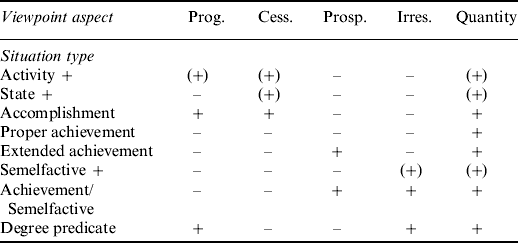
The above discussion also shows that the lexical aspectual situation type of the examples is in many ways crucial to the selection of the object marker. In contrast, viewpoint aspect can be explicitly expressed by the object case only in certain situation types. The unbounded situation types, i.e. states and activities, require the partitive object irrespective of quantity and viewpoint aspect (examples (4) and (5); exceptions will be discussed in section 3). In unbounded situation types the partitive thus cannot unequivocally indicate viewpoint aspect, though it can often be interpreted with this kind of a meaning. Among the bounded situation types, accomplishments trigger the total object if the situation has been brought to its endpoint and if the quantity of the object NP is closed and its entire referent has participated in the event. In accomplishments, the partitive can indicate a cessative or progressive viewpoint aspect, or (if not interpreted as indicating one of these viewpoint aspects) an open quantity of the object referent. The two punctual situation types, achievements and semelfactives, do not allow the progressive or cessative readings for the partitive, since the situations they indicate are not durative. Proper achievements (‘notice’, ‘find’) take the aspectual total object (or the quantificational partitive), but extended achievements (in Finnish, verbs meaning e.g. ‘shoot’, ‘buy’, ‘kill’) allow the aspectual partitive to indicate a prospective viewpoint aspect – that the event is about to take place or that the referent of the subject is attempting the achievement. Semelfactives always take the partitive object, since in spite of their temporal boundedness they are atelic and lack an end result. However, as example (8) shows, the division of punctual verbs into achievements and semelfactives is far from clear-cut, and as example (9) shows, some punctual verbs (‘shoot’) can take both kinds of object marking depending on the conceived nature of the end result. An even more complicated case in point involves so-called degree predicates like ‘warm’, ‘lengthen’ or ‘shorten’ (example (10)). These resemble accomplishments in that they are durative and thus allow the progressive partitive (10). However, the object marker also participates in the resultative vs. irresultative opposition with degree predicates: it can reflect the conceived nature of the end result (gradual vs. absolute). The overall situation is summarized in table 1, which indicates the readings available for the partitive object in each situation type.
The functions of the partitive object

Key: Prog.=Progressive; Cess.=Cessative; Prosp.=Prospective; Irres.=Irregulative
In each row of the table, the possible readings of the partitive are marked with a plus (+) mark. As can be seen, there is a plus mark immediately following the name of certain situation types. These are the atelic situation types that exclude the total object altogether: activities, states and semelfactives. The other situation types, which do not have a plus mark after their name, allow viewpoint aspect and quantity to determine the case of the object. As can also be seen, some of the plus marks in the table are in parentheses. A bare plus mark indicates a function that can be the sole factor motivating the partitive object. Parentheses around the plus mark indicate that the partitive allows the interpretation with the function in question, in addition to another function. This happens in situation types that require the partitive in any case but can have different aspectual readings for it. For instance, the partitive object in an activity expression can have either a progressive or a cessative reading, but since the atelic nature of the situation type requires the partitive anyway, these functions remain only possible alternative interpretations. In contrast, the partitive object of an accomplishment verb can specifically indicate progressive or cessative aspect, or open quantity. The same principles work in quantification: in atelic situation types that require the aspectual partitive anyway, the partitive cannot unequivocally indicate open quantity (it remains indifferent to quantity). In contrast, the telic situation types allow the partitive to have a quantificational reading – but only if its viewpoint aspectual readings do not apply. If interpreted as indicating viewpoint aspect, the partitive again becomes indifferent to quantity.
Above I have discussed object case marking from the point of view of the partitive object, trying to pin down the factors motivating it within each aspectual type. Alternatively, the system can be approached from the point of view of the total object, the usage conditions of which turn out to be simpler: the total object is used in (affirmative) accomplishment and achievement expressions with a perfective viewpoint (thus excluding prospective, progressive and cessative viewpoints), on condition that the object indicates a closed quantity that has participated in the event in its entirety.
At a crude level, the opposition between the partitive and the total object thus seems to follow the principle suggested by Leino (Reference Leino1991): the partitive indicates incompleteness of the situation in one way or another. This explanation strives towards a central objective of all scientific investigation: generalization. However, an adequate explanation must also be able to deal with problematic instances, and one should not strive towards generalization at the expense of the facts. Though a widespread consensus prevails among scholars of Finnish grammar that the three factors of negation, aspect and quantity explain the case marking of the object, and that more general terms such as boundedness or incompleteness represent useful and valid generalizations, there remain a few problematic instances that are not easily explained by such general principles. These include particular uses of both the partitive and the total object. First, the partitive is used in certain examples that are aspectually bounded and cannot proceed further in time; thus the total object would be expected (Huumo Reference Huumoforthcoming). Second, the total object is used in certain examples indicating situations that are aspectually unbounded; thus the partitive would be expected. Some of these uses have been discussed in some detail in the literature, while others have escaped the attention of scholars.
In the following discussion it will be argued that the generalizations concerning Finnish object marking have given too much weight to what has been taken to be the prototype situation for these oppositions, that is, an aspectual opposition which involves as one pole a telic, non-punctual and thus an accomplishment-type situation that gradually proceeds towards its endpoint, finally reaches it and thereby attains completion. In English, such examples include I took ~ was taking the letter to the post office (non-incremental object) or I read ~ was reading the book (incremental object); to understand the Finnish object marking properly we need to pay attention to incremental and non-incremental instances in each opposition type.
The problematic instances to be discussed in the following sections involve expressions that indicate unbounded situations but nevertheless select the aspectual total object. In section 3 I will argue that the motivation for using the total object in such instances is indeed boundedness of aspect or quantity (or both), but a type of boundedness that differs fundamentally from the canonical kind that gets realized only after cumulating gradually over time. The type of boundedness that will be relevant here, to be called continuous boundedness, is one that obtains throughout the entire situation, at any given point of time during its duration. In section 3.1, I will discuss two types of usage of the total object that have received attention in earlier work, i.e. habitual expressions and so-called quasi-resultative sentences (Huumo Reference Huumo2005). Habitual expressions are aspectually dual in the sense that they indicate the iteration of an event that may itself be bounded. Since the quantity of the iterations is unbounded, the overall situation is also unbounded, even though its component situations may be bounded. It will be shown that in habitual examples, Finnish aspectual object marking reflects the nature of the component situations, not the overall habitual situation, although the duration of the latter can however be indicated by durative adverbs. The quasi-resultative type consists of stative situations which, according to the analysis of Huumo (Reference Huumo2005), are conceptualized as ‘frozen’ fictive accomplishments that extend over time. In section 3.2 the focus is on two usage types that have not been discussed previously: continuous completives (accomplishments/achievements) and continuously bounded quantities. It is in these latter two types that we need to draw a distinction between overallaspect (classical aspect, proceeding and cumulating in time) and another type of aspect, henceforth called the transient aspect, which is orthogonal to the time axis and thus gives a characterization of the ‘cross-section’ of the situation at any given point of time, i.e. whether the indicated relationship is conceptualized as bounded or unbounded at any given point of time during the event. It is argued that transient aspect plays a central role in Finnish object marking and needs to be taken into account in order to give a coherent picture of the grammatical systems involved in aspectual object marking.
3. The total object as indicator of continuous boundedness
The fact that the total object can be used in unbounded examples shows that the general rules of Finnish object marking fail to explain certain usages that are of crucial importance to the theory of aspect. In this section it is argued that even in such problematic instances the function of the total object is to indicate boundedness (of aspect or quantity), but of a type that differs from the canonical type where boundedness equates to the reaching of an endpoint where the event itself culminates. In the instances to be discussed below, boundedness prevails continuously: the situation does not develop towards an endpoint but consists of a continuous force-dynamic interaction (in the sense of Talmy Reference Talmy2000: 409–470) that serves to keep the situation complete at each point of time, as in the English example This brush cleans the conveyor belt before it enters the machinery (‘continuously keeps the conveyor belt in the state of total cleanliness’).
In the same way as canonical boundedness, continuous boundedness can be based either on aspect alone or on a combination of aspect and quantity. When the continuous boundedness of a situation is purely aspectual, the situation is conceptualized as a continuous completive (a higher-order term for accomplishments and achievements) where a force-dynamic interaction between an actor and an undergoer keeps the undergoer in a state conceived as completed, or resultative, as the classical Finnish terminology puts it (see also Huumo Reference Huumoforthcoming). This means that the situation cannot develop towards an even greater perfection; on the other hand, without the continuous force-dynamic interaction the situation would cease to obtain and the undergoer would leave its resultative state. Correspondingly, when the continuous boundedness of the situation is motivated by a combination of bounded aspect and closed quantity, the object is incremental and changes its reference through time but at the same time indicates closedness of quantity at each individual point of time. More concretely, such a sentence means that continuously all substance (or multiplicity of individuals) that enters the situation is brought into a new, resultative state by the force-dynamic interaction indicated by the verb.
In sections 3.2 and 3.3 I will discuss such examples in detail; I will refer to the two types as continuously closed quantities and continuous completives. First, however, I will discuss in section 3.1 two other types where the total object is used in unbounded sentences. These types have been dealt with in the literature to some extent, and they are closely related to the new types introduced here. The first type consists of habitual or generic examples, and the second type of so-called quasi-resultative examples (for these, see Huumo Reference Huumo2003). After this, I will proceed to continuous boundedness.
3.1 The habitual and the quasi-resultative types
In the literature, two kinds of uses of the total object in unbounded sentences have been distinguished: the habitual-generic type and the so-called quasi-resultative type. In the linguistic literature on aspectual coercion, a lot has been written about habitual and generic expressions, with a consensus prevailing that habitual and generic expressions coerce dynamic expressions into static ones (see e.g. Carlson & Pelletier Reference Carlson and Pelletier1995, de Swart Reference Swart1998: 383). However, Michaelis (Reference Michaelis2004: 5, 20–21) points out that as far as their internal composition is concerned, habitual situations are isomorphic to iterated events, i.e. activities. Langacker (Reference Langacker1999: 251) argues that although a habitual or generic expression indicates a situation that occurs repeatedly, this repetition can be generalized into a continuously prevailing state in the structural plane, which ‘comprises event instances with no status in actuality’ and is thus different from the actual plane, which ‘comprises event instances that are conceived as actually occurring’. According to Langacker, habitual and generic expressions differ from repetitive (iterative) ones in the sense that the latter remain in the actual plane: ‘A repetitive expression profiles a higher-order event residing in the actual plane, whereas habituals and plural generics – grouped as general validity predications – profile higher-order events in the structural plane’. Croft (Reference Croftforthcoming) emphasizes that habitual expressions involve a repeated sequence of events which are characteristic of a particular individual, and that, in this sense, such expressions construe the regular recurrence of the event as an inherent state of the individual.
For our present analysis the relevant factor is the necessity of distinguishing between two levels in habitual expressions: the level of the individual component situations and the (virtual) level of the more abstract habitual state itself. Such a division between the two levels explains the facts of Finnish object marking quite neatly: the case of the object is determined by the nature of the component situations, even though there may be other aspectual elements present (such as durative modifiers) that relate to the event at the more abstract level of the habitual state. The stative meaning of habitual expressions can thus be seen as another kind of viewpoint aspect, which is not internal but external to the actual events: it expands the viewpoint of the conceptualization from singular component events to a continuous habitual state. The selection of the Finnish object case depends in all respects on the type of the component situations. If the component situations fulfil the general criteria for the total object, then the total object is used even though the habitual reading makes the overall situation unbounded at the structural level. The aspectual unboundedness of the overall habitual situation is shown by the fact that a direct durative modifier can be used in spite of the presence of the total object, which normally rejects such modifiers because of the boundedness it indicates (cf. example 3 above). This exceptional compatibility of such otherwise incompatible elements is explained by the fact that they indicate boundedness at two different levels. Consider (12) and (13).
(12) Ole-n luke-nut lehde-n kirjasto-ssa jo vuode-n aja-n. be-1sg read-ptcp paper-tot library-ine already year-gen time-tot ‘For a year already, I have been reading the newspaper in the library.’
(13) Leikkas-i-n nurmiko-n yksin koko kesä-n. mow-pst-1sg lawn-tot alone whole summer-tot ‘For the whole summer I mowed the lawn alone.’
The total object in (12) and (13) gets its motivation from the bounded nature of the component situations: the examples indicate that, each time, the whole paper is read (12) and the entire lawn is mown (13). The component situations underlying the habitual state are thus accomplishments. At the habitual level, the situation is static and thus unbounded: the person has the habit of reading the paper in the library or mowing the lawn. It is this habitual state whose duration is indicated by the durative modifier: in (12) the durative modifier indicates that the habit of reading the paper in the library has lasted for a year. The exceptional compatibility of the total object and the durative modifier is thus explained by the fact that they indicate boundedness at two different levels: the total object indicates the boundedness of each component situation (i.e. the reading of the whole paper on each occasion), whereas the durative modifier sets temporal boundaries to the overall habitual state. It is worth noting that in this respect Finnish differs from many other languages, such as French or Russian (discussed by Smith Reference Smith1997) which use imperfective verb forms in habitual expressions – a point I return to below.
A more problematic usage of the total object is the one called the quasi-resultative type (QR, see Huumo Reference Huumo2003). QR sentences are aspectually static and unbounded but nevertheless take the total object, which makes them appear an anomaly. The term quasi-resultative was originally suggested by Itkonen (Reference Itkonen1976) to characterize the exceptional object marking of such examples: QR sentences resemble bounded sentences (resultatives in the traditional terminology) in form but are semantically unbounded. Itkonen associated the phenomenon with particular verbs, and distinguished three classes of QR verbs: 1) non-agentive perception verbs such as ‘see’, ‘hear’, 2) non-agentive mental verbs such as ‘know’, ‘remember’, and 2) transitive verbs indicating locative relationships (in a broad sense). It is noteworthy that like the habitual sentences discussed above, QR sentences also accept a direct durative modifier. Consider (14)–(17).
(14) Näe-n häne-t koko aja-n. see-prs.1sg s/he-tot all time-tot ‘I [can] see him/her all the time.’
(15) Ole-n tien-nyt se-n jo viiko-n. be-prs.1sg know-ptcp it-tot already week-tot ‘I have known it for a week already.’
(16) Kuusi kuukaut-ta lumi peittä-ä maa-n. six month-par snow cover-prs.3sg land-tot ‘For six months, snow covers the land.’
(17) Vesi täyttä-ä ammee-n. water fill-prs.3sg tub-tot ‘Water fills the tub.’ [=the tub is full of water]
In the above examples, (14) has a non-agentive perception verb, (15) has a non-agentive mental verb, while (16) and (17) indicate a locative relationship in a transitive construction. As pointed out by Leino (Reference Leino1991), the meaning of examples like (16) and (17) involves a sense of continuous completeness: the land is totally covered with snow and the tub is completely full of water. Note, however, that the overall aspect of such examples is unbounded, and therefore, according to the hierarchy of the Finnish object marking rules, the partitive would be the expected case. Such examples also illustrate the fact that many (non-agentive) perception and mental verbs and transitive verbs of location can be used in the quasi-resultative pattern. In fact, it is somewhat misleading to talk about specific ‘QR verbs’, especially as far as group 3 is concerned, since many different verbs may appear in this pattern. It is, rather, the compatibility of the meaning of the verbs and the QR pattern that is relevant here.
Different explanations for the QR pattern have been proposed (see Huumo Reference Huumo2005 for a summary and discussion), ranging from historical explanations to the semantic explanation suggested by Denison (Reference Denison1957) and elaborated by Huumo (Reference Huumo2005), according to which a conceptualization based on fictive dynamicity (in the sense of Talmy Reference Talmy2000: 99–175) motivates the total object in such constructions. According to this latter explanation, the QR pattern represents the conceptualization of a static situation as involving fictive dynamicity – a fictive change that is brought to its end phase. Fictive dynamicity is a concept introduced by Talmy (Reference Talmy2000) in his extensive study on cognitive semantics. He demonstrates how fictive dynamicity is a widespread conceptualization strategy in language and how it can be argued to motivate numerous usages of semantically dynamic lexical items (such as motion verbs) and grammatical markers to express situations that are actually static in the extralinguistic reality. The most celebrated examples of fictive motion are expressions that indicate the static position of an elongated entity (such as a road, a river, or a mountain range) by representing it with a motion verb and locative elements indicating directionality, e.g. The highway goes from Tartu to Tallinn (~from Tallinn to Tartu); This mountain range extends all the way from Mexico to Canada (~from Canada to Mexico). It is clear that the directionality indicated in such examples is purely subjective, since the extralinguistic situation is static and involves no motion. This is also shown by the fact that the extralinguistic situation remains the same even if the directionality changes into its opposite, as shown by the two versions of the above examples. If a similar change were to be made in an expression of actual motion (The bus goes from Tartu to Tallinn ~ from Tallinn to Tartu), the referent situations would also have to be different.
Talmy demonstrates that in addition to such canonical expressions of fictive motion there are many other types of linguistic expressions that make use of dynamic elements to indicate static situations via fictive dynamicity (see Talmy Reference Talmy2000 for a more detailed analysis). To give a few examples, dynamic verbs of appearance can be used to indicate the permanent presence of an entity in a location (The palm trees clusteraround the oasis; This rock formation appearsnear volcanoes), and many expressions indicating a cognitive (perceptive) relationship between a human being and the surrounding world represent such a relationship as involving directionality, even though the actual situation involves no motion (e.g. I can see you fromwhere I'm standing; Frommy bedroom window I can see all the way tothe mountains; for directionality in Finnish expressions of perception see Huumo Reference Huumo2010, and in Finnish expressions of other kinds of mental relationships, Huumo Reference Huumo, Helasvuo and Campbell2006).
What connects the Finnish QR pattern with the phenomenon of fictive dynamicity is that though QR expressions are apparently static, they have many features that seem to point to an underlying dynamic conceptualization. For instance, many verbs available in the QR construction are aspectually ambiguous: they may indicate either a state or an accomplishment/achievement. Both meanings can plausibly be regarded as basic lexical meanings of the verbs, although an alternative is to treat one of these meanings as basic and the other as a result of aspectual coercion (see Michaelis Reference Michaelis2004: 53–54 who examines English verbs such as remember and fill). However, since it is less than clear which of the meanings should be considered the primary one (and on what basis), I prefer to consider the static and dynamic meanings of such verbs as being on a par, which makes the verbs aspectually polysemous; for example, the mental verbs ‘see’ or ‘hear’ can indicate either a continuous or an inchoative perceptive relationship between the experiencer and the stimulus (‘to become aware of something by sensing it’ vs. ‘to continuously perceive something by a sense’). On the other hand, for transitive-locative verbs such as ‘cover’ (16) or ‘fill’ (17) the primary reading is clearly the dynamic change-of-state one. The static reading seen in (16) and (17) is thus secondary and arises only in particular contexts, especially in sentences where the subject refers to an inanimate, static entity. The explanation based on fictive dynamicity thus assumes that these static uses are motivated by a conceptualization involving a fictive change; accordingly, the total object of such examples reflects the aspectual nature of the fictive accomplishment.
This analysis is supported by the fact that, in Finnish, canonical fictive motion can also be expressed by transitive verbs such as ylittää ‘cross’, and in this case the total object is also used, as shown in (18).
(18) Tie ylittä-ä autiomaa-n.road cross-prs.3sg desert-tot ‘The road crosses the desert.’
Example (18) is semantically transparent and supports the fictive dynamicity analysis for the whole QR pattern. In (18), the fictive motion of crossing the desert is construed as completed (i.e. the road covers the whole distance from one side of the desert to the other), and this is what motivates the total object – note that the overall unboundedness of the actual (static) referent situation would be expected to trigger the partitive marking. If we compare (18) with a similar example indicating true objective motion (19), we see that in (19) the case opposition in the object marking works normally with the same verb ylittää ‘cross’: the partitive indicates progressive aspect and the total object the completion of the event.
(19) Bussi ylitt-i autiomaa-ta ~ autiomaa-n. bus cross-pst.3sg desert-par desert-tot ‘The bus was crossing the desert.’ [par] ~ ‘The bus crossed the desert.’ [tot]
A comparison with (19) suggests that the total object is used in (18) because the fictive crossing of the desert by the road is conceptualized as similar to the completed crossing of the desert by the bus in (19). The partitive object would not be natural in (18), but if used, it would have to indicate a progressive meaning of actual, ongoing motion along the road (as in The road was just crossing the desert when it started to rain). In the same way as in the habitual type, the partitive is thus unable to indicate the unbounded nature of the overall static situation.
As already noted, Finnish object markers clearly differ in this respect from aspect markers of certain other languages, where attention is focused on the overall (unbounded) nature of situations like that in (18). For instance, Spanish transitive verbs that indicate fictive motion in a manner similar to (18) take the imperfective past tense form, which reflects the conceptualization of the situation as unbounded; consider (20).
(20) Esta vía cruza-ba la ciudad de este a oeste. this road cross-ipfv.3sgart city from east to west‘This road crossed the city from East to West.’
(Internet)
The imperfective form cruzaba ‘crossed’ in (20) reflects the unboundedness of the situation and differs dramatically from the Finnish object markers that focus on the internal aspectual nature of the fictive motion – i.e. whether the fictive motion along the desert is completed or not.
The following example demonstrates that the meaning opposition observed in (19) is also present in locative QR examples. In (17) the verb täyttää ‘fill’ was used to designate the static situation where the bath is full of water, whereas in (21) it indicates actual change, where the bath is being filled with water by someone. Again, the opposition between the object markers works normally in (21): the partitive indicates progressivity and the total object conveys completeness of the event. The opposition between fictive dynamicity and an actual change is thus displayed here in the same way as in (18) vs. (19).
(21) Äiti täyttä-ä ammee-n ~ ammet-ta. mother fill-prs.3sg tub-tot tub-par ‘Mother fills (will fill) the tub.’ [tot] ~ ‘Mother is filling the tub.’ [par]
If the explanation that the object marking in QR sentences is based on fictive dynamicity is correct, then the motivation for the total object in QR examples resembles that proposed above for habitual examples, except for the fact that the accomplishment motivating the total object is iterated in habitual examples but only fictive in the QR type. In the same way as in habituals, this fictive accomplishment is then ‘stretched’ over time, only this time the temporal dimension is not based on iteration. I will return to the QR type in section 5, after treating certain other problematic uses of the object markers in unbounded sentences. In sections 3.2 and 3.3 I will discuss the hitherto unexplained uses where the total object is motivated by a continuously closed quantity or a continuously bounded aspect (continuous completives).
3.2. Transient vs. overall quantification
The literature on Finnish object marking has mentioned certain apparently habitual examples (including a total object) that under closer scrutiny turn out to be problematic for the explanation provided above for habituals. Consider (22), originally from Itkonen (Reference Itkonen1976) :
(22) Ole-n jo kauan osta-nut maido-n tä-stä kaupa-sta.be-prs.1sg already long.time buy-ptcp milk-tot this-ela store-ela ‘For a long time already, I have been buying [my] milk at this store.’
Itkonen argues that (22) indicates a replicate event and is thus similar to habitual examples like (12) (reading the newspaper in the library): the person repeatedly buys milk at the store, and the example conceptualizes this recurring activity as a habitual state. According to such an analysis, the motivation for the total object would be similar in (22) and (12). However, there is one important difference between these examples that has gone unnoticed. As I have argued above, in the habitual type proper (12) the total object is motivated by the inherent bounded nature of each component situation. For instance, in (12) the whole newspaper is read each time, and it is this boundedness of each component situation that motivates the total object. In (22), too, each component situation involves one accomplishment of ‘buying milk’. However, the important difference between (12) and (22) is that ‘milk’ is a mass noun, and therefore the total object in (22) should in principle indicate not only that the ‘buying’ has been performed each time but also that the quantity of the milk involved in any act of buying is closed – but this is not part of the meaning of the example. To see this, consider examples (23) and (24), which refer to a single act of buying milk. The most natural way of referring to such an event is to use the partitive object, which indicates an open quantity (‘I bought [some] milk’ (23)). The total object is also possible (24), but is understood as referring to a closed quantity of milk, such as a bottle or a glass (in a café), or another kind of a closed quantity needed for a particular purpose (e.g. in baking).
(23) Ost-i-n maito-a. buy-pst-1sg milk-par ‘I bought [some] milk.’
(24) Ost-i-n maido-n.buy-pst-1sg milk-tot ‘I bought [a/the] milk.’
The problem is that the habitual example (22) does not need to indicate (though it can be interpreted as indicating) the replicate act of buying a closed quantity of milk. What the total object means is that the person buys milk only at this particular store (and refrains from buying it elsewhere). The closedness of the quantity thus prevails throughout the continuous, unbounded situation: all the milk the person consumes is bought at the store, but the quantity of milk bought on any given occasion does not need to be closed. If the partitive object were used in (22), this meaning of a continuous totality would disappear, and the example would merely indicate that the person has been buying milk at the store for a long time, allowing the possibility that s/he has been getting milk from other sources too. The opposition between the case markers can thus be paraphrased as ‘continuously all’ (total object) vs. ‘continuously some’ (partitive object).
In (22) ‘buying milk’ is a replicate accomplishment – the iteration of the process of going to the grocery store and getting milk. Thus the existence of individual component acts is strongly present in the meaning of the example. However, the verb ostaa ‘buy’ also allows uses where it indicates a continuous, homogeneous situation lacking any such component acts. Interestingly, the total object is used even in such instances, if the speaker wishes to indicate the meaning of a continuously closed quantity. Consider (25).
(25) Ole-n jo kauan osta-nut sähkö-n tä-ltä yhtiö-ltä. be-prs.1sg already long.time buy-ptcp electricity-tot this-ela company-ela ‘For a long time already, I have been buying [my] electricity from this company.’
In (25), ‘buying electricity’ is understood as an unbounded, homogeneous situation where electricity is being purchased and consumed. No individual accomplishments can be distinguished, and therefore the internal aspect of such component situations cannot be the factor motivating the total object – there simply are no component situations. The example conveys a meaning similar to that of (22): the person continuously buys all the electricity s/he consumes from this particular company, and no electricity from other sources. Again, if the partitive object were used, the meaning of a continuous totality would disappear, and the example would mean that the person has been purchasing electricity from the company, but without any implication as to whether s/he has been purchasing it from other sources as well.
As additional examples of this type, consider (26) and (27).
(26) Tämä putki johta-a tehtaa-n jätevede-n joke-en.this pipe lead-prs.3sg factory-gen waste. water-tot river-ill ‘This pipe leads the waste water of the factory into the river.’
(27) Tuuletin puhalta-a savu-n ulos. fan blow-prs.3sg smoke-tot out‘The fan blows the smoke out.’
Examples (26) and (27) are closely similar to (25): the situation is unbounded and the object is incremental. The object refers to a homogeneous substance that passes through the situation and enters a new state as the result of undergoing the process designated by the verb. Since the object is incremental and the situation unbounded, the quantity indicated by the object must also be open: new waste water (26) and new smoke (27) is entering the situation continuously, and there is no end to the incremental quantity. The use of the total object in such examples thus contradicts both the aspectual and the quantificational rules of Finnish object marking – the situation is unbounded in time, and the (incremental) quantity of the object referent is open. What motivates the total object is again the continuously closed nature of the quantity: the quantity of the substance involved in the event at any point in time is closed, and there is thus no water or smoke that would escape the process.
These examples show that the quantity indicated by an object NP needs to be considered from two different points of view: as transient quantity (the quantity of the referent participating in the event at any given point in time) and overall quantity (the overall quantity of the referent, distributed over time). The total object in examples like (25)–(27) indicates a closed transient quantity and ignores the nature of the overall quantity. More precisely, the use of the total object excludes the possibility that, at any given point of time, there would be a quantity of the referent escaping the event. Thus (25) excludes the possibility of buying electricity from other sources, (24) excludes the possibility of there being some quantity of waste water (produced by the factory) that would not go through the pipe, and (27) excludes the possibility that some quantity of the smoke would not be blown out by the fan. Such a motivation in fact resembles that proposed above for habitual and quasi-resultative examples: again, it is not the aspectual–quantificational nature of the overall situation but the nature of any conceivable component situation (in this case, a ‘slice’ or ‘cross-section’ of the homogeneous situation at any given point in time) that motivates the object marking. The case marking of the object in the continuity type can be characterized as reflecting aspect as orthogonal to the time axis (at any given point of time during the event) and not as parallel to it (reaching completion only at the endpoint of the event), as is the case in classical aspect.
I will call this type of opposition between the case markers the continuity type, a term reflecting its overall unbounded aspectual nature. A comparison with the canonical use of the object markers discussed in section 2 reveals a number of significant differences. As far as quantity is concerned, it is easy to see that the continuity type differs from the canonical type, where quantity is conceptualized in the overall sense only: if the overall quantity is incremental but closed, it gradually cumulates during the event and finally reaches completeness when the whole referent has participated.
Since the function of the total object is so different in the canonical and the continuity types, it is usually possible to keep them apart in the interpretation of particular examples. On the other hand, the functions of the partitive object overlap: the situations it indicates are unbounded in both types, and therefore the examples are often ambiguous. Since the partitive also has its aspectual readings (progressive, cessative, irresultative), it is often impossible to tell whether the (projected) overall quantity of the object NP would be open or closed. This in turn may give rise to multiple ambiguities in examples with the partitive. Consider (28), which is an extreme case, since here the verb puhdistaa ‘clean’ is a degree predicate and thus with the partitive object it can also get the irresultative reading ‘to make X (somewhat) cleaner’, as opposed to its resultative sense ‘to make X (completely) clean’. This irresultative situation may then be extended in time, if continuously fed by new substance, which results in a reading where all the exhaust gas (of a car) is being continuously cleaned by the catalytic converter in the irresultative sense (i.e. not completely).
(28) Katalysaattori puhdist-i pakokaasu-a.catalytic.converter clean-pst.3sg exhaust.gas-par
(a) ‘The catalytic converter was cleaning exhaust gas.’ [Activity, progressive]
(b) ‘The catalytic converter was cleaning the exhaust gas.’ [Accomplishment, progressive]
(c) ‘The catalytic converter cleaned [some] exhaust gas.’ [Accomplishment, perfective, open quantity]
(d) ‘The catalytic converter cleaned the exhaust gas [somewhat].’ [Degree predicate, perfective if overall quantity closed]
(e) ‘The catalytic converter cleaned the exhaust gas [somewhat].’ [Degree predicate, imperfective if overall quantity open]
As the translations show, example (28) can have a number of readings depending on the conceived quantity of the exhaust gas and the aspectual nature of the situation. Consider first the progressive readings of (28) (readings (a) and (b)). Here the partitive indicates an ongoing event where the catalytic converter is cleaning exhaust gas, but the (projected) overall quantity of the gas can be either open (a) or closed (b). As usual, the progressive partitive conceals the overall quantity of the referent by focusing on a point-like cross-section of the event only. As translation (c) shows, the partitive can also indicate an open quantity of the object referent in an event that has been completed, i.e. that the quantity of the gas that underwent the cleaning was open. But there are even more possible readings of (28). Reading (d) exemplifies yet another aspectual function of the partitive, i.e. that of indicating irresultativity of the event. Here, even though the event has been brought to its endpoint, and even though the quantity of the exhaust gas may be closed, it does not bring about an end result substantial enough to motivate the total object. With reading (d), (28) indicates that the (closed quantity of) gas is not cleaned completely (i.e. ‘made clean’ in an absolute sense) but only incompletely (‘made [somewhat] cleaner’ in a scalar sense). Huumo (Reference Huumoforthcoming) demonstrates how in examples like (28) the partitive can only indicate irresultativity if its progressive and quantificational readings are already excluded. This means that the function of indicating irresultativity, though aspectual by nature, is hierarchically lower than the quantificational function – which is of course a contradiction and a challenge to the hierarchy of functions (negation>aspect>quantity) of the partitive. Finally, the partitive object in (28) can be understood as representing the continuity opposition (reading (e)). In this case it focuses on the continuous incompleteness of the situation (as opposed to the continuous completeness indicated by the total object in examples like (25)–(27)). In this reading the transient quantity is closed but the cleaning itself is irresultative (though in a continuous sense): at any point in time, the catalytic converter makes the exhaust gas (being processed right then) only somewhat cleaner in the irresultative sense, but not completely clean in the resultative sense. This last opposition type will be discussed in more detail below.
3.2 Continuous completives
In the previous sections we have seen that both pure aspect and pure quantity, but also the combination of the two, play a role in the case marking of the Finnish object. Now we may ask whether the two separate quantification types (transient~overall quantity) discussed in section 3.2 have an aspectual counterpart – i.e. whether there are situations that continue unbounded in time but are nevertheless conceived as bounded (resultative) in a continuous sense. One instance already discussed is the habitual type in section 3.1, where it was argued that the conceived boundedness of the component situations was the reason for using the total object. We now need to consider whether there are homogeneous situations that are conceived as continuously bounded, in the same sense as example (25) with the electricity, but without an incremental participant whose transient quantity would motivate the total object. A situation like this is conceptualized as a continuous completive, where a force-dynamic interaction keeps the resultative situation stable. It is also a necessary precondition for the use of the total object that without such a force-dynamic interaction the situation would cease. Consider examples (29) and (30).
(29) Harja puhdista-a liukuhihna-n ennen kuin se kulkeutu-u sisään koneisto-on.brush clean-prs.3sg conveyor.belt-tot before than it go-prs.3sg into machine-ill ‘The brush cleans the conveyor belt before it enters the machine.’
(30) Ilma-n paine työntä-ä lentokonee-n ove-n tiuka-sti kiinni.air-gen pressure push-prs.3sg airplane-gen door-tot tight-ly shut‘The air pressure pushes the door of the airplane tightly shut.’
In (29) the brush continuously keeps the conveyor belt (completely) clean while the belt is (presumably) moving in an endless cycle. The total object thus does not indicate the reaching of an end result of an event that gradually proceeds towards its endpoint; rather, example (29) says that the brush continuously keeps the belt in the state of total cleanliness. Similarly in (30) the air pressure continuously keeps the door shut, overriding any possible effects of counterforces in this force-dynamic interaction. The nature of the transient aspect in these examples can best be seen if we consider the situation type indicated by these verbs: they are accomplishments (‘clean X’, ‘push X shut’), sometimes alternatively interpretable as degree predicates (e.g. ‘make X cleaner’ in a scalar sense). However, in the continuous situation indicated by (30), it is the endpoints of these accomplishments that get ‘stretched’ in time: the examples indicate a force-dynamic interaction where the actor continuously keeps the undergoer in a state that would normally be a resultative state following an accomplishment. This is the most crucial difference between the present examples and habituals: a habitual reading of an accomplishment means that the whole accomplishment is repeated at regular intervals, whereas the current examples indicate that the accomplishment is being continued over time to keep up the resultant state, which the undergoer would otherwise leave (i.e. the conveyor belt would not stay clean or the door would not stay shut, were it not for the forces that continuously keep up this state).
In addition to accomplishments, certain achievements can also be understood in this continuous completive sense. For instance, the verbs huomata ‘notice’ and löytää ‘find’ allow such readings under appropriate circumstances:
(31) Ole-n jo kauan huoman-nut kaljuuntumise-si.be-prs.1sg already long.time notice-ptcp going. bald-tot.2sgpx ‘For a long time already, I have been noticing your baldness.’
(32) Pitkään Liisa löys-i elämä-n-sä sisällö-n uskonno-sta.long.time Liisa find-pst.3sg life-gen-2sgpx content-tot religion-ela ‘For a long time Liisa found the content of her life in religion.’
Even though ‘notice’ and ‘find’ are normally punctual achievements, these examples stretch them over time by evoking an interpretation where a person keeps continuously noticing or finding something. This is in part caused by the nature of the object NP in these examples: it does not refer to a concrete object but to a process (going bald) or an abstract matter (content) that is being continuously discovered. The continuity reading is forced upon these examples by the durative elements kauan and pitkään (both meaning ‘for a long time’).
However, not all continuous completives require such an underlying accomplishment or achievement. Recall that in examples indicating a transient quantity (discussed in 3.2) the partitive object could sometimes be understood in the meaning ‘continuously some’, as opposed to the meaning ‘continuously all’ indicated by the total object. It was argued that this opposition focused on the transient quantity, not the overall quantity (which was open in both cases). Corresponding aspectual oppositions can be found in our current examples. In its opposition to the total object indicating a continuous accomplishment, the partitive can mean that the (unbounded) situation is incomplete in a continuous sense, i.e. that the exerted force-dynamic interaction fails to keep up a continuous resultative state. The opposition is neatly illustrated by (33) vs. (34).
(33) Hammastahna estä-ä reikiintymise-n.toothpaste prevent-prs.3sg cavity.formation-tot ‘The toothpaste [completely] prevents cavity formation.’
(34) Hammastahna estä-ä reikiintymis-tä.toothpaste prevent-prs.3sg cavity.formation-par ‘The toothpaste prevents [=works against] cavity formation.’
Aspectually, both examples indicate a situation that extends unbounded in time. The opposition between the object markers thus does not reflect aspectual boundedness vs. unboundedness (or resultativity vs. irresultativity, which is a different factor) in the classical sense. Rather, it indicates the difference between continuous resultativity (33) and continuous irresultativity (34) of the situation. In (33) (as in (29) and (30)) the total object indicates a continuous accomplishment: the toothpaste completely and successfully prevents cavity formation at any point in time. The partitive in (34) means that the toothpaste works against cavity formation, but it does not guarantee the end result: cavities may occur.
As is usual with the Finnish object markers, even in the continuous opposition types there are ambiguous instances where the quantificational and aspectual functions of the case opposition overlap. In such instances the partitive can be understood as indicating either an open transient quantity or a continuously prevailing incompleteness of the situation. As our earlier example (28) showed, the case marking of the object can reflect either the resultativity opposition (the partitive indicating the conceptualization of the end phase as irresultative, i.e. ‘The catalytic converter made the exhaust gas somewhat cleaner’) or the completeness opposition (the partitive indicating progressivity, i.e. ‘The catalytic converter was cleaning [the] exhaust gas’). From this point of view, consider (35), which has a plural object and thus brings up quantificational factors as well.
(35) Lyhens-i-n ~ hame-i-ta.shorten-pst-1sg skirt-pl-par ‘I shortened [the] skirts.’~‘I was shortening [the] skirts.’
The first possible reading for the partitive in (35) is the progressive one, in which case the projected overall quantity of the skirts as well as the nature of the end result of the shortening (resultative or irresultative) are concealed: ‘I was shortening [the] skirts.’ If the progressive reading is excluded and the situation is thus understood as terminated, quantity takes over and the partitive indicates open quantity: ‘I shortened [some] skirts.’ However, as in (28) above, the quantificational function of the partitive will then conceal the nature of the event with respect to resultativity: the example does not tell whether the skirts were shortened in a resultative or in an irresultative sense. It is only if we interpret the situation as terminated and the quantity of the object NP as closed that the partitive is available to indicate its hierarchically lowest function, irresultativity: ‘I shortened the skirts (=made them somewhat shorter).’ Finally, there is the possibility of interpreting (35) as an instance of the continuity type, in which case it acquires the reading where each skirt in an endless continuum (e.g. on a production line in a clothing factory) is shortened in the irresultative sense.
Now consider the interpretation of the total object in the otherwise similar example (36).
(36) Lyhens-i-n hamee-t.shorten-pst-1sg skirt-pl.tot ‘I shortened [the] skirts.’
Example (36) can indicate the resultativity of the shortening of a closed quantity of skirts, i.e. that all skirts of a closed quantity were made ‘short’ in the absolute sense. On the other hand, (36) can also have the continuity reading where each skirt in an endless continuum (e.g. in a factory production line) is made ‘short’ in the resultative sense. As (37) below shows, it is only with this last-mentioned reading that the example allows a direct durative modifier in spite of its total object.
(37) Kuukaude-n aja-n iltavuoro lyhens-i liian pitkä-t hamee-t.month-gen time-tot night.shift shorten-pst.3sg too long-tot skirt-tot ‘For a month's time the night shift shortened the skirts that were too long.’ [e.g. in a situation where the morning shift was making too long skirts]
Example (37) indicates that, continuously, all skirts produced by the morning shift were shortened by the night shift, and that the shortening was resultative, which is the reason for using the total object.
3.4 Interim summary
As assumed in earlier studies of Finnish object marking, the partitive object is indeed the most common way of referring to unbounded situations. It is only if the speaker's or hearer's attention is on some transient quantificational or aspectual feature of the event that the opposition between the partitive and the total object starts to play a role in unbounded sentences. When this is the case, the overall unbounded nature of the event is backgrounded and the focus of the case opposition is put on the transient nature of the situation at any individual point in time. In such cases the total object can have the function of indicating closedness of the transient quantity (the meaning ‘continuously all’), or continuous boundedness of transient aspect (continuous accomplishments), or a combination of the two. From the viewpoint of transient aspect, the partitive may indicate either an open transient quantity (‘For a long time, I have been buying electricity from this company’ in (25)) or the continuously prevailing irresultativity of the situation (‘The toothpaste prevents [=works against] cavity formation’ in (34)). Obviously, the partitive in unbounded examples can also be simply understood as reflecting straightforwardly the overall unboundedness of the situation, in which case the transient aspectual or quantificational viewpoints are not taken into consideration. It is only in its opposition with the total object in unbounded examples that the transient aspectual features of the partitive are brought into the foreground.
What is common to the habitual, the quasi-resultative and the continuity type is that they can all be argued to indicate an extended viewpoint aspect, i.e. an aspect where the intrinsically completive situation type indicated by the verb (an achievement or an accomplishment) is conceptualized as being extended over time. This is clearest in the habitual examples, where we can actually distinguish between the individual component situations and the overall state: the examples considered in section 3.1 show how the verb and the case marking of the object reflect the nature of the component situations, while the habitual meaning is indicated by other clausal elements. Similarly, the fictive change underlying the QR type, if we look at the basic situation type of the verb, is most often an achievement or an accomplishment, most clearly so in locative QR expressions where accomplishment verbs such as ‘cross’, ‘cover’ or ‘fill’ can be used (mental expressions are a less straightforward case, since their verbs are ambiguous between an achievement and a state: ‘see’, ‘know’, etc.). Also the verbs in the continuity type are completive verbs; the examples discussed in this section involve verbs indicating meanings ‘buy’, ‘lead (X to Y)’, ‘blow (X out)’, ‘clean’, ‘push’, ‘prevent’ and ‘shorten’. The continuity type thus ‘stretches’ such a completive situation in time. The crucial factor distinguishing the continuity type from habitual expressions is that in the continuity type the situation continues seamlessly over time and thus no individual completive component subsituations can be distinguished. Considering the situation type of the verb, however, it seems natural to consider such examples as also involving an extended viewpoint: any cross-section of the continuous situation would count as a bounded event.
Finally, it should be pointed out that although I have distinguished continuous completives from generic and habitual expressions in the above discussion, this does not mean that these expression types carry no generic meaning at all. In fact, they resemble generic expressions in many crucial ways, as is also reflected by the use of the simple present form in many of the English translations above. In their analysis of generic expressions, Krifka et al. (Reference Krifka, Pelletier, Carlson, Meulen, Chierchia, Link, Carlson and Pelletier1995: 9) discuss examples like Mary handled the mail from Antarctica; this example resembles Finnish continuous completives with the interpretation ‘continuously all mail (if any) coming from Antarctica was handled by Mary’. Krifka et al. argue that such examples are generic, and point out that they can be used to describe the responsibilities of Mary even if there never was any real mail from Antarctica at all. Krifka et al. also argue that many generic examples involve a characterizing meaning, which consists of an essential property of some entity mentioned in the sentence (normally the subject); such generic examples are thus static. The authors point out that linguistic forms which exclude static predicates (such as the English progressive) are often incompatible with characterizing predicates (their example is *John is weighing 175 pounds).
Against this background it is noteworthy that Leino (Reference Leino1991) analyzes the total object of the Finnish quasi-resultative type as an indicator of a static meaning and contrasts it with the partitive, which he considers dynamic. The ‘totality’ indicated by the total object is indeed quite well compatible with stativity, and many of the examples discussed above (in section 3.1) can be argued to indicate an essential property of the referent of their subject. However, it must be pointed out that the static vs. dynamic opposition is not sufficient to explain all the relevant case oppositions, since the partitive can also be used in many static expressions. For instance, if the fictive change indicated by a quasi-resultative example were conceived as incomplete in some sense or another (as in (34)), then the partitive object might be used – and the sentence would probably escape the attention of scholars since the overall unboundedness of the situation makes the partitive the expected choice anyway.Footnote 4
As argued, many continuous completives can certainly be analyzed as semantically generic. The crucial point here, however, is that genericity or habituality as such does not in itself trigger the total object in Finnish. For instance, the Finnish counterpart of the habitual example Mary smokes cigarettes (Krifka et al. Reference Krifka, Pelletier, Carlson, Meulen, Chierchia, Link, Carlson and Pelletier1995: 39) would take the partitive object. The use of the total object here would make the overall aspect of the situation bounded (‘Mary smokes [=is going to smoke] the cigarettes’), or potentially a continuous completive (‘Mary smokes continuously all cigarettes [that I buy]’). As argued above, in generic or habitual examples it is the nature of each conceivable component situation that determines the case marking. In expressions of continuous completives the total object can only be explained if transient aspect and quantity (i.e. aspect and quantity as orthogonal to the time axis) are taken into account. One must thus look beyond the overall generic meaning of such examples to explain the object marking in Finnish.
4. Effects of an incremental subject
In the previous sections I have discussed in detail the Finnish object marking from the viewpoints of aspectual boundedness of the situation and the quantity of the object referent. However, other NPs of the sentence may also contribute to such interpretations. In this section I will take a closer look at the effect of the subject on object marking. Like the object, the subject can be incremental (e.g. Water was dripping from the tank), and this may result in unbounded aspect (see also Verkuyl Reference Verkuyl1972). In Finnish transitive sentences, the subject must take the nominative case, and therefore features such as open quantity or unbounded aspect cannot be marked on subjects (e.g. by using the partitive). The situation is different, however, with intransitive/existential subjects, which do allow the use of the partitive to indicate open quantity and incremental nominal aspect (though not pure aspect; for details, see Huumo Reference Huumo2003 and the references mentioned there).
Since the focus of this paper is on object marking, I will only discuss intransitive or existential subjects briefly. It suffices to say that these subjects have similar quantificational options as object NPs: they can indicate open or closed quantities, and both kinds can participate in the event incrementally or non-incrementally. Consider the intransitive example (38) with an achievement verb and a nominative subject that indicates a closed quantity. This causes a bounded reading for the sentence, irrespective of whether the guests arrive all at once (collective reading) or one by one (distributive reading). Because the overall quantity of the guests is closed, the situation reaches its endpoint when all the guests have arrived. In contrast, example (39) has an existential partitive subject, which indicates an open quantity (and does not trigger number agreement in the verb which is in the singular), and therefore the distributive reading results in unboundedness of the overall situation (‘guests kept arriving’).
(38) Vieraa-t saapu-i-vat. guest-pl.nom arrive-pst-3pl ‘The guests arrived.’
(39) Viera-i-ta saapu-i. guest-pl-par arrive-pst.3sg ‘[Some] guests arrived./Guests kept arriving.’
In the same way as the total object in some of our earlier examples (e.g. (25)), the nominative subject can also indicate a closed transient quantity (‘continuously all’), as in (40).
(40) Iltapäivä-n aja-n museovieraa-t tul-i-vat sisä-än sivuove-sta. afternoon-gen time-tot museum.visitor-pl.nom come-pst-3pl in-ill side.door-ela ‘During the afternoon, the museum visitors came in through the side door.’
The example refers to a situation where continuously all visitors had to use the side door to enter the museum. In this respect it is similar to transitive examples like (25) above, where the total object indicates a closed transient quantity (though in (40) the closed transient quantity is not foregrounded by the case marking since the transitive subject is in the nominative anyway). Also its opposition with the partitive subject is similar to that in object marking. In the same way as the partitive object (if used in (25)), the use of a partitive subject in (40) would indicate an open transient quantity (‘for the whole afternoon there arrived guests through the side door’). In that case the focus would be local and restricted to the side door only (see Huumo Reference Huumo2003), and the sentence would not exclude the possibility that other guests arrived through other doors.
Now consider transitive examples that indicate a situation where the referent of the subject participates incrementally. In the following examples the subject refers to an elongated entity (‘freight train’) that gradually passes the referent of the object (‘semaphore’). In (41) the total object indicates that the situation is completed, whereas in (42) the partitive indicates progressivity.
(41) Tavarajuna sivuutt-i opastime-n.freight. train pass-pst.3sg semaphore-tot ‘The freight train passed the semaphore.’
(42) Tavarajuna sivuutt-i opastin-ta.freight. train pass-pst.3sg semaphore-par ‘The freight train was passing the semaphore.’
The referent of the subject in (41) and (42) is a bounded entity and thus its quantity is closed. Its incremental participation determines the duration of the event, and the progressive (42) indicates that the whole train has not yet passed the semaphore. As usual, the progressivity of the situation is marked on the object by using the partitive case. This may seem somewhat paradoxical, given the fact that in (42) it is the referent of the subject whose incremental participation gives rise to the incompletedness of the situation. However, the grammatical system of Finnish does not allow the marking of progressivity on the subject NP.
Now consider what happens if the subject is incremental and refers to an open quantity, each of whose (conceivable) components completes the aspectually bounded event designated by the verb. With a distributive reading, such incremental plural subjects give rise to an iterative interpretation, and in spite of the overall unboundedness, the total object can be used to indicate the boundedness of the individual component situations (43).
(43) Juna-t ohitta-vat nykyään asema-n pysähty-mä-ttä. train-pl.nom pass-prs.3sg nowadays station-tot stop-inf-abe ‘Nowadays trains pass the station without stopping.’
In (43) the total object indicates that each train accomplishes the event of passing the station. Example (43) resembles the generic and habitual examples discussed in section 3.1. In fact, (43) is understood as generic; the only difference from those earlier examples is that now it is the referent of the subject that changes in each component situation, whereas in our earlier examples it was the referent of the object. Example (43) shows, once again, how Finnish object marking pays attention to the internal aspectual nature of the individual component events, not to the overall unbounded nature of the holistic situation (which is unbounded). If we again compare Finnish with Spanish, we see that Spanish uses an imperfective verb form in similar examples, e.g. los trenes pasaban la estación sin parada ‘the trains passed[imperfective] the station without stopping.’ Thus, in contrast with Finnish, the Spanish system of aspectuality conceptualizes such situations at the holistic level, where they are unbounded. Finally, the unboundedness of example (43) is also shown by the fact that in spite of the total object it is possible to add a direct durative modifier that indicates the duration of the overall situation (44).
(44) Jo vuode-n aja-n juna-t o-vat ohitta-neet asema-n pysähty-mä-ttä. already year-gen time-tot train-pl.nom be-prs.3pl pass-ptcp station-tot stop-inf-abe ‘For a year already, the trains have passed the station without stopping.’
More problematic are cases where the incremental subject NP is headed by a singular mass noun and refers to a homogeneous substance where no individual referents can be distinguished. From this it follows that the situation cannot include iterative components: there are no distinguishable component referents to perform such component events. Recall again our earlier examples (25)–(27) (the ‘buying electricity’ type), where the object NP referred to a substance whose transient quantity was closed but whose overall quantity was open. We saw that in such instances Finnish uses the total object to indicate the closedness of the transient quantity, in spite of the fact that no individual accomplishments can be distinguished. Remarkably, we find the total object also in examples where the subject refers to such an open overall quantity which ‘streams’ through the situation and keeps the event completed in a continuous and seamless sense. Consider (45) and (46).
(45) Venäjä-ltä tule-va sähkö ylittä-ä raja-n Imatra-lla. Russia-abl come-ptcp electricity cross-prs.3sg border-tot Imatra-ade ‘The electricity coming from Russia crosses the border at Imatra.’
(46) Nykyään vesi alitta-a keskusta-n tunneli-n kautta. nowadays water pass.under-prs.3sg city.centre-tot tunnel-gen through‘Nowadays the water passes under the city centre through a tunnel.’
In (45) and (46) we have a subject that refers to a substance (electricity, water) that participates in the event incrementally: the event is being ‘fed’ by new substance all the time. The overall quantity of the substance is thus open, and this results in unbounded aspect – there is no end point to the event. In (45), for instance, new electricity keeps coming across the border all the time. Unlike (44), however, (45) and (46) do not designate iterative events that consist of distinguishable component situations. The events they designate continue seamlessly and homogeneously in time, but the total object is used nevertheless. If the partitive object were to be used, it would indicate a progressive meaning, which would make these examples awkward, since it would require the subject NP to indicate a closed overall quantity. In (45) this would result in a reading like ‘The [particular] electricity coming from Russia is crossing the border at Imatra’; cf. example (42) with the freight train. Remarkably, thus, the partitive object would require the overall situation to be bounded and then select a progressive viewpoint on it, whereas the total object allows the unbounded conceptualization of the overall situation.
In the following examples (47)–(48), on the other hand, the subject (‘traffic’) allows the iterative conceptualization of the situation from the viewpoint of individual participants in the traffic, i.e. cars driving past the accident site. Therefore, in spite of being formally a mass noun (‘traffic’), the subject in these examples can be coerced into an interpretation where it refers to a replicate mass (a series of countable objects). The consequences of such a shift in conceptualization are demonstrated by the object case marking in (47) and (48); the difference in interpretation of the durative modifier is particularly relevant.
(47) Liikenne kiers-i onnettomuus-paika-n kiertotie-tä pitkin yli puoli tunti-a. traffic bypass-pst.3sg accident-site-tot detour-par along over half hour-par ‘The traffic bypassed the accident site via a detour for more than half an hour.’ [the traffic arrangement existed for half an hour]
(48) Liikenne kiers-i onnettomuus-paikka-a kiertotie-tä pitkin yli puoli tunti-a. traffic bypass-pst.3sg accident-site-par detour-par along over half hour-par ‘The traffic bypassed the accident site via a detour for more than half an hour.’ [it took the cars half an hour to bypass the site]
In (47), which has the total object, ‘half an hour’ indicates the overall duration of the situation during which the detour was in effect. In contrast, in (48) ‘half an hour’ is the time it takes any individual car driving in the traffic to pass the accident site by the detour. This shows clearly that the partitive in (48) does not indicate the unbounded aspect of the overall situation but instead takes on a specific progressive reading that is internal to the conceivable component situations. This is also why the durative modifiers in the two examples set a temporal boundary to the event at different levels. Because the component situations are conceptualized as progressive in (48), they allow the durative modifier to indicate their temporal extension. In contrast, the total object in (47) makes the component situations themselves bounded, and therefore the durative element must relate to the overall situation by indicating its duration.
Given that the durative modifier has such different functions in the two examples, it is even possible to create an (admittedly marginal) example containing two different durative modifiers, one indicating the duration of the overall situation and the other the duration of any individual component situation. Consider (49), which means that there was a traffic arrangement in effect for the whole morning such that it took each car half an hour to pass the accident site.
(49) Koko aamu-n liikenne kiers-i onnettomuus-paikka-a kiertotie-tä pitkin yli puoli tunti-a. whole morning-tot traffic bypass-pst.3sg accident-site-par detour-par along over half hour-par ‘For the whole morning, the traffic bypassed the accident site via a detour [that took] half an hour [to drive].’
To sum up our observations concerning transitive examples that combine telic verbs and incremental subjects, we have seen that the partitive object can only be used to indicate progressivity of a telic event but not to indicate the general unboundedness of the overall situation that results from an open overall quantity of the subject NP. For the event to be telic, the incremental subject must be understood as indicating a closed quantity that participates in the event incrementally: the event reaches its endpoint when the whole referent of the subject has participated (as in example (41) with the freight train). Another possible interpretation is the one where the progressivity concerns the actions of individual components of the subject referent, such as the cars moving in the traffic in (48), where the focus is on the individual cars that make up the stream of traffic.
What the examples discussed in this section show, then, is that Finnish aspectual object marking not only reflects aspectual and quantificational features of the expression from the viewpoint of the object NP itself, but sometimes it reflects the aspectual effects of the subject NP as well. Against this background, it may be easier to see why the total object is used in examples like (47). At first sight the total object appears paradoxical here, since the event is clearly unbounded at the holistic level. However, considering the opposition between (47) and (48) we see that the opposition between the partitive and the total object reflects the internal aspectual nature (progressive vs. completed) of the component events that constitute the unbounded holistic situation. The focus of attention in example (48) is on the (conceivable) individual components of the subject referent, each of which accomplishes one instantiation of the situation (in its turn). This can be so even in cases where no discrete components can be distinguished, i.e. where the referent of the subject is a homogeneous substance such as electricity or water (examples (45) and (46)). Such examples in fact resemble the continuity type discussed in 3.2, only now the homogeneous substance participating in the event is referred to by the subject NP and not by the object NP. The object marking of examples like (45) and (46) can be explained by assuming that it reflects the aspectual nature of a cross-section of the homogeneous event – e.g. in (46) the overall aspectual situation is unbounded since the situation is continuously ‘fed’ with new water, but at the same time it is bounded from the point of view of any conceivable subquantity of the water that passes under the city via the tunnel.
5. A different perspective on quasi-resultative examples
We can now return to the riddle of the total object in quasi-resultative (QR) examples, discussed in section 3.1. Recall that the paradox was that the total object, which canonically indicates aspectual boundedness, is used in sentences that refer to completely static situations. The explanation I offered in 3.1 was that such cases involve a meaning component of fictive dynamicity (a fictive accomplishment) that motivates the object marking. But considered objectively, QR examples would appear to fulfil all the main criteria for the partitive object: they indicate a static situation that does not develop towards a culmination, is unbounded, and represents a minimal degree of transitivity.
The discussion in sections 3 and 4, however, suggests that QR sentences can in fact be seen as an extreme instance of the continuous accomplishment type discussed in 3.3, where the referent of the subject continuously exerts a force-dynamic effect on the referent of the object and keeps it in a state that it would otherwise leave. As we have also seen, both the subject and the object can be incremental in such examples, i.e. they can change their reference over time so that new entities (or new substance) enter the situation continuously, so as to complete and re-complete the event over and over. For instance, in the examples with an incremental subject, each (conceivable) component of the subject referent accomplishes the event in turn, making the object referent enter a condition or a state or just maintaining it there. Depending on the nature of the subject referent, such a situation can be iterative, as in The visitors push the door open when they enter the museum, or continuous, as in The water pushes the hatch open when it streams out of the container, or something between the two, as in Dark clouds conceal the moon from sight. The Finnish equivalents of these examples all take the total object (assuming that the event is resultative, i.e. the door and the hatch are kept fully open, and the moon is kept completely hidden behind the clouds); consider (50).
(50) Pilve-t peitt-i-vät kuu-n.cloud-pl.nom conceal-pst-3pl moon-tot ‘Clouds concealed the moon.’
Example (50) allows three interpretations that constitute a continuum from iterative to quasi-resultative. We can conceptualize the clouds, first of all, as a group of individuals, in which case the sentence indicates an iterative accomplishment: each cloud conceals the moon in turn. Second, the clouds could be seen as a seamless, substance-like mass where it is impossible to distinguish boundaries, or even as a homogeneous substance that conceals the moon in a continuous sense. Third, the example allows a static interpretation, assuming that the clouds concealing the moon are not moving; and this static interpretation brings us to a classical quasi-resultative example of the locative type (cf. examples (16) and (17)). The quasi-resultative type, accordingly, turns out to be one extreme (static) on a continuum extending from iterative via homogeneous to static.
A similar continuum can be distinguished in examples where it is the object that is incremental (and where the subject is a discrete individual maintaining its identity throughout the event). As with subjects discussed above, the continuum of objects likewise extends from discrete individuals that participate sequentially (This machine cleans the recycled bottles), via a continuous substance that ‘streams’ through the situation (e.g. The catalytic converter cleans the exhaust gas of the car), and finally to examples where the referent of the object remains the same (The brush cleans the conveyor belt). Against this background, the total object of the QR type certainly appears less paradoxical than it does if we consider it as an isolated, exceptional phenomenon.
6. Conclusion
In this paper I have shown how the general concept of aspectual unboundedness is too broad and vague to explain all the intricacies of Finnish object marking. The category of unbounded situations covers a multiplicity of aspectual and quantificational relations that may obtain in the situation and between its participants. One of the most relevant among these relations is the opposition between transient and overall, which prevails both in aspect and in quantity. It is this opposition with respect to transient aspect and/or quantity that plays a role in the case marking of the object in sentences with an unbounded overall aspect. Furthermore, it must be emphasized that the aspectual function of the partitive is not as monolithic as has been (implicitly) assumed in the earlier literature; at least, a fundamental distinction needs to be drawn between the functions of indicating unboundedness and irresultativity.
The main contribution of this work to the general theory of aspect is the discovery of the continuity opposition types. The discussion above has shown that boundedness (of aspect or quantity) need not always be considered as being parallel to the time axis, but that it can also be orthogonal to it, i.e. it can prevail at any given point of time during the event. In order to understand Finnish aspectual object marking, we thus need to pay attention to transient aspectual and quantificational phenomena, i.e. the conceptualization of an event as bounded or a quantity as closed in a continuous sense. Our brief comparison with other languages also shows that languages can conceptualize such situations differently: languages of one type pay attention to the overall aspectual nature of the holistic event, languages of another type ‘look into’ the conceivable (sometimes only fictive) component situations and focus on their internal aspect. This difference explains why aspectual theories that have been developed on the basis of the first-mentioned type may encounter difficulties when applied to languages of the second type, such as Finnish.