Poor emotion regulation strategies (ERS) have been found to be associated with children's later externalizing problems in early childhood (e.g., Gilliom, Shaw, Beck, Schonberg, & Lukon, Reference Gilliom, Shaw, Beck, Schonberg and Lukon2002; Stansbury & Zimmerman, Reference Stansbury and Zimmerman1999). However, little research has considered the potential role of ethnicity and culture in moderating the relationship between ERS and the development of externalizing symptoms (Compas, Conner-Smith, Satzman, Thomsen, & Wadsworth, Reference Compas, Connor-Smith, Satzman, Thomsen and Wadsworth2001; McLoyd, Reference McLoyd, Taylor and Wang1997). Although it has been postulated that culture may influence the development and implementation of ERS (Fox & Calkins, Reference Fox and Calkins2003; Izard, Reference Izard1983; McCarty et al., Reference McCarty, Weisz, Wanitromanee, Eastman, Suwanlert and Chaiyasit1999; Raver, Reference Raver2004), most of the research has employed primarily European American (EA), middle-class samples. To our knowledge, there has been limited examination of the generalizability of associations between ERS and child outcomes to nonmajority cultural groups (e.g., different ethnicities or nationalities). Given recent research finding that the more normative a behavior was in a specific culture, the fewer negative relationships existed with negative child outcomes and vice versa (e.g., Bradley, Corwyn, Burchinal, McAdoo, & Garcia Coll, Reference Bradley, Corwyn, Burchinal, McAdoo and Garcia Coll2001; Deater-Deckard, Dodge, Bates, & Pettit, Reference Deater-Deckard, Dodge, Bates and Pettit1996; Gunnoe & Mariner, Reference Gunnoe and Mariner1997; Lansford et al., Reference Lansford, Chang, Dodge, Malone, Oburu and Palmerus2006), there is reason to investigate whether culture or ethnicity may play a similar moderating role between children's use of ERS in a cultural context and their later behavioral outcomes (Raver, Reference Raver2004). In addition, as differences between ethnic groups on parenting or child outcomes also have been confounded by family income (Bradley et al., Reference Bradley, Corwyn, Burchinal, McAdoo and Garcia Coll2001), we also examined whether frequency of ERS or associations between ERS and children's externalizing problems varied by family income.
Emotion Regulation
Emotion regulation can be seen as both the ability of an individual to transform an emotion or to devise coping mechanisms to manage emotions (Campos, Frankel, & Camras, Reference Campos, Frankel and Camras2004; Eisenberg & Spinrad, Reference Eisenberg and Spinrad2004; Kopp, Reference Kopp1989; Witherington, Campos, & Hernstein, Reference Witherington, Campos, Hernstein, Fogel and Bremner2001). Throughout childhood, emotion regulation matures as children develop more complex ways of dealing with emotions (Dodge, Reference Dodge1989; Eisenberg & Spinrad, Reference Eisenberg and Spinrad2004; Kopp, Reference Kopp1989). For example, an infant may fall asleep in the presence of emotional distress, whereas a preschooler may verbally express his or her emotions or seek comfort from a caregiver. It has been proposed that the development of emotion regulation begins at the earliest months of life (Kopp, Reference Kopp1989), with development occurring most quickly in the toddler and preschool years (Kochanska & Knaack, Reference Kochanska and Knaack2003; Vaughn, Kopp, & Krakow, Reference Vaughn, Kopp and Krakow1984). A combination of neurological development (i.e., attention) and environmental factors (i.e., interaction with caregiver; Blair, Reference Blair2002; Calkins & Howse, Reference Calkins, Howse, Philipot and Feldman2004) impact the child's brain to better handle emotions (Posner & Rothbart, Reference Posner and Rothbart2000). It is this interaction between biology and environment that is hypothesized to lead to individual differences in emotional control (Calkins & Howse, Reference Calkins, Howse, Philipot and Feldman2004).
Children's emotion regulation capabilities have been consistently associated with later externalizing problem behavior (e.g., Eisenberg et al., Reference Eisenberg, Cumberland, Spinrad, Fabes, Shepard and Reiser2001; Gilliom et al., Reference Gilliom, Shaw, Beck, Schonberg and Lukon2002; Rubin, Coplan, Fox, & Calkins, Reference Rubin, Coplan, Fox and Calkins1995; Stansbury & Zimmerman, Reference Stansbury and Zimmerman1999). Most researchers agree that the environmental stressors in which low-income children grow up predispose them to the risk for poor emotion regulation (Evans, Reference Evans2004; Raver, Reference Raver2004; Thompson & Calkins, Reference Thompson and Calkins1996). Therefore, it is particularly important to examine emotional development with low-income children (Raver, Reference Raver2004).
Although the literature indicates that high levels of negative emotionality are linked to children's externalizing problems (Rydell, Berlin, & Bohlin, Reference Rydell, Berlin and Bohlin2003; Shaw, Keenan, & Vondra, Reference Shaw, Keenan and Vondra1994; Shaw, Owens, Vondra, Keenan, & Winslow, Reference Shaw, Owens, Vondra, Keenan and Winslow1996; Snyder, Stoolmiller, Wilson, & Yamamoto, Reference Snyder, Stoolmiller, Wilson and Yamamoto2003), children who show high levels of negative emotionality and demonstrate issues in regulating emotion are at particularly high risk for externalizing problems (Eisenberg et al., Reference Eisenberg, Sadovsky, Spinrad, Fabes, Losoya and Valiente2005). Specifically, research has generally found more active ERS, such as information gathering and active distraction, to be associated with more positive behavioral and social outcomes (e.g., Ellenbogen & Hodgins, Reference Ellenbogen and Hodgins2004; Gilliom et al., Reference Gilliom, Shaw, Beck, Schonberg and Lukon2002; Grolnick, Bridges, & Connell, Reference Grolnick, Bridges and Connell1996; Raver, Blackburn, Bancroft, & Torp, Reference Raver, Blackburn, Bancroft and Torp1999; Ravindran, Matheson, Griffiths, Morali, & Anisman, Reference Ravindran, Matheson, Griffiths, Merali and Anisman2002; Silk, Shaw, Forbes, Lane, & Kovacs, Reference Silk, Shaw, Forbes, Lane and Kovacs2006; Silk, Shaw, Skuban, Oland, & Kovacs, Reference Silk, Shaw, Skuban, Oland and Kovacs2006). Likewise, the use of more passive regulation strategies that help the child deal with the emotion but not change the situation (e.g., avoidance, self-soothing, physical comfort seeking) have been associated with more negative behavioral and social outcomes for children (Eisenberg et al., Reference Eisenberg, Fabes, Guthrie, Murphy, Maszk and Holmgren1996; Eisenberg, Fabes, Nyman, Bernzweig, & Pinuelas, Reference Eisenberg, Fabes, Nyman, Bernzweig and Pinuelas1994).
Socialization contributions to emotion regulation development
In addition to changes associated with the developing maturity of children mentioned above, previous research has found children's emotion regulation skills to be influenced by socialization through parenting and exposure to the outside culture. Parents, influenced by their own cultural context, act as guides for the development of children's ERS, particularly for young children (Calkins & Johnson, Reference Calkins and Johnson1998; Denham, Zoller, & Couchoud, Reference Denham, Zoller and Couchoud1994; Kopp, Reference Kopp1989). Overall, individual differences in parents' provision of support (e.g., explanations about emotions) and responsiveness to their children's emotions have been related to children's levels of negativity and frustration in response to emotion-evoking experiences (Calkins & Johnson, Reference Calkins and Johnson1998; Spinrad, Stifter, Donelan-McCall, & Turner, Reference Eisenberg and Spinrad2004). For example, parents' own use of ERS during a frustration task was found to be reflected in their child's use of a similar strategy (i.e., maternal encouragement of distraction was associated with greater use of distraction by the child; Stansbury & Sigman, Reference Stansbury and Sigman2000). However, other than a few exceptions (e.g., Garner & Spears, Reference Garner and Spears2000; Gilliom et al., Reference Gilliom, Shaw, Beck, Schonberg and Lukon2002; NICHD Early Childhood Research Network, 2004), research examining children's development of ERS has been focused on predominantly middle-class, EA samples interpreted with the underlying assumption of what behaviors are more effective or normative within the EA culture.
Cultural Differences in Expectations for Child Behavior
It is important to first define our use of the terms ethnicity and culture. Although ethnicity is not necessarily an indication of a child's cultural background, there is a body of research suggesting that within the greater American culture, African American (AA) culture, as defined by ethnicity, has distinct and separate values and beliefs from EA culture. Cultural anthropologists have argued that this is rooted in the AA experience of slavery and racism (Ogbu, Reference Ogbu1988; Patterson, Reference Patterson1998) and the greater number of stressors minority parents have placed on them such as neighborhood segregation, racism, and poverty (Garcia-Coll & Pachter, Reference Garcia-Coll, Pachter and Bornstein2002). It is these cultural experiences that have been posited to be associated with parenting differences between EA and AA parents (Ogbu, Reference Ogbu1981). It is these potential ethnic cultural differences in parenting that are the focus of the current paper.
It is generally accepted that individuals within cultures attempt to socialize children toward success within the culture (Cheah & Rubin, Reference Cheah and Rubin2004; Julian, McKenry, McKelvey, Reference Julian, McKenry and McKelvey1994; Ogbu, Reference Ogbu1981; Whiting, Reference Whiting1996). These culturally specific values and expectations for children may influence and modify children's behavior (McCarty et al., Reference McCarty, Weisz, Wanitromanee, Eastman, Suwanlert and Chaiyasit1999; Rothbaum, Weisz, Pott, Miyake, & Morelli, Reference Rothbaum, Weisz, Pott, Miyake and Morelli2000). For example, Bornstein and colleagues (Bornstein, Cote, & Venuti, Reference Bornstein, Cote and Venuti2001; Bornstein et al., Reference Bornstein, Tamis-LeMonda, Pascual, Haynes, Painter and Galperin1996) have found that parents in multiple countries and regions around the world adjust their parenting style according to cultural expectations for child development. In contrast, if a child's behavior is unacceptable within the culture there may be a greater chance for caregiver–child conflict similar to the coercive cycle leading toward negative behavioral outcomes (Patterson, Reference Patterson1982).
The literature on racial socialization attempts to understand how families of color teach their children to understand intergroup and intragroup interactions (Hughes et al., Reference Hughes, Rodriguez, Smith, Johnson, Stevenson and Spicer2006) using both verbal and nonverbal messages (Lesane-Brown, Reference Lesane-Brown2006, p. 403). Research has consistently pointed to cultural socialization as an important aspect of childrearing (Hughes et al., Reference Hughes, Rodriguez, Smith, Johnson, Stevenson and Spicer2006), and it has been related to positive child outcomes (Caughy, O'Campo, Randolph, & Nickerson, Reference Caughy, O'Campo, Randolph and Nickerson2002; McHale et al., Reference McHale, Crouter, Kim, Burton, Davis and Dotterer2006). For example, parent socialization of culture has been found to be related to lower levels of externalizing behavior for boys (Caughy et al., Reference Caughy, O'Campo, Randolph and Nickerson2002; Caughy, Nettles, O'Campo, Lohrfink, & Fraleigh, Reference Caughy, Nettles, O'Campo, Lohrfink and Fraleigh2006).
The United States includes a diverse set of cultural heritages, each with its unique set of values. However, the vast majority of research investigating parenting has utilized predominantly EA samples. For example, conclusions have been drawn about the relationship between high levels of parent sensitivity, low levels of harsh or inconsistent discipline, or the use of indirect (i.e., distraction or reasoning) limit setting and later child emotional control and self-sufficiency (e.g., Baumrind, Reference Baumrind1971; Houck & Lecuyer-Maus, Reference Houck and Lecuyer-Maus2004; Kaufmann et al., Reference Kaufmann, Gester, Lucia, Salcedo, Redina-Gobioff and Gadd2000) with either all or majority EA samples. A child with a secure attachment type has been characterized as emotionally expressive, readily seeking comfort and help from caregivers in emotionally invoking situations. The attachment literature, largely utilizing EA parents and children, characterizes secure attachment to emotionally sensitive and responsive parenting by the primary caregiver (Ainsworth, Blehar, Waters, & Wall, Reference Ainsworth, Blehar, Waters and Wall1978; NICHD Early Childhood Research Network, 2006). The cultural emphasis on parental use of distraction and open emotional expression within the EA culture may be related to the findings of previous research linking children's use of distraction, a more independent behavior to more favorable child behavioral outcomes (e.g., Gilliom et al., Reference Gilliom, Shaw, Beck, Schonberg and Lukon2002). This may also indicate that children's open emotional expression and secure attachment as seen through more passive ERS such as physical comfort seeking, may be related to fewer behavioral issues for EA children.
There is a small but growing literature specifically examining the relationship between the AA culture and the values instilled in AA children. There are several cultural aspects relevant to AA values and child rearing that may influence the ERS children choose to use in an emotional situation. Many low-income AA children grow up in a society in which their children will have to confront racism (McAdoo, Reference McAdoo and Bornstein2002), and frequently AA children live in racially segregated neighborhoods characterized by high levels of crime. It has been theorized that impoverished AA families living in these neighborhoods may utilize firm discipline and obedience as one method of protecting AA young children and ensuring their safety (Belsky, Reference Belsky1993; Kelley, Power, & Wimbush, Reference Kelley, Power and Wimbush1992; Whaley, Reference Whaley2000). Other research has noted AA parents may set earlier developmental goals related to self-sufficiency than parents of other ethnic groups (Brody, Flor, & Gibson, Reference Brody, Flor and Gibson1999); for example, expecting AA children to care for themselves and be self-sufficient at an early age (e.g., toilet training, weaning, caring for siblings; Hill, Reference Hill1999), particularly for male children (Baumrind, Reference Baumrind1972). Julian and colleagues (Reference Julian, McKenry and McKelvey1994) found that AA mothers reported placing greater emphasis on fostering independence and controlling expression of emotions than EA, Asian American, and Hispanic American mothers. Therefore, differences in the values of independence and emotional control may lead to those AA children who can control their emotional expression independently at an earlier age to feel more accepted within the culture than a child who has difficulty keeping his/her emotions under control. If a child is unable to demonstrate independence and maturity through utilizing more passive ERS, this behavior may be seen as negative, and therefore related to later externalizing behavior.
There have been calls for research to examine cultural differences in parenting and socialization to focus on within-group differences as opposed to between-group differences (e.g., Garcia-Coll et al., Reference Garcia Coll, Lamberty, Jenkins, McAdoo, Crnic and Wasik1996; Bradley, Corwyn, McAdoo, & Garcia-Coll, Reference Bradley, Corwyn, Burchinal, McAdoo and Garcia Coll2001; Johnson et al., Reference Johnson, Jaeger, Randolph, Cauce, Ward and Nichd Eccrn2003). The field appears to recognize the value in both emic- (examining data within a culture or system) and edic- (examining data to compare systems or groups) analyses. Hughes and colleagues (Reference Hughes, Rodriguez, Smith, Johnson, Stevenson and Spicer2006) point out that socialization patterns may have different meaning across racial groups, and therefore without understanding how a variable is perceived within an ethnic culture, it is difficult to draw conclusions about differing racial patterns in child outcomes. However, given the lack of research on parenting in non-EA cultures, both within- and between-group research may be valuable, particularly if the contextual and/or ideological values of the parent are considered in the analysis (Johnson et al., Reference Johnson, Jaeger, Randolph, Cauce, Ward and Nichd Eccrn2003).
Research tends to suggest that children living in low-income high-risk environments appear to experience different parenting than other socioeconomic groups (McLoyd, Reference McLoyd1998). Much of research on ethnic differences in parenting has been confounded with socioeconomic status (SES), particularly for AA parents (Leyendecker, Harwood, Comparini, & Yalcinkaya, Reference Leyendecker, Harwood, Comparini, Yalcinkaya, Luster and Okagaki2005). Some research has found differences in parenting are explained more by income, with more similar parenting within low-income families than by ethnicity (Bradley et al., Reference Bradley, Corwyn, Burchinal, McAdoo and Garcia Coll2001; Middlemiss, Reference Middlemiss2003). Similarly, some research has indicated that differences in parenting socialization by racial groups may be more related to family income than ethnic group (i.e., with more racial socialization occurring in higher SES families or finding ethnic difference dissipate when income is used as a covariate; Bradley et al., Reference Bradley, Corwyn, Burchinal, McAdoo and Garcia Coll2001; Caughy et al., Reference Caughy, O'Campo, Randolph and Nickerson2002). Brody and Flor (Reference Brody and Flor1998) have postulated that their concept of “no nonsense parenting,” a parenting style that falls halfway between authoritarian and authoritative parenting, is an adaptive parenting style for low-income families, irrespective of race or culture. Therefore, the current study will test both ethnicity and income as possible moderators of children's ERS and later externalizing behavior.
Study Goals
The current study begins to address the gap in the literature by exploring both between-culture group differences (i.e., AA and EA ethnic culture) along with within-culture group differences (i.e., income) as possible moderators of the relationship between specific ERS with later externalizing problems. To test the hypothesis, two samples of low-income AA and EA boys were followed from the toddler period over time, with follow-up reports of child externalizing behavior available from parents and/or teachers.
Methods
Participants in Sample 1
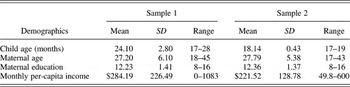
Participants included 120 mother–son dyads recruited from the Women, Infants, and Children (WIC) Nutritional Supplement Program in the Pittsburgh, PA, metropolitan area during the spring and summer of 2001 (for a more complete description of the sample, see Shaw, Dishion, Supplee, Gardner, & Arnds, Reference Shaw, Dishion, Supplee, Gardner and Arnds2006) to participate in a clinical trial of a prevention program focused on the development of early behavior problems. Because of the original study's interest in examining externalizing behavior and research suggesting that rates are higher in males, only families with male children were recruited. Families were approached at WIC sites and invited to participate if they had a son between 17 and 27 months old, following a screen to ensure that they met the study criteria for inclusion. Those who were low SES (i.e., maternal education and family income) and had either or both family and/or child risk (e.g., maternal depression or substance abuse; child externalizing symptoms) were included in the sample. As the larger sample was interested in the prevention of behavior problems, if risk criterion were attained for only socioeconomic and family risk, mothers were also required to rate children above the sample mean on either the Intensity or Problem Factors of the Eyberg Behavior Inventory to increase the probability that parents would desire assistance in this area. Of 271 families who participated in the screening, 124 families met the eligibility requirements and 120 (97%) agreed to participate in the study (Table 1). In terms of ethnicity, 45% of mothers were AA, 43% were EA, and 11.7% were biracial. At the time of the initial assessment, 45% were married or living together, 50% were single and never married, and 5% were separated, divorced, or widowed.
Demographic characteristics for Samples 1 and 2 at first assessment

The study's main goals were to examine potential differences in the frequency of ERS by maternal ethnicity, and explore whether ERS were differentially related to child externalizing outcomes as a function of maternal ethnicity. As the focus of the study was on potential differences between EA and AA families and there were too few biracial mothers to analyze them as a separate subgroup, biracial mothers were dropped from the analyses (n = 5). The biracial cases were not significantly different from retained cases on income, F (1, 119) = .52, ns, or education, F (1, 119) = .67, ns.
Mothers in Sample 1 were approached and asked if they would be willing to complete a series of questionnaires about the “Terrible Twos.” Questionnaires were focused on the child's disruptive behavior and maternal well being (e.g., depression, social support), and took approximately 20 min to complete. Participants who completed this screen received $10 for their assistance. Families who met the criteria for study inclusion discussed above were contacted about participating in a more intensive study, of which 50% would have the opportunity to take part in a home-based, family intervention.
Participants in Sample 2
Data from a second sample of low-income boys were used to test and potentially corroborate the findings for Sample 1. Sample 2 was derived from a larger study examining the antecedents of early conduct problems in boys (see Shaw, Winslow, & Flanagan, Reference Shaw, Winslow and Flanagan1999). Participants for the study were recruited from WIC clinics between 1989 and 1992 when the children were between 6 and 17 months of age. Unlike Sample 1, to qualify for the study, the families only needed a male child of the appropriate age with at least one older sibling living in the home. Of the 421 families who were approached and agreed to participate, 310 (74%) participated in the initial 18-month-old assessment. Of the original sample who participated in the 18-month assessment, a subsample of 115 boys was selected that would generate a similar percentage of EA and AA parents as Sample 1, had teacher-reported outcomes at age 6 or 7, and met a behavioral criteria (Table 1). Because the purpose of the second sample was to compare the results to Sample 1, and because Sample 1 was purposively selected for behavior problems whereas Sample 2 was selected only if they met basic demographic characteristics, a subsample of boys were selected from Sample 2 to include in the current study that met a behavioral threshold. At an age 2 assessment in Sample 2 (that is, not utilized in the current study for any other purpose), mothers completed the Child Behavior Checklist (CBCL; Achenbach, Reference Achenbach1992) 2/3 measure. To make the samples similar on behavior problems, only those boys in Sample 2 who scored above the mean on the CBCL 2/3 externalizing factor at age 2 were considered for the subsample. The subsample (i.e., Sample 2) included 56% EA and 44% AA mothers (children with biracial mothers were excluded to make the two samples comparable). At the 18-month visit, 67% of mothers in the subsample stated they were married or living with a partner, 2% were divorced, 27% stated they were always single, and 4% were other (e.g., widowed, separated). The children included in the subsample did not differ significantly from the full sample at the 18-month assessment on family income, F (1, 278) = 1.65, ns, child negative emotionality, F (1, 278) = 2.57, ns, or maternal education, F (1, 278) = 3.22, ns.
Procedures in Sample 1
The mothers and sons in Sample 1 completed a series of home-based assessments when children were approximately 2 years old. During the assessment, mothers completed questionnaires and mothers and sons completed a series of interaction tasks. All tasks were videotaped and coded at a later point. The visit began with a 15-min free play that was followed by a 5-min clean-up task. Next, the child and mother completed a no-toys task (5 min; Smith & Pederson, Reference Smith and Pederson1988), followed by three cooperative tasks (3 min each), and two inhibition tasks in which the child was introduced to a robot who vocalized and was mobile (2 min) and a tunnel (2 min). Finally, mothers were filmed preparing a meal for the child (10 min) and having the child eat the meal (10 min; Gardner, Reference Gardner2000). The assessments were approximately 2.5 hr in length, and mothers were reimbursed for their participation.
The children were coded for their ERS and presence of negative emotions during the no-toys task. The children had just completed a clean-up task and were then left in the room without toys to play with while the mother worked on questionnaires. The mothers were told to react to the child in a manner that was most comfortable for them (Smith & Pederson, Reference Smith and Pederson1988).
Following the home visit, families randomly assigned to the intervention group were given the chance to meet with a parent consultant for two or more sessions. In the first session, the parent consultant convened a get to know you (GTKY) meeting and in Session 2 she provided feedback on the child's behavior and the family's resources. During both sessions, motivational interviewing was used to create dissonance between the parent's perception of the child's current adjustment and future attainment (Miller & Rollnick, Reference Miller and Rollnick2002). Follow-up sessions addressed parenting and issues that compromised caregiving quality (e.g., parenting techniques, parental conflict, neighborhood resources). For additional details on the intervention, see Shaw et al. (Reference Shaw, Dishion, Supplee, Gardner and Arnds2006). Although participation in the intervention was voluntary, 92% of the families participated in the GTKY and feedback sessions, and a smaller percentage (41%) engaged in one or more additional sessions with the parent consultant. For the current study, the family's treatment status will be used as a covariate in all analyses.
When the children were approximately 3 and 4 years of age, 109 (91% retention) families participated in follow-up home visits, similar in structure and content used in the initial home visit, with a few alterations in the observation procedures to match the child's developmental status. Families were reimbursed for their time at each assessment. At age 4, no differences were found between participants who remained in the study and those who did not take part in the age 4 assessment on income, F (1, 118) = .01, ns, or maternal education, F (1, 118) = 2.66, ns.
Procedures in Sample 2
The mothers and sons in Sample 2 completed a similar procedure to Sample 1 with a few notable changes. The assessments were completed in a laboratory when the children were approximately 18 months old. All tasks were videotaped from behind a one-way mirror and coded at a later point in time. Similar to Sample 1, the visit began with a 15-min free play that was followed by a 5-min clean-up task. Next the dyad participated in the no-toys task, the directions for which were identical to Sample 1; however, the task lasted for 3 rather than 5 min, as it did for Sample 1. After the no-toys task, the mother and child worked on three cooperative tasks (3 min each), followed by a break and the administration of the Strange Situation (Ainsworth et al., Reference Ainsworth, Blehar, Waters and Wall1978). Each of the lab assessments was approximately 2 to 2.5 hr in duration, and mothers were reimbursed for their participation.
When the children were 3.5 years of age, mothers completed the CBCL (Achenbach, Reference Achenbach1991) on the participating children during another laboratory visit. In addition, when the children were 6 and/or 7 years old, their classroom teachers were sent a packet of questionnaires, including the Teacher Report Form (TRF; Achenbach, Reference Achenbach1991). Both mothers and teachers were reimbursed for their participation.
Measures for Samples 1 and 2
In both Samples 1 and 2 the measures administered were identical except for where noted below (e.g., child negative emotionality).
Demographics
This questionnaire included questions about formal education and income, ethnic background, and race. For purposes of the present study, data on maternal race were obtained from this questionnaire.
Children's ERS use
Both samples employed a coding system based on work by Grolnick and colleagues (1996) and adapted by Gilliom and colleagues (Reference Gilliom, Shaw, Beck, Schonberg and Lukon2002). Four behaviors were coded for their presence or absence during each of the 30 10-s intervals during the 5-min no-toys task for Sample 1 and each of 18 10-s intervals during the 3-min no-toys task for Sample 2. For every interval, children were coded as having been engaged in at least one of the codes. The child could employ more than one strategy in an interval, and with the exception of two codes (i.e., physical comfort seeking and self-soothing), which could be coded while a child engaged in other behaviors, the child could be coded as engaged in only one behavior at a time. Codes included the following: (a) physical comfort seeking: touching mother, reclining on mother's lap, requesting to be held; (b) self-soothing: sucking on a thumb, bottle or sippy cup, twirling hair, reaching for a comfort object such as a blanket. The self-soothing code was added to the original coding system after this strategy was observed frequently in younger children; (c) active distraction: describes behaviors in which the focus of attention is not on the delay object or the task, including the child dancing around the room, singing, or engaging in imaginary play; (d) focus on delay object: included the child crying, tantruming, and attempting to break into the forbidden box of toys. Because of the differences in the length of the task between samples, a ratio of the number of intervals the child employed a strategy to the total possible intervals was used as the final score for each strategy. To ensure the task was adequately stressful for the children, the coders recorded the number of intervals in which the child showed some level of negativity or distress (e.g. crying, whining, or fussing). The results indicated that children expressed negativity in an average of 5.08 (SD = 7.25) of 30 intervals with a range from 0 to 28 in Sample 1 and a mean of 6.85 (SD = 6.65, range = 0–18) of 18 intervals in Sample 2. Interrater reliability was calculated on 20% of the tapes and was found to be satisfactory (Pearson r = .74–.92). The same coders coded the tapes from both samples. The coders were unaware of the study hypotheses and were blind to the group status of families in Sample 1.
CBCL 4–18
Mothers completed the CBCL 4–18 (Achenbach, Reference Achenbach1991), which assesses behavioral problems in children over the past 6 months using a 3-point Likert scale of whether the behaviors are not true (0), somewhat true (1), or very true (2) of their child. For purposes of the present study, the raw scores for the broadband externalizing factor was used, for which data were available at age 4 for boys in Sample 1, and at age 3.5 for boys in Sample 2. Internal consistencies ranged from .89 to .83 for the factor in Samples 1 and 2, respectively.
Measures for Sample 1 only
Children's negative emotionality
As previous literature has found a connection between child negative emotionality and externalizing behavior (Shaw et al., Reference Shaw, Keenan and Vondra1994, Reference Shaw, Owens, Vondra, Keenan and Winslow1996), to ensure that the relationship observed between the child's strategy use and later externalizing behavior was not because of the child's negative emotionality, maternal ratings of negative emotionality were used as a covariate in analyses. At the age 2 assessment, in Sample 1, mothers completed the troublesome factor of the 24-month version of the Maternal Perceptions Questionnaire (MPQ; Olson, Bates, & Bayles, Reference Olson, Bates and Bayles1989). The troublesome factor is based on four items and assesses the frequency of negativity between the child and caregivers, with a higher score indicating higher levels of negative emotionality. The MPQ has shown to be predictive of school-age behavior problems (Olson et al., Reference Olson, Bates and Bayles1989). In the present sample, internal consistency of the troublesome factor for the 24-month assessment was satisfactory (α = .68).
CBCL 2/3
At the age 2 assessment for Sample 1 parents completed the CBCL 2/3 (Achenbach, Reference Achenbach1992). Similar to the CBCL 4–18 version, the CBCL 2/3 version asks the parent to rate whether the behavior is not true (0), somewhat true (1), or very true (2) of their child over the past 2 months. For the purposes of including a covariate of concurrent behavior problems, the raw scores of the externalizing behavior broad-band scale were utilized in the current study.
Measures for Sample 2 only
Children's negative emotionality
At the 18-month assessment in Sample 2 the mothers completed the difficulty factor of the Bates Infant Characteristics Questionnaire (ICQ; Bates, Freeland, & Lounsbury, Reference Bates, Freeland and Lounsbury1979). The difficulty factor assesses the intensity and frequency of fussy, irritable children's behavior. The ICQ has shown to be predictive of preschool behavior problems (Bates, Maslin, & Frankel, Reference Bates, Maslin and Frankel1985). Internal consistency of the difficulty factor for the sample was good (α = .80).
Toddler Behavior Checklist (TBC)
Because the CBCL had not yet been developed for children as young as 18 months at the time the assessment was conducted for Sample 2, the TBC (Larzelere, Martin & Amberson, Reference Larzelere, Martin and Amberson1989) was administered. The TBC was created as a parent-report measure of 103 social emotional behaviors for children 9–48 months. Two subscales of oppositional behavior and aggression were averaged to create a score that could be used as a covariate of externalizing behavior at the time of the initial assessment for Sample 2. The two subscales were correlated .72 and internal consistency was .92 in the current sample.
Teacher Report Form (TRF)
For Sample 2 only, the TRF (Achenbach, Reference Achenbach1991) was used to assess problem behavior in a school setting. The TRF is a widely used, well-validated measure of children's behavior in academic settings. To gain a more robust picture of the child's functioning, we collected the data when children were 6 and 7 years old. When only one of two school reports were available, that score was used (n = 42), but when two scores were available they were averaged to form a composite (n = 69). The teachers' ratings collected at age 6 and 7 were highly correlated (r = .61; p < .001). For purposes of the present study, the raw scores of the 34-item externalizing factor were used. In the present sample, internal consistency for externalizing was high (α = .98).
Results for Sample 1
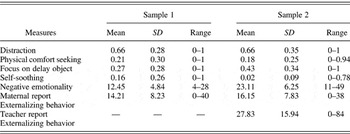
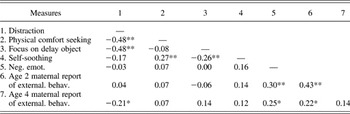
To better interpret the findings, descriptive statistics and bivariate correlations are provided in Tables 2 and 3 for Sample 1. The ratios for the whole sample by strategy in Table 2 indicate that although distraction was the most common strategy, the other three strategies occurred approximately 20% of the time, suggesting a fairly high use. In Sample 1, as shown in Table 3 it is interesting to note the positive correlation between physical comfort seeking and self-soothing (r = .27. p < .01). In addition, children who used distraction tended to not use physical comfort seeking or focus on delay object during the task. Supporting previous literature, the bivariate correlations indicate a significant negative correlation between the child's use of distraction and later externalizing behavior, as well as a significant positive correlation between the caregiver's rating of the child's negative emotionality and their later externalizing behavior.
Descriptive statistics of predictor and outcome variables for Samples 1 and 2

Pearson correlations between predictor and outcome variables in Sample 1 (N = 114)

*p < .05. **p < .01.
The mother's report of her child's concurrent externalizing behavior at age 2 was significantly correlated with the child's externalizing behavior at age 4. Therefore, to account for any relationship between concurrent and future externalizing behavior, age 2 scores were used in subsequent multivariate analyses. The EA and AA dyads did not differ on maternal education, F (1, 113) = .14, ns, but EA families were significantly higher than AA families on per-capita income, F (1, 110) = 4.79, p < .01. Therefore per-capita income also was used as a covariate in later analyses.
To examine whether frequency of strategy use or child negative emotionality varied as a function of child ethnicity, a multiple analysis of variance (MANOVA) with ethnicity as the predictor and five dependent variables including observed child ERS and maternal reports of negative emotionality served as the dependent variables. The overall MANOVA was nonsignificant, F (5, 103) = .74, ns. No differences were found with respect to ethnicity on maternal report of child negative emotionality on the MPQ troublesome factor, F (1, 109) = .00, ns; or the frequency of ERS for active distraction, F (1, 109) = .00, ns; physical comfort seeking, F (1, 109) = 2.87, ns; self-soothing, F (1, 109) = .23, ns; or focus on delay object F (1, 109) = .46, ns.
Children's ERS
To explore whether ethnicity might moderate the association between strategy use and child externalizing problems, a series of hierarchical multiple regressions were computed. After centering all continuous variables, in each equation, treatment group status, per-capita income, mother's ethnicity, child negative emotionality, and age 2 externalizing behaviors were entered first to statistically control for their potential effects on later child externalizing behavior along with the ERS (i.e., one per equation). The second step then included the centered interaction between the ERS and maternal ethnicity. It should be noted in interpreting the results that because of the centering of continuous predictor variables, the main effects in the model are actually conditional effects, in that it indicates the relationship between that variable and the outcome variable, conditional on all other variables in the model being at the average or equivalent to “0” for dichotomous variables.
Because the moderator, ethnicity, was a dichotomous variable of two levels with a meaningful “0” value, the F test on the change in R 2 when the interaction term was entered is sufficient to test the significance of the moderator (Aiken & West, Reference Aiken and West1991; Frazier, Barron, & Tix, Reference Frazier, Barron and Tix2004). If this test was significant, the interaction was graphed using the methods discussed in Aiken and West (Reference Aiken and West1991).
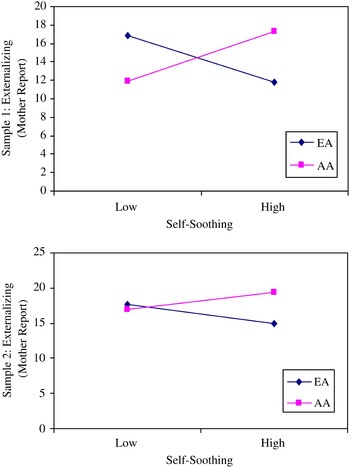
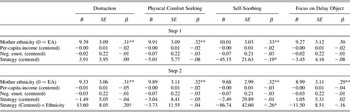
For all four equations, the overall model significantly predicted children's age 4 externalizing behavior (see Table 4). For active distraction the overall equation was significant, F (7, 96) = 5.51, R 2 = .25, p < .001. In the final step of the equation, a negative relationship was found for income and a positive relationship for age 2 child externalizing behavior with later externalizing behavior, but the interaction term between ethnicity and distraction was not significant. The overall equation including physical comfort seeking was significant, F (7, 96) = 4.83, R 2 = .22, p < .001, with a negative relationship in the final step of the equation found for income and positive relationship with both negative emotionality and concurrent child externalizing behavior and later externalizing behavior; and a significant interaction found between ethnicity and physical comfort seeking. The test of the interaction indicated a significant difference in the relationship between physical comfort seeking and externalizing behavior for EA and AA children (ΔR 2 = .05, p < .05). When the interaction was graphed using a mean split to dichotomize physical comfort seeking, the graph indicated higher levels of child externalizing behavior at high levels of physical comfort seeking for AA children and lower levels of child externalizing behavior at higher levels of physical comfort seeking for EA children (see Figure 1). The graph also indicates AA children had lower levels of externalizing behavior at low levels of physical comfort seeking, whereas EA children had higher levels of externalizing behavior at low levels of physical comfort seeking. The equation for self-soothing was significant, F (7, 96) = 5.02, R 2 = .23, p < .001, and indicated a positive relationship for both child negative emotionality and concurrent externalizing behavior with later externalizing behavior, as well as a significant interaction for ethnicity by self-soothing in the final step of the equation. The test of the interaction indicated a significant difference in the relationship between self-soothing and externalizing behavior for EA and AA children (ΔR 2 = .04, p < .05). Similar to physical comfort seeking, when the interaction for self-soothing was graphed using a mean split, the graph indicated higher levels of child externalizing behavior at high levels of self-soothing for AA children and lower levels of child externalizing behavior at higher levels of self-soothing for EA children (see Figure 2). Like physical comfort seeking, the graph indicates AA children had lower externalizing behavior at low levels of self-soothing, whereas EA children had higher externalizing behavior at low levels of self-soothing. Finally, the overall equation for focus on the delay object was significant, F (7, 96) = 4.63, R 2 = .21, p < .001, and the only significant relationship in the final step of the equation was a positive one for the mother's rating of the child's age 2 externalizing behavior and later externalizing behavior.
The interaction between maternal ethnicity and physical comfort seeking in relation to the mother reports of child externalizing behavior for Sample 1 (age 4) and Sample 2 (age 3.5). [A color version of this figure can be viewed online at journals.cambridge.org/dpp]

The interaction between maternal ethnicity and self-soothing in relation to mother reports of child externalizing behavior for Sample 1 (age 4) and Sample 2 (age 3.5). [A color version of this figure can be viewed online at journals.cambridge.org/dpp]

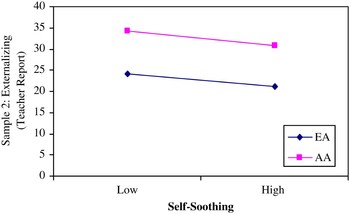
Interaction between maternal ethnicity and self-soothing in relation to teacher-report of child externalizing behavior for Sample 2 (age 6/7). [A color version of this figure can be viewed online at journals.cambridge.org/dpp]

Hierarchical linear regressions including ethnicity predicting maternal report of children's age 4 externalizing behavior in Sample 1

Note: Distraction: overall F (7, 96) = 5.16, p < .001; Step 1: R 2 = .26, p < .001; Step 2: ΔR 2 = .01, ns. Physical comfort seeking: overall F (7, 96) = 5.17, p < .001; Step 1: R 2 = .19, p < .001; Step 2: ΔR 2 = .05, p < .05. Self-soothing: overall F (7, 96) = 5.13, p < .001; Step 1: R 2 = .20, p < .001; Step 2: ΔR 2 = .04, p < .05. Focus on delay object: overall F (7, 96) = 4.12, p < .001; Step 1: R 2 = .19, p < .001; Step 2: ΔR 2 = .07, ns.
*p < .05. **p < .01.
Results for Sample 2
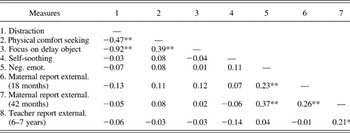
As in Sample 1, descriptive statistics and bivariate correlations for the predictor and outcome variables are provided (see Tables 2 and 5). First, similar to Sample 1, the rates of children's use of ERS are interesting. There are similar rates of the use of distraction and physical comfort seeking between the two samples. However, the rates of the child's focus on the delay object are significantly higher than in Sample 1 (t = −4.14, p < .001) and the rates of self-soothing are significantly lower (t = 5.49, p < .001). As with the correlations for Sample 1, children who utilized distraction tended to not use physical comfort seeking or focus on the delay object during the task. In addition, similar to Sample 1 and previous research, a significant positive correlation was found between mother's rating of the child's negative emotionality and later mother-reported externalizing behavior.
Pearson correlations between predictor and outcome variables in Sample 2 (N = 111)

*p < .05. **p < .01.
The mother's report of the child's externalizing behavior at 18 months was significantly correlated with the mother's report of the child's externalizing behavior at 3.5 years; however, it was not related to the teacher's report of child externalizing behavior at 6–7 years of age. Therefore, to account for any relationship between concurrent and future externalizing behavior, the child's 18-month scores were used in subsequent multivariate analyses involving mother-reported externalizing behavior, but to conserve power not those involving teacher reports of later child externalizing behavior.
The same question regarding the role of ethnicity was explored with Sample 2 using the same methods, with the only difference being the additional availability of both mother and teacher reports for evaluating child externalizing across context (i.e., school vs. home). As in Sample 1, the EA and AA families did not differ on maternal education, F (1, 108) = 3.53, ns, but EA families were found to have significantly greater per-capita income, F (1, 108) = 16.38, p < .001. Therefore, per-capita income was entered as a covariate in subsequent analyses.
Maternal reports and observations of children's emotion regulation were then compared with respect to ethnicity. Again, a MANOVA with ethnicity serving as a predictor and five dependent variables including observed child ERS and maternal reports of negative emotionality was computed to test for differences between ethnic groups. As with Sample 1, the overall equation in Sample 2 was found to be nonsignificant, F (5, 130) = 1.69, ns, indicating no differences with respect to maternal report of toddler's negative emotionality F (1, 134) = 2.67, ns, active distraction, F (1, 134) = .04, ns; physical comfort seeking, F (1, 134) = .32, ns; self-soothing, F (1, 134) = 1.64, ns; or focus on delay object F (1, 134) = .29, ns, as a function of ethnicity.
Children's ERS
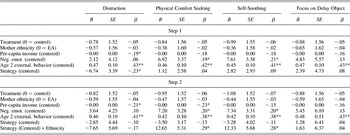
Like Sample 1, hierarchical linear regressions were then used to explore whether significant interactions were evident between mother ethnicity and individual child's ERS, using both maternal and teacher report of externalizing problems as dependent variables. In each equation, per-capita income, mother's ethnicity, and child negative emotionality and one ERS variable were entered first, followed by the interaction between the ERS variable and maternal ethnicity. For the equations predicting maternal report of externalizing problems only, 18-month-old child's externalizing problems were entered in the first step of the equation.
In the first set of regression equations using maternal reports of externalizing at age 3.5, all four equations were significant (see Table 6). For active distraction, the overall equation was significant, F (6, 117) = 4.07, R 2 = .14, p < .001, with only two variables demonstrating a significant positive relationship in the final step of the equation: child negative emotionality and externalizing behavior at 18 months with later externalizing behavior. The equation for physical comfort seeking, F (6, 117) = 5.14, R 2 = .15, p < .001, also indicated significant positive relationships in the final step of the equation between both child negative emotionality and externalizing behavior at 18 months with later externalizing behavior. The interaction term involving comfort seeking and ethnicity was a trend. Given the exploratory nature of the current study and goal of the second sample to support or disconfirm the findings in the first sample, the interaction was plotted to examine for similarities (see Figure 1). Similar to findings for Sample 1, the interaction indicated that lower use of physical comfort seeking was related to lower levels of externalizing behavior and higher rates of externalizing behavior at higher use of physical comfort seeking for AA children. However, unlike Sample 1, the pattern was more flat for EA families, showing no strong relationship between the two variables in Sample 2. The significant equation for self-soothing, F (6, 111) = 4.74, R 2 = .14, p < .001, included significant positive relationship in the final step of the equation for child negative emotionality and externalizing behavior at 18 months with later externalizing behavior. Again, like physical comfort seeking, the interaction term involving self-soothing and ethnicity was a trend (p = .07), and therefore was plotted because of the exploratory nature of this study (see Figure 2). The pattern was similar to Sample 1, albeit on a smaller scale indicating higher levels of externalizing behavior for AA children who used more self-soothing and lower levels of externalizing for EA children who used more self-soothing. However, unlike Sample 2, there did not appear to be a group difference at low levels of self-soothing. Finally, the overall equation for focus on delay object was significant, F (6, 117) = 4.12, R 2 = .14, p < .01, and similar to Sample 1, a significant positive relationship was found in the final step of the equation between mother's rating of the child's negative emotionality and externalizing behavior at 18 months with later externalizing behavior.
Hierarchical linear regressions including ethnicity predicting maternal report of children's age 3.5 externalizing behavior in Sample 2

Note: Distraction: overall F (6, 117) = 4.07, p < .001; Step 1: R 2 = .14, p < .001; Step 2: ΔR 2 = .00, ns. Physical comfort seeking: overall F (6, 117) = 5.14, p < .001; Step 1: R 2 = .15, p < .001; Step 2: ΔR 2 = .02, ns. Self-soothing: overall F (6, 117) = 4.74, p < .001; Step 1: R 2 = .14, p < .001; Step 2: ΔR 2 = .02, ns. Focus on delay object: overall F (6, 117) = 4.12, p < .001; Step 1: R 2 = .14, p < .001; Step 2: ΔR 2 = .01, ns.
†p < .10. *p < .05. **p < .01.
The same hierarchical regressions were then conducted using teacher reports of child externalizing behavior at ages 6 and 7. Similar to the mother report, the overall model significantly predicted teacher's report of children's externalizing behavior in school for all four equations (see Table 7). The overall equation was significant for active distraction, F (6, 109) = 2.76, R 2 = .07, p < .05; however, there was a significant positive relationship between maternal ethnicity and later externalizing behavior. In addition, there was a trend on the interaction between distraction and ethnicity. However, because this finding was not present in Sample 1, the interaction was not further investigated. Similar to both previous analyses, the overall equation including physical comfort seeking, F (6, 109) = 2.20, R 2 = .07, p < .05, was significant; however, unlike Sample 1, the only significant relationship was for maternal ethnicity, indicating a positive relationship between ethnicity and later externalizing behavior. The equation for self-soothing was significant, F (6, 109) = 3.65, R 2 = .10, p < .01, again with significant positive effects for mother ethnicity and the interaction term involving ethnicity and self-soothing. Therefore, the interaction was graphed to further examine the data. Unlike the plots of self-soothing for maternal-reported externalizing behavior in Samples 1 and 2, the plot of the interaction indicates a fairly flat slope for both AA and EA children, indicating a racial difference in teacher-reported externalizing behavior but less association with levels of self-soothing. Finally, the overall equation for focus on delay object was significant F (6, 109) = 2.52, R 2 = .07, p < .05, but the only significant direct effect was between mother's ethnicity and later externalizing behavior.
Hierarchical linear regressions including ethnicity predicting teacher report of children externalizing behavior in Sample 2

Note: Distraction: overall F (5, 109) = 3.25, p < .01; Step 1: R 2 = .08, p < .05; Step 2: ΔR 2 = .02, p < .10. Physical comfort seeking: overall F (5, 109) = 2.58, p < .05; Step 1: R 2 = .08, p < .05; Step 2: ΔR 2 = .01, ns. Self-soothing: overall F (5, 109) = 4.31, p < .01; Step 1: R 2 = .11, p < .01; Step 2: ΔR 2 = .03, p < .05. Focus on delay object: overall F (5, 109) = 2.95, p < .05; Step 1: R 2 = .08, p < .05; Step 2: ΔR 2 = .02, ns.
†p < .10. *p < .05. **p < .01.
Because results from Sample 2 provided only marginal support of the findings in Sample 1 that maternal ethnicity moderates the association between strategy use and later externalizing problems, an alternative possibility was tested. Because of the significant relations between income and externalizing behavior in Sample 1, the presence of ethnic differences by income in both samples, and previous theorists and researchers (i.e., Bradley et al., Reference Bradley, Corwyn, Burchinal, McAdoo and Garcia Coll2001; Graham, Reference Graham1992), pointing to income as an explanatory variable for ethnic differences in parenting, the decision was made to conduct follow-up analyses with Sample 2 to examine income as a possible alternate moderator to explain the relationship between strategy use and externalizing behavior.
Income as a possible moderating variable
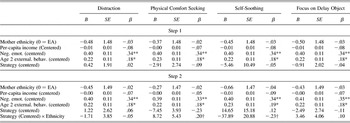
Hierarchical linear regressions were conducted utilizing a similar equation to the above analyses; however, rather than the interaction between ethnicity and strategy use, an interaction between income and strategy use was included. Although the overall equations were significant (Tables 8 and 9), none of the analyses using Sample 2 data, including both mother- and teacher-reported externalizing behavior, revealed significant interactions between income and strategy use. As recruitment criteria restricted the sample to low-income families and thus limited variability, it is unclear if the lack of a relationship is related to the sample characteristics or a lack of relationship between income and strategy use.
Hierarchical linear regressions with income predicting mother report of children's externalizing behavior in Sample 2

Note: Distraction: F (5, 112) = 4.98, R 2 = .15, p < .001. Physical comfort seeking: F (5, 112) = 5.29, R 2 = .16, p < .001. Self-soothing: F (5, 112) = 5.17, R 2 = .15, p < .001. Focus on delay object: F (5, 112) = 4.90, R 2 = .14, p < .001.
*p < .05. **p < .01.
Hierarchical linear regressions with income predicting teacher report of children's externalizing behavior in Sample 2

Note: Distraction: F (4, 109) = 2.94, R 2 = .07, p < .05. Physical comfort seeking: F (4, 105) = 2.76, R 2 = .06, p < .05. Self-soothing: F (4, 105) = 3.53, R 2 = .08, p < .01. Focus on delay object: F (4, 105) = 2.87, R 2 = .06, p < .05.
*p < .05. **p < .01.
Discussion
This purpose of this paper was to examine the relationship between ERS and later externalizing problems in two low-income samples with at least two ethnic groups. In Sample 1, it was found that ethnic culture moderated the relationship between two of the children's ERS and later externalizing behavior, namely, physical comfort seeking and self-soothing for AA children. A similar pattern was found in Sample 2, but the data only suggested a trend pointing to a group difference at high levels of self-soothing for mother reports of externalizing problems. The pattern was less consistent at low levels of self-soothing and for teacher-reported externalizing behavior.
Consistent with our hypotheses, in Sample 1 specific ERS, namely, self- or other comfort-seeking behaviors, were differentially associated with externalizing problems for EA versus AA families. In Sample 1, significant interactions were found between maternal ethnicity and use of physical comfort seeking, such that the use of physical comfort seeking was positively associated with externalizing behavior for AA versus EA children. Although the interaction in Sample 2 was only a trend in the mother-reported data, in Sample 2 for AA families, a similar relationship was present between high levels of physical comfort-seeking and externalizing behavior. The pattern was not present for teacher-reported externalizing behavior for physical comfort seeking. This pattern across a greater length of time in Sample 2 than for Sample 1 provides some support for the validity of the pattern in samples of low-income, urban boys. In addition, it should be noted that the patterns emerged after statistically accounting for family income, child negative emotionality, and earlier child externalizing behavior, all significant predictors in previous research of child externalizing behavior (e.g., Miech, Caspi, Moffitt, Wright, & Silva, Reference Miech, Caspi, Moffitt, Wright and Silva1999; Shaw et al., Reference Shaw, Keenan and Vondra1994). However, extreme caution should be exercised given the marginal nature of the interactions. Overall, although the results appear to indicate that the use of the same ERS may have differential outcomes for low-income AA and EA children in relation to externalizing outcomes, more research is needed to validate the current results.
A similar pattern emerged for self-soothing behavior. In fact, in Sample 1 there was an inverse relationship between the level of self-soothing and externalizing problems for both AA and EA children. At high levels of self-soothing, EA children appeared to have lower levels of externalizing behavior, whereas AA children had higher levels of externalizing behavior. However, although similar trends were found using maternal reports in Sample 2 for AA children, the same pattern was not replicated for EA children. In addition, the inverse pattern did not replicate itself in the teacher-reported externalizing data.
One possible explanation for the difference between the samples with the self-soothing variable is setting differences, as self-soothing behavior was evident significantly less often in the lab (i.e., Sample 2) than in the home (i.e., Sample 1), therefore providing a wider range in the incidence of self-soothing during the task. This is not surprising given access to self-soothing materials (e.g., pacifiers, security blankets) was more readily accessible in the home. Another possible explanation for these differences is the age of the children. The children in Sample 1 were approximately 6 months older than the children in Sample 2. Although it seems more likely that younger children may engage in higher rates of self-soothing, it is possible that children in Sample 1 engage in more self-soothing because of their difference in age compared to Sample 2. Because Sample 1 was recruited on the basis of low-income status and other risk-related criteria, as opposed to only enrollment in WIC (Sample 2), Sample 1 families showed a higher and greater range of scores on child externalizing problems. However, as variability of scores (i.e., standard deviation) was comparable across samples, it is unlikely that this factor accounted for differences in the magnitude of effects.
The current study is merely exploratory and the data provide the platform from which additional research should begin to explore these questions. One possible explanation for the trends in the data comes from previous research suggesting that AA parents may expect their children to be autonomous and more mature at an earlier age than EA parents (e.g., mastery of toilet training; Baumrind, Reference Baumrind1972; Brody et al., Reference Brody, Flor and Gibson1999; Julian et al., Reference Julian, McKenry and McKelvey1994). It was hypothesized that a toddler's use of more dependent (e.g., physical comfort seeking) or less mature regulation strategies (e.g., self-soothing by sucking a thumb or cuddling a teddy bear) may be viewed more negatively within the AA culture, and therefore be associated with the development of higher rates of later externalizing problems for AA versus EA children. Conversely, the value of emotional expression in the EA children may lead a parent to see those behaviors more positively, possibly leading to rating their children lower on externalizing behavior later. Ethnic differences in relation to externalizing problems may have been more consistently demonstrated for self-soothing behavior because if AA mothers place a greater value on self reliance (Baumrind, Reference Baumrind1972; Hill, Reference Hill1999), self-soothing might be viewed as a less mature strategy. However, compared to other more independent and emotionally regulated strategies (e.g., active distraction), it is possible that both physical comfort seeking and self-soothing behaviors are interpreted by AA mothers with a more negative valence. Previous literature has indicated that more passive or avoidant strategies similar to self-soothing and physical comfort seeking may be related to poor behavioral and social outcomes in children compared to more active, constructive strategies such as distraction (Eisenberg et al., Reference Eisenberg, Fabes, Nyman, Bernzweig and Pinuelas1994, Reference Eisenberg, Fabes, Guthrie, Murphy, Maszk and Holmgren1996). However, given the limitations of the current study, specifically the use of two data sets that were not specifically designed to answer questions about ethnicity and socialization of emotion, it is difficult to draw any conclusions. The one definitive statement that can be made is additional research is necessary to further explore the relationship between culture and emotion socialization and later child outcomes.
Limitations
There are several limitations that need to be considered in interpreting the current findings. First, as mentioned previously, neither of the two studies was originally designed with the current study's primary objective: to examine cultural differences in the perceptions of ERS and child behavior. Therefore, it is difficult to draw conclusions about the maternal beliefs regarding the children's behavior because their beliefs were not assessed. Future research needs to obtain more direct measurements of this construct and more specifically design the study to explicitly explore these questions. Although many questions remain unanswered, the current study may open a dialogue about possible differences that may exist in children's socialization of ERS by ethnic culture. Second, a notable limitation of the current study is the lack of an emic-based analysis of the data. Because of the challenges of conducting an emic-based approach with two relatively small samples, the current paper has a primarily edic-based analysis. However, it is vitally important for future research to design studies with larger groups of AA and EA families to more closely examine the impact of cultural socialization on child ERS from an emic perspective. Third, both samples only include low-income, urban, male toddlers from two ethnic groups, and therefore the results may not generalize to toddler-age girls, children from less impoverished socioeconomic strata, or children from different sociocultural or geographic backgrounds. Additional research including these populations will be necessary to better understand the findings presented here.
Another limitation rests with the use of a brief observational task for capturing ERS. Although this brief time frame may be viewed as having limited ecological validity, several other studies have found time-limited tasks to predict child outcomes longitudinally (Garcia, Shaw, Winslow, & Yaggi, Reference Garcia, Shaw, Winslow and Yaggi2000; Gilliom et al., Reference Gilliom, Shaw, Beck, Schonberg and Lukon2002; Pianta, Smith, & Reeve, Reference Pianta, Smith and Reeve1991; Supplee, Shaw, Hailstones, & Hartman, Reference Supplee, Shaw, Hailstones and Hartman2004). Similarly, the length of the task varied between the two samples. Although ratios were used to adjust for the task length, differences in the results between the samples may be partially related to the children's behaviors in a task that was 3 versus 5 min in length. Fifth, the current study focused on maternal ethnicity as a proxy for the culture a caregiver may encourage in their children; however, the role of alternate caregivers in socialization cannot be minimized and should be included in future research. Because of the constraints that the current data were not collected with the idea of examining the role of ethnic culture, unfortunately more detailed information about whether the maternal ethnicity matched the dominant culture that the child is being raised in is unknown (e.g., the mother is EA but lives in a predominantly AA neighborhood and her child grows up with the influence of the culture of their peers as well as their family). Similarly, biracial caregivers were eliminated from the sample because of the lack of data on the dominant culture influencing child rearing and the small size of the subgroup. This limitation should be addressed in future research as biracial caregivers are an important subgroup of families, particularly when examining the influence of ethnic culture on child outcomes. Future research should gather a more careful assessment of the child's exposure to multiple cultural contexts. Sixth and finally, because of the nature of the specific questions being addressed in the current study compared to the large, complex relationships that previous research has found to predict the development of child externalizing behaviors, it is not surprising only a small percentage of the variance was explained. The current findings suggest, however, that future research examining the development of externalizing behavior should consider the contribution of culture in that theoretical and empirical model.
Conclusions and Future Directions
The current findings suggest the possibility that the same type of ERS toddler boys use may be associated with differential externalizing outcomes as a function of parental ethnic culture. This study only represents an initial step in examining how culture might be associated with the course of children's development of ERS. Future research is needed to better understand how culture might influence the relationship between children's ERS and a diverse range of children's socioemotional outcomes. First, more longitudinal research of children's strategy use with diverse samples is necessary to understand if culture is associated with children's expression of strategies over time. Second, research needs to examine the mechanisms by which culture might be related to children's strategy use and later externalizing behavior, particularly examining parental beliefs and actions on the children's expression of strategies. Third, future research needs to consider other regulation strategies not previously studied that may act as protective factors for children within their own ethnic culture. Certain behaviors may be more adaptive in one culture than another, and these behaviors may have been overlooked by previous research focusing on EA children.