Introduction
Cannabis is the most commonly used illicit drug internationally (United Nations Office on Drugs and Crime, 2014), and there is a current move in a number of countries to decriminalize or legalize its use. Previous studies in non-psychotic populations (Kendler & Prescott, Reference Kendler and Prescott1998; Kendler et al. Reference Kendler, Karkowski, Neale and Prescott2000, Reference Kendler, Ohlsson, Maes, Sundquist, Lichtenstein and Sundquist2015) highlight that a combination of genetic and environmental factors influence cannabis use. Patients with psychosis are more likely to use cannabis than the general population (D'Souza, Reference D'Souza2007) but psychosis-prone individuals are not more likely to use cannabis (Henquet et al. Reference Henquet, Murray, Linszen and van Os2005). Although cannabis use is widely recognized both as increasing risk for the development of psychosis and for exacerbating the course of psychotic illness (Henquet et al. Reference Henquet, Murray, Linszen and van Os2005; D'Souza, Reference D'Souza2007; Giordano et al. Reference Giordano, Ohlsson, Sundquist, Sundquist and Kendler2015), the processes through which cannabis has these effects remain largely unknown. Several theoretical models have been proposed. The indicator variable model hypothesizes that there are other factors that cause both psychosis proneness and cannabis use (D'Souza et al. Reference D'Souza, Sewell and Ranganathan2009). The self-medication hypothesis (Khantzian, Reference Khantzian1985) posits that the intoxicating effects of cannabis (and other drugs) relieve both positive and negative symptoms of psychosis and that, therefore, people experiencing psychosis are more likely to use, and continue to use, cannabis; nevertheless this has not been supported by empirical studies (Kolliakou et al. Reference Kolliakou, Castle, Sallis, Joseph, O'Connor, Wiffen and Ismail2015). Lastly, there is the causal model, which proposes that the risk of developing psychosis is increased by the use of cannabis. It points out that even though the majority of cannabis users will not develop psychotic symptomatology, cannabis use is associated with an increased risk of later psychotic experiences (Henquet et al. Reference Henquet, Di Forti, Morrison, Kuepper and Murray2008; Casadio et al. Reference Casadio, Fernandes, Murray and Di Forti2011), while continued cannabis use is associated with poorer outcomes among individuals with psychosis (Zammit et al. Reference Zammit, Moore, Lingford-Hughes, Barnes, Jones, Burke and Lewis2008; van der Meer et al. Reference van der Meer and Velthorst2015).
The causal model has attracted most support in recent years. However, it leaves an important question unanswered: ‘why do patients with psychosis use or continue to use the drug if it makes them worse?’ Indeed, the exact reasons why patients with psychosis use cannabis remain unclear. There has been little empirical research examining whether the subjective effects of cannabis differ between individuals with psychosis and members of the general population. This has been investigated, for the first time, in the present study. If psychosis is associated with a greater reactivity to, and enjoyment of, the effects of cannabis this might help explain the continued use of cannabis among those diagnosed with psychosis, despite evidence that such use may exacerbate their illness. In support of this, subjective pleasant experiences in the early stage of cannabis use predict later risks of cannabis dependence (Fergusson et al. Reference Fergusson, Horwood and Swain-Campbell2003) and, furthermore, seem to be influenced by genetic factors (Lyons et al. Reference Lyons, Toomey, Meyer, Green, Eisen, Goldberg, True and Tsuang1997).
In testing any of the above models, cannabis potency needs to be addressed. In recent years, alongside traditional marijuana (grass) and resin (hash), a new potent variant (often termed skunk) has become widely available in many countries. Potter et al. (Reference Potter, Clark and Brown2009) reported skunk-type cannabis seized in 2005 in England to have an average Δ9-tetrahydrocannabinol (Δ9-THC) content of 12.9% compared with an average 3.6% of hash-type cannabis, while the UK Home Office (Mwenda et al. Reference Mwenda, Ahmad and Kumari2005) reported a slight increase in the average content of Δ9-THC for both types: 16.2% in skunk and 5% in hash. Both potency studies also reported that cannabidiol levels were almost absent in high-potency skunk-like cannabis (0.1%).
A second aspect to consider closely is that genetic susceptibility may also render some individuals more vulnerable to cannabis-related psychosis. In particular, as we and others have shown, carriers of the C allele of AKT1 rs2494732, which is involved in dopamine signalling, have an increased risk of psychosis onset after cannabis use (van Winkel et al. Reference van Winkel, van Beveren and Simons2011; Di Forti et al. Reference Di Forti, Iyegbe, Sallis, Kolliakou, Falcone, Paparelli, Sirianni, La Cascia, Stilo, Marques, Handley, Mondelli, Dazzan, Pariante, David, Morgan, Powell and Murray2012, Reference Di Forti, Marconi, Carra, Fraietta, Trotta, Bonomo, Bianconi, Gardner-Sood, O'Connor, Russo, Stilo, Marques, Mondelli, Dazzan, Pariante, David, Gaughran, Atakan, Iyegbe, Powell, Morgan, Lynskey and Murray2015).
We set out to compare the self-reported effects of cannabis between first-episode psychosis patients and matched controls from the general population, and to take into account the type of cannabis used as well as frequency of use.
Method
Sample
This study utilized a subsample of the Genetic and Psychosis (GAP) sample (Di Forti et al. Reference Di Forti, Morgan, Dazzan, Pariante, Mondelli, Marques, Handley, Luzi, Russo, Paparelli, Butt, Stilo, Wiffen, Powell and Murray2009) and comprised 252 patients who met International Classification of Diseases (ICD)-10 (World Health Organization, 1992) criteria for a first episode of psychosis (FEP), and 217 controls, all of whom reported using cannabis. The patients were aged 18–65 and presented with a FEP to the Lambeth, Southwark and Croydon adult in-patient units of the South London and Maudsley (SLaM) NHS Foundation Trust, between 1 May 2005 and 31 May 2011. In addition to ICD-10, the Schedules for Clinical Assessment in Neurosychiatry (SCAN; Wing et al. Reference Wing, Babor, Brugha, Burke, Cooper, Giel, Jablenski, Regier and Sartorius1990) were used to clarify symptomatology during the month before the assessment. Patients who met the diagnostic criteria for organic psychosis (ICD-10, F09) were excluded from the cohort. The control group was recruited from the same area of South-East London; those who met criteria for a psychotic disorder or with a previous diagnosis of psychotic illness were excluded (Di Forti et al. Reference Di Forti, Morgan, Dazzan, Pariante, Mondelli, Marques, Handley, Luzi, Russo, Paparelli, Butt, Stilo, Wiffen, Powell and Murray2009).
Measures
We collected sociodemographic data (age, gender; self-reported ethnicity) through the Medical Research Council Social Schedule (MRCSS). From March 2006, we collected more detailed history of cannabis use by adding the Cannabis Experience Questionnaire modified version (CEQmv; Di Forti et al. Reference Di Forti, Morgan, Dazzan, Pariante, Mondelli, Marques, Handley, Luzi, Russo, Paparelli, Butt, Stilo, Wiffen, Powell and Murray2009); this included frequency of use and type of cannabis used, age of first use, if they still use, frequency of this current use and the use of other substances. We investigated experiences reported both during and after cannabis intoxication, which were collected with a five-point Likert scale (from rarely or never to always) and a subjective rating of the quality of that experience (‘good’, ‘bad’ or ‘neutral’). Contrary to the original version of the CEQ (Barkus et al. Reference Barkus, Stirling, Hopkins and Lewis2006), which included 55 experiences, the CEQmv (Di Forti et al. Reference Di Forti, Morgan, Dazzan, Pariante, Mondelli, Marques, Handley, Luzi, Russo, Paparelli, Butt, Stilo, Wiffen, Powell and Murray2009) includes only 14 items to reduce respondent burden (which was selected following factor analyses; Table 2).
All participants were also asked to describe the type of cannabis they typically used, and divided into two categories: hash-type (median THC: 3.54%) and skunk-type (median THC: 13.98%); according to features of cannabis samples seized by the Metropolitan Police in South-East London and the later UK Home Office Study (Hardwick & King, Reference Hardwick and King2008; Potter et al. Reference Potter, Clark and Brown2009), grass-type cannabis is rarely used in this area and less than 1% of participants used it. In our study those using imported herbal cannabis were included in the high-potency category due to the high level of THC contained (Potter et al. Reference Potter, Clark and Brown2009).
Statistical analysis
The χ2 test was used to compare cannabis-related experiences in patients and controls and Pearson correlations to investigate the relationship between the experiences, and the frequency, the type of cannabis use and the genetic vulnerability to psychosis symptomatology. Principal component analysis with Varimax rotation was run in order to create variables able to summarize the areas involved in cannabis intoxication and understand if these cannabis-related experiences could have any role in the maintenance of cannabis use.
The components obtained with the principal component analysis were analysed using multiple linear regression to understand the relationship between experiences and environmental/personal variables. For each factor a score was calculated using the factor loadings and this formed the dependent variable in linear regression analyses. Independent variables included: the ‘will to stop using cannabis’, the ‘amount of money spent per week on cannabis’, the ‘duration of cannabis use’ and the ‘current status (as current user or not)’, the ‘frequency of cannabis use’, the ‘type of cannabis mostly used’, the ‘age at first cannabis use’, the ‘presence of positive family history for psychosis or for other psychiatric disorders’ and the ‘beliefs about the impact of cannabis use on health’. ‘Caseness’ (presence of diagnosis of a psychotic disorder) was forced as an independent variable for all the analyses.
To account for multiple comparisons we used Bonferroni correction (on the basis of the number of predictors included) and only p values lower than 0.006 were considered significant.
Results
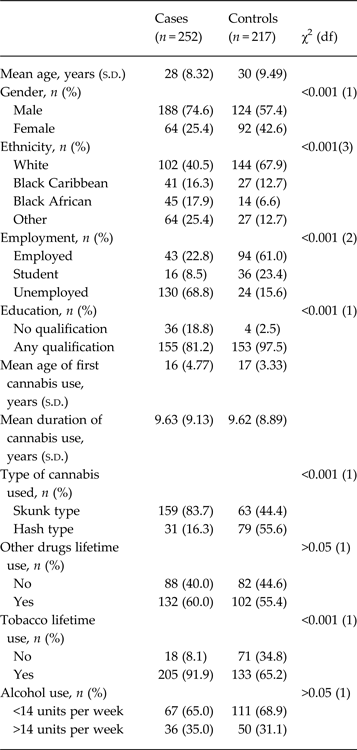
A total of 252 patients [74.6% male; mean age 28 (s.d. = 8.32) years] and 217 controls [57.4% male; mean age 30 (s.d. = 9.49) years] were included in the analysis. Of the FEP participants, 22.8% were employed at the time of the interview compared with 61.0% of controls; 18.8% of patients had no education qualification as opposed to 2.5% of the controls. The duration of cannabis use did not differ between the two groups. However, high-potency skunk-like cannabis was more commonly used by FEP patients (83.7%) than controls (44.4%) (Table 1).
Sociodemographic characteristics and patterns of cannabis use in cases and controls

df, Degrees of freedom; s.d., standard deviation.
Cannabis-related experiences
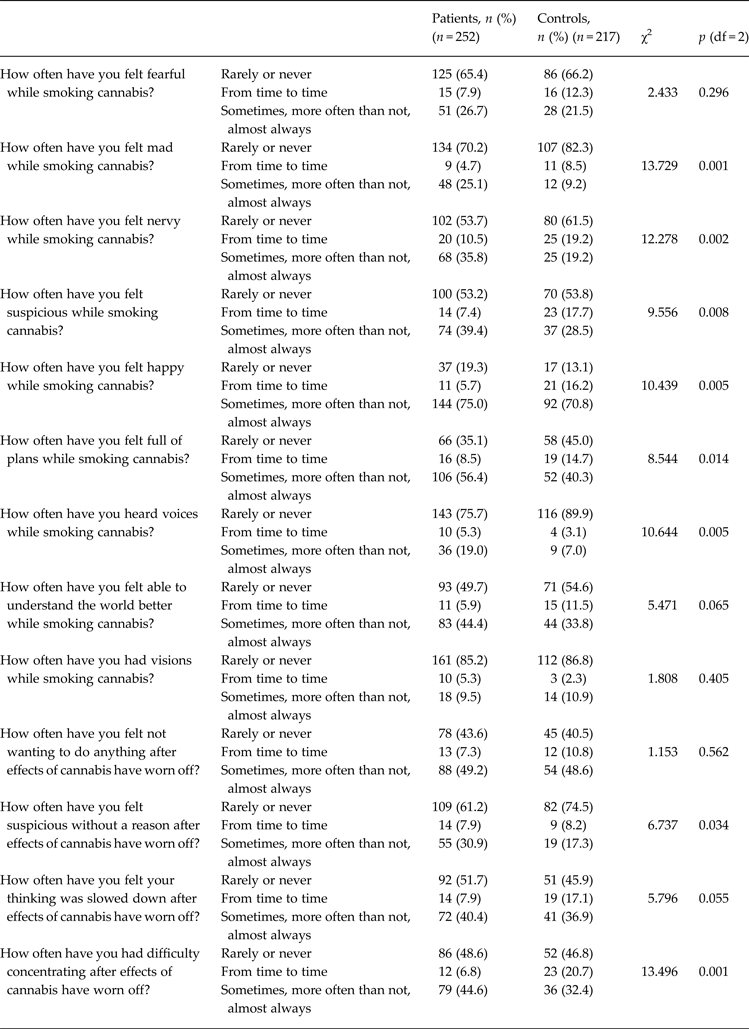
The experiences were divided into two categories: (a) experiences during cannabis intoxication; and (b) experiences after the effect of cannabis had worn off. Both categories showed significant differences between patients and controls (Table 2). For experiences ‘during’ cannabis use, feeling like going mad (χ2 = 13.729, p = 0.001), feeling nervous (χ2 = 12.287, p = 0.002), feeling suspicious without a reason (χ2 = 9.556, p = 0.002), feeling happy (χ2 = 10.439, p = 0.005), feeling full of plans (χ2 = 8.544, p = 0.014) and hearing voices (χ2 = 10.644, p = 0.005) were more common within FEP participants than controls.
Cannabis experiences in patients v. controls

df, Degrees of freedom.
Additionally, some experiences ‘after’ cannabis use were more frequently noted by patients than controls: being suspicious without a reason (χ2 = 6.737, p = 0.034) and difficulty concentrating (χ2 = 13.496, p = 0.001).
Principal component analysis
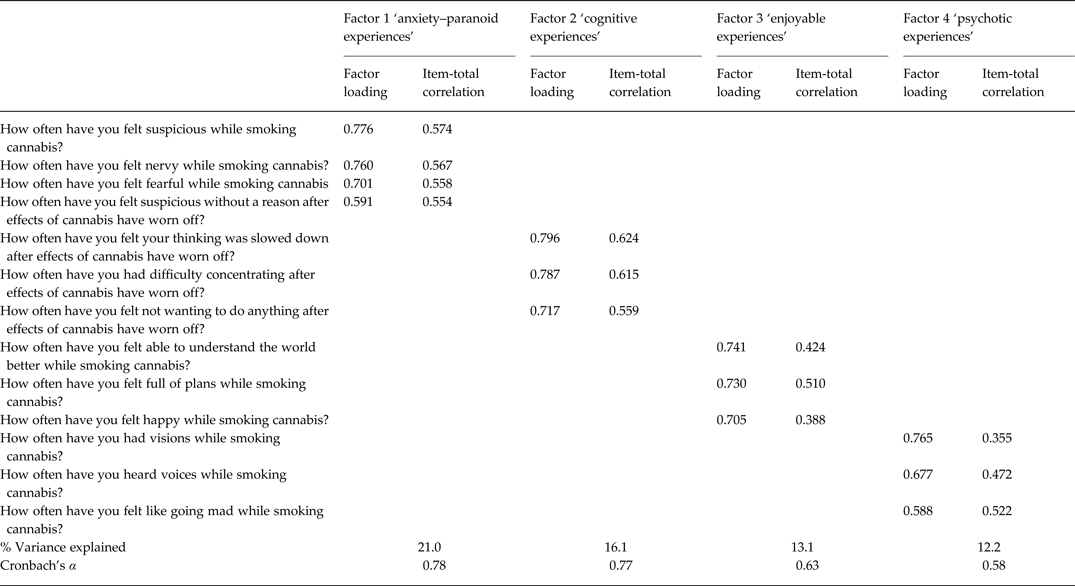
A Principal component analysis with Varimax rotation of the 13 cannabis experiences (Table 3) identified four factors (eigenvalues between 1.183 and 4.575) which overall explained 62.3% of the total variance in cannabis-related experiences. Each of the four factors was retained in subsequent analyses as each explained more than 10% of the total variance. The factor loadings and item-total correlations for this four-factor solution are summarized in Table 3.
Principal component analysis of cannabis-related experiences

The first factor component was defined by four items each with a factor loading >0.5, and explained 21.0% of the total variance. Even though the item ‘how often have you felt suspicious without a reason after effects of cannabis have worn off?’ showed a higher factor loading for another component as well, we considered it part of the this component to preserve its coherence. This component had good internal consistency (Cronbach's α = 0.78) and the items showed acceptable item-total correlations. The items included in this factor related to anxiety, fear and suspicion and therefore this factor was labelled as ‘anxiety–paranoid’.
The second factor component consisted of three items with each factor loading >0.5 and explained 16.09% of the total variance; this component also displayed good internal consistency (Cronbach's α = 0.77) and the items, which form it, showed good item-total correlation. The items comprising this factor related to thought and concentration and we therefore labelled this factor ‘cognitive experiences’.
The third factor component, which we called ‘enjoyable experiences’ due to all the pleasant experiences included, showed acceptable Cronbach's α values (0.63) and item-total correlations. This component explained 13.1% of the total variance.
The final factor component was characterized by the presence of positive symptoms and we labelled it ‘psychotic experiences’. This explained 12.2% of the total variance, had a lower internal consistency index (Cronbach's α = 0.58) but its items displayed an acceptable level of item-total correlation.
Linear regression
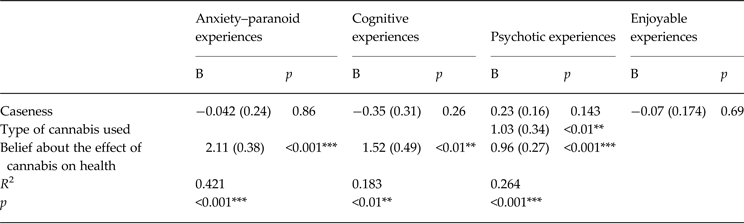
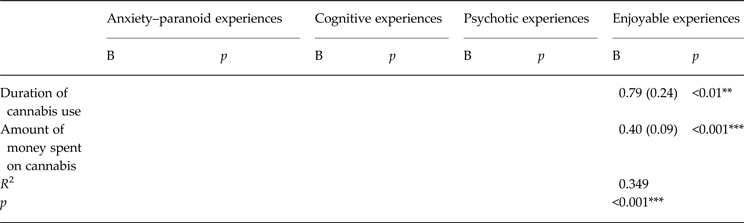
The best-fitting models (Table 4) showed that belief about the impact of cannabis on health was one of the strongest predictors of unpleasant experiences, suggesting that cannabis users are able to identify adverse effects of cannabis. However, awareness of the adverse effects of cannabis was not associated with a stronger motivation to stop using cannabis. Investigating the whole-sample ‘enjoyable experiences’ did not show any strong association with the considered independent variables; considering only the FEP subgroup, this factor was positively related to the amount of money spent weekly on cannabis as well as to a longer duration of cannabis use (Table 5), suggesting that these positive experiences reinforce further cannabis use in psychotic patients.
Linear regression analysis aspects of cannabis use and belief about the health effects of cannabis on subjective experiences of cannabis use a

Data are given as regression coefficient (standard error).
a Predictors which did not show significant results with the dependent variables are not reported in this table: alcohol use; other drugs use; tobacco use; amount of money spent on cannabis; duration of cannabis use; frequency of cannabis use. Confounder variables: age, gender and ethnicity.
** p <0.01, *** p <0.001.
Linear regression analysis aspects of cannabis use on subjective experiences of cannabis use (FEP group) a

Data are given as regression coefficient (standard error).
FEP, First episode of psychosis.
a Predictors which did not show significant results with the dependent variables are not reported in this table: Alcohol use, other drugs use, tobacco use, beliefs about the effect of cannabis on health, type of cannabis use, frequency of cannabis use. Confounder variables: age, gender and ethnicity.
** p <0.01, *** p <0.001.
Use of high-potency cannabis was related to more frequent psychotic experiences, indicating that use of skunk instead of hash increased psychotic symptomatology.
To better understand the relationship between psychotic illnesses and sensitivity to the effects of cannabis, we tested for significant interactions between caseness and each of the significant predictors. None of these interactions was significant, suggesting that the associations between predictors and cannabis-related experiences did not differ between patients and controls.
No multillinearity problems were found between the considered predictors.
Discussion
In line with our previous reports, the FEP subjects in our sample, relative to controls, were more likely to use cannabis frequently, preferred potent varieties (Di Forti et al. Reference Di Forti, Morgan, Dazzan, Pariante, Mondelli, Marques, Handley, Luzi, Russo, Paparelli, Butt, Stilo, Wiffen, Powell and Murray2009, Reference Di Forti, Marconi, Carra, Fraietta, Trotta, Bonomo, Bianconi, Gardner-Sood, O'Connor, Russo, Stilo, Marques, Mondelli, Dazzan, Pariante, David, Gaughran, Atakan, Iyegbe, Powell, Morgan, Lynskey and Murray2015; Kolliakou et al. Reference Kolliakou, Joseph, Ismail, Atakan and Murray2011) and reported an earlier age of onset of cannabis use (Di Forti et al. Reference Di Forti, Sallis, Allegri, Trotta, Ferraro, Stilo, Marconi, La Cascia, Reis Marques, Pariante, Dazzan, Mondelli, Paparelli, Kolliakou, Prata, Gaughran, David, Morgan, Stahl, Khondoker, MacCabe and Murray2014). Although there were no significant differences in the duration of cannabis use between the two groups, at the time of the interviews, more patients than controls had been currently smoking cannabis.
We show that FEP patients showed higher sensitivity to cannabis than controls as also reported in other studies (Radhakrishnan et al. Reference Radhakrishnan, Wilkinson and D'Souza2014). This hypersensitiveness involved not only more frequent ‘unpleasant experiences’ but also increased ‘enjoyable feelings’. These intensified enjoyable experiences could reinforce, working as a reward, cannabis use (Wetherill et al. Reference Wetherill, Childress, Jagannathan, Bender, Young, Suh, O'Brien and Franklin2014) in both patients and controls, increasing the risk of developing cannabis dependence and balancing, at the same time, the experience of unpleasant effects.
We found that a larger amount of money spent per week was positively associated with enjoyable experiences in the patient group whereas unpleasant experiences were positively associated with the presence of beliefs about the impact of cannabis use on health; thus, FEP patients were aware of the unhealthy effect of cannabis on them.
We demonstrate that psychotic patients are more susceptible to all the psychological effects of cannabis, not only the positive ones as shown in previous literature (Thornton et al. Reference Thornton, Baker, Johnson, Kay-Lambkin and Lewin2012). Happiness and fluency of thinking were more often reported by patients than controls and were positively associated with a larger amount of money spent per week to purchase the substance. It is likely that these positive cannabis-related experiences may contribute to the persistence of cannabis use in psychotic patients, consistent with previous findings (Zeiger et al. Reference Zeiger, Haberstick, Corley, Ehringer, Crowley, Hewitt, Hopfer, Stallings, Young and Rhee2012).
The significant association between more frequent cannabis-related psychotic experiences and the potent variant of cannabis is in line with the association between the use of skunk and higher risk of psychosis which we previously found (Di Forti et al. Reference Di Forti, Marconi, Carra, Fraietta, Trotta, Bonomo, Bianconi, Gardner-Sood, O'Connor, Russo, Stilo, Marques, Mondelli, Dazzan, Pariante, David, Gaughran, Atakan, Iyegbe, Powell, Morgan, Lynskey and Murray2015).
Why are psychotic patients more sensitive to cannabis? One possibility is that they become more sensitive following the onset of psychosis. An alternative explanation is that they already held an intrinsic sensitivity. For instance, evidence has suggested a role of variation in the AKT1 gene in influencing the individual response to the psychotogenic properties of cannabis use (van Winkel et al. Reference van Winkel, van Beveren and Simons2011; Di Forti et al. Reference Di Forti, Iyegbe, Sallis, Kolliakou, Falcone, Paparelli, Sirianni, La Cascia, Stilo, Marques, Handley, Mondelli, Dazzan, Pariante, David, Morgan, Powell and Murray2012, Reference Di Forti, Marconi, Carra, Fraietta, Trotta, Bonomo, Bianconi, Gardner-Sood, O'Connor, Russo, Stilo, Marques, Mondelli, Dazzan, Pariante, David, Gaughran, Atakan, Iyegbe, Powell, Morgan, Lynskey and Murray2015). The AKT1 gene encodes for a kinase protein involved in post-synaptic D2 dopamine signalling and to post-synaptic sensitivity and it has been suggested to moderate the risk for psychosis (Murray et al. Reference Murray, Mehta and Di Forti2014).
These results should be considered in the light of some limitations and strengths; first of all the large number of missing data; 61.4% of our sample completed all questions about the experiences included in the CEQ with a range of missing data between 31.3 and 38.6%; as reported earlier a large proportion of those missing data was related to the later introduction of the CEQmv in the collection of cannabis history; a higher presence of missing data was also observed within the control group, especially for those who had used cannabis once.
In conclusion, our findings highlight the hypersensitiveness of FEP patients to the effects of cannabis; this hypersensitiveness was linked to stronger experiences not only during intoxication, but also to cognitive impairment after cannabis use and these, as well as other experiences, were also related to genetic susceptibility. Contrary to the self-medication hypothesis, cannabis did not relieve psychotic symptomatology as higher levels of psychotic experiences were reported by FEP patients. It seems that other factors, including pleasure seeking, may encourage and maintain cannabis use in FEP patients. The relationship between the type of cannabis use and a massive presence of psychotic experiences support the causal model, highlighting the presence of a third factor which increases the risk to have psychotic-related experiences after cannabis use.
Our findings concerning both skunk use and more enjoyable experiences reported during cannabis intoxication are in line with the indicator variable model showing how different factors can guide the relationship between psychosis-proneness and cannabis use.
Because our data were collected from a FEP population and the cannabis-related experiences included experiences occurring both before and after the onset of psychosis, further prospective studies should assess the changes in subjective cannabis experiences before and after the exacerbation of psychosis considering also if antipsychotic medication could change the subjective cannabis-related experience playing a role in the maintenance of cannabis use. The role of individual genetic variants and/or polygenic risk score for psychosis should be explored to understand their role in influencing the quality and frequency of cannabis-related experience and the maintenance of cannabis use.
Acknowledgements
The study was funded by the UK National Institute of Health Research (NIHR) Specialist Biomedical Research Centre for Mental Health, the South London and Maudsley (SLaM) NHS Foundation, the Institute of Psychiatry of King's College London, the Psychiatry Research Trust, Maudsley Charity Research Fund, and the European Community's Seventh Framework Programme (grant agreement no. HEALTH-F2-2009-241909; project EU-GEI). The study was supported by the Genetics and Psychosis (GAP) and Physical Health and Substance Use Measures in First Onset Psychosis (PUMP) study teams of the Institute of Psychiatry, King's College London, and SLaM.
Declaration of Interest
None.