INTRODUCTION
Whilst current fishery management is most commonly based on a single stock assumption, it has long been recognized that the stocks of many marine fish comprise several spawning components with a variable degree of geographical and even reproductive segregation (McQuinn, Reference McQuinn1997; Smedbol & Stephenson, Reference Smedbol and Stephenson2001). Such stocks are considered to be population rich. The lesser sandeel, Ammodytes marinus, appears to be one such population rich species where, within the North Sea, there are several geographically distinct spawning aggregations with limited movement between them (Proctor et al., Reference Proctor, Wright and Everitt1998; Pedersen et al., Reference Pedersen, Lewy and Wright1999; Munk et al., Reference Munk, Wright and Pihl2002; Christensen et al., Reference Christensen, Mosegaard and Jensen2008). Failure to account for population richness in fisheries management may lead to the depletion of stock components with unknown ecological consequences (Stephenson, Reference Stephenson1999; Frank & Brickman, Reference Frank and Brickman2000) and could critically affect the long-term stability and sustainability of the entire stock (Hilborn et al., Reference Hilborn, Quinn, Schindler and Rogers2003). Short-term, localized stock failures, although perhaps small in number relative to the entire stock, can have a significant impact on the breeding success of marine top predators such as seabirds (Monaghan, Reference Monaghan1992; Wright, Reference Wright, Greenstreet and Tasker1996; Frederiksen et al., Reference Frederiksen, Wright, Harris, Mavor, Heubeck and Wanless2005). Indeed, the localized nature of the sandeel stock has lead to the precautionary closure of the fishery off the north-east UK coast since 2000.
Despite such concerns, stock productivity in the sandeel, in terms of the recruitment potential of a stock, is currently based on spawning biomass and estimated using a mean weight and age-at-maturity schedule calculated for the whole stock. Here, spawning stock biomass is as a proxy for total egg production and this may be problematic because fecundity per unit mass can vary with age and condition (Marshall et al., Reference Marshall, Kjesbu, Yaragina, Solemdal and Ulltang1998). For example, significant population level departures from these stock parameters may make a component population more or less vulnerable to depletion. A recent comparison of sandeel maturity–size relationships demonstrated significant differences in size- and age-at-maturity among the main fished regions in the North Sea (Boulcott et al., Reference Boulcott, Wright, Gibb, Jensen and Gibb2007). Similar variability has also been reported outside the main North Sea assessed region (Gauld & Hutcheon, Reference Gauld and Hutcheon1990; Bergstad et al., Reference Bergstad, Høines and Krüger-Johnsen2001). Given these differences in size-at-age, age specific fecundity may also be expected to vary between spawning aggregations unless fish from slower growing regions exhibit higher fecundity per unit size. The available information on the fecundity–size relationships for this species does not suggest regional differences in fecundity at size (Macer, Reference Macer1966; Gauld & Hutcheon, Reference Gauld and Hutcheon1990; Bergstad et al., Reference Bergstad, Høines and Krüger-Johnsen2001), although these studies do not consider many of the important fished areas. Regional differences in size and condition may also be reflected in the rate of atresia. Atresia has been related to low condition in other species (Ma et al., Reference Ma, Kjesbu and Jørgensen1998) and so sandeels from areas of low growth may be expected to exhibit a higher incidence of atresia.
Spawning stock biomass (SSB) models of recruitment potential implicitly assume an isometric proportionality between total egg production and SSB (Serebryakov, Reference Serebryakov1990); however, whether such assumptions are biologically relevant to the North Sea sandeel stock is questionable. Studies of gadoid species have shown that egg production for a given SSB can vary because female size, age and condition can all lead to deviations in the fecundity–mass relationship (Hodder, Reference Hodder1965; Hislop, Reference Hislop1988; Kjesbu et al., Reference Kjesbu, Klungsoyr, Kryvi, Witthames and Greer-Walker1991). Indeed, given recently documented demographic variation in the age-at-maturity in sandeels (Boulcott et al., Reference Boulcott, Wright, Gibb, Jensen and Gibb2007), it is imperative that future models of recruitment potential consider how the size composition of the spawning stock affects the total number of eggs produced per SSB. This position is further underlined when one considers that recruits to spawning aggregations off the Firth of Forth, Scotland, and occurring in the east and west central North Sea are likely to originate locally (Proctor et al., Reference Proctor, Wright and Everitt1998; Munk et al., Reference Munk, Wright and Pihl2002), and that differences in local egg production could affect the vulnerability of these stock components to mortality by predators and the fishery.
Until recently, Ammodytes marinus supported the largest fishery in the North Sea (ICES, 2005) and still forms an important component of the food webs in the North Atlantic (Sherman et al., Reference Sherman, Jones, Sullivan, Smith, Berrien and Ejsymont1981; Daan, Reference Daan1990). The aim of our study was to determine the relationship between potential fecundity, size, and age in phenotypically distinct populations. The key populations that were the subject of our study were chosen on the basis of current fishing activity and previously recorded regional differences in life history characteristics (Boulcott et al., Reference Boulcott, Wright, Gibb, Jensen and Gibb2007).
MATERIALS AND METHODS
Sample collection
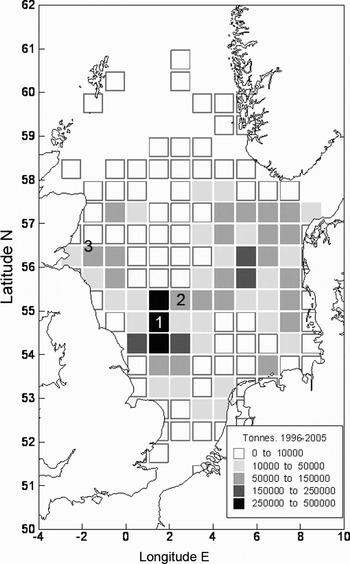
Collections of sandeel were made during several North Sea surveys conducted by the Danish Institute for Fisheries Research (now DFU-Aqua) and MSS in 1999, 2003 and 2004. In all instances sampling took place between late October and early December; a time which coincided with A. marinus' period of over-wintering in the sand, shortly after the summer growing season and prior to winter spawning. Collections for all three regions in 2004 took place within a 16 day window between November and December. The samples were collected from the sediment using a modified scallop dredge with a 15 cm tooth-bar. Surveys were undertaken at three key fishing areas for which considerable variation in length-at-age has been found to exist (Boulcott et al., Reference Boulcott, Wright, Gibb, Jensen and Gibb2007): North-West Rough, Elbow Spit and the Firth of Forth (Figure 1). Surveys conducted in a fourth sample area, Fisher Bank, during 1999 and 2004 were unable to yield sufficient numbers for the purposes of meaningful comparison and were not included in subsequent analyses. Previous work has revealed that sandeels from Fisher Bank mature earlier and at a larger size than the other areas tested in this study (Boulcott et al., Reference Boulcott, Wright, Gibb, Jensen and Gibb2007), and its omission due to poor recruitment, although unavoidable, is regrettable. Upon capture, all fish were frozen before their transferral to the laboratory. Age was estimated from sagittal otoliths by an experienced reader using the method given in ICES (1995).
The distribution of Danish sandeel landings between 1996 and 2005 (DIFRES). The three sample regions used in our study are: (1) North-West Rough; (2) Elbow Spit; and (3) the Firth of Forth.

Atresia
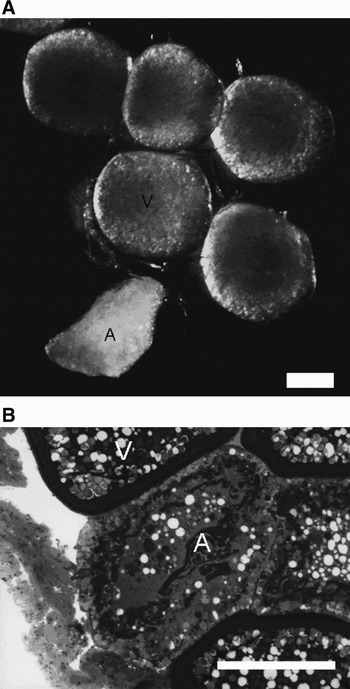
A sub-sample comprising all age-1 females (N = 110) caught in the three regions during 2004 was used to determine the prevalence and relative intensity of atresia. Here, intensity was calculated as the proportion of α-atretic oocytes to vitellogenic oocytes found to occur in a sample of approximately 250 oocytes taken from the mid-section of the ovary. Óskarsson et al. (Reference Óskarsson, Kjesbu and Slotte2002) demonstrated that it was possible to examine the level of pre-ovulatory atresia in whole-mount preparations of herring ovary. To test whether this technique was valid in the sandeel, 20 ovary samples were examined for atresia both histologically and under the binocular microscope. Around 100 vitellogenic oocytes were examined for evidence of α-stage atresia in both histological and whole mounts. As in herring, whole-mount atretic oocytes tended to be irregular in shape, relatively smaller than the normal ones and with an uneven transparency (Figure 2a, b). Intensity of atresia estimated under the binocular microscope and the corresponding histological sections were compared using a paired t-test. There was no significant difference in intensity between the two methods (t 2,18 = –1.16; P = 0.22) although the mean incidence of atresia was low, i.e. 1.7 and 1.8% for histological and whole mount, respectively.
Images of formalin-fixed late α- atretic (A) and vitellogenic oocytes (V) under (A) binocular microscope and (B) historesin section stained with toluidine blue from a 1 year old Ammodytes marinus. Scale bar = 200 µm.

In addition to atresia rates, condition, and eviscerated weight were also recorded for each individual. Relative condition factor (Kn) was calculated in the following manner: Kn = 100·(W/ ) (Le Cren, Reference Le Cren1951); where W is the individual wet weight (g), and is the predicted weight for a given length based on a weight–length relationship (where W = aLb) calculated from a representative sample of over 6000 North Sea sandeels. When comparing atresia rates across regions, only those data collected during the same 16 day window in 2004 were used (N = 110).
Fecundity estimation
In total, 253 mature, age-1 and 2 females were sampled from the three regions. Since A. marinus is a group, synchronous determinate total spawner, producing a single batch of oocytes that are spawned over a short spawning period (Gauld & Hutcheon, Reference Gauld and Hutcheon1990), potential fecundity could be defined as the number of vitellogenic oocytes found in the ovary immediately prior to spawning (Kjesbu et al., Reference Kjesbu, Witthames, Solemdal and Walker1998). The fact that no fish in our study displayed evidence of having already spawned (i.e. no hydrated oocytes were present) permitted us to produce a reliable estimate of potential fecundity. In addition to estimates of fecundity, total length (± 1mm), whole body weight (± 0.001g), eviscerated weight (± 0.001g) and ovary weight (± 0.001g) were also measured. Using eviscerated weight (W), relative fecundity was derived in the following manner:

Estimates of potential fecundity were produced using the auto-diametric fecundity method (Thorsen & Kjesbu, Reference Thorsen and Kjesbu2001), with the necessary species parameters being derived from a previous gravimetric study of 300 A. marinus sandeels (Boulcott & Wright, Reference Boulcott and Wright2008). The successful application of the auto-diametric method also requires that the size distribution of oocytes in the ovary is homogeneous, a fact which has been confirmed by previous studies of A. marinus (Gauld & Hutcheon, Reference Gauld and Hutcheon1990; Bergstad et al., Reference Bergstad, Høines and Krüger-Johnsen2001; Boulcott & Wright, Reference Boulcott and Wright2008). Under the auto-diametric method, predicted potential fecundity was expressed as follows: PF = M O × 2605.6 × D O−2.7689 (250 ≤ D O ≤ 1000), where M O is the ovarian weight (g) and D O is the mean oocyte diameter in fresh ovary (µm). For each individual, mean oocyte diameter was estimated from a sample of 100–200 oocytes.
It is important to correct any estimate of potential fecundity collected over different dates for pre-ovulatory atresia because of down-regulation in the period between the end of follicle proliferation and spawning (Kennedy et al., Reference Kennedy, Witthames and Nash2007). As our sampling regime extended over 39 calendar days, ovaries collected from different sample years proved to be at different developmental stages, with those samples collected later in the calendar year presumably exposed to greater losses from atresia (Ma et al., Reference Ma, Kjesbu and Jørgensen1998; Kurita et al., Reference Kurita, Meier and Kjesbu2003). To correct PF for the number of oocytes resorbed through atresia (Nres), the likely down-regulation of potential fecundity due to atresia was incorporated in each statistical model by including oocyte diameter as a standardizing factor (see Thorsen et al., Reference Thorsen, Marshall and Kjesbu2006). Potential fecundity data were not adjusted by applying an estimate of turnover rate as the lack of information on atretic degeneration times for the study species would add a high level of uncertainty.
Statistical analyses
All data were tested for normality, using a Shapiro–Wilk test, and for homogeneity of variance (Sokal & Rohlf, Reference Sokal and Rohlf1995). Fecundity–length relationships across regions were fitted using a general linear model (GLM). Models initially included all explanatory variables. Non-significant terms were then removed from the model sequentially by a process of stepwise deletion. A measure of model fit was based on a pseudo-coefficient of determination (Swartzman et al., Reference Swartzman, Silverman and Williamson1995), which was taken to be the fraction of the total variation explained by the model: r2 = 1– (residual variance/null variance). When examined together, the regions North-West Rough, Elbow Spit and the Firth of Forth were initially expressed within the model as a three level factor. Where stated, significance levels represent the minimal model. Atresia versus body condition relationships were also analysed using a GLM. To comply with the requirements of normality, atresia estimates were square-root transformed prior to analysis.
It was our intention in both the analysis of potential fecundity and atresia to adopt a fully balanced design which included all regions, years and ages sampled. In practice, due to exceptionally poor recruitment in certain year-classes and areas, only sufficient samples were obtained from the Firth of Forth for such an analysis. Therefore, GLMs were only applied to those datasets, according to year, age and region, which yielded sufficient numbers.
RESULTS
Atresia
A 99% prevalence rate of atresia was recorded for fish from all three regions collected within the 16 day collection period in 2004. Taking age-1 individuals collected in 2004, the only age group for which we had sufficient sample numbers in each region, the average intensity of atresia recorded from these fish was 6.4% (minimum = 0.9%, maximum = 15%). Oocyte diameter ranged from approximately 200 to 1000 µm. No effects of condition (GLM; F1, 105 = 0.97; P = 0.33), length (F1, 105 = 0.94; P = 0.33), region (F2, 105 = 0.82; P = 0.44) or oocyte diameter (F1, 105 = 0.23; P = 0.63) were found to have a bearing on atresia rates.
Potential fecundity
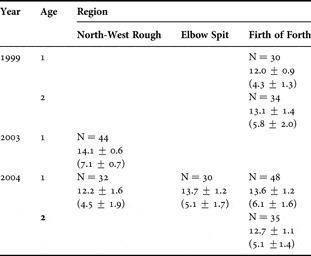
Taking the data from all three sampling years (N = 253), potential fecundity was found to vary from 913 to 10,527 for fish ranging in size from 9.9 to 16.3 cm total length. Relative fecundity was found to range from 226 to 1524 oocytes.g−1 of eviscerated weight. Potential fecundity was found to increase significantly with length and the relationship best described as a power function: (PF = 0.3829 × L3.59, r2 = 0.67). Similarly, the relationship between potential fecundity and weight was best described as a power function: PF = 632.31 × W1.06, r2 = 0.64. Sample numbers, mean total lengths and mean gutted weights for age-1 and 2 fish split according to region and year of collection are given in Table 1.
Fish sample numbers collected in 1999, 2003 and 2004 split according to age and region. Mean total lengths and mean gutted weights (in parentheses) of surveyed fish are stated below sample numbers. Quoted error terms represent one standard deviation from the mean.

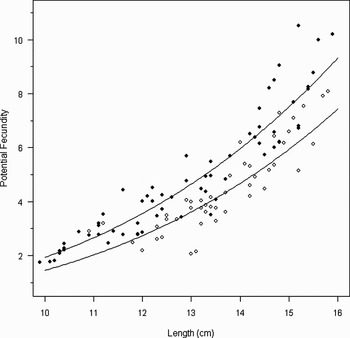
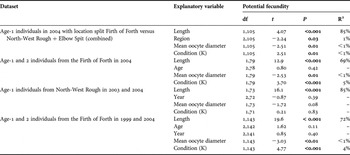
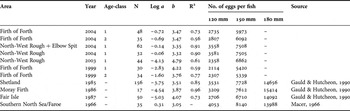
To assess the possible influence of region on potential fecundity, data for age-1 individuals caught in the three regions within a 16 day period in 2004 were analysed. An initial analysis, where each region was modelled individually by a three level factor, did not reveal a significant regional effect (t 2, 105 = −1.55; P = 0.12). Combining the data from the two neighbouring sites within the Dogger Bank area, North-West Rough and Elbow Spit, allowed us to compare these similar sites with the Firth of Forth. The results from this model indicated a significant effect of region, length, mean oocyte diameter and condition on potential fecundity (Table 2). Length accounted for 85% of the variation in potential fecundity with region, mean diameter and condition accounting for 1%, 0.4% and 0.3%, respectively. Derived parameters for the fecundity–length relationship in A. marinus obtained from this study and from others are given in Table 3. The relationship between potential fecundity and length was highest for the combined Dogger Bank sites; indicating that fish collected from the Firth of Forth produce relatively fewer eggs per unit size than elsewhere, with this disparity increasing with body size (Figure 3). Estimating potential fecundity between these regions for a standard fish length of 12 cm yields an expected oocyte number of 3558 (North-West Rough + Elbow Spit combined), and 2735 (Firth of Forth).
The relationship between potential fecundity and length for age-1 individuals collected in 2004 from the Firth of Forth (open circles) and the combined Dogger Bank sites, North-West Rough and Elbow Spit (black circles).

The output of four general linear models (GLM) fitted to each dataset containing estimates of potential fecundity. Models initially included all explanatory variables prior to the removal of all non-significant terms by a process of stepwise deletion (significant differences in bold).

Estimated parameters of the fecundity–length relationship in Ammodytes marinu s where: log Fecundity = log a + b log Length. Egg production numbers are fitted estimates of production at stated fish length.

Comparing data collected for age-1 and age-2 individuals from the Firth of Forth during 2004 (Table 2) revealed a significant effect of length, mean oocyte diameter and condition, but not age. Length accounted for 69% of the variation in potential fecundity, with condition contributing to 5% of the variation. When comparing data collected in 2003 and 2004 in North-West Rough for age-1 individuals, a significant effect of length, but not year or condition was found. Length was found to account for 85% of the variation in potential fecundity. Comparing data collected for age-1 and age-2 individuals from the Firth of Forth in 2004 with data collected during the 1999 survey for the same demographic group revealed a significant effect of length and condition, but not age or year. Length was again found to be the main predictor of potential fecundity, accounting for some 72% of variation, with condition accounting for 4% of the variation.
DISCUSSION
Potential fecundity
The derived relationships for potential fecundity indicate that there are marked differences in egg production between regional spawning aggregations in the North Sea. Such disparities in egg production are further amplified by differences in population growth rates and maturation profiles across these aggregations. Most notably, lower fecundity-at-length of sandeels collected from the Firth of Forth, coupled with a reduced level of maturity-at-age in this region (Boulcott et al., Reference Boulcott, Wright, Gibb, Jensen and Gibb2007), will result in a lower number of eggs per biomass for a given age-class compared to other regions. A previous study of the Firth of Forth (Boulcott et al., Reference Boulcott, Wright, Gibb, Jensen and Gibb2007) indicates that sandeels from this region are slower growing than the other North Sea regions. Such a disparity may reflect differences in local productivity since the sandeel's zooplankton prey tends to only have one short spring bloom in the vicinity of the Firth of Forth compared to more protracted spring and autumn peaks in other North Sea regions (Franz et al., Reference Franz, Colebrook, Gamble and Krause1991).
As is typical, fecundity in Ammodytes marinus is strongly influenced by size (Lambert et al., Reference Lambert, Yaragina, Kraus, Marteinsdottir and Wright2003). One possible explanation for this strong influence is that A. marinus is a capital breeder, solely reliant on stored energy reserves whilst overwintering in the sand prior to its emergence to spawn. Although weight is often a better predictor of fecundity than length (Koops et al., Reference Koops, Hutchings and McIntyre2004), this was not found to be the case in this study. Sandeels decline in weight during the period of vitellogenesis so length may be a more reliable predictor of fecundity (Boulcott & Wright, Reference Boulcott and Wright2008). Predicted by life history theory (Stearns & Crandall, Reference Stearns, Crandall, Potts and Wootton1984; Trippel, Reference Trippel1998) to affect potential fecundity, age was not, however, found to be a significant factor affecting fecundity in our study. Nonetheless, parameters which attempt to describe potential fecundity presuppose the occurrence of maturation, and it is the probability of maturation that is affected by age during the first three years of development (Boulcott et al., Reference Boulcott, Wright, Gibb, Jensen and Gibb2007). Similarly, our study did not detect a significant effect of year when comparing collections over the 5 year study period. This finding was unexpected as plasticity in life history characteristics caused by both environmental perturbation and density dependent competition (Stearns, Reference Stearns1992) would be likely to play some part in determining fecundity. For example, the density dependent nature of fecundity has been found in herring; another single, demersal spawner found in the North Sea (Messieh et al., Reference Messieh, Pottle, MacPherson and Hurlbut1985; Bailey & Altamar, Reference Bailey and Altamar1989).
Fecundity is believed to be constrained by genes and modulated by somatic growth and/or nutrition (Wootton, Reference Wootton1979; Tyler & Sumpter, Reference Tyler and Sumpter1996). Hence, ovarian development occurring during a period of partial or complete fasting tends to lead to stronger relationships between condition, energy reserves, and potential fecundity than one for a period of feeding (Lambert et al., Reference Lambert, Yaragina, Kraus, Marteinsdottir and Wright2003). Since the energy for oocyte development in the sandeel is derived from stored energy acquired during summer feeding (Boulcott & Wright, Reference Boulcott and Wright2008), a relationship between fecundity and condition may also be expected in A. marinus. For example, fecundity is related to condition in a species with a similar ovarian cycle to sandeels, the Atlantic herring, Clupea harengus (Ma et al., Reference Ma, Kjesbu and Jørgensen1998; Kurita et al., Reference Kurita, Meier and Kjesbu2003). That condition was found to be a poor predictor of potential fecundity in the models tested could relate to the fact that fish were sampled long after the decision to commit to egg production had taken place (Boulcott & Wright, Reference Boulcott and Wright2008).
Atresia
Bromley et al. (Reference Bromley, Ravier and Witthames2000) suggest that atresia in species with determinate fecundity could be a mechanism to fine-tune batch sizes in response to food shortage. The small effect of oocyte diameter on potential fecundity seen in this study could be explained as down-regulation of oocyte numbers arising from pre-ovulatory atresia. However, it should be noted that oocyte diameter was not found to be a significant, explanatory variable in all the models tested. Whilst down-regulation through atresia probably has only a small effect on fecundity over the sampling period, over the entire period of vitellogenesis (September–December; Boulcott & Wright, Reference Boulcott and Wright2008) such intensity may have a considerable effect. Our estimates of the intensity of atresia are comparable with those found in herring (Kurita et al., Reference Kurita, Meier and Kjesbu2003). Although herring experience a similar restive over-wintering period to sandeels in some cases (Kurita et al., Reference Kurita, Meier and Kjesbu2003), the similarity in down-regulation between the two species is unexpected given that herring also undergo energetically demanding migration events. Here, higher rates of down-regulation might act as a buffer against unpredictable and potentially large energetic demands. Nevertheless, few studies of atresia and condition based on data collected from the field exist (Lambert et al., Reference Lambert, Yaragina, Kraus, Marteinsdottir and Wright2003), and where they do the results are often conflicting, suggesting that the predicted relationship may be not applicable to all stages of development (Kurita et al., Reference Kurita, Meier and Kjesbu2003) or all species.
Whatever the cause, the low intensity of atresia in sandeels suggests that once committed, egg production does not reduce differentially in response to other energetic constraints such as somatic maintenance or unfavourable temperatures during the first reproductive season. Our study also indicates that regional egg production is not affected by regional differences in the prevalence and intensity of atresia.
Relevance to management
The results of our study, when taken in combination with the disparities in maturity–size relationships found in these regions (Boulcott et al., Reference Boulcott, Wright, Gibb, Jensen and Gibb2007), are relevant to attempts to replace spawning stock biomass with measures of stock reproductive potential (SRP) (Trippel, Reference Trippel1999), that more closely reflect a stock's ability to produce viable eggs. In order to provide estimates of stock egg production, relative egg production estimates need to be combined with accurate information on the biomass-at-age for each region. Attempts have also been made to consider the contribution of regional sandeel stock components to produce spatially explicit models of models of sandeel abundance (Christensen et al., Reference Christensen, Mosegaard and Jensen2008), however, further data, such as the information provided in this study, are required before such models can accurately model regional variation across the North Sea stock. The value of such approaches is highlighted in the Firth of Forth in circumstances where age-1 fish dominate the stock. Here, only a proportion of the dominant age-class will mature with each being relatively less productive than other sandeel aggregations in the North Sea. Given such regional differences in productivity, sandeels in the Firth of Forth region may be more susceptible to growth over-fishing than other regions. Whilst the North Sea is currently managed as a single stock, concern over the local fishing impact off the north-east UK coast on sandeel availability for seabirds, together with evidence for reproductive isolation (Proctor et al., Reference Proctor, Wright and Everitt1998; Munk et al., 2001), led to the precautionary closure of this region. Our Firth of Forth data lend weight to the argument for a regional management plan that protects sufficient sandeel resources for local predator populations, such as seabirds (Monaghan, Reference Monaghan1992; Wright, Reference Wright, Greenstreet and Tasker1996; Fredriksen et al., 2005). In the context of stock reproductive potential, our conclusions support the call for the adoption of more realistic proxies of egg production than current stock-level spawning stock biomass estimates that often use knife-edge maturity relationships (Trippel, Reference Trippel1999).
ACKNOWLEDGEMENTS
We would like to thank Henrik Jensen, Fiona and Iain Gibb for assistance and fruitful discussions on this topic. We also thank Marlene Quintal for assistance with histological preparation and the Danish Institute for Fisheries Research (now DFU-Aqua), CEFAS and the masters and crews of RV ‘Dana’, FRV ‘Corystes’ and FRV ‘Clupea’ for help in sample collection. This work was supported by The Danish Institute for Fisheries Research, CFP DG XIV No. 98/025 and PROTECT (FP6-2003-SSP-3) projects from the Commission of the European Union.