Introduction
The seasonal melting of sea ice in the Arctic Ocean, which has been confirmed for several summers in a row and is widely documented, has become a hot topic in the media. It is fuelling many speculative scenarios about the purported renewal of a ‘cold war,’ or even an actual armed conflict, in the Arctic, for the control of both its natural resources and its sea routes.
The melting sea ice is indeed giving a second wind to projects, abandoned in the 19th century, to find shorter sea routes between Europe and Asia. A look at the map shows the savings in distance that can be achieved with the Arctic routes: for example, a trip between London and Yokohama through the northwest passage is 15,700 km and 13,841 km through the northeast passage, which is significantly shorter than the route through Suez (21,200 km) or Panama (23,300 km) (figures from Mapinfo GIS software). These figures fuel the idea that the Arctic routes, because they are shorter, are bound to attract abundant through traffic, and consequently will become a major political issue. Amid the media widespread image of a future maritime highway across Arctic seas, some scientists have yielded to the popular image and speculated that Arctic traffic is set to increase rapidly - see for instance Roston (Reference Roston2009: 469) asserting that ‘because the Northwest Passage is about to become an alternative route to the Panama Canal, the volume of use within the passage will likely exceed 3 000 vessels a year’. Beyond the seemingly decisive advantage of Arctic routes, however, remain many obstacles to navigation. In addition, the scenarios for the fast development of marine traffic in the Arctic remain highly speculative. However, traffic, especially traffic bound for Arctic locations, is increasing, fuelled by the prospect of natural resource exploitation. To what extent is the legal frame adapted to such an expansion of traffic?
Types of commercial shipping traffic in the Arctic
Shipping activities in the Arctic, both current and potential, are diversified. In the north as elsewhere, transport is a derived activity. The level of demand for transport services depends on the demand for the products to be transported. As a result, shipping markets are often segmented in terms of cargo carried by ships and the origin and destination of the shipments. Today's ships are specialised and optimised in size, technology and flag of registry in order to meet the needs of shippers and the specific combinations of cargoes and routes. The balance of supply and demand at a given time can differ significantly between each shipping market segments. In studying the impacts of a changing environment, it is important to consider such divisions because different types of traffic will be impacted differently in a transforming ice regime.
Transit traffic
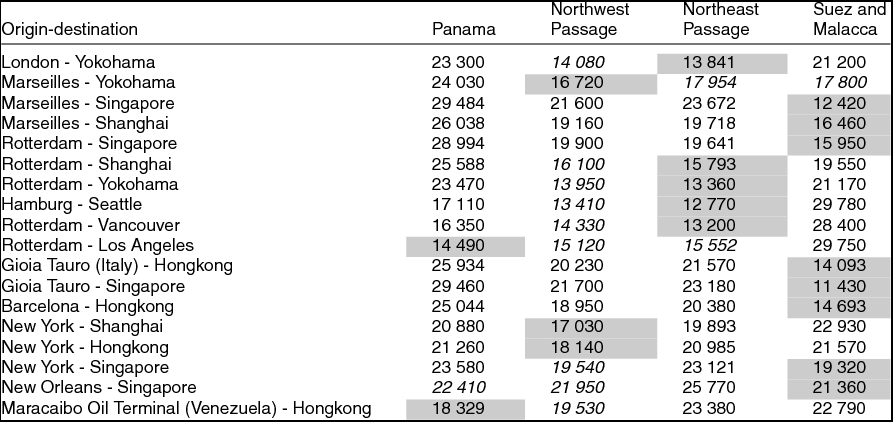
In this type of traffic, ships navigate the waters of the Arctic only to link southern markets with one another. Such shipments are not associated with any dynamics of the region: the Arctic only offers a short-cut. Gains in distance between some of the major world markets can be important when sailing through the Arctic as opposed to current routes through Suez or Panama. This is notably the case for exchanges between the North and Baltic seas and east Asian ports (see Table 1). Sailing distances are some 25 or 30% shorter along the Arctic route in certain cases. This is the central factor that fuels much of the speculation about the potential for a rapid intensification of shipping in the region. The potential gains are significant on some routes and they will be a factor in future developments. We will see however in the next section that the increases in operation costs implied by the Arctic routes can rapidly offset the advantages of the raw savings in distances.
Distance between major ports, using the northwest passage, Suez or Panama, depending on the origin/destination.

Source: author calculation using ArcGIS and MapInfo softwares. Northwest passage route using McClure Strait; Northeast passage route using Kara, Vilkitski, Sannikov and Long Straits. No political impediment to navigation considered.
Grey: shortest distance. Italics: less than 15% difference.
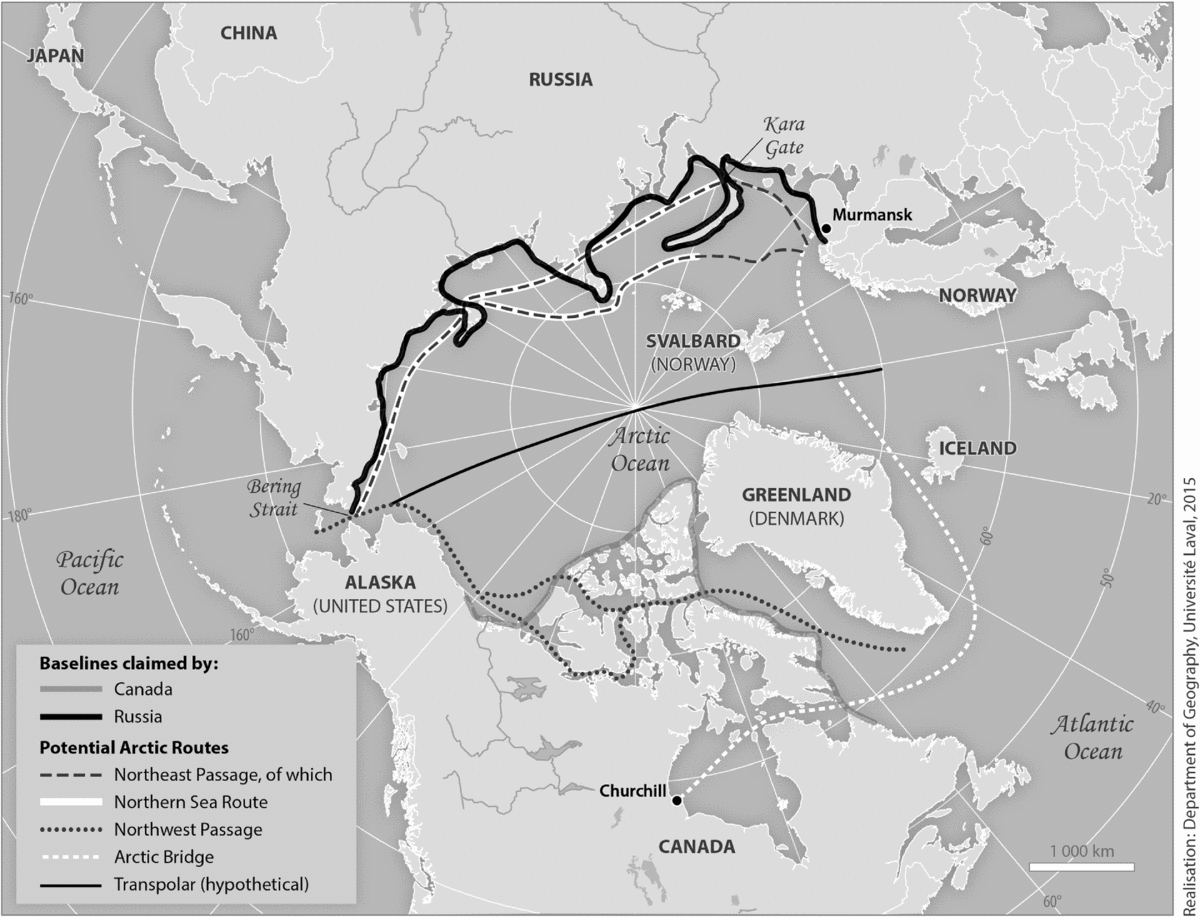
By nature, transit traffic does not have to come through the Arctic, therefore it is necessarily in direct competition with other alternative routes. In addition, there are three main shipping routes through the Arctic joining the Atlantic and the Pacific basins: the northwest passage through the Canadian archipelago; the northeast passage along the Russian coasts; a route directly across the Arctic Ocean towards the pole is also conceivable, it is called the transpolar route (Lasserre Reference Lasserre and Lasserre2010b; Stephenson and Smith Reference Stephenson and Smith2012; Østreng and others Reference Østreng, Eger and Fløistad2013; Stephenson and others Reference Stephenson, Brigham and Smith2014) although it remains hypothetical for the present time because of large volumes of sea ice remaining at the minimum extent in September. The Arctic bridge is a sea lane between Murmansk and Churchill (Manitoba, Canada) that has been used by a few ships since 2007, and that was designed to boost traffic from the port of Churchill, active since 1931. However, traffic is declining because of a sharp drop in wheat exports from the Canadian Prairies, and Omni Trax, the owner, is seriously considering selling it (Radio-Canada (Montréal) 2 December 2015) (Fig. 1).
Arctic routes.
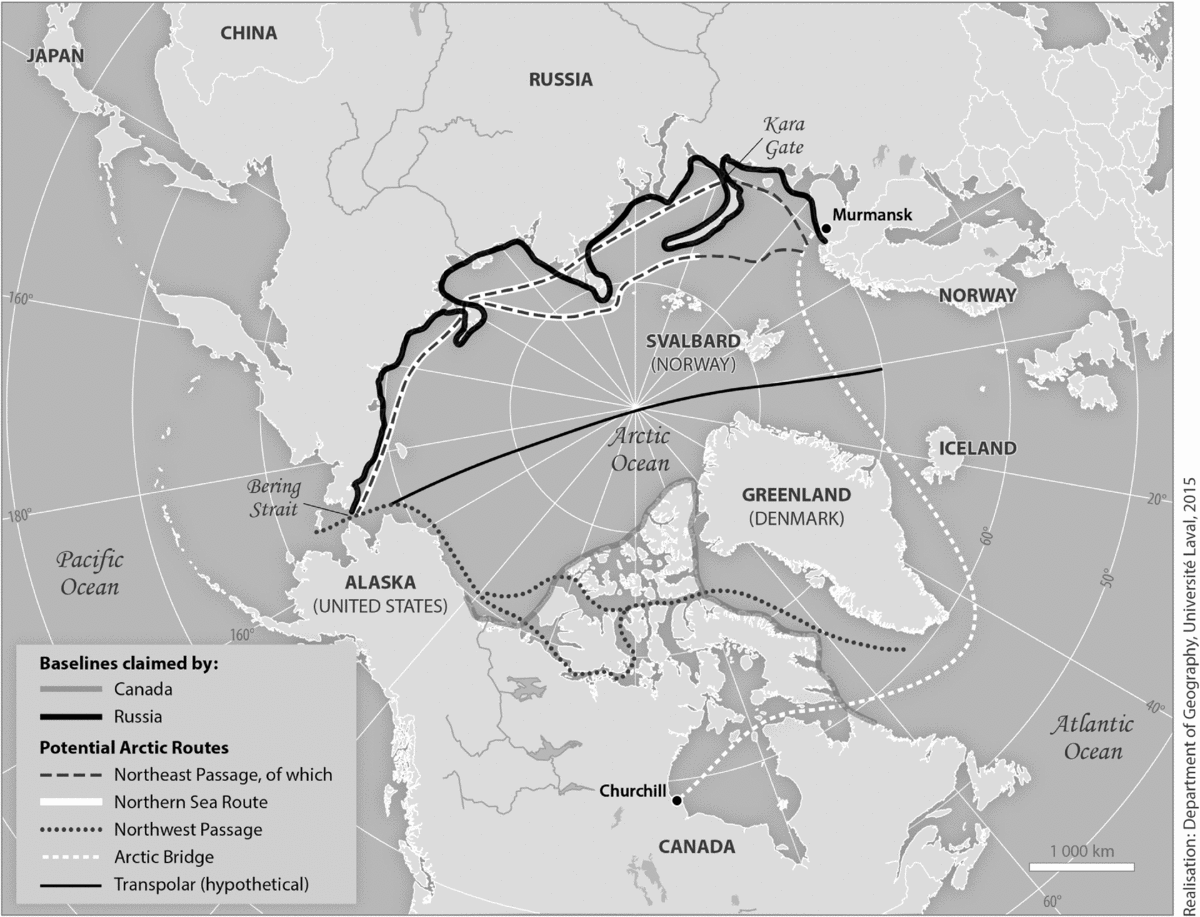
Several types of cargo could potentially benefit from the shorter Arctic routes. However, not all cargoes have the same sensibility to the incertitude associated with the development of new routes. The shipping world is divided into two main types of operations. Bulk shipping concerns the loading of products such as ores, grains or petroleum products that are loaded directly into cargo holds or tanks. These shipments are made on demand. The contractual model is sometimes compared to that of a taxi: a shipper agrees with a ship operator on the delivery of a specific amount of bulk from A to B. In contrast most manufactured good are shipped in containers in an organisational mode referred to as liner shipping. This modus operandum is comparable to that of a bus. The ship operator sets up a fixed scheduled with predetermined sailing dates from each of the selected ports of calls. In this model, shippers can book in advance fixed amount of spaces on weekly departures to accommodate their just-in-time supply-chains. The product sold in liner shipping is the offer of year-round services for which the main reliability indicator is schedule-integrity. Thus, the containerised liner trades of the world are more likely to be negatively affected by the seasonality of Arctic routes as much as by the incertitude around transit times during the shipping season. Bulk cargoes are managed as on-off operations and making them better candidates for seasonal shipments.
Resources-based traffic
In contrast with transit traffic, destinational traffic is bound to the Arctic to load or unload cargo to or from the region. In this category the greatest volumes concern the transportation of mineral resources extracted from the Arctic. Such shipments are not new. In the eastern Canadian Arctic for example, lead and zinc have been shipped every summer from the mid-seventies to the early 2000s from mines in Nanisivik (on Baffin Island) and Little Cornwallis Island (to the north of 75°N). Nickel currently is shipped out year-round from Deception Bay (northern Quebec) and Voisey's Bay (northern Labrador) (Haley and others Reference Haley, Matthew and Szymoniak2011; Têtu and others Reference Têtu, Pelletier and Lasserre2015). We can also mention oil and gas exploitation and shipment from the Barents and Kara Seas.
For this type of traffic, there is obviously no alternative routing. It is a matter of evaluating the possibility to sail ships to the extraction site and evaluating the cost of the shipping operations within the larger commercial viability equation for the project. Climate change and retreating ice will therefore have impact on the overall transportation cost by reducing the technical requirements for the ships employed. In some cases, the opening of an ice-free summer window can create a shipping season in which non-ice-strengthened ships can be used. Since sites being considered for commercial exploitation in the Arctic will normally hold large reserves of high quality resources, the quantity that can be shipped to market is often a main constraint on production levels. Lengthened shipping seasons can also have a direct impact on the profitability of a project by increasing the volumes that can be brought yearly to market.
Re-supply traffic
A third type of traffic can be observed in Arctic shipping. It is also Arctic-bound, but concerns transportation in the region of supplies needed by local communities. Food and some lighter goods can be brought-in by aircraft but building materials, vehicles and heavier equipment have to be transported by ships. This traffic is largely conditioned by the local availability of port infrastructures. In Greenland most trades are containerised since ships can dock at facilities available in most communities. In Canada, general cargo ships sail from southern ports with barges and tugs loaded on deck. For unloading, ships anchor near the villages and then use their tugs and barges to unload cargo on a beach ramp. Heating oil and gasoline is transferred from anchored tankers to shore tanks via a floating connection. In this market, it is the socio-economic evolution of Arctic communities that will shape the demand for shipping, more so than the changing climatic conditions. Easier conditions may potentially simplify the navigation and lengthen the shipping season but the small volumes and the size of the territory will continue to translate into high transportation costs.
To conclude this overview it should be pointed out that these divisions are not always mutually exclusive. For example, mining sites may be re-supplied in part by empty bulkers coming-in to load ore. The construction phase of a mining project will often generate more business to services otherwise dedicated to community supplies. One mix-category in particular can create confusion in the evaluation of recent and future developments of merchant shipping in the Arctic. Bringing mineral resources extracted from the Arctic (or from sub-Arctic regions) to market may imply a long passage through the Arctic Ocean and is sometimes presented as pure transit shipping, whereas it is in fact traffic originating from the Arctic region. For example, some of the ship movements along the northeast passage in recent years involve shipments of iron ore from Kirkenes, a Norwegian port located north of the Arctic Circle, to China.
Sea shipping in the Arctic remains difficult
Arctic routes (northeast and northwest passages) are competing with warmer routes
The recent accelerating melting of Arctic sea ice underscores the potential advent of Arctic sea routes that are geographically much shorter between the Atlantic and the Pacific than classical routes through Panama or Suez and Malacca. A quick comparison underlines this fact but introduces nuances (Table 1).
It appears that indeed, for most origin-destination pairs of ports in the northern hemisphere, distances are shorter along the northeast passage or the northwest passage. However, depending on the exact location of the origin or the final destination, some routes remain shorter via classical routes: it is not true Arctic routes are always shorter. In fact, the more southern the origin and/or destination points are located, the less Arctic routes have an advantage.
There are also land routes that compete with sea transport: from Japan or China to New York for instance, a container may be loaded on a ship across Panama; or on a ship across the northwest passage; or on a ship to Prince Rupert for instance, and then by rail onto New York. Similarly, an overland rail route exists across Asia, mainly using the Trans-Siberian, linking Asian regions with Europe (Verny and Grigentin Reference Verny and Grigentin2009; Lasserre and Huang Reference Lasserre and Huang2015).
Arctic shipping remains characterised by seasonality
Although the ice is melting rapidly in the summer and that the proportion of multiyear ice is decreasing rapidly, the ice will reform every winter under the prevalent polar conditions, which include, despite global warming, severe cold (below –40ºC), strong winds, total darkness (the polar night) and complete isolation. No climate change model envisages that ice will not form during the winter. It may be first-year ice that will be present in the Arctic with the gradual melting away of old ice, but sea ice about 1.5 m thick will keep reforming in Arctic seas despite the melting trend (Lasserre Reference Lasserre and Lasserre2010; Bourbonnais and Lasserre Reference Bourbonnais and Lasserre2015). Since 1979, the first year satellite data was collected so as to assess precisely the extent of sea ice, sea ice at its maximum of January decreased by 3,2% per decade, contracting from 15.5 million sq km to 13.8 million sq km, a slow decrease that does not seem to question the return of sea ice in the winter; whereas decline at its summer minimum extent (in September) displays a sharp decrease from 7.2 million sq km to 5.1 million sq km, a 13.7% decline per decade.
Therefore, potential transit routes will not operate during winter. It is not a technological issue: strongly strengthened ships or icebreakers could punch through the ice, but the ship construction costs, high insurance premiums and the higher fuel consumption necessary to break through ice make this kind of transit totally unprofitable, even if the route is shorter. This means that ship owners will have to change their schedules twice a year (in spring when the ice melts, and in autumn when it forms back), a situation that not only is costly but also increases the risk of errors, and hence of delays as well. Accurately predicting freeze-up and breakup is still very difficult. Since schedules are fixed several months in advance, there is a risk of launching summer routes before some straits are ice-free or, conversely, of missing a number of days when navigation is possible (Lasserre Reference Lasserre and Lasserre2010b; Lasserre and Pelletier Reference Lasserre and Pelletier2011).
The Arctic: a difficult and challenging environment
Arctic routes will always present specific difficulties, even if they open up to seasonal navigation:
* Even though a definite trend of reduced surface and thickness of the sea-ice cover can be documented, there will always be ice in the winter, as well as in the polar night and very low temperatures in the winter. What may change here with climate change is the approximate date when the sea-ice breaks up in the spring: sooner than presently, and when it reforms in winter, later than presently. It is impossible, from one year to the next, to anticipate the exact date of these events, thus leaving shipping firms guessing when they could begin and end their services through Arctic routes (Houssais Reference Houssais and Lasserre2010; Lasserre Reference Lasserre and Lasserre2010; Bourbonnais and Lasserre Reference Bourbonnais and Lasserre2015).
* The pace and geography of the spring breakup, a consequence of the seasonality explained above, will be different from year to year, allowing drifting ice to move with currents and winds and possibly clog specific straits, especially in the Canadian Arctic, where, according to most models, the remnants of the multi-year ice will remain the longest: as the ice gradually breaks up, ice remnants could penetrate the archipelago and drift into sea channels (Guy Reference Guy2006; Lasserre Reference Lasserre and Lasserre2010).
* Similarly, risks posed by growlers and small icebergs, which are very difficult to detect, force ships to greatly reduce their speed, as the possibility of encountering such blocks of ice increases. A growler is a very hard, modestly sized (one to two m wide) block of multi-year ice that floats barely above the surface. Hitting one at full speed (over 17 knots) could very well sink a ship (Lasserre Reference Lasserre and Lasserre2010). Climate change has accelerated the melting of the Greenland ice cap (Lasserre Reference Lasserre and Lasserre2010): the ice shelf is speeding up through glaciers towards the sea and the rhythm of iceberg calving has increased significantly. Icebergs are still a real hazard for shipping in the area, especially as fog increases as well, forcing ships to slow down (Hill Reference Hill2000; Shaw Reference Shaw2008; Zentilli and others 2006), as testified by the collision of two Russian tankers along the northeast passage in July 2010 (Nilsen Reference Nilsen2010). Let us also note the collision between the cargo ship Reduta Ordona and a growler in July 1996 in Hudson Strait, where the ship nearly sank, or the sinking of trawlers BCM Atlantic off Labrador's coast in March 2000 or Finn Polaris in August 1991 off Greenland. Many more icebergs will drift in Baffin Bay. Although they are detectable, their increased number will force ships to reduce speed, especially on foggy days. Besides, they disintegrate into several small growlers that are barely detectable: an iceberg field therefore demands a slow pace (F. Julien, personal communication, 14 January 2009). These growlers present a real hazard to shipping: small in size, about a meter large, they nevertheless weigh a lot, more than a metric ton; being made of multi-year ice, they are extremely hard, whereas they barely float above the surface, making detection very difficult. In November 2007, the cruise ship MS Explorer sank in Antarctica after hitting a growler, although it had an ice-strengthened hull and proper certification (Stewart and Draper Reference Stewart and Draper2008). Navigation could therefore be slower than with normal routes, increasing transit times. Even icebreakers slow down when navigating among multi-year ice blocks. This is important as the media always presents the potential time saved through Arctic straits by assuming commercial speed will be maintained, around 22 knots for container ships. Such a speed in Arctic waters with a standard hull is dangerous (Guy Reference Guy2006; A. Quinn and N. Roberts, personal communication, 23 November 2007; F. Julien, personal communication, 14 January 2009). But, if ships must slow down so as to reduce risk, then transit time will increase, reducing the advantage of going across Arctic waters.
* Because of the random but persistent presence of ice, navigation in these waters requires an ice-strengthened hull, powerful night ice spotting radars, an experienced crew, and equipment to cope with icing, protect cargo from frost, etc., thus increasing costs.
* Insurance companies will demand that this equipment be present. It is likely they will be extremely reluctant to insure ships not designed for navigation in potentially iced waters and with an inexperienced crew (N. Roberts, personal communication, 23 November 2007; Verny and Grignetin Reference Verny and Grigentin2009). Premiums are much more expensive: depending on the shipping firm's experience, the ships' equipment, crew and route, and can range between 20% and 100% above standard prices1.
* Mapping is still inadequate in these waters. To be sure, this will gradually be corrected as exploration intensifies, but, if we exclude the main historical channels, depths and subsurface features, as well as marine tables, are often poorly recorded. It is estimated that only 6% of the Arctic waters are charted to international standards and 11% is mapped (Trauthwein Reference Trauthwein2012). As an example, on 22 October 2006, when the Canadian icebreaker Amundsen crossed the Bellot Strait with one of the authors on board, marine tables stated she would have the tide against her; in fact, the reverse proved to be the case.
* In the historic southern northwest passage and northeast passage routes, several straits present low water levels: the Union Strait, for instance, is only 13 m deep, inadequate for larger ships. The northern route of the northwest passage, through McClure Strait, is 200 m deep, allowing any ship to go through, and it opened up for the first time in 2007, but it is exposed to drifting ice throughout the summer. Besides, navigable channels in the Canadian archipelago are at times narrow (a few km), which is a concern for large ships, especially if there is ice to avoid.
Shallow and narrow straits do not prevent navigation, but they limit the options for shipping companies as ship size has steadily increased since the 1960s, especially in the container industry, from an average capacity of 500 TEUs (container unit) to Panamax ships in 1984 (4 400 TEUs) and then to 8 000 TEU ships in 2003, with drafts exceeding 14.5 m, 15 m for 14 000 TEUs ships that now measure between 360 and 397 m long. Large oil tankers (ULCC) are up to 450 m in length and have drafts greater than 20 m.
At the same time, the Suez and Panama canals are already or soon will be getting larger. When completed in 2016, the new Panama Canal will be able to welcome ships with a draft of 18.3 m. In 2010, the upgraded Suez Canal became capable of accommodating ships 20,1 m in draft (Lasserre Reference Lasserre and Lasserre2010b) and it was doubled in some sections so as to ease ship crossings in 2015 (Financial Times (London) 5 August 2015).
Adaptation to the risks of shipping implies higher operating costs
These difficult shipping conditions make for increased risks that in turn convert into higher costs. First, direct costs are to be incurred so as to face physical risks.
Building, as well as operating ice-strengthened ships, is more costly: strengthening and winterising a ship costs several million dollars per unit; heavier, such a ship consumes more fuel per km. An ice-strengthened ship is thus a costly investment that cannot be afforded if the ships is to navigate only for short periods in Arctic waters (Lasserre and Pelletier Reference Lasserre and Pelletier2011; Lasserre Reference Lasserre2015).
So as to reduce risks, Russia imposed a mandatory piloting scheme along the northern sea route (NSR), and strongly encourages ships to be escorted by icebreakers. The toll (already in place in the northeast passage, and still discussed in Canada along the northwest passage) is not necessarily more expensive than the Suez Canal toll, but with the significantly higher insurance premiums, one cannot say if the real cost of transiting via Arctic routes would still be that attractive.
Second, shipping in the Arctic challenges the way liner shipping is structured and questions its profitability.
The container shipping industry and the car shipping industry which uses roll-on roll-off ships, operate in a just-in-time mode, and this operational constraint is being reinforced as shipping operations are more and more integrated in a broader logistics chain (Terrassier Reference Terrassier1997; Clarkson Research Studies 2004; Lorange Reference Lorange2008; Damien Reference Damien and Guillaume2008; Lasserre and Pelletier Reference Lasserre and Pelletier2011). This industry is therefore not driven by the transport cost per TEU alone, but by other factors such as transit time, marketing advantages of faster delivery, but also the reliability of delivery schedules and the value of markets along the way. Container shipping firms do not merely sell the shipping of goods, but also market their intention to provide on-time delivery according to a fixed schedule; they pay penalties when not respecting these schedules. Drifting ice, an increasing number of icebergs that break up into many smaller growlers that represent a high risk, and thick fog banks, however, make it difficult to meet these tight schedules. Drifting ice can temporarily block some straits, making them very tricky to navigate, which could cause delays in delivery or perhaps even force the ship to turn around and transit by the Panama Canal, resulting in disastrous delays both in terms of financial penalties and reduced credibility.
Along Arctic routes, there is no intermediate market (stopovers) and no port adequately equipped to receive the containers to be onloaded/offloaded at potential rotations, which reduces the commercial interest of these routes, compared with the multiple loading/unloading opportunities along traditional routes such as Suez or Panama. This is in line with the literature that underlines the restructuring of the shipping industry along a ‘main line’ of major port hubs (Rotterdam, Felixstowe, Algeciras, Marsaxlokk, Suez, Singapore, Hong Kong, Shanghai, Busan, Kobe and Long Beach) from which transhipment is operated to service regional ports (Comtois and Rimmer Reference Comtois, Rimmer, Pinder and Slack2004; Damien Reference Damien and Guillaume2008; Renault Reference Renault2010).
A very different pattern of development for Arctic passages in Russia and Canada
The receding sea ice opens up channels that were long sought by Europeans to reach Asia, across the fabled northwest or northeast passages. The former is generally understood as the sea stretch from Lancaster Sound to the Bering Strait, although many authors limit its scope to the Canadian Archipelago. The northeast passage follows the Siberian Arctic coast and crosses Russian Arctic straits between the mainland and Russian Arctic archipelagos: Novaya Zemlya, Severnaya Zemlya, the New Siberian Islands and Wrangel Island. There is a difference here between the two passages. The northwest passage rests almost entirely in Canadian-claimed internal waters, if it is defined as extending from Baffin Bay to the Beaufort Sea, whereas the northeast passage merely skips across Russian straits and thus Russian-claimed internal waters, but for the most part lies outside Russian territorial waters, except in a few places. The route lies rather in the Russian Exclusive Economic Zone (EEZ), which is not neutral, since Russian regulations on shipping along the NSR, based upon article 234 of the UN Law of the Sea, obliging ships to respect Russian regulations within Russia's EEZ, particularly as regards mandatory piloting and icebreaker escort. The NSR is the Russian-administered route between the Kara Gate and the Bering Strait, thus a subsection of the northeast passage.
Both Russia and Canada nevertheless claim sovereignty over the passages (see section 4). If the legal positions of both states are similar regarding Arctic passages (they may differ on the issue of extended continental shelves, which is a totally different issue), however there is a striking discrepancy regarding the development of traffic along the two passages.
The Russians, since 1991, have openly tried to develop transit shipping along the northeast passage. A special administration body has been created to manage traffic between the Bering Strait and the Kara Gate, this segment being called the northern sea route (NSR). The NSR administration supervises applications for transit and collects the fees Russia imposes in exchange for providing piloting or icebreaker escort services, plus the possibility to dock at one of the several small ports along the NSR in case of emergency, like Arkhangelsk, Dudinka, Tiksi, Pevek or Anadyr, and a network of search and rescue centres in the Arctic.
In Canada, there is no mandatory transit fee, but no service other than aid to navigation (seasonal buoys, frequent transmission of ice maps) is provided: there are not enough icebreakers to organise convoys and no mandatory piloting has been put in place. There is no deepwater port along the northwest passage between Iqaluit (the latter not even having a wharf) and Point Barrow in Alaska; permanent search and rescue bases are far to the south in Gander, Halifax, Trenton, Cold Lake, or Comox. The infrastructure and associated services are thus much lighter on the Canadian side of the Arctic.
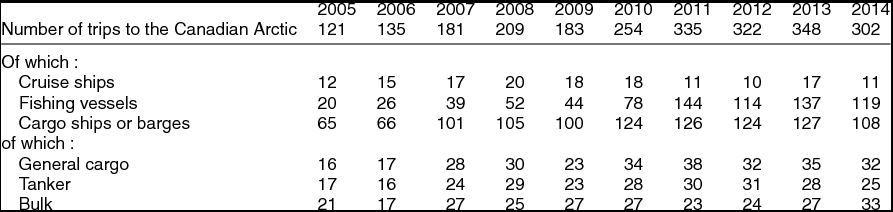
Traffic is also very different in the two regions. Local, destinational traffic is on the rise in both Arctic Canada and Russia, a fact known despite the absence of public statistics on the Russian side. In Canada, the number of ships entering the Arctic waters, considered north of the 60th parallel, was growing year after year until 2011 when traffic entered a plateau. Most of these ships are commercial cargo ships supplying mining exploration and the local communities, and fishing trawlers (Table 2).
Number of ship trips to the Canadian Arctic, 2005–2014.
Source: compiled by F. Lasserre, data from Nordreg/Canadian Coast Guard, Iqaluit.
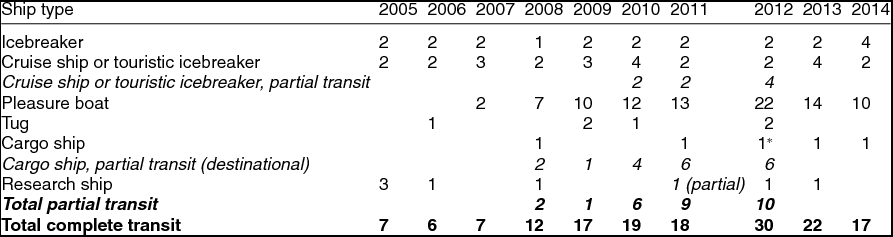
Statistics are more comparable for transit. Data shows transit remains poorly developed along the northweat passage, and mainly fueled by pleasure boats (see Table 3). Commercial cargo transit, despite the much talked-about August 2013 transit of the bulk carrier Nordic Orion, is still minimal.
Transit traffic in the northwest passage, 2005–2014.
Source: compiled by F. Lasserre, data from Nordreg, Iqaluit.
* But with local service too, Gotland Carolina was loaded with oil products in Vancouver, stopped in Dutch Harbour, then in Tuktoyaktuk to unload part of its cargo, then again in Wise Bay. The ship then proceeded to Rotterdam, its final destination. This trip is thus formally a transit, but in fact a destinational trip too as the ship unloaded twice cargo to Arctic destinations, and then the ship repositioned.
In the east, transit traffic has taken longer to take off, but since 2010 traffic is picking up and developing at a steady rate. Not only is it developing at a much faster rate than along the northwest passage, it is also composed of commercial traffic, a dimension largely absent in the northwest passage for now. Traffic shrank considerably in 2014 with several reasons being aired: the effects of western economic sanctions following the outbreak of war in the Ukraine; the decision by Russian authorities to dedicate icebreakers primarily to offshore oil exploration, thus severely reducing their availability to transiting ships.
It remains to be seen to what extent this long-term growth trend will continue or if the 2014 dip will repeat itself. It must be underlined that most of this transit traffic is in fact fueled by bulk cargo ships loading in northern Norway or in Murmansk, thus reflecting an Arctic destinational traffic sustained by the exploitation of natural resources, rather than a long-haul transit traffic from the Pacific to the Atlantic (Lasserre and Alexeeva Reference Lasserre, Alexeeva, Lalonde and McDorman2015).
Of course, this Arctic transit traffic is still far from competing with the classical southern routes across the Suez or Panama canals: in 2014, 17,148 ships crossed the Suez Canal; 11,956 ships crossed the Panama Canal; 79,344 transited the Malacca Strait (Hand Reference Hand2015) (Table 4).
Official transit traffic in the northeast passage/NSR, 2005-–2014.

Source: adapted from Centre for High North Logistics (www.chnl.no) and NSR Administration (www.arctic-lio.com/nsr_transits).
What kind of regulation and governance to minimise risks?
Despite the fact that traffic is still small when compared to busier seas, it is indeed growing, especially for destinational traffic linked to the servicing of local communities or fueled by natural resources exploitation. The question of a legal/regulatory framework is thus all the more relevant as an accident, given the fragile environment, could have disastrous consequences. As already mentioned, in 2010 two Russian tankers collided along the NSR. In August 2010, the oil tanker Nanny ran aground near Pangnirtung in the Canadian Arctic, thankfully not triggering an oil spill. In September 2013, the tanker Nordvik struck an ice floe while sailing in the Matisen Strait in the NSR and began taking in water before it could manage to be tugged back to Murmansk.
Sovereignty issues along Arctic passages
Canada and Russia stress their sovereignty on these Arctic waterways which is all the more important in the absence of mandatory and strict rules for navigation in the Arctic that could open the door to poorly suited ships. Nobody doubts that this argument also serves their claims, but there is an objective rationale in this argument: shipping in the Arctic remains dangerous and the Arctic environment is very fragile.
For Canada, the whole passage is within Canadian internal waters of the Canadian Arctic archipelago, claimed as such based on historic reasons. Canada also proclaimed strait baselines around the archipelago so as to justify the claim. Canada thus denies the right of transit passage, and does not agree with the interpretation put forward by the United States and the European Union, that the passage is an international strait open to international shipping (Bartenstein Reference Bartenstein and Lasserre2010; Lalonde and Lasserre Reference Lalonde, Lasserre and Lasserre2010, Reference Lalonde and Lasserre2013). So far, the dispute is merely rhetorical and low-toned, as neither the United States nor the European Union consider openly challenging Canada's position, by sending ships openly defying Canada's regulations, or by pressuring Canada into negotiating an agreement.
One reason may be that in so doing, they would also be forced, so as to remain consistent, to challenge Russia's claim as well, since it too is based on the same argument: Russia's Arctic straits are within Russia's internal waters for historic reasons and are encompassed within Russia's baseline (Lalonde and Lasserre Reference Lalonde and Lasserre2013). Russia also claims control of shipping in the Siberian seas (Kara, Laptev, East Siberia) based on the UN Law of the Sea article 234 that provides for a state to take specific environmental protection measures regarding seas covered by ice for most of the year.
Enforcement of sovereignty: rules of navigation
Since 1991, Russia has opened the NSR to foreign traffic buts under strict controls. The latest version of the legislation controlling shipping along the NSR is the rules of navigation on the water area of the Northern Sea Route decreed by the order 7 of the Ministry of Transport of Russia dated 17 January 2013. The regulations provide for the criteria required to be granted the right to ply the NSR, to have access to an icebreaker escort, the fees for icebreaker assistance and for piloting. No ship can sail along the NSR without an official permit that is granted considering its ice class, its cargo, its crew and the likely ice conditions at the time of the journey.
In Canada, there is no fee for transit, but services provided are not as developed as in Russia: no icebreaker escort, Nordic Orion in August 2013 being an exception, negotiated ad hoc and had no piloting. Buoys are deployed in the spring and navigation aid and ice maps are regularly sent to ships that register with NORDREG (Vessel Traffic Reporting Arctic Canada Traffic Zone), the Canadian Coast Guard bureau responsible for the supervision of marine transportation in the Arctic. For long, it was not mandatory to register with NORDREG for a ship intending to enter Canada's Arctic waters. Since 1 July 2010, any ship over 300 gross tonnage, or carrying a pollutant or dangerous goods, must register prior to entering the 200 miles zone of Canada's Arctic waters. Shipping in the Canadian Arctic is also regulated by the 1970 Arctic Shipping Pollution Prevention Regulations (ASPPR) that provide criteria for allowing or refusing the entrance of vessels into Canadian Arctic waters, depending on a zone/date table taking into account the ice class of the ship. A Canadian officer must be on board in the following cases when in Arctic waters:
– on tankers, when carrying oil as cargo,
– when any ship, over 100 gross tons is navigating outside the baseline dates from the Zone/Date Table, and
– while using the Arctic Ice Regime Shipping System, that permits ships to navigate outside of the current Zone/Date System when ice conditions are suitable.
With this regulation (ASPPR and registration with NORDREG), Canada places an environmental protection orientation to its assertion of sovereignty in Arctic waters, with good reasons: the Arctic ecosystem is fragile and a major oil spill from a poorly-suited vessel to Arctic navigation could prove disastrous. These requirements triggered a protest from the United States on 18 August 2010, as Washington is unhappy with what is considers a request of permission to transit. Canadian officials on the other hand insist NORDREG does not grant permission, but rather checks that the request appears reasonable (Transport Canada 2012; Canadian Coast Guard Reference Guard2013).
Safety of navigation: an operational perspective
A well adapted legal framework is unquestionably an essential tool to minimise the risks associated with shipping activities in the Arctic. Experience also shows that beyond proper rules, their implementation is a crucial element, as well as are the means to enforce compliance. Insurance policies are a way to induce shipowners into abiding by international regulations as insurance companies often adopt international guidelines as their basis (Sarrabezoles and others Reference Sarrabezoles, Lasserre and Hagouagn'rin2014), but it rests on policies set by private companies. In the southern waters world-wide, port state control is essential in the control of risks posed by foreign-flag ships. In this process, it is the inspectors of the country of the port visited by a ship that are given the right to board the vessel and verify rule-compliance. This responsibility initially lies with the country in which the ship is registered. If inspection reveals significant technical problems in the application of International Maritime Organization's (IMO) standards, national inspectors have the power to detain a ship in port until satisfying corrections are made. Although it has long been worked into the international conventions of the IMO, the process was enhanced by the entry into force of International Safety Management Code (ISM) in 1998. ISM marks a cornerstone in the evolution of IMO's approach to safety. It recognises the importance of the human element stating that a safety culture needs risk evaluation, preparedness, clear communication and direct involvement of the crew and their employer. From a risk management perspective, port state control is also innovative in formalising the sharing of information among ship inspectors of different nationalities. This is done through the Paris memorandum of understanding (MoU) on the Atlantic (https://www.parismou.org) and the Tokyo MoU on the Pacific (www.tokyo-mou.org/). By accessing the full reports of their European colleagues through a shared data base, Canadian inspectors can target the riskier ships before their arrival at national ports. There is no legal barrier to conduct port state control in the Arctic. The region can readily be integrated in this essential component of the safety net for shipping. In practice however, conducting port state control over such a vast territory with infrequent traffic will pose significant financial challenges to the authorities. Arctic nations will need to commit important resources to be able to position sufficient personnel to inspect ships in a comparable manner as done in the south.
A second approach to controlling risk posed locally by international ships is compulsory pilotage. A pilot is a professional mariner trained with detailed knowledge of the navigational conditions in a specific area: a section of a river or maritime accesses to a given port. Upon entry in the zone, the pilot boards the vessel to guide its captain for the passage. On the east and west coasts of Canada as well as on the St. Lawrence and the Great Lakes pilotage is generally compulsory for commercial vessels of 300 tons and above. The Pilotage Act defines regional administrations to oversee the provision of pilot services within the previous mentioned regions. The Arctic is not covered by the act with the exception of port entry into Churchill. Here again the vast territory and the low density of commercial traffics make the organisation of a pilotage system similar to southern practices seemingly difficult in the Canadian Arctic. A different practice has developed however considering disposition of the law and commercial needs of international vessels. Few individuals offer on-board ice advisor services on a private contract basis. Ice advisors are certified mariners but not legally recognised as pilots, nor are their skills subject to official verification. But experienced officers can offer needed consultant services to crews unfamiliar with Arctic operations.
Beyond these prospective considerations, the most immediate and significant development for operations of ships in the Arctic is certainly the recent adoption of the polar code. After the usual long and complex processes of international negotiations, the formal adoption by the IMO of the code sends a strong signal. The International Code for Ships Operating in Polar Waters aims to recognise and to mitigate the specific risks encountered in Arctic and Antarctic waters. The code will be mandatory and apply to all commercial vessels (it also contains a set of recommended non-mandatory disposition in its part B). It sets compulsory requirements in three different areas: design and construction of the ships; onboard safety equipment and operations and manning (IMO 2015). Rather than setting up a new convention, the code was finalised by amendments to both major IMO's conventions (IMO 2015), the International Convention for Safety of Life at Sea (SOLAS: amendment adopted in November 2014) and the International Convention for the Prevention of Pollution from Ships (MARPOL: amendment adopted in May 2015). More than 150 States have ratified the funding texts of these conventions. They are bound to the amendments accepted by IMO's governing committees. This procedure therefore sets course for an entry into force of the code expected in January 2017 (IMO 2015).
Yet as with all legislations, how the code is going to be applied in practice will dictate much of its effectiveness in improving standards of navigation in polar waters. Two aspects in particular retain our attention. First is the training to be given to officers and to a lesser extent, to the crew. What will be the content of the future courses and, considering that ice-navigation expertise is relatively limited worldwide or more exactly geographically concentred, who will be recognised as having the right to offer such training? A second fundamental challenge and possible weakening factor is the interpretation of current ice condition dispositions. As a governing principle, the code applies to all commercial vessels entering polar waters as defined by explicit geographical boundaries specified right from the introduction of the text. Yet, the code is also founded on the principle that risks within polar waters will vary importantly, particularly in relation to local ice-coverage (see article 3.2 in IMO 2014). In accordance, mitigating measures need to be adapted to local conditions. For example, Chapter 12 (IMO 2014) dealing with manning and training issues states that special training in ice-navigation will not be required for masters and officers of vessels sailing through polar waters if they are ice-free. This illustrates the importance ice condition reports could play in the application of the code.
Conclusion
The ice cover is definitely retreating rapidly in summer, opening up straits that not too long ago were considered closed. However, there remains strong inter-annual and temporal variability: some places will be ice-free one year and not the following, and it is impossible to predict when a specific place will be ice-free or for how long. Some climate scenarios suggest the Arctic Ocean could open up in the summer as early as 2015. The shortest route between Europe and Asia, in this case, would not be Arctic passages but the direct route across the North Pole. Should this scenario materialise, this Arctic Ocean route would prove far more attractive for bulk shipping than the complicated routes through the northwest or northeast passages.
Local navigation for general cargo is already expanding and will probably continue to do so. Natural resources exploitation (oil and gas, metals, and other minerals) is likely to recover in a matter of a few years in the Arctic, sustaining the continued development of traffic at local ports. Although this type of traffic will be subject to country port regulations, it has the potential to be more polluting than transit traffic as it will carry concentrated ores or hydrocarbons.
As far as transit traffic is concerned, media reports claiming that the northwest passage is on the verge of becoming a super seaway are farfetched. Bulk shipping is more likely to be interested than container shipping in testing the profitability of Arctic transit routes. Local mining traffic represents a greater hazard as its cargo is potentially more polluting.
The threat represented by developing shipping in the Arctic can therefore be described as follows. Traffic is unlikely to be heavy: the Arctic will not be another Panama Canal. Traffic will, however, be boosted by either bulk transit or, more probably, by mineral and oil exploitation-potentially very polluting cargos. Control and regulation of shipping in the Arctic, therefore, remain necessary in order to reduce pollution risk.
In describing the effects of the melting sea ice in the Arctic, the media and several analysts have focused on a possible boom in shipping in the region. An analysis shows that, even though some ships are likely to come, it is not the explosion of traffic that some envision will take place. Jumping to farfetched conclusions is both wrong and counterproductive, for if doomsday scenarios do not materialise, contingency planning based on these worst-case scenarios lose credibility. However, security issues must be tackled with and navigation frameworks must be put in place, whether internationally (through the polar code) or locally, through regimes of navigation.
Acknowledgements
This paper benefited from the following research grants: ArcticNet NCE 2010-UL3, 2010–2014, Fonds Québécois pour la Recherche en Sciences et Cultures (FQRSC) 136916, 2010–2014, and Social Sciences and Humanities Research Council of Canada 122520, 2013–2016.