Introduction
Insect galls are one of the most spectacular products of evolution, as they represent atypical organ-like structures made by plants under the direction of stimuli provided by insects (Shorthouse et al. Reference Shorthouse, Wool and Raman2005). These novel plant structures provide food and protection from the elements for the galler (Stone et al. Reference Stone, Schönrogge, Atkinson, Bellido and Pujade-Villar2002; Ronquist et al. Reference Ronquist, Nieves-Aldrey, Buffington, Liu, Liljeblad and Nylander2015). The ability to induce galls has evolved in seven orders of insects, but perhaps the most complex are those induced by cynipid wasps (Hymenoptera: Cynipidae). The majority of the approximately 1400 described species of gall wasps induce galls on leaves, stems, or roots of oaks (Quercus Linnaeus; Fagaceae) and roses (Rosa Linnaeus; Rosaceae) (Ronquist et al. Reference Ronquist, Nieves-Aldrey, Buffington, Liu, Liljeblad and Nylander2015). Although seemingly well protected, cynipid galls attract many species of Hymenoptera with different feeding ecologies ranging from phytophagous inquilines that feed only on gall tissues, to parasitoids that feed on gall-inhabiting larvae (Hayward and Stone Reference Hayward and Stone2005). The assemblage of all inhabitants associated with a population of galls induced by the same gall wasp species is considered a component community, and each species of gall wasp is thought to support a unique gall community (Shorthouse Reference Shorthouse, Shorthouse and Floate2010).
Interactions among and between cynipid species and their associated communities are complex, and the construction of qualitative or quantitative food webs to understand these interactions is challenging (Stone et al. Reference Stone, Schönrogge, Atkinson, Bellido and Pujade-Villar2002). Many gall component communities are known to contain morphologically cryptic species (Abe et al. Reference Abe, Melika and Stone2007; Nicholls et al. Reference Nicholls, Preuss, Hayward, Melika, Csoka and Nieves-Aldrey2010, Reference Nicholls, Schönrogge, Preuss and Stone2018; Zhang et al. Reference Zhang, Gates and Shorthouse2014, Reference Zhang, Gates and Shorthouse2017), and the addition of molecular tools to aid in both species determination and the discovery of new species has helped resolve the complex relationships among cynipid gall component communities.
There have been approximately 50 species of gall wasps in the genus Diplolepis Geoffroy (Hymenoptera: Cynipidae) described worldwide, all of which induce galls on roses. Nearly two-thirds of these were described from North America, suggesting the genus is poorly represented in the Palaearctic. However, this could also reflect insufficient sampling, as evidenced by recent descriptions of new species from China (Wang et al. Reference Wang, Guo, Liu and Chen2013). Species identification of Diplolepis based on adult morphology is challenging as few original descriptions have sufficient detail and identification keys are lacking (Shorthouse Reference Shorthouse1993, Reference Shorthouse, Shorthouse and Floate2010). Phylogenetic relationships of Diplolepis have been investigated using two mitochondrial gene regions, cytochrome b and 12S rRNA, but with conflicting results due to limited taxon sampling and poor sequence quality (Plantard et al. Reference Plantard, Shorthouse, Rasplus, Csóka, Mattson, Stone and Price1998).
Based on the results of their analyses, Plantard et al. (Reference Plantard, Shorthouse, Rasplus, Csóka, Mattson, Stone and Price1998) divided the Nearctic Diplolepis species into four groups: “D. nebulosa,” “D. polita,” “D. rosaefolii,” and “flanged femur” clades. The Palaearctic species were divided into two species groups: “D. eglanteriae” and “D. rosae.” However, the validity of Diplolepis species were not tested, despite some species differing by < 10 base pairs out of 386 (0.026%) in CytB (Plantard et al. Reference Plantard, Shorthouse, Rasplus, Csóka, Mattson, Stone and Price1998). This brings further doubt into current identification of Diplolepis, which has traditionally separated species based on their distinctive galls.
Inquilines of the genus Periclistus Förster (Hymenoptera: Cynipidae) have lost the ability to induce their own galls (Ronquist et al. Reference Ronquist, Nieves-Aldrey, Buffington, Liu, Liljeblad and Nylander2015), and are obligatorily dependent on completing their development within galls of Diplolepis (Brooks and Shorthouse Reference Brooks and Shorthouse1998; Shorthouse and Brooks Reference Shorthouse and Brooks1998). Periclistus induce gall tissues of their own from the tissues of the galls they inhabit. They do not feed on the bodies of the inducers, but the larval inducer is killed during oviposition by the female Periclistus (Shorthouse and Brooks Reference Shorthouse and Brooks1998). Feeding by Periclistus causes each larva to be surrounded within its own chamber, and as a result the inquiline-modified galls are structurally different from normal galls (Shorthouse Reference Shorthouse, Shorthouse and Floate2010).
The phylogenetic position between inquilines and other gall-inducing cynipids has been controversial, ranging from a single origin of inquilinism derived from gall-inducing cynipids (Liljeblad and Ronquist Reference Liljeblad and Ronquist1998) to multiple transitions between galler and inquilines (Ronquist et al. Reference Ronquist, Nieves-Aldrey, Buffington, Liu, Liljeblad and Nylander2015). The genus Periclistus includes 18 described species worldwide, and all members of the genus are restricted to galls induced by Diplolepis to complete their larval development (Ritchie Reference Ritchie1984; Liljeblad and Ronquist Reference Liljeblad and Ronquist1998; Shorthouse and Brooks Reference Shorthouse and Brooks1998; Pujade-Villar et al. Reference Pujade-Villar, Wang, Guo and Chen2016). Ritchie (Reference Ritchie1984) revised the Nearctic Periclistus based on morphological characters in his PhD thesis, but the new species descriptions were not published and thus are not considered valid names.
DNA barcoding studies, which use a 658-base-pair region of the mitochondrial gene cytochrome c oxidase subunit I (COI), have demonstrated the ability of this marker to confidently link field-collected organisms with a reference sequences of a previously identified species (Hebert et al. Reference Hebert, Cywinska and Ball2003). Species boundaries of Diplolepis and their associated inquiline Periclistus have been based exclusively on adult and gall morphology, but species identification is challenging in these genera (Ritchie Reference Ritchie1984; Shorthouse Reference Shorthouse, Shorthouse and Floate2010). Similar re-examination of species boundaries of cynipids and their associated parasitoids have demonstrated the use of COI in integrative taxonomic revisions, which then leads to taxonomic revisions and description of new species (Ács et al. Reference Ács, Challis, Bihari, Blaxter, Hayward and Melika2010; Zhang et al. Reference Zhang, Gates and Shorthouse2014, Reference Zhang, Gates and Shorthouse2017). The major aim of this study is to: (1) test the species concepts of Diplolepis, and inquiline Periclistus using COI, and (2) reconstruct the phylogeny of Diplolepis and Periclistus.
Materials and methods
Specimen collection and deposition
The reference collection of J.D.S. includes rose gall inhabitants collected over the past 50 years by himself and graduate students. Adults of Diplolepis and Periclistus were obtained by one of two ways. Mature galls initiated in the previous year were collected in spring after inhabitants had been exposed to natural cold temperatures, storing them in either jars or whirl-pak bags (Fort Atkinson, Wisconsin, United States of America) at room temperature, then removing the adults as they exited. Alternatively, mature galls were collected in the fall of the year they were induced, placed in whirl-pak bags and the galls subjected to temperatures of 0–3 ºC in incubators for 3–4 months to break diapause. The bags were then stored at room temperature and adults placed in alcohol as they exited the galls. In all cases, collections of distinctive galls induced by each species were placed in separate bags or jars. This reference collection covers a wide geographical area across Canada, as well as representative collections from the United States of America, Japan, and Turkey.
Reference collections of point-mounted specimens from many localities were deposited in the Canadian National Collection of Insects, Arachnids, and Nematodes in Ottawa, Ontario, Canada; and the National Museum of Natural History in Washington, District of Columbia, United States of America. The remaining many hundreds of thousands of wet specimens were deposited at the University of Edinburgh in Edinburgh, United Kingdom, under the care of Graham Stone. Additional voucher specimens from the northwestern United States of America were provided by C.L., and are deposited at the Washington State Department of Agriculture Collection in Olympia, Washington, United States of America. The Palaearctic Diplolepis species used in this study were collected from Romania, Georgia, Russia, and Kazakhstan by Z.L., and vouchers are stored in Babeş-Bolyai University, Cluj-Napoca, Romania.
All specimens used in this study were identified to species whenever possible (see Supplementary Table S1). Specimens of Diplolepis were identified by J.D.S. (n = 313), C.L. (n = 14), or L.Z. (n = 24). Specimens of Periclistus (n = 260) were identified based on the key by Ritchie (Reference Ritchie1984). We opted to use numbers (e.g., Periclistus species 1) to designate unnamed species as their species descriptions from the Ritchie (Reference Ritchie1984) PhD dissertation are considered nomina nuda and unavailable. The outgroups for the phylogenetic analyses of Diplolepis and Periclistus consisted of Liebelia fukudae (Shinji) and Synophromorpha sylvestris (Osten Sacken) (Hymenoptera: Cynipidae), respectively. The outgroups were chosen from published sequences of their closest relatives based on the phylogeny by Ronquist et al. (Reference Ronquist, Nieves-Aldrey, Buffington, Liu, Liljeblad and Nylander2015).
DNA extraction and polymerase chain reaction amplification
The DNA extraction protocol was performed as part of a PhD thesis by Lima (Reference Lima2012). Genomic DNA was extracted from one or two legs removed from each voucher specimen using the methods outlined in Ivanova et al. (Reference Ivanova, deWaard and Hebert2006) at the Biodiversity Institute of Ontario (Guelph, Ontario, Canada), or at the Interdisciplinary Research Institute on Bio-Nano-Sciences of Babeş-Bolyai University (Cluj-Napoca, Romania) using the Qiagen Blood and Tissue Kit (Valencia, California, United States of America) following the standard protocol. The following primer sets were used to amplify the DNA barcode region of COI: LepF1 (5′-ATT CAA CCA ATC ATA AAG ATA TTG G-3′) and LepR1 (5′-TAA ACT TCT GGA TGT CCA AAA AAT CA-3′) (Hebert et al. Reference Hebert, Penton, Burns, Janzen and Hallwachs2004); or MLepF1 (5′-GCT TTC CCA CGA ATA AAT A-3′) and MLepR1 (5′-CCT GTT CCA GCT CCA TTT TC-3′) (Hajibabaei et al. Reference Hajibabaei, Janzen, Burns, Hallwachs and Hebert2006); or LCO1490 (GGT CAA ATC ATA AAG ATA TTG G) and HCO2198 (TAA ACT TCA GGG TGA CCA AAA AAT CA) (Folmer et al. Reference Folmer, Black, Hoeh, Lutz and Vrijenhoek1994).
Polymerase chain reactions were carried out in 96-well plates in 12.5 μL volumes containing: 2.5 mM MgCl2, 5 pmol of each primer, 20 mM dNTPs, 10 mM Tris-HCL (pH 8.3), 50 mM of KCl, 10–20 ng (1–2 μL) of genomic DNA, and one unit Taq DNA polymerase (Platinum Taq DNA polymerase; Invitrogen, Carlsbad, California, United States of America). Polymerase chain reaction thermocycling profile was: one cycle of 60 seconds at 94 °C, five cycles of 40 seconds at 94 °C, 40 seconds at 45 °C and 60 seconds at 72 °C, followed by 35 cycles of 40 seconds at 94 °C, at 51 °C and 60 seconds at 72 °C, with a final extension of five minutes at 72 °C. Polymerase chain reaction products were visualised on a 2% agarose E-gel (Invitrogen), and positive single bands were selected for bidirectional sequencing with the BigDye Terminator Cycle Sequencing Kit on an ABI3730xl DNA Analyzer (Applied Biosystems, Waltham, Massachusetts, United States of America) at the Biodiversity Institute of Ontario.
Phylogenetic analyses
Contigs of COI were assembled using Sequencher version 4.5 (gene codes) and aligned using Muscle (Edgar Reference Edgar2004) implemented in Mega X (Kumar et al. Reference Kumar, Stecher, Li, Knyaz and Tamura2018) and manually inspected by eye for errors. Summary statistics were calculated using AMAS (Borowiec Reference Borowiec2016). Bayesian inference analyses were conducted using MrBayes version 3.2.6 (Ronquist et al. Reference Ronquist, Teslenko, Van Der Mark, Ayres, Darling and Höhna2012). Each analysis had two independent searches with four chains and were run for 10 000 000 generations, sampling every 1000, with a 25% burnin discarded. The dataset was not partitioned based on nucleotide position as it would limit the amount of data per partition (approximately 219 base pairs) for accurate parameter estimation. The best fitting model of molecular evolution was tested using jModelTest2 (Darriba et al. Reference Darriba, Taboada, Doallo and Posada2012), and the general time-reversible model, with a parameter for invariant sites and rate heterogeneity modelled under a gamma distribution (GTR + I + G), was chosen based on the Bayesian information criterion for both taxa. Phylogenetic trees were visualised in FigTree, version 1.4.2 (Rambaut Reference Rambaut2012), and enhanced using Adobe Illustrator CS5 (San Jose, California, United States of America). Intra - and interspecific divergence was calculated using the Kimura-2-Parameter (Kimura Reference Kimura1980) model in Mega X. Automatic barcode gap discovery was also performed using K2P model with default settings (Puillandre et al. Reference Puillandre, Lambert, Brouillet and Achaz2012). Sequences are publicly available on GenBank (see Supplementary Table S1), and the North American specimens can also be found on the Barcode of Life Data System (BOLD; http://barcodinglife.org; Ratnasingham and Hebert Reference Ratnasingham and Hebert2007) in projects Rose gall wasps Diplolepis of North America (DIPNA) and Rose gall inquilines Periclistus of North America (PERNA).
Results
Gall inducer Diplolepis
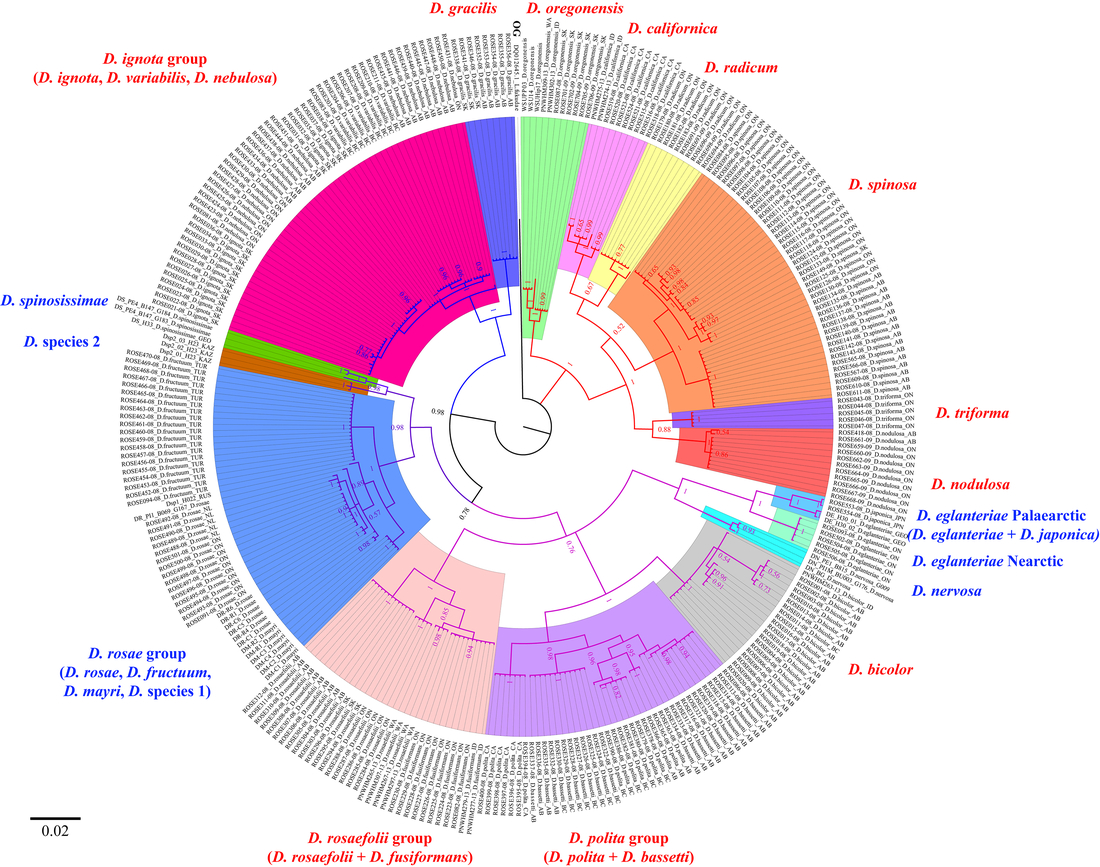
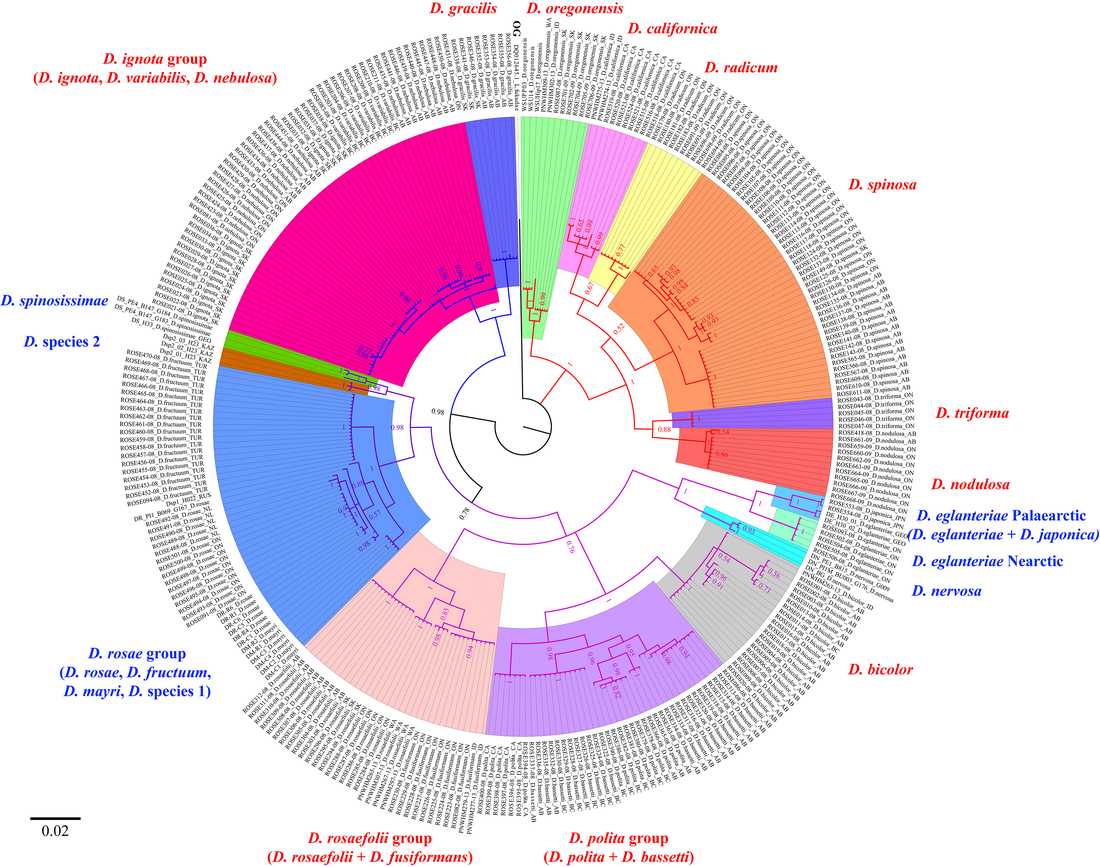
In total 313 COI sequences averaging 597 base pairs (204 parsimony informative sites, 74% AT content) were generated from the Diplolepis specimens, including 15 Nearctic and nine Palaearctic species, as well as two undescribed species collected from Russia and Kazakhstan (Fig. 1, Supplementary Fig. S1). The genus Diplolepis is recovered as monophyletic, and is further divided into the flanged femur and the leaf galler clades. Most the species were also recovered as monophyletic, with the exception of the following non-monophyletic sets of species among which genetic divergence was < 3%: D. polita (Ashmead) and D. bassetti (Beutenmüller); D. fusiformans (Ashmead) and D. rosaefolii (Cockerell); D. nebulosa (Bassett), D. variabilis (Osten Sacken), and D. ignota (Bassett); D. mayri (Schlectendal), D. rosae (Linnaeus), D. fructuum (Rübsaamen), and Diplolepis species 1. In contrast, round leaf galls resembling D. japonica (Walker) and D. eglanteriae (Hartig) collected in the Palaearctic are genetically distinct from those collected in the Nearctic (3.43%), and were therefore split into two groups. Genetic distances are calculated by combining Diplolepis with very low divergences grouped into species groups, and intraspecific divergence ranged from 0% to 2.44% (Supplementary Table S2A), while interspecific divergence ranged from 4.60% to 17.55% (Supplementary Table S3A).
Bayesian inference tree of Diplolepis based on COI. Values indicate Bayesian posterior probability. The branches are colour-coded by (sub)clades: red = flanged femur; blue = Nearctic leaf galler; purple = Palaearctic multi-chambered galler; and pink = mixed leaf galler. Outgroup is labelled in black, while ingroup species are labelled as Palaearctic (blue), Nearctic (red), or outgroup (OG).
Inquiline Periclistus
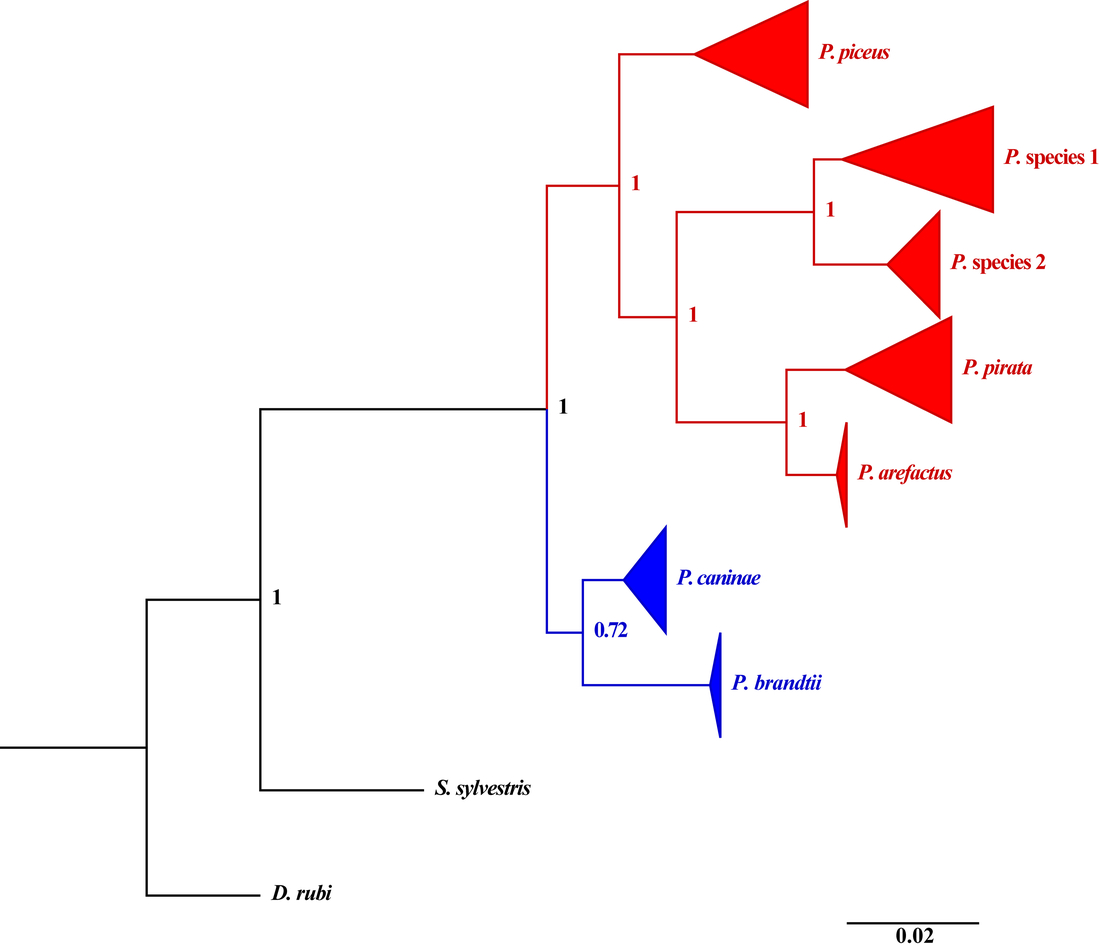
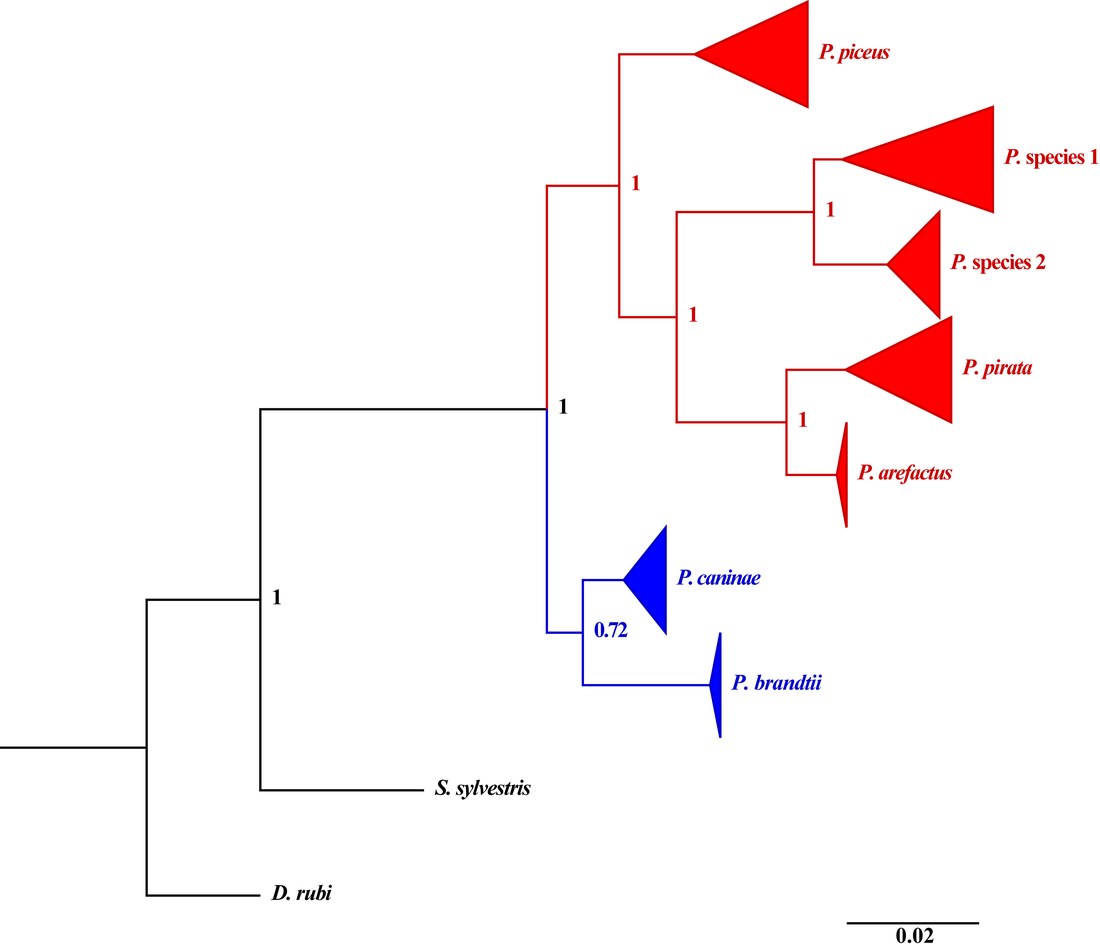
A total of 260 COI sequences averaging 597 base pairs (159 parsimony informative sites, 76% AT content) were used for the Periclistus analysis (Fig. 2, Supplementary Fig. S2). The intraspecific divergence ranged from 0.13% to 2.16% (Supplementary Table S2B), while interspecific divergence ranged from 3.55% to 9.30% (Supplementary Table S3B). The genus Periclistus is recovered as monophyletic and is further divided into the Nearctic (P. arefactus McCracken and Egbert, P. pirata (Osten Sacken), P. piceus Fullaway, and two unidentified species labelled as Periclistus species 1 and Periclistus species 2) and Palaearctic clades (Periclistus brandtii and P. caninae).
Discussion
Phylogeny of Diplolepis and species delimitation based on COI
This study is the first large molecular phylogenetic dataset to test the current species boundaries of Diplolepis rose gall wasps. Most of the Diplolepis species were recovered as monophyletic groups, with the exception of D. polita + D. bassetti, D. fusiformans + D. rosaefolii, D. ignota + D. nebulosa + D. variabilis, and D. mayri + D. rosae + D. fructuum + Diplolepis species 1, which were recovered with very little genetic distance between them (Fig. 1). In addition, the round leaf galls that resemble D. eglanteriae/D. japonica were split into Palaearctic and Nearctic clades due to high genetic divergence. Automatic barcode gap discovery recovered a total of 17 species groups, which is consistent with our analysis (Fig. 1).
The Diplolepis tree divides into two major clades. The “flanged femur” clade was also recovered by Plantard et al. (Reference Plantard, Shorthouse, Rasplus, Csóka, Mattson, Stone and Price1998), and includes exclusively Nearctic species that have the synapomorphic trait of flanged metafemora. Members of this clade oviposit on the stem tissue at the base of leaf buds, which develops as galls on stems (D. triforma Shorthouse and Ritchie, D. californica (Beutenmüller), D. oregonensis (Beutenmüller), D. spinosa, D. nodulosa) or adventitious roots (D. radicum (Osten Sacken)) of the plant.
The leaf galler clade includes all the species that do not have flanged metafemora, and includes species from both Palaearctic and Nearctic regions that induce single-chambered or multi-chambered galls from either leaflets within buds or from tissues at the base of developing leaflets. Multiple species within the leaf galler clade have very low intraspecific genetic distance despite having distinct gall morphology (Supplementary Fig. S1). This leaf galler clade was recovered as five separate lineages by Plantard et al. (Reference Plantard, Shorthouse, Rasplus, Csóka, Mattson, Stone and Price1998), with the three Palaearctic species grouping closer to the flanged femur clade. This polytomy observed by Plantard et al. (Reference Plantard, Shorthouse, Rasplus, Csóka, Mattson, Stone and Price1998) is likely due to limited data, as they were only able to recover < 400 base pair sequence fragments. This clade can be further split into three subclades. The Nearctic leaf galler subclade includes D. gracilis (Ashmead), D. nebulosa, D. variabilis, and D. ignota, and induces single-chambered or multi-chambered galls on leaves. The D. ignota group consists of D. ignota, D. variabilis, and D. nebulosa, all three of which induce spherical galls on the abaxial (lower) surface of leaves and have similar genetic sequences. Their galls range from single-chambered to multi-chambered and are found on R. arkansana Porter (D. ignota) or R. woodsii (D. variabilis and D. nebulosa) from early spring to late summer (Shorthouse Reference Shorthouse, Shorthouse and Floate2010). This result is congruent with Plantard et al. (Reference Plantard, Shorthouse, Rasplus, Csóka, Mattson, Stone and Price1998), where only 1–3 base-pair substitutions were observed in CytB between these three Diplolepis species.
The Palaearctic multi-chamber subclade includes D. fructuum, D. mayri, D. rosae, D. spinosissimae (Giraud), and two undescribed species. Diplolepis species 1 falls close to D. rosae with very little genetic divergence, but its gall may be single-chambered or multi-chambered and appear on the leaf-vein or the stem. Diplolepis species 2 is the sister group of D. spinosissimae, and induces single-chambered galls in the interior walls of hips. In our analysis, the D. rosae group, which consists of D. rosae, D. mayri, D. fructuum, and Diplolepis species 1, all have distinct gall morphology, but lack genetic variation based on COI data. In the past, D. fructuum has been considered a geographic race of D. mayri (Güçlü et al. Reference Güçlü, Hayat, Shorthouse and Tozlu2008), and our result once again casts doubt on the validity of these species. As D. rosae and D. mayri have been introduced to North America (Shorthouse Reference Shorthouse2001), we included samples of D. rosae from both its native and introduced range, which exhibited little genetic distance between populations.
Finally, there is a mixed leaf gall subclade including both Palaearctic (D. eglanteriae, D. japonica, D. nervosa (Curtis)) and Nearctic species (D. bicolor (Harris), D. polita, D. bassetti, D. rosaefolii, D. fusiformans) (Güçlü et al. Reference Güçlü, Hayat, Shorthouse and Tozlu2008; Shorthouse Reference Shorthouse, Shorthouse and Floate2010). Almost all members of this group induce galls on leaf tissue, with the only exception being D. fusiformans, a species that forms small, fusiform galls on immature rose stems (Shorthouse Reference Shorthouse, Shorthouse and Floate2010). The leaf galler D. rosaefolii was rendered paraphyletic by D. fusiformans. These two species are among the smallest Nearctic species, and are often found in the same habitat and on the same individual plant. It is possible that they are conspecific and capable of attacking both leaf and stem tissues. Similarly, the D. polita group consisting of D. polita and D. bassetti also have very little genetic distance, and both induce spiny, single-chambered galls on the adaxial (upper) surface of the leaf in the spring (Shorthouse Reference Shorthouse, Shorthouse and Floate2010). The main differences between the two species are largely based on host plant and gall surface structures, as the galls of D. polita are generally weakly spined and found on R. acicularis Lindley and R. nutkana Presl (Shorthouse Reference Shorthouse1973), whereas the galls induced by D. bassetti are mossy in appearance and mostly found on R. woodsii Lindley. (Shorthouse Reference Shorthouse, Shorthouse and Floate2010). The Palaearctic species D. eglanteriae was also thought to have been introduced to North America (Shorthouse Reference Shorthouse2001); however, specimens collected in Canada were genetically divergent from its conspecifics in the Palaearctic. This is further confounded by the inclusion of D. japonica as the sister group to the Palaearctic D. eglanteriae clade, which also induces round galls on rose leaves and is grouped together with the Palaearctic D. eglanteriae clade. Therefore, we separated the round galls collected from the Palaearctic and the Nearctic into two separate groups, but future studies with larger sample size from Europe, Asia, and North America are needed to fully delimit the boundaries of these species.
Diplolepis identification is primarily based on a combination of geography, host plant, and gall morphology rather than adult wasp morphology, which could have resulted in the over-splitting of species. Alternatively, mitochondrial genes such as COI and CytB may not delimit certain Diplolepis species complexes due to introgression or incomplete lineage sorting that leads to mitonuclear discordance, which has been observed in a variety of insects, including cynipids (Rokas et al. Reference Rokas, Melika, Abe, Nieves-Aldrey, Cook and Stone2003; Linnen and Farrell Reference Linnen and Farrell2007; Nicholls et al. Reference Nicholls, Challis, Mutun and Stone2012). Therefore, without the inclusion of additional nuclear genes and extensive morphological study of the type materials, we are hesitant to propose taxonomic changes based on COI data alone.
Delimiting Periclistus using DNA barcodes
Similar to the gallers, the COI data were able to delimit the Periclistus species associated with Diplolepis galls into seven species (Fig. 2). Periclistus caninae, P. brandtii, P. pirata, P. piceus, and Periclistus species 1 are inquilines of multiple species of galls P. caninae and P. pirata attack both single-chambered and multi-chambered galls P. piceus and Periclistus species 1 are reared exclusively from single-chambered galls, while P. brandtii exclusively inhabits multi-chambered galls (Fig. S2). All five generalist Periclistus species are capable of modifying small, single-chambered galls such as D. nodulosa and D. polita to larger, multi-chambered galls (Shorthouse Reference Shorthouse1980; Brooks and Shorthouse Reference Brooks and Shorthouse1998; LeBlanc and Lacroix Reference LeBlanc and Lacroix2001). The presence of inquilines has been shown to change the community dynamics of the galls as the inducers are usually killed by Periclistus during oviposition (Shorthouse and Brooks Reference Shorthouse and Brooks1998) and by altering the gall size and number of inhabitants in larger, multi-chambered galls where some inducers can survive the inquiline oviposition (László and Tóthmérész Reference László and Tóthmérész2006). Additionally, this alteration in gall community also attracts additional specialist parasitoids that only feed on Periclistus (Zhang et al. Reference Zhang, Gates and Shorthouse2014, Reference Zhang, Gates and Shorthouse2017). However, not all Periclistus attack multiple species of galls, as P. arefactus and Periclistus species 2 are only associated with a single species of Diplolepis.
Bayesian inference tree of Periclistus based on COI. Values indicate Bayesian posterior probability. Outgroups are labelled in black, while ingroup species are labelled as either Palaearctic (blue) or Nearctic (red).
With the addition of these two undescribed Periclistus species, the Holarctic diversity of Periclistus is increased to 14 species (Pujade-Villar et al. Reference Pujade-Villar, Wang, Guo and Chen2016). Our phylogeny includes less than half of the known species, so it is unclear whether this Palaearctic/Nearctic divide will hold once more specimens are added. The description of these two new Periclistus species and the taxonomic revision of the genus are beyond the scope of this paper; however, we recommend revisions that use molecular data as a guide for species descriptions as some of the morphological differences used by Ritchie (Reference Ritchie1984) differed from our COI results.
Biogeography of rose, Diplolepis, and Periclistus
As is the case with most highly specialised phytophagous insects, Diplolepis gall-inducers are restricted to attacking closely related plants of the same genus. In the case of Diplolepis and Periclistus, all host plants are shrubs of the genus Rosa, and the phylogeny of the insects cannot be understood without first discussing the host plants. Roses are notoriously difficult to identify, with some species characterised by extensive continuous morphological variation that blurs their limits with each other and with their ancestors (Wissemann and Ritz Reference Wissemann and Ritz2007). Besides, their intraspecific variability, hybridisation, and polyploidy result in species boundaries that are hard to define (Fougere-Danezan et al. Reference Fougere-Danezan, Joly, Bruneau, Gao and Zhang2015). However, the propensity to hybridise is likely a characteristic that provides new opportunities for Diplolepis to exploit and has contributed to speciation within the genus.
Based on recent biogeographic work on Rosa, the genus mostly likely evolved during Eocene in Asia and western North America, and most extant American species are the results of re-colonisation from Asia through the Bering Land Bridge (Fougere-Danezan et al. Reference Fougere-Danezan, Joly, Bruneau, Gao and Zhang2015). The genetic exchange between the two continents through the land bridge is also reflected in Diplolepis phylogeny, where multiple subclades within the leaf galler clade have mixed Palaearctic and Nearctic species. The origin of Diplolepis is likely Palaearctic, as the only fossil of the tribe Diplolepidini is found in Thorness Bay in the United Kingdom, which dates to Late Eocene (Antropov et al. Reference Antropov, Belokobylskij, Compton, Dlussky, Khalaim and Kolyada2014). This Palaearctic origin is also strengthened by the fact that Liebelia Kieffer (Hymenoptera: Cynipidae), the sister group of Diplolepis that also attacks Rosa, is found exclusively in the Palaearctic. Considering the high number of Rosa species in the Palaearctic (> 150), a larger number of undescribed Diplolepis species may be expected from eastern Palaearctic and Oriental region. Similar to the oak gall wasps Cynipini, which also have been historically understudied in these two regions (Pénzes et al. Reference Pénzes, Tang, Stone, Nicholls, Schwéger, Bozsó and Melika2018), sampling efforts are needed to fully understand the origin of Diplolepidini, and Cynipidae as a whole.
A similar evolutionary trend of increasing gall size is also observed in Periclistus, in which many species are able to modify single-chambered leaf galls into forming distinctly enlarged, multi-chambered galls (Shorthouse Reference Shorthouse1980; Brooks and Shorthouse Reference Brooks and Shorthouse1998; LeBlanc and Lacroix Reference LeBlanc and Lacroix2001). All species of leaf gallers in North America are attacked by Periclistus; however, most of the stem galls are not (Shorthouse Reference Shorthouse, Shorthouse and Floate2010), possibly suggesting that the ancestral Periclistus first attacked leaf galls of Diplolepis. Leaf galls are easily located and remain small and succulent for several weeks of their development, providing ample opportunity for ovipositing Periclistus. Once established in galls of one species, the resulting adults that exited galls late in the season could have oviposited in a different gall wasp species, setting the stage for sympatric speciation.
Conclusion
The intimate relationships between gall wasps and their associated inquilines and parasitoids provide an ideal study system for evolutionary ecology and speciation. However, phylogenetic relationships in these groups remain unresolved. By using the COI marker in combination with wide sampling and detailed ecological data, we were able to build the largest phylogeny of the rose gall wasps Diplolepis to date. We also used the COI data to delimit species of Diplolepis and Periclistus and found disparity between gall morphology and molecular data. However, without additional genetic markers or morphological data of the wasps, we chose not to propose taxonomic changes due to known biases of data interpretation based on a single mitochondrial gene. Regardless of the use of COI in cynipid phylogenetics, species identification based on gall or adult morphology should be viewed with caution, given the unresolved nature of these data. Future research should use an integrative taxonomic approach to resolving evolutionary relationships, and the incorporation of multi-locus or even genomic-level data should aid in the resolution of these cryptic but diverse groups of insects.
Supplementary material
To view supplementary material for this article, please visit https://doi.org/10.4039/tce.2019.59.
Acknowledgements
We would like to acknowledge J. Lima for sequencing the Canadian Diplolepis and Periclistus specimens. Discovery Grants from the Natural Sciences and Engineering Research Council of Canada and the Laurentian University Research Fund supported the J.D.S. field collections. The collecting trip of Z.L. to Russia, Kazakhstan, and Georgia belonged to the RO-CRES expedition, funded by a project of the Babeş-Bolyai University in Cluj, Romania, with identification number CNFIS-FDI-2018-0104. Gall collections by C.L. in Washington State were partially supported by the National Science Foundation-IGERT award 0114304.