Introduction
Marine ‘partnerships’ or ‘symbiotic’ associations (sensu De Bary Reference De Bary1878) have only recently been recognized to play a very important role in shaping marine communities, since they may affect their structure to an extent as important as predation or physical disturbance (Hay et al. Reference Hay, Parker, Burkepile, Caudill, Wilson, Hallinan and Chequer2004). In particular, parasitism may increase connectance (links/species; Dunne et al. Reference Dunne, Williams and Martinez2002) and affect nestedness, chain length and linkage density of food webs dramatically (Lafferty et al. Reference Lafferty, Dobson and Kuris2006), and may play a major role, with consequences that have still to be quantified, in most marine environments.
Historically, the study of ‘symbioses’ has been focused on reef communities, where these kind of partnerships are widespread and abundant, whilst examples occurring in temperate and cold areas, especially polar waters, have been little studied. Nevertheless, in recent years, partnerships involving Antarctic marine invertebrates have received increasing interest with the result that a provisional list of different associations occurring in this area now numbers 23–25 different examples, mainly shifted towards parasitism, with polychaetes and molluscs being the commonest symbionts (Schiaparelli et al. Reference Schiaparelli, Ghirardo, Bohn, Chiantore, Albertelli and Cattaneo-Vietti2007 and unpublished data).
Among the polychetous annelids, the setting-up of close associations with other marine invertebrates is a rather common phenomenon at all latitudes (Martin & Britayev Reference Martin and Britayev1998), especially in the case of Polynoidae. This family of 1666 species (Fauchald & Barnich Reference Fauchald and Barnich2009a), mainly of generalist carnivores (Fauchald & Jumars Reference Fauchald and Jumars1979), also numbers several examples of species living as ‘symbionts’ on different invertebrate hosts (e.g. Pettibone Reference Pettibone1982, Reference Pettibone1993, Britayev et al. Reference Britayev, Krylova, Aksyuk and Cosel2003). Among polychaetes, 55% of commensal polychaete species belong to the Polynoidae (Martin & Britayev Reference Martin and Britayev1998).
In the Southern Ocean, Polynoidae are well represented with about 82 species known (Fauchald & Barnich Reference Fauchald and Barnich2009b) out of a total of 677 species of polychaetes described so far for this area (RAMS 2009). For most of these polynoids, however, no ecological data are available and to date only Polynoe thouarellicola Hartmann-Schröder, Reference Hartmann-Schröder1989, has been reported as a ‘commensal’, having been found in association with gorgonians of the genus Thouarella (Hartmann-Schröder Reference Hartmann-Schröder1989).
In the present contribution, we describe an Antarctic association from the Ross Sea involving the polychaete Eunoe opalina McIntosh, 1885 (Phyllodocida: Polynoidae) and the holothurian Bathyplotes bongraini Vaney, 1914 (Holothuroidea: Synallactidae), which have never been reported in association before, probably due to the well known bias of destructive sampling, as trawling or dredging, which may separate symbionts and hosts.
The partnership between polynoids and holothuroids has been previously reported from shallow tropical waters, where it has been extensively studied from an ecological point of view (Britayev & Zamishliak Reference Britayev and Zamyshlyak1996, Britayev et al. Reference Britayev, Doignon and Eeckhaut1999, Britayev & Lyskin Reference Britayev and Lyskin2002, Lyskin & Britayev Reference Lyskin and Britayev2005), and for Californian temperate shallow water communities (e.g. Dimock & Davenport Reference Dimock and Davenport1971). A few more scattered examples involving these partners have been described for the deep waters of the Atlantic Ocean (e.g. Wesenberg-Lund Reference Wesenberg-Lund1941, Kirkegaard & Billet Reference Kirkegaard and Billet1980). In each of these examples different species of polynoids and holothuroids are involved, establishing relationships which only partially overlap, if their ecological traits are taken into account.
Here we describe the southernmost case of such an association, the first one for Antarctica, and review the available literature comparing this example with the tropical shallow water and deep water, non-Antarctic, counterparts. The possible ecological role of these ‘symbiotic’ associations, generally overlooked in deep waters environments, is discussed in the light of the potential influence they may have on benthic soft bottom food webs.
Methods
Polychaetes and holothurians were collected by two different cruises in the Antarctic waters by the RV Tangaroa. The first one took place in the Ross Sea, from January–March 2004, sampling between 65°S and 75°S and from 65–1570 m. The second one occurred between February and March 2008, sampling from 66°S and 76°S and from 150–3553 m. Both cruises used Orange Roughy Trawls, Beam Trawls and dredges.
Immediately after collection, samples were carefully observed and polychaetes photographed in situ on the host, in order to document their exact position on the holothuroid. After fixation in 70% ethanol, every specimen of E. opalina was dissected and its stomach isolated. Stomachs were then dipped for half a day in a solution of 1‰ Rose Bengal, rinsed three times in water and their contents extracted, dehydrated in increasing alcohol concentrations (80%–90%–100%) and placed on a glass slide for microscope examination. The dominance method (Holden & Raitt Reference Holden and Raitt1974) was adopted to quantify the abundance of food items.
As regards the host, B. bongraini, skin fragments from three different parts (oral zone, central zone, anal zone) of the holothurian body were cut both from dorsal and ventral sides. Ossicles of the body wall were then obtained by digesting the tissue with the proteolitic enzyme Tripsina (Tiago et al. Reference Tiago, Brites and Kawauchi2005). The ossicles were then rinsed in distilled water, dehydrated and mounted on a glass slide with Eukitt. SEM observations of chaetae, polychaete stomach content and holothuroid skin and ossicles were performed with a Leica Stereoscan 440, after dehydratation of samples with HMDS (hexamethyldisilazane) (Nation Reference Nation1983).
Results
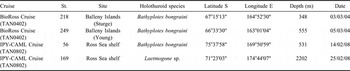
Both cruises together provided a total of 86 specimens of B. bongraini which carried 26 specimen of E. opalina. Since we found only one polychaete per holothurian, the estimated infestation rate is about 30% of the holothuroid population. Due to logistic restrictions, the evaluation of the infestation rate has been possible only in selected stations (see Table I) and, therefore, the distribution of this association may be much wider than herein considered.
List of sampling stations in the Balleny Islands and in the Ross Sea areas.

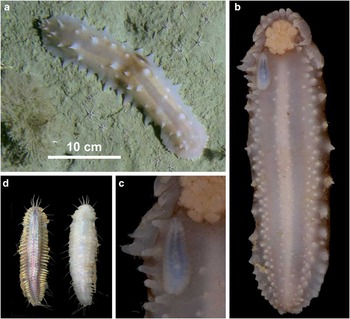
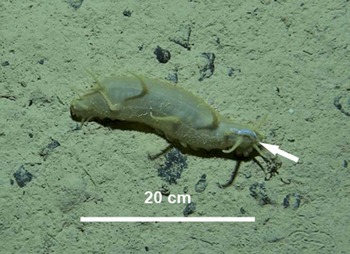
Both species are here reported for the first time in the Ross Sea. Bathyplotes bongraini (Fig. 1a) was previously known from western Antarctica (Weddell Sea, between 245–465 m; Antarctic Peninsula, 250 m) and eastern Antarctica (Prydz Bay, 120–768 m; off Kemp Land, 603 m) (O’Loughlin Reference O’Loughlin2002, O’Loughlin et al. Reference O’Loughlin, Manjón-Cabeza and Ruiz2009), while E. opalina was known for the Antarctic Peninsula and the Scotia Ridge (Fauchald Reference Fauchald2009).
Different views of the association between Bathyplotes bongraini and Eunoe opalina. a. B. bongraini specimen photographed in situ (Tangaroa 2008 Cruise, station 56). b. Ventral view of a freshly collected B. bongraini specimen carrying E. opalina next to its mouth, between the fields of tube feet. c. Particular showing the cephalic end of B. bongraini with E. opalina lying into its ‘niche’ in the host tegument. The polychaete ventral side is in direct contact with the holothurian’s one. d.E. opalina specimen: ventral view (left) and dorsal view (right).

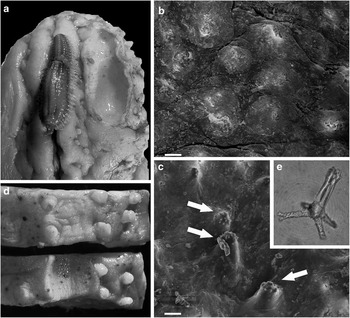
In all the cases we have examined, E. opalina (Fig. 1d) was exclusively found on the host’s ventral side, mainly next to the mouth of the holothuroid, between tube feet fields (Fig. 1b & c) (in one case only it was on the opposite side), where it was lying in a depression excavated into the holothurian tegument. This cavity remained clearly visible even after polychaete removal, perfectly fitting the worm’s shape and size (Fig. 2a).
Position of the polychaete on the host. a. Depression dug by Eunoe opalina into Bathyplotes bongraini skin, clearly visible only after polychaete removal and whose dimensions perfectly fit with polychaete size. b. SEM micrographs of tissue sample belonging to an intact portion of B. bongraini body wall (Scale bar: 50 μm). c. SEM micrographs of healing tissue sample corresponding to the inner part of the depression (Scale bar: 50 μm); arrows show the partially exposed spines of B. bongraini body wall ossicles. d.B. bongraini skin section: intact portion of the holothuroid body wall (above) and inner part of the depression dug by the polychaete (below). e. Typical 4-armed crosses ossicle with a central spine vertical to the plane of the arms, belonging to the body wall of B. bongraini.

SEM observation of the host’s tissue samples, taken from an intact portion of the holothurian body (Fig. 2b) and from the inner part of the depression dug by the polychaete (Fig. 2c), respectively, showed the presence of a different skin texture in the two areas. It is clear that the polychaete activity has somehow removed part of the tegument, almost exposing (Fig. 2c, arrows) the 4-armed crosses ossicles (Fig. 2e), typical of B. bongraini tegument, that emerged beneath the thin, perhaps healing, tissue. Where the tegument is intact, the ossicles do not protrude and are completely embedded.
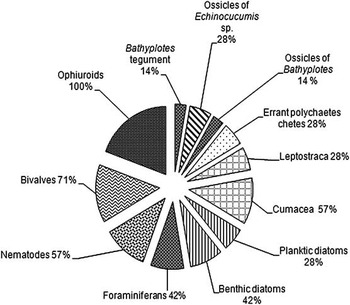
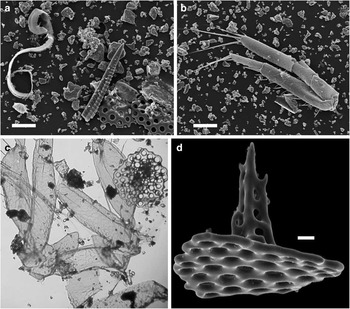
The stomach content analysis of seven polychaetes (dominance method, according to Holden & Raitt Reference Holden and Raitt1974) (Fig. 3) allowed the identification of a variety of prey items (Fig. 4a), as: ossicles of Bathyplotes (14%) and other holothuroid species (Echinocucumis sp.) (28%) (Fig. 4d), bivalves (71%), foraminiferans (42%), benthic (42%) and planktic (28%) diatoms, ophiuroids (100%), chaetae of errant polychaetes (28%), microcrustaceans fragments (Fig. 4b & c) belonging to Cumacea (57%) and to Leptostraca (28%) and nematodes (57%).
Eunoe opalina food items quantified with the dominance method (Holden & Raitt Reference Holden and Raitt1974).

SEM micrographs of Eunoe opalina stomach content. a. Overview of the main food items (Scale bar: 100 μm). b,c. Particular of microcrustacean fragments. d.Echinocucumis sp. ossicle (Scale bar: 20 μm).

Discussion
Representatives of most marine phyla are known to live in close association with echinoderms, establishing different typologies of partnerships, ranging from phoresis to parasitism (e.g. Barel & Kramers Reference Barel and Kramers1977, Jangoux Reference Jangoux1987a, Reference Jangoux1987b).
Among echinoderms, Holothuroidea harbours the highest number of symbionts, reaching a total of 145 species belonging to ten different Phyla (Jangoux Reference Jangoux1987b, table I, p. 223). These associated organisms may live inside the holothuroid body, as in fishes (Carapidae) and crabs (Pinnotheriodae), or outside and/or transdermically, as in the case of bivalves (Galeommatoidea) and gastropods (Eulimidae) (Warén Reference Warén1983, Jangoux, Reference Jangoux1987a, Ng & Manning Reference Ng and Manning2003, Middelfart & Craig Reference Middelfart and Craig2004, Parmentier & Vanderwalle Reference Parmentier and Vandewalle2005). On the whole, it has been estimated that, in temperate and tropical waters, about 40 different species of holothuroids are the hosts in 50 recognized cases of ‘symbioses’ involving polychaetes (Martin & Britayev Reference Martin and Britayev1998).
To date, the best known association between a polychaete and its holothuroid host is that of the polynoid Gastrolepidia clavigera Schmarda, 1861, a shallow water ‘polyxenous’ species from the Indo-West Pacific region, which is known to live on 13 different holothuroids of the families Stichopodidae and Holothuriidae (Martin & Britayev Reference Martin and Britayev1998). Gastrolepidia clavigera has been studied in detail from an ecological point of view and, therefore, represents a good reference example to be compared with E. opalina, the most ‘extreme’ case of such a kind of relationship, occurring in the cold Antarctic waters.
The first macroscopic difference between these two polychaetes is that E. opalina was found in only one specimen per host, always placed ventrally next to the mouth of the holothurian’s body, where it lies in a deep depression produced by the polychaete itself. Gastrolepidia clavigera may be present with up to four specimens per host, usually living on the holothurian dorsal side (Britayev & Zamishliak Reference Britayev and Zamishlyak1994, Reference Britayev and Zamyshlyak1996, Britayev et al. Reference Britayev, Doignon and Eeckhaut1999) where they may form temporary depressions that disappear after polychaete removal (Britayev & Zamishliak, Reference Britayev and Zamyshlyak1996). Gastrolepidia clavigera is also known to crawl into the mouth or cloaca of the holothurian host in case of threats (Britayev & Zamishliak Reference Britayev and Zamishlyak1994, Reference Britayev and Zamyshlyak1996), a behaviour not observed in E. opalina, although it has to be taken into account the fact that no in vivo long-term observations are available for this species.
A comparison between the stomach contents of the two polychaetes reveals that both species have a wide variety of food items, which almost perfectly overlaps from a qualitative point of view, including: holothuroid ossicles, crustacean fragments, multicellular and unicellular algae, chaetae and jaws of polychaetes (other than G. clavigera or E. opalina), detritus, foraminifera and fragments of the shells of bivalves (Britayev & Lyskin Reference Britayev and Lyskin2002 for G. clavigera; present data for E. opalina, Fig. 3).
Unfortunately, it is not possible to make a direct, quantitative comparison of food items due to the different methodologies used but some very important differences can be highlighted about the origin of the holothuroid ossicles found in the stomachs. In G. clavigera, the stomach content analysis clearly indicates that the polychaete feeds on the skin of the host from which it has been collected (Britayev & Lyskin Reference Britayev and Lyskin2002). Eunoe opalina contains B. bongraini ossicles and another distinctive kind of ossicles, clearly not belonging to the host species. These ossicles fall within the morphological range of the genus Echinocucumis and may belong to a not yet described species (O’Loughlin, personal communication Reference O’Loughlin, Manjón-Cabeza and Ruiz2009).
This finding opens several scenarios, the most obvious one being that of a host switch of E. opalina during its lifetime. However, considering the size of the known Echinocucumis species, which are really small holothurians, almost comparable to E. opalina in average size, a permanent association with this holothuroid genus can be excluded. The possibility that these ossicles could already be present in the sediment as loose items and that these are passively ingested by the polychaete during its feeding activity seems highly improbable, as these have been found in quantities in the stomachs and always in very good condition (not damaged, etched or worn). Most interestingly, the same ossicle type was also found in stomachs of E. opalina specimens from the Weddell Sea (unpublished data). It is therefore possible that E. opalina undertakes opportunistic predation on other holothuroid species (i.e. Echinocucumis), if these are somehow detected by the polychaete during the host’s grazing activity on the bottom. The fact that Echinocucumis ossicles have been found in E. opalina stomachs both from the Ross Sea and the Weddell Sea, possibly indicates that the environmental settings in which B. bongraini specimens is found are very similar, despite the distance between the two areas, and have almost the same species composition.
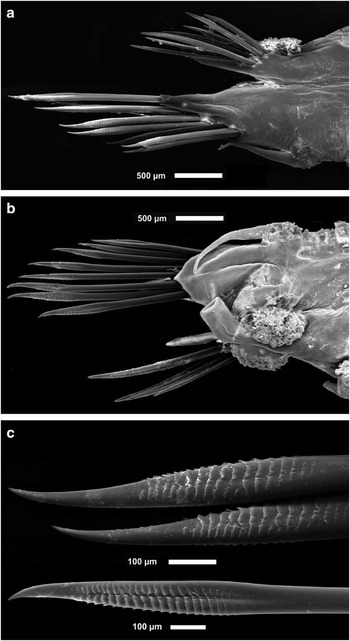
Although belonging to different genera, it is clearly evident that G. clavigera and E. opalina are adapted to live in association with holothuroids, both showing morphological peculiarities linked to their symbiotic mode of life. As documented by Britayev & Zamishlyak (Reference Britayev and Zamishlyak1994), G. clavigera has specially designed attaching structures, called ‘ventral sucker-like lobes’. These features have probably evolved to enable the adherence of the polychaete to several hosts, accounting for the potentially different ‘tegument properties’ encountered from time to time. In contrast, E. opalina does not have these structures, but shows distally dentate spines (Fig. 5a–c), known to occur in other symbiotic polynoids (Martin & Britayev Reference Martin and Britayev1998).
Eunoe opalina parapodia and chaetae. a. Right parapodium, posterior view (Scale bar: 500 μm). b. Left parapodium, posterior view (Scale bar: 500 μm). c. Particular of distally dentate neurochaetae (Scale bars: 100 μm).

In summary, G. clavigera is a ‘polyxenous’ polychaete with several host species, while E. opalina is a ‘monoxenous’ polychaete, always associated with B. bongraini. On the other hand, it is clear that E. opalina has a wider prey range including other holothurian species with which no ‘symbiotic’ partnerships are established.
From an ecological point of view, these differences are rather intriguing and might be possibly related to the ecosystems in which these associations have been established, and not only to the taxonomic and morphological differences between the two symbionts.
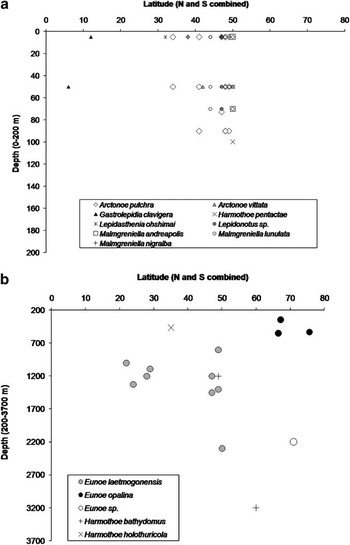
The latitudinal and bathymetric distribution of the documented associations involving polynoids and holothuroids show that most of them occur in the Northern Hemisphere, at intermediate latitudes and on the continental shelf (shallower than 200 m, Fig. 6a).
Latitudinal and bathymetric distribution of the documented associations involving polynoid polychaetes and holothuroids worldwide distributed. Northern and southern latitude values have been combined. a. Shelf water records (0–200 m). b. Deepwater records (200–3700 m).

The relationship between E. opalina and B. bongraini, even if it occurs between 348–555 m depth (Fig. 6b), should be considered in the category of shelf examples, as it is known that the Antarctic continental shelf is much deeper than other continental shelves, due to the weight of the ice cap (Anderson Reference Anderson1999). On the other hand, it is also known that most Antarctic species are extremely eurybathic and recolonized the shelf only when it again became available after ice retreat during interglacials (Brey et al. Reference Brey, Dahm, Gorny, Kalges, Stiller and Arntz1996).
Several similarities between Antarctic and deep water representatives of ‘symbiotic’ associations involving polynoids and holothurians species can also be highlighted. For example, the presence of a ‘scar’ on the host’s ventral body wall clearly resembles what has already been described for the polychaetes Harmothoe bathydomus Ditlevsen, 1917 and Eunoe laetmogonensis Kirkegaard & Billet, 1980, respectively associated with the holothuroids Bathyplotes natans (Sars, 1868) and Laetmogone violacea Theel, 1879 (Wesenberg-Lund Reference Wesenberg-Lund1941, Kirkegaard & Billet Reference Kirkegaard and Billet1980), both occurring in deep Atlantic waters (800–3200 m). The first example, in particular, is remarkable not only for the similarities with the Antarctic case, but also because the partners involved in the association are another Bathyplotes species and a polychaete that, although now included in Harmothoe, a genus closely allied to Eunoe, has been considered indistinguishable from E. opalina by Ditlevsen (Reference Ditlevsen1917, p. 26).
It is therefore possible that these two deep water polynoid-holothuroid associations share a common origin with the Antarctic one. The disjointed, bipolar distribution could be explained in the light of the ‘thermohaline expressway’ hypothesis, according to which some Antarctic species could have spread into deep water basins outside Antarctica, by following the increased production of cold, hyperhaline water masses during glacial cycles (Strugnell et al. Reference Strugnell, Rogers, Prodohl, Collins and Allcock2008). Independent information on phylogenetic relationships of both polynoids and holothuroids would be required to test this hypothesis but, unfortunately, no such studies are yet available.
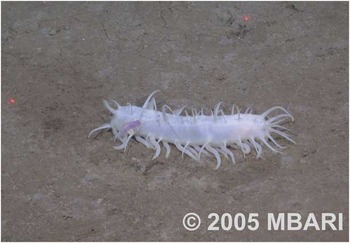
Deep water polynoid-holothuroid partnerships might be much more common and widespread than believed. Using images collected during deepwater ROV surveys, we were able to document two further examples. The first one refers to a specimen of Oneirophanta mutabilis Théel, 1879, photographed at 3356 m, off Monterey (California), with a polynoid moving on its body (Fig. 7). This record increases the maximum known depth limit for a polynoid associated with an holothuroid (the previous deepest record was of 3136 m for H. bathydomus, Ditlevsen Reference Ditlevsen1917), and adds a new host record in this kind of association. A further example is that of Laetmogone sp. (probably an undescribed species, O’Loughlin personal communication Reference O’Loughlin, Manjón-Cabeza and Ruiz2009), photographed at 2202 m in the Ross Sea. This latter species carried an undetermined polynoid whose cephalic end was clearly inserted within the holothuroid tentacles crown (Fig. 8).
Specimen of Oneirophanta mutabilis, carrying a ‘symbiotic’ polychaete, photographed at 3356 m in the Monterey Canyon, California (28/08/2005, Tiburon Dive 889: 40.94°N; 127.48°E, MBARI courtesy, © 2005 MBARI). Distance between the two laser beam points is 30 cm.

Undetermined specimen of Laetmogone sp. carrying a symbiotic polychaete, photographed in situ at 2202 m in the Ross Sea (IPY-CAML Cruise, TAN0802, st. 169). The head of the polychaete (arrow) is clearly inserted within the holothuroid oral tentacle crown. This behaviour could be interpreted as kleptocommensalism, with the polychaete possibly stealing food items before the holothuroid swallow them.

A precise, strict definition of the relationship between E. opalina and B. bongraini is not possible, as it appears to be a mix of phoresis (the polychaete is carried by the host), protective association (the polychaete is also protected from predators by its host), parasitism (the polychaete removes and ingests host skin and ossicles) and kleptocommensalism (due to the possibility that some of the preys are removed from the host mouth as documented in Fig. 8). Nevertheless, it is clear from the variety of food items collected, and from the removal of host tegument, that the polychaete may have both a detrimental effect on its host and a negative impact on other bottom dwelling invertebrates living in the same environment.
Considering the formula to calculate Connectance, corrected to include parasites (C = L0/F(F + P), where C = connectance, L0 = number of links, F = free living species and P = parasite species) (see Lafferty et al. Reference Lafferty, Dobson and Kuris2006 for details), it emerges that the presence of E. opalina in the loop determines an increase of connectance from 0.25 (holothuroid-detritus chain with a single link, where detritus is contemplated as a ‘non-phylogenetic category’, Dunne et al. Reference Dunne, Williams and Martinez2002) to 0.33 (detritus-B. bongraini-E. opalina chain, with two links), in accordance to what is expected when parasites are included in food webs (Lafferty et al. Reference Lafferty, Dobson and Kuris2006). Interestingly, if we take into account the double role of E. opalina, that can be considered simoultaneously a free living species (F) and a parasite (P), by including in the calculation also the food items (i.e. bivalves, ophiuroids and the other holothuroid species) which are not part of the B. bongraini diet, the number of total links rises to five and the connectance decreases to 0.16.
Given the major role that parasites have been demonstrated to play on complex food webs in general (Lafferty et al. Reference Lafferty, Dobson and Kuris2006), and in the light of the above calculations, it is reasonable to suppose that in Antarctica, where trophic levels are simplified, no ‘modern’ predators exist (Aronson & Blake Reference Aronson and Blake2001) and food webs do not have much redundancy, the impact of such a ‘multitasking’ predator-parasite as E. opalina might be even of a greater magnitude, deeply affecting Connectance and other food web features.
Further studies dedicated to the quantification of the effects that the ‘symbiotic’ interactions may have in Antarctica, will enable some of the hypotheses proposed here to be tested and will contribute to our understanding of the ecological constraints which affect invertebrates living at high latitudes.
Acknowledgements
We would like to acknowledge the crew of the Tangaroa expeditions ‘BioRoss TAN0402’ and ‘IPY-CAML TAN0802’ for logistic support during both cruises. A particular acknowledgement is due to Anne Nina Loerz (NIWA) and Sadie Mills (NIWA) for collaboration during the cruises. We are indebted to the New Zealand Ministry of Fisheries (MFish) and NIWA (Wellington) for the financial support of the cruises and related study activities. We are extremely grateful to MBARI (www.mbari.org) for the permission to use the picture from the Tiburon Dive 889, and to Mark O’Loughlin (Marine Biology Section, Museum Victoria) for the useful commentaries and suggestions. Geoff Read (NIWA, Wellington) kindly provided the E. opalina classification. Gaia Magioncalda and Sylvie de Sousa Pereira contributed to laboratory analyses. Two anonymous reviewers are acknowledged for useful comments on the manuscript. This paper is a contribution to the multinational Latitudinal Gradient Project and contribution 28 to the Census of Antarctic Marine Life (CAML).