Introduction
Developmental dyslexia (henceforth “dyslexia”) is a learning disability that is characterized by impaired reading and spelling in spite of normal intelligence and educational opportunities and in absence of sensory impairments (American Psychiatric Association, 2013; Snowling, Reference Snowling2001). Individuals with (a familial risk of) dyslexia are known to experience difficulties in the area of phonological skills (Vellutino et al., Reference Vellutino, Fletcher, Snowling and Scanlon2004; see Melby-Lervåg et al., Reference Melby-Lervåg, Lyster and Hulme2012 for a meta-analysis), which has led to the predominant view that the literacy impairments in dyslexia stem from an underlying phonological deficit. When learning to read and spell, children must acquire the correspondences between letters and sounds (i.e., graphemes and phonemes). If, however, the processing, storage, and/or representation of phonological information is impaired, children experience difficulties in the acquisition of grapheme–phoneme mappings that in turn result in problems with literacy acquisition (e.g., Ramus & Szenkovits, Reference Ramus and Szenkovits2008).
Over time, researchers have uncovered impairments in cognitive abilities other than literacy and phonological skills. These may involve general cognitive skills such as the processing of visual and auditory input (e.g., Stein & Walsh, Reference Stein and Walsh1997; Tallal, Reference Tallal2004), attention (e.g., Facoetti et al., Reference Facoetti, Paganoni and Lorusso2000), and motor functioning (e.g., Ramus, Reference Ramus2003), but may also extend to language domains other than literacy and phonology, such as inflectional morphology and syntax (e.g., Rispens & Been, Reference Rispens and Been2007; Robertson & Joanisse, Reference Robertson and Joanisse2010; Scarborough, Reference Scarborough1990). Together, these observations have led to suggestions of a more general learning deficit in dyslexia (Nicolson & Fawcett, Reference Nicolson and Fawcett2007, Reference Nicolson and Fawcett2011), that is, a deficit of the domain-general ability to detect statistical patterns in sensory input, including spoken and written language (henceforth “statistical learning”, but note that Nicolson and Fawcett [Reference Nicolson and Fawcett2007, Reference Nicolson and Fawcett2011] use the term “procedural learning deficit”; Gabay et al., Reference Gabay, Thiessen and Holt2015; Lum et al., Reference Lum, Ullman and Conti-Ramsden2013, but see, e.g., Schmalz et al., Reference Schmalz, Altoè and Mulatti2017, and Van Witteloostuijn et al., Reference van Witteloostuijn, Boersma, Wijnen and Rispens2017).
The aim of the present study is twofold: (1) to investigate the performance of children with and without dyslexia on measures assessing inflectional morphology and syntax and (2) to examine whether children’s performance in these domains can be explained by individual differences in phonological processing and memory and/or statistical learning ability. In doing so, we contribute to the existing literature on grammatical ability in children with dyslexia and enhance our understanding of their difficulties in this area. Most importantly, we hope to provide novel insights into the underlying cause of the linguistic difficulties observed in dyslexia by investigating two opposing theories (i.e., phonological or statistical learning deficit).
Grammatical performance in children with dyslexia
Besides pronounced deficiencies in the areas of literacy skills and phonology, individuals with dyslexia or with an elevated, familial risk of dyslexia (FRdys) have been shown to experience delays in oral language development in early childhood (see Snowling & Melby-Lervåg, Reference Snowling and Melby-Lervåg2016 for a meta-analysis). Studies of spoken language skills in young FRdys children have shown that they produce shorter sentences of lower syntactic complexity and achieve lower vocabulary scores than low-risk children (e.g., van Alphen et al., Reference van Alphen, De Bree, Gerrits, De Jong, Wilsenach and Wijnen2004; Chen et al., Reference Chen, Wijnen, Koster and Schnack2017; Koster et al., Reference Koster, Been, Krikhaar, Zwarts, Diepstra and Van Leeuwen2005; Lyytinen et al., Reference Lyytinen, Ahonen, Eklund, Guttorm, Laakso, Leinonen, Leppanen, Lyytinen, Poikkeus, Puolakanaho, Richardson and Viholainen2001; Ramus et al., Reference Ramus, Marshall, Rosen and van der Lely2013; Scarborough, Reference Scarborough1990; Snowling & Melby-Lervåg, Reference Snowling and Melby-Lervåg2016). Furthermore, when school-aged children with dyslexia or FRdys children are compared to their TD peers, they are found to achieve lower scores on standardized tests of grammar (e.g., the Clinical Evaluation of Language Fundamentals [CELF]; total language score: McArthur et al., Reference McArthur, Hogben, Edwards, Heath and Mengler2000; word structure subtest: Joanisse et al., Reference Joanisse, Manis, Keating and Seidenberg2000; recalling sentences subtest: Ramus et al., Reference Ramus, Marshall, Rosen and van der Lely2013; Finnish inflectional morphology test: Aro et al., Reference Aro, Eklund, Nurmi and Poikkeus2012; Lyytinen et al., Reference Lyytinen, Ahonen, Eklund, Guttorm, Laakso, Leinonen, Leppanen, Lyytinen, Poikkeus, Puolakanaho, Richardson and Viholainen2001; cf., e.g., Carroll & Myers, Reference Carroll and Myers2010). Similarly, there are indications that (pre)school-aged children with dyslexia and FRdys children perform more poorly on experimental tasks that assess inflectional morphology, including pluralization (Joanisse et al., Reference Joanisse, Manis, Keating and Seidenberg2000), subject–verb agreement (Jiménez et al., Reference Jiménez-Fernández, Vaquero, Jiménez and Defior2011; Nash et al., Reference Nash, Hulme, Gooch and Snowling2013; Rispens et al., Reference Rispens, Roeleven and Koster2004; Rispens & Been, Reference Rispens and Been2007), and past tense formation (Joanisse et al., Reference Joanisse, Manis, Keating and Seidenberg2000; Nash et al., Reference Nash, Hulme, Gooch and Snowling2013). The same holds for the comprehension of sentences (Robertson & Joanisse, Reference Robertson and Joanisse2010) and the correct interpretation (and production) of complex syntactical structures such as passive sentences (Reggiani, Reference Reggiani2010; Shankweiler et al., Reference Shankweiler, Crain, Katz, Fowler, Liberman, Brady, Thornton, Lundquist, Dreyer, Fletcher, Stuebing, Shaywitz and Shaywitz1995), relative clauses (Bar-Shalom et al., Reference Bar-Shalom, Crain and Shankweiler1993; Mann et al., Reference Mann, Shankweiler and Smith1984; Shankweiler et al., Reference Shankweiler, Crain, Katz, Fowler, Liberman, Brady, Thornton, Lundquist, Dreyer, Fletcher, Stuebing, Shaywitz and Shaywitz1995), and referential pronouns (Waltzman & Cairns, Reference Waltzman and Cairns2000). Even though overt morphological and grammatical difficulties (in oral language) appear to attenuate with age, some studies suggest that such difficulties may be persistent (Cantiani et al., Reference Cantiani, Lorusso, Perego, Molteni and Guasti2013; Leikin and Zur Hagit Reference Leikin and Zur Hagit2006; Rispens et al., Reference Rispens, Been and Zwarts2006; Vender et al., Reference Vender, Mantione, Savazzi, Delfitto and Melloni2017).
Note, however, that group comparisons of children with dyslexia with age-matched TD children have yielded null findings as well, both on standardized tests of grammar (Carroll & Myers, Reference Carroll and Myers2010; Ramus et al., Reference Ramus, Marshall, Rosen and van der Lely2013) and on experimental tasks examining inflectional morphology and syntax (e.g., Rispens et al., Reference Rispens, de Bree, Kerkhoff, Hoeksema, Gilbers and Hendriks2014; Ramus et al., Reference Ramus, Marshall, Rosen and van der Lely2013). It is currently unclear how this should be interpreted. Conceivably, the reported difficulties in the area of inflectional morphology and syntax in individuals with dyslexia may be restricted to specific grammatical processes (or may only affect subgroups of children with dyslexia; see Rispens et al., Reference Rispens, Roeleven and Koster2004). On the other hand, it is also possible that tasks employed in these studies were insufficiently sensitive. In any case, it is relevant and necessary to contribute new data.
The abovementioned oral language difficulties in children with dyslexia are reminiscent of developmental language disorder (DLD; previously known as specific language impairment; Bishop et al., Reference Bishop, Snowling, Thompson and Greenhalgh2017), a disorder that is defined by oral language problems and pronounced difficulties in the areas of morphology and syntax. Dyslexia and DLD are distinct diagnoses that can co-occur within a single child. The behavioral overlap between the two disorders is known to be high (e.g., McArthur et al., Reference McArthur, Hogben, Edwards, Heath and Mengler2000; Catts et al., Reference Catts, Adlof, Hogan and Weismer2005), which has raised the question of whether the two disorders should be viewed as distinct or as two points on a single continuum (e.g., Bishop & Snowling, Reference Bishop and Snowling2004). Although we are aware that the debate on this matter continues, we leave it aside here. We focus on grammatical performance in children who have been diagnosed with dyslexia and do not meet the diagnostic criteria for DLD.
Theories of dyslexia: Phonological deficit and statistical learning deficit
Theories of the underlying cause of dyslexia should not only account for the impairments in the area of reading and spelling, but should also be able to explain the abovementioned difficulties with inflectional morphology and syntax. In line with the dominant view that dyslexia originates from a deficit in phonological skills, grammatical problems in dyslexia have been theorized to be “further symptoms of an underlying phonological weakness” (Shankweiler et al., Reference Shankweiler, Crain, Katz, Fowler, Liberman, Brady, Thornton, Lundquist, Dreyer, Fletcher, Stuebing, Shaywitz and Shaywitz1995, p. 149). This idea is supported by evidence that children with dyslexia are especially impaired in morpho-phonology – morphological processes that interact with phonology (Shankweiler et al., Reference Shankweiler, Crain, Katz, Fowler, Liberman, Brady, Thornton, Lundquist, Dreyer, Fletcher, Stuebing, Shaywitz and Shaywitz1995; Rispens & Been, Reference Rispens and Been2007). In such processes, the selection between allomorphs depends on the phonological characteristics of the stem. For example, the selection of the /t/, /d/, or /ɪd/ (or /əd/, depending on the region) allomorph in English past tense verb inflection, as in bake – baked, try – tried, and bait – baited, depends on the final phoneme of the verb (e.g., Joanisse & Seidenberg, Reference Joanisse and Seidenberg1998; Joanisse et al., Reference Joanisse, Manis, Keating and Seidenberg2000). More generally, problems with the processing of phonological information may affect the acquisition of morphological paradigms (i.e., verb inflection; Joanisse & Seidenberg, Reference Joanisse and Seidenberg1999), which in its turn may give rise to difficulties in detecting and grasping syntactic agreement. In addition, difficulties with syntactic structures have been linked to limitations in phonological short-term memory in dyslexia (see Melby-Lervåg et al., Reference Melby-Lervåg, Lyster and Hulme2012; Snowling & Melby-Lervåg, Reference Snowling and Melby-Lervåg2016 for meta-analyses): if the processing and storage of phonological information is impaired or limited, this is likely to affect syntactical processing of speech. In support of this idea, Robertson and Joanisse (Reference Robertson and Joanisse2010) showed that when memory demands are high, children show poorer syntactic processing of spoken sentences, and this effect is more pronounced in children with dyslexia than in TD children.
Alternatively, the grammatical difficulties may be explained through an underlying deficit in implicit learning. Nicolson and Fawcett (Reference Nicolson and Fawcett2007, Reference Nicolson and Fawcett2011) and Ullman and Pierpont (Reference Ullman and Pierpont2005) argue that procedural learning difficulty is associated with grammatical impairment. Statistical learning, which may be seen as a specific instantiation of procedural learning (e.g., Qi et al., Reference Qi, Sanchez Araujo, Georgan, Gabrieli and Arciuli2019; Steacy et al., Reference Steacy, Compton, Petscher, Elliott, Smith, Rueckl, Sawi, Frost and Pugh2019; Ullman et al., Reference Ullman, Earle, Walenski and Janacsek2019), has been found to be deficient in individuals with dyslexia (e.g., Gabay et al., Reference Gabay, Thiessen and Holt2015; Sigurdardottir et al., Reference Sigurdardottir, Danielsdottir, Gudmundsdottir, Hjartarson, Thorarinsdottir and Kristjánsson2017; Singh et al., Reference Singh, Walk and Conway2018), although the evidence is not unequivocal (Schmalz et al., Reference Schmalz, Altoè and Mulatti2017; Van Witteloostuijn et al., Reference van Witteloostuijn, Boersma, Wijnen and Rispens2019). Statistical learning, that is, detecting distributional and sequential patterns in (linguistic) input, has been argued to support the acquisition of syntactic categories (Mintz, Reference Mintz2002, Reference Mintz2003; Wijnen, Reference Wijnen2013) as well as the rules of morphology and syntax (e.g., Bannard et al., Reference Bannard, Lieven and Tomasello2009; Evans et al., Reference Evans, Saffran and Robe-Torres2009; Kidd & Kirjavainen, Reference Kidd and Kirjavainen2011). For example, the acquisition of nonadjacent patterns in language, such as the relationship between auxiliaries and inflections on the verb (e.g., the boy is running, where the intervening verb may vary), may be supported by a mechanism that tracks co-occurrence statistics (e.g., Goméz, Reference Gómez2002). The hypothesized relationship between statistical learning and grammatical acquisition is supported by research that has shown that performance on statistical learning tasks is related to grammatical abilities in TD children. Studies have established such relationships between statistical learning and syntactic priming (Kidd, Reference Kidd2012), grammatical processing (Clark & Lum, Reference Clark and Lum2017), and the comprehension of complex syntactical structures such as passives and relative clauses (Kidd & Arciuli, Reference Kidd and Arciuli2016). Likewise, individual differences in the statistical learning ability of adults have been shown to correlate with the comprehension of relative clauses (Misyak et al., Reference Misyak, Christiansen and Tomblin2010) and the comprehension of written sentences in general (Misyak & Christiansen, Reference Misyak and Christiansen2012). Moreover, studies have demonstrated impaired statistical learning in children with DLD who are known to experience grammatical difficulties (see Lammertink et al., Reference Lammertink, Boersma, Wijnen and Rispens2017, and Lum et al., Reference Lum, Conti-Ramsden, Morgan and Ullman2014 for meta-analyses). No studies to date have explored the relationship between grammatical performance and statistical learning ability in individuals with and without dyslexia.
The current study
In the present study, we tested the grammatical abilities of 100 school-aged Dutch-speaking children with and without dyslexia. This was done using two standardized tests of grammar, which target different levels of grammatical knowledge: inflectional morphology and syntax (the “word structure” and “recalling sentences” subtests of the Dutch version of the CELF; Kort et al., Reference Kort, Schittekatte and Compaan2008). Furthermore, we aimed to highlight specific areas of difficulty through an exploratory analysis of error patterns. Most importantly, we tested two accounts of dyslexia that make predictions about the relationship between grammar on the one hand and underlying problems in either phonological memory or statistical learning ability on the other hand. Thus, we aimed to answer the following three research questions (note that whereas research questions 1 and 3 are confirmatory, research question 2 is of an exploratory nature):
-
(1) Do children with dyslexia perform worse than their TD peers on grammar as measured through standardized tests (CELF word structure and CELF recalling sentences)?
-
(2) Do children with dyslexia make different errors than their TD peers on the CELF word structure and/or CELF recalling sentences?
-
(3) Do phonological memory and/or statistical learning ability contribute to individual differences in the CELF word structure and/or CELF recalling sentences? And, if so,
-
(a) is this contribution different for dyslexia versus TD?
-
(b) is this contribution different for the CELF word structure versus the CELF recalling sentences?
-
In relation to research question 3, we focused on measures of phonological memory, since individuals with dyslexia are typically impaired in this area (Melby-Lervåg et al., Reference Melby-Lervåg, Lyster and Hulme2012; Snowling & Melby-Lervåg, Reference Snowling and Melby-Lervåg2016) and phonological memory is theorized to contribute to grammatical abilities (e.g., Robertson & Joanisse, Reference Robertson and Joanisse2010). Digit span forward and nonword repetition tasks were used to assess phonological short-term memory (i.e., immediate recall), while the digit span backward was used as a measure of verbal working memory (i.e., the manipulation of verbal information prior to recall; e.g., Baddeley, Reference Baddeley2012; Alloway et al., Reference Alloway, Gathercole, Kirkwood and Elliott2009). Naturally, these memory tasks also rely on the processing of phonological information and (already established) phonological representations, which is especially true for nonword repetition (Rispens & Baker, Reference Rispens and Baker2012). In addition to relations between the measures of phonological short-term memory (digit span forward), verbal working memory (digit span backward), and phonological processing (NWR), receptive vocabulary (measured in our study using the PPVT; Dunn et al., Reference Dunn and Dunn2005) is also assumed to be related to the ability to repeat nonwords (Bowey, Reference Bowey2001; Edwards et al., Reference Edwards, Beckman and Munson2004; Munson et al., Reference Munson, Kurtz and Windsor2005; Gathercole, Reference Gathercole2006, Rispens et al., Reference Rispens, Baker and Duinmeijer2015). In young children, phonological processing capacity contributes to vocabulary acquisition (Bowey, Reference Bowey2001; Gathercole, Reference Gathercole2006). During development, lexical knowledge in turn has a predictive effect on nonword repetition (Metsala et al., Reference Metsala, Stavrinos and Walley2009). Lexical representations stored in long-term memory predict NWR: chunks from existing lexical representations can be used for nonword repetition. The more detailed and “robust” the lexical representations are, the better phonological information can be flexibly used for novel phonological representations as is the case in nonword repetition (Edwards et al., Reference Edwards, Beckman and Munson2004, Munson et al., Reference Munson, Kurtz and Windsor2005, Metsala, et al., Reference Metsala, Stavrinos and Walley2009). For this study, we wanted to test vocabulary, phonological processing, and (short-term/working) memory separately in order to investigate the relation to grammar, even though we expect some overlap in performances on these tasks.
Statistical learning was tested using two experimental tasks that targeted different aspects of the domain-general ability to detect statistical regularities: visuomotor sequence learning (SRT task) and auditory nonadjacent dependency learning (A-NADL task). Although we are aware that the SRT task is typically considered a sequence learning or procedural learning task, the type of learning that takes place in an SRT task can also be described as statistical: it involves tracking the co-occurrences of adjacent elements (see also, e.g., Kidd, Reference Kidd2012). Both statistical learning measures have previously been related to grammatical performance in children and/or have demonstrated impaired learning ability in children with DLD (SRT: e.g., Clark & Lum, Reference Clark and Lum2017; Kidd, Reference Kidd2012; Lammertink et al., Reference Lammertink, Boersma, Wijnen and Rispens2020a; A-NADL: e.g., Iao et al., Reference Iao, Ng, Wong and Lee2017; Lammertink et al., Reference Lammertink, Boersma, Wijnen and Rispens2020b). Besides phonological memory and statistical learning measures, our regression analysis includes other potential sources of variance in grammatical performance (children’s age, gender, and SES, and their scores on measures of nonverbal reasoning, vocabulary, and sustained attention).
It is important to note here that any statistical analyses were done in order to answer research question 2 are exploratory, since the tasks used to measure grammatical performance were not designed for error analysis specifically. The results from these analyses may further our understanding of the grammatical problems associated with dyslexia and may thereby serve to highlight potentially interesting directions for future research. Moreover, it should be noted that group comparisons regarding statistical learning ability in the present sample have already been discussed in detail elsewhere (van Witteloostuijn et al., Reference van Witteloostuijn, Boersma, Wijnen and Rispens2019).
Methods
Participants
The ethics review board of the University of Amsterdam approved this study. One-hundred 8- to 11-year-old children were included: 50 children with a prior diagnosis of dyslexia (26 girls, 24 boys, mean age in years:months = 9:10) and 50 individually age-matched TD children (24 girls, 26 boys, mean age = 9:8). To confirm participation as (non-)dyslexic, word (EMT; Brus, & Voeten, Reference Brus and Voeten1972) and pseudowords (Klepel; van den Bos et al., Reference Van den Bos, Spelberg, Scheepsma and De Vries1994) reading tests were administered. All included children with dyslexia had a maximum norm score of 6 (i.e., 10th percentile) on word and pseudoword reading, while TD children had a minimum norm score of 8 (i.e., 25th percentile). Ten additional children with dyslexia and four additional TD children did not meet these predetermined inclusion criteria regarding their reading scores and were therefore excluded from the final sample. Parental (in the case of dyslexia) and teacher (in the case of TD) reports confirmed that all 100 participants in the final sample were native speakers of Dutch and none had diagnoses of (other) developmental disorders such as DLD. All participants completed each of the tasks included in the present study. Again, please note that the sample is identical to the one described by Van Witteloostuijn et al. (Reference van Witteloostuijn, Boersma, Wijnen and Rispens2019; Reference van Witteloostuijn, Boersma, Wijnen and Rispens2021), which focuses on group comparisons on statistical learning measures. Similarly, the group of TD children partly overlaps with studies examining language and statistical learning in children with DLD (Lammertink et al., Reference Lammertink, Boersma, Wijnen and Rispens2020a, Reference Lammertink, Boersma, Wijnen and Rispens2020b). These previous reports thus have a different focus than this study and there is no overlap in the interpretation of the data.
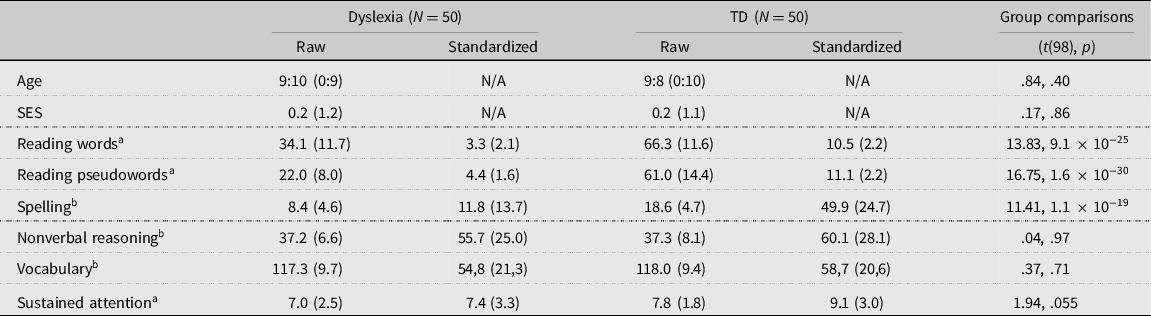
Besides reading and spelling, a range of background measures were collected (Table 1). These included standardized measures of receptive vocabulary (Peabody Picture Vocabulary Test (PPVT-III-NL; Dunn et al., Reference Dunn and Dunn2005), nonverbal reasoning (Raven’s Standard Progressive Matrices; Raven, Reference Raven2003), and sustained attention (the Score! subtest of the Dutch Test of Everyday Attention for Children (Schittekatte et al., Reference Schittekatte, Groenvynck, Fontaine and Dekker2007). Also, an indication of children’s socioeconomic status (SES) was determined on the basis of their home or school postal codes through open data that was published by the Netherlands Institute for Social Research (NISR, 2017). These SES scores reflect the status of a given postal code in comparison to other Dutch postal codes. Open source data can be accessed through the following (Dutch) link: https://www.scp.nl/Onderzoek/Lopend_onderzoek/A_Z_alle_lopende_onderzoeken/Statusscores.
Children with and without dyslexia’s mean (and SD) age and SES, and results from reading, spelling, nonverbal reasoning, and sustained attention: raw scores, standardized scores, and group comparisons

Note: Age in years:months. Data regarding SES by postal codes were obtained from the Netherlands Institute for Social Research. Raw scores on reading words (Een minuut test, Brus & Voeten, Reference Brus and Voeten1972) and pseudowords (Klepel, van den Bos et al., Reference Van den Bos, Spelberg, Scheepsma and De Vries1994) represent the number of words read within the time limit of 1 and 2 min, respectively. Raw scores on spelling represent the number of words spelled correctly out of 30 in a Dutch dictation test (Braams & de Vos, Reference Braams and de Vos2015). Nonverbal reasoning was measured using Raven’s Standard Progressive Matrices (Raven, Reference Raven2003); raw scores represent the number of items answered correctly out of 60. The Peabody Picture Vocabulary Test (PPVT-III-NL; Dunn et al., Reference Dunn and Dunn2005) was used as a test of receptive vocabulary; raw scores represent the number of items answered correctly out of a maximum of 204 items. Finally, sustained attention was assessed by the Score! subtest of the Dutch Test of Everyday Attention for Children (Schittekatte et al., Reference Schittekatte, Groenvynck, Fontaine and Dekker2007); raw scores represent the number of items answered correctly out of 10. Standardized scores represent either a norm scores (norm = 10) or b percentile scores (norm = 50).
In line with their diagnosis, children with dyslexia were found to perform significantly worse than the TD children on reading words, reading pseudowords, and spelling. No evidence for a difference between the two child groups was found regarding their age, SES, vocabulary, or nonverbal reasoning. Children with dyslexia scored lower than TD children on our measure of sustained attention, although this effect did not reach significance. Individual differences in age, SES, vocabulary, and nonverbal reasoning are included as control predictors in our regression model that investigates the contribution of phonological memory and statistical learning ability to grammatical performance (research question 3).
Materials
Measures of grammatical performance
Children’s grammatical abilities were assessed through two subtests of the Dutch version of the standardized CELF language assessment battery (CELF-4-NL; Kort et al., Reference Kort, Schittekatte and Compaan2008): the word structure and recalling sentences subtests. The word structure task measures children’s ability to apply word formation rules (i.e., inflectional morphology), while the recalling sentences task tests children’s ability to listen to and repeat sentences, thereby considering grammatical performance at different levels (i.e., semantics, morphology, and syntax). It is important to note here that a sentence recall task is not a purely syntactic task; although CELF recalling sentences performance is influenced by syntactic complexity and long-term memory representations of language (i.e., lexical knowledge; Klem et al., Reference Klem, Melby-Lervåg, Hagtvet, Lyster, Gustafsson and Hulme2015), it is also affected by a child’s verbal short-term memory (Alloway & Gathercole, Reference Alloway and Gathercole2005). Nevertheless, it is typically considered a measure of syntactic competence (e.g., Blom & Boerma, Reference Blom and Boerma2019; Frizelle & Fletcher, Reference Frizelle and Fletcher2014).
In the CELF word structure task, children were shown pictures and were instructed to finish sentences read out by the experimenter. The task consists of 30 items that are divided into categories targeting different aspects of morphology including pronouns, nouns (i.e., diminutives and plurals), verbs (i.e., subject–verb agreement, tense, and compound verbs), and adjectives (i.e., comparatives and superlatives). Responses were coded as either correct or incorrect, with a maximum score of 30. Children’s scores were not converted to standardized (i.e., norm) scores, since norms are available up until the age of 8 and our sample consists of 8- to 11-year-old children.
The CELF recalling sentences task required children to repeat sentences of increasing length and complexity as dictated by the experimenter. In accordance with the CELF manual, 8-year-old children repeated a maximum of 31 sentences, while children aged 9 years or older were administered a maximum of 23 sentences (the first 8 sentences were not administered). Responses received a score of 3 (0 errors), 2 (1 error), 1 (2 or 3 errors), or 0 (4 or more errors) and testing was discontinued after five consecutive 0 scores. Children’s individual score was the total number of points awarded to the administered sentences.
Measures of phonological memory
Phonological processing and phonological short-term and working memory were assessed through two tasks: a digit span task (CELF-4-NL; Kort et al., Reference Kort, Schittekatte and Compaan2008) and a shortened version of a nonword repetition task (NWR-S; le Clercq et al., Reference Le Clercq, van der Schroeff, Rispens, Ruytjens, Goedegebure, van Ingen and Franken2017). Both the forward and backward digit span tasks were administered, in which children were required to repeat sequences of digits of increasing length either in the same order (forward digit span; 16 items) or in the reversed order (backward digit span; 14 items). In the NWR-S, 22 pre-recorded nonwords were played one at a time and children had to listen carefully and repeat each nonword as accurately as possible. Items in the digit span and NWR-S tasks were scored as either correct or incorrect.
Measures of statistical learning
In each trial of the SRT task, a single visual stimulus (smiley) appeared in one of the four marked locations on the screen of a tablet computer. There were 7 blocks of 60 trials each. Participants were required to press a button on a gamepad with a location corresponding to the location of stimulus on the screen as accurately and as quickly as they could upon the appearance of the visual stimulus. Without the participants’ knowledge, the successive locations of the visual stimulus (over trials) followed a predetermined sequence (4, 2, 3, 1, 2, 4, 3, 1, 4, 3; numbers indicate locations) that was repeated six times in blocks 2–5 and block 7 (“sequence blocks”). In contrast, in block 6 (“disruption block”), the 60 presentation locations of the stimulus were chosen randomly. The 7 blocks of the actual test were preceded by a practice block (28 trials). Learning in the SRT task is measured as the increase in reaction times (RTs) in disruption block 6 as compared to the surrounding sequence blocks.
In the A-NADL task, children listened to an artificial language consisting of a series of simple “sentences”, each built from three pseudowords: a–X–b. Unbeknownst to the participants, the first pseudoword (a) in each sentence was taken from a set of two monosyllables (tep, sot), each of which was associated with a specific pseudoword (b) in the third position (mip, lut). Thus, the pseudowords a and b formed 2 dependency pairs, separated by another pseudoword X, which was taken from a set of 24 disyllabic items. The task was designed to assess if participants (implicitly) detect this recurrent nonadjacent a–b dependency. This dependency mirrors those found in natural languages, such as the morphosyntactic relationship between auxiliaries and inflections on the verb in English (e.g., “is walking”, where the is–ing relationship is nonadjacent and the intervening verb may vary).
The task was modelled on the SRT task and thus contained blocks in which the artificial language strings adhered to a–X–b nonadjacent dependency rules (i.e., rule blocks 1–3 and 5) and an intervening block in which strings were presented in which the dependency between the first and third pseudoword was disrupted (i.e., disruption block 4). In the rule blocks, the nonadjacent dependencies tep X lut and sot X mip were each presented 24 times. In addition to the items containing the nonadjacent dependency rules, each rule block contained 12 filler trials with an f 1–X–f 2 structure where f 1 does not predict f 2 (f 1 and f 2 are taken from a set of 24 one-syllable nonwords, not including tep, sot, lut, or mip, and X refers to the same set of 24 two-syllable nonwords used in the a–X–b structure). In the disruption block, the occurrence of lut and mip was no longer predicted by the a–X–b rule: in 24 out of 30 trials, lut and mip still occurred in the b position, but one of the one-syllable fillers f occurred in the a position (i.e., f–X–b structure). The remaining six trials were entire filler items (i.e., f 1–X–f 2 structure).
Children performed a word-monitoring task in which they tracked the occurrence of one of the two predictable nonwords (i.e., the b element in the a–X–b structure). Half of the participants were assigned to lut as a target and half to mip. Children were instructed to press a green button when they heard the target nonword and to press a red button when they did not hear the target nonword (Lammertink et al., Reference Lammertink, Van Witteloostuijn, Boersma, Wijnen and Rispens2019; López-Barroso et al., Reference López-Barroso, Cucurell, Rodríguez-Fornells and de Diego-Balaguer2016). As in the SRT task, learning in the A-NADL task is reflected by slower RTs to input in the disruption block than to rule-governed input in the surrounding rule blocks.
In both the SRT and A-NADL tasks, accuracy and RTs to each trial were recorded. As explained, learning is evidenced by shorter RTs to structured input as compared to random input and, therefore, the individual measures of learning used in the regression analysis are difference scores (SRT: normalized RT in disruption block 6 minus mean normalized RT in sequence blocks 5 and 7, A-NADL: normalized RT in disruption block 4 minus mean normalized RT in rule blocks 3 and 5).
General procedure
As mentioned in Section “Participants”, children in the present study were tested as part of a larger project investigating statistical learning and its relation to language in children with and without dyslexia and DLD (van Witteloostuijn et al., Reference van Witteloostuijn, Boersma, Wijnen and Rispens2019; Reference van Witteloostuijn, Boersma, Wijnen and Rispens2021; Lammertink et al., Reference Lammertink, Van Witteloostuijn, Boersma, Wijnen and Rispens2019; Lammertink et al., Reference Lammertink, Boersma, Wijnen and Rispens2020a, Reference Lammertink, Boersma, Wijnen and Rispens2020b). The test battery was administered one-on-one by an experimenter in the child’s home or school. It took approximately 3 hr to complete and was divided into three testing sessions. Importantly, each testing session consisted of one statistical learning measure, combined with a range of background and language measures. The orders between and within sessions were counterbalanced and children were randomly assigned to one out of six testing orders.
The CELF word structure, CELF recalling sentences, PPVT, and digit span tasks were dictated by the experimenter. Instructions (SRT, A-NADL) and auditory stimuli (A-NADL, NWR-S) in the statistical learning and NWR-S tasks were pre-recorded by a native Dutch speaker and were played over Sennheiser HD 201 headphones. PPVT images were shown on a Windows Surface 3 tablet. The SRT and A-NADL tasks were programmed and administered through E-prime 2.0 and displayed on the same tablet (Psychology Software Tools, 2012; Schneider et al., Reference Schneider, Eschman and Zuccolotto2012). Accuracy and RTs in the SRT task were logged using a Trust Wired GXT 540 gamepad controller, while responses to the A-NADL task were logged through an external button box. Verbal responses in the CELF word structure, CELF recalling sentences, and NWR-S tasks were recorded using an Olympus DP-211 voice recorder.
Scoring and analysis
The following sections provide details of our method of scoring and analyses regarding group comparisons, the error exploration, and the regression model. All analyses are performed in R software (R Development Core Team, 2008); raw (summary level) data files and R Markdown and HTML files containing all analyses reported in the present study can be found on our Open Science Framework (OSF) project page (https://osf.io/kjctf/).
Group comparisons
Individual t-tests were run on children’s raw scores on our outcome measures (CELF word structure and CELF recalling sentences; research question 1) and raw scores on the tests assessing phonological memory (digit span forward, digit span backward, and NWR-S) in order to investigate whether a difference in performance is observed between participants with and without dyslexia. As mentioned, investigations of group differences on the statistical learning measures (SRT and A-NADL) were already reported in detail elsewhere (van Witteloostuijn et al., Reference van Witteloostuijn, Boersma, Wijnen and Rispens2019), and are thus not reanalyzed here.
Error explorations
Children’s performance on the CELF word structure and CELF recalling sentences were examined in more detail through error analyses to explore whether children with dyslexia make qualitatively different errors than their TD peers (research question 2). Since items of the CELF word structure are already divided into categories, we inspected the total number of errors (and proportion of answers correct) per category (see Section “Measures of grammatical performance”). To explore potential differences between children with and without dyslexia in their performance on the CELF word structure categories, individual binomial generalized linear mixed-effects (GLMER) models were built for each error category using the lme4 package for R (version 1.1.13; Bates et al., Reference Bates, Maechler, Bolker and Walker2014). These models were run on the proportions of errors in a category with group as the predictor (orthogonally contrast-coded such that the TD group was coded as −1/2 and the dyslexia group as +1/2) and included a random intercept per subject.
For ease of error analysis, responses to the CELF recalling sentences were recoded as either correct or incorrect (instead of 0, 1, 2, or 3; see Section “Measures of grammatical performance”). Besides scoring the accuracy on the sentence level, we categorized errors according to a predetermined scoring schedule including errors pertaining to the inflectional morphology of verbs (subject–verb agreement, tense, overgeneralization, and lexical errors) and nouns (plural, article choice, and lexical errors), and errors regarding the referential use of pronouns (demonstratives). These error categories combined will be referred to as “specific errors”. The remaining errors (i.e., errors that could not be categorized under specific error categories) were deemed “unspecific errors”, which included omissions, additions, replacements, and displacements of words that we did not analyze further (e.g., uttering a word in a different position in the sentence or switching two words). As in the CELF word structure analysis, Poisson GLMER models were run to explore potential group differences in the number of errors in specific error categories. All models included a random intercept per subject and a random intercept per item. Please note that the model for verb overgeneralizations failed to converge, and therefore the random intercept for an item was removed from this model.
Furthermore, the effects of syntactic complexity, sentence length (number of words), and group (dyslexia vs. TD) on sentence accuracy (i.e., an overall score on the sentence of 0 [incorrect] or 1 [correct]) were explored using a separate GLMER model. 19 sentences were marked as “syntactically complex”; these consisted of passive sentences (N = 6) and sentences containing a subordinate clause (N = 13). Ninety-five percent confidence intervals (CIs) were computed through Wald’s approximation for CI’s and raw sentence length (i.e., number of words in target sentence) was centered and scaled by standard deviation. The categorical predictors included in the model were sentence complexity and group, which were orthogonally contrast-coded. Sentence complexity was coded into two contrasts such that the first contrasted simple (coded as −2/3) and complex sentences (passive and subordinate, coded as +1/3) and the second contrasted the two complex sentence types (i.e., passive coded as −1/2 and subordinate coded as +1/2). The coding of group was identical to the coding reported for the regression model: the TD group was coded as −1/2 and the dyslexia group as +1/2. The random effect structure of the model contained by-subject intercepts and by-subject random slopes for sentence length, sentence complexity, and the interaction between sentence length and sentence complexity.
Since testing on the CELF recalling sentences was halted after five consecutive 0 scores (see Section “Measures of grammatical performance”), it is important to note that testing was discontinued after a similar number of sentences in both participant groups of children with and without dyslexia (dyslexia: 29.5 [SD = 2.8], TD: after 30.2 [SD = 2.0]). Although a subset of children (i.e., children over the age of 8) did not complete sentences 1 through 8, we disregard this in our error analyses since children were individually matched on age. Of all 2,320 sentences administered to our 100 participants, 10 sentences resulted in null responses that were categorized as missing data and were excluded from analyses (dyslexia: N = 6, TD: N = 4).
Regression analysis
We set up a linear regression model to examine whether a range of predictors contribute to individual differences in performance on our outcome measures of grammar (research question 3). This was done using the lm function included in R, which modeled grammatical performance by a number of control predictors (age, gender, SES, nonverbal reasoning, vocabulary, and attention) and predictors relevant to research question 3 (phonological memory: digit span forward, digit span backward, and NWR-S, statistical learning: SRT, and A-NADL). Group membership (dyslexia vs. TD) was added as a predictor in order to assess interactions between group and other predictors (research question 3a). The significance of predictors to both grammatical measures combined (CELF word structure and recalling sentences) was determined through the Manova function in the car package for R (version 2.1.5; Fox et al., Reference Fox, Weisberg, Adler, Bates, Baud-Bovy, Ellison and Heiberger2012). The effects of phonological memory and of statistical learning on grammar performance were investigated by comparing the full model to models from which all measures assessing phonological memory (digit span forward, digit span backward, and NWR-S) and both statistical learning measures (SRT and A-NADL) were removed. To compare the contribution of predictors to CELF word structure versus CELF recalling sentences (research question 3b), we computed 95% CIs using the profile method (confint function in R) and examined the overlap of 95% CIs of individual predictors for the two measures of grammar performance. Importantly, raw scores on continuous outcome variables (CELF word structure and CELF recalling sentences) and predictors (age, SES, nonverbal reasoning, attention, PPVT, digit span forward, digit span backward, NWR-S, SRT, and A-NADL) were centered and scaled. The categorical predictors, that is, gender and group, were orthogonally contrast-coded: females were coded as −1/2 and males as +1/2, and, similarly, the TD group was coded as −1/2 and the dyslexia group was coded as +1/2.
Results
We present the results regarding our three research questions: the group comparisons pertaining to research question 1 are described in Section “Group comparisons”, followed by the error exploration in Section “Error exploration” (research question 2), and the regression analysis in Section “Regression analysis”(research question 3). While the analyses related to research questions 1 and 3 can be viewed as confirmatory, the analyses related to research question 2 are exploratory in nature. Additionally, our regression analysis provides us with some exploratory findings that may be of interest and are reported separately following recommendations by Wagenmakers et al. (Reference Wagenmakers, Wetzels, Borsboom, van der Maas and Kievit2012).
Group comparisons
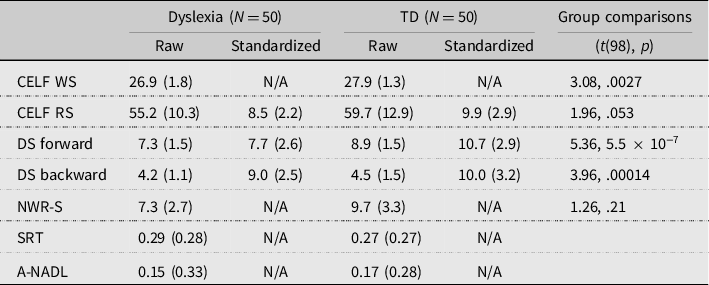
Table 2 presents the mean (and SD) scores on the two measures of grammar (CELF word structure and CELF recalling sentences), and the phonological memory (digit span forward, digit span backward, NWR-S) and statistical learning (SRT, A-NADL) measures included as predictors in our regression model that is discussed in Section “Regression analysis”. In order to answer our first research question, we examined group effects on children’s grammatical performance as measured by the CELF word structure and recalling sentences subtests (see Table 2 for group comparison statistics). Results reveal that participants with dyslexia achieved significantly lower scores on the CELF word structure. The children with dyslexia also achieved lower scores on the CELF recalling sentences, although this effect did not reach significance. Out of 50 children with dyslexia, 9 received a norm score of 6 (i.e., 10th percentile) or lower on the CELF recalling sentences, while 7 out of 50 TD children received a norm score of 6 or lower. No norm scores are available for the CELF word structure subtest (see Section “Measures of grammatical performance”). Together, these results suggest subtle difficulties in the area of grammar in the group of children with dyslexia.
Mean (and SD) scores on measures of grammar, phonological skills, and statistical learning: raw scores, standardized scores, and group comparisons

Note: Raw scores: CELF word structure (WS) = number of items correct out of 30, CELF recalling sentences (RS) = total score on administered sentences, digit span (DS) = number of items answered correctly out of 16 (forward) or 14 (backward), NWR-S = number of nonwords repeated correctly out of 22, SRT = difference in normalized RTs (RT disruption – RT sequence), A-NADL = difference in normalized RTs (RT disruption – RT rule). Standardized scores represent norm scores (norm = 10). No standardized scores are available for the CELF word structure, NWR-S, SRT, and A-NADL tasks.
Furthermore, the children with dyslexia performed significantly worse than the TD children on the digit span forward task and the NWR-S, which both assess phonological processing and short-term memory. No evidence of such a difference between participant groups was found for the digit span backward that targets phonological processing and working memory. Finally, as previously published in Van Witteloostuijn et al. (Reference van Witteloostuijn, Boersma, Wijnen and Rispens2019), although evidence of learning was found for both statistical learning measures when looking at children with and without dyslexia together, no evidence of a group difference emerged for either the SRT (p = .61) or the A-NADL (p = .87) task. The correlations between the tasks used to assess grammar, phonological memory, and statistical learning are provided in the appendix.
Error exploration
Word structure
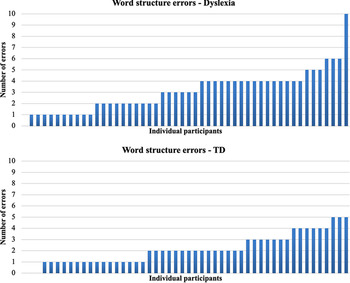
Overall, the children with dyslexia made an average of 3.1 errors out of 30 potential errors (range: 0–10 errors) and the TD children made 2.1 errors (range: 0–5 errors; see Figure 1). Table 3 presents the children’s performance in the CELF word structure task per category. Performance on regular plurals and past tense formation was found to be at the ceiling both in participants with and without dyslexia. Moreover, on categories eliciting demonstrative and personal pronouns, the children with and without dyslexia achieved comparable levels of accuracy. The other categories may inform us about different error patterns in children with dyslexia as compared to their TD peers, as participants with dyslexia achieve numerically lower accuracy levels. The difference in accuracy levels between participants with and without dyslexia reached marginal significance, given the multitude of exploratory binomial GLMER models, on irregular plurals and compound verbs (estimate = .94, SE = .46, z(100) = 2.04, p = .041 and estimate = .78, SE = .30, z(100) = 2.62, p = .0089, respectively). Differences between the children with and without dyslexia did not reach significance on diminutives or comparative superlatives (estimate = .75, SE = .47, z(100) = 1.62, p = .11 and estimate = 1.88, SE = 2.07, z(100) = .91, p = .36, respectively).
Histogram showing the distribution of performance on the CELF word structure subtest; children with dyslexia are presented in the top graph, TD children are presented in the bottom graph. Each bar represents the number of errors (out of 30 test items) of an individual participant.

Word structure: number of errors and accuracy (in percentage) in the different categories per group

Closer inspection of the error pattern on the irregular plurals (4 items) revealed that the children with dyslexia made most errors on the item ei – eieren [εi – εiərə(n)] (“egg – eggs”; 12 errors), followed by schip – schepen [sxɪp – sxeːpə(n)] (“ship – ships”; 5 errors), and fewest errors were made on koe – koeien [ku – kujə(n)] (“cow – cows”; 2 errors) and glas – glazen [ɣlɑs – ɣlaːzə(n)] (“glass – glasses”; 2 errors). The errors in the TD participants were distributed more equally (koe – koeien: one error, ei – eieren: two errors, schip – schepen: three errors; glas – glazen: 0 errors). Generally speaking, errors on irregular plurals were cases of overgeneralization: participants applied the regular plural rules (add/ə(n)/or /s/) to irregular nouns (i.e., ei – *eien *[εiə(n)], schip – *schippen *[sxɪpə(n)], glas – *glassen *[ɣlɑsə(n)], koe – *koes *[kus], instead of applying the required more complex suffix (/ərə(n)/ as in ei – eieren) or alteration of the noun stem (i.e., vowel lengthening as in schip – schepen [sxɪp – sxeːp-ə(n)] and glas – glazen [ɣlɑs – ɣlaːz-ə(n)], or stem alteration as in koe – koeien [ku – kuj-ə(n)].
Regarding compound verbs, the majority of errors (dyslexia: 40 out of 46; TD: 27 out of 28) was made on the item wassen af (“[they are] washing the dishes”) and only a few errors were made on the item speelt gitaar (“[he/she] plays the guitar”). These errors were cases in which the child failed to separate the two verbal elements, such as zij zijn aan het afwassen (“they are washing the dishes”; this is not ungrammatical, but maybe an avoidance strategy), and/or cases in which the infinitive form of the verb was used (i.e., *zij gitaar spelen [“she guitar plays”], or *zij afwassen [“they washing the dishes”]).
Recalling sentences
In our GLMER model predicting children’s performance on the CELF recalling sentences task, we found a significant effect of sentence length: accuracy was lower for longer sentences than for shorter sentences (odds ratio estimate = a factor of 1.5 per standard deviation, 95% CI = [1.41 …1.60], p = 3.5 × 10⁻³⁵). There was also a significant effect of sentence complexity; accuracy was lower for sentences that contained a complex syntactical structure as compared to simple sentences (odds ratio estimate = 58, 95% CI = [13 … 261], p = 1.1 × 10⁻⁷). These two predictors were found to significantly interact with one another, indicating that the effect of length on performance is stronger in simple sentences than in complex sentences (estimated odds ratio = 1.35, 95% CI = [1.19 … 1.55], p = 7.5 × 10⁻⁶). Furthermore, accuracy was significantly higher on sentences containing subordinate clauses as compared to passive sentences (odds ratio estimate = 23, 95% CI = [5 … 119], p = .00015) overall and the effect of length was found to be significantly stronger for subordinate clauses than for passive sentences (odds ratio estimate = 1.53, 95% CI = [1.31… 1.79], p = 7.9 × 10⁻⁸). The effect of group in interaction with sentence complexity (p = .81) or sentence length (p = .87) is nonsignificant, as are the three-way interactions with group. Thus, performance on the CELF recalling sentences task is influenced by sentence length and sentence complexity in children, and we find no evidence of a difference in performance between children with and without dyslexia regarding the effects of sentence length and sentence complexity.
A total number of 4,762 errors (dyslexia: N = 2,525, TD: N = 2,237) on the CELF recalling sentences task were classified into predetermined categories (see Section “Error explorations”). The largest proportion of total errors (approximately 74%) were classified as nonspecific: omissions of words (dyslexia: 35.5%, TD: 36.4%), replacements, displacements, and switches of words (dyslexia: 26.9%, TD: 25.6%), and additions of words (dyslexia: 11.1%, TD: 11.9%). Nonspecific errors involved function words slightly more often than content words (dyslexia: 51.2% and 48.8% of nonspecific errors, respectively, TD: 51.9% and 48.1% of nonspecific errors, respectively).
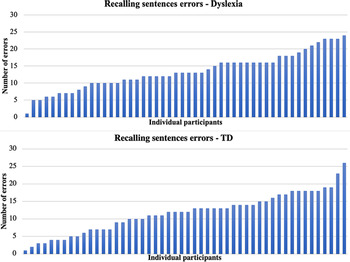
The remaining 26% of errors (dyslexia: N = 671, TD: N = 585) were labeled as specific errors, divided into errors pertaining to nouns (plurals, article choice, and lexical errors), verbs (subject–verb agreement, tense, overgeneralization, and lexical errors), and demonstrative pronouns (see Section “Error explorations”). Table 4 presents a summary of these results. The children with dyslexia made an average of 13.4 specific errors (range: 1–24 errors) and the TD children made 11.7 errors (range: 1–26 errors; see Figure 2). The largest proportion of specific errors (approximately 55%) was classified as lexical errors, both in the children with dyslexia (verbs: N = 192, nouns: N = 168) and in the TD children (verbs: N = 192, nouns: N = 139). Regarding nouns, the children made very few pluralization errors (dyslexia: N = 6, TD: N = 7). More errors were made concerning article choice: both the choice between indefinite and definite articles (een vs. de/het; dyslexia: N = 36, TD: N = 30) and between the two definite articles (de vs. het; dyslexia: N = 67, TD: N = 41). Exploratory Poisson GLMER models suggest that children with dyslexia may make more errors regarding the choice between the two definite articles in Dutch (estimate = .53, SE = .24, z(2,320) = 2.24, p = .025), an effect that is considered marginally significant given the number of exploratory models. No evidence of a difference between groups was found for errors concerning the choice between indefinite and definite articles (estimate = .22, SE = .26, z(2,320) = .87, p = .39). Second, regarding verbal morphology, the children made a small number of subject–verb agreement errors (dyslexia: N = 15, TD: N = 23) and overgeneralization errors (dyslexia: N = 13, TD: N = 4), whereas tense errors were more frequent (dyslexia: N = 121, TD: N = 107). No evidence of a difference in performance between children with and without dyslexia was found regarding the number of subject–verb agreement errors (estimate = −.33, SE = .39, z(2,320) = −.83, p = .40) and tense errors (estimate = .16, SE = .18, z(2,320) = .90, p = .37). The children with dyslexia were found to produce more verb overgeneralization errors, which is again considered marginally significant given the number of exploratory tests (estimate = 1.24, SE = .57, z(2,320) = 2.17, p = .030). These are instances where children apply the regular Dutch past tense rule (i.e., add /te/) to irregular verbs, such as koop – *koopte (correct: kocht; “buy – *buyed – bought”). However, please note the low number of errors in this category overall. Lastly, no evidence of a difference in performance between children with and without dyslexia was found regarding the incorrect use of the demonstrative pronoun (dyslexia: N = 53, TD: N = 42; estimate = .25, SE = .21, z(2,320) = 1.19, p = .23).
Recalling sentences: number of errors in the categories covering verb, noun, and pronoun errors per group

Histogram showing the distribution of performance on the CELF recalling sentences subtest; children with dyslexia are presented in the top graph, TD children are presented in the bottom graph. Each bar represents the number of specific errors of an individual participant.

Regression analysis
Regression analysis: confirmatory findings
In order to answer research question 3, we performed a linear regression analysis to investigate the effects of phonological memory (digit span forward, digit span backward, and NWR-S) and statistical learning (SRT and A-NADL) on children’s performance on the CELF word structure and recalling sentences subtests. MANOVA results show that NWR-S (Wilk’s λ = .88, F[2,80] = 5.28, p = .0070) scores significantly affect grammar performance (CELF word structure and recalling sentences combined). The effects of the digit span forward (Wilk’s λ= .96, F[2,80] = 1.89, p = .16) and backward (Wilk’s λ = .99, F[2,80] = .22, p = .81) tasks do not reach significance. Importantly, when we compare the full model to a model where the phonological memory measures (digit span forward, digit span backward, and NWR-S) are removed, this results in a significant decrease in the fit of the model (F[12,162] = 2.80, p = .0017). The model provides no evidence of an effect of statistical learning on explaining individual differences in performance on the CELF word structure and recalling sentences (SRT: Wilk’s λ = .99, F[2,80] = .36, p = .70; A-NADL: Wilk’s λ = .99, F[2,80] = .29, p = .75). Comparing the full model to a reduced model where the statistical learning measures (SRT and A-NADL) are removed does not reveal a significant difference in fit between the models (F[8,162] = 1.04, p = .41). Thus, we can conclude that phonological memory skills contribute to the grammatical performance of children with and without dyslexia; and we find no evidence for or against the hypothesis that statistical learning contributes to children’s grammatical performance.
Regarding potential differences between children with and without dyslexia (research question 3a), the model shows a significant interaction between phonological processing and short-term memory, as measured by the NWR-S, and group (NWR-S * Group: Wilk’s λ = .92, F[2,80] = 3.51, p = .035). To follow-up on this interaction, the correlation between nonword repetition and grammatical performance is significant in both groups (TD: r(48) = .58, p = 1.0 × 10⁻⁵; dyslexia: r(48) = .51, p = .00019). No other interactions with group are found to be significant. As for potential differences in the contribution to CELF word structure versus recalling sentences performance (research question 3b), we cannot conclude that there is a difference in effect of the NWR-S due to overlapping 95% CIs (effect NWR-S on CELF word structure: estimate = +.20, 95% CI [−.05 … +.46], p = +.11; effect NWR-S on CELF recalling sentences: estimate = .28, 95% CI [+.09 … +.47], p = .0044).
Regression analysis: Exploratory findings
The regression model provides us with some exploratory findings that may be of interest. First, nonverbal reasoning (Raven; Wilk’s λ = .87, F[2,80] = 6.06, p = .0035) and vocabulary (PPVT; Wilk’s λ = .81, F[2,80] = 9.28, p = .00024) are found to contribute to CELF word structure and recalling sentences performance combined. Second, there is no evidence that the effect of group membership contributes to children’s grammatical performance over and beyond the other predictors included in the model (Wilk’s λ = .95, F[2,80] = 2.31, p = .11).
In addition to these findings provided by the model, we wish to further explore the effects of phonological memory and statistical learning on grammar performance. First, the results described above suggest that the effect of phonological memory is largely carried by the NWR-S. This is corroborated by a further analysis: removal of digit span forward and backward does not significantly affect the fit of the model (F[12,162] = .56, p = .81). Similarly, we wish to explore the effect of the A-NADL task on its own, since this statistical learning task is considered to model aspects of grammar acquisition. Removing the SRT task from the model does not result in a significant decrease in fit (F[4,162] = .90, p = .46), and the effect of the A-NADL task on its own remains nonsignificant (Wilk’s λ = .99, F[2,80] = .31, p = .73). Please note that the effect of the SRT and A-NADL tasks combined also did not reach significance (Section “Regression analysis: confirmatory findings”).
Discussion
The goal of this study was to examine the performance of Dutch-speaking school-aged children with and without dyslexia on standardized measures of inflectional morphology and syntax. We investigated whether phonological memory and statistical learning ability contributed to children’s grammatical performance, in order to shed light on the underlying causes of the linguistic difficulties associated with dyslexia. Here, we first discuss the findings concerning group and error pattern analyses of tasks assessing inflectional morphology and syntax (research questions 1 and 2), followed by a discussion of the contributions of phonological memory and statistical learning to children’s grammatical performance (research question 3).
Grammatical performance in children with dyslexia
In line with previous studies examining the performance of children with dyslexia on (standardized) tests of grammar, children with dyslexia in the present study achieved slightly lower scores on the CELF word structure subtest that assesses inflectional morphology (see also Joanisse et al., Reference Joanisse, Manis, Keating and Seidenberg2000) and the CELF recalling sentences, targeting both morphology and syntax (see also Carroll & Myers, Reference Carroll and Myers2010). When investigating the effects of a range of predictors on grammatical performance, results showed that group membership (i.e., having a diagnosis of dyslexia or not) did not contribute to individual differences in grammar over and beyond other contributors to performance (e.g., vocabulary, nonverbal reasoning, nonword repetition, and digit span tasks). Together, these findings agree with earlier findings that showed that difficulties in the area of grammar in individuals with dyslexia exist, but they are subject to substantial individual variation (Rispens et al., Reference Rispens, Roeleven and Koster2004) and that the grammatical problems appear to be subtle (Rispens & Been, Reference Rispens and Been2007), at least in 8- to 11-year old children.
To explore the nature of the observed (subtle) difficulties within the CELF word structure and recalling sentences subtests, we performed a fine-grained analysis of children’s error patterns. Here, we highlight the most important findings. First, regarding the CELF word structure subtest, no evidence of a difference between participant groups was found on the production of diminutives (i.e., producing the correct diminutive suffix on nouns as in boom–pje; “tree–DIM” [diminutive marker]; see also Boersma, Reference Boersma2018), comparative superlatives (e.g., snel, snel–ler, snel–st; “fast, fast–er, fast–est”), regular and irregular past tense, or pronouns. Please note that accuracy on demonstrative pronouns was low in both participant groups (dyslexia 68%, TD: 66%): children overuse the common demonstrative pronoun die (“that”) in situations where the neuter pronoun dat (“that”) is required. The overgeneralization of the common gender in Dutch is a pattern previously described for TD children (see, e.g., Blom et al., Reference Blom, Polišenská and Weerman2008), and is therefore not unexpected. Interestingly, participants with dyslexia were found to achieve scores close to ceiling performance on items targeting regular plurals (98.5% accuracy), while accuracy was found to be lower than in their TD peers on items assessing irregular plurals. Errors on irregular plurals were cases of overgeneralization of the regular plural rule. As suggested by Ullman (Reference Ullman2001) in his declarative/procedural model of language, the use of irregulars is thought to be supported by the mental lexicon, while the use of regulars depends on the application of structural rules (i.e., grammar). Thus, in the case of irregular plurals, instead of retrieving the correct (irregular) plural form from their lexical memory (e.g., ei, ei–eren; “egg–PL” [plural marker]), participants with dyslexia were more likely to incorrectly apply the regular pluralization rule than TD participants (e.g., ei, ei–*en; “egg–*PL”). If grammatical problems in children with dyslexia were the consequence of an underlying deficit in statistical learning, one would not expect this pattern of results. Rather, this pattern of findings may suggest a problem with lexical retrieval for language production in individuals with dyslexia, which is in line with previous studies indicating poor performance on tasks assessing lexical retrieval (i.e., rapid automatized naming; e.g., Bexkens et al., Reference Bexkens, van den Wildenberg and Tijms2015). Furthermore, participants with dyslexia were outperformed by TD participants on separable compound verbs. This is an indication of difficulties with the production of the correct verb-second word order in Dutch: the finite verb (i.e., the verb that expresses tense and/or agreement) appears in the second position (zij wassen af, “they wash up”) and, thus, the production of an infinite verb in the second position is ungrammatical (*zij afwassen, * “they washing up”). Problems related to the verb-second phenomenon have previously been demonstrated in children with DLD and are argued to be the result of underlying processing and working memory deficits (e.g., Blom et al., Reference Blom, Vasić and de Jong2014; de Jong, Reference de Jong1999; Rice & Wexler, Reference Rice and Wexler1996; Verhoeven et al., Reference Verhoeven, Steenge and van Balkom2011). Moreover, both overregularization and V2 avoidance strategies are known to occur in the language production of younger TD children and have been proposed to be the result of weak memory traces (e.g., Marcus et al., Reference Marcus, Pinker, Ullman, Hollander, Rosen, Xu and Clahsen1992; Wexler, Reference Wexler, Lightfoot and Hornstein1994). Thus, likewise, limitations in the retrieval of lexical information may help explain the difficulties with these phenomena in older children with dyslexia.
Second, regarding the CELF recalling sentences subtest, children’s accuracy was lower when sentences were longer and when they were syntactically more complex. There was no evidence that these effects of sentence length and syntactic complexity affected children with and without dyslexia differently. Thus, although CELF recalling sentence performance is influenced by both short-term memory load and syntactic complexity, we find no evidence that this effect is more pronounced in children with dyslexia as previously reported by Robertson and Joanisse (Reference Robertson and Joanisse2010) for sentence comprehension. As for specific error types, the children with dyslexia made more errors with respect to choosing the correct definite article (common de or neuter het) and produced more overgeneralization errors regarding past tense (applying the regular morphological rule to irregular verbs, e.g., koop–*te; “buy–*ed”). From a statistical learning perspective, one would expect to find more errors in regular past tense formation as compared to the irregular past tense formation in individuals with dyslexia; a pattern that is not reflected in our findings. In contrast, as for the irregular plural errors in the CELF word structure subtest, the irregular past tense error types explained above appear to be lexical in nature. In Dutch, the correct choice between the common and neuter article depends on the lexical knowledge of the noun: since Dutch gender is largely arbitrary, it has to be stored in the mental lexicon for each noun separately (e.g., Blom et al., Reference Blom, Polišenská and Weerman2008; Orgassa & Weerman, Reference Orgassa and Weerman2008). Thus, we find errors suggesting difficulties in lexical retrieval, both in the CELF word structure and the CELF recalling sentences subtests.
Importantly, there are a number of limitations that we would like to point out here. First, future research needs to investigate these exploratory findings regarding differences in error patterns between children with and without dyslexia to test whether the findings reported here are reliable and generalizable. Second, the CELF word structure subtest may not have been maximally sensitive to differences in performance in the current sample due to the fact that it is designed to test children between 5 and 8 years of age. Finally, it is worth noting that the results presented here are based on few items (e.g., compound verbs in the CELF word structure) and/or a low number of errors overall (e.g., overgeneralization of the regular past tense in the CELF recalling sentences). Moreover, the items on which we based our error analysis were not designed to provide insights regarding the underlying reasons for (subtle) grammatical difficulties in dyslexia. In order to investigate this further, future studies should a priori distinguish between specific error types that would be expected based on a phonological or statistical learning account of dyslexia. Future studies comparing children with dyslexia not only to a group of age-matched TD children, but also to a group of children with DLD, may further our understanding of the extent of grammatical difficulties in dyslexia and of the overlap with the problems observed in DLD.
Contributions to grammar performance in children with and without dyslexia
The second aim of the present study was to investigate whether phonological memory and statistical learning ability impact children’s grammatical performance. Research question 3 asked if phonological memory and/or statistical learning ability contributed to individual differences in the CELF word structure and/or recalling sentences subtests. Our analyses controlled for children’s age and SES, as well as scores on tasks measuring their nonverbal reasoning, vocabulary, and attention. We conclude that phonological processing and phonological short-term and working memory contribute to the grammatical performance of children with and without dyslexia, above and beyond other predictors in the model. Thus, the results from our regression analysis support the idea that the grammatical problems observed in dyslexia may be partially explained by an underlying weakness in the area of phonology (e.g., Shankweiler et al., Reference Shankweiler, Crain, Katz, Fowler, Liberman, Brady, Thornton, Lundquist, Dreyer, Fletcher, Stuebing, Shaywitz and Shaywitz1995; Joanisse et al., Reference Joanisse, Manis, Keating and Seidenberg2000). More specifically, problems with the processing and short-term storage of phonological information, as measured by nonword repetition and digit span tasks, contribute to difficulties in the areas of inflectional morphology and syntax (see also Robertson & Joanisse, Reference Robertson and Joanisse2010). The correct processing and memorization of verbal material is relevant in both the CELF word structure and recalling sentences subtests, since they involve the processing of spoken sentences and either completing (CELF word structure) or repeating (CELF recalling sentences) these sentences. The link between phonological memory and grammar performance in the present study is further supported by the finding that children with dyslexia make more errors than TD children on compound verbs, which has previously been related to a phonological processing and memory limitation in children with DLD (e.g., Blom et al., Reference Blom, Vasić and de Jong2014). Similarly, it is in line with the fact that participants were affected by sentence length in their performance on the CELF recalling sentences. Taken together, these results underline the contribution of phonological processing and phonological memory to grammatical performance, and support the hypothesis that (some of the) grammatical problems observed in dyslexia result from an underlying problem in the area of phonology (e.g., Shankweiler et al., Reference Shankweiler, Crain, Katz, Fowler, Liberman, Brady, Thornton, Lundquist, Dreyer, Fletcher, Stuebing, Shaywitz and Shaywitz1995). Note that the exploratory error analyses discussed in Section “Grammatical performance in children with dyslexia” support these findings.
We could not conclude whether or not statistical learning ability, as assessed through SRT and A-NADL tasks, contributes to children’s grammatical performance. It is important to note that no evidence of group differences in statistical learning performance was reported for the present sample (see Van Witteloostuijn et al., Reference van Witteloostuijn, Boersma, Wijnen and Rispens2019). In previous studies, statistical and procedural learning have been shown to be impaired in individuals with dyslexia (e.g., Gabay et al., Reference Gabay, Thiessen and Holt2015; Lum et al., Reference Lum, Ullman and Conti-Ramsden2013) and DLD (e.g., Lammertink et al., Reference Lammertink, Boersma, Wijnen and Rispens2017; Lum et al., Reference Lum, Conti-Ramsden, Morgan and Ullman2014), and have been related to grammatical abilities in TD children (e.g., Clark & Lum, Reference Clark and Lum2017; Kidd, Reference Kidd2012; Kidd & Arciuli, Reference Kidd and Arciuli2016). However, not all published data provide evidence of a statistical or procedural learning impairment in individuals with dyslexia (e.g., Kelly et al., Reference Kelly, Griffiths and Frith2002; Rüsseler et al., Reference Rüsseler, Gerth and Münte2006). Meta-analyses (Schmalz et al., Reference Schmalz, Altoè and Mulatti2017; van Witteloostuijn et al., Reference van Witteloostuijn, Boersma, Wijnen and Rispens2017) show that there is wide variation in the magnitude of group differences across studies, which are likely associated with both participant and task variables (e.g., the type of structure to be learned, the modality in which statistical learning is assesses, task complexity, etc.). These meta-analyses have also raised the issue of a potential publication bias in the field, suggesting that the evidence for differences between TD children and children with dyslexia or DLD is weaker than it may seem.
Nonetheless, even in the absence of a group effect, associations between statistical learning performance and grammatical performance could have been obtained. However, our data do not provide evidence for (or against) the relationship between statistical learning on the one hand and inflectional morphology and syntax on the other hand. While this may seem surprising, other studies have similarly reported null results when looking at the relationship between statistical learning and language performance (e.g., West et al., Reference West, Vadillo, Shanks and Hulme2017). Recently, the reliability of statistical learning measures has been questioned, especially in child participants (e.g., Arnon, Reference Arnon2019a; West et al., Reference West, Vadillo, Shanks and Hulme2017). Therefore, current statistical learning measures may not be suitable to examine the hypothesized relationship with linguistic performance (e.g., Arnon, Reference Arnon2019b). Note, however, that the statistical learning measures used in the present study were reliable at detecting learning in child participants with and without dyslexia overall. In line with concerns relating to reliability, statistical learning measures have been shown to only weakly correlate amongst each other (e.g., Schmalz et al., Reference Schmalz, Moll, Mulatti and Schulte-Körne2019; Siegelman & Frost, Reference Siegelman and Frost2015), which may help explain the mixed results regarding the relationship between statistical learning and measures of linguistic performance (i.e., some studies reporting significant correlations and others reporting null findings). Of course, these factors do not exclude the possibility that statistical learning plays an important role in language acquisition and is therefore related to children’s grammatical performance, but merely affect our ability to evaluate this link (Arnon, Reference Arnon2019b). More research is needed in order to improve on present methodologies of measuring statistical learning and to more reliably evaluate its relationship to language.
Finally, we would like to return to lexical storage and/or retrieval as potential additional sources of variation in grammatical performance, and of grammatical difficulties in dyslexia. Of course, lexical knowledge, in general, is one of the crucial building blocks of the comprehension and production of language, and lexical knowledge is affected in children with DLD (see McGregor, Reference McGregor and Schwartz2009 for a review). This relationship is also apparent from the present study: children’s receptive vocabulary knowledge contributes to their performance on inflectional morphology and syntax. More specifically, however, children with dyslexia were shown to experience difficulties in irregular plurals (CELF word structure), irregular past tense (CELF recalling sentences), and the choice between the common and neuter definite article (CELF recalling sentences). We would like to speculate that, besides phonological processing and memory, the automatic access and retrieval of lexical representations may be impaired in dyslexia (see also Bexkens et al., Reference Bexkens, van den Wildenberg and Tijms2015), while the representations themselves may be unimpaired. A similar line of reasoning has been suggested regarding the retrieval processes of representations of speech sounds and phonology (Boets et al., Reference Boets, de Beeck, Vandermosten, Scott, Gillebert, Mantini, Bulthé, Sunaert, Wouters and Ghesquière2013; Griffiths & Snowling, Reference Griffiths and Snowling2001; Ramus & Szenkovits, Reference Ramus and Szenkovits2008; Rispens et al., Reference Rispens, Baker and Duinmeijer2015). If individuals with dyslexia are unable to efficiently retrieve lexical representations from long-term memory (e.g., irregular plural or past tense forms), they are more likely to apply the regular morphological rule instead, resulting in overgeneralizations as described in the present study.
In summary, deficits in the area of phonological processing and phonological short-term and working memory, as well as lexical retrieval, are likely to contribute to the linguistic performance of children with dyslexia, not only in the area of literacy skills but also regarding inflectional morphology and syntax. Of course, we cannot rule out the possibility that the observed relationship between short-term and working memory and long-term language knowledge is bidirectional. Linguistic representations (syntactic/morphological representations) stored in long-term memory seem to impact on the performance of verbal working memory tasks, in the sense that long-term linguistic representations are automatically activated, which is advantageous when recalling sentences as compared to a list of words (Jefferies et al., Reference Jefferies, Ralph and Baddeley2004). Evidence from experiments with children furthermore suggests that the quality and robustness of long-term memory representations, such as lexical and syntactic knowledge, influence performance on tasks involving verbal short-term and/or working memory (e.g., Kidd et al., Reference Kidd, Brandt, Lieven and Tomasello2007; Mainela-Arnold & Evans, Reference Mainela-Arnold and Evans2005; Munson et al., Reference Munson, Kurtz and Windsor2005), which has led to discussions whether working memory and representations of linguistic knowledge are distinct and separable entities (e.g., MacDonald & Christiansen, Reference MacDonald and Christiansen2002; Mainela-Arnold & Evans, Reference Mainela-Arnold and Evans2005). Future work is needed in order to clarify whether the link between short-term and working memory on the one hand, and linguistic performance, on the other hand, is in fact a bidirectional relationship (see also Marshall, Reference Marshall2020; Riches, Reference Riches2020).
Nonetheless, the observations of the present study fit with suggestions that multiple cognitive deficits may help explain the range of behavioral difficulties associated with dyslexia and other developmental disorders, as well as the comorbidity between different disorders (e.g., Law et al., Reference Law, Vandermosten, Ghesquière and Wouters2017; Pennington, Reference Pennington2006). Already in 1999, Wolf and Bowers suggested the double deficit hypothesis: impairments in phonology or rapid automatized naming were assumed to cause dyslexia, with more severe problems when both phonological and rapid automatized naming difficulties were present in a single individual. As mentioned previously, there is also emerging evidence that children with a FRdys experience delays in oral language development in early childhood (Snowling & Melby-Lervåg, Reference Snowling and Melby-Lervåg2016). More research is needed to increase our understanding of the exact nature of the underlying causes of dyslexia and to shed light on the so-called “risk factors” of developing developmental disorders such as dyslexia (Pennington, Reference Pennington2006). Investigations of multiple sources of variance simultaneously, as attempted in the present study, may shed light on these open questions.
Acknowledgments
We would first and foremost like to thank all children, their parents, and the primary schools (De Bosmark; De Kemp; De Ludgerschool, and De Ieme) that participated in our study. We are also grateful to Imme Lammertink for collaboration on the development of the statistical learning measures. Furthermore, we thank Iris Broedelet, Sascha Couvee, and Darlene Keydeniers for help with testing the control group and Dirk Jan Vet for technical assistance in developing the tasks. This work was supported by the Netherlands Organization for Scientific Research (NWO) through a personal Vidi grant awarded to Judith Rispens (grant number 276-89-005). The funders had no role in study design, data collection, and analysis, decision to publish, or preparation of the manuscript.