Transgressions in romantic relationships are somewhat inevitable and occur very frequently. Transgressions are typically defined as a violation of the prevailing norms of the relationship, whether implicit or explicitly (Finkel et al., Reference Finkel, Rusbult, Kumashiro and Hannon2002), as perceived by one member of the couple. Once the transgression takes place, the manner in which the affected party perceives it will influence his or her strategies to cope with or resolve it, and clear the way to stay in the relationship, or break up (Jonker et al., Reference Jonker, Sijbrandij and Wolf2012). The present study’s objective is to examine how people react to different transgressions that may occur in a romantic relationship. Specifically, we aim to test how the type of transgression (sexual infidelity or sexual coercion) is associated with its perceived severity, the probability of leaving the relationship, and the use of conflict resolution strategies, as well as analyze the influence of dependence on the partner and commitment to the relationship, on those processes.
Sexual Transgressions: Infidelity and Coercion
An array of transgressions may occur in the course of a romantic relationship. They are compiled in the research literature, and include jealousy, violation of privacy, infidelity, violence, insults, and lies (see a proposed classification in Finkel et al., Reference Finkel, Rusbult, Kumashiro and Hannon2002). Above all others, sexual infidelity and sexual coercion are considered the most common, humiliating, and detrimental to the relationship (e.g., Beltrán-Morillas et al., Reference Beltrán-Morillas, Valor-Segura and Expósito2015; Young & Furman, Reference Young and Furman2013).
Infidelity can be defined as involvement of a romantic, emotional, or sexual nature with a third person outside the relationship, in violation of the partners’ commitment to relational exclusivity (Metts & Cupach, Reference Metts, Cupach, Spitzberg and Cupach2007). The consequences of infidelity for people who experience it range from feelings of anger, deceit, and doubt, to depression, deterioration of self-esteem, and loss of trust (e.g., Heintzelman et al., Reference Heintzelman, Murdock, Krycak and Seay2014). Previous studies report that approximately 20–40% of people have experienced an incident of infidelity at some time in their lives (Beltrán-Morillas et al., Reference Beltrán-Morillas, Valor-Segura and Expósito2015, Reference Beltrán-Morillas, Valor-Segura and Expósito2019a; Whisman & Snyder, Reference Whisman and Snyder2007).
Sexual coercion, on the other hand, is defined as behavior undertaken with the intention of making the other person engage in sexual activity, despite their lack of interest, lack of will to do so, or lack of ability to resist; applying verbal pressure, blackmail, threats, or even physical force to do so (Black et al., Reference Black, Basile, Breiding, Smith, Walters, Merrick, Chen and Stevens2011; DeGue & DiLillo, Reference DeGue and DiLillo2005). Sexual coercion predicts negative repercussions for those who experience it, including posttraumatic stress, guilt, depression, anger or irritability, worrying, low sex drive, and reduced sexual satisfaction (e.g., Brown et al., Reference Brown, Testa and Messman-Moore2009). Prevalence data indicate that verbal (compared to physical) coercion is most common, especially in the context of romantic relationships, and that 38% to 70% of women have been sexually coerced by their intimate partners (e.g., Garrido-Macías & Arriaga, Reference Garrido-Macías, Valor-Segura and Expósito2020; Young & Furman, Reference Young and Furman2013).
Perceptions of and Reactions to the Transgression
When someone’s partner commits a sexual transgression, whether infidelity or coercion, the most important decision they face is whether to stay in the relationship or break it off. Causal attribution theory holds that people’s reactions to events are guided by their attributions –or explanations– about them (Weiner, Reference Weiner1979). Accordingly, how severely someone interprets the transgression influences how they will react to it, and their final decision (Garrido-Macías et al., Reference Garrido-Macías, Valor-Segura and Expósito2017; Metts & Cupach, Reference Metts, Cupach, Spitzberg and Cupach2007). There is empirical evidence to suggest that sexual infidelity is the most serious transgression that can happen in a couple, and one of the primary reasons couples break up (e.g., Beltrán-Morillas et al., Reference Beltrán-Morillas, Valor-Segura and Expósito2015). On the other hand, studies of sexual coercion have shown it has an adverse effect on relationships, and such situations are associated with a high probability of ending the relationship (Garrido-Macías et al., Reference Garrido-Macías, Valor-Segura and Expósito2020; Garrido-Macías & Arriaga, Reference Garrido-Macías, Valor-Segura and Expósito2020).
On the other hand, communication and conflict resolution styles are important factors in confronting a problem. Particularly, in the context of romantic relationships, how someone communicates after experiencing a transgression helps determine if the relationship will continue or dissolve (Weiser & Weigel, Reference Weiser and Weigel2014). Likewise, constructive resolution strategies (voice and loyalty) have a positive emotional tone, promote cooperation, and help preserve the relationship whereas destructive strategies (exit and neglect) include hostile behaviors that denote competition, negativity, and displeasure, and harm the relationship (Overall et al., Reference Overall, Sibley and Travaglia2010). Therefore, when faced with a transgression, people who utilize destructive conflict resolution strategies often intend to leave the relationship, whereas constructive strategies are channeled toward problem-solving and preserving the relationship (Metts & Cupach, Reference Metts, Cupach, Spitzberg and Cupach2007; Overall et al., Reference Overall, Sibley and Travaglia2010). It is true that people usually cope with problems, handling them directly through strategies like voice (independently of whether they wish to continue the relationship or not), but it has been confirmed that in general, the likelihood of using destructive strategies increases with the transgression’s severity (Weiser & Weigel, Reference Weiser and Weigel2014). For instance, studies of transgressions in couples have shown that when confronted with infidelity (considered the most severe transgression), people tend to react with more destructive – and less constructive – strategies (Finkel et al., Reference Finkel, Rusbult, Kumashiro and Hannon2002; Weiser & Weigel, Reference Weiser and Weigel2014). However, as far as we know, no previous study has tested what sort of strategy is utilized in cases of sexual coercion.
Although infidelity and sexual coercion are considered major transgressions occurring in the romantic relationship sphere, no study to date has focused on analyzing the differences between them. A study of college women (Beltrán-Morillas et al., Reference Beltrán-Morillas, Valor-Segura and Expósito2019a) assessed the influence of relationship transgression type on the process of forgiveness, reporting that participants forgave sexual infidelity to a greater extent than physical violence. It is understandable that people would take a more earnest view of physical violence than sexual infidelity, because its consequences are more alarming and grave (Messing et al., Reference Messing, Campbell, Sullivan Wilson, Brown and Patchell2017). However, in the case of sexual coercion, we might expect a different interpretive pattern, for various reasons explained below. First, empirical evidence suggests that perceptions of sexual coercion vary as a function of the perpetrator’s tactics. The infraction is perceived more negatively if physical force (versus verbal pressure) was used (e.g., Brown et al., Reference Brown, Testa and Messman-Moore2009; Garrido-Macías et al., Reference Garrido-Macías, Valor-Segura and Expósito2020; Katz et al., Reference Katz, Moore and Tkachuk2007). Second, the reality that coercion takes place in the couple’s intimate life may stir motivations and desires that lead the victim to make certain justifications, or even assume a degree of responsibility for it, in which case they would view the incident less negatively. On the other hand, in the case of sexual infidelity, the transgressor violates a commitment to their partner; allowing a third person to get involved in the relationship (Dillow et al., Reference Dillow, Malachowski, Brann and Weber2011; Watkins & Boon, Reference Watkins and Boon2016) is a breach of intimacy, so the chances of justifying the transgression are diminished.
On another note, since sexual coercion is more frequently committed by men against women (e.g., Krahé et al., Reference Krahé, Berger, Vanwesenbeeck, Bianchi, Chliaoutakis, Fernández-Fuertes, Fuertes, Gaspar de Matos, Hadjigeorgiou, Haller, Hellemans, Izdebski, Kouta, Meijnckens, Murauskiene, Papadakaki, Ramiro, Reis, Symons, Tomaszewska and Hellemans2015; Young & Furman, Reference Young and Furman2013), and the empirical evidence suggests gender differences in how transgressions are perceived in general (e.g., Beltrán-Morillas et al., Reference Beltrán-Morillas, Valor-Segura and Expósito2015; Garrido-Macías et al., Reference Garrido-Macías, Valor-Segura and Expósito2017), it is vital for the present study to take gender differences into account. Generally speaking, recent literature affirms that women, compared to men, perceive transgressions as more serious (Beltrán-Morillas et al., Reference Beltrán-Morillas, Valor-Segura and Expósito2015; Garrido-Macías et al., Reference Garrido-Macías, Valor-Segura and Expósito2017) and tend to make greater use of active strategies like voice and exit, and less use of the passive strategy loyalty. That said, gender differences have not been observed in the use of neglect strategies (Okutan et al., Reference Okutan, Buyuksahin Sunal and Sakalli Ugurlu2017; Stolarski et al., Reference Stolarski, Postek and Smieja2011).
Influence of Commitment and Dependence on Perceptions of and Reactions to the Transgression
Although abandoning the relationship is a common reaction to infidelity and sexual violence, some people decide to stay. With that in mind, it would be prudent to study the process by which people make the decision. Certain features of the relationship must be taken into account, such as dependence and commitment, which can influence one’s view of a transgression as well as the relationship outcome (Metts & Cupach, Reference Metts, Cupach, Spitzberg and Cupach2007).
Partner-specific dependence is characterized by a series of thoughts, beliefs, feelings, and behaviors related to emotional needs and protection- and support-seeking from one’s intimate partner (Ruppel & Curran, Reference Ruppel and Curran2012; Valor-Segura et al., Reference Valor-Segura, Expósito and Moya2009). Dependent people tend to idealize their partner, place them at the center of their universe, and feel the need to tolerate the transgressions they are experiencing in an effort to preserve the relationship (Tan et al., Reference Tan, Arriaga and Agnew2018).
Whereas dependence can reflect an objective reality one relies upon and wants to continue, commitment is more closely associated with global, abstract motivation and a subjective, voluntary desire to continue the relationship (Tan et al., Reference Tan, Arriaga and Agnew2018). People might feel committed because of gratifying moments they shared with their partner and the anticipation of more to come, because their habits or routines are interwoven, because of shared history, or because they hope to keep memories and future plans intact that would be lost if the relationship ended (Tan et al., Reference Tan, Arriaga and Agnew2018). With that in mind, commitment could be considered a person’s tendency to stay in a particular relationship long-term and feel psychologically drawn to it (Weiser & Weigel, Reference Weiser and Weigel2014).
Generally speaking, high levels of dependence are usually associated with a higher level of commitment to the relationship and higher odds of staying in it (Tan et al., Reference Tan, Arriaga and Agnew2018). Similarly, and in keeping with cognitive consistency theory, commitment to and dependence on one’s partner can mitigate negative perceptions of transgressions, leading people to overlook or minimize threats that arise in the relationship (Arriaga & Capezza, Reference Arriaga, Capezza, Mikulincer and Shaver2011). Accordingly, people with high levels of commitment and dependence tend to perceive transgressions as less severe, utilize more constructive conflict resolution strategies, and are more likely to stay in the relationship (e.g., Finkel et al., Reference Finkel, Rusbult, Kumashiro and Hannon2002; Garrido-Macías et al., Reference Garrido-Macías, Valor-Segura and Expósito2017; Weiser & Weigel, Reference Weiser and Weigel2014.)
That being said, dependence and commitment do not always act as protective factors for the relationship. The type of transgression may impact the process, and the more severe the infraction, the harder it is to positively reinterpret (Arriaga & Capezza, Reference Arriaga, Capezza, Mikulincer and Shaver2011). Some studies report that commitment is a predictor of staying in an abusive relationship, independent of the transgression’s severity (e.g., Young & Furman, Reference Young and Furman2013), but others argue that there are limits to its influence on a person’s appraisals of transgressions. Empirical evidence about infidelity and sexual coercion has demonstrated that commitment and partner-specific dependence are associated with higher tolerance of transgressions, and a higher probability of staying in the relationship, but only when the transgression’s severity is low (Beltrán-Morillas et al., 2019Reference Beltrán-Morillas, Valor-Segura and Expósitoa; Garrido-Macías et al., Reference Garrido-Macías, Valor-Segura and Expósito2020; Weiser & Weigel, Reference Weiser and Weigel2014). A study conducted by Beltrán-Morillas et al. (Reference Beltrán-Morillas, Valor-Segura and Expósito2019a) found that dependence predicts higher motivation to forgive the transgression (because feelings of guilt increase) in cases of violence, but not sexual infidelity. However, earlier literature suggests that relationship factors can in fact function as risk factors for staying in the relationship in severe cases. With regard to infidelity, there is empirical evidence that dependence increases the odds of leaving the relationship (e.g., Beltrán-Morillas et al., Reference Beltrán-Morillas, Valor-Segura and Expósito2015, Reference Beltrán-Morillas, Valor-Segura and Expósito2019b), perhaps because that is considered an unforgivable betrayal that violates deeply held relationship norms of commitment and loyalty (Beltrán-Morillas et al., Reference Beltrán-Morillas, Valor-Segura and Expósito2019b; Watkins & Boon, Reference Watkins and Boon2016).
Based on the information presented, the present study’s objective is to analyze the relation between the type of sexual transgression that occurred (sexual infidelity vs. sexual coercion), and how it is perceived and reacted to, and then determine how dependence and commitment influence those processes. First of all, we expect to find higher perceived severity, greater use of destructive strategies to break off the relationship, and accordingly a higher probability of leaving the relationship in transgressions involving sexual infidelity, compared to sexual coercion (Hypothesis 1). Second, with respect to gender, we expect to find that women (versus men) perceive greater severity, use more active-oriented strategies, and are more likely to leave the relationship (Hypothesis 2). Third, we expect to find that when the transgression is sexual coercion, dependence and commitment will both predict lower perceived severity, less use of destructive strategies, and thus a lower probability of leaving the relationship; and the opposite pattern when the transgression is infidelity (higher perceived severity, higher probability of leaving the relationship, and greater use of destructive strategies) (Hypothesis 3).
Method
Participants and Design
The sample was comprised of 453 participants from the general population in Spain, of which 33 were eliminated because they reported not having honestly answered to the questionnaire, and 21 were eliminated because they had a same-sex partner at the time the research was conducted. Therefore, the final sample had 399 people: 203 in the sexual infidelity condition (158 women and 45 men) and 196 in the sexual coercion condition (145 women and 51 men), ranging in age from 18 to 64 years old (M infidelity= 30.84, SDinfidelity = 10.91; M coercion= 31.58, SDcoercion = 10.03). Of the sample analyzed, the majority had received higher education (72.4% of the infidelity group, and 67.9% of the coercion group). Participants were required to be over 18 years of age, and currently in an opposite-sex romantic relationship (regardless of their sexual orientation) of at least six months’ duration at the time the research was conducted. In the infidelity condition, participants had been with their partner 9.30 years on average (SD = 9.67, 26.1% married), while in the coercion condition the average relationship duration also was 9.30 years (SD = 9.03, 32.1% married).
A single-factor, multivariate, between-groups experimental design was employed, in which the type of sexual transgression was manipulated by describing a hypothetical situation (scenario method). Participants were randomly assigned to one of two conditions: Sexual infidelity or sexual coercion. The dependent variables were perceived severity of the situation, conflict resolution strategies for the situation described, and probability of leaving the relationship. Furthermore, commitment and dependence were measured as predictor variables.
Procedure
Convenience sampling was used to select participants and collect data. An invitation to participate was circulated via different social media (e.g., WhatsApp, Facebook, Twitter), and interested parties enrolled by following a link to the Qualtrics platform. There they completed an online questionnaire. After reading and signing an informed consent form, participants had to imagine the described scenario (infidelity or coercion sexual transgression) as happening in their current romantic relationship. Afterward, participants rated the severity of the transgression, reported what conflict resolution strategies they would use, and indicated the probability that they would leave the relationship. Next, they completed measures of commitment and dependence with their relationship. Lastly, participants provided demographic information and were informed about the study and its expected outcomes. The study took about 15 minutes to complete, and participants agreed to take part on an anonymous, voluntary basis, with the confidentiality of their answers guaranteed. All measures were approved by the research ethics committee at the University of Granada, Spain.
Instruments
Manipulation
The sexual transgression variable was manipulated according to two different scenarios: Infidelity and sexual coercion. Participants were given the following instructions: “In romantic relationships there are often conflicts, varying in their intensity and etiology. One is described below. Please read it closely, and imagine the situation occurring in your romantic relationship.” Then a definition of the transgression from the literature is provided – either of sexual infidelity or sexual coercion (Black et al., Reference Black, Basile, Breiding, Smith, Walters, Merrick, Chen and Stevens2011; DeGue & DiLillo, Reference DeGue and DiLillo2005; Metts & Cupach, Reference Metts, Cupach, Spitzberg and Cupach2007), and examples of it are given, based on the sexual/explicit subscale of the Definitions of Infidelity Questionnaire (DIQ; Thompson & O’Sullivan, Reference Thompson and O’Sullivan2016; e.g., “your partner kisses someone else”) or the Sexual Coercion in Intimate Relationships Scale (SCIRS; Shackelford & Goetz, Reference Shackelford and Goetz2004; e.g., “your partner tells you it is your duty to satisfy their sexual needs”).
Manipulation Check
A question about the hypothetical situation is included to gauge whether the sexual transgression manipulation had the desired effect, of activating sexual infidelity or coercion: “What type of situation did you imagine?” The question provides a dichotomous response scale: 1 (“my partner had some sort of sexual relationship with another person”); or 2 (“my partner had sex with me even though they knew I didn’t want to”).
Severity
One item evaluates the perceived severity of the scenario: “How serious do you consider the situation described?” Answers are given on a Likert-type scale from 1 (not severe at all) to 7 (very severe) such that higher numbers indicate higher perceived severity.
Probability of Leaving the Relationship
One item assesses to what extent participants would end the relationship if the hypothetical situation happened to them (“what is the probability you would leave the relationship, if the situation described really happened to you?”). Respondents answer using a Likert-type scale from 1 (not at all likely) to 7 (very likely), with higher numbers indicating higher probability of leaving the relationship.
Conflict Resolution Strategies
To evaluate strategies that people deploy to resolve issues with their partners, we used the Spanish version of the Accommodation among Romantic Couples Scale (Valor-Segura et al., Reference Valor-Segura, Garrido-Macías and Lozano2020). It is comprised of 27 items that evaluate four dimensions: voice (e.g., “When my partner tells me something I don’t like, I tell him/her what is bothering me”), loyalty (e.g., “When my partner hurts me, I don’t say anything but simply forgive him/her”), exit (e.g., “When we have problems, I consider ending our relationship”), and neglect (e.g., “When my partner and I have problems, I refuse to talk to him/her”). It has a Likert-type response scale with nine alternatives, from 1 (I never do that) to 9 (I always do that), with higher scores indicating a higher degree of the dimension being evaluated. We found similar Cronbach’s alpha coefficients as the original scale (αvoice=.78, αloyalty=.67, αexit=.85 and αneglect=.80).
Commitment
To measure commitment to the romantic relationship, the commitment level subscale of the Investment Model Scale (IMS, Rusbult et al., Reference Rusbult, Martz and Agnew1998) was used. Participants answered its seven items (e.g., “I want our relationship to last for a very long time”) on a Likert-type scale from 0 (strongly disagree) to 8 (strongly agree). The mean of subscale answers was utilized, with higher scores indicating a higher level of commitment to the relationship (α =.78).
Dependence
The Spanish version of the Spouse-Specific Dependency Scale (SSDS, Valor-Segura et al., Reference Valor-Segura, Expósito and Moya2009) was used to measure dependence on one’s partner. The scale covers three dimensions: Emotional dependency (e.g., “Having a close bond with my partner makes me feel secure”), exclusive dependency (e.g., “My partner is the only one I could turn to in a crisis”), and anxious attachment (e.g., “I feel bad when my partner has a good time without me”). For the purposes of the present study, the average score across all dimensions was used. Participants completed the scale’s 17 items using a Likert-type response scale from 1 (disagree strongly) to 6 (agree strongly), with higher scores indicating higher level of partner-specific dependence (α =.79).
Sociodemographic Characteristics
Data pertaining to sex and partner sex, age, sexual orientation, level of education, marital status, and relationship duration were collected.
Honest Responding
One item assesses whether participants have been honest in their responses to the questionnaire (“which statement best describes your responses to this survey?”). Respondents answer using a 3-point response scale: 1 (my responses to this survey were accurate), 2 (my responses to this survey were not entirely accurate), and 3 (my responses to this survey were completely false). As explained above, participants whose responses were not honest (scoring above 1, n = 21) were excluded from the analyses.
Results
Descriptive Statistics and Correlations
Table 1 presents means, standard deviations, and correlations for all the variables of interest to this study. Based on the data, perceived severity appears to be positively correlated with probability of leaving the relationship (p < .001) and use of voice as a conflict resolution strategy (p = .030). Although commitment and dependence positively correlated with one another (p < .001), they showed a different pattern of association with the dependent variables. Commitment to the relationship was negatively associated with destructive strategies geared toward ending the relationship (exit, p < .001; and neglect, p = .001) and positively associated with strategies to sustain the relationship (voice, p = .007). Meanwhile, dependence correlated positively with use of passive strategies (loyalty, p = .006; and neglect, p < .001) and negatively with the active strategy of voice (p = .018). In addition, the voice conflict resolution strategy correlated negatively with exit (p = .034), loyalty (p < .001), and neglect (p < .001).
Means, Standard Deviations and Correlations among Dependent Variables

Note. ***p < .001**p < .01. *p < .05.
Manipulation Check
To determine whether or not our manipulation of sexual transgression type had the desired effect, we conducted a contingency chi-squared test, entering as variables the type of sexual transgression (infidelity versus coercion) and type of hypothetical situation (manipulation check). Results confirmed the experimental manipulation’s success, with 100% of participants presented with the sexual infidelity condition imagining that transgression, and 100% of participants presented with the sexual coercion condition imagining that scenario χ²(1, 399) = 399.00, p < .001.
The Influence of Sexual Transgression Type and Gender on Perceptions of and Reactions to it
To measure the effects of condition and gender on perceptions of and reactions to the transgression in question (Hypotheses 1 and 2), we conducted a MANOVA, entering condition and gender as independent variables, and perceived severity, probability of leaving the relationship, and conflict resolution strategies (exit, loyalty, voice, and neglect) as dependent variables.
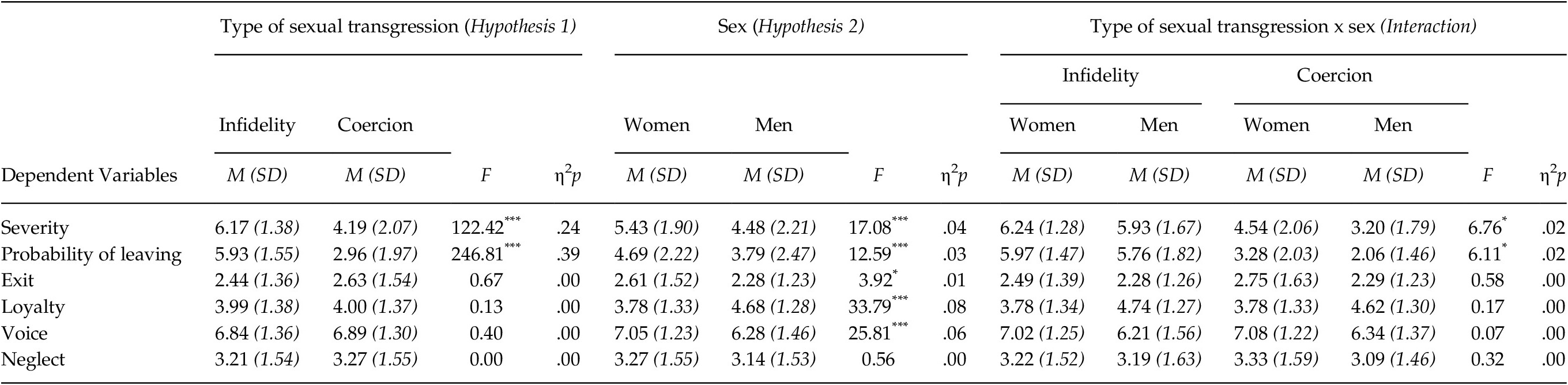
First of all, results point to a significant effect of condition, Wilks’ λ = .60, F(6, 390) = 43.46, p < .001, η2p = .40. Supporting Hypothesis 1, the type of sexual transgression affected severity, F(1, 395) = 122.42, p < .001, η2p = .24, and probability of leaving the relationship, F(1, 395) = 246.81, p < .001, η2p = .39, such that participants evaluated infidelity more negatively than coercion, perceiving an act of infidelity as more serious and more likely to lead to a break-up than an instance of sexual coercion (see Table 2). Nevertheless, participants did not differ in their use of conflict resolution strategies (exit, loyalty, voice, and neglect) as a function of sexual transgression type (see Table 2).
Effect of Condition and Sex on Tolerance: Means, Standard Deviations, and Hypothesized Comparisons

Note. Means and standard deviations are compiled in the table (in parentheses and italics). Those values indicate the effects of transgression type (Hypothesis 1) and sex (Hypothesis 2) on the dependent variables, and the interaction between the two. Measures of severity and probability of leaving the relationship are measured on a scale from 1 (not at all severe/likely) to 7 (very severe/likely), whereas the four conflict resolution strategies are measured on a scale from 1 (I never do that) to 9 (I always do that).
***p < .001**p < .01. *p < .05.
Second, in terms of gender differences, results revealed a significant effect, Wilks’ λ = .84, F(6, 390) = 12.58, p < .001, η2p = .16. Corroborating Hypothesis 2, gender differences were observed in perceived severity, F(1, 395) = 17.08, p < .001, η2p = .04; probability of leaving the relationship, F(1, 395) = 12.59, p < .001, η2p = .03; and use of exit, F(1, 395) = 3.92, p = .048, η2p = .01, voice, F(1, 395) = 25.81, p < .001, η2p = .06, and loyalty strategies, F(1, 395) = 33.78, p < .001, η2p = .08. Specifically, as Table 2 illustrates, women viewed sexual transgressions more negatively than men, perceiving them as more severe and themselves more likely to leave the relationship (using strategies of exit more, and loyalty less). Women also employed more constructive conflict resolution strategies (voice) than men, although significant gender differences were not detected in use of neglect strategies (see Table 2).
Finally, the interaction between type of sexual transgression and gender was not found to be significant, Wilks’ λ = .98, F(6, 390) = 1.36, p = .232, η2p = .02.
The Role of Dependence and Commitment in Perceptions of and Reactions to the Transgression
To test Hypothesis 3 – that dependence and commitment predict lower perceived severity, lower probability of leaving the relationship, and less use of destructive strategies in the case of sexual coercion; and greater perceived severity, higher probability of leaving the relationship, and more use of destructive strategies in the case of sexual infidelity – a series of regression models was carried out. Specifically, 12 moderation analyses with 5000 bootstraps were run in the SPSS PROCESS macro (Model 1; Hayes, Reference Hayes2017). First, we tested the interaction effect of condition (moderating variable, where 0 = sexual infidelity and 1 = sexual coercion) and commitment (predictor variable) on each criterion variable (severity, probability of leaving the relationship, exit, loyalty, voice, and neglect). Second, we tested the interaction effect of condition and dependence (predictor variable) on the same criterion variables listed above. The variable sex was entered as control.
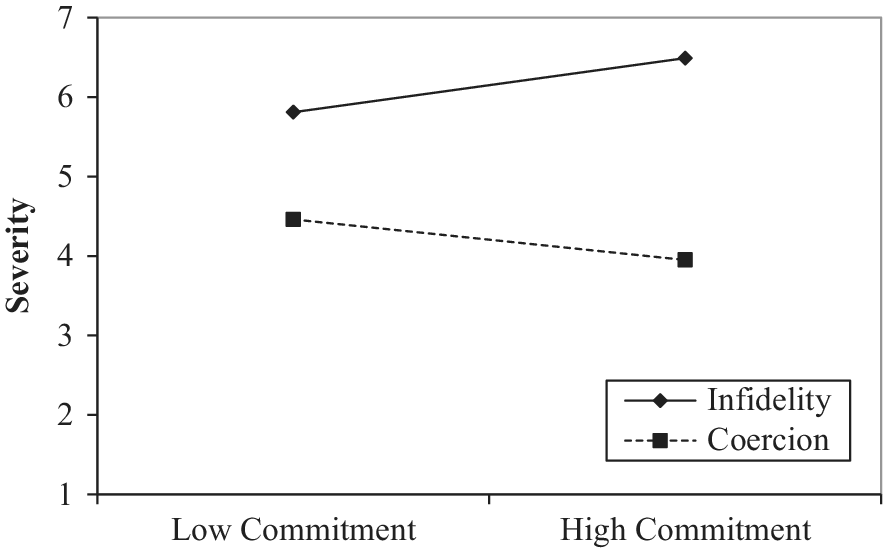
First, in terms of commitment, results indicate an interaction effect of commitment x condition on perceived severity, b = –.46, t = –3.53, p < .001, 95% CI [–.72, –.20], showing a significant moderating effect for both sexual coercion, b = –.20, t = –1.99, p = .047, 95% CI [–.40, –.01] and sexual infidelity, b = .26, t = 3.12, p = .002, 95% CI [.10, .43]. Accordingly, as shown in Figure 1, in the sexual coercion condition, higher (versus lower) levels of commitment predict lower perceived severity; and in the sexual infidelity condition the opposite pattern occurs, with higher (versus lower) commitment predicting higher perceived severity.
Interaction Effect of Condition x Commitment on Perceived Severity

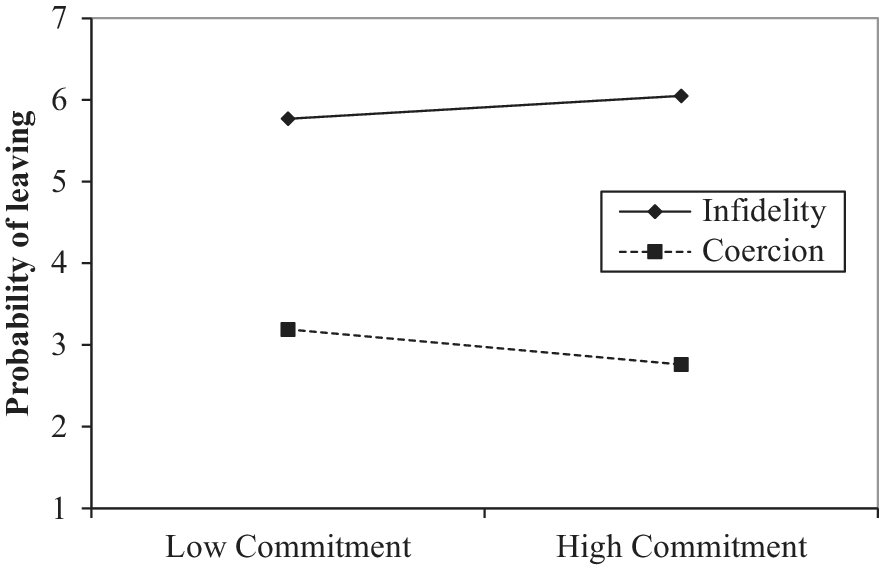
Next, an interaction effect of commitment x condition on probability of leaving the relationship was observed, b = –.27, t = –1.98, p = .048, 95% CI [–.55, –.01]. However, although the pattern was similar to that of perceived severity as Figure 2 shows, the moderating effect was not significant in the sexual coercion condition, b = –.17, t = –1.54, p = .123, 95% CI [–.37, .05] nor the sexual infidelity condition, b = .11, t = 1.23, p = .218, 95% CI [–.06, .28].
Interaction Effect of Condition x Commitment on Probability of Leaving the Relationship

Commitment x condition interaction effects were not observed in the remaining criterion variables: exit, b = –.03, t = –0.18, p = .854, 95% CI [–.29, .24]; loyalty, b = .02, t = 0.21, p = .833, 95% CI [–.20, .24]; voice, b = –.04, t = –0.34, p = .732, 95% CI [–.27, .19]; or neglect, b = –.08, t = –0.66, p = .513, 95% CI [–.33, .17].
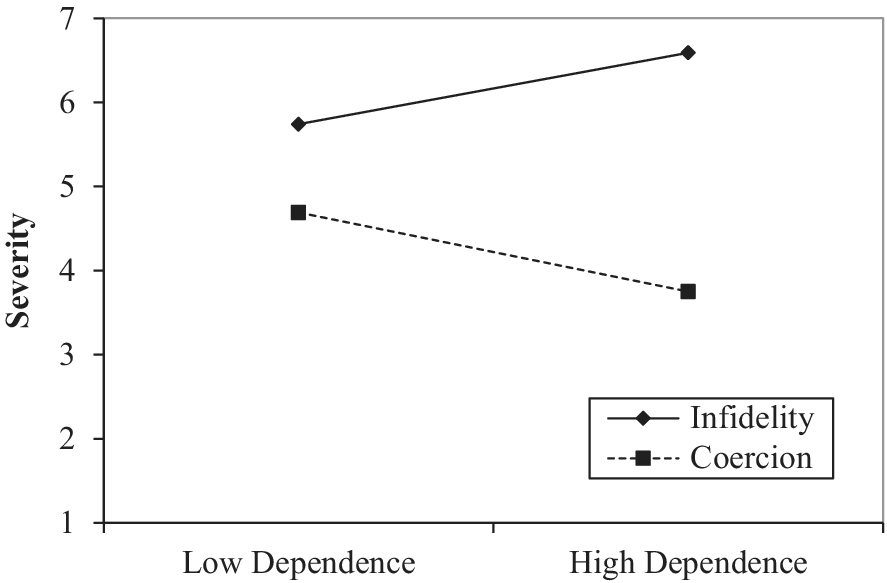
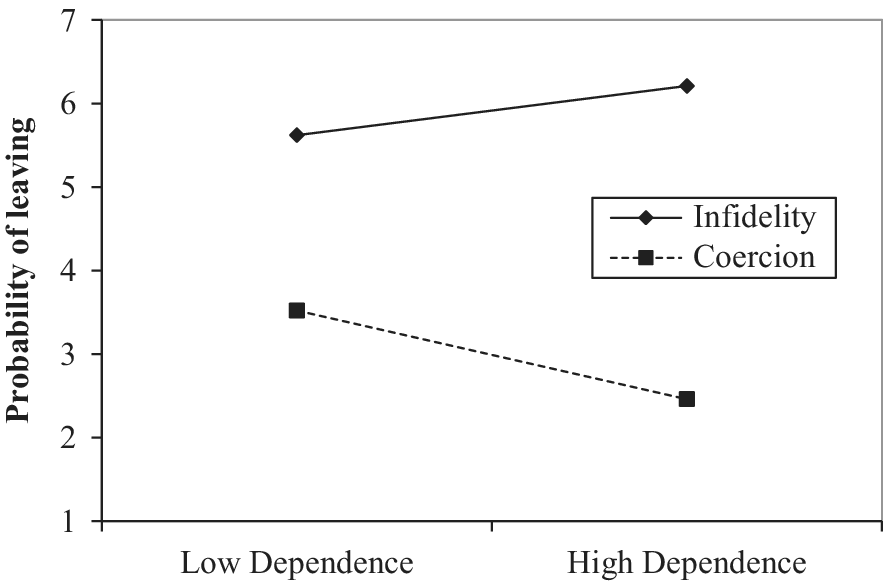
Regarding dependence, results again demonstrated an interaction effect of dependence x condition on perceived severity, b = –1.29, t = –5.75, p < .001, 95% CI [–1.73, –.85], and probability of leaving the relationship, b = –1.20, t = –5.06, p < .001, 95% CI [–1.66, –.73]. Examining dependence’s effects on severity and probability of leaving the relationship by condition revealed a significant moderating effect of the sexual coercion condition on severity, b = –.68, t = –3.66, p = .001, 95% CI [–1.04, –.31], and probability of leaving the relationship, b = –.77, t = –4.24, p < .001, 95% CI [–1.12, –.41]; and of the sexual infidelity condition on severity, b = .61, t = 4.82, p < .001, 95% CI [.36, .86], and probability of leaving the relationship, b = .43, t = 2.82, p = .005, 95% CI [.13, .73]. Likewise, as observed in Figures 3 and 4, in the sexual coercion condition, higher (versus lower) levels of dependence predict lower perceived severity and lower probability of leaving the relationship. However, in the sexual infidelity condition, again the opposite pattern emerges, with high (compared to low) levels of dependence predicting higher perceived severity and greater likelihood of leaving the relationship.
Interaction Effect of Condition x Dependence on Perceived Severity

Interaction Effect of Condition x Dependence on Probability of Leaving the Relationship

Similar to the findings about commitment, we did not uncover interaction effects of dependence x condition on conflict resolution strategies: exit, b = –.43, t = –1.69, p = .092, 95% CI [–.92, .07]; loyalty, b = .28, t = 1.24, p = .215, 95% CI [–.17, .72]; voice, b = .02, t = 0.10, p = .921, 95% CI [–.42, .46]; and neglect, b = –.39, t = –1.47, p = .143, 95% CI [–.90, .13].
Discussion
The present study’s aim was to examine the influence of sexual transgression type (infidelity versus coercion) on perceived severity, use of conflict resolution strategies, and probability of leaving the relationship, and to analyze the impact of relationship factors like dependence and level of commitment on participants’ reactions.
First of all, results partially support Hypothesis 1 in that participants perceived sexual infidelity more negatively than sexual coercion, so that they considered infidelity to be a more serious transgression than coercion, and therefore, they were more inclined to leave the relationship after an instance of infidelity (versus coercion). The body of literature casts the two as the most severe transgressions that can happen in romantic relationships, and both frequently lead to break-up (e.g., Beltrán-Morillas et al., Reference Beltrán-Morillas, Valor-Segura and Expósito2015; Garrido-Macías et al., Reference Garrido-Macías, Valor-Segura and Expósito2020; Weiser & Weigel, Reference Weiser and Weigel2014), however infidelity is perceived more negatively than coercion. One plausible explanation is that the sexual coercion scenario represented in this study is an instance of verbal coercion, which tends to be perceived less negatively than ones involving physical force (e.g., Brown et al., Reference Brown, Testa and Messman-Moore2009; Garrido-Macías et al., Reference Garrido-Macías, Valor-Segura and Expósito2020; Katz et al., Reference Katz, Moore and Tkachuk2007), and that the transgression occurs in the most private, intimate sphere of the couple’s relationship. In that relational context, verbal coercion tends to be normalized; thus, it is not perceived as negatively and as warranting a response (e.g., Salwen & O’Leary, Reference Salwen and O’Leary2013). Therefore, it is understandable that participants would view an infidelity transgression as worse, which by involving a third person infringes on the couple’s commitment to exclusivity and could be considered an unforgivable betrayal (Dillow et al., Reference Dillow, Malachowski, Brann and Weber2011; Watkins & Boon, Reference Watkins and Boon2016).
We went on to analyze conflict resolution strategies deployed as a function of sexual transgression type (infidelity versus coercion). Previous studies have reported that people are more likely to use destructive strategies the more severe the transgression is (Weiser & Weigel, Reference Weiser and Weigel2014). Although participants in the present study determined that infidelity is more severe than coercion, results do not suggest they used more destructive – and less constructive – strategies in the infidelity condition than the coercion condition. The expected pattern of conflict resolution strategies appears in the earlier literature on infidelity (e.g., Finkel et al., Reference Finkel, Rusbult, Kumashiro and Hannon2002; Weiser & Weigel, Reference Weiser and Weigel2014), but we have found no studies examining them in situations of sexual coercion. Perhaps the fact that both transgressions happen in the sexual sphere of an intimate relationship influences the type of communication undertaken to try and resolve the issue. With that in mind, future research should take a closer look at the types of strategies that emerge in cases of different sexual transgressions, and test whether or not these findings are replicable.
Next, a differential effect of gender was found on perceptions of the transgressions, supporting Hypothesis 2. Specifically, women considered both transgressions more severe than men did, and were more inclined to leave the relationship. These results are consistent with previous research findings in showing that women (versus men), generally speaking, take a more negative view of transgressions in romantic relationships, independently of the nature of the transgression committed (Beltrán-Morillas et al., Reference Beltrán-Morillas, Valor-Segura and Expósito2015; Garrido-Macías et al., Reference Garrido-Macías, Valor-Segura and Expósito2017). Regarding the use of conflict resolution strategies, we corroborated earlier research findings by confirming that women use strategies of exit and voice more, and strategies of loyalty less, as compared to men (Okutan et al., Reference Okutan, Buyuksahin Sunal and Sakalli Ugurlu2017; Stolarski et al., Reference Stolarski, Postek and Smieja2011).
With respect to an individual’s levels of dependence on their partner, and commitment to the relationship through different sexual transgression scenarios, results suggest we accept Hypothesis 3 in part. Specifically, in the sexual coercion condition, people with high levels of commitment and dependence viewed the situation as less severe and were less likely to leave the relationship as a result of it, compared to people with low levels of commitment and dependence. Conversely, in the sexual infidelity condition, the opposite pattern was observed, with high levels of commitment and dependence predicting appraisals of higher severity and higher probability of leaving the relationship, thus promoting more negative perceptions (Beltrán-Morillas et al., Reference Beltrán-Morillas, Valor-Segura and Expósito2015, Reference Beltrán-Morillas, Valor-Segura and Expósito2019b; Weiser & Weigel, Reference Weiser and Weigel2014). In terms of conflict resolution strategies, commitment and dependence’s predictive power did not alter as a function of condition.
Broadly speaking, people with a high degree of dependence on their partner and strong commitment to their relationship often wish – and need – to stay in the relationship even if they are not satisfied with it (Tan et al., Reference Tan, Arriaga and Agnew2018; Weiser & Weigel, Reference Weiser and Weigel2014). They also tend to minimize threats as they arise in service of maintaining the relationship (Arriaga & Capezza, Reference Arriaga, Capezza, Mikulincer and Shaver2011, Tan et al., Reference Tan, Arriaga and Agnew2018). In view of these findings, which support Hypothesis 3 and prior empirical evidence, we may conclude that commitment and dependence are essential factors in deciding to leave a relationship or not, because they mitigate negative perceptions of the transgressions. However, that is true only insofar as the transgression is perceived as less severe, as in the case of sexual coercion (Garrido-Macías et al., Reference Garrido-Macías, Valor-Segura and Expósito2020; Young & Furman, Reference Young and Furman2013). Similarly, it could be said that in cases of infidelity, relationship factors do not have the same ameliorating effect on negative perceptions, because the transgression’s higher perceived makes it wholly unacceptable (Weiser & Weigel, Reference Weiser and Weigel2014). On another note, the fact that a sexual transgression occur between two partners in a relationship – or on the contrary, involve a third party, breaking with norms of loyalty conceived of by both partners – may be key to how commitment and dependence impact perceptions of the transgression.
We believe the present research makes important strides, in line with our expectations, and expands our understanding of how sexual transgressions in intimate relationships are perceived. However, there are certain research limitations to bear in mind. First, although scenarios-based methodology is commonly employed, simulating situations by prompting participants to imagine them (e.g., Dillow et al., Reference Dillow, Malachowski, Brann and Weber2011; Garrido-Macías et al., Reference Garrido-Macías, Valor-Segura and Expósito2017; Katz et al., Reference Katz, Moore and Tkachuk2007), they may be less representative of responses that would emerge if the circumstances unfolded in real life. Nonetheless, by providing the definition and a wide array of examples of the transgression instead of specifying the context in which it occurred, we think participants could more easily extrapolate this hypothetical, general situation to a past lived experience, or one they might experience in the future. This study’s second limitation relates to sample characteristics, specifically, the fact that more women participated could influence the results. We say that with due consideration of earlier findings that there are gender differences in perceptions of transgressions and use of conflict resolution strategies (e.g., Beltrán-Morillas et al., Reference Beltrán-Morillas, Valor-Segura and Expósito2015; Garrido-Macías et al., Reference Garrido-Macías, Valor-Segura and Expósito2017; Okutan et al., Reference Okutan, Buyuksahin Sunal and Sakalli Ugurlu2017; Stolarski et al. Reference Stolarski, Postek and Smieja2011). In that regard, a more true-to-life proportion of men and women in the sample would be preferred, to guarantee the replicability of results. Moreover, we must bear in mind that while coercion can be perpetrated by members of both sexes (e.g., Katz et al., Reference Katz, Moore and Tkachuk2007; Krahé et al., Reference Krahé, Berger, Vanwesenbeeck, Bianchi, Chliaoutakis, Fernández-Fuertes, Fuertes, Gaspar de Matos, Hadjigeorgiou, Haller, Hellemans, Izdebski, Kouta, Meijnckens, Murauskiene, Papadakaki, Ramiro, Reis, Symons, Tomaszewska and Hellemans2015), it is most commonly perpetrated by men against women, and within the current social context, perceptions of coercion vary substantially between men and women. Therefore, future research should include studies to address gender differences, and studies of coercion in women-only samples.
Involvement in a romantic relationship has many positive outcomes, yet it can become one of the biggest sources of anguish and pain if the relationship is violent and rife with conflict. In that regard, infidelity and sexual coercion are considered two of the most serious, painful transgressions that can happen to a couple, with terrible repercussions for the person trespassed against. Thus, it is especially important to study how people perceive such transgressions, what decisions they make about their relationships, and the role of relationship variables in that decision.
Central to these results is the finding that people have a more negative view of sexual infidelity than sexual coercion. The present research furthermore contributes new data about how relationship factors differentially affect perceptions of infidelity and coercion. Verbal coercion, despite resulting in unwanted sexual relations, tends to get normalized in romantic relationships (e.g., Salwen & O’Leary, Reference Salwen and O’Leary2013) and not be perceived with as much aversion as infidelity, whereas in cases of sexual infidelity, the betrayal is considered unforgiveable since it violates relationship norms of commitment and loyalty (Beltrán-Morillas et al, Reference Beltrán-Morillas, Valor-Segura and Expósito2019b; Watkins & Boon, Reference Watkins and Boon2016). Accordingly, being in a committed relationship one depends upon might encourage people to minimize negative perceptions and stay in the relationship in cases of sexual coercion; and have the opposite effect in cases of infidelity, because among other considerations, this transgression’s higher perceived severity renders it unacceptable (Weiser & Weigel, Reference Weiser and Weigel2014). These results highlight the importance of taking into account factors like dependence and commitment in intervention, above all in violent, abusive romantic relationships where sexual coercion is frequently committed against women and goes unnoticed, that is, with an eye to reducing the cognitive dissonance women in those relationships experience which favors staying in an abusive relationship.
Future research must be conducted to strengthen and refine the present study’s findings. Understanding how this type of transgression (especially coercion) is experienced and interpreted could help create outreach, counseling, prevention, and intervention initiatives, and contribute to sexual health research. Likewise, a closer examination of factors that explain how people react to sexual transgressions must urgently be undertaken in order to identify appropriate solutions to promote correct identification of transgressions and better decision making.