INTRODUCTION
Spatio-temporal variation in habitat use and abundance of small carnivores are important ecological processes. Inferences on population dynamics and community structure lie in the theory of habitat selection by organisms. According to the theory, the pattern of animal density between habitats should express the manner in which occupants maximize fitness rewards in the chosen habitats (Morris Reference MORRIS1988). Heterogeneous landscapes provide opportunities for habitat partitioning allowing variation in habitat use by carnivores (Lantschner et al. Reference LANTSCHNER, RUSCH and HAYES2012) through spatio-temporal change, due to individual movement, population dispersion, differences in habitat structure or resource availability (Jennings et al. Reference JENNINGS, SEYMOUR and DUNSTONE2005). Spatio-temporal variation in abundance and occupancy is expected to occur in forests subject to changes in season, topography and impact of human activities (Burton et al. Reference BURTON, SAM, BALANGTAA and BRASHARES2012). Therefore, rare and elusive species must be investigated by repeated site sampling in multi-season and multi-year surveys (Gu & Swihart Reference GU and SWIHART2004, Hansen et al. Reference HANSEN, RENKEN and MILLSPAUGH2012).
Compared with large carnivores, small carnivores are one of the most species-rich groups characterized by differences in body size, morphology, habitat specialization and life-history strategies (Kalle et al. Reference KALLE, RAMESH, SANKAR and QURESHI2012, Mudappa et al. Reference MUDAPPA, KUMAR and CHELLAM2010). Past studies involved unsuitable monitoring techniques (opportunistic sightings, rapid surveys, sign surveys, random interviews) as they are unsystematic, constrained in seasonal and spatial coverage and do not account for the variation in occupancy and detection probability (Kumara & Singh Reference KUMARA and SINGH2007, Mudappa Reference MUDAPPA2001, Yoganand & Kumar Reference YOGANAND and KUMAR1995). Only a handful of studies have applied rigorous statistical models to small-carnivore data in India (Gupta Reference GUPTA2011, Nag Reference NAG2008, Prakash et al. Reference PRAKASH, MUDAPPA, RAMAN and KUMAR2012). Although a few studies have used a camera-trap-based mark-recapture framework to determine densities of small carnivore species in other parts of the world (Gerber et al. Reference GERBER, KARPANTY and KELLY2012, Sarmento et al. Reference SARMENTO, CRUZ, EIRA and FONSECA2010), it may not be applicable to species lacking pelage patterns (e.g. some species of palm civet and mongoose) and for those species with markings, recapture probabilities may be too low to use mark-recapture models effectively.
A specific occupancy approach by Mackenzie et al. (Reference MACKENZIE, NICHOLS, LACHMAN, DROEGE, ROYLE and LANGTIMM2002) and Royle & Nichols (Reference ROYLE and NICHOLS2003) allows abundance and occupancy estimation without the need for individual identification of animals. The occupancy method by Royle & Nichols (Reference ROYLE and NICHOLS2003) is based on the premise that changes in the proportion of the occupied area of a species may be correlated with changes in its population size. Therefore, it is a fundamental step to developing systematic study designs and testing these models. The primary objectives of this study, the first of its kind attempted for some of the small carnivore species, were to (1) determine abundance and occupancy of nine small carnivore species using presence/absence data in Mudumalai Tiger Reserve (Mudumalai); (2) to determine which of the three major habitats: dry thorn, deciduous and semi-evergreen forests influence occupancy and abundance of small carnivores; and (3) to study the relative importance and magnitude of these effects. We chose occupancy and abundance as the variables of interest while explicitly accounting for detection probability. We test the habitat selection theory through models that predict species distribution across three habitats; it assumes that each species selects its habitat in an adaptive way as a response to environmental heterogeneity. We tested whether species abundance and occupancy vary with habitat, year and season. To investigate species-habitat relationships we formulated a priori hypotheses based on available literature that (1) dry thorn forest would have positive effects on abundance and occupancy of jungle cat (Felis chaus), rusty-spotted cat (Prionailurus rubiginosus), grey mongoose (Herpestes edwardsii) and ruddy mongoose (Herpestes smithii); deciduous forest would have a positive influence on leopard cat (Prionailurus bengalensis), small Indian civet (Viverricula indica), common palm civet (Paradoxurus hermaphroditus) and stripe-necked mongoose (Herpestes vitticollis); semi-evergreen forest would have a positive influence on brown palm civet (Paradoxurus jerdoni) and (2) abundance and occupancies of jungle cat, rusty-spotted cat, common palm civet, grey mongoose and ruddy mongoose would be higher in the dry season while those for leopard cat, small Indian civet, brown palm civet and strip-necked mongoose would be higher in the wet season.
MATERIALS AND METHODS
Study area
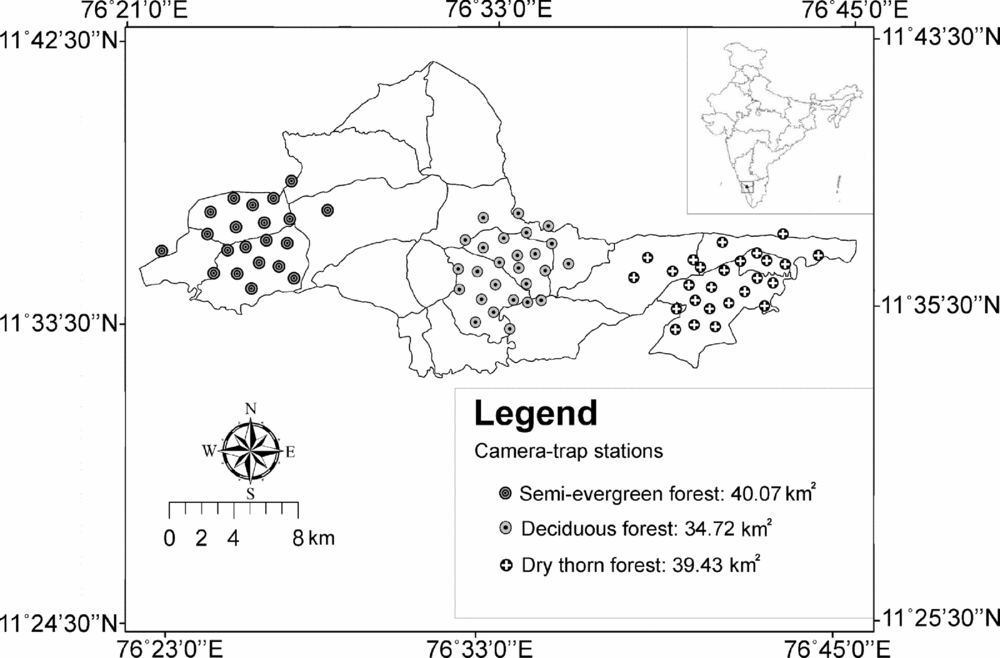
Mudumalai Tiger Reserve (11°32′–11°43′N; 76°22′–76°45′E) is a Protected Area with comparatively minimal human disturbance (Figure 1). This 321-km2 reserve is part of a large contiguous forest tract with Wayanad Wildlife Sanctuary to the north-west, Bandipur Tiger Reserve in the north, in the south and the east with Singara and Sigur Reserved Forests forming the boundary of the Nilgiri North Division. The vegetation includes tropical dry thorn forest, tropical dry deciduous forest, tropical moist deciduous forest, tropical semi-evergreen, moist bamboo brakes and riparian fringe forests (Champion & Seth Reference CHAMPION and SETH1968). Deciduous forests are characterized by a tree canopy layer (~ 10–25 m high) comprising Tectona grandis L., Anogeissus latifolia DC., Lagerstroemia microcarpa Wt. and Syzygium cumini L. Semi-evergreen forests are characterized by a tree canopy layer (20–30 m high) comprising Syzygium cumini, Olea dioica Roxb. and Bischofia javanica Bl. The dry thorn forest is defined by a ground layer of shrubs (~ 3–5 m) with sparse woody plant cover largely comprising Ziziphus spp., Anogeissus latifolia and Erythroxylum monogynum Roxb. The terrain is undulating, interspersed with hills, valleys, ravines, water courses and swamps. Altitude ranges from 960 to 1266 m asl. The climate is monsoonal with dry season (January–April), first wet (May–August) and second wet (September–December) seasons. A variety of land-use practices and disturbances prevail such as human settlements, cultivation, livestock grazing, and extraction of fuel wood and non-timber forest products.
Camera-trap locations for recording small carnivores in Mudumalai Tiger Reserve, India (2010 and 2011).

Field sampling
The camera-trap surveys were designed to photo-capture terrestrial small carnivores. We selected 114 km2 of study area which was divided into three sampling zones; deciduous (covering c. 35 km2), semi-evergreen (c. 40 km2) and dry thorn forest (c. 39 km2) such that each zone represents the core of the broader habitat types to conduct camera trap surveys for 2 y (2010–2011). Sampling area selection was based on representativeness of forest types and low human presence to minimize the loss of cameras. We used the geographical information system ArcView v. 3.2 (ESRI, Redlands, CA, USA) to calculate the three sample areas. The camera trap surveys were conducted in the dry and wet season in deciduous and dry thorn forest, while the semi-evergreen forest could be sampled only in the dry season due to logistic constraints and inaccessibility during the wet season. We divided the survey area into a 1-km2 grid and systematically chose camera locations based on preliminary sign surveys of their tracks, scat deposits, carcasses and sightings from interviews of local people and forest guards. We selected the most suitable camera locations (along trails, forest roads, near stream beds, around water holes, near potential fruiting trees and near termite mounds) which were likely to trap small carnivores. We deployed passive-infrared camera traps Deer-cam DC300 (Non Typical, Inc., Park Falls, Wisconsin, USA), Stealthcam (Bedford, Texas, USA) and Moultrie Game Spy D-40 digital trail cameras (Moultrie Feeders, Alabaster, Alabama, USA) along suitable sites. Stations consisted of two passive-infrared cameras mounted opposite each other. A pair of skilled Kurumba trackers also assisted in identifying suitable camera-trap locations especially to detect civets. Every year we deployed 25 camera trap stations in the deciduous forest, 21 in the semi-evergreen forest and 26 in the dry thorn forest. Each of the forest types were sampled for 30 d. The distance between neighbouring stations averaged 1.17 km (SD = 0.21 km, N = 72). Cameras were approximately 25 cm above the ground and set to be active for 24 h a day and no bait or lure was used at any location to attract animals. The photo-capture delay was set to 1 min and sensitivity was set to high. Sampling stations were checked on average every 3 d to ensure continued operation and the batteries and film were replaced when necessary. More details on capture success, trapping effort and number of camera-stations occupied by small carnivores for dry and wet seasons can be found in Kalle et al. (Reference KALLE, RAMESH, QURESHI and SANKAR2013a, Reference KALLE, RAMESH, SANKAR and QURESHIb).
Data analysis
Photographs provided information on date and time of the picture taken. We calculated the latency to initial detection (LTD; Foresman & Pearson Reference FORESMAN and PEARSON1998), defined as the time (d) from camera deployment until initial detection of a species at a station using camera trap data. Mean LTD was calculated to draw comparisons between seasons and forest types. This metric was used to evaluate the effectiveness of cameras to capture rare or elusive carnivores.
MacKenzie et al. (Reference MACKENZIE, NICHOLS, LACHMAN, DROEGE, ROYLE and LANGTIMM2002) developed a model to estimate site occupancy and detection probability based on repeated presence–absence data from multiple sites. Royle & Nichols (Reference ROYLE and NICHOLS2003) extended this model to allow for abundance-induced heterogeneity. Capture histories developed for each location consisted of a string of 10 trapping occasions by pooling three successive days into one trapping occasion (e.g. 1–3 d = first trapping occasion, 4–6 d = second trapping occasion and so on). For each occasion the target species could score a 1 or a 0, where 1 indicates that the animal was captured at the sampling station during that trapping occasion (at least one of the three days) and 0 if it was not captured. This was necessary in order to increase the probability of capture and to make it > 0.10 per trapping occasion, as recommended by Otis et al. (Reference OTIS, BURNHAM, WHITE and ANDERSON1978) and White et al. (Reference WHITE, ANDERSON, BURNHAM and OTIS1982).
To identify habitats that influence small-carnivore occupancy and abundance we constructed competing models representing various hypotheses pertaining to important influences on carnivore habitat use, as suggested in previous studies (Joshi et al. Reference JOSHI, SMITH and CUTHBERT1995, Mudappa Reference MUDAPPA2001, Mudappa et al. Reference MUDAPPA, NOON, KUMAR and CHELLAM2007, Nixon et al. Reference NIXON, RAO, KARTHIK, ASHRAF and MENON2010). We implemented single-season and heterogeneity models (MacKenzie et al. Reference MACKENZIE, NICHOLS, LACHMAN, DROEGE, ROYLE and LANGTIMM2002, Royle & Nichols Reference ROYLE and NICHOLS2003) using program Presence 4.1 (http://www.mbrpwrc.usgs.gov/software/presence.html) with species-level detection histories developed for each camera trap location. Single-season models provide estimates of occupancy ψ (probability of occurrence) and detection probability p (the probability that a species will be detected if truly present) (MacKenzie et al. Reference MACKENZIE, NICHOLS, LACHMAN, DROEGE, ROYLE and LANGTIMM2002). Occupancy estimates will still be less biased than models that do not include heterogeneity therefore the idea behind the Royle & Nichols (Reference ROYLE and NICHOLS2003) model is that site-specific detection probabilities vary due to differences in the number of individuals present at each site and these abundances can be modelled based on repeated presence-absence data. This model provides estimates of parameters λ and r, defined as average abundance per site and inherent detection probability, respectively (Royle & Nichols Reference ROYLE and NICHOLS2003). Here λ is interpreted as the expected number of individuals per sample unit. In this model, the occupancy ψ is not directly estimated and has to be derived from λ, the average number of individuals at each site as ψ = 1 − e − λ. The model assumes that populations are closed and that individuals are distributed in space according to a Poisson process. If these assumptions are violated, the estimated parameters should not be interpreted as abundance but rather as a random effect (MacKenzie et al. Reference MACKENZIE, NICHOLS, ROYLE, POLLOCK, BAILEY and HINES2006). We incorporated site-specific habitat covariates that included presence or absence of major habitat types; dry thorn (DTF), deciduous (DEC) and semi-evergreen (SEV) forests to predict λ and ψ. Models were run for every dry and wet season separately for 2010 and 2011. The potential covariates for occupancy and abundance were allowed to vary, individually or combined. Finally, the simplest models, where occupancy and detection probability ψ(.),p(.) and detection probability and average abundance r(.),λ(.) remained constant, was produced. We obtained 95% confidence intervals for modelling procedures. Multiple models were explored and by ranking these models using an information-theoretic approach, we examined the relative support and strength of evidence for each model. The information criterion used is Akaike's Information Criterion (AIC) which uses maximized log-likelihood to estimate the information distance between the best approximating model and the true generating mechanism. Because the ratio of sample sizes (n) to the maximum number of estimated parameters (k) was < 40, we ranked models according to AICc (AIC adjusted for small sample size). Models with ΔAICc values ≤2 from the most parsimonious model were considered to be strongly supported, and their variables were considered the most determinant of species occurrence and abundance patterns. We addressed cases of poor model fit (i.e. the model chi-square value was >95% of the bootstrap values) by estimating an overdispersion factor (ĉ), inflating standard errors by a factor of √ĉ and using a quasi-corrected AICc (QAICc) for model selection (Burnham & Anderson Reference BURNHAM and ANDERSON2002). Model-averaged parameters were calculated using Akaike weights (w) for proportion of sites used and detection probabilities. To infer the relative influence of each covariate on occurrence, model weights (wi) were summed over all models containing the particular covariate. A model averaging technique was applied to estimate occupancy and abundance when there were several top-ranked candidate models. The model-averaged parameter (β) defined as the untransformed estimates of coefficients for covariates were used to describe the influence of habitat type (positive or negative) on small-carnivore species in our models. The most parsimonious models for the observed data were used to estimate the final carnivore specific occupancy and abundance (and associated standard errors (SEs)).
RESULTS
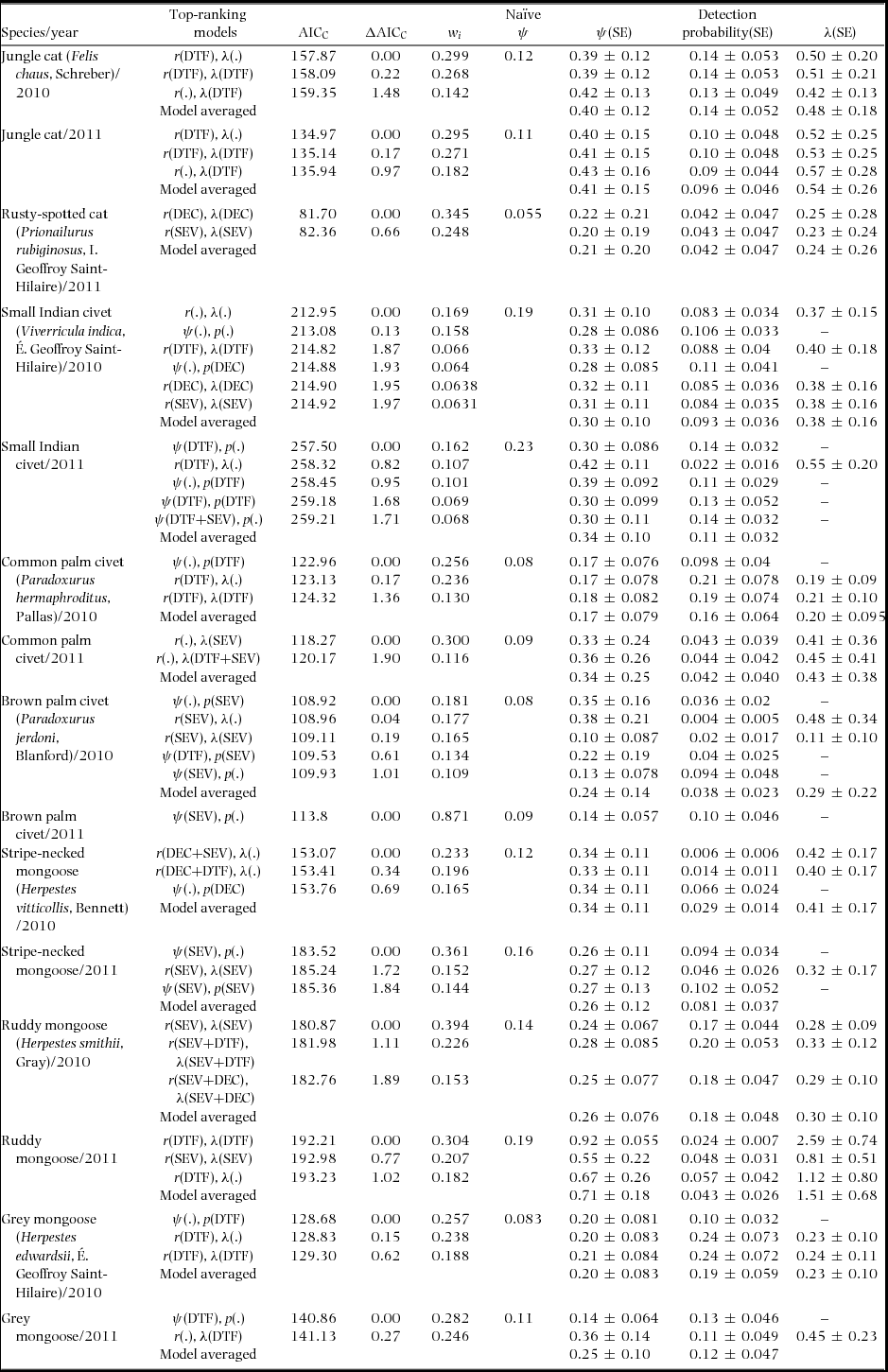
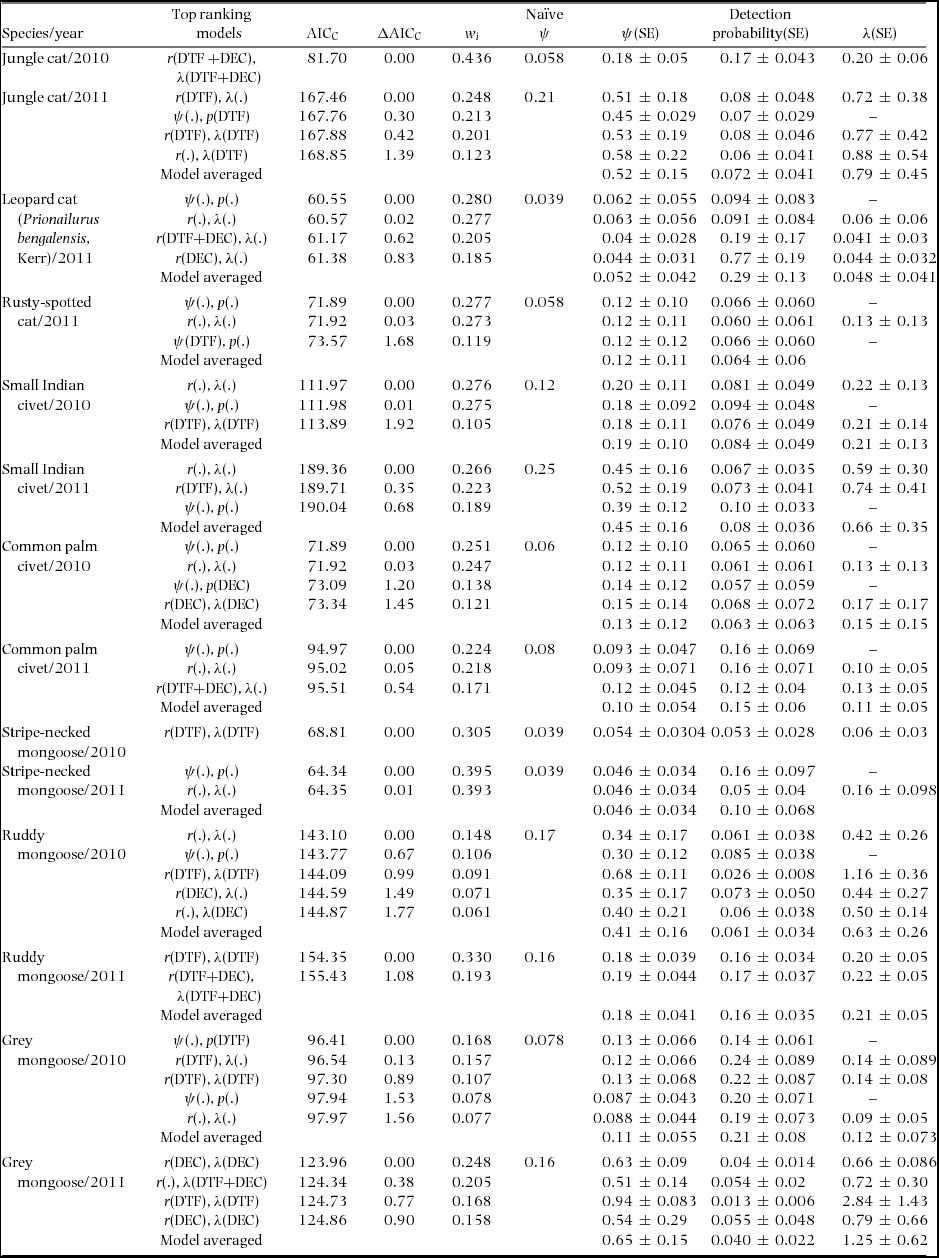
Trapping effort amounted to 750 trap nights in the deciduous forest in the dry and wet seasons each, 780 trap nights in the dry thorn forest (both seasons each) and 630 trap nights in the semi-evergreen forest for the dry season only, thus the total effort amounted to 7380 trap nights yielding 448 photographs of nine species of small carnivore. In the dry season, the average naïve occupancy of 2010 and 2011 ranged from 0.048 for rusty-spotted cat to 0.21 for small Indian civet (Appendix 1). In the wet season, the average naïve occupancy of both years ranged from 0.039 for stripe-necked mongoose to 0.18 for small Indian civet (Appendix 2).
Latency to initial detection
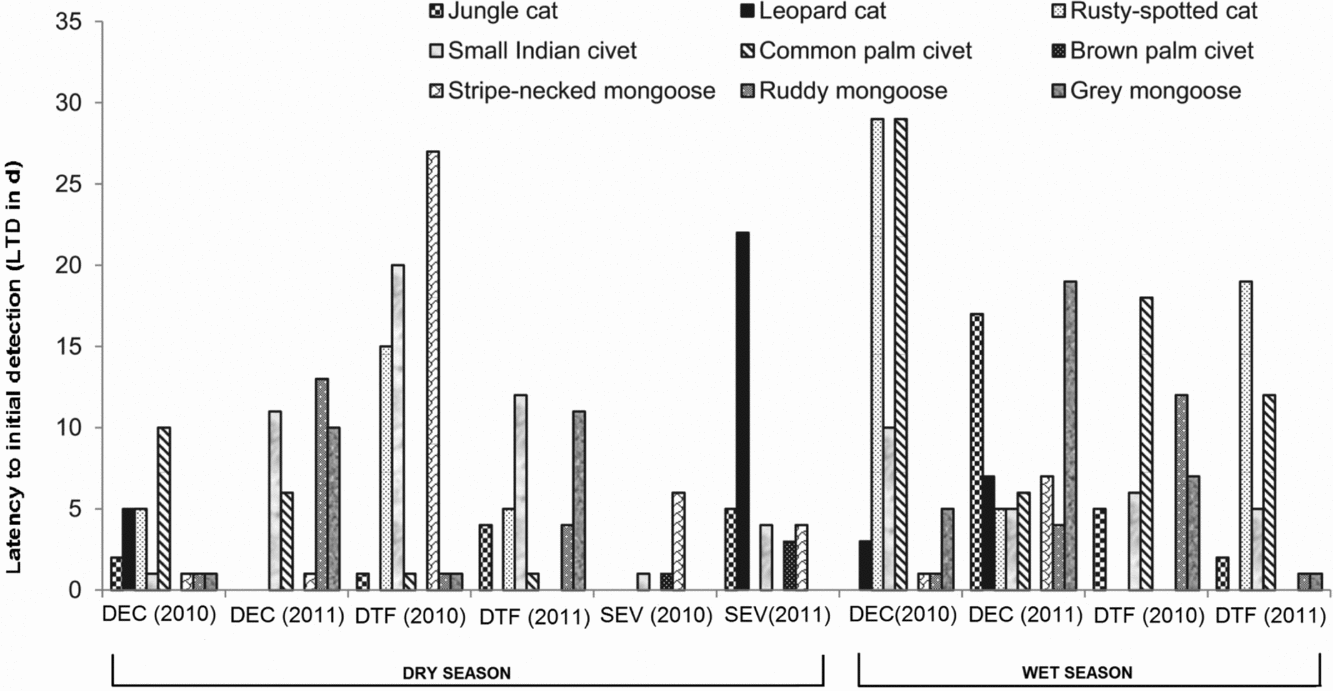
When we took the average latency of both years, we found significant differences across seasons and forest types, and between seasons within forest type (Figure 2). Mean latency for jungle cat was significantly higher in the wet season of deciduous forest (mean LTD = 8.5) than in the dry season (mean LTD = 1). Mean latency for jungle cat was similar in thorn and semi-evergreen forest for the dry season. Mean latency for leopard cat was significantly higher in the semi-evergreen (mean LTD = 11) forest than in deciduous forest (mean LTD = 5). There was a wide variation in the mean latency between seasons in deciduous forest for rusty-spotted cat (mean LTD = 2.5 in the dry season and 17 in the wet season). In the dry season, mean latency for small Indian civet was higher in thorn forest (mean LTD = 16) than deciduous forest (mean LTD = 6) and also differed greatly between seasons in the former. Mean latency for common palm civet differed between seasons within thorn (mean LTD = 1 in dry season and 15 in wet season) and deciduous forests (mean LTD = 8 in dry season and 18 in wet season). For stripe-necked mongoose mean latency was significantly higher in the thorn forest (mean LTD = 13.5) than in deciduous forest (mean LTD = 1) in 2010. There was not much variation in the mean latency between seasons and habitat types for ruddy mongoose. For grey mongoose mean latency was significantly higher in the wet season of deciduous forest (mean LTD = 12) than dry season (mean LTD = 5.5) and the thorn forest (mean LTD = 6 in dry season and 4 in wet season).
Latency to initial detection (LTD in d) of small carnivores across dry and wet seasons (2010 and 2011) in dry thorn (DTF), deciduous (DEC) and semi-evergreen forests (SEV) in Mudumalai Tiger Reserve, Western Ghats, India. Note that missing data in a particular habitat for the survey period indicates the species was not camera-trapped.
Influence of habitat on carnivore abundance and occupancy
The top-ranked models for jungle cat included the thorn forest showing a positive relationship with abundance; β = 3.45 ± 0.93 in 2010 and β = 3.19 ± 0.97 in 2011 for dry season and β = 1.59 ± 0.30 in 2010 and β = 1.88 ± 0.82 in 2011 for the wet season. Due to low sample size, models for rusty-spotted cat did not converge for the 2010 data (both seasons), therefore inferences were drawn from 2011. The top-ranked model for rusty-spotted cat in the dry season (2011) had deciduous forest with a positive relationship with abundance (β = 1.34 ± 1.1, Appendix 1). For the wet season (2011), constant models performed better than covariate models (thorn forest) giving a low average abundance of 0.13 ± 0.13 for rusty-spotted cat (Appendix 2). For small Indian civet in the dry season (2010), constant models performed slightly better than covariate models. In contrast in 2011, thorn forest was the most important covariate in the dry season (∑w = 0.51) showing a negative relationship with occupancy of small Indian civet (β = −1.84 ± 0.93, Appendix 1). Occupancies for small Indian civet were higher in the deciduous forest (0.42 ± 0.11) than in semi-evergreen (0.36 ± 0.13) and thorn forests (0.10 ± 0.08) in decreasing magnitude. In the wet season (2010), the constant heterogeneity model performed better than the covariate model containing thorn forest that showed a negative association with abundance of small Indian civet (β = −1.45 ± 0.64). In 2011, the constant heterogeneity model performed slightly better (w = 0.26) than the covariate model (w = 0.22) that showed that thorn forest had a negative influence on abundance (β = −1.04 ± 0.75, Appendix 2). In the dry season, thorn forest was the most important variable influencing abundance of common palm civet positively (∑w = 0.62, β = 1.15 ± 0.52 in 2010 and β = 0.24 ± 0.68 in 2011) while in 2011, semi-evergreen forest had a negative effect on abundance (β = −30.4 ± 1.86, Appendix 1). For the wet season the constant models performed better (∑w = 0.50 in 2010 and ∑w = 0.44 in 2011) than covariate models for common palm civet that showed the negative effect of deciduous forest on occupancy (w = 0.14, β = −1.83 ± 0.97) and abundance (w = 0.12, β = −1.79 ± 0.99) in 2010 and the negative effect of both deciduous (β = −1.99 ± 0.39) and thorn forest (β = −2.01 ± 0.39) on abundance in 2011 (Appendix 2). Semi-evergreen forest was an important predictor of brown palm civet (∑w = 0.79 in 2010 and ∑w = 0.87 in 2011) showing a positive influence on abundance (β = 2.4 ± 0.94) in 2010, and occupancy for both years (β = 2.94 ± 1.21 in 2010 and β = 27.6 ± 2.86 in 2011, Appendix 1). Deciduous forest was an important covariate influencing abundance of stripe-necked mongoose in the dry season of 2010 (∑w = 0.42, β = 3.29 ± 1, Appendix 1) while in 2011, semi-evergreen forest was the most important predictor (∑w = 0.65) showing a positive association with occupancy (β = 1.96 ± 1.04) and abundance (β = 0.61 ± 0.31). For the wet season (2010), dry thorn forest influenced abundance of strip-necked mongoose negatively (β = −2.58 ± 0.63) while in 2011 none of the covariates influenced occupancy/abundance (Appendix 2). In the dry season (2010), the semi-evergreen forest was an important variable (∑w = 0.77) showing a negative relationship with abundance of ruddy mongoose (β = −0.50 ± 0.33) while in 2011, thorn forest had a positive influence (∑w = 0.49, β = 0.95 ± 0.29, Appendix 1). In the wet season (2010), the constant heterogeneity model was the top-ranked model for ruddy mongoose and in 2011, thorn forest was the best predictor of abundance (∑w = 0.52, β = 0.51 ± 0.44, Appendix 2). In the dry season, thorn forest was the most important variable for grey mongoose (∑w = 0.68 in 2010, ∑w = 0.53 in 2011), with a positive influence on abundance (β = 2.6 ± 1.83 in 2010, β = 2.64 ± 1.07 in 2011, Appendix 1). For the wet season of 2010, thorn forest was the most important variable (∑w = 0.43) with a positive effect on abundance of grey mongoose (β = 1.74 ± 1.02) while in 2011, deciduous forest had a negative impact on abundance (β = −1.3 ± 0.69) and thorn forest had a positive effect (β = 1.04 ± 0.50, Appendix 2).
Seasonal differences in abundance and occupancy
After accounting for the detection probability, the estimated average occupancy (average of both years) of jungle cat was 0.4 ± 0.13 in the dry season and 0.35 ± 0.10 in the wet season. In the wet season, average abundance of jungle cat was higher in 2011 (λ mean = 0.79 ± 0.45) than in 2010 (λ mean = 0.20 ± 0.06), while it did not differ between years in the dry season (Appendix 1 and 2). Model-averaged occupancy of leopard cat was marginally higher than the naïve estimate in 2011 so we may have failed to detect the species in other potential sites where it could have been present. Due to low sample size of leopard cat, models did not converge for the dry and wet season of 2010 hence inferences were drawn from 2011 data (wet season). Average abundance of leopard cat was low (λ mean = 0.048 ± 0.041) and the constant single-season model performed better than heterogeneity models (Appendix 2). Model-averaged occupancy of rusty-spotted cat was higher in the dry season (ψ mean = 0.21 ± 0.20) than wet season (ψ mean = 0.12 ± 0.11). Model-averaged occupancy of small Indian civet across seasons (0.32 ± 0.1) was higher than naïve estimates. Overall average abundance of small Indian civet was similar across seasons; λ mean = 0.46 ± 0.18 in the dry season and 0.43 ± 0.24 in the wet season. Model-averaged occupancy and abundance of common palm civet were higher in 2011(ψ mean = 0.34 ± 0.25, λ mean = 0.43 ± 0.38) than in 2010 for the dry season while there was no difference between years in the wet season (average of both years, ψ mean = 0.11 ± 0.087 and λ mean = 0.13 ± 0.1). Occupancy and abundance of brown palm civet were not comparable between seasons as it was not camera-trapped in the wet season hence inference was drawn from the dry season. Modelled occupancy of brown palm civet varied marginally between years (ψ mean = 0.24 ± 0.14 in 2010 and ψ = 0.14 ± 0.057 in 2011). Modelled occupancy of stripe-necked mongoose was marginally higher than naïve estimate in the wet season suggesting that we may have failed to detect stripe-necked mongoose in other potential sites where it could have been present but it was significantly higher than estimates for dry season. Occupancy and abundance (average of both years) of stripe-necked mongoose was higher in the dry season (ψ mean = 0.3 ± 0.11 and λ mean = 0.36 ± 0.17) than in the wet season (ψ mean = 0.05 ± 0.032 and λ mean = 0.11 ± 0.064). Modelled occupancies of ruddy mongoose in the dry season of 2011 (ψ mean = 0.71 ± 0.18) and wet season of 2010 (ψ mean = 0.41 ± 0.16) were significantly higher than naïve estimates.
Model-averaged abundance of ruddy mongoose in both seasons was higher in 2010 than 2011 while average abundance was higher in the dry season (λ mean = 0.90 ± 0.40) than in the wet season (λ mean = 0.42 ± 0.18). Average abundance (average of both years) of grey mongoose was higher in the wet season (λ mean = 0.68 ± 0.35) than dry season (λ mean = 0.34 ± 0.16). However, average abundance was higher in 2011 (λ mean = 0.45 ± 0.23 in dry season, λ mean = 1.25 ± 0.62 in wet season) than in 2010 (λ mean = 0.23 ± 0.10 in dry season, λ mean = 0.12 ± 0.073 in wet season).
DISCUSSION
Our study showed that occupancy and abundance of most of the small carnivore species varied across habitat types and seasons indicating spatio-temporal variation in species distribution. Confidence intervals for most species were large, probably a consequence of small sample size of captures. The mean latency to first detection indicated that cameras need to be in the field for more than 30 d in the dry thorn forest for stripe-necked mongoose, in the semi-evergreen forest for leopard cat and in the deciduous forest for rusty-spotted cat, common palm civet and grey mongoose to achieve adequate capture probabilities. This could also be explained by varying habitat preferences and overall rarity of species in the particular habitat. Based on responses to habitat covariates our a priori predictions were found true for most small carnivores, except for rusty-spotted cat and leopard cat due to the low sample size. The higher abundance of rusty-spotted cat in deciduous forests of Mudumalai could be an indication of a relatively suitable habitat to fulfil semi-arboreal habits of this cat, although this relationship will have to be interpreted cautiously due to the relatively low sample size of captures coupled with high standard errors in our estimates which also warrants excessive search efforts in further surveys on the rusty-spotted cat. The lack of records and no covariate effects for leopard cat was probably due to its rarity and elusiveness in the study area demanding more sites to be sampled or multiple detection methods to be applied.
In the heterogeneous forests of Mudumalai, small carnivores could be categorized into four types from modelled species-habitat relationships: close-forest specialist (brown palm civet); moderately close forest (stripe-necked mongoose); moderately open forest specialist (rusty-spotted cat); open-forest specialist (jungle cat, common palm civet, grey mongoose, ruddy mongoose) and generalist (small Indian civet). Open-forest specialists increased their abundance in dry thorn forest, moderately open forest specialists in dry thorn and deciduous forest, moderately close forest specialist in deciduous and semi-evergreen forest and close-forest specialist in semi-evergreen forest. Although small carnivores are often perceived to be habitat generalists and opportunists, our predictions show that at the regional scale the three groups of small carnivore, except for small Indian civet clearly showed an inclination to increasing occupancy and abundance in specific habitats. According to theory, a generalist can co-occur with specialists and this holds true for small Indian civet since it appeared to be the most widespread in terms of relative occupancy of all small carnivores.
According to the habitat selection theory, one habitat will consistently support a greater density of species than the other (Morris Reference MORRIS1992). Qualitative differences (e.g. differences in habitat structure or kinds of resource that influence foraging efficiency) imply that species are efficient in extracting resources and become descendants in the habitat (Morris Reference MORRIS1988). Small carnivores in Mudumalai were able to recognize quantitative and qualitative differences in habitats and then make a choice. In this case, open-forest specialists might thus profit from a variety of primary resources (easier-to-catch animal prey such as rodents) available on the forest floor, and rather populate in open forests such as the dry thorn forests. For the strictly arboreal species like the brown palm civet, the canopy layers must offer resources, mainly fruits for frugivorous mammals, hence the semi-evergreen forest is the most resource-rich for this species. Moreover, the thorn and semi-evergreen forests offer a large number of fruiting trees with greater fruiting tree diversity than deciduous forests, thereby supporting both species of palm civets, respectively. There is a noteworthy difference concerning the relationship between arboreal, semi-arboreal and terrestrial species assemblages, indeed it appears that each of the three habitats and/or a combination of habitats were exploited by species of the three assemblages (with exceptions). Most terrestrial carnivores (except for stripe-necked mongoose and small Indian civet) benefited from dry open forests, semi-arboreal carnivores from open to moderate canopy cover and the strictly arboreal carnivore profited from maximum canopy cover. Therefore, spatio-temporal dynamics in habitat occupancy by the three carnivore assemblages can be related to species ecological traits such as habitat preference, foraging type and taxonomic affiliation.
The inter-annual variation as well as seasonal variation in abundance of jungle cat, common palm civet, small Indian civet, stripe-necked mongoose, ruddy mongoose and grey mongoose could be related to changes in resource abundance, shifts in habitat use or other non-measured biotic/abiotic factors such as competition with dominant predators, suggesting that future studies on population monitoring must be continued over time taking these unmeasured variables into account. Perhaps, the absence of covariate effects on some species in the wet season could indicate sufficient distribution of trophic resources in turn reflecting the spatial distribution of the species. In contrast to our prediction, higher abundance of grey mongoose in the wet season might be correlated with its breeding period, although we need substantial proof for validation. Given the elusive nature of the small carnivore assemblage there are a few methodological considerations and limitations in our research. For instance, variation in the efficiency and capability to record species presence/absence among different models of camera traps can influence our results. Therefore, the use of these different brands of cameras would have influenced our main findings. In future studies, it would be preferable to estimate densities using actual home range of small carnivores from the region of concern. For some like the lesser cats, home range could exceed the subunit area sampled. Despite intensive search efforts, low detection probabilities (0.029–0.21) presented particular difficulties in monitoring cryptic small carnivores, thus limiting the reliability of occupancy estimates in our study (MacKenzie et al. Reference MACKENZIE, NICHOLS, LACHMAN, DROEGE, ROYLE and LANGTIMM2002). For example, civets being strictly arboreal and semi-arboreal would require multiple cameras at a station including placement of cameras at potential fruiting trees/den sites (Kalle et al. Reference KALLE, RAMESH, SANKAR and QURESHI2013b). For future surveys (e.g. camera trap placements) it is better to cover large sample areas and reduce the inter-trap distance to produce precise occupancy estimates.
The application of our modelling approach enabled the identification of suitable areas for a neglected group of carnivores. Our modelling efforts suggest that temporal replication could provide opportunities to develop better models of species distribution. Future monitoring should consider methods of abundance estimation comparing datasets of mark-recaptured and unmarked individuals for revalidation. Indeed, the observation of differential occupancy of habitat types by multiple species and the apparent interaction with co-occurring species suggests that interspecific differences in abundance may serve to enhance habitat selection. The changes in small carnivore density highlights the close relationship between these species and the vegetation structure and suggests that effective management of this assemblage could be achieved by careful management of the habitat structure. Management should aim at maintaining the habitat heterogeneity of southern tropical forests, as any management regime which reduces the habitat diversity would probably result in a decrease in the diversity of small carnivores. Further studies are needed to understand the intra-guild relationships, niche separation of carnivores across forests subject to different management regimes or disturbance gradients in other reserves of the Western Ghats.
ACKNOWLEDGEMENTS
The authors would like to thank the Director and Dean, Wildlife Institute of India (WII) and the Chief Wildlife Warden, Tamil Nadu for granting research permission in Mudumalai as a part of the project, ‘A study on sympatric carnivores in Mudumalai Tiger Reserve’. Financial support for the research was provided by the Wildlife Institute of India. We are grateful to the editor and an anonymous reviewer for useful comments on the manuscript. We thank our field assistants C. James, M. Kethan, M. Mathan and the forest department officials for their assistance during fieldwork.
The top-ranking models for predicting abundance and occupancy of small carnivores based on camera-trap data in the dry season of Mudumalai Tiger Reserve, India. Parameters r and λ are defined in Royle & Nichols (Reference ROYLE and NICHOLS2003) as inherent detection probability and average abundance per site, p is detection probability and site occupancy (ψ) with associated mean standard error (± SE). Information presented for each model includes dry thorn forest (DTF), deciduous forest (DEC), semi-evergreen forest (SEV), AICC which is the small-sample size correction to AIC or QAICC (quasi-corrected AICC with overdispersed data), ΔAICC(AICc – min AICc), wi is the AIC weight for model i, and (.) convention indicates constant across all sites.
The top-ranking models for predicting abundance and occupancy of small carnivores based on camera trap data in the wet season of Mudumalai Tiger Reserve, India. Parameters r and λ are defined in Royle & Nichols Reference ROYLE and NICHOLS2003 as inherent detection probability and average abundance per site, respectively; p is detection probability and site occupancy (ψ) with associated mean standard errors (± SE). Information presented for each model includes dry thorn forest (DTF), deciduous forest (DEC), semi-evergreen forest (SEV), AICC which is the small-sample size correction to AIC or QAICC (quasi-corrected AICC with overdispersed data), ΔAICC(AICc – min AICc), wi is the AIC weight for model i, and (.) convention indicates constant across all sites.