After its first description in 1971,Reference Fontan and Baudet 1 the creation of a circulation according to the Fontan principle has undergone various modifications and has made possible the treatment of a large number of patients with functionally univentricular hearts. Most centres currently perform total cavopulmonary connection by creating a lateral tunnel in the atrium or by using an extracardiac conduit with good short-term results.Reference Dabal, Kirklin and Kukreja 2 Extending the indications for the Fontan operation inevitably leads to a larger number of borderline patients with haemodynamic instability in the early postoperative period.Reference Ovroutski, Sohn and Baribkin 3 , Reference Hosein, Clarke and McGuirk 4 The postoperative management of these patients is challenging, as the conventional measures for haemodynamic optimisation are often ineffective in the Fontan circulation.Reference Gewillig, Brown and Eyskens 5 The theoretical importance of spontaneous breathing for this type of haemodynamics was hypothesised by Fontan in his first reportReference Fontan and Baudet 1 and was confirmed by others.Reference Penny and Redington 6 – Reference Fogel, Weinberg and Hoydu 8 The first report on early extubation of a small group of patients after Fontan-type operation was published in 1980,Reference Schuller, Sebel, Bovill and Marcelletti 9 and subsequently there were a number of clinical studies about early extubation in selected stable patients.Reference Lofland 10 – Reference Morales, Carberry, Heinle, McKenzie, Fraser and Diaz 12 The present study aimed to investigate the feasibility and possible benefits of early extubation in an unselected group of patients after total cavopulmonary connection, including the haemodynamically unstable ones. By hypothesising that institution of spontaneous ventilation can be a management tool for circulatory instability after the Fontan operation, we investigated the immediate haemodynamic effects of extubation in a group of unstable patients.
Materials and methods
We retrospectively investigated all patients who had undergone Fontan operations in our centre between 2004 and 2013. The study protocol was reviewed by the Ethics Committee in our institution and the need for informed consent was waived.
Surgery
The surgical strategy for creating extracardiac non-fenestrated total cavopulomonary connection in our institution has been published elsewhere.Reference Schreiber, Hörer, Vogt, Cleuziou, Prodan and Lange 13 All operations were performed under cardiopulmonary bypass; aortic cross-clamping was performed only when additional procedures were performed. A non-ringed polytetraflourethylene tube was used as the extracardiac conduit between the inferior caval vein and the pulmonary artery. Our policy did not involve creation of a fenestration routinely.
Anaesthesia and ICU treatment
Intraoperatively, short-acting opioids such as sufentanyl and remifentanyl with small doses of benzodiazepines were preferred. The patients were transferred to the ICU unit under an infusion of propofol (1–2 mg/kg/hour), which was terminated when extubation was aimed. All patients regularly received analgetics – low-dosed morphine (0.05–0.1 mg/kg) and non-steroidal anti-inflammatory drugs and, if needed, midazolam 0.1 mg/kg as a sedative in agitated patients. The catecholamine and volume management was guided by the haemodynamic status of the patients, the echocardiographic findings, the judgement of the attending anaesthesiologist intraoperatively, and the paediatric cardiologist at the ICU. During the study period, there was a trend towards an increasing use of milrinone (0.3–0.5 µg/kg/minute) for the first 24 hours postoperatively.
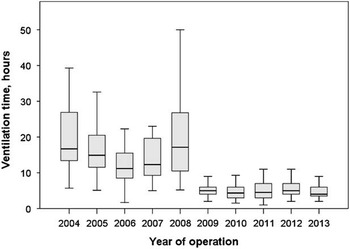
All patients were extubated at the ICU. The timing of extubation of each individual patient was decided by the attending paediatric cardiologist according to the current management policy at the ICU. Our postoperative strategy for ventilating and treating Fontan patients changed in 2009 (Fig 1). Until the end of 2008, a stable circulatory condition additional to effective breathing was required in order to proceed with extubation. Haemodynamic stability was defined as absence of clinical signs of low cardiac output syndrome, such as increased heart rate, worsening acidosis, high lactate levels, increasing inotrope and volume requirements, elevated central temperature, and systemic hypotension.Reference Shekerdemian 14 After 2009, extubation in the first 12 hours postoperatively was the goal, regardless of the haemodynamic status of the patients. The main criterion for discontinuing mechanical ventilation in that period was sufficient spontaneous breathing. When extubation was aimed, propofol infusion was discontinued and, as soon as the patient showed signs of sufficient spontaneous breathing, a short trail of breathing on CPAP or on a modified t-tube system was made. High FiO2 up to 80% before extubation was accepted. If the patient was breathing sufficiently, we proceeded with extubation. After extubation, special care was taken to achieve ongoing analgesia with morphine and/or non-steroidal anti-inflammatory drugs.
Ventilation times in hours after TCPC according to years between 2004 and 2013. Boxes represent median, the low and high quartile, and whiskers indicate the minimum and maximum values.

Study design
The charts of the patients were reviewed, and the postoperative ventilation times, re-intubation rates, and maximal catecholamine doses and volume requirements in the early postoperative period were analysed. The lengths of ICU and hospital stay were also documented. The postoperative ventilation time was defined as the time from arrival at the ICU to the first extubation. If a patient had to be re-intubated, the subsequent ventilation time was not calculated in the analysis. In order to be able to objectify the catecholamine treatment, we used the inotrope score from the study by Wernovsky et al:Reference Wernovsky, Wypij and Jonas 15
 $$\eqalignno{ & {\rm Inotrope}\,{\rm score\,{\equals}\,dopamine}\,\left( {{\rm \mu g/\,kg/minute}} \right){\rm {\plus}} \cr & {\rm dobutamine}\,\left( {{\rm \mu g/kg/minute}} \right){\rm {\plus}100}{\times}\,{\rm adrenaline}\,\cr &\left( {{\rm \mu g/kg/minute}} \right){\rm {\plus}} {\rm 100}\,{\times}\,{\rm noradrenaline}\,\cr &\left( {{\rm \mu g/kg/minute}} \right){\plus}10\,{\times}\,{\rm milrinone}\,\left( {{\rm \mu g/kg/minute}} \right) $$
Volume requirement was defined as the quantity of crystalloids, colloids, and blood product infusions in ml/kg during the first 24 hours at the ICU.
Patients
Between 2004 und 2013, 271 total cavopulmonary connections were performed in our centre. Patients who underwent conversion from another form of Fontan circulation to a total cavopulmonary connection (n=16) or a revision of the venous circuit (n=1) were excluded from the study; one patient had a tracheostomy with preoperative intermittent ventilation requirement and was also excluded.
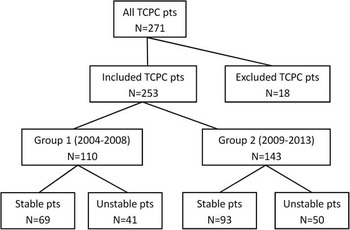
The final study population included 253 patients (Fig 2). The studied patients were divided into two groups according to the year of operation – patients operated on before the end of 2008, and hence extubated according to conventional criteria, comprised group 1, and patients operated on after the beginning of 2009 when extubation was aimed in the first 12 postoperative hours regardless of their circulatory status comprised group 2. Patients from both groups were further divided into two subgroups according to their stability. Unstable patients were defined as those with maximal inotrope scores or volume requirements in the first 24 postoperative hours that exceeded the 75th percentile for these values for the whole group.
Study population, divided into groups according to the year of operation and subgroups according to their hemodynamic stability.

The main hypothesis of this study was that early extubation is possible and haemodynamically beneficial in all patients following the Fontan operation, and thus it can be a valuable tool for optimising the circulation in these patients, especially in the unstable ones. First, we compared the re-intubation rates, volume requirements, and inotrope scores between the patients from groups 1 and 2 – for example, before and after changing the extubation strategy – and analysed the reasons for ventilating patients longer than 12 hours in group 2. Next, we aimed to analyse whether the new extubation strategy was possible in the unstable patients as well and how it affected their outcomes. Therefore, we compared the ventilation times and re-intubation rates of the unstable patients from each group with values of the stable patients from the same group and also the outcomes of the unstable patients from group 1 with the outcomes of the unstable patients from group 2. In addition, we studied the reasons for the re-intubations among unstable patients from group 2. In order to investigate the effects of extubation in the unstable patients, we analysed the changes in certain parameters of the unstable patients from group 2 at defined time points relative to the extubation. The chosen parameters were mean arterial blood pressure, mean cavopulmonary pressure, inotrope score, volume requirement, partial carbon dioxide pressure, and arterial saturation, and the time points analysed were initially after admission to the ICU, 2 and 1 hours before extubation, and at the 1st, 2nd, 6th, 12th, and 24th hour after extubation.
Statistics
Continuous variables are presented as medians with interquartile ranges, and categorical variables are presented as number of patients and relative frequencies. Comparisons of data of patients from groups 1 and 2 and between the stable and unstable patients were performed using the Mann–Whitney test for continuous variables and the χ2-test for categorical variables. The changes in the recorded variables of the unstable patients from group 2 between two time points were analysed using the Wilcoxon signed-ranks test. The statistical analysis was performed using SPSS v16.0 software, and p⩽0.05 was considered to be statistically significant.
Results
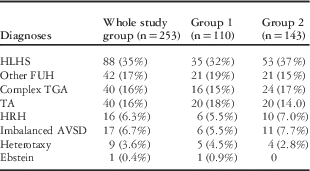
The present study included 253 patients. Their diagnoses are presented in Table 1. In all patients, the total cavopulmonary connection was performed using an extracardiac conduit – 16 mm in four (1.6%), 18 mm in 230 (91%), 20 mm in 15 (5.9%), and 22 mm in four (1.6%) patients. Additional surgical procedures were performed in 30 (12%) patients and included atrioventicular valve plasty in 17 (6.7%) patients, pulmonary artery plasty in 10 (4.0%), atrioseptectomy in two (0.8%), and aortic arch plasty in one (0.4%) patient. In five patients (2.0%), a fenestration was made. Among all, three patients died, which accounts for an overall mortality of 1.2%. In none of the expired patients was death directly associated with extubation or complications surrounding re-intubation.
Diagnoses of the included patients.

AVSD=atrioventricular septal defect; FUH=functionally univentricular heart; HLHS=hypoplastic left heart syndrome; HRH=hypoplastic right heart; TA=tricuspid atresia; TGA=transposition of the great arteries
Comparison between groups 1 and 2
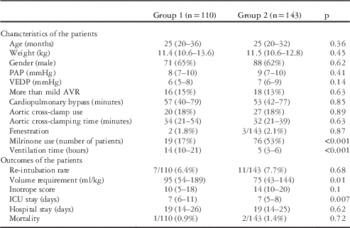
Patients who were operated on before the end of 2008 were included in group 1 (n=110), and patients who were operated on after 2009 were included in group 2 (n=143). Apart from the increased milrinone use and the shorter ventilation times in group 2, there were no other significant differences in the characteristics of the patients from both groups. Patients from group 2 needed significantly less volume and stayed for shorter durations in the ICU. There were no significant differences in mortality or re-intubation rates between both groups. Comparison of the characteristics and the outcomes of patients from both groups are presented in Table 2.
Characteristics and outcomes of the patients from both groups.

AVR=preoperative atrioventricular valve regurgitation; PAP=preoperative pulmonary arterial pressure; VEDP=preoperative ventricular end-diastolic pressure
Data are presented as medians with interquartile ranges
Indications for longer ventilation in group 2
After the change of extubation strategy in 2009, four patients were ventilated for >12 hours before their first extubation. In one patient, the sternum was left open after a long and complex surgical procedure. In another patient, the postoperative course was complicated with bleeding, requiring surgical chest re-exploration for haemostasis, which delayed extubation. In one hypoxaemic patient, urgent cardiac catheterisation with interventional veno–venous collateral closure was performed in the first few postoperative hours. He developed cardiac arrest and had to be resuscitated during the procedure, and therefore therapeutic hypothermia requiring mechanical ventilation was instituted for the following 36 hours. The last patient was extubated 36 hours after the operation because of poor haemodynamic status. This patient had to be re-intubated and underwent left pulmonary artery stenting, which led to stabilisation.
Comparisons between stable and unstable patients from both groups
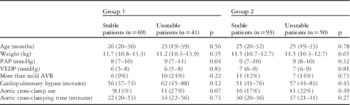
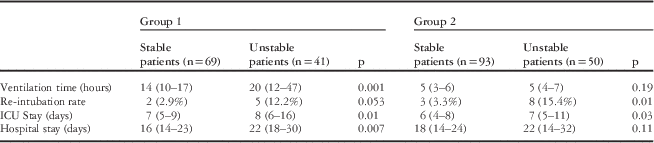
The definition of unstable patients – for example, exceeding the 75th percentile for volume (189 ml/kg for group 1 and 144 ml/kg for group 2) or for inotrope score (18 for group 1 and 20 for group 2) – was met by 41 patients from group 1 and by 50 patients from group 2. Comparison of the preoperative and intraoperative characteristics of the stable and unstable patients from both groups is presented in Table 3. Outcomes of patients from the four subgroups are presented in Table 4. In group 1, the unstable patients had longer ventilation times (p=0.001), longer ICU (p=0.01) and hospital stays (p=0.007), and a tendency towards higher re-intubation rates (p=0.053) compared with the stable patients from the same group. In group 2, there were no significant differences in ventilation times (p=0.19) and hospital stay durations (p=0.11) between the stable and the unstable patients, but the unstable patients stayed longer in the ICU (p=0.03) and needed significantly more re-intubations (p=0.01). Compared with the unstable patients from group 1, the unstable patients from group 2 had shorter ventilation times (p<0.001), similar re-intubation rates (p=0.66), needed less volume [177 (102–227) versus 267 (151–532) ml/kg, p=0.006], and had comparable inotrope scores [22 (18–26) versus 21 (12–33) p=0.78] and ICU (p=0.06) and hospital stay (p=0.85) durations.
Comparison of the preoperative and intraoperative characteristics of the stable and unstable patients from groups 1 and 2.

AVR=preoperative atrioventricular valve regurgitation; PAP=preoperative pulmonary arterial pressure; VEDP=preoperative ventricular end-diastolic pressure
Outcomes of patients from both groups, divided into subgroups according to their stability.

Data are presented as medians with interquartile ranges
Indications for re-intubation in unstable patients from group 2
From group 2, eight unstable patients had to be re-intubated. In three patients, haemodynamic stabilisation was noted after extubation, but they had to be re-intubated for respiratory reasons. In two patients, additional mechanical ventilation due to insufficient spontaneous breathing was needed – in one associated with sedation for pleural drainage insertion and in the other probably due to lasting anaesthetic effects after surgery at the time of extubation. Both patients were extubated 7 hours after their re-intubations. Another patient had respiratory insufficiency because of atelectasis, resolving after re-intubation with ventilation for 12 hours. In addition, three patients had to be re-intubated because of profound haemodynamic instability – one patient developed pericardial tamponade and was re-intubated for surgical exploration and successfully extubated 5 hours after the procedure, and the other two patients were stabilised after additional interventions. Among them, one underwent pulmonary artery stenting and was extubated successfully 4 hours after the catheterisation. The other patient underwent secondary fenestration and needed ventilation for four additional days because of neurological complications. Both patients, who died, account for the other two re-intubations, one of them being re-intubated before extracorporeal membrane oxygenation (ECMO) cannulation and the other one during haemodynamic deterioration, resulting in multi-organ failure.
Extubation effects in unstable patients from group 2
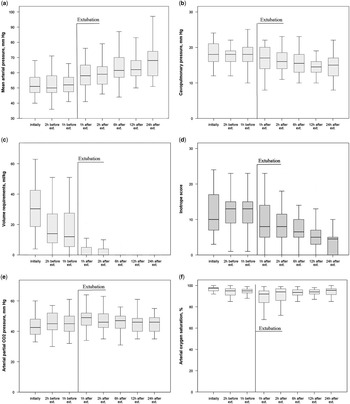
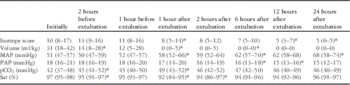
We included 50 patients for this analysis. With extubation, we observed acute elevation in mean arterial pressure (p=0.001), no change in cavopulmonary pressure (p=0.30), reduction in volume requirements (p<0.001), reduction in inotrope scores (p=0.009), elevation in arterial partial carbon dioxide pressure (p=0.001), and reduction in arterial oxygen saturations (p=0.001). The changes in volume requirements, inotrope scores, mean arterial pressures, cavopulmonary pressures, arterial partial carbon dioxide pressure, and arterial oxygen saturation are graphically presented in Figure 3, and the values at selected time points are presented in Table 5.
Graphical presentation of the changes of the mean arterial pressure (a), mean cavopulmonary pressure (b), volume requirements (c), inotrope scores (d), arterial partial CO2 pressures (e) and arterial saturations (f) of the patients in the selected time points, relative to extubation. Boxes represent median, the low and high quartile, and the whiskers indicate the minimum and maximum values.

Inotrope scores, volume requirements, mean arterial pressure (MAP), mean cavopulmonary pressure, partial CO2 pressure (pCO2), and arterial oxygen saturation (Sat) of the unstable patients from group 2 in the selected periods relative to extubation.

PAP=mean pulmonary arterial pressure
Data are presented as medians with interquartile ranges
* p< 0.05 compared with the previous time point
Comment
Although randomised prospective studies on this issue are lacking, it is commonly accepted that spontaneous ventilation is haemodynamically beneficial for patients following completion of the Fontan circulation and that they should be extubated early. Currently published clinical experience with early extubation, however, is limited to selected groups of stable patients. Our study suggests that early extubation is possible in the large majority of patients following total cavopulmonary connection, including the haemodynamically unstable ones. Moreover, extubation of unstable patients is associated with circulatory stabilisation.
Spontaneous breathing with negative intrathoracic pressure during inspiration is one of the key determinants of pulmonary blood flow and ventricular preload in the Fontan circulation.Reference Penny and Redington 6 – Reference Fogel, Weinberg and Hoydu 8 Many reports show that early extubation is possible in many patients after congenital heart surgery, but haemodynamic instability is considered an indication for longer mechanical ventilation.Reference Mitternacht, Thanjan and Srivastava 16 The logical questions that arise are as follows: can we extubate all patients after a certain cardiac operation such as the Fontan operation, after which the patients should haemodynamically benefit from spontaneous breathing? Can we perform this in unstable patients? And can this be a management tool for optimising circulation in these patients? Many centres have adopted the strategy of extubation following total cavopulmonary connection in the operation room or soon after admission to the ICU, and encouraging results have been published.Reference Lofland 10 – Reference Morales, Carberry, Heinle, McKenzie, Fraser and Diaz 12 These studies, nevertheless, involved more or less selected, haemodynamically stable patients; the unstable patients were treated according to conventional low cardiac output treatment strategies including longer mechanical ventilation. A review of the published data on this topic shows that a substantial number of patients after Fontan operations – reaching above 30% in different series – are ventilated for longer than 24 hours following the operation.Reference Ovroutski, Sohn and Baribkin 3 , Reference Mutsuga, Quinonez and Mackie 11 , Reference Salvin, Scheurer and Laussen 17 In contrast, our postoperative management protocol for Fontan patients, starting in 2009, involved an early extubation attempt in nearly all patients. There were a few patients in whom this strategy was not applied; however, the indication for delayed extubation was circulatory instability in only one of them. Our new policy was associated with significantly shorter ventilation times and did not lead to an increase in re-intubation rates compared with the group of historical controls.
Shortening the duration of postoperative ventilation has some obvious benefits such as potential decrease in pulmonary complications, reduction in the need for sedatives, and increased patient comfort. We observed shorter ICU stays in our patients from the second period, which at least partially is associated with the shorter ventilation times. Given the key role of spontaneous breathing in the Fontan circulation, there should be additional specific haemodynamic benefits from such a strategy. Loffland et al,Reference Lofland 10 using an invasive Doppler method in a group of patients after cavopulmonary anastomoses, showed that extubation in the operation room leads to a significant increase in the cardiac index. Our findings confirm that this has clinical consequences and suggest that early extubation can be a useful management tool for achieving haemodynamic stabilisation. In our unstable patients, we observed constant mean arterial pressures until extubation, but under significant volume substitution and catecholamine therapy, followed by an acute, but sustained increase thereafter. This allowed a rapid reduction in other therapeutic measures – the volume requirements and the inotrope scores of patients immediately after extubation were acutely lower. The stabilisation that occurred with extubation was not temporary; in fact, after discontinuing mechanical ventilation, the volume infusions in the majority of unstable patients could be terminated. After introducing the early extubation strategy, patients needed significantly less volume compared with historical controls, and this applied both to the whole group and to the unstable patients. In a study by Salvin et al Reference Salvin, Scheurer and Laussen 17 on 226 Fontan survivors, increased volume requirement was the only independent factor for prolonged postoperative recovery, probably representing the compound effects of multiple risk factors. Our results suggest that performing early extubation might be a tool for reducing volume requirements, and therefore possibly postoperative morbidity as well.
In the early postoperative period, patients who have undergone the Fontan operation experience acute enhancement of pulmonary blood flow, which is entirely passive, and acute reduction of the preload of the systemic ventricle. In addition, perioperative factors such as transient pulmonary vascular resistance elevation, ventricular dysfunction, and systemic vascular resistance changes are associated with the adaptation of some patients to the new circulation with significant haemodynamic instability. Our unstable patients benefitted from extubation most probably because of a combination of acute increase in venous return to the thorax, influenced by the suctioning pump of negative pressure inspiration, and a drop in pulmonary vascular resistance after discontinuing positive pressure ventilation. In contrast to Loffland et al,Reference Lofland 10 the cavopulmonary pressures of our patients did not change significantly acutely after extubation. The most probable explanation for this is that the reduction in pulmonary vascular resistance with extubation was accompanied by an elevation in pulmonary blood flow, which precluded a fall in the cavopulmonary pressure. A similar mechanism was proposed by Shekerdemian et al in a study that investigated the effects of positive and negative pressure ventilation in Fontan patients.Reference Shekerdemian 14 The authors found that switching from positive to negative pressure ventilation decreased pulmonary vascular resistance, increased pulmonary blood flow, and increased systemic blood flow. Instituting spontaneous breathing with negative intrathoracic pressures probably has the same effects on this circulation. To our knowledge, this is the first study to describe that this can be a valuable clinical tool for stabilising unstable patients after the Fontan operation.
The unstable patients after 2009 were not ventilated for longer than the stable ones, which shows that the strategy with timely postoperative extubation could be applied to all patients regardless of their circulatory status. An important finding in our study is that, after introducing the new strategy with timely extubation, the unstable patients had higher re-intubation rates compared with the stable patients. In the first period, however, the unstable patients also tended to have higher re-intubation rates than the stable ones, with the difference almost reaching statistical significance, and the unstable patients from both periods had similar re-intubation rates. This probably suggests that it was not the new strategy that led to more re-intubations in unstable patients. The changes in partial carbon dioxide pressures and arterial saturations in the unstable patients from group 2 showed good tolerance of the institution of spontaneous breathing in spite of their fragile circulatory status. In spite of that one must consider the negative effects of re-intubation – not only were these associated with sedation and potential additional respiratory complications but also were specifically related to the Fontan circulation. As extubation enhances cardiac output, instituting positive pressure ventilation reduces it, potentially causing additional haemodynamic instability. It was common for our re-intubated patients to temporarily need additional circulatory support in form of volume or inotropes after re-intubation. Interestingly, all three patients who remained haemodynamically unstable after extubation needed additional interventions thereafter. In our opinion, patients with failed extubation effort and prolonged haemodynamic instability following total cavopulmonary anastomosis should undergo aggressive diagnostics for other reasons for their bad circulatory condition.
Augmenting the cardiac index of the Fontan circulation with conventional measures is highly ineffective.Reference Gewillig, Brown and Eyskens 5 Although milrinone and nesiritide are proven to be effective in postoperative patients with biventricular circulations, a recent prospective randomised, double-blinded, placebo-controlled trial showed no outcome differences in patients with Fontan operations treated postoperatively with these two drugs and placebo.Reference Costello, Dunbar-Masterson and Allan 18 Early institution of spontaneous breathing can be a useful, unconventional tool for circulatory optimisation in unstable patients following total cavopulmonary connection. Circulatory instability is considered a contraindication for early extubation after congenital surgery,Reference Mitternacht, Thanjan and Srivastava 16 but patients after the Fontan operation seem to represent an important exception to that rule. At present, in the daily practice of postoperative management of low cardiac output syndrome after total cavopulmonary anastomosis in our unit, one of the first measures, which we consider, is early extubation.
Our study has some important limitations. It is a retrospective, observational study and suffers from the limitations of its design. The best way to define haemodynamic stability would be direct measurement of cardiac output, which is obviously not performed as a routine. Analysing parameters such as serum lactate, central venous saturation, acidosis, tachycardia, etc. could be an possible approach for describing the circulatory status with the drawback that all of them reflect a moment condition. The need for circulation support in the form of volume substitution and inotropic drugs potentially reflects the complex nature of the term ‘haemodynamic stability’; however, both parameters are subjective treatment measures, guided by the attending physicians. It is possible that other factors contribute to the lower volume requirements in the second period, such as increased milrinone use or other unrecognised factors. It is possible that other unrecognised factors apart from extubation led to stabilisation in unstable patients.
Conclusion
Extubation in the first few postoperative hours in the ICU is possible in nearly all patients following total cavopulmonary anastomosis, regardless of their haemodynamic status. Timely institution of spontaneous breathing in unstable patients after this operation is associated with haemodymanic stabilisation and reduced needs for other therapeutic measures such as volume and catecholamine infusions. A possible drawback of a strategy with early extubation in all patients following total cavopulmonary anastomosis is increased re-intubation risk in unstable patients.
Acknowledgement
None.
Financial Support
This research received no specific grant from any funding agency or from commercial or not-for-profit sectors.
Conflicts of Interest
None.
Ethical Standards
The study protocol was reviewed and approved by the Ethics Committee of the Technical University in Munich, Germany and the need for informed consent for the retrospective inclusion of the patients in the study was waived.