1. INTRODUCTION
The objectives for employing an autonomous vehicle (AV) to perform plume tracing are wide ranging. One of the goals could involve locating a source of a chemical discharge that is spatially dispersed by an ambient (carrier) fluid flow. This task is useful in the location of the source of a hazardous chemical discharge in water bodies (Arrieta et al, Reference Arrieta, Farrell, Li and Pang2003; Farrell et al, Reference Farrell, Li, Pang and Arrieta2003a), location of source of a gas leakage or the origin of a fire (Ishida et al, Reference Ishida, Nakamoto and Morizumi1999) and in demining operations (by tracing volatile chemicals dispersed from the ordnance). Another goal is the mapping (Farrell et al, Reference Farrell, Pang and Li2003b) or surveillance of a chemical plume which is of particular importance in environmental monitoring. It can be argued that the use of a large scale array of static sensors can also be used to locate a chemical source or for environmental monitoring. However, such a type of passive sensing mechanism is only capable of finding sources located within the area covered by the array. Additionally, the cost and number of sensors rises with an increased need for resolution or the extent of the search area. A compact and mobile system for plume tracing such as an AV or an autonomous robot equipped with the necessary sensors provide an active sensing platform which can cover a larger measurement area more efficiently and at a much lower cost. Thus the mobility of AVs makes them more effective in locating the source of a chemical plume as compared to a static system (Ishida et al, Reference Ishida, Nakamoto and Morizumi1999).
Farrell et al (Reference Farrell, Pang and Li2003b) have suggested a way of mapping water-borne plumes by an AV using hidden Markov methods. The use of a REMUS autonomous underwater vehicle (AUV) for chemical plume tracing (CPT) has been demonstrated by Farrell et al (Reference Farrell, Li, Pang and Arrieta2003a) and Arrieta et al (Reference Arrieta, Farrell, Li and Pang2003). Another project called Springer is underway for the purpose of synoptic characterisation of effects like riverine plumes, fronts and salinity intrusion. Springer will be helpful in real-time mapping of pollutant spills and the tracking of contaminants to their source (Naeem et al, 2006). Another system has been developed by Ishida et al (Reference Ishida, Nakamoto and Morizumi1999) based on the behaviour of a moth. Russell et al (Reference Russell, Thiel and Mackay-Sim1995) have developed a robotic system to locate hazardous chemical leaks. Whilst Zarzhitsky et al (Reference Zarzhitsky, Spears, Thayer and Spears2004) have reported a fluid dynamics based approach to multi-robot CPT for localisation of a toxic odour source.
This paper is organised as follows. The task description of achieving CPT is outlined in the next section. Section 3 briefly explains the main approaches found in the literature. CPT using biomimetic techniques is detailed in Section 4 whilst Section 5 presents multi-robot guidance strategies. Finally, discussions and concluding remarks are provided in Section 6.
2. TASK DESCRIPTION
The task of CPT can simply be put forward as a straightforward question (Cowen and Ward, Reference Cowen and Ward2002): given a measurable concentration of a dissolved substance at a point within a fluid flow, where is the source? However the answer to this question is significantly complex for a variety of reasons. Chemical signals from any source propagate through a fluid environment in a peculiar way. Unlike wave or wave like propagation of acoustic, visual and other electromagnetic signals, chemical signals disperse through the environment by molecular diffusion and bulk flow (Atema, Reference Atema1995). The chemical source gradually dissolves into the ambient fluid medium resulting in a chemical trail or, in other words, an ‘odour plume’. A plume can be defined as those regions of space that contain the set of all molecules released from a single source (Grasso and Atema, Reference Grasso and Atema2002). When the flow of ambient fluid is turbulent the plume is not smooth, but discontinuous and patchy. Turbulence acts to fragment a continuous stream of chemicals released from an odour source and so patches of ambient fluid are interposed between patches of odour (Murlis and Jones, Reference Murlis and Jones1981; Grasso, Reference Grasso2001).
The localisation of a chemical source in a fluid entails the tracking of an intermittent plume. The challenge for an AV is to have an effective strategy that will enable it to determine the odour (chemical) source location even though the plume concentration is intermittent and the advection distance of the detected odour is unknown. In addition to this, the flow of the carrier fluid varies with time and location (Farrell et al, Reference Farrell, Li, Pang and Arrieta2003a; Wei et al, Reference Wei, Farrell and Carde2001).
3. MAIN APPROACHES
The simplest approach to CPT is to develop a gradient based strategy, wherein the AV simply tracks the gradient of the chemical concentration formed by the dispersion of the chemical by fluid flow. However, the dispersion of chemicals by turbulent fluid flow is not in a smooth gradient but has complex structures and is often characterised by many local maxima and minima. Thus an AV employing a simple gradient following algorithm using the instantaneous sensor information would be inefficient in tracing a turbulent plume because of the risk of being trapped in a local maxima or minima.
One approach, considering the patchy nature of a plume, is to have a dense array of sensors distributed over the area of interest and a long time average of the output of each sensor to generate a smooth (time-averaged) plume and subsequently use this estimated data for a gradient-based algorithm for locating the source. The requirement of a wide array of sensors makes this strategy inefficient for a single searcher vehicle (Wei et al, Reference Wei, Farrell and Carde2001). Thus there is a requirement for a strategy that makes use of instantaneous (or very recent) sensor information to generate the necessary speed and heading commands to guide the AV to the source.
The ability of many animals to locate distant odour sources provides example solutions to the complex problem of CPT by a single searcher vehicle. Such animals have the natural ability to navigate from one patch of plume to another to reach the source. The strategies used by these animals to span gaps between patches as they track an odour to the source are real CPT problems, which are not based on the naive assumption of tracking through smooth continuous gradients (Grasso et al, Reference Grasso, Basil and Atema1998). These have inspired a range of biomimetic robots that try to mimic the techniques of the animals for accomplishing CPT.
Another approach to plume tracing is to use a network of several simple mobile robotic vehicles by distributing a number of sensors throughout a group of smaller and simpler communicating robots and implementing a collaborative search. The use of multiple robots circumvents the spatial limitations of a single robot. These robots can be organised as an array of mobile sensor network to implement a gradient based algorithm (Sandini et al, Reference Sandini, Lucarini and Varoli1993) or any other complex algorithms. This strategy provides a wider and faster search procedure to trace a chemical plume.
The task of tracing a chemical plume may be broken down into the following subtasks (Farrell et al, Reference Farrell, Pang, Li and Arrieta2004):
● Plume finding. This subtask involves the searching of a large area to detect the plume for the first time. Detection of the plume relies on measurement of low level chemical signatures at distances that are potentially far from the source.
● Plume maintaining. The plume finding subtask is a time consuming activity. Thus when the plume is found it is important to maintain at least intermittent contact and at the same time progress towards the odour source.
● Plume reacquiring. If the plume is patchy in nature, the vehicle may invariably traverse out of the plume. At this juncture the vehicle must initiate a local search and manoeuvre in the direction which would increase its chances of reacquiring the plume.
● Source declaration. Once the vehicle reaches the source of the plume, it should be capable of positively identifying the source.
The next section provides a synoptic presentation of the biomimetic approach for CPT.
4. BIOMIMETIC APPROACH
The highly evolved sensory mechanism of many animals allows them to use air- or water-borne plumes of odour molecules to locate distant unseen resources. Hence, they offer excellent models for the development of robotic systems which are capable of orienting themselves to chemical plumes (Belanger and Willis, Reference Belanger and Willis1998). A range of studies have been performed to investigate the behaviour and orientation of several organisms such as moths, blue crabs and lobsters in odour plumes. These organisms execute plume tracing, naturally, to perform essential biological tasks such as foraging, mate seeking and predator evasion. Fundamental approaches to all biomimetic strategies, described in this paper, do not precisely mimic animal orientation to the odours, but use the salient features of their odour guided manoeuvres to develop an equally effective biomimetic technique that can be compared with the real biological strategies of the animals.
4.1. Strategies based on insect behaviour
Numerous studies have been carried out to comprehend the odour guided navigation behaviour of insects (Belanger and Willis, Reference Belanger and Willis1998; Vickers, Reference Vickers2000). The best studied example of plume tracing behaviour in biology is the hypothesis of how male moths track plumes of the female sex-attractant pheromone upwind to their source, a sexually receptive female (Belanger and Willis, Reference Belanger and Willis1998). A male moth searching for the plume of pheromone upon detection of plume flies in the upwind direction. This upwind flight known as ‘surging’ in biological terms, is highly logical and is described as follows. If the moth has detected a pheromone plume, the flow of the wind must be bearing the pheromones from the source towards it. Therefore movement against the flow (upwind) will reduce its distance from the source. Owing to the patchiness of the plume and meander of its centreline, the male moth might loose contact with the plume. At this point it ceases upwind flight and flies in a cross-wind direction to the flow in a bid to re-enter the plume. This cross-wind (counter turning) flight is known as ‘casting’ in biological terms. Thus the male moths use a sequence of upwind surges and horizontal castings to locate the source.
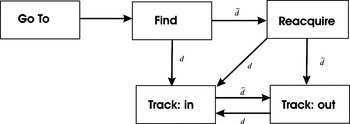
Farrell et al (Reference Farrell, Li, Pang and Arrieta2003a) have presented a behaviour based planning strategy inspired primarily by the behaviour of moths. The implementation of this strategy on a REMUS AUV is now described. The AUV is employed to locate a chemical plume, trace it to the source and manoeuvre to reliably declare the source location. The AUV is constrained to manoeuvre within a predefined search region called the operation area (op-area), where it should search for a specified chemical. The op-area is defined in a two dimensional coordinate system by x∊[x min, x max] and y∊[y min, y max]. The strategy proposed by Farrell et al (Reference Farrell, Li, Pang and Arrieta2003a) is based on coordination of different reactive behaviours like plume finding, tracking and reacquiring. Figure 1 shows the behaviour switching diagram of the behaviours where the symbol d denotes the behaviour switch when chemical is detected and  represents a change in the behaviour when chemical is not detected.
Behaviour switching diagram (Farrell et al, Reference Farrell, Li, Pang and Arrieta2003a).

CPT is achieved by behavioural coordination of the following subtasks:
Go-To. The start of a search operation begins with this behaviour. At this stage heading commands are issued that direct the vehicle from its current location (i.e. home location) to the target location (i.e. a point in the op-area). The vehicle heading ψ is calculated by using a line of sight of guidance formula:

where atan2 is a four quadrant arctangent function, (x g, y g) are coordinates of target location, (x c, y c) are the coordinates of current vehicle location and v c is the constant speed command.
Find Plume. By assuming that the chemical source may be located anywhere within the op-area, Farrell et al (Reference Farrell, Li, Pang and Arrieta2003a) undertake a complete uniform search of the area in an attempt to find the plume. The vehicle is made to explore the op-area by reflecting it off the boundaries of the region in a billiard ball fashion. This allows the vehicle to search effectively the entire op-area by frequently crossing it in a cross flow direction and also along the flow direction until the entire op-area is searched. The vehicle switches from Find Plume to Track Plume behaviour as soon the plume is found.
Track Plume. Once the vehicle detects the plume concentration over a predefined threshold value, the vehicle switches to tracking behaviour. This behaviour attempts to trace the plume towards the source location which is based on the surge and cast type motion of the male moth. The behaviour is implemented in two phases, Track-in and Track-out. In the Track-in case, the vehicle heading ψ is defined as:
This makes the vehicle move exactly in an upstream direction as soon as it detects the odour concentration greater than a predefined threshold. Whilst implementing Track-in behaviour, if the vehicle does not encounter any trace of a plume for a certain time interval it switches over to Track-out behaviour and moves in a cross stream direction much like the casting motion of the moth. The vehicle heading ψ is calculated as:
The angle β(t) is selected to force the vehicle to implement the counter turning manoeuvre, where the sign preceding β(t) determines the direction of counter turning (left or right).
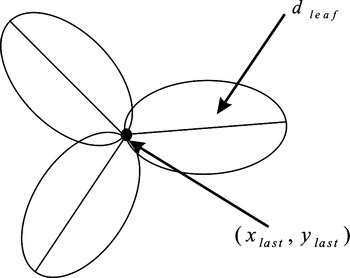
Plume Reacquire. If the searcher loses contact with the plume for greater than λ seconds the vehicle declares the plume to be lost and switches from Track-out to Reacquire behaviour. The Reacquire behaviour is implemented using a clover leaf shaped trajectory as shown in Figure 2. The clover leaf centre is the last location at which the odour was detected: (x last, y last). The parameter d leaf determines the size of the leaves and hence the extent of the search. This pattern is selected because it yields a significant search in all directions relative to the last detection point. The vehicle reverts to plume-finding behaviour if the plume is not re-contacted within N_re repetitions of the reacquisition trajectory. However, if the plume is detected at any point during the reacquire behaviour, the vehicle switches over to Track-in behaviour.



Clover leaf trajectory of the plume reacquire behaviour (Farrell et al, Reference Farrell, Li, Pang and Arrieta2003a).

The source declaration is not implemented as a separate behaviour, it is based on the tracking progress of the vehicle. Every time the Track-in behaviour ends, the last detection point is added to a list. This list is sorted according to the distance along the direction of the flow. As long as the vehicle is making progress up the plume, the initial few points on the list will be widely separated. When the three points on the list differ in the direction of flow by less than 4m, indicating the vehicle has ceased upstream progress, the most up flow point on the list is declared as the source location.
Farrell et al (Reference Farrell, Li, Pang and Arrieta2003a) have presented a successful in-water experimental demonstration of CPT on a REMUS AUV. The op-area selected for the experiments was 250–300 m along the shore and 100 m cross-shore. Using the strategy described above, a plume of Rhodamine dye was successfully tracked for over a distance of 100 m. A more recent paper by Farrell et al (Reference Farrell, Pang and Li2005) demonstrates CPT results in an op-area of dimension greater than 60 football fields. The AUV tracked the chemical plume for over 975m between the first detection point and the declared source location.
4.2. Strategies inspired by a lobster
Lobsters belong to the family of marine crustaceans which have a remarkable ability of tracing chemical odour plumes for a number of biological activities such as foraging, mating and individual recognition. Lobsters possess a pair of antennules located on their head containing chemoreceptor cells. Studies hypothesize that the lobsters flick the antennules at a frequency of approximately 4Hz in order to increase the probability of finding the plume and to obtain directional information. Thus they use a combination of information available from the sensor cells located on both their antennules and legs. The initial distance orientation is guided by the flicking of antennules and it has been demonstrated in a number of experiments (Grasso et al, Reference Grasso, Basil and Atema1998; Consi et al, Reference Consi, Atema, Goudey, Cho and Chryssostomidis1994) that on average, the behaviour of the lobster is consistent with steering towards the side of the antenna sensing the higher concentration (Grasso et al, Reference Grasso, Basil and Atema1998). However, in the vicinity of the source, there is a definite behavioural change and increasing use of the array of chemo-sensors located on their legs is made to help locate the source.
Grasso et al (Reference Grasso, Basil and Atema1998) are involved in the study of a lobster's perspective of tracing a chemical plume. The authors have tried to apply analogous biomimetic strategies on their robotic lobster, named “Robolobster”, which is similar in size to a real lobster and possesses a pair of conductivity sensors as antennas. A simple strategy has been implemented that allows the robotic lobster to orient itself to chemical signals in a turbulent marine medium. This strategy makes use of the chemical concentration of plume only to locate the source. Many animals use directed reaction to a chemical stimulus. Such a guidance using chemical cues alone is known as chemotaxis in biological terms.
The purely chemotactic algorithm implemented for “Robolobster” for tracking a salt plume in a water tank has two simple rules:
Rule 1. Robolobster turns to the side of one of the two antennules (conductivity sensor) which encounters higher concentration of salt plume. If the concentration experienced by both sensors is the same the robot simply moves forward.
Rule 2. Robolobster moves backwards if both sensors detect no salinity. This is important because this guidance strategy based on the comparison between the left and right sensor readings is prone to drift the robot out of the plume. Moving backwards allows the Robolobster to re-enter the plume and hence minimise the chances of getting lost.
This strategy makes the robot align itself to a local plume axis by maintaining a constant mean reading between the two spatially separated sensors. The robot moves forward when both the sensors bear similar readings assuming this motion would lead to the source. However this strategy performed well only when tracking plumes over a very short distance of a few metres from the source.
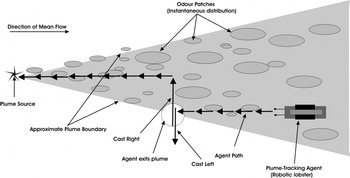
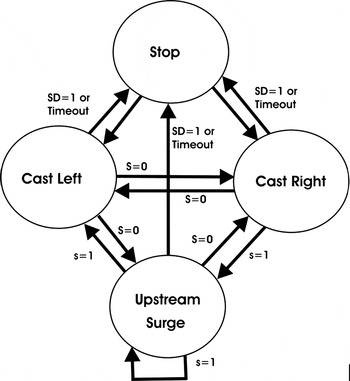
Grasso and Atema (Reference Grasso and Atema2002) implemented another biomimetic strategy based on Odour Gated Rheotaxis (OGR). OGR is a biological plume tracing technique that uses the direction of mean flow of the carrier fluid along with chemical detection for guidance. The OGR strategy is somewhat similar to the surge and cast type motion of a male moth. Figure 3 depicts the robotic lobster performing CPT using an OGR based strategy. While tracing a chemical plume, the robotic lobster judges whether it is within or outside the plume. If the agent establishes that it is within the plume it moves upstream. However, if the agent determines that it is outside the plume it makes a move across the mean flow allowing it to make contact with the plume. Figure 4 describes the implementation of the OGR strategy on the robotic lobster. When the sensors located on the robotic lobsters are triggered (i.e. state S=1), indicating that the robot is within the plume, it performs an upstream surge. Conversely, if the robot moves out of the plume or reaches a hole in the plume then the sensors are not triggered (i.e. S=0). At this juncture the robot chooses a direction (left or right) to counter turn or cast. This task of selecting the casting direction is not trivial. When the robot travels out of the plume boundary the possibility of the actual plume being on its left or right side is equal. Grasso and Atema (Reference Grasso and Atema2002) have suggested a novel approach to this problem. The robot uses a rudimentary memory which stores the number of plume stimulations received by the left and right sensor. Upon the loss of plume (i.e. S=0) the robot simply casts in the direction of the sensor which received the highest stimulations. The robot continues to alternate between the surging and casting motions until the bottom sensor detects odour (i.e. SD=1) which indicates that the robot has reached the source of the plume. A timeout command is used to resolve the conflicts between the different sensory states.
Illustration of Robotic lobster performing OGR based strategy (Zarzhitsky et al, Reference Zarzhitsky, Spears, Thayer and Spears2004).

Schematic illustration of OGR based strategy (Zarzhitsky et al, Reference Zarzhitsky, Spears, Thayer and Spears2004).

The use of mean flow information in OGR makes intuitive sense because mean flow is a salient and informative environmental cue to the source direction. In addition, if the agent senses the plume, the mean flow must be bearing chemicals from the source towards the agent and therefore a movement against the mean flow will reduce the agents' distance from the source. Many animals implement an upstream (or upwind) motion when detecting odour.
This study demonstrated two well known biological search techniques on autonomous robots, namely the chemotaxis and OGR inspired from lobsters. It is shown how these guidance strategies make use of a pair of spatially separated sensors mounted on an AV to track chemical plumes. A strategy inspired by bacterium is now described in the next section.
4.3. Strategy inspired by bacterium
Bacterium makes use of the gradients of chemical signals released from nutrition (food) sources to reach the location successfully. Their search strategy can be related to a simple chemotactic process which comprises of alternating between two behaviours. The first behaviour called ‘run’ allows the bacterium to swim smoothly in a straight line in a particular direction; the second behaviour called ‘tumble’ allows it to reorient randomly in a new direction for the next run. In the absence of any concentration gradient, the bacterium executes a random walk. When the bacterium senses a positive gradient it reduces the frequency of its tumbling leading to a greater run length in the direction of positive gradient. Conversely, the negative gradient does not have influence on its tumbling behaviour. Alteration in tumbling frequency allows the bacterium to move forward in the direction of the source.
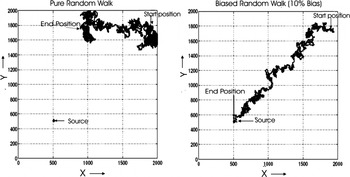
Dhariwal et al (Reference Dhariwal, Sukhatme and Aristides2004) have proposed a novel technique inspired by the bacterium, based on a biased random walk for detection, seeking and tracking of a gradient inducing source. This algorithm is multi-functionary and can be used to track gradients produced by any of the different types of sources such as light, heat, pH or chemical concentration. The robotic agents in this strategy are programmed to employ a biased random walk with a mean free path (MFP) of 10 units. In other words, under the absence of a concentration gradient a robot would move 10 units of distance in the search area in a random direction. After this the robot executes tumbling (changing its direction randomly). If the robot senses a positive change in gradient, it decreases its tumbling frequency. This change in frequency is the ‘bias’ in the random walk, which increases the run length in the direction of the positive gradient. A 10% bias was used in their strategy which is similar to that observed in the motion of bacterium. Figure 5 depicts the simulation of a robot performing a pure random walk and a biased random walk. An increase in the bias helps the robots to reach the source faster, however, increasing the bias of the random walk might not be a good idea if the source is mobile or of a variable intensity.
Pure random walk vs. biased random walk (Farrell et al, Reference Farrell, Pang, Li and Arrieta2004).

Dhariwal et al (Reference Dhariwal, Sukhatme and Aristides2004) claim that their biased random walk algorithm has significant advantages over a simple gradient descent algorithm. It is pointed out that the chances of the robot being trapped in a concentration minima or maxima are significantly lower than using a gradient based strategy. In addition, the sensing and memory requirements for this algorithm are small since the robot has to store only the last sensor output and compare it with the current reading. The computation of control involves the change in the length of the run in response to the sensed gradient change. It is suggested that this simple biologically inspired algorithm can be effectively implemented on a group of autonomous robots to track concentration gradient emerging from different types of sources such as light, pH or odour.
It is worth mentioning here that bacterium operate at low Reynolds numbers whilst the lobster and moth operate at medium to high Reynolds numbers. This is critical because at low Reynolds numbers, the time averaged and instantaneous fields are very similar with well-defined and temporally stable gradient fields. This is not true for medium or high Reynolds number flows. Therefore, the moth/lobster and bacterium strategies cannot be directly compared. However, the authors are reviewing the biomimetic techniques inspired from nature which could be applied to any robot performing CPT regardless of the nature of the medium. The performance of these algorithms on AVs could be compared qualitatively and quantitatively to obtain the best possible solution to the CPT problem.
5. MULTI-ROBOT APPROACH
The strategies examined so far have been mostly based on a single AV or robot performing CPT. This task has also been successfully performed using multiple robots or searcher agents using a form of distributed sensing or some kind of swarm intelligence (SI). The task of CPT can be ameliorated by the physical distribution of the odour sensing elements, which in principle could improve system speed and robustness via parallelization of the search procedure. The parallelization of a search is best achieved by distributing a number of sensors throughout a group of smaller and simpler communicating robots which are capable of performing a collaborative search of the plume.
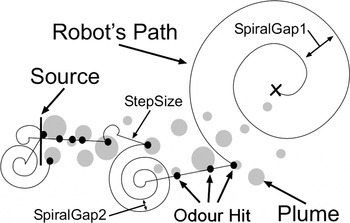
Hayes et al (Reference Hayes, Martinoli and Goodman2002) have described a distributed algorithm by which groups of robots can solve the odour localisation task. As with many CPT algorithms, described previously, they have approached the task of CPT for odour localisation by subdividing it into four subtasks of plume finding, plume maintaining, plume reacquiring and source declaration. Based on this, the odour localisation strategy developed is called the Spiral Surge (SS) algorithm. Figure 6 depicts a searcher vehicle performing a SS algorithm. As shown, plume finding is performed by an initial outward spiral search pattern (SpiralGap 1) (see Table 1). The initial spiral search allows for an extensive search of the local area. The spiral gap can be increased or decreased based on a priori information or size of the search area. Plume maintaining behaviour is implemented by a simple upstream surge akin to OGR. When an odour packet is encountered during the spiralling motion, the robot samples the wind direction and moves upwind for a set distance (StepSize). If during the surge behaviour the robot encounters another plume particle, it continues to travel upstream. After a surge, if no further plume particles are encountered, the robot begins the casting behaviour. Casting is also achieved by spiralling movement, the ‘casting spiral’ (SpiralGap 2) can be tighter than the ‘plume finding spiral’. A plume hit during ‘casting spiral’ results in the robot performing an upstream surge. If no plume hit is made for a set amount of time (CastTime) the robot declares the plume to be lost and switches to plume finding behaviour.
Spiral-Surge odour localisation behaviour (Belanger and Willis, Reference Belanger and Willis1998).

Spiral Surge algorithm parameters (Belanger and Willis, Reference Belanger and Willis1998).

Source declaration can be accomplished by a robot by keeping in track of the past spiral hit distances. The robot near the source of the plume will keep on surging out of the plume boundary and subsequently spiral back to the origin of the surge before receiving another plume hit. If the robot encounters a series of small inter-hit distances after the casting spiral, this indicates that the robot has ceased progress up the plume, and must therefore be at the source.
Hayes et al (Reference Hayes, Martinoli and Goodman2002) extended this algorithm to a multi-robot application using the principles of SI. SI is a computational and behavioural metaphor for solving distributed problems inspired by the biological and social behaviour of creatures of many varied species (Hayes et al, Reference Hayes, Martinoli and Goodman2002). Instead of using one robot, the task of odour localisation is achieved by a swarm of robots performing the same SS algorithm. The effectiveness of this swarm search is increased by incorporating collaboration between the nodes of the swarm. In this study, the performance impact of three types of communication signals are examined:
● No signal (NONE). No communication signal between two nodes.
● Come here (ATTRACT). Signal emitted by upwind surging robots that causes all robots downwind, or with no plume information to surge in the direction of the calling (attracting) robot. This signal may be used in plumes with significant meander where the presence of larger number of robots at a particular location is necessary to improve chances of source location.
● Stop (KILL). Signal emitted by the first robot to receive odour information that causes all other robots to surge away from the signalling robot and then enter a static mode (power save mode). This signal can be useful to allow only a single robot to perform plume traversal and source declaration, which in certain situations can be more successful.
The study shows that integrating the information collected by a group of agents in an elementary manner can increase the efficiency of the odour localisation system performance (Hayes et al, Reference Hayes, Martinoli and Goodman2002). This study used a very elementary interaction signal but a more involved interaction scheme with a greater number of signals and variable signalling strengths might be useful for tracing more complicated plume structures.
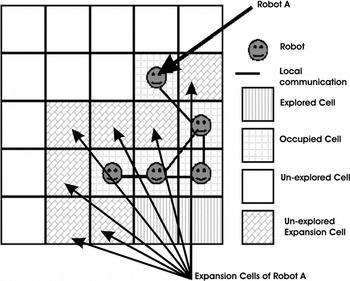
Cui et al (Reference Cui, Hardin, Ragade and Elmaghraby2004) have developed a fuzzy logic based approach to control a swarm of small robots to locate a hazardous contaminant source. The swarm of robots is deployed in the suspected area to act as a mobile sensor network to search for the source of a hazardous gas leak. The entire search area is divided into a grid of small cells as shown in Figure 7. Each cell in the grid can be occupied by only one robot at a time. Each robot can measure the concentration of chemical in its own cell and transmit it by communicating directly with robots in eight adjacent cells. Communication with robots not in direct line of sight can be achieved by multi-hop paths of the ‘ad hoc’ communication network. It is imperative that each robot has at least one other robot in any of the adjacent cells, otherwise the ad hoc network would be disrupted.
The environment grid map and expansion cell (Vickers, Reference Vickers2000).

Movement of each robot is controlled by the principles of swarm behaviour control. The ‘separation property’ of the swarm behaviour requires that each robot avoids exploration of a cell occupied by another robot to ensure wider coverage without overlapping. The ‘cohesion property’ of swarm behaviour ensures that each robot can occupy any unexplored and unoccupied cell provided there is at least one robot in any of the eight adjacent cells, such cells are called expansion cells. Figure 7 shows the expansion cell of Robot ‘A’. The cohesion property helps to keep the ad hoc network intact.
Assuming that the concentration of odour gradually decreases from its emission source generating a concentration gradient, it is obvious that the nearer a robot is to the source the higher the sensor reading value will be. Every robot collects concentration and position information of its neighbouring robots using the ad hoc network. The use of the ad hoc network to obtain concentration measurements of remote robots increases the perceptible area of each robot. Using this information, the robot decides its next location in the direction of highest reported concentration. Thus, the aim of the strategy is to keep on steering individual robots and hence the entire swarm, to the vicinity of highest reported concentration until the swarm finally reaches the location of the source.
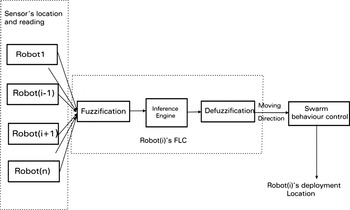
Cui et al (Reference Cui, Hardin, Ragade and Elmaghraby2004) makes use of the fuzzy logic control (FLC) based swarm behaviour to endow each robot with the ability to steer in the direction of the emission source. This assumes that there are n robots (R 0, R 1, … R n) where each robot makes use of its swarm-based FLC to generate the optimal deployment location. Figure 8 describes the implementation of swarm-based FLC for the i th robot designated as robot(i). The procedure is outlined below.
Fuzzification. At this stage the robot receives the position and concentration information from all robots. The fuzzification process converts these crisp inputs into fuzzy linguistic variable inputs. The location angle of all robots relative to the robot(i) are described as front zero (FZ), front right (FR), front left (FL), left (L), right (R), rear zero (RZ), rear right (RR) and rear left (RL). The odour concentration that each robot's sensor detects is represented as: low (L), medium (M) and high (H).
Fuzzy inference engine. Here the fuzzy inputs from the fuzzification stage are combined with a set of rules to generate fuzzy outputs. Cui et al (Reference Cui, Hardin, Ragade and Elmaghraby2004) have developed simple fuzzy rules in IF-THEN form to continuously steer the robot in the direction of the highest reported concentration. The FLC rule base is briefly described as follows:
If concentration is HIGH and direction is FZ, THEN move to FZ expansion cell.
If concentration is HIGH and direction is FL, THEN move to FL expansion cell.
.
.
If concentration is HIGH and direction is RR, THEN move to RR expansion cell
Defuzzification. Finally the fuzzy output from the fuzzy inference engine is converted to a crisp value which is a fuzzy set, containing robot(i)'s movement direction and its membership function. This fuzzy information is converted into crisp information to compute the next manoeuvre. The centroid of gravity method was employed to obtain a crisp deterministic output. For the interested reader, further details of fuzzy set theory can be found in Chen and Pham (Reference Chen and Pham2001).
Block diagram of the Swarm-based FLC system (Vickers, Reference Vickers2000).

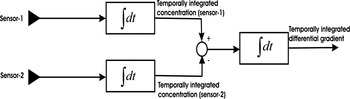
Sandini et al (Reference Sandini, Lucarini and Varoli1993) have investigated the possibility of finding the source of a leaking pollutant by tracking the concentration gradient of the leak using a swarm of robots. Each robot is equipped with a compound sensor composed of two spatially separated sensory units. The instantaneous concentration reading from each of the two units is temporally integrated which are compared continuously to generate a differential gradient (see Figure 9). The control strategy is based on the computation of the difference between the concentrations measured by the two sensing units. When the differential gradient is below a certain threshold the robot performs Exploration (plume finding or reacquiring) behaviour, in which a random walk is carried out composed of rectilinear motion interrupted by random turns. When the differential gradient is above the threshold it employs ‘Gradient Following’ (plume maintaining) behaviour and moves in the direction of the sensor experiencing higher concentration.
Logical structure of the sensor used for Gradient following (Grasso, Reference Grasso2001).

As explained earlier, a simple gradient following algorithm is not very efficient in tracing a turbulent plume. Sandini et al (Reference Sandini, Lucarini and Varoli1993) employed a cooperative search method using a swarm of robots. Each robot transmits its differential gradient reading to other robots using an infrared link. A robot not only obtains gradient readings from its own sensors but also acquires measurements transmitted from other vehicles present in the swarm. As a net advantage, the perceptible area of each unit is expanded and the convergence to the source of gradient is more likely to occur. The movement of the robot is controlled by the combination of its own ‘direct’ readings and ‘indirect’ readings transmitted from the other robots. The whole control procedure is outlined below:
● if the robot does not sense concentration directly and indirectly it continues Exploration behaviour;
● if the robot senses the concentration only directly it continues Gradient following behaviour;
● if the robot senses the concentration only indirectly it moves in the direction of the robot experiencing higher concentration;
● if the robot senses concentration directly and indirectly it decides to move in the direction of the stronger signal.
It is demonstrated that even by using a simple cooperative behaviour, the swarm was able to locate the source much faster (about 2 times) in comparison to robots acting independently without any communication.
6. DISCUSSION AND CONCLUSIONS
The structure of a plume is made up of many microscopic odorant packets. The spatial and temporal distribution and their physical properties provide an assortment of information (such as time averaged or instantaneous concentration, mass flux divergence etc) (Zarzhitsky et al, Reference Zarzhitsky, Spears, Thayer and Spears2004). Each component of this information can be potentially used to generate a plume tracing algorithm because there is no clear consensus on details of plume structure and dynamics which are useful. Thus, it is not surprising that there are a large number of strategies for plume tracking (Kazadi et al, Reference Kazadi, Goodman, Tsikata, Green and Lin2000). This paper has reviewed several guidance strategies which enable AVs to track chemical plumes. So far, biomimetic techniques have had a greater share of interest in this field, however, strategies based on multi-robots and fluid dynamics (Zarzhitsky et al, Reference Zarzhitsky, Spears, Thayer and Spears2004) have also been demonstrated.
The biomimetic approaches are based on the understanding of the modalities and techniques used by animals and their ability to deal with patchy and intermittent natural phenomena. However, the performance of these algorithms is inferior to the performance of their biological counterparts. The main reason being the lack of understanding of animal behaviour. Animals combine multiple sensor modalities (olfactory, sight, auditory, tactile), especially in “source declaration” and the current generation of AVs are still not capable of this level of data fusion.
The use of collaborative search with multiple robots can provide a wide spatial distant array of numerous sensors which can circumvent the problem posed by the intermittency of the plume. The collaboration between the robots can in fact shorten the time of the entire search procedure (Sandini et al, Reference Sandini, Lucarini and Varoli1993). The multi-robot based strategies provide reliability through redundancy and provide large area coverage from a wide distribution of robots. Moreover, failure of one or more units will not jeopardise the overall sensing operation (Russell et al, Reference Russell, Thiel and Mackay-Sim1995). The cost of robots, however, could impose a significant constraint on their development. In the case of underwater CPT, the communication between the robots is severely restricted and hence the desired performance may not be achieved.
Contemporary methods such as artificial intelligence (AI) can vastly improve the plume tracing strategy. Use of AI techniques such as artificial neural networks (ANN) and fuzzy logic can improve coordination of different behaviour. Such a strategy has been devised by Farrell et al (Reference Farrell, Li, Pang and Arrieta2003a) for the REMUS AUV. Lilienthal et al (Reference Lilienthal, Ulmer, Frohlich, Stutzle, Werner and Zell2004) have achieved the sub-task of source declaration with the use of an ANN to improve the robot's ability to identify the source accurately. The fuzzy logic based approach of Cui et al (Reference Cui, Hardin, Ragade and Elmaghraby2004) aided greatly the achievement of source localisation even in the event of node failures. Despite the improvements that AI techniques can bring to the task of CPT very few strategies have used these techniques to their advantage. Hence, there is a definite potential for exploration in this research area.
Clearly a greater effort is required in understanding and interfacing between several interdisciplinary fields such as biological behaviour and principles of fluid dynamics to develop a practical chemical plume tracking system which is capable of providing reliable tracking information to the AV.