There can be no doubt that armed conflict directly kills, injures, and harms more men than women in that combatants are predominantly male.1
The World Health Organization (WHO) estimates the share of females among direct war fatalities to fall between as low as 9.9 percent in 2004 and up to 42 percent in 1998 (WHO various years). The WHO mortality figures have been heavily criticized as being unreasonably inflated (Human Security Centre 2005). It is unclear, however, whether this criticism affects the share of female mortality. In any case, a higher share of men among direct war mortality is plausible.
Lacina and Gleditsch 2005, 7.
The indirect effects of militarized conflicts3
We use the terms “armed conflict,” “militarized conflict.” and “war” interchangeably.
Specifically, this article analyzes the impact of militarized conflict on the so-called gender gap in life expectancy, which we define as the ratio of female to male life expectancy at birth (in most countries women live longer than men in peacetime such that the ratio is above unity).5
The gender gap in life expectancy is usually measured as the absolute difference between female and male life expectancy, rather than the ratio between the two. For reasons explained below, this absolute difference can be a misleading indicator. We stress, however, that our results uphold even if we defined the gender gap as the absolute difference.
Despite a rise in quantitative gender-analytical studies in recent years, no one has yet rigorously analyzed the uneven effect that armed conflict has on men and women. Instead, existing scholarship has focused on whether gender inequality affects the likelihood of using violence in intra- and interstate conflict.6
See Marshall and Ramsey 1999; Caprioli 2000, 2003, and 2005; Caprioli and Boyer 2001; and Regan and Paskeviciute 2003.
The remainder of this article is organized as follows. The first section explains how our study relates to two strands of literature in international relations, namely, gender studies and studies on the health consequences of conflict. The second section provides an explanation of why militarized conflicts should have an influence on the gender gap in life expectancy. The third section discusses the research design of our quantitative study. The fourth section presents the results; and the final section concludes.
Link to Existing Literature
Our study relates to two important strands of literature in international relations (IR). First, our analysis is located in an emergent strand within IR that employs gender as an analytical category. This means that we try to explain the differential impacts of armed conflict on men and women not merely by recourse to biological differences, but also by tracing the different vulnerabilities that derive from the social roles men and women assume, voluntarily or involuntarily. As Moser has argued, a gender analysis assists in understanding why men and women as social actors and with differential access to resources are differentially affected by violence.8
Moser 2001.
Carpenter 2003.
Carver 2004.
Carpenter 2005.
Taking gender seriously as an analytical concept does not imply that we subscribe to the feminist IR agenda of active engagement in a political struggle for the empowerment of women.13
Carpenter has lamented that mainstream IR scholars have been largely silent on gender, thus depriving knowledge on gender of nonfeminist insights.14Carpenter 2002, 153.
Keohane 1998, 196.
See Caprioli 2004 for an overview.
See Marshall and Ramsey 1999; Caprioli 2000, 2003, and 2005; Caprioli and Boyer 2001; and Regan and Paskeviciute 2003.
Second, our analysis directly relates to studies that have addressed the broader and long-term public health consequences of armed conflict. Our original contribution is that we look at these consequences with a gender-analytical perspective. Three recent articles have demonstrated the seemingly obvious: international and civil wars reduce the quality of life of broad parts of the population and reduce the mean life expectancy of the country that is engaged in militarized conflicts. For example, Ghobarah, Huth, and Russett study cross-national variation in 1999 data on disability-adjusted life years (DALYs).18
DALY is a new measure that has been estimated by the World Health Organization (WHO) starting in the late 1990s. DALYs are calculated for individual major disease categories and reflect the years of life lost due to death in the fatal cases as well as the expected disability caused by a disease in nonfatal cases. They are the most important input for estimating health adjusted life expectancy (HALE), which adjusts nominal life expectancy for expected years with disability. Specifically, Ghobarah, Huth, and Russett regress DALYs in 1999 on estimated fatality figures from civil wars in the period 1991 to 1997 as well as a range of control variables. The results are interpreted as the long-term effects of civil wars. They estimate that around 12 million DALYs were lost in 1999 due to civil wars in the same countries plus perhaps another 3 million DALYs in neighboring countries, which is close to twice WHO's estimate of direct and immediate loss of DALYs from all armed conflicts in 1999.19Murray 1994 discusses the technical basis of DALYs.
Davis and Kuritsky use panel data to estimate the effect of armed conflict on life expectancy and other health indicators in sub-Saharan Africa over the period 1980 to 1997.20
Davis and Kuritsky 2002.
A recent study by Li and Wen analyzes the effects of an armed conflict dummy as well as of past conflict duration on adult mortality (people aged fifteen to sixty-four).21
Li and Wen 2005.
Several more papers have studied variation in life expectancy, mostly in a cross-national setting, but without addressing the impact of armed conflict.22
See Hertz, Hebert, and Landon 1994; Williamson and Boehmer 1997; Kennelly, O'Shea, and Garvey 2003; and Bossuyt et al. 2004.
Williamson and Boehmer 1997.
Conflict and the Gender Gap in Life Expectancy
Wars kill, before, during, and after military operations take place. Before the actual conflict starts, military expenditures often rise and drag scarce resources away from health services and medical care. During conflict, the most obvious victims are the casualties directly attributable to conflict. Both soldiers and civilians suffer morbidity and mortality inflicted by wounds. The direct effects of combat and military operations are likely to affect men more. Because most soldiers in most armies are male, men should be more severely affected by the direct causes of war than women. The more civilians are directly killed by military operations, the more women will be directly killed as well.24
It is difficult to estimate reliably the share of civilian victims of armed conflict. The often quoted statistic that this share increased from 14 percent during World War I to 67 percent in World War II, reaching 75 percent and 90 percent during the armed conflicts of the 1980s and 1990s (which were predominantly civil wars), respectively, is based on shaky empirical evidence, as Murray et al. 2002, 346f, have pointed out.
Foege 1997.
The many indirect negative consequences on health and mortality are likely to affect men and women differently, partly because of biological reasons, but mainly because of variation in the socioeconomic status of men and women. In the following subsections, we identify three indirect effects that account for the fact that militarized conflicts unevenly affect men and women. We refer to these effects as the economic damage effect, the displacement effect, and the sexual violence effect. Clearly, these effects are not independent but may easily reinforce one another, thereby rendering the situation more dramatic for the people involved. Keeping these interaction effects in mind, it is for explanatory purposes that we discuss the three effects separately and in turn. After this discussion, the theoretical section concludes with a discussion of why the identified effects can be expected to be particularly strong when armed conflict has ethnic roots or takes place in a country in which the central political order has collapsed.
The Economic Damage Effect
Armed conflicts affect all aspects of life, including the economy. They often lead to the destruction of agricultural systems causing food shortages. Food shortage leads to rising food prices, which in crucial cases may cause famines. As observed by Drèze and Sen, famine is a problem of food distribution and poverty rather than a problem resulting from an absolute lack of food.26
Drèze and Sen 1990.
Ashford and Huet-Vaughn 1997.
King and Martin 2001, 2.
Particularly problematic to the civilian population is damage to the medical and health care infrastructure. Hospitals and pharmacies are destroyed; doctors and nurses have fled the country or have been killed. Economic collapse and a shortage of public funds lead to severe underfunding and underprovision of both private and public health services. Even emergency medical problems fail to be attended to on time, while fundamental prevention policies with long-term beneficial health effects such as immunization and monitoring programs are simply terminated. For example, a WHO report on the medical situation in Bosnia between 1992 and 2000 concludes: “Pharmaceutical supply during the war and postwar period was mostly channeled through humanitarian aid programs, covering up to 70% of supplies—according to some estimates. In a large number of cases, this heavily influenced the choice of therapy, which often depended on the kind and quantity of drugs available.”30
WHO 2004, 1.
With agricultural systems as well as infrastructure damaged, it is no wonder that armed conflicts have a significant effect on average income levels and the economic growth rate. Estimates of the effect of international and civil war on per capita income and the growth rate typically find a significant and robust negative influence.31
Collier estimates that per capita income declines at an average annual rate of 2.2 percent relative to its counterfactual during civil wars.32Collier 1999.
In addition to loss in average incomes, wars influence the absolute and relative price levels. The majority of the population, for which income does not keep up with inflation, has increasing difficulties in meeting their basic needs. Price increases are most severe for goods for which demand reacts least elastically on price increases—in other words: goods that are most desperately needed: clean water, food, electric power, and medication.
Why is the economic damage caused by armed conflict likely to affect women more than men? Women are likely to suffer more from an increase in food prices and famines than men. For physiological reasons, women are particularly susceptible to vitamin and iron deficiencies in diets. In addition, in male-dominated societies, males get priority in food distribution at the expense of girls and women. The decline in basic health care hits women more because of their specific reproductive roles. Damage caused to the health infrastructure reduces obstetrical care and increases the number of miscarriages as well as maternal and infant mortality.33
Ashford and Huet-Vaughn 1997.
UN 2003, 41.
More generally, a significant decline in purchasing power will affect women differently than men because in many cultures men receive preferential access to resources. When resources become scarcer, then the part of the population suffering from discrimination is necessarily hit even harder. Many of the negative effects of armed conflict on women are thus not due to biological reasons, but are due to what Carpenter calls “preexisting gendered social structures.”35
Carpenter 2004, 243.
The Displacement Effect
Armed conflict often dislocates people from their usual homes, crowding them into remaining shelters. Worse still, often they have to leave their home cities or villages and have to seek refuge in makeshift refugee tent camps—either in foreign countries across the border or as internally displaced persons (IDPs). As a consequence, infectious diseases such as diarrhea, measles, acute respiratory diseases, and malaria, but also sexually transmitted diseases including HIV/AIDS, spread more easily, often turning into epidemics. Weakened and fragile individuals die more easily from diseases they might have survived in better physical and mental conditions.
Health conditions are particularly poor in refugee camps. Toole reports mortality rates from refugee camps that are up to 100 times higher than the normal mortality rate in the affected country.37
Toole 1997.
Women are not only more likely to die from the dire conditions in refugee camps, they also possibly account for the largest average share of camp population.
Though there is little reason to formulate a deterministic negative influence of displacement in militarized conflicts on the gender gap in life expectancy, we believe that the probabilistic argument is fairly strong. With an increased number of displaced persons, the gender gap in life expectancy is likely to decline, because of the health conditions in refugee camps and the possible overrepresentation of women in these camps.
The Sexual Violence Effect
A third effect is due to the targeted infliction of violence on women as part of a “gender ideology.”39
Carpenter 2004, 237.
Stiglmayer and Faber 1994.
Reports on systematic rapes and murders of women in relation to war are by no means limited to Bosnia. In other conflicts, particularly in sub-Saharan Africa, rape was used with the intention of spreading HIV/AIDS and other sexually transmitted diseases. Injuries to vaginal tissue is a common consequence of rape and renders affected women much more susceptible to sexually transmitted diseases. In principle, women should enjoy special protection in armed conflict. The Geneva Convention relative to the Protection of Civilian Persons in Time of War from 1950 requires that civilians “shall be at all times humanely treated, and shall be protected especially against acts of violence,” while women “shall be especially protected against any attack on their honor, in particular against rape, enforced prostitution, or any form of indecent assault” (Article 27). However, many warring parties simply do not obey their obligations under the Geneva Convention and other humanitarian law, which has prompted the UN's Security Council to call on “all parties to armed conflict to take special measures to protect women and girls from gender-based violence, particularly rape and other forms of sexual abuse, and all other forms of violence in situations of armed conflict.”43
UN 2000, par. 9.
The Role of Ethnicity and Collapse of Political Order
The economic damage effect, displacement effect, and the sexual violence effect can be expected to be particularly strong where armed conflict takes place in a country where the political order has collapsed or where conflict has ethnic roots. A collapse of political order almost by definition means that the central government is no longer capable of providing even the most basic infrastructure and other public goods, not least because it no longer commands over an effective tax system.44
Without being able to raise sufficient revenues, the government cannot combat imminent social catastrophes, even if it is willing to do so. Often, civil wars are the reason for a country to develop into a failed state, but it is as important to note that civil wars also tend to be more dirty and intense in failed states. Collapse, disintegration, and armed conflict have occurred in the former Soviet Union, the Balkans, the Caucasus, and Central Africa. In all instances, dozens of political entities emerged, in which self-appointed political leaders struggle among each other and with entities of overlapping claims. As a consequence, failed states can no longer perform basic functions such as education, security, or governance. In these countries, civil wars do not take place between insurgents and government troops, but between different paramilitary groups competing for political control of the country or particular regions. Such a civil war between various warlords, whose prime interest is mostly in arms and drug trafficking for short-term profit maximization, often turns out to cost many more civilian victims than militarized conflicts between the governments and groups that aim at taking over political control.In the burgeoning literature on failed states, Sierra Leone often serves as an example.45
Between the mid-1970s and the late-1990s, government revenues declined from approximately $250 million to less than $10 million. In some failed states such as Somalia, civil disorder ultimately led to famine as food distribution systems broke down. More generally, eight of the ten countries that have the highest share of undernourished population according to Food and Agriculture Organization (FAO) data—Afghanistan, Angola, Ethiopia, Somalia, Sudan, Mozambique, Liberia, and Sierra Leone—frequently went through cycles of autocratic government, ethnic conflict, and political failure.46FAO 2005.
Ethnic conflict also increases the likelihood that governments will treat foreign help with political reservations, even if the emergency is caused by natural factors. After the devastating tsunami in December 2004 that caused deaths in eleven countries, the Indonesian government was most reluctant to accept foreign assistance even though the province Banda Aceh, location of a civil conflict with ethnic roots, was hit harder than any other coastal strip around the Indian Ocean. This behavior mirrors the dismissive policies of the Sudanese government during the ongoing civil war in Darfur, which also has ethnic roots. The Sudanese government not only denied carrying out military operations against the rebels, but also strongly opposed humanitarian intervention by the UN, while the Janjaweed militias have been reported of killing civilians, mass rape of women, and looting property.
Conflicts in failed states are also likely to generate higher numbers of refugees and internally displaced people because the central authority can no longer guarantee anything resembling security in many areas.47
Conflicts with ethnic origin can also be expected to generate higher refugee flows because the very intention of warfare is often the ethnic cleansing of certain regions (if not the whole country) from other ethnic groups. Neumayer reports a strong effect of civil and ethnic wars as well as collapse of state authority on asylum migration to Western Europe, which is likely to be highly correlated with refugee flows to neighboring countries as well as internal displacement.48Neumayer 2005.
Davenport, Moore, and Poe 2003.
Norwegian Refugee Council 2002, 5.
The sexual violence effect of armed conflict is facilitated by the fact that many militarized conflicts lead to a partial or complete collapse of political order. The absence of a rule of law hits the vulnerable most severely. At the same time, reports on systematic rapes and rape-related murder of women, forced impregnation, and forced abortion are particularly abundant during ethnic wars. In such conflicts, sexual violence serves as a means of ethnic cleansing, terrorization, and humiliation, not only of the violated women, but also the men of the same ethnic group who are forcibly demonstrated their failure to protect “their” women. Sexual violence against women thus serves as an important signal “from man to man,” wounding the men of the opposing ethnic group in their masculinity by marking them as incompetent.51
Seifert 1994, 58.
Liz Kelly, cited in Shoemaker 2001, 8.
Shoemaker 2001.
Seifert 1994.
Hypotheses
Social phenomena such as civil wars can hardly be explained by deterministic theories. Our discussion of the link between militarized conflict and the gender gap in life expectancy is no exception to the rule. Yet the preceding discussion has identified three effects that make a negative influence of militarized conflict on the gender gap in life expectancy probable. In particular, we have explained how and why the economic consequences of war, the displacement effect and the sexual violence effect are likely to jointly affect women more adversely than men. Taking the probabilistic nature of our theory into consideration, we derive the following testable hypotheses from the above discussion:
H1: Armed conflict is likely to decrease the gender gap in life expectancy
H2: Armed conflict is likely to decrease the gender gap more strongly if the conflict has ethnic origins
H3: Armed conflict is likely to decrease the gender gap more strongly if conflict takes place in a country in which the central political order has collapsed
The following section puts these hypotheses to empirical test.
Research Design
In the last section we argued that while most direct victims are men, women are likely to suffer more from the indirect adverse consequences of international and civil wars. We measure these adverse consequences by life expectancy. But life expectancy and the gender gap are a product of multiple influences—geographical, social, economical, and political—that one would need to control for to test our hypotheses. Not all determinants of life expectancy are easy to measure. Geographical influences such as the likelihood of acquiring malaria are not equal across countries. A simple cross-sectional analysis of life expectancy is likely to suffer from omitted variable bias, or, if we were to collect data on the national propensities of serious diseases, would suffer from potentially severe measurement errors. To deal with the various estimation problems, we have opted for gathering internationally comparable panel data of life expectancy. The main advantage of relying on panel data is that only pooled data allows controlling for unobserved factors that vary across countries and are possibly correlated with our explanatory variables. Fixed effects estimators eliminate bias from omitted time-invariant variables and also remove the level effects of time-varying omitted variables. Unfortunately and inevitably, the dynamic effects of omitted time-varying variables may still bias the estimates.
To our knowledge, the most reliable source for life expectancy data in panel form is provided by the U.S. Census's International Data Base (IDB). In comparison, for example, to data provided by the World Bank,56
World Bank 2004.
U.S. Census 2004, B5.
We nevertheless should expect that analyses of IDB data to some extent suffer from correlated errors, because models that are used to predict the values of a certain variable cannot avoid systematic error. Our analyses inherit these systematic errors. To avoid seriously biased estimates, we use a lagged dependent variable approach, which sufficiently eliminates serially correlated errors. As explained in the literature review, the new WHO data on DALYs lost represent a comprehensive and data-intensive measure and with less measurement errors than a life expectancy measure, but the disadvantage is that DALYs are not yet available over a longer period of time, allowing only a cross-sectional analysis. A cross-sectional analysis does not allow controlling for time-invariant country-specific omitted variables. For these reasons, we prefer data that allows more advanced estimation techniques over cross-sectional data with less measurement errors. Also, while nonadjusted life expectancy is theoretically inferior to disability adjusted life expectancy, we note that the WHO itself has pointed out that the two are highly correlated.58
Mathers et al. 2001, fig. 4.
The IDB data base provides information on life expectancy for 145 countries and for the years between 1975 and 2002. However, the panel is not balanced, that is, the amount of information available for each country may vary. Next, we will first briefly introduce the data. Then we discuss the estimation problems and the remedies in greater detail. The following sections present the results of our analyses.
Variables and Data Sources
We use data from various sources. As we explained before, the dependent variable, gender differences in life expectancy, comes from the U.S. Census's IDP data base. Life expectancy varies greatly in the sample we analyze. The mean life expectancy across countries is slightly above sixty-one years, but varies between thirty-seven years in Angola and eighty years in Japan. Over time, average life expectancy has increased from approximately fifty years in 1970 to sixty-five years in 2002.
We use as our dependent variable the ratio rather than the absolute difference of female to male life expectancy. The reason is that, under certain conditions,59
Changes in mortality rates of a specific age cohort affect also person-years lived of older age cohorts due to changes to the number of survivors to older age, and this has a larger effect on life expectancy at birth if the life expectancy of the age cohort is higher. See Preston, Heuveline, and Guillot 2001, 64. Militarized conflicts lead to relatively larger changes in the gender gap in life expectancy if the persons killed have not yet reached age cohorts that show large gender differences in mortality rates. For example, if most individuals killed in a war are below thirty years old, and if women above thirty are less likely to die at a certain age than men of the same age and women's life expectancy at birth is higher, then the change in the absolute difference between female and male life expectancy is a biased proxy for the mortality rates of that conflict.
For technical details on life expectancy computation, see 〈http://mathworld.wolfram.com/LifeExpectancy.html〉. Accessed 28 April 2006.
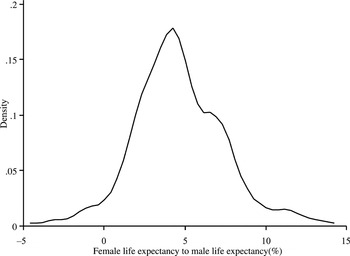
Figure 1 displays the distribution of the ratio of female to male life expectancy across countries.

Kernel density distribution of the gender gap in life expectancy
In 100 out of 2,956 country-years, men lived longer than women (hence the ratio of life expectancies in percent is smaller than 100). In Bangladesh, India, and Nepal, this phenomenon is common and can possibly be attributed to the traditional cultural bias against females in these countries. In all other cases a “negative gender gap”—that is, men living longer than women—is the exception rather than the rule. The highest men-women incline (in our sample) was reported from Sudan in 1988. This was also the time when the civil war in the south had caused a large refugee movement to the cities, especially to Khartoum. In September 1988 the WHO estimated the total number of refugees as up to 750,000, among which a large portion suffered from severe undernutrition.61
Toole and Waldman 1988.
While Andreev et al. 2003 hold the Russian health care system responsible, other sources report a steep increase in alcohol abuse and deaths from organized crime; see McKee 1999.
As our measures of civil war, we rely on Fearon and Laitin's coding of civil wars.63
Fearon and Laitin 2003. We updated their data from 1999 up to 2002.
See 〈http://www.correlatesofwar.org/〉. Accessed 15 March 2006.
Strand, Wilhelmsen, and Gleditsch 2004. Recently, there have been attempts to develop cardinal estimates of battle deaths—see, for example, Doyle and Sambanis 2000; and Lacina and Gleditsch 2005. The validity and reliability of these estimates are currently still unclear and we leave using these cardinal measures for future research.
Information on collapse of the political order is taken from the Polity project, which codes both the democracy and the autocracy score “−77” when coders observed “a complete collapse of central political authority.”66
See 〈www.cidcm.umd.edu/inscr/polity〉. Accessed 15 March 2006.
Data from World Bank 2004.
See 〈www.cidcm.umd.edu/inscr/polity/〉. Accessed 15 March 2006.
Finally, we add a series of dummy variables that—though imperfectly—seek to catch the effects of natural disasters (earthquake, storms, tsunamis, and so on) and epidemics (HIV/AIDS) on life expectancy. In both cases, we use crude proxies that aim at reducing errors rather than capturing the variance across countries. For natural disasters, we use data from the Emergency Disasters Data Base (EM-DAT).69
See 〈www.em-dat.net〉. Accessed 15 March 2006.
Data from UNDP 2004.
This list of regressors is perhaps incomplete. One should keep in mind, however, that we control for correlation with fixed effects of all variables with sufficient within variation. Of course, there can always exist an omitted time-varying variable whose within variance is highly correlated with the within variance of one of these regressors. We cannot rule out the possibility that such a variable exists, but we are not aware of one.
Estimation Procedure
Mirroring our theoretical expectations, we are particularly interested in unconditional and conditional effects of armed conflict on the gender gap in life expectancy over the entire conflict period. In principle, it would be useful to distinguish between immediate and lagged effects of conflict. Unfortunately, this is rendered difficult given that conflict data is only discrete and most conflicts last longer than one year. We observe an average conflict duration of 2.77 years for international wars, 7.53 years for nonethnic civil wars, and 11.71 years for ethnic civil wars in our sample. In seven countries—Colombia, Chad, Ethiopia, Sudan, India, the Philippines, and Indonesia—the civil war spans over the entire observation period. A lagged conflict variable would therefore be highly collinear with the contemporaneous conflict variable, which then results in inefficient estimation. Estimation of dummy variables within a lagged dependent variable (LDV) model is even more problematic, because the lagged dependent variable reduces the efficiency of the estimation already. Further adding the lagged values of a dummy regressor would only lead to unreliable estimates.
The fact that armed conflicts and especially civil wars often have a long duration has some advantages as well, however. This is because our coefficients estimate the effects of conflict on life expectancy over the entire conflict periods and thus cover some of the long-term effects of conflict. Life expectancy data is more problematic for estimating short-term effects of conflict because census data for single years of intense conflict often does not exist and the influence of unexpected shocks on life expectancy is notoriously hard to estimate and therefore tends to be unreliable. Specifically, we found life expectancy data in the years of genocides hardly consistent with reported evidence. For example, while Verwimp reports household-level data that suggests that men were more likely to be killed during the genocide in Rwanda than women,71
Verwimp 2003.
Men were possibly the main target in other historical events of large-scale genocides as well, even though this is contested—see the contributions in Jones 2004. In sensitivity analysis we found that it makes little difference to our estimates if we drop observations from years of and surrounding events of genocide from the data based on information contained in Harff 2003.
Basically, the estimation procedure we employ compares average change in the gender gap in life expectancy in conflict countries with the average change in the gender gap in nonconflict countries. However, the interpretation of our estimation coefficients is slightly more complex. To capture the explainable level differences between countries we add the lagged dependent variable to the right-hand-side variables. With a coefficient of approximately 0.9, our dependent variable is “quasi-differenced”—as econometricians dubbed it.
An unbiased and efficient estimation has to resolve a series of econometric complications. We discuss the most important problems in turn. To start with, panel data analyses are typically hampered by the notorious problem of serially correlated errors. Unfortunately, serial correlation may have many sources. A wrongly specified model, false assumptions about lagged effects of explanatory variables, persistent effects, and related problems all may lead to autocorrelation. Broadly speaking, the literature provides two ways to deal with autocorrelation. The first approach seeks to exactly model the dynamics of all variables and has clear advantages in time-series analyses. In panel data, however, it is likely that unit-specific dynamics exist. In this case, the first approach would lead to estimates that at best capture the average dynamics over all units. Therefore, most dynamic analyses of panel data have relied on the second approach and treated autocorrelation as nuisance. Researchers aim at estimating unbiased coefficients without carefully modeling the dynamics of the explanatory variables. The LDV approach, on which we rely, is the most prominent example of the second group.
In addition, a fixed-effects model is required if omitted variables or initial variance exists that are correlated with at least one explanatory variable. However, scholars have frequently argued that fixed effects models may “throw the baby out with the bathwater” because they completely abandon the between variance.73
Beck and Katz 2001.
Hsiao and Plümper and Troeger have suggested a remedy for this type of estimation problem.74
Plümper and Troeger—in brief—propose using a three-stage estimator to obtain unbiased estimates of variables that have enough within variance to allow efficient estimation while at the same time estimating rarely changing variables by pooled ordinary least squares (OLS). This technique thus trades unbiasedness for efficiency, which in finite samples pays off with more reliable point estimates if the within variance is really low. Efficient estimation is especially important if the regressor of interest is an event dummy as in our case. De-meaning these event dummies leads to extremely inefficient estimation. Units that show no within-variation over time either because they never experienced a militarized conflict or because a conflict stretched over the entire period that we analyze would not contribute to the estimation of the militarized conflict coefficients.75See Plümper, Troeger, and Manow 2005.
Analysis
Mean Sample Effects
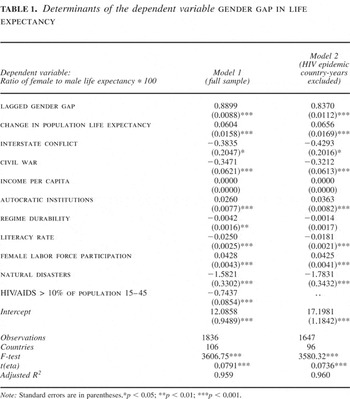
Table 1 presents our estimation results.76
We have tested whether our dependent variable has a unit root. Because we analyze an unbalanced panel, the standard Im, Pesaran, and Shin 2003 test, the most reliable unit root test for panel data, is not applicable. Instead, we regressed the gender gap on its lagged value in an otherwise empty fixed effects model. We then use an F-test to test whether the estimated coefficient equals 1. This is 68.81 in the full sample and 131.77 in the sample where the high HIV prevalence countries are excluded, significantly rejecting the null. We thus do not consider the possibility of a unit root further.
Determinants of the dependent variable gender gap in life expectancy

Before we explore the relations between the various conflict types and the gender gap in life expectancy further, we briefly discuss the estimated effects of the control variables. We find that while a higher per capita income boosts life expectancy, it does not seem to make a difference to the life expectancy gap between men and women. The gender gap significantly widens in autocratic regimes. Political stability has no effect in the restricted sample, but decreases the gender gap in the full sample. We are not surprised to find that female labor force participation actually widens the gender gap. Of course, women's predisposition for heart attacks and lung cancer is likely to increase with higher labor force participation,77
Pampel 2003.
We intend to explore the effect of natural disasters on the gender gap in life expectancy in more detail in future research.
UN 2002, 20.
ICRC 2001, 112.
Conditional Effects
Not all militarized conflicts are alike—to say the least. Some wars are more violent, some occur in politically unstable countries, some conflicts are ethnically motivated, and so on. Of course, one could say this variance in the severity of militarized conflicts renders the estimation of mean effects such as those presented in the previous section meaningless. But that is not true: knowing that on average women are more affected over the entire conflict period is already interesting.
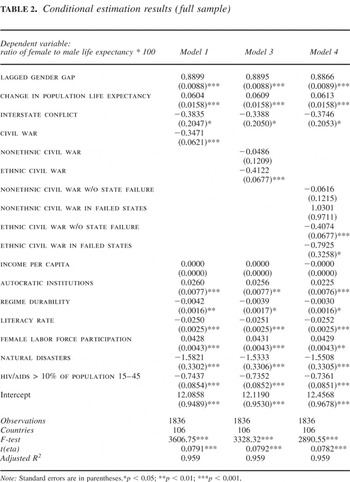
In the theoretical section, we have argued that the influence of militarized conflict on the gender gap is likely to be influenced by whether the conflict has ethnic roots and the political authority in the country has collapsed. In this section we test these conjectures by estimating individual coefficients for ethnic and nonethnic civil conflicts as well as for these conflict types in countries where the central political authority has collapsed and where it has not (in our sample, no failed states engaged in international conflict). Table 2 reports the results. It allows an easy robustness check because we repeat results from Model 1 again in the first column.
Conditional estimation results (full sample)

Observe that our estimates do not vary much following the inclusion of variables that capture conditionality. Most coefficients of the conditional Model 3 do not deviate significantly from the coefficients of the unconditional Model 1. When we distinguish between ethnic and nonethnic civil wars, we find that it is only ethnic civil wars that reduce the gender gap in life expectancy. Of course, one has to keep in mind that the vast majority of civil wars has ethnic roots. When we further distinguish between ethnic and nonethnic civil wars taking place in “failed” states and “nonfailed” states (Model 4), then we find that it is ethnic wars in failed states that have the largest impact on the gender gap in life expectancy, reducing the female to male life expectancy ratio by 0.79 percentage points, whereas the effect of ethnic civil wars in other countries is 0.40 percentage points.81
To illustrate, assume that life expectancy in a country is 60.0 years for men and 64.8 years for women (implying a score of 108 on our dependent variable). If an ethnic war in a failed state reduced men's life expectancy by 2 years to 58.0 years, women's life expectancy would decline by 2.62 years to 62.18 years.
To sum up, we found support for our first hypothesis that over the entire conflict period, the gender gap in life expectancy decreases. Our second and third hypotheses, namely, that this decline is stronger when the conflict has ethnic origins or the political order collapses, needs to be qualified, however: ethnic civil wars have an effect that is stronger still in failed states, whereas nonethnic civil wars do not have any effect. This finding does not necessarily falsify our second and third hypotheses in respect to nonethnic civil wars. Rather, ethnic civil wars are more common than nonethnic civil wars and ethnic civil wars are more likely than nonethnic civil wars to take place in failed states. Therefore, the conditional estimates for nonethnic civil wars suffer largely from inefficiency. Better state failure data and more wars may help to improve estimates, but the world would be much better off if we had to wait a long time before the conditions for efficient estimation were satisfied.
Conclusion
Militarized conflicts kill in various ways. They kill soldiers and civilians directly, but also have important indirect effects and find their victims among the larger civilian population, killing people that have never crossed the line of fire. We have argued that women are likely to suffer more from these negative indirect effects and possibly to an extent that overall they could be more adversely affected by conflict than men, despite the fact that men naturally are the main direct victims of war. We have demonstrated that, indeed, on average women suffer more than men from international and civil wars, as measured by the effect of conflict on the ratio of female to male life expectancy. This confirms our first hypothesis. The average decline in the gender gap in life expectancy suggests that the direct and indirect consequences of wars combined either kill more women or that the killed women are younger on average than the killed men. Findings on our second and third hypotheses have been more mixed, however. We have found that the effect on the gender gap is indeed stronger if the civil war has ethnic roots, which confirms our second hypothesis. But the type of civil war matters even more than we expected because we find that only ethnic civil wars decrease the gender gap, whereas nonethnic civil wars do not. Similarly, we find that it is only for ethnic civil wars that the effect on the gender gap becomes stronger if the conflict takes place in a “failed” state, in accordance with our third hypothesis, but not for nonethnic civil wars. As we explained above, the caveat is that few civil wars are nonethnic and even fewer civil wars in “failed” states are nonethnic, such that variation is low and estimation inefficient.
The finding that, on average, conflicts lower the life expectancy of women more than that of men means that policymakers, nongovernmental organizations, and the academic community need to pay much closer attention to the hidden, indirect consequences of conflict, which are both “profound” and “underappreciated.”82
Human Security Centre 2004, 18.
Our study opens up important avenues for future research in IR. First, future research could explore characteristics of conflicts other than the ones looked at here, which might help explain why some conflicts apparently are so much more damaging to women, whereas others are not. In the analyses supplementing the estimates we reported here (see Appendix 2), we found some regional differences for international wars, but not for ethnic civil wars (only ethnic civil wars in southern Africa were estimated to be even more damaging to women than the average effect). More in-depth case study research might be able to elicit reasons for these differences. Second, the theoretical justification for our hypotheses can explain our findings, but future research should provide a better understanding and a more detailed account on the relative importance of specific channels through which armed conflict harms women more than men. For example, is damage to the health infrastructure or damage to agricultural and food distribution systems more important? Third, future research should address what role, if any, the effect of armed conflict on the gender gap in life expectancy plays for the likelihood of external policy intervention as well as how external intervention impacts on the effect of armed conflict. Why do multinational peace-keeping forces intervene in some conflicts but not in others? Why do international donors attempt to rebuild the country with the help of enormous sums of development aid and technical assistance after some conflicts but not others? How is international aid related to the politics of the government in crisis countries? Do these interventions have a significant effect on the impact of armed conflict on the gender gap in life expectancy and, if so, under what conditions?
From a methodological point of view, we believe that future research would benefit from a more disaggregated and case-study type of approach. On the one hand, studies are needed that analyze the individual level. For instance, political scientists and economists should have a better understanding of how government failure and ethnic conflicts affect the prices of goods of basic need. As yet, we have a much better understanding on how markets work in good times, but we know relatively little about the operation of markets in the presence of natural or man-made disasters. On the other hand, case studies could provide additional insights into the interdependencies between the various effects of militarized conflict and political institutions. For many of the new research avenues that could be taken from this study's results, the quality of data and the number of observations are likely to be insufficient for macro-level studies to provide interesting results.
Appendix 1. Descriptive Statistics

Appendix 2. Robustness Tests
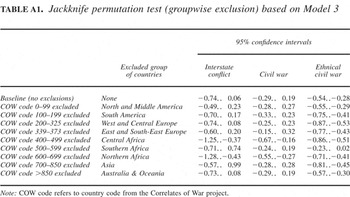
We did two robustness tests—groupwise jackknife and bootstrap—to study whether the results reported in Model 3 of Table 2 stand up against the apparent variance across conflicts. See Table A1. A groupwise jackknife excludes each group of observation once. In the jackknife, we tested the robustness of our model in respect to such influence by eliminating groups of neighboring countries from the estimation. We distinguish between nine country groups: North and Middle America, South America, West and Central Europe, East and South-East Europe, Central Africa, Southern Africa, Northern Africa, Asia, as well as Australia and Ozeania. We found that for civil wars and especially for ethnic civil wars the estimates presented in Table 2 are fairly robust to the exclusion of geographical regions. The effect of interstate wars on the relative gender gap, however, shows strong regional variations, suggesting that not all international wars are alike in their influence on the civil population. The only statistically significant deviation for ethnic civil wars is southern Africa, where such conflicts affect women more strongly still than the average conflict in the global sample as the confidence interval lies entirely above the one from the global sample.
Jackknife permutation test (groupwise exclusion) based on Model 3

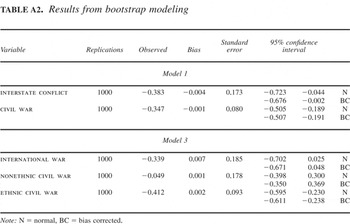
Results from bootstrap modeling

We observe similar robustness when bootstrapping Models 1 and 3. See Table A2. We used various procedures, each with 1,000 replications. We observed that the estimated bias for all variables including the conflict variables is negligibly low (we show only the bootstrapped results of the conflict variables here). The confidence intervals of both the normal regression and the bias corrected results almost perfectly overlap. Thus we may conclude that our results are not sensitive to particular cases.