Introduction
The poultry industry in Nigeria constitutes an important agricultural enterprise to the nation, contributing substantially to the nation's Gross Domestic Product (GDP) (Permin et al., Reference PERMIN, PEDERSON and RISE1998; Ambali et al., Reference AMBALI, ABUBAKAR and JAMES2003). The population of poultry (both local and exotic chickens) in Nigeria has been estimated at approximately 190 million (Orajaka, Reference ORAJAKA2005). It is generally believed that developing the poultry industry is a fast means of bridging the protein deficiency prevalent in most developing countries of the world (Jibir and Usman, Reference JIBIR and USMAN2003). It forms an appropriate system for supplying the fast-growing human population with high-quality protein (Permin et al., Reference PERMIN, PEDERSON and RISE1998; Guéye, Reference GUÉYE2004) whilst providing additional income to the generally resource-poor small holder farmers (Guéye, Reference GUÉYE2004), thereby helping to alleviate poverty.
Modern day commercial poultry production involves confinement (Ogundipe, Reference OGUNDIPE2002), whilst rural poultry production involves free range (Van Eekeren et al., Reference VAN EEKEREN, MAAS, SAATKAMP and VERSCHUUR1995; Orajaka, Reference ORAJAKA2005). Typically four management systems have been recognized: the free range or unimproved backyard, the improved backyard, the semi-intensive and the intensive systems (Branckaert and Guéye, Reference BRANCKAERT and GUÉYE2000, Guéye, Reference GUÉYE2004). The choice of system is largely determined by the availability of resources and inputs; such as housing, cages, feed, drugs, time/attention (Guéye, Reference GUÉYE2004) and vaccination.
This important component of the agricultural sector continues to be fraught by constraints related to high mortality, due mainly to viral, bacterial and fungal infections (Abdu et al., Reference ABDU, WAKAWA, SA'IDU and UMOH2005; Guéye, Reference GUÉYE2004; Oboegbulem et al., Reference OBOEGBULEM, ORAJAKA and OKOYE1980; Chansiripornchai, Reference CHANSIRIPORNCHAI2004), housing, feeding, breeding, marketing and information dissemination (Guéye, Reference GUÉYE2004), and in addition, resistance due to over-use of antibiotics by poultry farmers and /or production of resistance markers by the infective agents (personal communication).
Disease prevention and control programs are limited in this industry, particularly in this part of the country, and high mortality rates due to therapeutic failure are common, perhaps associated with treatment failures due to transferable drug resistance (Saeed et al., Reference SAEED, MOHAMMED, ASHRAF and CARL2000; Deborah et al., 2005) even in vaccinated flocks (Ambali et al., Reference AMBALI, ABUBAKAR and JAMES2003). This paper aimed at assessing some poultry management practices and disease recognition by poultry farmers in Maiduguri, arid zone of Nigeria, with the view of improving the poultry production in this part of the country.
Study area
The study was conducted in Maiduguri metropolis, capital of Borno State, Nigeria. The Metropolis is made up of two local government areas (Jere and Maiduguri Metropolitan Council). It is located on longitude 135°E and latitude 115°N with a land mass of about 50,778 square kilometres. It is the largest city in the North-Eastern region of Nigeria. Borno State is being bordered by the republics of Niger, Chad and Cameroun to the North, North-East and East respectively. Maiduguri lies in the Sahel savannah vegetational region. The climate is favourable with an annual maximum temperature of 34.8°C: March and April are the hottest months with temperature range of 30-40°C. The area is usually cold and dry during harmattans (strong winds characteristic of the region), with November to January being the coldest months. Average annual rainfall is between 88 and 108mm, the rainy season covering the months of June to October (Anon, 2006).
The assessment was based on the administration of close-ended questionnaire which sought information on poultry management practices, flock size, housing system, vaccination and recognition of signs of disease conditions amongst others. Two hundred and fifty copies of the questionnaire were given out to poultry farmers in the study area with the assistance of day-old-chicks sellers, poultry feed merchants and poultry clinics of the State Veterinary Hospital and University of Maiduguri Veterinary Teaching Hospital.
Characteristics of poultry production
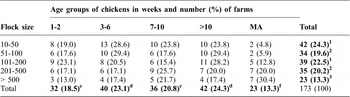
Out of the 250 questionnaires distributed, 173 (69.2%) were completed and returned. Table 1 shows the distribution of poultry farms maintained by farmers in relation to flock size and age-groups of chickens.
Distribution of poultry farms maintained by poultry farmers in Maiduguri in relation to flock size and age (N=173).

Figures in parentheses are percentages.
Mean values with different superscripts differ significantly (p < 0.05).
MA= multi-age
The rearing system practiced in Maiduguri by poultry farmers is shown in Table 2. Farmers who practice the deep litter confinement system were highest in number with n=143 (82.7%), followed by those who used cage confinement system (n=22; 12.7%), whilst those that practiced the free range or extensive system were the lowest in number (n=8; 4.6%).
Rearing systems practiced by poultry farmers (N = 173) in Maiduguri.

Mean values with different superscripts differ significantly (p < 0.05).
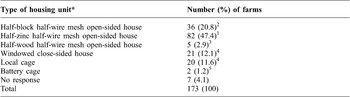
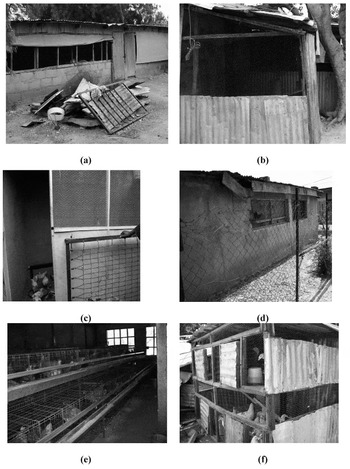
Table 3 shows the types of housing units maintained by the respondent farmers. Half-zinc half-wire mesh open-sided housing proved most popular (47.7%), followed by half-block half-wire mesh open-sided houses (20.8%), whilst half-wood half-wire mesh open-sided (2.9%) houses were the least popular. Only 21 (12.1%) respondents kept birds in windowed closed-sided houses, whilst those that used local and battery cage housing systems accounted for 11.6% and 1.2% of respondents respectively. The different types of poultry houses maintained by poultry farmers in Maiduguri are shown in Figure 1.
Poultry housing systems (type of housing units) maintained by farmers in Maiduguri (N=173).

*Houses roofed with galvanized iron sheet (zinc).
Mean values with different superscripts differ significantly (p < 0.05)
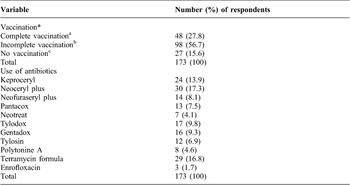
Table 4 shows vaccination levels and antibiotics usage in poultry rearing from the producers answering the questionnaire. The majority of farms had only incomplete vaccination schedules, and some reported that no vaccinations occurred. On the other hand, farms in which multiple antibiotic combinations use was common differed from those in which double or single antibiotics combination use were common. However, there was no difference between farms in which double antibiotic combinations were in use and those in which single antibiotics were in use. This may result from more intelligent and judicial use of these antibiotics by the two categories of farmers: the effect of antibiotics being determined by the dose, dosage, concentration, level and rate or frequency of use and duration of administration amongst other things.
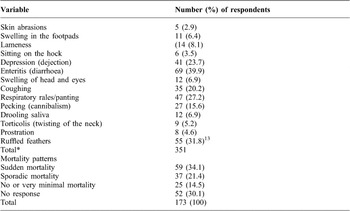
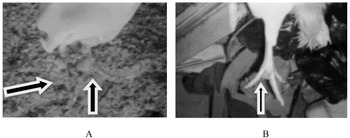
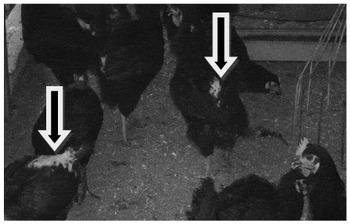
Table 5 shows disease recognition by poultry farmers in Maiduguri, whereby the producers were asked to confirm their familiarity with certain disease symptoms and its link to specific disease. Figure 2and 3 show some typical examples of disease conditions easily recognized by the producers.
Types of poultry houses maintained by poultry farmers in Maiduguri.
(a) Half block half wire mesh open-sided house; (b) half zinc half wire mesh open-sided house
(c) Half wood half wire mesh open-sided house. (d) windowed closed-sided house
(e) Battery cage; (f) local cage

Vaccinations and use of antibiotics in poultry by poultry farmers in Maiduguri (N = 173).

*Vaccinations against major poultry diseases endemic in this area (Infectious bursal disease, Newcastle disease, Fowl cholera, Fowl typhoid, and Fowl pox)
aHave vaccinated birds against all the 5 major diseases above with full adherence to vaccination schedules
bHave vaccinated birds against all or some of the major diseases but with no adherence to vaccination schedules
cHave not attempted vaccination even with single dose of vaccine against any of the diseases.
Confirmed disease recognition and incidence of mortality as reported by poultry farmers in Maiduguri.

*Majority of farmers indicated recognition of more than one sign of disease ( hence, total > 173).
Swollen digital pads (digital pad dermatitis) in a laying hen.
(A) Plantar view; (B) Dorsal view

Poultry vices (cannibalism or pecking) amongst laying hens.

Discussion
Poultry production has undergone rapid changes during the past decades due to the introduction of modern intensive systems of production which places a high premium on health care, hygiene and management with a small but highly skilled labour force (FAO, Reference FAO2000). Poultry production is growing fast, with annual production rate of 3.7% over the past decade. As a consequence, the vast majority of chickens and turkeys are now produced in houses with 15,000–50,000 birds in industrialised countries (FAO, Reference FAO2007). Globally, the per capita egg consumption for the year 2015 is projected to be 9.8 kg with additional demand for 12,007 million tons of eggs, with 12.3% of that need arising in Africa (Windhorst, Reference WINDHORST2008). In Nigeria, the projection has been set at 3.3 kg with additional demand of 113.4 million tons of eggs (Windhorst, Reference WINDHORST2008).
The study reported above showed, unsurprisingly, that small scale (small-holder flocks) production was most commonly practiced in Maiduguri, where the majority of farmers kept less than 500 chickens in a flock. The study also showed that deep litter was the most common poultry rearing system in the study area. This observation is in line with the trend reported in United States (May et al., Reference MAY, MALONE, CHALOUPKA and HUFF1982), western-Europe (Lokhorst, Reference LOKHORST1996) and Switzerland (Gunnarsson et al., Reference GUNNARSSON, KEELING and SVEDBERG1999) where the cage system was phased out in practice by legislation in 1991 with minimal use of conventional cages. In Europe in particular, research continues into the details of alternative housing systems for laying hens, following the ban on conventional cages from 2012 (Hetland and Svihus, Reference HETLAND and SVIHUS2007).
Interest in alternative housing systems for laying hens has increased in recent years mainly because of public concern for the welfare of hens in cages. A Dutch study showed that chickens kept on wire floors peck more than those reared on litter (Gunnarsson et al., Reference GUNNARSSON, KEELING and SVEDBERG1999). It was also shown that early exposure to litter and quality of litter during rearing are important to prevent feather pecking in adult layers (Gunnarsson et al., Reference GUNNARSSON, KEELING and SVEDBERG1999). This may probably explain the reason why rearing birds on litter was observed in this study as the most common system of management amongst poultry farmers in Maiduguri. The deep litter system is relatively convenient, with less injuries to chickens and encourages production (May et al., Reference MAY, MALONE, CHALOUPKA and HUFF1982). The use of deep litter, which results in consumption of wood shavings by chickens, was also said to cause a remarkable reduction in the particle size of digesta passing from the gizzard, reduce feed consumption and increase efficiency in both broilers and layers (Hetland and Svihus, Reference HETLAND and SVIHUS2007). Very few farmers practice the cage system in this area, probably because of the conclusion that welfare of birds are compromised more in cages than in well-run alternative systems such as deep litter. This may probably be due to behavioural restrictions and environmental deficiencies manifested by abnormal behaviour patterns such as, feather pecking, cannibalism, sham- dust bathing, stereotyping and hysteria in the cages as reported by Hansen (Reference HANSEN1994). It may be due to the cost or availability of cages, or due to adverse effects on bone strength in battery caged birds compared to litter-reared birds (Fleming et al., Reference FLEMING, WHITEHEAD, ALVEY, GREGORY and WILKINS1994). The result of the present study also showed that 83% of the flocks managed in this area were reared on litter, which is in agreement with previous studies (May et. al., 1982; Lindberg and Nicol, Reference LINDBERG and NICOL1996). This result is also supported by the fact that carcass quality is compromised more in caged birds than in litter-reared birds (Hansen, Reference HANSEN1994), and that condition scores for broilers on litter are greater than for those reared in cages (May et al., Reference MAY, MALONE, CHALOUPKA and HUFF1982). Only 8(4.6%) of the 173 poultry farmers in Maiduguri practice the free range or extensive management system. This perhaps may be due to the possible risks of fracture birds which are kept by extensive management system may be exposed to as a result of greater opportunity for more severe accidents than in litter management system (Fleming et al., Reference FLEMING, WHITEHEAD, ALVEY, GREGORY and WILKINS1994). However, confined poultry housing can produce large amounts of waste, which may contain substantial quantities of pathogens (FAO, Reference FAO2007). Much of this waste is being disposed off in the environment untreated, and which may pose an infection risk for both domestic and wild animals and birds.
The poultry housing systems used in Maiduguri is not comparable to housing elsewhere in this country or abroad. Poultry houses are erected by farmers according to their tastes or depend upon their resources and environmental influences (Van Eekeren et al., Reference VAN EEKEREN, MAAS, SAATKAMP and VERSCHUUR1995; Van Beek and Beeking, Reference VAN BEEK and BEEKING1995; AgVet, Reference AGVET2002). The most commonly observed housing systems in this area were the half-zinc half-wire mesh open-sided buildings (47.4%) and the half block–half wire mesh open-sided buildings (21%). The climate, cost of materials and the presence of pests, particularly termites, have become determinants in poultry housing system in Maiduguri Metropolis. The area is infested by termites and this may account for the reason why wooden housing system (2.9%) was least utilized by poultry farmers as observed in the present study. Heat stress in poultry manifests itself in insulated poultry houses (Sahin and Kucuk, Reference SAHIN and KUCUK2003), and in poultry houses made solely with zinc sheets in many parts of the world, particularly countries with hot climates (as experienced in the study area). Stress factors from environmental sources are generally recognized to have a major impact on body weight and egg production. Higher environmental temperatures have deleterious effects on poultry, reducing rate of growth, feed intake, live weight gain and feed efficiency, digestibility of nutrients, egg production, egg weight etc. (Sahin and Kucuk, Reference SAHIN and KUCUK2003). More severe stress can result in body temperature rising to fatal levels, especially in birds kept in poultry houses made completely of zinc or galvanizing roofing sheets (as superstructure as well as the roof).
The present study also showed that only 27.8% of the poultry farmers (N = 173) observed full adherence to vaccination schedules for their chickens, as against 56.7% non-adherence. There is therefore the need to enlighten poultry farmers on the endemic poultry diseases in this region and the dangers they pose; as has been practiced elsewhere (Adene, Reference ADENE1997, Abdu et al., Reference ABDU, WAKAWA, SA'IDU and UMOH2005). Diarrhoea (39.9%), ruffled feathers (31.8%), pecking (27.2%), depression (23.7%) and respiratory rales/panting (20.2%) were the most commonly encountered signs of disease conditions by farmers in the study area. This perhaps may be predisposed by weather or poor management practices. It has been reported that high environmental temperature decreases rates of retention of calcium, iron, potassium, magnesium, sodium and zinc in broilers, and this can lead to diarrhoea, depression, ruffled feathers and increased respiratory rates and panting observed in this study. Keeping birds in open-sided block houses increases ventilation rates and use of evaporative systems such as fan in enclosed poultry houses as well as lowering stocking densities have been said to help alleviate the negative effects of heat stress in chickens. Other factors that may predispose these signs and such signs as coughing, lameness, digital pad dermatitis observed in the present study include microbial infections.
Several systems for scoring the presence and severity of foot pad dermatitis or avian pododermatitis exist (Mayne et al., Reference MAYNE, ELSE and HOCKING2007; Hocking et al., Reference HOCKING, MAYNE, ELSE, FRENCH and GATCLIFFE2008). These generally are based on a subjective assessment of the area of the food pad that is affected by the lesion (s). Based on the scoring system (Hocking et al., Reference HOCKING, MAYNE, ELSE, FRENCH and GATCLIFFE2008) the foot pad dermatitis observed in the present study was given a score 1. The prevalence of foot pad dermatitis in chickens especially broilers, had been proposed to be used as one of the main criteria of welfare on which future stocking density for specific farms would be based (Hocking et al., Reference HOCKING, MAYNE, ELSE, FRENCH and GATCLIFFE2008). The assessment of foot pad dermatitis has also been proposed as a parameter for cross –national comparisons of management systems, feeds and husbandry practices (Hocking et al., Reference HOCKING, MAYNE, ELSE, FRENCH and GATCLIFFE2008).
Though immune and chemotherapeutic measures have become part of poultry management practice in Nigeria, most poultry diseases still remain endemic in the country (Ambali et al., Reference AMBALI, ABUBAKAR and JAMES2003). The use of antibiotics as feed additive for growth promotion and disease control in domestic animals has increased over the years (Van den Bogaard and Stobberingh, Reference VAN DEN BOGAARD and STOBBERINGH1999). This practice has resulted in an increase in antibiotic resistance by some intestinal bacteria of domestic animals (Swezey et al., Reference SWEZEY, BADWIN and BROMEL1981; Saeed et al., Reference SAEED, MOHAMMED, ASHRAF and CARL2000) including poultry. In addition to the increase in resistance it has been demonstrated that antibiotics may have a detrimental effect on the animal body (Swezey et al., Reference SWEZEY, BADWIN and BROMEL1981). It was reported that the use of tetracycline in poultry caused an inhibition of immunoglobulin synthesis (Swezey et al., Reference SWEZEY, BADWIN and BROMEL1981; Van den Bogaard and Stobberingh, Reference VAN DEN BOGAARD and STOBBERINGH1999). Similarly, as a result of chlortetracycline in feeds, therapeutic failure of this drug was documented in cases of colibacillosis in pigs (Swezey et al., Reference SWEZEY, BADWIN and BROMEL1981). It was also observed in a study with turkeys that the use of tetracycline as feeds supplement increased antibiotic resistance level in bacteria present in the liver and blood of these species, and that the degree of resistance in isolates correlated with the level of antibiotic concentration administered to the birds (Swezey et al., Reference SWEZEY, BADWIN and BROMEL1981). Farmers in Maiduguri may likely face similar resistance problems as most of them are in the habit of using multiple antibiotics as chemo-prophylactic measures. This is evident from the widespread application of antibiotics in poultry by poultry farmers, observed in the present study.
In conclusion, the trend towards industrialization of poultry production can be observed in developing countries, where traditional systems of management are being replaced by intensive management practice, most notably in South America, Asia, Europe and parts of Africa including Nigeria. Global animal food production is undergoing a major transformation that could lead to a higher risk of transferable drug-resistant infections from animals to humans. The movement of poultry and the concentration of thousands of confined birds may increase the likelihood of transfer of the infective agents. The greatest threat to the poultry industry is currently the global epidemic and dissemination of the influenza virus H5N1 strain. The present study has revealed some management practices such as housing and inadequate coverage of vaccination schedules to still pose serious constraints to poultry industry in the study area. The need to educate poultry farmers in this region on better housing system, management and adequate vaccination program is paramount, if disease control, eradication and profitability needed to be achieved. The indiscriminate use of antibiotics by poultry farmers in this region and in the country as a whole should be discouraged, particularly for chemoprophylaxis rather than chemotherapy as this could lead to the emergence of many bacteria with multiple drug resistant strains. Also, guidelines for the prudent use of antibiotics in conjunction with the National Agency for Food and Drug Administration and Control (NAFDAC) should be enforced in Nigeria in order to eliminate drug residues in chicken meat which may confer resistance in humans.