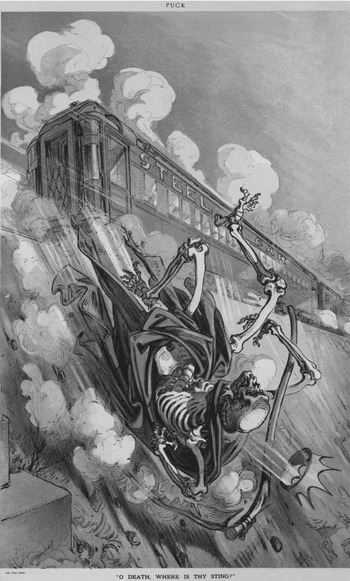
“No accidents were reported [on the New Haven] yesterday.
The cause of this has not yet been ascertained.”
Life 1913a
On the night of June 6, 1911, a rear collision and derailment near Fairfield, Connecticut, that ultimately involved four freight trains of the New York, New Haven & Hartford Railroad (the New Haven), claimed the lives of five trainmen. The wreck was largely indistinguishable from the many hundreds of similar disasters that had plagued American railroading for decades (Aldrich Reference Aldrich2006; Shaw Reference Shaw1961). Accordingly, while it made the front page of the Springfield Union (1911; hereafter Union), other papers mostly ignored the story.
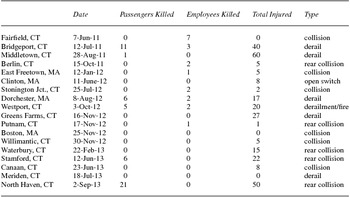
Yet the Fairfield wreck inaugurated what became a virtual avalanche of criticism of the New Haven's safety record. All the carriers had experienced a surge in accidents in the decade after 1900, making railroad safety a major public issue, and criticism of the New Haven arose in part because Fairfield initiated what appeared to be a remarkable string of train accidents between 1911 and 1913 (table 1).Footnote 1 But modern research on risk perception suggests that accident worries reflect more than simply risk probabilities. Train wrecks at this time had characteristics that made them seem especially horrifying. In the days of wooden cars they often involved fires. They were largely involuntary—especially before the widespread use of automobiles, and with the New Haven having a transportation monopoly in Southern New England. And they were uncontrollable: no passenger could influence the likelihood of an accident.
Publicized train accidents and casualties on the New Haven Railroad, 1911–1913.

Source: Adapted from New York Times 1913f.
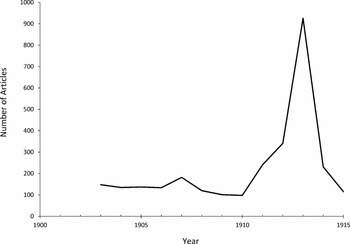
These accidents also occurred in a context that greatly magnified their importance. Risk perceptions are socially constructed and circumstances may amplify or attenuate public risk attitudes. There can be “information cascades” (also termed “availability cascades”), which are “self-reinforcing process[es] of collective belief formation by which an expressed perception triggers a chain reaction that gives the perception increasing plausibility through its rising availability in public discourse” (Kuran and Sunstein Reference Kuran and Sunstein1999: 683). As another author puts it (Vasterman Reference Vasterman2005: 111), “[O]nce a topic gains a certain level of attention. . . it attracts more attention, and because it attracts more attention it becomes more newsworthy.” And the public's perception of the magnitude of a risk is likely to reflect the volume of news. Moreover, these cascades can frame “stories” and employ verbal and visual signals (in this case, headlines such as “Railroad Massacre” or cartoons with a death's head) in ways that can magnify perceived risk, erode trust, and ultimately stigmatize a company. Such an information cascade struck the New Haven in the years 1911 to 1913 (figure 1). Moreover, the New Haven's accident “story” was amplified by a second “story” of its financial follies that was playing out during the same period, and both events occurred at a time when Progressive Era concerns subjected big business activities to more than ordinary scrutiny. Finally, the location of the New Haven in Southern New England made its accidents of peculiar concern to the eastern news media.Footnote 2
Newspaper and magazine articles on New Haven railroad wrecks, 1903–1916. The information cascade in 1912 and 1913 is clearly evident.

By 1900 the New Haven was dominated by Morgan banking interests, and in 1903 Morgan installed Charles S. Mellen as president of the company (Chernow Reference Chernow1990). Almost immediately, Mellen began a campaign to monopolize transportation in Southern New England, buying up interurban lines, steamship companies, and other railroads. Virtually all writers have concluded that Mellen was a first-rate railroader, but he was aloof, arrogant, and his actions skirted the edges of illegality (Abrams Reference Abrams1964; Staples and Mason Reference Staples and Mason1947; Weller Reference Weller1969). Mellen's unscrupulous methods stirred up a hornet's nest of opposition making him “head devil of the plutocracy” for New Englanders (White Reference White1938: 98). Louis Brandeis began the opponents' attack in 1907 (McCraw Reference McCraw1984; Urofsky Reference Urofsky2009). Thereafter a nearly continuous series of investigations and reports that denounced the New Haven's dodgy finances and efforts to dominate New England transportation continued unabated until about 1914. Ultimately these widely publicized charges of monopolization, reckless financing, and bad service would draw in the legislatures and utility commissions of Connecticut, Massachusetts, and Rhode Island, while the Justice Department, Congress, and the Interstate Commerce Commission (ICC) investigated these issues as well.Footnote 3
Both the explosion of accidents and the New Haven's financial follies struck during the high tide of Progressive Era worries over big business. Antimonopoly, as Daniel Rogers (Reference Rogers1982) wrote, was an older “social language” that Progressives drew upon as they denounced trusts and privilege. Its deployment by middle-class reformers, as he noted, probably reflected the recent and rapid growth of very large corporations. Other scholars also stress the importance of “the trusts” in shaping the progressive agenda (Chambers Reference Chambers2000; Diner Reference Diner1998). Moreover, as a number of writers have noted (Dorsey Reference Dorsey1995; John Reference John2012; Thelen Reference Thelen1969), it was bad behavior, not simply size, that led Progressives to distinguish “bad” from “good” trusts. Such bad behavior by railroads included corporate arrogance on the part of executives such as Mellen, as well as accidents. And as Mohun (Reference Mohun2013) and others (Aldrich Reference Aldrich2006) have argued (and as some railroaders understood at the time), tolerance for such behavior was declining during these years.
Thus either the monopoly-finance story or the upsurge in accidents would have made the New Haven a target for reformers and gradually the press began to link them as part of a larger tale of the evils of monopoly. To the company's Progressive critics, accidents resulted because management (1) was preoccupied with monopoly to the exclusion of safety and/or (2) found the payoff to monopoly higher than the payoff to safety. Thus, these two stories conjured up monopolizing bankers who paid fat dividends instead of investing in safety. Such views must also have influenced risk perception, making the New Haven's accidents seem particularly immoral. In short, the monopoly story played into Progressive Era concerns, eroding trust in the New Haven's management, and amplifying the New Haven's moral culpability for its accidents.Footnote 4
Finally, the New Haven's location placed all its activities under a microscope. It was an East Coast railroad whose activities affected the lives of many educated, affluent citizens of New York and New England. A number of them rode it to work or on vacation, and many read and wrote for the numerous newspapers and opinion journals published there. Had a midwestern railroad attempted to monopolize Iowa interurbans or experienced a series of bad accidents, one imagines that its actions would have received less play in the eastern news media.Footnote 5
Thus by 1913, the New Haven and its managers had become stigmatized as a symbol of all that was wrong with American railroading. A number of writers have explored its financing and efforts to monopolize New England transportation. But the New Haven's alleged poor safety record was also part of the public indictment, and scholars have largely ignored that piece of the story. This paper analyzes the New Haven's accident record in the years just before World War I. Although—as will be shown—the New Haven's safety record was far better than contemporaries believed, perception was what counted, and we employ popular eastern newspapers and magazines to investigate the self-reinforcing process that led to an amplification of public risk perceptions. We also briefly contrast the stories detailed in the popular press with an alternative narrative contained in business and industry journals. By 1913 the accident and monopoly stories combined to generate an unprecedented wave of public condemnation—as expressed in both government investigations and news stories—that stigmatized the New Haven as the quintessential “bad trust”—with, as will be shown, far-reaching consequences. The story thus captures a moment when public attitudes toward corporate risks were changing, and reveals some of the forces shaping those attitudes and the results that followed.Footnote 6
The Wrecks Begin
There are no public statistics for the number of train wrecks on individual carriers for this period. The list in table 1 comes from the New York Times (hereafter Times) and was published right after a wreck on the New Haven at North Haven, Connecticut. The Times, however, almost certainly got it from similar lists published previously in the Outlook (1912), the Springfield Republican (1912e; hereafter Republican), Boston Journal (1912l; hereafter Journal), Boston Globe (1913a; hereafter Globe), Boston Herald (1913a; hereafter Herald), Independent (1913a), New York Sun (1913), and New York World (1913b; hereafter World). They reflected public perceptions that the New Haven was a particularly dangerous road. These perceptions began to coalesce in 1912 after the New Haven had begun to experience what seemed like a remarkable string of wrecks. The widely reported lists also exemplified the sort of availability cascade that amplified public worries, and it seems likely that they copied from one another.Footnote 7
Economics was probably what motivated the popular press to sensationalize the New Haven's accidents, for then, as now, disasters—especially those that might kill local folk—made good copy and newspaper competition was at an all-time high during the Progressive Era (Smythe Reference Smythe2002, Reference Smythe2003). Moreover, as noted, the New Haven's disasters could be framed so that they dovetailed nicely with other stories of the company as a bad trust. Thus, while some mass market newspapers and journals largely ignored the New Haven's wrecks, I found none that supported the company. Indeed, its only support came from the business and trade press—the Wall Street Journal and Railway Age Gazette (hereafter Gazette)—papers with a very different audience than the popular press.
While a review of every wreck would be tedious, investigation of five of the worst disasters—all in Connecticut—at Fairfield (1911), Bridgeport (1911), Westport (1912), Stanford (1913), and North Haven (1913)—along with how they were reported can demonstrate how public risk perceptions became amplified and why the New Haven's safety record became stigmatized.
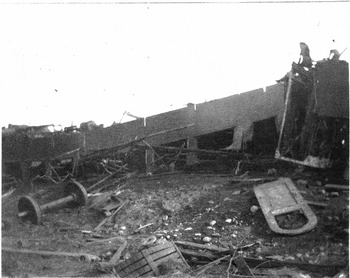
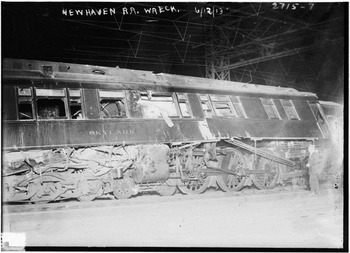
As noted, the wreck parade began at Fairfield, Connecticut, on June 6, 1911 (figure 2). The New Haven ran a four-track line going roughly east-west through Fairfield, with traffic governed by automatic home and distant block signals to protect against rear collisions.Footnote 8 At about 11:16 that night, New Haven freight No. 338 passed a yard tower near Fairfield, going east and stopped about a half mile later to fix a bad brake, its rear protected, presumably, by a home block signal that showed red and with a semaphore set to stop. In addition the conductor ordered his flag man back to protect the train. After fixing the brake, they got under way. Almost immediately a following freight—Train H-Y-2—with Engineman Elliott Beach in the cab, struck the caboose of Train 338, which was then traveling about 10 miles per hour. Train 338 derailed and its wreckage spilled, landing on and apparently stopping a passing westbound freight, which was then struck by a following freight, whose locomotive boiler exploded, setting the whole mess on fire and killing five trainmen (Interstate Commerce Commission 1911a).
The freight train wreck at Fairfield on June 6–7, 1911 was spectacular but unremarkable; its importance came later as newspapers repeatedly emphasized that it began the New Haven's wreck parade. Source: Archives & Special Collections at the Thomas J. Dodd Research Center, University of Connecticut Libraries.

Railroad safety was becoming of increasing concern during these years (Aldrich Reference Aldrich2006; Mohun Reference Mohun2013), and Congress had given the ICC authority to investigate train accidents in the Accident Reports Acts of 1910. Following in the footsteps of Charles Francis Adams and the Massachusetts Railroad Commission, the ICC would employ public investigations and thus public opinion to press the carriers for better safety (McCraw Reference McCraw1984; Mohun Reference Mohun2013). Fairfield was one of its first efforts.
The immediate causes of the disaster were straightforward. Engineman Beach ran a stop signal, while the ICC investigator concluded that the flagman of Train 338 could have gone back no more than a quarter mile, which was a wholly inadequate distance, to protect his train. Yet there was more to the story than simple man-failure. Engineman Beach probably missed the yellow distant signal for caution, while the investigation revealed that the light illuminating the red home signal had gone out. Moreover, it had been out for some time and had been repeatedly reported but not fixed. Enginemen were in the habit of running up to it to try to see the semaphore; moreover, as Train H-Y-2 approached, the tower-man came out and waived a white signal lantern, which Engineman Beach probably took to mean proceed. In short, the Fairfield wreck revealed some serious lapses in the New Haven's management. It was well known that the signal system was defective and that enginemen had been violating rules to compensate; yet nothing had been done. The ICC's report was sharp but temperate accusing the New Haven of sloppy maintenance practices for failing to fix the signal lights, and sloppy operating practices that tacitly allowed enginemen and brakeman to violate rules.
As noted, such disasters had been common on American railroads for decades (Aldrich Reference Aldrich2006) and accordingly the ICC's criticisms might have been directed at nearly any American carrier at this time. Nor was Fairfield in any sense “the first” New Haven accident in many years. Nearly a year earlier in September 1910 the Globe (1910a) reported the page one news that there had been many injured when that railroad's New York Express “jump[ed] iron.” A month later (Globe 1910b) the paper reported another New Haven wreck with two fatalities and five injuries as “Locomotives Crash into Passenger Car.” Thus Fairfield was not widely reported because it was not particularly remarkable at the time; it only stands out in retrospect as the press later rather arbitrarily made it important by employing it to begin lists of the New Haven's string of wrecks.
A bit more than a month after Fairfield, on the morning of July 12, 1911, New Haven Train No. 72, the Federal Express, heading northeast and carrying vacationers from Philadelphia and New York, derailed near Bridgeport, Connecticut, killing 11 passengers and three crew members. That line was governed by manual block signals, including one that governed speed control.Footnote 9 Train 72 was directed to cross over from Track 2 to Track 4 so that it could stop at the Bridgeport station to set off a car. The safe speed for the crossover, as stated in the New Haven's rules and indicated by the signal on the approach, was 20 to 25 miles per hour, and Engineman Curtis was both experienced and, as the ICC noted, “familiar with the rules, tracks and signals at the place of the accident.” Yet he took the crossover running at 55 to 60 miles per hour; causing the locomotive and tender to jump the track, pulling all but the last two cars with it. The track near Bridgeport was elevated; the derailed locomotive and cars struck a bridge girder, overturned, and careened down the embankment, coming to rest about 400 feet beyond the derailment. The pile-up reduced one of the wooden cars to splinters, causing most of the casualties (Interstate Commerce Commission 1911b).
The Connecticut Railroad Commission, the county coroner, and the ICC all investigated the wreck and as inquiries played out they kept the disaster in the news for nearly two weeks. Everyone agreed that the primary fault lay with Engineman Curtis. Yet the No. 10 crossover employed at Bridgeport was particularly sharp and the coroner also held the New Haven management “criminally negligent” (Journal 1911b) for failing to use a longer crossover with a reduced angle, although the ICC report pointed out that such a crossover would not fit in the track there. The ICC did recommend two important changes. Trains should be brought to a stop before such crossovers—which, of course, raised the risks from rear-end collisions. Second, the ICC launched the first salvo in what would be a 40-year campaign to promote automatic train control “[i]n all situations where accidents are likely to occur through the non-observance by enginemen of signals or rules calculated to insure safety, automatic train control apparatus should be provided.”Footnote 10 Of course, no such technology then existed (Interstate Commerce Commission 1911b: 7).
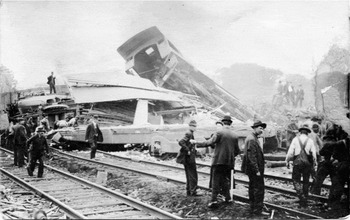
Perhaps because the Federal Express was a New York City train and because passengers were killed, this wreck occasioned far more public outcry than had the Fairfield disaster. Moreover the stories employed powerful visual and verbal images as signals that made the wreck seem especially horrible (figure 3). There were front-page pictures in both the Boston Globe (1911a) and the Boston Journal, which described “Frightful Scenes,” and “bodies crushed and mangled” (1911a) as well as “pathetic scenes when mothers learn children are dead.” Making the disaster more frightening to their readers, most papers provided lists of the killed and injured. In the days before driver's licenses and Social Security cards, many of the dead carried no identification and were listed as “unknown.” There were tales of heroism and individual tragedies: “the wreck will be responsible for two more deaths if Mrs. Sarah Calabra. . . succumbs for she is about to give birth to a child,” the Washington Post reported (1911). Like the images and signal words, such human interest stories turned the tragedy from an abstraction into a frightening reality, in all likelihood enhancing risk perceptions.
The Bridgeport wreck yielded dramatic news stories illustrated by images such as this one because it occurred in the New York metropolitan area and killed passengers.

The press also framed the accident so as to place blame on the New Haven. While the company rushed into print to defend itself—“Dead Engineer Blamed for Wreck,” it claimed—(Globe 1911a), most papers adopted the coroner's finding, which laid blame on the short crossover and blamed the New Haven's management. The New York Times (1911) indicted management in an editorial employing signal words entitled “Bridgeport Massacre.” Outlook (1911) wondered about short crossings—which were a management responsibility. Life (1911a) went even further; it was one of the earliest publications to link the New Haven's accident story to the finance-monopoly story, claiming that the “New Haven. . . is more concerned with its dividends than with the welfare of its passengers.” Later (Life 1911b) it suggested that “Mr. Mellen will not agree [with the need to replace crossovers as]. . . improvements cost money.”Footnote 11
Only the Railway Age Gazette and Wall Street Journal framed the story so as to exculpate the New Haven. Blaming the crossover was nonsense the Gazette claimed (1911); if an engine runner would take a cutoff at too high speed he would do the same on a curve, the journal opined, and to avoid such wrecks the New Haven would have to straighten every curve on its line. As the Gazette routinely reported, such accidents had been endemic to American railroading for decades: it urged better discipline. The Wall Street Journal (1911) also blamed the engineman, observing “we have not invented any machine yet which can do away with human. . . responsibility” and it went on to take a swipe at labor unions that it thought eroded discipline.
After Bridgeport, the wrecks followed thick and fast. At Middletown, Connecticut, on August 28, 1911, spreading rails threw an express train off the track but—as the cars hit nothing solid—only one passenger was killed (Republican 1911). The newspapers initially accepted the company's explanation that blamed train wreckers for removing spikes that held the rails to the ties (Globe 1911b). Later stories reported that police found no evidence for the claim; more likely, the combination of a wet, spongy roadbed after heavy rain plus high speed on a curve had placed excess lateral stress on an outside rail. Thus while the New Haven was largely blameless for Middletown, it continued a pattern begun at Bridgeport where the company seemed more interested in denying responsibility for its accidents than in trying to understand and prevent them, thereby—almost surely—further eroding public trust in management (Pawtucket Times 1911).
After Middletown, as table 1 demonstrates, the New Haven experienced wrecks on October 14, 1911, in Berlin, Connecticut (Herald 1911, 1912); on January 12, 1912, at East Freetown, Massachusetts; and on June 11, 1912, near Clinton, Massachusetts. None of these accidents excited much comment at the time, but a sideswiping collision at Stonington Junction on July 25, 1912, that killed two employees was briefly front-page news (Republican 1912b; Tribune 1912a). Although they were not major stories, these minor wrecks were all reported and would be included in later newspaper lists indicting the New Haven's safety record. Even the Dorchester derailment on August 8, 1912, that killed six passengers, made little news outside of New England (Globe 1912c; Journal 1912c). Perhaps this was because New York travelers were not involved and there were no public ICC hearings. The Massachusetts Board of Railroad Commissioners (1913) investigated the wreck, but its cause was never discovered. However, it moved the Boston Journal (1912d, 1912e) to denounce wooden cars, which again focused blame on management.
The papers reported other wrecks so minor they were excluded from lists such as table 1. Yet they added to the cascade of information and must have contributed to public anxieties over train travel. Thus the Boston Journal reported a slight collision on March 12, 1912, with the headline “Federal Express Again Meets Hoodoo Number” and reminded its readers of two previous wrecks of that train in the past year (Journal 1912a). The term hoodoo conveys the notion that the train is hexed and train accidents are mysterious and frightening. On July 10 it reported a train wreck in Nantasket, Massachusetts (Journal 1912b). As these events transpired the press also continued to report the monopoly story then being played out in hearings as the ICC conducted its investigation of New England railroads. One headline was “Board Probing Mellen Roads” (Globe 1912b). In July, the ICC opened a broad investigation of service and rates on New England railroads and began hearings in Boston (Globe 1912a; Republican 1912a). It generated headlines such as “Brandeis Grills New Haven Road” (Journal 1912f) and suggested financial misdealing. Charles Edward Russell published as a book Stories of the Great Railroads (Reference Russell1912)—his earlier muckraking essays on railroad skullduggery. In the preface he accused the New Haven and its bankers of trying to suppress its publication—a claim the Springfield Republican (1912c) thought deserved investigation.
An Information Cascade and Stigma
Two months later, on October 3, 1912, a major disaster struck at Westport, Connecticut. Train 53 left Boston heading for New York that day, consisting of a locomotive and tender run by Engineman Clark, and 10 cars—all made out of wood. Just outside of Westport, running 12 minutes late, Train 53 derailed when Engineman Clark took a No. 10 crossover from Track 1 to Track 3 at too high rate of speed. The engine and tender and all but the last three cars left the rails and traveled about 400 feet before plunging down an embankment where the first parlor car crashed into the locomotive and was then telescoped by the second parlor car. The boiler burst and the wreck then caught fire, killing nine passengers and injuring 50 (Interstate Commerce Commission 1912c).
The ICC, represented by Commissioner Charles McChord and Chief Inspector of Safety Appliances Hiram Belnap, investigated the crash and as they pointed out, Westport was nearly a mirror image of the earlier Bridgeport wreck. The initial cause of the disaster lay squarely on the shoulders of Engineman Clark, and as usual, that is precisely where the New Haven heaped the blame (Pawtucket Times 1912a). Yet the New Haven seemed far from blameless, and in language far sharper than it had used in earlier reports, the ICC excoriated management for failing to replace the No. 10 crossovers or requiring a stop before such crossovers as remained—as it had recommended after Bridgeport. The commission also stressed that the company had recently admonished its engine drivers for failing to keep to the schedule (but neglected to mention that the company specifically ruled out speeding to make up time). And it criticized management for its seemingly fatalistic attitude toward such disasters. When company Vice President of Operations Henry Horn was asked if a less sharp crossover might reduce such accidents his reply was: “It is simply putting a premium on the violation of a rule” (Interstate Commerce Commission 1912d: 10). Although Horn's point could not have been more poorly phrased, it was essentially correct. Again, the Railway Age Gazette (1912a,1912b) framed the wreck largely as a matter of labor discipline, pointing out that a man who will speed through a No. 10 crossing may simply go even faster through a crossing that is less sharp. Seen that way the New Haven's failing was a matter of organization and discipline not technology. But technology might yet provide a solution, the commission hoped, and it again lectured the New Haven for failing to make any effort to develop automatic train control and threatened to ask Congress for the power to require such devices.
As usual with wrecks on New York trains, the press gave wide publicity to the disaster. Most accounts largely accepted the ICC's narrative, framing the story as a penurious corporation refusing to spend money on safer crossovers. And because accidents with fires seemed especially dreadful, reporting emphasized the conflagration (figure 4) and the New Haven's continued use of wooden cars. The Boston Journal (1912g) informed readers that “Burning wreckage adds to horror of the scene.” “Wooden Cars Fatal,” was the New York Tribune's headline (1912b, hereafter Tribune) next to a front-page picture of the smoldering wreck. Again, human-interest stories listed unidentified victims, described shrieks and screams of burning passengers, and reported families claiming the dead. In an editorial the Republican (1912d) called for the company to shift to steel cars. The Wall Street Journal (1912a, 1912b) provided a more complex narrative. The accidents also reflected the New Haven's enormous traffic density, it pointed out. It again urged better discipline and while it too worried about wooden cars, it noted that the extra expense and weight of steel cars might cause problems.
The derailment at Westport on October 3, 1912 that killed nine passengers mirrored the earlier wreck at Bridgeport but added fire to the horror. Dramatic images like this one destroyed trust in the New Haven management. Source: J. W. Swanberg Collection.

The hearings were reported virtually every day for nearly two weeks and the company did not help itself when Vice President Horn seemed to portray accidents as inevitable. Worse still, about this time, President Mellen, put his lamentably poor public relations skills on display, commenting on the New Haven's accidents (Journal 1912h). As noted, Mellen had already become a symbol of corporate arrogance, and a modern writer has termed him the “most hated man in Boston” (Chernow Reference Chernow1990: 174). The company could not have chosen a worse public spokesman. Mellen termed steel cars “not an unmixed blessing” (Journal 1912i), which was surely correct but unlikely to improve the company's standing with the public. And he minimized the dangers of crossover accidents, claiming they occurred only once in every 3 million crossovers (ibid.). Alas he went on to note that the New Haven had 867 crossovers per day on the Boston-New York route alone. Assuming, for the sake of argument, that this route accounted for a third of all such crossings then the system would have about 949,000 per year and could, by his logic, expect one Westport-like disaster every 3.2 years! All in all, his remarks again portrayed the company as arrogant, unwilling to learn, and indifferent to public safety.
Westport was a public relations disaster for the New Haven. Some accidents have “signal value” (Wolff Reference Wolff2005), and Westport was surely one such wreck. The burning cars amplified its horrors, while the failure of the company to follow the ICC's recommendations after the Bridgeport wreck suggested an indifference to public safety that eroded public trust in management and emphasized its moral culpability (Journal 1912m). The Railway Age Gazette remarked on the “outburst of bitter criticism,” that the company was facing and claimed that “New England, from the governors to the preachers, is aflame with more or less righteous indignation” (Gazette 1912c: 1171). Figure 1 bears out this contention. Worrying about ripple effects, it claimed that these attacks “may have an important influence on the public's relations with the railroads throughout the country.” Much of the problem, that journal argued, resulted from Mellen's utter lack of diplomacy. His “curt manners and arbitrary methods have made him numerous enemies,” it observed. Most railroad managers had learned that “nothing is more unprofitable than to ignore or defy public sentiment,” the Gazette concluded (ibid.), but Mellen had not been an apt learner.
As the Gazette implied, by this time, a number of other major carriers had begun campaigns to improve their public relations. In part this reflected rising public concerns over train wrecks, which in turn resulted from broader changes in the public's perception of what constituted acceptable risks (Mohun Reference Mohun2013). The Pennsylvania Railroad hired Ivy Lee to improve its image (Aldrich Reference Aldrich2007; Baumgartner Reference Baumgartner1913; Churella Reference Churella2013) and he also opened that company's accident investigation to the public. Lee also worked for the Baltimore & Ohio and Union Pacific and later went on to burnish the public image of John D. Rockefeller (Hiebert Reference Hiebert1966; Raucher Reference Raucher1968). All the Harriman lines (the Union Pacific, Southern Pacific, and Illinois Central) began to open their accident investigations to the public. In response to the rising tide of public criticisms and regulatory threats, these and other carriers also began to publish news releases and craft the public utterances of top officials. Moreover, thoughtful executives also realized that the industry as a whole needed better public relations. About 1910, the carriers had established the Bureau of Railway Economics and the Special Committee on the Relation of Railway Operation to Legislation to advance their cause and by 1912 the American Railway Association was beginning to realize the role accidents played in generating regulatory threats to industry autonomy (Aldrich Reference Aldrich1997). The New Haven's experience must have reinforced these efforts because it underlined the potential external costs of a single company's wrecks: its record threatened to bring new and unwelcome safety legislation upon the whole industry. More broadly the New Haven's experience provided a sobering example to thoughtful businessmen everywhere of the dangers that arise from corporate arrogance and unfavorable publicity.
The fire in the rubble at Westport was barely out when another derailment occurred close by, at Green's Farm, Connecticut, on November 16 (Interstate Commerce Commission Accident Report 1912d). The initial headlines blamed the wreck on a broken rail or spreading rails—either of which brought to mind the likelihood of poor construction or shoddy maintenance. In fact, as the company claimed, the cause was later determined to be an equalizer bar (part of the car suspension) that dropped, a failure that even high standards of maintenance might not catch, but no doubt the damage done to the company's reputation by the earlier stories remained (Journal 1912j). The next day another wreck, at Putnam, Connecticut, made headlines and cost the life of a trainman. On the 25th of November there was a wreck near Boston, Massachusetts, and on the 30th another near Willimantic, Connecticut (table 1).
These were “near misses”; no passengers were killed and there were few injuries. Still they must have magnified risk perceptions because, as everyone knew, the low casualty rate was a matter of luck. Moreover, by now the press was in full cry and even wrecks as minor as that at Boston, which yielded no casualties, began to be added to the New Haven's wreck parade. The information cascade was in full swing: on November 30, 1912, Outlook and the Springfield Union published lists of wrecks on the New Haven that began with Fairfield and included those in table 1 to date, plus a few more. The Boston Journal (1912l) followed with a list of its own. Earlier (Journal 1912k) that paper reprinted a New York World editorial that termed the New Haven a “Morgan-Rockefeller road” and suggested that accidents would cease if management became as interested in passengers as they were in monopoly. On December 9, 1912, that paper again editorialized that the wrecks were a result of monopoly. About the same time the ICC's report on Westport made headlines (Globe 1912d; Journal 1912n; Union 1912b), blasting the company's management and shortly thereafter Connecticut's state attorney announced charges of manslaughter and criminal negligence against the New Haven's management (Journal 1913a; Pawtucket Times 1912b).
In early December, Representative George O'Shaunessy from Rhode Island announced that he had discovered in the New Haven's actions “the diabolical hand of a monopoly which brooks no interference” (Pawtucket Times 1912c). He went on to describe the company as a “monstrosity of a waterlogged corporation” and authored a congressional resolution directing the ICC to begin another investigation of the New Haven's finances. About the same time Louis Brandeis (Reference Brandeis1912) chipped in with an article linking the New Haven's finances to its wrecks—as he had earlier in the ICC's New England hearings—and urging a breakup of the company. At the end of the year the Justice Department indicted the New Haven under the Sherman Act on monopolization charges for its purchase of the Boston & Maine Railroad (Journal 1912p). Thus, by the end of 1912 the New Haven's management had achieved the considerable feat of being under indictment for both antitrust violations and criminal negligence stemming from a train accident.
In late November 1912, this string of widely publicized accidents resulted in at least two mass protests against the New Haven, both of which made national news (New Orleans Times Picayune 1912). Reacting to a series of sermons from all the churches in town, the citizens of Norwalk, Connecticut—many of whom regularly commuted on the New Haven—called a mass meeting (Times 1912a, 1912b). The idea spread, and a similar call went out in Bridgeport (Tribune 1912c). Some 800 people attended the Norwalk meeting, including ministers, the mayor, and other notables. Representative Lynn Wilson of Bridgeport blamed the wrecks on “watered stock which caused a cutting down of all running expenses, which resulted in the accidents.” The New Haven, he concluded, was “a cancer of imperialism. . . [and] a financial despot” (Union 1912a). The railroad was also referred to as a “thousand armed octopus” (Tribune 1912d). Such heated rhetoric revealed just how frightened of the New Haven's accident record the public was becoming. The meetings ended with resolutions urging the railroad to improve its safety and imploring the public utilities commission to wake up.
Belatedly, the New Haven officially attempted to explain itself to the public, in December 1912 taking out three advertisements titled “THE TRUTH” in major eastern papers (figure 5). These pointed out that Green's Farm had been the result of a dropped equalizer bar. They also noted that even a longer crossover would not have prevented Westport, but went on to explain what efforts might reduce such accidents (Republican 1912f). Finally, the company made a splash offering $10,000 for a practical automatic train control device. Had these efforts occurred a year earlier and been wrapped in a public relations campaign of the sort the Pennsylvania railroad developed when it hired Ivy Lee, they might have had an impact. Instead the New Haven had made Charles Mellen and his subordinates its public face, and as demonstrated they had been defensive and arrogant. Mellen never accepted any blame for the company's wrecks. Later he privately termed his indictment for the Westport derailment as being “occasioned by one of my engineers disobeying his orders.”Footnote 12 Worse, at the same time the New Haven was issuing its “TRUTH” press releases, Mellen published a long defensive letter that blamed accidents on train wreckers and attacked Brandeis personally (Journal 1912o).
The New Haven attempted to present its case to the public in several New England and New York newspapers without much success. Risk perceptions are less influenced by recitations of facts than by dramatic images and metaphors.

By now, however, it was too late for candor; Mellen and the New Haven had been stigmatized. On December 12, 1912 the Independent (1912) called on Mellen to resign. In early 1913 Life (1913a) illustrated the public mood, reporting sarcastically that “no accidents were reported [on the New Haven] yesterday. The cause of this has not yet been ascertained.” On January 1, 1913, under the headline “Manslaughter and Monopoly,” the Boston Journal reported the indictment of top officials for the Westport wreck and the trial began in April (Republican 1913a). There followed a brief intermission until the next wreck—another rear-end collision at Waterbury, Connecticut, on February 22, 1913, that injured 15 (table 1).
Brandeis, who had been publicly trying for some time to hitch his antimonopoly campaign to the New Haven's bad accident record, continued his efforts in private. On June 2, 1913, Brandeis wrote Charles McChord telling him of rumors the New Haven had recently laid off employees in departments that affected safety and urging him to investigate (Brandeis to McChord, June 2, 1913). Later Brandeis wrote to McChord and to Chief Safety Inspector Hiram Belnap informing them of minor accidents that they might have overlooked (Brandeis to McChord, October 1, 1913; Brandeis to Belnap, June 6, 1913, June 27, 1913, June 28, 1913). Clearly, Brandeis was trying to convince the commission that the New Haven was even more dangerous than it appeared and that its poor safety record was an outcome of its efforts at monopolization. His case was immeasurably strengthened by the Stamford disaster of June 12, 1913.
An “Appalling Record. . . of Wrecks”
On that date, the first section of Train 53 (First 53), consisting of a locomotive and tender, and five wooden cars (one of which had a steel frame), was running south from Springfield, Massachusetts, to New York City.Footnote 13 It left Springfield about 3:50 in the afternoon, arriving at Stamford about 4:45 where it stopped to switch to an electric locomotive. The track at Stamford was protected with manual block signals; the last car of First 53 was 171 feet beyond the home signal, which was set to stop, and there was in addition a distant signal some 1,800 feet farther north that showed caution. The second section of Train 53 (Second 53), run by Engineman Dougherty, and consisting of a locomotive, tender, and six cars with a combined weight of about 1.2 million pounds, had left Springfield only four minutes after First 53. Records showed that over some of the road Second 53 had averaged better than 65 miles per hour. Although Dougherty belatedly applied the brakes he ran through the distant and home signal, hitting First 53. A moving train contains kinetic energy that depends on its weight and the square of its velocity (Bibel Reference Bibel2012). Weighing about 1.2 million pounds and traveling at roughly 40 miles per hour, Second 53 transferred most of this energy to the rear car of First 53, which it entirely telescoped (figure 6), killing six and injuring 22 people (Interstate Commerce Commission 1913a).
The Stamford wreck, June 12, 1913. Images like this one reveal why travelers found train collisions especially scary and helped stigmatize the New Haven's use of wooden cars.

Under McChord's guidance, the ICC made a thorough investigation of the wreck. It found that Dougherty had reported airbrake problems with this locomotive several days earlier, which he blamed for the wreck. An extensive investigation by outside experts brought in by the commission cast doubt on this claim, but concluded that the brakes did not work as well as they should have. The investigation discovered a haphazard system of locomotive maintenance on the New Haven, and the experts also advised that the distant signal was not located far enough back from the home signal. Much of the ICC's inquiry centered on Dougherty. He had worked less than a year as an engineman and had only about 18 days experience running passenger trains. He had never run with a traveling engineer (a supervisor who trained and evaluated engineers) in the cab, and had received no special training from the company. He had made the Springfield to Stamford run only twice before. Outside experts on both the Pennsylvania Railroad and Delaware, Lackawanna & Western testified that one with so little experience would not have been given the throttle of a fast passenger train on their roads.
The commission's report was blistering. It faulted the New Haven's management for being slow to employ steel cars, which might have mitigated the tragedy; a poorly set up signal system; sloppy maintenance procedures; and especially placing an inexperienced engineman at the controls and providing him no instructions or guidance. Something is “out of gear on a railroad where high-class trains may be given over to an uninstructed engineman,” the commission concluded (Interstate Commerce Commission Accident Report 1912a: 22). It ended with a threat not only to the New Haven but to other railroads as well. “Establishment of safer and more efficient operation of this railroad is immediately necessary if congressional legislation extending the scope of governmental regulation of railroads is not to be called for and justified in the interest of public safety” (ibid.: 24; italics added).
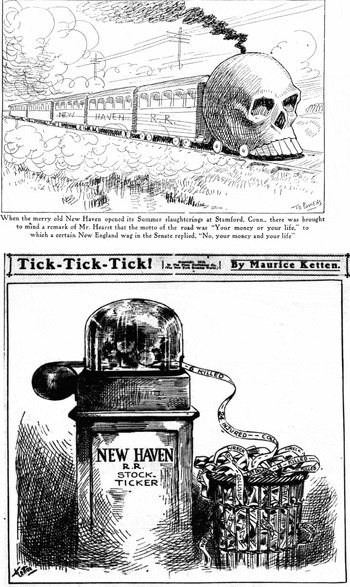
Predictably, with the disaster on a New York–bound train, the New York and New England newspapers had a field day, and the information cascade rolled on (figure 1). Stamford made front-page news; complete with the usual pictures and lists of victims intended to emphasize the horror. In an editorial, the New York World (1913a) referred to “The Stamford Crime.” For the first time numbers of cartoons of the New Haven's accidents appeared. Cartoonists had long portrayed the New Haven as a monopoly; they now depicted it as a road of death (figure 7). There were reports of the “death car,” and excruciating quotations such as “I saw the lower part of my wife's body hanging through the window. . . a doctor. . . came and said she was dead” (Times 1913a). Several papers and opinion weeklies reminded the public of earlier accidents by providing more lists such as that in table 1—which by this time could hardly have been necessary—and subsequently they reported minor wrecks that, absent Stamford, surely would have been less newsworthy. The Reverend Christian Reisner explained to his Upper West Side parishioners that the problem was the idle rich—by which he meant the New Haven's stockholders. “Poorly paid men,” he explained “are put under heavy responsibility that dividends may be paid on watered stock” (Times 1913c). The use of wooden cars came under increasing attack. The New York Tribune (1913a) reported one victim who claimed that “a steel coach instead of that split eggshell would have prevented the disaster.” Almost immediately a Massachusetts representative filed a bill to require all-steel cars (Herald 1913c). The wreck remained major news for about two weeks with daily reports of the ICC investigation trickling out.
Stamford led to an outpouring of cartoons that linked the New Haven's finances to its safety.

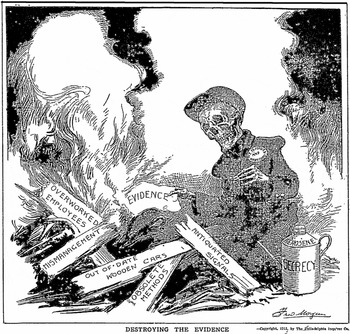
Immediately after the disaster, New Haven officials wrong-footed themselves by burning the wrecked parlor car (Journal 1913b). For a company that had already largely lost public trust it is hard to imagine anything more likely to destroy what little credibility the management had left. The Outlook (1913a) wondered if it was “criminal destruction of evidence” or just stupidity. The Railway Age Gazette (1913a) was astounded, describing it as an “utter blunder” in public relations and concluding that “the short sightedness of the management. . . seems utterly inconceivable.” Even the Wall Street Journal (1913a) agreed, claiming that “nothing more foolish [than the burning of the wreck] could have been devised.” The Independent (1913a), which had earlier called for Mellen's head, specifically linked Stamford to the ongoing monopoly and financial investigations of the New Haven. Management had been unduly concerned with acquisitions and finance rather than operation and safety, it opined.
The New Haven's efforts at damage control were also weak and belated. Still tone deaf, President Mellen immediately issued a statement that expressed sympathy for the passengers, but managed to foist all blame on others (Herald 1913b). And in testimony to the ICC, the general manager claimed that union pressures had required the company to employ Engineman Dougherty on Second No. 53—which, in an editorial, the New York World (1913d) described as “whining.” Only the business press framed the narrative in this manner. The Wall Street Journal (1913a) blamed “short sighted labor union[s]” that required employment of incompetent enginemen. Similarly, the Railway Age Gazette (1913b) framed the issue as one of labor management that plagued all the carriers about this time.
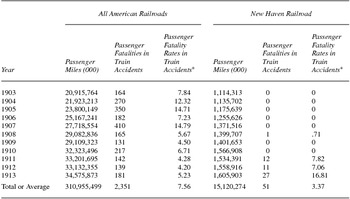
When the company's general superintendent blamed the string of wrecks on “hard luck,” the Times (1913b) sarcastically subheadlined the story “Men Just Rush to Death.” Nor could it have helped the New Haven's public image when (at the advice of counsel), Mellen pleaded the Fifth Amendment during the coroner's inquest into the wreck (Journal 1913d). Finally, nearly two weeks after the accident the New Haven responded by publishing a broadside entitled “Official Record” that listed its passengers carried as well as the numbers killed and injured during the Mellen years (Journal 1913c; see table 2). The Wall Street Journal (1913b, 1913c) remarked on the striking disconnect between these figures and public perceptions. It noted a number of travelers who were shocked to discover the New Haven's low casualty rate, which they termed “unbelievable,” and quoted one who thought that the company had killed 137 passengers in the past three years! Yet As modern research has shown, such data, out of any context, are unlikely to counter the powerful visual and verbal images that had been marshaled by the press—in short, they really are “unbelievable.” They certainly failed to convince Life (1913b), which invented a mythical “Railway Gardening Club” that was to plant forget-me-nots along the New Haven's tracks.
Passenger fatalities and fatality rates, all American railroads and the New Haven, 1903–1913.

Source: Interstate Commerce Commission 1903–1913 and author's calculations.
*Per billion passenger miles.
About a month after Stamford, on July 10, the ICC released its report on New England railroads. It excoriated the New Haven's various financial dealings, and urged a breakup of its system. Although the commission praised the company's passenger service it pointedly criticized the lack of steel cars. It also suggested that “the merger [with the Boston & Maine] has so overloaded the executive heads of the entire aggregation as to impair not only the correct and economical financial administration, but also the efficiency and safety of operation” (Interstate Commerce Commission 1913: 617). On July 18, Mellen resigned (Journal 1913e). While the ICC report on the New Haven's finances and acquisitions surely gave him a push, Brandeis privately informed McChord that it was the company's accidents that drove him out. “Your and Mr. Belnap's work in connection with recent New Haven accidents have. . . contributed largely to the resignation of Mr. Mellen,” Brandeis observed (Brandeis to McChord, July 18, 1913). On the same day the company announced that Howard Elliott, late of the Northern Pacific, would become the new president (Journal 1913e). The Globe (1913b) reassured its readers that he was an easterner and a Harvard graduate. On the 28th, the New Haven's Stockholders' Protective Committee also began an investigation into the company's finances (Journal 1913f).
While the Stamford wreck contributed to the rising clamor for steel cars, their value, and by inference the New Haven's failings, was highlighted by wrecks on other lines where they seemed to have prevented mass casualties. On July 30, one such accident occurred near Tyrone, Pennsylvania, on the Pennsylvania Railroad (Interstate Commerce Commission 1913b). In many respects it resembled Stamford: an engineman missed a signal and his train, weighing about 1.9 million pounds and traveling about 30 miles per hour plowed into the train in front. But, as was widely reported (Journal 1913g; Republican 1913b; Times 1913d), the coaches on the preceding train were of steel construction; rather than telescoping, their ends crushed, absorbing much of the collision energy. While there were many injuries, no passengers were killed. Three days later on September 2, as the public was digesting the meaning of Tyrone, the worst disaster in a decade struck the New Haven at North Haven, Connecticut.
At about 5:45 that morning, New Haven Train No. 91 consisting of a locomotive and tender, and 11 wooden cars, was stopped just beyond an automatic block signal that showed red, north of North Haven, Connecticut. The morning was foggy and visibility limited to about 200 feet. This block signal system contained no distant signals and so Engineman Rufus Wands had been unable to stop his train in time. He finally came to a halt and whistled for a flagman with the rear of his train about a car length beyond the red signal.Footnote 14 Traffic was especially heavy in that first week of September, averaging 33 trains a day, as passengers returned to work from the long Labor Day weekend. Train 91 was one of five trains that had left Springfield, Massachusetts, between about 4:40 and 5:00 heading south that morning. It had been stopped about 10 minutes when Train 95, the White Mountain Express, consisting of a locomotive and tender, and seven cars, weighing about 1.2 million pounds and running about 40 miles per hour, plowed into the rear of Train 91. Again, the kinetic energy was largely absorbed by telescoping the wooden cars, which killed 21 passengers (Interstate Commerce Commission 1913c).
The wreck made headlines nationwide. As usual, the newspaper reports were sensational with gruesome pictures and lists of the killed and injured. The Washington Post (1913a) editorialized on the New Haven's “calamitous rear-end collision” that it thought “will move congress to act.” The Boston Journal's headline was “New Haven Wreck Kills 26,” and it went on to describe “bodies hurled 100 feet through air” (1913h). Later (1913m) the Journal referred to Train 91 as the “Death Train,” and it bluntly editorialized that the company's “accident record. . . is bad” (Journal 1913i). “Banker Management” would be laid bare, the paper claimed (Journal 1913l). Similar stories appeared in the Boston Globe (1913c), which also featured the death of one Miss Emille Kennedy Davis, whose body was “identified by her betrothed” because she wore his Yale pin. Such human-interest stories, of course, again made the wreck more real and more horrible to readers. The New York Times (1913e) described the anguish of parents who heard of the wreck as they were waiting at Grand Central Terminal for their children to return from summer camp on Train 91. As usual, there were unidentified dead and—adding to the horror—the coroner later reported looting. One especially lurid headline reported the looters cut of the finger of a woman who was still alive to steal her ring. This was later proved false but no doubt the damage had been done (Journal 1913j; Tribune 1913b).
The public coverage of the wreck was so loud that the Railway Age Gazette summarized many of the stories (1913d, 1913e), presumably as a warning to other carriers. North Haven also yielded another burst of editorial cartoons (figure 8) that savaged the New Haven, depicting it once again as a death trap. Journals of option such as the Independent (1913b) and Outlook (1913b) excoriated nearly every facet of the company's management and linked its accident record to its finances and mergers. The wreck continued the process of stigmatizing wooden cars as uniquely dangerous (figure 9). As one engineering journal concluded, “[T]he press was filled with utterances of the most hysterical nature demanding the immediate retirement of wooden passenger cars” (Railway and Engineering Review 1913). Once again the business press provided alternative narratives. Railway Age Gazette (1913c) again stressed the problem of poor training and labor management. These were hard to link to finance and monopoly it observed, and compared North Haven to similar accidents on other carriers. The Wall Street Journal (1913e, 1913f), as usual laid blame on the enginemen and union pressures to employ them, but it also saw North Haven as the predictable outcome of extreme traffic congestion that characterized most major carriers at this time. In an oblique reference to the ICC's refusal to raise freight rates in 1910 (Martin Reference Martin1971), it claimed that such accidents resulted from the carriers' inability to raise capital thanks to “continued assaults. . . by politicians” (Wall Street Journal 1913d).
This cartoon appeared after the North Haven wreck of September 3, 1913. It suggests just how powerfully and how widely the New Haven's accident record and its various well-publicized failings had stigmatized the company.

The New Haven's wrecks contributed to widespread public clamor for steel cars reflected in editorials and cartoons, and companies responded rapidly.

Demonstrating his public relations skills, ICC Commissioner McChord immediately telegraphed the New Haven, ordering it not to destroy any of the wrecked cars as it had after Stamford, and then held a press release where he read parts of the commission's report on that wreck that had urged the introduction of steel cars (Journal 1913k). He promised a thorough and efficient investigation. The report was all of that and more. It detailed the accident, revealing that all the cars were of wood construction and several dated from 1893. It described the automatic block signal system that used older banjo-type disks and had no distant signals, which, with some understatement, it termed “inadequate”—especially given the traffic density on the division that experienced the accident (Interstate Commerce Commission 1913c: 23). Yet the report also noted that after the Westport disaster the New Haven had begun to convert to steel cars and that it was upgrading both its track and signal system.
The most damning criticism the commission reserved for the New Haven's sloppy operating practices. Engineman Wands testified that it was not unusual to run a red signal in foggy weather. Indeed he had been reprimanded for the practice several times. Others corroborated his story. The commission concluded that “records furnished in this case is [sic] conclusive proof that they [management] knew of these dangerous practices. Their responsibility in the matter cannot be evaded” (ibid.: 25). Testimony also revealed that the flagman had set torpedoes no more than 60 to 70 feet before the red signal, a wholly inadequate distance. While operating managers believed that speeds of no more than 20 to 25 mile per hour were safe during a fog they had done nothing to enforce such limits. In fact, there were five trains dispatched in a 36-minute period from Springfield south that morning and running in dense fog their average speeds ranged from 35 to 51 miles per hour. Part of the problem, the commission suggested, was too few supervisors: on a division of 440 miles with 3,000 men there were but eight trainmasters. The shore line division that had been the source of many of the accidents had even less supervision: there were 763 miles of main track and 8,500 employees under one superintendent and eight trainmasters (Gazette 1913g).
The ICC summarized its conclusions in a series of scathing rebukes to the New Haven's management. None of its accident reports on any other company were even remotely as harsh. “It is the absolute duty of a railroad company to know beyond question whether or not signals are obeyed and rules are rigidly lived up to,” it announced (Interstate Commerce Commission 1913c: 26). And it reminded readers that “in reports by this commission of the investigation of previous accidents on this railroad, defects of management, neglect of obvious precautions for safety, ineffective rules and these not systematically enforced, high-speed trains closely following one another without adequate safeguards, dereliction of duty on the part of certain employees, as well as a general weakness of discipline, have been denounced and condemned.” That “this state of affairs is allowed to continue to exist,” the commission termed “astounding” (ibid.: 32).
The commissioners also linked New Haven's poor safety record to the company's finance and acquisitions. In a sharply worded rebuke to the board of directors that is unparalleled in any of its other reports, it named the members of the board, whom it held liable for the New Haven's accidents, and it repeated word for word a claim it had made in the New England investigation:
If it were properly to be considered here, however, we would give weight to the suggestion that the merger has so overloaded the executive heads of the entire aggregation as to impair not only the correct and economical financial administration, but also the efficiency and safety of operation. This suggestion is not based on a consideration of mileage, but of the complexity of the New England railroads and of the necessity of these railroads for close and intentional superintendence. (ibid.: 31)
Terming the directors “magicians in the art of finance and wizards. . . in the construction of great systems” (ibid.: 32), the commissioners asserted that in failing to turn from finance to safety when the conditions warranted, they had been derelict in their duty. The commissioners observed that they could only recommend safety improvements, but as they had in the Stamford report they also urged an expansion of federal authority. They threatened to recommend legislation requiring steel cars. And in a thinly veiled threat, the commission concluded: “Safety of operation. . . would seem to be a subject over which the Congress might exercise its full authority” (ibid.: 35). As both the Springfield Republican (1913c) and the Railway Age Gazette (1913h) concluded, because new legislation could not be limited to a single road, the commission again seemed to be requesting power over all railroad operating departments.
Truth and Consequences
After the ICC's public whipping—and perhaps even well before—it would surely have been difficult to find anyone to defend the New Haven's safety record. The various commission reports and the newspaper stories all painted the same picture: thanks to the management's focus on finance and mergers, passenger safety on the New Haven had become, as the Washington Post (1913a) termed it, a “record of horror upon horror's head.” Yet as the Wall Street Journal discovered (1913b, 1913c), and as modern research has shown, actual and perceived risks can vary widely. The publicity surrounding the early accidents encouraged more publicity of the later accidents and led to the magnification of minor wrecks. The result (figure 1) was a cascade of stories encouraging the belief that the New Haven was especially dangerous.
In fact, there is little evidence that the New Haven was any more dangerous than most other lines at this time. The commission's reports on the company's safety lapses were indeed stinging, but much the same could have been (and was) said for other lines as well (Gazette 1913c). Thus, on March 29, 1911, a derailment on the Pennsylvania Railroad on bad track near Martin's Creek, New York, caused the wooden cars to burn killing 12 (Interstate Commerce Commission 1911c). On July 4, 1912 an engineman on the Delaware, Lackawanna & Western, running too fast in poor weather ran both distant and home signals and collided with a preceding train near Corning, New York, telescoping a wooden car and killing 39 passengers (Interstate Commerce Commission 1912a). Similarly, the rear collision on July 14, 1912, that telescoped an old wooden car on the Chicago, Burlington & Quincy at Western Springs, Illinois, killing 13 people resulted from too high speed in dense fog on a stretch of track with no distant signals (Interstate Commerce Commission 1912b).
Moreover, accidents that killed passengers were extremely rare events. There were 15,743 reported train accidents in 1912 resulting in 139 passenger fatalities. Thus at most only .88 percent of all accidents killed passengers that year. Hence, the New Haven's dreadful record for the years from 1911 to 1913 provides little information on its safety, as a single accident might make any carrier appear comparatively risky for several years. For example, in 1912, the tiny Ligonier Valley Railroad had not killed a passenger in a decade; but because it carried so few passengers, one dreadful wreck that killed 19 yielded a fatality rate of 687 times the national average that year! The Pennsylvania, the Lackawanna, the Burlington, and several other carriers all had above-average passenger fatality rates during 1911 through 1913 due to one or two major accidents. Yet in its Stamford investigation the ICC had called in managers from two of these lines as safety experts. Because the critics of the New Haven blamed the Mellen regime for the wrecks, the relevant time period to measure the company's safety record is Mellen's tenure. As table 2 demonstrates, over that period, the New Haven was much safer than average for its passengers. When asked later what had caused the New Haven's wrecks, Mellen responded “I attribute them to the same thing I do the rain and the sunshine. . . they are incomprehensible to me” (63rd Cong., 2d Sess., SD 543 1914: 922). Chance, in short, while it seemed an unsatisfying explanation to most newspaper reporters and other contemporaries, probably accounted for the burst of accidents that overtook the New Haven in the years from 1911 to 1913.Footnote 15
Whatever the facts of the New Haven's safety record, however, by 1913 a cascade of public condemnation had made the company a symbol for unsafe railroading—with lasting consequences. The string of wrecks, in combination with stories of the New Haven's finances and mergers, interacted in a way that not only amplified risk perceptions, but also they undermined management's moral authority, making the New Haven's dangers seem especially unacceptable. This unprecedented outcry generated unprecedented results: government investigations and public rage not only drove Mellen from the New Haven's presidency, it forced the Morgan interests out of management as well (Journal 1913o) and ultimately broke the company apart. Even Rockefeller's Standard Oil had not been the subject of such drastic action.
While there was much to criticize in the New Haven's management, as has been noted, its failings were common to most other roads at the time. Moreover, as the business press revealed, the popular treatment was incomplete, for traffic congestion, rate regulation, and labor management problems were part of the accident narrative. To acknowledge the business position is not to absolve the Mellen management of its mistakes but rather to suggest a more complex story with more villains than the popular press found convenient. In any event, the popular narrative prevailed and it generated a set of unprecedented problems as the company's new management sought to undo the damage to the company's reputation.
Mellen had come to symbolize all that was wrong with the New Haven—he was one of the last of the aloof, arrogant nineteenth-century business executives—and his departure was the first step in removing the stigma under which the company had labored. The new president, Howard Elliott, quickly revealed that he had learned from Mellen's errors and the new approach followed by the Pennsylvania and the Harriman lines (Aldrich Reference Aldrich2007). He inaugurated an almost textbook illustration of how a company that has been stigmatized could regain its footing. Elliott pursued a policy of candor that contrasted sharply with his predecessor and was intended to counter the image of arrogance, incompetence, and indifference that had plagued the company.
The first job was to cope with the publicity surrounding the North Haven disaster. On the day of the wreck Elliott announced a policy of full disclosure (Herald 1913d). The next day he eschewed any desire to keep the coroner's hearing secret (Union 1913a). As the hearings on the wreck began he announced that he would make the New Haven the safest railroad in the country (Globe Reference Sunstein1913d; Union 1913b). In the following three weeks he held news conferences, invited reporters to his office, admitted that banjo signals were obsolete (Journal 1913n), and pledged to upgrade signals and speed the transition to steel cars. His actions produced headlines that the company would spend $7 million for safety (Gazette 1913f; Pawtucket Times 1913a). He also sent out a public appeal to employees to improve safety—and announced new physical tests of the men—and reduced the size of the New Haven's divisions to improve supervision (Pawtucket Times 1913b). He dropped in for a visit to mend fences with the ICC (Globe 1913e) and brought the Safety First movement to the New Haven (Gazette 1914; Globe 1914). He was also lucky: the passenger fatality rate returned to zero in 1914 and no more major wrecks plagued the New Haven for several years. In 1914, the antitrust case was settled with a consent decree that undid most of Mellen's empire building and thereafter the company gradually faded from the headlines.
Public outcry over the New Haven's string of wrecks also contributed to two major changes in railroad technology. As noted, the well-publicized failures of the New Haven's operating practices at Stamford contributed to the ICCs emerging interest in some form of automatic train control, and it would first mandate such a system inside of a decade (Aldrich Reference Aldrich2006). In addition, the New Haven's wrecks that demolished wooden cars—along with wrecks on other lines that seemed to show the superiority of steel construction—generated immediate public clamor for the railroads to introduce steel cars. The Railway Age Gazette (1913i) and other technical publications (Engineering News 1913), however, urged caution. There was an opportunity cost, they argued, for steel cars were expensive and the money might be better spent elsewhere. Despite such concerns, congressmen filed several bills that would have mandated an almost immediate conversion to steel cars (Washington Post 1913b) and Congress undertook a broad investigation into railroad safety that focused on steel cars (63rd Cong., 2d Sess., Subcommittee of House Committee on Interstate and Foreign Commerce 1914). Such regulatory threats were what Thomas McCraw (Reference McCraw1984: 35) has termed the “gun behind the door.” In fact, as the ICC concluded, publicity had already achieved as much as might be hoped for through legislation, for the carriers were voluntarily buying the new equipment as fast as it could be made. As late as 1909 half of all new car orders were for wood; by the first six months of 1913 that number had dropped to zero (Gazette 1913i). The New Haven's well-publicized wrecks were by no means the only force driving this transformation, but they powerfully contributed to it.
Ripples from the New Haven's pariah experience helped reshape the broader political economy as well. Public pressures heightened worries that Congress would extend the ICC's regulatory grasp into all railroad operations. The carriers responded not only with public relations departments but with the Safety First movement as well (Aldrich Reference Aldrich1997). Other corporations also developed public relations departments (Marchand Reference Marchand1998; Raucher Reference Raucher1968; Tedlow Reference Tedlow1969). As an example of what could happen to a company stigmatized as a “bad trust,” the New Haven's experience must have powerfully contributed to this movement.