1. THE POLITICS OF TAPE
Tape is an inherently political medium, its history, for Hayles, ‘marked with the imprint of international capitalism and politics as surely as it was with the imprint of voices’ (Hayles Reference Hayles and Morris1997: 77). Its military origins as a closely guarded secret of Nazi Germany, and its subsequent utilisation as a tool of propaganda, subversion, surveillance and conflict set it apart from other recorded sound technologies which emerged from processes of industrial, commercial and consumer-oriented development. These factors posit its history as something of a battleground, or conflict zone, in which the state, military, industry, artists and consumers all occupy prominent roles. This history is paralleled in the creative legacy of tape as a medium which enabled composers and artists to capture, cut, reassemble and reposition sonic material, and in so doing, to challenge existing concepts of musicality and ownership. The eventual ubiquity of the compact audio cassette and recordable cassette player allowed amateurs, enthusiasts and consumers to similarly capture, share and reconfigure recorded sound, thus inserting themselves into the production process.
The existence of a new recording technology was first suspected by allied intelligence monitoring German broadcasting stations in the early 1940s who recognised in the German transmissions, ‘a fidelity and a continuity of sound … an absence of surface scratching … that ordinary transcription records could never have yielded’ (Kittler Reference Kittler, Winthrop Young and Wutz1999: 106). This technology, the Allies discovered when they later entered the studios of Radio Luxembourg, was ‘a new Magnetophone of extraordinary capabilities’, magnetic tape that could ‘execute any possible transmission of data because they are equipped with recording, reading, and erasing heads, as well as with forward and reverse motion’ (Kittler Reference Kittler, Winthrop Young and Wutz1999: 108).
The creative potential of these machines was explored in the post-war years in a range of state-sponsored academic and broadcasting research facilities, which included the Groupe de Recherche Musicales in Paris, the Westdeutscher Rundfunk (WDR) studio in Cologne, the RAI Studio of Phonology in Milan and the BBC Radiophonic Workshop in London. These studios would collectively give rise to experimental and electroacoustic works by composers including Luciano Berio (RAI, Milan), Delia Derbyshire (BBC Radiophonic Workshop, London), Pierre Schaeffer (GRM, Paris) and Karlheinz Stockhausen (WDR, Cologne), which would help to shape the landscape of twentieth-century avant garde and experimental music. As Ross notes, such favourable state funding of experimental music practice allowed ‘the former Fascist nations … to demonstrate how far they had evolved from the days when Schoenberg’s work had been labeled “degenerate music”‘ (Ross Reference Ross2007: 420). State support of the new musical vanguard of the era may thus be considered a means of exercising what Nye terms ‘soft cultural power’, the process via which ‘a country may obtain the outcomes it wants in world politics because other countries – admiring its values, emulating its example, aspiring to its level of prosperity and openness – want to follow it’ (Nye Reference Nye2004: 5). The showcasing of this new music at locations such as the Darmstadt Summer Courses for New Music and the 1952 Masterpieces of the 20th Century festival in Paris may be seen as further utilisation of this soft cultural power. The former, as Ross notes, was helped into existence by the Office of Military Government, United States in 1946, while financing for the latter was entirely arranged by the CIA in the guise of a coalition of arts patrons named the Fairfield Foundation. This level of state interest in funding the creation and performance of avant garde and experimental music would end with the Cold War, further emphasising its political motivations. Rutherford Johnson notes that ‘after the 1980s, state funding for new music was cut in many countries, the result of the end of the Cold War and with it the justification for supporting cultural soft power’ (Rutherford Johnson Reference Rutherford Johnson2017: 26). This decrease in funding once the battles of the Cold War were perceived to have been resolved serves to underline that state support for the new experimental musics was fuelled, not by the desire to support creative exploration and innovation, but rather, as Nye suggests, to influence world politics by presenting the aspirational image of an open, liberal and forward-facing society. The history of tape music thus may be said to be intrinsically entwined with the politics and propaganda of the Cold War.
Others employed tape as a means of questioning, ridiculing or interrogating the state and its mechanisms. In the 1960s and 1970s, William Burroughs would adopt tape as a subversive creative tool, applying the cut and paste techniques he had explored in his ‘Cut-Up Trilogy’ of novels to a series of audio recordings designed to subvert and oppose what he terms ‘control systems’. In his 1970 essay The Electronic Revolution, Burroughs proposes that tape recorders can be utilised as a tool to ‘nullify’ the ‘monopoly position’ of ‘control systems’ (Burroughs Reference Burroughs1970: 12) declaring that ‘Cut/ups on the tape recorder can be used as a weapon … TO DISCREDIT OPPONENTS … TO SCRAMBLE AND NULLIFY ASSOCIATIONAL LINES PUT DOWN BY MASS MEDIA’ (Burroughs Reference Burroughs1970: 13). Burroughs suggests various strategies by which this aim may be achieved; for example, editing the speeches of a rival politician to accentuate ‘stammers, mispronouncing [and] inept phrases’ and splicing this together with sex tapes and ‘hateful disapproving voices’ (Burroughs Reference Burroughs1970: 8). ‘Illusion’, Burroughs states, ‘is a revolutionary weapon’ (Burroughs Reference Burroughs1970: 12) and the effective use of cut/up techniques can assist in countering ‘a growing power and more sophisticated technique used by establishment mass media to falsify, misrepresent, misquote, rule out of consideration … or simply ignore and blot out of existence: data, books, discoveries that they consider prejudicial to establishment interest’ (Burroughs Reference Burroughs1970: 14). Tape’s ability to capture and reconfigure audio thus, for Burroughs, makes it a tool via which the individual may oppose and expose corrupt institutions or disrupt what Deleuze will later term ‘the numerical language of control’, the codes, passwords and ‘watchwords’ that ‘mark access to information or reject it’ (Deleuze Reference Deleuze1992: 5).
In the 1980s, as the ability to capture, cut and reconfigure sound became widespread, tape would constitute the first major battleground between the music industry and consumers, as perhaps best exemplified by the British Phonographic Industry’s ‘Home-Taping Is Killing Music’ copyright infringement campaign (Figure 1). Seeking to counter the threat it believed was posed to music industry profits by private citizens recording music to cassette in their homes, the BPI emblazoned blank and recorded media with stickers bearing their anti-piracy slogan and campaigned for a prohibitive levy to be placed on the sale price of blank cassettes. Heylin, in Bootleg: The Secret History of the Other Recording Industry (Reference Heylin1994), offers an account of the music industry’s campaign against ‘home-piracy’ that echoes Burroughs’s reference to the monopoly position of control systems. The music industry, Heylin believes, was motivated by its, ‘determination to exert total control over all forms of recorded music … to ensure that however, whenever and whatever music was available, it was enjoyed only at their discretion’ (Heylin Reference Heylin1994: 230).
Home Taping is Killing Music logo.

The industry adopted multiple strategies to assert this control. It juxtaposed foreign tape manufacturers with domestic record firms in an attempt ‘to appeal to the worst kind of protectionist thinking’ (Heylin Reference Heylin1994: 240). It sought to censor the music press, threatening to withdraw advertising from publications that ‘support or encourage either piracy or home-taping’ (Heylin Reference Heylin1994: 236). It took legal action against hardware manufacturers in an effort to block the emergence of new technologies such as the two-in-one cassette deck. Industry resistance, and the resultant low availability of commercial titles and high production costs, also helped to suppress the emergence of DAT (digital audio tape) as a high-quality recordable consumer format which merged the creative possibilities of tape with the high fidelity potential of digital audio. Such efforts to divide and conquer, to suppress technological progress and media discourse, could be said to illustrate literal examples of Burroughs’s control systems at work.
2. REWIND: A BRIEF HISTORY OF THE MIXTAPE
Tape’s particular power, as both a creative and a political tool, stems from the opportunities, unique among recording technologies, which it affords to capture, transform, shape and distribute audio material. These capabilities arguably find their most open expression in the medium and genre known as the mixtape, assembled and compiled from pre-existing recordings which the mixtape producer reconfigures according to their personal preference. For Miller, the ‘mixed tape’ is ‘the ultimate example of a new art object … [wherein] …the cassette arrives at a point where it is the electromagnetic equivalent of the blank canvas’ and the mix ‘allows the invocation of different languages, texts and sounds to converge, meld, and create a new medium that transcends its original components’ (Miller Reference Miller, Cox and Warner2004: 353).
The birth of the mixtape is inextricably intertwined with that of hip-hop. Before hip-hop had a name, the mixtape provided it with a platform via which its sound and message were recorded, copied and distributed independent of the networks and mechanics of the music and entertainment industries. The earliest mixtapes, in the classic hip-hop context, created new works by borrowing and reconfiguring existing sound material. Recordings were looped, scratched, cross-faded, sped up, slowed down, combined, or overlaid with new material. This musical vocabulary echoes techniques explored by experimental composers in the post-war years, most explicitly perhaps, the ‘manipulations’ of Pierre Schaeffer’s early phonographic explorations. Capturing sound material on phonographic record, Schaeffer developed a host of techniques by which he could affect the material: varying playback speed in order to alter pitch, repeating or looping sections via the creation of a ‘closed groove’ (sillon ferme), scratching records, randomly picking up and placing down the stylus or accentuating the materiality of records by exploiting the static and crackle of vinyl as a further sound source.
Where Schaeffer drew upon the ‘concrete’ sounds of the world around him for sonic material, hip-hop DJs and producers borrowed from pre-existing musical recordings to forge a musical methodology that saw the aesthetics of popular and experimental music combine and collide. In doing so they recast vinyl records from consumer object to open-ended sound source and disrupted the hierarchical separation of producer and consumer as imposed by the music industry, a system wherein, according to Adorno, ‘the listener is converted, along the lines of least resistance, into the acquiescent purchaser’ (Adorno Reference Adorno and Bernstein1938: 38). For Toop, early DJ culture, and in turn that of the mixtape, are part of ‘many forces chipping away at the hierarchical, separated roles of producers and consumers’ thus eroding ‘fixed definitions of performance, performer and audience’ (Toop Reference Toop1995: 41). For Oswald meanwhile, the increasing interactivity of sound-producing and -reproducing technology ensures that ‘listeners are once again, if not invited, nonetheless encroaching upon creative territory’ (Oswald Reference Oswald1985) as technological developments enable a shift from an era of passive to active listening.
Mixtapes flourished through the 1980s and early 1990s, their ‘combination of compilation and DIY recording’ (Hegarty Reference Hegarty2007: 2) forming the basis of what Moore terms ‘cassette culture’ and offering, as Hegarty suggests, ‘a way around the culture industry, a re-appropriation of the means of production’ (Hegarty Reference Hegarty2007: 2). Their distribution network would spread across international borders, ‘held together [as Jayce Clayton recalls] by slow postal services and scrawled addresses, mail order catalogues and tiny labels and kids just swapping tapes’ (Clayton n.d.). Home-produced compilations helped distribute genres of sound and music unwelcome even in the fringes of the music industry. Clayton, aka DJ Rupture, recalls receiving a home-made cassette compilation of Japanese noise groups entitled Eat Shit Noise Music via mail order. ‘Issues of quality, musicianship, fidelity, funkiness, lyrical content, rhythmic prowess, historical relevance, etc [he recalls] had no business here.’ Instead, ‘dynamic, lascivious violence poured from the speakers’ (Clayton n.d.). To the 15-year-old Clayton, this unlicensed compilation with its ‘no-fi Xerox artwork and poorly typed tracklist’ made it ‘obvious that an individual with photocopier access and a dual cassette deck could make a substantial difference in their world … [and] … suggested that I could actively participate in music’ (Clayton n.d.). The audience thus is encouraged by the mixtape to participate in multiple manners – to create, record, compile, curate, package, distribute and share. As Viegener states, the mixtape allows its producer proclaim, ‘I am no mere consumer of pop culture … but also a producer of it’ (Viegener Reference Viegener and Moore2004: 35). This blurring of the lines between consumption and production, or read/write culture, is clear in the production of mixtapes such as Eat Shit Noise Music, where the mixtape creator morphs to inhabit the roles of curator, label owner or sleeve artist, and the fan, such as Clayton, who receives the tape is subsequently moved to occupy an active role in musical production.
3. COMPACT DISC: READ ONLY MEMORY
By the late 1980s, despite initial scepticism from consumers and large swathes of its own ranks, the music industry had successfully established the compact disc as the dominant commercial format for recorded music. If tape, as suggested herein, represents an era of creative freedom and exploration across the spectrum of music lovers – creator and consumer, professional and amateur – the compact disc can more readily be associated with a period of unparalleled consumption and a reassertion of the music industry’s control over the form of recorded music. For the BPI’s Gennaro Castaldo, ‘the CD came to symbolise … new material success and aspiration. If you owned a CD player it showed you were upwardly mobile’ (quoted in Lynskey Reference Lynskey2015). Lynskey notes that CD sales surpassed 1 billion in 1992 and 2 billion in 1996 while ‘the profit margins were the stuff of dreams. The CD was cheaper than vinyl to manufacture, transport and rack in stores, while selling for up to twice as much’ (Lynskey Reference Lynskey2015). This surge in sales and drop in production and distribution costs lead to unparalleled profits for the music industry.
Alongside this sales surge, CD signalled a diminishing and dispersal of the capabilities of individuals to engage directly with the media of recorded music and take control of, or act upon, recorded sound. The CD era, in its initial stages at least, may be seen as a reassertion of the power of the industry’s control system, a return to passive listening and consumption. The ability to combine elements, to incorporate sounds from multiple media sources, to physically interact with the medium is removed, as is the ability to intervene in, act upon, or react to the recording process (unless one had access to what remained prohibitively expensive genuine CD recorders). Rewritable CDs would eventually be introduced to the market in 1997, but would offer limited ability to interact with recorded sound, replacing the notion of ‘the mix’ with the ability to simply compile or catalogue. The read/write culture of cassette and the mixtape thus is replaced with the read only memory of the CD ROM.
This limited capacity for interaction with recorded sound would also ensure that no CD-based music, an equivalent perhaps of turntablism or tape music, would emerge. However, notable exceptions exist; for example, within the work of Yasunao Tone, Oval and Nicolas Collins, who explored the composition and performance potential of treated, modified or dysfunctional compact discs and compact disc players. Tone, in 1984 began experimenting with treated or ‘wounded’ CDs, sticking pieces of scotch tape to the surface of the disc and puncturing or scratching it. These prepared discs provided the raw material for unpredictable and indeterminate live performances of which Tone commented that ‘playing prepared CDs according to the score was like advancing in a maze where ambush was everywhere, and that made the performance situation all the more interesting’ (Tone Reference Tone1997). The electronica trio Oval also utilised prepared CDs, modified with marker and tape, which they sampled, looped and layered on works such as 94diskont (Reference Toop1995) in a CD-based aesthetic more tonal, melodic and conventionally musical than Tone’s noise ambushes.
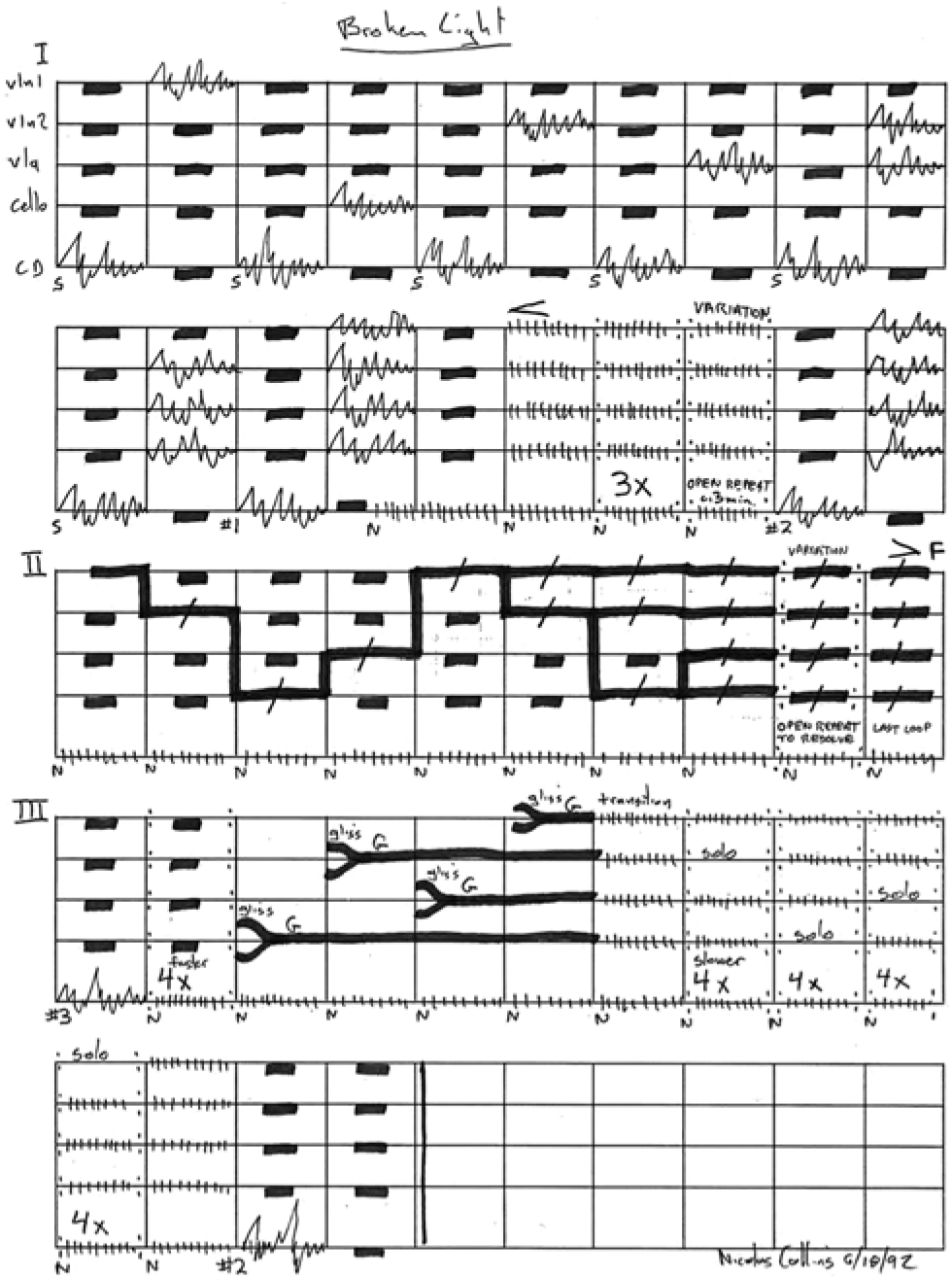
Nicolas Collins, inspired by both Tone’s explorations and the turntablist techniques of hip-hop culture, began in 1989 to experiment with a portable Sony Discman, exploring its potential as a device for the generation and manipulation of audio material. Intrigued as to what was occurring within the player in moments of seeming silence, when, for instance, it was in pause mode or moving between tracks, Collins identified and disconnected the trace of a mute signal, which silenced the player in such moments, thus releasing a flood of sounds ranging from ‘furious stylistic jump-cutting’ to short and fragmented ‘lilting loops’ (Collins Reference Collins2009: 2). Collins explored this sound world in conjunction with varied performance ensembles across a subsequent series of works. The first of these, Broken Light (1991), ‘pits a live string quartet against a compact disc of Baroque concerti grossi by Corelli, Torelli and Locatelli’ (Collins Reference Collins2009: 3) (Figure 2). Collins’s performance set-up provides the performers with a set of foot switches via which they skip through the looping CDs, deriving pitch material from the resultant sounds. The composer states that performances ‘have the tension and sense of uncertainty associated with improvised music, but are set against the harmonic roadmap of a more “composed” form’ (Collins Reference Collins2009: 4).
Nicolas Collins Broken Light (1992). www.nicolascollins.com/texts/brokenlightscore.pdf. Reproduced with permission of the composer.

Collins further explored the use of the portable CD player in subsequent pieces such as In CD (1992), which ‘featured three performers stepping through identical discs of a Beethoven piano trio, evoking Terry Riley’s landmark composition, In C, as the loops slip out of phase and sync with one another’ (Collins Reference Collins2009: 4). Still (After) Lives (1997) for chamber ensemble explores these techniques in an acoustic context. The ensemble emulates the electronic transformations and artefacts that characterised Collins’s CD experiments in an acoustic realisation of a digital timestretch, extending the first nine measures of Giuseppe Guami’s Canzon La Accorta a Quatrro from its original duration of 24 seconds to 8 minutes.
Tone, Oval and Collins explored a range of methodologies for innovative CD-based explorations of borrowed and re-contextualised sound. By creating interactive CD-based music and sound, their work resists the passive read-only culture of music consumption which the music industry seeks to establish. In their foregrounding of error, dysfunction and noise within the CD communications system, these artists also expose the shortcomings of the CD marketing mythology, the promise of ‘perfect sound forever’ that accompanied much early CD advertising. Hainge states that ‘the history of the development of different audio formats from wax to vinyl to tape to CD … seems itself to be driven by a single-minded, stubborn desire to render the communication system entirely transparent (or inaudible, rather)’ (Hainge Reference Hainge2007: 28). We might add to this by suggesting that the compact disc represents the industry’s desire, not only to render the communication system inaudible, but also to render the audio content intangible so that we can no longer borrow from or reconfigure it and can instead focus purely on its acquiescent consumption. The creative methodologies explored by Tone, Oval and Collins offer a number of creative strategies which resisted such efforts.
4. CORPORATE PLAYLISTS AND THE COMMERCIALISATION OF THE MIXTAPE’S LEGACY
While home-taping and ‘home piracy’ were the primary focus of music industry wrath in the pre-MP3 and file-sharing era, the mixtape has come to embody something of a forerunner of the industry’s current streaming and subscription model and, in particular, of the playlists which Spotify sees as its, ‘answer to product innovation’ (Gear Reference Gear2017). For Fenby-Hulse, writing in Networked Music Cultures: Contemporary Approaches, Emerging Issues (Reference Fenby-Hulse, Nowak and Whelan2016), ‘the mixtape’s aura has underpinned the development of music streaming services such as Spotify and Apple Music’ (Fenby-Hulse Reference Fenby-Hulse, Nowak and Whelan2016: 174). Spotify’s corporate literature meanwhile contains multiple references to mixtapes. The press release announcing the launch of its Discover Weekly playlist, for example, promises ‘our best-ever recommendations delivered to you as a weekly mixtape of fresh music’ and states that ‘it’s like having your best friend make you a personalised mixtape every single week’ (Spotify 2015). Apple Music recognises similar commercial value in the legacy of the mixtape. Fenby-Hulse cites a 2015 US patent filed by Apple, ‘for a feature that would enable users to create and share personalised albums with one another’, in which the company states that ‘the digital age has lost some of the personalisation that was available during the analog age. For example, the creation and gifting of a cassette mixed tape was a popular activity between two parties’ (Fenby-Hulse Reference Fenby-Hulse, Nowak and Whelan2016: 174). The individualised nature of the mixtape and its ability, as Hegarty states, to ‘target its audience of one’ (Hegarty Reference Hegarty2007: 3) is key, it would seem, to the contemporary music industry in guiding the listener through the labyrinthine archive of the music streaming service.
Where the mixtape, however, targets its audience with new musical combinations and selections, Spotify’s Spotify For Brands corporate literature makes it clear that it is more interested in targeting audiences with advertising and corporate messages. Its sponsored playlist feature promises sponsors ‘premium brand placement within the playlist, [ensuring that] your brand surrounds listeners with audio or video messages’. Brands are offered the chance to ‘maximize awareness’ and ‘connect with listeners on their favourite playlists’ via background images, sponsored audio messages, logo placement, video sequences and other media assets. The Spotify playlist thus seeks to intensely commodify and commercialise the private listening experience.
As well as adding multiple layers of additional commodification to the listening process, Spotify actively seeks to discourage diversity in its user’s listening habits. It cites a Snickers campaign, for example, which operates on the premise that unusual listening activity suggests the listener is hungry and not themselves and should be sold some chocolate to bring them to their senses. The advertising spiel proudly states that:
Snickers had a hunch that when people get hungry, they stream songs that don’t match the rest of their music taste. A hardcore grime fan listening to classic rock? Must be famished. A pop music fan switching to ambient instrumentals? Clearly needs a snack. Snickers teamed up with Spotify to identify these moments when a listener’s music taste shifted to the opposite of their usual preference. Then, of course, we reminded them to grab a Snickers. (Spotify n.d.a)
This campaign clearly shows efforts to homogenise listening habits and discourage eclectic or exploratory inclinations in favour of passive, predictable consumption. The Spotify playlist thus is less the blank canvas of Miller’s mixtape, ready to be filled with new combinations across cultural, historical or genre divides, and more a blank billboard available for assorted advertising pitches, for which the archive of recorded sound functions as ‘content’ to attract consumers. Where mixtape culture seeks to challenge or disregard musical and cultural boundaries and hierarchies and circumvent the dictates of industry, commercial playlist culture is more akin to Adorno’s concept of the music industry model as one which ‘erects wire fences between the musical provinces’ (Adorno Reference Adorno and Bernstein1938: 31).
5. CONTEMPORARY CASSETTE CULTURE AND THE CONTEMPORARY MIXTAPE
Alongside the rise of streaming services and curated playlists a new contemporary global cassette culture has emerged. Just as mixtapes such as Eat Shit Noise Music provided a platform for fringe and marginal music, a host of contemporary cassette labels offer an outlet for experimental and underground sounds from across the globe. Uganda’s Nyege Nyege Tapes describes itself as ‘a Kampala based label exploring, producing and releasing outsider music from around the region and beyond’ (Nyege Nyege Tapes 2018). Releases such as their Sounds of Sisso compilation shine a light on contemporary East African electronic music while a series of archival releases retrospectively document the work of artists such as Jako Maron and Otim Alpha. The willingness and ability to create physical releases of such non-commercially orientated sounds stems largely from the low cost of manufacturing and distributing cassettes. As Paul Condon of Ireland’s Fort Evil Fruit label explains, ‘producing vinyl is prohibitively expensive and CDs often feel like landfill nowadays. The cassette format is a low-cost means of presenting albums as beautiful physical artefacts when they might otherwise only exist as downloads’ (New Irish Underground Label Fort Evil Fruit 2011).
Alongside the economic practicality and aesthetic potential, the sound of cassette, its tendency towards saturation, potential for rich bass tones and even its sometime inconsistent playback speed have long held allure for many and continue to do so today. Keith Richards, for example, famously achieved the distinctive overdriven acoustic guitar sound on the Rolling Stones’ Street Fighting Man by recording direct to an early Philips cassette player with the band later constructing the rest of the track around this sonically distinctive recording. In 1982 Philip Glass released a special cassette mix of his Glassworks album created specifically for listening on the then new Walkman portable cassette players. Upon recent reissue it was said that this mix, ‘bursting with low-end thump and a punchy, less-separated stereo sound … blows away the more genteel, familiar version’ (Colter Walls Reference Colter Walls2016). Gruff Rhys meanwhile, of the alternative pop band Super Furry Animals and co-founder of the Peski label, which has released multiple cassettes, suggests that ‘listening to a cassette tape is not an exact science. Some cassette players play them a little faster. Others distort and phrase the music, changing the sound on the cassette forever’ (quoted in Hogan Reference Hogan2010).
Where cassette culture of the 1980s and 1990s depended upon personal exchange and postage of home-produced cassettes, contemporary cassette labels adopt a hybrid physical and digital distribution strategy. Labels such as Nyege Nyege, Fort Evil Fruit and The Tapeworm typically produce short-run cassettes (c.100–200) which emphasise a strong visual aesthetic. Digital copies are usually also made available and releases are often distributed and sold via online independent retailers such as Boomkat and Bandcamp. In shunning corporate distributors such as Spotify and Apple Music, contemporary cassette culture aligns itself with the mixtape ethos of bypassing or circumventing the mainstream music industry.
Alongside the re-emergence of cassette, the mixtape itself has re-emerged as a creative form for experimental musicians. Part composition, part compilation, this iteration of the mixtape is located somewhere between sound art and the DJ mix. Occupying a number of hybrid formats, both physical and purely digital, these contemporary mixtapes may be considered examples of what Bolter and Grusin have dubbed ‘remediation’ to describe ‘the representation of one medium in another’ (Bolter and Grusin Reference Bolter and Grusin2000: 45), or the characteristic Bourriaud (Reference Bourriaud2002) identifies among many contemporary artists and artworks to ‘inhabit … historicised styles and forms’ (Bourriaud Reference Bourriaud2002: 15).
The experimental electronic duo Demdike Stare have, since 2009, explored a sample-based creative aesthetic as informed by their status as avid record collectors as it is by their production and performance activities. This aspect of Demdike’s work is perhaps most prevalent across a series of short-run cassette-only mixtapes which the duo have produced since 2013. Drawing upon ‘musical sources ranging from obscure library records to long forgotten jazz, early electronic, and industrial recordings’ (Boomkat 2011), Miles Whittaker of the pair has described the project as being ‘all about records and the archive of aural culture from the last 50 years’ (quoted in Wasacz Reference Wasacz2011). For Pitchfork Magazine the duo’s work ‘reaches for a moment – a confluence of sounds – that never actually happened’ (Powell Reference Powell2011). Wire magazine meanwhile has noted their ability to ‘release the hidden potential they detected in obscure and forgotten records’ (Stannard Reference Stannard2013). Demdike’s work may thus be considered an aural archaeology of sorts in which the acts of researching, exploring, listening to and, indeed, consuming music are directly intertwined with the creative process.
Demdike Stare’s mixtape releases adopt multiple creative methodologies which explore the potential of the mixtape as a contemporary creative medium. They incorporate elements of DJ culture, concrete compositional technique, field recording, sound art and, at times, reconfigure the mixtape as sonic sketchbook or collage-based composition and performance tool. The first of these releases, The Weight of Culture (2013), resembles an eclectic DJ set whose often obscure and esoteric selections seem designed for private rather than public listening, the ‘audience of one’ (Hegarty Reference Hegarty2007: 3) perhaps that Hegarty identifies as the target of the mixtape. It incorporates works by Ennio Morricone, little known post-punk artists Orior and Italian soundtrack and library music composer Allesandro Allesandroni alongside the Detroit techno of Jeff Mills and Ethiopian jazz of Mulatu Astatke. These are interspersed with treated vocal samples, snatches of vinyl crackle and static and washes of ambient synths, blurring the lines between musical material and the materiality of musical media as well as the distinction between where borrowed and original material begin and end.
On The Age of Innocence (2015) the duo seemingly make greater use of field recordings and found sound. Environmental recordings emerge and mutate into tonal timbres while short-wave radio explorations punctuate electronic pulses. Identifiable elements remain however. Eight seconds of Notorious BIG’s Warning are cut up over a skittering two-step rhythm. John McLaughlin’s ambient guitar stylings from Miles Davis’s In A Silent Way/It’s About That Time appear in the mix, mutate into timbral stasis and retreat into the ether.
Circulation (2017) reimagines the mixtape as a sonic sketchbook of sorts incorporating formative fragments of ideas for Demdike’s 2016 Wonderland album release alongside sampled and manipulated elements of sounds which inspired that work. Circulation thus is ‘pieced together from breakdowns, transitions, pitched-down intros and transposed versions of music the pair have been influenced by over the years [such that] hooks appear, subside and re-emerge transformed, sort of like an old mixtape that’s been chewed up and spliced back together’ (Boomkat 2017).
The Feedback Loop (2018) meanwhile borrows and reassembles elements of the catalogue of Italian improv collective Il Gruppo Di Improvvisazione Nuova Consonanza into a new collage composition and performance. As the duo themselves explain:
Tasked by the Festival Nuova Consonanza for a live performance at their 53rd Edition, with the remaining gruppo members in attendance, (Ennio Morricone, Giancarlo Schiaffini, Giovanni Piazza, Alessandro Sbordoni) we apprehensively dived into our collections for pieces by Gruppo and it’s members in order to create this homage. Using samplers, synths and effects we looped and layered chosen sections to create new pieces which we had to then play in front of the mighty Il Gruppo, captured here for posterity. (Boomkat 2018)
The work of German electronic music composer and performer Hainbach utilises cassettes and tape players as key components of the composition and performance process and reimagines the mixtape as a live audiovisual cassette-based performance. The recording, playback and tonal features of multiple cassette players are explored via a range of tools and techniques through which the artist exploits and manipulates the sonic characteristics and material nature of tape and tape players. A portable Marantz cassette player is utilised for its characteristic deep bass tone while its pitch control and vary-speed playback functions offer additional performance capabilities. At times another Marantz model is adapted to create a home-made tape echo. A modified voltage-controlled walkman enables further temporal manipulation while a range of Dictaphones provide a more lo-fi quality and texture. The artist’s library of home-made cassette loops meanwhile offer ambience and atmosphere. Hainbach utilises this performance set-up (in conjunction with additional hardware such as mixers and effects pedals) in his C45 LO-fi Ambient Tape Mix series. This ongoing series of videos documents live performances in which Hainbach mixes and manipulates tracks from the contemporary cassette scene with fragments of his own work. They operate both as new works in their own right and as avenues into contemporary cassette culture. Hainbach’s use of consumer technologies as tools for performance and creation, as with mixtapes in their original cassette form, blurs lines between production and consumption, or creativity and consumerism in a series of works which function as a hybrid fusion of high art concepts and consumer technologies.
Media artist Stephen Cornford reconfigures consumer electronics devices and, via sculptural, installation and audiovisual works, explores how the narratives and ideologies which surround and inhabit them develop or dissolve over time. Where Demdike Stare undertake an aural archaeology of the archive of recorded music and Hainbach explores the creative potential of once ubiquitous media players, Cornford performs a media archaeology and exploration of audio technologies via investigation of their physicality and component structure and by seeking to listen to the devices themselves rather than the recorded materials they have been designed to transmit. Cornford’s 2007 piece For Violin, Viola & Tape threads a loop of quarter-inch tape, driven by a reel-to-reel tape machine, over the strings of a violin and viola, using the tape to both ‘play’ and record the instruments. The mournful sonority which results may once have been interpreted to signal the potential replacement or overtaking of musicians and acoustic instruments by technology. In Cornford’s piece, however, it seems more a requiem for the technology of tape itself, now largely abandoned by humans, the potential-filled future of innovation and creativity it once embodied now a thing of the past as technological development drives it towards obsolescence.
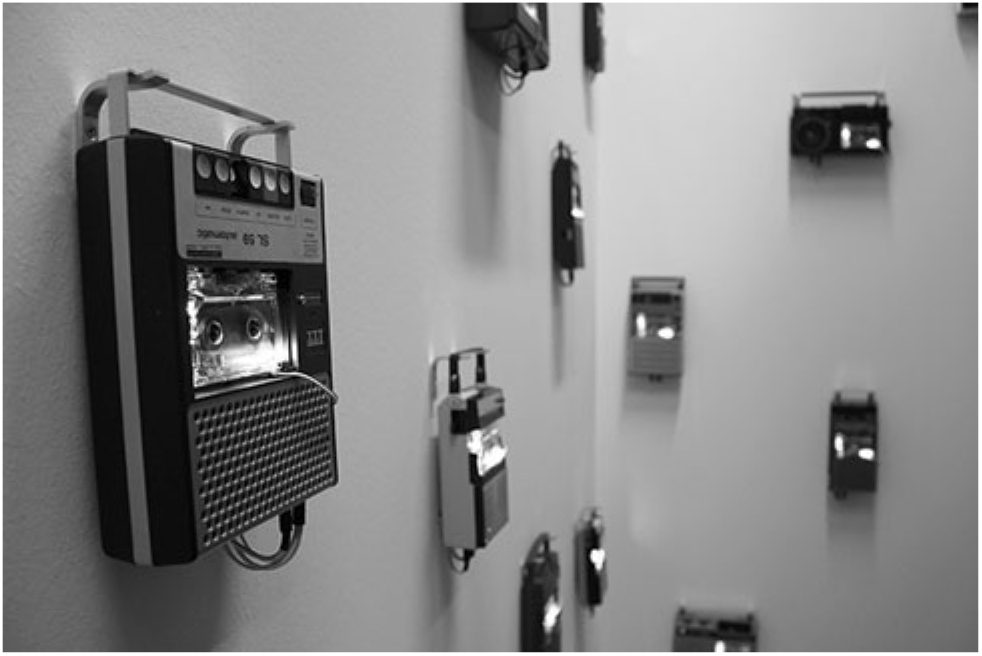
Binatone Galaxy (2011) is, Cornford states, ‘an installation for used cassette players which looks on their obsolescence not as an ending, but as an opportunity to reconsider their functional potential’ in which the players, ‘superseded as playback devices … become instruments in their own right’ (Cornford Reference Cornford2011). The work mounts multiple cassette players on the walls of the exhibition space (Figure 3). Fitted with contact mics and motion sensors, the players are activated by external movement, their inner workings and mechanical motions, rhythms and resonances all amplified within the installation environment. The critic Louise Gray, upon encounter with the piece notes:
Models from Boots, Sanyo, Robotic, one lone and gorgeously named Binatone Galaxy: they all hang on the walls, wired up, tapes loaded and ready for action. Smitten by an attack of technological melancholia, the visitor can wonder who owned these things, what pop charts did these machines once record? Were they ever placed next to pillows, late at night for surreptitious listening pleasures? What happened to the voices that once rubbed the magnetic heads of these little machines? (quoted in Cornford Reference Cornford2011)
Stephen Cornford Binatone Galaxy (2011). https://stephencornford.net/BinatoneGalaxy.html. Reproduced with permission of the artist.

Gray here highlights an intimacy in our relationship to tape that, once again, distinguishes it from other audio media formats. The potential to capture moments and voices, to transport these to the most intimate environments, to attempt, via the mixtape, to court, woo or impress are all elements of this. This intimacy, or at least its memory, perhaps intensifies once the medium enters mass-market obsolescence. Hegarty notes that ‘within the dying of media comes the passing or slow dying of individual units tapes, records, cylinders, cartridges all of which decay, and in so doing, seem to take on characteristics of having lived’ (Hegarty Reference Hegarty2007: 1). Binatone Galaxy locates this anthropomorphic quality not only within the media units and the sounds they contain but also within the playback devices themselves. It does so by providing them with a voice and listening to that voice. While the piece is heavy in nostalgia and melancholia, it is ultimately about looking forward rather than backwards. In bringing these cassette players into contact with technologies such as contact microphones and motion sensors, in recasting them as instruments, performers or sculptural objects, it invests them with new meaning, purpose, potential and life.
6. CHARACTERISTICS OF THE MIXTAPE
Analysis of these works along with that of previous iterations of the mixtape suggest a set of characteristics, which may be said to justifiably warrant the use of the term ‘mixtape’, even as its form morphs across media, and where it may retain little or no engagement with its original medium of cassette tape. These characteristics help to distinguish the mixtape from commercial forms such as the curated playlist and to resist attempts to co-opt or commodify the legacy of the mixtape. They might serve as tools which can be adopted to counteract the increasing drive towards passive, commodified and homogenous listening, which this article suggests, streaming services such as Spotify actively encourage. Finally, they may be adopted as creative strategies, perhaps through direct engagement with the concept of the mixtape as a creative form, which, as Cornford does for the cassette player for example, invests the medium of the mixtape with new meaning and potential. I have previously written of these characteristics and their possible application (Glennon Reference Glennon2018) and here expand on that initial analysis.
6.1. Hybridity
The mixtape is a uniquely hybrid form – part composition, part compilation. It combines elements from multiple sources, media and timeframes, erasing spatial and temporal boundaries, often breaking down barriers between genres, styles and media and enabling existing concepts and creations to live on in new formats. It blurs lines between read and write cultures, consumption and production, creativity and consumerism and between technologies of production and reproduction. It is an antecedent to, and latterly, an extension of, sampling culture that hybridises the acts of listening and creating. The mixtape challenges notions of recorded music as commodity and offers the potential to uncover new meanings in recorded sound. In the words of Matias Viegener, the mixtape makes ‘the existing world tell tales it does not intend to tell … [and gets] … the world to send you a message it never meant to send’ (Viegener Reference Viegener and Moore2004: 35). Continued active engagement with the hybrid nature of the mixtape may function as a strategy against the efforts of streaming services such as Spotify to promote a more homogenous and passive listening culture and may also serve as a creative strategy for the creation of new sounds, styles and forms.
6.2. Distribution
Mixtapes are distributed via non-mainstream methods. This may be via personal exchange, mail order, download from non-corporate/commercial websites, purchase from merch stands at gigs, or via non-mainstream formats (in which category the cassette tape may now be placed). Continued consideration of and engagement with non-corporate and alternative distribution strategies may help sustain a musical culture, which resists efforts to commodify all aspects of the creative and listening processes, and which nourishes creativity over commerce.
6.3. Intervention
The creator of a mixtape must be able to intervene in the recording process and to attain control over what is heard, to affect where sounds begin and end, to overlay material and to combine elements from multiple sources. Efforts to retain the ability to act upon recorded sound increase the potential capacity for new styles and forms to emerge and for music enthusiasts to venture from the terrain of consumption to that of creation.
6.4. Labour
The creation of a mixtape involves an investment of labour at least equal to that required to listen to it in full. Dean Wareham, of the band Galaxie 500 states:
It takes time and effort to put a mix tape together. The time spent implies an emotional connection with the recipient. It might be a desire to go to bed, or to share ideas. The message of the tape might be: I love you. I think about you all the time. Listen to how I feel about you. Or, maybe: I love me. I am a tasteful person who listens to tasty things. This tape tells you all about me. (Wareham Reference Wareham and Moore2004: 28)
This time, effort and investment of labour differentiates the mixtape from the playlist, mix CD, or disc drive filled with MP3s which may be created simply by dragging and dropping file references from one window to another. Further consideration and awareness of how the labour of musicians and music lovers is utilised and of who benefits from it may serve to diminish the capacity for the exploitation of this labour via, for example, the commodification of music lover’s listening habits and activities.
7. CONCLUSION
The mixtape is a unique and vital creative form that has had a profound and ongoing impact upon musical culture. It is part of a wider history of the medium of tape, in which a lineage of military, political, commercial and cultural conflict is mirrored in the creative potential tape has afforded to cut, disrupt and rearrange music and musical roles. Recent efforts to commodify the legacy of the mixtape highlight the importance of actively engaging with this legacy in a manner that seeks to serve music rather than marketing. In doing so musicians and music lovers may seek to initiate a cultural economic re-appropriation of music and the activities of listening to and creating music, from those who seek to place these activities in the service of the marketing and advertising industries.
Acknowledgements
Kindly supported by the Digital Studies Scholarship via the College of Arts and Tourism, Dublin Institute of Technology. Additional support generously provided by Culture Ireland.