“D’Arcy Thompson was unique” wrote Arthur Wallace in Nature in 2006, “no one before him had attempted the kind of geometrical approach to development and evolution that he did” (Wallace Reference Wallace2006, 401). In the same year John Whitfield noted that Thompson's fellow scientists thought of him “as a dilettante and showed no interest either in his ideas or in giving him a better job” (Whitfield Reference Whitfield2006, 1). In the introduction to the abridged edition of On Growth and Form (hereafter, GF) published in 1992, Tyler Bonner admitted that “with all his impressive armoury of talents he was, in the world of science, a lonely figure” (Bonner Reference Bonner1992, xvii). His ideas on evolution, Bonner added, “were heretics in 1917, and it must be admitted that, for partly different reasons, they remain so today” (ibid., xvii). In 1986, Mark Ridley recorded that D’Arcy “was left to develop his ideas alone, and he developed a correspondingly unique set of answers to the questions which all of Balfour's school were grappling with” (Ridley Reference Ridley, Horder, Witkowski and Christopher1986, 47). Finally, in an article published in 1971, Stephen Jay Gould argued that Thompson was “one half century too early” (Gould Reference Gould1971, 257). His mathematical approach was premature for his times and therefore his fellow scientists were not really impressed. At most, Thompson's approach to zoology was perceived by many of his colleagues as old-fashioned, timeworn natural history.
As this short series of quotations suggest, Thompson has been depicted, on occasions, as an anachronistic naturalist, unconnected and isolated from his contemporary community of scientists. A precursor of new and fertile ideas, his science was unique, idiosyncratic, and unorthodox. He could have impressed artists or humanists, but did not influence scholars working in his own discipline. Of course, in 2002 Gould tried to revise such a picture. He recognized that some aspects of Thompson's science were, in reality, not so unique: “Although I have studied D’Arcy Thompson's wonderful book throughout my career, I originally made a major error in sitting him within the history of biology. All intellectuals love a courageous loner, and I had been beguiled by D’Arcy Thompson's seemingly anachronistic peculiarities. . . . I had therefore viewed D’Arcy Thompson as the ultimate man out of time” (Gould Reference Gould2002, 1183). In such a revised version, Thompson was not a lonely man working in an institution in the middle of nowhere. He was a child of his time.
But in what sense was Thompson's biology connected to the science of his time? In what sense was he not alone? To Gould, Thompson shared with his contemporaries the common idea that the mechanism of natural selection was not enough for explaining speciation; adaptation and phylogeny alone could not account for the creation of new forms.Footnote 1 However, despite his conventional agreement with the critiques against the Darwinian paradigm, Thompson's positive solution was in total opposition to his contemporary intellectual trends. As Gould explained:
If this general and multifaceted critique of Darwin functionalism . . . harmonized well with the major trends of thought in the evolutionary biology of his generation, the second prominent implication that he drew from his idiosyncratic theory of form could not have stood in more oppositional relationship to an even deeper, and even more general, assumption of the evolutionary science, both in D’Arcy Thompson's day and in our own. (Ibid., 1204)
With Bonner, Gould concluded that even though Thompson may have shared the anti-Darwinian rhetoric of his time, his solution – i.e., his science of form – was nevertheless “idiosyncratic” and “unorthodox.” In other words, again, Thompson was essentially isolated and his proposal heretic, though he shared the diffused skepticism about Darwinian biology. In sum, Gould's Reference Gould2002 excellent – and probably the best available – exegesis of Thompson's science still conveyed the idea that the Scottish zoologist was a maverick who believed that physical forces, mathematical laws, and growth rates were more important than heredity, evolution, and adaptation in explaining and shaping organic forms.
Gould, together with most interpreters, viewed Thompson as a Don Quixote of the twentieth century: a genial, lonely, and “cranky”Footnote 2 figure stubbornly pursuing a commendable and unrealistic route. This was a route that no one took seriously or found really convincing, despite the fact that it charmed many scholars. But Gould's picture, though scholarly accurate in many respects, misses the intricate and essential network of people, contexts, ideas, theories, and institutions behind Thompson's scientific enterprise. In other words, as we will see in this article, GF was not a book of one man. Thompson's mathematical morphology was not the science of a loner and his ideas on evolution were not so “heretical.”
Through the analysis of archival sources and a novel interpretation of Thompson's background, this article aims to propose a new picture of the Scottish Professor. An unedited hidden world of connections will emerge: a world that has been largely overlooked not only by Gould, but also by all previous interpreters. Thompson, as his large correspondence suggests, was part of a vibrant community of international scholars who, from different perspectives and with diverse approaches, shared most of his ideas and perspectives; they shared not only his anti-Darwinian rhetoric and skepticism, but, above all, his ideas on morphology, mathematics, and evolution. We will see that even Thompson's “idiosyncratic” masterpiece was not only indebted to past naturalists, Greek mathematicians, and eighteenth-century naturalists. Instead, it was a study profoundly shaped by other contemporary zoologists working on similar issues and with whom Thompson was in correspondence. We will also see that the reason why Thompson's science of form has been portrayed as “unique” lay not in his own character, but in our historiographical tradition. In other words, past historians and interpreters of Thompson's biology looked in the wrong direction. In focusing exclusively on what happened in the community of evolutionary biologists, they overlooked the debates happening among other relevant groups of naturalists. But the archival materials presented here demonstrate that, if we want to grasp the complex world of Thompson, we need to look elsewhere. We need to look at the international network of developmental biologists, morphologists, comparative anatomists, physicians, and biochemists: a network that presents many interesting novelties, forgotten names, and surprising links.
Thus, when we move our attention to other communities and intellectual contexts, Thompson's science will appear different and more interesting than previous readings. For instance, Gould noted that Thompson aimed to “virtually abolish phylogenetic reasoning and historical explanation in general” (ibid., 1204). Although Thompson never questioned evolution, he thought that history was not the best tool for understanding animal form. Such an anti-historical stance was, according to Gould, in opposition to the general trend in evolutionary studies during the first decades of the twentieth century. However, when we look at Thompson's network and context and what was happening among developmental biologists and morphologists, we realize that Thompson's position was quite conventional. To him – along with many of his contemporaries – historical explanations were suspect: they appeared as controversial and unsupported speculations. Indeed, any explanation about organic evolution had to start with the knowledge of the laws ruling individual development. Animal morphologies and their historical changes were only comprehensible through the understanding of how individual development worked. As one British contemporary of Thompson famously argued: “Ontogeny does not recapitulate phylogeny: it creates it” (Garstand Reference Garstand1922, 82). If we accept the premise that evolution was considered as a consequence – not the cause – of developmental changes, Thompson's solution was only an original variation on a common and underlying theme. As I will show in the last sections of this article, Thompson firmly believed that the differentiation of the organic form could not be explained by Darwinian evolution, but by individual growth rates emerging from a specific “system of forces.” This idea was quite diffused, in its diverse forms, during the first decades of the twentieth century.Footnote 3 So, in changing Thompson's context, we will see that he was less heretic, less bizarre, and less lonely than commonly believed.
Of course, I do not intend to deprive Thompson of his uniqueness: I aim only to contextualize his originality. In other words, this essay shows that both Thompson and his scientific world were well-rooted in an international discussion on the nature of life phenomena, well-established in a traditional setting of studies in developmental biology, and well-founded in disparate international institutions and laboratories. The article is divided into two interrelated sections: in the first I will introduce a few of the several connections that Thompson entertained with international and national scholars. In other words, we will see how Thompson's world was part of a more general research program in the continent and elsewhere. In the second, I will describe how this research program was behind Thompson's agenda as expressed in GF. I will emphasize Thompson's debts to nineteenth- and twentieth-century organicist traditions. I will explain how and why his ideas of morphological evolution stemmed from an original mix of Cuvier and Lamarck. Finally, I will propose a new reading of GF based on my previous analysis of the archival sources.
The International Network
In 1939, Albert Dalcq (1893–1973), a young embryologist working at the Université Libre de Bruxelles (ULB), sent a letter to the Secretary of the Royal Society of Edinburgh. With that letter, Dalcq politely requested a portrait of Thompson for his Lab in Brussels. Indeed, he admitted that Thompson had deeply influenced his work: “When I was a young assistant,” Dalcq explained to the Secretary of the Royal Society,
I once saw Professor D’Arcy Thompson and attended here, in Brussels, his memorable lecture. This was for me an impression of which I now realize it has influenced my whole research life and I wish to have a portrait of the author of Growth and Form in my Laboratory. (Dalcq Reference Dalcq1939, 2)
The portrait, Dalcq added, was not only for adorning a working space. Dalcq intended to use Thompson's picture for a new book that he was writing: a book following his 1938's Form and Causality in Early Development, published by Cambridge University Press and was titled L’Oeuf et Son Dynamism Organisateur. Footnote 4 After all, Dalcq concluded, Thompson was the “real promoter of the mode of interpretation which is becoming prevalent in the problem of early morphogenesis” (ibid., 2). In the several enthusiastic letters Dalcq addressed to Thompson, he not only expressed his admiration for the Scottish scholar, but he also invited him to Brussels to deliver seminars and lectures. As Dalcq mentioned, at the ULB's faculty of medicine there were scholars sharing most of Thompson's interests and working on similar lines of research.Footnote 5 Dalcq himself was well in line with Thompson's understanding of biological sciences: he aimed to provide a causal, physico-chemical explanation of organic form and development.
Dalcq was a well-respected representative of the Belgian school of embryology (Pasteels Reference Pasteels1975; Thieffry Reference Thieffry2001; Mulnard Reference Mulnard1992). Born in 1893, he was trained as a physician at the ULB under Albert Brachet's supervision. In 1930, Dalcq became director of the laboratory of embryology in the same university and, in turn, trained many promising students and future influential scholars. As Thieffry notes, “the contributions of Dalcq and his pupils played an important role in the development of molecular biology in Belgium, stimulating the integration of genetics and biochemistry in the curriculum of the main Belgian universities” (Thieffry Reference Thieffry2001, 152).
Dalcq was only one among many other admirers and followers of Thompson's science in Europe. This is not entirely surprising considering that Thompson was a well-traveled scholar. He attended and gave seminars and lectures in several universities in the world. He was an enthusiastic supporter of young zoologists and maintained excellent and reliable correspondence with eminent figures of his time. Born in 1860, Thompson had begun studying medicine at the University of Edinburgh. In 1880 he attended Cambridge to study natural history with Francis Balfour and, in 1884 – with a glowing letter of recommendation by Michal Foster in his hands – he was appointed professor of biology at the University College, Dundee (see Foster Reference Foster1884).Footnote 6 Thompson, as it is well known, was an admirer of classics and was versed in foreign languages. His father had been a professor of Greek in Galway and, as Evelyn Hutchinson notes, “he got his Greek easily, from his father” (Hutchinson Reference Hutchinson1948, 578). Very young, he translated Hermann Müller's Die Befruchtung der Blumen durch Insekten, a translation auspicated and introduced by Darwin himself (Müller Reference Müller1883). Thompson also translated Aristotle's Historiae Animalium and wrote a book suggesting the strong and multiple relations between classical studies and science (Thompson Reference Thompson1940). His eclectic learning, especially in reference to his 1917 masterpiece, GF, has been often emphasized and does not require further exploration. Yet, the importance of his large network of contemporaries has not been highlighted accordingly, for instance, his important and enduring contacts with the Vienna Vivarium and friendship with its director Hans Przibram (1874–1944).
Przibram had graduated in zoology at the University of Vienna under the supervision of Berthold Hatschek (1854–1941), a morphologist and embryologist who had been a student of both Ernst Haeckel and Rudolf Leuckart (Storch Reference Storch1949). After spending a brief period in Leuckart's laboratory in Leipzig, Przibram traveled to Strasbourg to study with the physiologist Franz Hofmeister (1850–1922). Once back in Vienna, Przibram purchased the old zoo-aquarium located in the large public park known as Prater. The old aquarium was sold due to bankruptcy in 1902 and Przibram converted it into an international experimental laboratory: the Vienna Vivarium (see Edwards Reference Edwards1911). The explicit goal of the institution was, as Przibram himself recalled, “to tackle all the big questions of biology” (Przibram, quoted in Drack et al. Reference Drack, Apfalter and Pouvreau2007, 357). Przibram's vision was to create an institution where many different disciplines and approaches could find common ground: a synthesis between physics, chemistry, biology, and physiology. Przibram's agenda included mathematical studies on organic morphogenesis: in particular, he aimed to understand the physical forces shaping the organism's development through a quantitative approach encompassing physical, chemical, and physiological knowledge. Not surprisingly, Przibram's project for a mathematical morphology had many similarities with Thompson's approach. Przibram deeply admired Thompson and his work. In a postcard he even called him “Dear and venerated Master!” (Przibram Reference Przibram1927, 1).
The relation between Thompson and Przibram was both institutional and intellectual. Ever since 1922, Przibram sent pamphlets to Thompson for advertising the institution he directed. Following the model of the Stazione Zoologica of Naples, the Vienna Vivarium rented research benches for national and international researches. As the pamphlet mentioned, the institution “wishes to let tables to students of experimental biology” (Przibram Reference Przibram1922, 1). It included fees, facilities, and expertise. Thompson was very happy to send assistants or scholars he admired to work at Przibram's institution. In 1925, he advised Joseph Henry Woodger (1894–1981) to attend. Woodger was a physician working at the Middlesex Hospital in London. After the 1930s, he became an influential theoretical biologist and bio-philosopher.Footnote 7 Thompson wrote the following to Woodger: “Przibram is a very good fellow, he has been extraordinarily kind to the fellows I have sent out to him, and though his Laboratory is (or lately was) a trifle impecunious and out-at-elbows (like everything else in Austria) its deficiencies did not prevent a lot of work being done” (Thompson Reference Thompson1925a, 1). Woodger's experience at the Vienna Vivarium was excellent. Przibram himself became an enthusiastic sponsor of Woodger. He helped him to get a job with a letter of recommendation. In the following years, Woodger would further develop the scientific and philosophical insights of the systemic approach that P. Weiss and von Bertalanffy were advertising from Przibram's Viennese Institution (see Drack et al. Reference Drack, Apfalter and Pouvreau2007).
Yet, Thompson and Przibram learnt from each other about mathematical morphology and other issues in the life sciences.Footnote 8 As Deborah Coen remembers: “Research at the Vivarium provided D’Arcy Thompson himself with inspiration for his mathematical morphology” (Coen Reference Coen2006, 494). Przibram, with Thompson, believed that physics and mathematics could be excellent allies for life sciences: they would provide a deeper understanding of the organic form, its development, and its evolution. Overall, researches at the Vienna Vivarium were very consistent with Thompson's agenda. Although Thompson and Przibram did not always agree about the applications and approaches of their mathematical morphology, they deeply respected each other's work (see Przibram Reference Przibram1923). When in 1928 Przibram was invited to give a lecture at the Royal Society of Edinburgh, he wrote to Francis Crew (1886–1973) and made clear that he wanted to meet D’Arcy personally (Przibram Reference Przibram1928, 1). In the second edition of GF, Thompson made great use of Przibram's findings. Their collaboration ended when in 1944 Przibram was killed in the Nazi concentration camp of Theresienstadt (Czech Republic). Thompson wrote a quite moving obituary to his memory (Thompson Reference Thompson1945).
Even though Przibram might have been a rich source of inspiration, Thompson also learned a good deal about physical and chemical forces shaping animal form from a relatively secondary figure: a biochemist called Emil Hatschek (1868–1944). Hatschek was a Hungarian émigré living in London since 1888 (Andrade Reference Andrade1944). He had studied chemical engineering at Zurich and Vienna. In England he became a notorious scholar in colloidal chemistry. As an independent researcher, he published several original and introductory works in the field: in particular, his Introduction to the Physics and Chemistry of Colloids (1913) went through five editions.Footnote 9 The correspondence between Hatschek and Thompson is important, both quantitatively and qualitatively. Hatschek was interested in issues on the relation between surface tension, energy, viscosity, vibrations, strains, and shapes in gelatinous substances. With Thompson, he believed that there were interesting relationships between the physical behavior of inorganic substances and the organic form. One year before publishing the first edition of GF, Thompson explained to Hatschek: “I feel all but certain that the whole symmetry of the coelenterate . . . of the part of the coral and of the jelly-fish are simply referable to an unseen vibration going on within the colloid substance” (Thompson Reference Thompson1916a). Hatschek encouraged Thompson to perform experiments. In particular, he sent specimens of gels with instructions attached for handling the materials and getting organic forms: “I send you separately the first specimens of imitations medusoids or zoophytes . . . which I made after very little trying. They consist of 20% gelatin, stained with indigo-carmine, which is dropped into a coagulating solution . . . if the specimens should arrive unrecognizable, you will have no difficulty in repeating the experiments” (Hatschek Reference Hatschek1918a). Hatschek took Thompson's agenda very seriously. He tried to reproduce different kinds of organic forms using all his chemical expertise.Footnote 10 Thompson was delighted about Hatschek's successful outcomes, though he lamented that many zoologists did not appreciate the importance of these results:
It seems to me that none of these zoologists grasp the points. They look upon the things as mere “curiosities”. They fail to grasp the point, viz. that we have shown, beyond a doubt, that the form of Medusa is a figure of equilibrium under certain peculiar conditions, and that therefore it is not to be explained as something attained, by way of “adaptation”, and by means of slow gradations of evolutionary development. (Thompson Reference Thompson1918, 1)
The several letters that Hatschek sent to Thompson were long and detailed recipes of how to reproduce animal forms with simple chemical substances. They represented experimental results that strongly supported Thompson's hypothesis that simple physical causes could explain part of the animal morphologies. In other words, Hatschek's meticulous experiments sustained one of Thompson's dearest ideas: animal form was not the result of evolution and adaptation, but the outcome of determined physical forces.Footnote 11 Many of the observations gathered by Hatcheck were later used by Thompson throughout the second edition of GF.
Of course, Thompson's international network was not confined to these mentioned examples. As we will see in the next sections, he benefited from many other scholars in Scotland, Britain, and the USA. Despite a number of excellent publications about the life and work of Thompson, little is known about his relations with other scholars and the scientific traditions he drew on. Indeed, the Scottish Professor was an excellent teacher and a very generous and supportive scholar. Many of his contemporary zoologists hugely benefited from his ideas, remarks, and observations. Conversely, he was receptive and open about new insights that older or younger zoologists could provide about his projects. In particular, as I will show, Thompson influenced, and was very often influenced himself by scholars such as Edward Stuart Russell, Julian Huxley, Patrick Geddes, and Edwin Conklin. Moreover, he admired the biological work undertaken by some zoologists at the University of Chicago, in particular Charles Manning Child, and Frank Rattray Lillie. He deeply respected the old biological traditions stemming from Von Baer, Goethe, Cuvier, Muller, Spencer, and the Scottish nineteenth-century anatomist John Goodsir.Footnote 12 Finally, he enjoyed discussing scientific and philosophical issues with his old and beloved friend, John Haldane. These elements constituted Thompson's complex intellectual world and deeply informed GF.
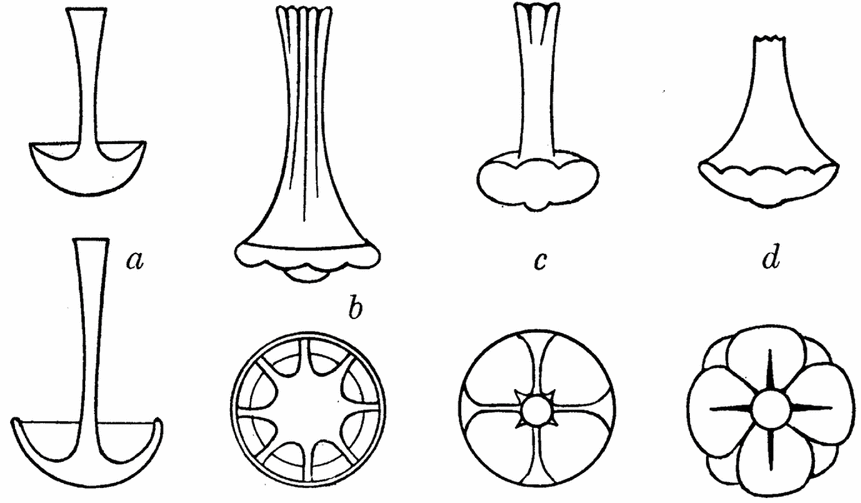
Medusoids that Hatschek produced with mixed aluminium, ferrous sulphate solutions, gelatin sol, and gum Arabic sol (Thompson Reference Thompson1942, 397).

Thompson's Further Allies
I am glad to know that . . . the new edition of “Growth and Form” is
approaching completion. The biological world will look forward with
keen anticipation to its appearance. (Edwin Conklin Reference Conklin1941)
In 1916, Edward Stuart Russell (1887–1954), a young morphologist working at the University of Aberdeen, published a book that would inspire different generations of scholars: Form and Function: A Contribution to the History of Animal Morphology. The study represented a general excursus through the history of biology. The main argument characterizing Russell's narrative was the idea that the history of morphological sciences (or morphological thought) could be divided into three different schools: the functional or synthetic school (to which Aristotle, Cuvier, and von Baer belonged), the formal or transcendental school (of which Geoffroy Saint Hilaire was a representative), and finally, the materialist or “disintegrative” school (which was founded by the Greek atomists). As is well known, the study was intended to justify Russell's own functionalist and organicist agenda in biology (see Roll-Hansen Reference Roll-Hansen1984; Esposito Reference Esposito2013). What is less known is that Thompson was enthusiastic – though critical in his own way – about Russell's achievement: “I have been reading your new book very carefully and with great pleasure, and I should like to send you my hearty congratulations and my best wishes for the book's success and your own” (Thompson Reference Thompson1916b). Of course, Thompson added honestly, he could not agree with all the book's contents, in particular with the idea that heredity and evolution could be explained with mnemonic or psychic hypotheses, but he deeply agreed with the harsh critique of Haeckel, Gegenbauer, and Lancaster's embryology and morphology and he found Russell's historical excursus superb. Yet, Russell was an excellent correspondent and enthusiastic follower of Thompson's biology. Thompson sent to Russell the proof-sheets of his GF for comments and critiques and Russell was more than happy to contribute. He considered Thompson's approach to morphology effective and extremely useful:
The important thing, from my point of view, is that you bring out the universal existence of correlation in Cuvier's sense. I tried to point out in my book the great value of the Cuvierian conception, which has for long been forgotten and ignored. It would be interesting to treat cases of functional convergence by your method as well as cases of homological resemblance. And the method should be extremely valuable applied to growth-changes. (Russell Reference Russell1917a, 2)
In another letter, Russell made clear that Thompson's physical method was in perfect agreement with his own functional approach: “I admire very much the thorough way you apply the methods and results of physical investigation to biological problems . . . to my mind there are only two possible methods in biology – the physical and the psychological – and these are complementary, not mutually incompatible” (Russell Reference Russell1917b, 1). In 1924 Russell published his second book, The Study of Living Things, and enlisted Thompson in his broad organicist agenda. In fact, although functional biology entailed a study of functional adaptations, it did not overlook the so-called “material condition of life,” that is to say, all the properties of life that are contiguous with physics and chemistry. Because functional activities required specific substances to work and were constrained by determined physical forces, knowledge about what Russell dubbed “the negative condition of functional activity” was essential, and Thompson's GF pointed in that direction. On his part, Thompson was forced to clarify his conception of mechanist biology as a non-materialist science. As he explained to Russell in a letter anticipating the publication of his great book, his physical approach to biology could be mistakenly defined as “gross materialism.” As he argued:
My own long delayed, but now forthcoming book on ‘Growth and Form’ takes a line which you have scarcely acknowledged to exist, and of which it is very possible you may heartily disapprove. You will perhaps call it the ‘grossest materialism’. I am inclined to object to the term . . . Materialistisch has acquired a peculiar significance of its own and it is hardly fair to use it as translation of “physikilisch”. The physicist who occupies himself on his grounds with the problems of matter and energy is surely not necessarily a materialist who seeks to carry physics and chemistry as far as ever he possibly can into both physiology and morphology. (Thompson Reference Thompson1916b, 1–2)
As we will see in the next sections, what Thompson had in mind was a third philosophical way between reductionist and vitalist positions. He discussed this approach with Haldane, Smuts, and others and it was in line with the work of influential philosophers whom Thompson admired, such as Henry Bergson and Alfred North Whitehead.
However, one of the most important figures in Thompson's large network surely was Julian Huxley (1887–1975). The friendly relationship between Thompson and Huxley is particularly important as they learned from each other about growth and form. Huxley had been trained in zoology at the University of Oxford. After a brief period of research in Germany, he took a position as demonstrator at Oxford's department of Zoology and Comparative Anatomy (see Dronamraju Reference Dronamraju1993). Huxley started the correspondence with Thompson in 1925 when he was appointed Professor of Zoology at King's College London. The dates are not casual. From the beginning of the 1920s, Huxley was interested in issues related to relative growth in fiddle crabs and other organisms (see Gayon Reference Gayon2000). In particular, Huxley's attention was focused on the morphological correlation about changes happening between the parts and the whole during an organism's growth. As is well known, in a paper published in 1924, Huxley formulated the equation describing the law of heterogenic growth: y = bx α. Yet in 1936, together with Georges Teissier, he coined the term Allometry (Huxley and Teissier Reference Huxley and Teissier1936). All that concerned relative growth was of high interest to Thompson. In 1925 he sent a letter to Huxley which stated: “I have been looking at your last letter . . . in which you gave me G.H.H.'s formula, for the rates of growth of x and y, at rates p and q, and the final value of y = bx α . . . I can see that this work of yours is going to improve vastly my Growth-chapter in the next edition” (Thompson Reference Thompson1925b, 3). However, Thompson firmly believed that Huxley was building on his own original work, and improving or extending his own novel results. Indeed, concerning Huxley's law of “constant differential growth,” Thompson felt that in the first edition of GF he had already expressed it, though implicitly:
I don't care a hang (I have perhaps cared all my life too little) about priority; but, since writing you last night, I have been wondering how far I expressed your idea of a “constant differential growth-ratio,” which was certainly present to my own mind all along . . . I don't want to deny that you now put it much better; but still . . . I think I had precisely your own main points clearly in mind. I don't want to question, or detract from, your own originality, your own independent discovery, in the very least; but I do want to feel satisfied that I was not so blind to an elementary and fundamental point as you perhaps think I was. (Thompson Reference Thompson1925b, 2; emphasis in the original)
Huxley never questioned the pioneering work of Thompson. In 1932, when Huxley published Problems of Relative Growth, he let Thompson know that the book was dedicated to him: “Here at least is an advance copy my growth book. You remember I asked you if I might dedicate it to you, and you said you would be glad for me to do so. I hope you will feel that it is a worthy offspring of Growth and Form” (Huxley Reference Huxley1932a, 1). Huxley not only began the book with a long quotation from Thompson, but introduced the book stressing his debt to the Scottish master: “I owe a great deal to previous work in the field; first and foremost to D’Arcy Thompson's Growth and Form” (Huxley Reference Huxley1932b, xi).
Huxley also helped Thompson to improve the new edition of GF, providing comments and advice.Footnote 13 One year before Thompson published the second edition in 1942, he sent a draft copy of it to Huxley. Although after World War II Huxley's interests were radically changed, he was extremely pleased: “How very kind of you to send a copy of your book! I think a good deal of it . . . You are indeed unique with your combination of different branches of learning” (Huxley Reference Huxley1941, 1). Until Thompson's death in 1948, they constantly exchanged information about articles, ideas, and books. Thompson was not isolated; he was in very good company.Footnote 14 His “idiosyncratic” science of form was not so idiosyncratic to his contemporaries.
Rereading On Growth and Form in Light of Thompson's Network
We cannot comprehend Thompson's seminal book without a general understanding of the context in which the book was written. As we have seen, Thompson was far from being a lonely academic; his work was essentially shaped from the intellectual environment in which he was immersed. GF was rooted in the academic network that has previously been illustrated. In other words, behind the scenes of GF and behind Thompson's discussions about mathematical morphology, growth rates, physical morphology, regeneration, and holism there were Przibram and Hatchek, then Russell, Conklin, Lillie, Huxley, Haldane, and Smuts, together with many other less known figures including comparative anatomists, embryologists, and morphologists who were against the idea according to which, to use Peter Medawar's expression, “zoological learning consisted of so many glosses on the evolutionary text” (Medawar, quoted in R. Thompson Reference Thompson1958, 221). The scholars who constituted Thompson's own network tended to interpret organic forms as manifestations of direct causal factors and not as a sign of evolutionary relations.Footnote 15 Thus, Thompson was not an idiosyncratic evolutionist: he was a mainstream developmental biologist interpreting evolution as many embryologists did. GF was a book read and praised within the community I am describing because it was understood and interpreted within a developmentalist context: a context where the organism's forms were conceived as the outcome of various kinds of forces, acting in diverse ways and diverse magnitudes. A context where, in addition, no history was necessarily required to explain organic adaptation and structure.
In addition, Thompson's complex network helps us to reconfigure his philosophical and scientific beliefs, as expressed in GF. First of all, Thompson was neither a reductionist nor mechanist, at least not according to the modern parlance meaning. Gould characterized him as “physicalist” (Gould Reference Gould2002, 1204), while Barry Ninham and Pierandrea Lo Nostro labeled the Scottish Professor as “reductionist” (Ninham and Lo Nostro Reference Ninham and Lo Nostro2010). Some have seen Thompson as a precursor of the methods employed by biochemists and others as predecessor of molecular biology (Whitfield Reference Whitfield2006; Clark and Medawar Reference Clark and Medawar1945; Kay Reference Kay1993). Passages of his works can plainly justify these interpretations. His crusade against different forms of vitalism and teleology and his defense of mechanist approaches in life sciences made him, apparently, a good fellow for the mechanist campaign. However, to see Thompson's biology as a physicalist, reductionist, or mechanist would be misleading and anachronistic because the meaning of these philosophical stances is contextually determined.Footnote 16 In fact, even though a modern reader might see Thompson's emphasis on the importance of mathematics in the study of living things – and the weight he gave to physics and mechanism to explain organic forms, the importance he attributed to geometrical symmetries in morphology – as a merely reductionist approach, it was not so intended by him and by many of his contemporaries. In the first decades of the twentieth century, the use and application of mathematics to solve biological problems was considered a very promising strategy for many “holist” theorists; the existence of some simple geometrical forms and quantifiable physico-chemical processes was not in contradiction with organicist biologies, and the mathematization of morphology was consistent with teleological ideals.Footnote 17
Thompson's position was straightforward and widely shared: with Przibram or Russell, Dalcq or Huxley, he believed that organisms did not break any physical law and they did not require any vital principle or transcendent energy in order to work, apart from physics and chemistry. Nevertheless, he felt that organisms exhibit some peculiarities that, as George Kimball nicely explained, made living entities special:
Thompson tries as often as possible to show the identity, or at least the analogy, between ordinary particles and organic creatures . . . and yet he considers that there is a unity of the living body which the non-living does not have. The unity is sometimes conceived as subservience of organic part to the whole, sometimes as an absence of dividing line between head and body – i.e. a physical continuity of material. (Kimball Reference Kimball1953, 143)
Although the difference between organic and inorganic matter was not seen by Thompson as fundamental, he thought, nonetheless, that living bodies manifested different mechanical properties due to specific chemical changes. But if we understand reductionism as the idea that the organism is explainable as the result of its parts taken individually and independent from the whole, Thompson had never been a reductionist. As Medawar specified, he tried to integrate different approaches and not merely to reduce life to physico-chemical laws:
We are mistaking the direction of the flow of thought when we speak of “analysing” or “reducing” a biological phenomenon to physics and chemistry. What we endeavour to do is very opposite: to assemble, integrate, or piece together our conception of the phenomenon from our particular knowledge of its constituent parts. It was D’Arcy's belief, as it is also the belief of almost every reputable modern biologist, that this act of integration is in fact possible. (Medawar, quoted in R. Thompson Reference Thompson1958, 227)
Yet, while Thompson apparently criticized the overuse of teleological thinking in biology, he was too Aristotelian to deny its purpose in nature. In fact, what he mainly denied was Darwinian teleology or, to put it differently, the adaptationist thinking according to which any organic conformation was there because it was useful for the survival of the organism during its phylogenetic past. Along with many biologists of his generation, Thompson felt that this adaptationist thinking introduced a speculative approach into biology: an approach very hard to disprove because it supposed what it pretended to explain. Organisms were nicely adapted because they had been selected for, and, as Medawar complained, explaining Thompson's position, “the formula would accommodate all comers” (ibid., 222). In addition, to Thompson and many of his contemporaries, the hypothesis that adaptation was explainable through the mechanism of natural selection could not be accepted because natural selection was considered, at most, a negative factor in evolution (see Bonner 1966). It destroyed but never created new organic forms, and therefore, new adaptations.Footnote 18 In brief, not only could natural selection be considered, at most, a very secondary mechanism of evolutionary diversification, but it also introduced a bad form of teleology.
Probably, there is no better chapter than that which Thompson dedicated to form and mechanical efficiency to illustrate the tension between bad and good uses of teleology in biological thinking; whereas explanation based on adaptation through natural selection mirrored an empty theological reasoning (not very far from Paley's style), the perfect adaptations that organisms manifested could be explained with the use of analogies taken from architecture or human artefacts. In these, both efficient and final causes (to use Aristotelian terms) are evident: efficient causes subsist for the sake of final causes, though the former are comprehensible only assuming the latter. In other words, the good use of teleology must be always associated with efficient causes – one explains the other, and vice-versa:
Of very different order from all such “adaptations” as these are those very perfect adaptations of form which, for instance, fit a fish for swimming or a bird for flight. Here we are far above the region of mere hypothesis, for we have to deal with questions of mechanical efficiency where statical and dynamical considerations can be applied and established in detail. The naval architect learns a great part of his lesson from the stream-lining of a fish; the yachtsman learns that his sails are nothing more than a great bird's wing, causing the slender hull to fly along; and the mathematical study of the stream-lines of a bird, and of the principles underlying the areas and curvatures of its wings and tail, has helped to lay the very foundations of the modern science of aeronautics. (Thompson Reference Thompson1942a, 960; emphasis in original)
Human artefacts are intrinsically purposive, as both organisms and their parts are made to work under precise circumstances and operate according to determined physical constraints. Just as bridges built by engineers are designed to resist certain specific loads and stresses, the architecture of vertebrate skeleton is made accordingly. The skeleton of a bison, horse, or ox works like a suspension bridge: all are made according to a well-planned distribution of lines of force and tensions. Now, for Thompson, the efficient causes lying behind the skeleton's adaptations included the phenomena of growth: bones grew under specific strains, stresses, and tensions, with all factors guiding and shaping the skeleton's architecture as a whole. Thompson argued:
Each animal is fitted with a backbone adapted to his own individual needs, or (in other words) corresponding to the mean resultant of the many stresses to which as a mechanical system it is exposed, [therefore] . . . skeletal form, as brought about by growth, is to a very large extent determined by mechanical considerations, and tends to manifest itself as a diagram, or reflected image, of mechanical stress. (Thompson Reference Thompson1942a, 1117)
However, mechanical stresses – as the efficient causes explaining bone morphologies and skeleton structures – were comprehensible only in the light of assumed functions. Unlike bridges, the skeleton form was the product of a progressive growth shaped from functional stimuli. Strains, stresses, and tensions derived from the specific conditions of life during development. The particular structure of an organism was intrinsically correlated to its life activities: in other words, walking, running, jumping, or flying – activities performed ever since the first stages of the organism's life – shaped the entire morphology. The organism was a continuous “work-in-progress”: a system that was at the same time active and passive to the environmental stimuli. This meant that efficient and final causes had to be considered as two faces of the same coin. Thompson followed Goethe who clearly argued in his Die Metamorphose der Tiere that in the organisms, “none of their functioning members are ever opposed to the others but labor in common toward life. Thus does its form determine an animal's manner of living and manner of living in turn react upon every form in the most powerful way. Thus the organized being is stable” (Goethe, quoted in Cassirer [Reference Cassirer1950] 1969, 204).
The same discourse was readily applicable to other cases: the forms of Spicule or Foramifera, leaf arrangements, or cellular aggregates. Nature was filled with instances showing the close interdependence of efficient and final causes. Thus we can better understand some opening words of Thompson's GF: “like warp and woof, mechanism and teleology are interwoven together, and we must not cleave to the one nor despise the other; for their union is rooted in the very nature of totality” (Thompson Reference Thompson1942a, 7).
Although Thompson was not a reductionist and never accepted pure structuralist biology, he believed that physical and chemical sciences offered the best tools for studying and understanding organic form. Cells, tissues, and organs, followed by flowers, leaves, and trees all obeyed physical laws (ibid., 10). Yet, Thompson's mechanism needs qualification. First of all, even though, as a hypothesis, he considered the organism as a certain kind material and mechanical entity,Footnote 19 he also admitted that physico-chemical properties were often not enough to explain life phenomena: “I would not for the world be thought to believe that this is the only story which life and her Children have to tell. One does not come by studying living things for a lifetime to suppose that physics and chemistry can account for them all” (ibid., 14). Mechanical and physical representations (which we would call models today) were deemed by Thompson to be useful simplifications, heuristic tools, and promising conceptual vehicles in understanding the simplest manifestations of life. While Thompson was focused on those phenomena that could be explained through simple mechanical representations, he did not pretend to apply them to all living phenomena; he had never been involved in the kind of materialist and monist philosophy as expressed, for instance, by Haeckel in Germany or Jacques Loeb in the United States.
Beyond Genetics: The Organism as a Whole
If the cells act, after this fashion, as a whole, each part interacting of necessity with
the rest, the same is certainly true of the entire multicellular organism . . . as Goethe
said long ago: “Das lebendige ist zwar in Elemente zerlegt, aber man kann es aus
diesen nicht wieder zusammenstellen und beleben.”Footnote 20 (Thompson Reference Thompson1942a, 344)
The particular form of organicism that Thompson defended surrounded the central theme of GF: how different kinds of forces shaped organic forms. The book was essentially a long list of cases showing how forces “compenetrate” organic matter in directing (or constraining) growth according to specific trends, and therefore produce diverse configurations. From the smallest organisms (for instance, minute bacteria, human blood corpuscles, and protozoa) to middle-sized creatures (for example, minute insects, jellyfish, or tiny fish) and subsequently to the largest life forms (for example, mammals or birds), all were influenced by diverse forces: surface-tension in the first, surface tension and gravity in the second, and gravity in the last case. Of course, growth was not only constrained by direct physical forces: it was a dynamic process entailing differential rates among various organic parts. The rates depended on osmotic, catalytic, and physiological secretions that, interacting with extant temperatures, retarded or accelerated the growth of organisms. For Thompson, as long as growth rates changed, the overall configuration of the organism changed accordingly.
But as we have seen in the first part of this article, the long and complex argument, explicated through more than one thousand pages, was not the outcome of an idiosyncratic mind: it was the result of a broad range of national and international allies, ancients, and contemporaries. When Thompson published the second extended edition of GF, he upgraded the new version with a reference to Lillie's works. F. R. Lillie (1870–1947) was the director of the Zoology department at the University of Chicago and President of Woods Hole, MBL (Willier Reference Willier1957). Back in the 30s, Lillie was a very famous developmental biologist. Thompson in particular admired Lillie's works on the physiology of feather's development. In 1942, Thompson sent Lillie an early copy of the new edition of GF and wrote:
It is a loss to me that we have never met, and a matter of great regret that we are little likely to do so . . . Pray accept the new edition of my book on Growth and Form, of which I am sending you an early copy today, under separate cover. I am sending it you for what it may be worth, to bridge the gulf between us. (Thompson Reference Thompson1942b, 1)
Lillie replied with enthusiasm, betraying his admiration for Thompson's undertakings: “Your kind letter tempers a little the regret I have long felt at not having met you in the flesh. Your beautiful translation of Aristotle's Historia Animalium has long been one of my joys; and the speaking acquaintance that I have had with your Growth and Form renders your gift of the new edition, now on the way, an appreciated honour” (Lillie Reference Lillie1942, 1). The gulf was bridged, and in the following months of 1942, they started a correspondence discussing feather development as well as other more mundane topics.Footnote 21
Lillie was not the only resource on whom Thompson relied and used in his book. Another important American figure represented for him a privileged source of inspiration: this was Charles Manning Child (1869–1954). As a colleague of Lillie in Chicago, Child was a well-known physiologist interested in animal regeneration (Hyman Reference Hyman1954). The interest of Thompson for Child is not surprising because the phenomena related to animal regeneration were seen as relevant instances of organic growth in general (Thompson Reference Thompson1942a, 274). In particular, he was fascinated by Child's experiments on planarian regeneration, which demonstrated the existence of gradients following the body-axis of the organism: gradients operating between two poles, one dominant and the other subordinate (ibid., 282). With Child, Thompson felt that the configuration of an organism was a function of its differential growth and, as such, it characterized a space-time event and not a mere spatial entity. With Child, Thompson assumed that differential growth rates depended on several factors: in particular, age and external temperature. Most importantly, with Child, Thompson concluded that differential growth rates are behind all morphological characters, peculiar or shared, of all organisms, and therefore specified individual or species qualities and conformations (ibid., 284). In sum, with Child, Thompson was saying that morphological variations were due to growth variations rather than genes or any other posited nuclear particle.Footnote 22
After discussing growth rates and regeneration, Thompson passed to cell theory. This is a chapter often overlooked by previous interpreters. However, it represents – together with the chapters on form and mechanical efficiency and on the theory of transformations – the best evidence proving that Thompson did not defend a kind of reductionist biology. First of all, he underscored De Bary and Whitman's critique of cell theory:Footnote 23 the cells were not the individual building blocks of the organism because the organism itself coordinated and drove their distribution. Famous naturalists, botanists, zoologists, and embryologists of different periods were enlisted by Thompson to support this stance: as well as De Bary and Whitman he also mentioned Goethe, Sachs, Rauber, Wilson, Sedgwick, and others. All together they strongly asserted that in cellular differentiation “we deal not with material continuity, not with little bridges of connecting protoplasm, but with a continuity of forces, a comprehensive field of forces, which runs through the entire organism and is by no means restricted in its passage to a protoplasmic continuum” (ibid., 345).
Thus, the entire organism was conceived as more than its composing parts; But what about individual cells? The position Thompson defended was, once again, the standard stance supported by most of the organicist biologists. In particular, drawing on John Goodsir, Thompson saw the cell as a sphere of action, where an unstable equilibrium of forces dwelled.Footnote 24 Surface-tension, of course, but also chemical and electrical forces were also involved. Yet, the cell was inseparably connected with its environment (Thompson Reference Thompson1942a, 333). A dynamical conception of the cell, Thomson maintained, must entail that the whole system work as an integrated individuality: there were neither active or passive regions, nor relevant or irrelevant parts, “for the manifestations of force can only be due to the interaction of the various parts . . . certain properties may be manifested, certain functions may be carried on, by the protoplasm apart from the nucleus; but the interaction of the two is necessary, that other and more important properties or functions may be manifested” (ibid., 342). For Thompson, and many other contemporaries upholding the importance of the cell surface and cytoplasm for reproduction and inheritance, the cortical regions of the cell played a fundamental role in all cellular activities (see Sapp Reference Sapp1987).Footnote 25 Thompson's organicist conception of the cell is particularly important when we consider his critique of Weismann's germ-plasm and Mendelian genetics; even though he was not directly opposed to the latter, it certainly did not fit his general framework.Footnote 26 The reasons for that derived not only from Thompson's views on the cell, but also from his understanding of cytology. Firstly, Thompson believed that investigations about cell functions were more important than knowledge about cell structure. Studying cell structure did not necessarily advance one's knowledge about cellular activities:
The things which we see in the cell are less important than the actions which we recognise in the cell; and these latter we must especially scrutinise, in the hope of discovering how far they may be attributed to the simple and well-known physical forces, and how far they be relevant or irrelevant to the phenomena which we associate with, and deem essential to, the manifestation of life.” (Thompson Reference Thompson1942a, 289; emphasis in original)
To Thompson, identifying specific structures – for instance, the germinal spot, chromatin, or chromosomes – did not explain, de facto, cellular functions. All hypotheses that correlated special properties to the matter contained in the cells – hypotheses such as Darwin's pangenesis or Weismann's germ-plasm – confused the action of energy with supposed physical particles: “If we speak, as Weismann and others speak, of an ‘hereditary substance’ . . . we can only justify our mode of speech by the assumption that a particular portion of matter is the essential vehicle of a particular charge or distribution of energy, in which is involved the capability of producing motion, or of doing work” (ibid., 288). All particulate theories of inheritance committed the sin of attributing to matter what was a manifestation of cellular forces; inheritance was not only a property of the whole cell, but it was also a manifestation of energy that, for its own nature, could not be identified or circumscribed to specific cell areas. Although all this ran against Darwin's and Weismann's hypotheses of heredity and development, it could not be easily fitted with the new paradigm developed by Morgan and his students at the Columbia Lab because, as we will see clearly in the next section, for Thompson, heredity was not based on the transmission of “factors” or “genes” but on the transmission of systems or equilibriums of forces.
Even though Thompson rarely mentioned heredity and never developed a personal, coherent, and articulate view on the field, his ideas on how organisms transmit and maintain their form, generation over generation, were clearly expressed when he dealt with evolution. Indeed, to him, evolution was not only Lamarckian in principle (although an adulterated form of Lamarckism) but it was based on a holistic perspective of evolutionary transformations and novelties: transformations entailing whole and dynamic systems of energy that could never be reduced to some physical properties of the cell nucleus alone.Footnote 27 As Thompson claimed in 1923: “The chromosome people are having a good innings; but their theories are top-heavy, and will tumble down of their own weight. It is of little use, meanwhile, to argue with them” (Thompson, quoted in Whitfield Reference Whitfield2006, 20).
Holistic Evolution
The biologist, as well as the philosopher, learns to recognise that the whole is not
merely the sum of its parts. It is this, and much more than this. For it is not a bundle
of parts but an organization of parts, of parts in their mutual arrangement, fitting
one with another in what Aristotle calls “a single and indivisible principle of unity”;
and this is not merely metaphysical conception, but is in biology the fundamental
truth which lies at the basis of Geoffroy's or Goethe's law of “compensation” or
“balancement of growth.” (Thompson Reference Thompson1942a, 1019)
Thompson had another good ally and friend with whom he discussed his scientific and philosophical ideas: John Scott Haldane. They had been close friends from a young age when they founded a naturalist club called “Eureka” (Thompson Reference Thompson1958, 25). Like Thompson, Haldane was born in Edinburgh in 1860, studied medicine at the University of Edinburgh and, like many physicians of his generation, spent part of his training in Germany, particularly in Jena where he attended the lectures of Johann Wolfgang Döbereiner, Justus Christian Loder, Haeckel, and the botanist Eduard Strasburger. Although interested in very different topics and having diverse opinions about life sciences and methods of investigation, they shared common views on what biology should be: both admired German bio-philosophy, both were attracted by the organicist metaphysics of Whitehead, Bergson, and General Smuts and, finally, both disagreed with genetic explanations of evolution.Footnote 28 In 1929, Haldane sent an enthusiastic letter to Thompson: “I was delighted to hear today from Julian Huxley that you are coming to South Africa after all, and are to join one of the public lectures. You may, therefore, also be able to take part in the Smuts discussion at Cape Town” (Haldane Reference Haldane1929, 1). Indeed, a few months later, both men attended the British Association conference in South Africa. Haldane participated as lead speaker in a session titled “The Nature of Life.”Footnote 29 Haldane and Thompson, together with other speakers and many participants, participated in discussions with the Cape Town host, Jan Christiaan Smuts, who, three years before had published a rather controversial book titled Holism and Evolution.
The meeting was a joint session of physiology, botany, and zoology. Smuts opened the debate with his new, holist hypothesis of life and evolution, as opposed to mechanist approaches in biology (see Goodman Reference Goodman2007, 366).Footnote 30 Lancelot Hogben played the devil's advocate, strongly arguing for reductionism and mechanism in biology.Footnote 31 Unfortunately, we have no clue about Thompson's contributions to the South African session. However we only know that organismal or holist interpretations of living phenomena were always at the center of his interests.Footnote 32 Thompson's understanding of morphology and development was essentially organicist and, as we will see in this section, his view on organic evolution was generally holistic too. With Haldane, Thompson believed that Evolution had nothing to do with transmission and selection of discrete characters because there was nothing purely discrete in the organic world. It is revealing that Thompson directly quoted Johannes Peter Müller in rejecting what he called the doctrine of single characters, i.e., the idea that the adult organism represents, in truth, a set of discrete hereditary factors: “The cause lying behind the existence of every part of the living body is included into its whole” (my translation)Footnote 33 was a statement that Muller, in his celebrated Handbuch der Physiologie des Menschen (Textbook of Physiology), attributed directly to Kant (Muller 1837, 18; Thompson Reference Thompson1942, 1020). It conveyed the idea that not only was the organic whole explicatively more important than its parts, but also that organic parts could only be separated through a process of abstraction – biologists’ distinctions – so that organs, tissues, cells, bones etc., were mere theoretical tools that could be helpful only if the scholar was fully aware that they were, in truth, abstractions. Organisms, from an ontological viewpoint, were irreducible and composite wholes and evolutionary mechanisms had to operate on functional wholes and not on small, discrete, characters (Thompson Reference Thompson1942a, 1018).
Now, for Thompson, one of the most evident instances of organic integration was the animal skeleton and its efficiency; it showed that the old morphological and anatomical observations – observations based on the structural analysis of parts as abstracted from the whole – were necessarily misleading (Thompson Reference Thompson1942, 1018). In fact, mirroring Kant's saying, he argued that the same principles were at work both in the architecture of the whole skeleton and in the constitution of a single bone. Yet, both skeleton and bones were in turn “moulded” with muscles and other tissues so that a complete understanding of the skeletal structure and function was possible, only if the whole was taken into account. As most organicist zoologists and physicians argued, biological investigation entailed a double process of investigation: analysis, whereby parts were abstracted from the whole and described in their own specificity, and synthesis, whereby the parts were understood as interconnected elements of the whole. Thompson subscribed to this principle and applied it to his morphological investigations; however, even though he believed that organisms could be seen as teleologically directed wholes, he preferred to focus on the idea that living beings were a product of well-defined physical causes acting on the whole organic system of forces.Footnote 34 This is the central idea behind his hypothesis of transformation. In the same way as the skeleton was a result of pressures, stresses, and forces acting on growing heterogeneous matter, so the forms of organism were the product of forces acting on the whole plant or animal structure. If forces explained form, then heredity and evolution (as conceived by Thompson's contemporaries) lost its privileged explicative power: “To look on the hereditary or evolutionary factor as the guiding principle in morphology is to give to that science a one-sided and fallacious simplicity” (Thompson Reference Thompson1942a, 1022; emphasis in the original).
Even though affinities among organisms (and morphological similarities among their parts) could indicate phylogenetic relations, Thompson believed that they could also be (and often were) the product of similar forces acting on the system as a whole. After all, organisms can be similar to each other, or maintain their invariable morphology for many generations because they live in similar environments and, therefore, are subjected to similar stresses, pressures, and forces. If form were strictly related to growth rates (which Thompson dubbed morphological heredity), and if growth rates were related to environmental stresses and forces, organisms’ morphology may change if environmental forces change. In other words, the systems of forces constraining or influencing growth rates can be disrupted by external forces or new habits, which, in turn, may lead to a new equilibrium or system of forces. As a consequence, in evolution, organisms were neither transformed through acquired characters nor through stochastic gene mutations, but they changed through new ‘acquired’ systems of forces:
The deep-seated rhythms of growth which, as I venture to think, are the chief basis of morphological heredity, bring about similarities of form which endure in the absence of conflicting forces; but a new system of forces, introduced by altered environment and habits, impinging on those particular parts of the fabric which lie within this particular field of force, will assuredly not be long of manifesting itself in notable and inevitable modifications of form. (Thompson Reference Thompson1942a, 1025)
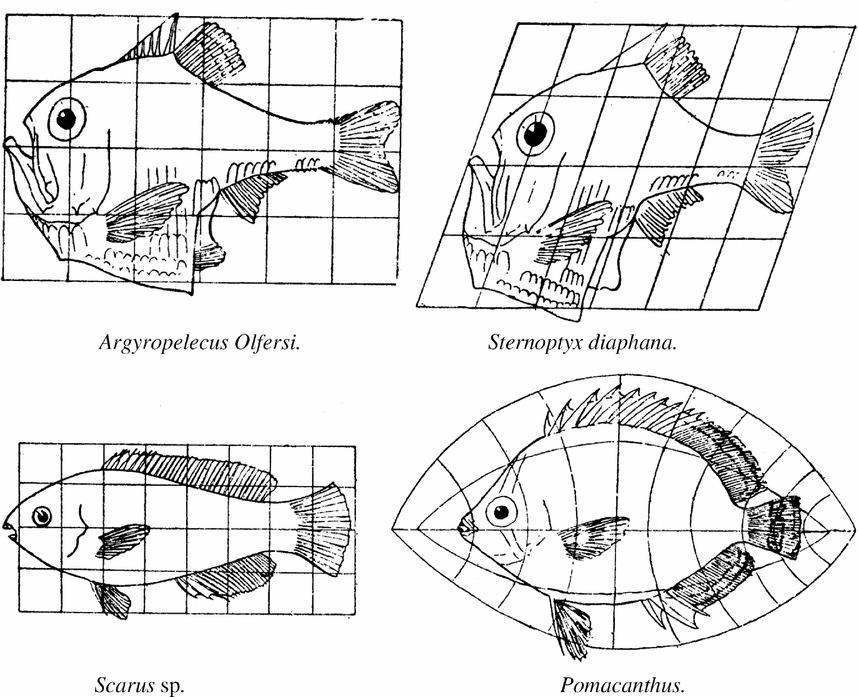
The system of forces Thompson had assumed was represented in the last celebrated chapter of his book: they were pictured as Cartesian deforming grids outlining the bauplans of organisms, as illustrated in figs. 2 and 3. Similar and related forms were compared and described through these geometrical grids. Thompson thought that similar forms varied in correspondence with various deformations of these coordinates, representing lines of force acting on the organism's whole body and on its parts.
Thompson's examples of grid transformation (Thompson Reference Thompson1942, 793).
In addition, Thompson grid's transformations illustrated how organisms change as a whole. Unlike the old morphological tradition which tended to analyze and compare single morphological parts, Thompson's diagrams did not illustrate variations or comparisons of single characters, but an overall reshaping of the bauplan. After all, he remained loyal to Cuvier who had argued that “correlation” among characters was a distinctive feature of the organism. Specific morphological characters were considered by Thompson, once again, as a mere abstraction, only conceived in the mind of the investigator because, as he claimed:
The living body is one integral and indivisible whole, in which we cannot find, when we come to look for it, any strict dividing line even between the head and the body, the muscle and the tendon, the sinew and the bone. Characters which we have differentiated insist on integrating themselves again . . . The coordinate diagram throws into relief the integral solidarity of the organism, and enables us to see how simple a certain kind of correlation is which had been apt to seem a subtle and complex thing. (Ibid., 1037; emphasis in the original)
Coordinates illustrated organic “holist” transformations as represented in closely-related bauplans. Thompson's grids were not appropriate to deal with transformations of unrelated or barely related bauplans because, just as in geometry, it is impossible to conceive a transformation of very different figures (Thompson used the example the incommensurability of helicoid and ellipsoid figures): “We cannot transform an invertebrate into a vertebrate, nor a coelenterate into a worm” (Thompson Reference Thompson1942, 1094). Incommensurability among forms, therefore among certain grids, reflected incommensurability among “types” in nature, as Cuvier had taught and used as argument against “transformationists” in his own time. However, unlike Cuvier, Thompson believed in evolution and, unlike Darwin, he maintained that organic transformation entailed large leaps: “Our geometrical analogies weigh heavily against Darwin's conception of endless small continuous variations; they help to show that discontinuous variations are a natural thing, that ‘mutations’ – or sudden changes, greater or less – are bound to have taken place, and new ‘types’ to have arisen, now and then” (ibid., 1095).
With Lamarck, Thompson felt that organic forms change over time and evolve as a function of the environment and new acquired habits. With Aristotle, Kant, Goethe, and Cuvier (and some of his contemporaries), he held that organisms are correlated and integrated individualities. He synthesized all these positions and conceived organic evolution as a process entailing “holist” transformations among related “types”: transformations due to inherited and plastic systems of forces.Footnote 35 Just as Child had argued that hereditary transmission entailed systems of reaction and not genes, so Thompson believed that evolution required the transmission of systems of forces and not factors.
Conclusion
Unlike previous accounts of Thompson's biology, this study showed that the Scottish professor was not a loner. He was not unconnected to the scientific context of his time and his science of form was not so idiosyncratic or heretic. As I have argued, previous historians portrayed Thompson's biology as idiosyncratic because they looked exclusively to one community of scientists: the evolutionary biologists. In doing so they missed Thompson's real network. The archival sources indicate that Thompson's interlocutors were rather developmental biologists, physiologists, biochemists, and physicians: all scholars who accepted or advanced his insights. In short, through analyzing Thompson's correspondence we obtained a very different picture. Not only did we discover that he was part of a large community of national and international scientists committed to revealing the mathematical or physico-chemical laws ruling organic growth, but we also realized that his science of form was an original proposal inscribed in a well-defined research program in developmental biology: evolutionary diversification was not due to stochastic gene mutation and selection, but to specific changes of growth and form happening during the individual development. I have tried to show that a decontextualized representation of Thompson's work and ideas is connected to a misleading interpretation of Thompson's science, philosophy, and epistemology, as expressed in GF.
Thompson was not a reductionist and physicalist in the current meaning of the terms. His intellectual network, together with his own convictions about biology and its method of investigations made him an organicist. As a scholar of Aristotle, Goethe, and Cuvier, he never abandoned teleology, even though he attempted to explore possible alternatives. His Lamarckian and holistic views rendered him skeptical about Neo-Darwinian mechanisms of speciation. In addition, Thompson's fascination with numbers and geometrical forms, his quest for simple laws, symmetries, and patterns regulating both inorganic and organic worlds (with the help of analogies such as soap bubbles, snow crystals, or clouds) did not make him a “crank,” but a well-respected participant and follower of a developmentalist tradition of natural science that was alive and vibrant during the first decades of the twentieth century.