INTRODUCTION
The Swan Point archaeological site, in interior Alaska, has become a prominent fixture in discussions about terminal Pleistocene human colonization and migrations into Eastern Beringia (Alaska and Yukon) and the Americas from northeastern Asia. The site contains some of the earliest unequivocal evidence of occupation in northern North America and late Pleistocene connections to stone tool traditions in eastern Siberia and Japan (Potter et al. Reference Potter, Reuther, Holliday, Holmes, Miller and Schmuck2017; Gómez Coutouly and Holmes Reference Gómez Coutouly and Holmes2018). Holmes and others (Holmes et al. Reference Holmes, VanderHoek, Dilley and West1996; Holmes Reference Holmes2001; Potter et al. Reference Potter, Holmes, Yesner, Goebel and Buvit2014) previously reported that the earliest component, here referred to as a “Cultural Zone” (CZ), dates back to ∼14,000 cal BP. It contains impressively preserved hearth features, activity areas (stone tool and organic tool manufacturing areas), and organic (faunal and floral) remains. Less known is the persistent use throughout the Holocene of Swan Point as a place where people based themselves to hunt and process animals, manufacture osseous and stone tools, and construct a semi-subterranean house and pit features, presumably for a longer-term living space and food storage (Smith Reference Smith2020).
Excavations have intermittently occurred at the site since 1991, and currently constitutes one of the largest areal excavations in the region, revealing several components within a stratified sequence of archaeological traditions and complexes: East Beringian, Chindadn, Denali, Northern Archaic, Dene-Athabascan, and Historic (Holmes et al. Reference Holmes, VanderHoek, Dilley and West1996, Reference Holmes, Potter and Reuther2022). Our work has built a large set of radiocarbon (14C) dates for a multi-component site in Eastern Beringia and interior Alaska (Holmes et al. Reference Holmes, VanderHoek, Dilley and West1996; Holmes Reference Holmes2001, Reference Holmes2008, Reference Holmes, Goebel and Buvit2011; Hirasawa and Holmes Reference Hirasawa and Holmes2017; Smith Reference Smith2020); 76 14C dates are evaluated. Here, we present a comprehensive chronological record based on sequential Bayesian models in OxCal (Bronk Ramsey Reference Bronk Ramsey2009a, b) for the Swan Point cultural zones and subzones that show the persistent use of this location in interior Alaska throughout the late Pleistocene and Holocene.
BACKGROUND
Swan Point and the Shaw Creek Flats
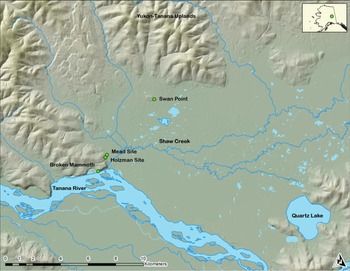
Swan Point is situated on a bedrock knoll that rises approximately 30 m above the surrounding northwestern edge of the Shaw Creek Flats (SCF; Figure 1), a low-lying alluvial plain within the middle Tanana River Valley (Holmes et al. Reference Holmes, VanderHoek, Dilley and West1996; Dilley Reference Dilley1998; Reuther et al. Reference Reuther, Potter, Holmes, Feathers, Lanoë and Kielhofer2016). The knoll is at the eastern end of an approximately 1-km-long bedrock ridge that is isolated from the edge of the Yukon-Tanana Uplands (YTU) foothills, making this a prominent landscape feature within the SCF (Dilley Reference Dilley1998:141).
Map of Alaska, the Shaw Creek basin, Quartz Lake, and the Swan Point, Mead, Holzman, and Broken Mammoth sites.

The interface of the SCF and YTU contributes to the diverse topography and biota and provides a unique array of ecological niches within this catchment (Reuther et al. Reference Reuther, Potter, Holmes, Feathers, Lanoë and Kielhofer2016), and the 14C record of Swan Point is the result of the complex modern and ancient interactions of local vegetation and faunal components. Modern vegetation in the lower terrain consists of sedge and shrubby muskeg and black spruce-larch forest, while closed canopy forests cover the lower slopes of the hills and open mixed forests and tundra at the higher elevations. The southern slopes of bedrock cliffs and terraces fosters xeric plant communities, that include plants such as Artemisia, sedges (Cyperaceae) and grasses (Poaceae). Alder (Alnus sp.) and willow shrubs (Salix sp.), soapberry (Shepherdia canadensis), grasses, sedges, and horsetail (Equisetum) tend to be early colonizers of newly exposed ground in areas of disturbance, such as active dunes and alluvial floodplains (Magoun and Dean Reference Magoun and Dean2000; Viereck and Little Reference Viereck and Little2007).
Wildlife and fish in the SCF are relatively diverse for interior boreal regions, and their present habitats and behaviors in the SCF are considered good proxies for the later Holocene (Reuther Reference Reuther2013; Reuther et al. Reference Reuther, Potter, Holmes, Feathers, Lanoë and Kielhofer2016). Moose (Alces alces) are relatively abundant in the lower lying flats where shrubs and aquatic plants thrive, and the Fortymile caribou (Rangifer tarandus) herd migrate through the uplands but also historically ranged in some of the lower valleys (Mishler Reference Mishler1986; Durtsche and Hobgood Reference Durtsche and Hobgood1990). Sheep (Ovis dalli) once historically occurred in the headwaters of Shaw Creek and Goodpaster River; however, they are now relegated to higher elevations in the uplands (Smith Reference Smith2020). Black and brown bears (Ursus americanus and arctos), beaver (Castor canadensis), coyotes (Canis latrans), fox (Vulpes vulpes), snowshoe hare (Lepus americanus), marten (Martes americana), weasels (Mustela sp.) and wolf (Canis lupus) are among the other furbearers that inhabit this region. The wetlands offer excellent habitat for birds that include waterfowl (swan, geese, ducks), raptors (eagles, gulls, hawks, owls), ravens, and ruffed grouse. Salmon species (Oncorhynchus sp.) and arctic grayling (Thymallus arcticus) spawn in the SCF drainage system and the Goodpaster River, northern pike (Esox lucius) are present in some lakes, and burbot (Lota lota) and smaller whitefish (Coregonus sp.) in rivers and sloughs.
The paleoecological record for the region shows broad changes in plant and animal communities over the last 16,000 years since deglaciation. Herbaceous tundra transitioned toward shrub tundra vegetation around 14,000 cal BP with willow (Salix sp.) becoming more common at that time (Bigelow and Powers Reference Bigelow and Powers2001; Tinner et al. Reference Tinner, Hu, Beer, Kaltenrieder, Scheurer and Krahenbuhl2006) in the middle Tanana Valley. Other shrubs and deciduous trees were locally present by 12,000 cal BP, including shrub birch (Betula nana), quaking aspen (Populus cf. tremuloides), and possibly alder (Alnus sp.; Reuther et al. Reference Reuther, Potter, Holmes, Feathers, Lanoë and Kielhofer2016). Picea (spruce) appears locally by 11,000–10,000 cal BP as forests begin to expand across the region; black spruce and muskeg appear more common after 7000–6000 cal BP (Bigelow Reference Bigelow1997; Brubaker et al. Reference Brubaker, Anderson, Edwards and Lozhkin2005; Reuther et al. Reference Reuther, Potter, Holmes, Feathers, Lanoë and Kielhofer2016).
Mammalian geographic ranges and abundances were restructured as vegetation communities changed throughout the terminal Pleistocene and Holocene. Hare, marmot (Marmota sp.), ground squirrel (Spermophilus parryii), arctic fox (Alopex lagopus), river otter (Lutra canadensis), wolf, caribou, horse (Equus lambei), mammoth (Mammuthus primigenius), moose, wapiti (elk; Cervus canadensis), steppe bison (Bison priscus), and sheep are present in the terminal Pleistocene and early Holocene faunal records (Yesner Reference Yesner, Walker and Driskell2007; Holmes Reference Holmes, Goebel and Buvit2011; Potter et al. Reference Potter, Holmes, Yesner, Goebel and Buvit2014; Wygal et al. Reference Wygal, Krasinski, Holmes and Crass2018), as well as numerous species of small mammals that do not co-occur today (Lanoë et al. Reference Lanoë, Reuther, Holmes and Potter2020). The ecological overlap of these species indicates a uniquely heterogeneous environment at the Pleistocene-Holocene transition. The co-occurrence of large mammalian grazers (bison, wapiti, and sheep) and browsers (caribou, moose) indicates a unique combination of xerophytic species and deciduous shrubs and trees in the SCF region into the early Holocene. Ground squirrels also indicate relatively year-round ice-free eolian deposits that allowed for burrowing and caching behaviors (Lanoë et al. Reference Lanoë, Reuther, Holmes and Potter2020); today, thick seasonal freezing active layers restrict ground squirrel habitat to higher elevations. Large and small mammal communities became less diverse into the Holocene with the expansion of the boreal forest and peatlands and decline in the extents of herbaceous tundra and deciduous forests and shrubs; several species became extirpated (bison, horse, mammoth, and wapiti), other species’ ranges were fragmented and reduced (caribou, sheep, ground squirrel), and a few species’ ranges expanded (e.g., moose and beaver; Guthrie Reference Guthrie2006; Reuther et al. Reference Reuther, Potter, Holmes, Feathers, Lanoë and Kielhofer2016; Lanoë et al. Reference Lanoë, Reuther, Holmes and Potter2020).
Site Stratigraphy
Excavations at Swan Point constitute an area of 85 m2 to date (Holmes Reference Holmes, Goebel and Buvit2011; Potter et al. Reference Potter, Holmes, Yesner, Goebel and Buvit2014; Smith Reference Smith2020). Four lithostratigraphic units (Units 1–4) and at least four buried soils have been described at the site (Figure 2; Holmes et al. Reference Holmes, VanderHoek, Dilley and West1996; Dilley Reference Dilley1998; Kielhofer et al. Reference Kielhofer, Miller, Reuther, Holmes, Potter, Lanoë and Crass2020). Unit 1 consists of the weathered gneiss bedrock. Unit 2 is a discontinuous sand deposit that is up to 45 cm thick and overlies the weathered bedrock. This deposit is made up of two different types of sands: a massively bedded aeolian gray fine sand, and a second poorly sorted sand that is composed of in situ weathered bedrock (grüs; Dilley Reference Dilley1998). Infrared stimulated luminescence (IRSL) dating of the feldspar component of the Unit 2 sands indicate they were deposited between 15.7 ± 1.11 and 22.2 ± 2.77 ka (Feathers Reference Feathers2018). Unit 3 is a thin (2–10 cm thick) layer of angular pebbles of quartz and gneiss derived from the weathered bedrock that shows limited amounts of localized seasonal downslope transport (Dilley Reference Dilley1998; Holmes Reference Holmes, Goebel and Buvit2011). Unit 3 overlies the Unit 2 sands with minimal to no mixture between the two units. Unit 4 is a loess (aeolian silt) cap that is up to 100 cm thick.
Generalized stratigraphic profile of Swan Point site sediments and soils showing cultural zones and modeled ages (see Methods section for modeling procedures). Depth in centimeters below surface (cmbs). IRSL ages on sand are italicized.

Four buried soils are contained within Unit 4, along with the surface soil. Cultural material is associated with each of the buried soils and the surface soil (Dilley Reference Dilley1998; Holmes Reference Holmes2008, Reference Holmes, Goebel and Buvit2011; Kielhofer et al. Reference Kielhofer, Miller, Reuther, Holmes, Potter, Lanoë and Crass2020). The lowest buried soil within Unit 4 consists of a loamy sand that is a 1–2 cm thick, discontinuous, and very weakly expressed buried incipient soil (2Ab-2Ck horizons). Previous 14C dating on materials from this buried soil indicates it dates between 14,440–13,550 cal BP (Holmes Reference Holmes, Goebel and Buvit2011). A series of discontinuous thin (1–2 cm thick) incipient soils (Ab1, Ab2, and Ab3 horizons) are situated 20–25 cm above 2Ab-Ck soil in Unit 4 and developed between 12,620–8370 cal BP. A surface forest soil (Cryochrept; O-A/E-Bw-BC horizons) formed in the upper 40 cm of Unit 4 loess and began developing after 7500 cal BP.
Loess accumulation was rapid during the terminal Pleistocene (0.32 mm/yr, 14,150–13,950 cal BP; and 0.17–0.14 mm/yr, 13,950–11,550 cal BP), and became nearly negligible during the early Holocene, at 0.015 mm/yr, 11,550–8200 cal BP (Holmes Reference Holmes, Goebel and Buvit2011). Deposition rates increase slightly during the middle to late Holocene (0.06–0.03 mm/yr, 8200–800 cal BP). The lower accumulation rates during the early to middle Holocene created less vertical separation between cultural occupations.
The integrity of the stratigraphic record has been discussed in several publications including Dilley (Reference Dilley1998), Holmes et al. (Reference Holmes, VanderHoek, Dilley and West1996), Kielhofer et al. (Reference Kielhofer, Miller, Reuther, Holmes, Potter, Lanoë and Crass2020), and Smith (Reference Smith2020). The cultural zones and subzones are generally vertically separated by culturally sterile loess. Some post-depositional disturbance to the stratigraphy includes animal and tree root burrowing and minor amounts of cryoturbation in isolated soil horizons within the soil stratigraphy; the effects of each of these disturbance mechanisms is minimal to cultural deposits and easily trackable vertically and horizontally across the site. Refit analyses throughout the cultural deposits show that the upper cultural zones (1 and 2; Smith Reference Smith2020:253) are more likely to have vertical displacement of artifacts than lower cultural zones 3 and 4 (Lanoë and Holmes Reference Lanoë and Holmes2016; Gómez Coutouly and Holmes Reference Gómez Coutouly and Holmes2018). Anthro-turbation, such as small pits dug into older occupations by more recent ones, was tracked across the site and easily recognized within the stratigraphy through mapping truncations of older deposits and horizons by younger ones (Smith Reference Smith2020).
Cultural Context
Swan Point and the SCF are part of the traditional territories of Middle Tanana Dene-Athabascan peoples. The SCF were part of extensive seasonal land use and trail systems, from the uplands to the flats and lakes, used by the Shaw Creek, Goodpaster, Salcha, and Big Delta Middle Tanana Dene bands (Andrews Reference Andrews1975; Mishler Reference Mishler1986; Smith Reference Smith2020). Villages and fish camps were located on several creeks, including Shaw Creek, Goodpaster, Delta, Salcha, and Tanana Rivers. Several Middle Tanana Dene place names have been retained throughout the SCF (Mishler Reference Mishler1986:121, 129). Debedee Ndiige refers to Shaw Creek that translates to “sheep horn creek.” Ttheethen T’ox refers to the Shaw Creek Bluff, which literally translates “stone hawk(?) nest.” Teech’el Menn’ likely refers to Quartz Lake, which translates to “flat broken rock lake,” but may also refer to other lakes in the area.
The archaeological record at Swan Point consists of five broad cultural zones, CZ4 to CZ0 (oldest to youngest), dating back to 14,200 cal BP. Holmes et al. (Reference Holmes, VanderHoek, Dilley and West1996; Holmes Reference Holmes2001, Reference Holmes2008) originally defined CZ4 through CZ1, each being set within six chronological periods (Beringian, Transitional, Early Taiga, Middle Taiga, Late Taiga, and Historic) that encompass broader cultural and environmental changes in interior Alaska. Cultural Zone 4 consists of two subzones, CZ4b and CZ4a, associated with the 2Ab-2Ck soil horizons.
CZ4b at ∼14,200 cal BP is the oldest dated component at Swan Point, which Holmes (Reference Holmes2001, Reference Holmes2008, Reference Holmes, Goebel and Buvit2011) placed within Phase I (Diuktai) of the East Beringian tradition. CZ4b is interpreted as a brief occupation, possibly a single event, based on the limited array of stone materials and tool types represented in the assemblage and the limited evidence of butchery and consumption of animal parts (Lanoë and Holmes Reference Lanoë and Holmes2016; Gómez Coutouly and Holmes Reference Gómez Coutouly and Holmes2018). The remains in CZ4b are generally oriented toward composite tool production (Holmes Reference Holmes, Goebel and Buvit2011; Lanoë and Holmes Reference Lanoë and Holmes2016; Gómez Coutouly and Holmes Reference Gómez Coutouly and Holmes2018). Microblade production in CZ4b is characteristic of the Yubetsu production technique used throughout Northeast Asia, and a distinctive trait of the late Pleistocene Diuktai Culture in eastern Siberia (Gómez Coutouly and Holmes Reference Gómez Coutouly and Holmes2018). Burins are present in relatively large quantities, being used to groove, scrape, and carve bone and ivory materials in CZ4b, likely into osseous projectile points that would have been incised and inset with fragments of microblades. A unique aspect of CZ4b is the presence of bone-fueled hearths that are preserved as carbonized fatty residue laden sediments (Crass et al. Reference Crass, Kedrowski, Baus, Behm, Goebel and Buvit2011). Faunal remains include large herbivores, lagomorphs, rodents, and birds. Megafauna includes mammoth, horse, and caribou with minor remains of moose and bison (Lanoë and Holmes Reference Lanoë and Holmes2016).
CZ4a overlays CZ4b with a vertical separation of 1–2 cm of culturally sterile sediment and some horizonal separation as well. This subzone is an even more limited occupation spatially and in artifactual content when compared to CZ4b and the overlying CZ3. CZ4a artifacts are primarily limited to stone tool manufacturing debris, and a handful of lanceolate biface fragments and end scrapers (Holmes Reference Holmes2014). Features consist of a hearth and a small concentration of burned animal bones. Hirasawa and Holmes (Reference Hirasawa and Holmes2017) quoted an age range of 13,300–13,100 cal BP for CZ4a. Given the limited amount artifactual materials, we place CZ4a in an unnamed phase of the East Beringian tradition (Holmes et al. Reference Holmes, Potter and Reuther2022).
Cultural Zone 3 is associated with at least two buried incipient soils (C3/Ab3 and C2/Ab2 horizons) separated by 10–15 cm of culturally sterile loess from CZ4 and the lowest 2Ab-2Ck paleosol (Holmes Reference Holmes, Goebel and Buvit2011; Kielhofer et al. Reference Kielhofer, Miller, Reuther, Holmes, Potter, Lanoë and Crass2020). CZ3 features are hearths that were surficial fires leaving ovoid charcoal stains and oxidized sediments. Faunal remains consist of wapiti, bison, moose, hare, and fish (Lanoë and Holmes Reference Lanoë and Holmes2016). Its artifact assemblage is characterized by an increased presence of biface production and a decrease in microblade products, and originally estimated to date between 12,700–11,200 cal BP (Holmes Reference Holmes2008; Hirasawa and Holmes Reference Hirasawa and Holmes2017).
Cultural Zone 3 has two subzones, CZ3b and CZ3a. Holmes (Reference Holmes, Goebel and Buvit2011) originally placed CZ3 into the Phase II of the East Beringian tradition; however, artifact and 14C dating analyses have refined the timing and cultural designations of the two subzones. CZ3b and CZ3a were previously noted as dating between 12,700–11,600 cal BP and 12,100–11,200 cal BP, respectively (Hirasawa and Holmes Reference Hirasawa and Holmes2017). CZ3b contains distinct triangular and teardrop shaped points, locally termed “Chindadn” or “Nenana” points, along with other bifaces with concave, round, and straight base forms. CZ3a bifaces trend toward more lanceolate forms that are similar to biface forms in Denali Complex assemblages. Both CZ3 subzones contain a minor number of microblades, although microblade cores are absent. Hirasawa and Holmes (Reference Hirasawa and Holmes2017) and Holmes et al. (Reference Holmes, Potter and Reuther2022) place CZ3b within the Chindadn tradition, while CZ3a is placed within the Denali Complex or tradition, both designations based on differences in biface forms.
Cultural Zone 2 represents a period when the archaeological record transitions between the Denali Complex and the Northern Archaic tradition (Holmes Reference Holmes2008, Reference Holmes, Goebel and Buvit2011; Hirasawa and Holmes Reference Hirasawa and Holmes2017). This zone was recovered from loess with minimal pedogenic development or weathering apart from a weakly developed soil (Ab1 horizon) and limited illuviation of sesquioxides (iron and aluminum; BC-C1 horizons) within 30–45 cm below the surface (Holmes Reference Holmes, Goebel and Buvit2011; Kielhofer et al. Reference Kielhofer, Miller, Reuther, Holmes, Potter, Lanoë and Crass2020). CZ2 is separated from CZ3 by 7 cm of culturally sterile loess. CZ2 has been difficult to vertically separate into subzones of occupations within the stratigraphy due to decreases in loess accumulation during the early to middle Holocene. Previous studies defined CZ2 within a limited time frame of 8300–7500 cal BP based on two 14C dates (Holmes Reference Holmes2008; Hirasawa and Holmes Reference Hirasawa and Holmes2017; Smith Reference Smith2020). We have subdivided CZ2 into two subzones, CZ2b and CZ2a, based on more recent excavations and renewed dating efforts. The lithic artifact assemblage contains lanceolate points, side scrapers, microblades, subconical and wedge-shaped microblades cores, and burins and burin spalls (Holmes Reference Holmes2008; Smith Reference Smith2020). CZ2 features are similar to CZ3 surficial hearths.
Cultural Zone 1 is contained within the lower horizons of the surficial forest soil (Bw-BC horizons) within 5–30 cm below the surface. CZ1 was first divided into two subzones, CZ1b and CZ1a, that date between 5300–680 cal BP (Holmes Reference Holmes2008; Hirasawa and Holmes Reference Hirasawa and Holmes2017). Recent excavations, with artifact assemblage analyses and more 14C dating, allowed CZ1 to be separated into three subzones, CZ1b, CZ1a1 and CZ1a2, dating between 5525–725 cal BP (Smith Reference Smith2020). These subzones are included within the Northern Archaic and Dene-Athabascan traditions (Holmes Reference Holmes2008; Smith Reference Smith2020). The CZ1b artifact assemblage contains notched and lanceolate bifaces, tabular microcores, and burins dating between 5500 and 2500 cal BP (Holmes Reference Holmes2008; Smith Reference Smith2020), well within the time frame of the Northern Archaic Tradition (Esdale Reference Esdale2008).
CZ1a2 contains both notched and lanceolate bifaces and boulder spall scrapers (locally termed chi-tho scrapers) dating between 2100–1450 cal BP (Smith Reference Smith2020). The artifact types and dating suggest that CZ1a2 represents a transition from the late Northern Archaic to the Dene-Athabascan tradition (Hirasawa and Holmes Reference Hirasawa and Holmes2017; Holmes et al. Reference Holmes, Potter and Reuther2022). The CZ1a1 artifact assemblage contains straight-based lanceolate points, organic (bone or antler) arrow points, ground adzes, chi-tho scrapers, and an implement made from native copper (Smith Reference Smith2020). Smith (Reference Smith2020) provided an age range of 1150–725 cal BP for CZ1a1, which falls with the accepted time frame for the Dene-Athabascan tradition (Dixon Reference Dixon1985; Holmes et al. Reference Holmes, Potter and Reuther2022). Novel structural features appear during the CZ1 period, including a house pit within CZ1a2 and storage (cache) pits within CZ1b and CZ1a1, along with both subsurface and surficial hearths and artifact-discard rings reminiscent of tent-like residential features (Smith Reference Smith2020). Faunal analysis for both CZ2 and CZ1 is incomplete and hampered due to poor preservation and fragmented remains. The remains consist primarily of unidentifiable calcined bone fragments of large and small mammals, but species of moose, beaver, hare (Lepus cf. americanus), and fish (Salmonidae) have been identified.
Cultural Zone 0 is the most recent occupation and contains Euro-American goods including glass beads and rifle cartridges manufactured ca. AD 1890–1910 (Holmes and Hemmeter Reference Holmes and Hemmeter2017). This component is present in the sod and upper 10 cm of the mineral soil (O-A/E horizons; Kielhofer et al. Reference Kielhofer, Miller, Reuther, Holmes, Potter, Lanoë and Crass2020; Smith Reference Smith2020). Features from CZ0 include a storage or trash pit and a charcoal scatter, most likely a hearth, associated with artifacts.
Many of the archaeological changes described above at Swan Point reflect more general trends in the regional interior Alaskan archaeological record. Regional human subsistence and settlement systems, indicated by site locations and within archaeofaunal records, generally follow environmental changes and fluctuations of animal and fish populations over the last 15,000 cal BP (Potter Reference Potter, Goebel and Buvit2011; Potter et al. Reference Potter, Holmes, Yesner, Goebel and Buvit2014; Reuther et al. Reference Reuther, Potter, Holmes, Feathers, Lanoë and Kielhofer2016). During the East Beringian tradition, lowland valleys were used during a broad range of seasons and for a diverse set of resources, while use of upland areas, such as the foothills of the Alaska Range, was more limited to specific seasons (Potter Reference Potter2008a; Blong Reference Blong2018). Wapiti and bison were prominent species in late Pleistocene and early Holocene subsistence systems. Mammoth and horse remains are present in a few archaeofaunal assemblages but may not have been a large contributing factor to human diets. Waterfowl appear to be an important resource in the earliest part of the archaeological records prior to the Younger Dryas Chronozone, 12,900–11,700 cal BP (Steffensen et al. Reference Steffensen, Anderson, Bigler, Clausen, Dahl-Jensen, Fischer, Goto-Azuma, Hansson, Johnsen, Jouzel, Masson-Delmotte, Popp, Rasmussen, Röthlisberger, Ruth, Stauffer, Siggaard-Andersen, Sveinbjörnsdóttir, Svensson and White2008; Viau et al. Reference Viau, Gajewski, Sawada and Bunbury2008). Small mammals, birds and fish became more commonly used during the latter half of the Younger Dryas, possibly as a response to regional reductions in population of larger bodied ranked prey species (e.g., bison and wapiti; Potter Reference Potter2008a; Reuther et al. Reference Reuther, Potter, Holmes, Feathers, Lanoë and Kielhofer2016).
Bison and wapiti continued to be important subsistence species throughout the late Pleistocene and into the early Holocene. By ∼6000 cal BP, a significant shift to subsistence strategies that were more focused on caribou occurred, likely due to changes in regional vegetation and increases in paludification that lead to habitat loss and population reductions in bison and wapiti (Potter Reference Potter2008b; Reuther et al. Reference Reuther, Potter, Holmes, Feathers, Lanoë and Kielhofer2016). This shift in strategy was coupled with increases in upland land use and in fishing in the lower valleys. Moose hunting also increased later in the Holocene (Potter Reference Potter2008b). Lakes and riverine locations were used more intensively during the late Holocene (after 3000 cal BP) as long-term habitations and resource storage became more prominent with an increased reliance on caribou and fish as primary subsistence resources.
METHODS
14C Dating
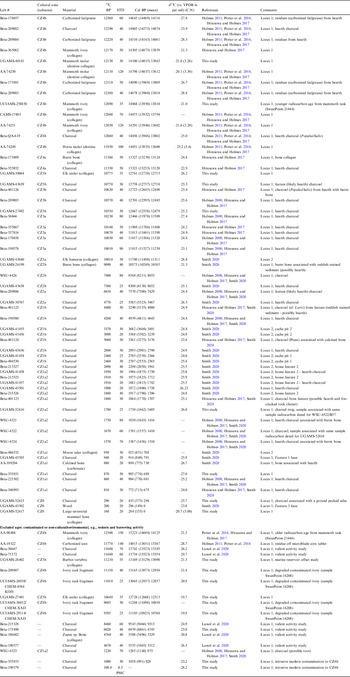
A total of 76 14C dates were run from multiple types of materials from the Swan Point site: bone carbonate from calcined bone (n=1), carbonized residue (carbonized fat or grease) (n=5), collagen (n=21), wood charcoal (n=48), and uncharred wood (n=1) (Table 1). Collagen was extracted from mammoth and horse dentine, wapiti antler, a burbot (Lota lota) vertebra, and jumping mouse (Zapus sp.) bones. Carbonized residues from Swan Point hearths are primarily composed of fatty acids from large ruminants and monogastric herbivores mixed with some plant material (e.g., grasses; Kedrowski et al. Reference Kedrowski, Crass, Behm, Luetke, Nichols, Moreck and Holmes2009). Table 1 summarizes the 14C dates from Swan Point.
14C dates from the Swan Point site.

14C dates were assayed at six different labs: Beta Analytic, Inc. (Beta), the Center for Applied Isotope Studies at the University of Georgia (UGAMS), the Lawrence Livermore National Laboratory Center for Accelerator Mass Spectrometry (CAMS), the University of Arizona Accelerator Mass Spectrometry Laboratory (AA), the Washington State University Radiocarbon Dating Laboratory (WSU), and the W.M. Keck Carbon Cycle Accelerator Mass Spectrometer Facility at the University of California Irvine (UCIAMS). The dates sent to CAMS were prepared at the Laboratory for AMS Radiocarbon Preparation and Research (NSRL). The WSU dates (n=5) were run on a liquid scintillator; all other ages were run on accelerator mass spectrometers.
Fifty-nine dates (78%) were used to construct the chronological models for the site (Table 1). Seventeen dates (22%) were excluded from the cultural zone modeling efforts for several reasons: (1) nine dates were deemed as outliers within the stratigraphy, most of them from charred roots reaching deeper strata and krotovinas related to our studies on periods of extensive small mammal burrowing (Lanoë et al. Reference Lanoë, Reuther, Holmes and Potter2020); (2) a set of dates (n=4) on a single piece of degraded mammoth ivory from two different labs and pretreatment methods spanning over 1500 14C years (∼2100 calibrated years), and are incongruent with the overall suite of CZ4b 14C ages indicating effects from exogenous contamination; (3) collagen from a mammoth tusk was dated twice by two different labs with the older 14C date (AA-98488) being rejected because it is an outlier among the complete set of ages on ivory and the total set of dates from CZ4b, while the younger 14C date (UCIAMS-258850) on the tusk is consistent with all ages from the subzone; (3) a single date (AA-19322) from carbonized residue adhering to a microblade core was rejected due to the age also being incongruent with the overall suite of CZ4b 14C ages and showing effects from exogenous contamination likely due to the very small size of the sample; and (4) a single date (UGAMS-26402) on a burbot vertebra displaying freshwater reservoir effects (e.g., older ages than contemporaneous terrestrial samples) that was used in a larger study on the antiquity of fishing in interior Alaska (Halfmann et al. Reference Halfmann, Potter, McKinney, Tsutaya, Finney, Kemp, Bartelink, Wooller, Buckley, Clark, Johnson, Bingham, Lanoë, Sattler and Reuther2020).
Two 14C dates (UGAMS-26401 and UGAMS-30064) from a single wapiti antler are slightly statistically different (χ2 test: df=1, T=7.44 [5% 3.84], p=.00638, procedures following Ward and Wilson [Reference Ward and Wilson1978]). UGAMS-26401 (10,640 ± 35 BP) was measured from a corner at a break on the antler, while the UGAMS-30064 (10,775 ± 35 BP) sample was drilled from the central core of the antler. The sample used to produce UGAMS-26401 would likely have been more susceptible to contamination from younger soil-derived acids because of cracks and pores at the end of the antler available for absorbing contaminants. The area of the UGAMS-30064 drilled sample had no visible structural failures within the antler. Therefore, we chose to use UGAMS-30064 over UGAMS-26401, or even combing the statistically disparate dates, in our models to reflect the most accurate age of this antler. The number of 14C dates used in the models varies across Cultural Zones and subzones (Table 2).
Cultural zones and subzones by modeled ages.

Statistical Analyses and Model Construction
Calibrations and Bayesian age modeling were conducted using OxCal 4.4 software (Bronk Ramsey Reference Bronk Ramsey2009a) and the IntCal20 terrestrial calibration model (Reimer et al. Reference Reimer, Austin, Bard, Bayliss, Blackwell, Bronk Ramsey, Butzin, Cheng, Edwards, Friedrich, Grootes, Guilderson, Haidas, Heaton, Hogg, Hughen, Kromer, Manning, Muscheler, Palmer, Pearson, van der Plicht, Reimer, Richards, Scott, Southon, Turney, Wacker, Adolphi, Büntgen, Capano, Fahrni, Fogtmann-Schulz, Friedrich, Köhler, Kudsk, Miyake, Olsen, Reinig, Sakamoto, Sookdeo and Talamo2020). As noted above, several dates were manually rejected and removed from the 14C date list used in the models based on prior knowledge of materials relationships to post-depositional disturbances and obvious incongruence within their stratigraphic contexts.
We modeled the beginning and ending boundaries of the Swan Point cultural zones and subzones in OxCal. A sequential model was constructed with the Sequence command to order all of the events, the Phase command to add unordered groups of events for each component within the sequence, and the Boundary command to constrain the start and end points of the phases (i.e., cultural zones and subzones; Bronk Ramsey Reference Bronk Ramsey2009a). An outlier analysis was used within the model to further identify outliers and materials, specifically wood charcoal, that have potential in-built age offsets and down-weight (i.e., lessen the statistical contribution) their contribution to the models (Bronk Ramsey Reference Bronk Ramsey2009b; Hamilton and Krus Reference Hamilton and Krus2018). The Outlier_Model command was first used to establish a “General” outlier analysis (Distribution: T(5); Magnitude: U(0,4); Type: t.; Outlier - Probability: 0.05; Bronk Ramsey Reference Bronk Ramsey2009b) for all of the dates from non-wood charcoal materials, and a second command for charcoal (Distribution: T(5); Magnitude: Exp(1,-10,0); U(0,3); Type: t.; Outlier - Probability: 1) to account for potentially in-built age offsets (i.e., the old wood effect).
The means of boundary starting and ending points within the models were used to demonstrate the timing of the cultural zones and subzones. Although the use of boundary means, rather than the boundary range probabilities, can portray the appearance of more precision in the quoted boundary modeled ages, we continue to follow common practice and for ease of presentation use the mean of boundary starting and ending points. However, we provide both means and probability ranges for boundary starting and ending points in Table 2. Summed probabilities (using the Sum command) are presented to show the overall distribution of unmodeled 14C ages within the cultural zones and their subzones.
RESULTS AND DISCUSSION
The OxCal outlier model for the Cultural Zones shows that the individual agreement indices (A) for each of the dates were over 60% and each set of data is a good match with the model (Bronk Ramsey Reference Bronk Ramsey2009a; see supplement). The OxCal outlier model for the subzones has only one date with an individual agreement index value below 60% (Beta-170457; A = 41.1%) indicating it as a potential outlier within the subzone CZ4b data set. However, we have not removed Beta-170457, not down-weighted it, from either of the sequential models for several reasons: (1) the sample was taken from a hearth and not intrusive, and its stratigraphy and archaeological context is secure; (2) we cannot establish any a priori reason (e.g., reservoir offset and contamination) for the material that was dated to produce older result than other dates from subzone CZ4b; and (3) Beta-170457 only a had low agreement value within the subzone outlier model, not in the Cultural Zone outlier model.
The OxCal model agreement indices (Amodel) of 99.7% and 90.8% indicate that the sequential models for cultural zones and subzones are internally consistent between the 14C data and modeled age outputs (supplement). These values are well above the ≥60% threshold value suggested by Bronk Ramsey (Reference Bronk Ramsey2009a, Reference Bronk Ramsey2009b) for acceptable and consistent agreement within a model. Agreement indices among individual 14C dates within the models (Aoverall) are also above 60%, with values of 100.2% for the model for cultural zones, and 87.4% for the subzone model. Convergence values within both models are over 95% indicating that the model is stable (i.e., truly representative results; Bronk Ramsey Reference Bronk Ramsey1995; Bayliss et al. Reference Bayliss, van der Plicht, Bronk Ramsey, McCormac, Healy, Whittle, Whittle, Healy and Bayliss2011).
Table 2 shows the modeled age ranges for the Cultural Zones and subzones. Figure 3 shows the distributions of the unmodeled 14C ages. Figures 4 and 5 display the distributions of the start and end boundaries of zone and subzone phases.
Distributions of unmodeled ages for calibrated 14C dates used in the OxCal sequential model for Swan Point. Blue = carbonized fat/grease; gray = charcoal and wood; green = ivory, dentine, bone collagen. (Please see online version for color figures.)

Distributions of modeled ages for Cultural Zone and subzone boundaries for Swan Point.

Distributions of modeled ages for subzone boundaries for Swan Point.

Cultural Zone 4 (14,312–13,157 cal BP)
The oldest cultural zone is CZ4 with 15 ages on multiple materials (mammoth ivory and cheektooth dentine, horse tooth dentine, charred bone, carbonized fatty residues, and wood charcoal) used in the age model. This study has compiled and added new ages for each of the CZ4 subzones: CZ4b and CZ4a. The modeled age for CZ4 ranges between 14,312–13,157 cal BP, which encompasses the previously CZ4 age range of 14,211–13,899 cal BP quoted by Potter et al. (Reference Potter, Holmes, Yesner, Goebel and Buvit2014), which was solely based on ages from CZ4b between 14,150 and 13,870 cal BP.
Our modeled age range for CZ4b is 14,177–13,900 cal BP, a more restricted time frame than those quoted in other previous studies. Hirasawa and Holmes (Reference Hirasawa and Holmes2017) quoted two age ranges for CZ4b, a longer range of 15,200–13,300 cal BP, which included the oldest 14C age (AA-98488; 12,500 ± 150 BP) on mammoth ivory from a large tusk at the site with a large standard deviation, and shorter range of 14,450–13,600 cal BP that excluded AA-98488. Our model also excludes AA-98488 given the recent additional dating of the tusk yielded a more precise and, we believe, more accurate AMS date (UCIAMS-258850; 12,090 ± 35 BP); however, a modeled age distribution that includes AA-98488 is 14,211–13,899 cal BP, less than 50 years difference between the older end of the ranges for both CZ4b modeled ages.
CZ4a has a modeled age of 13,387–13,113 cal BP, which is similar to the range of 13,300–13,100 cal BP quoted by Hirasawa and Holmes (Reference Hirasawa and Holmes2017). There is a gap of around 515 years between the CZ4b and CZ4a occupations.
Cultural Zone 3 (12,860–11,327 cal BP)
Cultural Zone 3 has two subzones (CZ3b and CZ3a) that have modeled ages between 12,860–11,327 cal BP, similar to an age range presented by Holmes (Reference Holmes2008). There is around 260 years separating CZ4a and the oldest CZ3 subzone, CZ3b. For this study, we were able to increase the amount of 14C dates for CZ3 presented in earlier studies, spread nearly equally across both subzones. The CZ3b modeled age range is 12,802–12,516 cal BP, while CZ3a is from 11,886–11,428 cal BP. Hirasawa and Holmes (Reference Hirasawa and Holmes2017) provided wider and overlapping age ranges for CZ3b (12,700–11,600 cal BP) and CZ3a (12,100–11,200 cal BP). Our modeled ages for the CZ3 subzones are more constrained and separated by nearly 630 years.
Cultural Zone 2 (10,695–5370 cal BP)
Cultural Zone 2 has been relatively difficult to date due to lower organic preservation and less vertical separation between components relegating previous studies (Holmes Reference Holmes2008; Hirasawa and Holmes Reference Hirasawa and Holmes2017) to only two 14C dates for this zone. Hirasawa and Holmes (Reference Hirasawa and Holmes2017) provided an age range for CZ2 between 8300–7500 cal BP. Our study has doubled the amount of CZ2 dates from 2 to 5 dates, and the age modeling extends the timing of the zone between 10,695–5370 cal BP. CZ2 is now defined into two subzones, CZ2b and CZ2a, that are separated by nearly 240 years. The earliest CZ2 occupation began around 715 years after the CZ3 occupations. CZ2b has a modeled age range of 10,714–7935 cal BP; there is a gap of ∼1800 years between the earliest CZ2b 14C age (UGAMS-26199; 9090 ± 40 BP) and the next oldest CZ2b 14C date (WSU-4426; 7400 ± 80 BP), visually emphasized within the summed probabilities of the subzones in Figure 6. CZ2a’s modeled age range is between 7699–5385 cal BP, and there is also ∼1800 years separating the two CZ2a 14C dates.
Summed probability distributions of Cultural Zone subzones.

Cultural Zone 1 (5,190–604 cal BP)
Cultural Zone 1 began around 160 years after the CZ2 occupation ended, and has a modeled age that spans from 5190–604 cal BP. As noted above, CZ1 is separated here into three subzones, CZ1b, CZ1a2, and CZ1a1 (oldest to youngest); previous studies solely separate CZ1 into two subzones, CZ1b and CZ1a (Holmes Reference Holmes2008; Hirasawa and Holmes Reference Hirasawa and Holmes2017). Hirasawa and Holmes (Reference Hirasawa and Holmes2017) provided ranges of 5300–3200 cal BP for CZ1b and 1870–680 cal BP for CZ1a, a gap between the two subzones of 1300 years. We have expanded the number of dates from the previous studies for CZ1 from 10 to 25 assays.
The CZ1b modeled age range is 5223–2342 cal BP, CZ1a2 between 2045–1463 cal BP, and CZ1a1 between 880–690 cal BP. A gap of 1230 years is present between the early two CZ1b dates (Beta-401125 and Beta-190580) and next oldest CZ1b age (UGAMS-41455); this gap is also evident in the summed probabilities in Figure 6. The separation between CZ1b and CZ1a2 is around 300 years, while CZ1a2 and CZ1a1 are less than 600 years. Our expanded dating program has lessened the original gap between CZ1b and CZ1a reported by Hirasawa and Holmes (Reference Hirasawa and Holmes2017) by 1000 years. Summed probability distributions of unmodeled ages show the separation of most of the subzones. However, the unmodeled age distributions for CZ2a and CZ1b overlap even though the cultural materials for each of these subzones are vertically separated. The Sequential models aide in calculating years of separation (∼160 years) between the two phases.
Cultural Zone 0 (414–94 cal BP)
Cultural Zone 0 is the most recent component with a modeled age range of 414–94 cal BP. CZ0 occurred around 280 years after the end of the CZ1a1 occupation. As noted above, CZ0 contains artifacts (e.g., rifle cartridges) that place some of the materials between AD 1890 and 1910, near the recent end of the modeled age range.
CONCLUSIONS
In this publication, we have presented the complete 14C record for the Swan Point site, along with Bayesian age modeling to compare with and attempt to replicate (Hamilton and Krus Reference Hamilton and Krus2018) calibrated age ranges for each Cultural Zone and their subzones from previous publications. Our age modeling on the Swan Point 14C record reaffirms, but also refines, the age ranges for the Swan Point Cultural Zones and subzones. The sample size of dates for each of the zones used in the model is on the lower end of acceptability for Bayesian modeling (“ten to twenty dates per layer” sensu Discamps et al. Reference Discamps, Gravina and Teyssandier2015), and the subzones are even smaller in number. Nevertheless, this 14C data set is among the largest from a multi-component site in Alaska.
The representation of each occupation within the Cultural Zones and subzones are not all easily distinguishable by vertical separation of sediment and the amount of sampling of 14C dates per CZ and subzones are not equal. Some of the cultural zones and subzones (CZ1 and CZ2) shaped by taphonomic issues, including lesser bone preservation due to acidic soils and more intense burning and processing of bone. The occupations in CZ2 are more compressed than in other zones due to lower sediment accumulation rates that lends to more difficulty in separating its subzones, which occurs during a significant transition in the archaeological record from the Denali Complex to the Northern Archaic tradition (Holmes Reference Holmes2008). The lowest and earliest Cultural Zones (CZ4 and CZ3) and subzones are relatively well discernible through vertical separation by sediment accumulation and have the largest amount and widest variety of materials used for 14C dating because of the excellent preservation of organic materials in more alkaline soils (Dilley Reference Dilley1998). Regardless of the taphonomic issues and differential sampling across CZs, the Swan Point archaeological, stratigraphic and 14C records remain one of the best chronologically controlled precontact sites in central Alaska and will help provide a control point for the refinement of changes within interior Alaskan pre-colonial cultural history.
The 14C record at Swan Point attests to the landform functioning as a central point in an ecologically diverse wetland. The unique landform of Swan Point is located on, a relatively large, isolated hill surrounded by the wide flat basin of Shaw Creek at the interface of uplands and lowland ecotones that likely played a determining role in focusing a specific suite of human behaviors that remained broadly similar across all cultural zones. All of the CZs indicate that Swan Point functioned as a site for secondary lithic reduction with tool crafting and refurbishment prominent activities throughout each period, as well as exhibiting butchery/consumption patterns consistent with a stable long-term logistic mobility system. The quality of lithic tool discards differs between components, suggestive of the presence of unique age-graded learning behaviors specific to each CZ (Gómez Coutouly et al. Reference Gómez Coutouly, Gore, Holmes, Graf and Goebel2020; Smith Reference Smith2020). Toward the later Holocene, the landform exhibited features consistent with seasonal residences and food storage, indicating decreased seasonal mobility with an emphasis on utilizing the centralizing qualities of the landform.
The archaeological records at other multicomponent sites, such as Broken Mammoth, Holzman, and Mead, surrounding the SCF, have been reported in a more limited fashion. The earliest CZs dating to the terminal Pleistocene and early Holocene at each of these sites are the most discussed (Yesner Reference Yesner2001, Reference Yesner, Walker and Driskell2007; Potter et al. Reference Potter, Gilbert, Holmes and Crass2011, Reference Potter, Holmes, Yesner, Goebel and Buvit2014; Wygal et al. Reference Wygal, Krasinski, Holmes and Crass2018, Reference Wygal, Krasinski, Holmes, Crass and Smith2021). While each of these sites also have later Holocene components, there has been little published yet on these periods, because they have relatively limited archaeological content (Holmes Reference Holmes and West1996; Gilbert Reference Gilbert2011; Potter et al. Reference Potter, Gilbert, Holmes and Crass2011; Wygal et al. Reference Wygal, Krasinski, Holmes and Crass2018). The archaeological and 14C dating records at Swan Point attest to it as being a major location that illuminates the antiquity and rich cultural heritage of interior Alaskan Dene-Athabascan peoples and of their lifeways.
ACKNOWLEDGMENTS
Funding was provided by a National Science Foundation grant to Crass and Holmes (ARC- 0540235) and the University of Wisconsin-Oshkosh. Additional funding was provided to Reuther and Smith through the Otto William Geist Fund at the University of Alaska Museum of the North, to Smith through the David and Rachel Hopkins Fellowship at the Alaska Quaternary Center at the University of Alaska Fairbanks, and Holmes through the Alaska Office of History and Archaeology. Field programs for excavations were through the Alaska Office of History and Archaeology, University of Alaska Fairbanks, University of Alaska Museum of the North, and the University of Wisconsin. We thank two anonymous reviewers and Derek Hamilton for their editorial comments that strengthened this article.
SUPPLEMENTARY MATERIAL
To view supplementary material for this article, please visit https://doi.org/10.1017/RDC.2023.30