Introduction
Sequential feeding (SF) is a feeding schedule that consists of placing animals in a contrasting situation, giving them diets of different nutritional values for one- to several-day cycles (Gous and Du Preez, Reference Gous and Du Preez1975). SF is used with several aims, which include the reduction of feed cost and the improvement of animal welfare by reducing the occurrence of leg abnormalities (Bizeray et al., Reference Bizeray, Leterrier, Constantin, Picard and Faure2002; Leterrier et al., 2005 and Reference Leterrier, Perrot, Favreau, Constantin, Bouvarel, Lessire and Picard2006). When this feeding programme was carried out on broiler chickens with diets varying in energy and/or protein concentrations given on alternate days, it resulted in the same efficiency as a complete feed (Bouvarel et al., Reference Bouvarel, Barrier-Guillot, Larroude, Boutten, Leterrier, Merlet, Vilarino, Roffidal, Tesseraud, Castaing and Picard2004). In this situation, even if total feed intake was similar to the intake of chickens fed continuously with a standard diet, chickens over-consumed high-energy and low-protein feed and under-consumed low-energy and high-protein feed (Bouvarel et al., Reference Bouvarel, Barrier-Guillot, Larroude, Boutten, Leterrier, Merlet, Vilarino, Roffidal, Tesseraud, Castaing and Picard2004). Feed intake was especially influenced by the energy concentration irrespective of the energy-to-protein ratio: chickens over-consumed high-energy feeds (isoproteic or not), and conversely under-consumed low-energy feeds (Bouvarel et al., Reference Bouvarel, Chagneau, Lescoat, Tesseraud and Leterrier2008). Because all these experiments used feeds given on alternate days, energy intake did not appear to be regulated over the medium term (day) but over a long-term interval with a day-to-day balance. It thus appears that during SF, experienced broilers expressed feed preference for high-energy diet, which influenced the daily intake. At 9 days of age and thereafter, chickens having a choice of two diets have a clear preference for the diet higher in energy and lower in protein than the diet lower in energy and higher in protein (Siegel et al., Reference Siegel, Picard, Nir, Dunnington, Willemsen and Williams1997). There are numerous examples of animals that appear not to make appropriate choices (from the standpoint of the human observer), implying that their food preferences are governed by factors other than, or additional to, nutritional wisdom (Forbes and Kyriazakis, Reference Forbes and Kyriazakis1995).
Indeed, the mechanisms underlying the control of eating behaviour are complex (Furuse, Reference Furuse2002). The wild ancestors of the domestic fowl possessed an ability to select nutrients meeting almost all their requirements. They thrived under conditions in which a variety of foodstuffs with different compositions were available. Domestication and intense selection based on maximising growth and gross feed efficiency have not precluded the ability of chickens to discriminate between diets differing in protein and energy (Siegel et al., Reference Siegel, Picard, Nir, Dunnington, Willemsen and Williams1997). Regulation of feed intake has two key components: one that involves the short-term control of feeding and one that involves the long-term regulation of energy balance by the central nervous system (Richards, Reference Richards2003). The long-term control of feed intake is of metabolic origin with a coordinated regulation of feed intake and energy expenditure to achieve energy balance according to the genetic basis (McMinn et al., Reference McMinn, Baskin and Schwartz2000; Furuse, Reference Furuse2002; Richards, Reference Richards2003; Richards and Proszkowiec-Weglarz, Reference Richards and Proszkowiec-Weglarz2007). The short-term control occurs from meal to meal. It is primarily governed by sensorial cues (visual, tactile and olfactory) (Kuenzel, Reference Kuenzel1989; Picard et al., Reference Picard, Melcion, Bertrand and Faure2002) and then by satiety signals generated in response to nutrient content and the physical presence of feed or of specific components in the gut (Denbow, Reference Denbow1994).
Because several diets are offered to the birds during SF, metabolic state is modified according to the diet fed previously, and the cyclic contacts with both different feeds may allow a learning process. Using an SF paradigm, the first aim of our study was to confirm that chickens do not regulate feed intake according to the energy-to-protein ratio over the medium term (day) using feeds given on alternate days. The second aim was to study the preferences between feeds using two-choice tests in order to understand whether energy and protein contents affect these feeding preferences in naïve animals, and whether experience (through SF) modifies them.
In a first experiment, two diets varying in energy content were used. The birds were fed both diets during an SF schedule that lasted for four 48 h cycles. They then underwent a feed choice to test their preferences. The same choice was offered to birds without any experience of both diets to compare experienced and naïve birds. In a second experiment, preferences were studied with diets varying in energy, and also in protein and in both energy and protein. In both experiments, feed intake was measured during SF and linked to with feed preferences expressed in the choice test. In contrast to our previous experiments carried out on chickens in groups (Bouvarel et al., Reference Bouvarel, Barrier-Guillot, Larroude, Boutten, Leterrier, Merlet, Vilarino, Roffidal, Tesseraud, Castaing and Picard2004 and Reference Bouvarel, Chagneau, Lescoat, Tesseraud and Leterrier2008), chickens were individually caged in this study to measure precisely the kinetics of individual feed intake.
Material and methods
Animals and housing
A three-floor battery of 96 individual cages (36 × 22 × 23 cm) in an environmentally controlled room was specially equipped with plastic feeders (18 × 5 × 7 cm). Lighting was reduced from 24L to 20L/4D on Day 3, and then decreased to 16L/8D on Day 7.
Experiment 1. In all, 192 male broiler chickens (Ross PM3) reared in two batteries received the same starter diet (2900 kcal/kg metabolisable energy (ME), 21% CP) ad libitum until Day 7. From Day 8 to Day 15, chickens were given either a control diet (96 animals) or a sequential treatment (2 × 48 animals) for each of two treatments. After SF, each chicken was fed the starter diet until the choice test (Day 17).
Experiment 2. In all, 108 male broiler chickens (Ross PM3) reared in two batteries received the same starter diet (2900 kcal/kg ME, 21% CP) ad libitum until Day 9. From Day 10 to Day 17, chickens were given either control (36 animals) or SF (3 × 24 animals) for each of three treatments. After SF, each chicken was fed the starter diet until the choice test (Day 20).
Feeding schedules
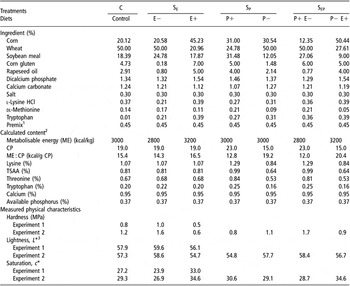
The first experiment focused only on the effect of energy content, while the second investigated the effect of both energy and protein content. Seven diets were used during the SF period (Table 1). The control treatment was a complete feed C (3000 kcal/kg ME, 19% CP). Two diets were isoproteic with differences in ME content: the low-energy feed (E− = 2800 kcal/kg ME) and the high-energy feed (E+ = 3200 kcal/kg ME). Two diets were isoenergetic with differences in protein and essential amino acid content: the high-protein feed (P+ = 23% CP) and the low-protein feed (P− = 15% CP). Two diets had differences in both protein and energy contents: the high-protein and low-energy feed (P+E−) and the low-protein and high-energy feed (P−E+). Diets, P+ and P−, E− and E+, P+E− and P−E+ were formulated to provide, on average (50/50), the same nutrient intake as the control feed.
Composition and characteristics of experimental feeds

1Supplied per kg of diet: vitamin A (retinol), 13 500 IU; vitamin D3, 3870 IU; vitamin E (tocopherol), 90 mg; vitamin K3, 4.5 mg; thiamin, 4.5 mg; riboflavin, 7.2 mg; vitamin B5, 2.25 mg, pyridoxine, 6.3 mg; vitamin B12, 0.018 mg; niacin, 90 mg; folic acid, 2.7 mg; biotin, 0.27 mg; cholin 495 mg; manganese, 73 mg; zinc 81 mg; iron, 52 mg; copper, 18 mg; iodine, 1.8 mg; selenium, 0.18 mg; cobalt, 0.54 mg, sulphur, 0.005 mg, magnesium, 0.001 mg; antioxidant, 4.5 mg.
2Calculated using the table published by Sauvant et al. (2002).
3Colour was measured using a Commission International d’Eclairage L*a*b*c* Hunterlab spectocolorimeter.
SF was carried out during four 48 h cycles tested in previous investigations (Bouvarel et al., Reference Bouvarel, Barrier-Guillot, Larroude, Boutten, Leterrier, Merlet, Vilarino, Roffidal, Tesseraud, Castaing and Picard2004). In experiment 1, three treatments were compared: (1) complete diet (C) and two treatments with an alternation of diets varying in energy content; (2) (SE: E− followed by E+); and (3) (SE′: E+ followed by E−). Both orders of alternating have already been tested with Bouvarel et al. (2007), observing a lower feed intake according to when the cycle started with an energy-rich or a protein-poor diet. In experiment 2, energy-poor, protein-rich, and protein-rich energy-poor diets were always given the first day of the cycle to avoid a reduction in the feed intake. Four treatments were compared in experiment 2: (1) complete diet (C); (2) alternation of diets varying in CP (SP: P+ followed by P−); (3) in energy (SE: E− followed by E+); and (4) in protein and energy contents (SEP: P+E− followed by P−E+). The treatments were arranged in a complete randomised block design.
Physical characteristics of feeds
The diets were manufactured on a semi-industrial scale by the experimental feed mill at the Poultry Research Centre in Nouzilly. They were pelleted using a steam pelleter (Ø = 2.5 mm, L = 47 mm).
Hardness was measured in 100 pellets of each diet using an INSTRON 5543 machine (INSTRON, Guyancourt Cedex, France). Hardness (H) was expressed as the maximum load necessary to break the outer upper surface of the pellet:

where H is the hardness (MPa), ML is the maximum load (N), L is the length of the pellet (mm) and R is the radius of the pellet (mm).
It ranged in experiment 1 from 0.4 to 1.0 MPa, and in experiment 2 from 0.6 to 1.7 MPa (Table 1). The control diets always had an intermediate hardness. The values were smaller and less contrasted for E+/E− in experiment 1 than in experiment 2.
Pellet length was measured individually using a calliper (200 repetitions/feed) and was very similar between diets within each experiment. It was 3.5 mm in experiment 1, and varied from 4.2 to 5.0 mm according to diets in experiment 2, with a difference equal to or less than 0.5 mm within a treatment. This difference was considered not to be detected by the birds.
Colour was measured using a Commission International d’Eclairage L*a*b*c* Hunterlab spectrocolorimeter (SOCEMI, Metz, France). L* represents the lightness, a*, red-green, b*, blue-yellow and c*(=√a*2 + b*2), the chroma (saturation). Mean L* and c* parameters varied from 54.7 to 58.4 and from 26.9 to 34.6, respectively, in experiment 2 and the same values were obtained in experiment 1.
The physical characteristics measured were dependent on the composition of the feed. High contrasts of physical characteristics of the experimental feeds were obtained when feeds varied in energy content only: a high level of energy (E+) obtained by adding oil decreased the hardness and lightness (L*) and increased chroma (saturation, c*) (Table 1).
Consumption and growth data during sequential feeding
During the SF period, the daily consumption of feed was measured after 15 min (cycles 1 and 4) and 24 h of distribution for every cycle. The 15 min period was chosen after preliminary measurements. Chickens were weighed individually before and after the SF period.
Feed choice test
The aim was to evaluate short-term preferences related to feed composition for chickens previously given the same feeds during the SF period (‘experienced’) or the control diet (‘naïve birds’).
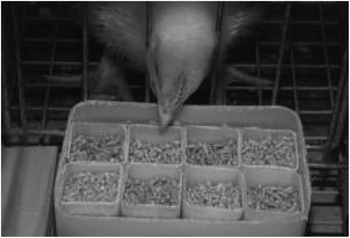
After SF, the chickens were exposed to the SRABox device (Chagneau et al., Reference Chagneau, Bessonneau, Bouchot, Lescoat, Picard and Lessire2006; Figure 1) containing the control diet in all eight microfeeders in order to habituate the birds on Day 16 (experiment 1) and Day 20 (experiment 2). The choice test was performed on Day 17 (experiment 1) and Day 21 (experiment 2)
SRABox device

Eight microfeeders with four microfeeders per feed in alternate positions were used (SRABox). In experiment 1 one feed combination (E−/E+) was tested and in experiment 2 three feed combinations were tested: P+/P−, E−/E+ and P+E−/P−E+ on naïve and experienced chickens. In experiment 1, 48 animals per feed combination were used (48 × 2 C, 48 SE, 48 SE′), and in experiment 2, there were 12 animals per feed combination (12 × 3 C, 12 SE, 12 SP, 12 SEP).
The test lasted 1 h after the 8-h dark period. Food intake during the choice test was recorded by weighing the microfeeders (±0.01 g) prior to and after 15 min and 1 h for experiment 1, and after 5 min (enabling short-term preference to be assessed better than after15 min) and 1 h for the second experiment.
Statistical analysis
All data were analysed using the STATVIEW program version 5. Tested factors were considered as significantly different if P < 0.05. The experimental unit was the bird reared individually in a cage.
The effect of SF on food intake and BW was tested with a one-way analysis of variance. When significant, the treatment means were tested using the Newmann and Keul test.
Preferences were tested (1) within a choice situation using the Wilcoxon paired test and (2) between choice situations using the Kruskall Wallis and Mann–Whitney tests.
Results
Feed intake and growth performance during the sequential feeding period
Experiment 1. There was no difference between treatments in total feed intake for 8 days (547 g per animal) and in final BW (568 g per animal) with the sequential treatments for the four cycles studied. Results were similar in SE and SE′ birds, indicating there was no effect of the order in which diets were alternated.
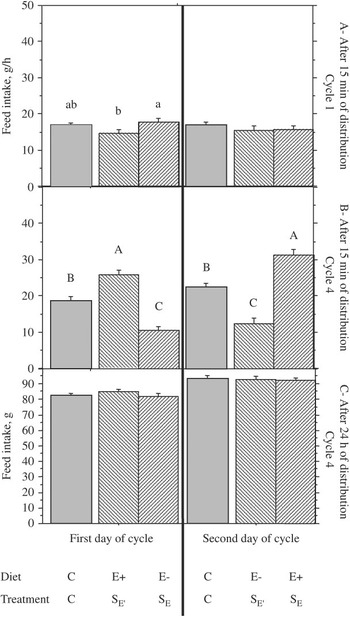
During the first 15 min of the first cycle, feed intake of the C group did not differ from the experimental groups. It was between that of E− and E+; E− was consumed more than diet E+ (Figure 2a). During the first 15 min of distribution of the fourth cycle, chickens under-consumed diet E−, while E+ was over-consumed (Figure 2b). Nevertheless, during the 24 h distribution, the total consumption of each diet was similar for each cycle (Figure 2c for the fourth cycle).
Experiment 1. Feed intake after first 15 min of distribution (g/h/chicken, cycles 1 and 4) and after 24 h of distribution (g/chicken, cycle 4). Cycle 1 (Day 8 to Day 9); cycle 4 (Day 14 to Day 15). Chickens were in a sequential feeding situation. They received one diet on Day 1 (first day of cycle), and another the following day (second day of cycle). Bars with different superscript letters are significantly different (Newmann and Keul’s test, P < 0.05).

Experiment 2. As in experiment 1, there was no difference between treatments in total feed intake for 8 days (634 g) and in final BW (683 g) with SF for the four cycles studied.
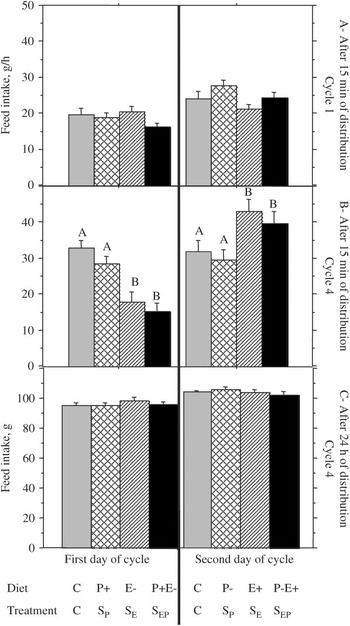
During the first 15 min of the first 2 days (cycle 1), feed intake was similar between groups (Figure 3a). During the first 15 min of the fourth cycle, E− and P+E− intake was almost half of the C intake (P < 0.01). In contrast, the next day chickens over-consumed E+ and P−E+ during the first 15 min of distribution (Figure 3b). With diets varying in protein content, no effect was noticed on feed intake during the first 15 min of distribution. Over the 24 h of distribution, the total consumption of each diet was similar for each cycle (Figure 3c for the fourth cycle).
Experiment 2. Feed intake after first 15 min of distribution (g/h/chicken, cycles 1 and 4) and after 24 h of distribution (g/chicken, cycle 4). Cycle 1 (day 10 to day 11); cycle 4 (Day 16 to Day 17). Chickens were in a sequential feeding situation. They received one diet on Day 1 (first day of cycle), and another the following day (second day of cycle). Bars with different superscript letters are significantly different (Newmann and Keul’s test, P < 0.05).

Feed choice test
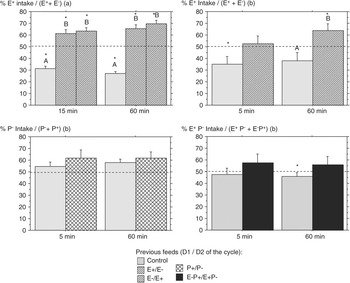
Experiment 1. All groups preferred one diet to the other: naïve chickens preferred E− to E+ after 15 min of the choice test, while experienced chickens preferred E+ to E− (Figure 4a). Similar results were obtained at the end of the 1-h test. The preference was significantly different between the controls and experimental groups (SE’ and SE) after 15 min and 1 h of the test. Experimental groups did not differ, indicating that the order of alternating the E+ and E− diets during SF did not influence the E+ preference.
Feed intake preference expressed by percentage of E+ and/or P− feed intake on the total feed intake: (a) in experiment 1: after the first 15 and 60 min of distribution, (b) in experiment 2: after the first 5 and 60 min of distribution. Chickens were in a choice-test situation to evaluate short-term preferences for chickens previously given the same feeds during the sequential feeding period (‘experienced’) or the control diet (‘naïve birds’). Naïve birds in grey. Experienced birds in hatched and dark. Means with * are significantly different from 50% (Wilcoxon paired test, P < 0.05). Bars with different superscript letters are significantly different (Mann–Whitney test, P < 0.05).

Experiment 2. As in experiment 1, naïve chickens preferred the E− diet (after 5 min), whereas experienced chickens preferred the E+ diet (after 1 h; Figure 4b). The preference between groups was significantly different after 1 h of testing.
For feeds varying in protein contents (P+/P− and E−P+/E+P−), there was no significant difference between naïve and experienced chickens (Figure 4c and d). Experienced birds did not significantly prefer one diet to the other, whereas naïve birds preferred P− (Figure 4c) and E−P+ (Figure 4d) after an hour.
Discussion
In this work, chickens fed alternately with diets varying in energy and/or protein consumed the same quantities of feed as birds fed with a complete diet. Surprisingly, they did not compensate for energy from one day to another, contrary to expected nutritional requirements.
Regulation of feed intake has two key components: one that involves the short-term control of feeding and one that involves the long-term regulation of energy balance (Richards, Reference Richards2003). The net result is a system that cumulatively regulates meal-to-meal feed intake along with the long-term maintenance of energy (fat) storage to achieve energy homeostasis (McMinn et al., Reference McMinn, Baskin and Schwartz2000). With SF, the metabolic state of chickens is modified from one day to another. Nevertheless, chickens did not express particular regulation of feed intake on the scale of the day. As observed previously by Bouvarel et al. (Reference Bouvarel, Chagneau, Lescoat, Tesseraud and Leterrier2008), but less marked here, feed intake was not influenced by the energy-to-protein ratio from one day to another. If that had been the case, chickens should have over-consumed low-energy feed according to the protein content. In both experiments at medium term (24 h), chickens consumed both diets in the same proportions, and at short term they over-consumed high-energy feeds (isoproteic or not) during the first minutes of distribution, whereas they under-consumed low-energy feeds after several cycles of distribution. Our findings corroborate previous results that have shown that chickens appear not to make appropriate choices in line with what would usually be considered as nutritional requirements (Forbes and Kyriazakis, Reference Forbes and Kyriazakis1995). This implies that their food preferences in the short term are different from those observed over periods of several days.
In both experiments, the choice test demonstrated that naïve chickens preferred the low-energy diet, while experienced birds preferred the high-energy diet. The fact that feed preferences were orientated immediately to the low-energy diet when the feeds were unknown (naïve chickens) suggests that this feed presented spontaneously very attractive cues, in particular visual and tactile cues. Indeed, the low-energy diet was the palest-coloured feed and Rogers (Reference Rogers1995) showed that immediately after hatching, chicks are attracted by particles exhibiting pale and bright colours. Chagneau et al. (Reference Chagneau, Bessonneau, Bouchot, Lescoat, Picard and Lessire2006) confirmed these results with 38-day-old broiler chickens. The low-energy diet was also the hardest feed and hard pellets are consumed more quickly than soft pellets of the same size (Picard et al., Reference Picard, Melcion, Bouchot and Faure1997). It has been suggested that hardness of particles is related to the ease of digestion in the upper part of the digestive tract (Picard et al., Reference Picard, Melcion, Bertrand and Faure2002). Moreover, other characteristics such as roughness or elasticity were possibly involved in the choice of naïve animals. Olfactory cues that are also involved in feed intake in chicken (Picard et al., Reference Picard, Melcion, Bertrand and Faure2002) would probably be confounded by the close proximity of both feeds during the choice test.
Another very interesting point of the choice tests between high- and low-energy diets concerns the opposite short-term choices of experienced chickens compared to naïve birds, experienced chickens preferring high-energy feed. This indicates that they learned to associate the sensorial characteristics of feed with energy content. Indeed, day-old chicks are able to associate nutritional effects with the sensorial characteristics of feed particles (Hogan, Reference Hogan1984). Post-ingestive nutritional effects of the feeds are progressively memorised and are coupled with sensory cues to let the chicken identify the feed. Ability to select diets is improved according to the bird’s experience. In rats, similar associative learning between sensory characteristics of feed and post-ingestive effects of nutrients influenced food preferences and acceptance (Sclafani, Reference Sclafani2001). These findings also demonstrate differential effects of isocaloric fat and carbohydrate on feed preferences. In our case, an increase in energy content was obtained by adding oil up to a limited inclusion level. The high-energy level certainly allowed a positive nutritional after-effect of feed ingestion as has been shown in rats (Lucas et al., Reference Lucas, Ackroff and Sclafani1998). However, some experiments in chickens have shown that birds prefer a high-energy diet despite a fat content similar to the low-energy diet (Siegel et al., Reference Siegel, Picard, Nir, Dunnington, Willemsen and Williams1997). In future work, it would be interesting to dissociate the effects of carbohydrate and oil on the positive nutritional after-effect.
No clear preferences were seen in tests with variations in protein content in naïve or experienced chickens. Only a slight preference for the low-protein diet was seen in naïve chickens. This diet represents the palest and hardest feed, which is the diet the most similar to the complete feed given the previous days to naïve chickens. During SF, feed intake of low- and high-protein diets was in fact similar to the complete diet during the first 15 min of distribution and over whole days. Bouvarel et al. (Reference Bouvarel, Chagneau, Lescoat, Tesseraud and Leterrier2008) obtained similar results with birds reared in groups. Nevertheless, the low protein content was perceived by chickens, which increased the time spent pecking and scratching, as if they were searching for additional nutriments. After 1 week of SF, chickens regulated their protein intake daily, as if they progressively distinguished high-protein from low-protein feeds (Bouvarel et al., Reference Bouvarel, Chagneau, Lescoat, Tesseraud and Leterrier2008). It thus appears that chickens needed a longer learning period than in the present work, probably because the physical characteristics of both feeds varying in protein contents were relatively similar (hardness and colour). As long as chickens are able to gauge the sensory properties of the feeds, they can compensate well for periods of access to only a low-protein feed, by subsequent higher intake of a high-protein feed and vice versa (Forbes and Shariatmadari, Reference Forbes and Shariatmadari1996).
Detection of differences between diets varying in protein content is certainly more difficult than detection of a single amino acid deficiency. Indeed, chickens fed alternately on a daily basis diets that were either amino acid deficient or not, initially took more than 4 h to reduce their intake of the amino acid-deficient diet, but after 1 week of adaptation their intake was reduced within the first hour of the deficient diet being provided (Picard et al., Reference Picard, Plouzeau and Faure1999). With naïve rats pre-fed a low-nitrogen diet, rapid detection of amino acid depletion was demonstrated behaviourally within 20 min of their first meal (Gietzen and Rogers, Reference Gietzen and Rogers2006).
For the treatment with variations in both protein and energy contents, no preferences were seen in naïve and experienced chickens. In naïve birds, this represents an intermediate result compared to those observed when dissociating the effects of energy and protein. This suggests that the preference for the low-energy diet was cancelled out by the preference for the low-protein diet seen previously. In experienced chickens, the clear preference previously demonstrated for the high-energy diet was greatly reduced by the low protein content of the diet. This suggests that the positive information due to the energy level may have been masked by signals originating from the protein content. As a result, signals coming from both protein and energy contents had no cumulative effects on feed preferences. The high variability of choice observed for experienced birds possibly indicates difficulty in identifying diets, maybe due to the greater similarity between the physical characteristics of pellets.
The preference for E+ in experienced birds was coherent with the fact that chickens consumed the E+ diet more quickly during the first 15 min of distribution over the fourth cycle of SF. However, preference for the high-energy diet did not lead to its higher daily intake. Our results with chickens caged individually indicate that the proportion of both feeds were similar to a complete feed. Broilers reared in a group increased their intake of E+ diet (Bouvarel et al., Reference Bouvarel, Chagneau, Lescoat, Tesseraud and Leterrier2008). This difference could be the consequence of a lower activity in chickens reared alone and thus the lower energy expenditure. Because social factors are major modulators of food intake in chickens (Picard et al., 1992; Forbes and Kyriazakis, Reference Forbes and Kyriazakis1995; Nielsen, Reference Nielsen1999), it is also possible that keeping animals in groups accelerated the learning period. Indeed, the fast learners may influence the others, especially by attracting them to the feeder according to the feed. Thus, this could increase the difference in feed intake between high- and low-energy diets in chickens reared in groups compared to isolated birds.
These results therefore suggest that with an SF schedule, chickens did not regulate feed intake over the medium term (day) on energy related to protein content. They learned to discern energy content in feed, and preferred high-energy feed, which was not the case for naïve chickens. However, effects of preference and experience were not observed with modifications of protein content. It would be interesting to identify sensorial cues involved in the process of learning about energy content, and to take into account the social facilitation associated with this process, since responses to choice tests can explain feed intake in chickens reared in groups but not that of those reared alone in cages.
Acknowledgements
This study was supported INRA and ACTA/MAP/MESR. The authors thank Kléber Gérard, François Breton and Bernard Guillerm for their technical assistance and are grateful to Sue Edrich for her revision of the English of the manuscript.