Introduction
Trapelia and Trapeliopsis were among the first genera to be separated from, or resurrected to accommodate, species of Lecidea, which until the 1970s encompassed species that are now classified in over 30 different genera in about 20 families in three different orders. In a classic paper, Coppins & James (Reference Coppins and James1984) transferred some further species, notably crustose taxa, to Trapeliopsis that until that time contained only squamulose forms, and described some species that were widely known under informal names such as “Trapelia spec.” or “Lecidea granulosa with orange pigment”, and presented a key to the British species of the two genera. They also clarified the distinction between Trapelia coarctata (Turner ex Sm.) M. Choisy and T. glebulosa (Sm.) J. R. Laundon, a matter that has been much debated before and since as the species seems to exhibit discrete variations, but their classification still stands firm. The separation of Trapeliopsis from Trapelia was repeatedly questioned, and nearly all Trapeliopsis species have been combined in Trapelia at one time (Wirth Reference Wirth1987). However, recent DNA investigations (Lumbsch et al. Reference Lumbsch, Schmitt, Mangold and Wedin2007) have supported the view that both are distinct genera (Lumbsch et al. Reference Lumbsch, Schmitt, Mangold and Wedin2007).
The taxonomy of these species complexes remains essentially unchanged in Europe since 1984, as can be seen from the key in Smith /et al. (Reference Smith, Aptroot, Coppins, Fletcher, Gilbert, James and Wolseley2009) which is virtually identical, and is still complete for most of Europe. However, while preparing a second volume of Schumm (Reference Schumm2008), it became apparent that two different, probably not even closely related, species are currently called Trapeliopsis wallrothii (Flörke in Spreng.) Hertel & Gotth. Schneid. in Macaronesia. They differ, for example, in the type of isidia. Trapeliopsis wallrothii s. str. has firm, often solitary, corticate isidia, as illustrated, for example, by Coppins & James (Reference Coppins and James1984) and Wirth (Reference Wirth1995). These isidia can be hand-sectioned with a razor blade and after falling off leave a conspicuous scar. The other species has softer, more clustered, partly decorticated isidia, which are often called gymnidia and are rather common in the Peltigerales and Physciaceae; these cannot be hand-sectioned without crumbling. Both occur in Macaronesia, while one of them is more widely distributed occurring also in Europe. Trapeliopsis wallrothii has previously erroneously been reported from America, where currently three similar, but different species are thought to occur (McCune et al. Reference McCune, Camacho and Ponzetti2002). No species of Trapelia or Trapeliopsis have previously been described from Macaronesia, but the occurrence of several widespread species has been noted. There are three Lecidea species described from Macaronesia that are not accounted for in recent publications (Tavares Reference Tavares1952), viz. Lecidea azorica Nyl. from the Azores, which is according to the description possibly a Porpidia, Lecidea homosemoides Harm. from the Canary Isles which is a maritime saxicolous species, and Lecidea conglobata (Hepp) Zahlbr. which is an illegitimate homonym. None of these are identical with the species treated here. The additional species of Trapeliopsis from Macaronesia is therefore described below as new, as well as an undescribed Trapelia species with red medulla that occurs in the same region.
Material and Methods
Identification and descriptive work was carried out in Soest using an Olympus SZX7 stereomicroscope and an Olympus BX50 compound microscope with interference contrast, connected to a Nikon Coolpix digital camera, and in Wangen using a Wild M3 stereomicroskope, an Olympus BX51 compound microscope with interference contrast, a Canon EOS 40D camera with MP-E 65 mm and a Mic HM 560 cryotome. Sections were mounted in tap water or iodine (I or IKI), or enhanced with lactophenol Cotton Blue (LCB). When nothing is indicated, tap water was used. All measurements were made on material mounted in water. The specimens are deposited in ABL, B, BR, L, and hb. Schumm. TLC was carried out following the protocol of Orange et al. (Reference Orange, James and White2001), with all three standard solvents and observation in UV before and after charring with sulphuric acid.
The Species
Trapelia rubra Aptroot & Schumm sp. nov.
MycoBank No: MB 564322
A crustose, nearly squamulose, terricolous Trapelia with crenate and seemingly sorediate apothecia and skyrin.
Typus: Portugal, Madeira, Camacha, Valle Paraiso, 36°17′N, 3°25′E, on soil between basalt of footpath, 750 m alt., 3 June 2011, A. Aptroot 69725 (BR—holotypus; ABL—isotypus).
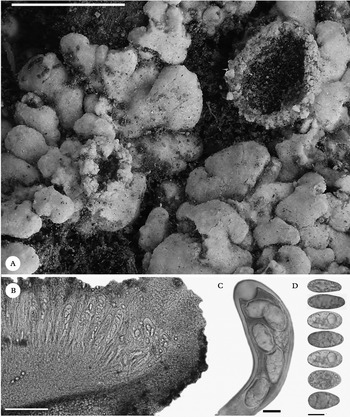
(Fig. 1)
Trapelia rubra (holotype). A, habitus; B, section through apothecium with margin; C, ascus (dark areas I+ reddish); D, ascospores. Scales: A=1 mm; B=100 μm; C & D=10 μm.

Thallus consisting of tightly appressed nodulose areoles, whitish, corticate, slightly glossy, mostly heavily pruinose, grey where not pruinose. Areoles roundish to incised, convex, c. 1 mm diam., but partly incised and mostly aggregated to form thallus patches of 0·5–2·0 cm diam. Medulla partly bright red. Algae green, c. 10 μm diam.
Apothecia usually present, sessile, cupular, up to 1 mm diam., circular, thalline margin white, crenulate with irregular rough surface; disc concave, pink, often white pruinose. Apothecium initials show as roughened whitish areas on the thallus, somewhat resembling soredia or the scars left by fallen-off isidia in Trapeliopsis wallrothii. Hymenium pink; hypothecium brown, partly bright red. Asci Trapelia-type. Ascospores 8 per ascus, hyaline, ellipsoid, 18–23×9–12 μm.
Pycnidia not observed.
Secondary chemistry. Thallus C−, K−, KC−, P−. Anthraquinone (skyrin, TLC) in red parts of the medulla and hypothecium, which react K+ purple.
Ecology and distribution. On compacted soil, for example between rocks on footpath, at lowland to mid elevations. Known from Madeira and the Canary Islands.
Discussion. This species resembles some morphs of Trapelia coarctata, but differs by the nearly squamulose areoles, the crenulate, seemingly sorediate, apothecium margin that does not become excluded, and especially by the patchy red colour (skyrin) in the medulla. Moreover, it occurs only on compacted soil, while Trapelia coarctata also, and even mainly, occurs on other substrata such as rock and timber.
Additional specimens examined. Spain: Canary Islands: Gran Canaria, 8 km W. of Teror, near Pinos de Galdar, 28°03′N, 15°37′W, 1295 m alt., 1999, F. Schumm 5314 (hb. Schumm), 5304 (ABL).
Trapeliopsis gymnidiata Aptroot & Schumm sp. nov.
MycoBank No: MB 564323
A crustose terricolous Trapeliopsis with mostly non-corticate isidia, large apothecia and gyrophoric acid.
Typus: Spain, Canary Islands, Gran Canaria, Embalse del Mulato, 27°54·9′N 15°41·6′W, 760 m alt., 31 December 1998, F. Schumm 5390 (B—holotypus), 5401 (ABL—isotypus), 5369, 5398, 5370 (hb. F. Schumm—isotypi).
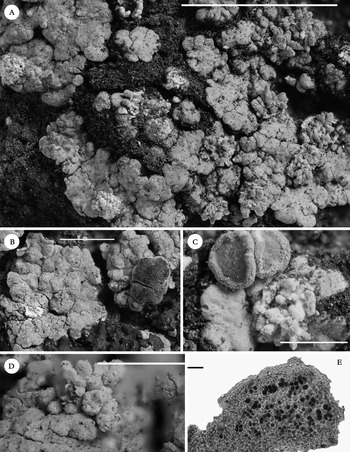
Trapeliopsis gymnidiata. A, habitus with gymnidia; B & C, habitus also with apothecia; D, gymnidia; E, section through gymnidium (dark areas LCB+ blue). (B, D & E, holotype; A & C, Schumm 10430). Scales: A=5 mm; B=2 mm; C & D=1 mm; E=20 μm.

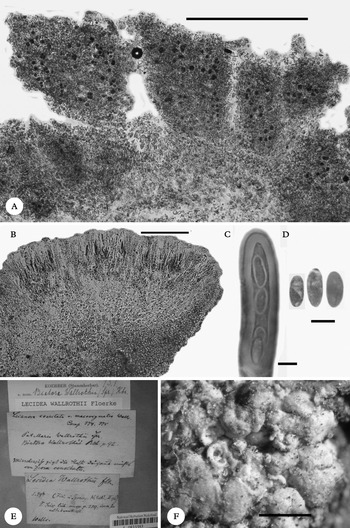
A–D, Trapeliopsis gymnidiata (holotype). A, section through gymnidium (dark areas LCB+ blue); B, section through apothecium with margin (dark areas LCB+ blue); C, ascus (dark areas IKI+ bluish); D, ascospores. E & F, Trapeliopsis wallrothii (isotype in L). E, label of the packet; F, habitus with scars where isidia have fallen off. Scales: A=200 μm; B=100 μm; C & D=5 μm; F=1 mm.

Thallus consisting of tightly appressed areoles that form a thick crust and can be slightly radially arranged along the margins, pinkish to lead grey, corticate, dull. Areoles angular, a little incised, flat to convex along the margins, c. 1 mm diam., aggregated to form thallus patches of 0·5–5 cm diam. Isidioid propagules or gymnidia (mostly non-corticate isidia) are formed in defined soralium-like places, c. 1 mm diam, soft, unbranched or gnarled, whitish grey, usually flattened and at most corticate at one side, c. 0·2×0·3–0·5 mm, easily detached, leaving inconspicuous, not clearly delimited, whitish scars. Medulla whitish. Algae green, c. 10 μm diam.
Apothecia usually present, sessile, up to 2 mm diam., margin often flexuose and undulating, without thalline margin; disc convex, brownish grey, margin lead grey, persistent, margin closely appressed to the thallus. Hymenium hyaline; epihymenium golden brown; subhymenium hyaline; hypothecium with pinkish crystals. Asci Trapelia-type. Ascospores 8 per ascus, hyaline, ellipsoid, 8·0–11·0×4·5–5·5 μm.
Pycnidia not observed.
Secondary chemistry. Thallus C+ fleetingly pink, K−, KC−, P−. Gyrophoric acid (TLC).
Ecology and distribution. On compacted soil, at lowland to mid elevations. Known only from the Canary Islands.
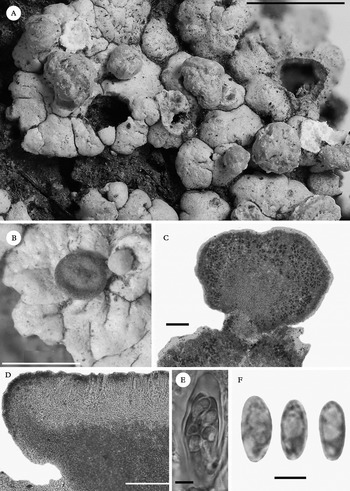
Discussion. This species strongly resembles T. wallrothii, but has softer, more clustered, partly decorticated isidia or rather gymnidia, which cannot be hand-sectioned without crumbling. The distinctly corticate isidia of T. wallrothii can be hand-sectioned with a razor blade and leave a conspicuous, well delimited scar when falling off. Both species occur in Macaronesia, where true T. wallrothii is only known from high mountains, while T. gymnidiata occurs at lower elevations.
Additional specimens examined. Spain: Canary Islands: Gran Canaria, Pinar de Tamadaba west of Artenara 28°02′N, 15°41′W, 1094 m alt., 2000, F. Schumm 8129 (hb. Schumm); Gran Canaria, 3 km north-west of Artenara, Embalse de Lugarejos, 28°02′N, 15°40·5′W, 340 m alt., 1999, F. Schumm 5113 (hb. Schumm); La Palma, Los Cancajos south of Santa Cruz, 28°38·7′N, 17°46′W, 30 m alt., 2007, F. Schumm 12987 (hb. Schumm); La Gomera, Los Barranquillos north-east of Arure, 28°09·1′N, 17°18·3′W, 1020 m alt., 2003, F. Schumm 10430 (hb. Schumm); Tenerife, Ladera de Guïmar, 400 m alt., 1983, A. Aptroot 11568 (ABL).
Trapeliopsis wallrothii (Flörke) Hertel & Gotth. Schneid.
in Schneider, Biblioth. Lichenol. 13: 153 (Reference Schneider1980).—Lecidea wallrothii Flörke, in Sprengel, Neue Entdeckungen im ganzen Umfang der Pflanzenkunde 2: 96 (1820); type: Germany, Halle, Kröllwitz, Wallroth (L0833383—isotype).
Lecidea salweii Borrer, in Hooker, Supplement to English Botany 3: 2861 (1841), also as “salweei” or “salweyi”; type: Great Britain, n. v. (see Laundon & Waterfield Reference Laundon and Waterfield2007: 386)
Trapeliopsis wallrothii (Schumm 8484). A, habitus with globose isidia; B, habitus also with apothecium; C, section through thallus with attached isidium; D, section through apothecium with margin (dark areas LCB+ blue); E, ascus (dark areas I+ reddish); F, ascospores. Scales: A=2 mm; B=1 mm; C & D=100 μm; E & F=5 μm.

See Smith et al. (Reference Smith, Aptroot, Coppins, Fletcher, Gilbert, James and Wolseley2009) for description.
Ecology and distribution. On compacted soil, in Macaronesia and S Europe at higher elevations, in the rest of Europe at lowland to mid elevations. Known from Macaronesia and Europe.
Notes on author citation and typification. As can be seen from the original paper, the original description is doubtlessly provided by Flörke; Sprengel was only the editor of the journal, in which various papers appeared (hence the title: “ganzen Umfang der Pflanzenkunde”). The author should therefore be Flörke in (not ex) Spreng., and “in Spreng.” can be left out at will. Schneider (Reference Schneider1980) cites a collection from H. N. Bolander, originating from North America, as type. Bolander was born long after the original description of the species. As no indication is given by Schneider (Reference Schneider1980) whether or not original material still exists, it can be seen as a mistake rather than a neotypification. Coppins & James (Reference Coppins and James1984) suggest that in case the original material proves untraceable, a specimen from the contemporary G. F. W. Meyer could be selected as neotype, but they refrained from neotypification. In the Koerber collection (Stammherbar) in Leyden, a specimen (L0833383, Fig. 3E & F) is present which was collected by Wallroth and labelled with the unpublished name “Lecanora coarctata v[ar]. macrocymatia Wallr.” It was apparently sent to Flörke, who described it as “Lecidea wallrothii Flk.” The species has thus been named after the collector, Wallroth. Subsequently, the type collection was divided and distributed over several herbaria, which was common practice at this time. The specimen in Leyden is certainly part of this type specimen, even though it does not bear a collecting locality or date. In the original publication, only the occurrence of this species in Kröllwitz (near Halle in Germany) is mentioned, which should thus be the type locality.
Details of illustrated specimen. Portugal: Madeira: Paúl da Serra, near Urze, 32°45·3′N, 17°06·5′W, 1400 m alt., 2001, F. Schumm 8484 (hb. Schumm).
Pat Wolseley is warmly thanked for sending photocopies of the description of Lecidea salweii. The collection manager in Leyden, Gerard Thijsse, is warmly thanked for his prompt sending of specimens from that herbarium.