1 Introduction
Speech production is inherently variable, with both linguistic and non-linguistic factors affecting the realization of segments. In stress-accent languages, stress tends to cause variation at the segmental level in duration (Fourakis Reference Fourakis1991, de Jong Reference de Jong2004), degree of consonantal constriction (Lindblom et al. Reference Lindblom, Agwuele, Sussman and Cortes2007, Lindblom, Sussman & Agwuele Reference Lindblom, Sussman and Agwuele2009), or vowel quality (de Jong Reference de Jong1995, Mooshammer & Geng Reference Mooshammer and Geng2008), for example. Stress may have a very salient effect on vowel quality, with certain vowel contrasts neutralizing in unstressed position (see Section 1.1), or a more modest one, causing only slight subphonemic changes in F1 and/or F2. The influence of prosodic structure at the segmental level has been observed in a number of languages (e.g. Lindblom Reference Lindblom1963, de Jong Reference de Jong1995, Byrd Reference Byrd1996, Fougeron & Keating Reference Fougeron and Keating1997), revealing that a variety of parameters, not only suprasegmental features, cue the presence of prosodic prominence and boundaries (Fougeron Reference Fougeron2001). The present study explores how lexical stress and intonational pitch accent affect vowel production in Central Catalan (hereafter, Catalan). The contributions of stress and accent are evaluated separately.
1.1 Phonological and phonetic vowel reduction
Languages with phonological vowel reduction present a less crowded vowel system in unstressed syllables than in stressed syllables, as two or more vowels that are contrastive in the latter context neutralize (see e.g. Crosswhite Reference Crosswhite2001). The Catalan stressed vowel inventory comprises seven vowels (full vowels: /i e ɛ a ɔ o u/). However, due to stress-conditioned vowel alternations, only three vowels (reduced vowels: [i ə u]) regularly appear in unstressed position (Figure 1), although other vowels can be found exceptionally in certain contexts (Mascaró Reference Mascaró2002, see also Section 1.2).
Regular Catalan stress-conditioned vowel alternations between stressed full vowels (top) and unstressed, phonologically reduced, vowels (bottom).

As Figure 1 shows, phonological vowel reduction targets non-high vowels in Catalan: /e ɛ a/ alternate with unstressed [ə], whereas /ɔ o/ are realized as [u] in unstressed contexts. The high vowels /i u/ do not exhibit phonological vowel reduction. This is a language- and vowel-specific categorical phenomenon: Not all languages exhibit phonological vowel reduction, and even in Catalan, which does, certain vowels (the high vowels /i u/) do not participate in these alternations.
On the other hand, phonetic vowel reduction is also known as vowel centralization or target undershoot, because it involves displacement of vowels toward the center of the F1*F2 vowel space, typically due to truncated gestures or increased temporal overlap between a vowel and its neighboring segments (de Jong Reference de Jong1995, Mooshammer & Geng Reference Mooshammer and Geng2008). This deviation from idealized canonical realizations has been claimed to affect all vowels in a gradient manner (Fourakis Reference Fourakis1991) under the appropriate circumstances (e.g. decreased duration); that is, it may occur automatically as a result of certain speech conditions (e.g. faster speech rate, more casual speaking styles). Absence of prosodic prominence also results in more centralized vowels or less extreme articulations. De Jong's (Reference de Jong1995) localized hyperarticulation hypothesis predicts that stress acts to enhance linguistically-encoded information. In this view, vowel place features would be maximized under prosodic prominence, making non-prominent (or less-prominent) vowels appear centralized with respect to prosodically prominent ones.
Vowel space expansion or feature-enhancing vowel articulation induced by prosodic prominence has been observed in English (de Jong, Beckman & Edwards Reference de Jong, Beckman and Edwards1993; de Jong Reference de Jong1995, Reference de Jong2004; Erickson Reference Erickson2002; Cho Reference Cho2005; Lindblom et al. Reference Lindblom, Agwuele, Sussman and Cortes2007; Cho & Keating Reference Cho and Keating2009; Cole et al. Reference Cole, Hualde, Blasingame and Mo2010; Jacewicz, Fox & Salmons Reference Jacewicz, Fox and Salmons2011, among others), German (Mooshammer, Fuchs & Fischer Reference Mooshammer, Fuchs, Fischer, Ohala, Hasegawa, Ohala, Granville and Bailey1999, Baumann et al. Reference Baumann, Becker, Grice and Mücke2007, Mooshammer & Geng Reference Mooshammer and Geng2008), Italian (Savy & Cutugno Reference Savy and Cutugno1998, Calamai Reference Calamai2001), French (Meunier & Espesser Reference Meunier and Espesser2011), Brazilian Portuguese (Arantes Reference Arantes2010), heritage Spanish (by speakers bilingual in English, Ronquest Reference Ronquest, Howe, Blackwell and Quesada2013), Arabic (de Jong & Zawaydeh Reference de Jong and Zawaydeh1999, Reference de Jong and Zawaydeh2002), and Korean (Cho, Lee & Kim Reference Cho, Lee and Kim2011). Catalan /i u/, which can appear in both stressed and unstressed positions, also exhibit hyperarticulation when lexically stressed (Nadeu Reference Nadeu2014).
1.2 Exceptions to phonological vowel reduction in Catalan
Despite the strong relationship between stress and vowel quality in Catalan, exceptions to phonological vowel reduction occur in some contexts (Cabré Reference Cabré2002, Reference Cabré2010; Mascaró Reference Mascaró2002; Nadeu & Hualde Reference Nadeu and Hualde2012). The full vowels /e ɛ a ɔ o/, which generally occur in stressed syllables, can appear in unstressed syllables in borrowings (karate [k a ˈɾa t e ] ‘karate’), clippings (fisioterapeuta > fisio [ˈf i z j o ] ‘physiotherapist’), cultisms and technicisms ( fase [ˈf a z e ] ‘phase’), in certain vowel combinations in hiatus (conrear [k u n r e ˈa] ‘to cultivate’), and in some compounds. In all examples here, stressed syllables are underlined, and full vowels in unstressed syllables are shown in bold in phonetic transcriptions.
On the basis of their phonological characteristics, three types of compounds can be distinguished in Catalan:
-
• type (i) compounds, which retain two stressed syllables (and, thus, two full vowels) – example (1a) below;
-
• type (ii) compounds, with one stressed syllable, but two full vowels – example (1b);
-
• type (iii) compounds, with one stressed syllable and, hence, only one full vowel – example (1c).
-
(1)
-
a. blau [ˈb l a w] ‘blue’ + elèctric [əˈlɛk tɾi k] ‘electric’ =
blau elèctric [ˈb l a wəˈlɛktɾik] ‘electric blue’
-
b. esquena [əsˈkɛnə] ‘back’ + dret [ˈdɾɛt] ‘straight’ =
esquenadret [əs k ɛ nəˈðɾɛt] (*[əs kənəˈðɾɛt]) ‘lazy’
-
c. tot [ˈt o t] ‘all, every’ + hom [ˈɔm] ‘person’ =
tothom [t uˈtɔm] ‘everybody’
-
For Spanish, Hualde (Reference Hualde2009) draws a distinction between ‘phrase-level compounds’ (which function as two prosodic words, each root preserving its lexical stress) and ‘word-level compounds’ (those functioning as a single prosodic word after destressing the first root). Catalan compounds belonging to types (i) and (iii) can be identified with Hualde's phrase- and word-level compounds respectively. Phrase-level or type (i) compounds are less lexicalized: They maintain two stresses and thus consist of two prosodic words, structurally resembling a phrase. Word-level or type (iii) compounds have undergone more extreme lexicalization and form one prosodic word only (hence becoming prosodically undistinguishable from any non-compound word). Type (ii) compounds may be viewed as an intermediate category. They form one single prosodic word (one lexical stress only), but they retain a special status by virtue of the presence of the full vowel in the first root. Most verb + noun compounds, like rentaplats ‘dish-washer’ [r e n təˈp l a t s] (lit. renta ‘(it) washes’ + plats ‘dishes’), belong to type (ii).
1.3 Verb + noun compounds
In Catalan and Spanish, these compounds (e.g. obrellaunes [ɔβɾəˈʎa w nəs] ‘can opener’) are segmentally homophonic with verb phrases with a third person singular present indicative verb form ( obre llaunes [ˈɔβɾəˈʎa w nəs] ‘(s/he) opens cans’), but contrast with them in their stress pattern. The claim is that these compounds and homophonic sequences differ from each other just in the absence vs. presence of stress (and a pitch accent) on the first root (Vaño-Cerdá Reference Vaño-Cerdá1984: 189; Prieto Reference Prieto and Jun2014: 45). The first root in the compound is characterized by its inability to attract a pitch accent, even in citation form. I take this fact as an indication of the unstressed status of the first root. In contrast, the derived word obertura ‘aperture’ ([uβərˈt uɾə], *[ɔβərˈt uɾə]) and the compound obrellaunes ‘can opener’ ([ɔβɾəˈʎa w nəs]) have the same stress/accent pattern, but different vowels in the initial syllable, as obertura ‘aperture’ ([uβərˈt uɾə]) is subject to the regular patterns of phonological vowel reduction, but not the compound.
Nevertheless, some authors have argued that these compounds present a secondary stress. These claims stem from the presence of a phonologically unreduced vowel in the first root (Bernal Reference Bernal2012, Prieto Reference Prieto and Jun2014).Footnote 1 Prieto (Reference Prieto and Jun2014: 45–46) considers verb + noun compounds as constituting an exception to the general tendency in Catalan for stressed syllables to receive a pitch accent: The first root of these compounds preserves lexical stress, but it does not receive a pitch accent, as it is deaccented in context, similar to what happens in cases of stress clash (for the realization of stress in situations of stress clash, see Prieto et al. Reference Prieto, Oliva, Palmada, Serra, Blecua, Llach and Oliva2001). However, a careful pronunciation of a sequence containing a stress clash can avoid deaccentuation, while this is not true for compounds. Also, it is unclear what would trigger the deaccentuation of the first root of compounds, since the two stressed syllables are not necessarily adjacent. Later on, though, Prieto (Reference Prieto and Jun2014: 48) claims that ‘first elements of compounds are incorporated in the prosodic word level’.
Other authors have treated verb + noun compounds as phrase-level compounds (Carrera Reference Carrera2005, Wheeler Reference Wheeler2005), but this view cannot be sustained in the light of the experimental evidence reviewed in the next section.
1.4 Evidence for the stresslessness of the first root in verb + noun compounds
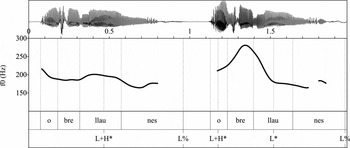
Figure 2 shows a realization of the compound obrellaunes ‘can opener’, with a single pitch accent on the stressed syllable -llau-, and the homophonic sentence obre llaunes ‘(s/he) opens cans’, in which both o- and llau- are accented. In addition, note the greater amplitude of the initial vowel in the sentence with respect to that of the compound.
Waveform, f0 curve, and prosodic annotation of the compound obrellaunes ‘can opener’ (left) and the sentence Obre llaunes ‘(S/he) opens cans’.

Mascaró (Reference Mascaró and Mascaró1983) and Prieto (Reference Prieto2003) present evidence of the stresslessness of the full vowel in the first root of type (ii) compounds (and in phonologically unreduced prefixes).Footnote 2 Mascaró (Reference Mascaró and Mascaró1983) investigated whether compounds of the type mitjanit ‘midnight’ ( mitja ‘half’ + nit ‘night’) and superarma ‘superweapon’ ( super- ‘super’ + arma ‘weapon’) were perceived as having one single prominence (like morphologically simple words, e.g. superar -me ‘to better myself’) or two prominences (like phrases, such as mitja nit ‘half a night’). His results confirmed that compounds pattern with morphologically simple words in that they only have one lexical stress (in the second root). The syllable in the first root of compounds (with putative secondary stress) behaves like an unstressed syllable.
Prieto (Reference Prieto2003) compared segmentally identical syllables hypothesized to have varying stress levels: primary stress; two types of secondary stress: rhythmic (in words with more than one pretonic syllable) and morphologically-conditioned (in compounds) stress; and no stress. The results show no acoustic evidence of the existence of secondary stress. Furthermore, a perception experiment revealed that listeners clearly distinguish primary stress from rhythmic and morphologically-conditioned stress, but not between those two. Prieto interpreted these results as indicative of only two stress levels in Catalan: stressed and unstressed.
The results in Mascaró (Reference Mascaró and Mascaró1983) and Prieto (Reference Prieto2003) suggest that there is no evidence for the preservation of the stress of the first member of a compound (at least of certain types of compounds). These results together with the inability of the first root of verb + noun compounds to attract a pitch accent even in citation form (Vaño-Cerdá Reference Vaño-Cerdá1984, Prieto Reference Prieto and Jun2014) strongly indicate that verb + noun compounds present only one lexically-specified stress (in the second root) and that the full vowel in the first root is only a relic of their formation. Therefore, verb + noun compounds constitute exceptional cases in which vowel identity does not cue stress, allowing us to examine how the absence vs. presence of stress (and accent) affects the whole full vowel inventory of Catalan.
1.5 Stress and accent
‘Stress’ and ‘accent’ have received different definitions in the literature. Here, ‘stress’ will refer to lexical primary stress, a word-level abstract property (see the discussion in Ladd Reference Ladd2009: 48–55), whereas ‘accent’ refers to intonational pitch accent; that is, actual sentence- or phrase-level prominence, typically an f0 event (Bolinger Reference Bolinger1958).
Early work on the correlates of prosodic prominence conflated stress and accent (e.g. Fry Reference Fry1958), given that stressed syllables typically serve as landing sites for pitch accents in stress-accent languages (Ladd Reference Ladd2009) and, when elicited in citation form, words tend to be accented. Sluijter & van Heuven (Reference Sluijter, van Heuven, Bunnell and Idsardi1996a) emphasized the importance of disentangling the two phenomena, since, even in the absence of accent, speakers can discriminate between stressed and unstressed syllables (see Sluijter & van Heuven Reference Sluijter, van Heuven, Bunnell and Idsardi1996a and references therein). Their own work (Sluijter & van Heuven Reference Sluijter, van Heuven, Bunnell and Idsardi1996a, Reference Sluijter and van Heuvenb) revealed that in English and Dutch accent is cued by f0 and overall intensity, whereas stress is cued by spectral balance and duration (and vowel quality in English). For Spanish, Ortega-Llebaria & Prieto (Reference Ortega-Llebaria and Prieto2007) showed that f0, intensity, and spectral tilt cued accent, and that stress was conveyed by duration, vowel quality, and spectral tilt. Ortega-Llebaria & Prieto (Reference Ortega-Llebaria and Prieto2010) confirmed duration as the primary cue to stress. Overall intensity could also distinguish between stressed and unstressed syllables, but only in the unaccented condition. Vowel quality and spectral tilt did not emerge as relevant cues to stress and accent, which was consistent with the results of an experiment on the perception of stress in unaccented contexts (Ortega-Llebaria & Prieto Reference Ortega-Llebaria, Prieto, Vigário, Frota and Freitas2009) that showed that duration and overall intensity (but not spectral tilt) contributed to the perception of stress.
For Catalan, duration has been identified as the most important correlate of stress, and f0 as the most salient correlate of accent. Astruc & Prieto (Reference Astruc, Prieto, Hoffmann and Mixdorff2006) found duration to be a robust correlate of the stress distinction. Spectral balance and vowel quality were also shown to cue the presence of lexical stress in contexts of phrasal deaccentuation. Accent, however, was cued by pitch and overall intensity (and, less crucially, vowel quality and duration). Ortega-Llebaria & Prieto (Reference Ortega-Llebaria and Prieto2010) confirmed the importance of duration as a correlate of stress, but not of accent. A study on the perception of stress in unaccented contexts in Catalan (Ortega-Llebaria, Vanrell & Prieto Reference Ortega-Llebaria, del Mar Vanrell and Pilar Prieto2010) revealed that listeners rely on duration and intensity, although duration is clearly the most robust correlate. The authors provided evidence that Catalan speakers can perceive stress in the absence of important cues such as f0 and vowel quality.
1.6 The present study
This study investigates the realization of full (i.e. phonologically unreduced) vowels found exceptionally in unstressed position in Catalan. Due to the lack of prosodic prominence, these vowels are expected to differ from lexically-stressed vowels in duration and, possibly, vowel quality (see Section 1.1). This study aims to characterize unstressed full vowels acoustically and to compare them to stressed full vowels and unstressed and reduced vowels. The remainder of this paper is organized as follows. Section 2 presents the research questions and hypotheses. Section 3 describes the methodology. Section 4 contains the results, which are discussed in Section 5. Section 6 presents the conclusion.
2 Research questions and hypotheses
The main research question is whether full vowels that occur exceptionally in unstressed syllables (for example, those in the first root of verb + noun compounds) undergo phonetic vowel reduction (i.e. whether they deviate from the realizations observed in stressed position). If they do, the effect might be due to the absence of lexical stress or intonational pitch accent. Therefore, the acoustic characteristics of full vowels in their normal stressed position and in their exceptional unstressed position are compared in accented and unaccented conditions.Footnote 3
The research questions are as follows:
-
1. Do unstressed full vowels differ from stressed full vowels in duration and vowel quality?
-
2. Do unstressed full vowels merge with phonologically reduced vowels?
-
3. If there are differences between unstressed and stressed full vowels, are these due to the absence vs. presence of lexical stress or pitch accent (or both)? If there are effects of both accent and stress, are these cumulative?
Verb + noun compounds are expected to be realized with a full vowel in the first root in most cases (question 2, see Mascaró Reference Mascaró2002). Recasens (Reference Recasens1993: 88) notes that certain borrowings and compounds may have alternating pronunciations with unstressed full and phonologically reduced vowels (the latter being more sporadic). Still, full vowel realizations are expected to be more frequent than reduced realizations.
Based on previous findings (Section 1.5 above), unstressed vowels in the first root of compounds realized as full vowels (question 1) are expected to exhibit shorter duration than their stressed counterparts in both accent conditions. Stressed vowels should show similar durations in the accented and unaccented conditions. Regarding vowel quality, it is expected that unstressed full vowels differ from their stressed counterparts. In line with findings showing an expanded vowel space in prosodically prominent positions (see Section 1.1), unstressed full vowels are hypothesized to undergo centralization, resulting in a compressed F1*F2 space, with respect to their stressed counterparts. Vowel quality is clearly a correlate of the stress distinction in Central Catalan, evidenced by the existence of phonological vowel reduction. Furthermore, unstressed /i u/ exhibited phonetic vowel reduction in Nadeu (Reference Nadeu2014). In that study, however, lexical stress covaried with intonational pitch accent. Therefore, the differences between stressed and unstressed vowels could either be due to lexical stress or accent or both.
In order to assess the contribution of each of these two factors, the same three stress/vowel quality groups are compared in unaccented position, where all the target items are expected to be produced with a flat f0 contour. Thus, this condition allows us to focus on the effects of lexical stress on vowel quality in the absence of intonational pitch accent (question 3). One hypothesis is that, once the stressed vowels in the verb + noun sequence lose tonal prominence, they will become undistinguishable from the unstressed full vowels in compounds. Alternatively, vowel quality may be a correlate of stress and not of accent. In that case, the difference between stressed and unstressed full vowels should be the same in the two accent conditions.
3 Method
3.1 Speakers
The data come from 20 speakers (10 male and 10 female; age range: 18–45 years, mean: 29.35 years) who were raised and live in areas where Central Catalan is spoken, learned this variety at home and considered it to be their dominant and usual language.Footnote 4 Given that they were all bilingual in Spanish, language dominance was determined by means of a language background questionnaire (Nadeu Reference Nadeu2013). All speakers considered their language skills, evaluated on a seven-point scale (1 = very poor, 7 = perfect), to be equal in both languages (three speakers) or higher in Catalan (mean for all skills combined: 6.70, range: 6–7) than in Spanish (mean: 6.06, range: 4–7). Participants also indicated how often they spoke Catalan at home, at their workplace or in college, in social settings, with relatives, with their closest friends, and with strangers. On average, they reported using Catalan predominantly in all the situations (over 70% for each context). When considering the six contexts together, the mean percentage of self-reported use of Catalan for all participants combined is 87% (with speakers ranging from 66% to 100% daily use of Catalan).
Nineteen speakers had completed or were in the process of completing university-level education. The remaining speaker had completed post-secondary professional training.
3.2 Materials
For each of the Central Catalan full vowels (/i e ɛ a ɔ o u/), two verb + noun compounds were selected. The target vowel always appeared in an open syllable between two voiceless stops or a stop and another consonant with clear boundaries, in order to ensure reliability in the duration measurements. The consonantal context could not be kept constant for all vowels due to lexical gaps. Then, for each compound, the corresponding, segmentally homophonic, verb + noun verb phrase and a morphologically related word with the relevant vowel in unstressed position were selected. The same vowel, thus, appeared in the same consonantal context in the three conditions. This yielded a total number of 42 target items (7 vowels × 3 stress/vowel quality conditions × 2 sets). Example (2) shows the items selected for vowel /a/. In these examples, the target vowel is in bold, and the stressed syllables are underlined. The complete list of target items is given in the appendix.
-
(2)
-
a. Compounds (unstressed full condition)
parallamps ‘lightning rod’, caçamosques ‘flycatcher’
-
b. Verb phrases (stressed full condition)
pa ra llamps ‘(it) grounds lightnings’, ca ça mosques ‘(s/he) catches flies’
-
c. Derived words (unstressed reduced condition)
parador ‘whereabouts’, caçadora ‘vest’
-
In the verb phrases, the target vowel is stressed and accented. In the compounds, it is unstressed, but full, because phonological vowel reduction is claimed to not apply in this context (Mascaró Reference Mascaró2002). Finally, in the morphologically derived words, the target vowel is unstressed and phonologically reduced. In most target items, the vowel under study appeared two syllables to the left of the syllable with lexical stress of the word (or of the next lexical stress in the case of verb phrases), although this was not possible for three items due to the scarcity of compounds of this type.
3.3 Procedure
The study comprised two tasks that aimed at eliciting realizations of the target items in accented (task 1) and unaccented (task 2) positions. This design is adapted from de Jong & Zawaydeh (Reference de Jong and Zawaydeh2002) and Cole et al. (Reference Cole, Hualde, Blasingame and Mo2010).
In the first task, target items were elicited in a position within a sentence where they received a pre-nuclear pitch accent (accented condition). Each target (compound or derived) word and verb phrase was embedded in a unique meaningful sentence. The sentences contained at least three accentable constituents (four in the case of verb phrases), and the target phrase or word preceded the nuclear accent. In Catalan, the nuclear accent of a declarative sentence with broad focus falls on the lexically stressed syllable of the last lexical word in the utterance (Estebas Vilaplana Reference Estebas Vilaplana2000). Note that in this condition the pre-nuclear accent will only be realized on the target vowel in the stressed condition (verb phrase). In the other conditions, a pre-nuclear accent will be realized on the target item, but not on the target vowel because it is lexically unstressed. The 42 target sentences were presented in randomized order, mixed with 48 distractor sentences, four times (in different blocks with different presentation orders).
The second task elicited the same target items in unaccented position (unaccented condition). As Ortega-Llebaria & Prieto (Reference Ortega-Llebaria and Prieto2010) note, lexical stress and accent tend to covary in declarative sentences in Catalan. Yet, lexically stressed syllables are unaccented quite systematically in certain contexts (e.g. Astruc-Aguilera & Nolan Reference Astruc-Aguilera and Nolan2007). For examples, in sentences with narrow or contrastive (or corrective) focus on an element other than the last constituent, the postfocal material is produced with a flat f0 contour (Estebas Vilaplana Reference Estebas Vilaplana2003). Therefore, in order to elicit the unaccented condition (task 2), the sentences were slightly modified, and another sentence was added, forming a minidialogue, as in (3).
-
(3) El pare torra pa per esmorzar.
‘Father toasts bread for breakfast.’
No, la MARE to rra pa.
‘No, MOTHER toasts bread.’
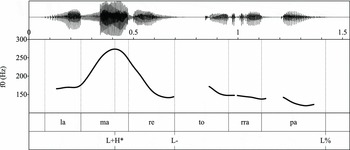
Participants were instructed to read silently the first sentence, which contained a mistake, and to read aloud the second sentence, with the mistake corrected. The constituent that needed to receive contrastive focus (indicated in capitals) was placed at the beginning of the sentence. Speakers were told to ‘emphasize’ the part in capitals. They were expected to place an L+H* pitch accent on the focused element, followed by a low f0 up until the end of the sentence (Vanrell et al. Reference Vanrell, Stella, Gili-Fivela and Prieto2013). In all cases, the target item occurred after the focused element, and so it was produced with a flat f0. Figure 3 shows an example of one of the target sentences in the unaccented condition.
Waveform, spectrogram, f0 curve, and prosodic annotation of the sentence La MARE torra pa ‘MOTHER toasts bread’, with a L+H* pitch accent on the focused word and a flat f0 curve until the end of the utterance.

In task 2, the sentences were presented four times in randomized order without filler items. It was expected that having to produce focused constituents would shift speakers’ attention away from the target items. Before starting the recordings, participants were given two sentences to practice. The tasks were always completed in the same order (task 1 first). Speakers filled out the language background questionnaire between the two tasks.
Participants were recorded in a very quiet room at the Universitat de Barcelona or in their home using a Samson Zoom H4n digital recorder and a head-mounted condenser microphone (Beyerdynamic Opus 55 Mk II). The recordings were digitized at 48 kHz (24-bit quantization).
3.4 Data analysis
3.4.1 Segmentation and codification
Three repetitions were analyzed, resulting in 126 tokens per speaker per task (for a total of 5040 vowels). Vowel boundaries were placed after careful inspection of the synchronized waveform and spectrogram display in Praat (Boersma & Weenink Reference Boersma and Weenink2014). Flanking consonants (mainly voiceless stops, fricatives, and trills) were selected so that segmentation was as unambiguous as possible. When the consonant was a voiceless stop, the vowel onset boundary was placed at zero-crossing of the first oscillation in the waveform after the release burst. The offset boundary was placed at the point in which F2 disappeared (following Turk, Nakai & Sugahara Reference Turk, Nakai, Sugahara, Sudhoff, Lenertová, Meyer, Pappert, Augurzky, Mleinek, Richter and Schließer2006). The trills and taps following the target vowel were treated as stops in this respect. For vowels preceding a trill, the vowel offset boundary was placed before the first occlusion. In some cases, rhotics were realized as approximants. Changes in the amplitude of the waveform and sudden variations in F3 were used to establish the boundary between vowel [u] and following /r/. In the sequence [p aɾ ~ pəɾ], changes in formant energy and frequency were used to place the boundary between [a ~ ə] and /ɾ/. For fricatives (/s ʃ/), determining the onset and offset of frication noise was straightforward. In a few cases in which a portion of the preceding vowel was devoiced and formant structure was lost, vowel offset boundary was moved to the point at which F2 disappeared. To identify vowel onset following /ʎ/, differences in amplitude and abrupt changes in formant structure were monitored (Ladefoged Reference Ladefoged2003: 145–147).
Ninety-six vowels corresponding to compounds and verb phrases (48 in each condition) were discarded due to unexpected realizations involving the mid vowels. Five male speakers produced the word pesa ‘(s/he) weighs’ (expected pronunciation: [ˈp e zə]) with the low-mid vowel /ɛ/, and two female speakers produced llepa ‘(s/he) licks’ (expected pronunciation: [ˈʎe pə]) also with /ɛ/. One of these female speakers also presented the low-mid back vowel /ɔ/ in torra ‘(s/he) toasts’ (expected pronunciation: [ˈt o rə]).
Failure to produce the expected vowels in these words is not entirely surprising. Due to a complicated historical evolution (see e.g. Gulsoy Reference Gulsoy1993) and rather limited functional load (Badia i Margarit Reference Badia i Margarit1988[1969], Reference Badia i Margarit1988[1970]), the distribution of the mid front vowel contrast (and to a lesser extent that of the mid back vowels) presents great inter- and intradialectal variation. Recasens (Reference Recasens1993: 82) notes that certain words have to be allowed two normative pronunciations (with /e/ and /ɛ/). Although the realizations noted above cannot, strictly speaking, be considered non-normative or non-target-like, those tokens were discarded because they differed from the expected realization for the purposes of this experiment.
In addition, one female speaker produced [o] (instead of expected [u]) in the morphologically derived words based on the root toca- (tocar ‘to touch’) in the accented condition (six tokens).
Another 162 tokens (30 in the accented condition and 132 in the unaccented condition) were discarded due to data acquisition problems, disfluencies, non-target-like vowel or intonation, or creaky voice. Creaky voice was quite common in the postfocal part of the sentences (task 2), especially in the data produced by female speakers. The final number of vowels included in the analyses was 2436 in the accented condition and 2340 in the unaccented condition.
Vowels were coded for stress/vowel quality condition and vowel identity. This was especially important for compound words, some of which were clearly identified as exhibiting phonological vowel reduction. To validate these intuitions, 1179 compound words (those with any of the vowels /e ɛ a ɔ o/ in the first root) were extracted from their sentences. They were divided into six blocks of approximately 200 compounds each (blocks 4, 5, and 6 contained 192, 196, and 191 tokens each due to the data loss mentioned above). Note that those cases which had been discarded due to the presence of unexpected vowels (e.g. /e/ for /ɛ/) in the target syllable were also included in these blocks, in order to confirm those transcriptions as well. For each compound, three additional transcriptions were obtained.
Six female native speakers of Catalan (age range: 22–29 years, mean age: 24 years) transcribed the data. They were all dominant speakers of Catalan and they all had taken at least one course in Catalan phonetics and phonology and had extensive practice with narrow phonetic transcription. They had to transcribe only one vowel (underlined in the list of words that they were given) per compound by choosing one of a few options. For example, for a compound with expected vowel /ɛ/, the options were: /e/, /ɛ/, [ə], and ‘other’. None of the raters ever chose that last option. They received 10 euros for each block they transcribed. Each rater transcribed three blocks.
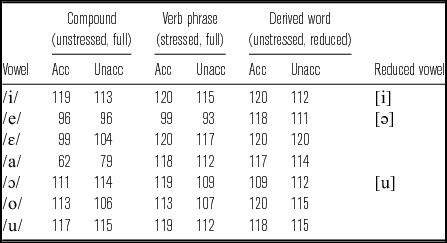
Based on the four transcriptions obtained for each of the 1179 target vowels, a vowel was marked as phonologically reduced (/e ɛ a/ > [ə], /ɔ o/ > [u]) if at least three out of the four transcribers had transcribed it as so. These tokens were not included in the analyses of duration and vowel quality, because the main goal is to determine whether shortening and centralization of full vowels occur in the absence of lexical stress. Including reduced tokens with the unreduced ones might obscure the findings. The phonologically reduced vowels in compounds are discussed separately in Section 4.4 below. Table 1 presents the total number of vowels included in the statistical analyses by vowel type and context.
Number of vowels included in the analyses by vowel identity, stress/vowel quality condition, and accent condition (acc = accented, unacc = unaccented).

3.4.2 Measurements
Duration, F1, and F2 measurements were extracted. F1 and F2 values were automatically extracted at vowel midpoint by means of the Burg algorithm as implemented in Praat (formant search ceiling = 5,000 Hz for men, 5,500 Hz for women; maximum number of formants = five; 25-ms analysis window).
The raw duration values (ms) were transformed to z-scores. For each speaker, the mean duration (all vowels together) and standard deviation were calculated. To each raw duration value of a given speaker, the mean of that speaker was subtracted, and the result was divided by the standard deviation. Thus, each transformed value reflects how many standard deviations away from the mean it is.
To explore the differences in vowel quality, the size of the area of the vowel space (see Audibert & Fougeron Reference Audibert, Fougeron, Besacier, Lecouteux and Sérasset2012) was calculated for each stress/vowel quality context, accent condition, and speaker separately (six area measurements per speaker, although some could not be calculated due to data loss).
3.4.3 Statistical analysis
The duration data were analyzed using linear mixed-effects regression, which incorporates both random and fixed effects. The fixed factors were Stress (stressed, unstressed full) and Vowel (/i e ɛ a ɔ o u/). Speaker and Item were included as random-effect terms, with by-speaker slopes for Stress. Significance of the fixed effects was evaluated by means of likelihood ratio tests (Baayen Reference Baayen2008: Chapter 7; Baayen, Davidson & Bates Reference Baayen, Davidson and Bates2008; Barr et al. Reference Barr, Levy, Scheepers and Tily2013) comparing the full model described above with simpler models, removing one effect at a time but keeping the same random structure.
The area size data were analyzed with repeated-measures ANOVA with Stress (stressed, unstressed full, unstressed) as a within-subjects variable and speaker Gender (female, male) as a between-subjects factor. Gender was included because the area size was calculated using non-normalized data, not because different behaviors were predicted for female vs. male speakers. Due to anatomical differences (i.e. men typically present a larger oral tract), men produce vowels with lower formant frequencies (Peterson & Barney Reference Peterson and Barney1952) and overall smaller vowel spaces than women (Simpson Reference Simpson2001, Chládková, Boersma & Podlipský Reference Chládková, Boersma and Podlipský2009, Escudero et al. Reference Escudero, Boersma, Rauber and Bion2009). Planned comparisons were explored with paired t-tests. The alpha level was adjusted using Bonferroni correction. The paired t-tests were considered significant if p < .0125 (.05/4).
The statistical analyses were conducted using the lme4 (Bates et al. Reference Bates, Maechler, Bolker and Walker2014) and ez (Lawrence Reference Lawrence2013) packages for R (R Core Team 2013).
4 Results
4.1 Lexical stress and accent
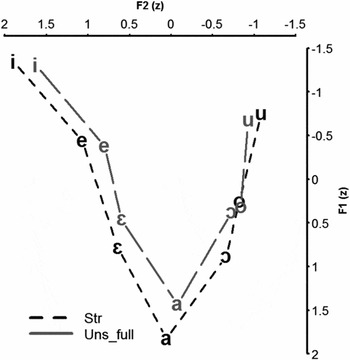
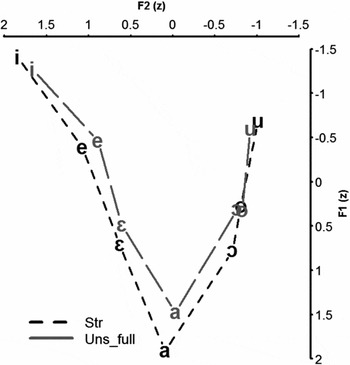
Figure 4 plots mean (z-score transformed) F1 and F2 for each vowel in the stressed and unstressed full conditions. Non-back vowels show a tendency toward vowel centralization in the unstressed full condition with respect to the stressed condition, especially in F2. In addition, /a/ and /ɛ/ display lower F1 in the unstressed condition, whereas /e/ and /i/ show a subtle tendency in the opposite direction. Regarding the back vowels, /u/ is lower and more fronted in the unstressed full condition than in the stressed condition. An interesting observation is that the low-mid vowel /ɔ/ seems to merge with /o/ in the unstressed full condition, which does not differ importantly from stressed /o/.
Mean F1 and F2 values in the stressed (str) and unstressed full (uns_full) conditions.

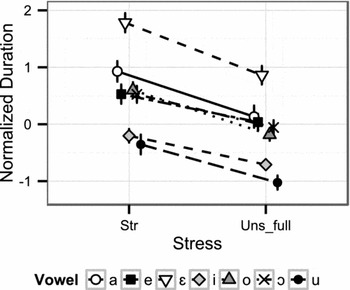
Stressed and unstressed full vowels are possibly also distinguished by their duration (Figure 5). All vowels exhibit shorter duration in the unstressed full condition. Statistical analysis returned a significant effect of Stress (χ2 (7) = 27.20, p < .001) and Vowel (χ2 (12) = 54.08, p < .001) on Duration, and a non-significant interaction between these two factors (χ2 (6) = 2.29, n.s.). Vowels are significantly longer in the stressed (M = 59.60 ms, SD = 17.81) than in the unstressed full condition (M = 49.25 ms, SD = 13.95).
Mean duration for each vowel separately in the stressed (str) and unstressed full (uns_full) conditions. Error bars indicate 95% confidence interval.

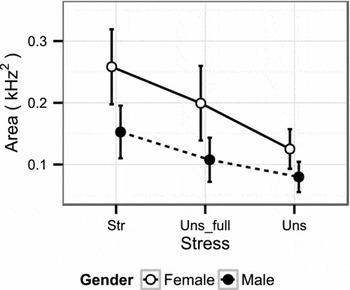
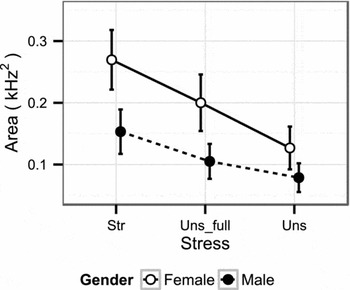
In order to determine whether, apart from shorter durations, absence of stress also resulted in vowel centralization, size of the vowel space area in the stressed, unstressed full, and unstressed conditions (Figure 6) was also compared.
Mean vowel space area in the stressed (str), unstressed full (uns_full), and unstressed (uns) conditions by gender. Error bars indicate 95% confidence interval.

The ANOVA with Area as dependent variable returned significant effects of Stress (F(2,30) = 54.38, p < .001) and Gender (F(1,15) = 9.33, p < .01). The interaction between the two factors was also significant (F(2,30) = 4.17, p < .05). Planned comparisons were carried out to determine whether the area of the vowel space in the unstressed full condition differed from that in the other two conditions. Due to the interaction between Gender and Stress, the effects of Stress are evaluated separately for female and male speakers. The analysis indicates that female speakers present a significantly smaller vowel space area in the unstressed full condition (M = 0.20 kHz2, SD = 0.07) than in the stressed (M = 0.26 kHz2, SD = 0.08) condition (t(7) = –6.87, p < .001). In addition, the vowel space area in the unstressed full condition is larger than the area in the unstressed condition (M = 0.13 kHz2, SD = 0.05, t(7) = 3.66, p < .01). Males also produced a larger vowel space area in the stressed condition (M = 0.15 kHz2, SD = 0.06) than in the unstressed full (M = 0.11 kHz2, SD = 0.05) condition (t(8) = –6.82, p < .001). The difference between the unstressed full and unstressed (M = 0.08 kHz2, SD = 0.04) conditions, although in the expected direction, failed to reach significance after Bonferroni correction (t(8) = 3.04, p = .016, n.s.). Regarding the significant effect of Gender, females exhibit a larger vowel space than male speakers, but the difference is magnified in the stressed condition.
These results confirm that full vowels that occur exceptionally in unstressed position (in compounds such as parallamps [p a ɾəˈʎa m s] ‘lightning rod’) are more centralized and shorter than their stressed counterparts (in verb phrases, para llamps [ˈp aɾəˈʎa m s] ‘(it) grounds lightning’). These full vowels are less centralized than purely unstressed (and phonologically reduced) vowels (in derived words, parador [pəɾəˈðo] ‘whereabouts’) and preserve more distinctions than are maintained in unstressed position, although the area measurement did not reveal differences between these two conditions for our male speakers.
4.2 Lexical stress without accent
To assess the effects of stress and accent separately, the same target items were elicited in postfocal position (task 2, unaccented condition), where lexically stressed syllables (in verb phrases) did not receive a pitch accent.
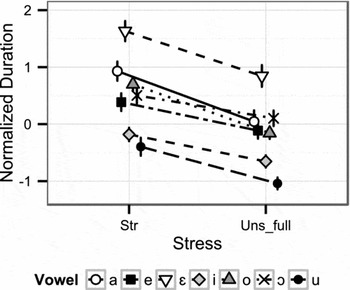
Figures 7 and 8 plot mean vowel formant frequencies and mean vowel durations respectively. Comparison of these figures with Figures 4 and 5 above, which present the equivalent data in the accented condition, indicates similar patterns of spectral and temporal variation. Non-back vowels and /u/ occupy less peripheral positions in the vowel space in the unstressed full condition. Turning to the back vowels, /o/ does not seem to be affected by the presence of stress, and unstressed full /ɔ/ clusters with realizations of stressed and unstressed full /o/, in line with the patterns observed in the accented condition. Stressed full vowels are longer than their unstressed full counterparts.
Mean F1 and F2 values in stressed (str) and unstressed full (uns_full) position in the unaccented condition.

Mean duration for each vowel separately in stressed (str) and unstressed full (uns_full) position in the unaccented condition. Error bars indicate 95% confidence interval.

The analysis of Duration returned significant effects of Stress (χ2 (7) = 24.88, p < .001) and Vowel (χ2 (12) = 50.06, p < .001), but the interaction between them was not significant (χ2 (6) = 2.90, n.s.). Unstressed full vowels (M = 50.41 ms, SD = 14.81) were approximately 10 ms shorter than stressed vowels (M = 60.29 ms, SD = 16.92) in the unaccented condition, which is a decrease of 16% of the total duration. The duration reduction from the stressed to the unstressed full condition was of the same magnitude in the accented condition (10 ms, 17%).
Like in the accented condition, the area of the vowel space decreases in this sequence: stressed > unstressed full > unstressed (see Figure 9). The ANOVA with Area as dependent variable yielded significant effects of Stress (F(2,30) = 66.18, p < .001) and Gender (F(1,15) = 14.35, p < .01), and a significant interaction between Stress and Gender (F(2,30) = 6.60, p < .01). Planned comparisons confirmed that, like in the accented condition, the area of the female speakers’ vowel space in the stressed condition (M = 0.27 kHz2, SD = 0.06) is larger than in the unstressed full (M = 0.20 kHz2, SD = 0.06) condition (t(8) = –6.99, p < .001), which in turn is larger than the vowel space in the unstressed (M = 0.13 kHz2, SD = 0.05) condition (t(8) = 3.83, p < .01). Male speakers’ vowel space was also larger in the stressed condition (M = 0.16 kHz2, SD = 0.05) compared to the unstressed full (M = 0.11 kHz2, SD = 0.03) condition (t(7) = –7.25, p < .001). However, the difference between the unstressed full and the unstressed conditions (M = 0.09 kHz2, SD = 0.03) was not statistically significant (t(7) = 2.94, p = .02, n.s.).
Mean vowel space area in stressed (str), unstressed full (uns_full), and unstressed (uns) position in the unaccented condition by gender. Error bars indicate 95% confidence interval.

Like in the accented condition, the vowel space area is smaller in the unstressed full condition than in the stressed condition, but bigger than in the unstressed condition (except for male speakers, like in the previous section).
When the target vowels are produced in postfocal context, the full vowels in compounds (unstressed position) still differ from stressed ones, which are realized without a pitch accent in this condition. This finding implies that what causes compression of the vowel space for unstressed full vowels is not the different accentuation of the compounds vs. verb phrases. In fact, these results can be understood as more evidence for the pure stresslessness of the full vowel in the first root of compounds. If the full vowels were actually lexically stressed but unaccented in context, the pattern that was revealed in the unaccented condition would not be expected. That is because the unaccentuation of all lexically stressed syllables in postfocal position eliminates the pitch accent in the verb phrase sequences. Therefore, the vowels in the first root of compounds and the vowels in the verb phrases would form a single category and should not differ from each other.
4.3 Accent
This section seeks further confirmation that vowel quality and duration are correlates of stress, but not accent, through the comparison of stressed vowels in the two accent conditions. If the realization of a pitch accent on a lexically stressed syllable does not affect its vowel quality, it can be concluded that vowel centralization is only caused by lexical stress and that vowel quality does not serve as a cue to intonational pitch accent.
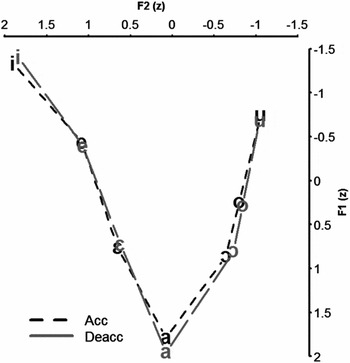
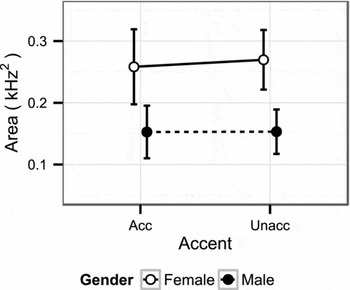
The two vowel polygons in Figure 10 suggest that stressed vowels are not affected much by the presence of accent. Figure 11 shows the mean area in each condition, separately for female and male speakers. The data were submitted to an ANOVA with Accent (accented, unaccented) as within-subjects factor and Gender (female, male) as between-subjects factor. There was a significant effect of Gender (F(1,16) = 15.43, p < .01), due to female speakers displaying a larger area than male speakers. However, neither the effect of Accent (F(1,16) = 0.03, n.s.) nor the interaction (F(1,16) = 0.68, n.s.) were significant.
Mean F1 and F2 values of stressed vowels in the accented (acc) and unaccented (unacc) conditions.

Mean vowel space area (stressed vowels only) in the accented (acc) and unaccented (unacc) conditions by gender. Error bars indicate 95% confidence interval.

Figure 12 shows practically no differences in duration between accented and unaccented stressed vowels, and the analysis of Duration revealed significant effects of Vowel (χ2 (12) = 31.01, p < .01), but not of Accent (χ2 (7) = 5.47, n.s.). The interaction between Vowel and Accent was not significant either (χ2 (6) = 5.31, n.s.).
Mean duration for each vowel separately in the accented (acc) and unaccented (unacc) conditions. Error bars indicate 95% confidence interval.

4.4 Variable application of phonological vowel reduction in Catalan compounds
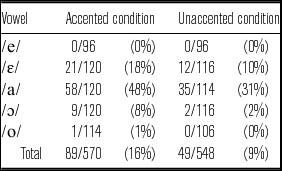
As noted, some of the target vowels in Catalan compounds were coded as phonologically reduced ([ə] for unstressed /e ɛ a/ and [u] for unstressed /ɔ o/). Eighty-nine vowels (out of 570) in the accented condition and 49 (out of 548) in the unaccented condition were produced as phonologically reduced, corresponding to 16% and 9% of the compound data respectively. The frequency of occurrence of phonologically reduced variants in the accented and unaccented conditions is not statistically different (χ2 (1) = 0.52, n.s.).
Table 2 presents the frequency of reduction of each of the five vowels that can undergo phonological reduction (/e ɛ a ɔ o/) and shows that certain vowels are produced as phonologically reduced vowels more often than others. Note that the presence of phonologically reduced vowels in compounds is rather unexpected, as verb + noun compounds are characterized by the presence of two full vowels (e.g. parallamps [p a ɾəˈʎa m s] ‘lightning rod’), as noted in the introduction (Mascaró Reference Mascaró2002, but see Recasens Reference Recasens1993).Footnote 5
Number of unstressed vowels in compounds realized as phonologically reduced vowels.

As Table 2 shows, /e/ did not reduce to [ə] on any occasion. A chi-square test comparing the frequency of occurrence of full vs. reduced vowels for vowels /ɛ a ɔ o/ was significant (χ2 (3) = 169.75, p < .001). However, vowel /o/ reduced only once (suggesting an unintended realization, rather than an acceptable realization of the compound), which might be responsible for the significant effect. If we remove this vowel, the chi-square test is still significant (χ2 (2) = 99.13, p < .001). Only the low and low-mid vowels present phonologically reduced variants with a certain frequency. /a/ is the vowel that was perceived to undergo phonological reduction more often (40% of the times across accent conditions). Next in frequency of reduction is /ɛ/, with 14% reduced realizations. /ɔ/ was realized as [u] in only 5% of its occurrences.
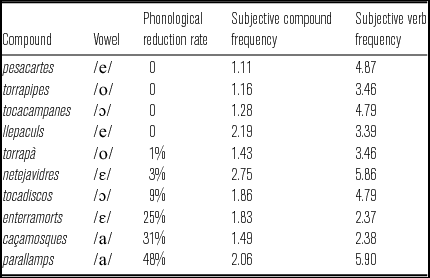
Another interesting observation is that not all compounds admit variable realizations. Those with /o e/ do not accept realizations with phonologically reduced vowels, although it is unclear whether this is due to the vowel present in the compounds or to the compounds selected. Among the compounds that admit variable realization with either a full or a reduced vowel, frequency of occurrence of the reduced variant is not homogeneous, even if they present the same vowel. In Table 3, the compounds are ordered by frequency of occurrence of the reduced variant. As expected, those that undergo reduction most often are those with vowel /a/, followed by one of the compounds with vowel /ɛ/. Important discrepancies in the frequency of occurrence of the reduced variant of the compounds with /ɛ/ and /ɔ/ are noted. This raises the question of the cause of this different behavior shown by the compounds selected for this study.
Phonological vowel reduction rate, subjective compound frequency, and subjective verb frequency of each compound.

One characteristic shared by the five compounds that accept reduced and full realizations is their semantic transparency. Their meaning is compositional. All of them refer to a person or object that does, or serves to do, what the noun and verb denote. However, this is also true of pesacartes [p e zəˈk a r təs] ‘letter scale’, which does not accept the reduced vowel, and torrapà [t o rəˈp a] ‘toasting stick’, with only one reduced realization.
Another possible explanation for the different behavior might be that the existence of cognates in Spanish (without phonological vowel reduction) could block phonological vowel reduction in some of these compounds, based on findings in Colomé & Miozzo (Reference Colomé and Miozzo2010) that suggest that bilingual speakers’ productions while speaking one language may be affected by activation of the phonological properties of words in the non-used language (see also Costa, Santesteban & Caño Reference Costa, Santesteban and Caño2005). However, only two of the compounds used in this study have cognates in Spanish (tocadiscos [t ɔ kəˈði s k u s] ‘record player’ and pesacartes [p e zəˈk a r təs] ‘letter scale’), and the former admits variable realizations.
Given that high-frequency words are known to exhibit more phonetic reduction than low-frequency words (Bybee Reference Bybee2001, Reference Bybee2006; Pierrehumbert Reference Pierrehumbert, Bybee and Hopper2001), the hypothesis that the frequency with which verb + noun compounds present reduced vowels was determined by lexical frequency was tested. Since there is no corpus of oral frequency for Catalan, subjective frequency estimates were collected using online surveys. To avoid having participants rate both the compound and its components, three separate questionnaires were created. Each questionnaire included 50 different words: 30 target items (10 compounds, 10 verbs, 10 nouns) and 20 fillers. Participants were asked to determine how often they used each of the words in the list (which included saying, hearing, reading, and writing it) by means of a seven-point scale (1 = never, 2 = a few times per year, 3 = a few times per month, 4 = once a week, 5 = two or three times per week, 6 = every day, 7 = a few times every day). These categories were adapted from Balota, Pilotti & Cortese (Reference Balota, Pilotti and Cortese2001).
Of the 341 complete responses collected, only responses by speakers who had learned Catalan at home and whose Catalan variety was Central Catalan were considered, yielding a total of 69 responses for the first survey, 76 for the second, and 70 for the third one. The frequency estimates shown in Table 3 above are thus based on approximately 70 ratings each.
The results indicate that the compounds chosen are very low-frequency words, which is probably true of most verb + noun compounds. The mean ratings assigned to the compounds range from 1.11 (1 = never) to 2.75 (3 = a few times per month). The four compounds that received the lowest subjective frequency estimates in our word list coincide with those that did not reduce (torrapà [t o rəˈp a] ‘toasting stick’ presented phonological reduction only once). Yet, those with the two highest rankings (llepaculs [ʎ e pəˈk u l s] ‘kiss-up’ and netejavidres [nət ɛʒəˈβiðɾəs] ‘window cleaner’) did not accept variable realizations either (or at least not commonly). If there is a relationship between lexical frequency and percentage of reduced realizations, it is not obvious in the data analyzed here. Verb frequency is not very informative either. It may be that the scale used did not have enough resolution toward the low extreme.
5 Discussion
5.1 Duration and vowel quality as correlates of lexical stress
The main research question was whether absence of lexical stress entailed phonetic reduction (shortening and centralization) in Catalan vowels. If differences were observed between stressed and unstressed full vowels, a secondary goal of this paper was to determine whether these differences were due to the presence of lexical stress or to the presence of accent (or both).
In both accent conditions, stressed vowels are longer than unstressed full vowels (the difference between them being around 10 ms). In addition, the vowel space occupied by unstressed full vowels is smaller than that occupied by stressed vowels, indicating that absence of stress results in vowel centralization and compression of the vowel space. This paper extends the findings that Catalan /i/ and /u/ shorten and centralize in unstressed position (Nadeu Reference Nadeu2014). Together, the results suggest that Catalan speakers use vowel quality to reinforce the stress distinction for those vowels that are not subject to phonological vowel reduction. In that study, however, stressed vowels received an intonational pitch accent, so it was unclear whether the duration and vowel quality differences were caused by the presence of stress, pitch accent, or both.
The fact that the results presented here align in the two accent conditions implies that vowel quality and duration are correlates of stress, not of accent. To further confirm this claim, stressed vowels were compared in the two accent conditions. No significant differences were found in duration or vowel space area, in line with the results in Ortega-Llebaria & Prieto (Reference Ortega-Llebaria and Prieto2010) and Ortega-Llebaria et al. (Reference Ortega-Llebaria, del Mar Vanrell and Pilar Prieto2010). Astruc & Prieto (Reference Astruc, Prieto, Hoffmann and Mixdorff2006) found that unaccented vowels were shorter than accented vowels in three out of their six speakers and concluded that duration is an optional cue to accent, which does not agree with the findings presented here. This disagreement could be due to the differences in the materials used: in Astruc & Prieto (Reference Astruc, Prieto, Hoffmann and Mixdorff2006), the unaccented target words appeared in utterance-final right-dislocations, whereas here they appeared in word-medial position (see Ortega-Llebaria & Prieto (Reference Ortega-Llebaria and Prieto2010: 87) for a related discussion of the effect of sentence type).
The non-effect of accent indicates that correlates that cue the presence of a level of prominence do not necessarily cue the presence of an extra layer of prominence. Stress and accent are not ‘parallel physical events’ (de Jong Reference de Jong2004: 512) in Catalan, and the effects of accent are not cumulative on those of stress. Similarly, Cho & Keating (Reference Cho and Keating2009) did not find evidence of cumulative effects of prosodic prominence in English. Future research will need to determine whether accent has any effect at the segmental level in Catalan.
The finding that absence of prosodic prominence causes shrinkage of the vowel space is as predicted by the localized hyperarticulation hypothesis. Note, however, that in de Jong (Reference de Jong1995) prosodic prominence corresponded to phrasal stress (accent), not lexical stress. In some languages, vowel hyperarticulation occurs under accent (see e.g. de Jong Reference de Jong1995, Lindblom et al. Reference Lindblom, Agwuele, Sussman and Cortes2007). Here, accent does not seem to affect vowel quality or duration. A possible explanation for the lack of effect of accent in Catalan vowel production stems from the prosodic characteristics of this language. The intonation of English differs from Catalan intonation in the density of pitch accents (Astruc et al. Reference Astruc, Payne, Post, Vanrell and Prieto2013). In English not all lexically stressed syllables receive phrasal stress, but in Catalan lexically stressed syllables tend to cooccur with an intonational pitch accent in most contexts, adding a level of prominence to an already prominent syllable. Given the prevalence of covariation of stress and accent in Catalan, the role of (prenuclear broad focus) accent as an enhancer of phonemic information may be less relevant or even superfluous. On the other hand, because accents are selectively placed on certain stressed syllables in English, accent may have a more salient role. The differences in pitch accent density between Catalan and English may be responsible for the divergent findings that accent enhances linguistically encoded information in English, but not in Catalan.
Nevertheless, a different type of accent (emphatic stress) does affect the realization of vowels (both duration and vowel quality) in Catalan (Nadeu & Hualde Reference Nadeu and Hualde2012). Emphatic stress refers to the presence of a pitch accent in a lexically unstressed syllable, typically in public speech. In a corpus study of Catalan radio speech, Nadeu & Hualde (Reference Nadeu and Hualde2012) found longer and more peripheral unstressed [i ə u] when they received emphatic stress. Thus, it can be concluded that different types of accent may not have the same impact on segments.
Regarding the apparently contradictory findings that vowel quality and duration do not cue the presence of a prenuclear accent but they do cue the presence of emphatic stress, note that the latter departs from accent in broad focus conditions in that it is not tied to a lexically stressed syllable, but may fall on any unstressed syllable (with certain locations with respect to the position of primary stress and word boundaries attracting emphatic stress more often than others). In a sense, emphatic stress presents some similarities with the realization of narrow focus. In both cases the pitch accent realized tends to be a L+H* accent (with the rise culminating within the syllable), and the material following these accents may be unaccented.
Despite the centralization exhibited by unstressed full vowels (Figures 4 and 7 above show that unstressed full vowels centralize, /i e ɛ a u/, or raise, /ɔ/), they do not merge with their unstressed and phonologically reduced counterparts. Statistical analysis confirms that the area of the vowel space is larger in the unstressed full condition than in the unstressed condition in the data produced by female speakers. In the data produced by male speakers, the same comparison approaches, but fails to reach, significance after Bonferroni correction is applied. This may be due to the fact that male speakers produce smaller vowel spaces than female speakers cross-linguistically (see Section 3.4.3 above). Smaller vowel spaces may allow for less compressibility, given that a compression of the same magnitude than in a larger vowel space would reduce the distance between two vowels to a larger extent and, thus, may be more likely to endanger vowel contrasts (on the notion of maximization of perceptual contrast, see Liljencrants & Lindblom Reference Liljencrants and Lindblom1972, Lindblom Reference Lindblom, Ohala and Jager1986, Flemming Reference Flemming, Hayes, Kirchner and Steriade2004). It is also worth noting that this could also result from a methodological shortcoming: Certain methods for evaluating changes in the size of the vowel space (e.g. vowel space area or contour) are sensitive to the size of the vowel inventory (Gendrot & Adda-Decker Reference Gendrot and Adda-Decker2007). A possible alternative would be to calculate F1 and F2 ratios (i.e. ratios between the most extreme vowels in the vowel space) or the mean distance between each vowel and the center of the vowel space. These two last measurements, however, put more weight on the corner vowels, and ignore the mid vowels which are of special interest in this paper.
The phonetic reduction by raising exhibited by vowel /ɔ/ deserves some attention: Unstressed full /ɔ/ presents mean values typical of vowel /o/ (see Figures 4 and 7). A tendency for unstressed mid vowels /ɛ ɔ/ to raise and become closer to their high-mid counterparts has also been noted in Brazilian Portuguese (Fails & Clegg Reference Fails, Clegg, Koike and Macedo1992). The low-mid vowels do not typically occur in unstressed syllables (where they are realized as the high-mid ones), except in derived words (e.g. caf[ɛ]zinho ‘coffee, diminutive’, b[ɔ]linha ‘ball, diminutive’). In this context, vowels /ɛ ɔ/ preserved their F2, but their F1 values were intermediate between those of stressed low- and high-mid vowels.
In the data presented here, /ɛ/ also shows raising, but not as extreme as that exhibited by /ɔ/. Full unstressed /ɛ/ does not merge with /e/. One limitation of this study is that consonantal context could not be completely controlled for. Compounds are relatively scarce, and it was impossible to find compounds that had the same neighboring consonants. Preference was given to those in which the target vowel was surrounded by voiceless stops and it appeared in an open syllable two syllables away from the primary stress. In both compounds with target vowel /ɛ/, the preceding consonant was /t/, but the following consonants were /r/ in one compound and /ʒ/ in the other. These are consonants that have a strong effect on vowel quality, and the effects are in opposite directions. In fact, when plotting individual tokens, /ɛ/ before /r/ (mean = 659.69 Hz, SD = 72.58) was almost as low as vowel /a/ for many speakers, whereas the other context (/ʒ/) triggered a much higher realization of /ɛ/ (mean = 535.53 Hz, SD = 65.78). It is possible that the effect of stress on /ɛ/ is masked by the large dispersion due to different consonantal context.
The raising of /ɔ/ to /o/ (as well as the more modest tendency in the same direction exhibited by /ɛ/) is consistent with the vowel alternations between the low-mid and high-mid vowels existent in Vulgar Latin and in some modern Romance languages, by which low-mid vowels merge with their high-mid counterparts in unstressed position. It is also consistent with the fact that, even in words that exceptionally admit full vowels in unstressed position, /ɛ ɔ/ are disfavored. Only compounds present /ɛ ɔ/ in unstressed syllables in Central Catalan. Other unstressed contexts where full vowels can be found only allow /e a o/. The mergers of stressed /ɛ e/ and /ɔ o/ into unstressed [e] and [o] respectively, as well as the raising of /ɔ/ (and to some extent /ɛ/ as well) presented here, may have a physiological basis. Lehiste (Reference Lehiste1970: 18–19) reported that high vowels tend to be shorter than low vowels and explained the correlation between vowel length and height (potentially a phonetic universal) by reference to physiological mechanisms. Low vowel targets demand larger articulatory movements, which require greater duration to attain. Given that absence of stress affects vowel duration, it may also condition vowel height.
A comparison of the effect of stress on back vs. front vowels revealed a somewhat asymmetrical behavior, with front vowels showing more pronounced centralization than back vowels. Front and back vowels have been shown to display different sensitivity to stress and coarticulatory resistance in other languages (Recasens & Espinosa Reference Recasens and Espinosa2006, Strycharczuk & Jurgec Reference Strycharczuk and Jurgec2008, Nadeu Reference Nadeu2014).
Regarding the organization of the Catalan vowel system, vowel /a/ patterns with the front vowels, instead of behaving like a central or back vowel (as is typically classified for Central Catalan, see Julià i Muné Reference Julià i Muné2002: 49 and Recasens Reference Recasens2014: 16, respectively). The presence of lexical stress increases F2 for vowel /a/. Assuming that prosodic prominence ‘entails a local shift toward hyperarticulate speech’ (de Jong Reference de Jong1995: 493) and, hence, results in an enhancement of place features, /a/ should be considered a front vowel in Catalan (see also Nadeu Reference Nadeu2014). /a/ is also more fronted under prosodic prominence in Korean (Cho et al. Reference Cho, Lee and Kim2011).
5.2 Phonological vowel reduction in verb + noun compounds
One of the research questions (question 2) concerned the possibility that full vowels in compounds actually underwent phonological vowel reduction. In both accent conditions, phonological vowel reduction occurs sporadically in some of the verb + noun compounds.
As mentioned in Section 1.2, Catalan compounds can be classified into three categories. The compounds analyzed in this paper fall under type (ii) (one stressed syllable, two full vowels, example (1b)). Yet, the results show that some of these compounds can also be realized with only one full vowel (and a phonologically reduced vowel in the first root). These compounds that show variation between a full and a phonologically reduced vowel in the first root would be expected to participate in change from type (ii) to type (iii) earlier than those that do not. In fact, the three categories can also be seen as different stages of compound word evolution, moving from a lexicalized syntactic phrase to a single prosodic word (whose internal structure may not be recoverable). The alternation between reduced and full vowels in these compounds makes them oscillate between types (stages) (ii) and (iii) (example (1c)). Still, at this point, for all the compounds investigated, the presence of the full vowel was more common than that of the reduced vowel.
In addition, different vowels showed different rates of phonological vowel reduction. One of the findings concerning the sporadic application of phonological reduction in the compounds analyzed here is the asymmetric behavior of low-mid vs. high-mid vowels. The low-mid vowels /ɛ ɔ/, as well as /a/, occasionally undergo phonological vowel reduction, but not /e o/. Even if they are also exceptional, /e o/ occur more frequently in unstressed position than /ɛ ɔ/. Unstressed /ɛ ɔ/ can only appear in compounds and unreduced prefixes and prepositions, whereas /e o/ can also appear in borrowings, clippings, and acronyms, which may explain their higher degree of resistance to phonological vowel reduction.
An attempt to relate frequency of occurrence of reduced variants with semantic compositionality, cognate status, or lexical frequency of the whole compound or the verb (first root) was not successful, although this may be due to the scarcity of data. A possibility that was not tested is that the factor that predicts the frequency of use of the reduced variant is the relative frequency of verb forms with stress on the root over verb forms with stress on the ending. Hay (Reference Hay2003: Chapter 6) noted that clusters that are ‘illegal’ in English (e.g. /f t l/, /n t l/, /s t l/, /k t l/ in complex words such as softly) undergo /t/ deletion more often in complex words that have higher frequency than their base than in complex words with lower frequency than their base. It could be predicted that a compound with a verb that is more commonly used in forms that are not stressed in the root (i.e. verbs that present a phonologically reduced vowel in the root more often than a full vowel) would be realized more often with a phonologically reduced vowel.
In sum, this study confirms that certain compounds are variably realized with or without phonological vowel reduction (Recasens Reference Recasens1993). The data also indicate that compounds differ regarding the frequency with which they present one or the other variant. This may suggest a higher degree of lexicalization of certain compounds, which admit phonological vowel reduction despite traditional claims. Further research is necessary to determine whether certain compounds exhibit phonological vowel reduction more often due to the type of vowel that they present (the reduction resulting from biomechanical constraints), frequency effects, or analogy (e.g. parallamps ‘lightning rod’ being produced with [ə] so often due to the existence of the more frequent compound paraigua [pəˈɾa jɣwə], *[p a ˈɾa jɣwə] ‘umbrella’).Footnote 6 All in all, the fact that phonological vowel reduction can apply in this type of compound may be taken as evidence that the first root in verb + noun compounds is indeed unstressed (and not simply deaccented in context).
6 Conclusion
This study manipulated the presence and type of prosodic prominence (lexical stress and intonational pitch accent) to investigate whether these have a systematic effect on vowel production in Catalan, a language with phonological vowel reduction. More specifically, full vowels were elicited in both stressed (accented vs. unaccented) and unstressed positions by means of two sentence reading tasks, in order to determine whether full vowels become longer and more peripheral when they are prosodically prominent, as the localized hyperarticulation hypothesis (de Jong Reference de Jong1995) would predict.
The results showed that the presence of lexical stress triggers an expansion of the vowel space area and an increase in vowel length. However, the presence of accent on an already lexically stressed vowel does not enhance its features any further, suggesting that the influence of accent at the segmental level is not cumulative on that of stress. An important difference between the results presented here and in previous studies is precisely the fact that accent is not cued by vowel quality and duration. It is hypothesized that this is due to prosodic differences between Catalan and English such as pitch accent density. These findings contribute to a body of cross-linguistic research dealing with the influence of prosody at the segmental level.
The results also provide further evidence for the stresslessness of the first root in verb + noun compounds (which exhibit phonetic vowel reduction and, sporadically, phonological vowel reduction), and shed light on the evolution of compound words in Catalan.
Acknowledgements
This research was supported by a Tinker Field Research Grant (awarded by the Center for Latin American and Caribbean Studies), the Anthony M. Pasquariello Research Award (Spanish, Italian, and Portuguese Department) and a Dissertation Completion Fellowship (Graduate College), all at the University of Illinois at Urbana–Champaign. I would like to thank Joan Carles Mora for facilitating my data collection at the Universitat de Barcelona, and Adrian Simpson and two anonymous reviewers for their constructive feedback. I am also grateful to José Ignacio Hualde, Jennifer Cole, Anna María Escobar, Chilin Shih, and Ryan Shosted for comments on an earlier version of this paper. All errors are my own.
Appendix
Target items by vowel and stress/vowel quality condition. The target vowel is shown in bold. Syllables with lexical stress are underlined.