

INTRODUCTION
Aegean prehistorians have long been aware of a class of unpierced chipped stone or clay artefacts, here identified as stoppers.Footnote 1 An element of vessel-sealing practice distinct from the sealing (material applied while malleable to cover/secure the stopper or lid in place), stoppers served as the back stop for a clay sealing within the mouth of a ceramic or, in rare instances, stone vessel. While the only unambiguous archaeological contexts where they have been found in the Mycenaean world is in the mouths of sealed transport vessels (e.g., Dawkins and Woodward Reference Dawkins and Woodward1909/10; Dakoronia and Kounouklas Reference Dakoronia, Kounouklas and Mazarakis Ainian2012; personal observation at Thebes), they are frequently treated as multifunctional and inscrutable, particularly when they are analysed within a cross-cultural and cross-temporal framework (e.g., d’Onofrio Reference Onofrio and Onofrio2007).Footnote 2 Because of their ubiquitous presence in archaeological sites of Late Bronze Age date and their difficulty to identify in the field, stoppers have frequently fallen through the cracks and their publication record reflects at best a general ambivalence. Don Evely perhaps best summarises the problematic attitude scholars have towards such chipped sherd discs writing that ‘though one suspects these are a commonplace item, their relative lack of distinction as objects probably leads to them being ignored’ (Everly Reference Evely and Evely2006, 300). Based on a careful reanalysis of the archaeological evidence presented in this study, however, three hypotheses can be raised. The first argument is that stoppers played an integral role in Aegean sealing practices as demonstrated unequivocally by their close metrological and contextual relationship with transport stirrup jars. Accepting the first hypothesis, the second and the third provide a plausible explanation as to why some, but not all, transport stirrup jars were sealed with stoppers. This can be explained in two ways (although the present author is not necessarily convinced that they are mutually independent): 1) transport stirrup jars sealed with stoppers were used particularly for sealing a specific commodity, wine, and this is strongly supported by statistical analysis of ceramic discs used as stoppers during the Roman period; 2) transport stirrup jars sealed with stoppers were sealed on the mainland, whereas transport stirrup jars sealed with clay plugs were sealed on Crete, an interpretation supported by the petrographic analysis of sealings found at Mycenae and the lack of stoppers in large deposits of transport stirrup jars such as at Chania.
DEFINITIONS
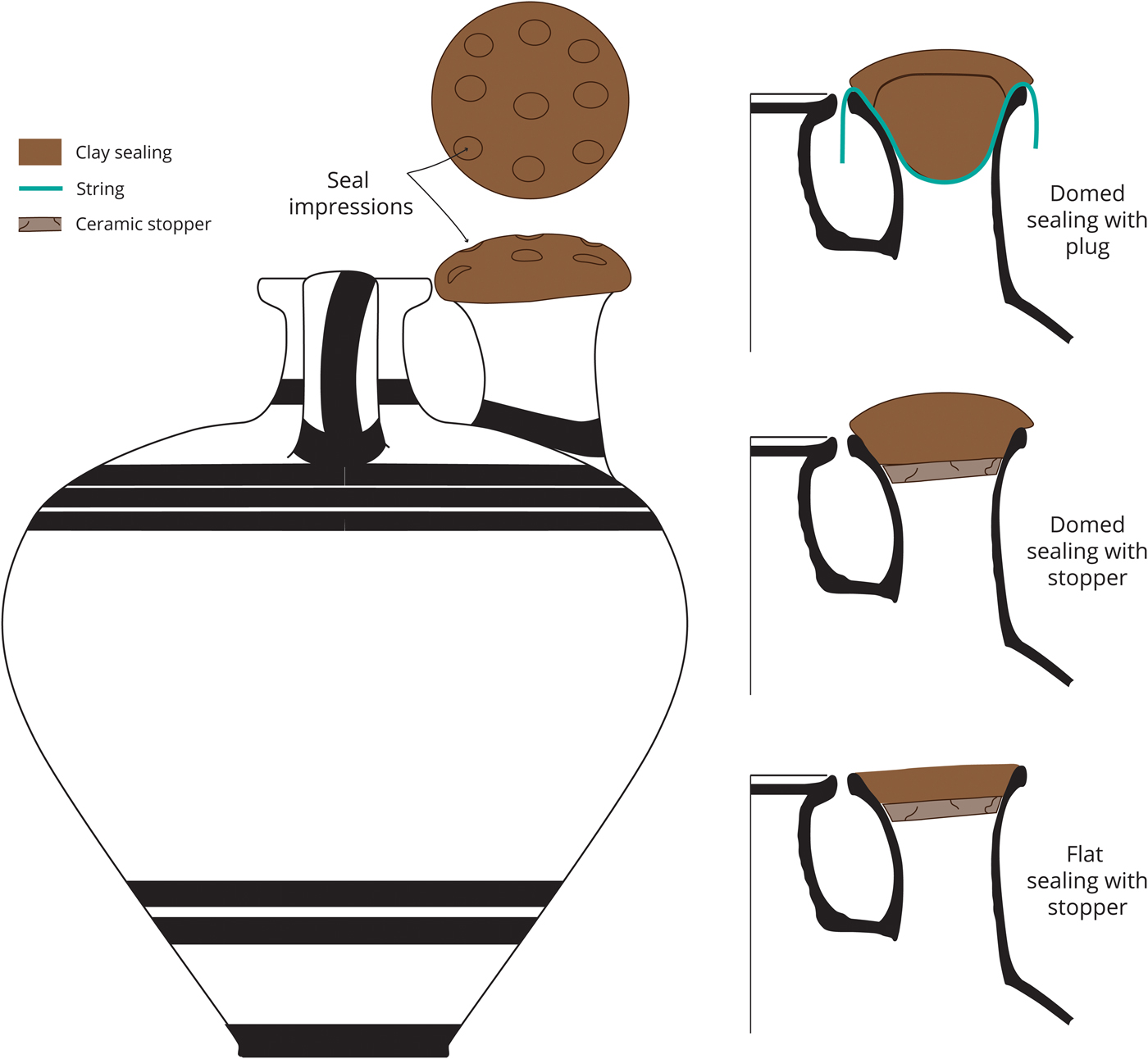
The study of stoppers in the Late Bronze Age Aegean is inhibited by terminological imprecision. The terms stoppers, plugs, caps and sealings are often used interchangeably, when, in fact, they actually refer to distinct elements (Fig. 1). Before moving on to a more thorough study of stoppers in their archaeological context, it is necessary to define the relevant terms more clearly.
Diagram of a transport stirrup jar with examples of the three sealing methods mentioned in this paper and identified archaeologically by the author (drawn by Tina Ross).

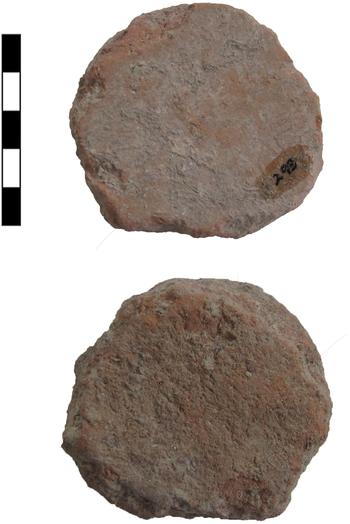
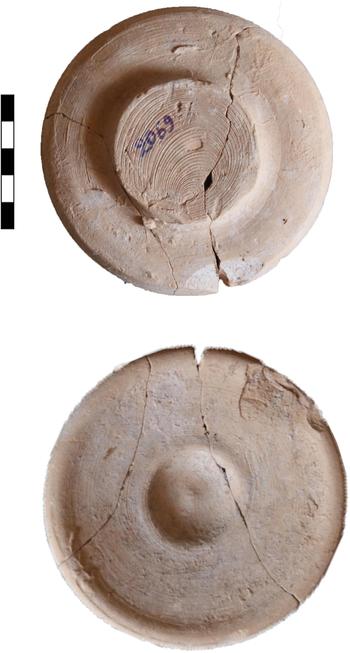
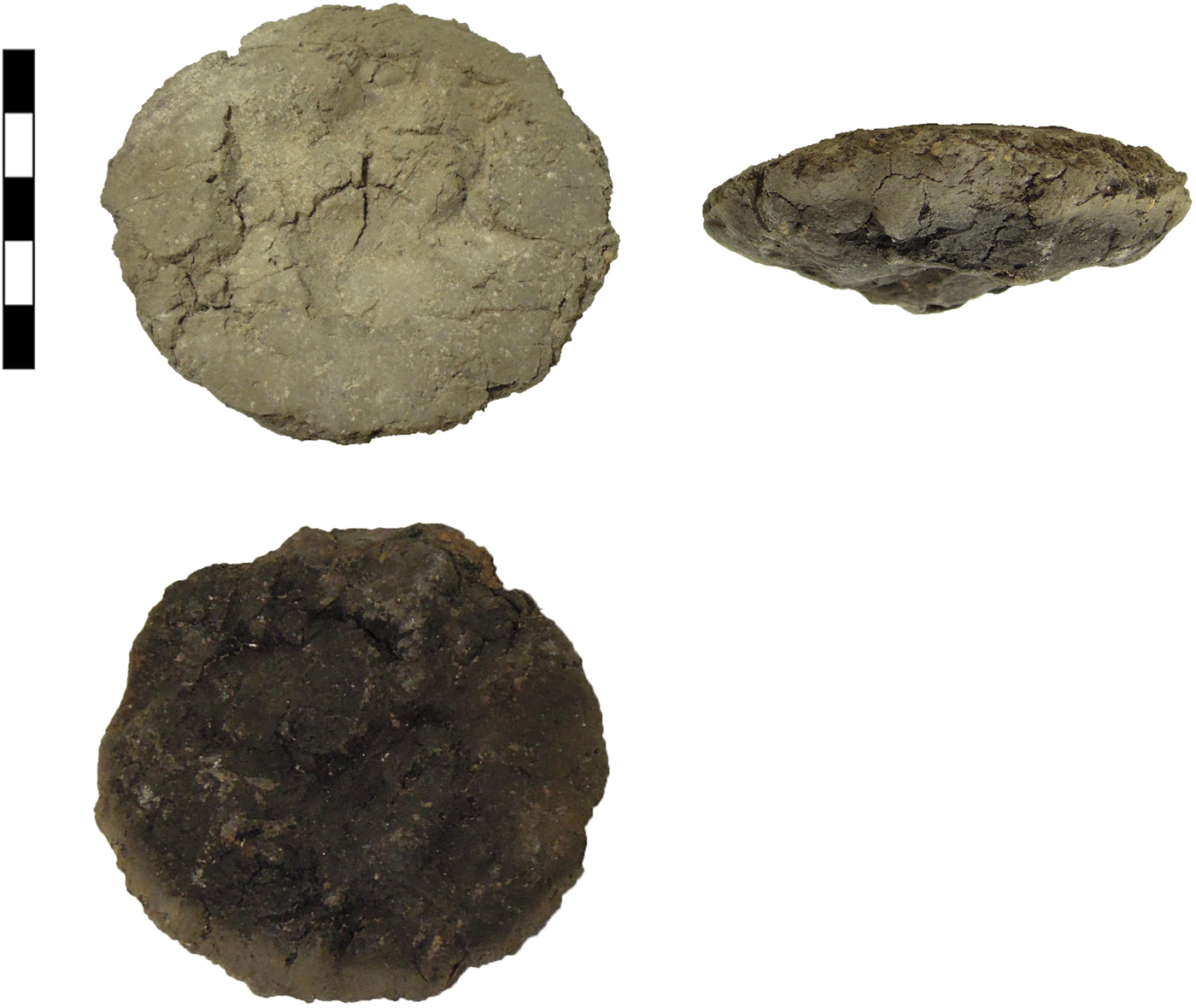
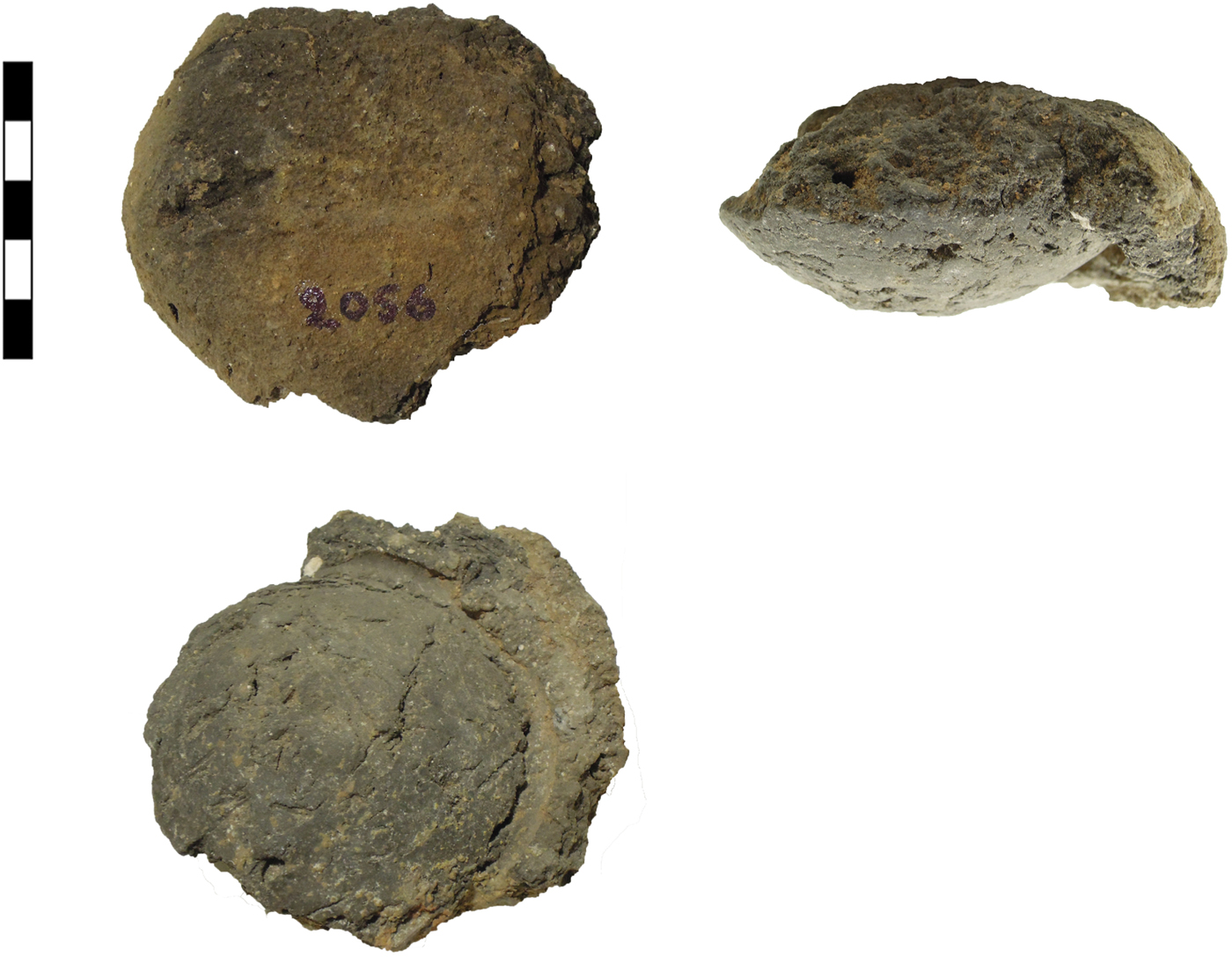
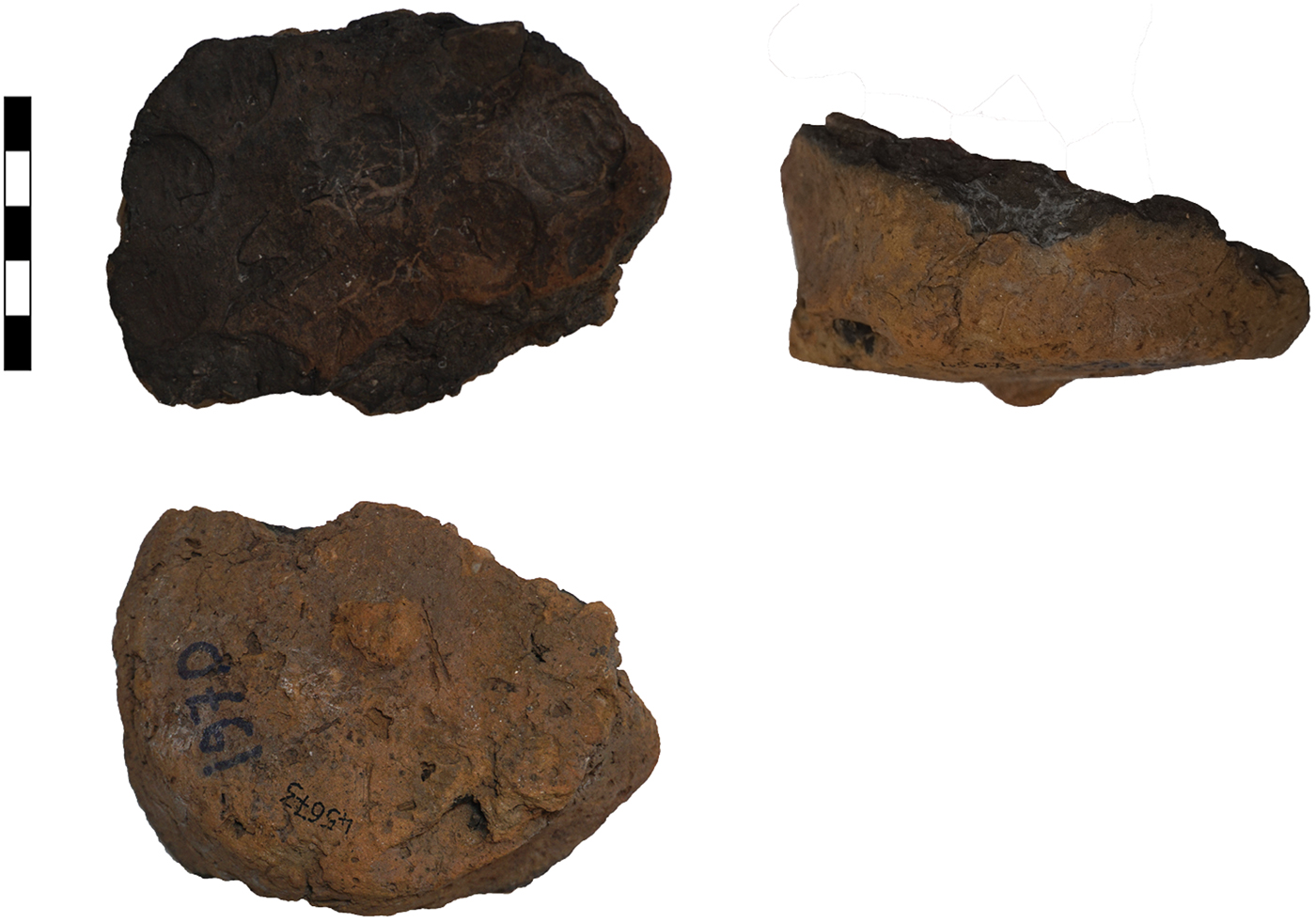
For the purpose of my study, I consider a stopper to be the element placed first in the mouth of a vessel in order to prevent the contamination of its contents. In Late Bronze Age contexts on mainland Greece this often takes the form of a chipped (Fig. 2), or very rarely of a wheel-made (Fig. 3), clay or stone disc, although there is evidence to suggest that perishable materials such as vine leaves (Dawkins and Woodward Reference Dawkins and Woodward1909/10, 9–11), basketry (Hallager Reference Hallager2001, 8), cloth (personal observation at Thebes) and leather (Hallager Reference Hallager2001, 8 fig. 4 caption, 15 n. 25) were utilised as well. Whether these were employed alone or in conjunction with chipped discs is not always clear. At least in the case of the Menelaion, the ceramic stopper discs were wrapped in vine leaves to ensure that the mud used for sealing did not contaminate the contents (Dawkins and Woodward Reference Dawkins and Woodward1909/10, 10 pl. III; Wace Reference Wace1953, 17). Not every reworked sherd is a stopper, however, and I have excluded pierced or partially pierced discs from the present study, since morphological considerations suggest they had an alternate and specialised function, some serving as spindle whorls for example, for which even examples with off-centre piercings are still well-suited (see Gibbs Reference Gibbs, Córdoba, Molist, Pérez, Rubio and Martínez2008). The unique nature of pierced discs is demonstrated by the greater attention paid to the manufacture of pierced discs, specifically their carefully shaved or ground edges vis-à-vis stoppers, which are normally only roughly chipped or flaked. I also exclude the category of reused kylix stems, which have been documented at a number of sites, from my definition of stoppers. These produced stopper-like objects meant to be inserted into the mouths of vessels, but unlike the stoppers discussed here, they seem to have functioned as lids, being placed in the mouth of narrow necked vessels to stop dust or insects from getting inside, but never receiving a proper clay seal over the top of them. That being said, some kylix bases, trimmed and abraded into circular discs, likely did serve as stoppers at both Eleon and Mycenae (see below). There can be no doubt that the two wheel-made stoppers known to the author took the form of a kylix base, but were cut from the hump and finished for use as a stopper by a potter, who was without doubt familiar with the normal practice of reuse.Footnote 3 We also have evidence that unfired clay was used for both the stopper as well as the sealing placed over top (Wace Reference Wace1953, 13; Fig. 4). It is probable that the unintentionally fired clay disc shown in Fig. 4 was allowed to dry in the sun prior to serving as a stopper, thereby ensuring it would not collapse when the sealing was applied.
Reworked ceramic stopper from Ancient Eleon showing distinct working around edges (photo by the author; courtesy of the Eastern Boeotia Archaeological Project).

Wheel-made stopper from the Archives Room, Thebes (photo by Bartłomiej Lis; © Ephorate of Antiquities of Boeotia, Hellenic Ministry of Culture and Sports).

Clay stopper from the Archives Room, Thebes. Note that the clay disc has no trace of being applied to the rim of the vessel indicating that it was placed within the spout as a stopper and intended to be covered by a sealing (photo by the author; © Ephorate of Antiquities of Boeotia, Hellenic Ministry of Culture and Sports).

A subcategory of stopper, here referred to as a plug, also served to block the mouth of the vessel in preparation for a separate sealing applied over top. In the case of plugs, however, the clay was still wet when it was positioned in the mouth of the vessel. This is apparent from the shape of the plug, as well as the presence of string impressions on the underside of the plug (Wace Reference Wace1953, 13; personal observation at Mycenae), which were intended to prevent the wet clay mass from slipping into the body of the vessel and spoiling the contents within. Such strings would also have aided in the removal of the plug (Tournavitou Reference Tournavitou1995, 80) and, once more, prevented contamination of the contents within. Although this may seem more challenging to execute, the same system of closure is also documented in Late Bronze Age Egypt (e.g., Hope Reference Hope1978), suggesting that it may even have been preferred for sealing certain types of commodities. This method of sealing is documented on mainland Greece at both the House of the Oil Merchant and House of the Columns at Mycenae, where both plugs and sealings were preserved by the intense heat of a destruction by fire (Wace Reference Wace1949, 94; Reference Wace1953, esp. 13 pl. 7; Bennett and Chadwick Reference Bennett and Chadwick1958, 7), as well as at Chania on Crete (e.g., Hallager Reference Hallager2001, 14–15 figs. 10–11). It should be noted that the plug method, as defined here, is equivalent with the ‘champagne cork’ method described by Alan Wace (Reference Wace1953, 13) in his publication of the sealed transport stirrup jars from the House of the Oil Merchant.
A sealing is distinct from both a stopper and a plug, as this refers to the material used to fix the stopper or plug in place as well as ensure a tight seal that would have prevented the continued fermentation of any alcoholic contents. Two types of vessel sealings can be defined on the basis of morphology: domed and flat. Domed sealings had a convex upper surface that extended over the rim or spout of the vessel (Figs 1 and 5). As such, the present use of domed sealing is equivalent with the term cap applied by Alan Wace (Reference Wace1953, 13) in his publication of the sealed transport stirrup jars from the House of the Oil Merchant. The use of domed sealings is well-attested for vessels with smaller apertures (<0.07 m) but does not appear to have been used for vessels with larger apertures (>0.07 m). In the latter case a flat sealing seems to have been preferred. In this instance the stopper was placed inside the mouth and clay was pressed over the top, filled flush with the rim of the vessel (Fig. 6). Just like a domed sealing, the flat sealing could be stamped with seal impressions, as is clear from Fig. 6, which is notable for preserving the distinct impression of a wheel-made stopper/reused kylix base on its reverse. Even when a plug was used in place of a ceramic or stone disc, the sealing was applied as a separate piece over the top (Haskell et al. Reference Haskell, Jones, Day and Killen2011, 3), demonstrating that the two were also conceived of as separate elements by the ancient sealer, not only the modern archaeologist. While a variety of materials possessed the properties desirable for sealing, the vast majority of Aegean sealings are made from clay tempered with vegetal material in order to reduce the risk of shrinkage or cracking. In rare instances plaster was used (Dakoronia and Kounouklas Reference Dakoronia, Kounouklas and Mazarakis Ainian2012, 1173; personal observation at Thebes) and, in exceptional instances, pitch (von Mercklin Reference Mercklin1935, 75). The sealing is rarely preserved in Aegean contexts since it is made of unfired, and therefore perishable, material. This was for practical reasons: first, it was necessary that the sealing be made from a malleable material to form a secure seal, and second, it was desirable that the sealing could be removed without too much difficulty, allowing the reuse of the transport container, rather than needing to smash off the spout. When the sealing is preserved, however, it can tell us a great deal, since it will preserve the shape and dimensions of the sealed vessel (e.g., Hallager Reference Hallager2001), impressions that document the method of sealing (stopper or plug) on its reverse, as well as any seal impressions or incised characters that may have been added after the act of sealing took place. The stamps, sometimes lumped together with the sealing itself, should be clearly distinguished terminologically as seal impressions, since they are not present on all sealings, but only those intended to be moved outside the household (see Panagiotopoulos Reference Panagiotopoulos2014).
Domed sealing from the Archives Room, Thebes. The upper surface is badly worn. Only the very bottom of the sealing is flattened indicating the stopper was placed quite low in the spout/mouth of the vessel (photo by the author; © Ephorate of Antiquities of Boeotia, Hellenic Ministry of Culture and Sports).

Flat sealing from the Archives Room, Thebes (photo by the author; © Ephorate of Antiquities of Boeotia, Hellenic Ministry of Culture and Sports).

A brief note should also be made on the distinction between lids and stoppers. As defined for the purpose of this article, a lid is a covering for the mouth of a vessel that is not intended to receive a sealing. Lids are attested throughout the Late Bronze Age Aegean sphere of interaction, and they can be either prefabricated wheel-made pieces or more casually worked discs or slabs. Sometimes even unworked stones would do, as is documented at Akrotiri (e.g., Marinatos Reference Marinatos1974, 32 pl. 72). On the mainland, lids were generally limited to a few collar neck closed shapes (e.g., Blegen Reference Blegen1928, 153–5; Furumark Reference Furumark1941, 78; Mountjoy Reference Mountjoy1999, 394–5 no. 88 fig. 138; Van Damme Reference Van Damme2017b, 62–3, 207–8) or cooking vessels (e.g., Furumark Reference Furumark1941, 78; Lis Reference Lis2017, 192, fig. 5). Fineware lids are easily recognised due to the regular appearance of a centrally-placed, vertical perforation, which may have served to ventilate their contents, or allowed for a cord to pass through to aid in removing the lid (Furumark Reference Furumark1941, 78). In the case of cooking pot lids, the central perforation is replaced with a centrally-positioned loop handle allowing the lid to be lifted from the vessel when hot (Furumark Reference Furumark1941, 78). While purpose-made lids such as these are readily identified in the archaeological record, their overall quantity is low in comparison to the total number of vessels recovered. This is no doubt due to the wide range of materials and even unworked objects that could be used as lids. While chipped ceramic or stone discs – here referred to as stoppers – or reworked kylix bases could also function as lids (e.g., Mountjoy Reference Mountjoy1999, 389–90 nos 65 and 68 fig. 135, 392–3 nos 79–80 and fig. 137), in general it seems that they were used in situations where a clay sealing was anticipated, in marked contrast to lids as defined here.
PAST SCHOLARSHIP ON AEGEAN SEALING PRACTICES
The study of Aegean sealing practices has traditionally focused on the decorative motifs and the iconography of engraved seals of bone, ivory, stone, or metal (e.g., Younger Reference Younger1988; Aruz Reference Aruz and Ferioli1994; Dickers Reference Dickers2001; Krzyszkowska Reference Krzyszkowska2005; Anderson Reference Anderson2016; Davis and Stocker Reference Davis and Stocker2016; Stocker and Davis Reference Stocker and Davis2017). Additional studies have focused on clay sealings, although the primary interest has remained on those sealings impressed with iconographic representations and/or inscriptions (e.g., Pini Reference Pini1964; Weingarten Reference Weingarten1983; Reference Weingarten1986; Reference Weingarten1988; Reference Weingarten and Cline2012; Palaima Reference Palaima, Ilievski and Crepajac1987; Reference Palaima1990; Hallager Reference Hallager, Agata and Moody2006; Younger Reference Younger and Cline2012; Panagiotopoulos Reference Panagiotopoulos2014). Rarely have sealings been studied for the information that they provide about Late Bronze Age storage practices more broadly defined, including the types of objects sealed and their role in international exchange, notable exceptions being Martha Wiencke's (Heath Reference Heath1958; Wiencke Reference Wiencke1969) detailed treatment of sealing practices at the House of Tiles at Lerna, Enrica Fiandra's (Reference Fiandra1968) work on the sealing practices at Protopalatial Phaistos, Ingo Pini's (Reference Pini1997) reexamination of the clay sealings from the Palace of Nestor and, most recently, Artemis Karnava's (Reference Karnava2018) study of stamped sealings and nodules from Akrotiri.
For the Aegean Late Bronze Age, Eric Hallager's (Reference Hallager and Hallager2001) study of sealing types from Chania is unique in presenting a holistic analysis that includes both those with and without seal impressions, demonstrating that sealing played an important role even in non-palatial settings. Hallager's publication shows the breadth of sealing methods employed simultaneously on Late Bronze Age Crete, seemingly tailored both to vessel type and contents. One of his most important contributions is to highlight the regular use of perishable materials, whether leather or basketry, for securing vessels. The lack of seal impressions on many of these sealings should be understood in the context of a domestic setting. These sealings were meant for the preservation of household commodities or temporary storage activities. Since these goods were confined to domestic usage, there was no need to stamp them with seal impressions
Hallager's paper demonstrates the importance of looking at sealing practices more closely and argues that even unstamped by-products of sealing activities can tell us much about Aegean society during the Late Bronze Age. Although stoppers are not sealings per se, they formed an integral element of Late Bronze Age sealing practice, allowing commodities to be secured for long distance transit. In contrast to the domestic sealings Hallager describes, which were intended solely for use in the household, the stoppers discussed in this article played an important role in the long-distance transport of commodities of palatial interest, and sealings on transport stirrup jars, when preserved, are always stamped with seal impressions (e.g., Dawkins and Woodward Reference Dawkins and Woodward1909/10, 10–11, pl. III; Bennett and Chadwick Reference Bennett and Chadwick1958, 7, 31 figs. 36–7). A broader understanding of contemporary sealing practices, furnished from Hallager's study, demonstrates that other sealing methods existed simultaneously, and the selection of stoppers for sealing transport stirrup jars was a conscious choice on behalf of those sealing them, presumably to ensure successful delivery of the contents contained within.
The present paper therefore argues for the close integration of stoppers within the study of Aegean sealing practices. Beginning with their previous interpretation within the field of Aegean scholarship, I examine in some detail the methodologically more rigorous study of stoppers in ancient Egypt, where better preservation enables a detailed understanding of the role of stoppers in sealing practices and, in particular, the different commodities that they sealed. I then present quantitative and contextual data to support a close relationship between stoppers and a single vessel type, in particular during Late Bronze Age III – the transport stirrup jar. As the primary container for the transport of bulk liquid commodities during the Late Bronze Age, transport stirrup jars performed many of the functions associated with amphorae in the Iron Age.Footnote 4 Particular attention is paid to the House of the Wine Merchant at Mycenae, where stoppers were excavated in a well-preserved context alongside transport stirrup jars. This well-preserved space offers important insights into the operation of a Mycenaean storeroom at the height of the palatial period. Having demonstrated the closeness of this relationship, I present a brief case study examining the distribution of Mycenaean stoppers at ancient Eleon. I argue that the relationship between stoppers and transport stirrup jars makes them valuable indicators of loci of opening and/or sealing transport stirrup jars, allowing us to identify the use of spaces even when transport stirrup jars are not physically present in the archaeological record. Furthermore, quantification of total counts of stoppers offer the potential to shed light on differential levels of consumption of the commodities they sealed, which I argue, on the basis of comparative evidence from the eastern Mediterranean, is most likely to have been wine. I conclude with a brief discussion of stoppers from later Aegean contexts and argue that these too are the product of sealing activities.
PREVIOUS INTERPRETATIONS OF STOPPERS
Previous scholars have considered stoppers to be game pieces (Moore and Taylour Reference Moore and Taylour1999, 110), counters or tokens (Marazzi and Tusa Reference Marazzi, Tusa and Laffineur2005, 607; d’Onofrio Reference Onofrio and Onofrio2007), potting tools (Van der Moortel Reference Van der Moortel, Shaw and Shaw2006, 345) or even toilet paper (Papadopoulos Reference Papadopoulos2002)! When published at all for the LH III Aegean, they have been relegated to catalogues of small finds of uncertain function (e.g., Renfrew Reference Renfrew1985, 332; Hochstetter Reference Hochstetter1987, 86; McDonald and Wilke Reference Mcdonald and Wilke1992, 625; Evely Reference Evely and Evely2006, 300; Cherry and Davis Reference Cherry, Davis, Renfrew, Brodie, Morris and Scarre2007, 406; Rahmstorf Reference Rahmstorf2008, 37–52). One persistent problem with such analyses is the attempt to consider worked discs of all periods under a common categorisation. Such an approach, by its very nature, disallows for change over time and for distinct object classes by size or material from emerging. Anna Maria d’Onofrio (Reference Onofrio and Onofrio2007, 87–9), for example, elides a variety of artefact types, separated out here, in her discussion of prehistoric Aegean ‘tokens’. But the handmade small (<2.0 cm) clay artefacts, almost certainly correctly identified as tokens, from the Temple Complex at Mycenae (Moore and Taylour Reference Moore and Taylour1999, 18, 71, 74 fig. 24, and 110) bear little relationship with chipped stone or ceramic discs. Indeed, the very nature of stoppers as an artefact manufactured from recycled detritus has further contributed to their liminal status in archaeological assemblages: should they be categorised as pottery or small finds? What value is there in publishing every stopper from a site? In this paper, I hope to demonstrate that it is precisely these approaches that have inhibited an understanding of the patterned deposition of stoppers in the archaeological record, not because stoppers themselves are inherently impossible to interpret. I begin here by reviewing previous publications of stoppers in Late Bronze Age III Greece as a starting point for the discussion that follows.
Stoppers were first identified as a discrete artefact class in Dawkin's excavations at the Menelaion near Sparta. In this instance, the domed sealings that covered the stoppers were also preserved. The vessels that the intact sealings and stoppers were associated with is not made explicitly clear, but Dawkins does make reference to Bügelkannen (stirrup jars): ‘the sealed mouth of one very large specimen in plain unpainted clay, which must have measured some .16m. across the handles’ (Dawkins and Woodward Reference Dawkins and Woodward1909/10, 9). It seems likely then that the other ‘plain jars’ he found sealed with stoppers and clay sealings were in fact transport stirrup jars as well, although there does not seem to be any way of verifying this as the relevant diary entry offers no additional information (Catling Reference Catling2009, CD-1–10). The preservation of both stoppers and sealings in situ allowed for a detailed reconstruction of the sealing method consisting of vine leaf wrapped stoppers with domed sealings (Dawkins and Woodward Reference Dawkins and Woodward1909/10, 9–11; Wace Reference Wace1953, 17). Despite these early finds, scholars have been hesitant to apply this relationship to all stoppers, but, as I will argue below, this ignores the growing body of evidence that stoppers served a relatively specialised function in Late Bronze Age Greece.
Stoppers and lids of a variety of sizes were also uncovered during Marinatos’ excavations at Akrotiri (e.g., Marinatos Reference Marinatos1969, pls 15.1, 21.2; Reference Marinatos1970, pls 7.1, 9.1–2; Reference Marinatos1971, pl. 98a–b; Reference Marinatos1972, pls 47a, 48; Reference Marinatos1974, pls 9, 67c, 71a–b, 72a–c; Reference Marinatos1976, pls 24b, 25a, 26a). These have only been published in preliminary reports, but it is clear that they were regularly used in tandem with a variety of vessels, including ewers, stirrup jars and amphorae, as well as smaller storage jars and even the largest pithoi. Stone was the preferred medium for these stoppers, many of which were employed in a semi-rough or even unworked state (Marinatos Reference Marinatos1972, 40 pl. 98a; Reference Marinatos1974, 32 pl. 71). Others were carefully worked into circular discs of the type referred to in this article as stoppers (Marinatos Reference Marinatos1972, 40 pl. 98b; Reference Marinatos1974, 32 pl. 72a). The former are not technically stoppers as defined in this article, and indeed, Marinatos (Reference Marinatos1972, 40; Reference Marinatos1974, 32) suggests that they functioned as lids, and so were never intended to receive a sealing over them. More rarely ceramic vessels were used, including conical cups (Marinatos Reference Marinatos1974, 31 pls 67c, 68a), which, in at least one instance, received a sealing over top. More recently Irene Nikolakopoulou (Reference Nikolakopoulou2002) has studied the storage jars and pithoi from Akrotiri, and she discusses lids employed for them. In no instance does she describe the use of sealings to secure the lids, and so they seem to have been simply set in position. The kinds of lids discovered for these vessels mirror the range of materials observed for stoppers, including stone slabs (Nikolakopoulou Reference Nikolakopoulou2002, 82–3), custom-made clay lids (Nikolakopoulou Reference Nikolakopoulou2002, 82), wooden lids (Nikolakopoulou Reference Nikolakopoulou2002, 84) and perhaps cloth or leather (Nikolakopoulou Reference Nikolakopoulou2002, 81–2), although the last are only interpolated from a series of holes pierced in the rim of the vessel itself. While we await a complete publication of sealing practices from Akrotiri, including the types of vessels that received clay sealings of the type documented elsewhere, it is worth noting both the breadth of vessel types that received lids and the numerous materials employed, both of which find close parallels with Hallager's (Reference Hallager2001) Cretan study.
Stoppers and lids were also documented in the excavations at Kommos (Rutter Reference Rutter, Shaw and Shaw2006; Reference Rutter2017; Van der Moortel Reference Van der Moortel, Shaw and Shaw2006). A few proto-palalatial-period stoppers predate the widespread use of transport stirrup jars and may be associated with oval-mouth amphorae instead (Van der Moortel Reference Van der Moortel, Shaw and Shaw2006, 344–5), but their quantity is not great. There are, however, Late Minoan III stoppers consisting of reworked parts of goblets or kylikes associated with transport stirrup jars at the site, but considering the large volume of transport vessels their quantity is meagre (Rutter Reference Rutter, Shaw and Shaw2006, 490–2, 513 nos 46b/4, 15, 20–3, pls 3.50–51; Reference Rutter2017, 231–2). Although some stoppers were clearly associated with transport vessels, a wide variety of functions is postulated for the reworked discs by the authors contributing to the final publication (Rutter Reference Rutter, Shaw and Shaw2006, 513; Van der Moortel Reference Van der Moortel, Shaw and Shaw2006, 344–5).
In his presentation of the small finds from the lower citadel at Tiryns, Lorenz Rahmstorf (Reference Rahmstorf2008, 37–52, Elektronischer Katalog 152–68) published a comprehensive account of the stoppers and discusses the possibility that they were used for closing vessels. In support of this he points to a concentration of stoppers associated with Rooms 121 and 122 of House VI (Rahmstorf Reference Rahmstorf2008, 51). Unfortunately, little is known about the ceramics from these spaces (cf., Lis Reference Lis2009), although Klaus Kilian (Reference Kilian1979, 404) interpreted them as storerooms and mentions a transport stirrup jar from one of the phases associated with this same area. Likewise, a concentration of stoppers from the two excavated Rooms of House XII have little published pottery to aid in their understanding. Although Rahmstorf felt like these concentrations could neither prove nor disprove an association with sealing, a review of some of the other areas where concentrations of stoppers have been found at Tiryns (e.g., Kw 14 [Rahmstorf Reference Rahmstorf2008, pls 108–9], R126/124 [Rahmstorf Reference Rahmstorf2008, pl. 139]) shows that rooms with evidence for storage activities are normal loci of stopper concentrations even late in the post-palatial period. It should be noted that Tiryns also provides the best evidence for the continuity of sealing practices into the Early Iron Age, as demonstrated by a seal-impressed clay sealing from the LH IIIC Late, Room 106 (Kilian Reference Kilian1979, 384). One interesting observation that can be gleaned from the data from Tiryns is a drop in the size of stoppers there during LH IIIC Middle and Late (Rahmstorf Reference Rahmstorf2008, Elektronischer Katalog 152–68), perfectly correlated with the disappearance of the transport stirrup jar from the archaeological record. Taken together, this evidence alone strongly links stoppers to a storage-related function in general and transport stirrup jars in particular, a point to which we will return below. Undermining the significance of such concentrations, Rahmstorf (Reference Rahmstorf2008, 42) pointed to the co-occurrence of stopper concentrations with spools. But this association is based on their co-occurence in domestic spaces (where, as already demonstrated above, they also co-occur with transport stirrup jars) and rubbish pits, where we might expect the ancient equivalent to a bottle cap to eventually wind up after its usefulness came to an end. Thus, the contextual evidence at Tiryns argues that stoppers did in fact have a more specialised function, since they do not occur in an even sprinkling across the site, but rather in concentrations in similar environments.
Stoppers from Kynos were recently published in a preliminary review of recycled materials recovered from the post-palatial levels (Dakoronia and Kounouklas Reference Dakoronia, Kounouklas and Mazarakis Ainian2012). In one published instance, the plaster sealing is still attached to the ceramic stopper, leaving no doubt as to its function (Dakoronia and Kounouklas Reference Dakoronia, Kounouklas and Mazarakis Ainian2012, 1178 fig. 9c). Nonetheless, the authors still accept that other discs of similar size could have been used for gaming (Dakoronia and Kounouklas Reference Dakoronia, Kounouklas and Mazarakis Ainian2012, 1173). While we await a more comprehensive treatment of the stoppers from Kynos, their findspots will surely add much to our understanding of their distribution within domestic contexts in post-palatial settlements.
This review of previous scholarship demonstrates the persistent association of stoppers with storage activities. While they are not always found in direct association with transport stirrup jars, their regular co-occurrence is frequent enough to merit further analysis. In addition, a careful review of the function of chipped ceramic discs elsewhere in the eastern Mediterranaean reveals a pattern of use noteworthy for its consistency across geographical regions.
STOPPERING TECHNOLOGY IN EASTERN MEDITERRANEAN PERSPECTIVE
The practice of stoppering and sealing vessels is well known throughout the Eastern Mediterranean. While I will focus in particular on the evidence from Egypt, since it represents the best preserved and most extensively discussed corpus of evidence, it should be known that stoppering was the rule, not the exception when it came to long-distance trade. This is exemplified by the discovery of reworked sherd discs found sucked into some of the Canaanite amphorae from the Ulu Burun shipwreck, apparently imploded by the pressure of the sea water (Pulak Reference Pulak1988, 11). No doubt these were originally sealed with clay, which has long since dissolved. These amphorae were originally believed to have transported terebinth resin on account of lumps of preserved resin found in many of the vessels, but a recent chemical analysis of the vessels by McGovern and Hall (Reference McGovern and Hall2016, 596–7) argues that they actually contain resinated wines. This appears to be supported by the discovery of macrobotanical remains, including grape seeds in the toes of the amphorae (Haldane Reference Haldane1993, 353). Although there are few Late Bronze Age wrecks published in enough detail to compare these findings, the correlation of stoppers and wine is noteworthy when placed within a broader Eastern Mediterranean context.
Similar sealing practices, utilising stoppers capped with mud sealings, are known in Egypt beginning in the New Kingdom (Murray, Boulton and Heron Reference Murray, Boulton, Heron, Nicholson and Shaw2000, 594). These have attracted a great deal of attention, since the mud sealings applied to the jars were frequently painted or stamped with inscriptions dating and identifying the contents of the vessels (e.g., Hope Reference Hope1978; Reference Hope and Baines1993; Boochs Reference Boochs1982; Denecker and Vandorpe Reference Denecker and Vandorpe2007). These include a whole range of liquids (e.g., wine and beer) and solids (e.g., meats, fruits, even natron). To be sure, not all mud sealings are associated with ceramic stoppers. Colin Hope identified a wide range of organic stoppers from the palace of Amenhotep III at Malkata (Hope Reference Hope1978, 14) and the tomb of Tutankhamun (Hope Reference Hope and Baines1993, 94), including some made from leaves, reeds, or sedges, whether wadded or as basketry, in addition to the usual plugs of mud or stoppers of reworked ceramic discs observed in the Aegean world. Small vessels made on the wheel, known as saucers, could also serve as stoppers (Hope Reference Hope and Baines1993, 95), although it is not clear as of yet if these were custom-made to fit the wine jars as later examples from Hellenistic Egypt were, or if they were in fact repurposed table wares. Although mud sealings were by far the most common, Egyptian stoppers were also covered by sealings of plaster or gypsum (Hope Reference Hope and Baines1993, 94) that ensured a tight and secure seal.
From Hellenistic Egypt, a surviving papyrus document indicates that stoppers were produced on the wheel by the thousands in tandem with amphorae for the wine trade (Mayerson Reference Mayerson2001). Despite this fact, such stoppers are far rarer in the archaeological record of Egypt or the Aegean than the reworked ceramic discs, or at least they are rarely represented in publications. In the case of Hellenistic Egypt, the form of such stoppers, a shallow saucer-type shape, may render their identification as stoppers challenging when their sealings are no longer adhering to them. Chipped sherd discs, meanwhile, can be easily identified even in a fragmentary state. Furthermore, as reworked items the relative value of stoppers made from chipped sherd discs may have been lower, increasing their likelihood of being discarded with rubbish, while wheel-made saucers may have been reused multiple times and not exclusively for sealing vessels. The discovery of a conical cup used as a stopper at Akrotiri is a good case in point and cautions us to think broadly about their possible uses (Marinatos Reference Marinatos1972, 40; Reference Marinatos1974, 32).
The site of Berenike, a port site on the Red Sea coast of Egypt, preserves evidence for intensive maritime trade from the Hellenistic through Roman periods. On account of this, and thanks to the generally good preservation afforded by the desert sands, stoppering practices here during the Roman period have been studied in careful detail (Sundelin Reference Sundelin, Sidebotham and Wendrich1996; Dieleman Reference Dieleman, Sidebotham and Wendrich1998; Bos and Helms Reference Bos, Helms, Sidebotham and Wendrich2000; Bos Reference Bos, Sidebotham and Wendrick2007; Mulder Reference Mulder, Sidebotham and Wendrick2007). Bos and Helms (Reference Bos, Helms, Sidebotham and Wendrich2000) developed a detailed classification system, further refined by Bos (Reference Bos, Sidebotham and Wendrick2007), for stoppers and sealings accounting for the different materials employed for stoppering and the morphology and material of the sealing applied to the vessel. Bos's studies demonstrated the amount of information that can be derived from a detailed study of sealing practices, even without considering the inscriptions and stamps on the sealings. The evidence from Berenike once again demonstrates the wide variety of materials employed as stoppers, not only reworked sherds, but also wheel-made bowls (likely intended for this function from their creation), cork, plant fibres (papyrus and palm), wood, shells, coral and cloth (Bos and Helms Reference Bos, Helms, Sidebotham and Wendrich2000, 277 fig. 12-3; Reference Bos, Sidebotham and Wendrick2007, 260 fig. 14-4).
The detailed study of stoppers at Berenike has encouraged similar studies at Mons Claudianus (Thomas and Tomber Reference Thomas, Tomber, Maxfield and Peacock2006), a Roman quarry camp in the eastern desert of Egypt where the typologies developed at Berenike were largely confirmed. At Mons Claudianus, however, the authors gave more detailed attention to the relationship between sealing practices and vessel type. Although sealing was a widespread phenomenon in Roman Egypt, different types of stoppers and sealings were apparently more suited to different vessel types. It should be noted that reused sherd discs and pottery stoppers, despite forming one of the most common types, were almost entirely associated with amphorae stoppering (Thomas and Tomber Reference Thomas, Tomber, Maxfield and Peacock2006, 248–9). Only rarely was this method extended to other types of vessels. This suggests that the method was deemed particularly suitable to the specific product being transported (wine) or to the specific type of transport container (amphora).
During the Roman period, lime plaster or pitch appear to have been preferred for sealing vessels. This was likely due to the propensity of mud sealings to crack and the ability of plaster or pitch sealings to survive maritime transport intact. In New Kingdom Egypt, where mud sealings are commonly preserved, evidence for their repair following cracking is apparent (Hope Reference Hope1978, 6). No doubt the integration of chaff, straw or other organic materials sought to reduce cracking whenever possible. Whatever its flaws, sealing vessels with mud and clay was by far the most common method in both Egypt and the Aegean during the Late Bronze Age, showing that, whatever its shortcomings were, the method was workable and economically almost certainly the most viable option, since alternatives such as plaster or bitumen would have been more time consuming and expensive to produce or acquire.
A number of similarities can be drawn between the more meagre Aegean evidence and the rich Egyptian documentation. Much like in Egypt, different sealing practices seem to have been used for other classes of vessels tailored to the dimensions of the aperture and the nature of the contents. While a wide range of sealing practices are attested, reworked sherds or purpose-made ceramic stoppers were almost exclusively employed for transport vessels. This review also strongly underscores the use of reworked ceramic discs as stoppers for wine transport in the Eastern Mediterranean for hundreds, if not thousands, of years. Most recently, Ross Thomas (Reference Thomas, Tomber, Maxfield and Peacock2018) has traced the continuous use of the stopper method of sealing at Naukratis from the third century bc into the Byzantine period. It seems highly likely to the present author that this continuous use goes back all the way to the Late Bronze Age, when the method is first documented. Thus, the evidence from Egypt not only supports, but also encourages the idea that a similar relationship exists between stoppers and transport stirrup jars in the Aegean Late Bronze Age and furthermore suggests a secondary relationship between the ceramic disc stoppers and the transport of wine even if the relationship was not one-to-one.
STOPPERS AND TRANSPORT STIRRUP JARS
There is good evidence that numerous commodities were sealed in the Late Bronze Age, but it is equally clear that different methods were applied on the basis of vessel shape and function. The latter could range from domestic needs to international trade. For instance, a box might be sealed for administrative purposes in a palatial context, or a pithos might be sealed in a domestic context to protect its contents from bugs, theft or even household consumption, as might be the case for seed grain. Pithoi are instructive of the different sealing methods that might relate to the commodity stored within. At Chania, Hallager (Reference Hallager2001) reports that basketry lids were sealed with clay over pithoi, whereas at Akrotiri a number of pithoi were found with protective lids made of large stone slabs (Nikolakopoulou Reference Nikolakopoulou2002, 82–3). When sealed these may have functioned in a similar manner to stoppers. The primary difference between the two methods was permeability. The method attested at Chania may have been more appropriate for grain, allowing aeration and thus preventing any mildew or mould from forming. The method from Akrotiri may have been appropriate to liquid commodities, when avoiding contamination and evaporation was paramount. If we accept that sealing methods were carefully selected and that the differences were not random, then it follows that a specialised vessel type used for transporting a limited range of commodities (probably wine as the comparative evidence suggests) would likewise favour a particular sealing method, in this case ceramic disc stoppers. In this section, I argue, on the basis of detailed measurements of stoppers and transport stirrup jar spout apertures, that there is a close relationship between the two and that this is not the product of random chance. In fact, most stoppers from Late Bronze Age III contexts are likely to have been used to seal transport stirrup jars. This evidence does not necessitate a one-to-one relationship between stoppers and transport stirrup jars, nor do I intend to argue for one. As demonstrated below, however, few stoppers reach the size necessary to stopper an amphora, and either some other method of sealing was used or amphorae were not employed for the transport of the same commodities. This accords well with the dominance of transport stirrup jars in long-distance trade during the palatial Late Bronze Age Aegean (Pratt Reference Pratt2016). Furthermore, the appearance of stoppers in post-palatial and Early Iron Age communities demonstrates that after the circulation of stirrup jars ceased, the method of sealing did not and instead was transferred to other containers.
Qualitative Assessment
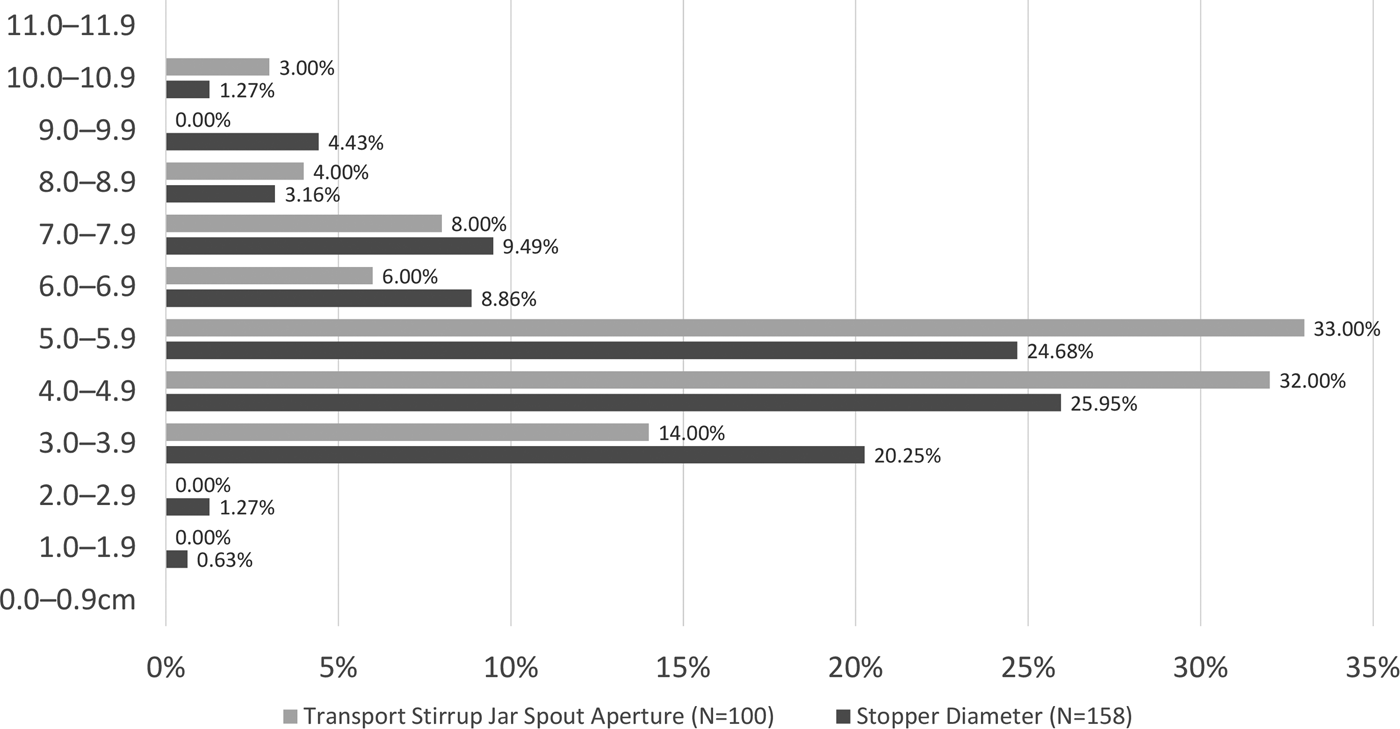
This paper presents for the first time the measurements of 158 stoppers from secure Late Bronze Age III contexts (Mycenae, 81; Tiryns, 43; Eleon, 34), contemporary with the floruit of transport stirrup jars in the Aegean. Many of the stoppers are from the ongoing excavations at the site of ancient Eleon, Boeotia, but I have been fortunate to access a large deposit of stoppers excavated at the House of the Wine Merchant at Mycenae, as well as a sizable number of published stoppers (undurchborte rundgeschlagene Scherben) from the site of Tiryns (Rahmstorf Reference Rahmstorf2008, Elektronischer Katalog 152–68). In Fig. 7, the percentage of diameters falling within centimeter specific distributions is shown in light grey. The measurement shown in Fig. 7 is the maximum diameter of the stopper, since this is a limiting factor in the size of spout that the stopper could be fit into. In addition to stoppers, I have also compiled accurate measurements of the aperture of 100 transport stirrup jars (Thebes, 43; Mycenae, 24; Pylos, 21; Zygouries, 12).Footnote 5 Aperture (i.e., the maximum diameter on the interior of the rim, rather than the exterior) was measured in order to determine the maximum size of stopper that could fit inside their spouts. The spouts of transport stirrup jars appear to have been designed to accommodate stoppers throughout Late Bronze Age III. Spouts almost always exhibit a characteristic flaring, ensuring that a stopper could be placed inside the spout without the risk of it falling unimpeded inside the vessel (see Fig. 1). This also ensured that the stopper would settle inside the spout, ensuring that a stronger sealing could be fashioned than if the stopper was placed on top of the rim. In Fig. 7, the percentage of apertures falling within centimeter specific distributions is shown in dark grey.
Graph showing the frequency of maximum stopper diameters and maximum stirrup jar spout apertures (graph by the author).

In total, 79 per cent of transport stirrup jars had spout apertures that fell within the narrow range of 3.0 to 5.9 cm. These measurements are strongly correlated with the regular spout apertures of Cretan-manufactured transport stirrup jars and agree well with the fact that these are the most widely distributed and abundantly attested of all transport stirrup jars.Footnote 6 Seventy-one per cent of stoppers fall into the same range, although on average they are slightly smaller, no doubt to allow for their insertion lower within the flaring spout (Fig. 1). A second significant, but much smaller, cluster of stirrup jars are those with apertures between 6.0 and 8.9 cm, which account for 18 per cent of the total. This is mirrored by a second cluster of stoppers, also with diameters between 6.0 and 8.9 cm, albeit once again slightly smaller on average than the spout apertures, and accounting for 21 per cent of the total number of stoppers surveyed. This cluster correlates reliably with a class of mainland-produced stirrup jars featuring somewhat larger spouts than their Cretan counterparts known from Zygouries, Pylos and Thebes (Haskell et al. Reference Haskell, Jones, Day and Killen2011, 17–19, typegroups XVIII and XXIIa). The significant drop off in frequency compared to the first cluster reflects the archaeological rarity of mainland-produced transport stirrup jars versus their Cretan counterparts. The remainder of the data demonstrates the existence of a small percentage of transport stirrup jar apertures (3 per cent) and stopper diameters (6 per cent) greater than 9.0 cm. The small number of transport stirrup jars with such spout diameters are exceptional mainland products (including two post-palatial examples) and represent a morphology very distinct from their Cretan counterparts. So far, the only specimens known are attested at Zygouries, Eleon and Lefkandi (Haskell et al. Reference Haskell, Jones, Day and Killen2011, 19, typegroup XXb; Van Damme Reference Van Damme2017b, 365–6 fig. 6.1; Popham, Evely and Sackett Reference Popham, Evely, Sackett and Evely2006, 28–9 no. P16, pl. 22.4). The stoppers in this category cannot be securely linked with transport stirrup jars, although a few examples with such spout diameters exist; rather, these chipped discs could have stoppered a range of shapes or even served as lids instead.
Even though the relationship between transport stirrup jars and stoppers is shown to be particularly close across three size clusters, it could still be argued that stoppers were used for a wide range of vessels. The main problem with this assertion is that for the largest cluster of stopper diameters (3.0–5.9 cm), there are few vessels with a comparable spout/rim aperture. A survey of all Mycenaean closed shapes reveals only one other shape during LH III that would overlap in any meaningful way at all: the rounded alabastron, a shape that a) occurs with relative infrequency in settlement deposits; b) has no significant contextual associations with the stoppers discussed here; and c) likely had a different method of sealing related to the small handles placed on the shoulder of the vessel. Indeed, an alabastron excavated from the Athenian Agora preserved traces of a textile secured across the mouth with a string or rope (Unruh Reference Unruh, Gillis and Nosch2007, 171–2), which demonstrates the most probable method. It remains likely therefore that stoppers were used for stoppering transport stirrup jars and rarely amphorae, the primary long-distance transport containers of the Late Bronze Age Aegean. As demonstrated by the evidence from Egypt presented above, ceramic disc stoppers were closely linked to long distance transport containers, since they protected their contents from accidental contamination and enabled a secure sealing to be affixed. A careful consideration of the contextual associations between stoppers and transport stirrup jars reaffirms this relationship for the Late Bronze Age Aegean world as well.
Contextual Relationship
As mentioned above, transport stirrup jars and stoppers were found in close association at the Menelaion in Laconia (Dawkins and Woodward Reference Dawkins and Woodward1909/10, 9–11). Since then, a number of significant deposits of stoppers have been found in direct or indirect association with transport stirrup jars, although the relationship has not always been pointed out or identified. In what follows, I have gathered these together to emphasize the variety of sites across the mainland of Greece where such a correlation is present. This update also serves to demonstrate that there is little evidence to support any other proposed function for stoppers during Late Bronze Age III, which, I would strongly contend, is a significant piece of evidence in-and-of itself against the multifunctional hypothesis.
Stoppers at Mycenae
In the 1920s and 1950s, the British School at Athens conducted exploratory work on a residential neighbourhood located to the northeast of the acropolis at Mycenae (Wace Reference Wace1922/3; Reference Wace1953; Wace, E.B. Reference Wace1954; French Reference French1961). This area revealed a sequence of occupation beginning in LH II, but containing two important building horizons dated to LH IIIA and LH IIIB respectively. Within the LH IIIB remains were found two LH IIIC graves, one a simple pit grave and the other a pithos burial. The LH IIIB buildings were all badly damaged by ploughing and their wall stones had been robbed by later builders, but the foundations of these structures remained impressive, standing up to three metres tall in some places. The impressive nature of these architectural remains led to their common names: the Cyclopean Terrace Building and the South Megaron. Sealed below these remains were the partially excavated remains of an earlier structure that was dubbed the House of the Wine Merchant on account of its finds. The latter appears to have been destroyed in a catastrophic event that resulted in numerous in situ finds.
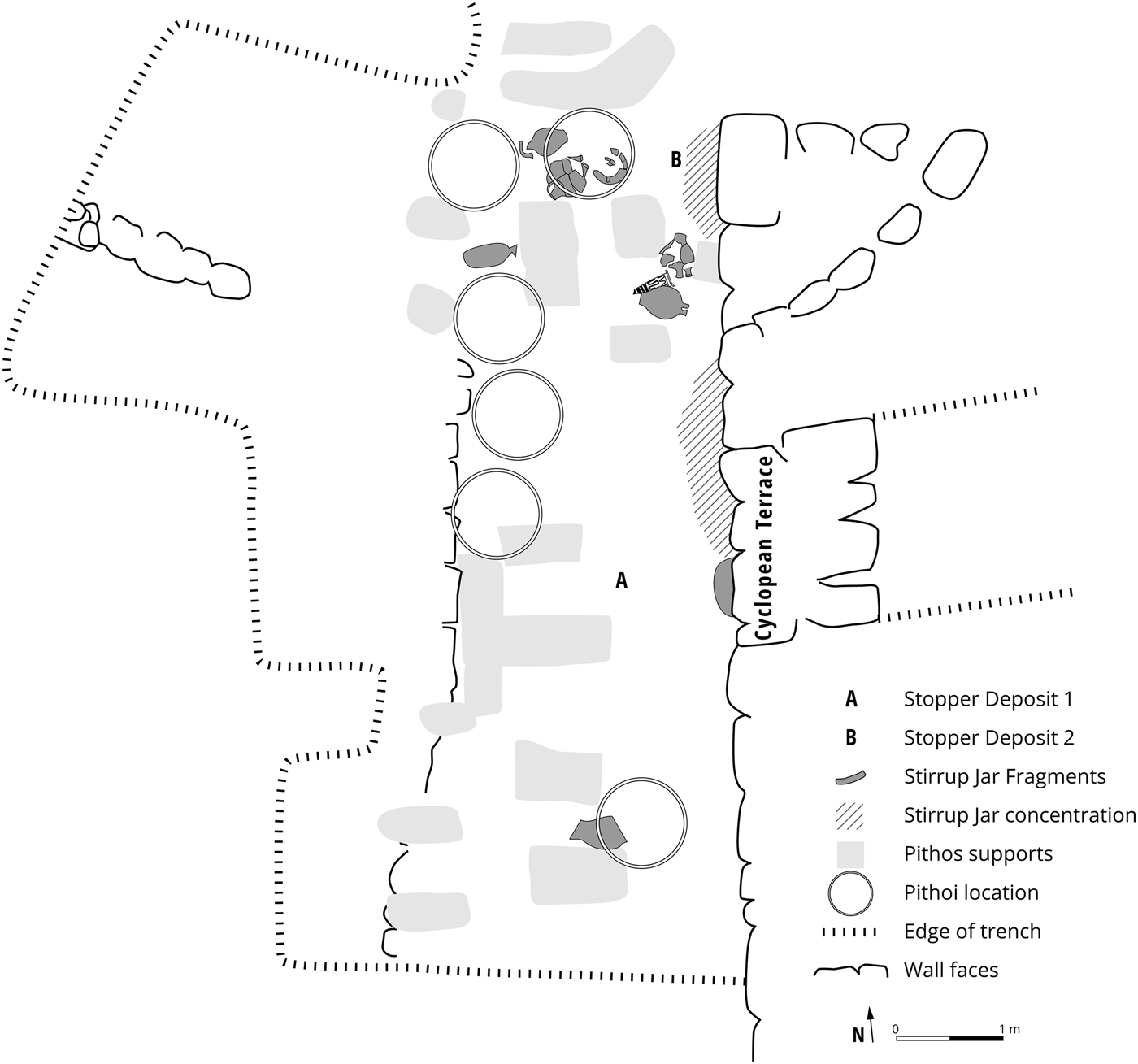
Although the House of the Wine Merchant remains only partially excavated, the uncovered area produced part of a storeroom replete with at least eight very large pithoi, each approximately 1.70 m in height, and over fifty complete or near-complete transport stirrup jars (Wace Reference Wace1953, 15–17; Fig. 8). Since their discovery, a large sample of these transport stirrup jars have been analysed petrographically and chemically, and it is clear that nearly all originate from central and western Crete, although they derive from a number of different producers (Haskell et al. Reference Haskell, Jones, Day and Killen2011, table 27 nos MYC8-14, MYC43-56, MYC76-83, MYC87-88, MYC100-102). The stirrup jars were found fallen from an upper level, as their findspots – tumbled in piles, sometimes inside of crushed pithoi – demonstrated (Wace Reference Wace1953, 16). The general impression is one of a large and exceedingly well-stocked storeroom. The excavator placed the date of destruction around LH IIIA2 on account of a decorated rhyton found in the destruction layer (Wace Reference Wace1953, 16 pl. 11b), and this would seem to accord well with the destruction of the Petsas House, located somewhat closer to the citadel, but exhibiting many similar features (see Shelton Reference Shelton, Schallin and Tournavitou2015).
Plan of the House of the Wine Merchant showing the findspots of stoppers (drawn by Tina Ross after unpublished excavation diary of E.B. French: Mycenae Excavation and Publication Archive, University of Cambridge, MCNE 1/1/044/13, 16, 17; by kind permission of Dr Elizabeth French, © The Mycenae Excavation & Publication Archive, Faculty of Classics, University of Cambridge).

Of particular importance is the discovery within this room of a plethora of stoppers made from reworked sherds and, more rarely, stone (Wace Reference Wace1953, 17), which were catalogued and recorded thanks to the dutiful attention of the original excavator, Elizabeth French. Notable is the presence of two discrete clusters of stoppers in this room, which suggests that they were stored in baskets or sacks awaiting use at the moment of the destruction (Fig. 8, A and B). Beyond these two discrete groups that were identified and collected together in the field, additional stoppers were recovered from the sherds sent for mending. It is possible that these stoppers (those found mixed with the sherds for mending) were actually sealing vessels at the time of the destruction, or else represent detritus that accumulated over the floors from frequent (un)sealing operations. As the clay sealings themselves were made of unfired clay, these have mostly been lost; only the stoppers, made from reworked sherds and stone, have survived in quantity. A single unbaked clay sealing, however, does indicate that some vessels had already received their sealings prior to the destruction. Unfortunately, the sealing in question ‘disintegrated as it was washed by mistake’ (Elizabeth French personal communication 2016), and there is no detailed description of this sealing in the field diary. The sudden catastrophe that destroyed the House of the Wine Merchant, nevertheless, preserves the best indications for the daily operation of a large storeroom at ancient Mycenae attesting both to sealed vessels with stoppers fixed in place with clay sealings, as well as stores of stoppers gathered for (re)use.
Altogether, 81 stoppers were collected from the single storeroom: five stone (6.2%); one made from a reused kylix bowl with most of the stem still attached (1.2%); and 75 chipped sherd discs (92.6%). Of the last category, 30 are made from coarse cooking pots or pithoi, 21 are from fineware vessels and the remainder are from medium coarse large vessels. It seems that vessels were reused opportunistically with little preference for a particular class of vessel. In the case of one stone stopper, a naturally worn rock appears to have been chosen on account of its size and disc shape. The preference of ceramic stopper discs over stone (93.8% versus 6.2%) no doubt reflects the easier workability of sherds versus stone.
Another area at Mycenae that preserved transport stirrup jars sealed with the stopper method as opposed to the plug method is Space 36 of the Citadel House Excavations. In this area, which constituted a mixed use space that shows evidence for cooking and storage activities, in addition to upper story craft production, two transport stirrup jars (French and Taylour Reference French and Taylour2007, CD 282 no. BE 21748, CD 312 no. BE 21792) and two kylix bases, cut from the stem of the kylix and abraded into circular discs, were found in the destruction fill (French and Taylour Reference French and Taylour2007, 19, CD 276 no. BE 16389, CD 389 no. BE 16371). The size of the spouts from the two stirrup jars is unfortunately difficult to ascertain, since the spouts do not survive intact, but it seems plausible that these two kylix bases served as stoppers for the two transport stirrup jars at the moment of the destruction.
Even under the best conditions, however, the discovery of stoppers with sealed vessels is not assured. A useful counterpoint to the House of the Wine Merchant is the House of the Oil Merchant, also excavated under Wace's direction. Despite the presence of a similar storeroom with 30 transport stirrup jars placed in the corridor just outside its entrance (Wace Reference Wace1953, 13), the House of the Oil Merchant excavations uncovered no stoppers whatsoever. As the house was destroyed by a violent conflagration, even unfired clay sealings were preserved on many of the transport stirrup jars. This enables a detailed study of their morphology and construction. In this case, in lieu of ceramic stoppers, clay plugs were used. These were then capped with the usual clay sealing, which were in turn stamped with seal impressions (Haskell et al. Reference Haskell, Jones, Day and Killen2011, 3). As Wace (Reference Wace1953, 17) had already observed, one possibility for the difference between employing plugs or stoppers for sealing vessels is the nature of the contents of each vessel: in his estimation wine and oil, although this has never been confirmed. Such specialisation in sealing practices is common in Roman Egypt, where stoppers were used primarily for wine transport (e.g., Mayerson Reference Mayerson2001; Thomas and Tomber Reference Thomas, Tomber, Maxfield and Peacock2006; Thomas Reference Thomas2018). Only chemical residue analysis of archaeologically excavated vessels with sealings intact, or perhaps direct testing of stoppers and plugs themselves, can resolve this question. A similar method of stoppering to that attested for the House of the Oil Merchant was used for the cache of transport stirrup jars from the House of the Columns demonstrating that this was not an isolated occurrence (Wace Reference Wace1949, 94; Bennett and Chadwick Reference Bennett and Chadwick1958, 7).
Another possibility that deserves to be entertained is the geographical origin of the contents. While the House of the Oil Merchant contains vessels from the mainland in addition to Cretan products, the vast majority originate from western and central Crete (Haskell et al. Reference Haskell, Jones, Day and Killen2011, table 27 nos MYC015–21, 23–4, 26–7, 31, 39, 72–4, 89–99). The presence of the same seal impression on a sealing from one of the mainland-produced jars and one of the Cretan jars guarantees that at least some of the vessels were reused and their new contents sealed at the same location. The chemical origin of the vessels in this case tells us little about where the contents originated. At the present, chemical analysis of the clay of the sealings, while not definitive, strongly suggests that the vessels were sealed in western Crete (Tomlinson and Day Reference Tomlinson, Day and Tournavitou1995, 320). It follows therefore that the batch of jars in the House of the Oil Merchant was a delivery from Crete and that at least some of the stirrup jars, despite being manufactured on the mainland, made their way to Crete, where they were sealed using the plug method and then sent back.
Indeed, there is strong reason to believe that the plug method may be the Cretan counterpart to the stopper method employed by mainland sealers. Cretan transport stirrup jars found in contemporary deposits at Chania, for instance, appear to have utilised the plug method of sealing as well (e.g., Hallager Reference Hallager2001, 14–15 figs. 10–11). In Room C of the LM IIIB1 Building 1, which contained numerous smashed stirrup jars, not a single stopper was recovered, but a stirrup jar sealing with clay plug was found complete with string and seal impressions (Hallager and Hallager Reference Hallager and Hallager2011, 52 no. 77-TC 099, pls 223–4, 235c:1). In fact, despite careful excavation methods and the discovery of numerous sealing methods, there are no published chipped ceramic discs from any of the LM II–IIIC levels from Chania. Likewise at Kommos, the chipped sherd disc stoppers discussed here are almost entirely absent, although Jeremy Rutter has published three reworked goblet bases found in conjunction with transport stirrup jars, which he believed were employed as stoppers (Rutter Reference Rutter, Shaw and Shaw2006, 490–2, 513 nos 46b/4, 15, 20–3, pls. 3.50–51). It should be noted, however, that Kommos exhibits many foreign connections and the overall rarity of the stoppers at the site suggests that it was not a regularly employed method here either. This is another strong indication that such sealing methods were not only the result of the commodity being sealed, but perhaps also indicative of the geographic origin of their contents. While I would not like to belabour the point, further investigation of this phenomenon may help to establish the Mycenaean practice more clearly in contrast to the Minoan practice.
Stoppers in Boeotia
In addition to Mycenae, stoppers and transport stirrup jars have been found in association at a number of sites across Boeotia. In the current excavations at ancient Eleon they are associated with Structure B, dated to the earliest phase of LH IIIC Early. While transport stirrup jars are often associated with the palatial period, there is increasing evidence to support the notion that even Cretan-manufactured transport stirrup jars were still circulating in some quantities during the early stages of the post-palatial period (e.g., Stockhammer Reference Stockhammer2008, 92–9; Kardamaki et al. Reference Kardamaki, Day, Tenconi, Maran, Papadimitriou, Demesticha and Knapp2015, 147). Two transport stirrup jars have been inventoried from the interior of this structure: one likely a Cretan product (Eastern Boeotia Archaeological Project [EBAP] P0284) and one certainly of mainland manufacture (EBAP P1149). The same structure has produced a plethora of stoppers, 11 in total, scattered both in the interior and exterior of the structure indicating that regular stoppering activities were taking place inside. The discovery of numerous stoppers in the fills of an exterior space interpreted as a road to the east of the structure suggests regular discard of stoppers in this area. Unfortunately, the lack of understanding of the plan of this structure or even the function of this large room hinders a complete interpretation. Another transport stirrup jar (P0894), preserving a nearly complete profile, was recovered from the burnt destruction levels overlying the Northwest Household(s). While no stopper is associated with this vessel, stoppers have been recovered from two rooms within the same structure (see below).
While the fortress at Gla appears to have been partially cleared out prior to the destruction of its rooms, a mendable transport stirrup jar was located on the floor of storeroom H1 (Iakovides Reference Iakovides1998, 22 fig. 8, 151, pl. 15a) and two others were recovered from the drain of storeroom H4 (Iakovides Reference Iakovides1998, 151 pl. 35a–b, figs. 37–8), one of which was inscribed and originates from west Crete (Haskell et al. Reference Haskell, Jones, Day and Killen2011, table 27 no. GLA02). The same building also produced at least one ceramic stopper from storeroom H3, which Iakovides (Reference Iakovides1998, 153 pl. 23a) connected with the sealing of transport vessels found within.
From the Archives Room at Thebes, transport stirrup jars and amphorae were found with both stoppers and sealings, some of which, having been excavated in the same contexts, are likely directly associated (Spyropoulos and Chadwick Reference Spyropoulos and Chadwick1975, esp. 52). A personal examination of these sealings also demonstrates that at least some of them were used in conjunction with stoppers as they have flat backsides caused from pressing against the stopper (e.g., Fig. 6, where the stopper was a reused kylix foot or a wheel-made stopper). Likewise, the House of Kadmos, one of the single largest deposits of transport stirrup jars anywhere in Mycenaean Greece, containing a mixture of mainland and imported vessels (Haskell et al. Reference Haskell, Jones, Day and Killen2011, table 27 nos TH01-47, 49–86, 88–90, 92), produced a number of stoppers that fall within the normal size distribution (Dakouri-Hild personal communication 2015). The complete publication of this material in the near future will greatly enhance our understanding of the close relationship between transport stirrup jars and stoppers in a second important Late Bronze Age III storehouse (see Dakouri-Hild Reference Dakouri-Hildin preparation).
STOPPERS AT ANCIENT ELEON: A CASE STUDY
In order to better understand the benefits of the secure association between stoppers and transport stirrup jars, it is instructive to analyse their distribution at the site of ancient Eleon. This site, currently excavated as a synergasia between the Boeotian Ephorate of Antiquities and the Canadian Institute in Greece and codirected by Alexandra Charami, Brendan Burke and Bryan Burns, attests continuous occupation throughout the Late Bronze Age. A survey preceding the excavation demonstrated occupation from the Early Bronze Age through LH IIIC followed by an Early Iron Age hiatus, before a reoccupation from the eighth through fourth centuries bc (Aravantinos et al. Reference Aravantinos, Burke, Burns, Fappas, Lupack and MacKay2016). The ancient acropolis was then abandoned, only being reoccupied for a short time by a small community during the Late Byzantine/Early Ottoman period, which has left ephemeral architectural remains beyond a stone tower on the highest point of the acropolis comparable to other so-called Frankish towers of central GreeceFootnote 7 and numerous deep pits cut into earlier levels. An elaborate, monumentalised burial enclosure, the so-called ‘Blue Stone Structure’, overlooked the main approach to the palatial and post-palatial settlement (Burns, Burke and Charami Reference Burns, Burke, Charami, Rupp and Tomlinson2017). Sometime during the palatial period, the site was fortified with a cyclopean wall with mudbrick superstructure. Evidence for local craft production includes the discovery of a steatite jewelry mould in a palatial period context (Burke and Burns Reference Burke, Burns and Driessen2016) and abundant evidence for textile manufacturing in the post-palatial period (MacDonald Reference MacDonald2017). Other than the Blue Stone Structure, the excavated remains appear to be domestic in character. The most fully excavated complex, the Northwest Household(s), preserves several phases of use from the LH IIIB1–LH IIIC Early 2 phases, including two important post-palatial destruction deposits (see Van Damme Reference Van Damme, Tankosić, Mavridis and Kosma2017a).
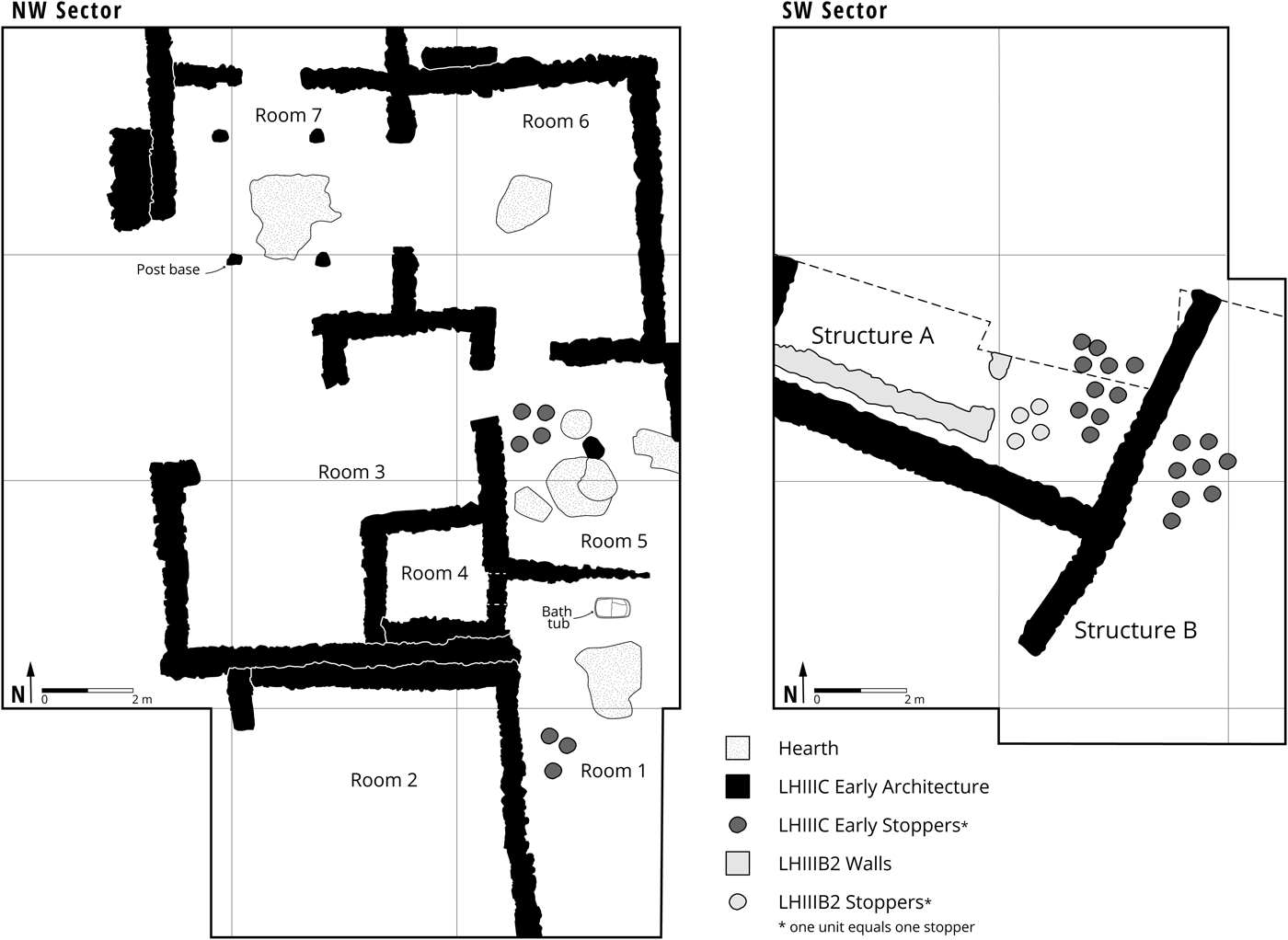
The post-palatial organisation of the household seems to have been fairly stable, with only minor alterations made to the structure after the first destruction horizon in LH IIIC Early 1. Stoppers were recovered embedded in, or lying on, floors in two rooms of the household: Room 1 and Room 5. In Room 3, currently interpreted as a semi-subterranean storeroom on the basis of three partially preserved unfired bins or kotselles (Van Damme Reference Van Damme2017b, 333–6), an intact hydria was found with a probable lid in situ, a roughly worked piece of tile. The largest concentration of stoppers, numbering four, was recovered from various floor layers within Room 5, a small kitchen room which preserved several hearths, at least three of which may have been in use during the final phase of occupation (Van Damme Reference Van Damme2017b, 339–42; Fig. 9). The stratigraphy of this room consists of alternating layers of ash, clay and hearth features which changed in size and location due to frequent renewal. Debris from the hearths was regularly swept off onto the adjacent floor and rubbish accumulated resulting in the incremental increases in floor elevation. The stoppers would appear to fit the profile of rubbish that was casually trodden into the floor surfaces. A second concentration of three stoppers was recovered from Room 1, currently believed to be a large domestic courtyard space (Van Damme Reference Van Damme2017b, 324–9). Such courtyards were frequently used for storage, cooking and dining activities (e.g., Stockhammer Reference Stockhammer, Yasur-Landau, Ebeling and Mazow2011; Maran and Papadimitriou Reference Maran and Papadimitriou2016; Van Damme Reference Van Damme2017b). The presence of a large transport stirrup jar placed in a domestic courtyard at Tiryns (Stockhammer Reference Stockhammer2008, 177–8; Reference Stockhammer, Bachhuber and Roberts2009) underscores these locations as places where the sealing and unsealing of such commodities could take place. The fact that Rooms 1 and 5 of the Northwest Complex at Eleon appear to have communicated (a door pivot was found in the north wall of Room 1, although no obvious threshold was preserved since the wall was heavily robbed away in antiquity) may also indicate that food preparation took place in Room 5 and was brought out to the courtyard already prepared, as attested at Tiryns. The presence of stoppers in both spaces points to wine consumption in tandem with dining in the courtyard, an activity supported by the presence of three kylikes found fallen in the bathtub of the courtyard (Van Damme Reference Van Damme, Tankosić, Mavridis and Kosma2017a, 173).
Plan of stopper finds spots at Ancient Eleon (drawn by Tina Ross after plan by Giuliani Bianco).

The presence of stoppers in these two rooms contributes not only to an understanding of the activities taking place within them, but also to understanding the circulation of commodities within the household. The only transport stirrup jar remaining in the Northwest Complex at the time of the destruction was stored in an upper story room, perhaps a measure designed to safeguard its contents. This vessel would have to be carried downstairs (a stairwell was likely conveniently located to the west of Room 5) to the kitchen or courtyard when required for use, whether for pouring out its contents or simply as a display object. These are details about the functioning of the household that can only be revealed through the detailed study of such innocuous finds as stoppers and their interpretation within their archaeological and social context.
A second context at Eleon shows an even more intense concentration of stoppers localised both inside an impressively built early post-palatial structure, referred to as Structure B, and in an adjacent street. This structure was preceded by a poorly understood palatial-period building, Structure A, which was destroyed at the end of LH IIIB2. Unlike the Northwest Household(s), Structure B experienced a destruction in LH IIIC Early 1, but does not appear to have been repaired and reoccupied. Stoppers were found both in the destruction fills, as well as the floor levels associated with Structures A and B. As noted above, at least two transport stirrup jars were also present in the same deposits, demonstrating that transport stirrup jars were stored either in the basement or upper story at the time of the destruction. Eight stoppers were also concentrated in the post-palatial levels to the east of Structure B in an area that is interpreted as a north–south oriented street. These derive from fills of rubbish that appear to have accumulated in this area over some time. While stoppers have been found in both Structures A and B, there is a dramatic jump in the total number of stoppers in the LH IIIC Early levels (four from Structure A versus 18 from inside and outside of Structure B).
It is tempting to connect this sudden increase in stoppers with increased availability of transport stirrup jars and their contents in secondary centres such as Eleon in the immediate aftermath of the collapse of the palace at Thebes, but the limited excavations in this area prohibit a firm understanding. The intensity of unsealing activities in this area may instead point to a functional difference in the use of the space (e.g., refuse disposal). It is these types of hypotheses that future careful contextualised study of stoppers at other sites will help to elucidate.
A review of the contexts above demonstrates a strong link between stoppering activities and storage vessels (transport stirrup jars in particular). Few mainland locations that have produced large quantities of transport stirrup jars have failed to produce stoppers (the House of the Oil Merchant is an obvious exception). This strongly indicates that the usage of stoppers and transport stirrup jars was somehow linked. As observed elsewhere, transport stirrup jars did not have to be sealed with stoppers, however, and it is worth pointing out that the Palace of Nestor has produced no published stoppers either, despite a reasonable number of complete transport stirrup jars (21 were measured in the present study including both inventoried and uninventoried items from Carl Blegen's excavations) and a thorough record of publication (Blegen and Rawson Reference Blegen and Rawson1966). This suggests a more complicated distribution of sealing methods than simply mainland versus Cretan practice. The evidence for perfumed olive oil production in the palace is one possible reason for the lack of ceramic disc stoppers (see Shelmerdine Reference Shelmerdine1985; Lis Reference Lis2016), if we accept that the difference in sealing method is predicated on the contents (wine versus olive oil).
A CODA ON IRON AGE STOPPERS
In contrast to the Late Bronze Age, where stoppers have been found in clear primary contexts, Iron Age stoppers have thus far been recovered mainly from fills and wells. As such, they have also proven difficult to interpret. While outside the scope of the present article, it will suffice here to note that the large number of Iron Age stoppers (e.g., Burr Reference Burr1933, 564, 603 fig. 71; Young Reference Young1939, 140; Brann Reference Brann1961, 342 no. F 62; Lalonde Reference Lalonde1968, 131; Papadopoulos Reference Papadopoulos2002, 423; Verdan Reference Verdan2013, 141–2 pl. 111; Erickson Reference Erickson2018, 176–8 fig. 146), in the opinion of the present author, are likely to have served a similar function in the sealing of amphorae, or other transport and storage vessels, although the presence of smaller examples shows that the relationship was not nearly as exclusive as in the Late Bronze Age, perhaps indicating a more consistent application of stoppers as part of the practice of sealing vessels. Certainly, the lack of primary find contexts makes any exclusive association during this period more challenging (Verdan Reference Verdan2013, 142). Notable in this regard, however, is a single pieced cut disc from an eighth-century bc grave published by Rodney Young, which was believed to have been used either as the stopper for a sealing or as an outright lid for an amphoriskos (Young Reference Young1939, 86 no. XVII 23, fig. 57). Any association of such cut discs with a ritual function has been cogently refuted by Michael Laughy (Reference Laughy2018, 642 fig. 9, 648–50) in his recent reanalysis of the stratigraphy and finds from the area of the Geometric House originally published by Dorothy Burr Thompson. More work is required on the many Early Iron Age discs recovered from the Athenian Agora, however, as they promise to shed light on continuities or discontinuities in sealing practices and commodity transport after the collapse of the palace system.
CONCLUSIONS
For over a century, a class of chipped ceramic and stone discs, here called stoppers, have appeared in the archaeological literature of the Aegean Bronze Age. As highlighted above, the only primary context in which stoppers have been found is placed inside the mouths of vessels in preparation for sealing. All other find spots are secondary, that is to say, discard contexts. While numerous archaeologists have assumed that such simplistic objects ought to be multifunctional, the evidence reviewed here suggests just the opposite. Ceramic disc stoppers had a single and enduring function across the eastern Mediterranean world because they offered a simple solution for the preservation and transport of liquid commodities. Over the course of thousands of years (from the Late Bronze Age through Late Roman period) this simple sealing technology either endured or reoccurred throughout the Eastern Mediterranean as the primary, if not only, means of sealing wine for long-term storage and maritime trade.
While stoppers certainly could have been reused for other functions, the burden of the evidence suggests that such reuse was rare. As once-recycled materials, stoppers were for the most part expedient and appear to have regularly been tossed out with domestic trash, just like bottle caps or corks today. In discussing stoppers found at the site of Nichoria, McDonald and Wilke (Reference Mcdonald and Wilke1992, 633) wrote: ‘Clearly our picture of everyday life in BA [Bronze Age] settlements would be incomplete if we forgot about such objects, even if their purpose defeats us.’ While one site alone may not provide the necessary evidence to solve the function of a given class of artefact, one of the foundations of archaeology is looking at the repeated spatial distribution of artefacts from multiple contexts in order to define ancient activities (e.g., Hodder and Orton Reference Hodder and Orton1976). It is hoped that the present article demonstrates that the pattern which emerges from close scrutiny of ceramic disc stoppers indicates links with transport vessels and sealing activities, that, when placed in its wider eastern Mediterranean context, becomes perfectly intelligible.
The present article has argued for a much stronger relationship between stoppers and transport vessels, particularly transport stirrup jars, than previous scholars and argued for greater attention to be paid to non-iconographic sealing practices in the Aegean world. A comparison with eastern Mediterranean sealing practices from the Late Bronze Age through Byzantine period demonstrates that these basic technologies have long lives and their use for the stoppering of particular containers, chiefly amphorae involved in long-distance trade of wine, is most likely analogous to their Late Bronze Age function on mainland Greece. A detailed metrological study of stoppers and transport stirrup jar apertures shows that they are closely correlated and that this is unlikely to be accidental. Furthermore, chemical residue analysis of a few transport stirrup jars suggests that transporting wine was one of their primary functions (Tzedakis and Martlew Reference Tzedakis and Martlew1999, 153 nos 134–5, 173 no. 165), although there is textual evidence to support the notion that perfumed oil was transported from time to time as well.Footnote 8 As the Mycenae evidence and comparative studies of sealing practices in Roman Egypt suggest, however, oil-bearing vessels could have utilised a different method of sealing, eschewing chipped ceramic or stone stoppers altogether.
While the present study has limited itself to unpierced chipped discs, it is possible that some pierced discs may have performed a similar function (although this requires more detailed study). Rarely, Late Bronze Age and Roman stoppers from Egypt were pierced, whether for the addition of a knotted cord to facilitate the removal of the sealing or to allow for the continued fermentation of the contents of the vessel (e.g., Hope Reference Hope1978, 7). Future studies may help to cast light on whether similar size distributions are seen within these data sets or if they should be categorised as a separate, discrete class of find.
I hope that the present study demonstrates the potential of stoppers to contribute not only to functional analyses of households, but also to consumption studies within and between settlements. Accepting that stoppers served as part of vessel-sealing practices offers a tantalising new avenue of research – chemical residue analysis of stoppers could offer insights into the contents of the vessels that they sealed, since they would have presumably come into regular contact with the contents stored inside. In such a manner, we may find that even the most unassuming of archaeological finds has a wealth of information to uncork.
ACKNOWLEDGEMENTS
This research was completed with funding from the Social Sciences and Humanities Council of Canada doctoral fellowship (752-2012-1055) while a fellow at the American School of Classical Studies. The idea to study stoppers in more detail came from the processing of pottery from ancient Eleon, where they began to appear in some quantity in 2012. I would like to extend my thanks to the directors of the Eastern Boeotia Archaeological Project: Alexandra Charami, Brendan Burke and Bryan Burns for allowing me to work on this material and encouraging me to see the project through to completion. Ioanna Damanaki was instrumental in securing countless permits to measure stoppers and stirrup jars as well as obtain image permissions. I extend my warmest thanks to the museum staff at the Archaeological Museum of Mycenae and the Thebes Archaeological Museum for facilitating my visits. I would also like to thank Sharon Stocker and Ioulia Tzonou, respectfully, for allowing me to access the Hora and Corinth apothekes to measure additional stirrup jars. Elizabeth French was instrumental in accessing the stoppers from the House of the Wine Merchant and the Mycenae Archive at Cambridge, and I hope the final product does justice to her meticulous notebooks. Thanks is also owed to Anastasia Dakouri-Hild for providing me with data from her work on the House of Kadmos, Marianna Nikolaidou for helping with the Greek abstract, as well as Brian Martens and Tina Ross for their assistance preparing the illustrations. In addition, I thank the following individuals for reading drafts of this paper or discussing various aspects of the project as it evolved: Brendan Burke, Bryan Burns, Jacob Engstrom, Bartłomiej Lis, Brian Martens, Sarah Morris, John Papadopoulos and Catherine Pratt. All errors and omissions that remain are my own.