Introduction
Rice (Oryza sativa L.) (2n = 2x = 24) is the world's second most important cereal and a key staple food crop from the Poaceae family. It plays a crucial role both nutritionally and agriculturally, providing sustenance to around 3.2 billion people globally. Currently, the rising demand for rice emphasizes the need to enhance its production while minimizing pest and disease outbreaks. With the teeming global population, the projected rice demand is expected to reach 590 million tonnes by 2050 (Samal and Babu, Reference Samal and Babu2018). Biotic stresses caused by fungi, bacteria and nematodes pose significant challenges to rice production by reducing both yield and quality. Among the bacterial diseases, bacterial blight (BB) is particularly concerning due to its widespread, destructive nature and its prevalence under favourable conditions. Caused by Xanthomonas oryzae pv. oryzae (Xoo), it is one of the most damaging diseases in both irrigated and rain-fed rice cultivation across Asia, leading to substantial losses, especially in regions with high-yielding varieties (Patil et al., Reference Patil, Jagadeesh, Karegowda, Naik and Revathi2017; Lu et al., Reference Lu, Zhong, Xiao, Wang, Ke, Zhang, Yin, Zhang, Jiang, Liu and Li2022). Infection during the maximum tillering stage leads to severe leaf blight symptoms impacting the primary photosynthetic area and causing significant yield losses ranging from 20 to 30%, with 80–100% in heavily affected fields (Sombunjitt et al., Reference Sombunjitt, Sriwongchai, Kuleung and Hongtrakul2017; Baliyan et al., Reference Baliyan, Malik, Rani, Mehta, Vashisth, Dhillon and Boora2018). Recently, the genes associated with pathogen virulence and the interactions between bacteria and plants have been closely examined (White and Yang, Reference White and Yang2009; Ryan et al., Reference Ryan, Heuberger, Weir, Barnett, Broeckling and Prenni2011). The thiG gene, involved in thiamine biosynthesis, has been identified as essential for the virulence of Xoo (Yu et al., Reference Yu, Liang, Liu, Dong, Wang and Zhou2015). The protein encoded by thiG functions as a vital enzyme in the synthesis of the thiazole.
To minimize yield losses and prevent disease outbreaks, various management strategies have been implemented, with chemical usage being widely adopted. However, the chemical control has proven largely ineffective against this disease (Laha et al., Reference Laha, Reddy, Krishnaveni, Sundaram, Prasad, Ram, Muralidharan and Viraktamath2009; Kumar et al., Reference Kumar, Kumar, Sengupta, Das, Pandey, Bohra, Sharma, Sinha, Sk, Ghazi and Laha2020), highlighting the need for cost-effective, easily adaptable and environmentally friendly solutions. One promising approach is to enhance resistance to bacterial blight by broadening the genetic base of high-yielding rice cultivars through the incorporation of resistant genes. Currently, 47 major BB resistance (R) genes have been identified in from wild relatives, landraces, mutants and cultivated species, conferring resistance against different Xoo strains (Brar and Khush, Reference Brar and Khush1997; Kumar et al., Reference Kumar, Kumar, Sengupta, Das, Pandey, Bohra, Sharma, Sinha, Sk, Ghazi and Laha2020; Liu et al., Reference Liu, Li, Wang, Xu, Yan, Wang, Shah, Peng, Zhu and Xu2024). The emergence of new pathotypes has made existing resistance genes increasingly vulnerable, underscoring the need for novel resistance sources, as rice cultivars with single major resistance genes are more susceptible to breakdown from pathogen mutations compared to those with multi-locus resistance. Therefore, breeding programmes focused on new resistance sources along with multi-locus resistance varieties offer a more effective strategy for achieving long-term sustainability in rice production. Out of the resistance genes, few gene combinations of xa5 + xa13 + Xa21 (Pradhan et al., Reference Pradhan, Barik, Sahoo, Mohapatra, Nayak, Mahender, Meher, Anandan and Pandit2016), Xa4 + Xa21 + xa5 + xa13 (Chukwu et al., Reference Chukwu, Rafii, Ramlee, Ismail, Oladosu, Kolapo, Musa, Halidu, Muhammad and Ahmed2019) and Xa4 + xa5 + Xa7 + xa13 + Xa21 (Hsu et al., Reference Hsu, Chiu, Yap, Tseng and Wu2020) have been shown to provide strong resistance to bacterial blight when introgressed together.
The wild rice species serve as valuable untapped sources of distinct alleles offering resistance to various biotic stresses (Bhasin et al., Reference Bhasin, Bhatia, Raghuvanshi, Lore, Gurpreet, Kaur, Vikal and Singh2012; Yang et al., Reference Yang, Lin, Cheng, Zhou, Chen, Liu, Li and Qiu2020), tolerance to abiotic stresses (Brar and Khush, Reference Brar and Khush2006; Cao et al., Reference Cao, Li, Tang, Zeng, Tang, Long, Wu, Cai, Yuan and Wan2020), as well as economically important traits such as grain yield (Luo et al., Reference Luo, Jun, Dai, Zhang, Yi, Yong and Xie2016; Balakrishnan et al., Reference Balakrishnan, Surapaneni and Yadavalli2020) and grain quality (Qi et al., Reference Qi, Ding, Zheng, Xu, Zhang, Wang, Wang, Zhang, Cheng, Qiao and Yang2018). Regarding bacterial blight, few BB-R genes that have been identified from wild species include Xa21 in O. longistaminata (Khush et al., Reference Khush, Bacalangco and Ogawa1990; Ronald et al., Reference Ronald, Albano, Tabien, Abenes, Wu, McCouch and Tanksley1992), Xa23 in O. rufipogon (Zhang et al., Reference Zhang, Lin, Zhao, Wang, Yang, Zhou, Li, Chen and Zhu1998; Wang et al., Reference Wang, Fan, Zheng, Qin, Zhang and Zhao2014), Xa27(t) in O. minuta (Gu et al., Reference Gu, Tian, Yang, Wu, Sreekala, Wang, Wang and Yin2004), Xa29 in O. officinalis (Tan et al., Reference Tan, Ren, Weng, Shi, Zhu and He2004), Xa30(t) in O. nivara (Jin et al., Reference Jin, Wang, Yang, Jiang, Fan, Liu and Zhao2007), Xa32(t) in O. australiensis (Zheng et al., Reference Zheng, Wang, Yu, Lian and Zhao2009), Xa33 in O. nivara (Kumar et al., Reference Kumar, Sujatha, Laha, Srinivasa Rao, Mishra, Viraktamath, Hari, Reddy, Balachandran, Ram and Madhav2012), Xa34 in O. branchyantha (Ram et al., Reference Ram, Laha, Gautam, Deen, Madhav, Brar and Viraktamath2008), Xa35(t) in O. minuta (Guo et al., Reference Guo, Zhang and Lin2010), Xa38 in O. nivara (Kaur et al., Reference Kaur, Grewal, Das, Vikal, Singh, Bharaj, Sidhu and Singh2006; Bhasin et al., Reference Bhasin, Bhatia, Raghuvanshi, Lore, Gurpreet, Kaur, Vikal and Singh2012), xa41 in O. barthii and O. glaberrima (Hutin et al., Reference Hutin, Sabot, Ghesquière, Koebnik and Szurek2015), Xa45 in O. glaberrima (Neelam et al., Reference Neelam, Mahajan, Gupta, Bhatia, Gill, Komal, Lore, Mangat and Singh2020) and Xa47(t) in O. rufipogon (Xing et al., Reference Xing, Zhang, Yin, Zhong, Wang, Xiao, Ke, Wang, Zhang, Zhao and Lu2021) and Xa48 in O. officinalis (Sinha et al., Reference Sinha, Kumar, Sk, Solanki, Gokulan, Das, Miriyala, Gonuguntala, Elumalai P, MBV and SK2023). Thus, the importance of wild rice species in relation to bacterial blight resistance lies in their genetic diversity, the presence of valuable resistance genes, and their contribution to sustainable agricultural practices and food security. In light of this, the present study was undertaken to identify potential new sources of bacterial blight resistance in different species of Oryza, utilizing the molecular markers to enhance breeding efforts for developing resilient rice varieties.
Material and methods
Plant material
One hundred and twelve wild rice accessions, comprising of 59 accessions of O. rufipogon, nine of O. nivara, five of O. australiensis, five of O. punctata, five of O. rhizomatis, four of O. officinalis, four of O. grandiglumis, four of O. alta, four of O. latifolia, three of O. eichingeri, two of O. minuta, two of O. longistaminata, two of O. barthii, one of O. glumaepatula, one of O. ridleyi, one of O. longiglumis and one of O. meridionalis (online Supplementary Table S1) were utilized in the present study. In addition to these, the BB-positive checks included Improved Samba Mahsuri, PR 114, IRBB-23, IRBB-27, FBR-15 and IR-64, while Samba Mahsuri was used as the susceptible check.
Phenotypic screening of the wild accessions for BB resistance
The wild rice accessions and susceptible check Samba Mahsuri were grown in pots and screened against bacterial blight at ICAR-Indian Institute of Rice Research (IIRR), Rajendranagar, Hyderabad, during Kharif 2020, Rabi 2020–2021 and Kharif 2021. The isolate of Xanthomonas oryzae pv. oryzae (Xoo) strain IX-020, was used to create disease artificially. The Xoo strain, IX- 020 was grown in modified Wakimoto's culture medium (Laha et al., Reference Laha, Reddy, Krishnaveni, Sundaram, Prasad, Ram, Muralidharan and Viraktamath2009) and using a 3-day-old culture, bacterial suspension (108 cfu/ml) was prepared and used for inoculation. The plants at maximum tillering stage were inoculated by clipping top 2–3 cm of completely developed leaves with sterilized scissors dipped in the bacterial suspension (Kauffman et al., Reference Kauffman, Reddy, Hiesh and Merca1973). Disease reactions were recorded on five plants following the Standard Evaluation System for Rice (IRRI, 2014) by measuring the lesions length caused by BB on each inoculated leaf at 14 days and 21 days after inoculation. Accessions were classified as resistant (⩽3 cm), moderately resistant (3–6 cm), moderately susceptible (6–9 cm) and susceptible (⩾9 cm) based on the mean lesion length as per Chen et al. (Reference Chen, Lin, Xu and Zhang2000).
Genotypic characterization using SSR markers
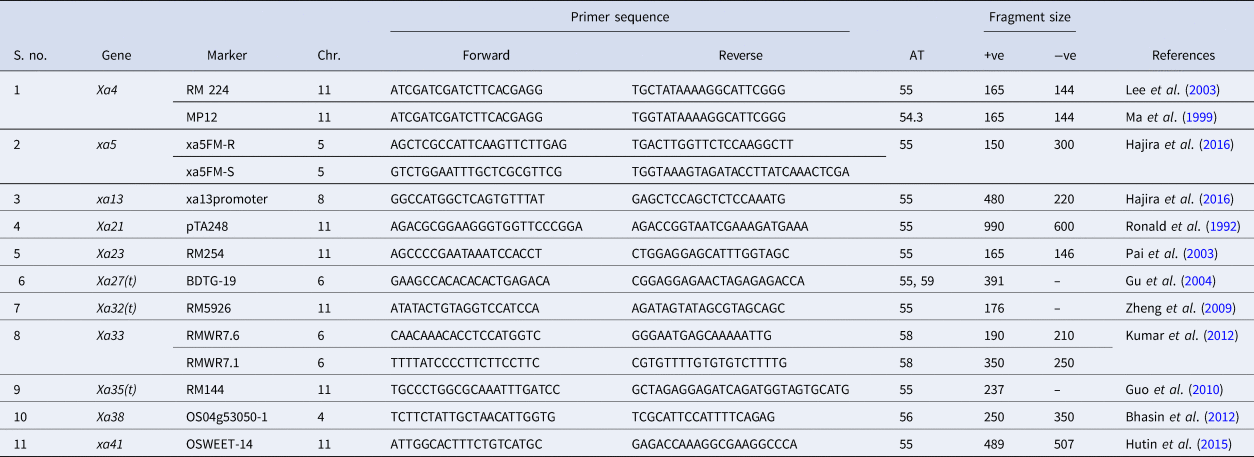
The accessions showing high BB resistance after inoculating with BB strain IX-020 were selected for molecular characterization. The bacterial blight resistant accessions of wild rice were characterized for the presence or absence of 11 bacterial blight resistant genes, namely Xa4, xa5, xa13, Xa21, Xa23, Xa27(t), Xa32(t), Xa33, Xa35(t), Xa38 and xa41 using the gene-linked reported markers (Table 1). Resistant checks were used as positives for bacterial blight (BB) resistance genes, including Improved Samba Mahsuri (xa5, xa13, Xa21), PR 114 (Xa38), IRBB-23 (Xa23), IRBB-27 (Xa27(t)), FBR-15 (Xa33) and IR-64 (Xa4). For the remaining genes, the amplicon size corresponding to the respective original donors is considered. On the other hand, the susceptible check Samba Mahsuri was negative for all the BB resistance genes, serving as a control in the experiment. The PCR amplification using the gene-specific primers was carried out using PCR cyclers with 2 μl of diluted DNA, 0.5 μl of forward primer, 0.5 μl of reverse primer, 4 μl of Master mix and 3 μl of nuclease-free water. Marker-specific annealing temperatures ranging between 54 and 63°C were used. The PCR amplified products were then resolved in 3% agarose (3 g of agarose dissolved in 100 ml 1× TAE buffer) gel at 100 V for 2 h in gel electrophoresis unit (iLIFE Biotech). The gels stained in ethidium bromide (10 mg/ml) were placed over the UV-transilluminator and documented using GELSTAN gel documentation system (Mediccare) for documentation. The documented gels with amplified products were scored visually and allele sizes were analysed against the standard 50 and 100 bp ladder and size is expressed in base pairs (bp).
Bacterial blight resistance genes used for characterization of wild rice accessions

Where, AT = annealing temperature.
Results
Phenotypic performance of wild rice accessions for bacterial blight disease
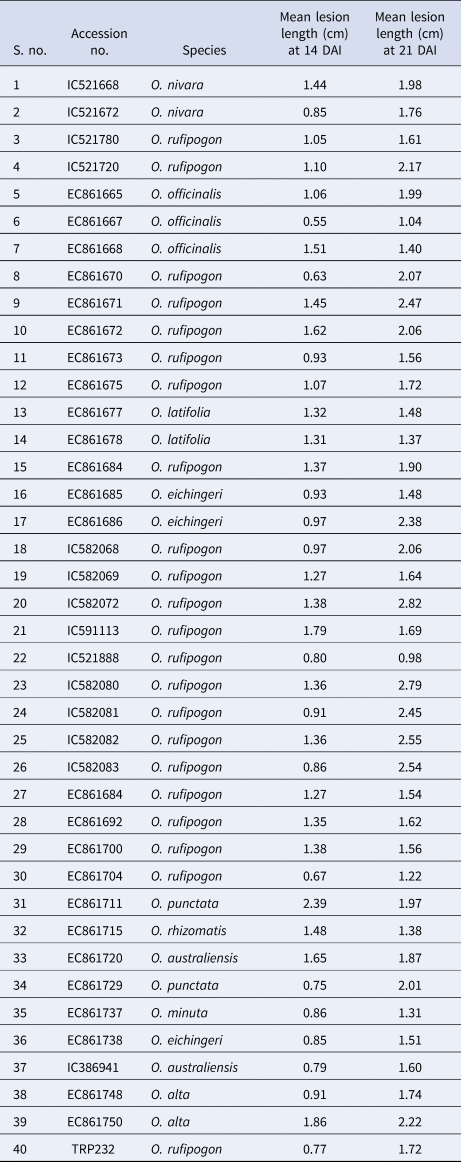
A total of 112 wild rice accessions along with the susceptible check (Samba Mahsuri) were screened for analysing their response towards an invasive strain of Xanthomonas oryzae pv. oryzae (Xoo). The phenotypic response of the rice accessions upon inoculation is shown in online Supplementary Table S2 and Fig. 1. In kharif 2020, 74 accessions were recorded as resistant with a lesion length of less than 3 cm, 18 accessions were moderately resistant with 3–6 cm lesion length, two were moderately susceptible with a length of 6–9 cm (IC581952, EC861760), while one accession (IC581951) was susceptible with more than 9 cm lesion length, after 14 days of inoculation. The susceptible check recorded a lesion length of 9.46 cm.
Colour map representing the presence or absence of reported genes in checks and 40 wild rice accessions. Blue colour indicates the presence of a gene, white colour indicates the absence of gene and yellow colour indicates no amplification.

In rabi 2020–2021, 91 accessions showed a lesion length of less than 3 cm (resistant), 16 accessions recorded a lesion length in between 3 and 6 cm (moderately resistant), two accessions showed between 6 and 9 cm (IC521719, EC861749), rendering them as moderately susceptible at 14 days after inoculation. During the same season, at 21 days, 34 accessions showed a lesion length of less than 3 cm (resistant), 50 accessions had 3–6 cm length (moderately resistant), 14 accessions showed between 6 and 9 cm (moderately susceptible) and six accessions showed more than 9 cm (susceptible). The susceptible check recorded 10.8 and 16.92 cm at 14 and 21 days, respectively. In Kharif 2021, at 14 days after inoculation, 98 accessions were resistant showing a lesion length of less than 3 cm, 16 accessions were moderately resistant (3–6 cm), one accession (IC581956) was moderately susceptible with a score of 6.74 cm. At 21 days after inoculation, 42 accessions were resistant, 64 accessions were moderately resistant, eight were moderately susceptible, while one accession (EC861727) was susceptible. Samba Mahsuri was completely susceptible at both 14 (9.78 cm) and 21 days (12.8 cm) after inoculation.
On the whole, based on the mean performance of three seasons at 14 days and 21 days after inoculation, 40 accessions (Table 2, Fig. 1) were consistently resistant with a mean lesion length of less than 3 cm. These 40 BB resistant accessions included 22 accessions of O. rufipogon, two accessions of O. nivara, three accessions of O. officinalis, two accessions of O. latifolia, two accessions of O. australiensis, one accession of O. minuta, two accessions of O. punctata, three of O. eichingeri, one accession of O. rhizomatis and two accessions of O. alta. These 40 resistant accessions were selected for further molecular characterization studies.
Reaction of promising BB resistant accessions of wild species of rice against IX-020 isolate across seasons

Molecular characterization of the BB resistant accessions
The molecular profiling of wild rice accessions for bacterial blight resistance revealed the presence of several Xa genes linked to resistance. The results are detailed in Fig. 1 and online Supplementary Fig. S1. The dominant Xa4 gene which is linked to RM224 marker was found in seven resistant accessions, namely, O. officinalis (EC861665, EC861668), O. rufipogon (EC861684, IC582068, IC582069), O. australiensis (IC386941) and O. alta (EC861748). Xa21 gene located on chromosome 11, linked to the pTA248 marker, was present only in one O. rufipogon accession (IC582069). RM254 marker flanking the Xa23 gene got validated in 16 of the wild rice accessions, viz., O. nivara (IC521668), O. rufipogon (IC521270, EC861672, EC861673, EC861675, EC861684, IC582068, IC582072, IC591113, IC521888, IC582080, IC582081, IC582082, IC582083), O. eichingeri (EC861686) and O. alta (EC861748). Accessions O. officinalis (EC861668) and O. rufipogon (EC861670, EC861671, EC861672, EC861704) were found to be having Xa27(t), flanked by BDTG-19 marker.
Similarly, seven accessions (O. nivara (IC521668), O. latifolia (EC861686), O. eichingeri (EC861686), O. rufipogon (IC582068, IC582080) and O. rhizomatis (EC861715) were recorded to be having the dominant Xa32(t) gene flanked by the RM5926. RMWR7.1 and RMWR7.6 markers flanking the Xa33 gene on chromosome 6, was identified in 14 accessions, viz., O. officinalis (EC861668), O. rufipogon (EC861673, IC582068, IC582069, IC582072, IC521888, IC582080, IC582081, EC861704), O. eichingeri (EC861685), O. australiensis (EC861720, IC386941) and O. alta (EC861748, EC861750). Fifteen accessions of wild rice, including O. officinalis (EC861665, EC861668), O. eichingeri (EC861686), O. rufipogon (EC861676, IC582068, IC582072, IC591113, IC521888, IC582080, IC582082, IC582083, EC861684, EC861692), O. minuta (EC861737) and O. alta (EC861750) were found to be having positive alleles for RM144 linked to Xa35(t) on chromosome 11. The dominant Xa38 gene on chromosome 11, flanked by the marker Oso4g53050-1, was found only in one accession of O. eichingeri (EC861686). Ten accessions, namely, O. rufipogon (IC521780, EC861670, EC861671, IC582069, IC591113, IC521888, EC861684), O. latifolia (EC861678), O. eichingeri (EC861685) and O. australiensis (EC861720) were positive for the presence of xa41, flanked by Osweet14 marker. On the other hand, the recessive xa5 gene, located on chromosome 5 and linked to the xa5FM marker, was identified in six accessions, viz., O. rufipogon (EC861670), O. latifolia (EC861678), O. rhizomatis (EC861715), O. australiensis (EC861720, IC386941) and O. alta (EC861750). Likewise, another recessive gene, xa13 on chromosome 8, linked to the xa13promoter marker, was absent in all the resistant accessions.
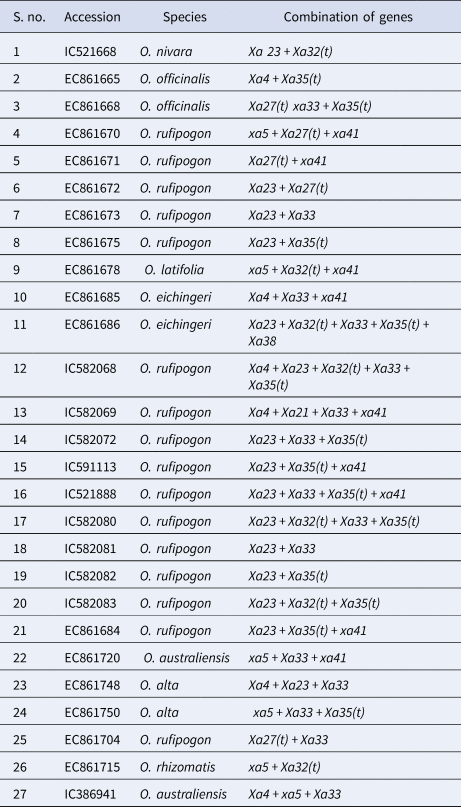
Out of the 40 BB-resistant accessions of wild rice, 30 accessions had more than one resistant gene, while five accessions, viz., IC521672 (O. nivara), EC861665 (O. officinalis), EC861677 (O. latifolia), EC861711 (O. punctata) and EC861738 (O. eichingeri) did not show any BB resistance genes validated. Notably, the accessions of O. rufipogon, namely, EC861670 (xa5 + Xa27(t) + xa41), EC861675 (Xa23 + Xa33 + Xa35(t)), IC582072 (Xa23 + Xa33 + Xa35(t)), IC591113 (Xa23 + Xa35(t) + xa41), EC861684 (Xa4 + Xa23 + Xa33), EC861684 (Xa23 + Xa35(t) + xa41) had three genes, while accessions IC582068 (Xa4 + Xa23 + Xa32(t) + Xa33 + Xa35(t)), IC582069 (Xa4 + Xa21 + Xa33 + xa41), IC521888 (Xa23 + Xa33 + Xa35(t) + xa41), IC582080 (Xa23 + Xa32(t) + Xa33 + Xa35(t)) and IC582083 (Xa23 + Xa32(t) + Xa33 + Xa35(t)) showed even greater genetic complexity with more than three resistance genes (Table 3). Similarly, O. australiensis with EC861720 (Xa4 + xa5 + Xa33 + xa41) and IC386941 (Xa4 + xa5 + Xa33) accessions, O. officinalis (EC861668- Xa4 + Xa27(t) + Xa33 + Xa35(t)), O. nivara (IC521668- Xa23, Xa32(t)) and O. latifolia (EC861678- xa5, Xa32(t), xa41) species presented valuable gene combinations. Moreover, O. eichingeri accession (EC861686) was particularly noteworthy for its unique combination of five resistance genes, viz., Xa23, Xa32(t), Xa33, Xa35(t) and Xa38. On the other hand, Xa21 was detected in only one O. rufipogon accession (IC582069). Overall, the gene combinations, namely, Xa23 + Xa33 + Xa35(t) + xa41 in IC521888, Xa23 + Xa32(t) in IC521668, xa5 + Xa32(t) + xa41 in EC861678 and xa5 + Xa32(t) in EC861715 were found to be highly effective as these genotypes exhibited high resistance.
List of BB resistant accessions of wild species rice with different gene combinations

Discussion
Developing disease-resistant cultivars is an effective and resource-efficient approach for attaining durable, environmentally sustainable and broad-spectrum resistance to BB (Sundaram et al., Reference Sundaram, Vishnupriya, Biradar, Laha, Reddy, Rani, Sarma and Sonti2008; Kanipriya et al., Reference Kanipriya, Natarajan, Gopalakrishnan, Ramalingam, Saraswathi and Ramanathan2024). In particular, creating and utilizing rice cultivars with multiple BB-R genes has proven to be a successful strategy for controlling the diverse range of Xoo strains (Kottapalli et al., Reference Kottapalli, Rakwal, Satoh, Shibato, Kottapalli, Iwahashi and Kikuchi2007; Kumar et al., Reference Kumar, Kumar, Sengupta, Das, Pandey, Bohra, Sharma, Sinha, Sk, Ghazi and Laha2020). In the present study, the phenotypic evaluation of wild rice accessions across multiple seasons revealed significant insights into their potential for bacterial blight resistance. The consistent performance of several accessions, particularly their resistance to the invasive strain of Xanthomonas oryzae pv. oryzae (Xoo), underscores the value of wild rice germplasm in breeding programmes aimed at enhancing disease resistance in cultivated rice varieties. In Kharif 2020, the majority of the accessions exhibited strong resistance, with 74 accessions showing lesion lengths of less than 3 cm, indicating high levels of resistance. This trend was similarly observed in subsequent seasons, with an even greater number of accessions demonstrating resistance during Rabi 2020–2021. Notably, in Kharif 2021, 98 accessions were resistant at 14 days post-inoculation, further confirming the robustness of these accessions against bacterial blight. These results are particularly significant when considering that the susceptible check, Samba Mahsuri, consistently recorded much larger lesion lengths, highlighting the enhanced resistance in the wild rice accessions. Species, O. longistaminata, O. barthii, O. ridleyi, O. longiglumis, O. grandiglumis, O. meridionalis and O. glumaepatula were not resistant to the bacterial blight. Similar studies on the screening for BB resistance were taken up by Singh et al. (Reference Singh, Dharmraj, Nayak, Singh and Singh2015), classifying 11 wild rice accessions as moderately resistant, 21 as moderately susceptible, and three as susceptible accessions.
The resistance observed in 40 wild rice accessions across three seasons, underscores the significant potential of these accessions in breeding programmes aimed at enhancing bacterial blight resistance. The prominence of O. rufipogon species with 22 accessions showing consistent resistance reinforces its importance as a key source of resistance genes. The diverse species represented in this resistant group, including O. rufipogon, O. nivara, O. officinalis, O. latifolia, O. australiensis, O. minuta, O. punctata, O. eichingeri, O. rhizomatis and O. alta, highlights the broad genetic base which is crucial for breeding efforts aimed at combating the evolving threat of bacterial blight. The selection of these 40 accessions for further molecular characterization aims to identify the underlying genetic factors contributing to their resistance.
Consequently, the molecular characterization revealed a high level of variability in the combination of BB resistance genes across the accessions. The presence of the Xa4 gene in eight accessions, xa5 in six accessions, Xa23 in 17 accessions, Xa27(t) in five accessions, Xa32(t) in eight accessions, Xa33 in 18 accessions, Xa35(t) in 15 accessions and xa41 in 11 accessions highlights a broad spectrum of bacterial blight resistance across wild rice species. This distribution indicates a rich genetic diversity that is valuable for breeding programmes aimed at developing durable and effective resistance. The recessive xa13 gene was absent in all resistant accessions, indicating a possible lack of contribution to resistance in these wild rice varieties. One of the most promising aspects of this study is the identification of accessions harbouring multiple resistance genes. The wild rice species O. rufipogon, a key progenitor of cultivated rice (Barbier et al., Reference Barbier, Morishima and Ishihama1991; Khush, Reference Khush1997), exhibited significant variation in its bacterial blight resistance gene combinations. Several accessions contained more than three resistance genes, exhibiting greater genetic complexity, making them highly valuable for gene pyramiding strategies to enhance resistance in cultivated rice. Similarly, species like O. australiensis, O. officinalis, O. nivara and O. latifolia showed valuable gene combinations, contributing further to the diversity of resistance genes available for breeding. Two standouts were an O. eichingeri (EC861686-Xa23 + Xa32(t) + Xa33 + Xa35(t) + Xa38) and O. rufipogon accession (IC582068-Xa4 + Xa23 + Xa32(t) + Xa33 + Xa35(t)), with a unique set of five resistance genes, highlighting their high potential for durable resistance and effectiveness against Xoo, especially given the rarity of Xa38. Notably, the combinations of Xa23 + Xa33 + Xa35(t) + xa41 in IC521888, Xa23 + Xa32(t) in IC521668, xa5 + Xa32(t) + xa41 in EC861678 and xa5 + Xa32(t) in EC861715 demonstrated a high degree of resistance against the pathogen. These multiple gene combinations could be essential for maintaining stability in resistance against the pathogenic strains, potentially mitigating the risk of resistance breakdown, as stated by Nath et al. (Reference Nath, Nath, Majumder and Kundagrami2022). On the other hand, the detection of Xa21 in a single O. rufipogon accession, pointed its rarity and significant potential for providing resistance. These accessions provide crucial genetic resources for developing rice varieties with enhanced and durable resistance.
Xa23 was originally mapped in O. rufipogon (Zhang et al., Reference Zhang, Lin, Zhao, Wang, Yang, Zhou, Li, Chen and Zhu1998; Wang et al., Reference Wang, Fan, Zheng, Qin, Zhang and Zhao2014). In our study, the presence of Xa23 was confirmed in several O. rufipogon accessions (IC521720, EC861672, EC861673, EC861675, EC861684, IC582068, IC582072, IC591113, IC521888, IC582080, IC582081, IC582082, IC582083, EC861684), highlighting its potential as a valuable genetic resource for improving bacterial blight resistance in rice. While both Xa35(t) and Xa27(t) have been identified in O. minuta (Gu et al., Reference Gu, Tian, Yang, Wu, Sreekala, Wang, Wang and Yin2004; Guo et al., Reference Guo, Zhang and Lin2010), our current study found the O. minuta accession EC861737 carrying only the Xa35(t) gene. Likewise, Xa32(t) which was identified in O. australiensis species (Zheng et al., Reference Zheng, Wang, Yu, Lian and Zhao2009) was not found in any of the resistant O. australiensis accessions, including EC861720 and IC386941. In the case of O. nivara, two genes, namely Xa33 (Kumar et al., Reference Kumar, Sujatha, Laha, Srinivasa Rao, Mishra, Viraktamath, Hari, Reddy, Balachandran, Ram and Madhav2012) and Xa38 (Cheema et al., Reference Cheema, Grewal, Vikal, Sharma, Lore, Das and Singh2008) which have been previously reported were not found in the O. nivara accession IC521672, in spite of being resistant. Similar validation of reported genes was performed by Chen et al. (Reference Chen, Yin, Zhang, Xiao, Zhong, Wang, Ke, Ji, Wang, Zhang and Jiang2022) and Singh et al. (Reference Singh, Dharmraj, Nayak, Singh and Singh2015) in wild rice accessions. Additionally, five accessions belonging to O. nivara, O. officinalis, O. latifolia, O. punctata and O. eichingeri species did not show any of the validated BB resistance genes despite their phenotypic resistance, suggesting the presence of novel resistance mechanisms or genes that were not covered by the markers used. This highlights the necessity of further inheritance and mapping studies to ascertain the novelty of the sources. Additionally, integrating advanced genomic tools such as whole-genome sequencing and transcriptome analysis could provide deeper insights into the genetic basis of resistance in these novel sources. Also, we reported the resistance of the accessions based on screening with a single virulent strain of the Xanthomonas oryzae pv. oryzae (Xoo) isolate. While our findings provide valuable insights into the resistance profiles, screening them against multiple Xoo isolates with varying virulence levels as a future line of work would strengthen the reliability of the resistance assessments. This approach will enhance understanding of the genetic basis of resistance and offer a more comprehensive evaluation of the accession's resilience to different Xoo strains.
Conclusion
The wild rice accessions identified in this study represent a rich source of genetic diversity for bacterial blight resistance. The combination of phenotypic and molecular characterization has provided a comprehensive understanding of their resistance potential, paving the way for their use in breeding programmes aimed at developing robust, disease-resistant rice varieties. The identification of accessions with complex gene combinations offers a promising avenue for marker-assisted selection and gene pyramiding in breeding programmes. These findings emphasize the value of conserving and utilizing wild rice germplasm to address the ongoing challenges of bacterial blight in rice production. Future research should focus on the functional validation of these genes in various genetic backgrounds and environments to confirm their utility in resistance breeding.
Supplementary material
The supplementary material for this article can be found at https://doi.org/10.1017/S1479262124000601.
Acknowledgements
The authors sincerely appreciate the support received from the ICAR-Indian Institute of Rice Research, Hyderabad and ANGRAU, Lam, for providing the necessary resources to carry out the experiment.
Competing interests
The authors declare they have no conflicts of interest.