Introduction
Green revolution technologies increased food production and helped India to achieve self-sufficiency in the 1980sReference Donald, Eugene, Pannu and Sheokand1. However, India is still home to 231 million undernourished people with a majority of these (175 million) living in rural areas2. This highlights the fact that the green revolution did not entirely address the issues faced by a significant section of rural India which comprises mainly marginal and small farmers. In India, 81% of farms are <2 ha and make up 38% of the total cultivated area3.
The FAO conference on organic agriculture and food security in May 2007 concluded that organic agriculture has the potential to improve the food security in developing countries, particularly for small farmersReference Scialabba4. Organic agriculture includes both certified and non-certified food systems. Organic agriculture may improve the local food security through the production of a diverse range of products at a lower input cost than in conventional farming5, thus alleviating the poverty of smallholders. Organic agriculture may also have a number of environmental benefits like improved soil structure, increase in soil organic matter contentReference Marriott and Wander6, Reference Fließbach, Oberholzer, Gunst and Mäder7 and larger biodiversityReference Bengtsson, Ahnström and Weibull8, Reference Tscharntke, Clough, Wanger, Jackson, Motzke, Perfecto, Vandermeer and Whitbread9, even though this is mostly documented in temperate regions. Under low-input conditions such as in East Africa, organic agriculture—mostly non-certified—has been found by a large number of NGOs to improve yields and food security10. However, organic farming has been found to result in lower crop yieldsReference Seufert, Ramankutty and Foley11, Reference De Ponti, Rijk and Van Ittersum12, especially in high-yielding areas, and there is a challenge in managing the nitrogen availability in organic systemsReference Seufert, Ramankutty and Foley11.
Only a few have studied the large-scale conversion of organic farming and its possible impacts on food production and food security. Organic conversion would not have a severe impact on global food supply, but would rather help to improve local food availability and food security in developing countries, particularly sub-Saharan AfricaReference Halberg, Rosegrant, Sulser, Knudsen, Høgh-Jensen, Halberg, Knudsen, Alrøe and Kristensen13. The results of another study show that organic methods could produce enough food on a global per capita basis to sustain the current or a larger population without increasing the land area under cultivationReference Badgley, Moghtader, Quintero, Zakem, Chappell, Avilés-Vàzques, Samulon and Perfecto14. These modeling studies considered the impact of organic agriculture on global food supply and world food security. However, there is lack of country-specific modeling of large-scale organic conversion on food security. Hence, this study was to assess the economic situation of marginal and small farm types, and state-level food production in the large-scale organic scenario in two states of India––Tamil Nadu and Madhya Pradesh.
Materials and Methods
This section is divided into five subsections: the first subsection presents the land-use pattern and socio-economic situations in the studied states before large-scale conversion, the second subsection describes the land-use changes and yield ratio for large-scale organic conversion, the third subsection shows the data sources and secondary data collection at state level, the fourth subsection describes the method of calculation for assessing the economic situation, and calculation of the state-level food production in the organic scenario is presented in the fifth subsection.
Land use and socio-economic situation before large-scale conversion
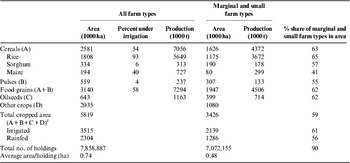
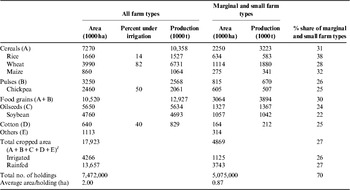
Two states in India were considered in this study—Tamil Nadu and Madhya Pradesh, which represent different but typical challenging situations of a high proportion of resource-poor smallholder farmers dependent on rainfed agriculture. Moreover, there are experiences with organic agriculture in these two states, which formed a basis for household-level surveys. In order to study a hypothetical situation where all the marginal and small farm types would convert their production to organic farming, it was necessary to create a simulation of a regional status by up-scaling the significantly relevant factors. The first part of this study at the household levelReference Panneerselvam15 conducted in three states of India in order to represent three very different situations in terms of agro-ecological conditions, farming system, market access and activities of NGOs promoting organic farming. The states chosen for household study were Uttarakhand, Madhya Pradesh and Tamil Nadu, respectively from north, central and southern parts of India. However, Uttarakhand, a new state, was left out for the up-scaling due to lack of secondary data. In Tamil Nadu, the Center for Indian Knowledge system, an NGOs promotes organic farming among small and marginal farmers to improve their food security. The NGO provides training to the farmers on organic farming and, to some extent, interest free credit. Also, the NGO educates the farmers to use farm resources to manage soil fertility and pests and diseases. In Madhya Pradesh, BioRe India, a private company, promotes organic cotton production. BioRe provides the associated farmers with training and technical advice on organic cotton production and purchases the cotton with a 20% price premium on actual market rates. The company operates an internal control system and arranges for external organic certification by an internationally accredited agency. Costs for extension, certification and for the organic price premium are recovered by selling the certified organic fiber at a higher price in international markets. The up-scaling of household study is justifiable because small and marginal holders represent more than 70% of the total farm holding in Madhya Pradesh and 90% in Tamil Nadu (Tables 1 and 2).
Land use, crop production and number of holdings under different farm types in Tamil Nadu.

1 This represents the total area sown in a year, i.e., the area counted as many times as there are sowings in a year.
Land use, crop production and number of holdings under different farm types in Madhya Pradesh.

1 This represents the total area sown in a year, i.e., the area counted as many times as there are sowings in a year.
In Tamil Nadu, marginal and small farms accounted for 90% of the total farm holdings, contributing 62% of the total food grain production of the state (Table 1), whereas in Madhya Pradesh, marginal and smallholdings constitute 70% of the cultivated land area, producing 30% of the total food grain output (Table 2). The share of pulses to the total food grain basket is higher in Madhya Pradesh, sharing 27% of the food grain area and 17% of the food grain production. Rice is the major crop in Tamil Nadu, whereas wheat and rice are the major crops in Madhya Pradesh. Each marginal and small farm cultivates an average of 0.48 ha in Tamil Nadu and 0.87 ha in Madhya Pradesh. In India, farm classification is based on the landholding size, and a household possessing <1 ha of land is classified as a marginal holding, 1–2 ha is a smallholding, 2–4 ha is semi-medium, 4–10 ha is medium and large holding is 10 ha and above.
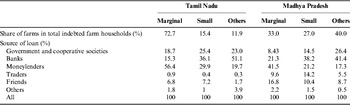
Typically, marginal and small farms mainly borrow from private lenders to meet the cost of fertilizers and pesticides, and hence they are highly vulnerable to indebtedness because of the high risk of crop failure due to climatic variability. Private lenders are the primary source of loans for marginal farmers both in Tamil Nadu and Madhya Pradesh, whereas government institutions and private lenders are the primary source of loans for the small farmers (Table 3).
Indebtedness and source of loan by farm types in Tamil Nadu and Madhya Pradesh.

Source: Adopted from the situation assessment survey of farmers in India, by NSS26.
Yield ratios and land-use changes in large-scale organic scenario
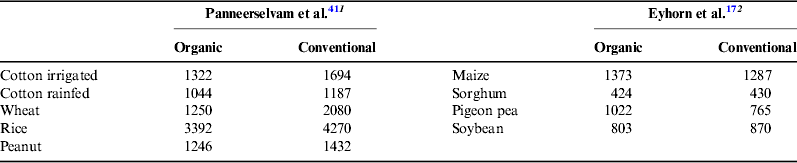
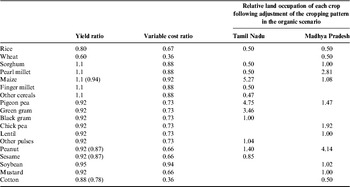
We derived yield ratios for organic and conventional farms from two studiesReference Panneerselvam, Hermansen and Halberg16, Reference Eyhorn, Ramakrishnan and Mäder17. The yield differences between the organic and conventional systems from these two studies are presented in Table 4. The ratios of crop yield and variable cost between the organic and conventional productions were calculated and are presented in Table 5. The yield ratio is the proportion of organic to non-organic yields reported by the studies. For example, the yield ratio of 0.80 means organic yield is 80% of the conventional yield obtained from the same crop from a given area. Similarly, the variable cost ratio is the ratio of organic to non-organic cost incurred for producing a given quantity of produce. Relative land use is the proportion of the area of a particular crop in an organic system relative to the non-organic system. In the up-scaling process, a number of assumptions of crops grown was made. The assumption on land-use changes has been performed based on the crop yield, the external input, nitrogen fixation, nutritional impacts and greenhouse gas emission. Detailed assumptions for the organic scenario are presented in Table 5. In general, the major shift in the cropping pattern toward rice and wheat in India has resulted in a lower consumption of pulses, from 42 g per capita per day in 1990 (72 g in 1956) to 33 g in 200518. This has incidentally resulted in more than 50% of the Indian population having a protein calorie deficiency19. Moreover, rice emits more greenhouse gas than peas or pulsesReference Kanyama20, so increasing the area under legumes has potential advantages in terms of reducing malnutrition, greenhouse gas emissions and improving soil fertility.
Average yield (kg ha−1) in organic and conventional systems (from Eyhorn et al.Reference Eyhorn, Ramakrishnan and Mäder17 and Panneerselvam et al.Reference Panneerselvam, Halberg, Vaarst and Hermansen41).
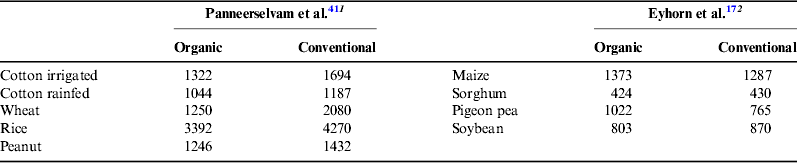
1 Average of 40 farms each in organic and conventional.
2 Average of 60 farms each in organic and conventional.
Ratio of crop yield, variable cost and land use in an organic scenario compared to the baseline (conventional).

Note: The values in ( ) are the ratios for the irrigated situation of the respective crops. All of the other ratios are for the rainfed situation, except rice and wheat.
Relative land use: Value 1 indicates no change in land use in the organic situation for a particular crop. Value 0.5 indicates a 50% area reduction under particular crops in the organic situation. Value 2 indicates a 100% area increase in the organic situation for a particular crop.
In the present scenarios, the relative land use was determined based on the distribution and performance of the crops under organic systems from household surveysReference Panneerselvam, Hermansen and Halberg16 showing more pulses grown and home-consumed in organic households. This was supported by other studies that suggest integration of legumes in the cropping systems in organic scenarios for nutrient management. Moreover, the Tamil Nadu State Agricultural Department recommended an alternative cropping pattern for some rice-growing areas, suggesting that it could be replaced by maize or pulses particularly in rainfed situations with, or under uncertainty in, water release from reservoirsReference Ramasamy, Ramanathan, Balasubramanian, Ragupathy, Natarajan, Devasenapathy and Natarajan21. A high number of farmers in Kerala reduced their rice area due to deterioration of soil health, poor nutrient use efficiency and a build-up of pests and diseases, and converted to more profitable cropsReference Das22. Another study also suggests that crop diversification of maize, pulses (green gram, pigeon pea and black gram) and ground nut performs better in rainfed rice areas, and suggests that the area under rainfed rice could be replaced by maize or pulses to increase the income of the farmersReference Kar, Singh and Verma23.
Data collection at the state level
The secondary data on land size, percentage of area under irrigation and number of holdings were derived from the state statistics3, 24–26. The area of each crop at the state level was derived from ‘Agricultural statistics at a glance’24. The area under each crop for marginal and small farms was extracted. Owing to the lack of accurate data for crop yields across the farm types, the yields were assumed equal for all farm types, although small farms could be expected to produce higher yields than large farms. Production in the conventional system from marginal and small farms was set as baseline production. Variable costs in conventional farming included purchase of seeds, fertilizers, manures and chemicals. Labor cost was not included in the calculation because it was difficult to obtain trustworthy data. An earlier comparative study omitted labor costs from the calculation of the net revenuesReference Hanson, Lichtenberg and Peters27 since very often in developing countries family labor has little opportunity for incomeReference Halberg, Rosegrant, Sulser, Knudsen, Høgh-Jensen, Halberg, Knudsen, Alrøe and Kristensen13, Reference Setboonsarng, Stefan, Leung and Cai28, Reference Schumacher29. The household surveyReference Panneerselvam, Hermansen and Halberg16 attempted to study labor use in farming activities on an individual farm basis when pre-testing the questionnaire. However, it was not possible to obtain sufficiently precise numbers due to the use of family labor for most of the farming activities and a highly irregular nature of input, e.g., varying between 2 and 9 h day−1 depending on need. Other studies have reported no differences in labor input between the organic and conventional farms in IndiaReference Eyhorn, Ramakrishnan and Mäder17 and suggest that smallholders have adequate labor force for farming organicallyReference Rasul and Thapa30.
Calculation of the parameters for assessing the economic situation in the organic scenario
The economic condition of the farmers was estimated in two situations: first by subtracting the variable cost (including interest at different rates) from the crop value, and second by subtracting the total costs (variable cost plus cost of fertilizer subsidy) from the crop value. The interest rate for the costs incurred for the inputs was included in the assessment. Variable costs include interest rates of 15 and 30% per annum, respectively, for loans obtained from the government and private moneylendersReference Rajeev, Vani and Bhattacharjee31. Also, a hypothetical situation of the government withdrawing the fertilizer subsidies was considered––as happened in Ethiopia where fertilizer subsidies were withdrawn from 1998Reference Araya and Edwards32. In this situation, the farmers have to carry the cost of the fertilizer subsidies, because the cost of this subsidy is added to the input costs. The fertilizer subsidies were derived from the secondary data for the marginal and the smallholders in Tamil Nadu and Madhya PradeshReference Sharma and Thaker33 and calculated for the unit area. A sensitivity analysis was performed by assuming different premium prices of the organic sales of 10 or 20%. This was based on the price premium of 10% found for the non-certified organic products in Tamil Nadu and for Madhya Pradesh a price premium of 20% was found for the certified organic productsReference Panneerselvam, Hermansen and Halberg16. It is acknowledged that the up-scaling does not take into account the long-term impact of organic agriculture and costs of certification and training (often covered by the NGOs). However, the up-scaling process has the advantage of integrating some hypothetical assumptions of different issues and their impact on food production and income.
Calculation of state-level food production in the organic scenario
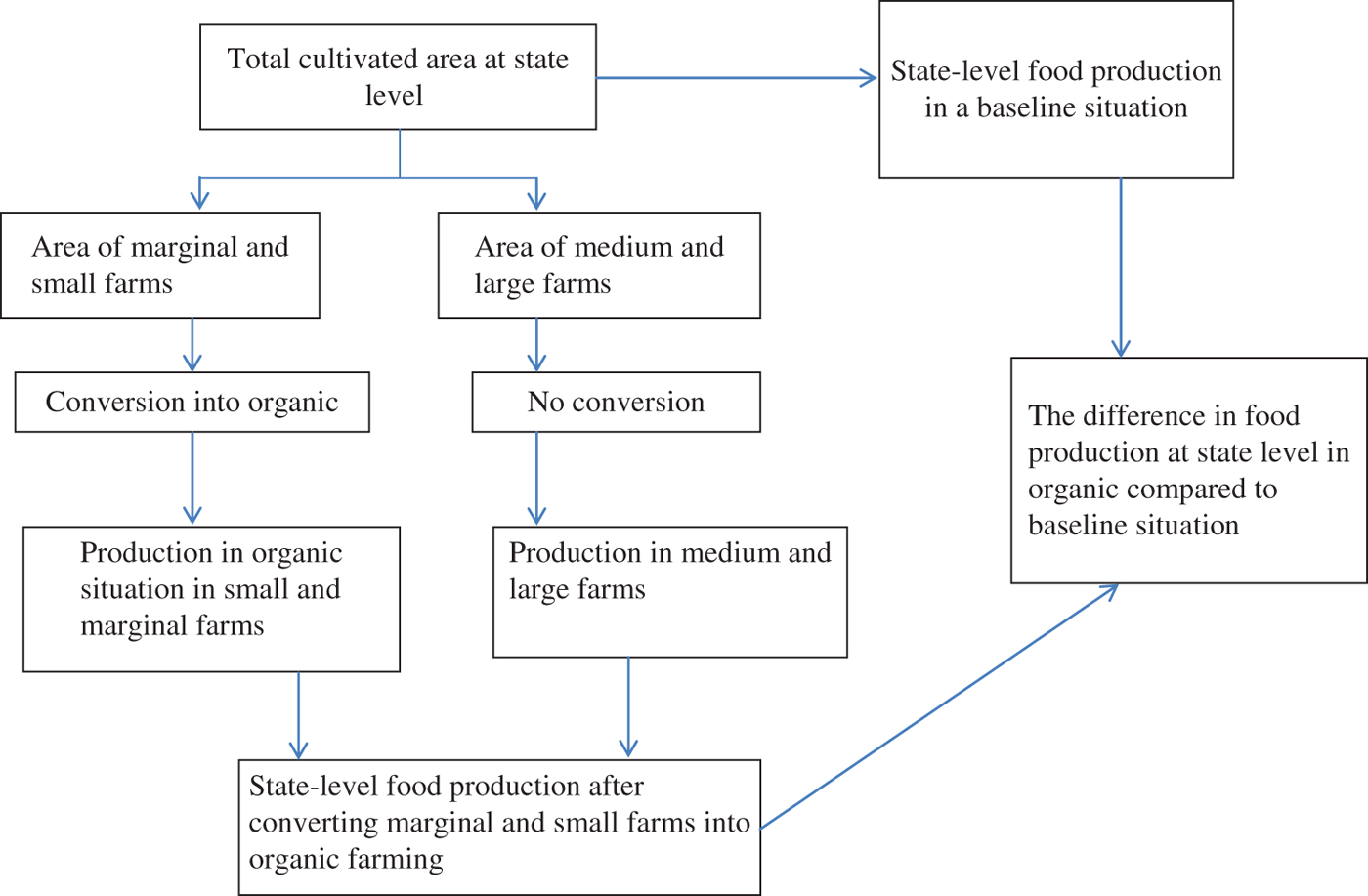
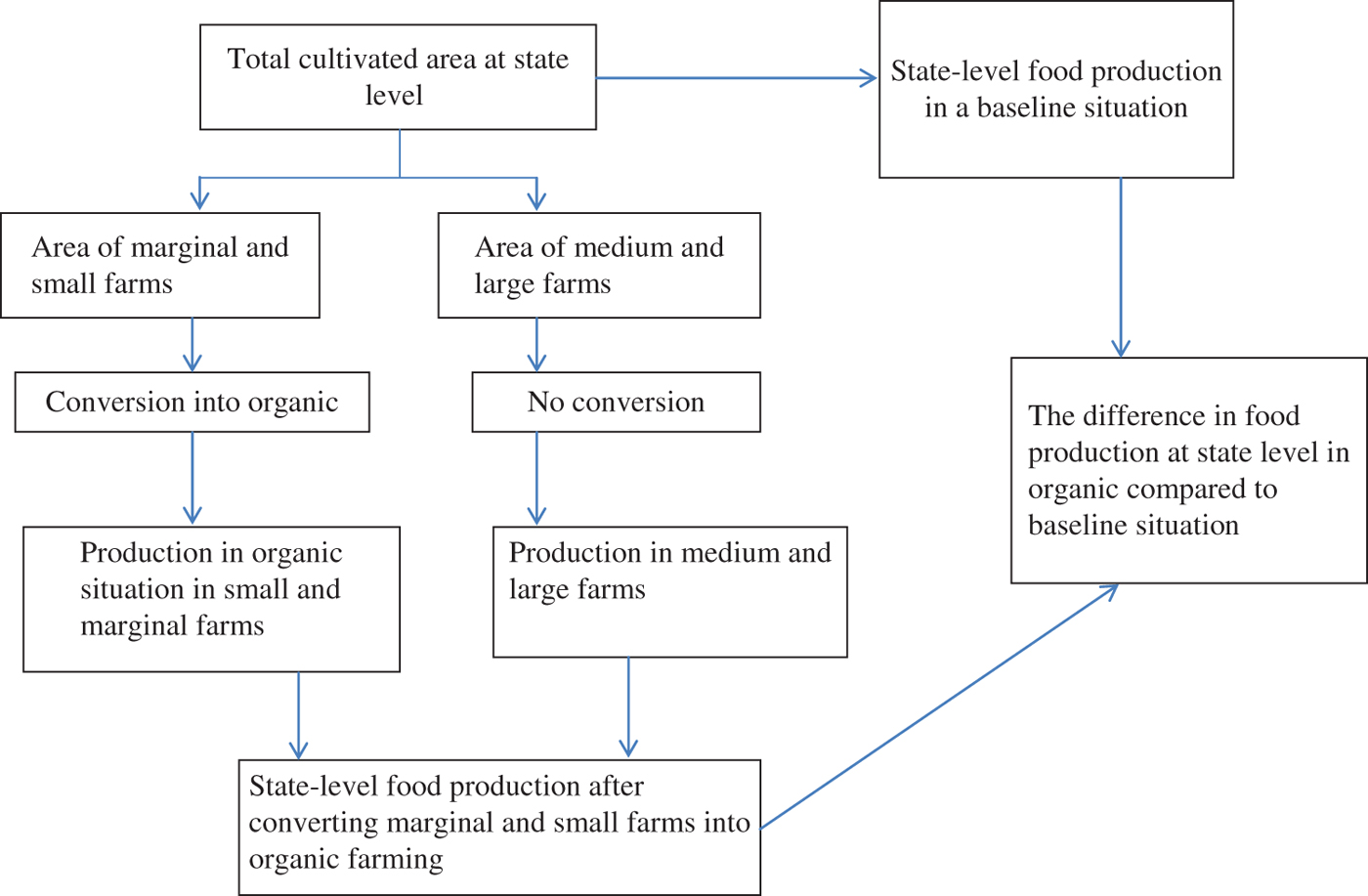
The methodological framework for the calculation of food production is presented in Fig. 1. The areas of marginal and small farms were extracted from the total cultivated area at the state level. The areas under marginal and small farms were converted to organic by applying the hypothetical assumptions mentioned above. The production from these converted areas is labeled as Organic MS production. The productions were calculated separately for the rainfed and the irrigated areas occupied by the marginal and small farms. Production from the medium and the large farms (not converted to organic) was added to the Organic MS production to obtain Organic production at the state level. Production from the marginal and the small farms under the conventional system of production is Baseline MS production. Production from all of the farm types from the conventional systems is called Baseline production at the state level.
Methodological framework of the up-scaling process.
Results
Estimated economic value of the farm holdings
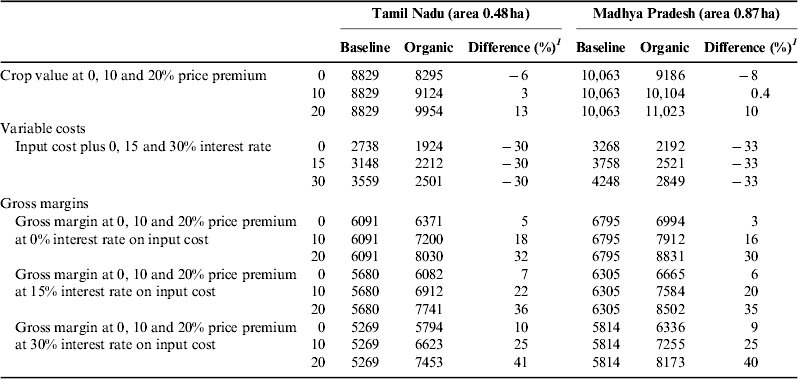
The estimated crop value in the organic scenario was lower (6–8%) than in the baseline scenario when no price premium was assumed, both in Tamil Nadu and Madhya Pradesh (Table 6). However, the estimated gross margin was higher in organic than in baseline both in Tamil Nadu and Madhya Pradesh, even at no price premium (Table 6). This was due to the 30% input cost reduction in organic systems. The variation in gross margin between the organic and the baseline increased with increasing price premium for organic products and, though less markedly, increased interest rate on the input cost. The difference in gross margin increased with increasing interest rate on loans which was due to the higher input cost in the conventional system reducing their gross margin. The gross margin was Rs. 5269 for the baseline compared with Rs. 7200 for the organic scenario in Tamil Nadu, when given a 10% price premium for non-certified organic products and organic farmers receiving interest-free credits from NGOs, in contrast to conventional farmers receiving credit at 30% interest as observed in the organic project areaReference Panneerselvam15. The gross margin was Rs. 5814 for the baseline scenario compared with Rs. 7912 for the organic in Madhya Pradesh. This means about 36% increase of the gross margin in the organic scenario over the baseline.
Estimated economic key figures in the baseline and the organic scenarios from the marginal and the small farms (Indian rupees/holding per year).
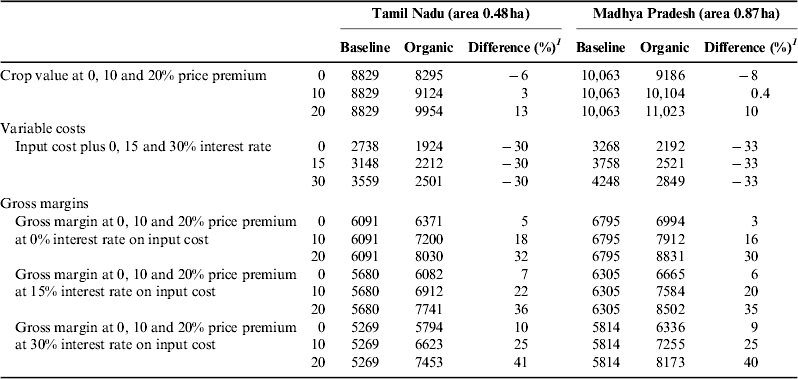
1 Difference in the percentage in organic compared to the baseline.
Note: crop value=yield × price, Gross margin=crop value–variable cost.
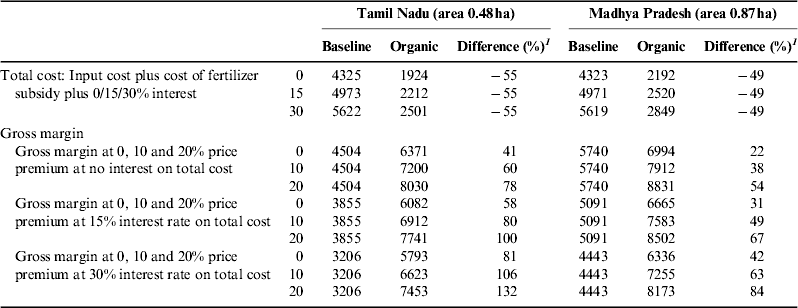
The variation in the gross margin between the organic and the conventional was much wider in the hypothetical situation of no fertilizer subsidy, thus the organic had a higher gross margin than the conventional in Tamil Nadu, at 80, 106 and 132% with a 0, 10 and 20% price premium, respectively (Table 7). Similarly, the gross margin was 43, 63 and 84% higher in the organic systems at a 0, 10 and 20% price premium in Madhya Pradesh. These were due to higher production costs in the conventional system due to additional costs of fertilizer subsidy in the input cost, and a price premium for the organic products. In Tamil Nadu, under the no fertilizer subsidy scenario, organic farms had higher gross margin, 98 and 124% increase over the baseline at 0 and 10% premium price (for the organic product), respectively, whereas in Madhya Pradesh, the organic farms had a higher gross margin and 57 and 78% increase over the baseline at 0 and 10% premium price, respectively. Conventional farmers in Tamil Nadu were more affected than those in Madhya Pradesh because of their more extensive use of fertilizer and higher fertilizer subsidy per holding.
Estimated economic key figures in the baseline (assuming the inclusion of fertilizer subsidy in the variable costs) and the organic scenarios (Indian rupees/holding per year).
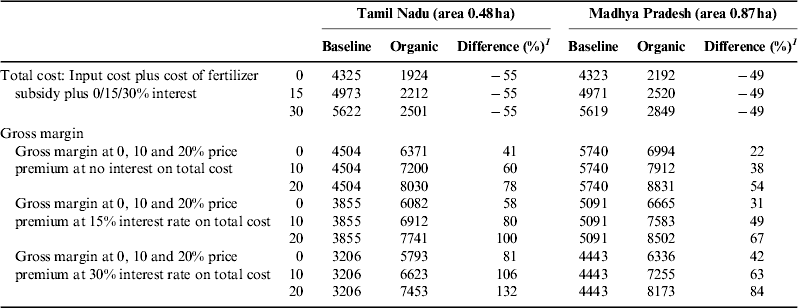
1 Difference in the percentage in the organic compared to the baseline.
Note: crop value=yield × price, Gross margin=crop value–variable cost.
Estimated production after large-scale conversion of marginal and small farm types
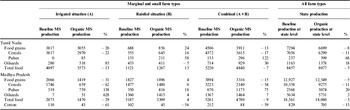
Marginal and small farms cultivate 3.4 million ha (59% of the area of all of the farm types) in Tamil Nadu and 4.8 million ha (27% of the area of all of the farm types) in Madhya Pradesh. Conversion of these marginal and small farms into organic farming reduced food production at the state level, 5% in Tamil Nadu and 3% in Madhya Pradesh over the baseline (Table 8). The conversion of the rainfed areas exclusively was beneficial by producing 13 and 4% more food from these areas in Tamil Nadu and Madhya Pradesh, respectively, compared to their rainfed baseline, whereas the organic conversion of the irrigated areas had a negative impact on food production. Owing to the assumed land-use changes, the production of pulses and oilseeds was found to be consistently higher in the organic scenario than the baseline scenario. In Tamil Nadu, the estimated pulse and oilseed productions were, respectively, 68 and 18% higher in the organic than the baseline scenario, whereas in Madhya Pradesh the rise was 20 and 2%, respectively.
Estimated productions (1000 t) from the marginal and the small farm types (MS) and its impact on state production under organic conversion.

Note: % is given as the difference in the organic compared to the baseline.
Discussion
Most of the households in the two states of India are marginal and small farms cultivating <2 ha and a large proportion of the farms are indebted. They need low-cost technology that uses on-farm resources to lever themselves out of the vicious cycle of poverty and food insecurity. This modeling study showed that large-scale conversion may have both positive and negative impacts on food security. Marginal and small farms—which constitute 90 and 70% (Tables 1 and 2) of the total farm holdings in Tamil Nadu and Madhya Pradesh, respectively—can potentially increase the gross margin (mainly by reducing production costs) and avoid the risk of debt by converting to organic. But such a large-scale conversion could also reduce food production by approximately 5% at the state level, if the organic yields are not improved.
The smallholder farmers can increase their income even without a price premium if they receive proper training and technical support to manage soil and pestsReference Panneerselvam15. Systematic training and extension in agro-ecological practices—which is not only supported by the NGOs but also by the state and the central governments—could increase nutrient management and crop yields, for example, by supporting organic fertilization parallel to the subsidies to chemical fertilizer use. Building improved soil fertility through agro-ecological practices could also render organic farms more resilient to climatic instabilityReference Dimitri, Kemp, Sooby and Sullivan34 and to changes in government policy, such as a discontinuation of fertilizer subsidy. In such a situation, the conventional system of production would be much more affected, assuming that the cost of the fertilizer subsidy would be carried by the farmers. The present level and the mechanism of the fertilizer subsidies masks the high costs of conventional production, and organic production would be even more competitive if such subsidies were not only tied to the fertilizer but also to organic manure and other agro-ecological soil fertility management practices. This is not just a theory, but is practiced in the Philippines under the Organic Fertilizer Production Project supported by the Bureau of Soils and Water Management (BSWM) to assist the national rice and corn programReference Carating, Fernando, Abrina and Tejada35. The Philippine government has supported this project by establishing 64 biological nitrogen fertilizer production units, about 2700 community-based composting facilities and 26,713 bags of annual production (50 kg per bag) of organic fertilizers. Similarly, a study from India found that small farms improved their economic and ecological indicators in a scenario with a policy to support organic agricultural practices compared to a policy that continues to support market based, synthetic inputs for cultivationReference Purushothaman, Patil and Francis36.
Certification costs and conversion costs were not included in this study. It may not be realistic to assume price premiums for all of the organic crops sold under a large-scale conversion scenario, since most produce will be home-consumed or sold locally. Thus, this up-scaling model included an organic scenario with no price premium (for non-certified organic products) and therefore, will not require costs for conversion and certification, besides the basic training in agro-ecological practices. Also, it is difficult to calculate the cost for conversion on an individual basis for the small and the marginal farms in India as most often the NGOs or companies promoting organic organize free training, extension and help certification on a group basis. Examples are, in the case of Tamil Nadu, the Center for Indian Knowledge systemsReference Panneerselvam15 and, in the case of Madhya Pradesh, a private company, BioReReference Panneerselvam15. On the other hand, a scenario where part of the current fertilizer subsidies were re-directed to also support local-scale organic fertilizer production or (training in) agro-ecological soil fertility practices would compensate for the knowledge-based conversion costs.
The study indicated that the overall food production in the organic scenario would be approximately 5% lower in Tamil Nadu and 3% lower in Madhya Pradesh given the relative yields used in the models. This 5 and 3% reduction at the state level may lead to higher food prices which may have a negative impact on the food security of the urban poor and landless rural people. However, conversion to organic has the advantages of reducing the production costs and the indebtedness, and of increasing the income, of the marginal and the small farmers who constitute 80% of the food insecure in India2. Moreover, most of the farms in Tamil Nadu were under a conversion period when the household survey was conductedReference Panneerselvam15 so there is a reason to believe that the organic yields may increase in Tamil Nadu after completion of the conversion period. The estimated pulse yields were conservative, because not all the families had yet introduced pulses due to lack of knowledge and seeds. Similarly, in the Madhya Pradesh case study which forms the basis of the relative yields a private company supports specific organic crops for a lucrative export market but the organic farmers are lacking knowledge and inputs to grow the full range of rotational food cropsReference Panneerselvam15. These factors resulted in a relatively conservative estimate of the state-level food production in our organic scenario. As discussed in Halberg et al.Reference Halberg, Rosegrant, Sulser, Knudsen, Høgh-Jensen, Halberg, Knudsen, Alrøe and Kristensen13 modeling of the food security consequences of large-scale conversion to organic agriculture is mostly sensitive to the projections of relative yield growth over time, and given the current low degree of research and, training in agro-ecological farming methods, there seems to be a wide potential for significant yield improvements in the organic systems in India.
Conversion of the rainfed areas to organic agriculture was found to be potentially beneficial for smallholder farmers because of almost comparable yields under these conditions and reduced input costs. Following this rationale, 76 and 40% of the area which is rainfed in Madhya Pradesh and Tamil Nadu, respectively (Tables 1 and 2), and 55% of the total rainfed agricultural land in India37, have conditions of competitive organic yields and large numbers of smallholder farms, which makes conversion to organic agriculture potentially interesting. Other studies also reported improvement in the yield and the income in rainfed areas by adopting organic farmingReference Purushothaman, Patil and Francis36, Reference Letter, Seidel and Liebhardt38 and conservation tillageReference Ghosh, Das, Saha, Kharkrang, Tripathi, Munda and Ngachan39. Conservation technologies such as zero or minimum tillage with direct seeding, residue cover and crop rotations, combined with better use of organic sources of nutrients including animal manure, crop residues and legumes, have potential to increase the water and nutrient use efficiency, and are also effective in reducing soil organic carbon lossesReference Bhatia, Kumar, Kumar and Jain40.
An additional benefit of converting to organic agriculture is that the higher pulse and legume oilseed production in the organic situation could increase the protein content in the diets of impoverished familiesReference Panneerselvam, Hermansen and Halberg16 and may help to counter the protein malnutrition that persists among more than 50% of the Indian population19. Such a reintroduction of more pulses in the smallholder farms is not theoretically exclusive to organic systems, but fits well into a logic of using locally available resources and agro-ecological practices for soil improvement and human nutrition. However, low yield in the organic system, particularly in irrigated conditions, is the major barrier for such a large-scale conversionReference Panneerselvam, Halberg, Vaarst and Hermansen41. Adopting organic practices with no tillage and direct seeded rice in irrigated areas has a potential to improve the water use efficiency and yield in addition to reducing the global warming potential (about 75%) compared to the conventional puddled transplanting method of riceReference Bhatia, Kumar, Kumar and Jain40. Two recent comprehensive meta-analyses compared the yields of organic and non-organic agriculture in three sets of conditions, irrigated versus rainfed, legumes versus non-legumes and developed versus developing countries, and found that organic yields were higher in rainfed areas, and in systems with legumes in developing countriesReference Seufert, Ramankutty and Foley11, Reference De Ponti, Rijk and Van Ittersum12.
We acknowledge that this study is a short-term analysis of food production, not considering the nutrient availability, price fluctuation and variation in yields over the long run. Although conversion to organic farming has economic and environmental benefits, only a portion of small and marginal farmers is converting, with the support of the NGOs and other organic-promoting organizations. Moreover, the large portion of farmers are not converting to organic due to lack of knowledge, unavailability of technology, fear of loss of yield and low confidence in controlling pests and diseases in organic methods and lack of institutional support regarding production technologyReference Panneerselvam, Halberg, Vaarst and Hermansen41. Hence, more research is needed to understand the long-term impact of organic conversion on food production, nutrient demand and supply, and food security in India, as a potential measure to improve local food security for the millions of food insecure, resource poor and indebted smallholder farmers.
Conclusion
This study indicates that conversion to organic farming may increase the gross margin of marginal and small farms by reducing their production costs and debts in an organic scenario with a policy that subsidizes fertilizer use for conventional farms. Among the two states, conventional farmers in Tamil Nadu were more affected than those in Madhya Pradesh because of their more extensive use of fertilizer and higher fertilizer subsidy per holding. The advantage of organic farming was larger under a scenario without fertilizer subsidies and the study suggests diverting part of the fertilizer subsidies to supporting organic and agro-ecological soil fertility measures. Large-scale conversion of marginal and small farms can have a small negative impact on the overall state-level food production. This study showed that the rainfed areas of marginal and small farms were more suitable for conversion to organic farming in the short run, due to comparable organic and conventional yields. Thus, 76 and 40% of the rainfed area, in Madhya Pradesh and Tamil Nadu, respectively, and 55% of the rainfed areas of the country are suitable for organic agriculture. Conversion of the irrigated areas can have a negative impact on food production and food security, but an increased cultivation of pulses and oilseeds (legume oilseeds—peanut and soybean) may compensate partly for the lower cereal yields. Organic production that has a higher proportion of legumes, crop diversification and a lower cost of production can potentially alleviate the consequences of crop failure resulting in further indebtedness of poor families, which is common in Indian agriculture. Although the study addresses short-term perspectives of large-scale conversion to organic farming, more research is needed to understand the long-term impact of organic conversion on food production, nutrient demand and supply, and poverty reduction.
Acknowledgement
We thank the International Centre for Research in Organic Food System (ICROFS) for funding this research through the GlobalOrg project.