





Introduction
Radiocarbon (14C) samples frequently contain both organic and inorganic carbon (Hajdas et al. Reference Hajdas, Ascough, Garnett, Fallon, Pearson, Quarta, Spalding, Yamaguchi and Yoneda2021). To provide reliable 14C measurements of the organic fraction, the inorganic carbon (IC), which is usually in the form of carbonate (e.g., calcite, aragonite and dolomite; Lorrain et al. Reference Lorrain, Savoye, Chauvaud, Paulet and Naulet2003), must be completely excluded (Bao et al. Reference Bao, McNichol, Hemingway, Lardie Gaylord and Eglinton2019). Even small traces of residual carbonate can have a large contaminating effect on 14C measurements of organic carbon (OC), due to the differing formation mechanisms and 14C values of these materials (e.g., 14C-dead geological carbonate rock versus modern organic matter).
To remove carbonate from samples, some form of acidification is usually used (Bao et al. Reference Bao, McNichol, Hemingway, Lardie Gaylord and Eglinton2019; Brodie et al. Reference Brodie, Casford, Lloyd, Leng, Heaton, Kendrick and Yongqiang2011; Galy et al. Reference Galy, Bouchez and France-Lanord2007; Hajdas et al. Reference Hajdas, Ascough, Garnett, Fallon, Pearson, Quarta, Spalding, Yamaguchi and Yoneda2021; Komada et al. Reference Komada, Anderson and Dorfmeier2008). Thermal separation is also feasible (Dean Reference Dean1974; Manning et al. Reference Manning, Lopez-Capel, White and Barker2008) but can be complicated in mixed samples by the overlapping combustion temperatures of organic and inorganic carbon (Hemingway et al. Reference Hemingway, Rothman, Rosengard and Galy2017). In radiocarbon laboratories, the acid-rinsing and acid-alkali-acid pretreatments are considered reliable for the removal of IC and are suitable for samples in chronological studies (Hajdas et al. Reference Hajdas, Ascough, Garnett, Fallon, Pearson, Quarta, Spalding, Yamaguchi and Yoneda2021; Norris et al. Reference Norris, Turnbull, Howarth and Vandergoes2020). However, these methods may not be appropriate for some sample types due to the use of decanting or filtration to remove excess acid which results in the loss of mobile OC that has been solubilized during the acid treatment (Bao et al. Reference Bao, McNichol, Hemingway, Lardie Gaylord and Eglinton2019; Galy et al. Reference Galy, Bouchez and France-Lanord2007; Komada et al. Reference Komada, Anderson and Dorfmeier2008; Shore et al. Reference Shore, Bartley and Harkness1995). Thus, these methods, or any pretreatment that causes the loss of some organic carbon, potentially compromise the interpretation of isotopic data and may not be suitable for studies where the total OC is required for analysis, such as those using 14C to determine total carbon turnover rates in soils, or for samples of dissolved organic carbon (DOC).
Besides acid-rinsing and thermal separation, at least two other approaches have been used to remove carbonate from samples. Although originally developed for analyses such as the quantification of total OC or the stable isotope composition of OC, these methods have subsequently also been used for radiocarbon measurements. One method involves fumigation with hydrochloric acid (HCl) and has been used to decarbonate material such as soils (e.g., Harris et al. Reference Harris, Horwáth and van Kessel2001; Plante et al. Reference Plante, Beaupré, Roberts and Baisden2013), particulate organic matter (Lorrain et al. Reference Lorrain, Savoye, Chauvaud, Paulet and Naulet2003) and sediments (Bao et al. Reference Bao, McNichol, Hemingway, Lardie Gaylord and Eglinton2019; Komada et al. Reference Komada, Anderson and Dorfmeier2008). This approach usually involves dampening the sample with a small volume of water and then placing it inside a sealed container with a vessel of concentrated HCl that produces an acid vapour. This treatment is usually applied for several hours or days e.g., Hedges and Stern Reference Hedges and Stern1984; Komada et al. Reference Komada, Anderson and Dorfmeier2008; Walthert et al. Reference Walthert, Graf, Kammer, Luster, Pezzotta, Zimmermann and Hagedorn2010. In some approaches, the fumigation vessel is warmed (e.g., to 60 °C) to facilitate fuming of the acid (Hemingway et al. Reference Hemingway, Rothman, Rosengard and Galy2017; van der Voort et al. Reference van der Voort, Hagedorn, McIntyre, Zell, Walthert, Schleppi, Feng and Eglinton2016). No rinsing is employed, therefore, acid fumigation approaches do not suffer from losses of OC in leachates. Studies have shown this approach to be reliable for removing carbonate, although it may not be suitable for samples with high carbonate content (>50% carbonate, Hedges and Stern Reference Hedges and Stern1984) or containing dolomite (Galy et al. Reference Galy, Bouchez and France-Lanord2007) and over exposure to acid fumes has been reported to cause preferential loss of 14C-enriched carbon (Komada et al. Reference Komada, Anderson and Dorfmeier2008).
Another approach for removing carbonate from samples without loss of mobile carbon, involves direct addition of a small volume of acid to the sample, followed by drying to remove residual acid and moisture. This method was originally described by Verardo et al. (Reference Verardo, Froelich and McIntyre1990) and subsequently modified and tested for 14C by Komada et al. (Reference Komada, Anderson and Dorfmeier2008; as the “aqueous method”) and usually involves in-situ acidification of samples inside small metal cups which are subsequently combusted along with the sample (Nieuwenhuize et al. Reference Nieuwenhuize, Maas and Middelburg1994). Although Komada et al. (Reference Komada, Anderson and Dorfmeier2008) reported that this method had low contamination in “blank” tests, isotope results were considered inferior to acid-fumigation, and subsequently, the acid-fumigation approach appears to have been more widely adopted for radiocarbon studies (e.g., Hemingway et al. Reference Hemingway, Rothman, Rosengard and Galy2017; Plante et al. Reference Plante, Beaupré, Roberts and Baisden2013; Walthert et al. Reference Walthert, Graf, Kammer, Luster, Pezzotta, Zimmermann and Hagedorn2010).
A criticism of the above pretreatments is that besides removal of carbonate, both methods can result in the inadvertent loss of organic matter (Bao et al. Reference Bao, McNichol, Hemingway, Lardie Gaylord and Eglinton2019; Komada et al. Reference Komada, Anderson and Dorfmeier2008). The mechanisms and extent of this issue appears unclear, but it has been suggested to include loss of acid volatiles, decarboxylation and oxidation (Komada et al. Reference Komada, Anderson and Dorfmeier2008). However, while Plante et al. (Reference Plante, Beaupré, Roberts and Baisden2013) demonstrated alterations to soil organic matter composition following acid fumigation (reflected in the thermal properties of the samples), the changes did not appear to significantly alter 14C results. Walthert et al. (Reference Walthert, Graf, Kammer, Luster, Pezzotta, Zimmermann and Hagedorn2010) also observed no effect on the δ13C signature of soil organic matter of acid fumigation over 8 or 32 hours. In contrast, Komada et al. (Reference Komada, Anderson and Dorfmeier2008) provided evidence that both stable and radiocarbon measurements could be affected by exposure to HCl, however, only if acid-fumigation exceeded 24 hours. Bao et al. (Reference Bao, McNichol, Hemingway, Lardie Gaylord and Eglinton2019) reported that acid-fumigation reduced the radiocarbon activity of labile OC, and, like Plante et al. (Reference Plante, Beaupré, Roberts and Baisden2013), also found changes in thermal profiles (reduction in thermally-labile organic carbon post-fumigation). Recently, He et al. (Reference He, Yang and Cui2025) compared different approaches to acid-rinsing and acid fumigation for carbonate removal in sediments, reporting that acid-rinsing allowed decarbonation with the least perturbation of the remaining organic matter. Notably, He et al. (Reference He, Yang and Cui2025) also linked loss of organic carbon to HCl concentration, recommending sample rinsing with dilute HCl, and considered that the OC loss was partly a result of residual CaCl2, which can also be corrosive and damage lab equipment (Hemingway et al. Reference Hemingway, Rothman, Rosengard and Galy2017; Huang et al. Reference Huang, Yang, He, Zhao and Cui2023; Walthert et al. Reference Walthert, Graf, Kammer, Luster, Pezzotta, Zimmermann and Hagedorn2010). This issue was mitigated by Hemingway et al. (Reference Hemingway, Rothman, Rosengard and Galy2017) by rinsing samples with Milli-Q water post-fumigation, though presumably this would result in the loss of water-soluble carbon (comparable to the issues experienced with the acid rinsing method) and therefore may not be suitable for all samples.
It would appear from the available literature that none of the current methods for removing carbonate from radiocarbon samples, without loss of OC or changes to the composition of the organic matter, are completely satisfactory. Moreover, with the increasing application of techniques such as ramped pyrolysis/oxidation to thermally partition 14C samples (Rosenheim et al. Reference Rosenheim, Day, Domack, Schrum, Benthien and Hayes2008) and thus gain a greater insight into complex sample mixtures (e.g., soils and sediments), reported perturbations to thermal profiles by acid pretreatments is a concern, raising the question of whether these thermal profiles reflect the sample composition or the decarbonation pretreatment.
To ensure complete removal of carbonate, excess acid is usually applied in these pretreatments. However, the amount of acid used can be much more than is actually required to effect complete carbonate removal often resulting from the fact that the amount of carbonate in a sample is unknown, and a very conservative approach is adopted as a result. For example, a typical radiocarbon analysis by accelerator mass spectrometry (AMS) requires only ca. 1 mg C and if the original sample contained a similar amount of carbonate (e.g., 1 mg calcite) as little as 0.1 mL of 1 M HCl would still provide excess acid, according to stoichiometry:
 \begin{equation}CaC{O_{\it 3}} + {\it 2}HCl \to CaC{l_{\it 2}} + C{O_{\it 2}} + {H_{\it 2}}O\end{equation}
Thus, 1 mole of carbonate (CaCO3; 100.09 g/mol) requires 2 moles of HCl for complete hydrolysis, and therefore, for removal of 1 mg (0.001 g) carbonate, moles of HCl required is given by:
 \begin{equation}{\it 2\times\left( {0.001/100.09} \right) = 2\times{10^{ - 5}}}\,mol\,HCl\end{equation}
Which, expressed as volume of 1 M HCl:
 \begin{equation}Volume = Moles/Concentration = {\it 2\times{10^{ - 5}}/1\,\,L = 0.02}\,mL\,HCl\end{equation}
In reality, it is not usually practical to use only the minimum amount of acid indicated by a stoichiometric calculation due to the time required to complete the reaction (Midwood and Boutton Reference Midwood and Boutton1998). However, using excessive acidity can potentially cause loss of OC (He et al. Reference He, Yang and Cui2025; Komadao et al. Reference Komada, Anderson and Dorfmeier2008), damage lab equipment (Hemingway et al Reference Hemingway, Rothman, Rosengard and Galy2017; Huang et al. Reference Huang, Yang, He, Zhao and Cui2023; Walthert et al. Reference Walthert, Graf, Kammer, Luster, Pezzotta, Zimmermann and Hagedorn2010), be inefficient and more costly, and unnecessarily expose operators to potential hazards.
Here, we report our “no leach” method to remove carbonate from radiocarbon samples. The method is a modification of the “aqueous method” tested by Komada et al. (Reference Komada, Anderson and Dorfmeier2008), itself based on work by Verado et al. (Reference Verardo, Froelich and McIntyre1990). The key features of this method are: 1. Avoidance of a rinsing or filtration step, thus ensuring retention of all mobile carbon; 2. A reduction in volume and molarity of the HCl used versus other methods, which should both reduce loss of acid-labile organic carbon and minimize CaCl2 residue in the pretreated sample; 3. Use of a non-dispersive infrared (NDIR) carbon dioxide (CO2) sensor to test that total decarbonation has occurred, thus providing a safety check for samples that have higher carbonate contents than expected. Besides describing the approach, we present an assessment of its 14C background and results for known 14C-content standards processed using the method. To demonstrate the effectiveness of the method for decarbonating samples, we also report the 14C values for carbon-containing sediments pretreated using the method, and results for DOC samples that were deliberately contaminated with carbonate prior to pretreatment.
Methods
Description of the “no leach” method
Figure 1 provides an overview of the method which starts with acid hydrolysis of the sample inside an Exetainer© (6 mL glass vial sealed by a plastic cap containing a chlorobutyl rubber septum; Labco Limited, UK). First, the cap is removed from the exetainer and sufficient sample material added so that, depending on the estimated %carbon, the sample should contain up to ca. 3–5 mg organic carbon. Next, 1 mL of 0.2 M HCl (Fisher Scientific, UK) is added to the exetainer using a dispensing pipette (Acura® 865, Socorex) ensuring that the sample material is completely submerged. At this stage the cap is not replaced on the exetainer to allow evolved CO2 to escape to atmosphere. Any effervescence is noted, since this may be an indicator of a substantial amount of carbonate that will require additional treatment. The sample is covered and left overnight at room temperature.
Overview of the “no leach” carbonate removal method. *Volume and/or molarity of the HCl can be increased if the sample is known beforehand to contain a large amount of carbonate or is shown to following the Sprint CO2 sensor test.

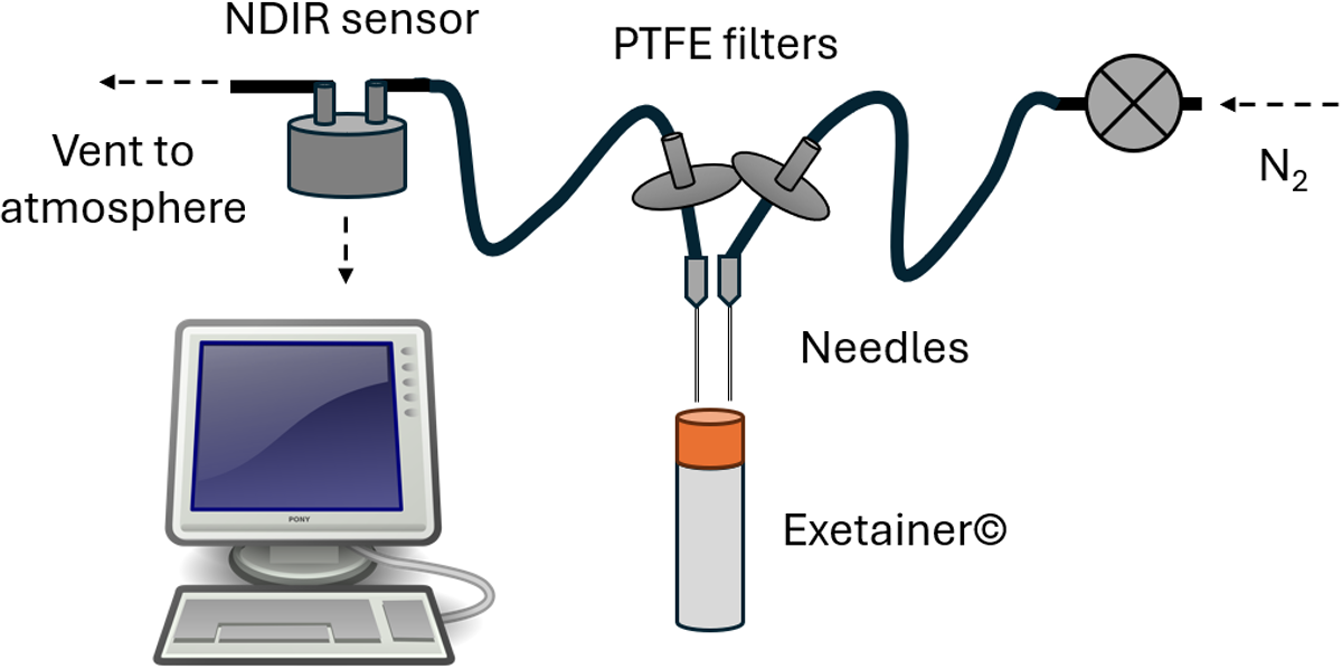
We next determine whether the overnight hydrolysis removed all of the carbonate present in the sample by testing whether CO2 is produced from a second acid hydrolysis. First, the cap is replaced on the exetainer to create an air-tight seal and the headspace inside the exetainer flushed with high purity nitrogen (N5.5, purity 99.995%, BOC, UK; flow rate 175 mL/min) using the apparatus shown in Figure 2. Two hypodermic needles (Agani 20G 0.9 × 38 mm) attached to gas lines (Tygon E-3603, Saint Gobain, France) are simultaneously inserted through the rubber septum of the exetainer with one supplying the nitrogen and the other performing as a vent. The nitrogen is allowed to flow through the exetainer headspace for about 30 seconds, which ensures complete replacement by nitrogen of any other gases in the exetainer headspace. Both gas line needles are simultaneously extracted from the exetainer septum, and then 0.5 mL of 0.2 M HCl is added through the exetainer septum via the dispensing pipette (Acura® 865, Socorex) fitted with a hypodermic needle (Agani 20G 0.9 × 38 mm). The sample is then left for at least 4 hours to allow time for any unreacted carbonate to hydrolyse, before testing the headspace gases for CO2.
Schematic showing the equipment used to test the CO2 concentration of the exetainer headspace. To measure the headspace gas the needles are simultaneously inserted through the septum of the exetainer. The gas lines are cleaned between samples, and the Sprint CO2 sensor zero-calibrated, using CO2-free nitrogen by inserting the needles into an empty exetainer.

A NDIR CO2 sensor (SprintIR-W, Gas Sensing Solutions, UK; selected for its fast response) is used to measure the CO2 concentration of the headspace gas. The sensor is connected downstream of the hypodermic needle that acts as a vent when the two gas line needles are inserted into the exetainer. Thus, high purity nitrogen enters the exetainer and forces the headspace gases through the second hypodermic needle and along a gas line to the Sprint sensor. The sensor is connected to an Arduino (https://www.arduino.cc/) microcontroller that is used to transfer the CO2 measurements via a serial connection to a computer for display and logging (using custom software written in the Processing programming language; https://processing.org/). The gas lines are cleaned and the Sprint sensor calibrated before each sample measurement by flushing with the high purity nitrogen (connecting the needles using an empty exetainer vial; Figure 2). Garnett et al. (Reference Garnett, Newton and Parker2021) provide details on connecting this sensor to a microcontroller.
For the majority of samples that we process, we do not detect any CO2 from the second hydrolysis step. However, if CO2 is detected the above hydrolysis steps are repeated until the headspace tests indicate that no more CO2 is evolving, which we consider demonstrates complete removal of carbonate.
Following carbonate removal, samples are freeze-dried, homogenized and combusted using the sealed quartz tube method (Boutton et al. Reference Boutton, Wong, Hachley, Lee, Cabrera and Klein1983) with excess copper oxide wire (ca.150–800 mg; Scientific Laboratory Supplies, UK) and silver foil (ca. 20–90 mg; Fisher-Scientific, UK). Samples are converted to graphite using Fe Zn reduction (Slota et al. Reference Slota, Jull, Linick and Toolin1987) and analyzed using AMS at either the Scottish Universities Environmental Research Centre AMS Facility (East Kilbride, UK) or the Keck Laboratory, University of California (Irvine, USA). For samples measured at SUERC AMS an aliquot of the recovered CO2 is measured for δ13C using isotope ratio mass spectrometry and used to normalize the 14C results to δ13C = –25‰; UCI samples are normalized using on-line AMS 13C measurement. Results are corrected for 14C background and reported as conventional radiocarbon ages (years BP, where 0 BP = AD 1950; Stuiver and Polach Reference Stuiver and Polach1977) or percent modern (pMC; where pMC = fraction modern x 100). See Ascough et al. (Reference Ascough, Bompard, Garnett, Gulliver, Murray, Newton and Taylor2024) for further details on sample preparation and measurement.
Tests used to verify the “no leach” pretreatment method
We processed standards of background (14C-dead) and known 14C-content primarily to establish whether significant amounts of contamination were introduced by the “no leach” pretreatment. If such contamination was added, we expected to observe a significantly higher pMC in the 14C-dead standard, and a significant shift in pMC of the known 14C-content standards away from their consensus values. Standards (barleymash from the third international radiocarbon intercomparison (TIRI) 116.35 ± 0.01 pMC, Gulliksen and Scott Reference Gulliksen and Scott1995, and internal lab standards anthracite coal (background) and 96H humin, 65.63 ± 0.54 pMC; Ascough et al. Reference Ascough, Bompard, Garnett, Gulliver, Murray, Newton and Taylor2024) were analyzed as part of the initial verification of the method, and subsequently, alongside sample batches as part of the routine laboratory quality assurance program.
To independently test that the pretreatment removed all carbonate from samples, as suggested by the CO2 sensor tests, we analyzed 2 sets of samples that were typical of materials routinely analyzed in our laboratory and known to contain carbonate. Three samples were from a lake sediment core from Lake Paringa in New Zealand (Howarth et al. Reference Howarth, Fitzsimons, Moody, Wang, Garnett, Croissant, Densmore, Howell and Hilton2025; Wang et al. Reference Wang, Howarth, McClymont, Densmore, Fitzsimons, Croissant, Gröcke, West, Harvey, Frith, Garnett and Hilton2020) for which 14C measurements had previously been made on bulk sedimentary organic matter following carbonate removal using acid-fumigation (Ascough et al. Reference Ascough, Bompard, Garnett, Gulliver, Murray, Newton and Taylor2024). Raw, untreated sample material with carbonate concentrations between 0.6–2.3% was used for the “no leach” test, and we used the 14C results from acid-fumigated samples as the reference value (SUERC-94300 Lake sediment A 93.68 ± 0.41; SUERC-94322 Lake sediment B 82.81 ± 0.38; SUERC-94332 Lake sediment C 81.40 ± 0.38 pMC), considering that if the results agreed within measurement uncertainty, the “no leach” method would be at least as reliable as the established acid-fumigation pretreatment.
Our final test involved DOC recovered from a peatland stream draining Langlands Moss, an ombrotrophic raised bog located in central Scotland, UK (55°44′07.3″N, 4°10′17.4″W). Water from the stream was filtered (using ashed Whatman GFF filters) and the DOC recovered as solids by a combination of rotary evaporation and freeze-drying, providing several grams of homogenized material for repeated tests. We mixed different amounts (2, 4 and 6 mg) of 14C-dead carbonate (IAEA-C1, International Atomic Energy Agency, Vienna, Austria) to aliquots (3–6 mg d/w) of the Langlands DOC before applying the pretreatment to test that the “no leach” method removed the carbonate. Since the original Langlands DOC was devoid of carbonate, we used it as the reference value and considered that all of the 14C-dead carbonate in adulterated samples would have been removed if these 14C results agreed with the reference.
For all tests, we calculated Z-scores (Scott et al. Reference Scott, Cook and Naysmith2010) which represent the offset in the radiocarbon content of a sample relative to the accepted/consensus value, expressed in units based on the analytical uncertainty.
 \begin{equation}{\rm Z - scores} = {(^{\it 14}}{C_{sample}}{\,\,- \,\,^{\it 14}}{C_{reference}})/\sigma\end{equation}
Where 14 C sample and 14 C reference represent the pMC values for the sample and accepted/consensus value and σ is the 1 σ measurement uncertainty. Z-scores <2 indicate results that are within 2 σ of the reference value and are conventionally considered to be acceptable (Scott et al. Reference Scott, Cook and Naysmith2010).
Results
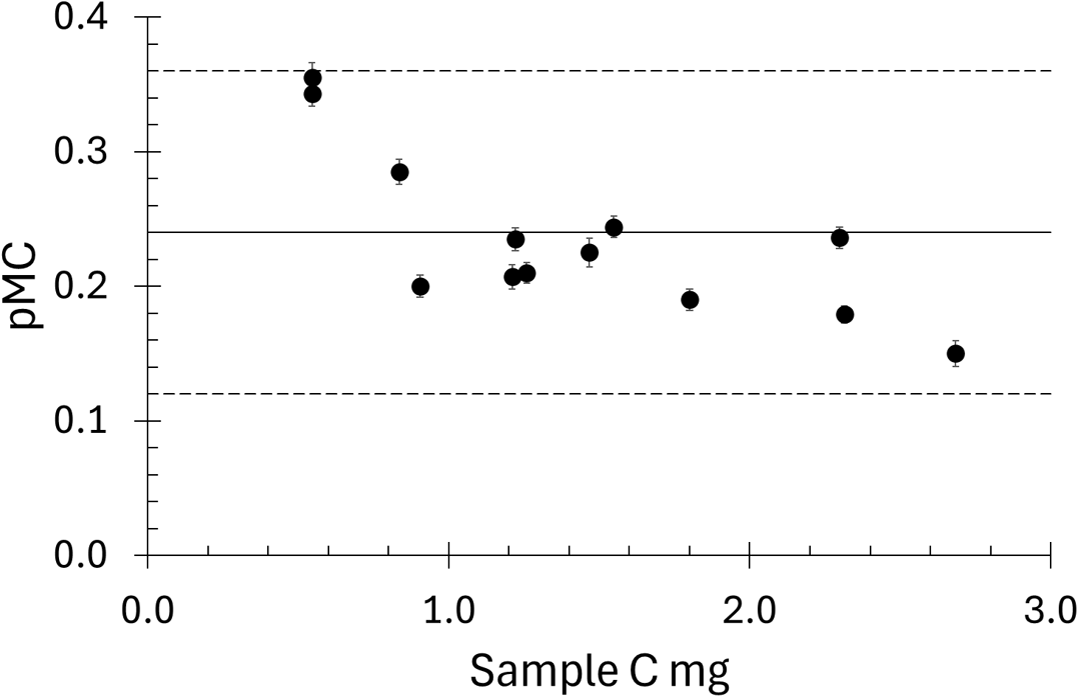
Figure 3 shows the 14C concentration of anthracite coal standards processed using the “no leach” pretreatment. Mean radiocarbon concentration of this laboratory background standard was 0.24 ± 0.06 (SD) pMC for samples that ranged in size from 0.55–2.68 mg C. The mean 14C content was therefore slightly higher, but within 1 σ of the long-term average for this standard when not subjected to any pretreatment (0.17 ± 0.10 pMC; Ascough et al. Reference Ascough, Bompard, Garnett, Gulliver, Murray, Newton and Taylor2024). As expected, 14C content was size-dependent with smaller standards having higher pMC values (Figure 3) although this trend was not significant for samples greater than 1 mg C (p>0.05).
Radiocarbon concentration of the anthracite coal laboratory background standard processed using the “no leach” method. Solid horizontal line represents the mean pMC and the two dashed lines are the ± 2σ range.

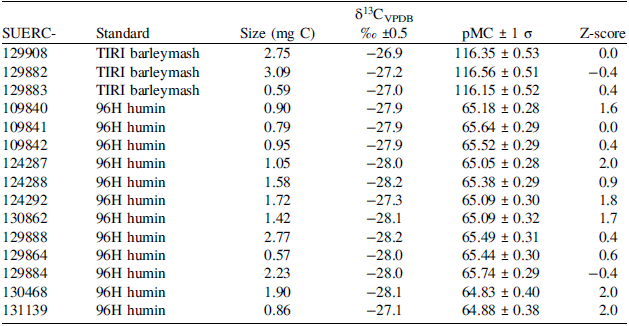
Results for the two radiocarbon laboratory process standards pretreated using the “no leach” method are shown in Table 1. All standards provided radiocarbon results within 2 σ of the consensus values, with size ranging from 0.57 to 3.09 mg C. Mean pMC for TIRI barleymash (116.35 ± 0.20; n=3) was within 1 σ of the international consensus value (Gulliksen and Scott Reference Gulliksen and Scott1995). For 96H humin, mean “no leach” results (65.28 ± 0.30 pMC) were within 1 σ of the reference value (Ascough et al. Reference Ascough, Bompard, Garnett, Gulliver, Murray, Newton and Taylor2024).
Results for radiocarbon laboratory process standards pretreated using the “no leach” method.

Table 1. Long description
The table presents results for radiocarbon laboratory process standards pretreated using the no leach method. It has 15 rows and 6 columns. The columns are labeled SUERC, Standard, Size (mg C), δ13C VPDB ‰ ±0.5, pMC ± 1 σ, and Z-score. The rows list specific data points for each standard, including TIRI barleymash and 96H humin. Each row provides values for the SUERC identifier, standard type, size in mg C, δ13C VPDB value, pMC value, and Z-score. Notable trends include the size ranging from 0.57 to 3.09 mg C and the pMC values for TIRI barleymash and 96H humin being within specific ranges of their consensus values.
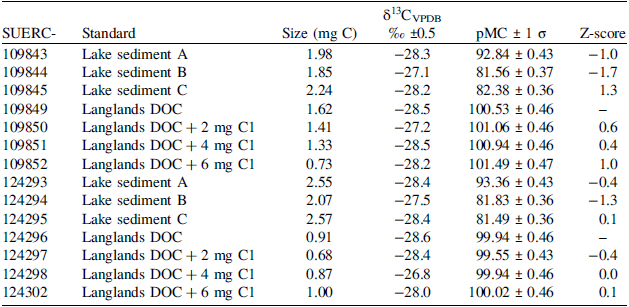
Table 2 presents the results for carbonate-containing samples following “no leach” pretreatment, with sample size ranging from 0.68 to 2.57 mg C (after “no leach” pretreatment). The three naturally carbonate-containing lake sediments all provided “no leach” 14C results that were <1.7 σ of the acid-fumigated paired aliquot, when measured over two occasions (therefore n=6). Similarly, six Langlands DOC–IAEA C1 carbonate mixes all provided 14C results in agreement (<1 σ) with the non-adulterated Langlands DOC reference value following “no leach” pretreatment.
Results for carbonate-containing samples after being pretreated using the “no leach” method. For Lake sediments, the Z-score is calculated with respect to the 14C measurement of the sample material after pretreatment using acid-fumigation. For the Langlands dissolved organic carbon (DOC), three aliquots had measured amounts of IAEA-C1 carbonate added prior to the “no leach” pretreatment. The Z-score for these samples are calculated with reference to the unadulterated material (Langlands DOC).

Table 2. Long description
The table presents isotopic measurements of lake sediments and dissolved organic carbon (DOC) samples. It has 15 rows and 6 columns. The columns are labeled as SUERC-, Standard, Size (mg C), δ13C VPDB ‰ ± 0.5, pMC ± 1 σ, and Z-score. The rows list different samples with their respective measurements. Each row provides the SUERC code, the type of standard, the size in mg C, the δ13C VPDB value with an uncertainty of ±0.5, the pMC value with an uncertainty of ±1 σ, and the Z-score. The table includes data for lake sediment samples and Langlands DOC samples with various treatments.
Discussion
Tests using radiocarbon standards
The 14C content of the 13 anthracite laboratory background standards pretreated using the “no leach” method (range = 0.15 to 0.36 pMC; Figure 3) were all within the 2 σ range of the same material when not subjected to any pretreatment (0.17 ± 0.10 pMC; Ascough et al. Reference Ascough, Bompard, Garnett, Gulliver, Murray, Newton and Taylor2024). This indicates that the additional steps included with the “no leach” method, such as storage in exetainers, addition of dilute HCl and freeze drying, did not introduce significant quantities of non-14C-dead carbon. Although the mean pMC for the “no-leach”-treated anthracite was slightly higher (0.24 pMC), the scatter (±0.06 pMC SD) was lower, implying that this pretreatment can be used to provide finite dates (i.e., pMC >2 σ of 14C background) for samples with ages up to ca. 45 ka BP. We found a significant negative correlation between the 14C content of the anthracite background standards and sample size, but only when including standards <1 mg C. This suggests that when analyzing small samples (<1 mg C) a size-dependent background correction should be applied (e.g., Ascough et al. Reference Ascough, Bompard, Garnett, Gulliver, Murray, Newton and Taylor2024).
TIRI barleymash and 96H humin are the two main non-background organic radiocarbon standards used at the NEIF Radiocarbon Laboratory (Ascough et al. Reference Ascough, Bompard, Garnett, Gulliver, Murray, Newton and Taylor2024) and all 14C results for 15 individual tests were within measurement uncertainty (<2 σ) of the consensus values. We draw two findings from this: First, this is further support that the “no leach” pretreatment does not introduce significant contamination. Second, that the direct addition of the relatively weak acid to these carbonate-free materials, has not significantly affected the 14C content, for example, due to reaction with any acid-labile organic matter. Indeed, we also note that the measured δ13C values are also in agreement with in-house δ13C consensus values for these materials.
Tests using organic samples containing carbonate
The previous analyses using laboratory standards provided a sensitive test for the introduction of contamination using the “no leach” method since the 14C reference values are well established. However, they do not provide a test for carbonate removal, and we are not aware of an organic 14C standard that also contains carbonate that we could use for tests. Therefore, we undertook trials on carbonate-containing real-world samples of lake sediment that had previously been analyzed following carbonate-removal using the established acid-fumigation method (Ascough et al. Reference Ascough, Bompard, Garnett, Gulliver, Murray, Newton and Taylor2024). For all three samples, measured on two occasions (i.e., total n=6), Z-scores were no higher than 1.7 indicating agreement (within measurement uncertainty) between “no leach” and acid-fumigated paired samples. As well as demonstrating that the two methods provide equivalent results, the “no leach” samples confirm that the acid-fumigation samples had been fully decarbonated before dating, which had not been independently confirmed (for example, using CO2 sensor measurements).
We note that δ13C measurements have been used in the past to determine the presence of residual carbonate following pretreatment (as indicated by enriched δ13C, e.g., van der Voort et al. Reference van der Voort, Hagedorn, McIntyre, Zell, Walthert, Schleppi, Feng and Eglinton2016; Walthert et al. Reference Walthert, Graf, Kammer, Luster, Pezzotta, Zimmermann and Hagedorn2010). However, the reliability of this approach is questionable, firstly, because the δ13C value of the carbonate-free organic matter is unlikely to be known in advance (at least to high precision), and moreover, a small amount of residual carbonate would only shift the sample δ13C value a small amount but could significantly impact the interpretation of a 14C result. For example, if residual carbonate from a geological source (14C = 0 pMC, δ13C = 0‰) contaminates a modern (14C = 100 pMC, δ13C = −25‰) organic sample, and accounts for just 4% of the total carbon, the effect on the sample δ13C would be about 1‰ which could be interpreted as natural variability in organic matter. The same contamination would shift a 14C measurement from 100 to 96 pMC, potentially implying an age of several hundred years compared to the contemporary. This uncertainty, caused by issues such as incomplete carbonate removal, was highlighted by Brodie et al. (Reference Brodie, Casford, Lloyd, Leng, Heaton, Kendrick and Yongqiang2011), who cautioned against making interpretations of small (ca. <4‰) changes in organic δ13C in sediment archives. In contrast, the Sprint CO2 sensor can easily detect headspace concentrations of a few hundred ppm CO2 in a few mL of headspace, representing in the order of ca. 0.001 mL, and equivalent to ca. 0.1% of a typical 1 mg C radiocarbon sample.
For the final tests we combined modern (ca. 100 pMC) DOC and a 14C-dead carbonate (IAEA C1), with the aim of simulating a young radiocarbon sample contaminated with geologically-old carbonate. We recognize that the carbonate added would not recreate the organic matter-carbonate matrix of a natural sample (Bao et al. Reference Bao, McNichol, Hemingway, Lardie Gaylord and Eglinton2019), however, isotopically (14C) it represents an extreme test of whether the carbonate was completely removed from the organic sample due to the difference in 14C activity of the components, with established reference values. Furthermore, by increasing the ratio of carbonate to organic matter (mixing 2–6 mg carbonate with 0.7–1.4 mg OC) the tests had relatively high carbonate concentrations that are known to be particularly challenging for the acid fumigation method (Hedges and Stern Reference Hedges and Stern1984). Nevertheless, all DOC samples that had been purposefully contaminated with carbonate provided radiocarbon activities within measurement uncertainty of the unadulterated DOC. This indicates that the “no leach” pretreatment had removed all of the carbonate and independently validates the Sprint CO2 sensor tests that had also indicated complete decarbonation.
Other considerations regarding the “no leach” method
We chose to use 1 mL of 0.2 M HCl in the first hydrolysis step based on the size (usually volume) of a typical soil or sediment sample; with 1 mL of HCl being sufficient to completely submerge a typical sample inside the exetainer and therefore exposing the entirety of the sample to acid. A molarity of 0.2 M HCl was selected since stoichiometrically, 1 mL of this would be sufficient to hydrolyse up to 10 mg CaCO3, which far exceeds the amount of carbonate expected in our samples, yet is still considerably weaker than acids typically used with other methods (e.g., Komada et al. Reference Komada, Anderson and Dorfmeier2008; Bao et al. Reference Bao, McNichol, Hemingway, Lardie Gaylord and Eglinton2019). In practice, a substantial number of the samples we process using the “no leach” method probably do not contain any carbonate; however, we can apply the pretreatment as a precaution knowing that it will not have negative impacts on the sample. Even though this may add slightly to the overall processing time, discovering that the sample still contained carbonate when combusted (e.g., from enriched δ13C values) would be significantly more inconvenient.
As noted by others (Hemingway et al Reference Hemingway, Rothman, Rosengard and Galy2017; Huang et al. Reference Huang, Yang, He, Zhao and Cui2023; Walthert et al. Reference Walthert, Graf, Kammer, Luster, Pezzotta, Zimmermann and Hagedorn2010), residue from the acid treatments can be corrosive to equipment and we were initially concerned about possible damage to the Sprint CO2 sensor from HCl vapours. To mitigate this, we adopted a high flow rate (175 mL/min) for the nitrogen carrier gas when performing the headspace tests to minimize the potential contact time between acid vapours and the sensor. We report that after processing over 200 samples we are still using the original sensor and have not observed any deterioration or damage.
On occasions, we have discovered some samples to contain far more carbonate than initially expected, for example, with minute traces of shell in marine sediment samples. This may be visually apparent due to effervescence when adding acid for the first time, or from the Sprint CO2 sensor tests. The hydrolysis step can be repeated until carbonate removal is complete and if necessary, volume and/or molarity of the HCl can be increased. If several hydrolysis steps are required, reducing the remaining headspace volume in the exetainer by freeze drying can be used to remove excess liquid and free up space for fresh HCl to be added, without loss of any sample material. Alternatively, larger exetainers (e.g., 12 mL volume) can be used which is especially useful for samples with low carbon contents. It should also be noted that our tests focussed on calcium carbonate contamination, and adjustment to the procedures may be required where other forms of carbonate, which react more slowly to HCl treatment (e.g., dolomite), are present.
Finally, several studies (Bao et al. Reference Bao, McNichol, Hemingway, Lardie Gaylord and Eglinton2019; He et al. Reference He, Yang and Cui2025; Plante et al. Reference Plante, Beaupré, Roberts and Baisden2013) have shown that characterising sample thermal profiles can be useful for assessing the impacts of different pretreatments on sample chemical composition. In future development we will use ramped oxidation (Garnett et al. Reference Garnett, Pereira, Taylor, Murray and Ascough2023) to evaluate the effects of the “no leach” pretreatment on sample chemical composition.
Conclusions
We report our “no leach” pretreatment which we use to remove carbonate from radiocarbon samples without loss of mobile carbon. The method incorporates a test using an NDIR CO2 sensor to ensure that decarbonation is complete which allows us to reduce sample exposure to acid. We find the method to be reliable, as demonstrated by the results for radiocarbon standards, and has advantages in terms of speed of processing (<24 hours) and quality assurance (especially for confidence that decarbonation has been complete). The reduction in the amount and concentration of acid used to remove carbonate from samples should have additional benefits in terms of operator safety, reducing the loss of acid-labile organic matter, and lowering the amount of corrosive CaCl2 retained in samples.
Data access
All data supporting this study are provided in the ‘Results’ section of this paper.
Acknowledgments
We thank all staff at the NEIF Radiocarbon Laboratory and colleagues at the Scottish Universities Environmental Research Centre. We are grateful to the UK Natural Environment Research Council for funding NEIF (grants NE/S011587/1 and NE/P013538/1). RGH acknowledges funding from the European Commission (ERC Consolidator Grant – 101002563 – “RIV-ESCAPE” project). For the purpose of open access, the authors have applied a Creative Commons Attribution (CC BY) licence to any Author Accepted Manuscript version arising from this submission.


 Open access

