





Psychological trauma symptoms such as anxiety, sleep disturbance and irritability are common in general hospital patients. Although a recent systematic review showed no evidence for individual-level risk factors such as age or gender, it remains unclear whether educational attainment, socioeconomic status or past psychiatric history, including previous post-traumatic stress disorder (PTSD), increase the risk. Reference Cyr, Guo, Marcil, Dupont, Jobidon and Benrimoh1 Trauma symptoms are especially common in patients with burns, myocardial infarction, intra-operative awareness and those admitted to the intensive care unit (ICU). Reference Kaseda and Levine2 In contrast to those in hospital, relatively little is known about these psychological symptoms following discharge. Follow-up studies of specific groups such as burns patients and those discharged after myocardial infarction show a high prevalence of psychological symptoms. Reference Edmondson, Richardson, Falzon, Davidson, Mills and Neria3 In particular, there is literature on post-ICU syndrome which comprises both physical symptoms, such as weakness, and psychiatric symptoms such as anxiety and psychological trauma. Reference Parker, Sricharoenchai, Raparla, Schneck, Bienvenu and Needham4
Admission to hospital with COVID-19 during the pandemic was associated with several biological, psychological and social risk factors. Reference Ko, Danielson, Town, Derado, Greenlund and Kirley5 Becoming infected with SARS-CoV-2 was more common in those in poor housing Reference Robb, Ahmed, Wong, Ladd and de Jong6 or precarious employment. Reference Bambra, Riordan, Ford and Matthews7 Among those infected, admission to hospital was more common in men, those over 60 and those with medical comorbidities. Psychosocial risk factors also contributed – living in a poor neighbourhood, Reference Tipirneni, Karmakar, OMalley, Prescott and Chopra8 physical inactivity and pre-existing psychiatric illness Reference Ceban, Nogo, Carvalho, Lee, Nasri and Xiong9 all further concentrating the association between socioeconomic disadvantage and COVID-19 severity.
Becoming ill with COVID-19 is associated with worse mental health outcomes, most notably anxiety and depression, Reference Crawford, Leeson, McQuaid, Samuel, King and Di Simplicio10 though the increased incidence of common mental disorder may have been transient. Reference Taquet, Sillett, Zhu, Mendel, Camplisson and Dercon11 Xie, Xu and Al-Aly Reference Xie, Xu and Al-Aly12 also reported an increased prevalence of acute stress reactions and post-traumatic stress disorder. Studies from China, Reference Shang, Pan, Cheng, Yang, Yan and Sun13 Italy, Reference Serra, Borrazzo, Vassalini, Di Nicolantonio, Koukopoulos and Tosato14 Norway Reference Einvik, Dammen, Ghanima, Heir and Stavem15 and Sweden Reference Ashman Kröönström, Krabbe, Larsson, Rafsten, Palstam and Sunnerhagen16 have investigated the prevalence of PTSD or probable PTSD in COVID-19 patients discharged from hospital. These studies are constrained by either small sample sizes (e.g. n = 109 in Italy, n = 125 in Norway and n = 120 in Sweden) or by reliance on single-centre design. Similarly, a few studies with small sample sizes have examined PTSD in patients discharged after severe acute respiratory syndrome and Middle East respiratory syndrome in Hong Kong (n = 90) Reference Mak, Chu, Pan, Yiu, Ho and Chan17 and the Republic of Korea (n = 63). Reference Park, Park, Lee, Kim, Lee and Lee18 From the pre-COVID-19 literature, there is evidence of an association between psychiatric comorbidity and worse long-term outcomes following discharge from hospital. Reference Doherty and Gaughran19 Patients with mental–physical comorbidity have greater lengths of stay, greater risk of readmission Reference Weichert20 and reduced employment. Reference Norman, Jackson, Graves, Girard, Pandharipande and Brummel21
A better understanding of the emergence of psychological trauma symptoms in patients discharged from hospital after admission with COVID-19 is important to inform strategies for prevention and early detection in future pandemics. We aimed to investigate (a) the prevalence of severe or persistent psychological trauma symptoms, and (b) which biological, psychological or social risk factors were associated with trauma symptoms in COVID-19 patients discharged from hospital. Knowing these will assist with future case identification so that appropriate interventions can be delivered.
Method
Study design, settings and participants
The Post-Hospitalisation COVID-19 (PHOSP-COVID) study is a large, multicentre, prospective cohort study. The study involves participants aged 18 and above who were discharged from 83 National Health Service (NHS) hospitals across the four UK nations after being admitted to a medical assessment unit or ward with confirmed or clinician-diagnosed COVID-19. Patient and public involvement and engagement (PPIE) has been embedded within the work of PHOSP-COVID throughout the research cycle from research prioritisation and identification of new research topics, through to dissemination. Further details of this study are described elsewhere. Reference Elneima, McAuley, Leavy, Chalmers, Horsley and Ho22,Reference Houchen-Wolloff, Poinasamy, Holmes, Tarpey, Hastie and Raihani23
The data used in these analyses are from a subset of PHOSP participants who consented to take part in two follow-up research visits in addition to routine care. Here, we report on the participants who completed the Posttraumatic Stress Disorder Checklist for DSM-5 (PCL-5) Reference Weathers, Litz, Keane, Palmieri, Marx and Schnurr24 at both research visits.
We assert that all procedures contributing to this work comply with the ethical standards of the relevant national and institutional committees on human experimentation and with the Helsinki Declaration of 1975, as revised in 2013. All procedures involving human subjects/patients were approved by the Leeds West Research Ethics Committee (20/YH/0225) and are registered on the ISRCTN Registry (ISRCTN10980107). Written informed consent was obtained from all study participants.
Data collection and outcome
Data collection for this subset of participants was through medical notes, and two research visits alongside clinical follow-ups. The study team at each site collected participants’ demographic data, admission characteristics and medical history data from hospital notes. The first research visit (described as ‘5 months’) occurred 2–7 months post-discharge, and the second research visit (described as ‘12 months’) occurred between 10 and 14 months post-discharge. At the research visits, clinical questionnaires and biological sampling were undertaken, including completion of the study-specific Patient Symptom Questionnaire (PSQ). Participants were asked to fill in a symptom questionnaire describing their health prior to having COVID-19. The details of variables included and when they were collected are described in the Supplementary Material.
The PHOSP-COVID study was funded as a COVID-19 rapid response study. Experts in organ-based disease specialties and mental health were canvassed to help choose the most appropriate patient-reported outcomes. The PCL-5, a 20-item measure that assesses the 20 DSM-5 symptoms of PTSD, was chosen to assess psychological trauma as it is by self-report and widely used in UK clinical practice, including in Improving Access to Psychological Therapies services. It has good convergent and discriminant validity as well as good test–retest reliability, which was important as it was administered more than once. It takes 5–10 min to complete. No permission or payment is required for its use as it is in the public domain. Each PCL-5 item is scored 0–4. A total score of 34 or more on PCL-5 is indicative of probable PTSD. Reference Murphy, Ross, Ashwick, Armour and Busuttil25
The primary outcome of our analyses was probable PTSD (PCL-5 ≥ 34) at the 5-months research visit. Reference Murphy, Ross, Ashwick, Armour and Busuttil25 Separately, we examined participants who had probable PTSD at 5 months and remained so at 12 months. Participants with probable PTSD at both time points are referred to as having ‘persistent’ probable PTSD. Explanatory variables known to be associated with mental health outcomes were available for these analyses. Demographics, social history, health history, data from hospital admission and research visits, including clinical measures, were used as explanatory variables in these analyses.
The analyses included clinical measures (body mass index (BMI)), physiological measure) and patient-reported measures employed at both research visits. The patient-reported measures we included were patient-perceived recovery (from PSQ), Dyspnoea-12 (D-12; breathlessness severity), Patient Health Questionnaire-9 (PHQ-9; depressive symptoms), and generalised anxiety disorder-7 (GAD-7; anxiety symptoms). For further details regarding variables used in this study, please see the Supplementary Material.
Statistical analysis
Analyses were conducted using R statistical software version 4.2.3 for Linux (R Foundation for Statistical Computing, Vienna, Austria; https://cran.r-project.org/bin/windows/base/old/4.2.3/dplyr) with mainly dplyr version 1.0.9 (Wickham H et al; https://dplyr.tidyverse.org), tidyverse version 1.3.2 (Wickham et al; https://cran.r-project.org/src/contrib/Archive/tidyverse/), tableone version 0.13.2 (Yoshida and Bartel; tableone: Create ‘Table 1’ to Describe Baseline Characteristics with or without Propensity Score Weights. R package version 0.13.2, https://github.com/kaz-yos/tableone), glmnet version 4.1.6 (Friedman et al; https://doi.org/10.18637/jss.v033.i0), mice version 3.14.0 (van Buuren et al; https://cran.r-project.org/web/packages/mice/index.html), miceafter version 0.5.0 (Heymans; https://mwheymans.github.io/miceafter/) and logbin version 2.0.5 (Donoghoe and Marschner; https://cran.r-project.org/src/contrib/Archive/logbin/) packages.
For our primary analysis, we stratified participants by probable PTSD status at 5 months. We describe the sociodemographic, admission and mental health characteristics of these participants. Binary and categorical variables are presented as counts and percentages, and continuous variables are presented as mean and s.d. Chi-squared tests were used for categorical variables and t-tests for the continuous variables to assess whether participants with probable PTSD differed from those without probable PTSD.
Before conducting regression analyses, those variables with more than 10% missing values were discussed with clinical members of the research team as to their relevance. It was decided that except for use of psychotropics and steroids during hospital admission, there was insufficient evidence to retain them. For those with less than 10% missing values we carried out multiple imputation by chained equations, assuming the data were missing at random. Five sets were imputed using the following sociodemographic and admission data: gender, age, ethnicity, English as first language, education, Index of Multiple Deprivation (IMD) quintile, income, living arrangements, blood pressure (systolic), admission duration, heart rate, temperature, SpO2, intensive care unit (ICU) admission, depression or anxiety; chronic fatigue or IBS (refers to fatigue syndrome, fibromyalgia or chronic pain, or irritable bowel syndrome); previous antidepressant medication use, previous treatment by a mental health practitioner and primary outcome variable (probable PTSD at 5 months). For the 12-months persistent probable PTSD analyses we added PCL-5, Dyspnoea-12 (D-12), PHQ-9 and GAD-7 at 5 months as continuous variables and having probable PTSD at 12 months to the imputation model in addition to the sociodemographic and admission data.
We first identified potential risk factors for probable PTSD at 5 months using logistic regression with imputed data. The logistic regression models included variables regarding admission and mental health history as potential predictors and probable PTSD (PCL-5 ≥ 34) at 5 months as the outcome variable. To obtain estimates of relative risk, appropriate for a cohort study, we fitted a log binomial model with those variables shown to have statistically significant (at the 5% level) coefficients in the logistic regression.
Separately, we repeated these analyses on participants with probable PTSD at both 5 months and at 12 months, comparing them with those with probable PTSD only at 5 months. Regression models included variables from 5 months in addition to variables used in our primary analyses. Persistent probable PTSD at 12 months was the outcome variable. To increase interpretability of the log-binomial models, continuous variables were converted into categorical variables. GAD-7 was used as a binary case/non-case measure based on a clinical cut-off of 9/10. Reference Spitzer, Kroenke, Williams and Löwe26 PCL-5 scores at 5 months were divided into categories using ‘cut’ function in R, creating three discrete groups based on score ranges. Pooled results from the log-binomial models are presented with risk ratio and 95% CI. We included all imputed data-sets in the regression analyses and combined the results using Rubin’s Rules. Reference Rubin27
Results
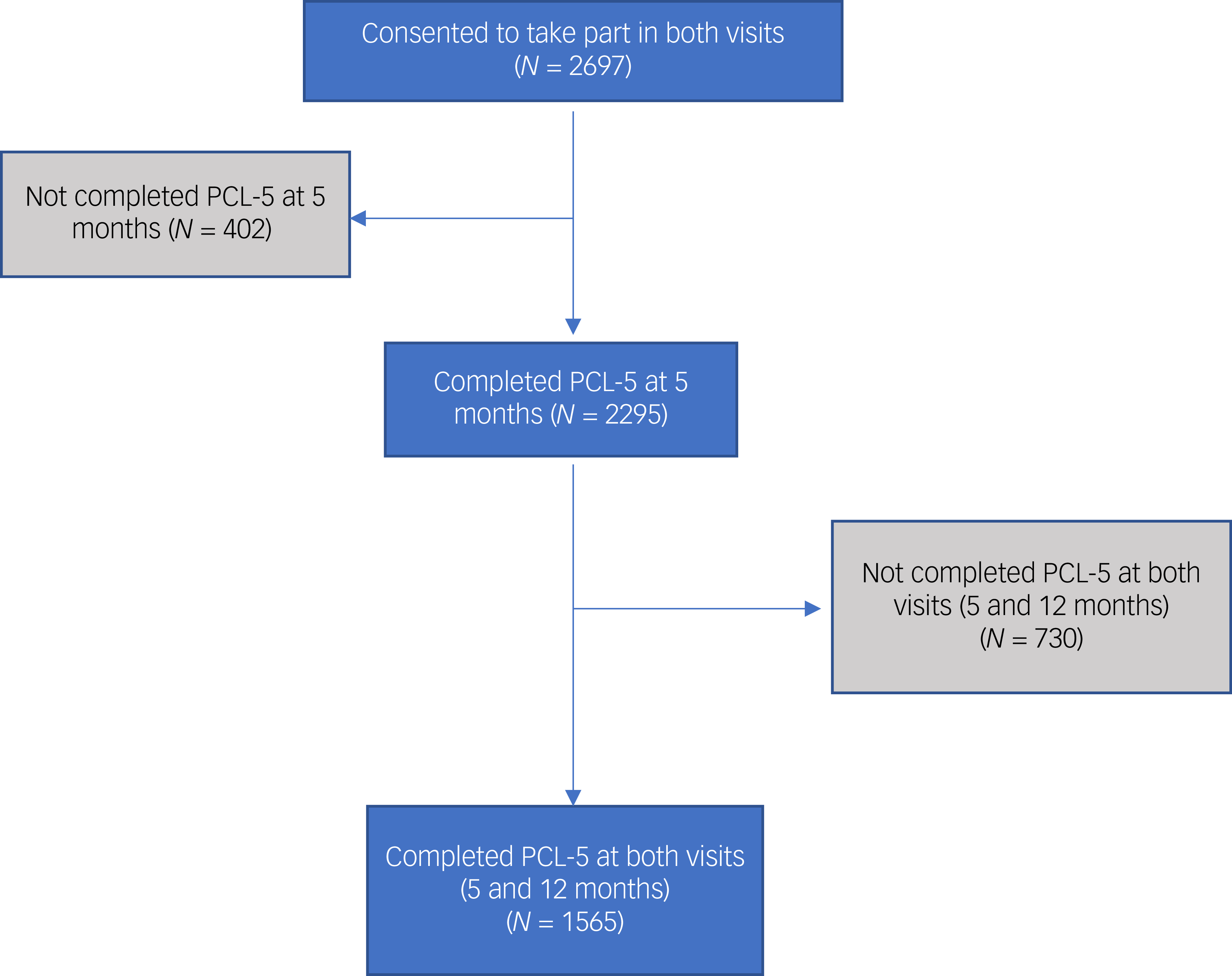
In total, 1565 participants who were discharged from 1 of the 83 NHS hospitals that took part in the study between March 2020 and April 2021 after treatment for COVID-19, and completed PCL-5 at both research visits that took place between August 2020 and March 2022, were included in the analysis (see Fig. 1). The median time from discharge to the first visit was 5.4 months, and to the second visit was 12.7 months.
Flow diagram of participants in this study. PCL-5, Posttraumatic Stress Disorder Checklist for DSM-5.

Characteristics of the sample
Most participants were male (n = 959, 61.3%), of White ethnicity (n = 1211, 77.4%) and were from more deprived areas (n = 971, 62%). The mean age was 59.4 years (s.d. = 12.0). Admission duration for 78.9% (n = 1235) was less than 20 days and one-third (n = 525, 33.5%) were admitted to ICU (see Table 1). Of these, 15.1% (n = 236) had probable PTSD (PCL-5≥ 34) at 5 months. Sixty-eight (4.3%) participants scored less than 34 on the PCL-5 at 5 months but scored ≥34 at 12 months. These participants were not the focus of this analysis.
Participants’ demographics, admission characteristics and mental health characteristics

Table 1 Long description
The table presents data on participants’ demographics, admission characteristics, and mental health characteristics. It has 1565 participants divided into two groups based on PCL-5 scores at 5 months: No (1329 participants) and Yes (236 participants). The table includes sociodemographic characteristics such as gender, age, ethnicity, English as a first language, education level, IMD quintile, income, living arrangements, and employment status prior to admission. Admission characteristics include systolic blood pressure, admission duration, heart rate, temperature, confusion, SpO2, psychotropic medication use, steroids use, and ICU admission. Health prior to admission includes EQ-5D-5L summary, anxiety or depression levels, treatment by a mental health professional, depression or anxiety, chronic or IBS, and antidepressant medication use. Each row provides specific data points for these characteristics, with percentages and means where applicable.
PCL-5, Posttraumatic Stress Disorder Checklist for DSM-5; IMD, Index of Multiple Deprivation; bpm, beats per minute; SpO2, oxygen saturation; ICU, intensive care unit; EQ5D-5L, EuroQuol-5 Dimension 5 Level; Chronic or IBS, chronic fatigue syndrome, fibromyalgia or chronic pain and/or irritable bowel syndrome.
The characteristics of participants who scored ≥34 on the PCL-5 at 5 months are shown in Table 1. Participants with probable PTSD at 5 months were more likely to be female (45.9% v. 37.5%), younger (mean age 54.8 years (s.d. = 10.6) v. 60.3 years (s.d. = 12.1)), from more deprived areas (IMD quintile 1: 75% v. quintile 3: 59.7%) and earning less than £35 001 per year (50% v. 37.3%). They were more likely to have had a longer admission duration (28.8% v. 19.7%) and used psychotropic medication while in hospital (40.3% v. 12.3%). They were more likely to report a history of depression or anxiety (39.4% v. 12.4%) and of using antidepressant medication (24.2% v. 9%). Participants with probable PTSD at 5 months had higher PHQ-9 and GAD-7 scores at 5 and 12 months (see the Supplementary Material).
Pooled risk ratios were estimated across strata defined by age, income, admission duration, previous depression or anxiety and psychotropic medication use during admission. These ratios quantify the association with meeting criteria for probable PTSD at 5 months, using non-case status (PCL-5 < 34) at 5 months as the reference category (Fig. 2). Sociodemographic factors associated with higher relative risk of having probable PTSD at 5 months included being younger (e.g. for age group of 18–50 risk ratio 3.0 95% CI: 2.1–4.3 p = <0.001 compared with age group of 65+), and having lower income or preferring not to say their income (e.g. for income of less than £19 001 risk ratio 2.1, 95% CI: 1.5–2.8, p < 0.001 compared with more than £35 000). Furthermore, longer admission duration (20 or more days, risk ratio 1.4, 95% CI: 1.2–1.7, p < 0.001 compared with less than 20 days), using psychotropics on admission and having previous depression or anxiety were also significantly associated with having probable PTSD at 5 months.
Relationship between probable post-traumatic stress disorder (PTSD) (PCL-5 ≥ 34 at 5 months) and participants’ characteristics. PCL-5, Posttraumatic Stress Disorder Checklist for DSM-5.

Characteristics of those with persistent ‘probable PTSD’
This sample included 236 participants who scored ≥34 on the PCL-5 at 5 months. Of these, 136 (57.6%) continued to score ≥34 on the PCL-5 at 12 months. There were several differences between participants with persistent probable PTSD and those who had probable PTSD only at 5 months (see Table 2).
Characteristics of participants with probable post-traumatic stress disorder (PTSD) at 5 months, stratified by persistent probable PTSD

Table 2 Long description
A table comparing characteristics of participants with probable PTSD at 5 months, stratified by persistent PTSD. The table has 36 rows and 10 columns. Column headers are: Overall, No, Yes, and P value. Row labels include N, Age in years at admission, Ethnicity, English first language, Education level, IMD quintile, Income, Living arrangements, Employment status prior to admission, and Social affect work 5 months. Each row provides specific data points for the categories Overall, No, Yes, and P value. Notable trends and comparisons are visible across the rows and columns, highlighting differences between participants with persistent probable PTSD and those with probable PTSD only at 5 months.
PCL-5, Posttraumatic Stress Disorder Checklist for DSM-5; IMD, Index of Multiple Deprivation; SpO2, oxygen saturation; ICU, intensive care unit; EQ5D-5L, EuroQuol-5 Dimension 5 Level; Chronic or IBS, chronic fatigue syndrome, fibromyalgia or chronic pain and/or irritable bowel syndrome; BMI, body mass index; PHQ-9, Patient Health Questionnaire; GAD-7, general anxiety disorder.
Those with persistent probable PTSD were less well-educated (74.3% v. 51% secondary education only), earned less than £19 001 per year (30.1% v. 19%) and more likely to have required an ICU admission (50.7% v. 34%). They were also more likely to report they had not recovered from COVID-19 at 12 months (73.5% v. 63%), have had a higher PCL-5 score at 5 months (mean PCL-5 50.4 v. 43.2) and higher PHQ-9- and GAD-7 scores at both 5 and 12 months.
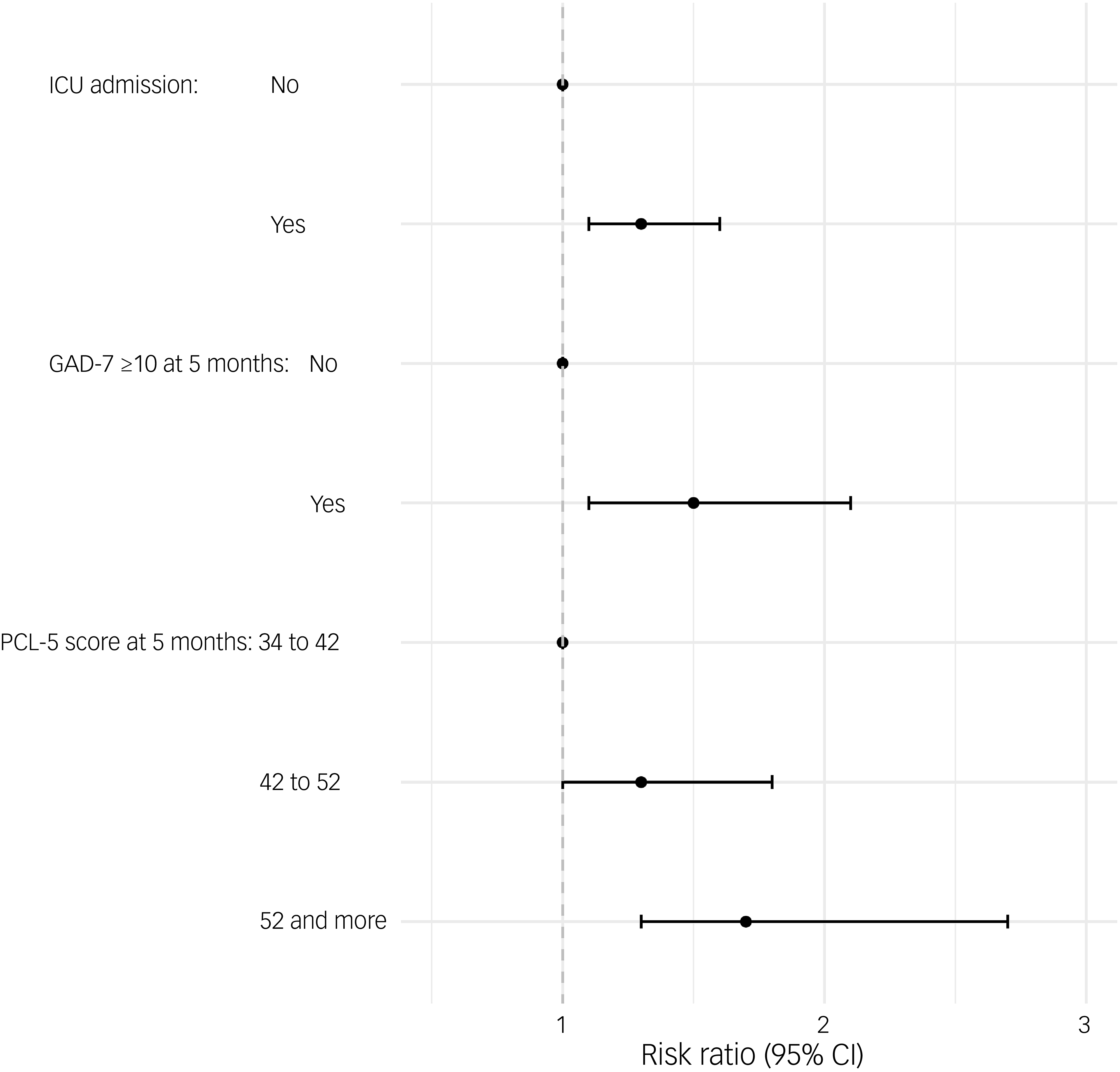
For the analyses of participants with persistent probable PTSD, risk ratios are presented within ICU admission, and GAD-7 and PCL-5 scores’ groups at 5 months reporting having persistent probable PTSD, with not having persistent probable PTSD at 12 months (i.e. only at 5 months) as the reference category (Fig. 3). Factors associated with persistent probable PTSD included being admitted to ICU (risk ratio: 1.3, 95% CI: 1.1–1.6, p < 0.001), higher GAD-7 scores and having a PCL-5 score greater than 42 at 5 months.
Relationship between persistent probable post-traumatic stress disorder (PTSD) (PCL-5 ≥ 34 at 5 and 12 months) and participants’ characteristics. PCL-5, Posttraumatic Stress Disorder Checklist for DSM-5; ICU, intensive care unit.

Discussion
The Post-Hospitalisation COVID-19 study (PHOSP-COVID) is one of the largest multicentre cohorts of people admitted to hospital with COVID-19 in the world. We analysed longitudinal data to describe the prevalence of, and risk factors for, probable PTSD in patients discharged from UK hospitals following admission for COVID-19.
Limitations
PHOSP-COVID has several limitations which may have had an impact on our analyses. Participants were recruited between August 2020 and March 2022 and so the cohort includes a mix of vaccinated and unvaccinated participants, and participants infected with different COVID-19 strains. Recruitment took place after hospital discharge and therefore information relating to the period before admission was obtained largely by participant recall and thus subject to recall bias. While 7935 participants were recruited to PHOSP-COVID, less than half consented to take part in 2 research visits, Reference Elneima, McAuley, Leavy, Chalmers, Horsley and Ho22 introducing further possible selection bias. We included only participants who completed the PCL-5 at both research visits, which may further amplify this selection bias. We have PCL-5 scores at only two time points. Future studies may gain greater insights from having more data points and being able to analyse changes over time. While PPIE activities have been substantial in the PHOSP-COVID project, we did not undertake additional PPIE work as part of these analyses.
The time between discharge and research visits varied between participants for practical reasons, and this may have had an impact on the reporting of psychological symptoms. Psychological health data were obtained by questionnaires only, and no clinical psychiatric assessment took place. PHOSP-COVID data include only participants who were admitted to hospital with COVID-19. We have therefore not been able to compare our findings with patients admitted to hospital for other reasons, or who had COVID-19 but were not admitted to hospital. In addition, we are aware that fewer older adults were admitted to ICU with COVID-19 in the UK. Those that were admitted are likely to have had very different premorbid health states compared with the younger, albeit less healthy, individuals admitted to ICU. If more older patients had been admitted to ICU, they may have survived and gone on to suffer PTSD at similar levels to younger patients.
Strengths
PHOSP-COVID is one of the largest multicentre cohort studies of people admitted to hospital with COVID-19 in the world. We report data from the period of admission to hospital and at two time points after discharge. There is a wide range of clinical data and a large amount of patient-reported psychosocial data concerning their lives before and after admission. In our analyses, both those with and without probable PTSD had been admitted to hospital during the same period, to some degree helping to control for the wider psychological risks presented by the pandemic itself.
PHOSP-COVID included the PCL-5 as a validated and widely used measure of self-reported PTSD symptoms based on DSM-5. A cut-off of 33/34 identifies people who are likely to have PTSD. Reference Murphy, Ross, Ashwick, Armour and Busuttil25 It is important, though, to recognise that diagnostic interviews, the gold standard, were not carried out in PHOSP-COVID. Scott, Reference Scott, Stevelink, Gafoor, Lamb, Carr and Bakolis28 using an ultra-brief screening tool, found marked discrepancies between the proportion of patients identified as cases of PTSD on screening and on using a diagnostic interview. Other studies Reference Murphy, Ross, Ashwick, Armour and Busuttil25 found smaller differences. We have used the term ‘probable PTSD’, recognising that psychometric measures and screening tools should not form the sole basis of a diagnosis. Reference Murphy, Ross, Ashwick, Armour and Busuttil25 In addition, PHOSP-COVID participants completed the PHQ-9 and GAD-7, both of which are widely used in clinical practice in the UK to record symptoms of depression and anxiety.
We found that 15% of patients discharged from hospital after admission for COVID-19 had probable PTSD at 5 months. This is around double the prevalence in the general population in the USA Reference Kessler, Chiu, Demler, Merikangas and Walters29 and the UK Reference Scott, Stevelink, Gafoor, Lamb, Carr and Bakolis28 and is in keeping with other, albeit smaller, studies of COVID-19 patients. Reference Klinkhammer, Duits, Horn, Slooter, Verwijk and Van Santen30,Reference Lucijanic, Mihaljevic Peles, Piskac Zivkovic, Lucijanic, Kranjcevic and Muzinic Marinic31 Few studies reported PTSD in patients admitted to hospital with acute respiratory infections prior to the COVID-19 pandemic. Denke and colleagues Reference Denke, Balzer, Menk, Szur, Brosinsky, Tafelski, Wernecke and Deja32 found a prevalence of 16% in 64 patients followed up after admission with severe community acquired pneumonia, and Lettinga and colleagues Reference Lettinga, Verbon, Nieuwkerk, Jonkers, Gersons and Prins33 reported 15% of 122 patients who survived an outbreak of Legionnaire’s disease had PTSD. Salehi and colleagues Reference Salehi, Amanat, Mohammadi, Salmanian, Rezaei and Saghazadeh34 carried out a systematic review of studies of PTSD following coronavirus outbreaks, though not restricted to hospitalised patients. The overall prevalence of PTSD was 18%, but varied substantially with study type, virus type, patient group and especially geographical location. Yuan and colleagues Reference Yuan, Gong, Liu, Sun, Tian and Wang35 systematically reviewed studies of PTSD after 21st century infectious disease epidemics. Of 80 studies, 47 were on COVID-19, although only 14/80 studies (1% of the participants) were on infected patients. They reported an overall PTSD prevalence of 23%, comparing this with 20% for major traumatic events and 16% for floods. Reference Yuan, Gong, Liu, Sun, Tian and Wang35
COVID-19 patients admitted to hospital were more severely ill than COVID-19 patients not admitted to hospital, and it might be expected that the more severely unwell patients were most likely to experience PTSD symptoms. We found some evidence to support this. Although patients who subsequently reported PTSD symptoms were of similar illness severity at the point of admission their total length of stay, a proxy marker of disease severity, was independently associated with probable PTSD at 5 months in multivariable analyses. We also identified several individual-level risk factors for probable PTSD at 5 months. In our univariable analyses, female patients and those of non-White ethnicity were more likely to report PTSD symptoms but these were no longer significant in multivariable analyses. In multivariable analyses, there was a dose effect for age and income; younger patients and patients on lower incomes were more likely to have probable PTSD at 5 months, as were COVID-19 patients who used psychotropics on admission and who reported having previously experienced psychiatric illness. Individual-level factors, Reference Yuan, Gong, Liu, Sun, Tian and Wang35 as well as clinical severity, are important in understanding PTSD in patients discharged from hospital after COVID-19.
Within those who had probable PTSD at 5 months,we explored risk factors associated with still having probable PTSD at 12 months. Of all participants, 15% had probable PTSD at 5 months and more than half (57%) still had probable PTSD at 12 months. Persistent probable PTSD was related both to illness severity and the characteristics of who became unwell, though interestingly the risk factors varied compared with those with probable PTSD only at 5 months. Admission to ICU was associated with persistent probable PTSD but greater length of stay was not. Having a GAD-7 score ≥10 at 5 months was associated with persistent high PCL-5 scores. Younger age and lower reported income were not associated with persistent probable PTSD. As might be expected, those with more PTSD symptoms at 5 months, as indicated by higher PCL-5 scores, were more likely to have persistent probable PTSD (mean PCL-5 score 50.5 v. 43.2). How ill you were and how distressed you were predicted persistent PTSD symptoms.
Probable PTSD at 5 months was associated, in multivariable analyses, with reporting a lower income and, in univariable analyses, with living in a more deprived area. A large Swedish register-based cohort study has shown that PTSD is more common among refugee migrants, individuals with psychiatric disorders and the socioeconomically disadvantaged groups. Reference Rahman, Zammit, Dalman and Hollander36 This aligns with the findings from the World Mental Health Surveys, which demonstrated socially disadvantaged groups (including those with low household income) had increased risk of persistent PTSD. Reference Koenen, Ratanatharathorn, Ng, McLaughlin, Bromet and Stein37 The association between PTSD and deprivation is partly driven by a higher incidence of trauma exposure in more deprived populations. Relatively few studies have attempted to control for this, though interestingly for our study, Hung’s study Reference Hung, Tol, Musci, Aketch and Bachani38 which showed that PTSD was more common in those with no household savings was conducted on general hospital in-patients in Kenya. Contracting COVID-19 in the UK was strongly associated with deprivation for a wide range of reasons, including living in more crowded housing, continued use of public transport and lower rates of vaccine take-up. Our findings are consistent with this. The retention of low income as an independent risk factor in the multivariable analyses is consistent with Holmes’ finding Reference Holmes, Callinan, Facemire, Williams, Ciarleglio and Smith39 that the increased risk of PTSD in more deprived groups is not solely explained by greater exposure to trauma. It seems plausible that the greater level of psychological strain associated with poverty and deprivation might itself increase susceptibility to PTSD. Deprivation and poverty contribute to a spectrum of risk for PTSD. Understanding where on this spectrum any one patient sits will require an understanding of their individual socioeconomic situation.
A history of depression or anxiety was an independent risk factor for having probable PTSD at 5 months in multivariable analyses. The association between past psychiatric history and PTSD is well established in the general PTSD literature Reference Brewin, Andrews and Valentine40 so the associations we describe with depression and anxiety were anticipated. Our findings add to the literature that this association holds for PTSD following admission to the general hospital. Reference Bienvenu, Gellar, Althouse, Colantuoni, Sricharoenchai and Mendez-Tellez41,Reference Wawer, Viprey, Floccard, Saoud, Subtil and Wafa42 This association is not fully explained by greater exposure to trauma. There may be general susceptibility to psychiatric illness, and it is possible that the association in population-based studies is confounded by access to services where a psychiatric diagnosis can be established. The importance of this finding in our study is that the elevated risk of PTSD in patients admitted to the general hospital for COVID-19 or any other reason will only be recognised, and therefore acted on, if a sufficiently detailed history is taken.
Implications
In 2020, COVID-19 was a new illness, with an unclear natural history. Hospitals filled up. Many people died. It is not surprising that a proportion of COVID-19 patients admitted to hospital developed significant symptoms of PTSD. Our study, however, identified a high prevalence of probable PTSD at 5 months following hospital discharge, with more than half of such patients remaining symptomatic at 12 months. It is tempting to explain this based on the particular challenges of COVID-19 at that time. Our findings are consistent with the idea that those with more severe illness were more likely to develop PTSD. But people did not become ill with COVID-19 or require admission to hospital randomly. The COVID-19 infection was more common, and led to worse outcomes, in more disadvantaged communities – it was an ‘unequal pandemic’. Reference Bambra, Riordan, Ford and Matthews7 In our analyses younger age, lower income and a history of psychiatric illness were all associated with worse psychological outcomes, independent of measures of physical illness severity.
Optimal management of future pandemics will require the construction of systems that can minimise psychiatric as well as physical complications. Until there is better evidence for preventing mental illness, early recognition and rapid signposting to evidence-based treatment will be required. COVID-19, like pandemics before it, most greatly affected the most disadvantaged in society. Mental illness sits on a similar social gradient. Our findings add to a body of evidence showing that individual-level risks, for example younger age, lower income and past psychiatric history, are all risk factors for probable PTSD after an admission for COVID-19. Patients’ social histories merit ‘the same attention as their disease status’ Reference Srivastava43 even for SARS-CoV-2 infected patients. Many of the risk factors for post-discharge PTSD can be identified by taking a good social history on admission. We also found that an extended length of stay and admission to ICU increased the risk of subsequent probable PTSD. Better recognition of risk factors prior to admission, and generated by the admission, could inform strategies to reduce post-discharge psychiatric complications.
Supplementary material
The supplementary material is available online at https://doi.org/10.1192/bjo.2026.12081
Data availability
The protocol, consent form, definition and derivation of clinical characteristics and outcomes, training materials, regulatory documents, information about requests for data access and other relevant study materials are available online at https://www.phosp.org. All analytical codes are in a secured environment. Requests for access to the codes should be directed to the corresponding author.
Acknowledgements
This study would not be possible without all the participants who have given their time and support. We thank all the participants and their families. We thank the many research administrators, healthcare and social-care professionals who contributed to setting up and delivering the study at all of the 65 National Health Service (NHS) trusts/health boards and 25 research institutions across the UK, as well as all the supporting staff at the National Institute for Health and Care Research (NIHR) Clinical Research Network, Health Research Authority, Research Ethics Committee, Department of Health and Social Care, Public Health Scotland and Public Health England, and support from the ISARIC Coronavirus Clinical Characterisation Consortium. We thank Kate Holmes at the NIHR Office for Clinical Research Infrastructure (NOCRI) for her support in coordinating the charities group. The PHOSP-COVID industry framework was formed to provide advice and support in commercial discussions, and we thank the Association of the British Pharmaceutical Industry as well as NOCRI for coordinating this. We are very grateful to all the charities that have provided insight to the study: Action Pulmonary Fibrosis, Alzheimer’s Research UK, Asthma + Lung UK, the British Heart Foundation, Diabetes UK, the Cystic Fibrosis Trust, Kidney Research UK, MQ Mental Health, Muscular Dystrophy UK, Stroke Association Blood Cancer UK, McPin Foundations and Versus Arthritis. We thank the NIHR Leicester Biomedical Research Centre patient and public involvement group and Long Covid Support. PHOSP-COVID is an independent research study jointly funded by the NIHR and UK Research and Innovation (UKRI) [PHOSP COVID, grant references: MR/V027859/1 and COV0319]. The views expressed in this publication are those of the author(s) and not necessarily those of the NHS, NIHR, The Department of Health and Social Care or UKRI. The electronic Data Research and Innovation Service (eDRIS) team, which is part of Public Health Scotland, provided us with required services to access to and work in the National Safe Haven which is a secure environment where data for our project was uploaded. Artificial Intelligence use: no artificial intelligence tools have been used in the research or writing process for this manuscript.
Author contributions
The manuscript was initially drafted by E.A. and M.H., and further developed by C.A., E.G., J.D.C., L.-P.H., A.H., M.M., B.R., O.C.L., M.R., O.E., H.J.C.M., A.S., M.S., R.M.S., V.C.H., L.H.-W., N.J.G., E.M.H., A.B.D., N.I.L., J.K.Q., L.V.W., R.A.E., C.E.B., R.M.W. E.A., M.H., R.M.W., C.A. and E.G. made substantial contributions to the conception and design of the work. C.E.B., L.V.W. and R.A.E. made substantial contributions to the acquisition of data. E.A., M.H., C.A. and R.M.W. contributed to the analysis or interpretation of the data. E.A., M.H., C.A., R.M.W., C.E.B., L.V.W. and R.A.E. accessed and verified the underlying data. All authors contributed to the critical review and revision of the manuscript. All authors had access to the data in the study and accept responsibility for the decision to submit for publication.
Funding
PHOSP-COVID is jointly funded by a grant from the MRC-UK Research and Innovation and the Department of Health and Social Care through the NIHR rapid response panel to tackle COVID-19 (grant references: MR/V027859/1 and COV0319). The views expressed in the publication are those of the author(s) and not necessarily those of the NHS, the NIHR or the Department of Health and Social Care.
Declaration of interest
E.G. reports receiving grants from NIHR, outside the submitted work. J.K.Q. reports grants from the Medical Research Council (MRC), NIHR, Health Data Research, AstraZeneca, Boehringer-Ingelheim (BI), GlaxoSmithKline (GSK), Insmed, Sanofi and payment or honoraria from GSK, BI, Sanofi, Chiesi and AstraZeneca, outside the submitted work. M.M. is an investigator on the PHOSP Grant. C.E.B. reports support from PHOSP-COVID, NIHR, UKRI and NIHR Leicester BRC for the present manuscript, and receiving grants and consultancy fees from 4D Pharma, Areteia, AstraZeneca, Chiesi, Genentech, GSK, Mologic, Novartis, Regeneron Pharmaceuticals and Roche and Sanofi, outside of the submitted work. A.B.D. reports funding from Wellcome in an unrelated personal fellowship (227856/Z/23/Z). A.H. reports support for the present manuscript from UKRI (MR/V027859/1) and NIHR Manchester BRC. J.D.C. reports grants and personal fees from AstraZeneca, BI, GSK, Chiesi and Grifols, and consultation fees from Insmed Novartis, Pfizer, Janssen, Antabio and Zambon, outside the submitted work. R.A.E. reports funding support from UKRI/MRC/NIHR for the present manuscript, grants from the Wolfson Foundation and Genentech/Roche, consulting fees from AstraZeneca/Evidera for Long COVID, speaker fees from Moderna on the topic of Long COVID, and leadership roles as Chair of the ERS Group 01.02 Pulmonary Rehabilitation and Chronic Care, and Chair of the ATS Pulmonary Rehabilitation Assembly, outside the submitted work. N.I.L. reports leadership roles as Director of Research, Intensive Care Society, UK, and Chair, Scottish Intensive Care Society Audit Group, Public Health Scotland, outside the submitted work. L.V.W. reports support from UKRI, GSK/Asthma and Lung UK, NIHR for the present manuscript, grants from Orion Pharma, GSK, Genentech and AstraZeneca, consulting fees from Galapagos, GSK and BI, support for attending meetings from Genentech, advisory board membership with Galapagos and a leadership role as Associate Editor for the European Respiratory Journal, outside the submitted work. B.R. reports funding from Wellcome in an unrelated personal fellowship (302210/Z/23/Z). E.A., M.H., C.A., R.M.W., L.-P.H., N.J.G., R.M.S., E.M.H., H.J.C.M., O.C.L, O.E., L.H.-W., M.R. and V.C.H. report no competing interests.




 Open access


eLetters
No eLetters have been published for this article.