Introduction
In this article, I will explore the possibility of anarchism to provide a strong analytical framework for studying societies from a perspective where power and control lie not only within institutionalized centres or states or even with a single chieftain or magnate, but also within the complex interaction and reactions of individuals, families and households or local, regional and even global cooperative groups and networks.
Power, wealth and centralization are pivotal in studies on social organization and dynamics from the Late Iron Age to the Middle Ages (A.D. 550–1550) in southern Scandinavia. The objective of such studies often relates to state formation and the development of centralized institutions and royal power, a tendency termed ‘power-and-prestige archaeology’ by Widgren (Widgren 1998, 281; see also Randsborg 1980; 1991; Mortensen and Rasmussen 1988; 1991; Callmer and Rosengren 1997; Wickham 2005; Ulsig 2011; Poulsen and Sindbæk 2011; Stidsing, Fiedel and Høilund Nielsen 2014; Näsman 2006). It is evident in work on central places (Jørgensen 2008; Söderberg 2005), on landscape studies (Fabech and Ringtved 1999; Hansson 2006) and on material records (Høilund Nielsen 2014; Feviele 2016). A predominant focus on aristocratic or royal powers, wealth and prestige, as well as on centralized and formalized institutions, however, has narrowed the perspectives on the mechanisms that form and constitute social organization and dynamics. The active role of people constituting society inside, outside, beside or in opposition to power structures and centralized institutions has seen less attention. There are many reasons for this: it is partly caused by the traditions and structural divisions in research history, partly by a predominant interest in economic explanations and partly by the character and handling of the surviving material culture, where objects of prestige metal and elite residences take precedence. It is easier archaeologically to identify the mighty and powerful. But is this really so? Are aristocratic or royal powers, wealth and centralized institutions the predominant constituting elements in social organization and dynamics? Can we not gain a more complex and nuanced understanding of how societies operate, evolve and are organized by acknowledging a broader and more differentiated and entangled group of participants with deliberate and complex ways of interacting and reacting? Should we not question a social preconception where large groups of people are not granted influence? How can we understand social organization and dynamics if we accept that humans act out of free will; that they seek autonomy, prosperity and the ability to choose freely; and that they will not tacitly confine themselves to structures not rational or reasonable to them and their world in their particular time and space?
Anarchistic principles acknowledge that social organization is constituted by human needs and desires achieved through human actions. Furthermore, in anarchism social organization is not considered a natural position but must be laboured. According to anarchism, three core principles stand out, aimed at accommodating individual or cooperative needs and maintaining social order: network organization, justified leaders and decentralization (Angelbeck and Grier 2012). Anarchism can be viewed and applied as a political programme or an idealistic endeavour often associated with disruption and disorder. However, this is far from the original anarchistic ideas. In this paper, I will apply principles of anarchism as an analytic tool in much the same way as Marxism has been applied to the social sciences for years. My main concern is social organization and dynamics in southern Scandinavia from the Late Iron Age to the Middle Ages (A.D. 550–1550), but I will not confine myself exclusively to this time- and space-specific frame. I will define the concept of anarchism and the main principles before turning to examples of anarchistic action. Even though anarchistic ideas are old, application in terms of method and theory is new to archaeology. Therefore this paper aims to explore the analytical and interpretive potential but does not claim to produce elaborated models or conclusions.
Why anarchism?
Anarchism has experienced regained interest and has recently been applied to a number of archaeological studies. Most influential is Angelbeck and Grier’s work on the Coast Salish region of the Pacific Northwest Coast (Angelbeck and Grier 2012; see also Flexner 2014; Counter archaeologies special issue of World archaeology, 49(3) (2017)). The use of anarchism in social science has two different sources: one is a theoretical framework applied to non-state, heterarchical or acephalous societies mostly based in an American anthropological research tradition, and the other is the application of anarchistic ideals to archaeological or anthropological research practice (Borck and Sanger 2017, 10; Purkis and Bowen 2004; Kintz 2017; Morgan 2015). I propose a third way, using the concept of anarchism as a lens through which to gaze anew on social organization and dynamics in cultural history in general. Anarchistic actions can be viewed as a response towards centralization and institutionalization in pre-state societies and can be helpful in understanding how societies organize to resist the emergence of centralization. But likewise, anarchistic actions can be seen as a response to negative aspects of centralized state systems, and accordingly be supportive in understanding social mechanisms within state systems. For archaeological research designs in particular, I believe there is much to gain. Generally, history is written by the victorious and stories that promote chiefs and kings or favour political actions are well known. However, we are all intrigued by the tales of Robin Hood, Spartacus and Asterix and stories of rebellion and resistance can be found all over the world, as in the Chinese tale of the Outlaws of the Marsh. They are, above all, tales of resistance and hostility to authority. In Knight’s words, ‘From forest to town and from song to print the outlaw myth continues to serve the multiple interests of audiences for whom resistance to authority is a deep-seated desire’ (Knight 2006, 159). Although none of the tales can be said with any accuracy to represent historical characters or incidences, they thrive on a collective memory of resistance to authority, a desire for autonomy and self-government, and an idea of cooperation in order to avoid imposed power structures. Rebellion and resistance otherwise only appear in the archives when successful or extremely disruptive; perhaps deliberately going unnoticed to avoid authoritative reactions (Flexner 2014, 84). Scott points to the ‘weapons of the weak’ as effective actions influencing social organization, and there are numerous examples of how the most oppressed, exploited and impoverished people resist colonial power or state structures (Scott 1985; Flexner 2014, 84). Accordingly, anarchism applied in archaeological research design can prove valuable since resistance and decentralization might be manifested in material expressions and landscape organization. Anarchism as an analytical lens through which to view the world is, therefore, as relevant today as in the medieval shadows of Sherwood or at the borders of an expanding Roman Empire.
However, according to Angelbeck and Grier (2012), anarchism does more than point the lens towards the marginalized and oppressed. It recognizes that social interaction is changeable, and that the status and authority of an individual or a group are connected to context: being both an oppressor and an oppressed in different situations and interactions, to use anarchistic terminology. Furthermore, offering a perspective liberated from neo-evolutionistic tradition – acknowledging individual intentionality more than material determinism – and a shift in perspective from authority to resistances, from centralization to decentralization, and from organization to disorganization, will allow a focus on important and under-studied dimensions of social organization, materiality and places. I do not merely aim to change the perspective and preserve the dichotomy just from the other side. Rather, I seek to point to the complexity, diversity and range of human actions, interactions and reactions. By recognizing and analysing network organization, justified leaders, decentralization and resistance, these actions will prove not merely to be counterproductive activities, but also productive reactions serving autonomy, growth and security, thereby holding potential for social organization and changes.
An anarchistic perspective provides not only a lens but also a mirror, and is useful to avoid ethnocentrism by questioning the primacy of hierarchy as the desired model of a complex society. As Rathbone states, ‘This problem proved particularly difficult because it is counter-intuitive to westerners for whom hierarchical organisation is deeply ingrained and for whom concepts of cultural complexity are typically welded to ideas of progressive social evolution’ (Rathbone 2017, 2, with references).
As noted by Angelbeck and Grier, anarchism provides a framework that can ‘resolve many of the apparent contradictions engendered by state-focused models of social hierarchy and complexity’ (Angelbeck and Grier 2012, 548). As regards the Coast Salish region central to Angelbeck and Grier’s study, they found that the society was highly complex but lacked complex political authority. Observations of societies with a high degree of social complexity in terms of elaborated material culture, composite rituals and different power relations, but without a state structure, are found all over the world and support the need for a complex approach (Flexner 2014, 83). We find leaders of high repute and status, but with little real power and no means of executing it; their power being circumscribed by creative social mechanisms (e.g. Mauss 1925; Clastres 1989; McGuire and Saitta 1996, 202; Saitta 1994). An anarchistic perspective will question our understanding of power, political representation and complexity. We will, in the mirror and through the lens of anarchism, be forced to ask what power is and how it is managed and maintained, and to view the answers anew.
But is an anarchistic perspective a fruitful contribution to archaeological research? Does it offer new insights not already put forward in earlier attempts to modify evolutionist and state-based models?
Anarchism stands on the shoulders of other perspectives favouring heterarchy, dialectical approaches, complexity and agency (Crumley 1995; Chapman 2003; Blanton and Fargher 2008; Kohring 2011; Kohring and Wynne-Jones 2007, 3; Bourdieu 1977, 164). What anarchism offers that sets it apart is, first, a coherent foundation for understanding diversity and complexity in power relations. Second, it acknowledges intentionality in human behaviour along with unconscious practices and actions. Finally, it offers an analytical approach that is operational and applicable. Accordingly, the concept of anarchism is a useful analytical tool to shed new light on social dynamics in any society.
A history of complex explanations
The past ten years have seen an increased interest in anarchistic thoughts in anthropology and archaeology (Borck and Sanger 2017, 9; Angelbeck and Grier 2012; Flexner 2014; Morgan 2015; Scott 2009).
The journal World archaeology dedicated an entire issue in 2017 to articles on counterarchaeologies (49(3)), and so did the SAA archaeological record (17(1)). In 2018, the Journal of contemporary archaeology followed suit with an issue dedicated to anarchism (5(2)). A Ph.D. thesis launched at the University of Freiburg in 2016 analysed intercultural communications and iconography in the western Mediterranean during the Late Bronze Age and the Early Iron Age using anarchism as a theoretical standpoint (Gonzalez 2016). At the annual meeting of the European Association of Archaeologists in 2017, a session focused on social theories and used anarchism as a keyword, as did many of the contributions. In 2018, an entire session set out to explore the concept of Archaeology and Anarchism. Welch (2017, 17) suggests that the revitalization of anarchism relates to ‘the apparent failures of late modern states around the world to make good on promises to support just and sustainable social systems’.
The concept of anarchism, however, is not new. Kropotkin, Proudhon and Bakunin, among others, developed anarchism and made it a popular social concept in the 19th century (Rathbone 2017; Borck and Sanger 2017). Anarchism, they claimed, was the rejection of elitism and authoritarianism and the creation of a new social body (Dolgoff 1972, 5). As with Marxism, anarchism developed as a reaction to modern industrialization, and Marx as well as the anarchistic protagonists found that individual freedom became oppressed and subservient to a rising elite. Although they shared common ideas, Marx and Bakunin saw different reactions to the oppression and disagreed strongly on two main concerns: first, where Marx saw economic and material factors as central to the process of inequality, anarchists believed that a complexity of factors, e.g. culture, gender and environment, were influential as well. Second, in contrast to Marxists, who believed that revolution was a necessary means to reach the end goal, anarchists believed that the means created the end (Marshall 2008; Borck and Sanger 2017).
Building on these thoughts, Marcel Mauss (1925) studied economies and markets without money and argued that, for moral reasons, a gift-giving economy was a preferred and conscious model avoiding profit and, accordingly, inequality. Likewise, Clastres (1989) offered an analysis of politics, demonstrating political organizations in Amazonian societies with distinct counteractions toward political powers. Central to both Mauss’s and Clastres’s analyses are systems that consciously decentralized power and authority, and costly rituals or exhausting responsibilities that levelled the accumulation of wealth or made power unattractive. Although not formulated as such, these arguments contained elements closely related to anarchistic principles and sparked a beginning, not only for social anthropology but also for anarchistic thoughts and discussions (Graeber 2004, 121–23).
Postcolonial studies emerging in the 1970s also sparked ideas of multiple identities and mutual relations as opposed to the dominating dichotomy of, e.g., master/slave, culture/barbarism or modern/primitive (Young 2009, 15). It seemed relevant to apply the concept of anarchism in regions and research fields where colonialism had been dominating, because the clear dichotomy between conqueror and conquered inevitably leads to resistance (Welch 2017, 17).
Many studies in the years to follow were concerned with power relations, lost voices, reactions to centralization, dominion and hierarchy (Barclay 1990; Earle 1997; Scott 1985; Clastres 1989; Morris 2005; McGuire and Saitta 1996), predominantly studies based in the United States (Rathbone 2017, 4), but European contributions have also come forward (e.g. Wengrow 2010; Gonzalez 2016). Study objects and methodologies vary according to different structural research traditions and include ethnographic studies, anthropological analyses, studies in historical archaeology and, to a lesser degree, archaeological studies (Rathbone 2017; Anderson 2005; Graeber 2004; 2009; Bettinger 2015; Flexner 2014; Morris 2005; see Borck and Sanger 2017, 9, for more examples).
With a regained interest in anarchism in social science in the past ten to twenty years, it has been argued that a specific theory of anarchism is yet to be defined (Schulze 2013; Graeber 2004; Scott 2012; Purkis and Bowen 2004). Anarchism is often understood as an embracing ideology and per se unwilling to define or constrain any theoretical framework. Academic encounters with anarchism deal with a broad range of study objects and methodologies, including resistance to and escape from stately institutions over organizational models and class struggle as a reaction to capitalism (Schulze 2013, 136). Morgan (2015, after Caraher, Kourelis and Reinhard 2014) suggests an ‘empty-vessel’ metaphor; an anarchistic container accommodating the different concepts, principles, methods and ideas of anarchism applied to archaeology, while Marshall (2008, 28 ff.) describes a river of anarchistic ideas. Graeber (2004) offered an anarchistic manifesto that became influential in social anthropology, presenting a number of requirements essential to a theory of anarchism, although never proposing a coherent theory of anarchism. In 2016, the Black Trowel Collective (2016) also offered a manifesto defining a number of characteristic principles essential to an anarchistic theory. Nevertheless, it was Angelbeck and Grier (2012) who made anarchism operational by defining a number of core principles. Although they do not impose a new theoretical paradigm, they offer a number of limited and defined principles that should be adapted to local contexts in a manner appropriate to regional settings and circumstances. I will adhere to these core principles and explain them below.
The principles of anarchism
The principles of an anarchistic approach defined by Angelbeck and Grier ‘include individual and local autonomy and expression, voluntary association, mutual aid, network organization, communal decision making, justified authorities, and decentralization (including active resistance to centralization)’ (Angelbeck and Grier 2012, 551–53; Graeber 2004, 2). Individual and local autonomy is an underlying and overarching principle rooted in a desire to seek individual autonomy and independence, and in a belief in the benefit of small-scale control. This is manifested in the first fundamental principle: network organization. Fundamental to network organization is mutual aid. The concept was explored and described by Kropotkin (1952), who argues for the idea that ‘I prosper if you do’ as fundamental to social organization. Network organization is the means through which mutual aid occurs. Anarchism proposes that social relations are not naturally given or an inherited condition. They must be achieved, and this requires a focused and deliberate strategy to gain and maintain social relations, e.g. through networks (Trigger 2006; Welch 2017, 11). Research demonstrates how societies deliberately switch between contrasting modes of organization. This implies a conscious, dynamic and complex social interaction defining social organization through time (Wengrow and Graeber 2015; Ehrenreich, Crumly and Levy 1995; McIntosh 2005; McGuire and Saitta 1996). Anarchism offers a multi-scale understanding of organizational dynamics, not by focusing on contradictions of opposing classes, but by allowing an individual basis focusing on the oppressor as opposed to the oppressed. This proposition acknowledges the contextual importance of recognizing that an individual can be both the oppressor and the oppressed in different situations and engage in network organizations at different levels and for different pursuits. This counts for organizations as well, making network organizations flexible, fluid and negotiable. Network organizations do not necessarily lack authorities following the second principle: justified authority. As proposed by Clastres (1989, 209), ‘The chief is an effective instrument of his (her) society’. In anarchism, a distinction is made between artificial or institutionalized authorities, and natural or justified authorities. Higher institutions imposing artificial authorities result in a lack of acceptance, and consequently in counteractions. Justified authorities, on the other hand, are requested because of their knowledge or skills. Justified authorities are widely accepted if their exercised power is limited in its spatial and temporal range and therefore situationally justified. It can be summed up as power to in contrast to power over (Angelbeck and Grier 2012, 547–52).
This leads to the third and final core principle: decentralization. This principle describes the active resistance to centralization of power and control, directed not only against states but also against any kind of absolute power, including within small communities. Flexner (2014, 84; after Hall 2000, 198) and Scott (1985) suggest that resistance and contra-actions are means of ‘subaltern voices’ or ‘the weapons of the weak’. Research testifies to how, despite strong colonization and oppression, even the most impoverished and downtrodden were able to persist and resist through violent or non-violent protest and action (Scott 1985; Flexner 2014, 84). However, anarchism allows decentralization at work at any level of society to be used by all individuals or groups to resist centralization and restrictions of liberation and independence. This is referred to by Graeber as ‘counterpower’. Social systems, he argues, are ‘based on the pursuit of different forms of value which pull people in different directions’, thereby provoking different reactions (Graeber 2004, 24–26).
Examples show how complex sets of cultural practices, such as migration, cultic performances and warfare, are activated to avoid unacceptable concentrations of wealth and power in the hands of individuals or groups (Scott 2009; Brumfiel 1995, 128; Crumley 1995; Earle and Spriggs 2015, 522–25; Clastres 1989; Graeber 2004; Flexner 2014). As formulated by Paynter (1989, 379), ‘there are too many levelling devices, too many places to escape to, too many authorities, and too many weapons too widely spread throughout the population to foster accumulation of power by the few’.
When applying anarchistic principles to interpretations of social organization and dynamics, whether it be networks, justified leaders or resistance of various forms, it might be useful to consider scale, frequency and effectiveness, as formulated by Welch (2017). Scale refers to the social breadth, depth and coordination of efforts and resistance; frequency refers to the number and timing of efforts and resistance, and finally, effectiveness is the achievement of an intended objective without unintended consequences (ibid., 19).
With the fundamental principles of anarchism – network organization, justified leaders and decentralization – as the premise for an analytic framework, I will turn to some well-known discussions and explore the usefulness of the principles to the evidence.
Anarchistic actions
There are plenty of examples demonstrating different anarchistic actions; in the Coast Salish region, autonomous groups organized collective defence systems (Angelbeck 2016); in the mountains of Central and East Asia, people evaded state structures by moving to a higher altitude to form parallel social structures (Scott 2009); and in the late Prehispanic Western Pueblos, communal life was combined with an acceptance of hierarchy (McGuire and Saitta 1996), just to name a few. In the following, I will re-examine highly debated phenomena central to social organization in the southern Scandinavian Late Iron Age to the Middle Ages from an anarchistic perspective: collective influence enforced by thing assemblies, a communal defence system at Danevirke and, finally, mobility and migration. These examples draw on archaeological evidence well supported by written sources demonstrating network organization, justified leaders and decentralization. Because anarchistic actions can be demonstrated in the written material, they have huge potential and relevance for archaeological research designs and can be further examined in future research. Naturally, written evidence is tampered with and manipulated, and accordingly of little use as a sole base for interpretation and explanation. The value is merely inspirational and supportive, pointing to actions and mechanisms that can be conceptualized together with the archaeological material (cf. Kristjánsdóttir 2011; Myrdal 2007).
Thing sites: authority in network organisation Social, administrative and legal regulations are essential to secure autonomy and influence, and the things served this purpose. They are important but ambiguous and underestimated elements for understanding social organization from the Late Iron Age to the Middle Ages. A thing can be conceptualized as a physical site or location in the landscape, featuring as an assembly or meeting of relations and interplays, and finally as a political or legal organization shaping social structures. The thing system functioned at different levels with local, regional and over-regional assemblies (Sanmark 2017, 42). It served several administrative functions, political and legal: resolving disputes, measuring punishment, discussing and agreeing on laws, and accepting elections of both a royal and an ecclesiastic character. Not until later in the Middle Ages did the things serve primarily legal functions (Sanmark 2009, 205; 2017, 50–54).
It can be argued that they played an important and autonomous part reflecting the power of network organization and the constitution of leaders by accommodating communal powers and decentralizing mechanisms in social organization (Sanmark 2009; 2017; Brink 1998, 300; Olsen 2015, 49). This system provided a decentralizing institution with various levels of control systems, providing reassurance that no one could gain unjust authority over others. But apart from administrative and legal functions, things provided a stage for alliances, marriages, displays of status and skills, and trade, all equally important to social organization (Sanmark 2017, 52). The structure and practices of the thing system can be understood as the glue that tied society together – demonstrating a society of individuals seeking autonomy and influence and adhering to no one but the community.
Central to the argument is the proposition that all free men had not just the right but also an obligation to participate at thing meetings. Participants with special rights were sometimes appointed depending on the situation, but in principle everyone could speak their mind. A further important aspect is that things could be called out of necessity in addition to occurring on set dates, and accordingly, the ad hoc possibility served as a controlling mechanism against unforeseen injustice (Sanmark 2017, 49–53).
Thing sites are not a homogeneous feature in Scandinavia and their functions and expression are much debated. In Norway, consistent ‘courtyard places’ are argued to have served as thing sites (Olsen 2015); in Sweden they demonstrate discontinuity and mobility (Sanmark 2009); whereas in Denmark there is very little evidence and research altogether. Prehistoric features such as hearths, enclosures and buildings, as well as surviving monuments, are found at a wide variety of attested assembly sites, but some leave no markers at all (Semple and Sanmark 2013, 509). Contextual knowledge is limited to a few written accounts. What they have in common, however, is two main pursuits: to secure collective and individual rights and to control leadership.
In the case of Norway, Olsen (2015) argues that ‘courtyard sites’ found here represent assembly sites, though other interpretations have been put forward (Storli 2010, Brink et al., 2011). Olsen (2015) argues that thing sites reflect social equality based on long-term continuity, pointing to a strong authority in their communal form, a central location in the regional setting presenting a polycentric structure as an assembly site for independent farmers, limited affiliation to chieftain farms and, finally, the unlogic of communal gatherings as an exercise of individual dominion. For Sweden, Sanmark likewise argues that the thing sites were located on land not suitable for farming, thereby suggesting that no general affiliation to individual farmsteads could be made. She points to the provincial laws emphasizing that there could only be one thing site per hundred, and that it had to be the ‘correct’ one (Sanmark 2009, 208). To Sanmark, this implies a conflict over the control of the thing system with a high degree of rivalry, autonomy and disobedience. The Swedish thing sites demonstrate a variety of features such as rune stones, mounds or a strategic communicative positioning by crossings and passings. They likewise demonstrate mobility, alterations and refurbishing, e.g. the erection of new rune stones, which is argued to reflect a rivalry where local families reinforced their position by establishing and controlling a thing site using landscape markers (Sanmark 2009, 234). Sanmark (ibid.) suggests that constructions and alterations must have required many resources, which points to strong leadership, consequently framing thing sites in an elite context. But could planning, investment and labour not have been carried out in communal agreement, with elites playing an equal part with other members of the community, perhaps appointed as leaders of the work in that time- and space-specific context? Research demonstrates how elites were responsive to, rather than exploitative of, the commune, and that elites could be subsumed, limited by kin and civil obligations (McGuire and Saitta 1996, 202; Saitta 1994). As a parallel to the constructions at thing sites, the erection of the Uppsala royal mound required an estimated 10,000 man-days of labour (Sundqvist 2016, 445). If the labour force worked with no self-interest, perhaps under coercion, the investment would increase dramatically. This is what Scott calls the weapons of the weak: ‘foot dragging, dissimulation, desertion, false compliance, pilfering, feigned ignorance’ (Scott 1985, xvi). Evidence shows, e.g. in the case of Haakon the Good and Danevirke (see below), how the local community was capable of organizing and acting in mutual agreement. Where thing sites in the short term served as a stage for social engagements, as argued above, they also, in the long term, served as a stage for maintaining commemoration practices, i.e. continuous traditions, collective memory and, accordingly, creating an identity for the people inhabiting the area (Sanmark 2017, 82–83). On that background, I find it reasonable to argue that alterations, erection of rune stones and mounds that Sanmark has found at Swedish thing sites were to benefit local and regional communal networks, and thereby participation and investment based on mutual interest.
The power of network organization effectuated at things is well illustrated in the election system of the Swedish king. When a Swedish king was elected near Uppsala, according to the Older Law of Västergötland, dating from 1280 but possibly containing older elements, he had to travel the country, a ceremonial tour (called Eriksgata) leading to all thing places in the kingdom. Here the community had to accept or reject the election of the king. The same practice applied to the election of bishops, contrary to canon law, consequently demonstrating the long-lived authority and influence of the things (Sanmark and Semple 2008, 250).
Also illustrating this is the account of Haakon the Good summoning an assembly with an intent to ask the people to elect him king after the death of his father. With a promise of rights to forest resources, he was elected. This demonstrates that the community empowered social organization and had to be pleaded with in order to obtain authority (Storm 1900, Chapter 1). In Denmark, the same procedure is known, with inaugurations taking place at all three known county thing sites: Viborg, Ringsted and Lund (Jørgensen 1974, 238–41). The rejection of Haakon the Good’s plea to the Frostathing to convert to Christianity also serves as an illustrative example of power in the hands of the community. After a discussion where arguments were presented, the assembled men rejected conversion to Christianity with an ultimatum: Either Haakon could accept their rejection or they would elect another king (Storm 1900, Chapter 15). Furthermore, they did not believe that Haakon the Good, a Christian convert himself, would refrain from his Christian belief, consequently forcing him to appear in public and participate in the heathen blot ritual (Storm 1900, Chapter 18). To advance such a threat and enforce its compliance implicates the power of the network organization founded in the local community. Furthermore, the mechanisms at work to secure justified authority become evident.
The need for and use of justified leaders can be argued for in a review of a large earthwork bordering the southern border of the ancient Danish territory, Danevirke.
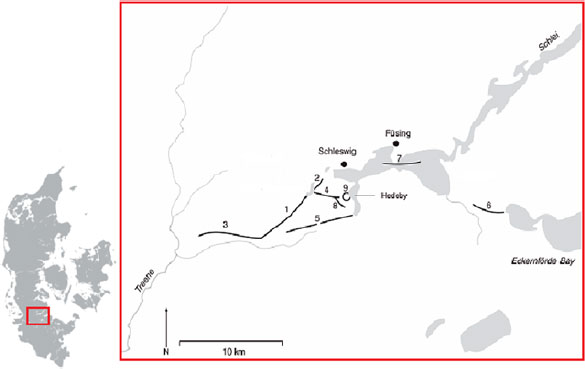
Danevirke – communal needs and justified leaders Danevirke is a rampart construction covering a total of thirty-five kilometres of linear earthworks separating the Jutland peninsula in Denmark from the continent. Although it appears as one entity, it is the result of an accumulative process with many phases, reworkings, alterations and extensions. Up until the Middle Ages it consisted of eight documented phases. Recent excavations, however, have revealed two earlier phases and an additional phase set in stones. The monument is built of turf and soil, but also phases and sections are framed with palisades and stones are known. Measurements differ but reach a height of four to five metres and a width of fifteen metres. At different times and in different sections a ditch is found in front and the structure clearly faces south (Andersen 1998, 9–18; Dobat 2008, 30; Witte 2015).
The location of Danevirke and different rampart sections: (1) Main Wall, (2) North Wall, (3) Crooked Wall, (4) Connection Wall, (5) Kovirke, (6) East Wall, (7) the off-shore work at Reesholm, (8) additional rampart and (9) Semicircular Wall around Hedeby. After Dobat (2008), drawn by Jens Kirkeby.

The earliest sections of Danevirke. The darkest section to the left represents the turf wall partly covering the dirt wall section and the ditch of this phase. The oldest part reaches a height of approx. 1.5 metres and is estimated to have been only slightly higher: approx. 1.8 metres at the time of construction. South is to the left. Photo: Frauke Witte.

The recently discovered new phases includes a turf-built phase dating to A.D. 450–500, covering an older but undated earth-built phase (Witte 2015) (Figure 2). The construction of Danevirke has traditionally been linked with historical sources in search of a rising kingdom. Like few other monuments, it has served a nationalistic narrative of early state formation testifying to a centralized royal institution capable of initiating the massive construction work (Andersen 2004; Andersen 2016, 153; Dobat 2008, 33–35). However, new research has challenged this perspective.
Based on a thorough analysis of the archaeological remains in their own right, and not as a stage for written evidence, Dobat concludes that each individual phase represents a short-term investment pointing to ‘the type of leadership found in societies who have a form of centralised leadership when it is needed’ (Dobat 2008, 60). This corresponds with the anarchistic principle of justified leaders. Another example can be found in Old Saxony, where a warlord would be chosen by lot at the assembly if the need for military action occurred. This structure eliminated competition based on wealth and prestige which could cause instability, new networks and new decentralizing actions (Goldberg 1995, 473). For Danevirke, the fact that new phases, reworkings and extensions were left to disintegrate shortly after termination is central to the argument, as is the presence of external stress from southern regions. Dobat, along with Andersen, sees the labour investment as a need for communal protection from external stress from the Frankish Empire (Dobat 2008, 55–58; Andersen 1998, 11–12). Dobat argues that in a later construction phase – from the 10th century – the incorporation of the early emporia of Hedeby into the defensive system with the building of Kovirke – a somewhat arbitrary and short-lived earthwork in the south-east – points to a socio-economic interest as well as a defensive interest. Even though the recent excavation results are not included in Dobat’s analysis, they correspond well with his interpretation of context-based activities, although the causal explanation of external stress has not been thoroughly established for these earlier phases. However, Hedeager suggests that the Hun expansion may have caused tension in Europe, resulting in the need for defence in this early period (Hedeager 2007; Andersen 2016, 155–56).
The investment is thus grounded in the anarchistic principle of mutual aid effectuated through network organization. No evidence points to a standing army permanently posted at Danevirke to control the southern frontier of a rising kingdom, and as the monument is not continuously maintained, there is little support for a centralized institution behind the establishment. In contrast, the early foundation of the defence system, along with its extended life and numerous reworkings, suggest that various interests and organizational structures must have been involved. I find it reasonable to suggest that a communal need for protection, real or imagined, secured through coherent networks by justified leaders, was the motivating factor behind the different construction phases of Danevirke. However, it can be questioned whether the threats are real and the measures realistic. The early phases appear to leave little protection against Hunnic expansion. The ramparts at this stage seem easily overcome by presumably mounted Huns. Instead of seeing external stress as a driver, internal network development and network maintenance can be an alternative motivator. Cooperation as a tool to integrate and structure society through communal engagements is noted for the Bronze Age mount building as well (Holst and Rasmussen 2012).
With the newly found and clearly older phases of Danevirke, a chronological connection with weapon sacrifices in the Danish moors can be established. Weapon sacrifices were common in Early Iron Age Denmark until c. A.D. 500 and amount to hundreds of sacrificed weapons and other equipment deposited in numerous locations comprising various incidences. Although the arguments are disputed, the actions behind the sacrifices have been understood as rituals undertaken by a local community (Witte 2015; Jensen 2003, 536; Lønstrup 1988, 97; Ilkjær 2003, 59–60; cf. Christensen 2006). That way it points to a regional or local organization in the Iron Age, thus enhancing the notion of a society building on networks and communal need. From that perspective, the construction of Danevirke can be seen as a continuation and evolvement of a local network organization – to a real or symbolic threat – constituted by justified leaders.
Migration and mobility – decentralising authority Above, I provided and discussed examples testifying to anarchistic principles of network organization and justified leaders. I now turn to examples of the third principle, that of decentralization or resistance. From an anarchistic perspective, mobility and migration can be understood as decentralization or resistance to an undesired social order. Flexner points to
the Piaroa from the Orinoco basin in South America, the Tiv from Nigeria, and the Malagasy of Madagascar as examples of anarchic societies that actively prevent anything resembling state power from emerging. One way is by simply moving away or disappearing whenever something like state power appears (Flexner 2014, 84; cf. Graeber 2004, 26–29).
Mobility is conceptualized by nomads bound together by way of life rather than by societal structures or boundaries. They operate outside state structures and can be difficult to organize and control since they do not adhere to borders or specific rulers. Their impact on state structures, however, can be influential, claiming rights to land for herding or overtaking sovereignty, as in the case of the Mongolians over the Chinese (Hall 1991, 38–43). Mobility, however, can likewise be understood as flexibility, evading or pursuing certain conditions within a societal structure. The expropriation of farmland in England in the Middle Ages resulted in extensive vagrancy, leading to strict legislation, with the purpose of forcing able workers into a workforce in a still more institutionalized society (Young 1979, 163). A provision in the Norwegian Frostathing Law also punished vagrancy (Iversen 2011, 271). Laws were issued in several European countries to force peasants to work, and it can be argued that the struggle for dominion over a reluctant workforce, as evident in the laws, is the result of a deliberate strategy of resistance or counterpower in the form of mobility.
When mobility takes a more consistent and permanent character it becomes migration. The growing urbanism of the Early Middle Ages, particularly evident in the old Danish territory, can also be understood in the light of decentralization and resistance. Why did people migrate to towns if not merely to fulfil a preconception of a growing industrialized society? The reason can likewise be found in resistance to increased centralization and dominion in the countryside in the Early Middle Ages. This is manifested in the 13th century by aristocratic and ecclesiastic institutions with still more demanding pressure of taxes, labour and tithe on farmsteads and villages. People evaded unfavourable conditions by migrating to towns.
The migration to Iceland in the middle of the 9th century can likewise be seen as a deliberate evasion of centralizing powers, although various causal explanations have been put forward (e.g. Vésteinsson 2007). Harald Fairhair tried to gain power over all of Norway, for example, imposing authority by military might. Not only violent conflict but also the resulting lack of autonomy and of self-government sparked the migration to Iceland. Ingolfr Arnarsson, a Norwegian prime mover, is said to have fled not only a murder conviction but also the restraints of a centralized power threatening the autonomy of tribal leaders (Olsen 2015, 52; Byock 2001, 82–83). Though disputed, a decentralized and proto-democratic society was achieved in Iceland with structures and systems that hindered the emergence of unjust dominion for approximately 300 years. This supports the argument of human intentionality and agency and a preference for autonomy and network organization (Byock 2001, 75–76; cf. Vésteinsson 2007).
The Viking settlement at Danelagen arguably can have the same causal explanation. Traditionally, plunder and profit figure high on the list of explanations for Norse invasion and settlement, but also power, trade and demographic and ecological crises and political trouble are put forward (Näsman 2000; Roesdahl and Wilson 1992, 27; Barrett 2008). Increased centralization along with political pressure from the Carolingian empire is likewise argued to motivate the raids and eventually migration forward (Myhre 1993). Centralization, institutionalization and conflict in the 9th century are difficult to attest and much disputed, but in the light of an anarchistic principle of decentralization and resistance this line of causal explanation may successfully be pursued.
Other examples of decentralization and resistance can be found in, e.g. satire, foot dragging, cultic rituals and rebellion. The list could go on with examples supporting the argument that social organization and dynamics are constituted through network organization, justified leaders and decentralization. However, it is time to ask whether it is reasonable to apply an anarchistic perspective to these examples.
An anarchistic contribution
As argued above, anarchistic actions, i.e. mutual interests in protection, influence and resistance in the pursuit of independence and self-governance, constitute social organization and dynamics evident in landscapes, monuments and phenomena. Other ways to understand and analyse social organization in the Scandinavian Late Iron Age have been offered over the years and other ways to interpret monuments and phenomena can be argued for (e.g. Zachrisson 1994; Thomasson and Anglert 2003; Sindbæk 2005; Roslund 2007; Lihammer 2007). Empirical evidence and social analysis are likely to suffer from generalizations and presumptions in order to systematize evidence. It is an analytical premise not to grant individuality, regional variation or justice. An anarchistic perspective, however, aims to recognize broad social complexity and varied empirical applications. Examples offered above demonstrate how anarchistic principles of network organization, justified leaders and decentralization can be recognized in a variety of places and situations and serve as a complex operational analytical framework. They are evident in the archaeological material, but the support of written evidence testifies to even greater potential in archaeological research designs. References to previous work within anthropology, ethnography and history demonstrate that anarchistic actions are present regardless of any source material favouring particular ideas, structures or organizational forms. Accordingly, the principles are not constrained by source material or by temporal, situational or contextual limitations, but are bound in the perspectives applied. If we seek to interpret Danevirke based on a nationalistic narrative, we will succeed, as years of research demonstrate. On the contrary, if we adhere to anarchistic principles as an explanation of social organization, nuanced interpretations emerge. However, are these interpretations grounded on a reasonable premise, and are the arguments thus sound? Can we assume that humans have the intentionality and capability to seek autonomy, independence and influence? As pointed out in the introduction, the tales of Robin Hood, Spartacus and Asterix thrive on a collective memory of resistance to authority, a desire for independence and self-government and an idea of cooperation in order to avoid imposed power structures. This wide collective memory might suggest an inherited interest in anarchistic principles. However, to elaborate further on this discussion, Mauss (1925) concludes in his comprehensive and influential studies of societies without money or a market economy that a gift economy (and not barter) existed, rooted in an ethical system where the pursuit of greater profit would be deeply offensive (ibid.). We can consider with Graeber (2004, 23) that
Amazonians don’t want to give others the power to threaten them with physical injury if they don’t do as they are told. Maybe we should better be asking what it says about ourselves that we feel this attitude needs any sort of explanation.
Furthermore, Angelbeck and Grier argue that shaping social and political life, and manifesting it in material culture, are highly intentional, and therefore anarchistic principles will be as well. They find a ‘substantial agency in all human actions and that humans … work to construct and manage the social reality in which they live’. However, they see no reason for this agency and management to consist of narrow self-interest or obsessiveness and argue that altruism, which can take institutionalized forms, ‘might be as strong as the social mechanisms promoting the benefit of a few’ (Angelbeck and Grier 2012, 579). Kropotkin, however, takes the argument a step further when he states that mutual aid is a question of survival rather than of altruism (Kropotkin 1952). Intentionality, however, is constrained by social constructions as well. As noted above, Bakunin argues that humans are a product of their social position, societal structures and history. Are humans thus capable of developing alternative sociopolitical organizations that sustain independence and autonomy rather than centralization and authority if we accept the premise of human intentionality? Research demonstrates ‘how hundreds of small villages, competing for wealth, slaves, prestige, are able to manage their intervillage affairs’ without waiting for centralization and decision making being placed in the hands of chiefs (Angelbeck and Grier 2012, 553; cf. Tollefson 1987).
Likewise, in his analysis of nodal points in early Viking Age Scandinavia, Sindbæk suggests that trading systems emerged and developed outside political organizations or centralized institutions: ‘Regardless of the political situation, each participant in a long-distance exchange will have had a significant incentive to seek out what he considered the most favourable, safe, and active places for trading’ (Sindbæk 2007, 128). Furthermore, he states, ‘One can think of many other periods and parts of the world in which this type of non-political initiative may well have proved pivotal’ (ibid., 119). In addition, social mobility demonstrates the capability to reshape social position and thereby influence social organization, as evident in, e.g., thraldom, where manumission was a possibility. We find evidence of this in the early medieval laws and wills, and, on one occasion, a rune stone testifies to the liberation of a slave (Myrdal 2011, 294; Iversen 2011). Organizational flexibility, whether economic, political or social, enables adjustment to changed circumstances, thereby offering alternative structures. Flexibility, however, providing no stable situations, means that tension or social conflict is ever-present. Anarchistic principles thereby imbue social dynamics and change. From an anarchistic perspective, the terms of sociopolitical relationships are constantly renegotiated, recalling Graeber’s counterpower (Graeber 2004). Social conflict over values in a broad sense leads to a suspension of old organizational forms but restates a new social organization on the ruins. Subsequently, we experience short- or long-term oscillations in manifestation and emphasis, ‘with shifts from autonomy to domination, from involuntary identifications to free associations, from cooperation to competitiveness, from hierarchy to heterarchy, and from imposed to justified authorities’ (Angelbeck and Grier 2012, 568). Unjust authority and hierarchical organization can be explained as emerging when social institutions that minimize or limit centralization break down. ‘Instead of being constructed by purposeful actions of elite individuals, these top-down societies may grow like weeds from cracks spreading in the social processes meant to limit aggrandizement’ (Borck and Sanger 2017, 11).
Conclusion
Anarchistic perspectives conceptualize social organization and dynamics across time and space. The premise of human aspiration to independence and autonomy, and the core principles of network organization, justified leaders and decentralization, as formulated by Angelbeck and Grier (2012), make anarchism an operational framework for analysis of social organization. The premise and principles sustain intentionality in human actions and capability in self-governing social structures, thereby restoring agency to a broad range of human participants. This has been argued using thing sites and the social organization evident here, by pointing to justified leaders and communal defence systems for mutual benefit, and by drawing attention to counteractions through mobility and migration. By pointing to flexibility in social organization and instability in power relations, anarchistic principles offer explanations for undefined perceptions embedded in paradigmatic and formalistic interpretations, such as ‘they were centres of political, economic, and religious power’ (Ludowici et al. 2010, 6). How power was obtained, maintained, and executed is rarely explained, even less how the responses, compliance and reactions to executed power were manifested in the local community. Anarchism as an analytical tool allows us to do just that.
As argued by McGuire and Saitta (1996, 202), ‘societies may have been quite variable with respect to the nature and sources of social conflict, and we miss an opportunity to explore this variation when we make conventional assumptions about hierarchy and its structural position in society’.
By directing focus away from hierarchy and centralization, anarchism elucidates other mechanisms that deserve equal attention, such as decentralization, counterpower or, in the words of Arkush (2012, 569), ‘collapses, delays, or pauses’. With anarchism, we can find new patterns in the evidence, historical as well as archaeological, and thereby improve our capacity to understand past human behaviours, consequently expanding the dimensions of how humans organized in the past and might do in the future.
Trine Louise Borake is a Curator and Archaeologist employed at the Museum of Western Zealand who is currently affiliated with Aarhus University conducting a Ph.D. project on Scandinavian central places. Her primary interest concerns social organization and dynamics, with a primary focus on the Iron Age to the Middle Ages. She is interested in human agency and interactions and in how social interplay and influence are manifested and negotiated. She has initiated and conducted fieldwork and research on Iron Age and medieval farmsteads in Zealand, Denmark. Recently, she has engaged in studies on detector material – a rapidly accumulating body of material in Scandinavian archaeology with potential to challenge and add nuance to ideas on social organization.