Introduction
Depression is a treatable condition and should not be considered a part of normal aging. Residents in nursing homes with multiple illnesses are at increased risk of acquiring additional mental disorders. Studies suggest that the prevalence of depressive symptoms in nursing homes could range from 14% to 82%, with a median prevalence of 29% (Seitz et al., Reference Seitz, Purandare and Conn2010; Snowdon, Reference Snowdon2010).
Feelings of anxiety and unease are common in nursing homes, with a prevalence of 13% to 65% depending on studies, and anxiety disorder prevalence varies from 3.5% to 11% (Seitz et al., Reference Seitz, Purandare and Conn2010). Recommended treatment for anxiety is similar to treatment for depression: selective serotonin reuptake inhibitors (SSRIs), serotonin–norepinephrine reuptake inhibitors (SNRIs) and/or cognitive behavioral therapy (CBT) (NICE, 2011).
Antidepressants
In different European studies, the prevalence of antidepressant use in nursing homes has been around 30% (Mann et al., Reference Mann, Kopke, Haastert, Pitkala and Meyer2009; Lustenberger et al., Reference Lustenberger, Schupbach, von Gunten and Mosimann2011). In Sweden, there has been a five-fold increase in the prescription of antidepressants in individuals aged 80+ years from 1995 to 2005 in men, and a three-fold increase in women. This could partly be explained by SSRIs having milder side-effects, particularly on cognition, than TCAs (tricyclic antidepressants), which were widely used to treat depression before the introduction of SSRIs (Weitoft et al., Reference Weitoft, Ericsson and Fastbom2012).
A Swedish study from 2004 reported the prevalence of prescribed antidepressants in nursing homes to be 41%, whereas in the general Swedish population of people aged 80+ years, the usage was 11% in men and 18% in women (Fastbom and Schmidt, Reference Fastbom and Schmidt2004).
Few studies have been conducted on adverse outcomes of SSRIs in nursing home settings, but a previous study indicated an increased risk of all cause-mortality, stroke/transient ischemic attack, falls, fracture, epilepsy/seizures, and hyponatremia in older people who were using SSRI. Other antidepressants showed similar risks, but TCAs, produced fewer of these adverse effects (Coupland et al., Reference Coupland, Dhiman, Morriss, Arthur, Barton and Hippisley-Cox2011). In a Norwegian study discontinuation of antidepressant treatment in patients with dementia led to an increase in depressive symptoms (Bergh et al., Reference Bergh, Selbaek and Engedal2012). A Swedish study however concluded that withdrawal of SSRI treatment is often successful in nursing home patients (Lindstrom et al., Reference Lindstrom, Ekedahl, Carlsten, Martensson and Molstad2007).
A Cochrane review indicated that TCAs and SSRI were of the same efficacy but that TCAs are associated with a higher withdrawal rate due to side effects (Mottram et al., Reference Mottram, Wilson and Strobl2006).
Recommended treatment for depression
According to Swedish guidelines for the treatment of depressive disorders (similar to NICE guidelines, (NICE, 2009)), CBT, alone or in combination with antidepressants, is recommended as the first-line treatment for mild to moderate depression.
Another Cochrane review indicated that CBT could be used to treat depressed elderly individuals, although only a few studies with small sample sizes have been conducted, and more research is needed (Wilson et al., Reference Wilson, Mottram and Vassilas2008).
Elderly patients with dementia and concurrent moderate major depressive disorder do benefit from antidepressant treatment both in respect of depressive symptoms and behavior disturbance (Lyketsos et al., Reference Lyketsos2003), although the benefit is modest and scientific evidence is limited. Furthermore, one study showed no effect of SSRIs on depression in elderly patients with concurrent dementia (Banerjee et al., Reference Banerjee2011).
Aim
The aim of this study was to examine whether symptoms of depression among residents in nursing homes are treated adequately, and whether antidepressants are used in an appropriate manner.
Material and methods
Sample
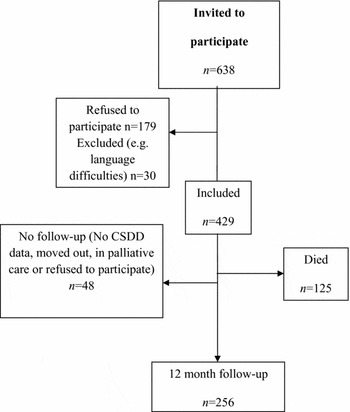
Data were collected from the Study of Health and Drugs in the Elderly (SHADES),a longitudinal cohort study of elderly people living in 11 nursing homes in three cities in the southern part of Sweden (Linköping, Jönköping and Eslöv). All residents of the 11 nursing homes were invited to participate in the study and when a participant moved or died, the next person who moved to the nursing home was asked to participate. Individuals who were at the nursing home temporarily for short-term rehabilitation or palliative care were excluded. Persons with language difficulties and persons under the age of 65 were also excluded. A total of 429 individuals were included. The inclusion and exclusion criteria are shown in Figure 1.
Flow chart of patients in the SHADES study.

Data collection
Specially trained nurses examined the participants in their respective nursing homes every six months between 2008 and 2011. All nursing homes patients have a general practitioner (GP) who regularly comes to the nursing home. Information on medical diagnoses, hospital admissions, rehabilitation plans (if any), and prescription of drugs were obtained from nursing home records and the GP's medical records.
Diagnoses were defined by present state and not by history of the disease.
Psychotropic polypharmacy was defined according to the Swedish National Board of Health and Welfare (The National Board of Health and Welfare, 2010) as simultaneous treatment with three or more psychotropic drugs from ATC (Anatomic Therapeutic Chemical classification system) groups N05A (antipsychotics), N05B (sedatives), N05C (hypnotics) or N06A (antidepressants), including subgroups (WHO Collaborating Centre for Drug Statistics Methodology, 2013).
In-person testing
The Cornell Scale for Depression in Dementia (CSDD) was used to measure depressive symptoms. The CSDD uses staff members to assist residents in giving answers, which makes it suitable for participants with cognitive dysfunction. In our study the CSDD was completed solely with the assistance of staff members. The CSDD consists of 19 questions regarding mood-related signs, behavioral disturbance, physical signs, cyclic functions, and ideational disturbance. Each answer is scored from 0 to 2 (0 = absent, 1 = mild/intermittent, 2 = severe), and the maximum score for the scale is 38. The cut-off score for depression was set at 8 (Alexopoulos et al., Reference Alexopoulos, Abrams, Young and Shamoian1988; Barca et al., Reference Barca, Engedal and Selbaek2010). The mini-mental state examination (MMSE) was used to evaluate cognitive functions (Folstein et al., Reference Folstein, Folstein and McHugh1975).
Statistical analyses
Descriptive statistics (Pearson's chi-squared test, Fisher's exact test, and independent t-tests) were used to analyze differences in the material. Levene's test was used for equality of variances. Data analysis was conducted with SPSS Statistics for Windows Version 21.0 (IBM Corp, Armonk, NY, USA).
Ethical considerations
SHADES was approved by the Ethical Committee in Linkoping, Sweden (application number M 150–07). Informed consent was obtained from all participants. If the patient could not understand the information and give informed consent, it was obtained from next of kin.
Results
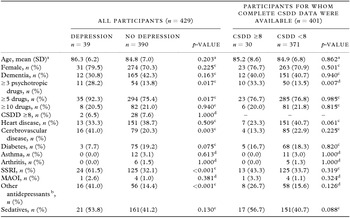
At baseline, 15.2% of participants had prescriptions for three or more psychotropic drugs. Baseline characteristics are shown in Table 1. The prevalence of depression according to medical records was 9.1% overall and the prevalence of CSDD score of ≥8 was 7.5%.
Baseline characteristics of the study participants

aIndependent samples t-test.
bATC code N06AX (tryptophan, mianserin, mirtazapine, bupropion, venlafaxine, reboxetine, duloxetine or agomelatine).
cPearson's chi-squared test.
dFisher's exact test.
In all, 46.2% of participants were prescribed one or more antidepressant at baseline and 33.0% of participants not diagnosed with depression and with a CSDD score of <8 were prescribed one or more antidepressants.
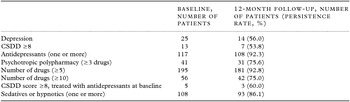
Persistence rates for depression and prescribed drugs at the 12-month follow-up are presented in Table 2, thus more than 90% of those treated with antidepressants were still on this treatment after 12 months.
Persistence of depression and use of medications at 12-month follow-up in the same individuals (n = 256)

No participant was treated with CBT.
There was a significant difference in median CSDD score between baseline and 12-month follow-up (1.0 and 2.0, respectively; p < 0.001, Wilcoxon signed ranked test).
The mean number of psychotropic drugs was 1.2 (SD 1.2) at baseline and 1.3 (SD 1.2) at 12-month follow-up, and the mean total number of drugs was 6.9 (SD 3.1) at baseline and 7.0 (SD 3.0) at 12-month follow-up. The most frequently prescribed group of psychotropic drugs was SSRIs (34.7%). The most frequently used drugs overall were aspirin (54.1%) and paracetamol (41.7%).
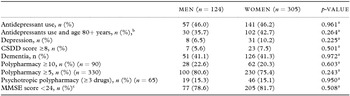
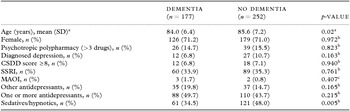
There were no significant differences between men and women regarding depression or use of antidepressants (Table 3). Patients without dementia were more often treated with sedatives/hypnotics but there were no associations between dementia and antidepressant prescription or psychotropic polypharmacy (Table 4).
Comparisons between men and women at baseline

aPearson's chi-squared test.
bIn total 323 nursing home residents were 80 years or older.
cMMSE was assessed in 349 patients. For 80 patients this was not possible.
Comparisons between participants with and without dementia, according to medical records, at baseline

aLevene's test for equality of variances.
bPearson's chi-squared test.
cFisher's exact test.
Discussion
The prescription of antidepressants in frail elderly individuals was extensive and sometimes without clear indication. In most cases it persisted after 12 months although many of these patients had no depression according to medical records and a CSDD score that did not indicate depression.
There was an increase in CSDD score at 12-month follow-up compared to baseline, (median score 1.0 and 2.0, respectively), but it cannot be considered clinically significant as these numbers are much lower than the cut-off for depression (set at 8). Of the thirteen participants with CSDD scores of ≥8, over seven still had a CSDD score of ≥8 at 12-month follow-up. This could be explained by symptoms of depression not being recognized, but conclusions are hard to draw due to the very low number of cases.
There was an association between psychotropic polypharmacy and diagnosed depression, as suspected, but nearly 14% of the non-depressed participants/participants with CSDD scores of <8 were prescribed three or more psychotropic drugs. Psychotropic drugs have been used to treat Behavioral and Psychological Symptoms of Dementia (BPSD), but when comparing participants with and without dementia, there were no associations between dementia and antidepressant prescription or psychotropic polypharmacy. There was however a possible under-diagnosis of dementia since 282 participants had MMSE scores <24 but only 177 participants had a dementia diagnosis.
At 12-month follow-up, three-quarters of the participants with three or more psychotropic drugs showed continued use. This may be adequate, but it raises questions about the necessity to treat residents with multiple other illnesses and medications with psychotropic drugs for this length of time.
The low prevalence of diagnosed anxiety (0.9%) probably did not reflect the real presence of anxiety and unease, which might not have been considered sufficiently severe to require a diagnosis.
A substantial proportion of the participants in this study had continued prescriptions of antidepressants after 12 months without an obvious indication.
There was no significant association between use of sedatives/hypnotics and diagnosed depression/CSDD score ≥8 at baseline, but patients without dementia, according to the medical records, used sedatives/hypnotics more often than patients with dementia.
This study has some limitations. There was no new examination by a physician to confirm the diagnosis of depression, as defined by CSDD score, at follow-up. Scales cannot diagnose depression, but only indicate the probability of depression. We did not analyze the relationship between CSDD score and depression diagnosis. The reason is that patients diagnosed with depression and subjected to treatment may have normal CSDD score.
Also, if conducting more comparisons, the effect of multiple tests and significance levels should be considered.
The sample used was not randomly selected, but rather selected for reasons of convenience from three different areas in Sweden, with persons living in nursing homes whose staffs were interested in joining the project. For residents who chose not to participate or were excluded, we have no information about diagnoses or their current medication. Thus, we do not know if these residents differed in baseline characteristics from the included subjects in any way.
Almost all of the participants with diagnosed depression were treated with antidepressants, and 56% were still depressed after 12 months. However, we do not have data on the current dosages of antidepressants. Similarly, 53.8% of participants with CSDD scores of ≥8 at baseline had scores of ≥8 at follow-up. This is consistent with another study that showed persistence rates of over 50% for depression at 12 months in frail elderly patients (Bergdahl et al., Reference Bergdahl2005).
The prevalence of diagnosed depression was 9.1%. This is in line with prevalence of major depression in nursing homes that in a literature review was 10% (Seitz et al., Reference Seitz, Purandare and Conn2010).
We do not have any data on neuropsychiatric symptoms which is a limitation since this could have been valuable in patients with depression and dementia.
The prevalence of one or more antidepressants in the participants aged 80+ years was 42.7% in women and 35.7% in men. These values are considerably higher than the figures from the National Public Health Report 2012, according to which 18% of women and 11% of men in the same age group were using antidepressants (Weitoft et al., Reference Weitoft, Ericsson and Fastbom2012). The health report does not separate frail elderly individuals from healthier individuals, which could explain the discrepancy. One should however in patients with multimorbidity consider whether guideline recommendations are applicable and be aware that these guidelines may drive polypharmacy for patients in whom treatment burden will sometimes be overwhelming (Hughes et al., Reference Hughes, McMurdo and Guthrie2013).
A Norwegian qualitative study, based on interviews with physicians and nurses in nursing homes, indicated that decisions to prescribe antidepressants were not always based on clinical diagnoses, but more often relied on registered nurses’ opinions, and that there was a lack of follow-up (Iden et al., Reference Iden, Hjorleifsson and Ruths2011). This may well be the case in the present study, as 33% of all participants without diagnosed depression or a CSDD score of ≥8 were prescribed antidepressants, without an obvious indication, which is also consistent with another study (Shah et al., Reference Shah, Schoenbachler, Streim and Meeks2012).
A report from the Swedish Council on Health Technology Assessment (SBU) did not assess CSDD due to a lack of high quality studies and urged for more studies on the subject (Swedish Council on Health Technology Assessment (SBU), 2012).
A Norwegian reliability and validity study of CSDD suggested a cut-off point of 8 based on the ICD-10 criteria for depression (Barca et al., Reference Barca, Engedal and Selbaek2010), while a Japanese study suggested a cut-off score at 5 (Schreiner et al., Reference Schreiner, Hayakawa, Morimoto and Kakuma2003). We chose to use a cut-off of 8, but there have been few validity studies of the CSDD.
Although chronic diseases and depression have been shown to be associated with each other, in this study there was only evidence of associations between cerebrovascular disease and diagnosed depression. This may be due to the low numbers of participants with a chronic disease and concomitant depression/CSDD score ≥8 (Moussavi et al., Reference Moussavi, Chatterji, Verdes, Tandon, Patel and Ustun2007).
This study shows that despite the extensive knowledge in this field, little has been changed regarding the treatment of frail elderly individuals, regarding the use of antidepressants without documented indication or the lack of non-pharmacological treatment of depression. We conclude that the guidelines were not being followed, especially not concerning non-pharmacological treatment, which was virtually non-existent in the elderly. Non-pharmacological treatment should be considered feasible in the elderly, especially in view of the extent of polypharmacy in this group and the associated hazards.
There is a need for intervention studies comparing different kinds of pharmacological and non-pharmacological treatments for depression in nursing home residents. Furthermore, the clinical implication from this study is that there is a need for systematic drug reviews at nursing homes, paying special attention to subjects who are on antidepressants.
Conflict of interest
None.
Description of authors’ roles
PM, CJÖ, and SM designed the study. MA performed the data analysis. PM and MA drafted the paper. CJÖ and SMÖ revised the paper. All authors read and approved the final version of the paper.
Acknowledgments
This study was financially supported by the Medical Research Council of Southeast Sweden (FORSS) and the Janne Elgqvist Foundation.
We are indebted to Stephen Gilliver for his expertise and invaluable advice in editing the paper.