1 Introduction
Are workers with defined contribution plans more mobile and thus less likely to achieve high levels of tenure than workers with defined benefit plans? This study uses data from the Survey of Income and Program Participation (SIPP) and the Panel Study of Income Dynamics (PSID) and duration analysis to answer this question. This analysis suggests that workers with defined contribution plans and 5–10 years of tenure are 23% more likely to leave their job than similarly tenured workers with a defined benefit plan.
The difference between this study and earlier ones that did not find a relationship between pension type and mobility is the inclusion of the interaction between pension type and tenure. The effect of pension type differs for workers at different stages in their career at a firm. Essentially, workers with defined benefit plans have varying amounts to lose depending on their vesting status and benefits accrued. When these amounts are small, their mobility patterns look very much like those of workers with a defined contribution plan. When possible losses are large, they are much less likely to leave than their counterpart with a defined contribution plan. These results are important for employers interested in retaining workers.
This paper proceeds as follows. Section 2, describes the shift from defined benefit to defined contribution plans and the incentives embedded in each. Section 3 describes previous studies that have explored the relationship between pension type and mobility. Section 4 presents descriptive statistics and describes the data that will be used in the analysis. Section 5 provides results of the empirical analysis. Section 6 concludes.
2 The differences between defined benefit and defined contribution plans
The nature of pension coverage has shifted dramatically in the last two decades (see Figure 1). Twenty years ago, most people with pension coverage had a traditional defined benefit plan that paid benefits at retirement in the form of a lifetime annuity – often a percentage of final salary for each year of service. The employer finances these benefits by making pre-tax contributions into a pension fund; employees typically do not contribute. The employer holds the assets in trust, directs the investments, and bears the risk. The Pension Benefit Guaranty Corporation (PBGC) insures benefits up to specified limits.
Private sector workers with pension coverage, by pension type, 1980, 1993, and 2006

Today the world looks very different. Most people with pensions have a defined contribution plan – most often a 401(k). In contrast to defined benefit plans, defined contribution plans are like savings accounts. Generally the employee, and often the employer, contributes a specified percentage of salary into the account. These contributions are invested, usually at the direction of the employee, mostly in mutual funds consisting of stocks and bonds. Upon retirement, the worker generally receives the balance in the account as a lump sum, albeit with the option to roll it over to an IRA.
Defined benefit plans and 401(k)s would be expected to have very different effects on worker mobility. The key factors are vesting and benefit eligibility. In a defined contribution plan, a worker is always entitled to withdraw his own contributions when moving from one job to another. The employer's matching contributions typically become vested between three and five years. Once vested, the worker suffers no loss in pension accumulations from job shifting.
In a defined benefit plan, the worker is typically vested after five years of service. However, the person is not entitled to a benefit until he meets certain age and service requirements and leaves the firm. Typically, the worker is eligible for a reduced benefit at age 55 with five to ten years of service and a full benefit at age 62–65 with 20 years of service. Because workers cannot get any benefit until they meet the early retirement requirements, they suffer a ‘capital loss’ if they leave prior to that time. Once the worker has satisfied the early retirement requirement, the loss suffered from job shifting declines steadily and disappears entirely at the full retirement age. In addition, defined benefit plans are also heavily backloaded in that benefit accrual rates are much higher in later years, as credits earned in earlier years are applied to higher and higher final salary. Workers who leave early do not enjoy this accretion.
Thus, the consequences of mobility differ under the two plans and those consequences differ by tenure. Before vesting – that is, less than five years of tenure – both defined benefit or defined contribution participants lose little when shifting from one job to another. One would expect their patterns to be quite similar. Once vested, defined contribution participants can move freely taking with them both their own contributions and their employer match. Defined benefit participants, in contrast, have an increasingly strong incentive to stay to meet the age and service requirements that will entitle them to early benefits. In this range, one would expect defined contribution participants to be much more likely to move than their defined benefit counterparts. After participants in defined benefit plans qualify for early retirement benefit, the capital loss they face by moving begins to decline so the difference in mobility by plan type should also diminish.
3 Evidence to date
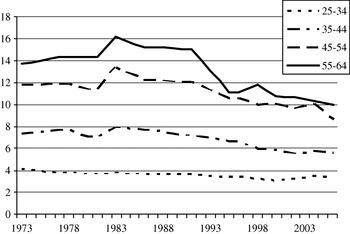
Over the same time period that defined contribution plans have seen a rise in use, several measures of job stability have shown declines. Jaeger and Stevens (Reference Jaeger, Stevens and David2000) indicate that the probability of a worker having less than ten years of tenure increased significantly from 1983 to 1996, while Neumark et al. (Reference Neumark, Polsky, Hansen and David2000) show significant declines in eight-year worker retention rates.Footnote 1Farber (Reference Farber2008) discusses recent declines in worker tenure and in the incidence of long-term employment, particularly in the private sector. This pattern is illustrated in Figure 2, which shows, using data from the Current Population Survey, a decline in the median tenure of employed males, especially those aged 55–64.Footnote 2
Median years of tenure of by age for employed males, CPS data, 1973–2006

While it is tempting to link the increase in the prevalence of defined contribution plans with the declines in job stability, little research supports such a claim. Researchers do agree that defined benefit plans have strong disincentives to mobility. For example, Gustman and Steinmeier (Reference Gustman and Steinmeier1995) explore how back loading, vesting, and capital losses for defined benefit plans alter mobility behavior. Of the many interesting findings in this work is that back loading of pensions discourages mobility, but not nearly as much as the compensation premium that accompanies pensioned jobs. Allen et al. (Reference Allen, Robert and Ann1988) also find that the capital loss associated with leaving a defined benefit pensioned job significantly discourages the hazard of mobility. Stock and Wise (Reference Stock and Wise1990) find that the probability of departure from large firms with defined benefit plans falls with tenure until the early retirement age. They also suggest that the switch to a defined contribution plan will increase departures, although they cannot test this result with their data.
Previous studies have used two approaches to examine the relationship between plan type and mobility. The first relates pension type and worker tenure using regression analysis. Along this line, Friedberg and Owyang (Reference Freidberg and Owyang2005) showed that having a defined contribution plan was associated with two to three fewer years of tenure than having a defined benefit plan. Implicitly, this literature suggests defined contribution workers move jobs more frequently than their defined benefit counterparts and thus fail to accumulate long tenures. However, the second approach, which relates job changes or worker quits to pension type, does not support this conclusion. In fact, Gustman and Steinmeier (Reference Gustman and Steinmeier1993) found no significant relationship between job-to-job movement and pension type.
One clear problem with regressing tenure on pension type, as is done in Friedberg and Owyang (Reference Freidberg and Owyang2005), is that low average tenure for employees with defined contribution plans could simply reflect the newness of such plans and have little to do with mobility. Similarly, analyzing the probability of mobility conditioned on pension type, as in Gustman and Steinmeier (Reference Gustman and Steinmeier1993), ignores the potential for mobility decisions to differ by level of tenure depending on pension type. This study can address both these issues because enough time has passed since the introduction of 401(k) plans to produce a large enough sample of workers with both a defined contribution plan and long tenure, making it possible to analyze the relationship among pension type, tenure, and mobility.
4 The data and some preliminary analysis
The empirical work uses duration analysis to identify the factors that affect the probability (or hazard) of leaving one employer for another. The equations are estimated using two different data sets both to establish that the results are robust and to take advantage of an additional variable in the second data set. The two data sets are the Survey of Income and Program Participation (SIPP) and the Panel Study of Income Dynamics (PSID). These panels are well suited for this analysis because they were conducted as computer assisted interviews, increasing the accuracy of mobility information.Footnote 3
The SIPP data are from the 1996 and 2001 panels. The topical module entitled ‘Retirement Expectations and Pension Plans’ from wave 7 of each panel contains information on pensions in the person's job as of that wave of the panel. The core survey contains other information of relevance. Specifically, since job quality and type is likely to affect the probability of finding a better job and thus moving, the analysis includes information on union coverage, health insurance coverage, size of the firm, the wage, hours worked, and industry of employment. Also included are an individual's education level, marital status, metropolitan residential status, race, age, and state unemployment rate. To allow for varying effects of pension type on mobility over a worker's career, dummy variables were generated, indicating if an individual had less than five years, 5–10 years, 10–15 years, 15–20 years, and 20 years or more years of tenure. These dummies were interacted with pension type. A set of nine age dummies were also included, with people aged 20–25 as the baseline case.Footnote 4 Finally, since some defined benefit employees can claim benefits as soon as they achieve a certain tenure–age combination, variables were included indicating that a person could likely claim an early retirement benefit if they had ten years of tenure and were at least 55 years old and a full benefit if they were at least 65 years old.
Individuals who have a pension were followed every four months and any job-to-job movement, job-to-unemployment movement, or attrition was recorded. For the 1996 panel, this involved following each individual for a maximum of one year and eight months, while for the 2001 panel this involved following an individual for a maximum of eight months. The four-month interview period of the SIPP is advantageous, since any job-to-job move over such a small time-period is likely to be voluntary. Of course, it is possible that some involuntary moves are captured and these would not reflect the effect of pension related incentives. However, once controlling for job and individual characteristics, it seems likely these involuntary moves are unsystematic.
Data from the PSID are used to support the results of the SIPP and also augment the empirical work with an important variable on risk preference. The PSID data are from the 1997–2001 biennial panels. A series of questions on increasingly risky lotteries in the 1997 survey allow for the construction of a measurement of risk preference based on Hryshko et al. (Reference Hryshko, Luengo-Prado and Sorensen2007) . This information is an attempt to control for selection into defined contribution jobs on characteristics associated with a desire for mobility, that is that individuals who are less risk averse are more likely to move jobs. Since data on pension type are only available biennially from the PSID from 1997 to 2001, individuals were followed from their 1999 interview to the 2001 interview. A job move was defined when the tenure on the job at the time of the 2001 interview was less than the time between that interview and the 1999 interview. The demographic and job-related control variables from the PSID are analogous to those used from the SIPP.
To illustrate the important interaction between pension type, tenure, and mobility previously described, we use data from the 1996 panel of the SIPP, which follows individuals for a full year after the collection of pension information. Workers are identified as moving jobs if they had a different ‘Job ID’ after one year.Footnote 5 Pension type is determined using a series of topical questions in keeping with Copeland (Reference Copeland2002) to mitigate pension reporting error.Footnote 6
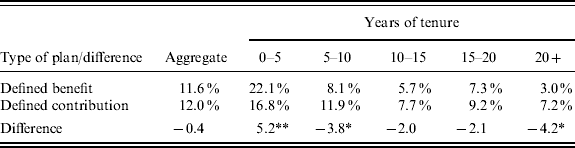
Table 1 shows the one-year job mobility rates for full-time private sector male workers. The results indicate that overall job mobility differs very little between workers covered by defined contribution and defined benefit plans, similar to the findings of Gustman and Steinmeier (Reference Gustman and Steinmeier1993) . However, when workers are separated into tenure groups, major differences become clear. For individuals with tenure less than five years, where more defined contribution employees than defined benefit employees are vested, defined benefit workers move jobs significantly more than defined contribution workers. However, with 5–10 years of tenure, when workers with both types of plans are typically vested but those with defined benefit would have significantly reduced benefit levels if they changed jobs, the one-year mobility rate is much higher for those with defined contribution plans. The difference remains, but does not become statistically significant again until tenure exceeds 20 years.
One-year job mobility rates, private sector full-time males aged 30–59
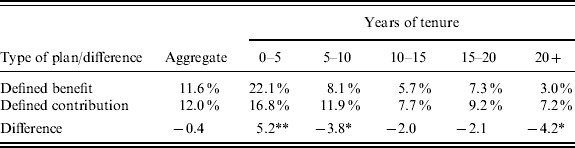
Note: ** Indicates significance at the 0.05 level, * Indicates significance at the 0.10 level.
Source: Authors' calculations from US Census Bureau Survey of Income and Program Participation (SIPP) (1998).
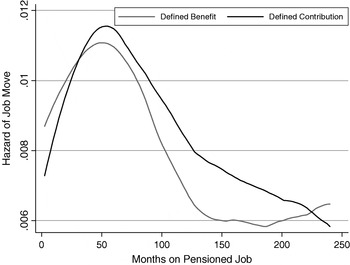
The importance of plan type and tenure is further illustrated by the Kaplan–Meier estimates of the hazard of leaving one's pensioned job for another job. This sample includes individuals from the 1996 and 2001 panels of the SIPP who were followed every four months, from the time their pension plan information was collected until they: (1) moved to a new job, (2) left their current employer for unemployment, or (3) their panel ended. The results in Figure 3 are consistent with the pattern shown in Table 1: defined benefit employees move more early in their careers, while defined contribution workers move more over the majority of their tenure. The next section explores this relationship further using more rigorous methodologies and controls.
Kaplan–Meier estimate of the hazard function, private sector full-time males aged 30–59

5 The multivariate results
The following section reports on a duration analysis where the time at risk was the length of time at the current job and failure was defined as a job-to-job move. Moves to unemployment or retirement were simply defined as exiting the sample. Thus, the analysis focuses on the risk that a worker leaves his or her firm for another firm given his or her time at the job and controlling for the worker's observable characteristics and the characteristics of the job itself. The results indicate that even when controlling for job quality and demographic characteristics, the differences that appear in the descriptive section of the paper persist.
Three specifications of a duration model were used to test the relationship between job-to-job mobility and pension type. Specification 1 used a Cox Proportional Hazards model without interactions of tenure and pension type. Specification 2 used a Cox Proportional Hazards model with interactions of tenure and pension type. Finally, because the baseline hazard of job move probably is not constant over the course of the worker's tenure, specification 3 allowed the baseline hazard to vary over time by assuming a Weibull survival distribution and included interactions of tenure and pension type.Footnote 7 All specifications included the same control variables – demographic characteristics (gender, race, education, marriage, and metropolitan residence) and job characteristics (unionization, health insurance coverage, firm size, and the log of wage). Since most public sector workers have defined benefit pensions and public employers that offer defined contribution plans are still somewhat rare and likely differ significantly from other public employers, only private workers were included in the analysis.
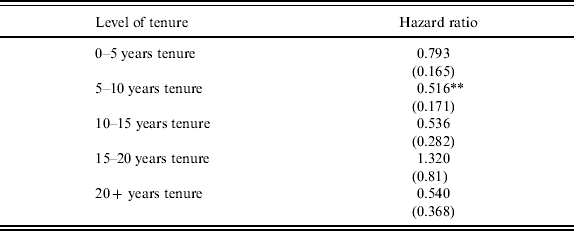
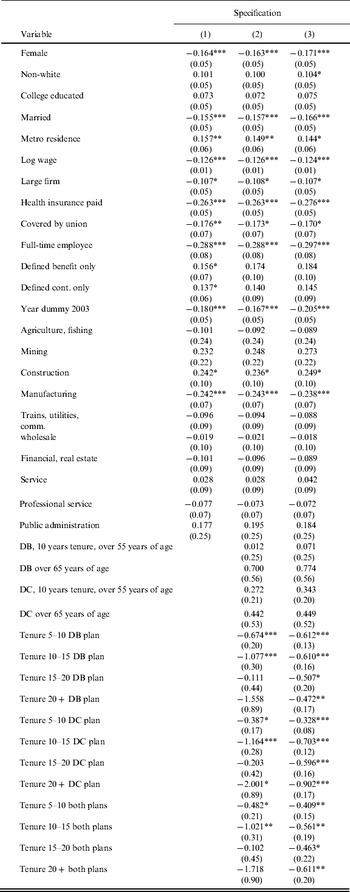
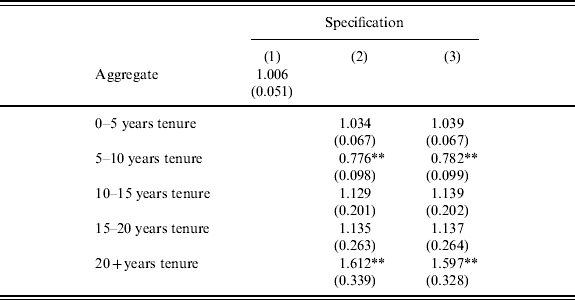
Table 2 contains the hazard ratios for defined benefit to defined contribution workers for each specification, with full results available in the Appendix.Footnote 8 The results are the ratios of the multiplicative effect of having a defined benefit plan to the effect of having a defined contribution on the hazard of job-to-job movement conditional on the level of tenure. A ratio higher than 1 indicates a defined benefit worker had a higher risk of mobility than a defined contribution worker, while a ratio below 1 indicates a lower risk of mobility.
Hazard ratios for defined benefit to defined contribution plans, all private sector workers
Notes: * Indicates significance at the 5% level.
** Indicates significance at the 10% level.
Standard errors are in parentheses.
Source: Authors' calculations from the SIPP (1998, 2003).
The results reveal two tenure groups with significant results regarding the relationship between tenure, pension type, and job-to-job mobility.Footnote 9 The first is the 5–10-year tenure group. Most defined contribution employees with this level of tenure are vested and able to move from job-to-job with their full pension accumulations completely in tact. On the other hand, most defined benefit employees would not yet qualify for early retirement and thus lose a considerable benefit by leaving the firm. As expected, the results show that workers covered by a defined contribution plan are 22% more likely to shift jobs than workers covered by a defined benefit plan. With 10–20 years of tenure, no significant differences in worker mobility exist, suggesting the differential effects of back-loading and capital loss are small. The implication is that employers should be less worried about high-tenure workers leaving as a result of a shift from defined benefit to defined contribution plans. One caution is that workers covered by defined contribution plans are less likely to make it into the 10–20-year tenure group in the first place.
The second significant tenure group is those with over 20 years. In this tenure range, defined benefit workers are significantly more likely to change jobs than workers covered by a defined contribution plan. This result is consistent with the predictions made earlier – the closer workers are to the full retirement age, the lower the capital loss they will experience as a result of a job change. Many individuals with defined benefit plans and this level of tenure are likely to qualify for a full pension benefit or may even have reached a maximum benefit and therefore have little incentive to remain at the same job.
In addition to findings for the pension type and tenure variables, the results on the key control variables are consistent with expectations. Wage, health insurance coverage, and unionization are all associated with a decreased probability of job move.Footnote 10 Relative to the retail industry, workers in the manufacturing industry are significantly less likely to move jobs. The fact that manufacturing workers are less likely to leave their jobs, even when conditioned on their benefit package and wages, suggests these workers have some other incentive to accumulate high levels of tenure. Perhaps manufacturing firms need workers with firm-specific experience and should encourage tenure in ways not picked up by controlling for pension type. Or, it is possible manufacturing workers have high wages due to their high levels of firm-specific experience, but would face substantial wage losses if moving to another firm within the same industry. This issue certainly merits future research, but is beyond the scope of the present paper. Although this paper did not report results for workers without any type of pension, these workers were included in a separate analysis and were much more mobile than any of the workers with pensions.
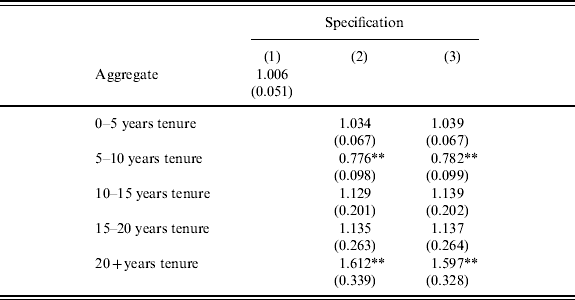
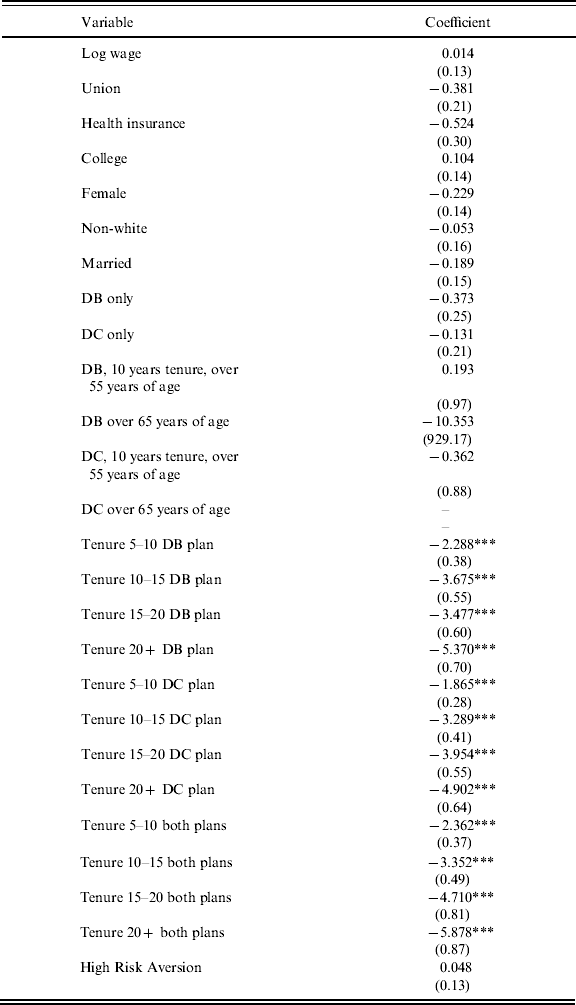
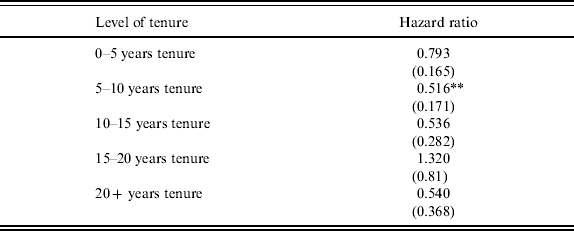
Despite the evidence presented above, making causal statements about the effect of pension type on job mobility is difficult. It is entirely possible, for example, that workers select into defined contribution plans because they know they do not want to stay in a job long enough to qualify for an early retirement pension benefit. To control for the possibility of selection, the analysis shifted from the SIPP to the PSID, which includes an index of risk aversion. The idea is that individuals who are classified as being more risk averse (using the method of Hryshko et al., Reference Hryshko, Luengo-Prado and Sorensen2007) would also be less willing to accept the personal and income-related risks associated with job search and job change. Since the PSID was only conducted every two years after 1996, individuals were followed for one two-year period to keep the analysis relatively comparable with the SIPP analysis. The model assumed a Weibull survival distribution and that risk aversion entered the hazard function as a covariate. The hazard ratios for defined benefit to defined contribution workers are reported in Table 3 for this specification, with full results available in the Appendix.
Hazard ratios for defined benefit to defined contribution plans, all private sector workers
Notes: ** Indicates significant difference from 1 at a 5% level.
* Indicates significant difference from 1 at a 10% level.
Standard errors are shown in parentheses.
Source: Authors' calculations from the University of Michigan's Panel Study of Income Dynamics (PSID) (1997–2001).
While the point estimates differ from those from the SIPP data, possibly due to differences in the time lags between data, the inference remains similar. Workers with defined contribution plans and between 5–10 years of tenure are significantly more likely to leave for a new job than workers with defined benefit plans. Interestingly, the point estimates on the high-risk aversion dummy suggest that these workers are less likely to move jobs than similar workers, although the difference is not significant. While this simple control does not mean that the results imply a causal relationship, it attempts to deal with one barrier to making such a claim. Further, the consistency of the main result across data sets is encouraging.
6 Conclusion
Over the last 25 years, the United States has seen a dramatic shift in the private sector away from defined benefit plans and towards defined contribution plans. While commentators constantly cite an increase in labor mobility as a major reason for the shift in the private sector from defined benefit to defined contribution plans, researchers to date have not been able to document any difference in mobility by pension type. This study argues that the inability to find such a relationship stems from ignoring the important role of job tenure. Using data from the Survey of Income and Program Participation (SIPP) and the Panel Study of Income Dynamics (PSID), duration analysis that includes the interaction of job tenure and pension type reveals that workers with between 5 and 10 years of tenure at a firm are 23% more likely to leave a job with a defined contribution plan than one with a defined benefit plan.
These results suggest firms trying to determine the effects of switching to a defined contribution plan should expect more turnover among workers with 5–10 years tenure. Yet, the caution remains that this analysis may not have controlled completely for unobservable characteristics of workers that may cause them to select into defined contribution plans because they have a propensity to move. Furthermore, certain firms within industries may offer defined contribution plans because they know workers in their specific firm tend to be more mobile by nature. Nevertheless, the results are consistent with the notion that defined contribution workers take advantage of pension portability during the middle of their tenures at a particular firm.
Appendix
Hazard regression coefficients from the Survey of Income and Program Participation: duration regression as specified in Section 4

Notes: *** Indicates a 1% level of significance.
** Indicates a 5% level of significance.
* Indicates a 10% level of significance.
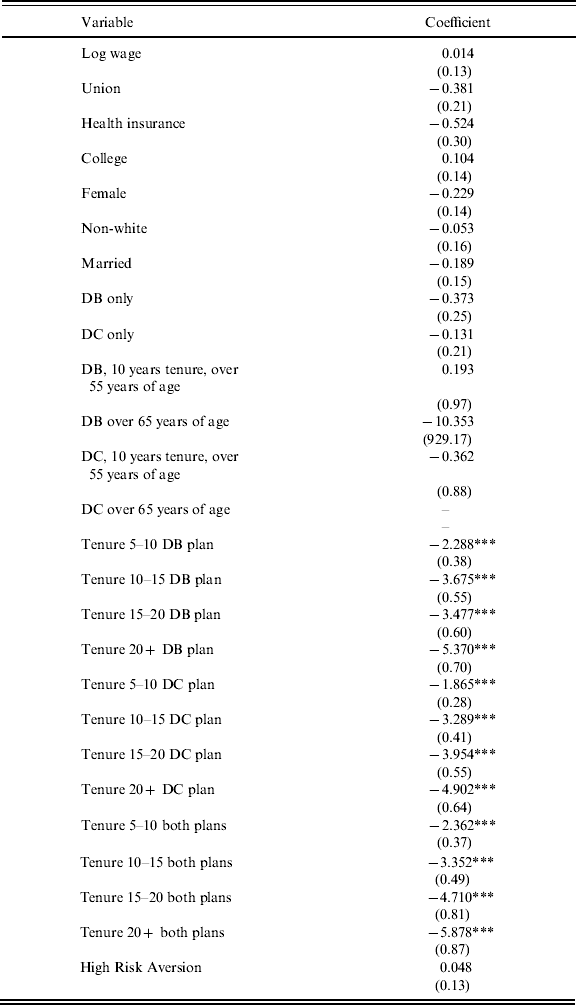
Standard errors are shown in parentheses. The base case in this analysis was individuals with both types of pension and 0–5 years of tenure. A set of age dummies was included in the analysis.
Hazard Regression Coefficients from the Panel Study of Income Dynamics as Specified in Section IV
Notes: *** Indicates a 1% level of significance.
** Indicates a 5% level of significance.
* Indicates a 10% level of significance.
Standard errors are shown in parentheses. The base case in this analysis was individuals with both types of pension and 0–5 years of tenure. A set of age dummies was included in the analysis.