“One may think of political associations as great free schools to which all citizens come to be taught the general theory of association.”Footnote 2
—Alexis de Tocqueville, Democracy in AmericaDecline of the Old Labor Movement: Everywhere and Deep-seated since the 1970s
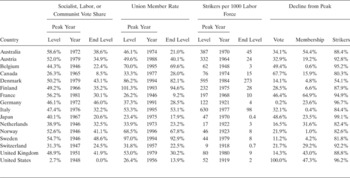
After decades of scholarly debate, the verdict is in: the old Labor Movement is dead throughout the industrialized democracies. For Americans, this is old news; our unions have been a declining share of the labor force for over fifty years, and scholars have produced an extensive literature on American Exceptionalism, or the relative weakness of radicalism in the United States. But American Exceptionalism has turned out to be a passing fancy, a way station along the path to a general decline that now afflicts all of the old industrial democracies from Scandinavia through continental Europe to North America and Japan. Already by 1970, the union share of the labor force had passed its peak in two other leading industrialized economies—France and Switzerland—and these were soon joined by the Netherlands (where the unionization rate peaked in 1973), Australia (1974), Japan (1975), Canada (1977), and the United Kingdom (1979).
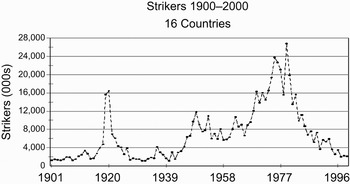
From there, decline spread to countries with the strongest and most entrenched Labor Movements. Austrian unions peaked in 1988; unions in Sweden and Denmark peaked in 1994; Belgian unions have been in relative decline since 1995; and unions in Norway, since 1996. Other aspects of the traditional Left have declined in tandem with the union movement. Membership in socialist and communist parties is down sharply and, despite occasional rallies, so is electoral support (see Table 1). The greatest and longest-lasting decline has been in the volume of strike activity (see Figure 1). From a peak in the 1970s, strike activity, the share of the labor force locked out or striking in a year in sixteen leading industrial countries, has fallen by over 80 percent.Footnote 3
Srike activity, 1900–2000 in 16 countries

The Decline of the Labor Movement.

Note: The “Vote Share” is for all Socialist/Labor/or Communist Parties. The “Union Member Rate” is the number of union members divided by the labor force. “Strikers per 1000” is the number of workers striking or locked out divided by the labor force. Data are described in Friedman, Reigniting the Labor Movement: Restoring Means to Ends in a Democratic Labor Movement (London, 2008).
The Labor Movement's decline goes beyond diminished support for established institutions and for an established repertoire of collective action. Behind these, there is a lost social vision, the passing of ideals of collective management and democratic self-governance that date back through Eduard Bernstein to Karl Marx, Ferdinand Lassalle, and the other founders of modern socialism. Always more than a campaign to benefit those workers fortunate enough to be able to form effective labor cartels, the Labor Movement was distinguished because through it, unions and political movements sought to transform capitalism into something more democratic and egalitarian in the interests of all. By promising to bring the rights and privileges of citizenship to all regardless of economic standing or birth, Labor staked a claim on the good will and support of all democrats, a claim that it could never make as a representative of a privileged group or a labor cartel. The Labor Movement would bring the capitalist's authoritarian workplace into line with the aspirations of emerging democracies, transforming workers—compelled by poverty to work for others—into equal citizens at both work and in the public arena.
Raising wages has always been important for the Labor Movement; surplus value represents the direct exploitation of workers by their employers. But the larger issue is the exercise of authority and power over workers nominally equal in a society that considers itself democratic. As such, the Labor Movement represents our collective aspiration to resolve the contradiction between the autocratic and unequal world of “wage work” and the democratic aspirations of a republic of citizens. Step by step, building reform on reform, Labor promised to reduce the power of money and the privileges of birth to emancipate all, to transform each one into an equal citizen in a democratic republic. In the words of Eugene V. Debs, the Labor Movement would transform a “republic in name into a republic in fact.”Footnote 4
As a movement for social reform, the Labor Movement has achieved notable and worthy successes. Especially in its Scandinavian strongholds and on the European continent, Labor has dramatically reduced the hazards of normal capitalist life, narrowed income disparities, and opened spaces for independent expression. Where the Movement remains strong, it protects these gains and continues to limit inequality and the power of capital. But even where strongest, Labor is losing power and vision, a decline that has led some to reexamine its democratic origins and to question whether its aspirations are either passé or hopelessly utopian. To Tony Blair, Gerhard Schröder, and other advocates of a non-socialist Third Way, there is no longer a place for a movement to democratize work. Workplaces have become democratic enough; suggestion boxes, workplace quality circles, and benevolent managers have rendered a democratic labor movement obsolete. Others, including some associated with the various new social movements, seem to think that work has become such a small part of life, so inconsequential, that it no longer matters that we leave it to capitalist autocrats so long as we maintain consumer choice and democratize culture and the family.
To raise these challenges is to answer them. Work matters, and the capitalist workplace remains a place of exploitation and autocracy, a standing rebuke to our democratic aspirations. Yet, these simple truths notwithstanding, the Labor Movement, the material representation of the campaign for democratic work, has lost its way because, even more than declining membership and support, it has forgotten its social vision. Labor has lost supporters before; indeed, some unions and socialist parties retain large memberships and great popular appeal. The Labor Movement is dying because it is losing the battle of ideas to those who would misconceive, misinterpret, and misrepresent it as the conservative defender of privilege rather than the democratic champion of universal participation and popular self-government. Worse, by defending established gains and privileges without regard for broader interests, Labor's defenders have too often earned this misrepresentation. It is this ideological defeat that cleared the path for decline. Once the Labor Movement lost its claim to represent industrial democracy and popular empowerment, the floodgates opened for labor leaders to join the winning side on the political Right and for supporters to abandon a movement gone astray.
Today, we look toward a general collapse of a Labor Movement born in the 1880s because, having lost sight of its democratic ends, the Movement has found little use remains for its means. Labor's decline and loss of will are the logical consequence of a particular growth pattern where leaders won union recognition from employers and state officials by promising labor peace in exchange for higher wages and better working conditions while abandoning broader goals of participation and industrial democracy. Abandoning democratic ends, the organized Labor Movement made a place for itself within capitalism as the enforcer of contracts against its own membership. Autocratic union governance resulted in a loss of both rank-and-file initiative and popular standing. Hollowed out, rejected by much of its natural constituency, the Labor Movement's top-down institutions could offer only weak resistance when employers and state officials turned against them after the radical wave of the 1970s. But the collapse of this old Labor Movement can be an opportunity for revival, if it finds again Labor's old goal of equal citizenship, achieved through the means of a revived participatory democracy.Footnote 5
Labor Movement: Theory and Practice
Practical women and men, most labor movement activists, and the scholars who chronicle their work, shun metaphysics and epistemology to deal with practical matters, organizing tactics, and bargaining strategy. But, even when neglected, questions of meaning and origin shape the way people interpret and therefore act in the world. In practice, most labor activists are philosophic simple materialists, an approach that privileges what they do and the practical, material activities of workers. Activists act and historians recount as if workers seek only to advance their corporeal interests, to raise their material living standards. They form unions, therefore, to address harsh working conditions and low wages, and these unions' task is to improve conditions without regard for “abstract” ideas or broader social concerns. Everything outside the paycheck is irrelevant ideology, the rationalizations of intellectuals.Footnote 6
Simple materialism is a convenient philosophy for labor organizing because it highlights what workers do and the material deprivation they suffer. Paradoxically, it has also been a convenient philosophy for union leaders who seek to minimize conflict with employers and state officials by emphasizing wages rather than challenging capitalist prerogatives such as control over hiring and firing or the management of the workplace. Thus, simple materialism became the social philosophy of a labor truce exchanging labor peace in an autocratic workplace for higher wages.
That said, many have challenged this form of materialism. Privileging reformist economic struggles over campaigns to empower workers turns means into ends; no one would deny that wage concerns are important, but simple materialists forget the movement's original goal of eliminating exploitation to win for workers the respect and the control over their lives due them as producers and as citizens. This is why so many activists have found themselves adrift between the democratic ideals that led them into the movement and work in bureaucratized unions that can come to resemble capitalist hierarchies more than any vision of worker democracy. Worse, by denying any common link between workplace struggles and democratic campaigns in other parts of society, simple materialism separates the Labor Movement from other social causes: organized workers and their unions become little labor monopolies at odds not only with capitalists but with nonunion workers, with workers in other unions, and with consumers and those outside the market economy.
There is a still deeper concern here: materialism is not only a flawed social philosophy, it is an implausible basis for a social movement. The Labor Movement can never be understood in materialist terms because rational, self-interested materialists do not join unions or radical political movements. And if materialism cannot explain the Labor Movement's origins, it cannot guide policy to reverse the Movement's decline.
Simple materialism, the idea that social action can be explained in terms of individuals' self-interested behavior, cannot explain the formation of unions or the rise of the Labor Movement. Individuals have a clear interest in working to produce private goods for themselves because these benefits accrue only to those who contributed. But this does not help us understand collective action because public goods, like unions, produce benefits available to all regardless of their contribution. If all employees receive a wage increase granted in a union contract and all benefit from shorter hours of work or better working conditions, then why would any selfish individual take the risk and the expense to help win this contract? Instead, selfish individuals will “free ride,” stand to the side and let others make the sacrifices, and then enjoy the benefits. Instead of contributing to produce public goods available to all, they will reason logically, as an unnamed French construction worker did, that “if the union's movement fails, we will have risked nothing, and if it succeeds, we will share the benefits.”Footnote 7
The fallacy of simple materialism is perfectly expressed by that French worker: collective action requires a commitment of private energies and resources to achieve public goals, but each individual can better advance their own private interests by remaining outside the movement. Of course, the dilemma is that if everyone tries to “free ride,” there will be no collective action and everyone will be worse off. Logically, then, the fact of the Labor Movement is by itself proof that simple materialism does not explain popular collective action; even action to achieve narrow materialist goals requires that we go beyond simple materialism and methodological individualism to explore other motives for individual action. Rather than thinking of workers as rational, selfish materialists, we should look at them as people who came to conceive of themselves not only as individuals but as members of a group seeking to advance group claims against others. And rather than looking at the origins of the Labor Movement in the working class, we should look at the place of the Movement in society as a whole.
How Did Unions Grow?
Rather than a rational choice theory founded in methodological individualism, we should begin with the actual patterns of union growth. Unions did not grow as simple materialists would expect, slowly and steadily in response to marginal changes in economic conditions. Instead, as Eric Hobsbawm showed over fifty years ago, “The graph of the membership of virtually every trade-union movement … looks like a series of sloping steps, or of broad valleys broken by sharp peaks … very rarely is it a mere rising slope.” Rather than reflecting gradual changes in economic interests, unions grow in sharp jumps, in leaps that “about doubled the basic strength of the trade-union movement, though even higher peaks were temporarily reached during the explosive periods.”Footnote 8 Hobsbawm showed how economic circumstances were secondary to British union growth spurts. Instead, they were associated with the development of a broader movement to open society to those previously excluded from power, campaigns to extend participation, in a word, to build democracy.
Hobsbawm was surprised that “leaps” “have attracted remarkably little attention among students.”Footnote 9 This should appear odd because the “leaps” that he describes characterize growth throughout the history of the Labor Movement. For sixteen advanced industrial economies since the 1880s, over half of all union membership growth comes in only a few years, “leap” years where unions grow by an average of almost 50 percent a year compared with an average growth rate of under 2 percent in other years. A few scholars have followed Hobsbawm to explore the importance and implications of “leaps.”Footnote 10 More have ignored them, to focus instead on the steady accretion of members predicted by simple materialist models of individual choice.Footnote 11
This inattention is unfortunate because focusing on “leaps” would change the dialogue on unionization by leading scholars to ask what would lead workers into collective action in large groups. Seeing union growth as a process of group leaps rather than individual choices leads us to “moments of madness,” times when groups seek to renegotiate their relationship with the polity.Footnote 12 In these moments, workers seek more than the higher wages or better working conditions that they could gain as individuals by scabbing or ingratiating themselves with their bosses. Instead, groups of workers seek what can be gained only through collective action—only if won for the group: dignity, respect, and the power due democratic citizens. By exposing the true origins of the Labor Movement, studying leaps shows how the Movement has always been less about materialism than about spirit, less Adam Smith than Thomas Jefferson, less a break with the past than a continuation of the bourgeoisie's own democratic revolutions in 1642, 1776, and 1789. It is only incidentally a campaign for contracts that will raise wages ahead of inflation or a campaign to build institutions to police these contracts. The Labor Movement of leaps is a social movement seeking to limit capitalism in the name of popular empowerment and participation and, as such, the natural ally of others struggling for democracy. Betrayed by institutions ready to trade labor peace for higher wages, starved by them of vision, this is the original Labor Movement. If labor is to come back, reviving the Left like a phoenix from the ashes, it will need to find again this spirit of democracy.
Many activists and historians before me have sought to underscore the central place of democratic aspirations in the Labor Movement. Labour Party activist Tony Benn says that the British Labor Movement “arose directly from the twin struggles of the British people to control Parliament through the popular vote and to gain the right to organize free trade unions.”Footnote 13 French socialist Jules Guesde called for the Labor Movement to complete the revolution of 1789 by seizing “the economic Bastille” that remained even after the political monarchy was overthrown.Footnote 14 American George McNeill warned of capitalist enterprises that become “a state within a state” organized to “make the employer a despot, and the employee a slave.”Footnote 15 His words were echoed by the American socialist leader Eugene V. Debs. Released from jail after the Pullman Strike of 1894, Debs announced that “[T]he spirit of ‘76 still survives. … The vindication and glorification of American principles of government, as proclaimed to the world in the Declaration of Independence, is the high purpose of this convocation.”Footnote 16
In its early years, the Labor Movement openly proclaimed its roots in the bourgeois democratic revolutions. While it came to be associated with German Marxism, the Second (socialist) International was launched in Paris at the centennial celebration of the French Revolution and was ushered in with the singing of the bourgeois democratic anthem, the Marseillaise. Whether in established democracies, like the nineteenth-century United States, or in aspiring ones, like the German or Russian Empires, democratic aspirations to extend equality and participation to the workplace sprang from the promise of the bourgeois revolutions to inspire the labor movement. “The Marseillaise,” Eric Hobsbawm writes, “was the anthem of German Social Democracy. In 1890, Austrian Social Democracy put the Phrygian bonnet … and the slogan Equality, Liberty, Fraternity, on its May Day badges.”Footnote 17 In America, Terence Powderly, leader of the Knights of Labor, came to the Labor Movement from an “implicit faith in what the Declaration of Independence held out to us” and “some lingering, belated wind from the scenes of the early days of the French Revolution.”Footnote 18 Chicago socialists and anarchists sang the Marseillaise at their meetings and celebrated July 14, the anniversary of the French Revolution (Bastille Day), well into the twentieth century; indeed, the crowd sang the Marseillaise when the Haymarket martyrs were executed.Footnote 19 Democrats first, the Chicago Anarchists, including Albert Parsons and the other Haymarket martyrs, sought to “reconstruct the economy on a democratic basis” with “self-governing community of equal producers.” They studied Marx and quoted him freely and “salted their speeches and pamphlets with songs and mottoes from the French Revolution and the Declaration of the Rights of Man,” along with Thomas Paine, Jefferson, Patrick Henry, and John Brown.Footnote 20 The great Chicago men's apparel strike of 1910 was launched at a rally under the red flag of socialism; to “the godlike sounds of the Marseillaise,” the crowd chanted the traditional democratic slogan: “Of Liberty, of Equality, of Fraternity.”Footnote 21 This does not mean that economic matters, including eliminating surplus value, are unimportant. But the fight against economic exploitation was part of a broader struggle against all forms of inequality, domination, and autocracy.
The popular labor movement grew when surging participation in collective action mobilized workers by giving them new confidence in their own abilities to manage affairs collectively. Growth comes in leaps when new groups previously outside the Labor Movement discover through participation that collectively they can achieve what they could barely even imagine for themselves: dignity, respect, and power. It is through participation in common struggle in the “moments of madness” that individual workers come to conceive of themselves as members of a worthy group. Throughout Europe and the United States in the 1930s, for example, it was the metallo workers in the expanding and newly mechanized metalworking industries, such as automobile manufacture, who joined the movement through participation in strikes, demonstrations, and sit downs. In the 1960s, it was public-sector workers, often white-collar and female but also many lower-skilled service workers. These workers came to unions in large groups through prior participation in mass movements that became a transformative experience, teaching the power and possibility of collective action to win respect. Often unconsciously, strike actions are organized to change participants’ rational calculations, to transform their consciousness from that of individuals concerned with personal material gains into members of a group advancing together to win respect.
Much group action in strikes, the collective effervescence of the organized working class, is designed to advance this transformation by passing over rational faculties to forge new emotional ties with others in the collective project. If the only purpose of a picket line, for example, was to discourage strikebreakers, then it would suffice to have one worker stationed outside each entrance to record names of strikebreakers. Instead, strikers ring a workplace with pickets throughout the day, marching together in unison, holding signs and chanting slogans together. More than a barrier to strikebreakers, these picket lines demonstrate commitment, not only to the strikebreakers, the employer, or the outside public, but, most of all, to each other. Once people have marched together, stood together, sung together, they are united in a way that no purely rational calculation could justify. This is what those sanitation workers in Memphis, Tennessee, meant in 1968 when they carried signs proclaiming: “I am a man.” Through slogans and common actions, workers become a class.
Participation in the full repertoire of the Labor Movement's collective effervescence gives common workers the opportunity to meet, to work together, and to develop new skills and confidence. Strikes assert a new working-class political economy challenging employer authority in the name of economic democracy and the right of workers to regulate their employment themselves. During the French sit-down strikes of 1936, for example, workers learned to manage their lives autonomously of employers or even union leaders. There was no throwing of monkey wrenches or the traditional sabot into costly machines. Instead, workers shut machines down with care, oiling and smearing with grease parts likely to rust. Women strikers were segregated from men on different floors “for reasons of propriety.” Striking against orders from union leaders, often in workplaces and industries without any unions, the strikers organized their own logistics, planned their campaigns, and identified their demands while learning to communicate with others inside and outside the plant. At the giant Renault plant at Billancourt, for example, workers
organized food service right away. We let down baskets from the window on a rope and brought them back up full of bread, sausage, drinks, and cigarettes. After two days, we had the women leave. Inside we organized dances and games. There were parades with Communist and Socialist flags. It was a real carnival. It lasted three weeks.Footnote 22
All workers have grievances, many long-standing, about treatment, lack of autonomy, and managerial disrespect. Workers usually tolerate these, accepting them as inevitable products of an unyielding fate or even legitimate exercises of authority by those wiser and more worthy than themselves. On such deference rests a social system of exploitation and autocracy. Rarely is deference effectively challenged, but when it is, it can unleash a tidal wave of anger, frustration, and hope. In these times, these “moments of madness,” everything can seem possible as workers leap into action, joining together to change life, marching together, organizing meetings, mass demonstrations, soup kitchens, and strikes. In a sense, these moments depend on irrationality, because individuals act to advance a public good. But this reflects a difference of ends as well as means. Just as the scope of action goes beyond individuals, the goals transcend individual advancement to include collective gains of respect and democracy at work.
Strikes, the French historian Michelle Perrot has written, are “popular celebrations” where workers discover their own potential for responsible self-government. “The return of the times of the prophets,” times when everything seems possible.Footnote 23 Participation in transformative collective action leads workers to adopt a new relationship with their fellows, their employers, and even themselves. In mass strikes, democracy is built from the ground up by workers whose experience of self-management leads to a new confidence in their capacity for self-government. Mass strikes build democracy by giving workers a taste for democratic life and training them in self-government. This is what makes strikes much more threatening to capitalist authority than unions. The real challenge to capitalism does not come from labor leaders, whose positions of authority in the union hierarchy can make them natural allies of authoritarian employers. The more serious challenge comes from rank-and-file militancy that challenges authority tout court in the name of democracy and popular participation. By celebrating rank-and-file autonomy and democratic participation, strikes challenge all authority, that of the union leadership as well as that of the employer.
In these moments of upheaval, in these “leaps,” striking workers create a political movement for democratic revolution. I would not subsume the union movement into any particular partisan campaign. Rather, strikes are political in a fundamental way because by extending popular control and democratic participation to the realm of “private” property, they challenge the established line between private and public. Thus, it is as political, not economic, actors that striking workers rush into unions—not for individual financial gain but to advance ideal political interests, to transform the polity.
Acting collectively, workers seek to achieve goals impossible as individuals. But this need not imply the creation of any permanent organization or formal union structure. Indeed, when unions were formed out of popular upheavals, their lasting structure and commitment to orderly collective bargaining and respect for law and contracts made them fundamentally different from the mass mobilizations of the original moment of madness. Worse, differences in means reflected different ends. The popular labor movement's upheaval represents a demand for power, a popular insistence on an end to all forms of exploitation and full extension of democracy to the workplace; unions and collective bargaining, however, represent a truce, even a class compromise between the popular labor movement and the established powers. Unions reorient popular energies away from issues that are not amenable to compromise toward those where concessions can be made and settlements reached without challenging basic interests: neither the right of the employer to manage nor the right of the union to represent the workers at large. What then of labor's fundamental claim to overturn managerial authority and capitalist property? Instead of power and democracy, unions direct labor toward wages and benefit issues that, by not challenging capitalist authority, lend themselves to compromise and effective collective bargaining.
But even this focus on transformative popular action misses a larger effect of popular upheavals: by presenting employers and state officials with a direct popular threat to their authority, strikes and popular upheavals frighten employers and state managers. Lacking faith in their own repressive powers, or unready to unleash these and openly abandon democratic values, employers and state officials try to contain upheaval by seeking out interlocateur valables, union leaders, and others as bargaining partners who could deliver labor peace in exchange for tolerable concessions. Collective bargaining did not come naturally to employers used to managing their businesses autocratically. But, frightened by popular unrest, they turned to unions as a relatively benign alternative to unorganized popular upheaval. If mass strikes and protest were seen as “impetuous” wild revolts, then strong unions, with bureaucracies and powerful leadership in control of significant benefits were seen as a means to restrain unrest and to structure labor relations.
Here was the great discovery of late nineteenth century social liberals, a way to assuage labor unrest by building on a materialist interpretation of the labor movement. Rather than reject popular and labor militancy tout court, the new liberalism would appease and redirect this militancy, channeling it away from democratic challenges and toward materialist issues that could be negotiated routinely between management and labor unions committed to restraining labor unrest. “Peaceable relations,” a British Royal Commission pronounced in 1894, “are, upon the whole, the result of strong and firmly established trade unionism.”Footnote 24 Unions achieve this pacific result by restraining labor unrest in exchange for persuading management to correct inequities by negotiating concessions on wages, hours, and working conditions and by channeling worker demands away from the most contentious issues toward those that can be addressed through collective bargaining. Here we see the true expectations of employers and state officials when they agreed to negotiate and sign contracts with unions representing their workers. Unions were not merely to transmit popular demands; they were to transform them, regulating and channeling unrest away from “unreasonable” democratic aspirations and impossible transformative demands toward those amenable to compromise within the structures of capitalist authority. Conciliation and collective bargaining are accepted by management only because it believes that unions would use contracts to restrain popular unrest.
Here is the paradox, even the Faustian bargain, of the organized Labor Movement. The product of popular upheaval, formal organizations have been established and have become powers in the land because of their promise to put the genie back into the bottle, to end the very strife that mobilized workers together into unions. Historians have recounted the story again and again, how periods of upheaval, moments of madness, have been resolved by the establishment of formal Labor Movement institutions committed to the restoration of social peace through reform and the channeling of social unrest into paths that do not disturb capitalist authority. Hardly had the French, in 1936, for example, discovered the power and possibility in the sit-down strike than their political and union leadership sought to restore tranquility. The Communist Party leadership proclaimed that it was not revolution or militancy but “order that will assure success.”Footnote 25 Communists and the socialists in the new Blum government campaigned to calm the masses and to channel the new energies into “possible” demands compatible with capitalist property and authority. In the subsequent Matignon Accords, unions exchanged a return to work for recognition, wage increases, and reduced hours of work. Grievous as these concessions were to French employers, many of whom never accepted Matignon, they were grounds for a class compromise because they left unchallenged the capitalist right to command workers' labor. Rejected for this very reason by many French workers, Matignon was the proving ground for the new French Labor Movement whose leaders stepped in to resolve the popular upsurges that had brought them power. On June 8, 1936, the French Communist paper L'Humanité declared “Victory is Obtained!” The improvement of salaries and of working conditions was presented as the full satisfaction of the striking workers' legitimate demands. The workers were still under the authority of capitalists who retained the power to exclude them from their workplaces; but the new, responsible Labor Movement leaders told workers to settle for higher wages, benefits, and a shorter work week.
“Everything isn't possible,” Maurice Thorez, leader of the French Communist Party told a meeting of Parisian Communists on June 11 of the same year. Strikers, he insisted, must abandon utopian notions of seizing power. They must “know how to agree to compromises in order not … to make the fear and panic campaigns of reaction any easier.” Above all, Thorez proclaimed in words echoed by labor leaders before and since: “one must know how to end a strike.”Footnote 26
Why Labor's Decline?
If unions grew because of the workers, then an explanation of union decline might also begin with the workers themselves. But if they grew because they solved a problem facing management, then explanations of union decline should begin there with the question of why management no longer looks to unions as a prop to their authority. Rather than focusing on changes in worker attitudes or changes in the balance of power between unions and employers, we need to focus on changes in the attitudes of those with more power in the class conflict: employers and state officials.
Authorities lost interest in unions because they failed to provide strike restraint and to channel popular unrest. For a time, after the great surge of labor militancy in the early twentieth century, unionization throughout the industrial democracies was associated with a “withering away of the strike.” Even to some extent in the United States, unions were accepted and their leaders admitted to the “power elite,” members of the corporatist alliance that governed industrial democracies after the Second World War. With unions restraining and channeling unrest, strike activity diminished, replaced by routine collective bargaining and regular consultation between leaders of business and labor.Footnote 27 But this postwar calm ended in the late-1960s and early 1970s with an upsurge in labor and popular unrest. After falling to a level below that of the 1920s, the share of the labor force striking throughout the advanced capitalist world rose to a new high in the 1960s and nearly doubled in the 1970s (see Figure 1). In Great Britain, for example, the home of “responsible” trade unionism, the number of strike days rose from under five million in 1968 to thirteen million in 1971 and twenty-four million in 1972, the greatest wave of industrial struggle Britain had seen since the 1920s.Footnote 28 Worse still, these new strikers were part of a broader democratic wave of popular unrest with demands for social inclusion and popular empowerment. In some countries, including France and the United Kingdom, military officials explored the use of force to restore “order,” while leading academics warned of a general “crisis of governability.” Lamenting that “[p]eople no longer felt the same compulsion to obey those whom they had previously considered superior to themselves in age, rank, status, expertise, character, or talents,” a widely cited report warned of a general “breakdown of democracy” because of excessive demands by the lower orders for participation in self-government. Government was “overloaded” by popular demands because too many citizens wanted to be involved in political life, whereas order depends “on some measure of apathy and noninvolvement on the part of some individuals and groups.”Footnote 29
As frightening as the magnitude of unrest was the failure of established unions to restrain or to channel protest. The share of strikes conducted without union approval, often against the express orders of union leadership, rose sharply. By the late 1960s in Britain, for example, the union leadership lost all control over rank-and-file militancy and over 95 percent of strikes were unauthorized. Ignoring commitments made by their leadership, millions of French workers in May 1968 joined with students to demand a “people's government” to “change life.” By early June, over ten million workers were on strike, closing virtually every industry and threatening to bring down the government. Similar “wildcat” strike waves swept the United States in 1970–1971 and in northern Italy in the “hot autumn” of 1969. Challenging management, government, and union leadership, unofficial rank-and-file committees emerged to coordinate unauthorized strikes, increasingly pushing protest further beyond the limits of established unions and collective bargaining.
Unions tried to channel worker protest into campaigns for higher wages, only to see worker demands overflow to issues like worker safety, discriminatory actions by supervisors and managers, working conditions, and demands for direct worker voice in shop-floor management. In Turin, Italy, striking auto workers at FIAT carried placards proclaiming: “What do we want? Everything!” French workers at Air France refused to submit to conditions that were “harmful to our health, to our nervous system, and an insult to our status as human beings.”Footnote 30
Protests like these threatened not only the authority of capitalists and managers but also union leaders who had devoted themselves to enforcing a social compromise exchanging popular cooperation for higher wages. Trying to regain control of these rank-and-file movements, leaders denounced demands for worker control and self-management. Georges Séguy, leader of the French union confederation (Confédération générale du travail, or CGT), denounced “empty formulas like self-management, reform of civilization, and other inventions.” But he was booed from the platform and denounced as a sellout when he appeared before strikers at Renault boasting of the higher wages a terrified government had granted the CGT. Other union leaders tried to get ahead of rank-and-file unrest by offering a broader platform for collective bargaining. In France, for example, the previously centrist Confédération Française Démocratique du Travail (or CFDT) adopted a platform calling for autogestion or worker self-management. While this distinguished the CFDT from its rivals in the CGT, little came of it even when CFDT's allies in the Socialist Party gained power in the 1980s. In Sweden, the leading labor union confederation sought to implement economic democracy with the so-called Meidner plan for wage-earner funds where a share of corporate profits would be issued as new stock equity to be controlled by a union fund. Little was heard of this controversial proposal after frightened employers brought down the Social Democrats in the next parliamentary election. Proposals for economic democracy gained traction in Great Britain when an older generation of British union leaders was replaced by radicals with roots in the rank-and-file movements of the late 1960s. But after the election of a new Labour government in 1974, these radicals exhausted themselves and their credibility in defending a Social Contract that restrained wages to bring down inflation.Footnote 31
While labor leaders scrambled to get ahead of their militant followers, employers and state officials lost all confidence in the old labor relations regime. Disenchanted by the failure of the union interlocateur valables to restrain unrest, employers and state officials found a new path to labor peace with no place for unions. At first, large and expensive concessions were granted to restore order—provoking concern for an impending bankruptcy of capitalism in the face of the democratic surge. But capitalists soon learned to wear out their adversaries through prolonged economic siege warfare and to out think them by insisting on the primacy of market solutions to democratic governance. By the early 1980s, leaders like Margaret Thatcher in Britain, Paul Volcker and Ronald Reagan in the United States, Helmut Schmidt and Helmut Kohl in Germany, and even François Mitterand in France, had restored order with severe and prolonged economic downturns, a widening of markets to threaten any national union movement, and an ideological offensive against democracy and social regulation.
The most important aspect of the return to order of the 1980s and 1990s is that nowhere, not even in labor's strongholds on the European continent or in Scandinavia, does the new economic regime depend on labor unions or collective bargaining. Talk of “social contracts” or “social corporatism” has almost disappeared from the economic lexicon. Capitalists and managers learned from the upheavals of the 1960s and 1970s that they could not rely on unions and the formal Labor Movement to restrain unrest. Having restored workplace order and some semblance of capitalist authority through economic restraint, globalization, and the preaching of neoliberal ideology, employers have no reason to share their tenuously restored authority with unions or with discredited labor leaders.
Instead of maintaining order through cooperation and engagement with formal labor unions and their political allies, employers reestablished labor peace on their own and with state support by raising the threat of job loss through macroeconomic policies and by establishing multiregional and multinational production systems. While this neoliberal agenda has been embraced throughout the advanced capitalist world, it has been executed more thoroughly in some countries—more in the United States, for example, than in Sweden, where strong unions and an extensive welfare state system still limit capitalist autonomy. Technological changes, including improvements in shipping and information management, have helped; but more than technology, neoliberalism has depended on political and ideological victories, including state policies, to open markets, including international financial markets, to deregulate labor markets, and to favor the fight against inflation over low unemployment as a macroeconomic policy.
These policies reverse a policy regime established after the Second World War. Their adoption, therefore, depended on the development of a new economic and social ideology and a new political alignment that isolated the traditional Labor Movement from political power and discredited it as a part of the broader democratic alliance. Here we have the second crucial aspect of the return to order after the upheavals of the 1960s and 1970s and the separation of the formal Labor Movement from broader movements for equality and democratic change.
Even where the Left was most fragmented, as in the United States, Labor entered the 1960s as part of a broad alliance with other social movements of the democratic left. Some of these other social movements flourished in the 1960s, including campaigns for civil rights, for women's rights, for environmental protection, and against war and militarism; but they increasingly did so outside of any alliance with Labor, and even in conflict with it. On the European continent, this split is represented by the formation of Green parties in opposition to established socialist and communist labor parties. First established in Germany, there is now a Green Party in every advanced capitalist country, campaigning for environmental responsibility, freedom through self-determination and individual autonomy, extending justice, non-violence, and respect for diversity. While often sympathetic with labor campaigns for better wages and working conditions, Green parties have few institutional ties with working-class movements, little affinity with workplace struggles, and little use for language of class conflict.Footnote 32 Springing from the political Left, Greens and others in the new social movements sometimes work in alliance with Labor, especially in campaigns against globalization and for managed or fair trade. But for many active in the feminist, environmentalist, and antiracist movements, or in campaigns against nuclear weapons or for local economic empowerment, Labor had become just another entrenched and unresponsive power to be overcome or avoided, more concerned with defending established advantages than with fighting for those without privilege.
By 1980, for the first time in a century, Labor was on its own. Worse, its reputation was tarnished; by having rejected the democratic movements of the 1960s and 1970s, organized labor was seen by many in the democratic movements as part of the power structure, another special interest, another monopoly unworthy of any particular attention or protection. Even for many workers, their unions had become little different than their employer's Human Relations Departments. Believing they had no friends in the formal Labor Movement, Labor's should-be democratic friends saw no reason to help to protect a movement of privileged workers and complacent Labor leaders. Allied with the established powers against democratic groups in the new social movements, Labor found few allies to help it fend off the neoliberal drive of the 1980s and 1990s. Instead, when employers struck against Labor, and, ultimately against all popular movements to extend democracy and participation, they hit a movement already divided, even at odds with itself.
A Future for Labor?
Yet, the Left needs a strong Labor Movement. Pragmatically, there has been little social or democratic progress without the help of a strong Labor Movement because only Labor has been able to provide consistently the resources and the muscle for successful campaigns for civil rights and for social welfare; the democratic Left needs a strong Labor Movement.
But there are deeper ties binding Labor and the Left. The Left, the campaign for democracy, needs a strong and a democratic Labor Movement because work is too important to leave out of our democracy. This is why the Labor Movement has been able to mobilize so many people and attract the resources to power the Left's political agenda for the last century. Notwithstanding the various frustrations and conflicts, the Left needs a strong Labor Movement because the Left is a struggle for a democracy that cannot survive without a democratic workplace. Authoritarianism at work undermines any possibility for democratic life and participation outside of work. Work is too central to people's lives to leave as an area of domination; experiences of authoritarianism at work teach both workers and managers lessons of subordination and submission to authority that undermine all attempts to build democracy at home and in the community. Democracy cannot be built only in the community; it cannot thrive confined to an artificial public sphere that excludes work. Without a strong and a democratic Labor Movement, public democracy will be undermined by the lessons taught at work and the authoritarian politics cultivated there. The Labor Movement is an essential school for democracy.
That said, how can we build a democratic Labor Movement? The old idea of cooperation with management, building nondemocratic institutions dedicated to imposing labor peace through the sacrifice of democratic workers, has been doubly discredited; rejected by employers, it undermines the Movement's own future by demobilizing the rank-and-file and separating Labor from democratic allies.
This leaves only two options. One path is ultimately to abandon the democratic project, accept the imposition of authoritarian hierarchy at work, perhaps tempered by a paternalistic labor movement or benign politics. The other is to seek a revitalized and democratic Labor Movement, one that will build democracy by mobilizing the workers themselves to challenge directly authority and hierarchy at work. This is a risky venture: it requires that we reject the established neoliberal economic and social policy, that we gamble on rallying workers and citizens to a democratic project that many have forsaken, and that we trust the workers as citizens to handle responsibly the power they seize. But this gamble is no greater than that undertaken by our ancestors who overturned monarchy, racial slavery, paternalism, and other forms of oppression. And if we are not to forsake their struggles, it is time for us to renew our own.