1. Introduction
The impact of natural catastrophes on societies and economies is likely to increase in the future. Climate change is expected to increase the frequency and severity of climate-related catastrophic events (IPCC, 2007). Vietnam is one of the countries in the world most prone to the effects of climate change and natural disasters. With 3,000 km of coastline and sea level expected to rise as a result of climate change, it faces natural hazards of various kinds, most importantly tropical storms such as cyclones and typhoons, floods, landslides and droughts. The country is expected to become more vulnerable in the future as a result of an increase in the frequency of some of these natural hazards, especially flooding, and its fast growing economy (around 7 per cent annually over the past decade) and population (about 2 per cent annually over the past decades) (GSO, 2008).
Embankments are the dominant approach to flood control in Vietnam (Do and Bennett, Reference Do and Bennett2008). However, besides physical infrastructures, ‘micro insurance’ is also increasingly considered worldwide as a complementary flood catastrophe mitigation mechanism. The body of literature related to catastrophe insurance, and crop insurance in particular, is vast and rapidly growing (e.g., Hazell, Reference Hazell1992; Kunreuther, Reference Kunreuther1996, Reference Kunreuther2006; Kleindorfer and Kunreuther, Reference Kleindorfer and Kunreuther1999; Browne and Hoyt, Reference Browne and Hoyt2000; Vandeveer, Reference Vandeveer2001; Botzen and van den Bergh, Reference Botzen and van den Bergh2008, Reference Botzen and van den Bergh2012; Brouwer and Schaafsma, Reference Brouwer and Schaafsma2013). It has been argued that crop insurance can play a vital role as a risk management instrument to enable poor farmers in developing economies to cope with weather-related production risk, hence contributing to poverty alleviation (e.g., Hazell, Reference Hazell2001).
However, empirical evidence of demand for catastrophe insurance and household risk aversion is limited in a developing country context (Akter et al., Reference Akter, Brouwer, van Beukering, Silver, French, Choudhury and Aziz2011). In this study, a choice experiment was therefore developed to investigate household willingness and ability to pay for micro insurance to reduce socioeconomic vulnerability and increase the coping capacity of residents living in different flood-prone coastal zones in Vietnam. The design of the choice experiment is an extension of previous research on micro insurance conducted in Bangladesh (Brouwer and Akter, Reference Brouwer and Akter2010). The novelty of the study is found in the estimation of the economic value of preventing a fatality, generally referred to as the value of a statistical life (VSL), under different catastrophic flood probabilities. This is to our knowledge the first stated preference study trying to estimate the VSL related to catastrophic flooding. Most stated preference studies of VSL refer to mortality risks due to air pollution, road safety or general environmental risks (Dekker et al., Reference Dekker, Brouwer, Hofkes and Moeltner2011).
The choice experiment was preferred over the contingent valuation approach since it allowed testing of the conditions under which households favor micro flood insurance. The contingent valuation method is limited in the number of possible terms and conditions that can be presented to respondents. Although still hypothetical, the choice experiment results provide important indications of household demand for micro flood insurance under different contractual design and provision conditions, such as insurance sum and premium. Moreover, compared to the ‘one shot’ contingent valuation approach, through choice repetition respondents are expected to be capable of making more precise and consistent decisions: they learn about the survey format, the associated hypothetical market and their own preferences (e.g., DeShazo and Fermo, Reference DeShazo and Fermo2002).
The paper is organized as follows. Section 2 presents the design of the choice experiment and section 3 the underlying econometric model. Section 4 introduces the case study area and describes the survey conducted to collect the empirical data. The choice experiment results, including willingness to pay (WTP) for micro flood insurance and the VSL under different catastrophic flood probabilities, are presented in section 5. Finally, section 6 concludes.
2. The choice experiment
Stated preference methods are rarely used in flood risk valuation studies (Brouwer et al., Reference Brouwer, Akter, Brander and Haque2009; Botzen and van den Bergh, Reference Botzen and van den Bergh2012). Demand for flood insurance has mainly been examined using existing actuarial data in countries where flood insurance exists (e.g., Kunreuther et al., Reference Kunreuther, Michel-Kerjan, Doherty, Grace, Klein and Pauly2009; Michel-Kerjan and Kousky, Reference Michel-Kerjan and Kousky2010).
In stated preference research, the general expectation underlying WTP is that people are risk averse when their decision involves potential losses under low probability–high impact conditions, and corresponding individual choice behavior is motivated by a desire for security (Tversky and Kahneman, Reference Tversky and Kahneman1979). In this study, respondents are faced with a situation where catastrophic events occur frequently with devastating effects on poor rural populations, and we test if risk aversion also holds under these circumstances. In theory, WTP for a reduction in risk exposure depends on: (i) the realized level of risk R, which is determined by exogenous risk X and self-protection activities SP; (ii) individual characteristics such as disposable income Y to be able to protect oneself against risk; and (iii) an individual's disutility from risk exposure (risk aversion) and hence utility S from a risk reduction (Bateman et al., Reference Bateman, Brouwer, Hanley, Georgiou, Machado, Mourato and Saunders2005). This is shown in equation (1).
 $${\rm WTP}_{i}=f \lpar Y_{i}\comma \; S_{i}\comma \; R\lpar X\comma \; SP_{i}\rpar \rpar$$
Most environmental risks faced by individuals are to a degree endogenous, since people can take actions to reduce the likelihood of an undesirable event occurring (self-protection) and the costs of the event to them if it occurs (self-insurance) (Shogren and Crocker, Reference Shogren and Crocker1991). In equilibrium, individuals equate the marginal benefits of self-protection or insurance (expected avoided disutility) with the marginal costs (price of self-protection or insurance), subject to their budget constraint. In the case of fatal risks, i.e., where people run the risk of dying, for instance due to catastrophic flooding, the concept of VSL can be used to measure the rate at which people are willing to trade off money income for reductions in mortality risk (Alberini and Chiabai, Reference Alberini and Chiabai2007). The VSL is calculated by dividing the maximum amount of money an individual is willing to pay for a reduction in mortality risk by the change in the probability of dying.
Demand for flood insurance is expected to increase as the frequency of catastrophic flooding increases, for instance due to climate change. In the choice experiment, respondents are asked to value increases in catastrophic flood probabilities from their initial (baseline) level. Included in the description of these exogenously driven future risk levels in the choice experiment is also the probability of dying as a result of a catastrophic flood. This allows us to estimate a VSL for different fatality probabilities due to catastrophic flooding. In general, WTP to reduce mortality risk is expected to increase when the latter is higher (Lindhjem et al., Reference Lindhjem, Navrud, Braathen and Biausque2011). Since WTP is divided by the mortality risk to find the VSL, the VSL decreases with increasing mortality risk. Following Brouwer and Schaafsma (Reference Brouwer and Schaafsma2013), social disruption is included to represent the immaterial damage cost due to catastrophic flooding.
The variation in the endogenous component of realized risk is found in this study in the offered insurance schemes in the choice experiment. These insurance schemes are offered to respondents after they are first presented with different states of the world in terms of catastrophic flood probability, fatality and social disruption. The insurance schemes are subsequently described in terms of insurance provider, cover and premium. In this way, we are able to value both the characteristics of different states of the world and the characteristics of the insurance policy.
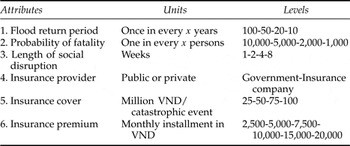
The insurance coverage sum, i.e., the loss paid directly to the insured by the insurer for first-party coverage, varies from VND (Vietnamese Dong) 25 million to VND 100 million per catastrophic flood event. In accordance with previous findings (Brouwer and Akter, Reference Brouwer and Akter2010), risk adverse households are expected to prefer higher damage cover. Furthermore, the catastrophic flood insurance can be provided either by a public (government) or private operator (insurance company of the respondent's own choice). No a priori expectations exist regarding household preferences for either public or private insurance provision. The premium for the insurance consists of monthly household installments varying from VND 2,500 to VND 20,000.
The experimental design is summarized in table 1. Baseline conditions for catastrophic flood probabilities, including mortality risks, are included in the design to test if the VSL is increasing in the level of baseline risk (e.g., Eeckhoudt and Hammitt, Reference Eeckhoudt and Hammitt2001). In the case of catastrophic flooding the baseline level is once every 100 years and for the probability of a fatality this is one in every 10,000 people. Due to climate change these probabilities are expected to increase in the case study area.
Experimental design

Alternative states of the world and insurance schemes are created by combining the six variables presented in table 1 based on their levels. Because respondents cannot be shown all possible combinations, the number of choice options is reduced to 16 sets of eight choice tasks each based on a D-efficient fractional factorial design using the software Sawtooth. Hence, respondents are asked to choose between 256 alternatives presented in pairs on 128 choice cards, which are divided over 16 sets of eight cards. Each respondent is randomly shown one of these 16 sets of eight different choice cards.
Finally, one of the main assumptions underlying stated preference research is that respondents know their preferences and that these preferences are stable and coherent (e.g., Brown et al., Reference Brown, Kingsley, Peterson, Flores, Clarke and Birjulin2008). Hence, from a set of alternative insurance policies given for future states of the world, the individual is assumed to be capable of selecting the most preferred insurance policy based on its characteristics. However, lack of familiarity and experience with flood risk insurance may undermine these a priori assumptions (Shaikh et al., Reference Shaikh, Sun and van Kooten2007). We examine choice consistency by presenting respondents with the same choice task at the beginning and the end of the choice experiment. So, a ninth card is added to each choice set, which is identical to the first choice card. Based on theory, choice behavior at the start of the experiment is expected to be consistent with choice behavior at the end of the experiment (Brouwer et al., Reference Brouwer, Dekker, Rolfe and Windle2010).
3. Econometric model
The design of the choice experiment can be translated into the following indirect utility function:
 $$V_{ij} =\beta _0 +\beta _1 {FP}_{ij} +\beta _2 {MR}_{ij} +\beta _3 {SD}_{ij} +\beta _4 I_{ij} +\beta _5 C_{ij} +\beta _6 P_{ij} +\varepsilon _{ij}$$
where indirect utility V of respondent i is measured through his or her observed choice for alternative j and an unobservable random term ɛ. This latter term is assumed to have an independent and identically Extreme Value Type I error distribution (e.g., Train, Reference Train2003).
Each alternative j is described with the help of a vector of k attributes, where β is the corresponding coefficient vector. In this case study, the parameters β1 to β3 represent the various states of the world: the exogenous increase in catastrophic flood probability (FP), mortality risk (MR) and social disruption (SD) due to climate change, while β4 to β6 refer to the characteristics of each insurance alternative j to mitigate the impacts of catastrophic flood risks: the insurance provider (I), damage cover (C) and insurance premium (P).
Respondent preferences and hence demand for micro insurance are expected to be higher when risk exposure is higher. Under the assumption that households are risk averse, they are expected to prefer higher indemnity coverage. The insurance premium is expected to have a negative effect on choice behavior: the higher the premium, the lower the probability that someone will want to buy insurance. The expected direction of influence of the attributes included in equation (2) is summarized below:
 $${\partial V}/{\partial {FP}}< 0\semicolon \; {\partial V}/{\partial {MR}}< 0\semicolon \; {\partial V}/{\partial {SD}}< 0\semicolon \; {\partial V}/{\partial C}>0\semicolon \; {\partial V}/{\partial P}< 0.$$
Affordability is expected to play an important role in this specific developing country context too. Household income is theoretically expected to significantly influence choice behavior. Lower income groups are less likely to be able to afford and hence choose insurance with higher premiums. Interactions between attributes and individual socioeconomic characteristics can be included in the utility function to account for such preference heterogeneity. The utility function is estimated using mixed logit regression models (e.g., Train, Reference Train2003; Hynes et al., Reference Hynes, Hanley and Scarpa2008), which allow us to capture the expected heterogeneity in respondent preferences due, among others, to differences in risk exposure as a result of the different locations where respondents live.
4. Survey implementation
The study presented in this paper was conducted in the province Quang Nam in Central Vietnam, about 300 km south of the old capital city, Hue. Quang Nam is a tropical coastal highland with an average temperature of 25.4 °C and an average annual rainfall of 2,580 mm. The climate of Quang Nam knows two seasons: the rainy season from September to December and the hot dry season from February to April. Around 70 per cent of Quang Nam's topography is made up of mountains and hills. The coastal zone of Quang Nam is plain land. The rivers Vu Gia, Thu Bon and Tam Ky are the main water providers for socioeconomic activities in Quang Nam (SRV, 2007). In 2007 the province had more than 1.4 million inhabitants, of which 83 per cent lived in rural areas and depended mainly on agriculture and aquaculture for their livelihood (GSO, 2008).
The study area is highly vulnerable to climatic hazards, such as tropical storms, floods and droughts, due to its geographic location and topographic conditions. These hazards cause losses to agriculture, infrastructure, households and life. Flooding is the most common of all environmental hazards, especially in the rainy season due to heavy rainfall. Future climate change is expected to worsen the situation. The most prominent floods in the last decades were those of 1999 and 2007. The most recent catastrophic flood in 2007 is used in this study as a point of reference. This extreme flood also caused by far the highest damage costs. The total estimated damage costs were around US$87 million and about 70,000 people had to be evacuated (Scarpa et al., Reference Scarpa, Ferrini, Willis, Scarpa and Alberini2005). The floods furthermore killed 39 people, while 339 people were seriously injured.
Within Quang Nam, three different districts were selected, which are located downstream from each other along the river Vu Gia: the upland district Dai Loc, the midland district Dien Ban, and the coastal district Hoi An where the river drains into the sea. In view of the fact that the province has a slope from west to east, during heavy rainfall this causes flooding with inundations especially in downstream areas. Hence, demand and WTP for micro flood insurance across the three risk-prone areas are expected to be higher in the downstream areas Dien Ban and Hoi An.
Due to a lack of information about exact household numbers and limited information about household socio-demographic characteristics at the district level, two communes were randomly selected from each district. Households living in the villages within each commune were subsequently randomly selected from available lists with household names and addresses at the commune level. In total, 540 households were selected in this way, 180 households from each district, equally divided across the two communes, which were more or less equally sized in terms of household numbers based on the available household lists. The survey consisted of face-to-face interviews lasting about 30 minutes and was conducted over a two-month time period in August and September 2009 by trained interviewers graduated from the University of Hue. The response rate was close to 100 per cent. Thirty interviews were dropped due to incomplete questionnaires, which resulted in a total number of 510 observations.
The questionnaire used for the survey consisted of three parts. The first part collected information about the household socio-demographic characteristics (e.g., age of the household head, household composition, income sources, etc.). The second part focused on household risk exposure levels, in particular related to the 2007 catastrophic flood event (e.g., frequency of flooding, inundation levels during regular flood seasons and the catastrophic 2007 flood, financial damage as a result of the 2007 flood, etc.). The third and final part included the choice experiment. The introduction to the choice experiment is included in Appendix A. Special attention was paid to the communication of the flood and mortality risks. The questionnaire and the choice experiment, including the risk levels, were pretested through 50 face-to-face interviews in the case study area prior to implementation of the survey. Changes were made to the questionnaire and choice experiment after the pretest, mainly to further clarify questions and the choice task. The survey targeted rural residents with limited education. Therefore, the attributes and their levels were conveyed to respondents on choice cards with pictographs and as little text as possible. Choice cards were printed on separate sheets of paper, laminated and bound together into a spiral binder for multiple use.
Each choice card shows two alternatives describing a possible future catastrophic flood risk situation and a specific micro insurance scheme to mitigate the possible financial impacts of this future risk on household socioeconomic vulnerability along with the option to choose none of the two (neither option A or B). The latter ‘opt-out’ option, as it was explained to respondents, is the baseline alternative and implies facing the increasing climate change induced catastrophic flood risks in the future and choosing not to mitigate them through the purchase of an insurance policy. The additional mitigation costs in this opt-out alternative are therefore zero. The baseline alternative was not further specified since baseline conditions were expected to differ across districts and individual respondents. The inclusion of this alternative is instrumental to estimate welfare measures that are consistent with economic demand theory (Hanley et al., Reference Hanley, Mourato and Wright2001).
An example of a choice card is presented in Appendix B. Respondents who chose the opt-out were asked in a follow-up question for their reasons. In order to make sure respondents had a clear understanding of the choice task, they were first asked to make their choice using an instruction card. Here, they were allowed to ask questions about the choice task before the choice experiment started.
5. Results
5.1 Sample characteristics
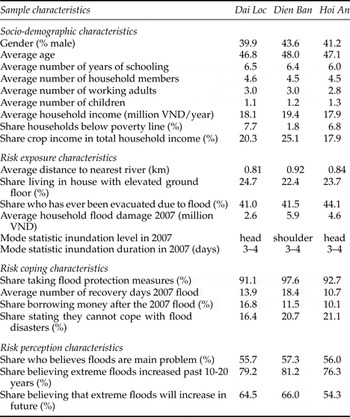
The socio-demographic characteristics of the 510 households included in our sample are summarized in table 2. No significant differences are found for any of the socio-demographic characteristics between the three districts, except for the share of crop income in total household income.Footnote 1 Compared to the limited available regional statistics for the province Quang Nam, the sample is fairly representative in terms of gender (52 per cent of the whole population is female) and household size (the average in the whole population is five family members).
Summary of household characteristics across the three districts

Most respondents in our sample are female and married (54 per cent). The average age of the respondent is around 40–50 years, with most respondents (55 per cent) falling in the age groups between 30 and 50 years and 51 and 65 years (26 per cent). The average number of years of schooling is six. Five per cent of the respondents are unable to read and write.
The households consist on average of five members, of which three earn income. Average household income in the sample is slightly less than that for the population as a whole (20 million VND or around $1,000 per year based on an average exchange rate in 2009 of 18,465 VND per US$). Less than 10 per cent have an annual income level that falls below the National Poverty Line fixed by the Ministry of Labour, Invalids and Social Affairs at VND 1,200,000 (US$65) for rural households (MOLISA, 2009). This share is lowest in Dien Ban and more or less the same in Dai Loc and Hoi An. As for the whole population, most people depend on agriculture, i.e., crop cultivation and livestock holding, for their livelihood. Less than half of the households in the sample live in a brick house, 8 per cent live in a wooden or bamboo constructed house. Everybody has access to electricity, but only 20 per cent to piped drinking water. Most households use tube well water. On average, a household owns only 0.15 ha of land.
Turning to the risk exposure indicators in table 2, all respondents live within a radius of 5 km from the nearest river. On average, a household lives less than 1 km from the nearest river, and almost a quarter of the respondents (23 per cent) live between 1 and 5 km from the nearest river. This is the same across all three districts. The only significant difference is found between Dai Loc and Dien Ban.Footnote 2 Three-quarters of the sample live in a one-storey house, a quarter in a house with an elevated ground floor. The flood disaster in 2007 was more severe than regular flooding during the rainy season, with a majority of the households in all three districts reporting shoulder-high inundation levels. The highest inundation levels were reported in Hoi An, followed by Dien Ban. Most households suffered from the inundations for 3–4 days, especially in Hoi An and Dai Loc. In most cases, the floods did not last longer than one week. Significant differences are found for inundation levels between the upland district Dai Loc and the coastal district Hoi An, and for inundation duration between upland Dai Loc and the midland district Dien Ban.Footnote 3
The average household flood damage in 2007 was highest in Dien Ban (US$315), followed by Hoi An (US$245) and then Dai Loc (US$140). Despite the fact that the damage was more than twice as high in Dien Ban than in Dai Loc, the difference is not statistically significant due to the high standard deviations. The same applies if the self-reported flood damage is expressed as a percentage of household income. Only the ranking of most severely struck districts changes in that case: the impact of the flood damage on household income is highest in the coastal district Hoi An (85 per cent) and lowest in the midland district Dien Ban (61 per cent). The share of the flood damage costs of average household income in Dai Loc is 73 per cent. These relative ranks correspond with the ranking of the number of recovery days after the disaster flood in 2007. The number of recovery days is significantly higher in Dien Ban than in Hoi An, but not in Dai Loc.Footnote 4
Between 40 and 45 per cent of all households have experienced evacuations as a result of flooding and the share of households taking flood protection measures is also very high. The most important measure before and during the flood events is to move property to a safer place. Besides cleaning the house and yard, securing clean drinking water is one of the most important activities after the flood event. Almost half of the sample are not satisfied with their current level of protection against catastrophic floods. Around 20 per cent of the sample stated that they are unable to cope with the impacts of flood disasters like the one in 2007. Most frequently heard reasons are that (i) they feel they live in an unstable house in a low lying area close to the river, (ii) they are too old and weak to protect themselves and have no adult family member to help them, and (iii) they have insufficient financial resources to recover from a catastrophic flood. In the latter case, many respondents reported that they still have unrepaired damages from the flood in 2007. On average, 13 per cent borrowed money after the extreme flood in 2007. This share was highest in Dai Loc and more or less the same in Dien Ban and Hoi An.
Finally, a majority of the respondents in all three districts consider catastrophic flooding the most important issue in their region. This is easily understood after examination of the high share of the sample facing catastrophic flood risks. A majority of 80 per cent of the respondents are of the opinion that catastrophic floods have increased over the past 10–20 years. Sixty per cent believe that their frequency of occurrence will increase further in the future. Forty per cent of the sample consider this likely and 45 per cent very likely, while 10 per cent are convinced that they will be struck more often by catastrophic floods in the future.
5.2 Testing equality of choice models across the three districts
Our hypothesis that demand is higher in the downstream areas Dien Ban and Hoi An was first tested using the Swait and Louviere (Reference Swait and Louviere1993) procedure. Based on the socio-demographic and risk exposure characteristics presented in section 5.1, the three districts seem fairly similar. However, in order to ensure that the data collected in the three districts can be combined in one aggregate model, we test whether the utility parameters β presented in equation (2) and the scale parameters μ in the choice model (e.g., Louviere et al., Reference Louviere, Hensher and Swait2000) are equivalent across districts. To this end, a pair-wise comparison is performed between the districts. In a first step, the mixed logit models of each district provide us with efficient estimates for μ1β1,…,μ6β6 in equation (2) and a likelihood function for each district. Then the scale parameter of, for example, the first district is normalized to μ1 = 1 for identification purposes.
In a second step, a pooled model including the first and second district is estimated, which has the effect of imposing equality on the preference parameters (β1 = β2). In this model the relative scale parameter μ2/μ1 is, however, not set equal to 1. A search procedure over a range of relative scale parameters is applied to estimate the combination of scale and pooled preference parameters providing the best model fit. At each possible relative scale parameter the data for the second district are rescaled such that a mixed logit model can be estimated. After the best fit model has been identified, a standard chi-square (Likelihood Ratio) test using the log likelihoods of the models from step 1 and the best fit model in step 2 can be used to test the difference between the preference parameters in the two districts under the null hypothesis that they are the same.
The third step, in which we test for differences in scale across districts, is conditional on accepting the chi-square test in step 2. It requires the estimation of a mixed logit model for the same pooled model as in step 2, but with equality imposed on both preference and scale parameters this time (β1 = β2 and μ1 = μ2). Again, a chi-square test can be applied to compare the log likelihood of the estimated model to the log likelihood of the pooled model with varying scale parameters. The results of this test procedure are presented in table 3.
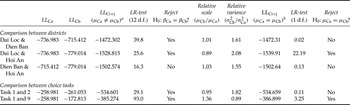
Test results for equality of preference (β) and scale (μ) parameters between districts and between the first and last choice task

Notes: LL, log likelihood. Likelihood ratio (LR) tests performed at 10% significance level.
a Pooled mixed logit model allowing scale parameters to vary; b pooled mixed logit model keeping scale parameters constant.
Equality of preference parameters is convincingly rejected for the pooled samples including the highland district Dai Loc (column 6), but cannot be rejected at the 10 per cent significance level for the two downstream districts Dien Ban and Hoi An. Also equality of scale parameters cannot be rejected for Dien Ban and Hoi An (last column 9). This implies that the choice models for Dien Ban and Hoi An can be estimated using the same pooled model. However, control has to be included for Dai Loc as preference and scale parameters are significantly different for respondents from this district.
5.3 Choice consistency test results
In order to test choice consistency, respondents were shown the first card also at the end again without telling them.Footnote 5 When asked afterwards whether they were aware of the fact that the first and last choice card were the same, 38 per cent of the respondents said that they noticed this, and hence most respondents did not know that they were shown the same card twice. When furthermore asked if they chose the same alternative on both choice occasions, 86 per cent said yes. This is slightly higher than what was actually observed. Almost 80 per cent of all respondents (78.6 per cent) consistently chose the same alternative during the last choice task as they did during the first choice task. This high share suggests that preferences are stable. However, when comparing the estimated choice models between the first and last choice task using the same Swait-Louviere test procedure as in the previous section, both equality of preference parameters and scale parameters is rejected at the 10 per cent significance level (table 3).
Comparing the error variance between the first and the last choice task and between the first two choice tasks, evidence of preference refinement is found. The error variance is significantly different when comparing choice cards 1 and 9, but not between choice cards 1 and 2. The variance is reduced by more than 50 per cent when going through the choice sequence from choice card 1 to choice card 2 and then on to choice card 9. Hence, although choices are consistent in a majority of cases, we find evidence of preference learning and refinement.
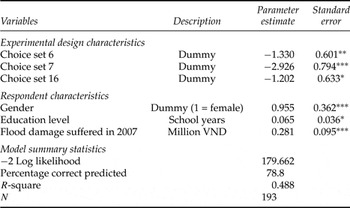
When regressing the variable as to whether or not a respondent changed his or her choice during the last choice task on a number of socio-demographic and design characteristics, choice consistency appears to be a function of both respondent socio-demographic and experimental design characteristics (table 4). The explanatory power of the estimated binary logistic regression model is high, almost 50 per cent. Women are more likely to change their choice, as well as higher educated respondents and respondents who suffered more damage during the catastrophic flood in 2007.
Estimated binary logistic model (1 = changed choice in last choice task)

Notes: Significance levels: *10%, **5%, ***1%, respectively.
On top of these variables, a significant effect of the experimental design was also detected. Three of the 16 choice sets appeared to significantly reduce the likelihood of respondents changing their choice during the last choice task compared to what they chose in the beginning. Dummy variables were created for the different choice sets to see if we could find a significant relationship between specific choice sets and choice consistency. Examining the levels of the attributes of the alternatives in these three choice sets more carefully, the first alternative in the first (and last) choice task consistently had the lowest insurance premium and lowest catastrophic flood probability (and in two of the three choice sets also the highest indemnity cover). In other words, despite randomizing the sequence in which choice cards were shown to respondents, these alternatives have the appearance of being dominant, hence explaining why respondents might have been reluctant to change their choices. We also tested for possible interviewer effects on choice consistency, but could not find any.
5.4 Choice experiment and WTP results
Of the 510 respondents, 62 per cent are interested and willing to pay for flood insurance. Hence, WTP for flood insurance is positive in a majority of the cases. Of the 194 respondents (38 per cent of the whole sample) who consistently chose neither of the two alternatives in the choice experiment, a majority (81 per cent) were either not interested in flood insurance or unable to pay extra for flood insurance given their limited financial income. These are considered legitimate reasons for refusing to choose between one of the two hypothetical alternatives, because they correspond with theoretical expectations (i.e., no preferences for the good in question and lack of income). The protest rate in this study is 6 per cent. Protest rates are more serious, because they provide important clues about the validity and reliability of the choice experiment, often related to procedural bias. Although no strict guidelines exist in the literature, a protest rate of 6 per cent is considered acceptable. The most important reason to protest was that, despite the extensive introduction to flood insurance, respondents wanted more information before they felt capable of making a decision whether or not to buy it. When asked after the choice experiment which attribute played the most important role in their decision to choose between the two alternatives, the catastrophic flood return period was mentioned most often (32 per cent), followed by the insurance premium (21 per cent).
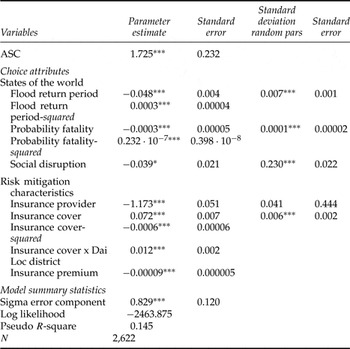
The choices were regressed on the choice attributes and other covariates using a combined random parameters and error component logit model, which was estimated in NLOGIT version 4.0, accounting for the panel data structure of the choice experiment. Panel data refer to the fact that we have multiple choice observations from each individual since each respondent answered a sequence of choice tasks in the choice experiment. The estimated choice model controlled for possible correlation between the observed choices across choice tasks. For efficiency purposes, the model was furthermore estimated using a Halton sequence of 100 replications in a quasi-Monte Carlo maximum likelihood simulation (Bhat, Reference Bhat2001). In our search for the statistically best fit model, we systematically included interaction terms between the attributes in our experimental design and dummy variables for respondents living in the three different districts. Only one of these interaction terms appeared to be statistically significant, namely for insurance cover in the upstream district Dai Loc (corresponding with our test results in section 5.2). The estimated best fit model is presented in table 5.
Estimated choice model

Notes: Significance levels: *10%, * *5%, ***1%, respectively.
The model is highly significant (outcome of the χ2 is 833.374 with 17 degrees of freedom) with a pseudo R 2 of around 15 per cent. The outcome for the error component is significant at the 1 per cent level and indicates that respondents evaluated the two hypothetical alternatives distinctly different from the existing situation (e.g., Scarpa et al., Reference Scarpa, Ferrini, Willis, Scarpa and Alberini2005). The significant positive outcome of the alternative specific constant (ASC) suggests that respondents prefer a change instead of no change from the current situation.
Preference heterogeneity is accounted for by randomizing the choice attributes across respondents. Different distributional assumptions were tested. A normal distribution produced the statistically best fit for the continuous design variables, while a uniform distribution was used for the dummy variable representing the insurance provider (see Hensher et al., Reference Hensher, Rose and Greene2005 for guidelines on the appropriate choice of distribution). However, this latter random parameter appeared not to be statistically significant at the 10 per cent level. Once control is included for these random effects, no additional significant effects could be detected for any of the other socio-demographic and risk characteristics discussed in section 5.1.
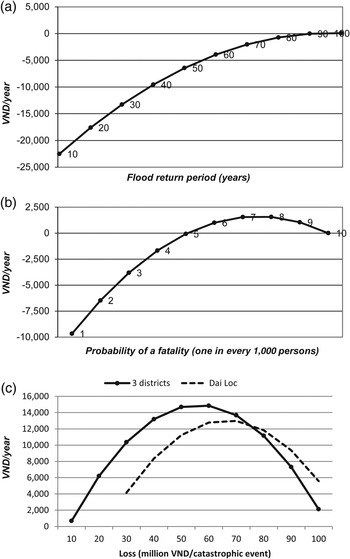
All attribute parameters are statistically significant and have the expected signs. Respondents dislike higher flood return periods, mortality risks and longer social disruption. A higher return period results ceteris paribus in a lower probability of an alternative being chosen. The same applies to a higher mortality risk and longer lasting social disruption. An interesting finding is that both the utility attached to catastrophic flood probability and the probability of dying are non-linear. Their quadratic terms are highly significant. As a consequence, reducing their probability results in deceasing returns. The marginal values are hence not constant, but a function of their levels. This is shown in figures 1a and 1b. Marginal WTP values are negative because the alternatives in the choice experiment represent increases in catastrophic flood probabilities and mortality risks, resulting in disutilities.
(a) WTP for different catastrophic flood probabilities, (b) WTP for different mortality risks, (c) WTP for different insurance covers in the three districts and Dai Loc

Especially in the case of mortality risk, the slope of the curve becomes increasingly steep at higher probabilities of dying, reflecting a higher WTP to avoid increasing mortality risk, but less than proportionally (and hence a lower VSL). Increments in catastrophic flood probabilities from current baseline levels are valued significantly less (and are in the case of mortality risk even positive). Turning points reflecting saturation levels are located at the lower end of the value domain used in the choice experiment: once every 92 years in the case of catastrophic flood probability and one in every 7,040 people in the case of mortality risk. WTP is VND 15 (US$0.001) per household per year when reducing the probability of dying from one in 7,000 persons to one in 8,000 persons per catastrophic flood event, and VND 3,193 ($0.17) per household per year when reducing the probability of dying from one in 1,000 persons to one in 2,000 persons.
Turning to the insurance design characteristics, respondents have a strong preference for a government-supplied flood insurance (the dummy variable for insurance provider has the value 1 if the provider is a private insurance company). As expected, a higher insurance premium results in a lower likelihood that an alternative is chosen. For insurance cover, both a significant linear and quadratic effect is found, indicating that this variable has a saturation level too: VND 61.2 million (US$ 3,314) in the case of all three districts together and VND 71.5 million (US$ 3,872) for the district Dai Loc. These saturation levels are more than 10 times the average flood damage reported by households during the last catastrophic flood in 2007 (see table 2), suggesting a strong risk aversion. The loss functions for all three districts together and Dai Loc are presented in figure 1c.
As expected, WTP for flood losses in figure 1c is, ceteris paribus, significantly lower in the upstream district Dai Loc compared to Dien Ban and Hoi An. Marginal WTP increases most when moving across the lower levels of flood damage. Across all three districts, household WTP is VND 685 (US$ 0.04) per year for the first VND 10 million (US$ 540) damage suffered as a result of a catastrophic flood. This increases more than proportionally to VND 5,506 (US$ 0.3) per year if the damage cover increases from VND 10 to 20 million. The increase in marginal WTP then displays diminishing returns from VND 4,170 (US$ 0.23) to VND 160 (US$ 0.009) per year if the indemnity cover increases from VND 20 to 30 and ultimately from 50 to 60 million per catastrophic flood event, respectively. After the turning point marginal WTP is still positive, but decreases as insurance cover increases further.
6. Discussion and conclusions
Discrete choice modeling has become increasingly popular in the economic valuation domain. However, almost no applications exist related to climate change and flood risks. This study contributes to the existing literature in a number of ways. From a practical policy point of view, we show that there exists substantial demand for flood insurance, even though a considerable share of the sample population indicate that they are unable to afford to pay for such insurance. After excluding these respondents from further analysis, we find no significant effect of household income any more on respondent choice behavior. Of all insurance design characteristics, only the insurance sum is characterized by significant preference heterogeneity. Respondents seem risk averse as they like higher insurance cover, preferably provided by the government, not a private insurance company. However, demand for catastrophic flood insurance has a ceiling. Respondents do not wish to insure more than 15 times their self-reported flood damage suffered during the last catastrophic flood in the case study area. Moreover, demand is spatially differentiated and is significantly lower upstream where flood risks are lower than downstream where risks are higher.
The validity of our results is strengthened by the fact that we convincingly manage to embed mortality risks in a clear and understandable way in the context of catastrophic flood probabilities. Although WTP to insure oneself against the occurrence of catastrophic floods and the probability of dying due to a catastrophic flood are not directly comparable (they are measured in different units), the relative increase in WTP for flood insurance is higher for an increase in catastrophic flood probability than for the same relative increase in mortality risk compared to current baseline conditions. The increase in WTP for flood insurance is non-linear in increasing flood probabilities and mortality risks, and characterized by significant preference heterogeneity. The former means that catastrophic flood risk valuation and the derived VSL exhibit decreasing returns in the level of the risk reduction. The latter confirms that the WTP welfare measure is not universally transferable. Risk perception and perspectives differ among individuals in the same situation, therefore leading to different decisions related to the purchase of catastrophic flood insurance.
In view of the fact that most respondents are unfamiliar with the concept of flood insurance, some degree of learning was expected to influence their decisions during the choice experiment. This was confirmed when comparing the preference parameters of the estimated choice model across the choice sequence. Although 80 per cent of the sample population passed the choice consistency test when presented with the same choice task at the beginning and the end of the experiment, preference parameters appeared to be significantly different and hence unstable during the choice sequence. However, choices in the final choice task were more stable than choices in the first choice task as measured through the lower error variance. Preference uncertainty is usually characterized by larger variance. From the responses of those who consistently chose the opt-out in the choice experiment, including those who protested, some indication was found that decision making in the choice experiment was not easy. Six per cent of the sample asked for more information before they felt capable of making a decision whether or not to buy flood insurance, while another 8 per cent said they needed more time to think. Future research in this area would benefit from a more detailed assessment of the relationship between choice complexity and preference stability.
Appendix A: Introduction choice experiment
I'd like to inform you about the possibility of extreme flood events occurring in the future. In the future the frequency of extreme flood events like the one in 2007 is expected to increase due to climate change. Also the damage associated with these events is expected to increase due to population growth and economic development. In order to anticipate these future flood risks, we would like to ask you to consider a number of descriptions of possible future situations and measures to mitigate the negative impacts of the increasing risks of flooding. We are interested to find out which of these measures you prefer given the expected future situation. All we ask you to do is to look at the presented situation and tell us which situation you prefer best given the expected increase in flood risk and the proposed measures to mitigate these risks. I will present you with an example card first to explain to you what the situations represent. Following this example card, I will show you nine more of these cards and for each of these cards you will be asked to indicate which situation you prefer most.
In each future situation the frequency of extreme flood events is expected to change, from currently once every 100 years to once every 10 years. The chance that someone will die as a result of the extreme flood event ranges between one in ten thousand people to one in one thousand people. This means that if an extreme flood event occurs, one in ten thousand or one in one thousand persons, including you and your family members, faces the risk of dying. The length of the social disruption during the aftermath of the extreme flood event, such as lack of electricity and clean water may vary between one and eight weeks.
In order to deal with these increased flood risks in the future, an insurance scheme is proposed in your region to mitigate the financial consequences of extreme flood events. The insurance will cover your financial damage costs as a result of future extreme flood events like the one in 2007. Having an insurance hence reduces the financial burden your family faces should an extreme flood event occur. You are free to choose the sum of money for which you wish to insure yourself and your family, ranging from 25 to 100 million VND per extreme flood event. This latter sum of money is the maximum amount of compensation you are entitled to in case you suffer any damage due to a flood.
You also have the option to choose from whom you wish to buy the insurance. The insurance will be either provided by the central government or a private insurance company. The standard insurance policy on offer includes home insurance to cover any damage to your family home, crop insurance to cover any damage to your crops, and a life insurance in case you or one of your family members die as a result of catastrophic flooding.
In order to obtain the insurance, your household will either have to pay every month a fixed insurance premium to the private insurance company or an extra earmarked tax to the central government. The premium amount or earmarked tax is the same; the only difference is that the insurance is a private one if concluded with the private insurance company, and a public one if concluded with the central government. The prices of the standard insurance policy vary between 2,500 and 20,000 VND per household per month.
The insurance policy applies to catastrophic flooding only. This means that a flood event has to be categorized officially as catastrophic by an independent assessor. Also the damage claim after the catastrophe and the indemnity paid will be evaluated and estimated by an independent assessor. The terms and conditions of your insurance are protected by law.
Appendix B: Example of a choice card